International Journal of Research (IJR)
e-ISSN: 2348-6848, p- ISSN: 2348-795X Volume 2, Issue 06, June 2015Available at http://internationaljournalofresearch.org
Available online:http://internationaljournalofresearch.org/ P a g e | 574
2-level DWT based Watermarking with scene change
detection
Bindu Reddy
Dept. of Electronics and Telecommunication Fr.C.R.I.T, Vashi, Mumbai, India
[email protected]
Anita Jadhav
Dept. of Electronics and Telecommunication Fr.C.R.I.T, Vashi, Mumbai, India
[email protected]
Abstract—
Embedding any digital information into
multimedia like audio, video and image is watermarking. Digital information can be in the form of image, video, etc. Watermarking is the technique used for many applications to protect the data. Watermarking can be done using spatial and frequency domain. Spatial domain includes least Significant Bit (LSB) method and frequency domain includes Discrete Wavelet Transform (DWT), Discrete Fourier Transform (DFT) and Discrete Cosine Transform (DCT) methods. 2-level DWT is used for video watermarking. Compared to DFT and DCT transform, DWT transform is more computationally efficient. We are proposing with and without scene change detection. Scene change detection is used to detect the scene changing which includes abrupt and gradual. MSE for various video is calculated to measure the success of the algorithm. This method represents less complexity and has smaller computation deal, so it can meet the real-time requirement.
Keywords— Video Watermarking; Scene Change Detection (SCD) Algorithm; Discrete Wavelet Transform; Embedding algorithm; Extraction Algorithm
I. INTRODUCTION
In the past several years there has been tremendous growth in multimedia technology and its applications. This growth has increased the necessity to build secure methods for legal distribution of the digital content over the internet. Digital watermarking can be classified as image, audio and video watermarking. In video watermarking, video is
divided into video sequence and then watermark is embedded to this video sequence. Video sequence is a collection of consecutive images which when moved at particular rate gives the impression of moving pictures to naked eye and to whom human mind interprets as video sequence. Image watermarking and video watermarking is similar related to some common characteristics [1]. Some techniques are enhanced in video watermarking compared to image watermarking. Video watermarking algorithms run in original video sequences and some compress the video before embedding watermark. We proposed to embed watermark in uncompressed domain. To select frame for embedding watermark in video sequence, we proposed scene change detection. A process that divides data into shots is scene change detection. Scene change can either be abrupt or gradual for video frames [14]. If sudden change in the scene occurs, then it is called as abrupt scene change. On the other hand, gradual scene change related to effects like fade in/out, dissolve, zoom, etc. Gradual scene change compared to abrupt scene change is more difficult and can cause scene change algorithms to fail [17]. Comparing two scenes is important part to detect scene change. There are different algorithms used to detect scene change.
II.PROPOSEDSYSTEM
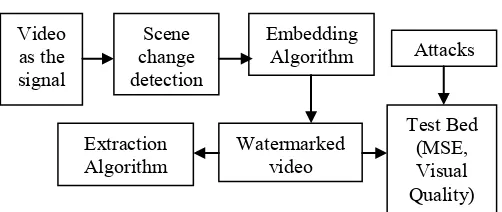
Fig. 1. Proposed block diagram of video watermarking
Video as the signal
Embedding Algorithm Scene
change detection
Watermarked video
Test Bed (MSE, Visual Quality) Extraction
Algorithm
International Journal of Research (IJR)
e-ISSN: 2348-6848, p- ISSN: 2348-795X Volume 2, Issue 06, June 2015Available at http://internationaljournalofresearch.org
Available online:http://internationaljournalofresearch.org/ P a g e | 575
The Proposed system includes scene change detection, embedding algorithm, attacks and extraction algorithm.
A. SCENE CHANGE DETECTION
There are various techniques for Scene change detection. We have implemented scene change detection using Otsu’s thresholding based, pixel-based and edge- pixel-based. Scene change detection basically is based on full image video analysis. Intensity information and motion information is used calculate inter-frame difference. These algorithms detect abrupt and gradual scene change.
1) Otsu’s thresholding-based method
In this, comparing of two images related to global thresholding can detect scene change. Background and foreground pixels are the two pixels which are used calculate threshold for each pixels. Then, Compare the two foreground and background pixels and accordingly set the threshold, if foreground pixel value exceeds than the threshold set, then there is a scene change [15], [16].
1. Read the AVI format video and convert video into frames.
2. To detect scene change, 10 frames are selected from video.
3. The frames selected are converted into gray. 4. Depending on foreground and background
pixels, applying global-threshold.
5. After getting the global threshold, convert into binary.
6. Divide video frame into blocks of 4×4. Take mean square error of each frame.
7. Threshold is set on trial error basis as 0.2 for gradual and 0.5 for abrupt.
8. Take the difference of each video frame and then compare.
9. If the difference of each frame is greater or equal to 0.5 or 0.2, then there is a scene change taking place otherwise no scene change.
10. Display video frame number and the video frame where scene change is taking place.
B. EMBEDDING ALGORITHM
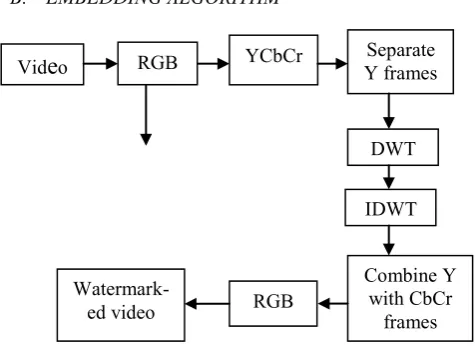
Fig. 2. Embedding Procedure
1. Read the AVI format video and convert video into frames.
2. Get the watermark image.
3. Convert selected frames which are in RGB format to YCbCr.
4. Separate Y frames from YCbCr.
5. Apply 2-level DWT using haar filter on Y frames.
6. Add watermark image to the approximation coefficients (LL2) with the help of watermark equation.
Watermark equation is represented as:
cA V
V'
(3)
Where,
c
is the scaling factor in the range of 0 to 1,V
is the selected wavelet coefficients,Ais embedding watermark image coefficients.7. Take 2-level IDWT after adding watermark. 8. Now, combine Y frames to CbCr.
9. Convert back to RGB.
10. Display the output i.e. watermarked video.
Discrete Wavelet Transform
In image processing, DWT plays important role because image data are spatial- spectral resolution and are discrete which is dependent on frequency. Spatial –resolution is large in high-frequency bands and small in low-frequency bands.
Vid
e
oWatermark-ed video
Separate Y frames YCbCr
RGB
DWT
Combine Y with CbCr
frames RGB
International Journal of Research (IJR)
e-ISSN: 2348-6848, p- ISSN: 2348-795X Volume 2, Issue 06, June 2015Available at http://internationaljournalofresearch.org
Available online:http://internationaljournalofresearch.org/ P a g e | 576
FRAME 5
FRAME 8
(b)
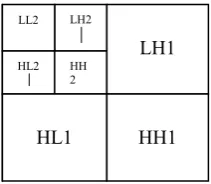
Fig. 3. 2-Level DWT
Fig. shows 2-level DWT. The band with lowest frequencies that is LL2 sub image has the smallest spatial resolution. LL2 band consists of approximation values of original image. Other bands such as (LH2, HL2, HH2, LH1, HL1, and HH1) are high frequencies and consist of detailed information of original image [3].
Performed Attacks
Geometric attacks like rotation and cropping are performed on the watermarked frames. The result shows that with modification in watermarked frames modifies watermarked coefficients also.
C. EXTRACTION ALGORITHM
Fig. 4. Extraction Procedure
1. Convert watermark frames which are in RGB format to YCbCr.
2. Apply 2-level DWT using haar filter on Y frames.
3. To get watermark coefficients back use the extraction equation which is shown below:
c A
V
V'
Where,
c
is the scaling factor in the range of 0 to 1,V
is the selected wavelet coefficients,V
'
iswatermarked wavelet coefficients and Ais watermark image coefficients.
III.RESULTS
A. SCENE CHANGE DETECTION
Fig. 5. Frames (10) selected from test1_video(Abrupt)
Fig. 6. Scene change taking place at 5th frame for
test1_video
Fig. 7. Frames (10) selected from test2_video(Gradual)
Fig. 8. Scene change taking place at 8th frame for test2_video LH2
LL2
HL2 HH 2
LH1
HL1 HH1
Watermark-ed frames YCbCr
Separate Y frames
DWT
Extraction equation Watermark
International Journal of Research (IJR)
e-ISSN: 2348-6848, p- ISSN: 2348-795X Volume 2, Issue 06, June 2015Available at http://internationaljournalofresearch.org
Available online:http://internationaljournalofresearch.org/ P a g e | 577
(a)
(b)
(a)
TABLE 1.COMPARSION OF TEST VIDEOS DEPENDING ON THEIR SIZE AND SCD
TEST VIDEOS
TOTAL
NO. OF
FRAMES
NO. OF
FRAMES SELECTED
MANUAL SCD SEEN
DETECTED SCD BY ALGORITHMS
SIZE:25MB
760 10 05
ABRUPT SCD
06
SIZE:1.73MB
198 10 NA
GRADUAL SCD
08
B. EMBEDDING WATERMARK
Fig. 9. Original frames of test1_video(Abrupt)
Fig. 10. Watermarked frames of test1_video(Abrupt)
Fig. 11. Original frames of tes2_video(Gradual) Fig. 12. Watermarked frames of test2_video(Gradual)
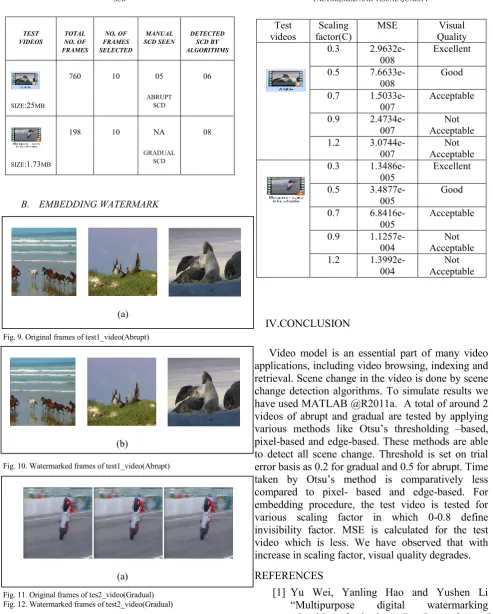
TABLE 2.COMPARSION OF TEST VIDEOS DEPENDING ON THEIR SCALING FACTOR,MSE AND VISUAL QUALITY
Test videos
Scaling factor(C)
MSE Visual
Quality 0.3
2.9632e-008 Excellent 0.5
7.6633e-008 Good
0.7
1.5033e-007 Acceptable 0.9
2.4734e-007
Not Acceptable 1.2
3.0744e-007 Acceptable Not 0.3
1.3486e-005 Excellent 0.5
3.4877e-005 Good
0.7 6.8416e-005
Acceptable
0.9
1.1257e-004 Acceptable Not 1.2
1.3992e-004 Acceptable Not
IV.CONCLUSION
Video model is an essential part of many video applications, including video browsing, indexing and retrieval. Scene change in the video is done by scene change detection algorithms. To simulate results we have used MATLAB @R2011a. A total of around 2 videos of abrupt and gradual are tested by applying various methods like Otsu’s thresholding –based, pixel-based and edge-based. These methods are able to detect all scene change. Threshold is set on trial error basis as 0.2 for gradual and 0.5 for abrupt. Time taken by Otsu’s method is comparatively less compared to pixel- based and edge-based. For embedding procedure, the test video is tested for various scaling factor in which 0-0.8 define invisibility factor. MSE is calculated for the test video which is less. We have observed that with increase in scaling factor, visual quality degrades.
REFERENCES
International Journal of Research (IJR)
e-ISSN: 2348-6848, p- ISSN: 2348-795X Volume 2, Issue 06, June 2015Available at http://internationaljournalofresearch.org
Available online:http://internationaljournalofresearch.org/ P a g e | 578
the 2009 IEEE International Conference on Mechatronics and Automation August 9 - 12, Changchun, China.
[2] Amit Joshi, Vivekanand Mishra1and R. M. Patrikar “Real Time Implementation of Digital Watermarking Algorithm for Image and Video Application” Sardar Vallabhai National Institute of Technology Surat, india.
[3] Kamrul Hasan Talukder and Koichi Harda, “Discrete wavelet transform for image compression and a model of parallel image compression scheme for formal verification”, in Proceeding of the world
congress of engineering 2007 vol1,
WCE2007, July 2-4,2007,London, U.K.http://en.wikipedia.org/wiki/Digital_wa termarking.
[4] Priya Porwal, Tanvi Garg, “ Digital Video Watermarking using modified LSB and DCT technique” in proceedings of International Journal of Research and Technology, Volume 3, Issue 4, April 2014.
[5] Chi-Man Pun, “A Novel DFT-based Digital Watermarking System for Images”, ICSP 2006.
[6] Navnidhi Chaturvedi and Dr.S.J.Basha,”comparision of digital image watermarking methods DWT and DWT-DCT on the basis of PSNR” in International Journal of Innovative Research in Science, Engineering and Technology Vol. 1, Issue 2, December 2012.
[7] Sadik.A.M.Al-Taweel, Hailiza Kamarulhali, “Digital Video Watermarking Based on 3D-Discrete Wavelet Transform Domain” in proceedings of 2009 IEEE International Conference on Signal and Image Processing Applications, school of computer sciences, Mathematical School, University Sains Malaysia, Minden 11800, Penang, Malaysia.
[8] H. Zhang and S. W. Smoliar, “Developing power tools for video indexing and
retrieval,” in Proc. SPIE’94, Storage and Retrieval for Image and video Databases II, vol. 2185, SanJose, CA, 1994.
[9] B. Shahraray, “Scene change detection and content-based sampling of video sequences,” in Proc. SPIE’95, Digital Video Compression: Algorithm and Technologies, vol. 2419, San Jose, CA, 1995. C. L.
[10] Huang and B. Y. Liao, “A Robust Scene-Change Detection Method for Video Segmentation,” IEEE Transactions on Circuits and Systems for Video Technology, vol.11, no.12, pp. 1281-1288, Dec. 2001.
[11] Ganesh. I. Rathod, Dipali. A. Nikam,” An Algorithm for Shot Boundary Detection and Key Frame Extraction Using Histogram Difference” in International Journal of Emerging Technology and Advanced Engineering, ISSN 2250-2459, ISO 9001:2008 Certified Journal, Volume 3, Issue 8, August 2013.
[12] Muthukrishnan.R and M.Radha,” Edge detection techniques for image segmentation” in International Journal of Computer Science & Information Technology (IJCSIT), Volume 3, No 6, Dec 2011.
[13] Rosin, P.L., Ioannidis, E.: Evaluation of global image thresholding for change detection. Pattern Recognition Lett.
24(14), 2345–2356 (2003).
http://en.wikipedia.org/wiki/otsu’s_thershol ding.
[14] Rachna H. B., M. S. Mallikarjuna Swamy,” Detection of Tuberculosis Bacilli using Image Processing Techniques” in International Journal of Soft Computing and Engineering (IJSCE), ISSN: 2231-2307, Volume-3, Issue-4, September.
International Journal of Research (IJR)
e-ISSN: 2348-6848, p- ISSN: 2348-795X Volume 2, Issue 06, June 2015Available at http://internationaljournalofresearch.org
Available online:http://internationaljournalofresearch.org/ P a g e | 579
Blois Cedex,
France.http://www.cs.cf.ac.uk/Dave/Multim edia/node231.html.
[16] Mrs. Chhaya S. Gosavi, Dr. Suresh N. Mali,” Frame Selection for Video Watermark Embedding using Scene Change Detection Algorithm” in International Journal of Electronics Communication and Computer Engineering, Volume 5, Issue (4) July, Technovision-2014, ISSN 2249–071X.
[17] Chung-Lin Huang and Bing-Yao Liao,” A Robust Scene-Change Detection Method for Video Segmentation” in IEEE transactions on circuits and systems for video technology, Volume.11, No.12, Dec 2001.
[18] Shu-Ching Chen, Mei-Ling Shyu, Cheng-Cui Zhang, R. L. Kashyap, “Video Scene Change Detection Method using Unsupervised and Segmentation and Object Tracking,” in IEEE International Conference on Multimedia and Expo, pp.57-60, 2001.
[19] Shujaat Ali Rathorel and S.A.M. Gilanil “Enhancing Invisibility and Robustness of DWT based Video Watermarking scheme for Copyright Protection” in proceedings of Information and Emerging Technologies, July 6-7 2007(ICIET 2007), Pakistan.