Available online:
https://edupediapublications.org/journals/index.php/IJR/
P a g e | 1266
A Study on Routing Protocols for Underwater Wireless
Sensor Networks (UWWSNs)
Murali Krishna Vedula
(M.Tech,)
Department of CSSE,
A.U.College of Engineering (A)
Andhra University, Visakhapatnam
Dr. Pallam Shetty,(Ph.D)
Professor,
Department of CSSE,
A.U.College of Engineering (A)
Andhra University, Visakhapatnam
Abstract- Acoustic communication is considered as the technique of sending and receiving messages below water. It may be treated as the ideal communication in aqua applications.Acoustic transmission, innate to the aquatic environment and used in underwater sensor networks (UWSNs), presents its own challenges in the terms of energy consumption, long propagation delay, and available bandwidth. These challenges are difficult to directly adapt in the underwater sensor networks which have been already proved in the terrestrial networks. End-to-end delay is the main element for delay sensitive underwater sensor networks. In this work, the idea of opportunistic based routing is applied for maximising the performance of the network while meeting the end to end delay requirements for delay sensitive UWSN applications. To improve the data collection in UWSNs is through the design of routing protocols considering the unique characteristics of the underwater acoustic communication and the highly dynamic network topology.
Keywords: Underwater Wireless Sensor Networks,
Routing, Acoustic, Wireless, Routing protocols for Underwater Wireless Sensor Networks,
1.
I
NTRODUCTIONAbout 71 percent of the Earth's surface is water-covered, and the oceans hold about 96.5 percent of all Earth's
water.In our earth 25% covered by human being and
remaining space is covered by water that could be river and oceans also.
The process of Acoustic communication is considered, as the ideal communication for sending and receiving messages below water in aqua applications.
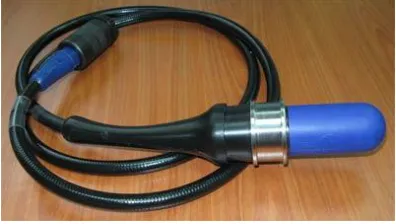
There are several ways of employing Underwater Acoustic communication, but the most common is by using Hydrophones.
Fig. Hydrophone
The Underwater Acoustic Communication is difficult due to the following factors –
Multi-path propagation Time variants of Channel Small available Bandwidth
Strong Signal Attenuation especially over long ranges.
High Energy Consumption Long propogation delay
These challenges are difficult to directly adapt in the underwater sensor networks which have been already proved in the terrestrial networks. End-to-end delay is the main element for delay sensitive underwater sensor networks.
To improve the data collection in UWSNs is through the design of routing protocols considering the unique characteristics of the underwater acoustic communication and the highly dynamic network topology.
Available online:
https://edupediapublications.org/journals/index.php/IJR/
P a g e | 1267 consumption. Also that it can significantly improve network
throughput and packet delivery ratio, while reducing energy consumption and network latency when compared with other routing protocols. It Can be used in hard and difficult mobile scenarios of very sparse and very dense networks and for high network traffic loads.
In recently years, underwater sensor networks (UWSNs) have been increasingly used in applications such as environmental monitoring, gas deposit exploration and exploitation, oceanographic data collection, oil spill monitoring, real-time warship monitoring, and disaster prevention.
2.
U
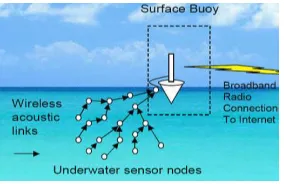
NDER SENSOR WIRELESS SENSOR NETWORKS Underwater wireless sensor network is a collection of Source nodes placed underwater and sink above water and is able to perform operations in wide range of applications. Some applications likes mine reconnaissance, distributed tactical surveillance, seismic monitoring, ocean samplingnetworks, equipment monitoring, environmental
monitoring, assisted Navigation, Disaster prevention and undersea explorations these all are the advantages of the underwater sensor networks. Since no system is perfect, therefore, even with all the above mentioned advantages of the system, a few disadvantages still exit like costly devices, more power requirement, Intermitted memory, Spatial correlation.
Fig. Underwater Wireless Sensor Network.
A. Fastest way for finding underwater information: Underwater sensor is the latest and fastest way of finding information which is available in underwater sensor network. This information is not only helpful for human being but also responsible for researchers.
B. Monitor the environment & climate: Most of researchers want to know about what is happing inside the water. It depends on the situation suppose if water is less so need for monitoring. But if water is More like a ocean so monitoring is mandatory because without monitoring we can never ever analyze the problems. Underwater sensor network system able to solve the problem those problems are part of
climate. Underwater sensor network play major role in detect climate change, improve weather forecast. Basically underwater sensor network not only monitor the climate but also helpful in nuclear, chemical and biological activates. C. Underwater device monitor system [13]: For monitoring the underwater sensor network where as costly devices are there all these devices are more costly that is play safety role in underwater sensor network.
D. Undersea Explorations [13]: Underwater sensor network perform operation into determine the paths for laying undersea cables, remove underwater reservoirs.
E. Ocean Sampling Networks [13]: Autonomous
underwater vehicles able for cooperative adaptive sampling of the 3D coastal ocean environment.
F. Disaster Prevention [13]: Underwater sensor network system able to perform seismic activity that starts from remote locations which provide tsunami warnings to coastal areas.
G. Assisted Navigation [13]: Underwater sensors are able to perform bathymetry profiling, also able find locate dangerous rock, submerged wrecks.
3.
P
ROBLEMS WITHUWSN
S1. More expensive Devices [13]: Underwater sensor devices are more costly. And no more supplier are provides these such kind of devices because these are devices are part of research oriented activity. Underwater sensor devices are not easily available in the market.
2. High power require for communication [13]: In underwater communication more power require because for exchanging data inside in water need more electricity require.
3. Hardware Protection requirement [13]: Inside the water lot of underwater devices are available not only for monitoring but also scientific work also there that is why more security is require inside the water for safety of the underwater components.propagation distance. Basically attenuation provoked by increases with distance and frequency, absorption due to conversion of acoustic energy into heat.
4. Intermitted data transfer [13]: Compare to terrestrial sensor network system where very small memory. But in underwater sensor network data transferring could be create big interrupt at the time.
5. Reading problem in space sensors [13]: Generally terrestrial sensors are related to each other. But In underwater sensor network it may not be possible in higher distance sensors but unlikely it could be co-related in higher distance among sensors.
6. More sparse deployment [13]: In underwater sensor network the deployment is often sparser but compare to terrestrial sensor networks are densely deployed.
Available online:
https://edupediapublications.org/journals/index.php/IJR/
P a g e | 1268 which comes underwater sensor networks time. Propagation
delay is orders of magnitude higher than in Radio Frequency variable and terrestrial channels.
8. Impaired channel [13]: The underwater channel is impaired because of multipath and fading.
9. Fouling and corrosion [13]: Underwater sensors are prone to failures because of fouling and corrosion.
10. Localization [11]: Localization is the challenging factor that is require for data labeling while some time critical applications require data without time delay.
11. High Maintenance [11]: Underwater sensors demands are increasing because for underwater sensors are very costly which are not easily available in the market and underwater sensor supplier and consultants are not available everywhere that is why cost is increasing. Underwater sensors are too costly because for underwater sensor networks high maintenance is required.
12. Temporary losses [13]: For the connectivity time packet sending time it could be loss between the data transmission. M. High bit error rates [13]: In underwater sensor network high bit error rates mostly come at the time of duration.
4.
D
IFFERENTR
OUTINGPROTOCOLINUNDERWATERSENSORNETWORK
There are ten different routing protocols available for underwater sensor network
.(a) Vector-Based Forwarding Protocol or location-based routing protocol,
(b)Robustness Improved Location protocol,
(c) Depth-Based Routing protocol,
(d) Hop-by-Hop Dynamic Addressing Based protocol,
(e) Focused Beam Routing Protocol
,(f) Path Unaware Layered Routing Protocol,
(g)Adaptive Routing protocol,
(h)GPS-free Routing Protocol,
(i) A Low Propagation Delay Multi-Path Routing Protocol,
(j) Pressure Routing Protocol.
(h) GEDAR routing protocol.
There is brief overview about common routing protocol underwater sensor network.
A. Vector Based forwarding Protocol:
VBRP this protocol is known as location based routing protocol. This is designed for underwater sensor network. Basically it refer to as the problem which helpful to improve the low delay and successful rate. For the current point of research scenario underwater sensor network with vector routing forwarding protocol. Its architecture depend upon underwater sensor network and it just a location based protocol which play major role in the underwater sensor network.VBF refer to as vector based routing forwarding protocol. Sometimes VBF also refer to as routing pipe which is perform a specific task for built connection between source, destination and packet delivery. The data packet is collection of the aim, location of the sender, forwarder and range field. VBF also refer to as routing pipe which is perform a specific task for built connection
between source, destination and packet delivery.
Robustness, energy efficiency, High success of data delivery and energy efficient these four feather comes under location based protocol which are not available in underwater sensor network that is why a novel routing protocol known as VBF.
B. Robustness Improved Location Protocol:
RILP This protocol is also same as location based routing protocol and also designed for underwater sensor network as well as its behaving like VBF. This is known hop to hop vector based forwarding protocol But this protocol is much better than location based routing protocol. One major problem which comes in location based routing protocol that is (i) low data delivery in sparse network, (ii) too sensitive to routing pipe radius. Above these two problems are removed in robustness improved location protocol that’s why some researcher mostly prescribe this protocol. Another main comparison between both of location based routing protocol and vector based forwarding protocol hop to hop vector based forwarding protocol is enhances data delivery ratio in sparse networks compared with VBF that is conduct simulations to evaluate Hop to Hop Vector Based Forwarding protocol and the results show that Hop to Hop Vector Based Forwarding yields much better performance than VBF in sparse networks. In addition, HH-VBF is less sensitive to the routing pipe radius threshold.
C. Depth-Based Routing Protocol:
Available online:
https://edupediapublications.org/journals/index.php/IJR/
P a g e | 1269 of the previous sender, able to make the overall result on
whether to forward a packet. For example suppose a node data sent its broadcasts. So here are many neighboring nodes calculate their depths and helpful to create a depth a difference with the sending node upon receipt of the data packets. Nodes which have lesser depths compare than the sender accept these data packets, while other nodes simply discard them. Aqua-Sim define terms to for simulations, authors use NS2 include underwater sensor network simulation packages extension. It’s useful for performance of the packet delivery ratio, performance of average end-to-end delay, performance of total energy consumption. Some different comes here depth based routing protocol where each node should have equipped with a depth sensor, which one hand can increase the cost while on the other hand can increase energy consumption. Another drawback refers to as broadcasting which helpful to step up the complexity of the routing due to making more nodes candidate for forwarding the data packets.
D. Hop to Hop Dynamic Addressing based Routing Protocol:
Efficient communication is the major problem in underwater sensor network. Radio signal cannot spread well in deep water, and replace radio signal with the acoustic channel. This replacement solution in many effects like high error probability, low bandwidths and high latency due to less propagation speeds. A novel routing protocol called Hop by hop dynamic addressing based for critical underwater monitoring missions. This protocol applies on multi sink architecture and also energy efficient, scalable and robust. .
E. Focused Beam Routing Protocol for Underwater Acoustic Networks:
For the current point of research scenario underwater sensor network with Focused Beam routing protocol. The focused beam routing protocol works on Sparce network. According to this routing protocol there are one mobility static nodes. There are location information require own location and sink location. Basically Focused Beam routing protocol works on geographic routing. This is known as scalable routing technique that depends upon the location information. Focused Beam routing protocol where static and mobile underwater acoustic networks can work without any clock synchronization. According to performance if we are considering different node densities and network loads so a discrete event underwater acoustic network simulator should be used. First of all we will observe the impact of
node density on the performance and results we can compare with Dijkastra’s shortest path algorithm.
F. Path Unaware Layered Routing Protocol:
This routing protocol just combination of two phases one is called layering phase and second is called communication phase. Communication phase helpful to define on fly that come from source to sink node across the concentric layers. Another layering phase helpful to focus on layers of spheres is formed around the sink node with each node belonging to only one of the spherical layers. There are choosing radiuses of spheres because that based on packet delivery latency and probability of successful packet forwarding that’s why this knows as layering phase.
G. Adaptive Routing Protocol:
The aim of Adaptive Routing protocol helpful to fulfill different application demand and also helpful to accomplish a good trade-off among delivery ratio, medium end-to-end delay and energy consumption for all packets. There is a key idea resource reallocation and exploit message redundancy means multiple copy of same message. The outcomes of Adaptive routing protocol achieve a good performance trade-off among delivery ratio, medium end-to-end delay and energy consumption and different packet delivery according to application requirements. According to performance wise medium end to end delay is high and packet delivery ratio should be good for important packages.
H. GPS-free Routing Protocol:
This GPS-free Routing Protocol is created for underwater sensor networks. This is known as Distributed Underwater Clustering Scheme. It is also helpful to compensate the high propagation delays of the underwater medium and minimizes the proactive routing exchange. According to performance wise this protocol good packet delivery ratio for dense network. This protocol is scalable and helpful to good performance of proposed scheme. This protocol helpful to achieves a very high packet delivery ratio when it considerable to reduce the network overhead and also increase the throughput.
I. A Low Propagation Delay Multi-Path Routing Protocol:
Available online:
https://edupediapublications.org/journals/index.php/IJR/
P a g e | 1270 numbers of multi-sub paths during the routing path
structure. Multi sub paths are helpful for sub paths form sender to its two-hop neighbors thru a relay node in the neighborhood of both sender and receiver nodes. Basically this approach is useful to keep data collision at receivers.
J. Pressure Routing Protocol:
This protocol works in underwater sensor network. Pressure Routing Protocol is hydraulic pressure depend on whatever cast routing protocol that applies the pressure levels other way we can say that the depth information to search paths for forwarding packets from source to the surface buoys. The Pressure Routing Protocol produced a novel opportunistic routing approach that has an efficient underwater dead end recovery mechanism along with the clustering of the nodes and co-channel interferences.e they receive packets from different relay nodes.
K. GEDAR routing protocol:
Geographic and opportunistic routing protocol (GEDAR) uses location information to formulate an efficient route search toward the destination. Geographical routing protocol is very suitable to sensor networks, where data aggregation is a useful technique to minimize the number of transmissions toward the base station by eliminating redundancy among packets from the different sources. GEDAR is an anycast, geographic and opportunistic routing protocol that routes data packets from sensor nodes to multiple sonobuoys (sinks) at the sea’s surface. When the node is in a communication void region, GEDAR switches to the recovery mode procedure which is based on topology control through the depth adjustment of the void nodes, instead of the traditional approaches using control messages to discover and maintain routing paths along void regions.
5.
CONCLUSIONIn this work, we carried out a study of Routing Protocols for Underwater Wireless Sensor Networks and their performance. In this paper Routing protocol for underwater sensor network is major research issue, which is helpful to solving networking interrupts, which generally comes into underwater sensor network and also provide platform for finding suitable routing protocol for specific purpose. The main aim of this paper is study for finding correct routing protocol for underwater sensor network projects.
References
[1] Yonca Bayrakdar, Nirvana Meratnia, Aylin Kantarci, A comparative view of routing protocols for underwater wireless
sensor
networks.978-1-61284-4577-0088-0/11/$26.00,2011IEEE
[2] Chang Su1, Xiaoming Liu1, P.R.China Vector-based low-delay forwarding protocol for underwater wireless sensor networks, 2010 International Conference on Multimedia Information Networking and Security,978-0-7695-4258-4/10 $26.00,2010 IEEE DOI 10.1109/MINES.2010.46.
[3] Nicolas Nicolaout, Jun-Hong Cui, KDario Maggiorini, Improving the Robustness of Location-Based Routing for
Underwvater Sensor Networks,1-4244-0635-8/07/$20.00,
2007 IEEE.
[4] Paul Wang, Uichin Lee, Youngtae Noh, Luiz F. M. Vieira, Mario Gerla, Jun-Hong Cui,Pressure Routing for Underwater
Sensor Networks, Bell Labs,
978-1-4244-5837-0/10/$26.00,2010 IEEE.
[5] Sarath Gopi, G. Kannan, Deepthi Chander, U. B. Desai and S. N. Merchant, PULRP: Path Unaware Layered Routing Protocol for Underwater Sensor Networks,978-1-4244-2075-9/08/$25.00 2008 ,IEEE.
[6] Muhammad Ayaz, Azween Abdullah, Hop-by-Hop Dynamic Addressing Based (H2 DAB) Routing Protocol for Underwater Wireless Sensor Networks,978-0-7695-3922-5/09 $26.00,2009 IEEE,DOI 10.1109/ICIMT 2009.70
[7] Mari Carmen Domingo, Rui Prior, Design and Analysis of a GPS-free Routing Protocol for Underwater Wireless Networks in Deep Water, In 2007 International Conference on sensor Technologies and applications,0-7695-2988-7/07 $25.00 2007.40.
[8] Liu Guangzong, , Li Zhibin, Depth-Based Multi-hop Routing Protocol for Underwater Sensor Network, In 2010 2nd International Conference on Industrial Mechatronics and Automation,978-1-4244-7656-5/10/$26.00,2011 IEEE
[9]Zheng Guo, Gioele Colombit, Bing Wang, Jun-Hong Cui, Dario Maggiorinit, Gian Paolo Rossit,Adaptive Routing in Underwater Delay/Disruption Tolerant Sensor Networks, 979-1-4244-1959-3/08/$25.00,2008 IEEE.
[10]John Heidemann,Yuan Li,Affan Syed,Jack Wills,Wei YE,Underwater Sensor Networking: Research Challenges and Potential Applications USC/ISI Technical Report ISI-TR-2005-603.
Available online:
https://edupediapublications.org/journals/index.php/IJR/
P a g e | 1271
[12] Peng Xie, Jun-Hong Cui, Li Lao, VBF: Vector-Based Forwarding Protocol for Underwater Sensor Networks, CSE Technical Report: UbiNet-TR05-03.
[13] Ian F. Akyildiz, Dario Pompili, Tommaso Melodia, State of the Art in Protocol Research for Underwater Acoustic Sensor Networks, WUWNet06, September 25, 2006, Los Angeles, California, USA, ACM 1-59593-484-7/06/0009 ...$5.00.
[14] Uichin Lee, Paul Wang, Youngtae Noh, Luiz F. M. Vieira, Mario Gerla, Jun-Hong Cui, Pressure Routing for Underwater Sensor Networks, 978-1-4244-5837-0/10/$26.00 ©2010 IEEE.
[15]Qiwu Wu, Xianwei Zhou, Jianping Wang, Zhizhong Yin, Lingzhi Jiang, A low-cost delay-constrained routing and wavelength assignment algorithm in WDM networks with sparse wavelength conversions.
[16] Jonathan Schrauwen, Jeroen Van Lysebettens, Tom Claes, Katrien De Vos, , Peter Bienstman, , Dries Van Thourhout, and Roel Baets, Focused-Ion-Beam Fabrication of Slots in SiliconWaveguides and Ring Resonators, IEEE PHOTONICS TECHNOLOGY LETTERS, VOL. 20, NO. 23, DECEMBER 1, 2008.
17] Geographic and Opportunistic Routing for Underwater Sensor Networks -2016
Rodolfo W. L. Coutinho, Azzedine Boukerche, Luiz F. M. Vieira, and Antonio A. F. Loureiroons‖, Journal.
AUTHORS
Murali Krishna Vedula
(M.Tech,)
Department of CSSE, A.U.College of Engineering (A) Andhra University,
Visakhapatnam