1935 |
P a g e
Message Size and TTL Based Congestion Control in Delay
Tolerant Networks
Amardeep
1, Dr. Devendar Gahlot
2, Dr. H S Bindra
3, Ankita Garg
4 1Deptt. of Computer Science, Gopichand Arya Mahila College, Abohar (Punjab)
2Deptt. of Computer Science, Govt. College of Engineering,,Bikaner (Rajasthan)
3Deptt. of Information Technology, MIMIT, Malout (Punjab)
4B.Tech., CSE, DR B R Ambedkar NIT Jalandhar (Punjab)
ABSTRACT
Sharing the information or the data is one of the most important requirements in this fast changing technological environment. So for this information sharing, set of devices are connected together to form a network. In modern world there are certain scenarios where the traditional wired or wireless networks cannot work. Under such stressful environment, Delay Tolerant Networks (DTNs) are deployed. The buffer management is one of the key areas for congestion control which need to be addressed in DTNs. In this paper, we have proposed a novel method for buffer management which takes into consideration the size of message and the remaining TTL for buffer management and for accommodation of new incoming message at each node. The results obtained by following this new approach suggest the improvement in the efficiency of the network under consideration.
Keywords : Delay Tolerant Network; Time to Live; Delivery Probability; Overhead Ratio;
Congestion Avoidance
I. INTRODUCTION
Sharing the information or the data is one of the most important requirements in this fast changing technological
environment. So for this information sharing, set of devices are connected together to form a network. These
devices are connected together through communication links. These communication links could be wired or
wireless. Traditional wireless networks such as Adhoc networks always guarantee the complete end to end path
between two communicating nodes. But there are certain scenarios where we cannot guarantee the complete end
to end path at all the times. These types of networks work under the stressful environment i.e. no ene-to-end
path, excessive delays, high mobility, asymmetric data transmission rate etc.
Under this stressful environment or in such type of networks the traditional TCP/IP protocol suit [1] cannot
work because the TCP/IP protocol suits are based on certain assumptions/requirements which are not met by
these networks. Such networks are termed as intermittently connected networks (ICNs).
As the time passed the ere aroused the need of the passing of information between the various types of ICNs like
1936 |
P a g e
gateways were made. These gateways make the exchange of protocol parameters between different ICNs by
converting the protocol parameters into the form acceptable by the target ICN (as in Figure 1).
As in the case of the ICNs there could be long delays in between the two connections, so there is the need of the
buffer space in the gateways so that they can hold the information for the time till the next contact opportunity
arises. For the proper interaction and functionality under these challenging conditions researchers were pushed
to develop a new networking concept. In open literature, it is known as a Delay or Disruption – Tolerant
Networking (DTN). Over the last decade, DTN is a highly active area of research. The design of Architecture,
the design of the application, routing, buffer management, congestion control are very pursuing issues in the
area of research [4].
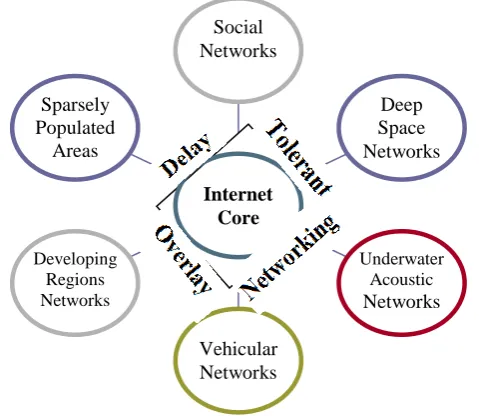
Figure 1: Delay Tolerant Networking
The Inter-Planetary Network (IPN), a task propelled in 1998 went for setting up availability between nodes
subjectively situated on the diverse close planetary system planets. Deep space correspondence is additionally a
sort of network where there extreme engendering delays, higher error rate, and successive interruptions.
Accordingly, customary protocols neglect to transmit information bundles over such networks [5]. Customarily,
we utilized TCP/IP protocol to send parcels from source to goal, which needs an ideal way to progress 100
percent. However, in DTN there isn't an assurance of end to end way, so web routers dispose of any message on
the grounds that a connection is down. That outcome in information misfortune. In DTN, routers can be
supplanted with DTN node, which has storage limit and in the later phase they send bundles of information. On
the off chance that the connection is down DTN node will hold the information until the point that the
connection comes up. DTN utilizes store-carry forward (SCF) system to send the information [6].
The web has TCP for dependability. In TCP, a connection is first settled. In the event that the information
packet is lost, the sender will retransmit the packet. DTN utilizes hop by-hop custody exchange. Progressive
node takes the custody, and the bundles move towards the goal. On the off chance that the bundle is lost and the
custody isn't recognized by the following node, the last custodian retransmits the information. Information can
be retransmitted from the nearest node instead of sender. Sparsely
Populated Areas Network
Developing Regions Networks
Vehicular Networks
Underwater Acoustic
Networks Deep Space Networks Social
Networks
1937 |
P a g e
The requirement for DTN emerges on account of the three reasons – (I) Lack of connectivity implies where
there is no end to end way amongst source and goal, we can't utilize TCP/IP protocol, rather we utilize DTN. (ii)
Irregular Delays can make an issue for TCP/IP. This issue can be overwhelmed with the assistance of DTN. (iii)
The Asymmetric bidirectional data rate can be endured to some degree in the customary protocol. Be that as it
may, if the asymmetry is extensive then it can be crushed effortlessly [7].
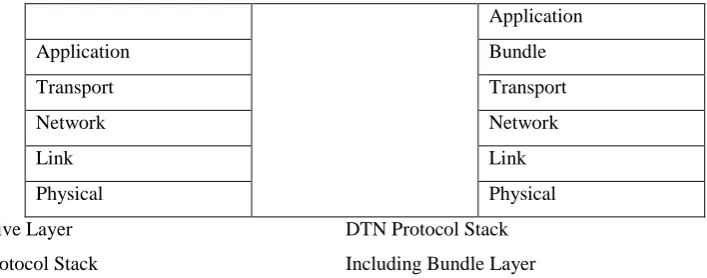
DTN is a network of littler networks. The DTN is an overlay on existing systems. This overlay is called as
bundle layer as appeared in Figure 2. This layer can go about as a gateway when two nodes interact with each
other. DTN is adaptable it can be effortlessly connected with the current protocol. DTN design utilizes new
addressing semiotics [8].
Application
Application Bundle
Transport Transport
Network Network
Link Link
Physical Physical
Original Five Layer DTN Protocol Stack
Internet Protocol Stack Including Bundle Layer
Figure 2: Protocol Stack of Internet and Delay Tolerant Networks
There can be two sorts of Contacts in DTN. To begin with kind of contacts are opportunistic contact. In this sort
of contact the node does not have any sort of immediate or aberrant data with respect to a contact later on. All
the contact is an effect of by-chance. Second class of contacts are planned contacts. These sorts of contacts are
those in which contact event is already known. This sort of contact for the most part happens when the nodes
move along a particular pre-defined way [6,9]. There are few significant routing protocols such as epidemic
[10], spray and wait [11], spray and focus [12] ProPHET [13] and Maxprop [14] which are utilized in DTN.
III. RELATED WORK
A significant concern in a system is congestion. A system is called congested if the quantity of messages sent on
the system is more prominent than the limit of the system. [1] DTN is a structure of hop-by-hop framework. In
DTN, flow control and congestion control are related thoughts. Flow control should be possible by restricting
the sending rate of a node to its next bounce node. Congestion Control implies dealing with the buffer at a DTN
gateway [8].
The significant techniques present to treat with these concerns are Proactive Control, Reactive Control and
Hybrid Control. – The proactive control is known as congestion avoidance and in this the inner primary
approach is used prior to the happening of congestion. A node can choose whether to acknowledge or dismiss
the custody of another package in view of its present buffer condition.
Reactive control technique reacts when congestion happens in the system. Hybrid control technique performs
congestion avoidance and furthermore responds to congestion development if it occurs in the system. As of now
1938 |
P a g e
correspondence. Yet, in DTN congestion control is a testing assignment on the grounds that in DTN end to end
way amongst source and goal can not be ensured dependably and correspondence latencies can be
discretionarily long. Because of this it makes high engendering delay. It stores the message in its buffer for quite
a while. It might be in hours or days. Congestion can be controlled by diminishing the sending rate in a system.
Congested node drops the bundles to manage blockage. On the off chance that dropping rate is speedier than the
sending rate then huge measure of bundles can be dropped. These messages may have been sent through
numerous past hops and consume extensive system assets before at last being dropped. That outcomes
information can be retransmit which can diminish system performance. Research in DTN exchange
dependability and blockage control is still in its beginning time [15]. Parcel of work in past has just been done to
control blockage in DTN. The writers in the past have worked in the field of blockage on the premise of two
methodologies i.e. Reactive and Proactive. In Reactive approach three vital inquires about are AFNER, N-Drop
and DATM.
Average Forwarding Number for Epidemic Routing (AFNER). This congestion control is a reactive
technique. It chips away at the supposition that the sending bundles are non-divided. Message bundles are
organized in rising order of their sending numbers. The message achieves its goal when the sending number of
bundle is more prominent than the normal sending number of the parcel is more noteworthy than Average
Forwarding Number of the parcels living in the entire buffer [16]. N-Drop Congestion control is a reactive
technique in light of the data which is put away inside the node. In the event that the node is skilled to store the
message to be sent in its buffer, it stores them generally checks for congestion and store the bundle by deleting
as of now put away packets on contrasting and the threshold value (N). In the event that there are no such
parcels whose sending number isn't more noteworthy than the threshold (N), at that point the last got bundle in
the buffer will be deleted [17]. DATM –To tackle the blockage issue in opportunistic system, a congestion
control procedure is suggested that depends on message deleting and transferring (DATM). The moving of the
node in opportunistic system isn't irregular however constrained by time and space. In this way, a few nodes
have high experience probability with the goal node. DATM is an arrangement of calculations summoned at a
opportunistic system when congestion happen. The congested node finds a message for goal and another
message for movement. In the interim the neighboring nodes decide if to get the exchange message and offer
reaction to the congested node. On the off chance that the neighboring nodes decline to get the exchanged
message it will be erased [18].
In Proactive technique two foremost researches are TBCC and CASE. Token based congestion control
(TBCC) is a congestion avoidance technique which is a proactive approach. In this approach those nodes which
have substantial tokens can infuse or send the messages. The principle point of the TBCC is to coordinate the
amount of information entering in the system with the aggregate system limit which implies that any system or
node must get that quite a bit of information as much as it can convey [19]. Congestion Avoiding Strategic
Epidemic Routing (CASE) is a blockage avoiding strategic epidemic routing algorithm. Epidemic is generally
utilized and reached out because of its elite highlights, yet there is a reasonable possibility of imparting node
1939 |
P a g e
IV. PROPOSED WORK
In any network, dispersing packets during correspondence is a vital matter that needs attention, likewise in DTN
the problem of congestion, pertaining to packet falls or messages receiving deleted, is as vital concern as,
creating the connection among nodes where end to end connection is not assured. In DTN the normal latency of
the network and normal hop tally are equally fixed and each has some fix value. Our proposed framework for
network congestion is based on congestion avoidance approach (proactive). Our research mainly focuses on
buffer management policy. The buffer management policy normally cannot noticeably decrease the network
overhead so we develop the new dropping policy which is based on size of the message and TTL of the
message. As per our proposed framework a threshold value for buffer occupancy is establish and all the
incoming message are accommodated in the node’s buffer normally until the threshold value is attained. When
the space of the buffer comes near to the threshold value our proposed framework becomes active. As per our
proposed framework when a new message comes, size of the incoming message is calculated. Messages having
largest size from the incoming packet in the buffer node are recognized and selected. After that the Time to Live
(TTL) value is obtained for selected messages. A comparison of the TTL value of the incoming message and
selected message is performed. If any message in selected message has lower TTL value than the TTL value of
the incoming message, the message with lower TTL will be dropped otherwise the incoming message cannot be accommodated in the node’s buffer.
V. EXPERIMENTAL RESULTS
In order to executive the proposed idea there are some system prerequisites. The system should support Java
based integrated opportunistic network environment (ONE) simulator, which is a extremely recommended for
performing DTN related research simulation and monitor the enviable results. We are using Java Net Beans with
ONE Simulator setup.
There are few classic performance metrics for examining the work of DTN protocols such as delivery
probability, over head ratio, buffer average time etc.
Delivery Probability = No. of messages delivered to the destination
No. of messages sent by the sender
Overhead Ratio = No. of relay messages – No. of delivered messages
No. of delivered messages
Buffer Average Time is the time that message spends in the node’s buffer. To examine the percentage span of
enhancement in the performance of considered routing protocol (epidemic) by dropping the messages from the
node’s buffer we have worked out a simulation setup. The featured simulation arguments for the considered
1940 |
P a g e
Table 1: Simulation parameter
Parameters Value
Simulation Time 43200 s
No. of Host group 1
No. of Host per group 100
Buffer size 4m-30m
Movement Model ShortestPathMapBasedMovement
Worldsize 4500, 3400
Group router Epidemic
Event.hosts 0, 99
The results obtained from our experiment with 100 nodes are summarized below in the Tables and figures:
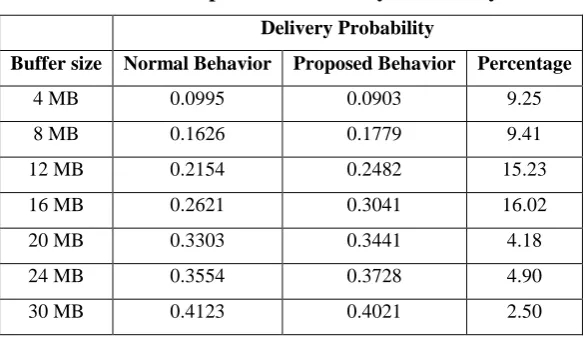
Table 2. Comparison of Delivery Probability
Delivery Probability
Buffer size Normal Behavior Proposed Behavior Percentage
4 MB 0.0995 0.0903 9.25
8 MB 0.1626 0.1779 9.41
12 MB 0.2154 0.2482 15.23
16 MB 0.2621 0.3041 16.02
20 MB 0.3303 0.3441 4.18
24 MB 0.3554 0.3728 4.90
1941 |
P a g e
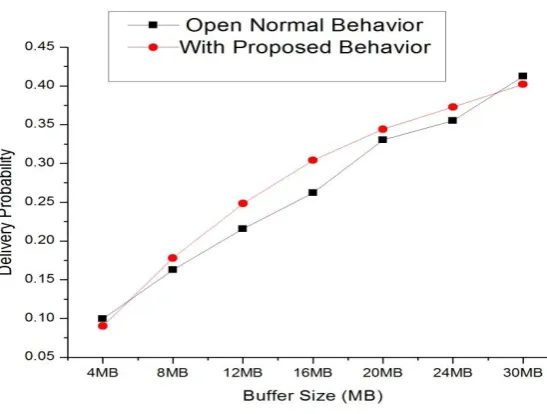
Figure 3. Comparison of Delivery ProbabilityFrom the data of Table 2 and Figure 3 it is concluded that the delivery probability of the nodes increases from
3% to 16% with different buffer sizes when our proposed buffer management mechanism is implemented. The
maximum increase in the delivery probability is observed at 16Mb buffer size and this increase is about 16%.
Table 3. Comparison of Overhead Ratio
Overhead Ratio
Buffer size Normal Behavior Proposed Behavior Percentage
4 MB 97.0928 120.6080 24.22
8 MB 103.0442 125.3977 21.69
12 MB 90.2833 114.4401 26.76
16 MB 79.8160 97.1349 21.70
20 MB 65.8152 85.5931 30.05
24 MB 61.2179 77.2737 26.23
1942 |
P a g e
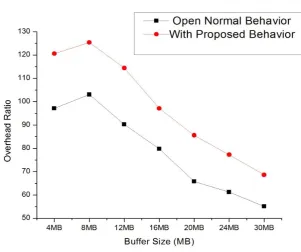
Figure 4. Comparison of Overhead Ratio
From the facts and figures mentioned in Table 3 and Figure 4, is can be analyzed that the overhead ratio of the
proposed mechanism is high as compared to the Normal behavior. But this increase in the overhead ratio is at
the cost of increased delivery probability in case of our proposed mechanism. There is increase in overhead ratio
as our mechanism removes the messages with larger size and less probability/time to get delivered and make
space for the new incoming message which has higher chances of being delivered.
Table 4. Comparison of Buffer Time Average
Buffer Time Average
Buffer size Normal Behavior Proposed Behavior Percentage
4 MB 840.1613 673.2940 19.86
8 MB 915.9741 729.3203 20.38
12 MB 1038.3159 879.8871 15.31
16 MB 1205.2419 1056.7311 26.76
20 MB 1379.2509 1213.3062 12.03
24 MB 1542.6765 1362.0041 11.71
30 MB 1754.3405 1549.5800 11.67
1943 |
P a g e
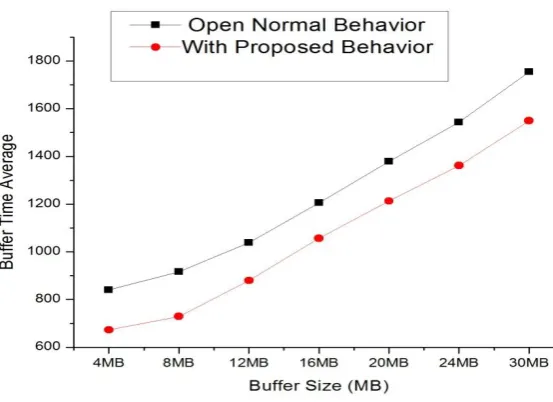
Figure 5. Comparison of Buffer Time Average
From the results obtained and depicted in Table 4 and Figure 5, it is evident that with the new proposed buffer
management mechanism, the messages are now being delivered more quickly and staying for less time in buffer
of the nodes. This means that the buffer is being now relaxed for accommodating the new incoming messages
and hence contributes in higher delivery probability.
VI. CONCLUSION
In this paper we proposed a new congestion avoidance framework so as to prevent congestion in the node
buffer. In this technique to solve the problem of congestion we used the size and TTL of the message. We have
conducted an experiment by using the ONE Simulator with epidemic protocol and shortest-path-map-based
movement model. Simulation results show that delivery probability has improved. The enhancement in delivery
probability has been seen up to 16 percent. The simulation results also show that to accommodate a new
message when an old message is dropped the overhead ratio increased which is natural. Buffer time average has
slow fallen down when the proposed framework became active.
In future we will expand our proposed framework on different routing protocols and also on different movement
models to avoid the congestion in node’s buffer.
REFERENCES
1.Forouzan, A Bechrouz, "Data Communications and Networking. Tata McGraw Hill, New Delhi, 2012.
2.K. Fall, S. Fareell, "DTN: An Architectural Retrospective. IEEE Journal on Selected Areas in Communications. Vol. 26. No. 5 June 2008.
3.M. Loubser, ”Delay Tolerant Networking for Sensor Networks,” SICS Technical Report, ISSN 1100-3154, January 2006. 4.Z. Zhang, "Routing in Intermittently Connected Mobile Ad Hoc Networks and Delay Tolerant Networks: Overview and
Challenges", IEEE Communications Surveys and Tutorials, Vol. 8, Issue No. 1, pp. 24-37, January 2006.
1944 |
P a g e
6.V. Cerf, S. Burleigh, A. Hooke, L. Torgerson, R. Durst, K. Scott, E. Travis and H. Weiss, "Interplanetary Internet (IPN): Architectural Definition,” Available Online: https://tools.ietf.org/html/draft-irtf-ipnrg-arch-00 Accessed as on 03/06/2015.
7.V. Cerf, S. Burleigh, A. Hook, L. Torgerson, R. Dust, K. Scott, K. Fall and H. Weiss, ”Delay-Tolerant Networking Architecture,” IETF Network Working Group, RFC4838, Informational, http://www.ietf.org/rfc/rfc4838.txt, April 2007. accessed as on 04/06/2015.
8.I. Psaras, N.Wang and R. Tafazolli, ”Six Years Since First DTN Papers: Is There A Clear Target?” First Extreme Workshop on Communications, Laponia, Sweeden, 2009.
9.K. Fall, ”A Delay-Tolerant Network Architecture for Challenged Internets,” Intel Research Berkley, 2003.
10. Lindgren, A., Doria, A., Schelén, O.: Probabilistic routing in intermittently connected networks. SIGMOBILE Mob. Comput. Commun. Rev. 7, 19–20 (2003)
11. Spyropoulos, T., Psounis, K., Raghavendra, C.S.: Spray and wait: an efficient routing scheme for intermittently connected mobile networks. In: Proceedings of ACM SIGCOMM workshop on Delay-tolerant networking (WDTN ’05), pp. 252–259. ACM, New York, Philadelphia, PA (2005).
12. Spyropoulos, Thrasyvoulos., Psounis, Konstantinos & Raghavendra, Cauligi S., "Spray and Focus Efficient Mobility-Assisted Routing for heterogeneous and Correlated Mobility" IEEE 5th Annual International conference on Pervasive Computing and Communications workshop, 2007.
13. Lindgren, A., Doria, A., Schelén, O.: Probabilistic routing in intermittently connected networks. SIGMOBILE Mobible Comput. Commun. Rev. 7, 19–20 (2003)
14. Burgess, J., Gallagher, B., Jensen, D., Levine, B.N.: MaxProp: routing for vehicle-based disruption-tolerant networks. In: Proceedings of IEEE INFOCOM, Barcelona (2006)
15. G. Zhang, Y. Liu, "Congestion Management in Delay Tolerant Networks", Proc, 4th Annual International Conference on Wireless Internet Brussels, Belguim, 2008.
16. Li Yun, Cheng Xinjian, Liu Qilie and You Xiaohu, "A novel congestion control strategy in Delay Tolerant Networks, "Future Networks Second International Conference, Sanya, Hainan, 2010.
17. Li Yun, Cheng Xinjian, Liu Qilie and You Xiaohu, "N-Drop: Congestion Control Strategy under Epidemic routing in DTN, Wireless Communication and Mobile computing: Connecting the world wirelessly conference on IWCMC, Leipzig, Germany, 2009.
18. Patil, Peeyush and Penurkar, Milind, "Congestion Control in DTN", Fourth Post Graduate Conference, SPPU Pune, 2015.
19. Coe E and Raghuvendra C, "Token based Congestion Control for DTNs, "Aerospace conference, Big Sky, MT, USA, IEEE 2010.