Single Core Implementation of Blue
Midnight Wish Hash Function on VIRTEX 5
Platform
Mohamed El Hadedy
1,2, Danilo Gligoroski
3and Svein J. Knapskog
11
The Norwegian Center of Excellence for Quantifiable Quality of Service in Communication
Systems(Q2S),
Norwegian University of Science and Technology (NTNU),
O.S.Bragstads plass 2E, N-7491 Trondheim, Norway
[email protected], [email protected]
2
Department of Electrical and Computer Engineering, University of Massachusetts Lowell,
Ball 301, One University Ave, Lowell, MA 01854, USA
Mohamed [email protected]
3
Department of Telematics, Faculty of Information Technology, Mathematics and Electrical Engineering,
The Norwegian University of Science and Technology (NTNU),
O.S.Bragstads plass 2E, N-7491 Trondheim, Norway
[email protected]
Abstract
This paper presents the design and analysis of an area efficient implementation of the SHA-3 candidate Blue Midnight Wish hash function with different digest sizes of 256 and 512 bits on an FPGA platform. The core functionality with finalization implementation without padding stage of BMW on Xilinx Virtex-5 FPGA requires 51 slices for BMW-256 and 105 slices for BMW-512. Both BMW versions require two blocks of memory: one memory block to store the intermediate values and hash constants and the other memory block to store the instruction controls. The proposed implementation achieves a throughput of 68.71 Mpbs for BMW-256 and 112.18 Mpbs for BMW-512.
I. INTRODUCTION
To obtain efficient and secure computerized information handling, hash functions are used in countless protocols and algorithms. Until now, two generations of SHA algorithms have been standardized and widely deployed -1, and 2, and although they have some similarities, they have also significant differences [1]. SHA-1 is the most frequently used member of the SHA hash family, employed in hundreds of different applications and protocols. However, in 2005, we witnessed a significant theoretical breakthrough in breaking the current cryptographic standard SHA-1 [2]. The discovered mathematical weaknesses which were shown to exist indicated the need for replacement with a stronger hash function [3], although there exist another family of standardized hash function called SHA-2 which officially replaced SHA-1 in 2010.
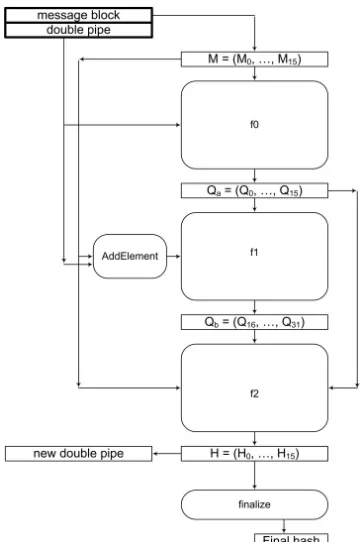
Fig. 1:Graphical representation of the hash function Blue Midnight Wish
The rest of the paper is organized as follows. In Section 2, we describe briefly the compression function of the second round version of the BMW algorithm, while Section 3 contains the architectural description of the BMW-256 design. In Section 4, the BMW hashing operations are detailed out. In section 5, the synthesis results of the FPGA implementation are given and comparisons with other related works are shown. Finally, in section 6, our conclusions are presented, and some observations and possibilities for future work are discussed.
II. THEHASHFUNCTION OFBLUE MIDNIGHT WISH
The BMW-n hash function is shown in Fig. 1. We refer to the variant that creates a 256 bit message digest as BMW-256 and the variant that creates a 512bit message digest as BMW-512. The basic data block which is used for BMW-256 is 32 bits long and for BMW-512 is 64 bits long. The algorithm has four different operations in the hash computation stage: bit-wise logical word XOR, word addition and subtraction, shifts (left or right), and rotate left. The BMW uses a double pipe design to increase the resistance against generic multi-collision attacks and length extension attacks. In the double pipe design, the sizes of the inputs to the compression function are twice the message digest size. The inputs to the compression function are the message blocks M(i) , along with the initialization vector H(i−1) (previous double pipe) and the output is the current double pipe H(i).
The hash function has two main parts: 1. Message digesting part and 2. Finalization part as it is shown in Fig. 1. The first part uses three separate functions f0, f1 and f2 to define the so called “compression function” of Blue
Midnight Wish. The output of the compression function is H(i)= (H0(i), H1(i) ,...,H15(i)). There are two inputs for the function f0: The first argument consists of sixteen n-bit words, which are working as initial values H0(i−1),H1(i−1),..,
H15(i−1). The second argument consists of sixteen n-bit words, which represent the input message block: M0(i), M1(i)
,..., M15(i).
The function f0(M(i), H(i−1)) computes M(i) ⊕ H(i−1) and produces Q(ai) as the first part of the extended
(quadrupled) pipe, hence Q(ai) = (Q(0i),Q (i) 1 ,...,Q
(i)
15). The inputs for the function f1 are three different arguments,
the message block M(i), the previous double-pipe H(i−1)and the value ofQ(ai). The function f1(M(i),H(i−1),Q(ai) )
computes the second part of the extended (quadrupled) pipe Q(bi), hence Q(bi) = (Q16(i) ,Q(17i), ..., Q(31i)). The third function f2 also takes three arguments; the message block M(i) and the values of both Q
(i)
a and Q(bi).
The function f2(M(i),Q(ai),Qb(i)) computes the new double-pipe value H(i), i.e. H(i) = (H
(i) 0 , H
(i) 1 ,..., H
(i) 15 ).
The second part (finalization) contains of the same compression function defined in the message digesting part (so it uses the same functions f0, f1and f2), but instead of initial valuesH(i
−1) 0 ,H
(i−1) 1 ,...,H
(i−1)
15 , it useConstant
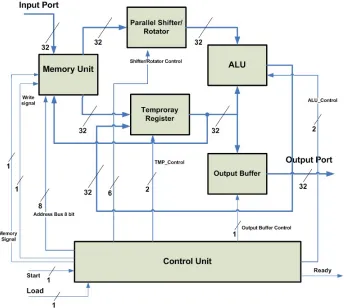
Fig. 2:BLUE MIDNIGHT WISH-256 Core Architecture
Fig. 3:Parallel Shifter/Rotator Block (BMW-256)
= (Constant0f inal ,Constant1f inal ,... ,Constant15f inal ) values and the role that was played by the input message block in the previous message digesting part, now will be played by the last obtained double-pipe H(i)= (H0(i), H1(i) ,...,
H15(i) ).
III. BLUEMIDNIGHTWISH256 COREARCHITECTURE
Fig. 2 shows the complete architecture of the entire BMW core-256 process, which includes six main hardware operative parts, Memory unit, Parallel Shifter/Rotator, ALU (Arithmetic Logic Unit), Temporary Register, Output Buffer and Control Unit. Their operations are as follows:
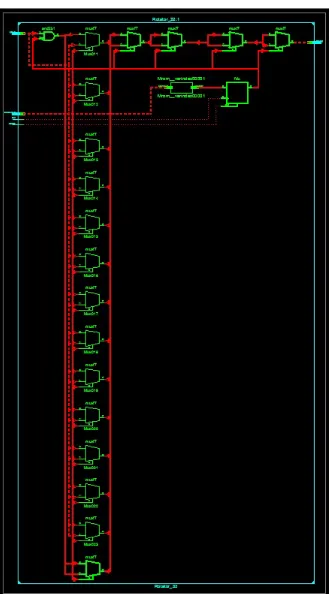
Parallel Shifter/Rotator: It contains a 5 x 32 Mux matrix each one is a 2 x 1 multiplex with a large encoder (5 X 11). This component is responsible for the shift and rotation operations of the 32 bit words. It receives 32 bit parallel data from the memory Block and transmits 32 bit parallel data to the ALU. That happens dependent on the value of the shifter control word. Because we have 36 operations in the BMW hash core, the width of shifter control word is 6 control bits as shown in Fig. 3 and Appendix A.
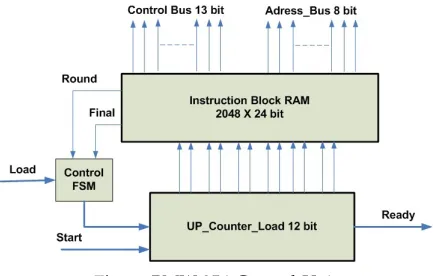
Fig. 4:BMW-256 Control Unit
Register to work as a parallel accumulator. This idea has been already applied in a similar way in the implementation of Beuchat et al., of the hash function BLAKE [9].
Temporary Register: It contains a 32 Mux 2 x 1 and a shift register. The Temporary Register works as an accumulator. It receives 32 bit words from The Memory Unit and The ALU and transmits data 32 bit words to the ALU and the output stage.
Memory unit: To implement the BMW-256 core memory block, we used an FPGA block RAM of size 256 x 32 bits. As we mentioned in section 3.1, the memory block contains a ROM to store the BMW-256 constantsKj, J=0,1,..., 15
, H(i−1)and theConstantjf inal . In addition, the memory block contains sufficient RAM to store the BMW-256 input message blocks (M(0i), M1(i),..., M(15i)), the intermediate values of the BMW hash function, and the final double pipe values H(i) = (H(i)
0 ,H (i) 1 ,H
(i) 2 ,...,H
(i) 15).
Output Buffer: After the finalization stage, the Output buffer will receive the final digest results.
Control Unit: It has been designed as a 2048 x 25 bit Instruction Block RAM, an 11 bit up counter load bit and a Control FSM (Finite State Machine) as shown in Fig. 4. it contains three operative parts, all of them working together to produce 8 bit memory address words to control the memory block traffic with the other BMW-256 sub-systems. Instructions Block RAM translated after placement and routing to one 36K Block RAM and one 18K block RAM. The Control Unit produces the 13 bit control word to control the data flow between the BMW-256 core sub-systems. The Control Unit subsystems are working as follows:
once the Start and Load signals becomes high, the organization of the sixteen input messages inside RAM location is started. Subsequently, the Load signal becomes low and the Instruction Block RAM starts to control the BMW hashing core to execute the f0, f1, and f2 according to the BMW-256 algorithm operations which was described
in section 2. Finally, the Round signal becomes high, and BMW hashing core starts to transfer the H0(i),H1(i),...,H15(i)
values in the message locations and and transfer Constf inal vaules in the H0(i),H1(i),...,H(15i) locations. After that the Final signal becomes high and the final hash output. The Control FSM is used to organize the movement of instructions from the up counter load according to the value of each of the signals Load, Round and Final.
IV. BLUEMIDNIGHTWISH HASHING OPERATIONS
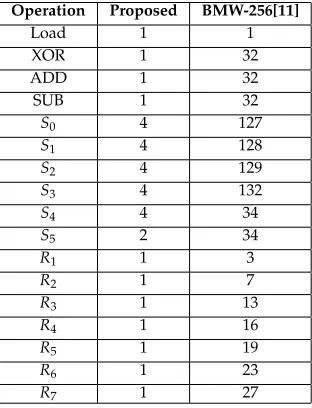
In this section we describe how the computation hash core works to execute the internal functions in BMW. As an example, we will explain how to XOR two blocks of data present in locations number 4 and 5 in the Memory Unit, and write the result in location number 7. First, the Control Unit gives order to the Memory Unit to choose location number 4. Then the Control Unit asks the Temporary Register to pick up the data from the data bus and subsequently the same operation happens with location number 5. However, instead of using the Temporary Register, the Parallel Shifter/Rotator picks up the data. Now, the Control Unit asks the Shift/Rotate Encoder to give order to the ALU to add these data and store them in the Temporary Register. Finally, the Control Unit gives order to the Memory Unit to pick up the data and place them in location number 7. Because we used the Parallel Shift/Rotate, and the parallel Arithmetic Logic Unit , we succeeded to reduce the number of cycles for each operation shown in Table I (page 5). Using the BMW operations in Table I, we see that we can execute the function f0 in 426 cycles, function f1 in 452 cycles and finally function f3 in 170 cycles.
V. PERFORMANCEEVALUATION
TABLE I: BLUEMIDNIGHTWISHhashing core operations (execution times)
Operation Proposed BMW-256[11]
Load 1 1
XOR 1 32
ADD 1 32
SUB 1 32
S0 4 127
S1 4 128
S2 4 129
S3 4 132
S4 4 34
S5 2 34
R1 1 3
R2 1 7
R3 1 13
R4 1 16
R5 1 19
R6 1 23
R7 1 27
TABLE II: BLUEMIDNIGHTWISHperformance results
Algorithm Name FPGA Type Area(Slice) Frequency [MHZ] Throughput Memory Blocks Throughput/Area (Slice)
Proposed BMW-256 Virtex5 XC5VLX110 51 141 68.71 Mbps 3 1.35
Proposed BMW-512 Virtex5 XC5VLX110 105 115 112.18 Mbps 3 1.09
BMW-256 [8] Virtex5 XC5VLX110 1980 264 5Mbps —– 0.0025
structure we have spent around 97% less area compared to previous design for BMW-256 on the same FPGA VIRTEX 5 XC5VLX110 device while increasing the measured throughput around 14 times.
VI. CONCLUSION ANDFUTUREWORK
In this paper we have presented an FPGA implementation of a new BMW hashing core structure using a parallel shifter/rotator and a parallel arithmetic logic unit (ALU) . The BMW core receives 16 message words and processes them. The goal was to use as small area as possible in order to minimize the hardware cost. For the future work, we will take on the challenge to improve this design. The goal is to improve the throughput while keeping the optimized the area usage. It will certainly be beneficial in some future usage scenarios to do a full implementation in ASIC.
ACKNOWLEDGEMENT
We would like to thank Jean-Luc Beuchat for his useful comments and hints how to improve the results presented in this paper.
REFERENCES
[1] National Institute of Standards and Technology, ”Secure Hash Standard (SHS), FIPS PUB 180-3”, Federal Information Processing Standards Publication, October 2008, http://csrc.nist.gov/publications/fips/fips180-3/ fips180-3 final.pdf
[2] X. Wang, A. C. Yao, and F. Yao. ”Cryptanalysis on SHA-1 hash function”. In proceeding of The Cryptographic hash workshop. National Institute of Standards and Technology, November 2005.
[3] NIST (2006). ”NIST Comments on Cryptanalytic Attacks on SHA-1”. http://csrc.nist.gov/groups/ST/hash/ statement.html
[4] William E. Burr,”Cryptographic Hash Standards: Where Do We Go from Here?”, IEEE Security and Privacy, Vol. 4, No. 2, pp. 88-91, Mar./Apr. 2006, doi:10.1109/MSP.2006.37
[5] D. Gligoroski, V. Klima, S. J. Knapskog, M. El-Hadedy, Jorn Amundsen and S. F. Mjolsnes,”Cryptographic Hash Function BLUE MIDNIGHT WISH”, Submission to NIST (Round 2) of SHA-3 Competition, September 2009 [6] D. Gligoroski, V. Klima, ”A Document describing all modications made on the Blue Midnight Wish cryptographic hash
[7] Xilinx,”Device Package User Guide”, 2010 http://www.xilinx.com/support/documentation/user guides/ug112. pdf
[8] M. El Hadedy, D. Gligoroski, S. J. Knapskog, ”Low Area Implementation of the Hash Function ”Blue Midnight Wish - 256” for FPGA platforms”. In Proceedings of The International Conference on Intelligent Networking and Collaborative Systems. IEEE Computer Society 2009 ISBN 978-0-7695-3858-7.
Fig. 5:Parallel Shifter/Rotator 32bits
Appendix A
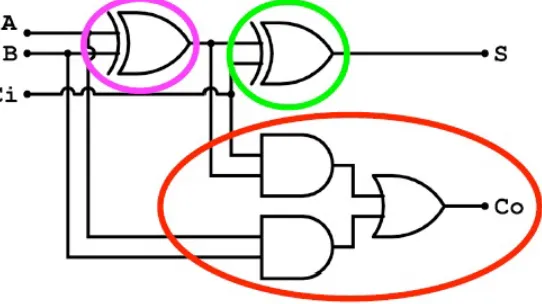
Fig. 6:One Bit Full Adder
Appendix B
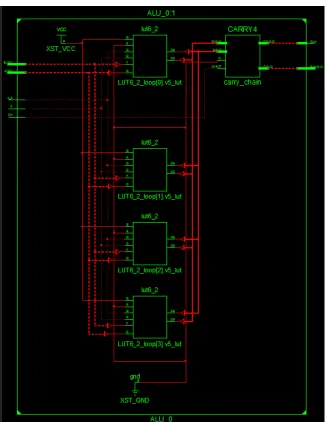
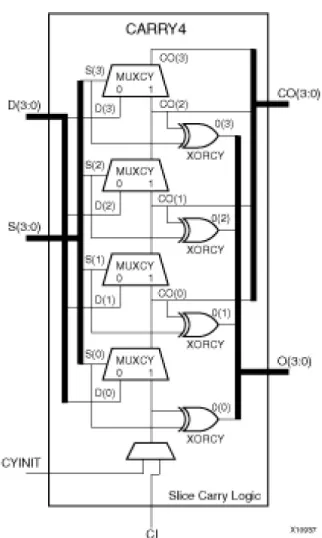
It is possible to map Carry ripple adder as shown in Fig.6 onto carry chain block as shown in Fig.7. By this way we can implement the ALU component using small area and low delay as shown in Fig.8 . Each 4-bit ALU contains 4 LUT6 2 and CARRY4. For BMW-256 , the ALU will use eight 4-bit ALU and for BMW-512 will use sixteen 4-bit ALU. Table.III contains the ALU implementations results for 32 and 64 bits versions. The LUT6 2 component is a six-input, two-output Look-Up Table (LUT) that can either act as a dual asynchronous 32-bit ROM (with 5-bit addressing), implement any two 5-input logic functions with shared inputs, or implement a 6-input logic function and a 5-input logic function with shared inputs and shared logic values. The CARRY4 as shown in Fig.9 represents the fast carry logic for a slice. The carry chain consists of a series of four MUXes and four XORs that connect to the other logic (LUTs) in the slice via dedicated routes to form more complex functions. The fast carry logic is useful for building arithmetic functions like adders, counters, subtractors and add/subs, as well as such other logic functions as wide comparators, address decoders, and some logic gates (specifically, AND and OR). This is discussed in [7] and has been already applied in the implementation of Beuchat et al., of the hash function BLAKE [9].
TABLE III:ALU using Carry Chain block
Name Area(slice) Delay
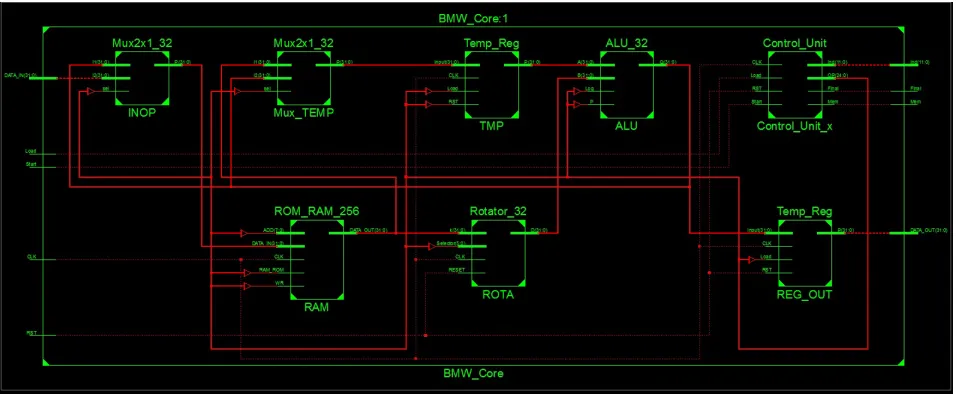
Fig. 10:RTL schematic for BMW-256
Appendix C