Experimental and performance study of Nano refrigerant (R290 +
CuO) in vapour compression refrigeration system
Himanshu Sharma , Mr. Neeraj Saraswat , Mr. Harsh Rai
1M.Tech Student (Thermal Engineering) Sunder Deep Engineering College,Ghaziabad, (U.P) 2,3
Assistant Professor,Sunder Deep Engineering College, Ghaziabad (U.P)
Abstract
system based on Nano refrigerant. The Nano refrigerant is combination of pure hydro-carbon refrigerant and nanoparticles like (R290+CuO). After that the system is run with the help of In this paper , the experimental and performance study of a vapour compression refrigeration Nano refrigerant (Pure refrigerant(R290) + nanoparticles (CuO)) and result is analysed. The results of the experiments indicated that the refrigerator performed better with nanoparticles as compared to pure Hydrocarbon. There is more temperature drop across the condenser for the nanorefrigerant (13.02% – 21.84%)
compared to pure R290 hydrocarbon
refrigerant. Similarly, a gain in the evaporator temperature (3.28% –5.83%) has been observed. An improvement in COP (5.3% – 14.15%) is also observed during the investigations. A reduction in the power consumption (11.5% - 31.8%) along with faster cooling (from 40 oC – 25 oC) is also achieved when nanorefrigerant is used. Thus, Cupric oxide (CuO) nanoparticles can be used to improve the performance of a hydrocarbon-based refrigeration system under investigated conditions.
Keywords: CuO nanoparticles, Nano
refrigerant hydrocarbon(R290), Coefficient of performance, Power Consumption.
NTRODUCTION
Presently a days interest for the refrigeration and cooling expanded day by day. Industry still as within the homes there would like for the comfort atmospherefor human as well as for man mad product. This can be achieving by the refrigeration and air conditioning. VCR is that the system among all most used for this purpose. In this system, refrigerant is employed because the operating fluid is that the crucial a part of the system. Its operating involves four main processes i.e. compression, condensation,
throttling and evaporation. The low
pressure and low temperature vapour
refrigerant enter into the compressor
through inlet valve and discharges to high pressure and high temperature refrigerant.
Then it enters into the condenser in
which action of refrigerant happens at
constant pressure and
temperature, wherever it rejects heat to the
environment, currently the refrigerant is
throttled through accelerator within
which refrigerant temperature becomes low and it enters into evaporator through that it absorbs heat and the cycle continues. Hence the vapour compression is considered for
refrigeration cycle. A simple vapour
compression refrigeration consists of following essential parts:
Available online: https://journals.pen2print.org/index.php/ijr/ P a g e | 178
Condenser: In which the high temperature and pressure vapour refrigerant is cooled and condensed by used of normally air and water.
Expansion valve: It is also called the throttle valve. The function of the expansion valve is to allowed the liquid refrigerant under high pressure and temperature passed through the
valve after reducing its pressure and
temperature.
Evaporator: In which the liquid-vapour refrigerant at low pressure and temperature is evaporated and changed into vapour refrigerant at low pressure and temperature, and discharge into the compressor.
WHAT IS NANO REFRIGERENT?
Nano-refrigerant which is one kind of nanofluids has been introduced as a superior properties refrigerant that increased the heat transfer rate in the refrigeration system. Many types of materials could be used as the nanoparticles to be suspended into the conventional refrigerants.
I.
LITERATURE REVIEW
1) D. Sendil Kumar & Dr. R. Elansezhian
(2012) investigated on Nano-refrigerant. Nano
Al2O3-PAG oil was used as Nano-refrigerant in
R134a in VCR system and increased COP upto 3.5
2) M.Abuzar Qureshi (2012) The aim of this
project is to comparatively analyze of COP using R134a & R600a Refrigerant in Domestic refrigerator at steady state condition.
In this experimental study Coefficient of performance of R600a was higher range of 40.86%-46.54% than R134a.
3) A.Senthilkumar & R. Praveen (2015) In
this paper, CuO - R600a were used as a working fluid of domestic refrigerators. The results indicated that CuO - R600a can work normally and efficiently in refrigerator. Combined with refrigerator using pure R600a as working fluids. 0.1 & 0.5g/L concentrations of CuO - R600a
can save 11.83% and 17.88% energy
consumption respectively and the freezing velocity of CuO - R600a was more quickly than the pure R600a system.
4) Dr. K.Dilip Kumar (2016) In this work, the
Al2O3 nano-oil is proposed as a promising lubricant to enhance the performance of vapour compression refrigerator .The result shows the COP of system were improved by 19.14%
5) Pravesh kumar kushwaha (2016)
Investigations into the performance of Nano-refrigerant (R134a + Al2O3) based refrigeration system. An improvement in COP was also observed during the investigations (1.17% – 9.14%) and reduction in power consumption (4.35% & 14.7%).
6) N Austin (2016) In this paper focuses on the
refrigeration systems in the premises of steady state.R134a and R600a are the two refrigerants considered for comparison. R600a performance coefficient was found to be in the higher range compared to R134a. It was almost 42.88%-47.56% better than R134a at a constant refrigerant effect of 48W and at a constant evaporating temperature
.
7) M.S.Bandgar(2016) The aim of this work is
to evaluate the performance of Vapour
Compression Refrigeration System using
SiO2nano particles mixed with Polyolester (POE) oil / Mineral oil (MO) as Nano lubricant and R-600a as a refrigerant. The result of this paper is the power consumption reduces by 12.02% when POE oil is replaced by a mixture of (MO+ 0.5% Silica). It has been observed that C.O.P. is increased by 11.66% when POE is replaced by a Nano lubricant (mineral oil + 0.5% of SiO2).
8) Balwant Kumar Singh(2017) In the present
work, an experimental study is made on the performance of refrigeration system based on (R600a|R290) Nano refrigerant. Here cupric oxide (CuO) nanoparticles of size (20-30) nm has been taken. There is improvement in COP of the system by 3.18%to 11.57 % due to usage of Nano refrigerant. It was observed that energy consumption reduces by 13.5% to 19.7% by using Nano refrigerant of different concentration taken under consideration.
9) J.Melvin Jones(2017) In this paper we
choose the nano refrigerant as Tio2, CuO, CNT, Al2O3 and R600a, R134a, R141b are used as a base refrigerants. This paper gives nano refrigerants provided with good results, showing
the temperature difference is better, when compared to the mixed refrigerants. The coefficient of performance is one of the important parameters for a refrigerant to obtain good cooling effect.
10) Barathiraja.K, Allen Jeffrey.J (2017) This
investigation thermodynamically analyses a vapour compression refrigeration system which compares R134a and R290/R600a refrigerants. In this paper, the experimental analysis of R134a and various ratios of R290/R600a refrigerants have been analysed. The Power consumption of the Hydrocarbon refrigerant R290/R600a has been decreased as compared to the R134a.The coefficient of performance has increases while time increases due to suction of high pressure and temperature increases.
Available online: https://journals.pen2print.org/index.php/ijr/ P a g e | 180 Fig.1 Experimental Setup
Fig.1 shows the experimental setup of vapour compression refrigeration system. It consist of compressor, condenser, expansion device, evaporator, measuring and controlling device. In above figure the experimental setup of pure hydrocarbon refrigerant along with nanoparticle is preformed in vapor compression refrigeration system.
III. EXPERIMENTAL PROCEDURE
In this experiment, the performance of the pure HC refrigerant is compared with the
nano refrigerant withinwhich totally
different concentrations of CuO
nanoparticles are mixed with HC refrigerant
in vapour compression refrigeration
system.The temperature of the refrigerant at inlet and outlet of each element of the
system ought to be measured with
thermometer. Similarly, pressure
measurement are taken across every
component of system with the pressure gauges fitted at the inlet and outlet of the
compressor and evaporator. These
measurements are necessary to evaluate the
performance of the system. The readings of meter and energy meter even be taken to
find the power consumption and energy
consumption of the system. First of all, the
performance is investigated with the
pure hydrocarbon refrigerant and then
experiment conduct with hydrocarbon + CuO with different concentration of 0.20gm, 0.30gm & 0.40gm.
IV. RESULT AND DISCUSSION
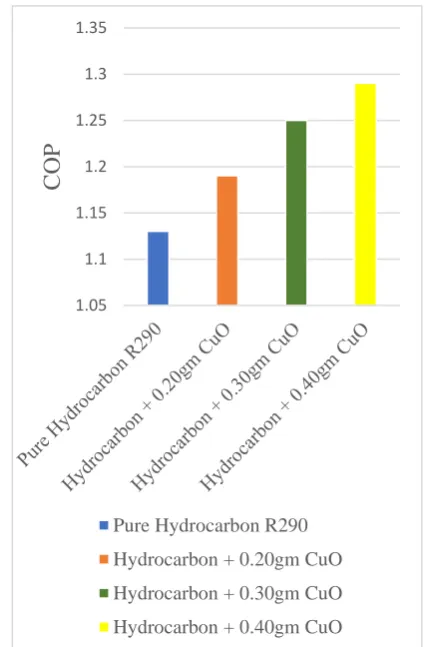
Fig. 2 shows that C.O.P. of pure R290 HC refrigerant is found to be 1.13 whereas C.O.P. of
nano refrigerants R290+0.20gm CuO,
R290+0.30gm CuO and R290+0.40gm CuO is found to be 1.19, 1.25 and 1.29.It has been observed that C.O.P. of the system increased as increased the concentration of nanoparticles with the pure hydrocarbon.
From fig.3 it has been observed that the power consumption decreases as the nano particles was
used with the pure hydrocarbon. As
concentration of nano particles increases the power consumption decreases.
Fig.2 C.O.P. Compression for nano refrigerant
1.05 1.1 1.15 1.2 1.25 1.3 1.35
COP
Pure Hydrocarbon R290
Hydrocarbon + 0.20gm CuO
Hydrocarbon + 0.30gm CuO
Refrigerant C.O.P. (T1 0C)
T2 (0C )
T3 (0C)
T4 (0C)
Pure R290
1.13 26.52 73.9 48.7 -0.7
R290 + 0.20gm
CuO
1.19 27.5 78.3 49.7 -1.1
R290 + 0.30gm
CuO
1.25 26.5 76.50 48.2 -1.8
R290 + 0.40gm
CuO
1.29 26.40 75 45.90 -2.60
Table.1 : C.O.P., pressure and temperature for R290 refrigerant and nano refrigerants
Fig. 3 Power consumption by pure R290 HC
refrigerant and nanorefrigerants
V. CONCLUSION
In this paper, the application of nanoparticles in a refrigerator has been studied that increase in heat transfer caused by the suspension of nanoparticles in the working fuid.
There are the following points to be investigated.
1. The experimental studies indicated that
refrigeration system doesn’t suffer with
nano refrigerant and works normal like
any conventional refrigeration system.
2. It was initiate that accumulation of CuO
nanoparticles to the refrigerant results in
enhancement in the thermo physical
properties and heat transfer properties of
the refrigeration system
3. The C.O.P. of the system increased by
(3.684% – 21.05%) with use of
hydrocarbon with nanoparticles.
4. A reduction in the power consumption
(11.5% to 31.8%) along with
temperature drop (from 40oC – 25oC) is also achieved when nano refrigerants are used.
VI. REFRENCES
[1]. D. Sendil Kumar & Dr. R. Elansezhian (2012) Experimental Study on Al2O3-R134a Nano Refrigerant in Refrigeration System
International Journal of Modern Engineering Research (IJMER) Vol. 2, Issue. 5
[2]. M.Abuzar Qureshi et al. (2012)
Comparative Analysis of Cop Using R134a &
0 0.02 0.04 0.06 0.08 0.1 0.12 0.14 0.16
Pure Hydrocarbon R290
Hydrocarbon+0. 20gm CuO
Hydrocarbon+0. 30gm CuO
Available online: https://journals.pen2print.org/index.php/ijr/ P a g e | 182 R600a Refrigerant in Domestic Refrigerator at
Steady State Condition (International Journal of Science and Research (IJSR)
[3]. A.Senthilkumar & R. Praveen (2015) performance analysis of a domestic refrigerator using cuo –r600a nano – refrigerant as working fluid (International conference on recent
advancement in mechanical engineering
&technology (icramet’ 15)
[4]. Dr. K.Dilip Kumar et al. (2016) An Experimental Investigation on Application of Al2O3 Nanoparticles as Lubricant Additive in
VCRS Int. Journal of Engineering Research
and Application ISSN: 2248-9622, Vol. 6, Issue 10, (Part -3) October 2016, pp.32-38
[5]. Pravesh kumar Kushwaha et al. (2016)
experimental study of nanorefrigerant
(r134a+al2o3)
Based on vapor compression refrigeration
system International Journal of Mechanical And
Production Engineering, ISSN: 2320-2092
[6]. N Austin (2016) Experimental Performance Comparison of R134a and R600a Refrigerants in Vapour Compression Refrigeration System at
Steady State Condition Journal of Advances in
Mechanical Engineering and Science.
[7]. M.S.Bandgar et al.(2016) VCR system using r-600a/ poe oil/mineral oil/nano-sio2 as working fluid: an experimental investigation [8]. Balwant Kumar Singh et al.(2017) An Experimental Study of Nanorefrigerant (HC
+CuO) Based Refrigeration System 2017
IJSRSET | Volume 3 | Issue 8
9. J.Melvin Jones et al.(2017) A review of r600a based nano refrigerant and mixed refrigerant
International Journal of Innovative Research in Science, Engineering and Technology
[10]. Barathiraja.K, Allen Jeffrey.J et al. (2017) Experimental Investigation on R 290 and R 600a In a Vapor Compression Refrigeration
International Journal of Science, Engineering
and Technology Research (IJSETR) Volume 6, Issue 3
[11]. P. Kannan, A. Manivanana (2016) Theoretical analysis of a vapour compression refrigeration system with R134a, R290, R600a
& various ratio of R290/R600a International