Differentially Private Billing with Rebates
George Danezis1, Markulf Kohlweiss1, and Alfredo Rial2 1
Microsoft Research Cambridge, UK
{gdane,markulf}@microsoft.com 2
ESAT-COSIC / IBBT KU Leuven, Belgium
Abstract. A number of established and novel business models are based on fine grained billing, including per-view, mobile messaging, voice calls, pay-as-you-drive insurance, smart metering for utility provision, private computing clouds and hosted services. These models apply fine-grained tariffs dependent on time-of-use or place of-use to readings to compute a bill.
We extend previously proposed billing protocols to strengthen their privacy in two key ways. First, we study the monetary amount a customer should add to their bill in order to provably hide their activities, within the differential privacy frame-work. Second, we propose a cryptographic protocol for oblivious billing that en-sures any additional expenditure, aimed at protecting privacy, can be tracked and reclaimed in the future, thus minimising its cost. Our proposals can be used to-gether or separately and are backed by provable guarantees of security.
1
Introduction
A number of business models are based on billing customers for fine grained use of a system or resource: mobile network providers charge per call length and type, pay-per-view TV providers charge for the actual requested content. Newer businesses rely heavily on fine grained recordings of activity for billing. Pay-as-you-drive automotive insurance bills drivers per mile depending on the type of road and time of travel. Elec-tronic tolling and congestion charging schemes have been proposed on similar lines. Smart-metering for electricity and gas is being rolled out in the EU and the US in the next few years. Finally, private cloud provision as well as hosted on-line service provi-sion might rely on fine-grained measurements of CPU time usage, memory allocation, disk storage, peak bandwidth, or even the demand and network congestion at the time of day.
This work makes two contributions to the field of privacy-friendly metering and billing. First, we discuss how to eliminate incidental, accidental or deliberate leakages of information resulting from disclosing the final bill. We show that by adding some, in the long run small, amount of noise it is possible to offer strong privacy guarantees on what an adversary can infer from the final bill. This problem is similar to covert channel minimization [3], and we use techniques from differential privacy that could be more widely applicable. Second, we attempt to minimise the cost of privacy through a cryptographic oblivious billing mechanism. The true cost of service provision is tracked across billing periods, but not revealed to the service provider, which can only verify the deposited funds cover costs. This allows customers to determine the levels of privacy they require and even get a rebate for the additional funds they used to protect their privacy.
Throughout this work we motivate our protocols through the example of a leased private computation cloud. A service provider installs a cloud of 10000 CPUs in the pre-misses of a large government intelligence agency. In our example, billing is performed on the basis of the compute hours actually used at a fixed rate of$0.12per CPU instance / hour3. A more complex tariff scheme where each hour in the year is costed differently is also supported. The government agency needs to settle the bill each month, but is worried that the amount of computation on particular days is leaked to its adversaries. We will show how our protocols can be used to reduce any leakage below a desired level.
Discussion of the state-of-the-art. Deployed systems for fine grained billing usually employ procedural access control mechanisms to protect privacy: usage data is gath-ered, and often stored centrally for the purposes of billing. Access control allows only designated parties and processes to access the data, and encryption technology might be used to protect storage and communications. Despite those protections, the fact that personal information is under the control of a service provider raises privacy concerns. A pilot deployment of a pay-as-you-drive insurance scheme by Norwich Union failed, stating privacy concerns as a leading reason for low uptake.4
Two types of privacy preserving metering and billing have been proposed in the lit-erature. First, a meter can be entrusted with applying a fine grained tariff to the usage data and only communicating to the service provider a final total fee. In this setting the meter has to be trusted by the users and the service providers both for privacy and correctness. This is usually achieved through trusted hardware and certification. In the automotive setting, where meters record positions of cars for tolling, spot checks have also been proposed to verify the correctness of the meter operation [1]. The second ar-chitecture requires meters to cryptographically certify readings and securely hand them over to a user device or service. Cryptographic operations can then be used to apply a tariff scheme, and output a bill along with the necessary cryptographic proofs that cer-tify its correctness. Meters are simpler, and any device can be used to compute bills [2].
3
The value of a standard compute instance / hour on Amazon EC2 and Microsoft Azure in December 2010.
4
Both architectures achieve the same goal: the bill and other necessary information are made available to the service provider, but further information on detailed readings is hidden from it and only available to the consumer.
In this work we are concerned with the remaining information leakage from privacy-preserving billing systems. The value revealed by the protocols, namely the value of the bill, could leak information or be used as a covert channel.
To illustrate the threat, consider a resource consumed in a number ofimax distinct time periodsi, fori ∈[0, imax]. Some consumption takes place at each time periodi denoted byci ∈[0, cmax], that should be billed at a tariff ofpiper unit. Thus the final
bill for all periods should beB = Pimax
i=0ci·pi. Without making any assumptions on
the consumption patterns, as they are out of the system designer’s control, it is difficult to estimate what information may be leaking from the final valueB. For example an adversary may know, through some side information, that the user consumed only in a single time periodT. In such a case the exact value ofcT can be inferred
straightfor-wardly by computingcT =B/pT. This example threat illustrates that a solution to this
problem should make no assumptions about the consumption pattern, assume that arbi-trary side-information is available to the adversary, and work for arbiarbi-trary (but known) tariff schemes.
We will use a trivial solution as a benchmark to evaluate our own proposals: the user could always pay an amount equivalent to the maximum possible consumption. In the example used so far, this would be:maxB=cmax·Pimaxi=0 pi. While this is an adequate
solution from a privacy perspective, it nullifies the benefits of fine-grained billing as users end up paying a fixed premium irrespective of their consumption. Furthermore it is very wasteful, if the objective is to hide usage of the private cluster at the granularity of an hour or a day.
Outline. Our techniques provide guarantees of privacy depending on the level of pro-tection required by the customers, as well as a cryptographic scheme to amortise the cost of such privacy provision. In Section 2 we study how much noise one needs to add to a bill to ensure specific consumption windows are protected. In Section 4 we propose a cryptographic rebate protocol that keeps a hidden track of the actual amounts due accross multiple billing periods, allowing users to reclaim some of the extra payments made. The rebate protocols also support deposits, anonymous payments using e-cash, and negative bill noise, and prevent abuse by ensuring the funds paid cover the costs of consumption.
2
Differential Privacy for Billing
We start from the premise that customers can add some “noise” to their bill in order to hide their exact usage at specific times. Of course this billing noise represents real money, so they wish to minimise it for a given level of protection required. The first problem we tackle is to determine how much more a customer should pay to hide their pattern of activity for a particular time frame.
it is nearly as likely as if it was extracted from a database with an arbitrary record re-moved. This definition encapsulates the intuition that a single individual’s record does not overwhelmingly affect the statistic in a way that information about the record might leak.
We have to modify this definition as well as its precise mathematical counterpart to make it applicable to the billing setting. We consider as our database the set of all readings from a meter. In the case of billing private cloud usage each record represents the number of CPUs used for each hour of the billing period. The customer then has to specify its privacy goal: for example they may wish to hide their activity at any arbitrary hour or any arbitrary day of computing. Then they should determine the quality of the protection provided, in terms of how much information the bill reveals about any particular period. Using those parameters we can calculate the additional amount to bill in order to achieve the desired privacy goals.
2.1 Privacy definitions
For simplicity we consider fixed size databases corresponding to a fixed term billing pe-riod. For our application this is sufficient, as we are primarily interested in the number of CPU instances used during each hour of the pricing period. For this reason the domain of all possible data sets is described as the Cartesian product:D={0, . . . , cmax}imax. For our private cloud scenariocmaxis the number of instances in the private cloud, and
imaxis the number of records per billing period. In our concrete examplecmax = 10000 andimaxis the number of hours in a month or a year.
First we define the “distance” between two sets of readings, and repeat some key definitions and results from differential privacy [4], upon which we will be building.
Definition 1. The record distanceRDist(D1, D2)between two data setsD1, D2∈ D corresponds to the number of elements (records) in whichD1andD2differ.
Definition 2. A randomized functionKgives-differential privacy if for all data sets
D1, D2∈ DwithRDist(D1, D2)≤1, and allS∈ΣImage(K),5
P r[K(D)∈S|D=D1]≤exp()×P r[K(D)∈S|D=D2].
The probability is taken over the randomness ofK.
Intuitively, mechanisms fulfilling this definition address concerns that an individual might have about filling in one record truthfully, rather than arbitrarily. Differential privacy guarantees that no output (and thus consequences of outputs) becomes signif-icantly more or less likely. In our case the randomized functionKwill be the billing amount increased by some random value.
A further observation about hiding multiple recordsk from a database will also prove useful:
5
Aσ-algebra over a setXis a setΣX ⊂2 X
Definition 3. A randomized functionK gives(k, )-differential privacy if for all data setsD1, D2∈ DwithRDist(D1, D2)≤k, and allS∈ΣImage(K),
P r[K(D)∈S|D=D1]≤exp(·k)×P r[K(D)∈S|D=D2]. The probability is taken over the randomness ofK.
Lemma 1. A-differentially private privacy mechanismKis also(k, )-differentially private.
Lemma 1 follows from Definition 3, and shows that the same privacy mechanismK
can obstruct inferences on multiple records. In such cases it provides a lower amount of privacy (i.e.0 =·k). Hence if a mechanism is to be used to protect multiple records
suitable security margins should be provided.
Differentially private mechanisms. The classical differential privacy mechanism by Dwork [4] adds Laplacian noise to the outcome of a query, parametrised by the “sensi-tivity” of the functionf.
Definition 4. The sensitivity of a functionf : D →Rnis the maximum distance
be-tween output values for which the domain differs in at most one record:
∆f = max
D1,D2∈D
RDist(D1,D2)≤1
kf(D1)−f(D2)k1
Forn = 1the sensitivity off is the maximum difference|f(D1)−f(D2)|between pairs of databases D1,D2 that differ in only one element. It is shown in [4] that if
f : D → R is a function with sensitivity∆f, then K(D) = Lap(f(D), ∆f/)is
differentially private.
Our adaptations of the differential privacy definitions. Instead of bounding the ratio be-tween output probabilities of actual vs. arbitrary information for a single hourly record, we want to give customers the option of hiding an arbitrary period of time. For exam-ple we may want to hide specifics of daily (chunks of 24 records) or weekly (chunks of 168 records) consumption. We call the period length a user is concerned with the privacy unit. Furthermore we need to achieve this for statistics in discrete domains (not continuous function), that can only make the bills bigger, never smaller.
Definition 5. The u-distance Distu(D1, D2), e.g., u ∈ {hourly,dayly,weekly} be-tween two data sets D1, D2 ∈ D corresponds to the number of u-units (collection of records) in whichD1andD2differ.
Our pricing scheme maps each D ∈ D, D = (c1, . . . , cimax) to a discrete price:
price(D) = Pimax
i=1ci ·pI, whereimax is the number of records per billing period, andpI is the price per hour per instance. Rather than having continuous positive and
negative noise as in the original Laplacian differential privacy mechanism, we want to only add discrete positive noise.
P r[K(D) ∈ S] = P
r∈SP r[K(D) = r]. Definition 8 can thus be restated as the
following equation:P
r∈SP r[K(D) = r|D = D1] ≤ exp()·Pr∈SP r[K(D) = r|D = D2].From this we derive an alternative definition for differential privacy for discrete distributions:
Definition 6. A randomized functionKgives-differentialu-privacy if for all data sets
D1, D2∈ DwithDistu(D1, D2)≤1, and allr∈Image(K),
P r[K(D) =r|D=D1]≤exp()×P r[K(D) =r|D=D2].
The probability is taken over the randomness ofK.
Lemma 2. Definition 8, Definition 3, and Lemma 1 apply tou-privacy:
1. For discrete privacy mechanisms Definition 8 and Definition 6 foru=hourly are equivalent.
2. Letnu be the number of records in a u-unit. IfK is (nu, )-differential
hourly-private, thenKis also(nu·)-differentialu-private.
Dwork [5] notes that, because of the multiplicative nature of the definition, an output whose probability is zero on a given database must also have probability zero on any neighboring database, and therefore, by repeated application of the definition, on any other database.
Handling privacy mechanisms that result in distributions for which the support of
K(D1)andK(D2)may differ requires extra care. Such a situation arises, e.g., when
Kadds only positive noise. If for instanceprice(D1)<price(D2)to whichK adds positive noise. Letνmin be the minimum amount of noise that is added, then the value
r=price(D1) +νmin is in the support ofK(D1)but has0probability forK(D2). It follows that such a mechanism can never be differentially private.
To overcome this problem, we define partial differential privacy. A statistic offers partially differential u-privacy if it is differentially private for all outputs in the overlap-ping support of any two databasesD1andD2withDistu(D1, D2)≤1. Furthermore we require the probability that the output of the statistic is not in the overlapping do-mains to be bound by a small probabilityδ. This means that the function is differentially private most of the time (or with probability at least1−δ).
Definition 7. A randomized functionKgivesδ-partially-differentialu-privacy if the following two properties hold:
1. For all D1, D2 ∈ D withDistu(D1, D2) ≤ 1, and all r ∈ Supp(K(D1))∩ Supp(K(D2)),
P r[K(D1) =r]≤exp()×P r[K(D2) =r].
2. For all data setsD1, D2∈ DwithDistu(D1, D2)≤1,
P r[r←K(D1) :r /∈Supp(K(D2))]< δ .
As for the traditional differential privacy definitions, longer periods of privacy can be guaranteed with lower security parameters:
Lemma 3. Letnu be the number of records in a u-unit. IfK is δ-partially(nu,
)-differential hourly-private, thenKis also(nu·δ)-partially(nu·)-differentialu-private
Proof. Consider the joint distribution ofK for allD1 andD2 withRDist(D1, D2) ≤nu. The probability of drawing a valuernot in the domain of at least one ofK(Di)
isδ0 ≤1−(1−δ)nu ≤n
u·δ. This proves Property 2 for partial differential privacy.
Ifris in the domain, Property 1 is proved as in Lemma 2. ut Given the above definition for privacy we propose a concrete mechanism to obscure readings. We simply add to the billf(D)for consumptionDan amount of noise drawn from a Geometric distribution with parameterp=/∆f,u.6The sensitivity∆f,uis the
maximum difference of a bill between two databasesD1andD2differing in at most 1 u-unit (e.g. an hour, a day, or a week). Similarly,is a security parameter expressing information leakage.
Claim. Letf : D → R be a function with sensitivity∆f,u, thenK(D) = f(D) +
Geo(/∆f,u)is(2·)-partially-differentiallyu-private.
Proof. We prove Property 1 as follows: assumeK(D1)outputsr that is also in the domain ofK(D2). Forp=/∆f,uand making use of the bound(1 +α)k ≤eαk:
Pr[K(D1) =t|D1] Pr[K(D2) =t|D2]
= (1−p)
(t−f(D1))p
(1−p)(t−f(D2))p= (1−/∆f,u)
(f(D2)−f(D1))
≤
1−
(f(D1)−f(D2))
(f(D2)−f(D1))
≤e
We prove Property 2 as follows: we show that the probability thatris not in the domain ofD(D2)is bound byδ= 2:
P r[r←K(D1) :r /∈Supp(K(D2))] =
Pr[Geo(/∆f,u)< ∆f,u] = 1−(1− ∆f,u
)∆f,u+1≤2 .
u t
As also noted by [7], the application of a public function on the outputs of a differ-entially private statistic does not leak any additional information. We can modify the billing function to only charge up to the maximum possible consumption:K0(D) =
min(f(D) +Geo(/∆f,u),maxD0f(D0)). Intuitively we use geometric noise, as this
adds the maximal uncertainty for a given mean. The variant of the geometric distribu-tion with support for negative and positive integers defined asPr[k] = 1
2(1−p)
|k|pis
the discrete equivalent of the Laplace distribution, and would also provide differentially private guarantees. We limit ourselves to the proposed noise distribution to ensure users only add positive noise to their bills.
Interpretation of differential privacy in terms of inference. From the attackers perspec-tive the goal of collecting statistics about the output of the privacy mechanismKis to infer something about the underlying database. For instance, the attacker might want to distinguish between two databasesD1andD2, in the sense of semantic security.
Differential privacy does not guarantee anything about the probability ratio (likeli-hood ratio) between databasesD1andD2withDistu(D1, D2)≤1given an observed outcome ofK; it merely says that this ratio will differ only by a small factor from the ratio of the prior. Note that becauseD1andD2 are interchangeable, the new ratio is also bounded from below.
Lemma 4. Given an observed outcome of a differentially private K the probability ratio (likelihood ratio) between databasesD1andD2withDistu(D1, D2)≤1differs by less than a factorexp()from the ratio of the prior.
P r[D=D1|K(D) =r]
P r[D=D2|K(D) =r]
≤exp ()×P r[D =D1]
P r[D =D2]
.
Proof. From Bayes theorem we can write:
P r[D=Di|K(D) =r] =
P r[K(D) =r|D=Di]×P r[D =Di] P r[K(D) =r]
whence, sinceKis differentially private, we can write:
P r[D=D1|K(D) =r]
P r[D=D2|K(D) =r] =
P r[K(D) =r|D=D1]
P r[K(D) =r|D=D2]×
P r[D=D1]
P r[D=D2] ≤exp ()×P r[D=D1]
P r[D=D2]
.
u t
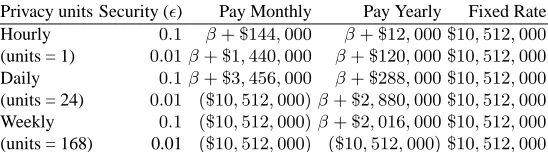
The cost of privacy. Obscuring bills by adding noise may lead to paying extra for a service. Customers have incentives to minimise their costs for a desired level of privacy protection. We provide a few illustrative examples of the average extra cost involved in settling a bill for different privacy units of an hour, a day or a week. In our usual example we consider a private cloud of 10K CPUs, billed as $0.12 a CPU / hour. We denote asβ =f(D)the actual service cost associated with the use of the service for a year.
Privacy units Security () Pay Monthly Pay Yearly Fixed Rate Hourly 0.1 β+ $144,000 β+ $12,000 $10,512,000 (units = 1) 0.01β+ $1,440,000 β+ $120,000 $10,512,000 Daily 0.1β+ $3,456,000 β+ $288,000 $10,512,000 (units = 24) 0.01 ($10,512,000)β+ $2,880,000 $10,512,000 Weekly 0.1 ($10,512,000)β+ $2,016,000 $10,512,000 (units = 168) 0.01 ($10,512,000) ($10,512,000) $10,512,000 Table 1. Yearly average bill after the application of the privacy mechanismK0
compared with the fixed rate privacy mechanism. Different values of the security parameter (), different privacy units (hourly, daily and weekly) as well as the options of paying monthly or yearly are presented. Amounts in parenthesis indicate that the expected cost is higher than paying for the maximum consumption.
Table 1 also contains the cost of paying bills monthly, which incur a 12 fold over-head for the same level of protection. It is clear that there are advantages in paying in batches if in fact the desired property is to hide any fixed period of time within the billing period (an hour, a day, a week). We will see in the next section how we can do better than this: we can aggregate the true cost of service provision, and use cryp-tographic methods to reclaim most of the additional cost of privacy in the long term without sacrificing any security.
Longer guarantees. Degradation of privacy in our framework is graceful, since some privacy guarantees are provided for periods longer than what is strictly defined by the chosen u-units. For example a user may choose a partially-differential functionK,24 providing u-privacy for a day (i.e. 1 u-unit = 24 hourly periods) with= 0.01. In our standing example this means he should add an extra amount to his bill drawn from a Geometric distribution with parameter$2,880,000. What does that guarantee? Let’s assume the adversary knows the exact consumption about all days except for one. Fur-thermore the adversary knows that the consumption on the target day could only have taken one out of two values with equal probability: this means that the ratio of priors
P r[D=D1]
P r[D=D2] = 1. Then after receiving information about the bill the adversary would at
best know that0.99≈ 1/(1 +)≈1/e ≤ P r[D=D1|K0(D)] P r[D=D2|K0(D)] ≤e
≈1 + = 1.01.
This is a small amount of information.
Now let’s consider an adversary that tries to infer something over a longer period, e.g., a week. The adversary knows all user consumption outside this target week, and furthermore knows that user consumption within the week could only have been one of two possibilitiesD0
1orD02with equal probability as before. Due to Lemma 3 we know that theK0(D)scheme is also partially-differentially private for a longer u-unit of a
week (1 weakly-unit =7×24hourly-units), with a new security parameter0 =·7. This
means that the new posterior ratio of probabilities over the two only possible outcomes is0.93≈1/(1 +0)≈1/e0
≤ P r[D=D1|K0(D)] P r[D=D2|K0(D)] ≤e
0
≈1 +0 = 1.07. Despite the
Limitations. Our variant of differential privacy relies on only introducing positive noise. This is desirable as it guarantees that the bill at least covers the cost of service provision. At the same time this provides a one sided security property: a final bill can always be confused with a lower bill, but not always with a higher bill. For example there is a positive probability that a sensitive day passes with no consumption and then no noise is added to the bill. If an adversary knows all other consumptions in the year, they can infer that indeed no consumption took place on the unknown day. Our mechanism thus assumes that the baseline of no consumption is not as sensitive as high consumption.
While information leakage about low levels of consumption is possible, it is not very likely for high levels of security as characterised by the security parameterδ. Summary. We have shown that adding noise to the bill can provide high levels of secu-rity parametrised by a parameterand a privacy unit. This security holds even against adversaries with knowledge of many readings. At the same time this comes with a high overhead. In the next section we show that the bulk of the cost of providing privacy can be recuperated in the long run. We achieve this by keeping hidden accounts of what is actually due for service provision, versus what has been paid. In the long run users can only add the necessary noise to keep their accounts positive, including negative noise – while ensuring that their funds cover their consumption.
3
Cryptographic Building Blocks of the
PBR
Protocol
Signature Schemes A signature scheme consists of the algorithms(Keygen,Sign,Verify).
Keygen(1k)outputs a key pair(sk,pk).Sign(sk, m)outputs a signatureson message m.Verify(pk,s, m)outputsacceptifsis a valid signature onmandrejectotherwise. This definition can be extended to support multi-block messagesm={m1, . . . , mn}.
Existential unforgeability [8] requires that no p.p.t. adversary should be able to output a message-signature pair(s, m)unless he has previously obtained a signature onm. Commitment schemes A non-interactive commitment scheme consists of the algorithms
ComSetup,CommitandOpen.ComSetup(1k)generates the parameters of the
com-mitment schemeparc.Commit(parc, x)outputs a commitmentcxtoxand auxiliary
informationopenx. A commitment is opened by revealing(x,openx) and checking whetherOpen(parc, cx, x,openx)outputsaccept. A commitment scheme has a
hid-ing property and a bindhid-ing property. Informally speakhid-ing, the hidhid-ing property ensures that a commitmentcxtoxdoes not reveal any information aboutx, whereas the binding
property ensures thatcxcannot be opened to another valuex0.
Our protocols make heavy use of homomorphic commitment schemes. A commit-ment scheme is said to be additively homomorphic if, given two commitcommit-mentscx1and cx2 with openings (x1,openx1) and (x2,openx2) respectively, there exists an operation
⊗such that, ifc=cx1⊗cx2, thenOpen(parc, c, x1+x2,openx1+openx2)outputs accept.
him to prove that the public and the secret value together fulfill some relational state-ment(witness,instance)∈ Rwithout disclosing the secret input to the verifier. The protocol should fulfill two properties. First, it should be a proof of knowledge, i.e., a prover without knowledge of the secret input convinces the verifier with negligible probability. More technically, there exists a knowledge extractor that extracts the secret input from a successful prover with all but negligible probability. Second, it should be zero-knowledge, i.e., the verifier learns nothing but the truth of the statement. More technically, for all possible verifiers there exists a simulator that, without knowledge of the secret input, yields a distribution that cannot be distinguished from the interaction with a real prover. Witness indistinguishability is a weaker property that requires that the proof does not reveal which witness (among all possible witnesses) was used by the prover.
We use several existing results to prove statements about discrete logarithms: proof of knowledge of a discrete logarithm [10]; proof of knowledge of the equality of ele-ments in different representations [11]; proof with interval checks [12], range proof [13] and proof of the disjunction or conjunction of any two of the previous [14]. These results are often given in the form of Σ-protocols but they can be turned into non-interactive zero-knowledge arguments in the random oracle model via the Fiat-Shamir heuristic [15].
When referring to the proofs above, we follow the notation introduced by Ca-menisch and Stadler [16] for various proofs of knowledge of discrete logarithms and proofs of the validity of statements about discrete logarithms.NIPK{(α, β, δ) : y =
g0αg1β ∧y˜ = ˜g0αg˜1δ ∧A ≤ α ≤ B} denotes a “zero-knowledge Proof of Knowl-edge of integers α,β, andδsuch thaty = g0αg1β,y˜ = ˜g0αg˜1δ andA ≤ α ≤ B holds”, wherey, g0, g1,y,˜ g˜0,g˜1 are elements of some groupsG = hg0i = hg1iand
˜
G=hg˜0i=hg˜1ithat have the same order. (Note that some elements in the represen-tation ofy andy˜are equal.) The convention is that letters in the parenthesis, in this exampleα,β, and δ, denote quantities whose knowledge is being proven, while all other values are known to the verifier. We denote a non-interactive proof of signature possession asNIPK{(x, sx) :Verify(pk, sx, x) = accept}.
4
Private Billing with Rebates
We have seen that one way of protecting privacy involves adding ‘noise’ to the bill to be payed for a certain period. Yet, the amount of noise can become significant particularly to achieve a high quality of privacy or privacy for longer periods within the billing time frame. For this reason we develop a complementary oblivious billing protocol that can be used to alleviate those concerns. Its key features include:
– The ability to maintain a hidden bill of actual consumption that can be used to reclaim any excess used for protecting privacy at a later time.
– A mechanism for proving that the amount payed to the utility provider exceeds the bill for actual consumption without revealing the actual bill.
– Compatibility with anonymous e-cash schemes allowing bills to be settled anony-mously, as well as advanced privacy friendly payment mechanisms that allow users to hide the amounts actually payed to the utilities.
We discuss in detail and prove the correctness of the billing protocols, and the mech-anisms to ensure payments exceed the amount consumed. The specifics of optional e-cash protocols that allow hidden payments are beyond the scope of this work, and we leave their detailed description to future work.
Our oblivious payment protocols can be used to reclaim in the long run an excess payed as a result of a differentially private billing mechanism as presented in the previ-ous sections. With the deposit facility, adding negative noise is possible, as long as the overall balance of payments stays positive. The protocols can also be used to support the naive mechanism where a bill for maximal consumption is payed, and allow parties to later reclaim some of it back. Finally given anonymous e-cash they can be used to provide full oblivious payments without the need to add any noise to the bills, as they never need to be revealed (technically:noise =−fee). Which variant to use therefore depends on the infrastructure available and the degree of complexity parties are ready to accept.
4.1 The PSM protocol
We will be building upon PSM (Privacy-Preserving Smart Metering), a cryptographic protocol for privacy-friendly billing [2]. PSM mediates interactions among three par-ties: a meterMthat outputs consumption datacons and related informationother; a service providerPthat establishes a pricing policyΥ and a userUthat receives con-sumption readings from meterMand at each billing period pays afee to providerP. The pricing policy Υ is a public function that takes consumption datacons together with other informationother (e.g., the time of consumption) and computes a price. The overall priceprice(D) =P|D|
i=1priceiis computed by adding the prices corresponding
to the individual consumptions in a billing period. For our running private cloud exam-ple,Υ(cons,other) = cons·0.12and does not depend onother. As in the original protocols we assume a tamper resistant meter is used to provide accurate and appropri-ately cryptographically packaged readings. These can be processed by the user to prove their bill in zero-knowledge to the provider. At this point users may also choose to add some noise to ensure differential privacy.
The security of PSM is shown in the simulation-based security paradigm [17– 19]. In the real world, the protocolPSM(M,P,U) is run in an adversarial environ-ment that may corrupt some of the protocol parties, indicated byM,˜ P,˜ U. Corrupted˜ parties just forward messages between the environment and honest protocol partici-pants. In the ideal world, dummy protocol partiesDM,DP,DUrun an ideal protocol
Ideal(FPSM, DM, DP, DU)by just forwarding messages to an ideal functionalityFPSM.
UncorruptedDx,x∈ {M,P,U}interact with the environment while corrupted dummy
partiesD˜xinteract with a simulatorSim.
We consider w.l.o.g. a corrupted providerP˜ and say that a protocol is secure against ˜
Simtranslates influence thatEnvhas throughP˜ on the protocol into influence onFPSM
throughD˜P, and leakage thatD˜Preceives fromFPSMinto leakage thatEnvcould learn
fromP. Similarly, PSM is proven secure against a corrupted user˜ U.˜ Listing 1 FunctionalityFPBR
FPBRis parameterized by deposit relationRand a policy setY and interacts with dummy parties DM,DPandDU. InitiallyT =∅,d= 0,account= 0.
On(Policy, Υ)fromDP whereΥ ∈Y - storeΥ; send(Policy, Υ)toDU On(Consume,cons,other)fromDM
- increment counterd; add(d,cons,other)toT; send(Consume,cons,other)toDU On(Deposit,(inc, wit), instance)fromDUwherebalance+inc≥0
- if((inc, wit), instance)∈R, letbalance+=inc, send(Deposit, instance)toDP On(Payment,from,until, noise)fromDUwhere
0≤from≤until ≤dandbalance+noise≥0
- fori=fromtountil, calculatepricei=Υ(consi,otheri) - letfee=Puntil
i=frompricei+noiseandbalance+=noise
- send(Pay,from,until,fee)toDP
4.2 Rebate Ideal Functionality
We propose a new ideal functionalityFPBR(see Listing 1) that extends the functionality
FPSM. The functionality keeps track of the user’s consumptions in a setT containing
tuples(i,cons,other). During a payment, the policyΥis applied to all(cons,other)in the interval[from,until]to compute the pricepricei =Υ(consi,otheri)per
consump-tion. The overall fee that the user has to pay is computed asfee =Puntil
i=frompricei+
noise. The valuenoiseis added to thefeeto improve the user’s privacy. The ideal func-tionality also maintains a balance that corresponds to the sum of all thenoiseadded to payments. Note that the user can get rebates by using negative noise, but that the balance is never allowed to be negative.
The ideal functionality also allows to increase the balance through a deposit. The user has to provide input((inc, wit),instance)∈R. The parameterization by relation
Rallows to support both standard deposit mechanisms that reveal the deposited amount incas well as advanced deposit mechanisms that hide this value from the provider. In the simple mechanism the user reveals how much he wants to deposit:wit=andR
corresponds to simple equality, i.e.R={(inc, ), inc)|inc∈Z}.
To obtain a more advanced privacy-friendly deposit mechanism, the witness could correspond to a one-show anonymous credentialcred. The relation requires thatcred is a one-show credential with an increment valueincand serial numbersissued un-der public key pkB, i.e, R = {((inc, cred),(s,pkB))|Verify(pkB,cred,(inc, s)) =
accept}. The real protocol cryptographically enforces this using a zero-knowledge proof.7To obtain such a one-show credential without revealing the value ofincto the
7A zero-knowledge proof of knowledge [9] is a two-party protocol between a prover and a
provider, additional infrastructure is needed. In particular such a mechanism seems to require some form of anonymous payment, either physical cash or anonymous e-cash. Given such a payment mechanism, the provider’s bank, after receiving an anonymous payment of valueincand depositing this amount on the provider’s bank account, could blindly issue the signature Sign(pkB,(inc, s))using a partially-blind issuing proto-col [20]. The issue protoproto-col guarantees that the bank does not learns, and thus even if the provider and his bank collude they cannot link the issuing ofcredto its use. Listing 2 ProtocolPBR(M,P,U)
PartiesM,P,Uare parameterized byRandY and interact over secure channels. All participants have registered public keys generated byMkeygen,Pkeygen,Ukeygenwith a key registration authorityFREGand keep their private keys secret.Palso registers commitment parametersparc.
On(Policy, Υ)fromEnv
- PrunsΥs←SignPolicy(skP, Υ)and sendsΥstoU - Upon receivingΥs,UextractsΥ; ifΥ /∈Y, he aborts
- ifVerifyPolicy(pkP, Υs) = 1,UstoresΥs, and sends(Policy, Υ)toEnv On(Consume,cons,other)fromEnv
- MincrementsdM, runs SC ← SignConsumption(skM,parc,cons,other,dM)and sends(SC)toU
- Upon receiving(SC),Urunsb←VerifyConsumption(pkM,parc,SC,dU+ 1) - ifb= 1,UincrementsdU, addsSCtoTU, parsesSCas(dM,cons,opencons, ccons,
other,openother, cother,sc), and sends(Consume,cons,other)toEnv
On(Deposit,(inc, wit), instance)fromEnvwhere
balance+inc≥0and((inc, wit), instance)∈R
- Uruns(aux0
, D)←Deposit(parc,(inc, wit),instance,aux, R)
- Usetsbalance+=incandaux =aux0
and sends(D, instance)toP - Upon receiving(D, instance),Pruns(c0
balance, b)←VerifyDeposit(parc, D, cbalance,
instance, R)
- ifb= 1, he setscbalance=c0balanceand sends(Deposit, instance)toEnv
On(Payment,from,until,noise)fromEnvwhere
0≤from≤until ≤dUandbalance+noise≥0
- Uruns(aux0
,Q)←Pay(skU,parc, Υs, TU[from:until],noise,aux)
- Usetsaux=aux0
andbalance+=noise;Usends(Q,from,until)toP
- Upon receiving(Q,from,until),P runs (fee, c0
balance, b) ← VerifyPayment(pkM,
pkU,pkP,parc,Q, cbalance,from,until)
- if b=1, he setscbalance=c
0
balanceand sends(Pay,from,until,fee)toEnv
4.3 Rebate Protocol
We propose a new protocol for privacy-preserving billing with rebates (PBR) (see List-ing 2) that extendsPSMwith a mechanism for adding noise, keeping a hidden balance, and making deposits. LikePSM, our protocol operates in theFREG hybrid-model [17]
where parties register their public keys at a trusted registration entity. As in the original scheme the user receives signed policies from the utility providerPand signed readings from the meterM. The payment transaction only reveals the overall fee, which now can be subject to additional noise.
using a homomorphic updatecnoiseto a balance commitmentcbalancethat commits the user to his balance towards the provider but keeps thebalanceitself secret. Our protocol supports an optionalDepositmechanism that allows the user to add or withdraw funds from the rebatebalance. Valueauxcontains the opening for a commitmentcbalanceto balance. Through the use of zero-knowledge proofs the provider is guaranteed that the value committed to incbalanceis updated correctly and never becomes negative.
The protocol partiesP,U, andMinteract with each other using algorithmsPkeygen, Ukeygen,Mkeygen(for key generation);SignPolicy,SignConsumption,Deposit, and
Pay (for generation of input); and VerifyPolicy, VerifyConsumption, VerifyDeposit, andVerifyPayment(for verification of input). The functionality of the meter as well asSignPolicy,SignConsumption,VerifyPolicy, andVerifyConsumptionare unchanged from the original scheme.8We describe the newDepositandVerifyDepositalgorithms and the changes toPayandVerifyPayment:
Listing 3 Algorithms
- Deposit(parc,(inc, wit),instance,aux, R). Parseauxas(balance,openbalance, cbalance).
Compute commitment(cinc,openinc) = Commit(parc,inc)and a non-interactive proof
πinc:9
πinc←NIPK{(inc,openinc, wit,balance,openbalance) :
(cbalance,openbalance) =Commit(parc,balance)∧
(cinc,openinc) =Commit(parc,inc)∧
((inc,wit),instance)∈R ∧ balance+inc≥0}.
LetD= (πinc, cinc)andaux0= (balance+inc,openbalance+openinc, cbalance⊗cinc).
Output(aux0
, D).
- VerifyDeposit(parc, D, cbalance,instance, R). ParseDas(πbalance, cinc). Verifyπinc. If
verification succeeds, setb= 1andc0
balance =cbalance⊗cinc, otherwise setb= 0. Output
(c0
balance, b).
- Pay(skU,parc, Υs, T,noise,aux). Parseauxas(balance,openbalance, cbalance). Compute
commitment(cnoise,opennoise) =Commit(parc,noise)and a non-interactive proofπnoise:
πnoise←NIPK{(noise,opennoise,balance,openbalance) :
(cbalance,openbalance) =Commit(parc,balance)∧
(cinc,openinc) =Commit(parc,inc)∧
balance+noise≥0}.
Letaux0
= (balance+noise,openbalance+opennoise, cbalance⊗cnoise).
The rest of the algorithm follows [2]: For each(i,cons,opencons, ccons,other,openother,
cother,sc)∈Twherefrom≤i≤until, calculatepricei=Υ(cons,other), commitment (cpricei,openpricei) = Commit(parc,price), and a proof πi that pricei was computed
correctly according to the policy and the commitmentsccons,cother. The proofπidepends on the policyΥ and can use auxiliary values inΥs, see [2] on how to implement different pricing policies.
Computingfee=noise+Puntil
i=frompriceiandopenfee =opennoise+
Puntil
i=fromopenpricei
gives an opening to a commitment tofee. LetQ = (fee,openfee, cnoise, πbalance,{sci, i, cconsi, cotheri, cpricei, πi}
N
i=1). Output(aux
0
,Q).
8
For the sake of brevity we omit theRevealmechanism of PSM. It would add little new and could be implemented in a straight forward manner using trapdoor commitments.
9IfRcorresponds to equality, the protocol can be simplified to avoid computingc
- VerifyPayment(pkM,pkU,pkP,parc,Q, cbalance,from,until). Parse Qas (fee,openfee,
cnoise, πbalance,{sci,di, cconsi, cotheri, cpricei, πi}
N
i=1). Verifyπnoise. If verification fails,
setb= 0. Otherwise setc0
balance=cbalance⊗cnoiseandb= 1.
The rest of the algorithm follows [2]: Fori=fromtountil, runMverify(pkM,sci,hi, cconsi,
cotherii)and verifyπi. Setb= 0if any of the signatures or the proofs is not correct. Add
the commitments to the pricesc0
fee =cnoise⊗ ⊗
N i=1cpricei
and executeOpen(parc, c0fee,
fee,openfee). If the output isrejectsetb= 0. Output(fee, c
0
balance, b).
Theorem 1. Given the security of its building blocks,PBR is secure against a cor-rupted providerP˜and a corrupted userU. (See Appendix with supplemental material.)˜
UsingPBRfor differential privacy. Even an ideal cryptographic billing mechanism as described by thePSM orPBR ideal functionalities cannot protect the user’s privacy against an adversary/environment that already knows enough about the user’s behav-ior – possibly including all consumption or additional random noise – to infer privacy sensitive information from the final fee alone. For our privacy analysis we assume that the environmentEnvis divided into a partEnvUthat is controlled by the user, and a partEnvP˜ that is controlled by the adversary and that may have some influence on and knowledge about the user’s behavior. In the originalPSMprotocol all the final fee is only the result of the individual consumptions ofEnvU for which the provider may make inferences or gain side information. ThePBRprotocol givesEnvUthe possibility to obscure the fee with random noise, which is easier to conceal fromEnvP˜.
5
Proof of
PBR
Protocol
Let≡denote computational indistinguishability. The following two claims have been proven about PSM [2]:
Claim (Security of PSM Against Corrupted Provider). Under the unforgeability of the signature schemes (Mkeygen,Msign,Mverify)and(Ukeygen,Usign,Uverify), under the hiding property of the commitment scheme, and the extractability and witness-indistinguishability of the proofs of knowledge, there exists a p.p.t.Simsuch that for all p.p.t.Env:
EnvkPSM(M,P˜,U)≡EnvkSimkIdeal(FPSM, DM,D˜P, DU).
Claim (Security of PSM Against Corrupted User). Under the unforgeability of the sig-nature schemes(Mkeygen,Msign,Mverify)and(Pkeygen,Psign,Pverify), under the binding property of the commitment scheme, and under the extractability and zero-knowledge property of the proofs of zero-knowledge, there exists a p.p.t.Simsuch that for all p.p.t.Env:
EnvkPSM(M,P,U)˜ ≡EnvkSimkIdeal(FPSM, DM, DP,D˜U).
Claim (Security of PBR Against Corrupted Provider). Under the unforgeability of the signature schemes (Mkeygen,Msign,Mverify)and(Ukeygen,Usign,Uverify), under the hiding property of the commitment scheme, and the zero-knowledge property of the proofs of knowledge,10there exists a p.p.t.Sim
˜
Psuch that for all p.p.t.Env:
EnvkPBR(M,P˜,U)≡EnvkSimP˜kIdeal(FPSM, DM,D˜P, DU).
Proof. We describe a series of game transformations that gradually change the crypto-graphic payload of messages as they are sent by the real protocol into the cryptocrypto-graphic payload of messages of the simulation. In each step the new game is shown to be com-putationally indistinguishable from the previous one.
– Game 0 - Game 3: These game transformations are unchanged from Appendix A of [2]. Game 3 corresponds to the execution of the real-world protocol, except that public keyspkMandpkUare replaced by other keyspk0Mandpk0Ufrom the same distribution, and that the game aborts ifEnvsends a message-signature pair (m, s)verifiable under public keypk0Morpk0Ubut for whichEnvdid not receive a signature on messagemverifiable under public keypk0Morpk0Urespectively. Lemma 5. Under the unforgeability of the signature schemes(Mkeygen,Msign,
Mverify),(Ukeygen,Usign,Uverify)the difference|Pr[Game 3]−Pr[Game 0]|
=ν1−2(κ).
– Game 4: This game proceeds as Game 3, except that the user keeps two different balances:balance andbalancec:balance is used for all checks, whilebalancecis
the value in commitmentcbalance. Commitmentscpricei are replaced by commit-ments to0, and commitmentscconsi,cotheriare replaced by commitments to tuples
(0,other0i)that map to0followingΥ. The commitmentcnoisein the payment mes-sageQis replaced by a commitment tonoise0 =fee. The proofsπiandπnoise are recomputed according to thePayalgorithm. The value ofbalance is updated with respect tonoise, whilebalancecandauxare updated with respect tonoise0.
Lemma 6. Under the assumption that the commitment scheme is perfectly hiding and that the non-interactive proofs of knowledge are witness indistinguishable the difference|Pr[Game 4]−Pr[Game 3]|=ν3(κ).
– Game 5: This game proceeds as Game 4, except that the proofπinc is replaced by a simulated proof of the same statement.
Lemma 7. Under the zero-knowledge property of the proofs of knowledge the dif-ference|Pr[Game 5]−Pr[Game 4]|=ν4(κ).
– Game 6: This game proceeds as Game 5, except that the commitmentcinc in the payment messageD is replaced by a commitment to the largestinc0 such that
balance+inc0≥0and∃wit: ((inc0, wit), instance)∈R. The value ofbalance
is updated with respect toinc, whilebalancecandauxare updated with respect to
inc0.
Lemma 8. Under the assumption that the commitment scheme is perfectly hiding and that the non-interactive proofs of knowledge are witness indistinguishable the difference|Pr[Game 6]−Pr[Game 5]|=ν5(κ).
SimP˜ does the same aborts, commitments, and proofs as Game 6, and forwards and receives messages fromFPBRas described in Listing 4. The strategy behind the
simula-tion of setup and initializasimula-tion is unchanged from Appendix A of [2]. The distribusimula-tion produced in Game 6 is identical to that of our simulation. By summation we have that
|Pr[Game 6]| ≤ν6(κ). ut
Listing 4 SimulatorSimP˜
SimP˜ is parameterized byRandY and interacts withFPBRthrough the dummy partyD˜Pand withEnvthrough the corrupted partyP˜.FREGis simulated as for thePSMscheme.
On(Policy, Υ)fromEnvthroughP˜ (Initialization)
- extractΥ; ifΥ /∈Y, abort
- ifVerifyPolicy(pkP, Υs) = 1, storeΥs, and send(Policy, Υ)toFPBRthroughD˜P
On(Deposit, instance)fromFPBRthroughDP˜ (Deposit)
- pick the largestincsuch that∃wit: ((inc, wit), instance)∈R
- compute a commitment(cinc,openinc) = Commit(parc,inc)and a simulated
non-interactive proofπinc
- letD= (πinc, cinc)andaux0= (balance+inc,openbalance+openinc, cbalance⊗cinc)
- setbalance+=incandaux=aux0
and send(D, instance)toEnvthroughP˜
On(Pay,from,until,fee)fromFPBRthroughD˜P (Payment)
- setnoise=feeandcons0
i= 0and pickother
0
isuch thatΥ(cons
0
i,other
0
i) = 0 - fori=f romtountil, runSCi←SignConsumption(skM,parc,cons0i,other
0
i, i) - create a tableTSimwith the signed consumptionsSCi
- run(Q,aux0
)←Pay(skU,parc, Υs, TSim,noise,aux) - letaux=aux0
; send(Q,from,until)toEnvthroughP˜.
Claim (Security of PBR Against Corrupted User). Under the unforgeability of the sig-nature schemes(Mkeygen,Msign,Mverify)and(Pkeygen,Psign,Pverify), under the binding property of the commitment scheme, and under the extractability property of the proofs of knowledge, there exists a p.p.t.SimU˜ such that for all p.p.t.Env:
EnvkPBR(M,P,U)˜ ≡EnvkSimU˜kIdeal(FPSM, DM, DP,D˜U).
Proof. We describe a series of game transformations that gradually change the crypto-graphic payload of messages as they are sent by the real protocol into the cryptocrypto-graphic payload of messages of the simulation. In each step the new game is shown to be com-putationally indistinguishable from the previous one.
– Game 0 - Game 4: These game transformations are unchanged from Appendix B of [2]. Game 4 corresponds to the execution of the real-world protocol, except for the following changes: The public keyspkMandpkPand the commitment param-etersparcare replaced by other keyspk0Mandpk0Pandparc0 from the same dis-tribution. Game 4 aborts if the witnesses of the proofsπiincluded in the payment
Lemma 9. Under the proof of knowledge property of the proof system and the un-forgeability of the signature schemes(Mkeygen,Msign,Mverify), and(Pkeygen,
Psign,Pverify)the difference|Pr[Game 4]−Pr[Game 0]|=ν1−3(κ).
– Game 5: This game proceeds as Game 4, except that it aborts if the witnesses of the proofsπincandπnoisecannot be extracted.
Lemma 10. Under the proof of knowledge property of the proof system the differ-ence|Pr[Game 5]−Pr[Game 4]|=ν4(κ).
– Game 6: This game proceeds as Game 5, except that it aborts ifEnv sends a payment messageQin which(fee,openfee)is a correct opening of commitment
cnoise⊗ ⊗Ni=1cpricei, butfee 6=noise+P until
i=frompriceiwherenoiseandpricei
are taken from the witnesses ofπnoiseandπiinQ.
Lemma 11. Under the binding property of the commitment scheme, the difference |Pr[Game 6]−Pr[Game 5]|=ν5(κ).
SimU˜ performs all the changes in Game 6, and forwards and receives messages from FPBRas described in Listing 5. The strategy behind the simulation of setup,
initial-ization, and consumption is unchanged from Appendix B of [2]. The distribution pro-duced in Game 6 is identical to that of our simulation. By summation we have that
|Pr[Game 6]| ≤ν6(κ). ut
Listing 5 SimulatorSimU˜
SimU˜ is parameterized byRandY and interacts withFPBRthrough the dummy partyD˜Uand withEnvthrough corrupted partyU˜.FREGis simulated as for thePSMscheme.
On(Policy, Υ)fromFPBRthroughDU˜ (Initialization)
- runΥs←SignPolicy(skP, Υ)and sendΥstoEnvthroughU˜.
On(Consume,cons,other)fromFPBRthroughD˜U (Consumption) - incrementdM, runSC←SignConsumption(skM,parc,cons,other,dM)
- send(SC)toEnvthroughU˜.
On(D, instance)fromEnvthroughU˜ (Deposit) - run(c0
balance, b)←VerifyDeposit(parc, D, cbalance,instance, R).
- ifb = 1and none of the conditions described in Game 5 are fulfilled, setcbalance =
c0
balance, extractinc, witfromπincand send(Deposit,(inc, wit), instance)toFPBR throughDU.˜
On(Q,from,until)fromEnvthroughU˜, (Payment)
- run(fee, c0
balance, b)←VerifyPayment(pkM,pkU,pkP,parc,Q, cbalance,from,until).
- if b = 1 and none of the conditions described in Game 4, Game 5, and Game 6 are fulfilled, setcbalance = c
0
balance, extractnoisefromπnoise and send(Payment,
6
Conclusions
OurPBRprotocol allows the user to add random noise to the final bill, to hide usage patterns that could otherwise be deduced from the fee. The rebate protocol supports deposits, anonymous payments using e-cash, and negative bill noise, while ensuring that the funds paid always cover the cost of consumption. The use of noise, however, comes at a cost, as it is money that the user has to pay upfront as a deposit and cannot invest elsewhere.
Consequently, we adapt the differential privacy framework to study how much noise is needed to protect specific consumption windows at different security levels. The dif-ferential privacy framework protects users against worse case outcomes – we leave as an open problem crafting more economical noise regimes to protect privacy by making further assumption about the users’ typical behavior.
Acknowledgment
We would like to thank Claudia Diaz, Carmela Troncoso, Cedric Fournet, and Jorn Lapon for discussions and comments that were most helpful in the preparation and presentation of this work.
References
1. Balasch, J., Rial, A., Troncoso, C., Preneel, B., Verbauwhede, I., Geuens, C.: Pretp: Privacy-preserving electronic toll pricing. In: USENIX Security Symposium, USENIX Association (2010) 63–78
2. Rial, A., Danezis, G.: Privacy-preserving smart metering. Technical Report MSR-TR-2010-150, Microsoft Research (November 2010)
3. Lipner, S.B.: A comment on the confinement problem. In: Proceedings of the fifth ACM symposium on Operating systems principles. SOSP ’75, New York, NY, USA, ACM (1975) 192–196
4. Dwork, C.: Differential privacy. In Bugliesi, M., Preneel, B., Sassone, V., Wegener, I., eds.: ICALP (2). Volume 4052 of Lecture Notes in Computer Science., Springer (2006) 1–12 5. Dwork, C.: Differential privacy in new settings. In Charikar, M., ed.: SODA, SIAM (2010)
174–183
6. Ghosh, A., Roughgarden, T., Sundararajan, M.: Universally utility-maximizing privacy mechanisms. In: Proceedings of the 41st annual ACM symposium on Theory of comput-ing. STOC ’09, New York, NY, USA, ACM (2009) 351–360
7. Barak, B., Chaudhuri, K., Dwork, C., Kale, S., McSherry, F., Talwar, K.: Privacy, accuracy, and consistency too: a holistic solution to contingency table release. In Libkin, L., ed.: PODS, ACM (2007) 273–282
8. Goldwasser, S., Micali, S., Rivest, R.: A digital signature scheme secure against adaptive chosen-message attacks. SIAM J. Comput. 17(2) (1988) 281–308
9. Bellare, M., Goldreich, O.: On defining proofs of knowledge. In Brickell, E.F., ed.: CRYPTO ’92. Volume 740., Springer-Verlag (1992) 390–420
11. Chaum, D., Pedersen, T.: Wallet databases with observers. In: CRYPTO ’92. Volume 740 of LNCS. (1993) 89–105
12. Okamoto, T.: An efficient divisible electronic cash scheme. In Coppersmith, D., ed.: CRYPTO. Volume 963 of Lecture Notes in Computer Science., Springer (1995) 438–451 13. Boudot, F.: Efficient proofs that a committed number lies in an interval. In Preneel, B.,
ed.: EUROCRYPT. Volume 1807 of Lecture Notes in Computer Science., Springer (2000) 431–444
14. Cramer, R., Damg˚ard, I., Schoenmakers, B.: Proofs of partial knowledge and simplified design of witness hiding protocols. In Desmedt, Y., ed.: CRYPTO. Volume 839 of Lecture Notes in Computer Science., Springer (1994) 174–187
15. Fiat, A., Shamir, A.: How to prove yourself: Practical solutions to identification and signature problems. In Odlyzko, A., ed.: CRYPTO. Volume 263 of LNCS., Springer (1986) 186–194 16. Camenisch, J., Stadler, M.: Proof systems for general statements about discrete logarithms.
Technical Report TR 260, Institute for Theoretical Computer Science, ETH Z¨urich (March 1997)
17. Canetti, R.: Universally composable security: A new paradigm for cryptographic protocols. In: FOCS. (2001) 136–145
18. Backes, M., Pfitzmann, B., Waidner, M.: The reactive simulatability (rsim) framework for asynchronous systems. Inf. Comput. 205(12) (2007) 1685–1720
19. Kusters, R.: Simulation-based security with inexhaustible interactive turing machines. In: Computer Security Foundations Workshop, 2006. 19th IEEE, IEEE (2006) 12–320 20. Camenisch, J., Lysyanskaya, A.: A signature scheme with efficient protocols. In: In SCN
A
Generalized Differential Privacy
We observe that differential privacy can be defined not only for databases that differ in exactly one record, but for any two database accepted byK that are in some relation
R⊂ D × D.
Definition 8. A randomized functionK gives-differentialR-privacy if for all data setsD1, D2∈R, and allS∈ΣImage(K),
P r[K(D)∈S|D=D1]≤exp()×P r[K(D)∈S|D=D2].
The probability is taken over the randomness ofK.
Existing differential privacy mechanisms can be adapted to meet this new notion by adjusting the sensitivity function to∆f,R.
Definition 9. The sensitivity of a functionf : D →Rnis the maximum distance
be-tween output values for pairs(D1, D2)∈R:
∆f,R= max
D1,D2∈R
kf(D1)−f(D2)k1
Forn = 1the sensitivity off is the maximum difference|f(D1)−f(D2)|between databasesD1, D2that are in relationR.
The fact that differential privacy can be generalized in this way is by itself not very surprising. The new notion, however, becomes interesting when one stops using differential privacy to define that an individual is not worse off no matter whether he participates in a database or not, but to define that he (or in fact everyone contributing to the database) is no worse off no matter whether he behaves in this particular way (D1) or that particular way (D2) – for all behaviors resulting in databases related by (D1, D2)∈R.
In particular ouru-privacy notion can also be defined in the following way:
Ru={(D1, D2)|Distu(D1, D2)≤1}.
Given this definition of differential privacy, one can also start with a privacy budget that fixes∆fto examine the amount of protection one can buy by looking at