Available Online at www.ijcsmc.com
International Journal of Computer Science and Mobile Computing
A Monthly Journal of Computer Science and Information Technology
ISSN 2320–088X
IMPACT FACTOR: 5.258
IJCSMC, Vol. 5, Issue. 8, August 2016, pg.73 – 77
A Framework of Mobile
Device Research in HCI
G Ravi Kumar
1, P Prudhvi Kiran
2¹Department of Information Technology & VIIT Visakhapatnam, India ²Department of Information Technology & VIIT Visakhapatnam, India
1
[email protected]; 2 [email protected]
Abstract - This paper presents a framework illustrates the various trends that point toward the increasing importance of mobile device research in Human Computer Interaction (HCI). These trends indicate a future in which the gap between the user and the mobile is even closer than today and computer use is more intermittent and in a greater variety of contexts than our current user models accommodate. The implications are that mobile devices must be made more accessible to an aging population, they must be designed for “situational impairments” incurred from on-the-go use, they must adopt flexible and rapid input mechanisms, and the models that describe them must be revamped to accommodate mobile use and behaviour. There are also opportunities for using mobile devices in various educational and industrial purposes in developing nations like India, where mobile devices became more common than desktop PCs.
Keywords - HCI, Mobile, User Interaction, User Needs, Interface Development, HCI Issues
I. INTRODUCTION
The last decade has seen a surge in off-desktop human computer interaction due to the prolific spread of mobile technologies. Such technologies include PDAs, handheld communicators, pocket music players, two-way pagers, digital cameras, smart watches, GPS units, medical and factory devices, and mobile phones.
There are also numerous hybrid devices that combine two or more of these devices into a single unit. Along with the advent of these devices has come a flurry of HCI research on topics including mobile input techniques [10], handheld web browsing [9,20], adaptive mobile interfaces [14], interfaces that span from devices to desktops [13], sensing devices [4], and many new mobile applications [7].
quickly reached the point where we can no longer afford to consider devices in isolation, but must take into account the larger social and contextual factors surrounding mobile device use.
Various factors include
A. The overall aging of the population.
B. The increasing amount of personal computing done away from the desktop.
C. The increasing capabilities of ever-smaller devices.
D. The convergence of computing capabilities onto the mobile phone.
A. The overall aging of the population
The current population of the United States is 296.5 million people. By 2050, this number is projected to swell to 419.9 million [15], an increase of nearly 42% in only 45 years. Of the current population, 12% are aged 65 or over,1 and this number is projected to reach 20% by just 2030 [8]. Europe is also aging. The percent of people aged 65 or over is projected to reach 23.5% by 2030, up from just 14.7% in 2000 [8]. Also consider that the average life expectancy for American males is 75 years, and for females it is 80 years. Life expectancy in Canada is even slightly higher. Clearly, the elderly are fast becoming a crucial demographic to consider, and one for whom current mobile interfaces may not be suitable.
B. The increasing amount of personal computing done away from the desktop.
As mobile devices permeate our lives, greater opportunities exist for interacting with computers away from the desktop. But the contexts of mobile device use are far more varied, and potentially compromised, than the contexts in which we interact with desktop computers. For example, a person using a mobile device on the beach in San Diego may struggle to read the device’s screen due to glare caused by bright sunlight, while a user on an icy sidewalk in Pittsburgh may have gloves on and be unable to accurately press keys or extract a stylus. By comparison, the differences between these people’s desktop experiences would almost certainly not be so dramatic.
C. The increasing capabilities of ever-smaller devices.
With the advent of so many new devices, it can be frustrating to learn new input techniques when encountering each new device. For instance, on the Palm PDA we had Graffiti. Then it became Graffiti 2. PocketPC devices use Jot. Then there are two-way pagers, like the Glenayre Access Link II (http://www.glenayre.com), which uses four directional arrows and a SELECT key.
D. The convergence of computing capabilities onto the mobile phone.
II. BROAD HCIISSUESCREATINGIMPACTONMOBILEUSERS
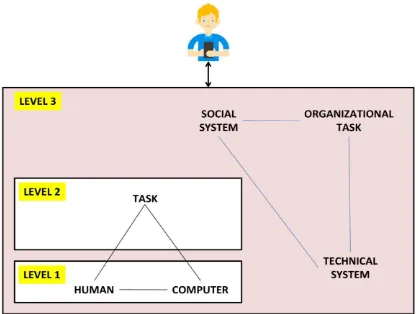
Only a few comprehensive frameworks of HCI issues and topics have been developed so far. This coincides with the observation that no agreed upon definitions of the range of topics for HCI exist. Among these few frameworks, Eason (1991) proposed a three-level model of HCI model, as depicted in the below figure.
In Figure,
A. Level 1 considers human–computer interaction as a form of conversation between two participants capable of processing information.
B. Level 2 broadens the framework to examine user, task, and environmental factors which may affect task performance. The next level considers the factors which are important when human–computer interaction takes place within a socio-technical systems framework. In Eason’s framework, environmental factors at Level 2 mainly refer to the physical environment such as visual display terminals and physical settings in which computers are used.
C. Level 3 IT and the interaction between human and computers have impacts on social life by changing the nature of jobs, the way organizations operate, and the way people interact with each other.
Fig. 1 User interaction with Three level model of HCI
III.FACTORS IN HCI IMPACTING MOBILE USERS
TABLEI FACTORS WITH ATTRIBUTES
Organizational Factors
Training
Job design
Politics
Environmental Factors Noise
Heating
Lighting
Health and Safety Factors Stress
Headaches
Disorders
The User Motivation
Enjoyment
Satisfaction
Comfort Factors Seating
Equipment layout
Plan
User Interface Input devices
Output displays
Natural language
Task Factors
Easy
Novel
Task Allocation
System Functionality
Hardware
Software
Application
IV.CONCLUSIONS
Important trends are underway concerning the proliferation and use of mobile devices. Although we will have the desktop computer with us for many years to come, mobile devices represent an even larger portion of the future of HCI. New research opportunities exist for improving mobile device accessibility; understanding, sensing, and responding to situational impairments; inventing new input techniques that can be used across multiple devices; and deploying new applications for education and medicine in developing nations. These exciting efforts await researchers skilled in mobile HCI and in meeting the needs of real users.
ACKNOWLEDGEMENT
I consider it as a privilege to thank all those people who helped me a lot for successful completion of this paper and helping me to improve the quality of work.
R
EFERENCES[1] Blair, P. (2005) A customizable hardware input interface for wireless, mobile devices. Proceedings of RESNA 2005. Arlington, Virginia: RESNA Press.
[2] Ferrett, G. (2004) Africans rush for mobile phones.BBC News. Published May 5, 2004. http://news.bbc.co.uk/1/hi/world/africa/3686463.stm
[3] GSM World. (2004) The Netsize Guide.http://www.gsmworld.com/
[4] Hinckley, K., Pierce, J., Sinclair, M. and Horvitz, E. (2000) Sensing techniques for mobile interaction. Proceedings of UIST 2000. New York: ACM Press, pp. 91-100. [5] Hirotaka, N. (2003) Reassessing current cell phone designs: Using thumb input
effectively. Extended Abstracts of CHI 2003. New York: ACM Press, pp. 938-939. [6] Isokoski, P. and Raisamo, R. (2000) Device independent text input: A rationale and
an example. Proceedings of AVI 2000. New York: ACM Press, pp. 76-83.
[8] Kinsella, K. and Phillips, D.R. (2005) Global aging: The challenge of success. Population Bulletin 60 (1). Washington, D.C.: Population Reference Bureau.
[9] Lam, H. and Baudisch, P. (2005) Summary Thumbnails: Readable overviews for small screen web browsers. Proceedings of CHI 2005. New York: ACM Press, pp. 681-690.
[10] MacKenzie, I.S. and Soukoreff, R.W. (2002) Text entry for mobile computing: Models and methods, theory and practice. Human Computer Interaction 17 (2), pp. 147-198.
[11] Microsoft Corporation. (2005) Digital Inclusion Through Mobile and Wireless Technologies Research Funding Initiative. http://research.microsoft.com/
[12] Mustonen, T., Olkkonen, M. and Häkkinen, J. (2004) Examining mobile phone text legibility while walking. Proceedings of CHI 2004. New York: ACM Press, pp. 1243-1246.
[13] Myers, B.A. (2001) Using hand-held devices and PCs together. Communications of the ACM 44 (11), pp. 34- 41.
[14] Nichols, J., Myers, B.A. and Rothrock, B. (2006) UNIFORM: Automatically generating consistent remote control user interfaces. Proceedings of CHI 2006. New York: ACM Press, in press.