UTILIZATION OF IMMUNIZATION SERVICES AMONG CHILDREN AGED UNDER FIVE IN KIRINYAGA COUNTY, KENYA
MARGARET WANGUI NJERU (BScN)
Q139/27683/2014
DEPARTMENT OF POPULATION AND REPRODUCTIVE HEALTH
THESIS SUBMITTED IN PARTIAL FULLFILMENT OF THE REQUIREMENTS FOR THE AWARD OF THE DEGREE OF MASTER OF PUBLIC HEALTH (REPRODUCTIVE HEALTH) IN THE SHOOL OF PUBLIC
HEALTH OF KENYATTA UNIVERSITY
DECLARATION
This research thesis is my original work and has not been presented for a degree in any other University.
Signature ………..….. Date ………
Margaret Wangui Njeru
Q139/27683/2014
Supervisors:
This research thesis has been submitted for review with our approval as University Supervisors.
Signature ……… Date ………..
Dr Albert Gachau
Department of Pathology
Kenyatta University
Signature ………. Date ………
Dr Priscilla N. Kabue
Department of Community Health Nursing
DEDICATION STATEMENT
ACKNOWLEDGEMENT
I would like to show appreciation to the Chairman of the Department of Population and Reproductive Health and the lecturers who trained me all the way through this course. I am indebted to my supervisors Dr Albert Gachau and Dr Priscilla N. Kabue for their assistance and ensuring that I have done and completed this thesis. I am grateful for their effort and continued unrelenting input through encouraging remarks and suggestions. My family has been of immense contribution from the beginning to the end of this paper. I am particularly grateful for their patience for the times I had to remain in school over the weekends and at times arrive home late.
I welcome the help colleagues at my work place offered. Special thanks goes to friends and classmates who stood with me through out in the course of this study. I would like to appreciate many others who directly or indirectly contributed to a successful completion of my thesis.
I would like to also acknowledge the respondents in the study as well as the various authorities such as KU – ERC and NACOSTI that made the study possible.
TABLE OF CONTENTS
DECLARATION ... ii
DEDICATION STATEMENT ... iii
ACKNOWLEDGEMENT ... iv
TABLE OF CONTENTS ... v
LIST OF FIGURES ... x
Abbreviations and Acronyms ... xi
Definition of operational terms ... xiii
Abstract ... xv
CHAPTER ONE: INTRODUCTION ... 1
1.1 Background of the Study ... 1
1.2 Problem Statement ... 3
1.3 Justification of the Study ... 4
1.4 Research Questions ... 4
1.5 Null Hypothesis ... 4
1.6 Research Objectives ... 5
1.6.1 Main Objective... 5
1.6.2 Specific Objectives... 5
1.7 Significance of the study ... 5
1.8 De-Limitations and Limitations of the Study ... 5
1.8.1 Delimitation of the Study... 5
1.8.2 Limitations of the Study ... 6
1.9 Theoretical Framework ... 6
1.10 Conceptual Framework ... 7
CHAPTER TWO: LITERATURE REVIEW ... 9
2.2 Utilization of Immunization Services Among Children Aged Under Five... 10
2.3 Social Demographic Factors Associated with Utilization Of Immunization Services Among Children Aged Under Five ... 13
2.4 Health Service Factors Influencing Utilization of Immunization Services Among Children Aged Under Five ... 16
2.5 Family Factors Associated with Utilization of Immunization Services Among Children Aged Under Five ... 19
2.6 Gaps in Immunization ... 21
CHAPTER THREE: MATERIALS AND METHODS ... 22
3.1 Introduction ... 22
3.2 Research Design ... 22
3.3 Variables... 22
3.4 Location of the Study ... 22
3.5 Study Population. ... 23
3.6 Inclusion and exclusion criteria ... 23
3.6.1 Inclusion Criteria ... 23
3.6.2 Exclusion Criteria ... 23
3.7 Sample Size Determination ... 23
3.9 Research Instruments ... 26
3.10 Pre-Testing of research instruments ... 26
3.11 Validity ... 26
3.12 Reliability ... 26
3.13 Data collections Techniques ... 27
3.14 Data management and Analysis... 27
3.15 Logistical and Ethical Considerations ... 27
CHAPTER FOUR: RESULTS... 29
4.2 Demographic Information of the Respondents ... 30
4.2.1 Socio-Demographic Information of the Respondents ... 30
4.3 Utilization of Immunization Services Among Children Aged Under Five... 31
4.4 Social-Demographic Factors Associated with Utilisation Of Immunisation Services. ... 32
4.4.1. Effects of Religion on Utilization of Immunization Services ... 32
4.4.2 Effects of Income on Utilization of Immunization Service ... 33
4.5 Health Service Factors Influencing Childhood Immunization ... 36
4.5.1 Health Service factors influencing utilization of immunization services. 37 4.6 Family Factors Associated with Childhood Immunization ... 39
4.6.1 Family Factors associated with Utilization of Immunization Services .... 40
CHAPTER FIVE: DISCUSSION, CONCLUSIONS AND RECOMMENDATIONS ... 43
5.1 Introduction ... 43
5.2 Utilization of Immunization Services Among Children Aged Under Five. .... 43
5.3 Socio-Demographic Factors Associated with Utilization of Immunization Services. ... 46
5.4 Health Service Factors Influencing Utilization of Immunization Services... 47
5.5 Family Factors Associated with Utilization of Immunization Services ... 50
5.6 Summary of The Findings ... 51
5.7 Conclusion ... 52
5.7 Recommendations ... 53
5.8 Further Research ... 54
REFERENCES ... 55
APPENDIX I. ... 58
APPENDIX II. ... 68
LIST OF TABLES
Table 3.1: Population description of children aged under five in the County-64851 ... ………...……….25 Table 4.1: Demographic characteristics of the Respondent………...…30 Table 4.2: Utilization of Immunization Services in Kirinyaga County among children aged under five………31 Table 4.3: Social demographic factors associated with utilization of
immunization services………...35 Table 4.4: Parameters of health Services factors on utilization of immunization services………..…37 Table 4.5: Health service factors influencing childhood immunization
LIST OF FIGURES
Abbreviations and Acronyms ANC Antenatal Care
BCG Bacille Calmette Guerine
CDH County Directors of Health
CHIS County Health Information System
EPI Expanded Programme on Immunization
GAVI Global Alliance for Vaccine and Immunization
GIVS Global Immunization Vision and Strategy
GVAP Global Vaccine Action Plan
IPV Injectable polio vaccine
KEPI Kenya Expanded Programme on Immunization
KHPF Kenya Health Policy Framework
KNH Kenyatta National Hospital
KU-ERC Kenyatta University Ethics Review Committee
MNCH Maternal, Neonatal and Child Health
MDGs Millennium Development Goals
NACOSTI National commission of science and technology and innovation
PCV10 Pneumococcal vaccine
SPSS Statistical Package for Social Sciences
TBA Traditional Birth Attendant
TB Tuberculosis
UNICEF United Nations Children’s Fund
UVIS Unit of Vaccines and Immunization
VPD Vaccine Preventable Diseases
Definition of operational terms
Antenatal care: Care that you receive from a health professional during pregnancy
BCG: Vaccination against tuberculosis administered intradermally at birth.
Compliance: This is defined or conceptualized to receiving the required number of doses of vaccines at the appropriate age as shown in the immunization schedule table and recorded in the child’s record card.
Expanded Programme on Immunization: This is a World Health Organization with an agenda of ensuring all children are immunized with all vaccines approved by WHO all over the globe..
Immunization: A process where one is protected from diseases through provision of vaccines.
Maternal Child Health Services: Refers to various facilities and programs offered to mothers and children to protect them from diseases that may endanger their life’s and hinder them from realizing good health outcomes. This includes care during pregnancy and until after delivery and care of the child during the child’s early years of life.
Multi-dose vaccine: Vaccines requiring multiple doses to sustain high response levels for the purpose of producing the desired outcomes.
Traditional Birth Attendant: A Pregnancy and child birth care provider offering services outside the health facility set up and mainly in the homesteads.
Vaccination schedule: These are services of vaccination which are age and time specific provided as per WHO guidelines to achieve maximum effectiveness after completing all the doses in the National child immunization schedule.
Abstract
CHAPTER ONE: INTRODUCTION
1.1 Background of the Study
Global Immunization Data by WHO and UNICEF (2013) reports that, immunization at present prevents mortalities approximating 2 to3 million annually for under five years. Etana and Deresa (2012) in their study confirmed that following continuous National immunization day’s campaigns carried out by WHO since 1967, immunization has been regarded as the key strategy to curb communicable diseases which are number one killer of children aged under five.
The worldwide Immunization Vision and Strategy was launched in Geneva UNICEF and WHO (2005). Kenya which has 47 counties Kirinyaga being one of them was included. These governments dedicated themselves to fight vaccine preventable diseases a cause of mortality of over 2 million children every year, two-thirds being children aged under five Cana van et al. (2014)
Global immunization vision and strategy aims at immunizing many children against emerging diseases with newly introduced vaccines and to integrate other key health interventions with immunization for example issue of dewormers, nets and provision of vitamin A in a hope to increase uptake of immunizations.
healthy lives and promote wellbeing for all at all ages’. The SDGs are to sustain the remarkable successes of MDGs that led to reduction of under five children mortality.
At present the immunization schedule is as follows: BCG is given at birth, Polio vaccine given at birth or within 2 weeks after birth, 3 doses of polio given at 6 weeks, 10 weeks and 14 weeks,1 dose of IPV given at 14 weeks,3 doses of pentavalent vaccine are administered at 6weeks, 10 weeks and 14 weeks. Pneumococcal vaccine is administered at 6 weeks, 10 weeks and 14 weeks. Rotavirus vaccine is administered at 6 weeks and 10 weeks. At 6 months’ vitamin A is given. Measles 1 and 2 vaccine is administered at 9 and 18 months respectively (WHO, 2013).
Etana and Deresa (2012) clarifies that immunization is a very effective approach for curbing the under-five killer diseases which are vaccine preventable, however the highest percentage of childhood illnesses and a death in Ethiopia is as a result of vaccine preventable diseases.
In Kenya, in every nine children, one child dies annually from vaccine preventable diseases, before they attain the age of five. Most lives will be saved with increased utilization of immunization services. (CDC, 2012). The death rate of children 0 to 59 months in Kenya was at 73/1000 live births (WHO and UNICEF, 2012).
1.2 Problem Statement
Immunization by administration of vaccines has been confirmed as the most successful approach that can effectively be employed to prevent childhood diseases. In Kenya, the Ministry of Health has provided an immunization compliance schedule for all children below 5 years.
The WHO and UNICEF (2014) states that mortalities due to vaccine preventable diseases were 1.5 million children worldwide. Africa under five mortality stands above 180/1000 live births (WHO, 2014). Kenya under five mortality stands at 73/1000 live births (CDC, 2014). In Kirinyaga under five mortality is at 48/1000 live births (CHIS, 2014). It is important to note that a substantial number of children deaths and illnesses in Kenya is related to diseases prevented through vaccinations.
In Kirinyaga County, children vaccinated were reported to be at 85% (CHIS, 2014). Statistics showed mortalities and morbidities reported to be related to vaccine preventable diseases among children under five years were 403 and 33218 respectively. Pneumonia 11%, diarrhea 34%, eye and ear infections 18%, 191 cases of TB confirmed (CHIS, 2014).
1.3 Justification of the Study
It is documented that 19.3 million children did not receive full vaccination and remained at risk of VPDs (GAVI, 2010). Statistics on morbidity (33218) and mortality (403) among children less than five years related to VPDs in Kirinyaga shows figures of public health concern. (CHIS, 2014).
There is limited information about the quality of vaccination services for this key population in Kirinyaga County as there is no documentation. Immunization is regarded as a key child survival intervention and so the study purposed to find out how it is being utilized. The study generated baseline information that can be used in advocacy for policy implementation towards improving immunization considered essential for child survival for this key population.
1.4 Research Questions
1. What is the level of utilization of immunization services among under five children in Kirinyaga County?
2. What are the social-demographic factors associated with utilization of immunization services among children aged under five in Kirinyaga County? 3. What are the health service factors influencing utilization of immunization
services among under five in Kirinyaga County?
4. What are the family factors associated with utilization of immunization services among under five in Kirinyaga County?
1.5 Null Hypothesis
1.6 Research Objectives 1.6.1 Main Objective
To investigate the utilization of immunization services among children aged under five in Kirinyaga County.
1.6.2 Specific Objectives
1. To assess the level of utilization of immunization services among under five in Kirinyaga County.
2. To establish the social-demographic factors associated with utilization of immunization services among children aged under five in Kirinyaga County 3. To determine the health service factors influencing utilization of
immunization services among under five in Kirinyaga County.
4. To assess family factors associated with utilization of immunization services among under five in Kirinyaga County.
1.7 Significance of the study
To identify gaps in relation to provision of immunization services and interventions put in place to ensure successful utilization of immunization services that ensures ‘reach every child strategy’ for proper control and elimination of Vaccine Preventable diseases which are leader killer and disabling diseases of young children.
1.8 De-Limitations and Limitations of the Study 1.8.1 Delimitation of the Study
1.8.2 Limitations of the Study
Recall bias was a limitation for respondents without child record cards on immunization for they could not remember the actual dates the child was immunized; this was overcomed by checking immunization scars. Smooth data collection for this research work was hindered by inadequate finances due to lack of funding. However, the researcher used the available resources appropriately to make sure that the objectives of the research were met.
1.9 Theoretical Framework
Immunization is a key strategy that prevents mortalities and morbidities related to vaccine preventable diseases among under five children, a key population that has lowered body immunity. Various theories on socio-demographic, health service and family factors variables by more than 3 authors have revealed interrelated factors that influence the outcome of utilization of immunization services.
For example theories on utilization of immunization services by authors (Abdul 2010), Abdi, et al.( 2014), Samra, et al.(2015) revealed that age was a significant factor for the parents /care givers choice to utilize immunization services .Educational background was found to influence utilization of services by authors, Lillian, et al.(2013), Abdul(2010), Quian li, et al.(2013) and Abdi et al.(2013) .Stock out of vaccines affected use and continuity of utilization of services leading to partial and non- immunized children putting them at risk of diseases. This was revealed by studies on immunization services conducted by authors Favina, et al.
(2013). The researcher was prompted by these theories to investigate whether the same factors affected utilization of services in the study area.
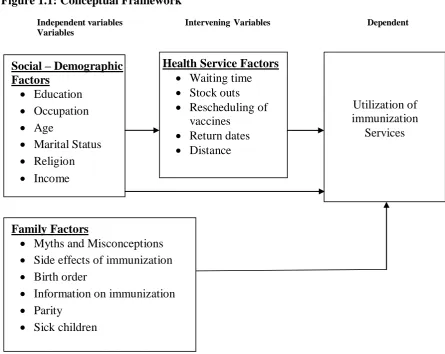
1.10 Conceptual Framework
Figure 1.1: Conceptual Framework
Independent variables Intervening Variables Dependent Variables
The frame work was adopted from (Andersen & Newman 1973) but the variables in the study are on immunization.
Social – Demographic Factors
Education Occupation Age
Marital Status Religion Income
Health Service Factors Waiting time Stock outs Rescheduling of
vaccines Return dates Distance
Utilization of immunization Services Family Factors
Myths and Misconceptions Side effects of immunization Birth order
Information on immunization Parity
CHAPTER TWO: LITERATURE REVIEW
2.1 Introduction
This chapter reviews literature from diverse sources linked to immunization services and factors that are associated with its utilization. It reviews international, regional and local studies with an aim to identify study gaps related to immunization services and factors associated with its utilization.
Immunization is a public health involvement aimed at reducing deaths and illnesses among young children. Etana and Deresa (2012) points out that it is an important means of controlling diseases, and has been considered a key economic health intervention.
International studies by Abdul (2010), Gupta and Samra, et al. (2015) shows that utilization of immunization services depends on awareness and knowledge on importance of immunization, the frequency of utilization of a health facility, the age of mothers/caregivers, income levels, fear of side effects and educational background. Qian, et al. (2013) in their study found out that utilization of immunization services was not dependent on family size, care givers age or whether the child was a boy or a girl in contrast to other studies.
accessible health facilities and frequency in vaccine stock out hinder effective utilization of services in that region.
Local studies by Mutua, et al. (2011), Onsuma, et al. (2015), Onyango, et al. (2012) and Tove, et al. (2012) revealed mixed association between individual assets and one’s financial spending, , place of delivery ,ethnicity, mothers educational background, age of the mother, number of children a mother had and utilization of immunization. Cana van (2014) did not find any significant reasons that accounted for maximum utilization of immunization services and recommended individual country to examine its economic situation, historical perspective and own political climate in order to fully utilize immunization services.
2.2 Utilization of Immunization Services Among Children Aged Under Five Yihunue, et al. (2015) studied childhood immunization in Ethiopia for 12-24 months old children and found that fully immunized children were 24.3%. This utilization was below the set national target of 66%. The study concluded that there was need to utilize health care facilities so as to get proper information on childhood immunization. This information will prompt them utilize immunization services and help ensure their children are fully immunized in full compliance with the National child immunization schedule.
reach large communities with immunization communication messages thus enhance high utilization rate.
Cana van, et al. (2014) used data on demographic and health survey of named African countries- Rwanda, Uganda, Kenya, Burundi , Tanzania, and Ethiopia and checked on rates of fully immunized child for BCG, polio and DTP as per WHO recommendations for under five years. The observation was that utilization of immunization services varied significantly by country. The study revealed that majority of children in all countries, had been administered with at least one dose of the vaccines recommended by WHO.
In Ethiopia, Tanzania, and Uganda less than 50% were partially immunized, they pointed out that high utilization of immunization services depended on hospital deliveries in contrast to home deliveries. Social-demographic factors were found not to consistently influence complete vaccination status across countries. The survey carried out by Canavan, et al.(2014) therefore revealed that no single factor can be consistently be singled out to account for complete vaccination status. They recommended the need for each country to examine its own political stability and economic status to ensure children are fully immunized.
transition. They observed that individual personalities of care providers and community perception on care provided contributed to this drop.
Onsuma, et al. (2015) studied maternal health and children immunization status in Kenya and found that majority of children vaccinated for BCG 94%, poliomyelitis 77%, DPT 91% and measles 74%. This clearly shows that those children who were started on BCG did not complete the schedule and also there is no information as to whether the 74% vaccinated against measles were fully immunized.
The conclusion was that parents who had lower than secondary education were not able to follow up their children to full immunization. Health education on importance of immunization was seen to play a key role in increasing uptake of immunization services. They recommended intensified health education to enable parents understand the benefits of immunization and to trace and immunize defaulters of immunization and particularly the urban informal settlement mostly inhibited by population with no or lower education. The study pointed out that the government pay particular attention to rural areas like Nyanza and Western Kenya to enhance increase in utilization levels.
on KEPI and equip them with knowledge on immunization to be able to educate the community on adherence with immunization schedule for pneumonia control.
Tove, et al. (2012) studied the integration of different health services as a way of raising immunization uptake. The integration of routine vaccination and hygiene interventions in Homa Bay District revealed good results. The study concluded that health education on benefits of immunization during vaccination visits and distribution of health products such as bed nets was found to increase the level of vaccines uptake. The study also recommended use of Community Health Workers (CHWs) to support vaccination and other health services in poor setting such as slums as this would promote vaccination uptake.
2.3 Social Demographic Factors Associated with Utilization Of Immunization Services Among Children Aged Under Five
Lilian, et al. (2013) observed that utilization of immunization services highly depended on mothers /caregivers level of education. In Kaptembwo, the high uptake of immunization services was dependent on mothers /caregivers level of education. . Those who had achieved high school education were 81.6% higher than those who had primary school education 76.7% and no education 42.9%. Ghei, et al. (2010) noted that inadequate information on benefits of immunization lead to failure to return for follow up doses
Abdul (2010) recommended that, to ensure no defaulters on immunization, health workers should regularly visit households with children under five years, give health education and vaccinate defaulters. They also suggested that outreach sites be put in place in order to encourage parents/caregivers who have competing priorities access immunization easily and this would reduce defaulter rate. Another suggestion was to capacity build the health workers and equip them with knowledge on KEPI and communication skills to enable them give the right message on immunization and be able to convince mothers/caregivers to timely take their children to health facilities for immunization.
Qian Li, et al. (2013) carried out a cross-sectional survey in East china to find out the compliance levels on all vaccinations among children aged under five and the associated factors. The study was carried out on 1426 mothers who had no permanent residence the results revealed low utilization of immunization services and non-compliance with National Child Immunization Schedule. Compliance levels were higher with parents with high level of education and those who visited health facilities regularly. They also observed that those families who were well up were able to ensure their children were fully immunized. The recommendation was that there is need to invest in social demographic aspects in order to improve sustainable health services.
parents/care givers. This shows a gap on adherence with the National child immunization schedule. Samra, et al. (2015) points out that females get married at an early age hence are not able to ensure full immunization for their children unlike elderly females. This is a gap in the service that is likely to affect herd immunity. In addition, first born children are valued a lot and are given priority in Bangladesh. They recommended that the government invest in education, for knowledge acquired will enable them understand the importance of immunization thus improving vaccination status in the country.
Abdi, et al. (2014) carried out studies in Ethiopia to assess levels of utilization of immunization services among children aged 12-24 months and the factors that influenced it. The survey revealed ever vaccinated 74.6% and fully immunized 36.6% indicating low utilization of services. The factors identified to influence utilization were low and no educational background , home visits by health workers, age of the caregiver, place of delivery and residential area. They recommended that in order to increase utilization of immunization services, parents should be encouraged to seek delivery services from health facilities for it is here that they get proper information on vaccination schedules thus reducing the incidents of missed opportunities, delivery in the health facility should be promoted, outreach services by health workers should be strengthened and greater utilization of health services by mothers be encouraged.
therefore recommended support for male education for them to acquire knowledge on children development and benefits of utilizing health facilities.
Mutua, et al. (2011) noted that a fully immunized child aged between 12 -24 months resident in informal settlements of Nairobi was influenced by household assets and expenditure, place of delivery, ethnicity, educational level and age. The study concluded that children resident in the slums were not routinely vaccinated and called for a way forward to ensure all children access vaccinations. The study recommended that programs involving parents of low income be established. These programs should prioritize health education and immunization campaigns at the community level to help improve utilization of immunization services. Wide spread awareness on hospital delivery to be created among the slum dwellers as this is associated with higher likelihood of utilizing immunization services especially for vaccinations administered at birth.
2.4 Health Service Factors Influencing Utilization of Immunization Services Among Children Aged Under Five
Favina, et al. (2012) noted that stock out of vaccines lead to missed opportunities for parents/caregivers were unlikely to go back for subsequent vaccinations. This is because some parents have missed work, have postponed key priorities, and have travelled long distances. This is one reason that compromises adherence to the National immunization schedule, long waiting hours without being served forces some mothers not to return their children for the successive vaccinations.
knowledge through health education given on the benefits of immunization while in hospital. This concurred with Rutachinzibwa (2010) in a study that demonstrated that hospital deliveries influenced high utilization of immunization services than home deliveries. These findings are similar to Ghei, et al. 2010) in their study in India where mothers/caretakers in proximity to health facility (less than one kilometer) stood a chance of 2.11 times to get their children fully immunized than those who could not access health facilities due to long distance.
Lilian, et al. (2013) observed that mothers/caretakers who were given a return date for subsequent vaccinations and growth monitoring by health workers stood a high chance of their children receive all vaccinations.
Lilian, et al. (2013) pointed that the level of uptake of immunization services was dependent on mothers/givers given a return date for subsequent vaccinations, availability of immunization card, affordability of services, and availability of vaccines and avoidance of frequent change of residence The study recommended the need to reinforce information, education and communication skills of the staff providing services for provision of quality care, intensify surveillance both active and passive, accelerated defaulter tracing in order to reduce dropouts of immunization.
importance of immunization and costing of services. The conclusion was that lack of information on rescheduled vaccination days lead mothers/caregivers to be turned away upon visiting the health facilities to come for vaccination on a particular day. This was cited as one reason for dropouts.
Etana and Deresa (2012) carried out a study on children aged 12-24 months to identify risk factors linked to uptake of immunization in central Ethiopia. Results demonstrated low immunization coverage, fully vaccinated 34.5% and unvaccinated 23.7%. The main reasons were lack of knowledge on immunization and lack of information on return dates for subsequent vaccinations. They recommended interventions at the community level through intensified health education on the benefits of immunization and need to seek skilled antenatal care and deliveries.
2.5 Family Factors Associated with Utilization of Immunization Services Among Children Aged Under Five
Robert, et al. (2010) in Pakistan, noted that certain anti-vaccine proponents had formed anti-vaccine movements visible in social media websites such as twitters and face book. The vaccine opponents’ purported vaccine related adverse effects, infections and even death. Roberts, et al. (2010) further pointed out that vaccinations were linked to deliberating diseases such as autism by some people even without scientific basis. They claimed that multiple vaccines could overload immune systems and even cause allergy.
The study revealed that some people believed that governments and scientists were holding key evidence of actual harms caused by vaccines and according to them these could be schemes by large pharmaceutical companies to enrich themselves. Some people claimed that vaccines contained harmful additives and argued that occasional resurfacing of certain diseases and endemics for example measles and pertussis is a “time testimony” that vaccination does not work. The study recommended continues campaigns on the importance of vaccination and same time create right attitude towards vaccinations.
to push immunization coverage to 100% in order to minimize deaths related to vaccine preventable diseases through health. Education.
Charles, et al (2010) noted that despite the benefits of immunization, there are persons who for no reason will not accept immunization for their children or relatives. Women who frequent health facilities stand a higher chance to get their children immunized. Charles, et al. (2010) confirmed that in Sub- Saharan Africa low vaccine uptake may be associated with lack of access to proper information leading to low community knowledge on immunization.
Hussein and Alemayehu (2013) carried out an evaluation review on immunization services and the related logistics in Oromia Regional State, Eastern Ethiopia. The study revealed that among under five children. 24.2% were not immunized, 22.9% fully immunized and 52.9% partially immunized. They observed that most parents/guardians were unaware of benefits of immunization and so they never returned their children to the health facilities for subsequent vaccinations. In their conclusion, inaccessible availability of services, false contraindications, myths and misconceptions were key determinants to low utilization of services.
2.6 Gaps in Immunization
Empirical literature in different regions have reviewed findings of immunization uptake but have not addressed whether fully immunized children were in compliance with the national child immunization schedule hence creating a research gap in. The study findings have not provided evidence based information on the impacts of factors associated with utilization of immunization
The studies have not mentioned utilization of the newly introduced vaccines which have played a key role in reducing morbidities related to vaccine preventable diseases among under five children and these include; pneumococcal vaccines, measles rubella and rotavirus vaccines.
CHAPTER THREE: MATERIALS AND METHODS
3.1 Introduction
This chapter has highlighted methodological details appropriate to the study.
3.2 Research Design
The scientific design adopted was descriptive cross sectional study and it was chosen because it is a one time study that provides a snapshot of health related characteristics of variables in a population at that particular time, such characteristics are immunization status, disease frequencies, numbers, distributions, with characteristics of affected people.
3.3 Variables
For the purpose of the study the dependent variable were the utilization of immunization services. The independent variables included social demographic, health service and family factors.
3.4 Location of the Study
Kirinyaga County borders Embu County to the East and south, Murang’a County to the West and Nyeri to the North West. Administratively, the County has 5 sub counties: Kirinyaga East, Kirinyaga West, Kirinyaga central, Kirinyaga North and Kirinyaga south. The County has a total population of 590,635. It covers an area of 1,479 km2, most of which lies on the southern slope of Mount Kenya, while the southern part (Mwea), are plains that are part of the Tana River basin.
The population growth rate is projected at 1.6% (CHIS, 2014). In Kirinyaga county health service delivery is offered from level 1 to level 4 hospitals. In total it has 238 health care facilities inclusive of public health facilities, faith based institutions and private health facilities. On average the population can access a health facility within a radius of about 5km..It is worth noting that communicable diseases, non-communicable diseases and violence / injuries are contributing to the high disease burden in the county.
3.5 Study Population.
Children aged under five years in Kirinyaga County
3.6 Inclusion and exclusion criteria 3.6.1 Inclusion Criteria
Children under five years who have lived for at least five years in Kirinyaga County who consented to participate in the study
3.6.2 Exclusion Criteria
Children under five years living in Kirinyaga County who were not in households at the time of study.
3.7 Sample Size Determination
Total under five populations in the County is 64851. A sample size of 422 respondents was used. This was determined by using, Fisher et al 1998 formula for a population greater than 10,000 as follows
n=z²pq/d² where n= sample size
q= accurate level at 0.5 d= level of precision at 0.05 z= confidence level at +/- 1.96 n= 1.962*0.5* 0.5/ 0.052 = 0.9604/0.0025
= 384
For non-responses 10% of 384 = 422.
To cater for attrition, 10% of the total sample was added (38) to cater for the participants who were likely to decline or drop out of study thus affecting analysis and create bias.
3.8 Sampling techniques
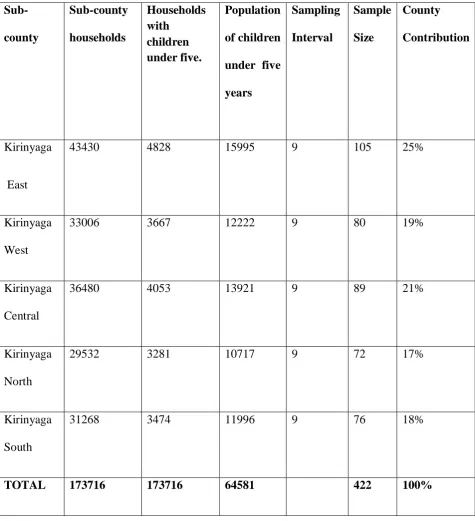
The study adopted a systematic random sampling. Total households in each sub-county (N) were divided by households with under five in each sub sub-county (n) to get the sampling interval of 9. To get the participating households systematic sampling of every 9th household that met the criteria of having children under five were visited until the required sample size was attained in each sub-county. Simple random sampling started with tossing a coin to direct on start direction. The kth skip was determined by :-
N/n = Total households in each sub county =9. Households with children under five
Table 3.1: Population description of children aged under five in the County-64851 Sub-county Sub-county households Households with children under five. Population of children under five years Sampling Interval Sample Size County Contribution Kirinyaga East
43430 4828 15995 9 105 25%
Kirinyaga West
33006 3667 12222 9 80 19%
Kirinyaga Central
36480 4053 13921 9 89 21%
Kirinyaga North
29532 3281 10717 9 72 17%
Kirinyaga South
31268 3474 11996 9 76 18%
3.9 Research Instruments
Data was collected with the help of structured and semi-structured questionnaires from respondents. Assessment of social demographic, health service and family factors was done. The child health record card was assessed for immunization data record.
3.10 Pre-Testing of research instruments
This ensured reliability of research methods and was conducted in the neighboring Embu West Sub-County by the principal investigator and the 5 research assistants. Research assistants were trained for 2 days and each administered 5 tools. This was done to ensure reliability of research instruments.
3.11 Validity
To ensure that the findings measure what is to be measured, research assistants were trained for 2 days. Scientific research methods were applied to design the data collection tools as well as the selection of the samples. This included using critically assessed instruments and following scientific sampling techniques to minimize information bias. By selecting children aged under five, it ensured unbiased information as they are supposed to have completed all immunizations. Selecting respondents with children above this age would lead to giving incorrect data.
3.12 Reliability
3.13 Data collections Techniques
The questionnaires were administered to respondents who could read and write to fill in and assistance provided to those who could not read and write by interpreting the questionnaires. Assessment of social demographic, health service and family factors was done. The child health record card was assessed for immunization data recording and verbal recall from respondents who did not have record booklets was also considered as valid information. The exercise took a period of 25 days.
3.14 Data management and Analysis
The raw data collected was edited, cleaned, sorted, coded and analyzed using statistical package for social scientists (SPSS) version 20. Descriptive data was presented using frequencies, percentages, means and standard deviation. The analyzed data was presented using tables, pie charts and frequency diagrams. Inferential statistics was carried out to determine the association between the dependent and independent variables using Pearson chi-square. The null hypothesis of chi square test is that no relationship exists on the categorical variables in the population, they are independent.
3.15 Logistical and Ethical Considerations
Approval was sought from Kenyatta University Graduate School, Kenyatta University Ethical review committee, National commission for science, technology and innovation (NACOSTI)
CHAPTER FOUR: RESULTS
4.1 Introduction
This chapter contains the results and presentations of the study findings. This study sought to assess immunization services for children 0 to 59 months in Kirinyaga County. This study was pegged on four specific objectives; to assess the level of utilization of immunization services among under five; to establish the socio-demographic factors associated with utilization of immunization services among under five; to determine health service factors influencing utilization of immunization services among under five; and to assess family factors associated with utilization of immunization services among under five in Kirinyaga County.
4.2Demographic Information of the Respondents 4.2.1 Socio-Demographic Information of the Respondents
The study participants were requested to provide their back ground information as well as their demographic details in the questionnaires. The demographic characteristics targeted by the study included the respondent’s gender, age, marital status, highest educational level, occupation, religion and income and this information is shown in (Table 4.1)
Table 4.1: Demographic characteristics of the Respondents Demographics characteristics
Demographics n = 388 %
Gender
Non-responses 36 9
Male 44 11
Female 308 79
Age
10 – 20 years 81 21. 20 – 30 years 174 45
30 – 40 years 82 21
Over 40 years 51 13
Occupation
Employed 74 19
Self – employed 146 38 Not – employed 160 41
Others student* 8 2
Income level (Kshs)
0 – 2000 171 44
2001 – 4000 70 18
4001 – 6000 99 26
6001 - 8000 45 12
8001 – 10, 000 3 1
Marital Status
Non- responses 24 6
Widows and widowers 13 3
Single 169 44
Married 182 47
Religion
Christian 361 93
Muslim 19 5
Others 8 2
Educational level
None 21 5
Primary 161 42
Secondary 169 44
College 25 7
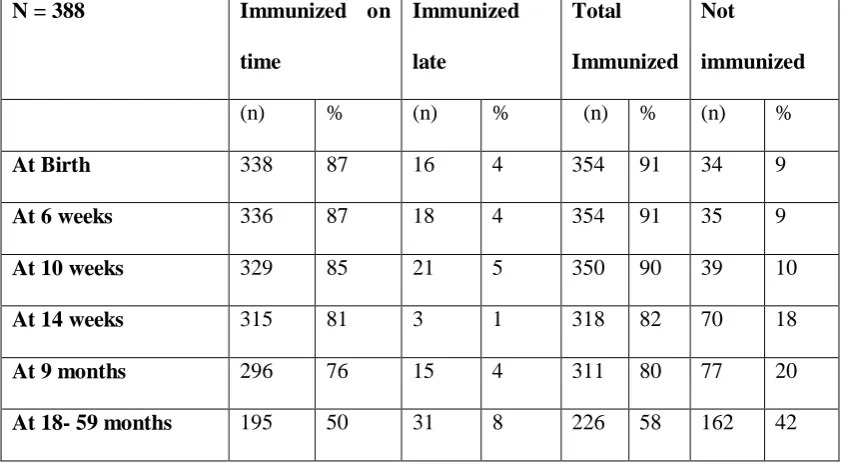
4.3 Utilization of Immunization Services Among Children Aged Under Five The objective of the study was to determine the level of utilization of immunization services among under five in Kirinyaga County. To achieve this, the researcher utilized the child health immunization record card and recall to ensure accuracy of data collected. Table 4.2 shows the utilization of immunization services in Kirinyaga County.
It shows children who received immunizations at birth - Bacillus calmette Guerin and birth polio, immunizations given at 6, 10 and 14 weeks which are multiple vaccine (pentavalent, pneumococcal, polio and rotavirus vaccines) and immunizations given to children at 9 and 18-59 months ( measles 1 and measles 2 vaccines). (Table 4.2)
Table 4.2: Utilization of Immunization Services in Kirinyaga County among children aged under five
N = 388 Immunized on
time
Immunized
late
Total
Immunized Not
immunized
(n) % (n) % (n) % (n) %
At Birth 338 87 16 4 354 91 34 9
At 6 weeks 336 87 18 4 354 91 35 9
At 10 weeks 329 85 21 5 350 90 39 10
At 14 weeks 315 81 3 1 318 82 70 18
At 9 months 296 76 15 4 311 80 77 20
4.4 Social-Demographic Factors Associated with Utilisation Of Immunisation Services.
4.4.1. Effects of Religion on Utilization of Immunization Services
The researcher deemed important that the respondents indicate their religion and whether religion in anyway affected their utilization of immunization services.
The majority of the respondents, (97%) were Christians and out of them 3% were members of a religion called kabonokia while 3% were Muslims. This implies that majority of the residents of Kirinyaga County are Christians with only a few Muslims. The respondents were then asked to indicate whether their religion affects their utilization of immunization services. The figure below indicates the results.
The pie chart below shows that majority of the respondents (97%) said that religion did not affect their utilization of immunization services while the remaining 3% indicated that their religion does not allow them to utilize any medical services. When asked to indicate why they do not believe in utilizing immunization services, these respondents (kabonokia religion) stated that Jehovah heals and that is why their religion bars them from utilizing health facilities for immunization and any other medical problem.
(Figure 4.1) 3%
97%
N=388
Yes
Figure 4.1: Effect of Religion on Utilization of Immunization Services.
4.4.2 Effects of Income on Utilization of Immunization Service
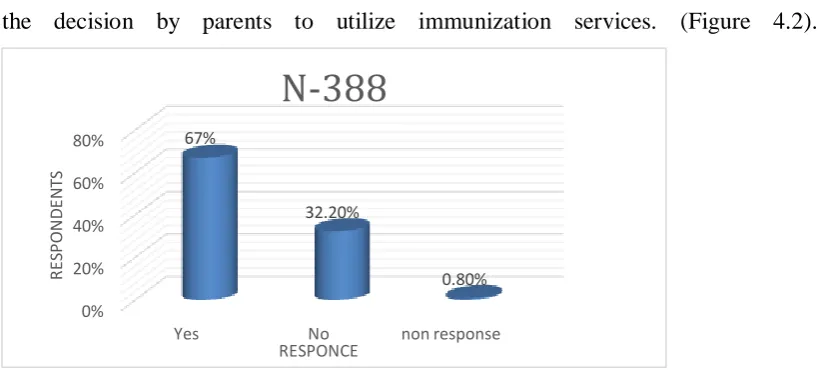
Majority of the respondents, (67.0%) indicated that their income level affects their decision to take their children for timely immunization, 32.2% were not affected and non-response 0.8%. This implies that income plays a major role in influencing the decision by parents to utilize immunization services. (Figure 4.2).
(Figure 4.2)
Figure 4.2: Effect of income on utilization of immunization services
The chi-square test of independence tested the hypotheses that there is no statistical difference between Utilization of immunization services and social demographic factors. A confidence interval of 95% was adopted which implied that the significant threshold was set at 0.05. Any p-value found to be less than the threshold was, therefore, subject to rejection of the hypothesis.
Various socio-demographic factors were subjected to a chi-square analysis test to determine whether they significantly affected the decision by respondents to utilize immunization services. These factors were gender, age, educational level, occupation, religion and income. The results displayed in the table below shows that
0% 20% 40% 60% 80%
Yes No non response
Table 4.3: Social demographic factors associated with utilization of immunization services
DEMOGRAPHIC CHARACTERISTICS VS IMMUNISATION SERVICES
DEMOGRAPHICS. n=388 % Df P-Value
Gender
Non-responses 36 9.3 9.3 df=2 X2=68.09,
P=0.001
Male 44 11.3
Female 308 79.4
Age
10 – 20 years 81 20.9 df=3 X2=212.9
P=0.003 20 – 30 years 174 44.9
30 – 40 years 82 21.2 Over 40 years 51 13.1 Occupation
Employed 74 19.1 df=3 X2=233.41
P=0.001 Self – employed 146 37.6
Not – employed 160 41.2 Others student* 8 2.1
Income level (Kshs)
0 – 2000 171 44.1 df=4 X2=233.41
P=0.002 2001 – 4000 70 18
4001 – 6000 99 25.7 6001 - 8000 45 11.7 8001 > 10, 000 3 0.8 Religion
Christian 361 93 df=2 X2=23.51,
P=O.7O7
Muslim 19 4.9
Others 8 2.1
Educational level
None 21 5.4 df=4 X2=423.44
P= 0.001
Primary 161 41.8
Secondary 169 43.6
College 25 6.6
4.5 Health Service Factors Influencing Childhood Immunization
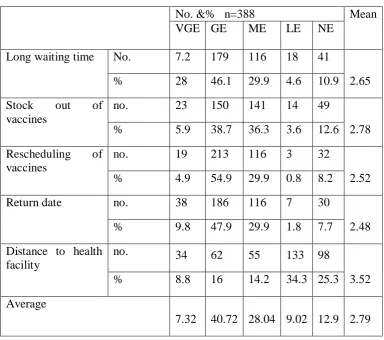
The objective of the study was to identify the influence of health service factors on childhood immunization in Kirinyaga County. The respondents were provided with a variety of statements on a Likert Scale where they were given five choices to select from where 1= Very Great Effect, 2= Great Effect, 3= Moderate Effect, 4= Low Effect and 5= No effect. Their responses are as displayed in (Table 4.4).
Table 4.4 shows majority of the respondents’ opinions on effects of health service factors. The mean average of 2.79 implies that the responses were skewed towards great effect.
25.3% (n= 98) stating that it has no effect on their decision to utilize immunization services. It can therefore, be deduced that distance is not an important factor to influence utilization of immunization services in Kirinyaga County. (Table4.4)
Table 4.4: Parameters of health Services factors on utilization of immunization services
No. &% n=388 Mean
VGE GE ME LE NE
Long waiting time No. 7.2 179 116 18 41
2.65
% 28 46.1 29.9 4.6 10.9
Stock out of vaccines
no. 23 150 141 14 49
2.78
% 5.9 38.7 36.3 3.6 12.6
Rescheduling of vaccines
no. 19 213 116 3 32
2.52
% 4.9 54.9 29.9 0.8 8.2
Return date no. 38 186 116 7 30
2.48
% 9.8 47.9 29.9 1.8 7.7
Distance to health facility
no. 34 62 55 133 98
3.52
% 8.8 16 14.2 34.3 25.3
Average
7.32 40.72 28.04 9.02 12.9 2.79
4.5.1 Health Service factors influencing utilization of immunization services
Health Service factors were identified as some of the possible reasons for the decision by parents and guardians to utilize immunization services and a chi-Square analysis was done to show the association, the table below shows the findings.
A confidence interval of 95% was adopted which implied that the significant threshold was set at 0.05. Any p-value found to be less than the threshold was, therefore, subject to rejection of the hypothesis.
Table 4.5 displays the results from the chi-square test analysis on various health factors on utilization of immunization found to be significant. Long waiting time (X2= 352.709, p=0.001), Vaccines out of stock (X2= 233.147, p=0.002), Rescheduling of vaccines(X2=206.86,p=0.001),Return date(X2= 199.964,p=0.001<), Distance to health facility(X2= 303.450,p=0.077) was found not to be statistically significant. (Table 4.5)
Table 4.5: Health service factors influencing childhood immunization
No. &% N=388 Mean Df P-Value
VGE GE ME LE NE
Long waiting time
No. 7.2 179 116 18 41
2.65
2 X2=352.70 ,P==0.001 % 28 46.1 29.9 4.6 10.9
Stock out of vaccines
No. 23 150 141 14 49
2.78
4 X2=233.14, P=0.002 % 5.9 38.7 36.3 3.6 12.6
Rescheduling of vaccines
No. 19 213 116 3 32
2.52
3 X2=206.86, P=0.001 % 4.9 54.9 29.9 0.8 8.2
Return date No. 38 186 116 7 30
2.48
4 X2=199.96, P=0.001 % 9.8 47.9 29.9 1.8 7.7
Distance to health facility
No. 34 62 55 133 98
3.52
3 X2=303.45 ,P=0.077 % 8.8 16 14.2 34.3 25.3
Average
4.6 Family Factors Associated with Childhood Immunization
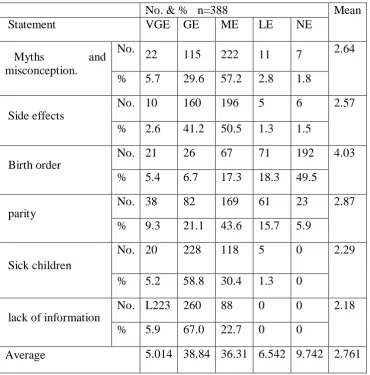
The objective of the study was to identify the family factors associated with childhood immunization in Kirinyaga County. The respondents were given a range of parameters on a likert scale that employs questionnaires used in scaling responses in a research. It measures intensities of either positive or negative response where 1=Very great effect, 2=Great effect, 3=Moderate effect, 4=Low effect and 5=No effect. Table 4.6 displays the opinions of the respondents on the effects of family factors on utilization of childhood immunization.
Table 4.6: Parameters of Family Factors on utilization of immunization services
No. & % n=388 Mean
Statement VGE GE ME LE NE
Myths and
misconception.
No.
22 115 222 11 7 2.64
% 5.7 29.6 57.2 2.8 1.8
Side effects
No. 10 160 196 5 6 2.57
% 2.6 41.2 50.5 1.3 1.5
Birth order
No. 21 26 67 71 192 4.03
% 5.4 6.7 17.3 18.3 49.5
parity
No. 38 82 169 61 23 2.87
% 9.3 21.1 43.6 15.7 5.9
Sick children
No. 20 228 118 5 0 2.29
% 5.2 58.8 30.4 1.3 0
lack of information
No. L223 260 88 0 0 2.18
% 5.9 67.0 22.7 0 0
Average 5.014 38.84 36.31 6.542 9.742 2.761
4.6.1 Family Factors associated with Utilization of Immunization Services
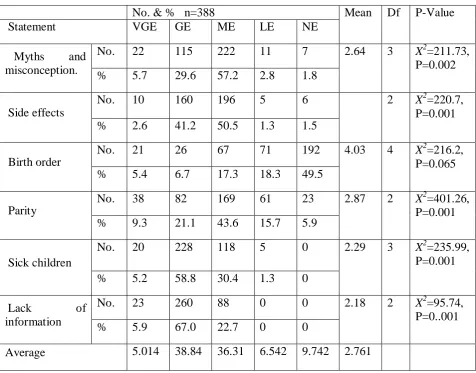
Family factors were identified as some of the possible reasons for the choice of utilization of childhood immunization and a chi-Square analysis was done to show the association
confidence interval of 95% was adopted which implied that the significant threshold was set at 0.05. Any p-value found to be less than the threshold was, therefore, subject to rejection of the hypothesis.
Table 4.7: Family factors associated with utilization of immunization services
No. & % n=388 Mean Df P-Value
Statement VGE GE ME LE NE
Myths and misconception.
No. 22 115 222 11 7 2.64 3 X2=211.73,
P=0.002
% 5.7 29.6 57.2 2.8 1.8
Side effects
No. 10 160 196 5 6 2 X2=220.7,
P=0.001
% 2.6 41.2 50.5 1.3 1.5
Birth order
No. 21 26 67 71 192 4.03 4 X2=216.2,
P=0.065
% 5.4 6.7 17.3 18.3 49.5
Parity
No. 38 82 169 61 23 2.87 2 X2=401.26,
P=0.001
% 9.3 21.1 43.6 15.7 5.9
Sick children
No. 20 228 118 5 0 2.29 3 X2=235.99,
P=0.001
% 5.2 58.8 30.4 1.3 0
Lack of
information
No. 23 260 88 0 0 2.18 2 X2=95.74,
P=0..001
% 5.9 67.0 22.7 0 0
CHAPTER FIVE: DISCUSSION, CONCLUSIONS AND RECOMMENDATIONS
5.1 Introduction
This chapter presents the study findings, inferences and recommendations drawn from the data collected and analyzed. The broad objective of the study was to assess the utilization of immunization services among children aged under five in Kirinyaga County. The response rate of the study was 100%, which was adequate to make inferences out of the targeted population
5.2 Utilization of Immunization Services Among Children Aged Under Five. The study findings revealed that utilization of immunization services cumulatively for under five years for measles 2 the last antigen in the schedule low at 58%. below the recommended target by WHO of 85%. Immunization uptake reveals high utilization of immunizations given at birth and at 6 weeks while utilization in subsequent visits showed a significant decline and at the same time showing ascending tread of zero cases (not immunized) and can be inferred that immunization was not accessible by all participants.
Zero vaccine doses (not immunized) were evidenced in all antigens. The findings are supported by Karanja and Kembich (2013) whose study in a Peri-urban area in Kenya revealed that utilization of first antigens was highly utilized followed by a declining trend in subsequent visits: BCG 99.8%, 1st Pentavalent 98.5%, 3rd Pentavalent 90.5% and measles 74%.
The study findings concur with Favina, et al. (2012) who noted that stock out of vaccines lead to missed opportunities and long waiting hours without being served forced mothers/ caregivers not to return their children for successive vaccinations leading to non-compliance with the immunization schedule and dropouts leading to partial immunization.
The outcome of the study on utilization levels has similar findings with an assessment study carried out by Hussein and Alemayehu (2013) on factors associated with utilization of immunization services and revealed that among children aged under five 52.9% were partially immunized, 22.9% fully immunized, and 24.2% not immunized.
This study found gaps on immunization similar to those of Koskei, et al. (2014) who in his study on utilization of immunization found that- immunization services was not accessed by all children demonstrating equity gaps despite efforts by the government to improve immunization services.
The study findings are supported by Gavi, (2010) where it is documented that 19.3 million children did not receive all the doses recommended by WHO and remained susceptible to vaccine preventable diseases.
The trend shows that majority of those children who started immunization did not complete the schedule and were partially immunized meaning that they were not fully protected from VPDs hence susceptible to contracting diseases. This study finding is also supported by Gupta et al.2015 in a study in India which found out fully immunized 74%, partially immunized 14% and not immunized 11%. The immunization schedule was therefore not adhered to as stipulated by KEPI Standards and Guidelines and it’s important in ensuring maximum protection from VPDs (KEPI, 2013).
The study findings revealed noncompliance with the National Child Immunization Schedule and this was evidenced by high percentages of children immunized late and those not immunized in all antigens. This was caused by negative influences of socio-demographic, health service and family factors.
it can spread to people who are not immune causing morbidities and mortality in the community. This also reflects negatively on herd immunity.
Measles 2 uptake was at 58% which is below WHO standards which is set at 85%. The cause of the low utilization was due to the fact that measles 2 was introduced in 2013 to be given at 18 months and the parents/caregivers back in their mind knows that immunization ends at 9 months and the other reason is that health workers also forget to give them return dates This is similar to a study carried out by Etana and Deresa (2012) in central Ethiopia who found measles coverage at 35.5% below WHO standards.
5.3 Socio-Demographic Factors Associated with Utilization of Immunization Services.
Majority of respondent utilizing immunization services were women, aged between 20 – 30 years, are of secondary level of education, are self-employed or not employed, are married or single and have an average monthly income of between 4000 – 6000. These observations are consistent with Abdi, et al. (2014), Sembuche,
et al. (2010) who revealed that employment status and educational background influenced utilization of immunization services in an area. Those with higher education had adequate knowledge on importance of immunization and concurs with studies carried out by Mutua, et al. (2011), Onsuna, et al. (2015), Onyango, et al.
utilization of immunization services highly depended on mother’s /caregivers level of education.
The findings of the study Concurs with Samia, et al. (2015) who carried out a study in Bangladesh to assess the impact of employment on utilization of immunization services and found that pressure of work and lack of time the employed parents/care givers were not able to take their children for timely immunization services as compared to unemployed counterparts.
The study findings also concur with Ghei, et al. (2010) in India that respondents with high level of education were more likely to immunize their children than those who had low education. In this study, income levels were low hence affecting the respondents’ decision to utilize immunization services. The study findings were similar to a study carried out by Mutua, et al (2011) in Nairobi who recommended that programs activities targeting mothers of low economic status be established to help improve immunization services.
The study findings also concur with a study carried out by Samra, et al. in Bangladesh as regards age as a factor influencing immunization and found that, females marry early hence are less likely to immunize their children due to fear of unknown.
factors influence the decision by respondents of Kirinyaga County to take their children for timely immunizations. Distance as a factor was not a hindrance to immunization because health care facilities are many and less than 7km apart.
The results showed that all health service factors except for distance had a negative statistical significant effect on the respondents’ choice to take their children for immunization services. These results imply that there was a statistical threshold that links health services factors to utilization of immunization services. These findings are supported by Abdi, et al. (2014) and Sembuche, et al. 2010 who found that inadequate health care providers, place of delivery, knowledge on importance of vaccination, inaccessible health facilities, and stock out of vaccines significantly affect the level of utilization of immunization services in a region. It can be deduced that health service factors have a significant effect on the respondent’s choice to utilize immunization services.
vaccinators. This leads to non-compliance with National Child Immunization Schedule, partial immunization and drop outs thus subjecting the children to infection with VPDs.
The study findings found that lack of information affected utilization of immunization services and concurs with a study carried out by Abdul, (2010) whose findings revealed that lack of information on rescheduling vaccination days due to shortage of vaccines or heavy workload, lack of knowledge on importance of immunization, costing of services, child sickness were reasons for incomplete immunization
The study findings found that distance was not a significant factor in utilization of immunization services. These findings differed with a study conducted by Abdi et al (2014) that revealed distance as a significant factor in the utilization of immunization services. The study found out that lack of information adversely affected utilization of immunization services and these findings are similar to a study done by Etana and Deresa (2012) which revealed that the reason for low immunization coverage was due to lack of information on return date for subsequent vaccinations.
5.5 Family Factors Associated with Utilization of Immunization Services
Family factors were identified to play a major role on utilization of childhood immunization services where majority of the respondents agreed that all health service factors except for birth order impacted a lot on childhood immunization with their opinions skewed to great effect. This implies that family factors influenced the decision by respondents to take their children for timely immunization services. Results from inferential statistics conducted at 95% confidence interval showed a statistical significance (p=0.001<0.05) on family factors and utilization of immunization services. Individual chi-square results of family factors showed that all family factors except for birth order had a statistically significant negative effect on utilization of childhood immunization services.
A study carried out by Hussein and Alemayehu (2013) in Ethiopia supported the study findings that lack of information on the importance of immunization, most mothers never returned their children to the health facilities for subsequent vaccinations due to fear of side effects, and this is one of the reasons that leads to partial immunization among children. According to study findings, this is a cause contributing to non- compliance with the National immunization schedule a danger that may lead to contracting VPDs.
Samra et al (2015) which revealed that first born children in Bangladesh are given priority. The study findings were also similar to a study carried out in Bangladesh by Abdi (2010) that children sickness was a significant factor in utilization of immunization services.
The study found out that myths and misconceptions affected utilization of immunization services. These findings are similar to a study conducted by Robert, et al. (2010) which showed myths and misconceptions as significant factors in immunization services. The study finding concur with a study carried out by Charles
et al. (2010) that lack of access to information hindered utilization of immunization services.
The study findings found parity to influence utilization of immunization and concurred with findings of a study conducted by Onsuma, et al. (2015) which showed that the number of children a mother had influenced utilization of immunization services
5.6 Summary of The Findings