Classification of Discourse Coherence Relations: An Exploratory Study
using Multiple Knowledge Sources
Ben Wellner
, James Pustejovsky , Catherine Havasi , Anna Rumshisky and Roser Saur´ı
Department of Computer Science Brandeis University
Waltham, MA USA
The MITRE Corporation 202 Burlington Road
Bedford, MA USA
wellner,jamesp,havasi,arum,roser @cs.brandeis.edu
Abstract
In this paper we consider the problem of identifying and classifying discourse
co-herence relations. We report initial
re-sults over the recently released Discourse GraphBank (Wolf and Gibson, 2005). Our approach considers, and determines the contributions of, a variety of syntactic and lexico-semantic features. We achieve 81% accuracy on the task of discourse relation type classification and 70% accuracy on relation identification.
1 Introduction
The area of modeling discourse has arguably seen less success than other areas in NLP. Contribut-ing to this is the fact that no consensus has been reached on the inventory of discourse relations nor on the types of formal restrictions placed on discourse structure. Furthermore, modeling dis-course structure requires access to considerable prior linguistic analysis including syntax, lexical and compositional semantics, as well as the res-olution of entity and event-level anaphora, all of which are non-trivial problems themselves.
Discourse processing has been used in many text processing applications, most notably text summarization and compression, text generation, and dialogue understanding. However, it is also important for general text understanding, includ-ing applications such as information extraction and question answering.
Recently, Wolf and Gibson (2005) have pro-posed a graph-based approach to representing
in-formational discourse relations.1 They
demon-strate that tree representations are inadequate for
1The relations they define roughly follow Hobbs (1985).
modeling coherence relations, and show that many discourse segments have multiple parents (incom-ing directed relations) and many of the relations introduce crossing dependencies – both of which preclude tree representations. Their annotation of 135 articles has been released as the GraphBank corpus.
In this paper, we provide initial results for the following tasks: (1) automatically classifying the
type of discourse coherence relation; and (2)
iden-tifying whether any discourse relation exists on two text segments. The experiments we report are based on the annotated data in the Discourse GraphBank, where we assume that the discourse units have already been identified.
In contrast to a highly structured, compositional approach to discourse parsing, we explore a sim-ple, flat, feature-based methodology. Such an ap-proach has the advantage of easily accommodat-ing many knowledge sources. This type of de-tailed feature analysis can serve to inform or aug-ment more structured, compositional approaches to discourse such as those based on Segmented Discourse Representation Theory (SDRT) (Asher and Lascarides, 2003) or the approach taken with the D-LTAG system (Forbes et al., 2001).
Using a comprehensive set of linguistic fea-tures as input to a Maximum Entropy classifier, we achieve 81% accuracy on classifying the cor-rect type of discourse coherence relation between two segments.
2 Previous Work
In the past few years, the tasks of discourse seg-mentation and parsing have been tackled from different perspectives and within different frame-works. Within Rhetorical Structure Theory (RST), Soricut and Marcu (2003) have developed two
probabilistic
models for identifying clausal ele-mentary discourse units and generating discourse trees at the sentence level. These are built using lexical and syntactic information obtained from mapping the discourse-annotated sentences in the RST Corpus (Carlson et al., 2003) to their corre-sponding syntactic trees in the Penn Treebank.
Within SDRT, Baldridge and Lascarides
(2005b) also take a data-driven approach to the tasks of segmentation and identification of discourse relations. They create a probabilistic discourse parser based on dialogues from the Red-woods Treebank, annotated with SDRT rhetorical relations (Baldridge and Lascarides, 2005a). The parser is grounded on headed tree representations and dialogue-based features, such as turn-taking and domain specific goals.
In the Penn Discourse TreeBank (PDTB) (Web-ber et al., 2005), the identification of discourse structure is approached independently of any lin-guistic theory by using discourse connectives
rather than abstract rhetorical relations. PDTB
assumes that connectives are binary discourse-level predicates conveying a semantic relationship between two abstract object-denoting arguments. The set of semantic relationships can be estab-lished at different levels of granularity, depend-ing on the application. Miltsakaki, et al. (2005) propose a first step at disambiguating the sense of a small subset of connectives (since, while, and
when) at the paragraph level. They aim at
distin-guishing between the temporal, causal, and con-trastive use of the connective, by means of syntac-tic features derived from the Penn Treebank and a MaxEnt model.
3 GraphBank
3.1 Coherence Relations
For annotating the discourse relations in text, Wolf and Gibson (2005) assume a clause-unit-based definition of a discourse segment. They define four broad classes of coherence relations:
(1) 1. Resemblance: similarity (par),
con-trast (contr), example (examp), generaliza-tion (gen), elaborageneraliza-tion (elab);
2. Cause-effect: explanation (ce), violated expectation (expv), condition (cond);
3. Temporal (temp): essentially narration; 4. Attribution (attr): reporting and evidential contexts.
The textual evidence contributing to identifying the various resemblance relations is heterogeneous at best, where, for example, similarity and contrast are associated with specific syntactic constructions and devices. For each relation type, there are well-known lexical and phrasal cues:
(2) a. similarity: and;
b. contrast: by contrast, but; c. example: for example;
d. elaboration: also, furthermore, in addi-tion, note that;
e. generalization: in general.
However, just as often, the relation is encoded through lexical coherence, via semantic associa-tion, sub/supertyping, and accommodation strate-gies (Asher and Lascarides, 2003).
The cause-effect relations include conventional
causation and explanation relations (captured as
the label ce), such as (3) below:
(3) cause: SEG1: crash-landed in New Hope, Ga.,
effect: SEG2: and injuring 23 others.
It also includes conditionals and violated
expecta-tions, such as (4).
(4) cause: SEG1: an Eastern Airlines Lockheed L-1011 en route from Miami to the Bahamas lost all three of its engines,
effect: SEG2: and land safely back in Miami.
The two last coherence relations annotated in GraphBank are temporal (temp) and attribution
(attr) relations. The first corresponds generally to
the occasion (Hobbs, 1985) or narration (Asher and Lascarides, 2003) relation, while the latter is
a general annotation over attribution of source.2
3.2 Discussion
The difficulty of annotating coherence relations consistently has been previously discussed in the literature. In GraphBank, as in any corpus, there are inconsistencies that must be accommodated for learning purposes. As perhaps expected, an-notation of attribution and temporal sequence rela-tions was consistent if not entirely complete. The most serious concern we had from working with
2There is one non-rhetorical relation, same, which
the
corpus derives from the conflation of diverse and semantically contradictory relations among the cause-effect annotations. For canonical cau-sation pairs (and their violations) such as those above, (3) and (4), the annotation was expectedly consistent and semantically appropriate. Problems arise, however when examining the treatment of purpose clauses and rationale clauses. These are annotated, according to the guidelines, as cause-effect pairings. Consider (5) below.
(5) cause: SEG1: to upgrade lab equipment in 1987.
effect: SEG2: The university spent $ 30,000
This is both counter-intuitive and temporally false. The rationale clause is annotated as the cause, and the matrix sentence as the effect. Things are even worse with purpose clause annotation. Consider
the following example discourse:3
(6) John pushed the door to open it, but it was locked.
This would have the following annotation in GraphBank:
(7) cause: to open it
effect: John pushed the door.
The guideline reflects the appropriate intuition that the intention expressed in the purpose or ra-tionale clause must precede the implementation of the action carried out in the matrix sentence. In effect, this would be something like
(8) [INTENTION TO SEG1] CAUSES SEG2
The problem here is that the cause-effect re-lation conflates real event-causation with telos-directed explanations, that is, action telos-directed to-wards a goal by virtue of an intention. Given that these are semantically disjoint relations, which are furthermore triggered by distinct grammatical constructions, we believe this conflation should be undone and characterized as two separate coher-ence relations. If the relations just discussed were annotated as telic-causation, the features encoded for subsequent training of a machine learning al-gorithm could benefit from distinct syntactic envi-ronments. We would like to automatically gen-erate temporal orderings from cause-effect rela-tions from the events directly annotated in the text.
3This specific example was brought to our attention by
Alex Lascarides (p.c).
Splitting these classes would preserve the sound-ness of such a procedure, while keeping them lumped generates inconsistencies.
4 Data Preparation and Knowledge Sources
In this section we describe the various linguistic processing components used for classification and identification of GraphBank discourse relations.
4.1 Pre-Processing
We performed tokenization, sentence tagging, part-of-speech tagging, and shallow syntactic parsing (chunking) over the 135 GraphBank docu-ments. Part-of-speech tagging and shallow parsing were carried out using the Carafe implementation of Conditional Random Fields for NLP (Wellner and Vilain, 2006) trained on various standard cor-pora. In addition, full sentence parses were ob-tained using the RASP parser (Briscoe and Car-roll, 2002). Grammatical relations derived from a single top-ranked tree for each sentence (head-word, modifier, and relation type) were used for feature construction.
4.2 Modal Parsing and Temporal Ordering of Events
We performed both modal parsing and tempo-ral parsing over events. Identification of events was performed using EvITA (Saur´ı et al., 2006), an open-domain event tagger developed under the TARSQI research framework (Verhagen et al., 2005). EvITA locates and tags all event-referring expressions in the input text that can be tempo-rally ordered. In addition, it identifies those gram-matical features implicated in temporal and modal information of events; namely, tense, aspect, po-larity, modality, as well as the event class. Event annotation follows version 1.2.1 of the TimeML specifications.4
Modal parsing in the form of identifying sub-ordinating verb relations and their type was per-formed using SlinkET (Saur´ı et al., 2006), an-other component of the TARSQI framework. Slin-kET identifies subordination constructions intro-ducing modality information in text; essentially, infinitival and that-clauses embedded by factive predicates (regret), reporting predicates (say), and predicates referring to events of attempting (try), volition (want), command (order), among others.
SlinkET annotates these subordination contexts and classifies them according to the modality in-formation introduced by the relation between the embedding and embedded predicates, which can be of any of the following types:
factive: The embedded event is presupposed
or entailed as true (e.g., John managed to
leave the party).
counter-factive: The embedded event is
pre-supposed as entailed as false (e.g., John was
unable to leave the party).
evidential: The subordination is introduced
by a reporting or perception event (e.g., Mary
saw/told that John left the party).
negative evidential: The subordination is a
reporting event conveying negative polarity (e.g., Mary denied that John left the party).
modal: The subordination creates an
inten-sional context (e.g., John wanted to leave the
party).
Temporal orderings between events were iden-tified using a Maximum Entropy classifier trained on the TimeBank 1.2 and Opinion 1.0a corpora. These corpora provide annotated events along
with temporal links between events. The link
types included: before ( occurs before ) ,
in-cludes (
occurs sometime during
),
simultane-ous ( occurs over the same interval as ), begins
( begins at the same time as ), ends ( ends at
the same time as
).
4.3 Lexical Semantic Typing and Coherence
Lexical semantic types as well as a measure of lexical similarity or coherence between words in two discourse segments would appear to be use-ful for assigning an appropriate discourse rela-tionship. Resemblance relations, in particular, re-quire similar entities to be involved and lexical similarity here serves as an approximation to defi-nite nominal coreference. Identification of lexical relationships between words across segments ap-pears especially useful for cause-effect relations. In example (3) above, determining a (potential) cause-effect relationship between crash and injury is necessary to identify the discourse relation.
4.3.1 Corpus-based Lexical Similarity
Lexical similarity was computed using the Word Sketch Engine (WSE) (Killgarrif et al., 2004) similarity metric applied over British Na-tional Corpus. The WSE similarity metric imple-ments the word similarity measure based on gram-matical relations as defined in (Lin, 1998) with mi-nor modifications.
4.3.2 The Brandeis Semantic Ontology
As a second source of lexical coherence, we used the Brandeis Semantic Ontology or BSO (Pustejovsky et al., 2006). The BSO is a lexically-based ontology in the Generative Lexicon tradi-tion (Pustejovsky, 2001; Pustejovsky, 1995). It fo-cuses on contextualizing the meanings of words and does this by a rich system of types and qualia structures. For example, if one were to look up the
phraseRED WINE in the BSO, one would find its
type is WINE and its type’s type is ALCOHOLIC
BEVERAGE. The BSO contains ontological qualia information (shown below). Using the BSO, one
wine
CONSTITUTIVE Alcohol
HAS ELEMENT Alcohol
MADE OF Grapes
INDIRECT TELIC drink activity
INDIRECT AGENTIVE make alcoholic beverage
is able to find out where in the ontological type
system WINE is located, what RED WINE’s
lexi-cal neighbors are, and its full set of part of speech and grammatical attributes. Other words have a different configuration of annotated attributes de-pending on the type of the word.
We used the BSO typing information to seman-tically tag individual words in order to compute lexical paths between word pairs. Such lexical as-sociations are invoked when constructing cause-effect relations and other implicatures (e.g. be-tween crash and injure in Example 3).
The use of the BSO is advantageous compared to other frameworks such as Wordnet because it focuses on the connection between words and their semantic relationship to other items. These con-nections are captured in the qualia information and the type system. In Wordnet, qualia-like informa-tion is only present in the glosses, and they do not provide a definite semantic path between any two lexical items. Although synonymous in some ways, synset members often behave differently in many situations, grammatical or otherwise.
5 Classification Methodology
This section describes in detail how we con-structed features from the various knowledge sources described above and how they were en-coded in a Maximum Entropy model.
5.1 Maximum Entropy Classification
For our experiments of classifying relation types,
we used a Maximum Entropy classifier5 in order
to assign labels to each pair of discourse segments connected by some relation. For each instance (i.e. pair of segments) the classifier makes its decision based on a set of features. Each feature can query some arbitrary property of the two segments, pos-sibly taking into account external information or knowledge sources. For example, a feature could query whether the two segments are adjacent to each other, whether one segment contains a dis-course connective, whether they both share a par-ticular word, whether a parpar-ticular syntactic con-struction or lexical association is present, etc. We make strong use of this ability to include very
many, highly interdependent features6 in our
ex-periments. Besides binary-valued features, fea-ture values can be real-valued and thus capfea-ture fre-quencies, similarity values, or other scalar quanti-ties.
5.2 Feature Classes
We grouped the features together into various
feature classes based roughly on the knowledge
source from which they were derived. Table 1 describes the various feature classes in detail and provides some actual example features from each class for the segment pair described in Example 5 in Section 3.2.
5We use the Maximum Entropy classifier included with
Carafe available at http://sourceforge.net/projects/carafe
6The total maximum number of features occurring in our
experiments is roughly 120,000.
6 Experiments and Results
In this section we provide the results of a set of experiments focused on the task of discourse rela-tion classificarela-tion. We also report initial results on relation identification with the same set of features as used for classification.
6.1 Discourse Relation Classification
The task of discourse relation classification in-volves assigning the correct label to a pair of
dis-course segments.7 The pair of segments to assign
a relation to is provided (from the annotated data). In addition, we assume, for asymmetric links, that the nucleus and satellite are provided (i.e., the
di-rection of the relation). For the elaboration
rela-tions, we ignored the annotated subtypes (person, time, location, etc.). Experiments were carried out on the full set of relation types as well as the sim-pler set of coarse-grained relation categories de-scribed in Section 3.1.
The GraphBank contains a total of 8755
an-notated coherence relations. 8 For all the
ex-periments in this paper, we used 8-fold cross-validation with 12.5% of the data used for test-ing and the remainder used for traintest-ing for each fold. Accuracy numbers reported are the average accuracies over the 8 folds. Variance was gener-ally low with a standard deviation typicgener-ally in the range of 1.5 to 2.0. We note here also that the inter-annotator agreement between the two Graph-Bank annotators was 94.6% for relations when
they agreed on the presence of a relation. The
majority class baseline (i.e., the accuracy achieved by calling all relations elaboration) is 45.7% (and 66.57% with the collapsed categories). These are the upper and lower bounds against which these results should be based.
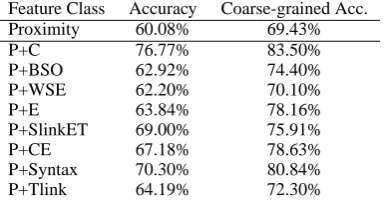
To ascertain the utility of each of the various feature classes, we considered each feature class independently by using only features from a sin-gle class in addition to the Proximity feature class which serve as a baseline. Table 2 illustrates the result of this experiment.
We performed a second set of experiments shown in Table 3 that is essentially the converse of the previous batch. We take the union of all the
7Each segment may in fact consist of a sequence of
seg-ments. We will, however, use the term segment loosely to refer to segments or segment sequences.
8All documents are doubly annotated; we used the
Feature Description Example Class
C Words appearing at beginning and end of the two discourse seg-ments - these are often important discourse cue words.
first1-is-to; first2-is-The P Proximity and direction between the two segments (in terms of
segments) - binary features such as distance less than 3, distance
greater than 10 were used in addition to the distance value itself;
the distance from beginning of the document using a similar bin-ning approach
adjacent; dist-less-than-3; dist-less-than-5; direction-reverse; samesentence
BSO Paths in the BSO up to length 10 between non-function words in the two segments.
ResearchLab EducationalActivity University
WSE WSE word-pair similarities between words in the two segments were binned as ( 0.05, 0.1, 0.2). We also computed
sen-tence similarity as the sum of the word similarities divided by the sum of their sentence lengths.
WSE-greater-than-0.05; WSE-sentence-sim = 0.005417
E Event head words and event head word pairs between segments as identified by EvITA.
event1-is-upgrade; event2-is-spent; event-pair-upgrade-spent
SlinkET Event attributes, subordinating links and their types between event pairs in the two segments
seg1-class-is-occurrence; seg2-class-is-occurrence; seg1-tense-is-infinitive; seg2-tense-is-past; seg2-modal-seg1 C-E Cuewords of one segment paired with events in the other. first1-is-to-event2-is-spent;
first2-is-The-event1-is-upgrade
Syntax Grammatical dependency relations between two segments as iden-tified by the RASP parser. We also conjoined the relation with one or both of the headwords associated with the grammatical relation.
gr-ncmod; gr-ncmod-head1-equipment; gr-ncmod-head-2-spent; etc.
Tlink Temporal links between events in the two segments. We included both the link types and the number of occurrences of those types between the segments
[image:6.595.74.523.65.354.2]seg2-before-seg1
Table 1: Feature classes, their descriptions and example feature instances for Example 5 in Section 3.2.
Feature Class Accuracy Coarse-grained Acc.
Proximity 60.08% 69.43%
P+C 76.77% 83.50%
P+BSO 62.92% 74.40%
P+WSE 62.20% 70.10%
P+E 63.84% 78.16%
P+SlinkET 69.00% 75.91%
P+CE 67.18% 78.63%
P+Syntax 70.30% 80.84%
P+Tlink 64.19% 72.30%
Table 2: Classification accuracy over standard and coarse-grained relation types with each feature class added to Proximity feature class.
feature classes and perform ablation experiments by removing one feature class at a time.
Feature Class Accuracy Coarse-grain Acc. All Features 81.06% 87.51%
All-P 71.52% 84.88%
All-C 75.71% 84.69%
All-BSO 80.65% 87.04%
All-WSE 80.26% 87.14%
All-E 80.90% 86.92%
All-SlinkET 79.68% 86.89%
All-CE 80.41% 87.14%
[image:6.595.73.525.77.343.2]All-Syntax 80.20% 86.89% All-Tlink 80.30% 87.36%
Table 3: Classification accuracy with each fea-ture class removed from the union of all feafea-ture classes.
6.2 Analysis
From the ablation results, it is clear that overall performance is most impacted by the cue-word features (C) and proximity (P). Syntax and Slin-kET also have high impact improving accuracy by roughly 10 and 9 percent respectively as shown in Table 2. From the ablation results in Table 3, it is clear that the utility of most of the individ-ual features classes is lessened when all the other feature classes are taken into account. This indi-cates that multiple feature classes are responsible for providing evidence any given discourse rela-tions. Removing a single feature class degrades performance, but only slightly, as the others can compensate.
[image:6.595.74.268.386.488.2]Relation Precision Recall F-measure Count
elab 88.72 95.31 91.90 512
attr 91.14 95.10 93.09 184
par 71.89 83.33 77.19 132
same 87.09 75.00 80.60 72
ce 78.78 41.26 54.16 63
contr 65.51 66.67 66.08 57
examp 78.94 48.39 60.00 31
temp 50.00 20.83 29.41 24
expv 33.33 16.67 22.22 12
cond 45.45 62.50 52.63 8
gen 0.0 0.0 0.0 0
Table 4: Precision, Recall and F-measure results.
6.3 Coherence Relation Identification
The task of identifying the presence of a rela-tion is complicated by the fact that we must
con-sider all
potential relations where
is the
number of segments. This presents a
trouble-some, highly-skewed binary classification prob-lem with a high proportion of negative instances. Furthermore, some of the relations, particularly the resemblance relations, are transitive in na-ture (e.g. ! #" %$&$'$)('*+-,.*0/214356 7" %$8$'$9('*:/,.*<;1>=
! #" #$&$'$)('*+-,.*<;21 ). However, these transitive links
are not provided in the GraphBank annotation -such segment pairs will therefore be presented in-correctly as negative instances to the learner, mak-ing this approach infeasible. An initial experiment considering all segment pairs, in fact, resulted in performance only slightly above the majority class baseline.
Instead, we consider the task of identifying the presence of discourse relations between segments within the same sentence. Using the same set of all features used for relation classification, perfor-mance is at 70.04% accuracy. Simultaneous iden-tification and classification resulted in an accuracy of 64.53%. For both tasks the baseline accuracy was 58%.
6.4 Modeling Inter-relation Dependencies
Casting the problem as a standard classification problem where each instance is classified inde-pendently, as we have done, is a potential draw-back. In order to gain insight into how collec-tive, dependent modeling might help, we intro-duced additional features that model such
depen-dencies: For a pair of discourse segments, *+ and
*:/ , to classify the relation between, we included
features based on the other relations involved with the two segments (from the gold standard annota-tions): ?@A('* + ,.*;1CBDFE
GIHKJ
and ?@A('* / ,.*L1CB$ME GON)J
.
Adding these features improved classification ac-curacy to 82.3%. This improvement is fairly sig-nificant (a 6.3% reduction in error) given that this dependency information is only encoded weakly as features and not in the form of model con-straints.
7 Discussion and Future Work
We view the accuracy of 81% on coherence rela-tion classificarela-tion as a positive result, though room for improvement clearly remains. An examination of the errors indicates that many of the remain-ing problems require makremain-ing complex lexical as-sociations, the establishment of entity and event anaphoric links and, in some cases, the exploita-tion of complex world-knowledge. While impor-tant lexical connections can be gleaned from the BSO, we hypothesize that the current lack of word sense disambiguation serves to lessen its utility since lexical paths between all word sense of two words are currently used. Additional feature engi-neering, particularly the crafting of more specific
conjunctions of existing features is another avenue
to explore further - as are automatic feature selec-tion methods.
Different types of relations clearly benefit from different feature types. For example, resemblance relations require similar entities and/or events, in-dicating a need for robust anaphora resolution, while cause-effect class relations require richer lexical and world knowledge. One promising ap-proach is a pipeline where an initial classifier as-signs a coarse-grained category, followed by sepa-rately engineered classifiers designed to model the finer-grained distinctions.
An important area of future work involves in-corporating additional structure in two places. First, as the experiment discussed in Section 6.4 shows, classifying discourse relations collectively shows potential for improved performance. Sec-ondly, we believe that the tasks of: 1) ing which segments are related and 2) identify-ing the discourse segments themselves are prob-ably best approached by a parsing model of dis-course. This view is broadly sympathetic with the approach in (Miltsakaki et al., 2005).
discourse.
Acknowledgments
This work was supported in part by ARDA/DTO under grant number NBCHC040027 and MITRE
Sponsored Research. Catherine Havasi is
sup-ported by NSF Fellowship # 2003014891.
References
N. Asher and A. Lascarides. 2003. Logics of
Con-versation. Cambridge University Press, Cambridge,
England.
J. Baldridge and A. Lascarides. 2005a. Annotating discourse structures for robust semantic interpreta-tion. In Proceedings of the Sixth International
Work-shop on Computational Semantics, Tilburg, The
Netherlands.
J. Baldridge and A. Lascarides. 2005b. Probabilistic head-driven parsing for discourse structure. In
Pro-ceedings of the Ninth Conference on Computational Natural Language Learning, Ann Arbor, USA.
T. Briscoe and J. Carroll. 2002. Robust accurate sta-tistical annotation of general text. Proceedings of
the Third International Conference on Language Re-sources and Evaluation (LREC 2002), Las Palmas, Canary Islands, May 2002, pages 1499–1504.
L. Carlson, D. Marcu, and M. E. Okurowski. 2003. Building a discourse-tagged corpus in the frame-work of rhetorical structure theory. In Janvan Kup-pelvelt and Ronnie Smith, editors, Current
Direc-tions in Discourse and Dialogue. Kluwer Academic
Publishers.
K. Forbes, E. Miltsakaki, R. Prasad, A. Sakar, A. Joshi, and B. Webber. 2001. D-LTAG system: Discourse parsing with a lexicalized tree adjoining grammar. In Proceedings of the ESSLLI 2001: Workshop on
Information Structure, Discourse Structure and Dis-course Semantics.
J. Hobbs. 1985. On the coherence and structure of dis-course. In CSLI Technical Report 85-37, Stanford, CA, USA. Center for the Study of Language and In-formation.
A. Killgarrif, P. Rychly, P. Smrz, and D. Tugwell. 2004. The sketch engine. In Proceedings of
Eu-ralex, Lorient, France, pages 105–116.
D. Lin. 1998. Automatic retrieval and clustering of
similar words. In Proceedings of COLING-ACL,
Montreal, Canada.
E. Miltsakaki, N. Dinesh, R. Prasad, A. Joshi, and
B. Webber. 2005. Experiments on sense
anno-tation and sense disambiguation of discourse con-nectives. In Proceedings of the Fourth Workshop
on Treebanks and Linguistic Theories (TLT 2005),
Barcelona, Catalonia.
J. Pustejovsky, C. Havasi, R. Saur´i, P. Hanks, and A. Rumshisky. 2006. Towards a Generative Lexical resource: The Brandeis Semantic Ontology. In
Lan-guage Resources and Evaluation Conference, LREC 2006, Genoa, Italy.
J. Pustejovsky. 1995. The Generative Lexicon. MIT Press, Cambridge, MA.
J. Pustejovsky. 2001. Type construction and the logic of concepts. In The Language of Word Meaning. Cambridge University Press.
R. Saur´ı, M. Verhagen, and J. Pustejovsky. 2006. An-notating and recognizing event modality in text. In
The 19th International FLAIRS Conference, FLAIRS 2006, Melbourne Beach, Florida, USA.
R. Soricut and D. Marcu. 2003. Sentence level dis-course parsing using syntactic and lexical informa-tion. In Proceedings of the HLT/NAACL
Confer-ence, Edmonton, Canada.
M. Verhagen, I. Mani, R. Saur´ı, R. Knippen, J. Littman, and J. Pustejovsky. 2005. Automating temporal an-notation within TARSQI. In Proceedings of the ACL
2005.
B. Webber, A. Joshi, E. Miltsakaki, R. Prasad, N. Di-nesh, A. Lee, and K. Forbes. 2005. A short intro-duction to the penn discourse TreeBank. In
Copen-hagen Working Papers in Language and Speech Pro-cessing.
B. Wellner and M. Vilain. 2006. Leveraging
ma-chine readable dictionaries in discriminative se-quence models. In Language Resources and
Eval-uation Conference, LREC 2006, Genoa, Italy.
F. Wolf and E. Gibson. 2005. Representing
dis-course coherence: A corpus-based analysis.
A Appendix
A.1 Confusion Matrix
elab par attr ce temp contr same examp expv cond gen
elab 488 3 7 3 1 0 2 4 0 3 1
par 6 110 2 2 0 8 2 0 0 2 0
attr 4 0 175 0 0 1 2 0 1 1 0
ce 18 9 3 26 3 2 2 0 0 0 0
temp 6 8 2 0 5 3 0 0 0 0 0
contr 4 12 0 0 0 38 0 0 3 0 0
same 3 9 2 2 0 2 54 0 0 0 0
examp 15 1 0 0 0 0 0 15 0 0 0
expv 3 1 1 0 1 4 0 0 2 0 0
cond 3 0 0 0 0 0 0 0 0 5 0
gen 0 0 0 0 0 0 0 0 0 0 0
A.2 SlinkET Example
S
NX VX NX NX
DT NN VBD $ CD TO VB NN NN IN CD
Event Event
+Past +Infinitive
+Occurr +Occurr
The university spent $ 30,000 to upgrade lab equipment in 1987
+MODAL
A.3 GraphBank Annotation Example
The university spent $30,000
An estimated $60,000 to $70,000 was earmarked in 1988. cause−
effect