1610
Connected End Equitable Domination
In Fuzzy Graphs
C. Gurubaran1, A. Prasanna2, and S. Ismail Mohideen3
1
Department of Mathematics, National College, Triuchirappalli, Tamilnadu, India. 2,3
Department of Mathematics, Jamal Mohamed College, Triuchirappalli, Tamilnadu, India. E-mail :[email protected], [email protected], [email protected]
Abstract: In this paper, we introduce the end equitable domination and connected end equitable domination of fuzzy graphs. End equitable domination number, connected end equitable domination number and some other relation are found. The characteristic of end equitable domination number and connected end equitable domination are discussed.
Keywords: fuzzy graph, equitable domination, end equitable domination, connected end equitable domination
2010 AMS Mathematics Subject Classification: 03E72, 05C72
1. INTRODUCTION
L.A. Zadeh[6] introduced the concepts of fuzzy subset of a set as a way for representing uncertainty. Fuzzy graphs were introduced by Rosenfeld[4], who has described the fuzzy analogue of several graph theoretic concepts like paths, cycles, trees, and connectedness. Somasundaram.A and Somasundaram.S[5] discussed domination in fuzzy graphs. They defined domination using effective edges in fuzzy graphs. Nagoor Gani.A., and Chandrasekaran.V.T., [3] defined domination in fuzzy graphs using strong arcs. The concept of equitable domination in fuzzy graphs was introduced by Dharmalingam and Rani[1]. In this paper, the end equitable domination sets, connected end equitable domination sets and its numbers are defined and discussed
2. PRELIMINARIES
Definition 2.1
A fuzzy graph is defined by where is a vertex set, is a fuzzy subset of V and is fuzzy relation . i.e., for all .
Definition 2.2
Let be a fuzzy graph then the order and size are defined as ∑ and ∑
Definition 2.3
An arc in a fuzzy graph is said to be strong if then are called strong neighbours.
Definition 2.4
The strong neighbourhood of the vertex
is defined as
{ }.
Definition 2.5
A connected acyclic fuzzy graph is said to be a tree.
Definition 2.6
A vertex in a fuzzy graph having only one neighbour is called a pendent vertex. Otherwise it is called non – pendent vertex.
Definition 2.7[2]
A vertex dominates if is a strong arc. A subset of is called a dominating set of a fuzzy graph if for every , there exists such that dominates . The minimum scalar cardinality taken over all dominating set is called domination number and it is denoted by of a fuzzy graph .
Definition 2.8[2]
Let and be two vertices in a fuzzy graph . A subset of is called an equitable dominating set if for every – there exist a vertex such that and | – | and . The minimum scalar cardinality of an equitable dominating set in a fuzzy graph is called equitable domination number and is denoted by .
3. END EQUITABLE DOMINATION IN FUZZY GRAPHS
Definition 3.1
Let be a connected fuzzy graph. An equitable dominating set is said to be an end equitable dominating set of if contains all the end vertices.
1611 The minimum fuzzy cardinality of an end
equitable dominating set is called the end equitable domination number of and it’s denoted by
.
Example 3.3
From figure (1) end equitable dominating set { },
Minimal end equitable dominating sets { } with and { } with
Theorem 3.4 For any fuzzy graph
Proof Let be a connected fuzzy
graph and be any minimum end equitable dominating set. By the definition every vertices has fuzzy end node if it has atmost one strong neigbour in and every vertex the condition | – | for and – . Therefore . Also any equitable dominating set in G is also dominating set. Therefore . Hence
.
Theorem 3.5 Let be the fuzzy cycle
with vertices, then
Proof Let G be the fuzzy cycle then it is 2-regular fuzzy graph then and similarly the fuzzy cycle not have the end vertices. So that . Hence
.
Observation 3.6
For any fuzzy graph without pendent vertices then
Theorem 3.7 If is totally equitable
disconnected fuzzy graph then for any connected fuzzy G is not isomorphic to .
Proof Let be a connected fuzzy
graph with order . Suppose is not totally equitable disconnected graph then there exist atleast two equitable adjacent vertices and have the strong edges then { } or { } is end equitable dominating set then { } which is a contradiction. Hence is totally equitable disconnected graph
Remark 3.8 The converse of the above
theorem is true but not always. i.e., if
then is totally equitable disconnected.
Theorem 3.9 For be a
connected fuzzy graph order with pendent vertices then { } where be the pendent vertex if and only if either G has atmost two equitable edges must be adjacent and atleast one of them pendent edge or one equitable edge not pendent.
Proof Let be a fuzzy graph with pendent
vertices and has one equitable edge not pendent. Suppose , strong edge then there are only two minimum end equitable dominating sets { } or { }. Therefore { }. Similarly if there is one equitable pendent edge . { } is the only minimum end equitable dominating set of G. Therefore . If there are two adjacent equitable edges and one of them is pendent say and the is not pendent, then { } and { }are the only minimum end equitable dominating sets in G. Thus . Next, consider that the two equitable edges are pendent then . Therefore . Conversely, suppose that be a graph with
v1
(0.7)
v2
(0.8)
v3
(0.6)
v4
(0.9)
v5
(0.5)
v6
(0.4)
v8
(0.4)
v7
(0.3)
0.1 0.4 0.7 0.4
0.3
0.3 0.4
1612 and with order then
. Let { } be the minimum end equitable dominating set of . For some vertex clearly will not pendent vertex from the definition of the end equitable dominating set. Now the vertex have two cases following,
Case (1) : is supporting vertex for some end vertex , then must be equitable adjacent by the pendent vertex and then has only one pendent equitable edge or is equitable adjacent by the pendent vertex and equitable adjacent by another vertex and hence and are two equitable adjacent edges.
Case (2) : is not supporting vertex then from the definition of end equitable domination number since there is one vertex in is any minimum end equitable dominating set in . Clearly, every end vertex is also equitable isolated vertex. Assume that . That means atleast one end vertex say is not exist in . But then it’s contradiction that . Hence any end vertex in must belong to every minimum equitable dominating set. Therefore any equitable dominating set is end equitable dominating set in . Hence .
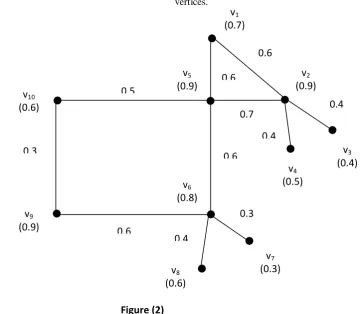
1613 is called connected end equitable dominating set if the induced subgraph 〈 〉 is connected.
Definition 4.2 Any connected end equitable
dominating set with minimum fuzzy cardinality is called minimum connected end equitable domination number and it’s denoted by minimum connected end equitable dominating set in G. clearly is also an end equitable dominating set in . Therefore . Hence .
Remark 4.4 The above theorem equality
condition holds for fuzzy graph has no end vertices. For example, fuzzy cycle and complete fuzzy graph holds the equality condition. connected equitable dominating set. Hence
Example 4.6 From figure (2) connected end
1614 cycle. Which is a contradiction to that is a tree.
Because every vertex other then the end vertex in a tree is cut vertex. Hence there is no connected end equitable domination number is less than . Hence . Similarly, if G is equitable totally disconnected then .
Corollary 4.11 For any be a fuzzy cycle with order p then { } and – { } should be connected.
Proof Since
{ } and – { } is any subset of the vertices on the cycle such that and any adjacent vertices. Clearly is connected and equitable set of it means
{ } and the known result we have { } .
Hence
{ }.
Corollary 4.12
(i) For any bi-star fuzzy graph with order then (ii) For any spider fuzzy graph then
Theorem 4.13 For any complete bipartite fuzzy
graph then
{ { } } Where be the order of the partition with number of vertices and be the order of the partition with number of vertices.
Proof
Case (1) : If and , in this case of the fuzzy graph G is equitable totally disconnected and by known result
and by theorem () . Hence
Case (2) : If where then if be the partite sets of , be selecting one vertex and then { } is connected end equitable dominating set. { } but . Hence { }
Observation 4.14 For any connected fuzzy
graph G any minimum connected end equitable dominating set must be contained all the support vertices.
v1
(0.7)
v10
(0.6)
v2
(0.9)
v3
(0.4) v4
(0.5) v5
(0.9)
v9
(0.9)
v6
(0.8)
v7
(0.3) v8
(0.6)
0.6
0.4
0.4 0.7 0.6
0.6
0.3
0.4 0.6
0.5
0.3
1615
Theorem 4.15 Let be connected fuzzy
graph with order and be the order of end vertices then , where which is not end vertex.
Proof Clearly if is connected fuzzy graph with order have their following two cases :
Case (1) : If has end vertices. Let be any connected end equitable dominating set of then be order of end vertices and also supporting vertices must along to dominating set. Hence
Case (2) : If G has no end vertices then it is obviously true. i.e.,
Conclusion The concept of domination in
fuzzy graph is very rich both in theoretical developments and applications. In this paper we introduce the concept connected end equitable domination in fuzzy graphs. We have found some bounds for the connected end domination number of fuzzy graphs. The various types of equitable domination in fuzzy graphs to precede future result.
REFERENCES
[1] Dharmalingam K.M., and Rani.M., (2014), Equitable domination in fuzzy graphs, International Journal of Pure and Applied Mathematics, Vol 94, No. 5., 661 – 667. [2] Gurubaran. C., Prasanna. A., Mohamed Ismayil.
A., (2018), Paired Equitable Domination in Fuzzy Graphs, International Journal of Mathematical Archive (IJMA), Vol 9, No 6, 43-47.
[3] Nagoor Gani. A., and Chandrasekaran.T., (2006), Domination in fuzzy graph, Adv.Fuzzy Sets and System 1(1), 17 – 26.
[4] Rosenfeld.A., Fuzzy graphs, in: Zadeh.L.A., Fu.K.S., Tanaka.K., Shimura.M(Eds.), (1975), Fuzzy Sets and Their Applications to cognitive and Decision Processes, Academic Press, New York, 77 – 95.
[5] Somasundaram.A., and Somasundaram.S., (1998), Domination in fuzzy graphs – I Pattern Recognition Letters, 19 787 – 791.