Semantic Naïve Bayes Classifier for Document Classification
How Jing, Yu Tsao
Research Center for Information
Technology Innovation
Academia Sinica, Taipei, Taiwan
{yu.tsao}@citi.sinica.edu.tw
Kuan-Yu Chen, Hsin-Min Wang
Institute of Information Science
Academia Sinica, Taipei, Taiwan
{kychen, whm}@iis.sinica.edu.tw
Abstract
In this paper, we propose a semantic naïve Bayes classifier (SNBC) to improve the conventional naïve Bayes classifier (NBC) by incorporating “document-level” semantic information for document classification (DC). To capture the semantic information from each document, we develop semantic feature extraction and modeling algorithms. For semantic feature extraction, we first apply a log-Bilinear document modeling (LBDM) algorithm to transform each word into a semantic vector, and then apply principal component analysis (PCA) to the semantic space formed by the word vectors to extract a set of semantic features for each document. For semantic modeling, a semantic model is constructed using the semantic features of the training documents. In the testing phase, SNBC systematically integrates the semantic model and the conventional NBC to perform DC. The results of experiments on the 20 News-groups and WebKB datasets confirm that, with the semantic score, SNBC consistently outperforms NBC with various language modeling approaches.
1
Introduction
Document classification (DC) is an important task in the information retrieval (IR) and natural language processing (NLP) areas. In recent years, many approaches have been developed for DC. Among them, a category of approaches views DC as a traditional ranking problem. These approaches first represent a document with a feature vector, known as the vector space model (VSM), and then machine learning algorithms can be applied to accomplish classification. Notable examples belonging to this category include support vector machine (Joachims, 1998), decision tree (Comite et al., 2003), logistic regression (Genkin et al., 2005), and k-nearest neighbor (Kwon and Lee, 2003).
Another successful category of approaches is based on the naïve Bayes classifier (NBC). NBC assumes that a document is generated from a probabilistic model. In the offline training process, the model parameters are estimated from a set of training documents. When performing DC, NBC calculates a conditional probability
P
c
|
d
(the posterior probability that documentd
belongs to classc
) and classifies the test document to the class that gives the highestP
c
|
d
. When calculatingP
c
|
d
, NBC makes word independence (bag-of-words) assumptions and decomposesP
c
|
d
to a product of individual word probabilities. These word probabilities are usually characterized by a statistical language model. In practice, unigram language modeling (ULM) is a popular choice due to its effectiveness and computational efficiency (Peng and Schuurmans, 2003; Bai and Nie, 2004; Wu and Wang, 2012). However, since NBC with ULM only considers frequencies of words occurring in a class, it may suffer from the problems of data sparseness and word usage diversity, leading to performance degradations for DC. To deal with the data sparseness (zero probability) problem of ULM, many smoothing techniques, such as Laplace (Bai and Nie, 2004) and Jelinek-Mercer (Jelinek and Mercer, 1980) smoothing techniques have been developed.The latent topic language modeling (LTM) approaches use a set of latent topics to decompose the relationships between documents and classes. Successful examples include latent semantic analysis (LSA) (Bellegarda, 2005; Deerwester et al., 1990), probabilistic latent semantic analysis (PLSA) (Hofmann, 1999a; Hofmann, 1999b), and latent Dirichlet allocation (LDA) (Blei 2011; Griffiths and Steyvers, 2004; Blei et al., 2003). For these approaches, classification scores are not computed directly based on the frequencies of the words but instead based on a set of latent topics along with the likelihoods that each class generates the respective topics. The use of latent topics effectively tackles the word usage diversity problem for ULM and performs DC in a concept matching manner.
Although NBC with LTM approaches have taken
the semantic information into account, the document-level semantic cues are not directly incorporated for the DC task (LTM approaches only extract the word frequency information from documents). In this paper, we intend to enhance the NBC-based approaches by incorporating document-level semantic information for DC. In the training phase, we estimate the parameters of the semantic model by using the training documents. In the testing phase, a semantic score is computed based on the given test document with a particular class. The final decision of DC is made based on a combined score from the semantic model and the traditional NBC. Since the proposed framework is derived based on the NBC framework, we name it “semantic NBC” (SNBC). We conduct experiments on two sets of corpora, namely 20 Newsgroups and WebKB. Experimental results demonstrate that SNBC consistently outperforms NBC with various language modeling approaches.
The remainder of this paper is organized as follows. Section 2 defines the notations and briefly reviews the related work. Section 3 introduces the proposed SNBC framework. Section 4 describes our experimental setup and discusses experimental results. Finally, we conclude this work in Section 5.
2
Related Work
In this section, we present notation and terminology to be used in the following discussions and review relat-ed work to the proposrelat-ed SNBC framework.
2.1
Notation
The basic unit in a DC task is word, which is denoted as
w
, wherew
V
, andV
denotes the vocabulary set. A document is a sequence of words, and we denote a document byd
, whered
represents the total number of words in the document. A class is a predefined document class, and we denote a class byc
. Assuming that we haveC
distinct classes, the goal of DC is to classify a test documentd
test into a specific classc
, wherec
C
.2.2
Naïve Bayes Classifier with Language
Modeling
NBC performs DC in two stages: training and testing. In the training stage, a generative model is estimated based on the training documents for each class. In the testing stage, NBC calculates the posterior probability of each class given the evidence of the test document and selects the class that gives the highest probability
|
.
max
arg
ˆ
P
c
d
c
c
(1)By applying Bayes' theorem on
P
c
|
d
, we have
|
|
P
d
|
c
P
c
,
d
P
c
P
c
d
P
d
c
P
(2)where
P
d
|
c
is the likelihood of documentd
under class
c
. Since NBC assumes that words ind
are independent to each other,
P
d
|
c
can be decomposed as
|
|
,,
d w
d w n
c
w
P
c
d
P
(3)
where
P
w
|
c
is the class unigram probability, which indicates the likelihood of wordw
occurring in the classc
, andn
w
,
d
denotes the frequency of wordw
occurring ind
. Generally, a unigram language model (ULM) is used for calculating
w
c
P
|
. However, ULM may encounter a data sparseness (zero-probability) problem. To deal with this problem, many smoothing techniques have been developed. Laplace and Jelinek-Mercer smoothing techniques are two successful examples.The Laplace smoothing technique calculates
w
c
P
|
by
,
,
,
1
|
La
V
w
c
w
n
V
c
w
n
c
w
P
(4)where
n
w
,
c
denotes the frequency of wordw
occurring in class
c
.The Jelinek-Mercer smoothing technique calculates
w
c
P
|
by
1
,
,
,
|
BGJM
P
w
c
w
n
c
w
n
c
w
P
w
V(5) where
P
BG
w
is a background language model obtained from the entire training corpus. The tunable parameter
in Eq. (5) can be determined based on a set of development data. Although many studies have proven that NBC with ULM can provide satisfactory performance, the method has a limitation: the classification process is based on literal term matching and only considers frequencies of words occurring in a class. Thus, NBC with ULM usually suffers from the issue of word usage diversity and polysemy, which can degrade the DC performance.2.3
Latent Topic Modeling
In contrast to literal term matching, a latent topic language modeling (LTM) incorporates a set of latent topic variables to decompose the relationships between documents and classes. PLSA (Hofmann, 1999a; Hofmann, 1999b) and LDA (Blei, 2011; Griffiths and Steyvers, 2004; Blei et al., 2003) are two representative LTM approaches. For PLSA,
d
c
|
|
|
,
, 1 PLSA
d w d w n Kk k k
c
T
P
T
w
P
c
d
P
(6) whereT
k is thek
th latent topic variable, andK
denotes the total number of latent topics. The word-topic likelihood
P
w
|
T
k
and topic-class likelihood
T
c
P
k|
can be estimated beforehand by maximizing the total log-likelihood of the training data. For traditional NBC with ULM, the model implicitly assumes that each word in a document is drawn from a single topic distribution. On the contrary, LTM generalizes the idea to allow a mixture of latent topics, which can overcome the word diversity problem of ULM.LDA shares a same concept as PLSA that uses a set of latent topic variables to model
P
w
|
c
. The major difference between LDA and PLSA is that PLSA assumes the parameters of topic models to be fixed and unknown, while LDA considers the parameters as random variables that follow a Dirichlet distribution. Because LDA uses a complex form for latent topic modeling, the estimation of model parameters is hard to be solved by an exact inference. To simplify the estimation, a variety of approximation algorithms, such as the variational Bayesian expectation maximization (VBEM) (Blei, 2011; Blei et al., 2003) and Gibbs sampling (Griffiths and Steyvers, 2004) algorithms, have been proposed.2.4
Log-Bilinear Document Modeling
Log-Bilinear document modeling (LBDM) (Maas and Ng, 2010; Maas et al., 2011) can be considered as a relaxed version of LTM. LBDM attempts to learn the word representation with a semantic space and use training documents to constrain those semantically similar words to be represented in near vicinity. The major difference of LBDM and LTM is that LBDM aims to directly parameterize the model for capturing word representations, while LTM focuses on estimating a set of latent topics (Maas and Ng, 2010). For matching the empirical distribution of words in each document, LBDM introduces a document specific variable
and defines the probability of a document as
|
,
,
,
d w d w nd
w
P
P
d
d
P
d
P
(7) where
,
exp
exp
|
' ' '
Vw w w
T w w T
b
b
w
P
(8)where
wis a vector representation of wordw
, and wb
denotes a bias for wordw
. LBDM assumes that w
and
are in
, and the variable
is modeled by a Gaussian prior density. The probabilityP
w
|
indicates how close the vector representation of wordw
,
w, is to
.Assuming that we are dealing with the entire set of document collection,
D
, the word representation matrixR
V (thei
th column vector ofR
denoting the vector representation of the
i
th word in the vocabulary) and word biasb
V (thei
thcomponent of
b
denotes the bias term for thei
thword in the vocabulary) can be estimated by
|
;
,
.
max
arg
,
;
max
arg
ˆ
,
ˆ
, , ,
D b R b Rb
R
b
R
D
b
R
d w d d
d w n d
d
P
w
d
P
P
(9) The integral over
d in Eq. (9) is intractable. To simplify the estimation, we assume that the posterior distribution is highly peaked around the MAP estimate of
d. By adding regularization terms forR
and
d and taking the logarithm, the parameters of LBDM are approximately estimated by
,
ˆ
,
;
ˆ
|
log
,
max
arg
ˆ
,
ˆ
2 2 ,
dd w d d
w
P
d
w
n
R
b
R
b
R
D b R (10) where
ˆ
d denotes the MAP estimate of
d for each documentd
D
. Since the objective function in Eq. (10) is not convex, a coordinate ascent process is performed to estimate the parameters. The estimation process first optimizes the word representations (R
and
b
) with keeping the MAP estimates
ˆ
d of each document fixed. Next, we find the new MAP estimate for each document with keeping the word representations fixed. The two estimation processes are performed iteratively until reach convergence.
.
ˆ
exp
ˆ
exp
ˆ
|
|
,
' ' '
,
d w
d w n
w w w
T c
w w T c d
w
d w n c
b
b
w
P
c
d
P
V
(11)
3
Semantic Naïve Bayes Classifier
NBC with LTM models has taken the semantic information into account and been confirmed effective for DC. However, the “document-level” semantic cues are not directly incorporated. In other words, documents are only treated as a sequence of words when determined the similarity between a class and a document (cf. Section 2). To exploit the semantic information of documents, we propose a semantic NBC (SNBC) framework in this paper. In what follows, we articulate the derivation of SNBC and the implementation process of SNBC to perform DC.
3.1
Literal and Semantic Models of SNBC
As presented in Section 2, NBC performs DC by conducting literal term matching (Eqs. (1)-(3)). To incorporate document-level semantic information, we divide
P
d
|
c
into two parts, namely the literal part and the semantic part, and reformulate Eq. (1) as
,
|
,
max
arg
|
max
arg
|
max
arg
ˆ
c
P
c
d
d
P
c
P
c
d
P
d
c
P
c
l s c
c c
(12)
where
d
s andd
l denote the semantic and literal parts, respectively. By assuming that the literal and semantic parts are conditionally independent given a class, we have
d
,
d
|
c
P
d
|
c
P
d
|
c
.
P
(13)As presented in Section 2,
P
d
l|
c
can be estimated by NBC with any language modeling approaches. The calculation of semantic model,P
d
s|
c
, will be detailed in the next section.3.2
Document-level Semantic Information
Capturing
This section describes the semantic feature extraction, semantic modeling, and semantic score calculation procedures in the SNBC framework.
3.2.1
Semantic Feature Extraction
As introduced in Section 2, LBDM can transform a word into a semantic vector representation. In the proposed SNBC framework, we incorporate LBDM to perform semantic feature extraction (SFE). Fig. 1 illustrates the SFE process. Assume that we have
N
cdocuments in the
c
th class. For then
th document, we apply LBDM to represent each word into a semantic vector. The collection of word vectors in that document then forms a semantic subspace for that document, denoted asE
cn. Next, we apply principal component analysis (PCA) onE
cn to extract its principal vectors,F
cn. Finally, we use the principal vectorsF
cn to capture main directions of semantic topics of the documentd
cn. In this paper, we only use the eigenvector with the largest eigenvalue as the semantic feature ford
cn. We will study the use of multiple eigenvectors in our future work.3.2.2
Semantic
Modeling
and
Score
Calculation
[image:4.595.303.518.74.208.2]Figure 2 illustrates the semantic modeling process, which can be divided into training and testing stages. In the training stage, we use the semantic features of the training documents to estimate a semantic model, where each class is modeled by a semantic distribution. In this paper, we use the Gaussian mixture model (GMM) for semantic modeling. Because each class may include several sub-topics (e.g., tennis, basketball, and boxing are all categorized in the sports class), we believe that GMM is a suitable Fig. 1. Semantic feature extraction (SFE) for the
c
thclass
1
c
d PCA
PCA LBDM
PCA 1
c
E Fc1
n c
d n
c
E Fcn
c N c
d Nc
c
E Nc
c
F
Documents Semantic Spaces Semantic
Features Semantic Feature Extraction (SFE)
Fig. 2. Semantic modeling and semantic score calculation for a test document
test
d Training Phase
Class 1
1 1
d 1
1
N
d
SFE
Semantic Modeling
Class C
SFE
Semantic Modeling
1
C
d NC
C
[image:4.595.83.280.86.288.2]each class. The semantic features of the training documents belonging to each class are used to train the GMM for that class. In the testing stage, for each class, the class specific SFE is performed to extract the semantic feature of the test document. Next, the extracted feature is tested on the class specific GMM to obtain the semantic score,
P
d
s|
c
, indicating the semantic likelihood of documentd
on classc
. Since the covariances for different GMMs may vary, we design a normalization algorithm to compensate the variations of semantic likelihoods by
|
,
,
,
|
|
1 1
c c
M
m m m m m
M
m m c m m
s
N
F
N
c
d
P
(13)
where
F
c is the semantic feature of the test document testd
for thec
th class, and the GMM model of classc
hasM
c Gaussian components with mean vectors
1,
,
Mc
, covariance matrices
1,
,
Mc
,and mixture weights
c
M
1,
,
.3.3
SNBC Score Calculation
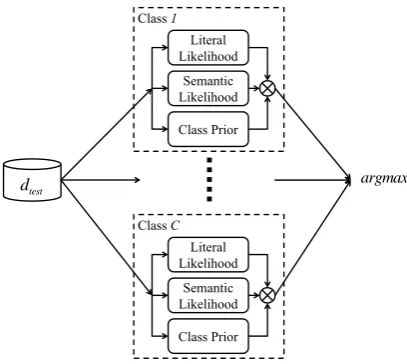
With NBC and the semantic model, we can calculate the final SNBC score by multiplying scores from three different information sources, namely the class prior, semantic information, and literal language modeling, as illustrated in Fig. 3. We further use
to control the scale of semantic information. Therefore, the classification rule for SNBC becomes
|
|
,
max
arg
ˆ
,
d w
d w n s
c
c
w
P
c
P
c
d
P
c
(14)
where the class prior,
P
c
, is simply kept
uni-form in this paper.
4
Experiments
This section describes our experimental setup, performance measure, and experimental results.
4.1
Experimental Setup
We conducted the DC experiments on 20 Newsgroups (20Ng) and WebKB datasets (http://web.ist.utl.pt/aca rdoso/datasets/) (Cardoso-cachopo and Oliveira, 2003). The pre-processing steps include stemming, removing stop words, and removing numbers and words with occurrence below four. 20Ng contains roughly 20,000 documents, which distribute approximately even across 20 classes. These documents are randomly divided into 60% for training and 40% for testing. WebKB originally contains seven different categories, and we use four major classes in the experiments. Finally there are around 4,200 documents, which are randomly divided into two thirds for training and one third for testing. Albeit that the way to systemically determine the values of the parameters in various machine learning approaches is still an open issue and needs further investigation and proper experimentation, the parameters in the following experiments are set empirically as follows. The number of latent topics and the dimension of LDBM are set to 10, which gives the optimal result in our preliminary experiments. For semantic modeling, the number of GMMs equals to the number of classes, and each GMM is characterized by 20 Gaussian components. The parameter
is set to 0.6.4.2
Performance Measure
In the following DC experiments, we use the standard F1-score measure for evaluation. F1-score (F) can be decomposed into two parts, namely recall (R) and precision (P).
,
#
#
examples
positive
prediction
positive
correct
R
(15),
#
#
prediction
positive
prediction
positive
correct
P
(16).
2
P
R
P
R
F
(17)To evaluate the average F1-scores across all the classes, we adopt micro-averaged and macro-averaged F1-scores (Yang, 1999). The micro-averaged F1-score assigns a same weight across different classes while the macro-averaged F1-score gives each class a specific weight according to the number of documents within that class.
[image:5.595.77.281.72.254.2]4.3
Experimental Results
Fig. 3. SNBC score calculation for a test document test
d argmax
Class 1
Literal Likelihood
Semantic Likelihood
Class Prior
Class C
Literal Likelihood
Semantic Likelihood
First, we evaluate the performance of conventional NBC with various language models, including ULM with Jelinek-Mercer smoothing (JM), LDA, and LBDM; their average F1-scores evaluated on WebKB and 20Ng are listed as JM, LDA, and LBDM, respectively, in the upper three rows in Tables 1 and 2. From Tables 1 and 2, we observe that LDA outperforms JM and LBDM in most cases. The results indicate that topic modeling performs better than other language modeling approaches, which is consistent with many previous studies (Blei et al., 2003).
Next, we combine the above three NBC systems, namely JM, LDA, and LBDM, with the semantic information (as presented in Section 3.3); the corresponding results are listed as SNBC (JM), SNBC (LDA), and SNBC (LBDM), respectively, in the lower three rows of Tables 1 and 2. From the experimental results, we note that SNBC consistently outperforms conventional NBC systems. The improvements from NBC to SNBC have been confirmed statistically significant based on the t-test (Agresti and Franklin, 2008). The superscript * in Tables 1 and 2 indicates that the corresponding improvement is significant at the 0.05 confidence level. Our experimental results confirm that the document-level semantic information provides complementary knowledge to the NBC with LTM and thus improve its performance for DC.
5
Conclusions
This paper has proposed a semantic naïve Bayes classifier (SNBC) that incorporates document-level semantic information to improve the performance of the conventional NBC for the DC task. The SNBC framework includes a semantic feature extraction scheme to extract the semantic information of a training/test document and a semantic modeling algorithm to compute the semantic score for a given document. In the testing phase, SNBC combines the semantic score and the language modeling score to perform DC. Our experiments have been conducted on the 20 Newsgroups and WebKB datasets. The results demonstrated that SNBC can improve the DC performance in terms of Micro-F1 and Macro-F1 scores for NBC with various language modeling techniques. The performance improvement of SNBC over NBC confirms the effectiveness of integrating document-level semantic information into the conventional NBC. Notably, this study adopts LBDM to prepare semantic features; other semantic extraction methods, such as PLSA and LDA, can also be used to prepare semantic features. More experiments on SNBC using different semantic extraction methods will be conducted and compared with other existing state-of-the-art approaches in the
References
Alan Agresti and Christine A. Franklin. 2008. In Statistics: The Art and Science of Learning from Data. Prentice Hall.
Alexander Genkin, David D. Lewis, and David Madigan. 2005. Sparse Logistic Regression for Text Categorization. DIMACS Working Group on Monitoring Message Streams. Project Report. Ana Cardoso-cachopo, and Arlindo L. Oliveira. 2003.
An empirical comparison of text categorization methods. In String Processing and Information Retrieval, 10th International Symposium, pages 183-196.
Andrew L. Maas and Andrew Y. Ng. 2010. A probabilistic model for semantic word vectors. In Deep Learning and Unsupervised Feature Learning Workshop X NIPS.
Andrew L. Maas, Raymond E. Daly, Peter T. Pham, Dan Huang, Andrew Y. Ng, and Christopher Potts. 2011. Learning word vectors for sentiment analysis. In Proceedings of the 49th Annual Meeting of the Association for Computational Linguistics: Human Language Technologies, pages 142-150.
David M. Blei, Andrew Y. Ng, and Michael I. Jordan. 2003. Latent dirichlet allocation. Journal of Machine Learning Research, 3:993-1022.
David M. Blei. 2011. Introduction to probabilistic topic models. Communications of the ACM, 55(4):77–84.
[image:6.595.310.518.94.172.2]Francesco De Comite, Remi Gilleron, and Marc Tommasi. 2003. Learning multi-label alternating decision trees from texts and data. In Proceedings of MLDM, pages 251-274.
Table 1. F1-scores of NBC and SNBC on the WebKB dataset
[image:6.595.309.517.200.280.2]Models Micro-F1 Macro-F1 JM 0.8381 0.8258 LDA 0.8388 0.8253 LBDM 0.8187 0.8133 SNBC(JM) 0.8491 0.8403 SNBC(LDA) 0.8603 0.8496 *SNBC(LBDM) 0.8488 0.8346
Table 2. F1-scores of NBC and SNBC on the 20Ng dataset
Frederic Morin, and Yoshua Bengio. 2005. Hierarchical probabilistic neural network language model. In Proceedings of AISTATS, pages 246-252.
Frederick Jelinek and Robert L. Mercer. 1980. Interpolated estimation of Markov source parameters from sparse data. In Proceedings of the Workshop on Pattern Recognition in Practice, pages 381-397.
Fuchun Peng and Dale Schuurmans. 2003. Combining naïve bayes and n-Gram language models for text classification. Lecture Notes in Computer Science, 2633:335-350.
Jay M. Ponte and W. Bruce Croft. 1998. A language modeling approach to information retrieval. In the 21st International ACM SIGIR conference on research and development in Information Retrieval, pages 275-281.
Jerome R. Bellegarda. 2005. Latent semantic mapping. Signal Processing Magazine, IEEE, 22:70-80. Jing Bai and Jian-Yun Nie. 2004. Using language
models for text classification. In Proceedings of AIRS.
Meng-Sung Wu and Hsin-Ming Wang. 2012. A term association translation model for naïve bayes text classification. In Proceedings of the 16th Pacific-Asia conference on Advances in Knowledge Discovery and Data Mining - Volume Part I, pages 243-253. Springer-Verlag.
Oh-Woog Kwon and Jong-Hyeok Lee. 2003. Text categorization based on k-nearest neighbor approach for web site classification. Inf. Process. Manage., pages 25-44.
Scott Deerwester, Susan T. Dumais, George W. Furnas, Thomas K. Landauer, and Richard Harshman. 1990. Indexing by latent semantic analysis. Journal of the American Society for Information Science, 41:391-407.
Thomas L. Griffiths and Mark Steyvers. 2004. Finding scientific topics. In Proceedings of the National Academy of Sciences, 101:5228-5235. Thomas Hofmann. 1999a. Probabilistic latent
semantic analysis. In Proceedings of Uncertainty in Artificial Intelligence, UAI 99, pages 289-296. Thomas Hofmann. 1999b. Probabilistic latent
semantic indexing. In Proceedings of the 22nd annual international ACM SIGIR conference on Research and development in information retrieval, pages 50-57.
Thorsten Joachims. 1998. Text categorization with support vector machines: learning with many relevant features. In Proceedings of the 10th
European Conference on Machine Learning, pages 137-142.
Yiming Yang. 1999. An evaluation of statistical approaches to text categorization. Journal of Information Retrieval, 1:67-88.