Error Detection and Recovery in Spoken Dialogue Systems
Edward Filisko and Stephanie Seneff
∗Spoken Language Systems Group
MIT Computer Science and Artificial Intelligence Laboratory
200 Technology Square, Cambridge, MA 02139
{
filisko,seneff
}
@csail.mit.edu
Abstract
This paper describes our research on both the detection and subsequent resolution of recog-nition errors in spoken dialogue systems. The paper consists of two major components. The first half concerns the design of the error detec-tion mechanism for resolving city names in our
MERCURYflight reservation system, and an in-vestigation of the behavioral patterns of users in subsequent subdialogues involving keypad entry for disambiguation. An important obser-vation is that, upon a request for keypad en-try, users are frequently unresponsive to the ex-tent of waiting for a time-out or hanging up the phone. The second half concerns a pilot ex-periment investigating the feasibility of replac-ing the solicitation of a keypad entry with that of a “speak-and-spell” entry. A novelty of our work is the introduction of a speech synthesizer to simulate the user, which facilitates develop-ment and evaluation of our proposed strategy. We have found that the speak-and-spell strat-egy is quite effective in simulation mode, but it remains to be tested in real user dialogues.
1
Introduction
Spoken dialogue systems are emerging as an intuitive terface for providing conversational access to online in-formation sources (Eckert et al., 1997; Gorin et al., 1997; Dahlback et al., 1999; Zue et al., 2000; Walker et al., 2001; Glass and Seneff, 2003; Pieraccini et al., 1997; Quast et al., 2003; J. Gustafson, 1999; Polifroni and Chung, 2002; Denecke, 2002; Seneff, 2002; Zue and Glass, 2000). While the effectiveness of such systems
∗This research was supported by an industrial consortium
supporting the MIT Oxygen Alliance.
has improved significantly over the past several years, a critical barrier to widespread deployment remains in the form of communication breakdown at strategic points in the dialogue, often when the user is trying to convey a critical piece of information that the system repeatedly misunderstands.
This paper focuses on the specific two-stage problem of error detection and subsequent recovery, in a situa-tion where the user is attempting to provide a named entity which the system fails to understand. It is not a straightforward process for the system even to notice that it has made a mistake. Tedious confirmation subdia-logues for every attribute provided would lead to annoy-ance and widespread unwillingness to use the system at all. Hence, the system should only invoke a confirmation subdialogue when it perceives there to be a communica-tion breakdown.
The second aspect of the problem, error recovery, is also challenging. The system may persist in mis-understanding repeated spoken renditions of the same named entity, unless a substantially different tactic can be adopted to assure higher communicative success.
confu-sion, or some other reason is not clear, however, since we were unable to interview users to identify why they chose not to use the keypad.
Motivated by the apparent need for a more intuitive error recovery strategy, we describe in Sections 5 and 6 a set of experiments that explore an alternative ap-proach whereby the user is instead asked to speak and spell the problematic city name. We have recently devel-oped the capability to utilize a pronounced version of a word to greatly enhance the accuracy of a letter recogni-tion task, and have successfully integrated this technol-ogy into a personal name enrollment task (Seneff et al., 2003; Chung et al., 2003). Our interest here was in evalu-ating whether a similar technique would be useful for the error recovery problem.
It is difficult, however, to develop and perfect an algo-rithm involving multiple recognition passes, that is only triggered sporadically in user conversations. Hence, we discuss a novel approach to system development based on simulating the completion of user dialogues beginning at the point where the system had detected a communica-tion breakdown. In other words, we utilize a speech
syn-thesizer to produce a speak-and-spell waveform that is
solicited in lieu of the keypad entry in theMERCURY di-alogues we have analyzed. DECTalk1acts as a user con-tinuing the conversation from the point where the orig-inal MERCURY system detected communication break-down. The synthetic speech is processed through the speak-and-spell recognition system. An analysis of the rate of success is then an indicator of how promising the method might be for real user dialogues. At the same time, we have expanded the set of cities from the origi-nal 500 known to theMERCURYsystem to a much larger
set of nearly 17,000 city names within the United States. If successful, this new speak-and-spell mode would thus greatly expand the number of cities that the system could theoretically recognize.
2
Background and Motivation
Spoken conversational systems have great potential for providing spoken language access to information sources. However, such systems are only useful if they can under-stand most of the content words in each utterance. Many a user has been aggravated by conversational systems that hypothesize the same incorrect words over and over, of-ten due to ignorance of critical words the user is speak-ing. The dialogue manager component is often of lit-tle or no help, suggesting, “Please try using shorter sen-tences,” or “I did not understand. Please rephrase your query.” The system must be able to recognize compli-cations such as misrecognitions, repetitive mistakes, and out-of-vocabulary (OOV) words, and to react
appropri-1
http://research.compaq.com/wrl/decarchives/dtj/dtjk01/
ately. A more successful interaction is achievable if the dialogue manager is able to work with the user to resolve an error in the course of the dialogue.
A common strategy used in human-human dialogue for handling an OOV word is for one participant to ask the other to repeat or spell the unknown word. This provides the inquisitor with more detailed information about the word, which can facilitate his understanding of the word. Several dialogue systems have employed such a strategy in dealing with a confusing or unknown word (Bauer and Junkawitsch, 1999; Schramm et al., 2000). We aim to employ such a speak-and-spell strategy in our system.
In this work, we focus on the class of place names, specifically cities, states, and airports. Such names are prevalent and problematic in any domain where geogra-phy plays a dominant role. For example, a weather infor-mation system or a flight reservation system must have the city, state, or country names exactly correct in order to be useful. In real user interactions, it is inevitable that some city will be mentioned that is unknown to the sys-tem. Such a name will often be misrecognized as a known city. The dialogue manager must determine whether a poorly scoring hypothesized city name is, in fact, a mis-recognized but known city, or an entirely new word. Such uncertainty must be resolved in a manner that is time-efficient and does not overburden the user.
For example, in the case of a weather information sys-tem, very common geographic names would most likely be known to the recognizer (e.g., New York, Moscow). If a user wants to know the weather in his hometown of Menominee, for example, which is unknown to the rec-ognizer, the system is faced with a problem. If the recog-nizer is not equipped with an unknown word detector, the closest word in the recognizer’s vocabulary will be cho-sen as the best hypothesis. The user will then have to pro-ceed through potentially many clarification turns in which the system repeatedly hypothesizes incorrect city names. Since “Menominee” is OOV, the system will never find the correct city name.
If, however, a large external database is available (e.g., US Census data), that the system could consult given a hypothesized spelling of the unknown city, there is hope that the system will find the user’s intended city name. Such an approach of access to a much larger vocabulary in spell mode has been successfully applied, for example, in (Schramm et al., 2000). In the most extreme case, the large external database would be the World Wide Web. One could imagine the system posing a search query on the Web to determine that the closest major city is Green Bay, Wisconsin, located 60 miles south of Menominee, so it may suffice to provide the weather for Green Bay.
User: I would like to fly to austin tomorrow morning [mis-recognized as “Boston”] System: Sorry. I’m not sure what you said. There are no flights from Boston to Boston. User: austin texas
System: Okay, flights from Austin to Boston departing between 5:00 am and noon on Monday March tenth. One moment please. If I have misunderstood you, you should say, Scratch that.
There are no nonstop flights. I have flights on American, Continental, and Delta. There are at least 6 flights departing between 8:00 a.m. and 9:00 a.m. Can you be more specific?
User: I would like to fly from boston massachusetts to austin texas
System: Please enter the departure city name using the telephone keypad ending with the pound key. User: 267866# [user enters “Boston” via keypad]
System: Okay from Boston to Austin. What date will you be traveling? USER: I would like to leave tomorrow morning
System: Okay, flights from Boston to Austin departing between 5:00 am and noon on Monday March tenth. One moment please. . . .
Figure 1:Example of a dialogue involving a successful entry of a departure city using the telephone keypad, initiated by the system based on perceived confusion.
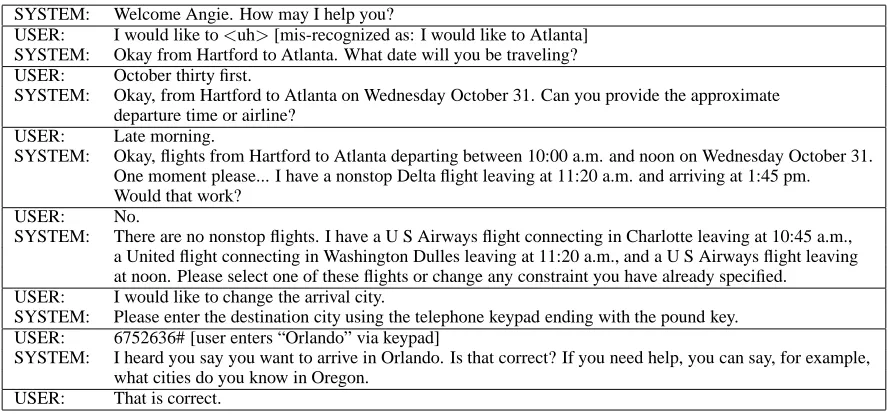
SYSTEM: Welcome Angie. How may I help you?
USER: I would like to<uh>[mis-recognized as: I would like to Atlanta] SYSTEM: Okay from Hartford to Atlanta. What date will you be traveling? USER: October thirty first.
SYSTEM: Okay, from Hartford to Atlanta on Wednesday October 31. Can you provide the approximate departure time or airline?
USER: Late morning.
SYSTEM: Okay, flights from Hartford to Atlanta departing between 10:00 a.m. and noon on Wednesday October 31. One moment please... I have a nonstop Delta flight leaving at 11:20 a.m. and arriving at 1:45 pm. Would that work?
USER: No.
SYSTEM: There are no nonstop flights. I have a U S Airways flight connecting in Charlotte leaving at 10:45 a.m., a United flight connecting in Washington Dulles leaving at 11:20 a.m., and a U S Airways flight leaving at noon. Please select one of these flights or change any constraint you have already specified.
USER: I would like to change the arrival city.
SYSTEM: Please enter the destination city using the telephone keypad ending with the pound key. USER: 6752636# [user enters “Orlando” via keypad]
SYSTEM: I heard you say you want to arrive in Orlando. Is that correct? If you need help, you can say, for example, what cities do you know in Oregon.
USER: That is correct.
Figure 2:Example of a dialogue involving a successful entry of an arrival city using the telephone keypad, provoked by a specific request by the user to change the arrival city.
lexicon, the system must now remain open to the possibil-ity that the hypothesized word (i.e., sequence of letters) is misspelled. In other words, a spelling checker must be utilized. Depending on the robustness of the spelling checker, the system may or may not be able to identify the intended word from a misspelling. With a large database, a potential misspelling could correspond to multiple data items. In such a case, the system would need to initiate a disambiguation subdialogue to resolve the ambiguity.
There are several pragmatic issues to consider in ob-taining spelled data from a user whether via keypad or speech. The problem of disambiguating keypad se-quences has been addressed using both dictionary-based (Davis, 1991) as well as probabilistic (MacKenzie et al., 2001) approaches. In both input modes, the user may use abbreviations such as “S T P E T E R S B U R G”
3
M
ERCURYError Recovery Strategy
The MERCURY system, accessible via a toll free num-ber2, provides information about flights available for over 500 cities worldwide. We have invested considerable ef-fort into makingMERCURYintuitive to use and robust in handling a wide range of different ways users might ex-press their flight constraints and select the flights of the itinerary. A typical user begins by logging on, providing both his name and password, which allows the system to look up some personalized information such as the e-mail address and the preferred departure city. MERCURY’s di-alogue plan involves arranging a trip one leg at a time. Once the itinerary is fully specified,MERCURYoffers to price the itinerary and, subsequently, to send a detailed record of the itinerary to the user via e-mail, which can then be forwarded to a travel agent for the actual booking. A critical aspect of flight dialogues is the successful communication of the source, destination, and date, all of which are susceptible to recognition error. MERCURY’s default policy is to use implicit confirmation to communi-cate to the user its interpretation of his utterances. In the meantime, it monitors the evolution over time of these three critical attributes. When it detects odd behavior, it switches into a mode where keypad entry is solicited. The keypad entry is matched against existing hypotheses and, if a successful match is obtained, is assumed to be correct. Otherwise, a verbal confirmation subdialogue, soliciting a “yes/no” answer, is invoked.For source and destination, the system tabulates at each turn whether the attribute was inherited, repeated, or changed. If a change is detected after flights have already been retrieved, the system prompts for spoken confirma-tion of the surprising move, anticipating possible recog-nition error. After two consecutive turns where the user has either apparently repeated or replaced the departure or arrival city, the system requests the user to enter the city by spelling it using the telephone keypad. This strat-egy is also used if a substitution/repetition of the city is followed by an utterance that is not understood, or when-ever the user explicitly requests to change the departure or arrival city. It turns out thatMERCURY’s 500 cities are uniquely identifiable through their keypad codes; how-ever, if this were not the case, a follow-up disambiguation subdialogue could be arranged. This keypad mechanism also provides the opportunity to confirm whether the de-sired city is known or unknown.
A similar process takes place for dates. If the user appears to repeat the date, without providing any other information, there is the suspicion that a misrecognized date has again been misrecognized the same way. In this case, the system tries to find an alternative hypothesis for the date by re-examining the N-best list of recognizer
2
1-877-MIT-TALK.
hypotheses, and, in any case, also asks for user confir-mation. As is the case for cities, the system invokes the keypad upon repeated date corrections.
Figures 1 and 2 provide two examples of user dia-logues involving keypad city entry. Figure 1 illustrates a dialogue where the conversation is clearly confused, and the system eventually takes the initiative to invite a keypad entry of the departure city. The user wanted to go to “Austin”, which the system misunderstood as “Boston”. This particular user had a default departure city of “Boston”, which caused the system to suppose that the user had requested a pragmatically unreasonable flight from “Boston” to “Boston”. The user’s follow-up fragment, “Austin, Texas”, was correctly understood, but misinterpreted as the departure city instead of the arrival city, leading to further confusion. It was only after the user had cleared up the confusion, with the complete ut-terance, “I would like to fly from Boston, Massachusetts to Austin, Texas,” that the system was finally on the right track, but by this point, it had identified difficulty with the source, reacting by launching a keypad entry request, with subsequent resolution.
Figure 2 shows an example subdialogue where the des-tination city was successfully entered using the telephone keypad, based on an explicit request on the part of the user to change the destination. Interestingly, the user delayed the correction until the system invited him to change any constraint that was already specified. This particular user probably believed that she was required to respond to the prompts, although it is conceivable that the user’s delayed response was due to inattentiveness. This dialogue thus reveals some of the potential difficul-ties encountered due to users’ false assumptions about the system’s behavior.
4
M
ERCURYAnalysis
We have been collecting MERCURY data over the tele-phone for the past several years (Seneff and Polifroni, 2000), involving user interactions with the system to make flight reservations. In examining these dialogues, we have come to the realization that, while keypadding the date (as a four digit numeric code for month and day) seems to be intuitive to users and therefore an effective mechanism for correcting misunderstandings, the situa-tion is far less effective in the case of city names.
In addition to many successful responses, however, several errorful responses were also observed, including misspelled words (e.g., “TEIPEI” for “TAIPEI”), out-of-vocabulary words (e.g., “DOMINICA”), or a string of valid references that could not be resolved as a sin-gle place name (e.g., “NEWYORKJFKNYC” for “New York’s Kennedy Airport”). A user time-out or hang-up was also common, and constituted a significant number of responses.
A total of 172 instances were observed in which the system prompted users to enter a source or destination via the keypad. The number of occurrences is rather low since this solicitation was only activated as a last resort. The system then entered a state where speech was not an option. The users’ responses to these prompts are sum-marized in Table 1. Most surprising is that nearly half of the time, the user did not even attempt to use the keypad. In only 88 of the cases did the user actively enter a key-pad code. The user let a time-out occur in 50 cases, and hung up the telephone in an additional 34 cases.
Description Count Percentage
user attempts at keypad entry 88/172 51.1%
time-outs 50/172 29.1%
hang-ups 34/172 19.8%
Table 1:Summary of users’ responses to 172 system prompts to enter a source or destination using the telephone keypad.
This attempt rate of 51.1% is significantly lower than originally hoped. Even within the 88 compliant cases, the results are disappointing, as shown in Table 2. In 61 cases, the keypad sequence entered by the user cor-responded to a valid city or airport name. Most of these were known to the system and were processed success-fully. The remaining 30.7% of attempts consisted of mis-spellings (such as a double tap on a key, substituting the number ‘0’ for the letter ‘o’, or terminating with ‘*’ in-stead of ‘#’) or apparent garbage.
Description Count Percentage
valid city/airport entered 61/88 69.3% misspelled city/airport entered 19/88 21.6% garbage entered (e.g, “***#”) 8/88 9.1%
Table 2: Summary of a total of 88 user attempts at entering a source or destination city or airport name using the telephone keypad after being prompted by the system.
4.1 Discussion
Our results suggest that the strategy of prompting for key-pad entry of questionable parameters shows potential for
recovering from situations in which the system is con-fused about what the user has said. We believe that such recovery can contribute to successful dialogue comple-tion, as well as elevating the user’s tolerance level. Nev-ertheless, our results also pose two questions that need to be addressed: why do some users’ attempts at keypad en-try contain errors, and, more importantly, why do some users not even attempt keypad entry?
It is not possible to know why an individual user was unable to enter a valid keypad sequence; we had no mech-anism to interview users about their behavior. We can, however, speculate that the errorful sequences were due to the non-intuitive nature of spelling with a telephone keypad, a user’s unfamiliarity with the spelling of a given word, typos, or a user’s confusion as to what qualified as an acceptable entry (e.g., Are abbreviations and nick-names allowed?).
We must also acknowledge the fact that what qualifies as a valid keypad sequence depends on the spelling cor-rection capabilities of the system. Even a simple spelling checker (not utilized during theMERCURY data collec-tion) could potentially allow the system to make sense of an errorful keypad sequence.
In the case of a time-out, it is difficult to know what each user was thinking as he waited. It is likely that the user was hoping for a return to speech mode after the time-out. The user may have hesitated for fear of send-ing the system down an even more divergent path. It is also possible that users were inattentive when the system instructed them to terminate with the pound key, and that they therefore entered the entire city, but without a termi-nation code. Clearly a strategic modification to automat-ically generate a ‘#’ after a significant pause might help reduce this type of error.
The reason for a hang-up is more obvious, given the dialogue context. For example, if the user had repeatedly said that he wanted to fly to Anchorage and the system had already hypothesized three other cities, it is under-standable that he would have hung up in frustration.
The telephone keypad would seem to be a very prac-tical mode of information entry given its physical acces-sibility and limited ambiguity per key. This small set of data in the flight domain, however, suggests that it is con-fusing, annoying, or simply intimidating to many users. The next challenge, then, is to utilize a similar error re-covery strategy, but to adopt a different mode of informa-tion entry, one that is more intuitive and less intimidating. We discuss such an option in the next section.
5
Spoken Spelling
and more intuitive. Our goal is to make the user feel con-fident that spelling a city name is a plausible request and that it can be the most effective path to task completion.
Undeniably, spelling recognition comes with its own set of problems, especially misrecognition of the spoken letters. One way to minimize such errors is to incorpo-rate limited spelling checking, such as allowing a single insertion, deletion, or substitution per word. For example, a spelling sequence recognized as “T E N V E R” could be mapped to “D E N V E R” as the closest match in the database. Obviously, a trade-off exists where overgener-ous spelling correction could lead to a false hypothesis.
A great challenge in developing conversational sys-tems is that dialogue strategies can only evolve through extensive experimentation, which requires a large amount of data, particularly for situations that occur rarely in ac-tual dialogues. To expedite development and evaluation of the recovery strategy, we decided to make use of sim-ulated user data to artificially continue MERCURY dia-logues beyond the point where the system had originally asked for a keypad entry, as described in the next section.
6
User Simulation
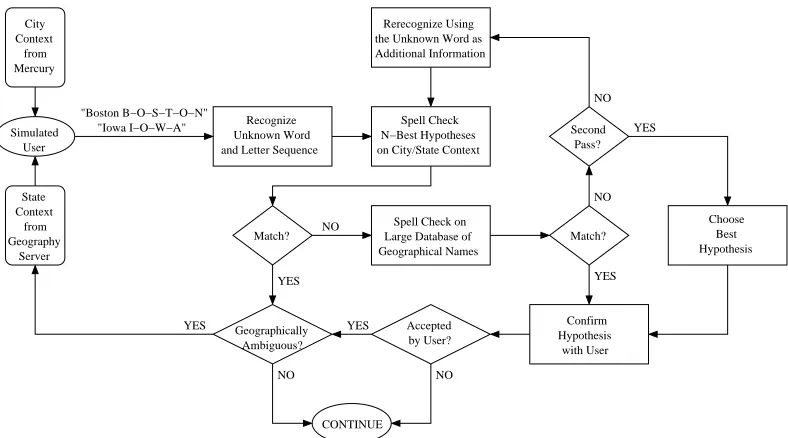
To streamline exploration of alternative dialogue strate-gies for error recovery, we have implemented a simulated user that speaks and spells a city name using DECTalk. A block diagram of our simulated user system is shown in Figure 3. Each synthesized waveform3contains a pro-nunciation of the city name that a user was trying to com-municate in the original dialogue, immediately followed by a spoken spelling of that city name (e.g., “Boston B O S T O N”). The waveform is passed to a first stage speech recognizer, which treats the spoken word as an un-known word and proposes anN-best list of hypothesized spellings for the synthesized letter sequence. For speech recognition, we use the SUMMIT framework (Glass et al., 1996), and the unknown word is modeled according to techniques described in (Bazzi and Glass, 2002).
Following the first stage recognition, a two-stage matching process first consults a list of “cities in focus” that were extracted as hypotheses from the original user’s final utterance before the keypad turn. Subsequently, if a match or conservative partial match is not found from the short list, a large database of 17,000 city and state names is consulted for a match or a partial match. In this case a confirmation subdialogue ensues.
If a match is found, a geography server determines whether the name is ambiguous. If so, a disambiguating item (e.g., state name) is requested by the dialogue man-ager. The simulated user then randomly chooses from
3
While DECTalk speech is artificial, we have not explicitly trained our recognizer on it, and thus we argue that it can serve as an effective stand-in for real human speech.
a list of candidate state names provided by the geogra-phy server. This utterance is currently also processed as a speak-and-spell utterance, mainly because we are inter-ested in obtaining more data on the performance of our speak-and-spell system.
If no match is found in either the short list or the external lexicon of known city names, another recogni-tion cycle is initiated, in which the phonetic content of the spoken word is used to enhance the performance of the spelling recognizer, following procedures described in (Chung et al., 2003). A letter-to-sound model is used to map from a graph of letter hypotheses proposed by the first stage recognizer to their corresponding plausi-ble pronunciations, using techniques described in (Sen-eff et al., 1996). The final set of hypotheses is obtained by merging hypotheses produced from both halves of the user utterance. Once again, both the short list and the large lexicon are searched for a match.
The idea is that this second stage should only be in-voked upon failure, in order to reduce the amount of com-putation time required. An alternative strategy would be for the system to unconditionally execute a second recog-nition to obtain a potentially more correct hypothesis. Such a strategy, however, would increase the system’s overall processing time.
6.1 Results and Discussion
The simulation was performed on a total of 97 user ut-terances, all of whichMERCURYhad designated as trou-ble situations in the original dialogues. The utterances utilized are those for which the system’s hypotheses con-tained city names, whether or not the user had actually mentioned a city name.
The simulation results are shown in Table 3. Out of 97 problematic sources and destinations generated by the simulated user, 58 required disambiguation with a state name (e.g., “Boston in Georgia”). Therefore, 155 speak-and-spell utterances were ultimately passed through the synthesize-and-recognize simulation cycle. All but one of the state names were correctly recognized. This high performance is likely due to the correct state’s guaranteed existence in the short list used by the spelling checker.
Our algorithm dictates that a second pass, which integrates the spoken name portion of the waveform with letter-to-sound hypotheses derived from the spoken spelling portion, be omitted if a match is found in the first pass. One question to ask is whether the system is being overconfident in this strategy. The results in the table sup-port the notion of using the second pass sparingly. In 68 cases, the system was sufficiently confident with its hy-pothesized city after the first recognition pass to omit the second pass; it made no errors in these decisions.
pro-Simulated User
"Boston B−O−S−T−O−N" "Iowa I−O−W−A" City
Context from Mercury
Context from State
Geography Server
Recognize Unknown Word and Letter Sequence
Rerecognize Using
Additional Information the Unknown Word as
Spell Check N−Best Hypotheses on City/State Context
Large Database of Spell Check on
Geographical Names
Match? Match?
Second Pass?
Accepted by User? Geographically
Ambiguous?
CONTINUE
Choose Best Hypothesis
Hypothesis with User Confirm NO
YES
YES YES
NO NO
YES NO NO
YES
Figure 3:Flow chart detailing the two-pass dialogue strategy for recovering from a problematic source or destination.
Description Count Percentage
correct city after pass 1 68/68 100% correct city after pass 2:
short list match 2/2 100%
database match 11/14 78.6%
no match (last resort) 5/13 38.5% total cities correct 86/97 88.7%
Table 3:Simulation results for 97 speak-and-spell city names showing the number of correct cities hypothesized by the sys-tem, after each of two recovery passes. For pass 2, a match was found on the short list or in the geographic database. No match resulted in resorting to the best recognition hypothesis.
nunciation information. There were two instances where the second-pass hypothesized city was found on the short list of focus cities from the original user utterance; both were correct. For the remainder, the large database was consulted. The system proposed the correct city in nearly 79% of the cases. After failing to find any match, the sys-tem atsys-tempted its last resort of proposing the best hypoth-esis from the second-stage recognizer. Not surprisingly, the system determined the correct city name in only 39% of these cases. Nevertheless, this percentage suggests that it is certainly better to perform the confirmation rather than to simply tell the user that the city is unknown, given that the recognizer may be correct without the aid of any external lexicon.
The majority of incorrect city hypotheses were due to limitations in the spelling checker and the absence of in-ternational names in the geographic database. The
cur-rent spelling checker, while quite powerful, allows only a single insertion, deletion, or substitution of a letter, or a swap of two letters. We believe that a more robust spelling checker can minimize many of these errors.
The system’s performance in hypothesizing the correct candidate for nearly 89% of the problematic city names is encouraging. These results show that this error recov-ery strategy is largely successful in the synthesize-and-recognize user simulation cycle. The simulated results are, of course, biased in that the simulated user was co-operative with all system requests. The results of the
MERCURYanalysis in Section 4 show that an errorful or nonexistent response from a user is a very likely possibil-ity. The installation of this strategy in a real system will require that user behavior be carefully monitored.
Although the prospects for the speak-and-spell input mode are promising, we would not want to entirely aban-don the use of the telephone keypad. It has been and re-mains a convenient and effective means by which to spell words. A more appropriate use of the keypad could be as a back-off strategy after the spoken spelling has failed, or in very noisy environments, where speech would be nearly impossible. One advantage of the keypad is that, barring mistakes, the system can be confident that when ‘3’ is pushed, one of the letters, ‘D’, ‘E’, or ‘F’, is in-tended. When combined with the spoken word being spelled, such keypad ambiguity can be reduced even fur-ther (Chung et al., 2003).
7
Future Work
in situations of compromised recognition performance, it remains to be seen whether it will work well in real user dialogues. An obvious next step is to incorporate this strategy into our MERCURYsystem in place of the key-pad entry request, and then to assess how well users are able to recover from errors and complete their dialogue interactions.
We are quite encouraged by the effectiveness of the strategy of involving DECTalk to simulate user utter-ances, and we believe this idea has merit far beyond the experiments conducted here. For example, we are inter-ested in developing a new CSAIL Information domain, which would allow users to call up and ask about the phone number, e-mail address, etc., for the 800 members of our laboratory. Many of these people have foreign-derived names, which would likely be difficult to pro-nounce, both for users and for DECTalk. However, it would be straightforward to process all 800 first and last names through simulated dialogues, and to obtain a list of those names that failed to be understood by the sys-tem. Developers’ attention could then be drawn toward the task of assuring these names are included explicitly and are correctly pronounced in the main recognizer, as well as augmenting the letter-to-sound system to include those problematic words in its training corpus. It would even be feasible to lexicalize difficult names within the first stage of the speak-and-spell recognizer, such that an explicit word hypothesis could be extracted from the spo-ken word at that point.
References
J.G. Bauer and J. Junkawitsch. 1999. Accurate recognition of city names with spelling as a fall back strategy. In Proc.
Eurospeech, volume 1, pages 263–266, Budapest, Hungary.
I. Bazzi and J. Glass. 2002. A multi-class approach for modelling out-of-vocabulary words. In Proc. ICSLP, pages 1613–1616, Denver, Colorado.
G. Chung, S. Seneff, and C. Wang. 2003. Automatic acquisi-tion of names using speak and spell mode in spoken dialogue systems. In Proc. HLT-NAACL ’03, pages 32–39.
N. Dahlback, A. Flycht-Eriksson, A. Jonsson, and P. Qvarfordt. 1999. An architecture for multi-modal natural dialogue sys-tems. In Proc. of ESCA Tutorial and Research Workshop
(ETRW) on Interactive Dialogue in Multi-Modal Systems.
J.R. Davis. 1991. Let your fingers do the spelling: Implicit disambiguation of words spelled with the telephone keypad.
Avios Journal, 9:57–66.
M. Denecke. 2002. Rapid prototyping for spoken dialogue systems. In Proc. COLING.
W. Eckert, E. Levin, and R. Pieraccini. 1997. User modelling for spoken dialogue system evaluation. In Proc. IEEE ASR
Workshop.
J. Glass and S. Seneff. 2003. Flexible and personalizable mixed-initiative dialogue systems. In HLT-NAACL 2003
Workshop on Research Directions in Dialogue Processing,
Edmonton, Canada.
J. Glass, J. Chang, and M. McCandless. 1996. A probabilistic framework for feature-based speech recognition. In Proc.
ICSLP, pages 1–4, Philadelphia, PA.
A. Gorin, G. Riccardi, and J. Wright. 1997. How may i help you. Speech Communication, 23:113–127.
M. Lundeberg J. Gustafson, N. Lindberg. 1999. The august spoken dialogue system. In Proc. Eurospeech ’99.
I.S. MacKenzie, H. Kober, D. Smith, T. Jones, and E. Skepner. 2001. Letterwise: Prefix-based disambiguation for mobile text input. In Proc. UIST, pages 111–120, Orlando, FL.
M. Marx and C. Schmandt. 1994. Putting people first: Specify-ing proper names in speech interfaces. In Proc. UIST, pages 29–37, Marina del Rey, CA.
R. Pieraccini, E. Levin, and W. Eckert. 1997. AMICA: The AT&T mixed initiative conversational architecture. In Proc.
EUROSPEECH, pages 1875–1878.
J. Polifroni and G. Chung. 2002. Promoting portability in dia-logue management. In Proc. ICSLP, pages 2721–2724.
H. Quast, T. Scheideck, P. Geutner, A. Korthauer, and R. Bosch. 2003. Robodima: A dialogue-object based natural language speech dialog system. In Proc. ASRU Workshop, pages 174– 179, Saint Thomas, Virgin Islands.
H. Schramm, B. Rueber, and A. Kellner. 2000. Strategies for name recognition in automatic directory assistance systems.
Speech Communication, 31(4):329–338.
S. Seneff and J. Polifroni. 2000. Dialogue management in the mercury flight reservation system. In Proc. ANLP-NAACL
2000, Satellite Workshop, pages 1–6.
S. Seneff, R. Lau, and H. Meng. 1996. ANGIE: A new frame-work for speech analysis based on morpho-phonological modelling. In Proc. ICSLP ’96, pages 110–113.
S. Seneff, G. Chung, and C. Wang. 2003. Empowering end users to personalize dialogue systems through spoken inter-action. In Proc. EUROSPEECH, pages 749–752.
S. Seneff. 2002. Response planning and generation in the mer-cury flight reservation system. Computer Speech and
Lan-guage, 16:283–312.
M. Walker, J. Aberdeen, J. Boland, E. Bratt, J. Garofolo, L. Hirschman, A. Le, S. Lee, S. Narayanan, K. Papineni, B. Pellom, J. Polifroni, A. Potamianos, P. Brabhu, A. Rud-nicky, G. Sanders, S. Seneff, D. Stallard, and S. Whittaker. 2001. Darpa communicator dialog travel planning systems: The June 2000 data collection. In Proc. EUROSPEECH, pages 1371–1374.
V. Zue and J. Glass. 2000. Conversational interfaces: Advances and challenges. Proc. IEEE, 88(11):1166–1180.
V. Zue, S. Seneff, J. Glass, J. Polifroni, C. Pao, T. J. Hazen, and L. Hetherington. 2000. Jupiter: A telephone-based conver-sational interface for weather information. IEEE