169
Survey on Local Binary Pattern for Texture Classification
Srishti Seth1, Anupriya2, Shilpa Dogra3, Nishant Shrivastava4 *
Jaypee University Anoopshahr [email protected]
Abstract -Local binary patterns (LBP) is a type of visual descriptor used for texture classification in computer vision. It is
a simple yet very efficient texture operators which labels the pixels of an image by thresholding the neighborhood of each pixel and consider the result as a binary number. It can be seen as a unifying approach to the traditionally divergent statistical and structural models of texture analysis. Perhaps the most important property of the LBP operator in real-world applications is its robustness to monotonic gray- scale changes caused, for example, by illumination variations. Another important property is its computational simplicity, which makes it possible to analyze images in challenging real-time settings. A useful variation of original LBP operator is the uniform LBP patterns, which can be used to reduce the length of the feature vector and implement a simple rotation invariant descriptor. This extension was inspired by the fact that some binary patterns occur more commonly in texture images than others. The occurrences of the LBP codes in an image are collected into a histogram. The classification is then performed by computing simple histogram similarities. Due to its discriminative power and computational simplicity, the method has been very successful in many such computer vision problems which were not earlier even regarded as texture problems, such as face analysis and motion analysis like face and facial expression recognition. In addition to that LBP has also been used in many other applications of biometrics, including eye localization, iris recognition, fingerprint recognition, palm print recognition, gait recognition and facial age classification. This study presents a survey on different LBP based methods and their performance comparison on representative texture databases.
Keywords- Local Binary Patterns(LBP), rotational invariance, texture classification, histogram, spacial Distribution.
1. INTRODUCTION
The basic idea behind LBP is that an image is composed of micro-patterns. LBP is the first- order circular derivative of patterns that is generated by concatenating the binary gradient directions. Local Binary Pattern (LBP) is a simple yet a very efficient texture operator which labels the pixels of an image by thresholding the neighbourhood of each pixel and considers the result as a binary number. The basic idea for developing the LBP operator was that two-dimensional surface textures can be described by two complementary measures: local spatial patterns and gray scale contrast.
Analysis of textures plays an important role in many applications in computer vision, for example, image retrieval, face image analysis, and motion analysis. A very challenging problem in texture classification is to extract rotation and histogram equalization invariant features. This problem is also of particular interest because the applications of rotation and histogram equalization sensitive feature extraction methods are strictly limited. In the past few decades, some researchers have considered applying various kinds of methods to extract rotation invariant texture features. Madiraju et al [3]. extracted rotation invariant features by computing the covariance. Chetverikov [2] used anisotropy features to classify rotated texture images. Also, Ojala et al [1] proposed the uniformed local binary patterns (LBP) approach to extracting rotation and histogram equalization invariant
features, which was extended by Huang by applying it to applications of face alignment [4].
Ojala et al [5] used the absolute grey level difference (AGLD) between a pixel and its neighbours to generate textons and used the histograms of them to represent the Image. LBP is basically proposed to use the sign instead of magnitude, of the difference to represent the local pattern. Ojala et al. [6] also proposed the multidimensional distribution of Signed Gray Level Difference (SGLD) and LBP is regarded as the simplified operator of SGLD by using sign patterns only. [7] Tan and Triggs proposed LBP to quantized the difference between the pixel and its neighbors into tree levels. Various extensions of the LBP, such as LBP variance with global matching dominant LBPs [8], completed LBPs [10], advance LBPs [9] etc., are proposed for rotational invariant texture classification.
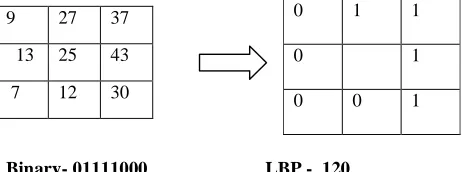
Binary- 01111000 LBP - 120
Fig. 1. 3 × 3 sample block for calculating LBP.
9 27 37 13 25 43 7 12 30
0 1 1
0 1
170
2. COMPLETED LOCAL BINARY PATTERN
In completed local binary pattern (CLBP) a local region is repressed by the centre pixel and a local difference sign-magnitude transform (LDSMT). The original LBP operator (Ojala et al. 1996) forms labels for the image pixels by thresholding for example by forming a 3 x 3 neighbourhood of each pixel with the centre value and considering the result as a binary number. The histogram of these 28 = 256 different labels can then be used as a texture descriptor. A binary map is made at the centre of the CLBP named as CLBP_C. The LDSMT divides the local structure of the CLBP into two components on the bases of magnitude and sign. Which is called as CLBP_M for magnitude and CLBP_S for sign and are proposed to code them. All the three code maps, CLBP_C, CLBP_S, and CLBP_M, are in binary format so that they can be readily combined to form the final CLBP histogram.
= (1)
where is the gray value of the central pixel, is the value of its neighbors, P is the total number of involved neighbors, and R is the radius of the neighborhood.
3.1.Sign and Magnitude Component
Vector (product sign and magnitude) characterises the local structure of an image. However, texture recognition
by direct matching the doesn't give appropriate results every time as it is sensitive to noise, translation, and rotation, etc. So we need to extract the distinct and stable features from dp vector to robustly recognise texture patterns. As seen earlier LBP uses the sign component only for pattern recognition. But apparently it may lead to some incorrect matches.
Therefore, many issues are need to be solved for complete
LBP. To form the original local difference sign and magnitude components are required so we can reconstruct
the original local difference using and then checking out which yields smaller error. It can be observed that the sign component follows a Bernoulli distribution. Thus the local difference can be reconstructed by using only the magnitude component.
3. UNIFORM LOCAL BINARY PATTERN
The possibility of using only uniform and rotation invariant binary patterns distinguishes the Local Binary Pattern methodology from its predecessors, because it enables a more compact image representation. It has been widely accepted that uniform LBPs, which contain at most two circular 0-1 or 1-0 transitions, are highly applicable and thus have been frequently used in various applications not only in texture analysis. While many modifications to the original LBP have been proposed, most image analysis applications still take advantage of a combination of LBP and uniform patterns, despite other modifications in sampling, such as applying Gabor filtering as a preprocessing step.
The patterns 00111000, 11111111, 00000000, and 11011111 are uniform. Selecting only uniform patterns contributes to both reducing the length of the feature vector (LBP histogram) and improving the performance of classifiers using the LBP features. Uniform LBPs can also be applied to obtain rotation invariance.
4. ROTATIONAL INVARIANT LOCAL BINARY
PATTERN
LBP produces different output values for neighboring pixels i.e. (256) in correspondence to this different binary patterns are achieved. As the image is rotated the gray scale values of the image also changes. To remove this rotational effect, the i.e. to assign each unique identifier a rotational invariant circular- bitwise shifting is performed in a clockwise manner where the bit is rotated for every bit. This is performed 8 times in a circular manner for 3x3 neighborhood and then the LBP is calculated of every number, the minimum among the all is selected as the LBP value of that image.
(2)
Where is performs the circular bitwise right shift.
However, concluded that the rotational invariance doesn’t provide a good discrimination due to two factors
(1). Not every pattern can sustain rotation some can sustain it quite well and other patterns do not and confuse the analysis.
(2). Crude quantization of the angular space 45º interval.
The varying performance of individual patterns are achieved. So, to quatify this we define uniformity measure ‘U’ which corresponds to uniform patterns.To achieve rotation invariance, a locally rotation invariant pattern could be defined as
171 In practice, the mapping from to (superscript “u2” means
uniform patterns with U 2), which has P*(P-1)+3 distinct output values.
The mapping of LBP P, R to LBP P, R rin2 is known as rotational invariance “uniform” patterns from U<=2 which has P+2 distinct output values.
5. COMPOUND LOCAL BINARY PATTERN
The Compound Local Binary Pattern [11] is basically an extension of the LBP operator for rotation invariant texture classification. Unlike the original LBP operator that uses P bits to encode only the signs of the differences between the center pixel and P neighbour gray values, the proposed method employs 2P bits, where the additional P bits are used to encode the magnitude information of the differences between the center and the neighbour gray values in a local neighbourhood using a threshold. The motivation behind the proposed encoding scheme is to increase the robustness of the texture feature representation by incorporating additional information that is discarded by the original LBP operator.
6. CONVENTIONAL LOCAL BINARY PATTERN
The performance of conventional LBP is simple and effective but limited, because these methods only consider micro structures of images such as edges, corners, spots and so on, although many of them show a good performance on texture classification.
The weakness is clear when different texture images have same micro structures. he conventional LBP just considers the uniform patterns in the images. It discards important pattern information for images whose dominant patterns and not uniform patterns. Also, the features of the conventional LBP are the histograms of the uniform patterns in a texture image. As such, the spatial distribution information of the patterns.
7. DOMINANT LOCAL BINARY PATTERN
This proposes a new feature extraction method that is robust to histogram equalization and rotation. First, the conventional LBP approach is extended to the dominant local binary pattern (DLBP) approach in order to effectively capture the dominating patterns in texture images. The DLBP approach computes the occurrence frequencies of all rotation invariant pat- terns defined in the LBP groups. These patterns are then sorted in descending order. The first several most frequently occurring patterns should contain dominating patterns. This shows that the DLBP approach is more reliable to
represent the dominating pattern information in the texture images.
(4)
where represents the center pixel is the neighboring pixel, i = 0, …. m-1, m is the total number of neighboring pixels, R is the circle radius which determines how far the neigh- boring pixels are located away from the center pixel.
The DLBP features encapsulate more textural information than the conventional LBP features, they lack the consideration of distant pixel interactions. The reason is that the binary patterns are extracted in the proximity of local pixels. The pixel interaction that takes place outside the local neighborhood system is unconsidered in LBP or DLBP. To replenish the missing information in the DLBP features, an additional feature set, features based on the Gabor filter responses are utilized as the supplement to the DLBP features.
8. ADVANCE LOCAL BINARY PATTERN
The concept of Advanced Local Binary Patterns (ALBP) [9] reflects the local dominant structural characteristics of different kinds of textures.
1) It is based on the framework of the conventional LBP, we extend it by observing the frequency histogram of all the labels of the patterns and then use the histogram distribution of the dominant patterns as features. Therefore, the features of the improved LBP method can describe the dominant pattern structures in a texture image more reliably and effectively. 2) This study is about the locations of all the dominant
pat- terns in a texture image and then construct a binary image for each dominant pattern by marking the locations where such dominant pattern occurs as ”1”, and ”0” otherwise. Therefore, each binary image contains the spatial distribution information of its corresponding dominant pattern.
3) Then, the Gray Level Aura Matrix [12] to extract the spatial information features in each binary image. It is found that significant improvement can be made by the modified LBP method.by combining the spatial distribution information of the dominant patterns, further improvement can be achieved. In the experiments, it is observed that high classification accuracy can be achieved even in the tough situation by applying rotation and histogram equalization to the challenging databases of texture images.
172 where n = 0, 1, ..., p − 1, Cir (x, n) performs a circular
anti- clockwise bitwise shift on the p-bit number by n times.
The grid search is performed to find out the best values of the parameters in which the highest classification accuracy can be achieved for each feature. We evaluate the performance of the proposed approach by performing texture classification experiments on the datasets. This implies that our method can produce robust rotation and histogram equalization invariant features for discriminating a large number of textures.
8.1 Spatial Distribution Information of Dominant Patterns
The advanced local binary patterns can more reliably and effectively describe the dominant pattern information and more robust to random rotation, the spatial distribution information of the dominant patterns (SIDP) is still lost. More precisely, by using the ALBP alone, we only know what are the dominant patterns in a texture image. However, we do not know where are the locations of such dominant patterns. So, such information actually is a powerful feature to describe the texture image.
(6)
9. GENERALIZED LOCAL BINARY PATTERN
For generalized LBP, the order less Bag-of-Words (BOW) [15, 16] approach has proven extremely popular and successful in texture classification tasks. Robust [17]and discriminative local texture descriptors and global statistical histogram characterization have supplied complementary components toward the BOW feature extraction of texture images.
9.1 Intensity-Based Descriptors
Inspired by Markov Random Field (MRF) models, we propose to use only local neighborhood distributions, similar to ideas of Varma and Zisserman. [16] In MRF modeling, the probability of a central pixel depends only on its neighborhood. It is a joint distribution of a central pixel and its neighbors, in order to test the significance of the conditional probability distribution for classification.
9.2. Difference-Based Descriptors
We propose two different descriptors, Radial Difference Local Binary Pattern and Angular Difference Local Binary Pattern (denoted as RD-LBP and AD-LBP respectively). The uniform patterns represent meaningful and fundamental characteristics of the local texture structures; examining the proportions of the uniform patterns for LBP, RD-LBP and AD-LBP [18].
10. SORTED CONSECTIVE LOCAL BINARY
PATTERN
The sorted consecutive LBP (scLBP) [19] encodes all patterns of the sign and magnitude components in a rotation-invariant manner. Conventional methods encode only patterns whose spatial transitions are not more than two, whereas scLBP encodes patterns regardless of their spatial transition. Conventional methods do not encode patterns on account of rotation-invariant encoding; on the other hand, patterns with more than two spatial transitions have discriminative power. The proposed scLBP encodes all patterns with any number of spatial transitions while maintaining their rotation-invariant nature by sorting the consecutive patterns. Since the elements of sorted consecutive patterns lie in different space, it can be generated to a discriminative code with kd-tree. Finally, we present a framework in which scLBPs and the kd-tree can be combined and utilized.
11. MULTI SCALE LOCAL BINARY PATTERN
Multi scale is theoretically and computationally simple approach yet efficient. This descriptors facilitate on rotational analysis on image textures at multi- scales [1]. In this method arbitrary circular neighbour sets are used instead of the eight neighbours. The samples as well as the radius from the central pixel can vary. In addition to that operators with different parameters are combined to obtain a multi-scale description of the textures. Samples which do not exactly fall on the pixels are obtained with bilinear interpolation. The value of the center pixel is used as a threshold in producing a binary code that describes the local pattern of the textures. The number of bins can be reduced in LBP distributions by considering only “uniform” codes. The uniform codes which consist of at most two zero to one or one to zero transitions which are allowed in the circular presentation of the binary number. They are basically shown to dominate the LBP distribution.
A multi-resolution LBP is constructed by extracting a number of LBP codes for each pixel with different P (the number of neighbours of the center pixel) and R (the radius from the center pixel). The marginal distributions of these codes were used as a texture descriptor. But this process has some short comings as the large neighbourhood radii will result in an andequate representation of 2D image. Aliasing effects are too a problem. So might be noise sensitivity is made while sampling on a single pixel positions. Even collecting of information from a large are make the operator more robust. To solve this problem Gaussian filtering is introduced.
173
12. MULTI DIMENSIONAL LOCAL BINARY
PATTERN
For multi-scale descriptors, the individual histograms are created in circular arbitrary which is called as one- dimensional LBP. During this operation, important information regarding the relationship between patterns across different scales is lost and additional ambiguity introduced. So this problem is solved by building multi-dimensional LBPs. This process is done by joint distribution of LBP codes at different scales where the combination of these codes identifies the histogram bin that has been incremented.
This theory of joint distribution was one time rejected and dismissed with an argument saying that this would not be statically reliable. As the statical reliability of one histrogram bin is not so important as compared to the whole distribution i.e. the entire histogram is utilized to characterize an image. Not even gray images but even colour information in images, multi- dimensional colored histogram are commonly employed and are proven to work well then one dimensional histograms.
13. EXPERIMENTAL RESULTS
The commonly used database for the descriptors are Outex, Brodatz and KTHTIPs. The outex includes of 24 classes of textures whereas the KTHTIPs datasets contains 11 different materials each material with 4 different physical material samples, totaling 44 physical samples. There are 24 homogeneous texture images selected from the Brodatz album, Brodatz containing of 24 classes. For complete LBP [22] the proposed result using two test suites Outex_TC_00012 and Outex_TC_00010. The multi-dimensional LBP [20] uses three datasets Outex_TC_00, outex_TC_10, outex_TC_12 for which average class accordingly over all three datasets increasing the result when employing all three radii. For multi scale LBP [21] Outex_TC_00011 is used. For advance LBP [9] it is calculated on Brodatz dataset with spatial information of dominant patters the percentile increases for the original making in the best among all the descriptors we have surveyed on. For dominant LBP [8] the Brodatz dataset is used which gives maximum approximation. The classification provided by Compound Local binary pattern [11] using Brodatz dataset. For Generalized LBP the KTHTIPs dataset. The Sorted Consecutive LBP is calculated using three datasets the best results calculated for Outex scLBP which uses 9120 images for training.
TABLE 1. Performance of different descriptors of local binary pattern in the Brodatz Database.
DESCRIPTORS Brodatz Dataset Compound local binary pattern 91.42%
Dominant local binary pattern 98.42+-0.49%
Advance local binary pattern 96.76%
TABLE 2. Performance of different descriptors of local binary pattern in the OUTEX Database.
DESCRIPTORS Outex Dataset Complete local binary pattern[22] 97.84%
Multi scale local binary pattern 92.70% Sorted consecutive local binary binary pattern in the KTHTPs Database.
DESCRIPTORS KTHTIPs
Dataset Generalized local binary pattern 62.50%
Sorted consecutive local binary pattern
95%
14. CONCLUSION
LBP family descriptors are simple yet efficient and hence used in many pattern recognition applications like face recognition, object recognition etc. The experiments are done to evaluate the performance of these descriptors on Outex, KTHTIPs, Brodatz and many more texture database. We Observed that the LBP family descriptors with rotation Invariance capability exhibit better texture classification performance. We also tested that descriptors with different LBP parameters such as radius and neighborhood.
REFRENCES
[1] T. Ojala, M. Pietikäinen, and T. T. Mäenpää, “Multiresolution gray-scale and rotation invariant texture classification with local binary pattern,” IEEE Trans. Pattern Anal. Mach. Intell., vol. 24, no. 7, pp. 971–987, Jul. 2002.
[2] D. Chetverikov, “Experiments in the rotation-invariant texture discrim- ination using anisotropy features,” in Proc. Sixth Int’l Conf. Pattern Recognition, 1982, vol. 18, pp. 975–985.
[3] S.V.R. Madiraju and C.C Liu, “Rotation invariant texture classification using covariance,” in Proc. Int’l Conf. Image Processing, 1994, vol. 2, pp. 655–659. [4] S.Z.Li X. Huang and Y. Wang, “Shape localization
based on statisti- cal method using extended local binary pattern,” in IEEE Proc. Conf. Image and Graphics, 2004, pp. 184–187.
174 [6] T. Ojala, K. Valkealahti, E. Oja, and M. Pietikäinen,
“Texture discrim- ination with multidimensional distributions of signed gray level differ- ences,” Pattern Recog., vol. 34, no. 3, pp. 727–739, 2001. [7] X. Tan and B. Triggs, “Enhanced local texture feature
sets for face recognition under difficult lighting conditions,” in Proc. Int. Workshop Anal. Model. Faces Gestures, 2007, pp. 168–182.
[8] S. Liao, M. W. K. Law, and A. C. S. Chung, “Dominant local binary patterns for texture classification,” IEEE Trans. Image Process., vol. 18, no. 5, pp. 1107–1118, May 2009.
[9] Shu Liao and Albert C. S. Chung “texture classification by using advanced local binary pattern and spacial distribution on dominant pattrens” IEEE Trans. Image Process pp1221-1224, 2007.
[10] Guo et al (2010). “A Completed Modeling of Local Binary Pattern Operator for Texture Classification” EEE Trans. Image Process., vol. 19, NO. 6, pp 1657- 1663.
[11] Faisal Ahmed, Emam Hossain, A.S.M. Hossain Bari, Md. Sakhawat Hossen “Compound Local Binary Pattern (CLBP) for Rotation Invariant Texture Classification” International Journal of Computer Applications (0975 – 8887) Volume 33– No.6, November 2011 .
[12] V.N. Vapnik, Ed., Statistical Learning Theory, John Wiley and Sons, New York, 1998.
[13] P. Brodatz, “Textures: A photographic album for artists and designers,” in Dover, 1966. a
[14] S. Nayar K. Dana, B. Ginneken and J. Koenderink, “Reflectance and texture of real-world surfaces,” ACM Trans. Graphics, vol. 18, no. 1, pp. 1–34, 1999.
[15]M.Varmaand A
Zisserman,Astatisticalapproachtotextureclassificati onfromsingle images, Int. J. Comput. Vision 62 (1-2) (2005) 61-81.
[16] M. Varma and A. Zisserman, statistical approach to material classification using image patches, IEEE Trans. Pattern Anal. Mach. Intell. 31 (11) (2009) 2032–2047.
[17] M. Calonder, V. Lepetit and P. Fua. Brief: binary robust independent elementary fea- tures, In Proc. of European conference on computer vision (ECCV), Crete, Greece, 2010.
[18] M. Heikkilä, M. Pietikänen and C. Schmid. Description of interest regions with local binary patterns, Pattern Recognit. 42 (3) (2009) 425–436. [19] Jongbin Ryu, Sungeun Hong, and Hyun S. Yang,
Member, “Sorted Consecutive Local Binary Pattern
for Texture Classification” IEEE TRANSACTIONS ON IMAGE PROCESSING, VOL. 24, NO. 7, JULY 2015 pp 2254-2265.
[20] Gerald Schaefer and Niraj P. Doshi “Multi-dimentional Local Binary Pattern for Improved Texture Analysis” 21ST International Conference on Pattern Recognition (2012) pp 2500-2503.
[21] M. Pietikäinen, and T. T. Mäenpää, “Multi scale and binary pattern for Texture Analysis,” SCIA 2003, LNCS 2742, pp. 885-892.