ON TEXT C O H E R E N C E PARSING
Udo
l l a h nAlbert-Ludwigs 4hfiversit~t Fmiburg Linguistische Infonnatik / Computerlinguistik
Fricdrichstr. 50 D-W-78(X) Freibtn-g i. Bixg,
Gcnn;my
email: [email protected],uni~freiburg.de
A B S T R A C T
In this paper global patterns of thematic text organization me
considered within the framework of a distributed model of text understmlding, ttased on file parsing resuhs of prior lext cohe- sioll analysis, specialized text grammar modules deternfine whether SOllle well-defined text lllltCro organization palteln is cOlll])ulabte flOlll the available text representatiolt SIrUCttlreS. The model underlying text coherence parsing formalizes hither to entirely intuitive textlinguistic notions whose origin can be traced back to Danes's work on thematic progression patleHlS.
1 I N T R O D U C T I O N
l)ufing tim last years it has become increasingly appar- ent that dialog and text understanding systems must account Ior connectivity relations that extend over sen- tence boundaries. This has led tn a bulk of work deal- ing with varinus forms of cohesimt-preserving lan- guage mechanisms, lnainly in the field of anaphora, which contribute to connectivity among sentences. From the focus on these linguistic phenomena one might obtain a misleading picture of textual connectiv- ity, viz. one that considers it basically as a 'fiat', con- tinuous streanl of formally connected utterances lacking additional structure. Far less research has been devnted to the intemM organization of cohesive utteranccs by mechanisms at a more global level of dialog/text archi-
tecture, the level of text coherence.
Major computational approaches rclated to co-. herence aspects within a dialog processing framework am due to Reichman's [1978], McKcown's [19851 and Scha & Polmlyi's [19881 lbnnalizations of diatog gram- mars. Coherence criteria of written texts llavc [)cell ill- vestigated ill tile context of 'Rhetorical Stmcttlm Thet) ry' IMann & Thompson 19881 and related extensions le.g., Altemlan 1982, Tucker, Nirenburg & Raskin 19861 of tile original theory of coherence relations ill discom.'se [Hobbs 1982]. A second major methodok)gy which deals with the global stnactufing of written texts is the model nf text lnacro propositions and superstnlc- turns [Kintsch & wm Dijk 1978, van Dijk 19801, tilt latter sharing all relevant pmtxmies one generally altriD- utes to story grammars [Runlelhari 19']51. The problem with this kind of methodology is that, unlike the coher- ence relation approach, the grammat,'s which have been proposed so far are litirly idiosyncnttic 10r each applica- tion dmnain (narratives, weather reports, etc.). Corn- molt to all these approaches is the requirement of a deep, propositionally guided understanding of the un- derlying discourse; in particular, a complete theory o1' its dontain and an exhaustive specifieatitm of a natural language grammar must be supplied in order to guaraw tee proper operation of implemented systelns. This
AcqEs In! COL1NG-92, NANI[.:S. 23-28 aot~q' 1992 2 5;
might explain wily, with only low exceptions, these
UItK|C1S Of text c o h e r e n c e h a v e resisted l u l l h e r coral)ilia
li0nal treatment as evidenced by Ol)cratiooal systems.
We here make an alternative alld conlpt|tationa[ly
m o r e tractable l)rolx)sal o n h o w it) deal wifll g l o b a l text
structures at the text coherei1ce level. Its roots Call be traced back to the seminal wolk of F, l)mms [ 1974], ill
which he inl~lrmally deve, lnped tile notion of thematie
progression patterm', distinguishinl; Delween three pro- totypical patterns, viz. constant theme, continuous tim realization of dxemes, and derived theme (see st:ctiou 3). The model outlined ill this paper stalls lmm a thor
ough fi~rmalization of (one ol) these notioos and places
it into the cnvimmnent of a fully operational wxt pars
ing ,~\vste.t wtlose design is mainly oriented towards the proper l~cognitiotl of text cohesion aod coherence p h e
n o l n c l l a . P e l l i o e n t f e a s o l l s for o u r c l l o i e c oI: a 1)allen
type model of text coherence ale:
(1) The text parser fomls part of tile text nndelstand- ing system TOPIC. It operates ht a i~al.world doruain [Reimer & ]tahu 19881, i.e. textual input is taken fl'onl
a t)crnlallcnt stream of test reports in major (;ennan i n fomladon technology magazines. As it seems that it will remain iu/'easible for a long time to come to provide exhaustive dt)tuain and grammar si~cilications lor rou- tinely operating text understmulers, a palticularly robust
partialpwwing approach capable o['handlinp potential specilication gaps has lreen adopted. These conditions obvkmsly preclude tile consideration of RST-style co hercnce relation COlUl)uting as a text coherence analysis stlategy, since relevant knowledge pmtions might be lacking lbr deteonming specific instances of coherence relations. Conversely, the coherence lelatiou appnlach seems currelflly itffeasiMe for tile rotlthle processing ol large-scale text collections in real donlaios.
(2) Tile description of ctlherence structures in tenns o f coherence mlatiotls or text macro prolx)silitms requires
the awlilability o[deet) m'seHiot~d knowledge from thcP
application domain (A-bt)x level spccilications in Kryp- Ion ternlinology; t:f. grachmau el al. [ 1985 It. The TOP
l(~ systellI, [ltlwcver, e m p h a s i z e s tile role o1: tetmDlo logiczd knowledge of its ¢[om~.iill, i.e. tile description ol prolotytiical plx)i)elties aIKl iuferellce rules related to
baste conceptual HIIi[S of the domain (Krypton's T-/xlx
level knowledge). As TOPIC is rather weak with re spool to lull-blown asseltiolm[ knowledge, coherelicc relation etm~puting, however valuable it might be, is currently out of reach for this systenl. Fortunately, Daues-type coherence t)allerns primarily t'eli:r to the level of tenninological knowledge.
(3) l'rototypical patterns oI: themalic llrogression arc
lairly gem:ral and independent Of particular domains
ttlat exlx)sitory lexts deal with. l.ingttistic studies have
collected empirical evidence for this claim through in- vestigations of texts from diverse domains [Giora 1983a, Kurzon 1984]. This coincides with the general- ity of use of most coherence relations, but is in sharp contrast to the highly constrained and domain-depend- ent model of superstructures and story grammars. (4) Major thematic progression pattems are correlated with particular search styles and retrieval modes in full- text information systems. Hence, providing typed co- herence operators inherently supports graphics-based user interactions with the TOPIC system in terms of ad-
vanced conceptual orientation and navigation tools for
semantically guided text graph tours (see section 5.3). (5) The investigation of thematic progression pattems is of value in its own methodological right. They con-
stitute a basic structural model of text macro organiza-
tion as opposed to model-theoretic and plan/goal-based approaches (a distinction made by Pustejovsky [1987]). As such they might complement current text under- standing methodologies whose emphasis, so far, has been on fairly knowledge-expensive assertional models (such as coherence relations and text macro proposi- tions) or stereotyped text-semantical models (such as superstructures and story grammars).
2 M O T I V A T I N G T H E N E E D F O R T E X T
C O H E R E N C E P A R S I N G
Tbe model of text structure parsing we propose draws a careful distinction between text cohesion and text coher- ence phenomena. As to the illustration of text cohesion mechatfisms in natural language texts, consider the fol- lowing text passage:
[1] The D e / t a X from ZetaMachineslnc. is a computer
system that mns Unix V.3.
[21 ~h.e_Lw[9~ is based on a 68020 processor.
[3] It has a 12-inch monochrome display and an integrated
telephone handset and built-in modem.
[4] Internally, there's a 40-megabyte hard disk, a 1.2-
megabyte 51/4-inch floppy disk drive, 4.5 megabytes of RAM, three RS-232C ports, and an S T-506 port.
Repeated occurrences of various text cohesion phenom-
ena are illustrated by nominal anaphora (7"he system'
in [2]), pronominal anaphora ('/t' in [3]), both referring
to the unique antecedent Delta-X (in [1]), while '/n-
ternally, there's a ... hard disk" (in [4]) is linked to
Delta-X via textual ellipsis. The basic cohesion among these sentences yields the common thematic back- ground for constantly elaborating on a single topic
(Delta-X). An appropriate text parser should, first of all, recognize these multiple cohesion phenomena and produce something like the following representation structures (indicated by [...]R):
II]R l)elta-X < manufacturer: { ZetaMachines Inc. } >
Delta-X < operating system: { Unix V,3 } > [21R Delta-X < CPU: { 68020 } >
13}R Delta-X < peripheral devices: { 12-inch monochrome display } >
Delta+X < peripheral devices: { telephune handset ] > Delta-X < e ~ t m u n i c a t i o n devices: { m o d e m } >
14]R Delta-X < external storage devices: { 40-megabyte hard disk } >
Delta-X < external storage devices:
{ 1.2-megabyte 51/4-inch floppy disk drive } > Delta-X < main memory: { 4.5 megabytes of R A M } > Deha-X < ports: { 3 RS-232C ports } >
Deha-X < ports: { ST-506 port } >
Ac'r~!s DE C O L I N G - 9 2 , NArcl'l~s, 2 3 - 2 8 AoC-r 1 9 9 2 2 6
What is still lacking is a representation facility which
characterizes this sequence of single assertions con-
stantly referring to a single topic (Delta-X) as constitut- ing a coherent whole. Recognizing linguistic forms of text coherency and providing appropriate thematic grouping operators for text knowledge bases is what
text coherence parsing mainly is about. Even if parsers would perfectly recognize and normalize all occurrences of text cohesion phenomena in texts, missing recogni- tion capabilities for text coherence phenomena would nevertheless produce under-structured, incoherent text knowledge bases in the sense that global pragmatic in- dicatops of discourse bracketing would be lacking.
3 B A S I C T E X T C O H E R E N C E P A T T E R N S
In this section, we informally describe the basic pat- terns of text coherence focused on in this paper. Ac- cording to Danes [1974] three categories of thematic developments can be distinguished:
~1 Constant Theme. This pattern is characterized by
the con.~tant elaboration of one specific topic within a text (passage) by considering several of its concep- tual facets. The following two paragraphs serve to illustrate this major pattern of thematic progression
(the reference points to the constant theme (Delta-
X) are indicated by italics):
[ T I . l l . The D e l t a - X from ZetaMachineslnc. is a
multiuser, multitasking computer system that runs
Unix V.3 and comes complete with most of the soft- ware needed for business applications. The combination
host computer/workstation is based on a 68020 proces-
sor, with dual 68000 processors providing peripheral
processing. It has a 12-inch monochrome display andan
integrated telephone handset and built-in modem.
Internally, there's a 40-megabyte hard disk, a 1.2-
megabyte 51/4-inch floppy disk drive, 4.5 megabytes of RAM, a network controller, three RS-232C ports, and
an ST-506 port.
7] C o n t i n u o u s T h e m a t i z a t i o n of Rhemes. In contrast to constant themes, this pattern realizes a
continuous shift of topics (visualized by bold ital- ics). The process starts with a theme and ,some com- ment on that theme which we shall call theme (actu- •
ally, an elaboration on one of its conceptual facets). Now this rheme is focused on as the next theme that is elaborated by a corresponding rheme, etc.:
IT1.2]. The $12,000 Delta-X host/workstation can
be supplied from ZetaMachines Inc.. 2999 State St.,
Santa Barbara, CA 93105. Zeta-Machines" sales man- ager, Brian Wilson, says that they also plan to market the Gamma-Z, a CAD/CAM workstation based on a
Connection Machine architecture. The underlying
theoretical foundations are due to D. Hillis, a former
M.I.T. student who first developed an experimental pro- totype based on connectionist principles.
Derived Theme. Global text structure can also be
introduced by a variety of topics which share con-
ceptual commonalities (facets) at the knowledge rep- reSelltation level (not necessarily need this be paral- leled with properties actually mentioned in the text!) without the general concept being explicitly stated in the text. Technically this is realized by a set of sub-
ordinates or instances of a common (only implicit) supcrordinate/prototype. Suppose the iUuslrative text ITI] composed of its two constituent parts from above, [T1.1 ] and [T1.2], is augmented by ~vel~d
paragraphs dealing with G a m m a - Z and S i g m a - P
machines on a similar level of detail as those pas-
s a g e s w l f i c h c o r ~ s i d e r t h e D e l t a - X in [TII:
[T21. The D e l t a o X from ZetaMachines... [1'1. I~TI.2] The G a m m a - Z is a MS-DOS machine. Peripheral devices include an 8- inch color display, a tmarix printer , and a key&)ar d ....
The S i g m a - P system makes available a lot of
desirable application sz~ftware such as a ck~tatnt~e,~stem,
word processing, and a variety of games . . . .
This text implicitly has w o r k s t a t i o n as a derived lhemc, since that is the immediate prototype concept of those three instauees ( D e l t a - X , G a m m a - Z , S i g m a - P ) explicitly menlioned in [T 2].
4 T I l E K N O W L E D G E S O U R C E S
I N V O I N E D IN T E X T P A R S I N G This section deals with the .knowledge sources involved in actually parsing a text. Basically (see Figure 1), these are constituted by the PARSE BULLETIN, a black- board-type memory which records the single events of the parsing process, the DOMAIN KNOWLEDGE BASE, which contains file domain-specific background knowledge needed for the parse, and various EXPER~Ps for actually driving the parse through the text grammar specifications they incorporate (cf. tlahn [1990] for a more comprehensive presentation).
The PARSE B U L L E T I N has a flat list struc. ture. It records the sequence of text tokens as they ap- pear in the text and, if relevant (see below), notes their
class identifiers (FRAME item, ADJective, etc.). More imlxmant, cox~structivc parsing activities based on oper- ations of the knowledge base and the parser are indi-
cated at ~ver',d positions (so-called parse points) in the
PARSE BULLETIN. The type of operation being per-
formed is indicated by a particular parse descriptor.
Some are internal to the management of the knowledge base, e.g., DEFACF (default concept activation), while others indicate grammatical relations recognized by tile parser, such as NounA'Vl' (conccptu~d attribution rela- tions between nouns), AdjA'FI' (conceptual attribution relations between adjectives and nouns). The items alZ
lcctcd by an operation lorm a so-called parse mple.
The parser does not consider every token it re- ceives from the input text at the same level of detail. Instead, it distinguishes between words which am sig- nilicant to its performance (conceptually relevant ones, such as nouns or arljcctives which denote concepts in the domain knowledge base, or linguistically relevant ones, such as negation particles, certain conjtmctions, quantiliers, etc.), and tho~ that are not (anrong them a wide variety of semantically indifferent nouns, verbs, particles, etc., each of which is assigned the class iden- tifier NIL). The latter are simply discarded from further analysis, while the fom~er arc assigned lexicalized grammar spccificafiorts. The parser h~s thus been tuned
towards partialparsing in a spirit similar to that advo-
cated by Schank ct al. [19801 and achieves text under- standing primarily on a terminological levcl of knowl- cdge representation.
ACfE,~ I ~ I ~ C ( ) I _ , I N ( ; 9 2 , N A N i ' I ! S , 2 3 - 2 8 A ( l ~ r 1 9 9 2 2 7
pARS1] BUI,I,I~TI~
{0o0] 0 FOP
[0Ol] "11~ Nil.
[002[ I~lt~-X FRAMF.
[002-1] l'J~ll|.X III D~iFACI'
1003] from NIL
[0041 7 z ~ l l c h ~ [zrt~ ['3lAME
[004.11 7~ut Miw~mol ]hte. Ill D 'EI:ACI'
[004.2] Delta-X t21 < nt~uauf~:iut~ I11'. ( Ze~M~cllkl~ ln~ I11 } ~. NeanA'rl"
[010.3] I)~.lta-X ~41 < ulis¢ mode [11: { mullitu~ } ~. ~ I j N I T [010.4] I~lta .X [5~ < ~ t i n g mod~ I1 I: ( nmldt~kiag ) > AdjAq[q'
. . . I
[013.2) I~lot-X ~6~ < ~ t i n l g system[ I11: { Unix V,3 I11 } > l q ~ n A 3 T !
1033.3] D e l t a - X l g l < l n ~ . ~ r l l f l : [ 68020111) > NouttA'Fl'
[037.31 ~ 0 a - X I101 < i ~ c t 12J: { 68020 HI. 6800~.1 Ill, 611000.2-Ill ] > NoudA'l'l'
[039.2} 68000-1 121 < functimx[ll: { pmiphe~al p r o o f i n g } > NounA'l'l" [039.3] 68000~2121 < function II1: { peripheral t~ooenliug } • N ~ l t & q ' l
[046.3] dh~lay-I t2J < p t ' ~ t ~ t i ~ roode I11: { n~aochro~a~ } > AdjA'lq' I046.4] I~[ta-X I111 < i/o t l ~ c ~ I11: { di~day-I Ill ] • NounA'Fr [046,5] Dclla-Xl|ll<pc~ii41~a'dd~wic~llk [ d i ~ p l a y - I l l l } > NounA'IT
[050.3] l~ll~-X I 121 < p,eriph~l deviot~ 12i: [ dilpllty- I I11, telel~ri¢ I11 } :. NotulA'l'f
i0"53.2/ D~lt~ XII31 . . . icali~nd~vi~lTJ: [ Uelephunelll, n ~ d ~ t l l t } > "N~nATF [053.3] IXelt~t-X I131 < pe~iph~l d~vic~ 131: { display- 1111,.... n ~ l m n Ill } > NounA'l'l'
[054] . PUNC-r
[055[ 0 EOP
D O M A I N KNOW1.BDGB B A S B
('- D~ii~,-~ [131 < Elf; I - W o ~ t l l i . i i > 1
< CPU I1 I: { 68020 Ill } [n-I~occ~uu~" I >
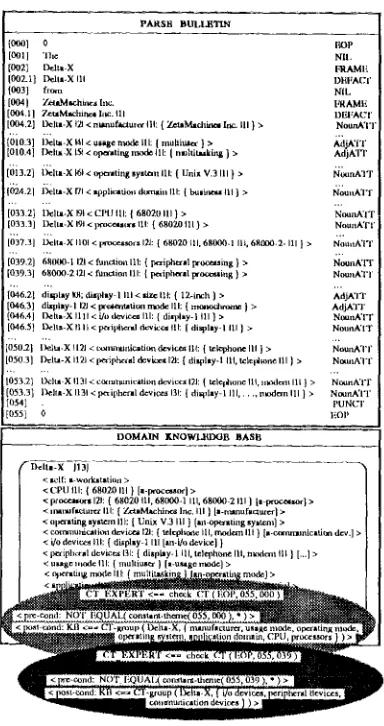
F i g u r e 1 A Snapshot o f the Parser (also Pre-Conditions llolding with rea?~ect to a C'otL~tant Theme Pattern)
The D O M A I N K N O W L E D G E BASE (KB for shoo) contains frame representation structures.
E~:hframe identifier (in bold face) is assigned a list of
slots (enclo~d by angular brackets). Them sioLs are as-
sociated with two different kinds of slot fillers. P e r m i t
ted slot fillers are enclomd in square brackets, [a-framo namo], which characterizes the range of possible slot fillers by ,all those fr~mles which ale a sulx)rdinate or an
instance of framo name. Actual slot fillers are enclosed
in curly braces and can be taken as facts either known
a prk)ri to ll~c system or acquired continuously from the text as its understanding proceeds during file parm.
In addition, each concept has attached to it an a.'~
tivation weight counter. The values of the weight fac~ [ors are enclosed by vertical bars attached to each item; if no bars explicitly occur, a zero weight is assumed. Activation weights arc incremented (starting from zero- level activation) whenever a noun denoting its associ- ated concept occurs in the text, and whenever structure- building operations in KB aflect that concept. The ma~
[image:3.432.212.404.8.371.2]nipulation of activation w e i g h t s serves several pur~ poses, the major ()tie being their use as an indicator of salience of concepts during rite text condensation phase, (luring which text s u m m a r i e s are generated flom the text representation structures resulting from lhe text parse [Reimer & tlahu 19881.
The text g r a m m a r is composed of a set of distrib- uted graulmar experts, cach one responsible for sortie specific linguistic function (e.g., concept attribution via nominal, adjectival or prepositional phrases, mlaphora). Each expert ix characterized by a unique E X P E R T N A M E trod ix activated by a m e s s a g e event, i.e., by receiving a message text which nifty contain some pa- rameters. 111 order to check its conlt~tence in contrib- uting to the parse, p r e - e n n d i t i o n s com[xrsed of com- plex test predicates are evaluated. If these pre-condi- tions hold for that expert, the p o s t - c o n d i t i o n s imme- diately apply, i.e. messages are sent to qualified actors (to other grammar experts, to the d o m a i n KB or to the bulletin).
5 A D I S T R I B U T E I ) M O D F , I~ O F T E X T
C O t l E R E N C E P A R S I N G
fil this paper, we shall not go intn the details of phrasal, clausal, and text cohesion parsing (of. llahn [ 1989] lot fin in-flcpth coilsideration of related technical issues). hlstead, we assume that these preliminary activities have aheafly t e e n carried out properly arid lhat sonic initial strnctural representation is already available from tile bulletin. These requirements are fulfilled in the snapshot of the PARSE BULLETIN in Figure 1, taken after all local parsing events have terminated; dlis char- acterizes a state ready to tune to the activation o[ global text stnlclure computing e x p e r t s .
We here consider the end of the paragraph (de- noted by the symbol 0 and the class identilier EOP) as an lulchoring point for coherence computation. It is mo- tivated hy the observation that -- at least in tile sublan- guage d o m a i n we are currently working in -- major tnpic m o v e m e n t s o c c u r p r e d o m i n a n t l y fit paragrat)h boundaries. This coincides with linguistic evidence for the (text)grammatical status o1: paragraphs [tlinds 1979, Giora 1983b, and Zadrozny & J c n s e n 1991]. There- lore, the proper rccogalition of textual macro structures is always initialized at the end o f a paragnq)h.
5 . 1 C o n s i d e r i n g C o n s t a n t T h e m e
Constant themc is a coherencc pattern which is charac- terized by multiple occurrences of a singlcJJ'ame in tt~
PARSE BULLETIN within one paragraph. Most of its occurrences, in turn, arc accompanied by a slot and/or slot fillet" indicating that some k n o w l e d g e base opera- tion with respect to.9~ame has ficcn carried out in KB (e.g., slot filling as indicated by NounA'lT or AdjA'IT for which wc shall introduce the LC* descriptor as a c o n v e n i e n t shorthand notation). It is the cnntilmous elaboration of that particular conccpt that makes the corresponding text passage coherent. While tbe bulletin maintains file sequential order of these (,pclations, KB
provides the conceptual background lot coulinuous ref-
erences to Ihe same frame object.
Vigure 2 visualizes the description for c o n s t a n t t h e m e ; the D O M A I N K N O W I , E I X i E BASE window displays fill properties of f r a m e dealt with in a text (passage) in the shadowed area of the frame Ix)x, while those ilot mentioned in tile text are in tile remaining white pat~t. Consequently, it is neither neccssaly Ihat all
A c l l i s tIE C O L I N G 9 2 , N A N T E S , 2 3 2 8 AO(JT 1 9 9 2 2 8
slots of a frame awulablc in the k n o w l c d g c basc be referred to in the text (as with sloth41 . . . ~'lotm), nor that there t)e any ordering constraint relating single slots of a fl'amc in KB to thc sequence of slot filling opera- tions in the PARSE BUI,LETIN.
pARSIq B U L L I ~ T I N [ . 1 0
[.l froMt
['.'] frame < s l c l l : { slotfilte q l >
i,',] f r a . . . . hit 7 : (slot fillet 7 } >
[..] fea~e < slot, : ( slot f i l i ~ } >
I . I frame < slc4n i : [ slot fillers I } >
[ .] frame <slot n: { slot fillet } > [..1 0
D O M A I N K N O W L E D G E B A S E
E
< self: a-f~me > < i i >< , i > • ~ ~i~ii,; L : .
< s l , t , , i : { . . } [ , ! > < . . >
< s l o t ~ : {.,. ) (,..I >
F i g u r e 2 The General Corr~tant "lTleme Configuration Pattern
The general pattern from Figure 2 is already pres- ent in Figure 1. This contains a description of the par's- ing results of the first paragraph of text [ T I . 1 ] . The entries in the P A R S E B U L L E T I N have been worked out by experts for linguistic p h e n o m e n a on tile local level of phrasal, sentence and text cohesion analysis. For the propose of constant theme computation, we need only consider those entries whose pat.se descriptor designates manipulations of slots or slot values of some frame (LC*-typc descriptors, such as NounATT or Adj- A'FF). Other descriptors are irrelevant here and have been left out on purlx)se in Figure 1. From this we con- struct the set THEMES. It consists of triples ( J?ame, slot, bullpos ) where frame is file name of a frame, and
slot is the name of a slot of that frame, both co-occur- ring as lexical parameters of some parse tuple in the PARSE BULLETIN with a LC*-typc pal~e descriptor;
bullpos gives file parse point in file PARSE BULLETIN
where frwne mid slot occur iustzmtancously. With re-
spect to Figure 1 TIIEMES is given by:
T H E M E S - { ( Delta X, m a n u f a c t u r e r , ( X M ) , (Delta-X, u s a g e m o d e , 0 1 0 ), (Delta-X, o p e r a t i n g m o d e , 0 1 0 ), (Detla-X, operating system, 013 ),
(Delta-X, application domain, 024 ),
( Delta-X, CPU, 033),
(Delta-X, p r o c e s s o r s , 0 3 3 ), (Delta-X. proccssors, 037 ), ( 68000 1, function, 039 ), (68(X~) 2, function, 039 ). ( display 1, size, 046 ),
( display-l, presentation mode, 046 ),
(Delta X, i/o devices, 046),
PRoc, ol: COI,IN(; 92, NANrI!s, AU(}. 23-28, 1992 I!OP F R A M E
I.(?*
d,,
[image:4.432.232.416.54.266.2](Delta-X, peripheral devices, 046 ),
( Delta-X, cormnunieatitm devices, 05(1 ),
( Delta-X, peripherM devices, 050 ),
(Delta-X, communication devices. 053 ),
( Delta-X, peripheral devices, 053 ) }
When considering TIIF, MES, we want tile criteri- on for constant {heine to tm spcci[ied in a way thai ac- COUIKS 10t tile fact that up to parse ix}int '037' each slt.}l (value) m a n i p u l a t i o n reR:rs to one particular 1heine
(Delta-X). Between parse lx}int '039' and '046' there is a minor themalical distortion in thai there is no proper referetlce to that [hellle, although slots are menlioltcd which are associated with other concepts, llowever, from parse lXfint '046' onward the already established theme is taken tip again till the end of tile para.graph. In conclusi{}n, Delta-X seelns to be a 1}mt~r ean{tidate for consideration as a constatlt theme o[ Ihat l}aragl'aph. 1
Figure 1 provides a snapshot of the pro-conditions that are encountered by tile C T E X P E R T , the coher ence expert for ConstantTheme. Runnin 8 twice, sup plied with diflcrent parametm,-;, it w o l k s out lhc results alluded to alxwc. The grammatical k n o w l e d g e needed for tile determination of it constant theme is incorpo- rated in its pre-collditi{m part. This expression is evalu- ated q~l,/E i f f c o n s l a n l - l h e t n e produces sotnc theme
and a t associated m m - c m p t y set R t l E M E S related to
theme, otherwise it is FAI~SI,;. Thc conditions for a c o n - s t a n t t h e m e can now Ira. stated morn precisely:
c o n s t a n t . t h e m e ( textptw~ tes~pos )
= ( t h e m e , IffI~X~IES, n e w p o s ) if["
( a ) testpos < t e x t p o s &
(b) ( textpos, O, E O P ) is in the PARSE BUIA,ETIN ~ & (el (prepos, O, COP ) is also in the PMLSE BULLI';
TIN such t h a t prepos < textpos a n d such that no other t r i p l e w i t h '¢' as t e x t i t e m i n t e r w m e s be- tween prepos a n d textpos in the l'Al~qE BUIAA:,~ T I N &
(d) n e w p o s • I m a x ( prepos, testpos )+1, textpos- I [ & (el t h e m e is a f r a m e in t h e D O M A I N KNOWL-
E I ) G E B A S E &
(f) V k i c [ m a x ( prepos, testpos ) ~1, ~tewpos- 1]:
( t h e m e , slot, k i ) { T I I E M E 8 .===> slot c I e H E M E S &
(g) -,~ k" c I m a x ( prepos, testpos)+l, newpos-1]: ({z) a i r _ t h e m e ( d i s t i n c t from t h e m e ) is a fl'ame
in t h e D O M A I N K N O W L E D G E BASE &
([~) ( a l t . t h e m e , slot', k" ) < T I [ E M E S & (,%) ,H tsk" (. T t I E M E S :
tsk" = ( t h e m e , slot, k" ) & (h) I R H E M E S I > 2 &
( i ) n e w p o s is m a x i m a l in t h e s e n s e t h a t
-,-I A p o s ~ [:max'( p r e p o s , t e s t p o s ) + l , t e x t p o s - l [ :
A p o s > n e w p o s &
c o n d i t i o n s (c) - (g) apply, too.
O t h e r w i s e , e o n s t a n t . t h e ~ w . ( textl~VS, testlms ) = *
1 Cleat~y, thi~ discu~ion should not b~ taken ~uch that the forr, lltl char~ctctizl- tion g i v ~ below ~mly ImMs for file specific sample text irdeHed to lhrilughoul this i~[~r lustead, it sh~ll{I indicate that, alth~lgh the blsic idea of Ul~llt[ic
prngres~lo(1 patterns ix overwhelmingly i;inl tie, levi-life texll lcJid [o I~ less
h o m o g ~ u s with rcapect to Ih~¢ pattefr~ ~ a n one lilly COllsider under c[¢lIi Ilkmratory condititms. Thus, fln~nal de.~crlptions have to be inherraltly mbusl towards ~uch hx:al foml~ of digmssi~ls
2 Referenc~ to mltrles th the PARSI! BUI~I.|~I'IN have the fro,nil ( PantePoint, par*dL'uple, I)at~eI)e~cnptar ).
AC1T:S lIE COLING-92, NANI'ES, 23 28 ^O~;t 1992 2 9
Some {'onimmllS lelated {{} this specilicafion:
(a) The l}aramclms supplied to c t m . ~ H l n l - l h e m e Spill lhe spatial extellsi{lil in P A R S E BI.JLI,ETIN which IS searched I{}l' it c{)nstiltll l.heltlC; tgxft)os always de- notes the end t)f {he c u u c n t l}aragraph, i.e. the up- per lx}und of |he search area, while testpos delimits its h)wer bound.
(It) The t}alse D}int characterized by textpos iaust colt~ tam tile end of-palagraph syitil}(}l 0.
(c) Since testt~o.~" ll>ay bc any arl)itrary parse t×}int pre- ceding textpos, prepo.~ denotes tile pat=sc point in PARSF, BtJ1.1 ,t';TIN thai contains 1he end-of-para- graph syml×)l occurfin.p; right l~'ft)re tile one {}ll palse ix}in{ textpos.
({1) After lixing the search intelwll in the bulletin for which a col]stanl IhenK: is going to bc coiuputed, tle~.vpos allows [0r vii'it)us choices as to how far a constant thenle may acLually extend iu that interval. (c) theme nlay be any frame from KP,.
(I) A ttu~me is related Ill ilS various fitcmes actor{ling to Ihe fblh}wilw, condition: ill each btllletin pasitic}n ( k ) where t/let, le t}cctlls in "I'llI,;MI'2~ wilhin lhe in. tclval delimited by newl)oS, its associated slot (slid glc fimme) is assig[~cd to lhe set RIIEMES.
(g) To guarautee lhat the~m~ is the only topic dealt wilh ill Ihe text, wBals{} requile that uo ah lh(:t?lt! differ- elll [rl)ilt t]leDle Occur ill lit{: chosell iiltelval such that it. also f{}nns pall t}f T I i I ; M E S .-- (;0 accotlllls ft}r m{}r{: eomplicat{'d cases where both, ah theme
a[td themL', i/lay {g,3cllr at tile Salllc p[nNe poini. (hi To role out insignilicant occttlrelIces of theme ilK:
cardinalily of R I I E M E S must exceed a cemlin level. (i) The m a x i m a l i t y criterion for newpos rules oul
choosilig t{}{) Slll~l[I valtleS (if tiewDos.
l.el us now consider an Bxanlple (}1 the COmllUla.. liotl iltocesses illvolved ill actual c{ttl{'.i'ellce [}arsillg (sec l:il,,ure 1). ValiOllS coherellCe eXl~.:llS slafl execllliOll tll}- {}1] consulnplioll of the 0 symlx)l (indicating tile end o l a paral;raph) by lhe administration ell}eli of t[te pai~er, hut wc shall limit o m attenlR}l| to (2'1" EXI)EIUI ' (since the others will e v e n t u a l l y staIvc). After r e c e i v i n g l:}le<:k CT{ ]'2OP, [)!15, [)00 ) a s ils st;.Irtilt}~ l a e s s a g t . ; , c o t t s t a n l - t h e m e is sutlplicd with inilial paranieters:
textpos :: {)55, testpos = {X}0. Obviously, pr~7}os = 0{X}, since the analysis st;ms l{)1 the til~t paragraph of the text. newpos c l a y ll(}W g a l i l e e l r O l l l ' 0 { ) 1 ' 10 ' 0 5 4 ' . l,et us consider Delta-X as theme. (This is a proper choice. 11 iml}ropcr choices were ntade, cott,%'ltttH- t h e m e w{}nld not t)roduce a significant result.). The chaice lor newpos milS[ aCCOlilitlottatc Ihe tClllp{}raly breakdown o{ the selected thet~w beginning from t×}si- tioll '{}39', since we have k' ~ {}39 { [IX)l, 0541 with
all theme :: 68000-1 (or 68000-2) ill T t l E M E S and Bo
pr0pcr triple ( l}eRa-X, slol 039 ) as required by condi- tion g(x.) al:~)ve. So newpos has to be adjusted properly to tile parse point '{}39', at which l×}int tile constant theme i}attem for l)eha-X eventually temfinates for lit{*, lirst time. This produces:
c~*nnt(o~t-the~ue( 0 5 5 , 0 0 0 ) = ( Delta.X,
[rrl(Lztuthcttzrer, u s a g e mode, operaling m~le, operatillg ~y~ tern, application domain, CPU, processors}, 089 )
and ( ' T E X P E I I T issues a {71'4 roup reading to KB incoi'l×}i'~lting lhe constant theme togcther with its ass{}- e l a t e d i ] t e t i i e s ,
Since lhc PARSE B U I J ,I ¢TIN hlts not exhat, stivc- ly lmen investigated with restmct to its coherence data
(newpos+l < textpos), CT E X P E R T resumes execu- tion, now starting with a-~econd set of parameters:
textpos = 055, testpos = 039 (see the second expert
placed into the foreground in Figure 1). Again, prepos
-- 000, but due to the new testpos parameter newpos is
now in the interval [40, 54]. The evaluation of con-
s t a n t - t h e m e ( 055, 039 ) starts with a proper choice of
newpos = 054. testpos+ l excludes 68000-1 (68000-2)
from further consideration. Finally, we obtain
cor~t~nt-theme( 055, 0 3 9 ) = ( Delta-X,
{i /o devices, peripheral devices, communication devices},054)
Note that the occurrence of display-I at parse point
'046' does not conflict with criterion (g), since we also
have Delta-X (thematically related to i/o devices "and
peripheral devices) at that parse point (cf criterion g(z)). Since the end of the paragraph has been reached, the coherence computation process hails.
Figure 3 represents the effects of grouping a con- stant theme and the themes referred to in the text pas- sage (cf. [055.1] and [055.2]) by the shadowed area of the (frame) box. This indicates that the grouped items are treated coherently in a text passage.
PARSB B L ~ . A ~ B ~
[ ~ 1 0 EOp
(;;;I ; ~o~
[055.11 ~ t a - X ( n m n u f a c t ~ , ~ g e I n ~ opc*ating mtxle, opulling |ylttl~n, application domain, CPU, procc~m~ ] (7.1" [055,2} ~ - X { bb device.a, peripheral d~-vice~t, ¢.ocmnunicatimt dcvic¢~ } C r
< #df: a-work,altion > ~ ' ~ : ' ~ It I:" ( 680~.0 i| I [..,1 >
I ~ ~ o ~ ffI:( a~[,~:tm] . . . .
I : ~ ~ E ~ ~ ~ i ~ i ~ ) ~..:I ~
i - < ~ ~ ~ ~ n~ ~ ! . f r ~ ~ I
< appliottion ~wlXe: [tn.applicttion soRw~re] • < ~ [,-~i¢©I >
< . . . >
F l g u r ¢ 3 Post-Conditions Holding with respect to a Constant Theme Pattern
5 . 2 R e m a r k s on Continuous Thematization
of Rhemes and Derived T h e m e
Similarily, formal descriptions have been worked out for the other two basic text coherence patterns mention- ed above. Instead of a full treatment, we give two rather informal sketches of the underlying regularities as they
have been incorporated into our framework. Contitm-
ous thematization of rhemes most significantly departs from the constant theme schema just outlined (in fact, both are mutually exclusive) in that the former incorpo-
[image:6.432.37.406.23.414.2]rates a continuous shift of the topics being considered.
Figure 4 illustrates this permanent change of issues in a text. The PARSE BULLETIN contains a sequence of
local theme-theme pairs w i t h f r a m e T i being tile current
local theme and slotftllerTi being its associated local
rheme. Text coherence is due to the fact that the current
local t h e m e (slotfillerTi) becomes the next local
theme ( f r a m e r l + l ) . This rheme-specific connectivity criterion is stressed by the double-sided black arrows in the DOMAIN KNOWLEDGE BASE which link the im- mediately preceding theme to its identical theme succes-
Acrl~.s DE C O L l N G - 9 2 , NAM'ES, 2 3 - 2 8 h o ~ r 1 9 9 2 3 0
sor, while local theme-theme connections are indicated by the one-sided grey arrows which go l~om the local theme to its associated local tl~eme. A sequence of local theme-theme pairs fulfilling the rheme-specilic conuec- tivity criterion in terms of overlapping palmneters (cur- rent rheme becomes next theme) constitutes what is
Item called c o n t i n u o u s thematization of rhemes,
i.e. a g/oba/theme-theme cluster.
[...1 0 EOe
i::.[
f,o-.,, , . ~ , , : (.~ o , , , , , . J , - , , . [ , t~.['"] "f¢'~' r l < Skirl ; [ # a flll~rr I ~ $ ~ l r l ) > IX:"
[...I St,m# r l < s l ° l r l : { |1o¢ filk~rrl ~ fr'm'r(l+l)) > L C '
[...] from'fro.l) <skJlr¢..li[llotfllk~rf..l)=fraWalr.]> LC j
[-.1 /rlm, r, ~llCar.:{ Ilot fllL~x. }> LC"
[.,.I 0 EOP
. . . i
'rr
7 I
_ . . .
I
F igu r e 4 The General Contiouous Thematization of Rhemes Configuration Pattern
An illustration is given by text fragment [T 1.2 ] in sec- tion 3 where bold italics stress the emerging global theme-rheme cluster constituted by tile following se- quence of overlapping local theme-theme pairs:
D e l t a - X - nmntffacturer- ZetaMachines Inc., ZetaMachines Inc. - product- G a m m a - Z ,
Gamraa-Z - architecture- Conn. Machine architecture, Conn. Machine architecture - developer-D. Hillis
The third pattern further generalizes the results of the afore-going coherence computations on the para- graph level and extends them over various (adjacent) paragraphs and possibly over the whole text. Consider a series of paragraphs, each one dealing exclusively with one special topic (see Figure 5 below). The first
paragraph deals with f r a m e T 1, tile second one elabo-
rates o n f r a m e T 2 , etc. A derived theme can be com-
puted when all these different (sub)topics call be linked
to the most specific general (super)topic (frameT). In
technical terms, these subtopics are all instances of that
supertopic.Text [T2] illustrates Otis pllenomenon: there are three paragraphs whose major topics arc Delta-X, Gamma-Z, and Sigma-P; a conceptual generalization step links them to the derived theme work, s'tation. In Figure 5 this relationship is indicated by thc arrows pointing fi'om each subtopic (of a single paragraptt) to its supertopic, thematically characterizing these para- graphs on a more general level of conceptualization.
(.ii~ d G~
i.'..l /,~'~L.r s < ~ t r s ~ : ~ ' ~ r s , ~ > Ic*
1...1 l ~ . r ~ <llottll:lld~fllle~rll}> IE*
1...] / ~ . e r~ <llOtr~.: I ~ot fiU~r~ I > I.C ~
[...] 0 I!OV
{.,.I f ~ # r . < tb~ r.t: ( la~ fdter r~tt > IX:*
[,,,I .,¢~ ~ r . < Ilot r . . : I a°t filler -~1 > IL~
[,.,I o 1 ~
b..I ¢4,0 I~T
F i g u r e 5 "]'he G e n e r a l D e r i v e d Theme Cot95guration Pattern
5 . 3 T h e M e r i t s o f Text C o h e r e n c e P a r s i n g Among the many advantages to having text coherence pbenomena under computational control we here em- phasize their potential for information retrieval dialogs. Evidence for this comes from our experiments with TOPOGRAPHIC, an interactive graphical interface to TOPIC's text knowledge b a ~ s [Thiel & Hammwhhner 1987]. In particular, we observed a close funclional re- lationship between the selection of particular coherence patterns and particular search states during the retrieval process which is performed on network representations of text summaries, so-called text graptLs:
1) Constant Theme coherently characterizesavari- ety of facts related to one particular topic. A CT-based search operation enhances the user ~ knowledge of that topic by presenting facets (or data related to those fac- ets) the user is probably not aware of, although they may be relevant to the solution of his or her problem. 2) Continuous Thematization o f Rhemes linlc,;a set of formerly unrelated topics by a coherent line of conceptual dependencies (cunent rheme becomes next theme). A CTR-based search operation therefore pro- vides the basis for thettuaical g~sociations and stim-
AOI"ES DE COLING-92, NANTES, 23-28 AO~I' 1992 3 1
ulates previously unconsidered lines of reasoning by thematically cotL~trained browsing.
3) Derived Theme g,~oups hierarchically related top- ics and thus may enhance the knowledge of alterna- tives of the particular topic (,and facts related to it) under focused attention of the user (by way of stimulating comparisolts, recognizing int0rmation gaps, etc.).
6 F I N A l , R E M A R K S
In this paper, a structural model of text coherence com~ putation has been proposed that strongly exploits the knowledge chunking inherent to fi~ame representations. These prccompiled knowledge structures are irtstantiat- cd by the topical evolution of a text ax represented in the
parser's bulletin. Tiros, various coherence phenomemt can be distinguished by particular instantiation pattents: f3 constant theme is defined by multiple instantia-
fions of aggregatiou (or conceptual association) re- lations for one particular f'r',une item in KB; ffl continuous thematization of rhemes is deiino
ed by multiple instantiations of aggregation rela- tions for continuously changing, though locally overlapping frame items in KB;
[-J derived theme is defined by multiple instantia- tions of generalization/classilication relations hold- ing between subparts of a frame hierarchy in KB. A m o r e e l a b o r a t e d f o r m a l d e s c r i p t i o n o f t h i s m o d e l - i n t : l n d i n g those p a r t s w h i c h c o u l d o n l y b e t r e a t e d r a t h e r s k e t c h i l y i n t h i s c o n t r i b u t i o n - is given i n l l a l m [ 1 9 9 1 ] . T h e p a r s e r is c u r r e n t l y r u n n i n g o n S U N S P A R C S t a t i o n s u n d e r U n i x ( S U N O S V 4 . 1 A ) . The functionality described i n t h i s paper is fully operational a n d p a r t of the T O P I C t e x t u n d e r s t a n d i n g s y s t e m .
R E F E R F , N C E S
A l t e r m a n , R. [1982] A ryst*m of z.v#n cohtr#nce r*lallons for hitrarchicallJ, orRandzing .wrtt concepts in text Uinv. of Tcxis it Aujthl (TR-188}. Brlchmmn, R J,; ~ E GIIhcrl; ILL L e v e | q u e [1985]. An clio••till hybrid reaton-
iri s $ y | t ~ - knowl~lgc and iynlJ::~[ Ifvc~. tcc~mtlt of K r y p t ~ Proc. lYCAI 8~,
pp 532-539.
Danes, I! [ 19741. F u n c t i ~ d zcatraLcc pcr~prztive ~nd the orgmnization of the text
In l! Danes. nd. Papirs on functio~l sgnt*~e perxp~ctlve. A c g d ~ i t , ] 06-128.
vail DlJk,T A [19g0] M a c r ~ t r ~ t ~ e s llz[ltdnlc/NJ; I . Eribatml G Iota, R. [ 19/1311]. Segm~tttinn and segment c~t~i~l: ~1 the thcanlinc ~nganizl-
tion of the text. T¢~, 3(2): 155-181.
t ; I o r a , R I19g3b[. l:tulctional parJgraph pe~pective In 1, pelt~fi & E. SSze[, nds
Micro and m~'ro ChaStity of teals. Ilamtmrg: IL lh~kc, ppA53-182 Ilahn, If. [1989]. Making under~ttndera out o f ptr~¢ps, I n ( e r ~ t i o ~ l Journal o l
Inl¢lligtnt Syst#ms , 4(3): 345-393.
tlahn, tl. [1990], L4xtkaliach vtrttiltt~ 7k;~t parsing, llerlin: Spnnger Uahn, U. [1991]. Distribut¢d taxt structurL parsing, I Jnguiltische InfomlltikK~ocn-
potcrlingulstik, Univ. F~ilmrg. ClJF-Rcport 4/91.
I I I n d l , J. [1979]. Oqgarhzational pattcm~ in dinc.o~r~e. In T Givhn, cA. Syntaxand stmantlca, Vol./L Ne~ yorkjNY: Academic lh'.. pp. 135-157.
IIc.bl~, J. R. [ 1982]. Toward~ tn undenfftnding of coherence in discottrse, ht W.G Ix.hne r & M. Ringle, eds. StrattllitJ for ~ l ~ a l lo~tgt~ag¢ p~c~¢si~g l liUsthde/ NI; L, Edb*~n. pp.223-243.
K I n t l e h , W.; T.A. van DlJk [1978[. 'l'owtrd a model of text comprehension and p,toduch~l. Paycholo~icalRavi~w, 85(5): 363-394.
Kurzotl, D. [1984] q~lemc~, hyl~rthem~ and the d i ~ o u n e structure of |tritalh legal texts, 71xt, 4(1-3): 31 55
Mann, W.C.; S.A. Thompson 11988], Khetoricll stxucture theory: towlrds a ftmcli~ltl theory o[ text organization. T*xt, 8(3): 243-287.
McKeown. K. [19851 Dilcou~e s t a t e g i ~ fen gmlerating natural-language text
Artifwiol I~a*iligenc¢ , 27(1):1-41,
PuateJovsky. J. [1987]. An integrated t h ~ r y of discourse analyau. In S. Nirca~ trarg, nd, M~h~ne t~nslat~n. Cambridge: Cambridge U.R pp,168d91. R elchmmn, R. [ 197g]. Coaven atiomtl cohenmey. Co~alti~ Science, 2(4): 283-327. R e l m e r , U,; U. Ilaht* [19~g}, Text c~rad~Jaati~ a~ knowledge base abstraction.
proc. 4th co~t~ on arti~iol int#lllg*nc# application# (CAIA~8), pp.338-344. R u m e l h a r t . D.E. 11975]. Notcat on • s c h ~ l f~r •tonc~. hi D. Bobmw & A. Col-
lins, CAs. R*pr~ntatwn and und~rsta~tdia/, New York: Academic E. 211- 236. Scha, R.; L. Polanyl [1988]. An augmeatcA co*atext f ~ g ~ m m a r for dlxcourse.
proc. COLING88, pp.573-577
Schank, R.C.; M. l.¢howltz; L I I I r n b l u m ~19g0]. An integrated undea~tander.
Am~rtc~ Joure.al of Computaho~l lda~ui~lics , 6(1 ): 13-30.
T h l e l , U.; R. Ilammw/Jhner [1987] Inform~tic~tal ~cotrtth8: ~n intetactt~ modal f ~ the g~ap~tlc.al • ~ to te~t k~wlndge haas. P~e. 10~ ACM SIGIR c o ~ on r~s*arch & d~#lop~iant in i ~ a ~ t i o ~ l r~ttri~val, pp.45-56
Tucker, A. IL; N l r e n b u r g , S,; Rltlkth, V. [1999]. D i ~ m r ~ and coh~ion m ex- pository text. e r o c COLING "86, p,p.181 183
Z l d r o z l r y , W.; Jenlen, K. [ 1991]. Semantici of p a n g ~ p h | , Computational 1in.
~tth-tics. 17(2): 171-209.