
Two-Phase Shift-Reduce Deterministic Dependency Parser of Chinese
Meixun Jin, Mi-Young Kim and Jong-Hyeok Lee
Div. of Electrical and Computer Engineering,
Pohang University of Science and Technology (POSTECH)
Advanced Information Technology Research Center (AITrc)
{Meixunj, colorful, jhlee}@postech.ac.kr
Abstract
In the Chinese language, a verb may have its dependents on its left, right or on both sides. The ambiguity resolution of right-side dependencies is essential for de-pendency parsing of sentences with two or more verbs. Previous works on shift-reduce dependency parsers may not guar-antee the connectivity of a dependency tree due to their weakness at resolving the right-side dependencies. This paper pro-poses a two-phase shift-reduce dependency parser based on SVM learning. The left-side dependents and right-left-side nominal de-pendents are detected in Phase I, and right-side verbal dependents are decided in Phase II. In experimental evaluation, our proposed method outperforms previous shift-reduce dependency parsers for the Chine language, showing improvement of dependency accuracy by 10.08%.
1 Introduction
Dependency parsing describes syntactic struc-ture of a sentence in terms of links between in-dividual words rather than constituency trees. The fundamental relation in dependency parsing is between head and dependent. Robinson[1] formulates four axioms to the well-formed de-pendency structures, known as single headed, acyclic, connective and projective.
In this paper, we present a dependency pars-ing strategy that produces one dependency struc-ture that satisfies all these constraints.
This paper is organized as follows. Related works are introduced in section 2. In section 3, detailed analysis of the work of Nivre[2] and Yamada[3] are given. Then our parsing strategy
is introduced. In section 4, experiments and re-sults are delivered. Finally a conclusion will be given in section 5.
2 Overview of Related Works
Most nature language grammars tend to as-sign many possible syntactic structures to the same input utterance. A parser should output a single analysis for each sentence. The task of selecting one single analysis for a given sen-tence is known as disambiguation.
Some of the parsing strategies first produce all possible trees for a sentence. The disam-biguation work is done in the end by searching the most probable one through parsing tree for-est. Statistical parsers employ probability as a disambiguation measure and output the tree with the highest probability[4,5]. However, in the work of Collins [6], 42% of the correct parse trees were not in the candidate pool of ~30-best parses. Disambiguation work by searching throughout the parsing tree forest has limitations.
The alternative way is to disambiguate at each parsing step and output the parsing result deter-ministically. Nivre[2] and Yamada[3] suggest a shift-reduce like dependency parsing strategy. In section 3.1 we give a detailed analysis of their approach.
the performance of the system on Chinese is about 10% lower comparing the performance of the original system.
3 Two-Phase Dependency Parsing
3.1 Review of Previous Shift-Reduce Dependency Parsers
Nivre[3] presented a shift-reduce dependency parsing algorithm which can parse in linear time. The Nivre’s parser was represented by a triples <S, I, A>, where S is a stack, I is a list of (re-maining) input tokens, and A is the set of deter-mined dependency relations. Nivre defined four transitions: Left-Arc, Right-Arc, Reduce, and Shift. If there is a dependency relation between the top word of the stack and the input word, according to the direction of the dependency arc, it can be either Left-Arc or Right-Arc. Otherwise, the transition can be either shift or reduce. If the head of the top word of the stack is already de-termined, then the transition is reduce, otherwise shift. The action of each transition is shown in Fig.1. For details, please refer to Nivre[3,10]. Fig.2 gives an example1 of parsing a Chinese sentence using Nivre’s algorithm.
Nivre’s[3,10] approach has several advan-tages. First, the dependency structure produced by the algorithm is projective and acyclic[3]. Second, the algorithm performs very well for deciding short-distance dependences. Third, at each parsing step, all of the dependency rela-tions on the left side of the input word are de-termined. Also as the author emphasizes, the time complexity is linear.
However, wrong decision of reduce transition, like early reduce, cause the word at the top of the stack loses the chance to be the head of oth-ers. Some words lose the chance to be the head of other following words. As a result, the de-pendents of this word will have a wrong head or may have no head.
The parsing steps of a Chinese sentence using Nivre’s[3] algorithm are given in Fig.2. At step-5 of Fig.2, after reduce, the top of the stack was popped. The algorithm doesn’t give a chance for the word 扩大 to be the head of other words. Therefore, word ‘引资’ cannot have word ‘扩 大’ as its head.In the final dependency tree of example-1 in Fig.2, the arc from 计划 to 引资 is wrong. Fig.3 gives the correct dependency tree. Here, 扩大 is the head of word 引资.
1 All the example sentences are from CTB.
If there is a dependency relation between top.stack and input If the dependency relation is Left_arc
Insert (input, top.stack) pair into set A pop(stack);
Else
Insert (top.stack, input) pair into set A push(input);
Else
If the head of top of the stack is determined pop(stack);
Else push(input);
Fig. 1. Transitions defined by Nivre[3]
这个 省 计划 扩大 招商 引资,
This province plan extend attract merchants attract investments.
The province plans to expand attracting merchants and investments.
stack , input relation set A
Step-0: <nil,这个省计划扩大招商引资,{}> Step-1:ÆS <这个,省计划扩大招商引资,{}> Step-2:ÆLA <省,计划扩大招商引资,{(省,这个)}> Step-3:ÆLA <计划,扩大招商引资,{(省,这个),(计划,省)}> Step-4:ÆRA <扩大 计划,招商引资,{(省,这个),(计划,省),
(计划,扩大)}> Step-5:ÆR <计划,招商引资,{(省,这个),(计划,省),
(计划,扩大)}> Step-6:ÆS <招商 计划,引资,{(省,这个),(计划,省),
(计划,扩大)}> Step-7:ÆLA <计划,引资,{(省,这个),(计划,省),
(计划,扩大),(引资,招商)}> Step-8:ÆLA <计划,nil,{(省,这个),(计划,省),
(计划,扩大),(引资,招商),(计划,引资)}>
The dependency structure of the output:
这个 省 计划 扩大 招商 引资,
S:Shift LA:Left-arc RA:Right-arc R:reduce
Fig. 2. Example-1: Parsing using Nivre’s algorithm
这个 省 计划 扩大 招商 引资,
Fig. 3. The correct parse tree of Example-1
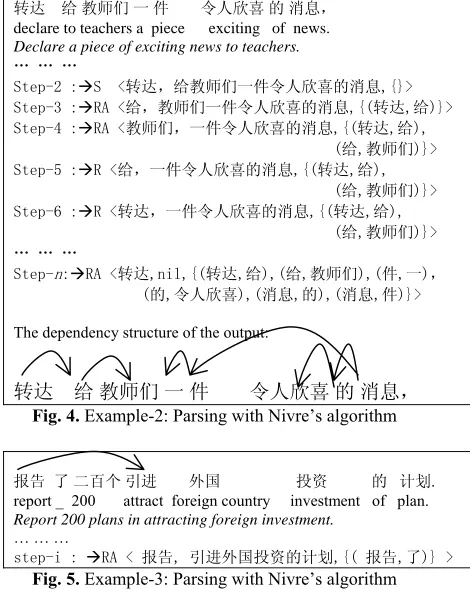
Fig.4. gives the parsing step of another example.
As the final dependency tree in Fig.4 shows,
there is no head for word 消息。After Step-5, the top of the stack is word 给 and input word is 一. There is no dependency relation between these two words. Since the head of the word 给
is already determined in step-2,the next transi-tion is R(educe). As a result, word 给 loses the chance to be the head of word 消息. So, there is no head assigned to word 消息 in Fig.4. There-fore, Nivre’s algorithm causes some errors for determining the right-side dependents.
Yamada’s[4] approach is similar to Nivre’s[3].
Reduce
Yamada’s algorithm define three actions: left, right and shift, which were similar to those of Nivre’s. Yamada parsed a sentence by scanning the sentence word by word from left to right, during the meantime, left or right or shift actions were decided. For short dependents, Yamada’s algorithm can cope with it easily. For long de-pendents, Yamada tried to solve by increasing the iteration of scanning the sentences. As Ya-mada pointed out, ‘shift’ transition was executed for two kinds of structure. This may cause wrong decision while deciding the action of transition. Yamada tried to resolve it by looking ahead for more information on the right side of the target word.
转达 给教师们一件 令人欣喜的消息,
declare to teachers a piece exciting of news.
Declare a piece of exciting news to teachers.
… … …
Step-2 :ÆS <转达,给教师们一件令人欣喜的消息,{}> Step-3 :ÆRA <给,教师们一件令人欣喜的消息,{(转达,给)}> Step-4 :ÆRA <教师们,一件令人欣喜的消息,{(转达,给),
(给,教师们)}> Step-5 :ÆR <给,一件令人欣喜的消息,{(转达,给),
(给,教师们)}> Step-6 :ÆR <转达,一件令人欣喜的消息,{(转达,给),
(给,教师们)}> … … …
Step-n:ÆRA <转达,nil,{(转达,给),(给,教师们),(件,一), (的,令人欣喜),(消息,的),(消息,件)}>
The dependency structure of the output:
转达 给教师们一件 令人欣喜的消息,
Fig. 4. Example-2: Parsing with Nivre’s algorithm
报告 了二百个引进 外国 投资 的 计划. report _ 200 attract foreign country investment of plan.
Report 200 plans in attracting foreign investment.
… … …
step-i : ÆRA < 报告, 引进外国投资的计划,{( 报告,了)} >
Fig. 5. Example-3: Parsing with Nivre’s algorithm
When applying to Chinese parsing, the deter-mination of dependency relation between two verbs is not effective. In the example-3 of Fig.5,
at step-i, the parser decides whether the depend-ency relation between 报告 and 引进 is either Left-arc or Right-arc. The actual head of the verb 引进 is 的, which is distant. By looking only two or three right side words ahead, to de-cide the dependency relation between these verbs at this moment is not reliable. Yamada’s algorithm is not a clear solution to determine the right side dependents either.
3.2 Two-Phase Dependency Parsing
For the head-final languages like Korean or Japanese, Nivre[3] and Yamada’s[4] approaches are efficient. However, being applied to Chinese text, the existing methods cannot correctly de-tect various kinds of right-side dependents in-volved in verbs. All wrong decisions of reduce transition mainly occur if the right dependent of a verb is also a verb, which may have right-side dependents.
For the correct detection of the right-side de-pendents, we divide the parsing procedure into two-phase. Phase I is to detect the left-side de-pendents and right-side nominal dede-pendents. Although some nominal dependents are right-side, they don’t have dependents on the right side, and will not cause any ambiguities related to right-side dependents. In Phase II, the detec-tion of right-side verbal dependents, are per-formed.
3.2.1 Phase I
In Phase I, we determine the left-side depend-ents and right-side nominal dependdepend-ents. We de-fine three transitions for Phase I: Shift, Left-Arc,
Right-Arc. The actions of transition shift and
Left-Arc are the same as Nivre[3] defines. How-ever, in our method, the transition of Right-Arc does not push the input token to the stack. The original purpose for pushing input to stack after right-arc, is to give a chance for the input to be a potential head of the following words. In Chi-nese, only verbs and prepositions have right-side dependents. For other POS categories, the action of pushing into stack is nonsense. In case that the input word is a preposition, there is no am-biguities we describe. Only the words belong to various verbal categories may cause problems. The method that we use is as follows. When the top word of the stack and the next input word are verbs, like VV, VE, VC or VA2 [11], the detection of the dependency relation between these two verbs is delayed by transition of shift. To differentiate this shift from original shift, we call this verbal-shift. The determination of the dependency relation between these two verbs will be postponed until phase II. The transitions are summarized as Fig.6.
If there is no more input word, phase I termi-nates. The output of the phase I is a stack, which
2 VV, VE, VC and VA are Penn Chinese Treebank POS
contains verbs in reverse order of the original appearance of the verbs in the sentence. Each verb in the stack may have their partial depend-ents, which are determined in Phase I.
If the action is Verbal-shift
: push the input to the stack else if the action is Shift
push the input to the stack
else if the action is Left-arc
set the dependency relation for two words; pop the top of the stack
else if the action is Right-arc
set the dependency relation for two words Fig. 6. Types of transitions in the phase I
The type of transition is determined by the top word of the stack, input word and their context. Most of the previous parsing models[4,12,13] use lexical words as features. Compared to Penn English Treebank, the size of Penn Chinese Treebank (version 4.0, abbreviated as CTB) is rather small. Considering the data sparseness problem, we use POS tags instead of lexical words itself. As Fig.7. shows, the window for feature extraction is the top word of the stack, input word, previous word of the top of the stack, next word of the input. The left-side nearest dependent of these is also taken into consideration. Besides, we use two more fea-tures, if_adjoin, and Punc. The feature vector for Phase I is shown in Fig.7.
3.2.2 Phase II
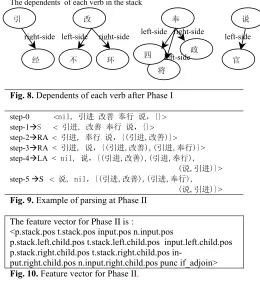
After Phase I, only verbs remain in the stack. In Phase II, we determine the right-side verbal dependents. We take the output stack of Phase I as input. Some words in the stack will have right-side dependents as shown in Fig.8. For Phase II, we also define three transitions: shift, left-arc, right-arc. The operations of these three transitions are the same as Phase I, but there are no verbal-shifts. Fig.9 shows the output of Phase I and parsing at Phase II of example given in Fig.8.
The window for feature extraction is the same as that of Phase I. The right-side nearest de-pendent is newly taken as features for Phase II. The feature vector for Phase II is shown in Fig.10.
The two-phase parsing will output a projec-tive, acyclic and connective dependency struc-ture. Nivre[10] said that the time complexity of his parser is 2 times the size of the sentence. Our algorithm is 4 times the size of the sentence, so
the time complexity of our parser is still linear to the size of the sentence.
Windows for feature extraction : t.stack : top word of the stack
p.stack: previous word of top of the stack input : input word
n.input: next word of the input word
x.pos : POS tag of word x
x.left.child : the left-side nearest dependent of word x
punc : the surface form of punctuation between top word of the stack and input word, if there is any
if_adjoin : a binary indicator to show if the top word of the stack and input word are adjoined
The feature vector for Phase I is :
<p.stack.pos t.stack.pos input.pos n.input.pos p.stack.left.child.pos t.stack.left.child.pos input.left.child.pos punc if_adjoin>
Fig. 7. Feature vector for Phase I
这位官员说,四川将奉行更加开放的政策,不断改善投资环境, 引进更多的海外资金、先进的技术和管理经验。
(The official said that Sichuan will pursue a more open door policy, continuously improve the investment environments and attract more capitals from overseas, advanced techniques and experiences of ad-ministration.)
The contents of stack after Phase I:<引进,改善,奉行,说>.
(attract, improve, pursue, said )
The dependents of each verb in the stack
Fig. 8. Dependents of each verb after Phase I
step-0 <nil, 引进 改善 奉行 说,{}> step-1ÆS < 引进, 改善 奉行 说,{}> step-2ÆRA < 引进, 奉行 说,{(引进,改善)}> step-3ÆRA < 引进, 说,{(引进,改善),(引进,奉行)}> step-4ÆLA < nil, 说,{(引进,改善),(引进,奉行),
(说,引进)}> step-5 ÆS < 说, nil,{(引进,改善),(引进,奉行),
(说,引进)}> Fig. 9. Example of parsing at Phase II
The feature vector for Phase II is :
<p.stack.pos t.stack.pos input.pos n.input.pos
p.stack.left.child.pos t.stack.left.child.pos input.left.child.pos p.stack.right.child.pos t.stack.right.child.pos
in-put.right.child.pos n.inin-put.right.child.pos punc if_adjoin> Fig. 10. Feature vector for Phase II.
4 Experiments and Evaluation
Our parsing procedure is sequentially per-formed from left to right. The feature vectors for
引
经
改
不 环
奉
政
将 四
说
官
right-side left-side right-side left-side right-side
left-side
Phase I and Phase II are used as the input for the parsing model. The model outputs a parsing ac-tion, left-arc, right-arc or shift. We use SVM as the model to obtain a parsing action, and use CTB for training and test the model.
4.1 Conversion of Penn Chinese Treebank to Dependency Trees
Annotating a Treebank is a tedious task. To take the advantage of CTB, we made some heu-ristic rules to convert CTB into dependency Treebank. This kind of conversion task has been done on English Treebank[14,10,4]. We use the dependency formalism as Zhou[15] defined.
CTB contains 15,162 newswire sentences (in-cluding titles, fragments and headlines). The contents of CTB are from Xinhua of mainland, information services department of HKSAR and Sinorama magazine of Taiwan. For experiments, 12,142 sentences are extracted, excluding all the titles, headlines and fragments.
For the conversion task, we made some heu-ristic rules. CTB defines total 23 syntactic phrases and verb compounds[11]. A phrase is composed of several words accompanied to a head word. The head word of each phrase is used as an important resource for PCFG pars-ing[12,13]. According to the position of the head word with respect to other words, a phrase3 can be categorized into head-final, head-initial or head-middle set. Table.1 shows the head-initial, head-final and head-middle groups.
For VP, IP and CP, these phrases have a verb as its head word. So we find a main verb and regard the verb the head word of the phrase. If the head word for each phrase is determined, other words composing the phrase simply take the head word of the phrase as its head. In the case of BA/LB4, we take a different view from what is done in CTB. Zhou[15] regards BA/LB as the dependent of the following verb. We fol-low Zhou’s[15] thought. For sentences contain-ing BA/LB, we converted them into dependency trees manually. With above heuristics, we con-verted the original CTB into dependency Tree-bank.
3 We use the label of phrases as CTB has defined. We
ex-clude FRAG, LST, PRN. For each definition of the phrase please refer to [11].
4 BA, LB are two POS categories of CTB. For details, see
[11].
4.2 Experiments
SVM is one of the binary classifiers based on maximum margin strategy introduced by Vap-nik[16]. SVM has been used for various NLP tasks, and gives reasonable outputs. For the ex-periments reported in this paper, we used the software package SVMlight [17].
For evaluation matrix, we use Dependency Accuracy and Root Accuracy defined by Ya-mada[4]. An additional evaluation measure, None Head is defined as following.
None Head: the proportion of words whose head is not determined.
GROUP PHRASES Head-initial PP; VRD; VPT;
Head-final ADJP; ADVP; CLP; DNP; DVP; DP; LCP; NP; QP; VCD; VCP; UCP; VSB; VNV;
Head-middle
CP; IP; VP;
Table 1. Cluster of CTB syntactic phrases
Table 2. Comparison of dependency accuracy with Nivre’s
We construct two SVM binary classifiers, Dep vs. N_Dep and LA vs. RA, to output the transition action of Left-arc, Right-arc or Shift. Dep vs. N_Dep classifier determines if two words have a dependency relation. If two words have no dependency relation, the transition ac-tion is simply Shift. If there is a dependency re-lation, the second classifier will decide the direction of it, and the transition action is either Left-arc or Right-arc.
We first train a model along the algorithm of Nivre[10]. The training and test sentences are randomly selected. Table.2 shows that 1.53% of the words cannot find their head after parsing. This result means that the original Nivre’s algo-rithm cannot guarantee a connective dependency structure.
With our two-phase parsing algorithm, there is no none head. Then, the dependency accuracy and root accuracy are increased by 10.08% and 13.35% respectively.
Dependency accuracy
Root
4.3 Comparison with Related Works
Compared to the original works of Nivre[10] and Yamada[4], the performance of our system is lower. We think that is because the target lan-guage is different.
Average sentence length
Dependency
accuracy Root accuracy
Ma[5] 9 80.25% 83.22%
Cheng[18] 5.27 94.44% --
Ours 34 84.42% 83.33%
Table 3 Comparison of the parsing performances between Ma[5], Cheng[18] and ours
Table 3 gives the comparison of the perform-ances between Ma[5], Chen[18] and ours. The training and test domain of Ma[5] is not clear. Cheng[18] used CKIP corpus in his experiments. The average length of sentence in our test set is 34, which is much longer than that in Ma[5] and Cheng[18]. The performance of our system is still better than Ma[5] and less than Cheng[8].
5 Conclusion
To resolve the right-side long distance de-pendencies, we propose two-phase shift-reduce parsing strategy. The parsing strategy not only guarantees the connectivity of dependency tree, but also improves the parsing performance. As the length of sentences increases, the ambigui-ties for parsing increase drastically. With our two-phase shift-reduce parsing strategy, the per-formance of syntactic parsing of long sentences is also reasonable.
The motivation of this paper is to design a well-formed dependency parser for Chinese. We believe that there’re rooms to improve the per-formance. We plan to work further to explore the optimal features. We also plan to parse Eng-lish text with our algorithm to see if it can com-pete with the state-of-art dependency parsers on English. We believe that our parsing strategy can apply to other languages, in which head po-sition is mixed, as Chinese language. We think that it is the main contribution of our approach.
References
1. Robinson, J.J.: Dependency structures and transformation rules. Language 46 (1970) 259-285 2. Nivre, J.: An efficient algorithm for projective
dependency parsing. In Proceedings of IWPT (2003) 149-160
3. Yamada, H. and Matsumoto, Y.: Statistical de-pendency analysis with support vector machines. In Proceedings of IWPT (2003) 195-206
4. Eisner, J.M.:Three new probabilistic models for dependency parsing: An exploration. In Proceed-ings of ACL.( 1996) 340-345
5. Ma,J., Zhang,Y. and Li,S.: A statistical depend-ency parser of Chinese under small training data. IJCNLP-04 Workshop : Beyond Shallow Analy-ese-Formalisms and Statistical Modeling for Deep Analyses (2004)
6. Collins,M.: Discriminative reranking for natural language parsing. In proceedings of ICML 17.(2000) 175-182
7. Fung,P., Ngai,G, Yang,Y.S and Chen,B.: A maxi-mum-entropy Chinese parser augmented by trans-formation-based learning. ACM transactions on Asian language information processing. Volume 3. Number 2.(2004) 159-168
8. Levy,R. and Manning,C.: Is it harder to parse Chi-nese, or the Chinese Treebank? In Proceedings of ACL. (2003) 439-446
9. Bikel, D.M. and.Chiang, D.: Two Statistical Pars-ing models applied to the Chinese Treebank. In proceedings of the second Chinese language processing workshop. (2000)
10.Nivre,J, Hall,J and Nilsson,J.: Deterministic de-pendency parsing of English text. In Proceedings of COLING.(2004) 23–27
11.Xue,N and Xia,F.: The bracketing guidelines for the Penn Chinese Treebank(3.0). IRCS Report 00-08, University of Pennsylvania (2000)
12.Collins,M.: Three generative lexicalised models for statistical parsing. In Proceedings of the 35th
Annual Meeting of the Association for Computa-tional Linguistics, Madrid (1997) 16-23
13.Charniak,E.: A maximum-entropy-inspired parser. In Proceedings of NAACL. Seattle (2000) 132– 139,
14.Collins,M.: A new statistical parser based on bi-gram lexical dependencies. In Proceedings of the Thirty-Fourth Annual Meeting of the Association for Computational Linguistics, philladelphia (1996) 184–191
15.Zhou,M. and Huang,C.: Approach to the Chinese dependency formalism for the tagging of corpus. Journal of Chinese information processing.(in Chinese), Vol. 8(3) (1994) 35-52
16.Joachims,T.: Making large-scale SVM learning practical. Advances in Kernel Methods-Support Vector Learning, B.Scholkopf and C.Burges and A.Smola(Eds.), MIT-Press (1999)
17. Vapnik, V.N.: The nature of statistical learning theory. Springer, New York. (1995)
![Fig. 1. Transitions defined by Nivre[3]](https://thumb-us.123doks.com/thumbv2/123dok_us/806043.1095149/2.595.301.557.64.559/fig-transitions-defined-by-nivre.webp)
![Table 3 Comparison of the parsing performances between Ma[5], Cheng[18] and ours](https://thumb-us.123doks.com/thumbv2/123dok_us/806043.1095149/6.595.87.297.157.233/table-comparison-parsing-performances-ma-cheng.webp)
