A classifier-based approach to preposition and determiner error
correction in L2 English
Rachele De Felice and Stephen G. Pulman Oxford University Computing Laboratory Wolfson Building, Parks Road, Oxford OX1 3QD, UK
{rachele.defelice|stephen.pulman}@comlab.ox.ac.uk
Abstract
In this paper, we present an approach to the automatic identification and correction of preposition and determiner errors in non-native (L2) English writing. We show that models of use for these parts of speech can be learned with an accuracy of 70.06% and 92.15% respectively on L1 text, and present first results in an error detection task for L2 writing.
1 Introduction
The field of research in natural language process-ing (NLP) applications for L2 language is con-stantly growing. This is largely driven by the ex-panding population of L2 English speakers, whose varying levels of ability may require different types of NLP tools from those designed primarily for native speakers of the language. These include applications for use by the individual and within instructional contexts. Among the key tools are error-checking applications, focusing particularly on areas which learners find the most challenging. Prepositions and determiners are known to be one of the most frequent sources of error for L2 En-glish speakers, a finding supported by our analysis of a small error-tagged corpus we created (deter-miners 17% of errors, prepositions 12%). There-fore, in developing a system for automatic error detection in L2 writing, it seems desirable to focus on these problematic, and very common, parts of speech (POS).
This paper gives a brief overview of the prob-lems posed by these POS and of related work. We
c
2008. Licensed under the Creative Commons Attribution-Noncommercial-Share Alike 3.0 Unported li-cense (http://creativecommons.org/licenses/by-nc-sa/3.0/). Some rights reserved.
then present our proposed approach on both L1 and L2 data and discuss the results obtained so far.
2 The problem
2.1 Prepositions
Prepositions are challenging for learners because they can appear to have an idiosyncratic behaviour which does not follow any predictable pattern even across nearly identical contexts. For example, we sayI studyinBoston butI studyatMIT; orHe is independentof his parents, butdependent on his son. As it is hard even for L1 speakers to articulate the reasons for these differences, it is not surpris-ing that learners find it difficult to master preposi-tions.
2.2 Determiners
Determiners pose a somewhat different problem from prepositions as, unlike them, their choice is more dependent on the wider discourse context than on individual lexical items. The relation be-tween a noun and a determiner is less strict than that between a verb or noun and a preposition, the main factor in determiner choice being the specific properties of the noun’s context. For example, we can sayboys like sport ortheboys like sport, de-pending on whether we are making a general state-ment about all boys or referring to a specific group. Equally, bothshe ateanappleandshe atethe ap-pleare grammatically well-formed sentences, but only one may be appropriate in a given context, de-pending on whether the apple has been mentioned previously. Therefore, here, too, it is very hard to come up with clear-cut rules predicting every pos-sible kind of occurrence.
3 Related work
Although in the past there has been some research on determiner choice in L1 for applications such as generation and machine translation output, work to date on automatic error detection in L2 writing has been fairly limited. Izumi et al. (2004) train a max-imum entropy classifier to recognise various er-rors using contextual features. They report results for different error types (e.g. omission - precision 75.7%, recall 45.67%; replacement - P 31.17%, R 8%), but there is no break-down of results by individual POS. Han et al. (2006) use a maxi-mum entropy classifier to detect determiner errors, achieving 83% accuracy. Chodorow et al. (2007) present an approach to preposition error detection which also uses a model based on a maximum en-tropy classifier trained on a set of contextual fea-tures, together with a rule-based filter. They report 80% precision and 30% recall. Finally, Gamon et al. (2008) use a complex system including a deci-sion tree and a language model for both preposi-tion and determiner errors, while Yi et al. (2008) propose a web count-based system to correct de-terminer errors (P 62%, R 41%).
The work presented here displays some similar-ities to the papers mentioned above in its use of a maximum entropy classifier and a set of features. However, our feature set is more linguistically so-phisticated in that it relies on a full syntactic anal-ysis of the data. It includes some semantic compo-nents which we believe play a role in correct class assignment.
4 Contextual models for prepositions and determiners
4.1 Feature set
The approach proposed in this paper is based on the belief that although it is difficult to formulate hard and fast rules for correct preposition and de-terminer usage, there is enough underlying regu-larity of characteristic syntactic and semantic con-texts to be able to predict usage to an acceptable degree of accuracy. We use a corpus of grammat-ically correct English to train a maximum entropy classifier on examples of correct usage. The classi-fier can therefore learn to associate a given prepo-sition or determiner to particular contexts, and re-liably predict a class when presented with a novel instance of a context for one or the other.
The L1 source we use is the British National
Head noun ‘apple’
Number singular
Noun type count
Named entity? no WordNet category food, plant Prep modification? yes, ‘on’ Object of Prep? no Adj modification? yes, ‘juicy’ Adj grade superlative
POS±3 VV, DT, JJS, IN, DT, NN
Table 1: Determiner feature set forPickthejuiciest apple on the tree.
POS modified verb
Lexical item modified ‘drive’ WordNet Category motion
Subcat frame pp to
POS of object noun
Object lexical item ‘London’
Named entity? yes, type = location
POS±3 NNP, VBD, NNP
Grammatical relation iobj
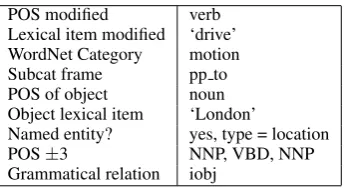
Table 2: Preposition feature set forJohn droveto London.
Corpus (BNC) as we believe this offers a represen-tative sample of different text types. We represent training and testing items as vectors of values for linguistically motivated contextual features. Our feature vectors include 18 feature categories for determiners and 13 for prepositions; the main ones are illustrated in Table 1 and Table 2 respectively. Further determiner features note whether the noun is modified by a predeterminer, possessive, nu-meral, and/or a relative clause, and whether it is part of a ‘there is. . . ’ phrase. Additional preposi-tion features refer to the grade of any adjectives or adverbs modified (base, comparative, superlative) and to whether the items modified are modified by more than one PP1.
In De Felice and Pulman (2007), we described some of the preprocessing required and offered some motivation for this approach. As for our choice of features, we aim to capture all the ele-ments of a sentence which we believe to have an effect on preposition and determiner choice, and which can be easily extracted automatically - this is a key consideration as all the features derived rely on automatic processing of the text. Grammat-ical relations refer to RASP-style grammatGrammat-ical re-lations between heads and complements in which the preposition occurs (see e.g. (Briscoe et al.,
1A full discussion of each feature, including motivation
Author Accuracy
Baseline 26.94%
Gamon et al. 08 64.93% Chodorow et al. 07 69.00%
Our model 70.06%
Table 3: Classifier performance on L1 prepositions
2006)). Semantic word type information is taken from WordNet lexicographer classes, 40 broad se-mantic categories which all nouns and verbs in WordNet belong to2(e.g. ‘verb of motion’, ‘noun
denoting food’), while the POStags are from the Penn Treebank tagset - we note the POS of three words either side of the target word3. For each
occurrence of a preposition or determiner in the corpus, we obtain a feature vector consisting of the preposition or determiner and its context, de-scribed in terms of the features noted above.
5 Acquiring the models
5.1 Prepositions
At the moment, we restrict our analysis to the nine most frequent prepositions in the data: at, by, for, from, in, of, on, to,andwith, to ensure a sufficient amount of data for training. This gives a training dataset comprising 8,898,359 instances. We use a standard maximum entropy classifier 4 and do
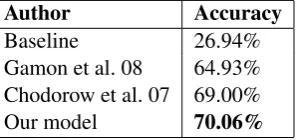
not omit any features, although we plan to experi-ment with different feature combinations to deter-mine if, and how, this would impact the classifier’s performance. Before testing our model on learner data, it is important to ascertain that it can correctly associate prepositions to a given context in gram-matical, well-edited data. We therefore tested the model on a section of the BNC not used in train-ing, section J. Our best result to date is 70.06%
accuracy (test set size: 536,193). Table 3 relates our results to others reported in the literature on comparable tasks. The baseline refers to always choosing the most frequent option, namelyof.
We can see that our model’s performance com-pares favourably to the best results in the literature, although direct comparisons are hard to draw since different groups train and test on different preposi-tion sets and on different types of data (British vs. American English, BNC vs. news reports, and so
2No word sense disambiguation was performed at this
stage.
3In NPs with a null determiner, the target is the head noun. 4Developed by James Curran.
Proportion of training data Precision Recall
of 27.83% (2,501,327) 74.28% 90.47%
to 20.64% (1,855,304) 85.99% 81.73%
in 17.68% (1,589,718) 60.15% 67.60%
for 8.01% (720,369) 55.47% 43.78%
on 6.54% (587,871) 58.52% 45.81%
with 6.03% (541,696) 58.13% 46.33%
at 4.72% (424,539) 57.44% 52.12%
by 4.69% (421,430) 63.83% 56.51%
from 3.86% (347,105) 59.20% 32.07%
Table 4: L1 results - individual prepositions
on). Furthermore, it should be noted that Gamon et al. report more than one figure in their results, as there are two components to their model: one determining whether a preposition is needed, and the other deciding what the preposition should be. The figure reported here refers to the latter task, as it is the most similar to the one we are evalu-ating. Additionally, Chodorow et al. also discuss some modifications to their model which can in-crease accuracy; the result noted here is the one more directly comparable to our own approach.
5.1.1 Further discussion
To fully assess the model’s performance on the L1 data, it is important to consider factors such as per-formance on individual prepositions, the relation-ship between training dataset size and accuracy, and the kinds of errors made by the model.
Table 4 shows the classifier’s performance on in-dividual prepositions together with the size of their training datasets. At first glance, a clear correlation appears between the amount of data seen in train-ing and precision and recall, as evidenced for ex-ample byoforto, for which the classifier achieves a very high score. In other cases, however, the cor-relation is not so clear-cut. For example by has one of the smallest data sets in training but higher scores than many of the other prepositions, while foris notable for the opposite reason, namely hav-ing a large dataset but some of the lowest scores.
Target prep Confused with
at by for from in of on to with
at xx 4.65% 10.82% 2.95% 36.83% 19.46% 9.17% 10.28% 5.85%
by 6.54% xx 8.50% 2.58% 41.38% 19.44% 5.41% 10.04% 6.10%
for 8.19% 3.93% xx 1.91% 25.67% 36.12% 5.60% 11.29% 7.28%
from 6.19% 4.14% 6.72% xx 26.98% 26.74% 7.70% 16.45% 5.07%
in 7.16% 9.28% 10.68% 3.01% xx 43.40% 10.92% 8.96% 6.59%
of 3.95% 2.00% 18.81% 3.36% 40.21% xx 9.46% 14.77% 7.43%
on 5.49% 3.85% 8.66% 2.29% 32.88% 27.92% xx 12.20% 6.71%
to 9.77% 3.82% 11.49% 3.71% 24.86% 27.95% 9.43% xx 8.95%
with 3.66% 4.43% 12.06% 2.24% 28.08% 26.63% 6.81% 16.10% xx
Table 5: Confusion matrix for L1 data - prepositions
such as the Oxford English Dictionary. However, we find no good correlation between the two as the preposition with the most senses is of (16), and that with the fewest isfrom(1), thus negating the idea that fewer senses make a preposition easier to learn. The reason may therefore be found else-where, e.g. in the lexical properties of the contexts. A good picture of the model’s errors can be had by looking at the confusion matrix in Table 5, which reports, for each preposition, what the clas-sifier’s incorrect decision was. Analysis of these errors may establish whether they are related to the dataset size issue noted above, or have a more lin-guistically grounded explanation.
From the table, the frequency effect appears evi-dent: in almost every case, the three most frequent wrong choices are the three most frequent prepo-sitions,to,of, andin, although interestingly not in that order,inusually being the first choice. Con-versely, the less frequent prepositions are less of-ten suggested as the classifier’s choice. This effect precludes the possibility at the moment of draw-ing any ldraw-inguistic conclusions. These may only be gleaned by looking at the errors for the three more frequent prepositions. We see for example that there seems to be a strong relation betweenof and for, the cause of which is not immediately clear: perhaps they both often occur within noun phrases (e.g.book of recipes,book for recipes). More pre-dictable is the confusion betweentoandfrom, and between locative prepositions such astoandat, al-though the effect is less strong for other potentially confusable pairs such asinandatoron.
Table 6 gives some examples of instances where the classifier’s chosen preposition differs from that found in the original text. In most cases, the clas-sifier’s suggestion is also grammatically correct,
Classifier choice Correct phrase
demandsofthe sector demandsfor. . . conditionfordevelopment conditionof. . . traveltospeed travelat. . . lookatthe USA lookto. . .
Table 6: Examples of classifier errors on preposi-tion L1 task
Author Accuracy
Baseline 59.83%
Han et al. 06 83.00%
Gamon et al. 08 86.07% Turner and Charniak 07 86.74%
Our model 92.15%
Table 7: Classifier performance - L1 determiners
but the overall meaning of the phrases changes somewhat. For example, while the demands of the sector are usually made by the sector itself, thedemands for the sectorsuggest that someone else may be making them. These are subtle dif-ferences which it may be impossible to capture without a more sophisticated understanding of the wider context.
%of training data Prec. Recall a 9.61% (388,476) 70.52% 53.50%
the 29.19% (1,180,435) 85.17% 91.51%
null 61.20% (2,475,014) 98.63% 98.79% Table 8: L1 results - individual determiners
5.2 Determiners
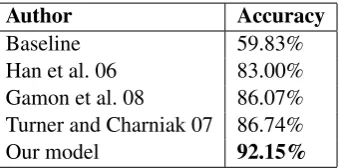
For the determiner task, we also consider only the three most frequent cases (a, the, null), which gives us a training dataset consisting of 4,043,925 instances. We achieve accuracy of 92.15% on the L1 data (test set size: 305,264), as shown in Ta-ble 7. Again, the baseline refers to the most fre-quent class,null.
The best reported results to date on determiner selection are those in Turner and Charniak (2007). Our model outperforms their n-gram language model approach by over 5%. Since the two ap-proaches are not tested on the same data this com-parison is not conclusive, but we are optimistic that there is a real difference in accuracy since the type of texts used are not dissimilar. As in the case of the prepositions, it is interesting to see whether this high performance is equally distributed across the three classes; this information is reported in Ta-ble 8. Here we can see that there is a very strong correlation between amount of data seen in train-ing and precision and recall. The indefinite arti-cle’s lower ‘learnability’, and its lower frequency appears not to be peculiar to our data, as it is also found by Gamon et al. among others.
The disparity in training is a reflection of the dis-tribution of determiners in the English language. Perhaps if this imbalance were addressed, the model would more confidently learn contexts of use fora, too, which would be desirable in view of using this information for error correction. On the other hand, this would create a distorted represen-tation of the composition of English, which may not be what we want in a statistical model of lan-guage. We plan to experiment with smaller scale, more similar datasets to ascertain whether the issue is one of training size or of inherent difficulty in learning about the indefinite article’s occurrence.
In looking at the confusion matrix for determin-ers (Table 9), it is interesting to note that for the classifier’s mistakes involving a or the, the erro-neous choice is in the almost always the other de-terminer rather than the null case. This suggests that the frequency effect is not so strong as to
over-Target det Confused with
a the null
a xx 92.92% 7.08%
the 80.66% xx 19.34%
null 14.51% 85.49% xx
Table 9: Confusion matrix for L1 determiners
ride any true linguistic information the model has acquired, otherwise the predominant choice would always be the null case. On the contrary, these re-sults show that the model is indeed capable of dis-tinguishing between contexts which require a de-terminer and those which do not, but requires fur-ther fine tuning to perform better in knowing which of the two determiner options to choose. Perhaps the introduction of a discourse dimension might assist in this respect. We plan to experiment with some simple heuristics: for example, given a se-quence ‘Determiner Noun’, has the noun appeared in the preceding few sentences? If so, we might expecttheto be the correct choice rather thana.
6 Testing the model
6.1 Working with L2 text
To evaluate the model’s performance on learner data, we use a subsection of the Cambridge Learner Corpus (CLC)5. We envisage our model to
eventually be of assistance to learners in analysing their writing and identifying instances of preposi-tion or determiner usage which do not correspond to what it has been trained to expect; the more probable instance would be suggested as a more appropriate alternative. In using NLP tools and techniques which have been developed with and for L1 language, a loss of performance on L2 data is to be expected. These methods usually expect grammatically well-formed input; learner text is often ungrammatical, misspelled, and different in content and structure from typical L1 resources such as the WSJ and the BNC.
6.2 Prepositions
For the preposition task, we extract 2523 instances of preposition use from the CLC (1282 correct, 1241 incorrect) and ask the classifier to mark them
5The CLC is a computerised database of contemporary
Instance type Accuracy
Correct 66.7%
Incorrect 70%
Table 10: Accuracy on L2 data - prepositions. Ac-curacy on incorrect instances refers to the classifier successfully identifying the preposition in the text as not appropriate for that context.
as correct or incorrect. The results from this task are presented in Table 10. These first results sug-gest that the model is fairly robust: the accuracy rate on the correct data, for example, is not much lower than that on the L1 data. In an application designed to assist learners, it is important to aim to reduce the rate of false alarms - cases where the original is correct, but the model flags an error - to a minimum, so it is positive that this result is com-paratively high. Accuracy on error identification is at first glance even more encouraging. However, if we look at the suggestions the model makes to re-place the erroneous preposition, we find that these are correct only 51.5% of the time, greatly reduc-ing its usefulness.
6.2.1 Further discussion
A first analysis of the classifier’s decisions and its errors points to various factors which could be im-pairing its performance. Spelling mistakes in the input are one of the most immediate ones. For ex-ample, in the sentenceI’m Franch, responsableon the computer services, the classifier is not able to suggest a correct alternative to the erroneous on: since it does not recognise the adjective as a mis-spelling ofresponsible, it loses the information as-sociated with this lexical feature, which could po-tentially determine the preposition choice.
A more complex problem arises when poor grammar in the input misleads the parser so that the information it gives for a sentence is incor-rect, especially as regards PP attachment. In this example, I wold like following equipment to my speech: computer, modem socket and microphone, the missingtheleads the parser to treat following as a verb, and believes it to be the verb to which the preposition is attached. It therefore suggestsfrom as a correction, which is a reasonable choice given the frequency of phrases such as to follow from. However, this was not what the PP was meant to modify: impaired performance from the parser could be a significant negative factor in the model’s performance. It would be interesting to test the
model on texts written by students of different lev-els of proficiency, as their grammar may be more error-free and more likely to be parsed correctly. Alternatively, we could modify the parser so as to skip cases where it requires several attempts before producing a parse, as these more challenging cases could be indicative of very poorly structured sen-tences in which misused prepositions are depen-dent on more complex errors.
A different kind of problem impacting our accu-racy scores derives from those instances where the classifier selects a preposition which can be cor-rect in the given context, but is not the corcor-rect one in that particular case. In the example I received a beautiful present at my birthday, the classifier identifies the presence of the error, and suggests the grammatically and pragmatically appropriate correction for. The corpus annotators, however, indicate on as the correct choice. Since we use their annotations as the benchmark against which to evaluate the model, this instance is counted as the classifier being wrong because it disagrees with the annotators. A better indication of the model’s performance may be to independently judge its de-cisions, to avoid being subject to the annotators’ bias. Finally, we are beginning to look at the rela-tions between preposition errors and other types of error such as verb choice, and how these are anno-tated in the data.
An overview of the classifier’s error patterns for the data in this task shows that they are largely sim-ilar to those observed in the L1 data. This sug-gests that the gap in performance between L1 and L2 is due more to the challenges posed by learner text than by inherent shortcomings in the model, and therefore that the key to better performance is likely to lie in overcoming these problems. In future work we plan to use L2 data where some of the spelling errors and non-preposition or deter-miner errors have been corrected so that we can see which of the other errors are worth focussing on first.
6.3 Determiners
task. On the incorrect instances (set size ca. 1200), however, accuracy is less than 10%.
Preliminary error analysis shows that the model is successful at identifying cases of misused deter-miner, e.g.afortheor vice versa, doing so in over two-thirds of cases. However, by far the most fre-quent error type for determiners is not confusion between indefinite and definite article, but omitting an article where one is needed. At the moment, the model detects very few of these errors, no doubt in-fluenced by the preponderance ofnull cases seen in training. Furthermore, some of the issues raised earlier in discussing the application of NLP tools to L2 language hold for this task, too.
In addition to those, though, in this task more than for prepositions we believe that differences in text type between the training texts the BNC -and the testing material - learner essays - has a sig-nificant negative effect on the model. In this task, the lexical items play a crucial role in class assign-ment. If the noun in question has not been seen in training, the classifier may be unable to make an informed choice. Although the BNC comprises a wide variety of texts, there may not be a sufficient number covering topics typical of learner essays, such as ‘business letters’ or ‘postcards to penpals’. Also, the BNC was created with material from al-most 20 years ago, and learners writing in contem-porary English may use lexical items which are not very frequently seen in the BNC. A clear exam-ple of this discrepancy is the nouninternet, which requires the definite article in English, but not in several other languages, leading to countless sen-tences such as I saw it in internet,I booked it on internet, and so on. This is one of the errors the model never detects: a fact which is not surpris-ing when we consider that this noun occurs only four times in the whole of the training data. It may be therefore necessary to consider using alternative sources of training data to overcome this problem and improve the classifier’s performance.
7 Comparison to human learners
In developing this model, our first aim was not to create something which learns like a human, but something that works in the best and most effi-cient possible way. However, it is interesting to see whether human learners and classifiers display similar patterns of errors in preposition choice. This information has twofold value: as well as be-ing of pedagogical assistance to instructors of
En-glish L2, were the classifier to display student-like error patterns, insights into ‘error triggers’ could be derived from the L2 pedagogical literature to improve the classifier. The analysis of the types of errors made by human learners yields some in-sights which might be worthy of further investi-gation. A clear one is the confusion between the three locative and temporal prepositionsat,in, and on(typical sentence:The training programme will startatthe 1st August). This type of error is made often by both learners and the model on both types of data, suggesting that perhaps further attention to features might be necessary to improve discrim-ination between these three prepositions.
There are also interesting divergences. For ex-ample, a common source of confusion in learners is between by and from, as in I like it because it’sfrommy favourite band. However, this confu-sion is not very frequent in the model, a difference which could be explained either by the fact that, as noted above, performance onfromis very low and so the classifier is unlikely to suggest it, or that in training the contexts seen forbyare sufficiently distinctive that the classifier is not misled like the learners.
Finally, a surprising difference comes from looking at what tois confused with. The model often suggestsatwheretowould be correct. This is perhaps not entirely unusual as both can occur with locative complements (one cango to a place orbe at a place) and this similarity could be con-fusing the classifier. Learners, however, although they do make this kind of mistake, are much more hampered by the confusion betweenforandto, as in She was helpful for me or This is interesting foryou. In other words, for learners it seems that the abstract use of this preposition, its benefactive sense, is much more problematic than the spatial sense. We can hypothesise that the classifier is less distracted by these cases because the effect of the lexical features is stronger.
8 Conclusions and future directions This paper discussed a contextual feature based approach to the automatic acquisition of models of use for prepositions and determiners, which achieve an accuracy of 70.06% and 92.15% re-spectively, and showed how it can be applied to an error correction task for L2 writing, with promis-ing early results. There are several directions that can be pursued to improve accuracy on both types of data. The classifier can be further fine-tuned to acquire more reliable models of use for the two POS. We can also experiment with its confidence thresholds, for example allowing it to make an-other suggestion when its confidence in its first choice is low. Furthermore, issues relating to the use of NLP tools with L2 data must be addressed, such as factoring out spelling or other errors in the data, and perhaps training on text types which are more similar to the CLC. In the longer term, we also envisage mining the information implicit in our training data to create a lexical resource de-scribing the statistical tendencies observed. Acknowledgements
We wish to thank Stephen Clark and Laura Rimell for stim-ulating discussions and the anonymous reviewers for their helpful comments. We acknowledge Cambridge University Press’s assistance in accessing the Cambridge Learner Corpus data. Rachele De Felice was supported by an AHRC scholar-ship for the duration of her studies.
References
Briscoe, Ted, John Carroll, and Rebecca Watson. 2006. The second release of the RASP system. In
COLING-ACL 06 Demo Session.
Chodorow, Martin, Joel Tetreault, and Na-Rae Han. 2007. Detection of grammatical errors involv-ing prepositions. In Proceedings of the 4th ACL-SIGSEM Workshop on Prepositions.
De Felice, Rachele and Stephen Pulman. 2007. Au-tomatically acquiring models of preposition use. In
Proceedings of the 4th ACL-SIGSEM Workshop on Prepositions.
De Felice, Rachele. forthcoming. Recognising prepo-sition and determiner errors in learner English. Ph.D. thesis, Oxford University Computing Labora-tory.
Gamon, M., J. Gao, C. Brockett, A. Klementiev, W. Dolan, D. Belenko, and L. Vanderwende. 2008. Using contextual speller techniques and language modeling for ESL error correction. InProceedings of IJCNLP.
Han, Na-Rae, Martin Chodorow, and Claudia Leacock. 2006. Detecting errors in English article usage by non-native speakers. Natural Language Engineer-ing, 12(1):115–129.
Izumi, Emi, Kiyotaka Uchimoto, and Hitoshi Isahara. 2004. SST speech corpus of Japanese learners’ English and automatic detection of learners’ errors.
ICAME, 28:31–48.
Turner, Jenine and Eugen Charniak. 2007. Language modeling for determiner selection. InNAACL-HLT Companion volume.