Title: Interventions for children with speech, language and communication needs: an exploration of current practice
Authors: Sue Roulstone1, Yvonne Wren1, Ioanna Bakopoulou2, Geoff Lindsay2.
1University of the West of England, Bristol and Bristol Speech & Language Therapy
Research Unit, Bristol.
Abstract
This paper reports a series of interviews with education and health practitioners. The aims were to identify interventions used in practice with children with speech, language and communication needs, to explore explanations for the choice of intervention and to identify the ways that outcomes were measured. Participants (n=61) included educational psychologists, speech and language therapists and education advisory staff. They talked about interventions in terms of published programmes, principles and activities,
I Introduction
In 2008, the Bercow Review of services for children and young people with speech, language and communication needs (SLCN), called for the establishment of a research programme to “enhance the evidence base and inform delivery of better outcomes for children and young people” (DfES, 2008:10). The UK government of the time responded by commissioning a programme of research (known as the Better Communication Research Programme http://www.warwick.ac.uk/go/bettercommunication) to investigate the effectiveness and cost-effectiveness of interventions. The concern was to improve understanding of what interventions work for children and young people with SLCN so that commissioners might develop services that were more effective and cost-effective. A number of projects arose from that programme of work and these are described in Lindsay, Dockrell, Law, Roulstone and Vignoles (2010). One project aimed to identify the research evidence available for interventions currently in use in both education and health services. As a first step it was therefore necessary to identify what interventions were being used with children with SLCN. This paper describes that process.
Soloff, Law et al, 2002; Lindsay, Dockrell, Mackie and Letchford, 2005a,b). Studies have also surveyed practitioners’ modes of delivery of intervention (e.g. group, direct, indirect) (Fuller, 2010). The latter study focused on the nature and delivery of speech and language therapy within local Sure Start programmes (similar to Head Start programmes in US). Other studies of practice have surveyed speech and language therapist’s (SLTs) use of interventions for children with speech problems (McLeod & Baker, 2004; Joffe & Pring, 2008) and receptive language impairment (Law, Campbell, Roulstone, Adams & Boyle, 2007). The two studies of speech interventions focused on interventions already mentioned in the research literature. They also investigated delivery processes such as frequency, and factors influencing the choice of intervention. Both surveys, one in the UK and one in Australia, concluded that individual SLTs favour particular interventions, although some that are mentioned in the literature, were rarely used in practice. Joffe & Pring (2008) also found that SLTs typically combined interventions.
that child, giving practical reasons and explicit rationales for their choice. Participants’ descriptions of interventions fell into two categories, focusing on skills acquisition and metacognitive skills. About one third of the explanations of intervention choices related to the underlying deficit such as processing limitations. The rest were described as ‘theories of therapy’ where there is no direct reference to an underlying deficit and the focus was more on the aims of the intervention.
These previous studies have focused on interventions for specific groups of children. In contrast, the aim of the study described here was to gain an understanding of
interventions used across the full range of SLCN. Furthermore, the focus was on the interventions used by services as a whole rather than the practice of individual practitioners.
1 Defining intervention
were a variety of definitions. At its broadest, an intervention is viewed as an action or technique or activity or procedure (or indeed combinations of these) that reflect a shared aim to bring about an improvement, or prevent a negative outcome, related to a child’s speech, language and communication skills; this can also include the modification of factors that are barriers or facilitators to change and the modification of an environment to facilitate communication development (Bunning, 2004; Dockrell and Messer 1999; Dollaghan, 2007; Law, Boyle, Harris, Harkness and Nye, 1998). For example, Law et al (1998:iii-iv) define intervention as “an explicit application of therapeutic/educational techniques intended to modify an individual’s performance in a designated area associated with communication”. Words such as treatment, therapy, intervention, and remediation are used interchangeably although they carry slightly different connotations, some more medically oriented than others.
McCauley & Fey (2006) present a model of intervention that identifies components that, they suggest, should be made explicit in the development or description of an
as well as the monitoring and assessment processes to be used. In an analysis of therapies used in acquired aphasia, Byng and Black (1995) identify key components of therapy including the design of the task and how it was explained, the stimuli and materials used, the nature of the interaction between therapist and patient, the feedback and facilitation provided as well as the duration and intensity of intervention.
In the research literature evaluating interventions, the specifics of an intervention have sometimes been lacking. For example, Pickstone, Goldbart, Marshall et al (2009), in a systematic review of interventions that target a child’s environment, commented on the variability of detail that is given by research reports. Pawson (2006) criticises the rather sloppy use of the word intervention. He argues that it is used as a catch-all term that conflates various activities such as clinical treatment, a healthcare programme or a training programme that are often quite dissimilar, leading to confusion about what is being described.
qualitative study which aimed to gather data from service managers about the interventions being used in their service.
2. Research questions:
The aim of this project was to map the interventions that are used with pupils with SLCN. In particular we aimed to:
a) identify the interventions in use with children and young people with SLCN;
b) explore the underlying rationale for the use of interventions in a particular context (e.g. with a particular group of pupils);
c) investigate the outcomes that are targeted by these interventions and how they are evaluated at a service level.
II Method
1 Overall design
participation in the study. At the time, other projects, commissioned from the governments’ Better Communication Action Plan (DCSF, 2008) and known as the Pathfinder projects were starting to examine aspects of joint commissioning. Initial contacts were made through these Pathfinder sites in order to create links between the two programmes of work. Some additional Local Authorities and NHS Trusts who were known through previous research programmes were also approached in order to establish a sample of services that were geographically diverse.
Interviewing followed an iterative process, so that data collected were fed back into successive interviews. All interviews were taped and field notes were taken at the time of the interviews. The tapes were not fully transcribed; instead, on-line analysis of the interviews was carried out using a structured format to collate the answers to each question. Recordings were used to provide clarification and to check for the detail of participants’ wording. Service documents were collected in order to provide context about how specific interventions were used within service care pathways.
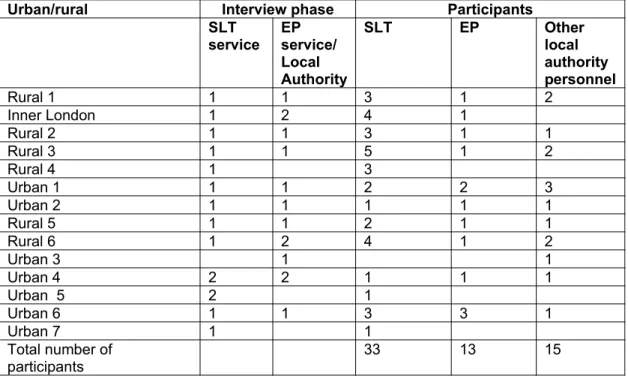
The sample covered 14 different areas: six rural counties, seven urban and one inner London Local Authority (LA), with a spread around England. Interviews were held with senior managers from ten Educational Psychology Services (EPS) and fourteen National Health Service (NHS) Speech and Language Therapy Services. In ten of the fourteen areas, Speech and Language Therapy Services were in the same locality as the EPS. It was decided to interview managers since they would have an overview of the interventions used in their service; however managers were also encouraged to include their team leaders and relevant associated service managers. Table 1 summarises the interviews that took place and the participants involved in each interview. In total, 61 practitioners were interviewed: 13 Educational Psychologists (EP), 33 Speech and Language Therapists (SLTs), and 15 advisory team managers. The latter had various designations which included references to SLCN, inclusion, sensory services, communication and interaction.
3 Procedure
the terms ‘Universal’, ‘Targeted’ and ‘Specialist’ (terms used to describe levels of intervention or services in the Every Child Matters agenda, DfES, 2003). This helped to ensure a common understanding of the groups of children of interest. Respondents were then asked to list all the interventions they used with children with SLCN, listing first of all those targeting communication, then language and lastly speech. They were then asked to describe one intervention from each list in detail. Given the variety of definitions found in the literature, it was anticipated that professionals from differing disciplines would identify and define interventions differently, so we did not wish our questions to contain preconceptions about what would be offered as examples of interventions; the
questioning process therefore began with broad open questions and probed for additional detail about their reasons for the use of the intervention and the outcomes used.
service and to add any others not already listed. Within each category, participants were asked to identify frequently used interventions about which they were asked a series of short questions: what age of child would be targeted with such an approach; what the intended outcomes would be; if they evaluated the effectiveness of the intervention at a service level and whether the intervention was used at a universal, targeted or specialist level. Information on which phase of interview was carried out is provided in Table 1.
Interviews were carried out by the first three authors (two speech and language therapists and one educational psychologist), in pairs at first to check for consistency of process and then singly subsequently. Interviews took from 45 minutes to 2 hours and were
conducted in the interviewees’ work-place in a quiet room.
<Table 1 here> 4 Analysis
III Results
1. Description and Categorisation of SLCN
Two main interpretations of the meaning of SLCN emerged from the first phase interviews: SLCN as intrinsic to many types of special needs or SLCN as an overarching category with many sub-diagnoses. Generally, participants from education backgrounds described SLCN as intrinsic to many types of special need and did not suggest sub- types. “It’s hard to think of children we are working with (who have) no need of some kind of communication need.” (educational psychologist)
Descriptions of SLCN were clearly influenced by the Special Education Needs (SEN) Code of Practice used in England (DfEE, 2001). One participant commented:
In contrast, SLTs tended to categorise children with SLCN into a diagnostic category or type of impairment (e.g. specific language impairment, cleft palate, voice problem, dyspraxia). One exception to this was an SLT service that categorised their children with SLCN into therapeutic need following the Care Aims model (Malcomess, 2005).
Responses to the questions about ‘Universal, Targeted and Specialist’ in the phase one interviews brought broadly similar answers from all participants, in that there was an acknowledgement of a hierarchy of need and provision; however, education practitioners tended to use the notion of wave one, two and three (as used in the SEN Code of Practice, DfEE, 2001)or tier one, two and three to express this idea. Box 1 shows one SLT
practitioner’s differentiation which was typical of most. < Box 1 here >
2. Types of interventions identified
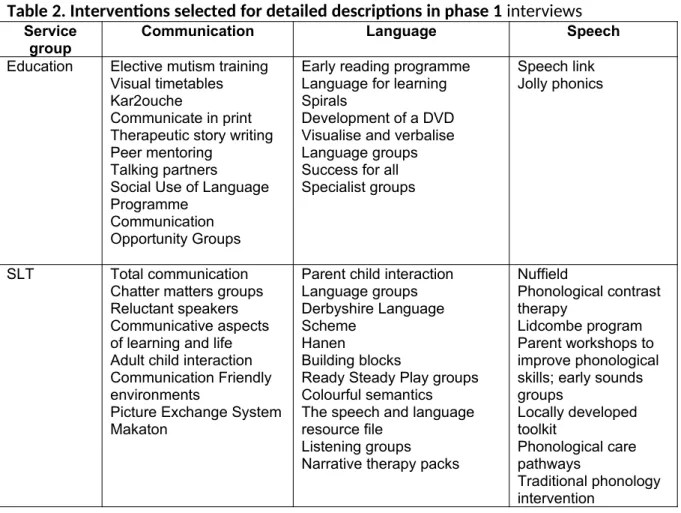
phase 1; as can be seen there was little overlap between education participants and SLTs. Education participants generally deferred to their SLT colleagues when offering
interventions about speech. In phase 2, similarly, there was little overlap in the choice of interventions described.
<Insert Table 2 >
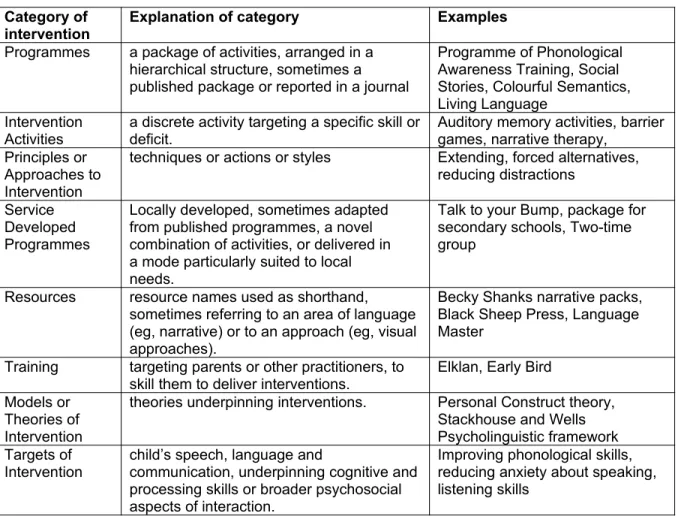
A total of 158 different interventions were mentioned and from these eight broad groupings of interventions emerged. Descriptions of each category along with examples appear in Table 3.
< Table 3 >
Although some respondents indicated that they used interventions as intended, others indicated that they varied them.
“It's based on PCI (parent-child interaction) and it's our boiling down to some key PCI general principles” (SLT)
“When you implement a programme, you can never just take it off the shelf and say ‘that’s absolutely right’, you’re always looking at it, taking feedback from the
schools, then developing things that bolster what they see as the gaps.”
(advisory service manager) Within the interviews there was not always time to probe for detailed explanations of terms that were used.
It was rare that interventions were linked exclusively to any particular level of intervention (that is, universal, targeted, specialist) or to any particular age or diagnostic group,
although some interventions were used in a more targeted fashion. For example, the Picture Exchange System (PECS) was reported mostly in the context of children on the autism spectrum and with those with severe and profound learning difficulties.
3. Participants’ rationales
When asked why they had chosen to use a particular intervention, respondents often gave a list of reasons.
Respondents’ statements of rationale frequently indicated that the intervention targeted an identified need or gap in services. This included references to the support that the interventions provided for professionals and parents to help them their understanding or reduce their levels of anxiety.
“To skill up the pre-school workers in the county to support all children” (SLT) “It meets the needs of children who can’t articulate” (LA)
“We had a significant number of schools with children entering nursery with deficit language skills” (LA)
“It's a tool for schools to use independently to assist children with their social communication” (LA)
Some made reference to evidence of the intervention’s effectiveness. These were either based on personal experience, local evaluations or on research evidence.
“Because it works” (SLT)
“We achieved good results through the evaluation initially” (LA)
“The evidence is that visual approaches help young people to cope” (LA)
“There is a strong evidence base about learning social skills within a group setting where children are able to learn from peers and practice skills with peers”(SLT)
In some cases, there was reference to some underlying theoretical position. “There’s a solid theoretical background explained in the manual” (SLT) “It’s based on the Stackhouse and Wells approach” (SLT)
Respondents also gave pragmatic reasons, related to efficiency, accessibility and popularity.
“it was a way of seeing more children” (SLT)
“it's fun for children, it's easy to provide visual resources for the sessions and fairly easy for another person to run the sessions.” (SLT)
“it is fun and children like it cause it’s easy and they can do it, and there’s a nice progression of activities that we can follow.” (LA)
4. Outcome evaluation
Participants were asked how they evaluated children’s responses to the intervention. They talked about improving or increasing the children’s skills in communication, language and speech as one would expect; they also mentioned the broader aspects of children’s social and interaction skills and aspects of psychosocial functioning such as self esteem and behaviour. Participants also reported that they were looking to impact on the child’s environment through change in the interactions of significant adults. Appendix 1 shows the outcomes mentioned in relation to examples of interventions identified by
participants.
In terms of the methods used in the evaluation of outcomes, participants mostly reported that outcomes were measured for the individual child. Systematic evaluation of an
particular intervention had been evaluated in a one-off project within their area. Some interventions are associated with evaluation forms which participants reported that they used routinely, for example a questionnaire associated with the Hanen programme. Feedback from parents and teachers regularly played a part in the evaluation of outcomes through questionnaire completion; one group reported that a user group was consulted for feedback. However, the predominant focus of evaluation was on the individual child.
5. Documentation
A wide range of types of documentation were submitted. Some gave guidance on which intervention should be used for specific groups of clients. For example, one SLT service care pathway showed that a child with speech difficulties aged above three years, six months and with good attention would receive a diagnostic screen programme while the same type of child but with poor attention would receive a sound awareness group programme. Some services provided practitioners with a range of interventions to select from using their professional judgement. Other services listed interventions related to the area targeted (e.g. one EPS listed interventions for children where the target was
intervention. Some services focused on the amount of intervention or at what point intervention would be provided for different groups of children. In some cases there was no direct or specific reference to the type of intervention.
Discussion
This study took a qualitative approach in terms of the sampling process, the structure of the interviews and the analytical approach. Sampling was purposive, aiming to gain an understanding of the range of interventions in use with children across the spectrum of need within SLCN. It should not therefore be surprising to see so many different
interventions or to see differences in the way that interventions were described. This reflects the diversity of practice that was sampled and the personalisation of responses that is a function of qualitative methods. Structured systems of describing interventions that include the goals, purposes, context and monitoring procedures such as that
variable way that interventions are described in the literature where there appears to be no consistency or consensus about how interventions are reported.
It was apparent that the intervention labels were used as a shorthand way of referring to an intervention. So the same label could easily be describing different interventions or different labels could be used to refer to similar interventions. Pawson (2006:33) refers to this as “label naivete” and cautions that a label may be used to describe an intervention associated with a particular set of theories, propositions and procedures whereas actual practice may differ from this.
regimes might be through a process of adaptation and combining of interventions to make them fit a perceived service (or individual) need.
(Pawson, 2006:35) as practitioners try to make the interventions fit local circumstances and work for particular individuals. As a result, interventions are rarely equally effective in every context.
Although other studies have investigated the assessments and measures currently used by SLTs, they have not investigated the use of outcome measures per se. Respondents in this study specified the outcomes targeted by each intervention. However, none of our
respondents indicated that outcomes were being collected at a service level. Given the current political context of outcomes-based commissioning (Department of Health, 2010) whereby services will be commissioned to deliver specified outcomes, it is of concern that services remain unable to demonstrate the outcomes achieved by the various intervention they offer.
1. Limitations of the study
In this small scale study, the aim was to identify the range of interventions in use, so it was not appropriate to look for patterns of usage. Service managers do not necessarily know about all the details of interventions employed by their teams. However, by talking to services managers, we obtained an overview of all the interventions used in the
2. Conclusions
This component of the Better Communication Research Programme was the preliminary step in a programme of work to explore the evidence basis of current practice. This study provided information about the kinds of categories of interventions that are in use by services. Interventions identified in this study were used in the next stage of the programme of work which carried out a survey to examine the distribution of the interventions and to identify patterns of usage with different age groups and types of SLCN (Roulstone et al., in press). The final stage of this component of the BCRP examines the evidence for the interventions used in current practice (Law et al., in press). Even where there is evidence to support the effectiveness of particular interventions, it is important to bear in mind that those interventions may have been adapted in practice. Therefore evaluations to judge the impact of an intervention locally would be advised.
Acknowledgements
References
Bercow, J. (2008) A review of services for children and young people (0-19) with speech, language and communication needs. Nottingham: DCSF .
Bunning K (2004) Speech and language therapy intervention: frameworks and processes. London: Whurr.
Byng S and Black S (1995) What makes a therapy? Some parameters of therapeutic intervention in aphasia. European Journal of Disorders of Communication 30(3): 303-316.
Department for Children Schools and Families (2008) Better Communication. An Action plan to improve services for children and young people with speech, language and
communication needs. Department for Children, Schools and Families. Crown Copyright.
Department for Education and Skills (2003) Every Child Matters. London: The Stationery Office.
Department of Health. (2010). The NHS Outcomes Framework 2011/12. Crown Copyright.
Dollaghan CA (2007) The Handbook for evidence-based practice in communication disorders. London: Paul H Brookes Publishing Co.
Dockrell J and Messer D (1999) Children’s language and communication difficulties: understanding, identification and intervention. London: Continuum.
Fuller A (2010) Speech and language therapy in Sure Start Local Programmes: a survey-based analysis of practice and innovation. International Journal of Language and Communication Disorders 45: 182-203.
Jones M, Onslow M, Packman A, Williams S, Ormond T, Schwarz T, and Gebski V. (2005) Randomised controlled trial of the Lidcombe Programme of early stuttering intervention. British Medical Journal 331: 659-661.
Lattermann C, Euler HA and Neumann K (2008) A randomized control trial to investigate the
impact of the Lidcombe Program on early stuttering in German-speaking preschoolers. Journal of
Fluency Disorders 33:52-65.
Law J, Boyle J, Harris F, Harkness A and Nye C (1998) Screening for Speech and Language Delay: A Systematic Review of the Literature, Health Technology Assessment 2(9).
Law J, Campbell C, Roulstone S, Adams C, and Boyle J (2007) Mapping practice onto theory: the speech and language practitioner’s construction of receptive language impairment. International Journal of Language and Communication Disorders 43(3):245-263.
Law, J., Lee, W., Roulstone, S., Wren, Y., Zeng, B. & Lindsay, G. (in press). “What Works” Interventions for children and young people with speech, language and communication
Lindsay G, Soloff N, Law J, Band S, Peacey N, Gascoigne M and Radford J (2002) Speech and language therapy services to education in England and Wales. International Journal of Language and Communication Disorder, 37(3): 273-288.
Lindsay G, Dockrell JE, Law J, Roulstone S. and Vignoles A (2010) Better Communication Research Programme: 1st interim report Research Report DFE-RR070. London: Department
for Education.
Lindsay G, Dockrell JE, Mackie C and Letchford B (2005a) The role of specialist provision for children with specific speech and language difficulties in England and Wales: A model for inclusion? Journal of Research in Special Educational Needs 5: 88-96.
Malcomess K (2005) The Care Aims Model. In: Anderson C and van der Gaag, A (eds) Speech and Language Therapy: Issues in Professional Practice. London: Whurr.
McCauley RJ and Fey ME (2006) Treatment of language disorders in children. London: Paul Brookes Publishing Co.
McLeod, S. and Baker, E., (2004). Current clinical practice for children with speech impairment. In B. E. Murdoch, J. Goozee, B.-M. Whelan and K. Docking (eds), 26th World Congress of the International Association of Logopedics and Phoniatrics.
Pawson R (2006) Evidence-based policy: a realist perspective. London: Sage Publications.
Roulstone, S., Wren., Bakopoulou,, I., Goolad, S. & Lindsay, G. (in press). Exploring interventions for children and young people with speech, language and communication
needs: a study of practice. DfE Research report.
Rousseau I, Packman A, Onslow M, Dredge R, and Harrison E (2002) Australian speech pathologists¹ use of the Lidcombe Program of early stuttering intervention. ACQuiring Knowledge in Speech, Language andHearing 4: 67-71.
Appendix I Outcomes targeted by intervention packages, activities and approaches.
Outcomes Intervention packages Intervention activities Principles and approaches
A. Communication:
Social skills Talkabout, Hanen, BLAST, Talking Partners, Social Use Language Programme, Socially Speaking, Circle of Friends, Social Stories,
Nonverbal communication
Intensive Interaction, Time to Talk,
Initiation Picture Exchange Communication System Sharing information Social Stories
Inference/verbal reasoning
Language for Thinking
Attention and listening Spirals, Talking Partners, BLAST,
barrier games, auditory memory activities, auditory
discrimination activities, cued articulation
Use and understand English (deaf/hearing impaired population)
Cued Speech
Provide a means of communication
patterns
B. Language:
Understanding of language
BLAST, Derbyshire Language Scheme, Visualize and Verbalize,
visual approaches to support language, symbols, chunking, repetition, forced
alternatives, reduced distractions, use of key words, providing feedback Expressive language
structure
Becky Shanks Narrative Pack, Colourful Semantics, Socially Speaking, Talking Partners, Hanen, Derbyshire Language Scheme,
language rich environment, modelling, extending, repetition, reducing
questions, use of key words, commenting
Range of sentence elements
Colourful Semantics
Narrative skills Becky Shanks Narrative Pack
Vocabulary narrative therapy, extending,
repetition, forced alternatives, use of key words
Fluency of language production
narratives
Specificity of language barrier games
Concept knowledge auditory memory activities use of symbols
Word finding chunking
minimal pair discrimination Metaphonological skills Metaphon, BLAST,
Change in speech sound system
Metaphon, Speech Link
Consistency of speech production
Core Vocabulary
Oro-motor skills Bobath Speech sounds in
isolation
Metaphon, traditional articulation
Speech sounds in words and sentences
minimal pair production, minimal pair discrimination, auditory bombardment, traditional articulation Identification of speech
sounds
cued articulation, auditory discrimination
Discrimination between similar words
auditory discrimination
D. Fluency:
Speak fluently Lidcombe Awareness of fluency Lidcombe
E. Other:
Confidence PEEP (Peers Early Education Partnership), Socially Speaking, Circle of Friends, Signalong
commenting, visual
approaches, visual timetable
symbols Behaviour Applied Behaviour Analysis,
Social Stories, Circle of Friends, TEACCH
Relationships Signalong, Circle of Friends, PEEP
Inclusion Circle of Friends Enjoyment of
communication
Lidcombe
Access to the curriculum
Spirals chunking, differentiating the
curriculum Opportunities to
communicate
creating a language rich environment
Self-monitoring/self-awareness
Lidcombe, Talkabout, barrier games, increasing awareness of errors, providing feedback
Parent skill/awareness Hanen, Spirals, PEEP (Peers Early Education Partnership), Lidcombe,
Parent Child Interaction
Teacher/teaching assistant
skill/awareness
Speech Link
Literacy Colourful Semantics, PEEP (Peers Early Education Partnership), Hanen, Picture Exchange Communication
Box 1. Universal, targeted and specialist – the view of one practitioner Universal: open and available to all;
Targeted: pupils who have additional needs who need additional intervention that would map onto school action*, targeted provision might involve across school provision;
Specialist: pupils with highest level of need requiring external involvement at a specific level rather than just advisory or modelling; it would involve pupil assessment, diagnosis and then delivering.
Table 1 Summary of participant sites interviewed
Urban/rural Interview phase Participants
SLT
service EP service/ Local Authority
SLT EP Other
local authority personnel
Rural 1 1 1 3 1 2
Inner London 1 2 4 1
Rural 2 1 1 3 1 1
Rural 3 1 1 5 1 2
Rural 4 1 3
Urban 1 1 1 2 2 3
Urban 2 1 1 1 1 1
Rural 5 1 1 2 1 1
Rural 6 1 2 4 1 2
Urban 3 1 1
Urban 4 2 2 1 1 1
Urban 5 2 1
Urban 6 1 1 3 3 1
Urban 7 1 1
Total number of
Table 2. Interventions selected for detailed descriptions in phase 1 interviews Service
group Communication Language Speech
Education Elective mutism training Visual timetables Kar2ouche
Communicate in print Therapeutic story writing Peer mentoring
Talking partners
Social Use of Language Programme
Communication Opportunity Groups
Early reading programme Language for learning Spirals
Development of a DVD Visualise and verbalise Language groups Success for all Specialist groups
Speech link Jolly phonics
SLT Total communication Chatter matters groups Reluctant speakers Communicative aspects of learning and life Adult child interaction Communication Friendly environments
Picture Exchange System Makaton
Parent child interaction Language groups Derbyshire Language Scheme
Hanen
Building blocks
Ready Steady Play groups Colourful semantics The speech and language resource file
Listening groups Narrative therapy packs
Nuffield
Phonological contrast therapy
Table 3. Examples of interventions identified by participants Category of
intervention Explanation of category Examples
Programmes a package of activities, arranged in a hierarchical structure, sometimes a published package or reported in a journal
Programme of Phonological Awareness Training, Social Stories, Colourful Semantics, Living Language
Intervention
Activities a discrete activity targeting a specific skill ordeficit. Auditory memory activities, barriergames, narrative therapy, Principles or
Approaches to Intervention
techniques or actions or styles Extending, forced alternatives, reducing distractions
Service Developed Programmes
Locally developed, sometimes adapted from published programmes, a novel combination of activities, or delivered in a mode particularly suited to local needs.
Talk to your Bump, package for secondary schools, Two-time group
Resources resource names used as shorthand, sometimes referring to an area of language (eg, narrative) or to an approach (eg, visual approaches).
Becky Shanks narrative packs, Black Sheep Press, Language Master
Training targeting parents or other practitioners, to skill them to deliver interventions.
Elklan, Early Bird Models or
Theories of Intervention
theories underpinning interventions. Personal Construct theory, Stackhouse and Wells Psycholinguistic framework Targets of
Intervention child’s speech, language and communication, underpinning cognitive and processing skills or broader psychosocial aspects of interaction.