A submission to: The British Milers’ club.
In respect of: The BMC Horwill Scholarship Award of 2013 By: Dr Matt Long & Jamie French
Note: The authors wish to acknowledge the considerable contribution of Dr Matt Barlow, a Senior Lecturer in exercise Physiology at Leeds Beckett University who assisted both in the collection of blood lactate, athlete perception and athlete time trial data. Additionally Dr Barlow assisted in helping support the writing of subsections of earlier drafts of this work. Secondly, wish to acknowledge the massive contributions of both Andy Henderson and Aaron Thomas also of Leeds Beckett University who were an invaluable source of support in helping to recruit and organise athletes for testing in the experimental side of the research. In addition, the work of Andi Drake (Leeds Beckett University), Paul Moseley (England Athletics) and Oregon based Peter Thompson, in their capacity as independent reviewers is gratefully acknowledged.
Title: The potentiation effects of high intensity warm ups in a middle distance context
In previous research (Long & French, 2013a, 2013b, 2013c, 2014a) we have explored how since the start of athletic competition, coaches have attempted to create innovative methods of preparing athletes to perform at their optimum. Much of the established coach education literature has focused on the effects of long term preparation and planning, now known as Periodization, in terms of how different activities are performed in the weeks and months leading up to a competition (Bompa and Haff, 2009).
duration of the warm up which matters but rather the intensity of the warm up undertaken before training and competition.
In this next section, we explore some of the existing secondary data from the literature which informed our present research hypothesis into warm ups.
The significance of V02 Kinetics to this study
VO2 kinetics can be defined as the behaviour of O2 uptake from rest to exercise. There are considerable changes in the body’s energy demands at the point of race commencement, with the energy turn over in muscles and metabolic rates increasing up to 10 fold within the first few seconds of the gun being fired. In contrast to this, the speed at which the O2 consumed is effectively used as a fuel in the production of ATP can take up to 2 – 3 mins to reach a constant steady state. So for the duration of this period, there is a deficit of oxygen and the body produces energy anaerobically which is inefficient and has the potential detrimental effect of interfering with the energy production later in the same race. There is some debate as to the exact processes by which the VO2 increases following high intensity training. There is, however, consistency of thought (Wilkerson et al 2004) that this is predominantly a result of the O2 deficit caused by exercise performed above the lactate threshold. The debate arises from whether this effect is a result of biochemical changes as key enzymes activate or whether this achieved through more “functional” changes such as the delivery of blood flow and therefore O2 to the specific muscles that are working (Jones, Koppo and Burnley 2003). Understanding this and subsequent speeding up the O2 Kinetics is therefore considered as important as VO2Max, Economy of Movement and Lactate Threshold in determining endurance athletes’ performance.
The existing literature
arena. Much of the evidence presented seems to be from the context of cycling. This is perhaps unsurprising given that from a physiological point of view it is relatively easy to test cyclists on either a measured track based circuit or on a stationary bike in the confines of a gymnasium or an ergometer in a lab.
A decade and a half ago, for instance, in a cycling context, Burnley et al., 2001 found that VO2 response to intensive exercise was dependent on the intensity of any preceding exercise bout and that the effects on the amplitudes of the phase II and slow VO2 components persisted for at least 12 minutes following prior heavy exercise. A year later, and once again in a cycling context, Burnley et al., 2002 found that V02 response to intensive exercise could be markedly altered by both substantial heavy-intensity submaximal preceding exercise and by short duration sprint preceding exercise that induces a residual acidosis and provides an increased availability of lactate. Significantly for our research they found that a more passive mode of warming up raised the temperature of an athlete but had no effect on V02 response. Jones, Koppo & Burnley, 2003 found that 'priming' exercise had the potential to markedly enhance both exercise tolerance and athletic performance. In physiological terms, they found that vigorous warm up exercise results in elevated blood and muscle lactate concentration. This in turn has the potential to produce a VO2 kinetic response that increases aerobic energy turnover when undertaking subsequent high intensity exercise. Jones et al., 2003 suggested that the elevation of blood lactate and early activation of VO2 kinetics, resulted in an increased time to exhaustion during subsequent perimaximal exercise, apparently by facilitating a greater aerobic contribution to the energy requirement of exercise. Perimaximal is exercise which is of a high intensity which is at 100% of VO2 peak (Gerbino et al, 1996). It is defined as the work rate at which VO2 is at its highest within exercise (W-VO2) (Jones et al 2003).
so-called ‘severe-intensity’ cycling performance by around 2-3%, thus indicating a potentiation effect.
It would, however, be somewhat misleading to claim that all evidence from the published literature is conclusive. For example, yet again in the context of cycling, Burnley et al., 2000 oversaw results which indicated that phase II V02 kinetics were not speeded by prior intensive exercise, suggesting not so positive effects. This being said one cannot discount the fact that it may have been the protocol which may produce these apparent effects rather than the intensive.
The question that an appraisal of the above literature leaves us with is basically; can the results of cycling trials be assumed to have a direct applicability to that of a middle distance running context?
We can get a clue to answering the above question through an appraisal of some existing experimental research already published in the field which has a more direct applicability to track and field running rather than cycling.
Experimental Research in a middle distance context for track and field athletics
We have produced research (see Long and French, 2013a, 2013b, 2013c) that has acknowledged that some experimental research already exists suggesting that High Intensity Warm Ups (HInWUs) may improve competitive performance in middle distance events. Drs. Stephen Ingram, Barry Fudge and Jamie Pringle from the English Institute of Sport and Dr. Andrew Jones of Exeter University, 2013 conducted research using an experimental design with a sample of 11 highly trained adult (national and international level) athletes. In this experimental research subjects volunteered to run two 800m time trials on separate days during their ‘competition’ phase of the periodisation cycle.
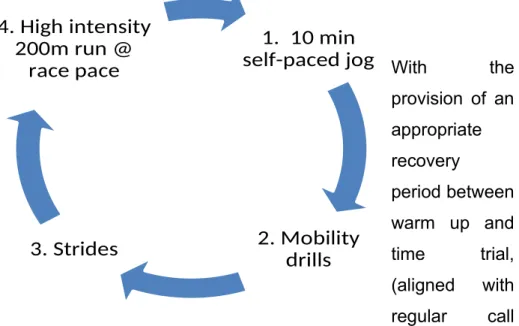
self-paced jog, (2) mobility drills and (3) strides. Alternatively, the ‘intervention trial’ was underpinned by the following practice of HInWU ‘priming exercise’ principles.
Figure One: A mode of high intensity warm up.
With the
provision of an appropriate recovery
period between warm up and time trial, (aligned with regular call room time- which in this study was set at 20 minutes) the results pointed towards enhanced performance over 800m for 7 out of 11 (64%) athletes with an average improvement of 1.2s when using HInWU. As a result of testing the volume of Oxygen consumed between the two trials it was suggested by Ingram et al., 2013 that the increase in performance is due to the speeding of V02 kinetics and greater oxidative energy contribution to total energy transfer. The research also suggested that athletes performing HInWU experienced a higher state of mental readiness although there were no specific tests to measure this.
Primary data collection prior to this project
We took an interest in the field of High Intensity Warm Ups from the early part of 2013. We noted that the research alluded to above, whilst involving high level athletes, did not involve coaches, or coach educators. We, therefore, decided to embark on some research involving the perceptions of these kinds
1. 10 min
self-paced jog
2. Mobility
drills
3. Strides
4. High intensity
200m run @
of people in our sport. We embarked upon a triangulation of both face to face and telephone semi-structured interview with a sample of 5 persons – namely one physiologist and four coaches/coach educators. During interview, Loughborough based Dr. Barry Fudge, who advises double Olympic champion Mo Farah, confirmed that the experimental research had demonstrated that the practice of the High Intensity Warm Up had effectively increased the amount of oxygen the body is able to consume, particularly at the start of the race and was therefore instrumental in producing energy in the most efficient way possible. The psychological effects of this practice cannot be underestimated as Fudge additionally confirmed that participants reported a greater “race readiness” after the HInWU, supporting research which has found that the effects may not be solely metabolic.
parameters of this current study. Additionally, British Milers’ Club President, Dr. Norman Poole, confirmed that his work with 2010 European 800m silver medallist Michael Rimmer was underpinned by these principles.
Former endurance running coach for UK Athletics, until 2000, Malcolm Brown, MBE, currently coaches various members of the British Triathlon squad based at Leeds Beckett University’s High Performance Centre. The man who was Olympic Performance Manager for the 2012 Olympics Games told us that when coaching middle distance running, “I encourage my athletes to get onto the track in the final minutes before competition. In the 800m specifically, I tell them to find their respective lane(s) and to practice running from the start to the breaking point after 100m. I ask them to do this at their intended race pace. This is something which they repeat 4 times before the actual event itself”.
Having played a pivotal role in guiding Alistair and Jonathan Brownlee to Olympic gold and bronze respectively, Brown continued, “I deliberately get 800m runners to practice these 4 x 100m runs as specified in lane as much for the psychological effect as the physical effect. There is something psychological about 'claiming your lane' in the race. By repeating it 4 times it becomes ingrained. It’s a process of habituation". The description of this habituation effect evokes mental images or the analogy of the proverbial cat marking its territory. There is something territorial about the mind set and body language of the athlete in the minutes before competitive battle.
and psychological principles may apply, although at this stage we could not be sure. At the very least we began to see that the long term and learned practice of HInWU may prepare athletes of lower chronological, biological and training ages to learn how to chain an effective warm up relatively early in their careers, thus establishing a model of good practice for later career development in athletics. This being said the distances undertaken by athletes of lower chronological, biological and training ages when undertaking any mode of high intensity warm up must be adjusted accordingly to take into account the principles of long term athlete development which are designed, in part, to prevent injury and to develop long term rather than short term performance.
How this research informed our Horwill scholarship application
It was decided that, like Ingram et al., 2013, we needed to undertake some form of experimental research involving athlete time trials. After consultation with the BMC Horwill scholarship committee, we decided that our research design would consist of randomised control trials with a cross-over involving one condition of ‘intervention’ and one ‘control’ group.
We noted that the original experimental research by Ingram et al., 2013 was based on a small scale sample of just 11 athletes. We felt sure that these researchers themselves would acknowledge that from such a small sample, representation of elite athletes and generalisability to the wider middle distance running community is impossible to achieve. Our research proposal recognised the limitations of such a small sample and after consultation with the committee after being awarded the scholarship, aimed for a quota sample of 20 well-trained athletes. We felt that a sample size almost twice as great as the original EIS led research would give us a greater claim towards being able to generalise our findings.
not really in a position to give informed consent to take part in the study. (Long & French, 2013a, 2015).
Written informed consent from the participating athletes (See Appendix One) was gained in line with Leeds Metropolitan (now Beckett) University Ethics procedures and approval gained from Leeds Metropolitan (Beckett) University Research Ethics Committee in accordance with the Declaration of Helsinki. It was agreed that subjects would have the right to remove both themselves and their data at any time and up to publication.
All participants approached were intended to be club, county or regional level athletes and above because the BMC is a middle distance club geared towards ‘performance’ rather than ‘recreational’ athletes and coaches.
The two gatekeepers for the generation of our sample were Andy Henderson and Aaron Thomas who both currently coach at Beckett University and have large groups of athletes (See Appendix Two). Prior to the award of the scholarship and at application stage, both indicated an agreement to support. An information sheet was given to Andy and Aaron detailing the purpose, proposed protocol and method of information dissemination. Informed consent from the athletes was intended to be gathered via information sheet and consent form again detailing the purpose, proposed protocol and method of information dissemination, along with a method of recording that consent is given.
a warm up to prime the system. We decided we would wish to measure blood lactate levels post the undertaking of intensive exercise to assess whether having primed the uptake of blood lactate accumulation, whether blood lactate accumulation is reduced during the trial or whether there is a performance increase for the same level of blood lactate accumulation. Lactate is produced from pyruvate as a result of normal body metabolism and although the level is increased during exercise. Blood lactate is usually 1–2 mmol/L at rest, but can rise to over 20 mmol/L during intense exercise. This rise in level is due to lactate being produced faster that the body can process it. In certain circumstances lactate can be used by the body as an energy source (McArdle, Katch and Katch 2010). ‘Race readiness’ is an inevitably vaguer term because athlete perceptions as to whether they are psychologically ready to undertake vigorous exercise with a performance component which is measured is of course highly subjective and based on ‘feeling’ rather than anything objective. We did however feel that some attempt to incorporate athlete self-perceptions of their own psychological state was of considerable value as this is itself an inherent part of performance in our sport.
variability, using field-based collection procedures to increase both internal and external validity of the design.
It was intended that the intended number of 20 athlete participants would be randomly assigned one of two warm up protocols.
Condition 1 – Traditional active warm up – Low Intensity Warm Up (LInWU)
A replication of the study by Ingram et al., 2013 was intended to involve the following:
10 min self-paced jog.
Mobility drills for 10-15 minutes in duration with athlete following their ‘normal’ routine rather than one prescribed by the experimenters. Short strides with walk-back recovery (e.g. 6 x 50 metres) to be
effected at faster than intended time trial pace. Condition 2- High Intensity Warm Up (HInWU)
A replication of the study by Ingram et al., 2013 was intended to involve the following:
10 min self-paced jog.
Mobility drills as in Condition 1.
Short strides as in Condition 1 (at same intensity but less than 6 in terms of volume).
1 x 200m at 800m race pace aimed to elicit the activation of VO2 kinetics.
In an attempt to control extraneous variables, the procedure was be repeated twice at the same time on different days with each group rotating through both types of conditions as outlined above. Each participant was to be randomly assigned to one of the two groups with athletes completing the conditions in a different order. It was hoped that this would design out the effect of protocol learning across as the two conditions progressed. It was intended that athletes run a total of 2 time trials between March 2014 and July 2014 with each participant completing all 2 tests within 21 days. As well as taking into account ambient temperature, the March-July window was set because we recognised that in effecting time trials over a middle distance event, that the warmer weather of the Spring and Summer would better facilitate the undertaking of work with a significant speed endurance component. Within this March-July window, we set the 21 day limit for the running of both tests to minimise the effects of periodization as it would be unhelpful to have athletes running one time trial in the winter for example and another in the spring because they would be at markedly different levels of fitness.
It was intended that lactate be collected using finger-tip or ear lobe prick extraction for subsequent analysis in laboratory and was planned to be collected (a) Immediately prior to warm up, (b) Immediately post warm up and (c) Immediately post time trial.
Unlike the study by Ingram at al., 2013 we were not content for this present study to be solely reliant on physiology and sports science. We wanted to have the ambition to triangulate our experimental data with athlete self-perceptions of mental state. To this end, athlete psychosocial tests were felt to be important. This was because cognition is a massive factor in athletic performance and having recognised this, we accordingly build it into our research design. (See Long, 2012b, Long & Lowes, 2012a, 2012b, 2012c, Long & Lowes, 2013, 2014).
aforementioned papers, Dr Barry Fudge confirmed that participants reported a greater “race readiness” after the HInWU, indicating that the effects may not be solely physically functional and metabolic. The fact that there were no specific tests to measure this in the original EIS led research was something we wished to address in our study. An inventory was intended be administered to all athletes with both short closed quantitative and open-ended qualitative questions recorded on a questionnaire. Their post time trial completion was used in order to assess perceptions of ‘race readiness’. (See Appendix Three).
As well as an account of athlete self-perceptions of mental state, we wished to further triangulate our data through development of an enhanced coaching ethnography to build on some of the interviews we did for the aforementioned papers. (see Long & French, 2013a, 2013b, 2013c).
1. Telephone interviews with a sample of coaches.
We proposed to interview a sample of high profile coaches, coach educators and mentors to assess their perceptions of the way in which they practice High Intensity Warm Ups to a greater or lesser extent. The estimated sample size was a snowball sample of 12 coaches to complement the sample of 4 coaches / coach educators whom we interviewed in our original BMC paper. (Long and French, 2013a). Telephone or electronic interviews were felt to be inexpensive and did not appear to present a major intrusion in the lives of recipients. (See Appendix Four for example consent form).
2. Observations of coaching practice.
We had to acknowledge that telephone interviews would offer valuable insight into coaching perceptions of practice rather than a direct account of practice itself. The fields of both Sociology and Cultural Studies, however, tell us that what people say is sometimes different to what they actually do in terms of social practice. This is why interviews with a proposed sample of 12 coaches were intended to be triangulated with observations of a sub-sample of at least 4 middle distance and endurance coaches working with athletes in the field. The diversity of practice in terms of how coaches effect warm up practices of varying degrees of intensity was felt to be invaluable in terms of providing context to the experimental design and the athlete psychology parts of the study. (See Appendix Five for coach ethnography consent form).
As a result we felt that a combination of experimental data, athlete socio-psychological data plus coach ethnography data, could lead to some potential benefits for both the British Milers’ Club and the middle distance community more generally in this country.
Potential benefits of this study
Raise awareness amongst BMC coaches of the potential benefits of High Intensity Warm Ups.
Raise awareness amongst the wider athletics community about how priming effects of high intensity warms ups may be beneficial both physiologically and psychologically, thus facilitating enhancement of performance.
Raise awareness amongst the wider athletics community of the importance of the principle of athlete-centredness in terms of coaching and athlete practices of High Intensity Warm Ups as being diverse and plural rather than singular and monolithic.
A challenge to both coach and athlete in the wider athletics community to consider the more precise nature of exactly how their warm up is ‘dynamic’ and its efficacy in preparing for what is to follow.
We now report on the conducting and findings of the research, beginning with the experimental data.
The experimental data
Seventeen athletes (Male n =4, Female n =13, mean age = 24.7 ± 10.6 years ( were recruited from running clubs based in Leeds. Whilst it is noted that there was an unequal gender split, the allocation of genders in each condition was randomised to minimize any effect. All participants had or were regularly competing at club or regional level competition. All participants provided their signed informed consent to participate in the research and were debriefed after (See Appendix Six).
resting heart rate of 100 bpm or above, systolic blood pressure of 140 mmHg or above and a diastolic blood pressure of 90 mmHg or above, as these values would indicate mild hypertension (ACSM, 2013). No athletes were deemed unable to take part in the study following this pre-screening procedure.
Procedures
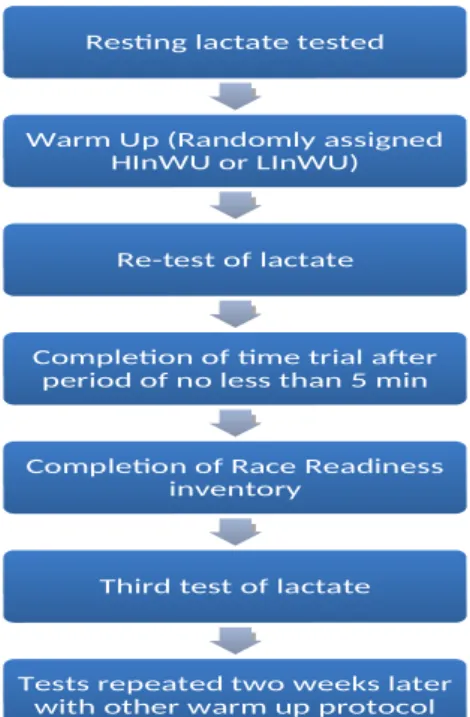
Figure 2: The two protocols
All testing took place on the 400m running track at Leeds Beckett University, Headingley Campus, Carnegie Sports Centre between April and July 2014. Following pre-exercise screening a small (5µl) resting fingertip capillary blood sample was taken and analysed using a Lactate Pro (Akray, Japan) portable blood analyser which has been to be a valid field measure for the assessment of blood lactate (Pyne et al., 2000). The participants were then assigned on a random basis to either a High Intensity Warm Up (HInWU) or a Low Intensity Warm Up (LInWU) group. The LInWU group performed their usual warm up routine, which typically did not a high intensity long stride. A number of
Resting lactate tested
Resting lactate tested
Warm Up (Randomly assigned HInWU or LInWU)
Warm Up (Randomly assigned HInWU or LInWU)
Re-test of lactate
Re-test of lactate
Completion of time trial after
period of no less than 5 minCompletion of time trial after period of no less than 5 min
Completion of Race Readiness inventory
Completion of Race Readiness inventory
Third test of lactate
Third test of lactate
Tests repeated two weeks later with other warm up protocol
athletes included pre-training striding exercises although this tended to be a number of strides not in excess of 50m in duration. The HInWU group performed their usual mobility drills and short strides plus a 200m effort at their 800m race pace. As mentioned previously, the rest given to the athletes was sufficient to allow them to recover from the high intensity stride, and was typically between 5 and 10 minutes prior to the time trial in both protocols. In remaining faithful to the principle of athlete centredness, no athlete started the trial until they felt ready to go. (See for example Gerbino et al. (1996); Jones et al. (2003a); Jones et al. (2003b); McArdle et al. (2010) and Wilkerson et al. (2004)).
As the tests were conducted outside, however, the duration of this recovery period was adjusted accordingly to maintain core body temperature. Following the completion of either the LInWU or HInWU the participants then had another fingertip capillary blood sample taken for the analysis of blood Lactate and this was effected as soon as was practically possible after athletes had stepped to the side of the track. After the blood samples were taken the participants then performed a maximal effort 800m time trial (TT) with performance time being recorded and another blood sample being taken following the TT for the analysis of blood lactate concentration.
Immediately after the completion of the time trial, a questionnaire was administered containing both Open Text responses and a number of Likert Scales. The Likert Scales were used to determine perceptions of how they rated the particular warm up, along with their perception of how well they thought that time trial went, having not been made explicitly aware of their finishing time. In addition, the athletes were asked to state any thoughts around that particular type of warm up.
Statistical Analysis
All statistical analyses were computed using SPSS version 21 (IBM, Armonk, NY, USA), with all statistical significance set at P<0.05. Before analysis, normality and equality of variance of the variables were assessed using a Kolmogorov-Smirnov test.
Repeated measures ANOVA were used to compare Blood lactate measurements. A Bonferroni post-hoc analysis was used to determine where any significant differences occurred. A paired samples t test was used to compare the TT time for both warm ups. Effect sizes, using Cohen’s d were calculated between Bla and TT time for the comparison of the HInWU and LInWU. For Cohen’s d, a modification to the effect size scale of Cohen (Cohen, 2013) were used and were interpreted as follows: 0 – 0.2 was considered to be a ‘trivial’ effect, 0.2 – 0.6 ‘small’, 0.6 – 1.2 ‘moderate’, 1.2 – 2.0 ‘large’, and >2.0 ‘very large’ effect (Hopkins, 2000).
A paired samples t test was used to look for different between perceptions of both the perception of time and perception of the warm up and Open Coding was used to analyse the open text responses to identify common themes contained within.
Results of the experimental data
HInWU LInWU
Blood Lactate Levels (Bla)
At Rest 1.58 ± 0.62 mMol.L-1 1.62 ± 0.73 mMol.L-1 After Warm Up 4.40 ± 1.93 mMol.L-1 2.06 (± 0.72 mMol.L-1 After Time Trial 10.42 ± 3.07 mMol.L-1 10.55 ± 2.73 mMol.L-1 Time Trial
149.45 ± 17.06s 147.39 ± 15.54
trials were also very similar with no significant difference found even with tests for size of the sample factored in (Cohen’s d <0.2). The average score after the time trials with following the HInWU was 10.42 mMol.L-1 (± 3.07) and 10.55 mMol.L-1 (± 2.73) for the LInWU.
However, when looking at the Bla concentrations immediately after the warm ups, there was a statistically significant difference (P<0.05). Immediately after the HInWU the Bla was found to be 4.40 mMol.L-1 (± 1.93) compared to 2.06 mMol.L-1 (± 0.72) following the LInWU. This meant that the HInWU produced a significant amount more Bla with this difference being significant even with relatively small groups (Cohen’sd= 1.57).
There was no significant (P>0.05) difference in the time taken for the Time Trial with the HInWU warm up average of 149.45 ± 17.06s and the LInWU achieving 147.39 ± 15.54s. Although there was a slight difference in average time within the time trial, it was not found to be significant, especially when taking into account the size of the groups within the study (Cohen’s d = 0.079).
There seems to be no statistically significant difference between their perceptions of how they felt (p = 0.16) or how they perceived they performed (p = 0.45), although the mean scores do suggest that those doing the High Intensity Warm Up reported more favorably across both feelings and performance (6.8 vs. 6.1: 6.53 vs. 6.01).
When interrogating the Open Text responses within the questionnaire, 10 stated they preferred or stated that or that they felt more prepared with the High Intensity Warm Up, with 3 stating they preferred the Lower Intensity Warm Up. 4 did not state a preference.
more favourable. More than half in the sample (59%) reported a preference toward HInWU following trials, with only 18% stating that they did not prefer that mode of warming up.
Before we report on the findings form the coaching ethnography side of the research, it is important we mention our invitation to deliver an England Athletics Workshop on the subject of High Intensity Warm Ups as part of the Local Coach Development Programme. Whilst not part of the formal research process, this workshop was instrumental in helping us frame some of the questions asked of coaches in our sample of interviewees at a later date. We undertook this workshop on behalf of the Midlands Area Coach Mentor for Endurance, Geoff James, because we felt it was a great way of promoting not just our own work but also that of the wider ‘BMC Horwill Scholarship Award’.
England Athletics Workshop. Wednesday 26th February 2014. Alexander stadium.
As well as being part based on a didactic, lecture based delivery to coaching attendees, the framing of the workshop allowed for focus group type discussion of a group which exceeded some 30 coaches as well as there being a small number of athletes in the audience.
Four important variables emerged from the workshop, namely (a) reasons why we warm up; (b) duration of warm up; (c) chaining of warm up and (d) intensity of warm up. The key things for us to consider as a result of the discussion generated were, firstly, that many coaches still see injury prevention as a primary function of warming up. Secondly, the overwhelming majority of coaches were keen to stress the psychological as well as the physiological benefits of warming up. Thirdly, in terms of the specifics of physiology, muscular activation was by far the most commonly cited benefit of warming up.
conditions. Surprisingly, only a minority openly acknowledged that warm ups needed to be event specific with a minority indicating that the first part of the fitness component of training sessions were being used to proverbially ‘top up’ a warm up.
When discussions turned to the way in which warm-ups for middle distance and endurance athletes were chained, it was noted that a minority of coaches still held on to the conviction that static stretching should be an inherent part of warm ups. More encouragingly, there was an explicit acknowledgement by some that warm ups have to be athlete-centred. There was an awareness that in some cases both athlete and coach do not have total control over the logistics of their warm up. In terms of proximity to the event, there seemed to be a conviction that there was a ‘correct’ time to warm up before an event rather than a window of opportunity. When fostering a healthier and more productive coaching culture, we felt this latter finding may need further research and a possible challenge to coaches after our research was completed in its entirety.
In terms of the intensity of warm up, this workshop told us that a minority of coaches still felt that ‘medium’ rather than ‘high intensity’ warm ups were appropriate for middle distance and endurance athletes. We felt this may have been due to the perception that athletes who are warmed up towards the higher end of the intensity spectrum may fatigue during competition itself. Pleasingly there was an awareness of the importance of taking into account chronological, biological and training ages in articulating an appropriate warm up with an athlete. There was some awareness of the need for event specificity in working with athletes to effect efficient warm ups.
The issues raised at this workshop could be fed into the questioning process for those who engaged with the project as part of the coach ethnography phase which is reported below.
We have articulated earlier in this documentation how the coaching ethnography comprised of both interviews (ordinarily telephone or electronic) and observational methods (See Appendices Nine and Ten for coach interview consent and debrief forms respectively). In reviewing the literature which has been presented earlier in this report, we alluded to the study conducted by the research team (see Ingram et al., 2013) which comprised the now British Athletics Head of Endurance, Dr. Barry Fudge. Many in the sample were aware of this study possibly due to Dr. Fudge’s prominent role as a physiologist and respected figure in the endurance community. Whilst many were intrigued by the findings which point to both the value and utility of High Intensity Warm Ups, some urged caution due to the small-scale nature of this original research. The following comment highlights this sentiment:
"With regards to High Intensity Warm Ups, its early days for me in terms of their understanding and usage. I am familiar with the research carried out by Barry Fudge and others but note that it was based on quite a small sample of athletesand 800 metresfor Barry’s study.” The coaching ethnography uncovered the following themes:
Static stretching. Guided discovery. RAMP.
Chaining of the warm up. Early reps syndrome.
Transferability from training to racing. Psychological as well as physical priming. Pace judgement.
Event specificity. Athlete centred.
Appropriateness for young athletes. Length of HInWU strides.
Climactic conditions.
At the heart of the research into High Intensity Warm Ups, is the underlying principle that warm ups need to be active and dynamic rather than passive and static. This research goes way beyond that basic principle in that we are researching warm ups which potentially optimize the physiological function (V02 kinetics) to produce a metabolic response with a concomitant psychological preparation.
1. Static stretching
Peter Thompson, 2006b has spoken about the importance of warming up through mobilization work by arguing the following: “Let’s think of it this way: any individual, whether they are an Olympic athlete or Jim or June in the local club, brings to the start of a training session or a competition a certain range of motion. At this time, before the warm-up, they are not able to access all of it, their current full ROM. The activities in the warm-up should be designed, relative to abilities, to use progressive mobilisation exercises to access the available ROM, not strive to increase the ROM. For athletes pursuing fitness goals, this may be expressed as an ‘active’ warm-up”. For Thompson (2006b: 35), active, dynamic warm ups are about activating functional flexibility. He continued that, ““Dynamic stretching through mobilisation exercises really wakes the neuromuscular system up, to prepare for what is to follow. This involves actively moving your trunk and limbs through the full range of motion that they will be used during the training or competition”.
Whilst the governing body and coach educators have been pushing for the abandonment of static stretching as a mode of warning up, evidence suggests that some coaching subcultures retain a collective belief that static stretching is appropriate as a mode of warming up, which may need to be challenged:
Whilst static stretching would not have been advocated as the norm for the warm ups being undertaken by their athletes, some in the sample mentioned their athletes were undertaking it to mobilise muscles if for example they were struggling with injury. Take the following quote as an example:
“We generally don't do static stretching before running but it may be appropriate with athletes who are cross training and have specific niggles or injuries”.
Some of the high profile coaches in the sample could be described as ‘organic’ coaches in the sense that they were not ‘theorists’ but learned best through experimentation and trial and error.
2. Guided Discovery.
Guided Discovery has been an established mode of coaching since the end of the Second World War and was introduced into Physical Education lessons in the 1970s after being endorsed by both the government and Local Education Authorities. This method involves the appropriate use of experimentation and learning by trial and error. The coach in the sample who was yet to experiment with the use of HInWU was herself committed to trying it through a process of Guided Discovery in the future:
“I may well experiment with it in the future".
It is at this point that the diversity of active and intense warm of practices first becomes evident:
“High intensity warms ups do have their value but in order to be exactly sure of what they do you'd need to experiment with lactate values are performing different types of warm up”.
Inevitably, with the nature of experimentation, things will go wrong and some acknowledged this, for example:
“Some of it is trial and error and it is possible to overcook it”.
the winter season, away from the track, perhaps when the proverbial stakes were not as high:
“I have been experimenting with it during the current XC season”.
This process of Guided Discovery was evident even for one coach in the sample, who wished to retain anonymity, but who had an extensive background in sports science. Take the following statement:
“I must make it clear that I am somewhat ‘old school’ as regards much of my athletics coaching. Thus, although my Master’s Degree was in Human Biology and I enjoyed over 30 years of invaluable involvement in academic and practical aspects of Sports Science programs at X University, my prevailing conviction is that the larger portion of what I have to offer as a coach has derived from my years of experience of working with and observing athletes and coaches, generation after generation, and the development of a distinctive system and rationale based strongly in common sense. I continue in a spirit of readiness to learn more and of open-mindedness (up to a point) - and believe that science and experience/common sense are a very powerful combination when pointing the same way. Should ‘science’ and experience or common sense point in different directions though, I would almost distrust the science”.
This reinforces the sentiments of the lead researcher on the ethnography, who was once told by British Athletics Head of Endurance, Dr Barry Fudge that it was the coaches who were the real innovators in the sport, with the sports science catching up with them and providing post hoc rationality later. The said coach continued that:
“In light of the above, it might not be surprising that my approach re warm-up as a coach largely reflects what I learned through a mix of copying, trial and error, and application of common sense over half a century ago”. One of the issues which was raised in the original literature based paper which we researched was the issue of active warm ups was the notion of R.A.M.P.
As we have seen previously, RAMP is an acronym for Raise, Activate, Mobilise and Potentiate, and many of the coaches in the sample were familiar with these principles:
"I personally have not used High Intensity Warm Ups but I do indeed follow RAMP principles”.
The sense of preparing the body for intense exercise that has a significant anaerobic component in terms of utilisation of the lactate energy system was mentioned explicitly by several in the sample:
“I guess their value (HInWUs) is they get the body ready for intense exercise”.
"Throughout my coaching career I have always been interested in the use of exercises and drills for injury prevention and improving technique. It is not, therefore, surprising that my athletes have a thorough exercise routine as part of their warm up. I feel that the dynamic exercises/drills we currently use meet the above criteria and prepare the body for training/racing and can be a useful focus in both these situations”.
Discussions around RAMP inevitably led on a consideration of both warm up volume and intensity. One high profile coach felt that a reduction in the volume of work undertaken and duration of warm up time could in fact lead to the practice of a more intense warm-up. This was a consideration when trying to guide an athlete through consecutive rounds of competition at the Glasgow Commonwealth Games in 2014:
“We had also worked at cutting back on overall volume of his warm-ups though, in the light of having to go through the process on 3 consecutive days”.
When debating the nature of HInWU, the issue of how warm ups are chained and progressed becomes paramount.
A fascinating insight into the chaining of a warm up and its intensity was offered by former international athlete, in relation to the coaching of own of his own athletes:
“The transitional point from static to dynamic is stretching>drills>strides. He does some resistance work with a dyna-band elastic loop at about the 2/3rds point in the warm-up. That's based on physio and S&C advice. His strides in flats are 3/4 pace. His final strides in spikes are top speed. I would say this is something that he has changed in the past two years - to go further, quicker and later with these, versus race start time. He spends a couple of minutes with a Powerbreathe device to expand his lungs in the final few minutes. There may not be complete science supporting that but I used to do something similar. The general idea is that your lungs are as prepared as they can be to operate to the max”.
This kind of practice was endorsed by some other coaches in the sample whose chaining of their athlete warm ups had been clearly thought through, with clear attention to detail:
“Our warm up routine begins gently with walking stretches, moving on to faster, dynamic, brain to muscle exercises. I always advocate my athletes starting slowly in the warm up phase before a training session. We do walking strides and focus on technical drills such as toe-ups and toe downs. We progress the warm up say from high knees, to alternate knees, what I call chicken runs and then taps on the ground. The warm up ends with three 50m crisp strides and finally a 200m fast stride.” In particular it was the early part of training sessions along with the early part of races which was felt to be where HInWU could have a potentially significant effect, in terms of say the first few repetitions of a standard 10x400 session or the first fast 200m of an 800m race.
5. Early Reps Syndrome.
“In a training context I tend to find some athletes are more sluggish than others on the first one or two repetitions so their warm up may need to be longer or more intense”.
“They (athletes) often find that their 1st 2 or 3 reps are relatively sluggish because their warm up hasn't been adequate”.
One coach in the sample mentioned that this was something that he had experienced as an athlete and could learn from as a coach:
“In my day if I was doing 2 sets of 4 x 200m and because of this principle it’s not surprise that the second set always felt quicker after you got going in the first set. It’s because the body has already generated lactate and you are ready for it”.
One interviewee mentioned that speed deficit at the beginning of middle distance races appeared to be a problem and something that HInWU could most certainly help to counteract:
“Y (a female international 800m runner) - often struggled with the speed and competitiveness of the first 200m of 800m”
This opens up a much wider debate about the transferability of HInWU in a training and in a racing context and whether there should be any difference in terms of practice.
6. Transferability from training to racing.
Some coaches raised the issue of whether a difference between the training and racing contexts existed, noting often subtle variations in coaching prescriptions and athlete practice:
“You have also got to remember that warms ups for competition may be slightly different from those in training”.
Others noted a difference in the intensity of warm ups before training in comparison with competitive action:
Some made the admission that they deliberately effected differential practices given the demands of the different contexts alluded to:
“I have tended to use them prior to competition rather than prior to training”.
Whilst some seemed comfortable with a differential level of intensity depending on whether the variable of competition was involved, one interviewee felt strongly that warm up practice prior to training should indeed simulate the same routine to be effected before racing:
“In terms of differences between warming up before competition and compared to warming up before training, there really shouldn't be any in that what we are looking for is the effecting of a routine.”
athletes often undertook warm ups which were specific to the training session in hand and often did not seem to try and replicate the type of warm up which may be effected before a competition. (See Appendix Twelve for Coach Observation Debrief forms). Due to the variability of practice in the middle distance and endurance groups that were observed, some athletes leaned towards a warm up of moderate intensity whilst others engaged in practices that leant them towards a warm of higher intensity. The observations confirmed that the issue of whether warm ups prior to training should mirror those undertaken prior to competition was indeed an important one.
The above context raised the issue of the extent to which HInWU could facilitate psychological as well as physiological priming.
7. Psychological as well as physical priming.
The realisation that athlete psychology is just as important as athlete physiology was felt by some to be indicative of a greater awareness of the role of the mind in sports and a wider cultural shift in coaching over the last decade or so:
“This being said I do feel that over the last few years greater awareness has been raised amongst coaches in terms of how warm ups at a higher intensity can prepare you for competition both physically and psychologically”.
One coach in particular felt that HInWU could potentially be invaluable in terms of effecting a productive level of psychological arousal, speaking of these athletes needing to achieve:
“(the) mental readiness to fight for their life”.
Getting athletes to effect HInWU was thought to be a practical problem for several coaches, before training:
This sort of process was felt to be a problem by some in the competitive context with athletes being keen to proverbially ‘save their energy’ and not wanting to over-tire themselves before the heat of battle:
“The problem is persuading the athletes to do it pre-race. They are fixated on the idea that it will detract from their performance in competition”.
The benefits of effecting a HInWU either before warm-ups or competition were not felt to be restricted to matters of physiology and psychology. The issue of pacing was raised by some coaches in the sample.
8. Pace judgment.
It was felt by some in the sample that athletes of younger chronological years and perhaps with a relatively low training age, would benefit from the tactical as well as the physiological benefits that effective pace judgement could bring. Pace judgement was explicitly mentioned by two interviewees:
“It’s not just about the physiology, but for me I think it’s so important for younger athletes to get their race pace right and High Intensity Warm Ups give you that opportunity. The under 15s we have worked with may need to run 100m strides 2 or 3 times before they get their pace judgement right before a session or a race”. (If taught running rhythms in training – no need to do it in the warm up. The principle of only doing in warm up what is skilled – it is not a time for learning. That should be in the unit that follows the warm up so that there is a gradual migration over time of activities done in the skills unit, to the fitness unit and then when, well-learnt and skilled, to the warm up.)
The ability of HInWU to play an inherent part in the coach helping to educate the young, developing athlete in terms of learning race pace specificity was felt to be key by others:
“I have to be more prescriptive with younger athletes as I feel they may lack pace judgement both in terms of races and in their approach to warms ups too. A coach working on young athlete perceptions of pace judgement is very important in my opinion”.
associated issue of getting athletes accustomed to race pace specificity, which is of course event specific.
9. Event specificity.
The sheer diversity of events that cover the remit of the BMC was mentioned by some as being highly relevant in terms of effecting differential warm up practice:
"Warm ups have to be event specific even when talking about the endurance events. A warm up for an 800m may be materially different from a warm up for one of my athletes about to run a 5000m”.
What did seem to emerge from the interviews was the conviction by many that HInWU were more appropriate for the middle distance rather than endurance events:
“I have tended to use them (HInWU) for Y (female international middle distance athlete) in particular for 800m races and not for 1500m or 3000m races.”
“Whilst a High Intensity Warm Up may be appropriate for an 800m race, it certainly may not be appropriate before an athlete attempts to run a marathon”.
The latter quote was implicitly endorsed by an interviewee who was a former GB international and who varies both the length and intensity of the warm up when coaching one of his athletes, who has run 800m in a major championships:
“The shorter the race, the longer the warm-up. For some marathons that I did, especially warm weather Championships, the level of running in warm-up was almost nil. For a 400m race, and sometimes a key 800m, ‘P’ has extended his warm up period from 30 mins to more than 50 mins this year”.
“The principle is the intensity of the efforts and the duration of them. I've been using this type of warm up for some of my walkers in training for the past 4 or 5 years or so. Some of the athletes who've used it include British record holder ‘B’ who has placed well in international competitions in recent years. Another example would be ‘C’ who has placed well over 10k events internationally in recent years. The interesting point is that someone like ‘C’ would tend to use a High Intensity Warm Up for events like 3-5 km that are closer to V02 max. It’s less important when one is race walking say over 20k or 50km. Another example of someone who would use a variant of a High Intensity Warm Up is the ‘D’, competed at both the London Olympics in the 2013 World Championships in Moscow over 50 km. Once again it’s dependent on what event the race walker is undertaking".
The golden principle espoused by some in the sample was that the shorter the event, the more intense the HInWU needed to be. This being said some argue that HInWU were by no means redundant for events over 3k:
“For something more aerobically based like a 3,000m race, the same principle applies but in practice ‘E’ would run a couple of high intensity efforts of between 80-100 metres. This is because the event is less intense compared to an 800m where he will be working for less than 2 minutes”.
“With regards to active warm ups, I think the guiding principle my fellow coach and I follow is that the intensity of the warm up should vary to equate with the intensity of work we are undertaking.”
Perhaps surprisingly, the use of HInWU was not restricted to those racing on the track but it also would seem to have an application across other running disciplines on other surfaces- in the following instance- mountain running- an event traditionally associated with strength endurance rather than the kind of speed endurance needed for middle distance running:
“Athletes I coach who have used this include ‘S’ who got a medal in the WMRA World Mountain Running Championships in Poland in September 2013. In addition there's ‘L’ who ran at those same mountain running world championships. There's also ‘O’, who was selected to run in the world youth championships".
“As a coach and team manager with the England junior mountain running team, I still adhere to this principle and we teach the value of athletes increasing the intensity of their warm ups at the training camps we run”.
The issue of making warm ups both technically relevant as well as intense enough to potentiate the physiological requirements of the forthcoming competition was raised by one particular coach who was working with an international junior athlete:
With regards to ‘Q’, who ran in the steeplechase at the world junior championships in Oregon last year, we have got her to run a 200m stride before competition in the 3,000m chase. This being said again the warm up has to be event specific so we will incorporate hurdle drills as part of it”.
Whilst some coaches felt more comfortable in terms of working on HInWU with their middle distance athletes, they did tend to feel that through Guided Discovery they would continue their journey into potentially experimenting with athletes in other events including the longer distances. Take the following:
“I have only ever used the specific inclusion of such a ‘one-off’ completion of competition warm-up with 800m runners, never with my 1500m or 5000m runners although I have thought about it a fair amount”.
“In terms of my own coaching, the question I have been asking myself is 'Can I develop it and apply the principles of priming the energy systems for improved performance to XC running' and other events beyond 800?”
Taking into consideration event specificity was also linked to the issue of adapting warm ups appropriately at various points of the periodisation cycle. Consider the following viewpoint:
“I guess with middle distance athletes doing more volume based aerobic endurance work in the winter, High Intensity Warm Ups are less of an issue at that point in the periodization cycle”.
As well as being event specific, the notion that warm-ups should always be athlete-centred was an inherent part of the responses given by interviewees.
The importance of coaches retaining the principle of athlete-centredness in their work was referred to by Thompson, 2005, p46 who asked the following rhetorical question: “But how do you know if your warm up routine is optimum for preparing both the body and the mind of your athletes? Do you have any other activities before the physical part of the warm up begins? Do you have a different routine for each athlete and do they have a different routine before training than before competition, or does your group adopt the ‘one size fits all’ approach to each athlete and to each situation?”
In our own research, the feeling that even HInWU needed to accommodate individual need was explicitly espoused by 6 interviewees in the sample because athletes are inevitably diverse in terms of both their physiological and psychological needs:
“Warming up has to be athlete centred as there will always be individual variation because a lot of it is actually about mental preparation for what's ahead”.
For some, individual variation would always be underpinned by the golden principle of warm ups that were active:
“I believe in giving the athletes I coach the freedom to adapt a warm up in a variety of ways as long as they are adhering to the principle of kick starting the aerobic energy system and running strides which are race pace specific”.
It was noted by others that some athletes were perhaps naturally a little more mobile than others and any lack of mobility needed to be compensated for during the warm ups:
“It's important to be athlete centred. If, for instance I have an athlete who is a little stiffer compared to some, I may get him to do a little more mobility work during the warm up phase, compared to others in the group”.
“High Intensity Warm Ups are something which I have allowed my athletes themselves to develop.”
“In general, I have allowed my athletes to develop/modify their own warm ups, with some discussion re optimisation, and made my own suggestions where I felt appropriate - regarding volume/intensity of run and striders and re volume and intensity of stretches/drills/exercises”. In addition to the use of Guided Discovery by the coach, one coach advocated the same principle should apply to athletes in terms of their taking ownership of warm ups:
“I'm a great believer that they, as athletes, should be in charge of what they do so I favour the use of Guided Discovery. They can come up with their own warm ups whilst adhering to the principle”.
Part of being athlete-centred involved acknowledging that athletes are a diverse bunch with different needs. This inevitably led to a discussion of whether HInWUs were appropriate for less biologically mature athletes with less well developed lactate (linking) energy systems.
11.Appropriateness for young athletes.
When discussing their appropriates for athletes of a less chronological age who were perhaps less biologically developed than others of a similar age, responses tended to link back in to what we have previously considered in relation to pace judgement. This tells us that the technical aspects of running cannot be divorced from the physiological aspects of running in terms of long term athlete development:
“As well as the practical side I worry that there is a danger that young athletes can and will 'overcook' it and they will run too hard too close to the race”.
“So for a senior it will be 30s at say 10-k race pace perhaps a little faster. Is that pace intensive enough? - Something I am exploring. I believe the effects of a High Intensity Warm Up can last up to 45 minutes. In addition I've used it with ‘F’ who placed well in the Southern counties in 2014. I am also trying it with my younger athletes aged 15-16 some who are competitive at the national top end in their age groups like ‘R’. For a junior man it may be 30s at 8-10k cross-country race pace. It’s more difficult to get it right with younger athletes because their performances (but perceptions of paces self-adjusts to fitness and improving capacities) can improve substantially over the course of a season and so effectively I have to constantly re-evaluate their warm ups in terms of intensity and their mind-set. I tend to be able to leave more mature athletes to their own devices in terms of devising their warm ups within an agreed overall approach”.
As well as the feeling that more mature athletes could self-regulate their use of warm ups. One of the critical points of discussion during the interviews focussed on the length of the stride or strides undertaken in order to effect a HInWU for athletes.
12.Length of HInWU stride(s).
When discussing length of the specific stride or strides which ordinarily take place after mobilisation drills in terms of the chaining of the warm up, the answers given by coaches reveal a wide diversity of practice. Once again the principle of athlete-centredness was an ever present:
“Typically my athletes at ‘B’ University AC will do 12-15 minutes of steady running before moving on to drills and then strides. These strides tend to be between 60m and 80m in duration and some athletes will want to do longer strides and others more shorter ones”.
11 out of the 14 coaches in the sample specifically raised the point that the length of strides effected was dependent on the availability of space especially in a competition context:
Notably there were those in the sample whose HInWU strides were much shorter than the experimental intervention made in the research by Ingram et al (2013), which of course involved a 200m effort:
“The warm up simply has got to be appropriate for the session which you about to undertake. So if we are working on the track with our athletes it’s likely that a High Intensity Warm Up will be used. In practice I have used 100m run at 800m race pace before a session”. “We started including 150m at 400m pace about 45 mins pre-race”. For some coaches, rather than being preoccupied with the distance being covered in HInWU stride or strides, they were more concerned with the time which the said effort took. Take the following:
"In a race walking context, I haven't got the athletes who I work with necessarily doing a High Intensity Warm Up over 200m. I have worked them for example doing two efforts of 30 seconds”.
This was a necessity for coaches intent on their athletes effecting a HInWU away from the track:
“For example I've been getting ‘G’, an English national cross county junior champion, to run 30s at his XC race pace.”
Longer strides as advocated by Ingram et al., 2013 and his team of researchers did appear to be normal practice prior to competition for some coaches and their athletes:
“I have used it with my own son ‘J’. For instance before he ran a 1500m in the Northern championships at Sheffield, I had him run 2-3 high intensity efforts of 200m. Going down the back straight of the 200m indoor track he'd be running pretty much flat out for around 55 metres or so”.
“’H’ often runs a 300m at metric mile pace before his 1,500m races whereas ‘T’ prefers a 200m effort before his 1,500m/ mile races”. "I believe in High Intensity Warm Ups. My athletes may run steadily for 15 minutes but the last 3 minutes of their warm up run will be at tempo pace. Then they do drills, followed by short to longer strides including a 300 metre effort. This 300 metre effort is what you could refer to as a 'good stride' rather than it being at maximum effort. They may run the 300m in around 50 seconds for instance. After this process of 'getting things firing' they have a 200 metre jog recovery and then it’s pretty much straight into the session”.
There was, however, some evidence that coaches modified or adapted the length of stride that their athletes typically effected in training, to that which they undertook in competition. For example, the same coach continued that:
“In terms of the competitive arena itself many of my athletes use a 150 metre stride before they race. This could be one stride but some prefer to do 2 with a jog back recovery.”
For some interviewees, length and intensity of HInWU was dependent on extraneous factors that whilst they were beyond their control, were something that they felt the need to respond to.
13.Climactic conditions.
Taking into account the variables of temperature and climactic conditions was something that 3 interviewees specifically mentioned in relation to modifying or adapting warm ups appropriately:
“For example, in hot and humid conditions I've witnessed ‘U’ (a University based internationally respected coach) avoiding any sort of warm up in preparing an athlete for an international 5,000m race. Due to the weather conditions and the fact that it was anticipated that the early pace be relatively steady, he deliberately tried to keep the body temperature of the athlete low, knowing that they could work their way into a 5,000m race over the first 2 or 3 laps".
“My athletes like ‘G’, do use High Intensity Warm Ups during the track season such as for 1500metres but his overall warm up will be tweaked to the temperature and other conditions experienced”.
than an end in itself. Doing the minimum necessary to fire the system and achieve a priming effect was thought to be relevant for some particularly in championship competition involving rounds:
“In general I have been happy if athletes keep their warm ups to an ‘effective minimum’ in terms of energy effort saving, especially through rounds and in case of hot/humid conditions.”
Indeed the demands of the competitive arena we never too far from the forefront of the minds of the coaches spoken to for this research.
14.Loss of control in competitive arena.
Accessibility of the track prior to competition was a huge logistical problem for coaches to adapt to and two coaches explicitly mentioned that it threatened to curtail attempts to effect a HInWU:
“The athletes I coach tend to run steadily for between 7-10 minutes before working on effecting dynamic drills. The specific problem I have with HInWUs is that access to the track to perform a measured 200m warm up is very difficult in lots of environments apart from elite competition when athletes have access to a warm up track. You can try and run 200m by the side of a track but it’s not ideal.”
There seemed to be a perception that the higher the level of competition, particularly in international terms, then the harder it was to retain a sense of control over the warm up of one’s athlete in a competitive arena, with the demands of the call room and so on:
Coaches, by their very nature, have to be of a pragmatic disposition, so what the interviews revealed was an ability for them to adapt to these challenges by means of improvisation.
15.Improvisation in a racing arena.
The ability of the coach to proverbially ‘think one one’s feet’ and to respond to the challenges of a given environment was raised by 6 interviewees in the sample and is evident in the followings statements:
“We had to improvise because obviously there was no warm up track but we worked the outside lane around the top bend while other races were going on. It worked and she ended up running a massive pb of over 800m just over a month after she had run her previous pb of 2:07 at a BMC regional race at Birmingham University.”
"In terms of a 200m or 300m High Intensity Warm Up I've often found that difficult to effect in logistical terms due to lack of space, at least close enough to the race. As a coach you have to be a pragmatist and work with the available space which you have.”
Some coaches in the sample would simply take their athlete away from the track in order to effect a HInWU:
“It doesn't have to be done on a track as it can be done on another surface if logistics dictate this.”
Pleasingly coaches who expressed an opinion on the matter, seemed to infer that the loss of control over athlete warm ups in major competition was something which they could work with and respond positively to. Take the following sentiments:
“The bigger the race, the longer the time spent in call rooms so the more important it is to be able to adapt this routine to fit the allotted timetable”.
“The major challenge is still in the competitive arena at championship level competition. In Zurich for example at the 2014 European championships, we found the warm up track was a drive away from the main stadium, so the 1st call for warm up was 50 minutes before the race. You have to learn to adapt and to change to these kind of circumstances which are beyond your immediate control”.