A Software Reference Architecture for Semantic-Aware
Big Data Systems
Sergi Nadala,∗, Victor Herreroa, Oscar Romeroa, Alberto Abellóa, Xavier
Francha, Stijn Vansummerenb, Danilo Valerioc
aUniversitat Politècnica de Catalunya - BarcelonaTech bUniversité Libre de Bruxelles
cCorporate Research and Technology, Siemens AG Österreich
Abstract
Context: Big Data systems are a class of software systems that ingest, store, process and serve massive amounts of heterogeneous data, from multiple sources. Despite their undisputed impact in current society, their engineering is still in its infancy and companies find it difficult to adopt them due to their inherent complexity. Existing attempts to provide architectural guidelines for their engi-neering fail to take into account important Big Data characteristics, such as the management, evolution and quality of the data.
Objective: In this paper, we follow software engineering principles to refine the
λ-architecture, a reference model for Big Data systems, and use it as seed to
createBolster, a software reference architecture (SRA) for semantic-aware Big
Data systems.
Method: By including a new layer into theλ-architecture, the Semantic Layer,
Bolster is capable of handling the most representative Big Data characteristics (i.e., Volume, Velocity, Variety, Variability and Veracity).
Results: We present the successful implementation ofBolster in three industrial projects, involving five organizations. The validation results show high level of agreement among practitioners from all organizations with respect to standard quality factors.
Conclusion: As an SRA,Bolster allows organizations to design concrete ar-chitectures tailored to their specific needs. A distinguishing feature is that it
provides semantic-awareness in Big Data Systems. These are Big Data
sys-tem implementations that have components to simplify data definition and exploitation. In particular, they leverage metadata (i.e., data describing data) to enable (partial) automation of data exploitation and to aid the user in their
∗Corresponding author. Address: Campus Nord Omega-125, UPC - dept ESSI, C/Jordi Girona Salgado 1-3, 08034 Barcelona, Spain
Email addresses: [email protected](Sergi Nadal),[email protected](Victor Herrero),[email protected](Oscar Romero),[email protected](Alberto Abelló), [email protected](Xavier Franch),[email protected](Stijn Vansummeren), [email protected](Danilo Valerio)
decision making processes. This simplification supports the differentiation of responsibilities into cohesive roles enhancing data governance.
Keywords: Big Data, Software Reference Architecture, Semantic-Aware, Data Management, Data Analysis
1. Introduction 1
Major Big Data players, such as Google or Amazon, have developed large
2
Big Data systems that align their business goals with complex data management
3
and analysis. These companies exemplify an emerging paradigm shift towards
4
data-driven organizations, where data are turned into valuable knowledge that
5
becomes a key asset for their business. In spite of the inherent complexity of
6
these systems, software engineering methods are still not widely adopted in their
7
construction (Gorton and Klein, 2015). Instead, they are currently developed
8
as ad-hoc, complex architectural solutions that blend together several software
9
components (usually coming from open-source projects) according to the system
10
requirements.
11
An example is the Hadoop ecosystem. In Hadoop, lots of specialized Apache
12
projects co-exist and it is up to Big Data system architects to select and
orches-13
trate some of them to produce the desired result. This scenario, typical from
14
immature technologies, raises high-entry barriers for non-expert players who
15
struggle to deploy their own solutions overwhelmed by the amount of available
16
and overlapping components. Furthermore, the complexity of the solutions
17
currently produced requires an extremely high degree of specialization. The
18
system end-user needs to be what is nowadays called a “data scientist”, a data
19
analysis expert proficient in managing data stored in distributed systems to
20
accommodate them to his/her analysis tasks. Thus, s/he needs to master two
21
profiles that are clearly differentiated in traditional Business Intelligence (BI)
22
settings: the data steward and the data analyst, the former responsible of data
23
management and the latter of data analysis. Such combined profile is rare and
24
subsequently entails an increment of costs and knowledge lock-in.
25
Since the current practice of ad-hoc design when implementing Big Data
26
systems is hence undesirable, improved software engineering approaches
special-27
ized for Big Data systems are required. In order to contribute towards this goal,
28
we explore the notion of Software Reference Architecture (SRA) and present
29
Bolster, an SRA for Big Data systems. SRAs are generic architectures for a
30
class of software systems (Angelov et al.,2012). They are used as a foundation
31
to derive software architectures adapted to the requirements of a particular
32
organizational context. Therefore, they open the door to effective and efficient
33
production of complex systems. Furthermore, in an emergent class of systems
34
(such as Big Data systems), they make it possible to synthesize in a systematic
35
way a consolidated solution from available knowledge. As a matter of fact,
36
the detailed design of such a complex architecture has already been designated
37
as a major Big Data software engineering research challenge (Madhavji et al.,
38
2015; Esteban, 2016). Well-known examples of SRAs include the successful
39
AUTOSAR SRA (Martínez-Fernández et al.,2015) for the automotive industry,
40
the Internet of Things Architecture (IoT-A) (Weyrich and Ebert, 2016), an
41
SRA for web browsers (Grosskurth and Godfrey, 2005) and the NIST Cloud
42
Computing Reference Architecture (Liu et al.,2012).
43
As an SRA,Bolster paves the road to the prescriptive development of software
44
architectures that lie at the heart of every new Big Data system. UsingBolster,
45
the work of the software architect is not to produce a new architecture from a
46
set of independent components that need to be assembled. Instead, the software
47
architect knows beforehand what type of components are needed and how they
48
are interconnected. Therefore, his/her main responsibility is the selection of
49
technologies for those components given the concrete requirements and the
50
goals of the organization. Bolster is a step towards the homogeneization and
51
definition of a Big Data Management System (BDMS), as done in the past
52
for Database Management Systems (DBMS) (Garcia-Molina et al.,2009) and
53
Distributed Database Management Systems (DDBMS) (Özsu and Valduriez,
54
2011). A distinguishing feature ofBolsteris that it provides an SRA for semantic-55
awareBig Data Systems. These are Big Data system implementations that have
56
components to simplify data definition and data exploitation. In particular,
57
such type of systems leverage on metadata (i.e., data describing data) to enable
58
(partial) automation of data exploitation and to aid the user in their decision
59
making processes. This definition supports the differentiation of responsibilities
60
into cohesive roles, the data steward and the data analyst, enhancing data
61
governance.
62
Contributions. The main contributions of this paper are as follows:
63
• Taking as building blocks the five “V’s” that define Big Data systems (see
64
Section2), we define the set of functional requirements sought in each to
65
realize a semantic-aware Big Data architecture. Such requirements will
66
further drive the design ofBolster.
67
• Aiming to study the related work on Big Data architectures, we perform a
68
lightweight Systematic Literature Review. Its main outcome consists on
69
the division of 21 works into two great families of Big Data architectures.
70
• We presentBolster, an SRA for semantic-aware Big Data systems.
Com-71
bining principles from the two identified families, it succeeds on satisfying
72
all the posed Big Data requirements. Bolster relies on the systematic
73
use of semantic annotations to govern its data lifecycle, overcoming the
74
shortcomings present in the studied architectures.
75
• We propose a framework to simplify the instantiation ofBolster to different
76
Big Data ecosystems. For the sake of this paper, we precisely focus on
77
the components of the Apache Hadoop and Amazon Web Services (AWS)
78
ecosystems.
• We detail the deployment ofBolster in three different industrial scenarios,
80
showcasing how it adapts to their specific requirements. Furthermore, we
81
provide the results of its validation after interviewing practitioners in such
82
organizations.
83
Outline. The paper is structured as follows. Section 2 introduces the Big
84
Data dimensions and requirements sought. Section3presents the Systematic
85
Literature Review. Sections4,5and6detail the elements that composeBolster,
86
an exemplar case study implementing it and the proposed instantiation method
87
respectively. Further, Sections7report the industrial deployments and validation.
88
Finally, Section8wraps up the main conclusions derived from this work.
89
2. Big Data Definition and Dimensions 90
Big Data is a natural evolution of BI, and inherits its ultimate goal of
91
transforming raw data into valuable knowledge. Nevertheless, traditional BI
92
architectures, whose de-facto architectural standard is the Data Warehouse
93
(DW), cannot be reused in Big Data settings. Indeed, the so-popular
characteri-94
zation of Big Data in terms of the three “V’s (Volume, Velocity and Variety)”
95
(Jagadish et al.,2014), refers to the inability of DW architectures, which typically
96
rely on relational databases, to deal and adapt to such large, rapidly arriving
97
and heterogeneous amounts of data. To overcome such limitations, Big Data
98
architectures rely on NOSQL (Not Only SQL), co-relational database systems
99
where the core data structure is not the relation (Meijer and Bierman,2011), as
100
their building blocks. Such systems propose new solutions to address the three
101
V’s by (i) distributing data and processing in a cluster (typically of
commod-102
ity machines) and (ii) by introducing alternative data models. Most NOSQL
103
systems distribute data (i.e., fragment and replicate it) in order to parallelize
104
its processing while exploiting the data locality principle, ideally yielding a
105
close-to-linear scale-up and speed-up (Özsu and Valduriez,2011). As enunciated
106
by the CAP theorem (Brewer,2000), distributed NOSQL systems must relax the
107
well-known ACID (Atomicity, Consistency, Isolation, Durability) set of properties
108
and the traditional concept of transaction to cope with large-scale distributed
109
processing. As result, data consistency may be compromised but it enables the
110
creation of fault-tolerant systems able to parallelize complex and time-consuming
111
data processing tasks. Orthogonally, NOSQL systems also focus on new data
112
models to reduce the impedance mismatch (Gray et al.,2005). Graph, key-value
113
or document-based modeling provide the needed flexibility to accommodate
114
dynamic data evolution and overcome the traditional staticity of relational DWs.
115
Such flexibility is many times acknowledged by referring to such systems as
116
schemaless databases. These two premises entailed a complete rethought of
117
the internal structures as well as the means to couple data analytics on top of
118
such systems. Consequently, it also gave rise to the Small and Big Analytics
119
concepts (Stonebraker, 2012), which refer to performing traditional
OLAP/-120
Query&Reporting to gain quick insight into the data sets by means of descriptive
121
analytics (i.e., Small Analytics) and Data Mining/Machine Learning to enable
122
predictive analytics (i.e., Big Analytics) on Big Data systems, respectively.
123
In the last years, researchers and practitioners have widely extended the
124
three “V’s” definition of Big Data as new challenges appear. Among all existing
125
definitions of Big Data, we claim that the real nature of Big Data can be
126
covered by five of those “V’s”, namely: (a) Volume, (b) Velocity, (c) Variety,
127
(d) Variability and (e) Veracity. Note that, in contrast to other works, we do
128
not consider Value. Considering that any decision support system (DSS) is the
129
result of a tightly coupled collaboration between business and IT (García et al.,
130
2016), Value falls into the business side while the aforementioned dimensions
131
focus on the IT side. In the rest of this paper we refer to the above-mentioned
132
“V’s” also as Big Data dimensions.
133
In this section, we provide insights on each dimension as well as a list of
134
linked requirements that we consider a Big Data architecture should fulfill. Such
135
requirements were obtained in two ways: firstly inspired by reviewing related
136
literature on Big Data requirements (Gani et al., 2016; Agrawal et al., 2011;
137
Russom, 2011; Fox and Chang, 2015; Chen and Zhang, 2014); secondly they
138
were validated and refined by informally discussing with the stakeholders from
139
several industrial Big Data projects (see Section7) and obtaining their feedback.
140
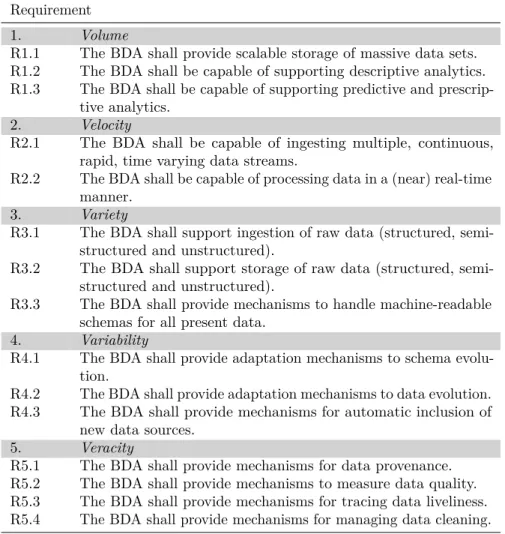
Finally, a summary of devised requirements for each Big Data dimension is
141
depicted in Table1. Note that such list does not aim to provide an exhaustive
142
set of requirements for Big Data architectures, but a high-level baseline on the
143
main requirements any Big Data architecture should achieve to support each
144
dimension.
145
2.1. Volume 146
Big Data has a tight connection with Volume, which refers to the large
147
amount of digital information produced and stored in these systems, nowadays
148
shifting from terabytes to petabytes (R1.1). The most widespread solution for
149
Volume is data distribution and parallel processing, typically using cloud-based
150
technologies. Descriptive analysis (Sharda et al.,2013) (R1.2), such as reporting
151
and OLAP, has shown to naturally adapt to distributed data management
152
solutions. However, predictive and prescriptive analysis (R1.3) show
higher-153
entry barriers to fit into such distributed solutions (Tsai et al.,2015). Classically,
154
data analysts would dump a fragment of the DW in order to run statistical
155
methods in specialized software, (e.g., R or SAS) (Ordonez,2010). However, this
156
is clearly unfeasible in the presence of Volume, and thus typical predictive and
157
prescriptive analysis methods must be rethought to run within the distributed
158
infrastructure, exploiting the data locality principle (Özsu and Valduriez,2011).
159
2.2. Velocity 160
Velocity refers to the pace at which data are generated, ingested (i.e., dealt
161
with the arrival of), and processed, usually in the range of milliseconds to seconds.
162
This gave rise to the concept of data stream (Babcock et al.,2002) and creates
163
two main challenges. First, data stream ingestion, which relies on a sliding
window buffering model to smooth arrival irregularities (R2.1). Second, data
165
stream processing, which relies on linear or sublinear algorithms to provide near
166
real-time analysis (R2.2).
167
2.3. Variety 168
Variety deals with the heterogeneity of data formats, paying special attention
169
to semi-structured and unstructured external data (e.g., text from social networks,
170
JSON/XML-formatted scrapped data, Internet of Things sensors, etc.) (R3.1).
171
Aligned with it, the novel concept of Data Lake has emerged (Terrizzano et al.,
172
2015), a massive repository of data in its original format. Unlike DW that
173
follows aschema on-writeapproach, Data Lake proposes to store data as they
174
are produced without any preprocessing until it is clear how they are going to
175
be analyzed (R3.2), following theload-first model-later principle. The rationale
176
behind a Data Lake is to store raw data and let the data analyst decide how
177
to cook them. However, the extreme flexibility provided by the Data Lake is
178
also its biggest flaw. The lack of schema prevents the system from knowing
179
what is exactly stored and this burden is left on the data analyst shoulders
180
(R3.3). Since loading is not that much of a challenge compared to the data
181
transformations (data curation) to be done before exploiting the data, the Data
182
Lake approach has received lots of criticism and the uncontrolled dump of data
183
in the Data Lake is referred to as Data Swamp (Stonebraker,2014).
184
2.4. Variability 185
Variability is concerned with the evolving nature of ingested data, and
186
how the system copes with such changes for data integration and exchange.
187
In the relational model, mechanisms to handle evolution of intension (R4.1)
188
(i.e., schema-based), andextension (R4.2) (i.e., instance-based) are provided.
189
However, achieving so in Big Data systems entails an additional challenge due
190
to the schemaless nature of NOSQL databases. Moreover, during the lifecycle of
191
a Big Data-based application, data sources may also vary (e.g., including a new
192
social network or because of an outage in a sensor grid). Therefore, mechanisms
193
to handle data source evolution should also be present in a Big Data architecture
194
(R4.3).
195
2.5. Veracity 196
Veracity has a tight connection with data quality, achieved by means of data
197
governance protocols. Data governance concerns the set of processes and decisions
198
to be made in order to provide an effective management of the data assets (Khatri
199
and Brown,2010). This is usually achieved by means of best practices. These
200
can either be defined at the organization level, depicting the business domain
201
knowledge, or at a generic level by data governance initiatives (e.g., Six Sigma
202
(Harry and Schroeder,2005)). However, such large and heterogeneous amount
203
of data present in Big Data systems begs for the adoption of an automated data
204
governance protocol, which we believe should include, but might not be limited
205
to, the following elements:
206
• Data provenance (R5.1), related to how any piece of data can be tracked to
207
the sources to reproduce its computation for lineage analysis. This requires
208
storing metadata for all performed transformations into a common data
209
model for further study or exchange (e.g., the Open Provenance Model
210
(Moreau et al.,2011)).
211
• Measurement of data quality (R5.2), providing metrics such as accuracy,
212
completeness, soundness and timeliness, among others (Batini et al.,2015).
213
Tagging all data with such adornments prevents analysts from using low
214
quality data that might lead to poor analysis outcomes (e.g., missing values
215
for some data).
216
• Data liveliness (R5.3), leveraging on conversational metadata (Terrizzano
217
et al.,2015) which records when data are used and what is the outcome
218
users experience from it. Contextual analysis techniques (Aufaure,2013)
219
can leverage such metadata in order to aid the user in future analytical
220
tasks (e.g., query recommendation (Giacometti et al.,2008)).
221
• Data cleaning (R5.4), comprising a set of techniques to enhance data
222
quality like standardization, deduplication, error localization or schema
223
matching. Usually such activities are part of the preprocessing phase,
224
however they can be introduced along the complete lifecycle. The degree
225
of automation obtained here will vary depending on the required user
226
interaction, for instance any entity resolution or profiling activity will infer
227
better if user aided.
228
Including the aforementioned automated data governance elements into an
229
architecture is a challenge, as they should not be intrusive. First, they should
230
be transparent to developers and run as under the hood processes. Second, they
231
should not overburden the overall system performance (e.g., (Interlandi et al.,
232
2015) shows how automatic data provenance support entails a 30% overhead on
233
performance).
234
2.6. Summary 235
The discussion above shows that current BI architectures (i.e., relying on
236
RDMS), cannot be reused in Big Data scenarios. Such modern DSS must adopt
237
NOSQL tools to overcome the issues posed by Volume, Velocity and Variety.
238
However, as discussed for Variability and Veracity, NOSQL does not satisfy key
239
requirements that should be present in a mature DSS. Thus,Bolster is designed
240
to completely satisfy the aforementioned set of requirements, summarized in
241
Table1.
242
3. Related Work 243
In this section, we follow the principles and guidelines of Systematic Literature
244
Reviews (SLR) as established in (Kitchenham and Charters,2007). The purpose
245
of this review is to systematically analyze the current landscape of Big Data
Requirement
1. Volume
R1.1 The BDA shall provide scalable storage of massive data sets.
R1.2 The BDA shall be capable of supporting descriptive analytics.
R1.3 The BDA shall be capable of supporting predictive and
prescrip-tive analytics.
2. Velocity
R2.1 The BDA shall be capable of ingesting multiple, continuous,
rapid, time varying data streams.
R2.2 The BDA shall be capable of processing data in a (near) real-time
manner.
3. Variety
R3.1 The BDA shall support ingestion of raw data (structured,
semi-structured and unsemi-structured).
R3.2 The BDA shall support storage of raw data (structured,
semi-structured and unsemi-structured).
R3.3 The BDA shall provide mechanisms to handle machine-readable
schemas for all present data.
4. Variability
R4.1 The BDA shall provide adaptation mechanisms to schema
evolu-tion.
R4.2 The BDA shall provide adaptation mechanisms to data evolution.
R4.3 The BDA shall provide mechanisms for automatic inclusion of
new data sources.
5. Veracity
R5.1 The BDA shall provide mechanisms for data provenance.
R5.2 The BDA shall provide mechanisms to measure data quality.
R5.3 The BDA shall provide mechanisms for tracing data liveliness.
R5.4 The BDA shall provide mechanisms for managing data cleaning.
Table 1: Requirements for a Big Data Architecture (BDA)
architectures, with the goal to identify how they meet the devised requirements,
247
and thus aid in the design of an SRA. Nonetheless, in this paper we do not
248
aim to perform an exhaustive review, but to depict, in a systematic manner, an
249
overview on the landscape of Big Data architectures. To this end, we perform a
250
lightweight SLR, where we focus on high quality works and evaluate them with
251
respect to the previously devised requirements.
252
3.1. Selection of papers 253
The search was ranged from 2010 to 2016, as the first works on Big Data
254
architectures appeared by then. The search engine selected was Scopus1, as
255
it indexes all journals with a JCR impact factor, as well as the most relevant
256
conferences based on the CORE index2. We have searched papers with title,
257
abstract or keywords matching the terms “big data” AND “architecture”. The
258
list was further refined by selecting papers only in the “Computer Science”
259
and “Engineering” subject areas and only documents in English. Finally, only
260
conference papers, articles, book chapters and books were selected.
261
By applying the search protocol we obtained 1681 papers covering the search
262
criteria. After a filter by title, 116 papers were kept. We further applied a
263
filter by abstract in order to specifically remove works describing middlewares
264
as part of a Big Data architecture (e.g., distributed storage or data stream
265
management systems). This phase resulted in 44 selected papers. Finally, after
266
reading them, sixteen papers were considered relevant to be included in this
267
section. Furthermore, five non-indexed works considered grey literature were
268
additionally added to the list, as considered relevant to depict the state of the
269
practice in industry. The process was performed by our research team, and
270
in case of contradictions a meeting was organized in order to reach consensus.
271
Details of the search and filtering process are available at (Nadal et al., 2016).
272
3.2. Analysis 273
In the following subsections, we analyze to which extent the selected Big Data
274
architectures fulfill the requirements devised in Section2. Each architecture is
275
evaluated by checking whether it satisfies a given requirement (3) or it does not
276
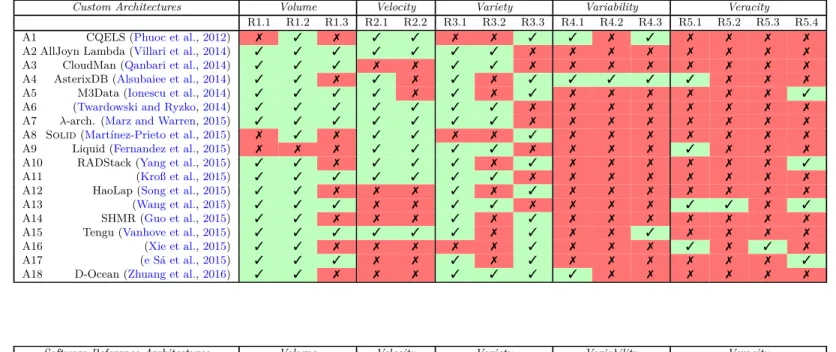
(7). Results are summarized in Table2, where we make the distinction between
277
custom architectures and SRAs. For the sake of readability, references to studied
278
papers have been substituted for their position in Table2.
279
3.2.1. Requirements on Volume 280
Most architectures are capable of dealing with storage of massive data sets
281
(R1.1). However, we claim those relying on Semantic Web principles (i.e. storing
282
RDF data), [A1,A8] cannot deal with such requirement as they are inherently
283
limited by the storage capabilities of triplestores. Great effort is put on improving
284
such capabilities (Zeng et al., 2013), however no mature scalable solution is
285
available in the W3C recommendations3. There is an exception to the previous
286
discussion, as SHMR [A14] stores semantic data on HBase. However, this impacts
287
its analytical capabilities with respect to those offered by triplestores. Oppositely,
288
Liquid [A9] is the only case where no data are stored, offering only real-time
289
support and thus not addressing the Volume dimension of Big Data. Regarding
290
analytical capabilities, most architectures satisfy the descriptive level (R1.2) via
291
1http://www.scopus.com
2http://www.core.edu.au/conference-portal 3
Custom Architectures Volume Velocity Variety Variability Veracity R1.1 R1.2 R1.3 R2.1 R2.2 R3.1 R3.2 R3.3 R4.1 R4.2 R4.3 R5.1 R5.2 R5.3 R5.4
A1 CQELS (Phuoc et al.,2012) 7 3 7 3 3 7 7 3 3 7 3 7 7 7 7
A2 AllJoyn Lambda (Villari et al.,2014) 3 3 3 3 3 3 3 7 7 7 7 7 7 7 7
A3 CloudMan (Qanbari et al.,2014) 3 3 3 7 7 3 3 7 7 7 7 7 7 7 7
A4 AsterixDB (Alsubaiee et al.,2014) 3 3 7 3 7 3 7 3 3 3 3 3 7 7 7
A5 M3Data (Ionescu et al.,2014) 3 3 3 3 7 3 7 3 7 7 7 7 7 7 3
A6 (Twardowski and Ryzko,2014) 3 3 3 3 3 3 3 7 7 7 7 7 7 7 7
A7 λ-arch. (Marz and Warren,2015) 3 3 3 3 3 3 3 7 7 7 7 7 7 7 7
A8 Solid(Martínez-Prieto et al.,2015) 7 3 7 3 3 7 7 3 7 7 7 7 7 7 7
A9 Liquid (Fernandez et al.,2015) 7 7 7 3 3 3 3 7 7 7 7 3 7 7 7
A10 RADStack (Yang et al.,2015) 3 3 7 3 3 3 7 3 7 7 7 7 7 7 3
A11 (Kroß et al.,2015) 3 3 3 3 3 3 3 7 7 7 7 7 7 7 7
A12 HaoLap (Song et al.,2015) 3 3 7 7 7 3 7 3 7 7 7 7 7 7 7
A13 (Wang et al.,2015) 3 3 3 7 7 3 3 7 7 7 7 3 3 7 3
A14 SHMR (Guo et al.,2015) 3 3 7 7 7 3 7 3 7 7 7 7 7 7 7
A15 Tengu (Vanhove et al.,2015) 3 3 3 3 3 3 7 3 7 7 3 7 7 7 7
A16 (Xie et al.,2015) 3 3 7 7 7 7 7 3 7 7 7 3 7 3 7
A17 (e Sá et al.,2015) 3 3 3 7 7 3 7 3 7 7 7 7 7 7 3
A18 D-Ocean (Zhuang et al.,2016) 3 3 7 7 7 3 3 3 3 7 7 7 7 7 7
Software Reference Architectures Volume Velocity Variety Variability Veracity
R1.1 R1.2 R1.3 R2.1 R2.2 R3.1 R3.2 R3.3 R4.1 R4.2 R4.3 R5.1 R5.2 R5.3 R5.4
A19 NIST (Grady et al.,2014) 3 3 3 7 7 7 7 3 7 7 3 7 3 3 3
A20 (Pääkkönen and Pakkala,2015) 3 3 3 3 3 3 3 7 7 7 7 7 7 7 3
A21 (Geerdink,2015) 3 3 3 7 7 3 3 7 7 7 7 7 7 7 7
Bolster 3 3 3 3 3 3 3 3 3 3 3 3 3 3 3
Table 2:Fulfillment of each requirement in the related work
SQL-like [A4,A10,A11,A18] or SPARQL [A1,A8] languages. Furthermore, those
292
offering MapReduce or similar interfaces [A2,A3,A6,A13,A14,A15,A20] meet the
293
predictive and prescriptive level (R1.3). HaoLap [A12] and SHMR [A14] are
294
the only works where MapReduce is narrowed to descriptive queries.
295
3.2.2. Requirements on Velocity 296
Several architectures are capable of ingesting data streams (R2.1),
ei-297
ther by dividing the architecture in specialized Batch and Real-time Layers
298
[A2,A6,A7,A10,A11,A15,A20], by providing specific channels like data feeds [A4]
299
or by solely considering streams as input type [A1,A8,A9]. Regarding processing
300
of such data streams (R2.2), all architectures dealing with its ingestion can
addi-301
tionally perform processing, with the exception of AsterixDB [A4] and M3Data
302
[A5], where data streams are stored prior to querying them.
303
3.2.3. Requirements on Variety 304
Variety is handled in diverse ways in the studied architectures. Concerning
305
ingestion of raw data (R3.1), few proposals cannot deal with such requirement,
306
either because they are narrowed to ingest specific data formats [A8,A16], or
307
because specific wrappers need to be defined on the sources [A1,A19]. Concerning
308
storage of raw data (R3.2), many architectures define views to merge and
309
homogenize different formats into a common one (including those that do it
310
at ingestion time) [A4,A5,A10,A12,A14,A15,A17]. On the other hand, theλ
-311
architecture and some of the akin architectures [A2,A6,A7,A11] and [A20] are the
312
only ones natively storing raw data. In schema management (R3.3), all those
313
architectures that favored ingesting and storing raw data cannot deal with such
314
requirement, as no additional mechanism is present to handle it. Oppositely, the
315
ones defining unified views are able to manage them, likewise relational database
316
schemas. There is an exception to the previous discussion, D-Ocean [A18], which
317
defines a data model for unstructured data, hence favouring all requirements.
318
3.2.4. Requirements on Variability 319
Requirements on Variability are poorly covered among the reviewed works.
320
Schema evolution is only handled by CQELS [A1], AsterixDB [A4] and D-Ocean
321
[A18]. CQELS uses specific wrapper configuration files which via a user interface
322
map new elements to ontology concepts. On the other hand, AsterixDB parses
323
schemas at runtime. Finally, D-Ocean’s unstructured data model embraces the
324
addition of new features. Furthermore, only AsterixDB considers data evolution
325
(R4.2) using adaptive query processing techniques. With respect to automatic
326
inclusion of data sources (R4.3), CQELS has a service allowing wrappers to
327
be plugged at runtime. Moreover, other architectures provide such feature as
328
AsterixDB with the definition of external tables at runtime, [A19] providing a
329
discovery channel or Tengu [A15] by means of an Enterprise Service Bus.
330
3.2.5. Requirements on Veracity 331
Few of the studied architectures satisfy requirements on Veracity. All works
332
covering data provenance (R5.1) log the operations applied on derived data in
order to be reproduced later. On the other hand, measurement of data quality
334
(R5.2) is only found in [A19] and [A13], the former by storing such metadata as
335
part of its Big Data lifecycle and the latter by tracking data quality rules that
336
validate the stored data. Regarding data liveliness (R5.3), [A16] tracks it in order
337
to boost reusage of results computed by other users. Alternatively, [A19] as part
338
of its Preservation Management activity applies aging strategies, however it is
339
limited to its data retention policy. Finally, with respect to data cleaning (R5.4)
340
we see two different architectures. In [A5,A13,A17,A19] cleansing processes
341
are triggered as part of the data integration phase (i.e. before being stored).
342
Differently, [A10,A20] execute such processes on unprocessed raw data before
343
serving them to the user.
344
3.3. Discussion 345
Besides new technological proposals, we devise two main families of works in
346
the Big Data architectures landscape. On the one hand, those presented as an
347
evolution of theλ-architecture [A7] after refining it [A2,A6,A10,A11,A15]; and,
348
on the other hand, those positioned on the Semantic Web principles [A1,A8].
349
Some architectures aim to be of general-purpose, while others are tailored to
350
specific domains, such as: multimedia data [A14], cloud manufacturing [A3],
351
scientific testing [A15], Internet of Things [A2] or healthcare [A13].
352
It can be concluded from Table 2 that requirements related to Volume,
353
Velocity and Variety are more fulfilled with respect to those related to Variability
354
and Veracity. This is due to the fact, to some extent, that Volume, Velocity and
355
partly Variety (i.e.,R3.1, R3.2) are core functionalities in NOSQL systems,
356
and thus all architectures adopting them benefit from that. Furthermore, such
357
dimensions have a clear impact on the performance of the system. Most of the
358
architectures based on theλ-architecture naturally fulfil them for such reason.
359
On the other hand, partly Variety (i.e., R3.3), Variability and Veracity are
360
dimensions that need to be addressed by respectively considering evolution and
361
data governance as first-class citizens. However, this fact has an impact on the
362
architecture as a whole, and not on individual components, hence causing such
363
low fulfiment across the studied works.
364
4. Bolster: a Semantic Extension for theλ-Architecture 365
In this section, we presentBolster, an SRA solution for Big Data systems
366
that deals with the 5 “Vs”. Briefly, Bolster adopts the best out of the two
367
families of Big Data architectures (i.e., λ-architecture and those relying on
368
Semantic Web principles). Building on top of theλ-architecture, it ensures the
369
fulfillment of requirements related to Volume and Velocity. However, in contrast
370
to other approaches, it is capable of completely handling Variety, Variability
371
and Veracity leveraging on Semantic Web technologies to represent
machine-372
readable metadata, oppositely to the studied Semantic Web-based architectures
373
representing data. We first present the methodology used to design the SRA.
374
Next, we present the conceptual view of the SRA and describe its components.
375
4.1. The design of Bolster 376
Bolsterhas been designed following the framework for the design of
empirically-377
grounded reference architectures (Galster and Avgeriou,2011), which consists of
378
a six-step process described as follows:
379
Step 1: decision on type of SRA. The first step consists on deciding the type of
380
SRA to be designed, which is driven by its purpose. Using the characterization
381
from (Angelov et al., 2012), we conclude that Bolster should be of type 5 (a
382
preliminary, facilitation architecture designed to be implemented in multiple
383
organizations). This entails that the purpose of its design is to facilitate the
384
design of Big Data systems, in multiple organizations and performed by a
385
research-oriented team.
386
Step 2: selection of design strategy. There are two strategies to design SRAs,
387
from scratch or from existing architectures. We will designBolster based on the
388
two families of Big Data architectures identified in Section3.
389
Step 3: empirical acquisition of data. In this case, we leverage on the Big Data
390
dimensions (the five “V’s”) discussed in Section2and the requirements defined
391
for each of them. Such requirements, together with the design strategy, will
392
drive the design ofBolster.
393
Step 4: construction of SRA. The rationale and construction of Bolster is
394
depicted in Section 4.2, where a conceptual view is presented. A functional
395
description of its components is later presented in Section4.3, and a functional
396
example in Section5.
397
Step 5: enabling SRA with variability. The goal of enabling an SRA with
398
variability is to facilitate its instantiation towards different use cases. To this
399
end, we provide the annotated SRA using a conceptual view as well as the
400
description of components, which can be selectively instantiated. Later, in
401
Section6, we present methods for its instantiation.
402
Step 6: evaluation of the SRA. The last step of the design of an SRA is its
403
evaluation. Here, and leveraging on the industrial projects whereBolster has
404
been adopted, in Section7.2, we present the results of its validation.
405
4.2. Adding semantics to theλ-architecture 406
Theλ-architecture is the most widespread framework for scalable and
fault-407
tolerant processing of Big Data. Its goal is to enable efficient real-time data
408
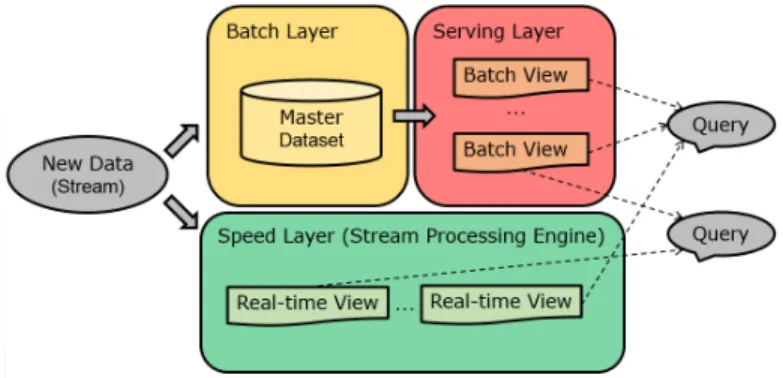
management and analysis by being divided into three layers (Figure1).
409
• TheBatch Layer stores a copy of the master data set in raw format as data
410
are ingested. This layer also pre-computesBatch Views that are provided
411
to theServing Layer.
Figure 1:λ-architecture
• TheSpeed Layer ingests and processes real-time data in form of streams.
413
Results are then stored, indexed and published inReal-time Views.
414
• TheServing Layer, similarly as theSpeed Layer, also stores, indexes and
415
publishes data resulting from theBatch Layer processing inBatch Views.
416
Theλ-architecture succeeds at Volume requirements, as tons of heterogeneous
417
raw data can be stored in the master data set, while fast querying through the
418
Serving Layer. Velocity is also guaranteed thanks to the Speed Layer, since
real-419
time views complement query results with real-time data. For these reasons, the
420
λ-architecture was chosen as departing point forBolster. Nevertheless, we identify
421
two main drawbacks. First, as pointed out previously, it completely overlooks
422
Variety, Variability and Veracity. Second, it suffers from a vague definition,
423
hindering its instantiation. For example, the Batch Layer is a complex subsystem
424
that needs to deal with data ingestion, storage and processing. However, as
425
the λ-architecture does not define any further component of this layer, its
426
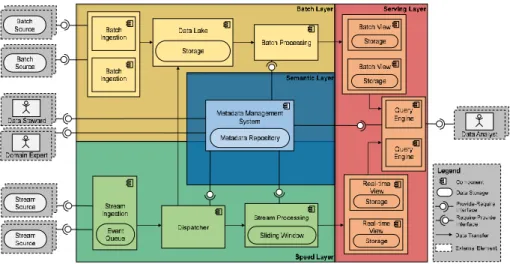
instantiation still remains challenging. Bolster (Figure 2) addresses the two
427
drawbacks identified in theλ-architecture:
428
• Variety, Variability and Veracity are considered first-class citizens. With
429
this purpose, Bolster includes the Semantic Layer where the Metadata
430
Repository stores machine-readable semantic annotations, in an analogous
431
purpose as of the relational DBMS catalog.
432
• Inspired by the functional architecture of relational DBMSs, we refine the
433
λ-architecture to facilitate its instantiation. These changes boil down to
434
a precise definition of the components and their interconnections. We
435
therefore introduce possible instantiations for each component by means
436
of off-the-shell software or service.
437
Finally, note that this SRA aims to broadly cover different Big Data use
438
cases, however it can be tailored by enabling or disabling components according
439
to each particular context. In the following subsections we describe each layer
440
present inBolster as well as their interconnections. In bold, we highlight the
441
Figure 2:BolsterSRA conceptual view
necessary functionalities they need to implement to cope with the respective
442
requirements.
443
4.3. Bolster Components 444
In this subsection, we present, for each layer composingBolster, the list of
445
its components and functional description.
446
4.3.1. Semantic Layer 447
The Semantic Layer (depicted blue in Figure 2) contains the Metadata
448
Management System (MDM), the cornerstone for a semantic-aware Big Data
449
system. It is responsible of providing the other components with the necessary
450
information to describe and model raw data, as well as keeping the footprint about
451
data usage. With this purpose, the MDM contains all the metadata artifacts,
452
represented by means of RDF ontologies leveraging the benefits provided by
453
Semantic Web technologies, needed to deal with data governance and assist data
454
exploitation. We list below the main artifacts and refer the interested reader
455
to (Varga et al.,2014;Bilalli et al.,2016) for further details:
456
1. Data analysts should work using their day-by-day vocabulary. With this
457
purpose, theDomain Vocabulary contains the business concepts (e.g.,
458
customer,order,lineitem) and their relationships (R5.1).
459
2. In order to free data analysts from data management tasks and decouple
460
this role from the data steward, each vocabulary term must be mapped to
461
the system views. Thus, the MDM must be aware of theView Schemata
462
(R3.3) and the mappings between the vocabulary and such schemata.
3. Data analysts tend to repeat the same data preparation steps prior to
464
conducting their analysis. To enable reusability and a collaborative
exploita-465
tion of the data, on the one hand, the MDM must storePre-processing
466
Domain Knowledgeabout data preparation rules (e.g., data cleaning,
467
discretization, etc.) related to a certain domain (R5.4), and on the other
468
hand descriptive statistics to assess data evolution (R4.2).
469
4. To deal with automatic inclusion of new data sources (R4.3), each ingested
470
element must be annotated with its schema information (R4.1). To this
471
end, theData Source Registertracks all input data sources together
472
with the required information to parse them, the physical schema, and each
473
schema element has to be linked to the attributes it populates, the logical
474
schema (R3.3). Furthermore, for data provenance (R5.1), the Data
475
Transformations Loghas to keep track of the performed transformation
476
steps to produce the views, the last processing step within the Big Data
477
system.
478
Populating these artifacts is a challenge. Some of them can be automatically
479
populated and some others must be manually annotated. Nonetheless, all of
480
these artifacts are essential to enable a centralized master metadata management
481
and hence, fulfil the requirements related to Variety, Variability and Veracity.
482
Analogously to database systems, data stewards are responsible of populating
483
and maintaining such artifacts. That is why we claim for the need that the MDM
484
provides a user friendly interface to aid such processes. Finally, note that most
485
of the present architectural components must be able to interact with the MDM,
486
hence it is essential that it provides language-agnostic interfaces. Moreover, such
487
interfaces cannot pose performance bottlenecks, as doing so would highly impact
488
in the overall performance of the system.
489
4.3.2. Batch Layer 490
This layer (depicted yellow in Figure2) is in charge of storing and processing
491
massive volumes of data. In short, we first encounter Batch Ingestion, responsible
492
for periodically ingesting data from the batch sources, then the Data Lake,
493
capable of managing large amounts of data. The last step is the Batch Processing
494
component, which prepares, transforms and runs iterative algorithms over the
495
data stored in the Data Lake to shape them accordingly to the analytical needs
496
of the use-case at hand.
497
Batch Ingestion. Batch sources are commonly big static raw data sets that
498
require periodic synchronizations (R3.1). Examples of batch sources can be
499
relational databases, structured files, etc. For this reason, we advocate for a
500
multiple component instantiation, as required by the number of sources and type.
501
These components need to know which data have already been moved to the Data
502
Lake by means ofIncremental Bulks Scheduling and Orchestration. The
503
MDM then comes into play as it traces this information. Interaction between the
504
ingestion components and the MDM occurs in a two-phase manner. First, they
505
learn which data are already stored in the Data Lake, to identify the according
506
incremental bulk can be identified. Second, the MDM is enriched with specific
507
information regarding the recently brought data (R5.3). Since Big Data systems
508
are multi-source by nature, the ingestion components must be built to guarantee
509
its adaptability in the presence of new sources (R4.3).
510
Data Lake. This component is composed of aMassive Storagesystem (R1.1).
511
Distributed file systems are naturally good candidates as they were born to
512
hold large volumes of data in their source format (R3.2). One of their main
513
drawbacks is that its read capabilities are only sequential and no complex
514
querying is therefore feasible. Paradoxically, this turns out to be beneficial for
515
the Batch Processing, as it exploits the power of cloud computing.
516
Different file formats pursuing high performance capabilities are available,
517
focusing on different types of workload (Munir et al.,2016). They are commonly
518
classified as horizontal, vertical and hybrid, in an analogous fashion as
row-519
oriented and column-oriented databases, respectively.
520
Batch Processing. This component models and transforms the Data Lake’s files
521
into Batch Views ready for the analytical use-cases. It is responsible to schedule
522
and executeBatch Iterative Algorithms, such as sorting, searching, indexing
523
(R1.2) or more complex algorithms such as PageRank, Bayesian classification
524
or genetic algorithms (R1.3). The processing components, must be designed to
525
maximize reusability by creating building blocks (from the domain-knowledge
526
metadata artifacts) that can be reused in several views. Consequently, in order
527
to track Batch Data Provenance, all performed transformations must be
528
communicated to the MDM (R5.1).
529
Batch processing is mostly represented by the MapReduce programming
530
model. Its drawbacks appear twofold. On one hand, when processing huge
531
amounts of batch data, several jobs may usually need to be chained so that
532
more complex processing can be executed as a single one. On the other hand,
533
intermediate results from Map to Reduce phases are physically stored in hard
534
disk, completely detracting the Velocity (in terms of response time).
535
Massive efforts are currently put on designing new solutions to overcome
536
the issues posed by MapReduce. For instance, by natively including other more
537
atomic relational algebra operations, connected by means of a directed acyclic
538
graph; or by keeping intermediate results in main memory.
539
4.3.3. Speed Layer 540
The Speed Layer (depicted green in Figure2) deals primarily with Velocity.
541
Its input are continuous, unbounded streams of data with high timeliness and
542
therefore require novel techniques to accommodate such arrival rate. Once
543
ingested, data streams can be dispatched either to the Data Lake, in order to
544
run historical queries or iterative algorithms, or to the Stream Processing engine,
545
in charge of performing one-pass algorithms for real-time analysis.
Stream Ingestion. The Stream Ingestion component acts as a message queue
547
for raw data streams that are pushed from the data sources (R3.1). Multiple
548
sources can continuously push data streams (e.g., sensor or social network data),
549
therefore such component must be able to cope with high throughput rates and
550
scale according to the number of sources (R2.1). One of the key responsibilities
551
is to enable the ingestion of all incoming data (i.e., adopt aNo Event Loss
552
policy). To this end, it relies on a distributed memory or disk-based storage
553
buffer (i.e. event queue), where streams are temporarily stored.
554
This component does not require any knowledge about the data or schema of
555
incoming data streams, however, for each event, it must know its source and type,
556
for further matching with the MDM. To assure fault-tolerance and durability of
557
results in such a distributed environment, techniques such as write-ahead logging
558
or the two-phase commit protocol are used, nevertheless that has a clear impact
559
on the availability of data to next components.
560
Dispatcher. The responsibilities of the Dispatcher are twofold. On the one hand,
561
to ensure data quality, via MDM communication, it must register and validate
562
that all ingested events follow the specified schema and rules for the event on
563
hand (i.e.,Schema Typechecking(R4.1,R5.2)). Error handling mechanisms
564
must be triggered when an event is detected as invalid, and various mitigation
565
plans can be applied. The simplest alternative is event rejection, however most
566
conservative approaches like routing invalid events to the Data Lake for future
567
reprocess can contribute to data integrity.
568
On the other hand, the second responsibility of the Dispatcher is to perform
569
Event Routing, either to be processed in a real-time manner (i.e., to the
570
Stream Processing component), or in a batch manner (i.e., to the Data Lake)
571
for delayed process. In contrast to theλ-architecture, which duplicates all input
572
streams to the Batch Layer, here only those that will be used by the processing
573
components will be dispatched if required. Moreover, before dispatching such
574
events, different routing strategies can influence the decision on where data is
575
shipped, for instance by means of evaluating QoS cost models or analyzing the
576
system workload, as done in (Kroß et al.,2015). Other approaches like sampling
577
or load shedding can be used here, to ensure that either real-time processing or
578
Data Lake ingestion are correctly performed.
579
Stream Processing. The Stream Processing component is responsible of
per-580
formingOne-Pass Algorithmsover the stream of events. The presence of a
581
summary is required as most of these algorithms leverage on in-memory stateful
582
data structures (e.g., the Loosy Counting algorithm to compute heavy hitters,
583
or HyperLogLog to compute distinct values). Such data structures can be
lever-584
aged to maintain aggregates over a sliding window for a certain period of time.
585
Different processing strategies can be adopted, being the most popular
tuple-586
at-a-time and micro-batch processing, the former providing low latency while
587
the latter providing high throughput (R2.2). Similarly as the Batch Processing,
588
this component must communicate to the MDM all transformations applied to
589
populate Real-time Views in order to guaranteeStream Data Provenance 590 (R5.1). 591 4.3.4. Serving Layer 592
The Serving Layer (depicted red in Figure2) holds transformed data ready
593
to be delivered to end-users (i.e. it acts as a set of database engines). Precisely,
594
it is composed by Batch and Real-time Views repositories. Different alternatives
595
exist when selecting each view engine, however as they impose a data model (e.g.,
596
relational or key-value), it is key to perform a goal-driven selection according to
597
end-user analytical requirements (Herrero et al., 2016). It is worth noting that
598
views can also be considered new sources, in case it is required to perform
trans-599
formations among multiple data models, resembling a feedback loop. Further,
600
the repository of Query Engines is the entry point for data analysts to achieve
601
their analytical task, querying the views and the Semantic Layer.
602
Batch Views. As in theλ-architecture, we seek Scalable and Fault-Tolerant 603
Databases capable to provide Random Reads, achieved by indexing, and
604
the execution of Aggregations and UDFs(user defined functions) over large
605
stable data sets (R1.1). Theλ-architecture advocates for recomputing Batch
606
Views every time a new version is available, however we claim incremental
607
approaches should be adopted to avoid unnecessary writes and reduce processing
608
latency. A common example of Batch View is a DW, commonly implemented
609
in relational or columnar engines. However databases implementing other data
610
models such as graph, key-value or documents also can serve the purpose of
611
Batch Views. Each view must provide a high-level query language, serving as
612
interface with the Query Engine (e.g., SQL), or a specific wrapper on top of it
613
providing such funcionalities.
614
Real-time Views. As opposite to Batch Views, Real-time Views need to provide
615
Low Latency Queryingover dynamic and continuously changing data sets
616
(R2.1). In order to achieve so, in-memory databases are currently the most
617
suitable option, as they dismiss the high cost it entails to retrieve data from disk.
618
Additionally, Real-Time views should support low cost of updating in order to
619
maintainSketches and Sliding Windows. Finally, similarly to Batch Views,
620
Real-time Views must provide mechanisms to be queried, considering as well
621
Continuous Query Languages.
622
Query Engines. Query Engines, play a crucial role to enable efficiently querying
623
the views in a friendly manner for the analytical task on hand. Data analysts
624
query the system using the vocabulary terms and apply domain-knowledge rules
625
on them (R1.2, R1.3). Thanks to the MDM artifacts, the system must internally
626
perform the translation fromBusiness Requirements to Database Queries
627
over Batch and Real-time Views (R3.3), hence making data management tasks
628
transparent to the end-user. Furthermore, the Query Engine must provide to
629
the user the ability forMetadata Query and Explorationon what is stored
630
in the MDM (R5.1, R5.2, R5.3).
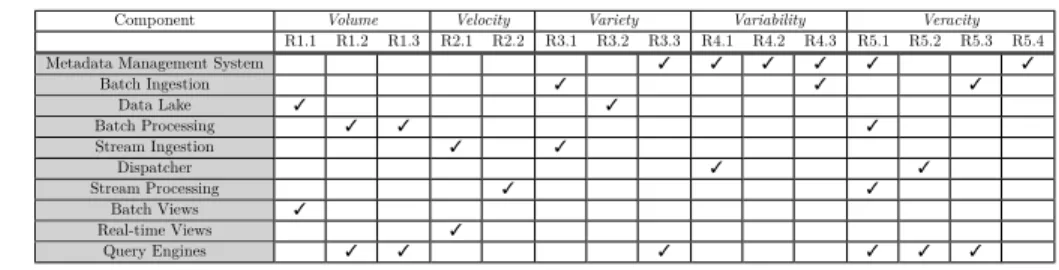
4.3.5. Summary 632
Table3summarizes for each component the fulfilled requirements discussed
633
in Section2.
634
Component Volume Velocity Variety Variability Veracity
R1.1 R1.2 R1.3 R2.1 R2.2 R3.1 R3.2 R3.3 R4.1 R4.2 R4.3 R5.1 R5.2 R5.3 R5.4
Metadata Management System 3 3 3 3 3 3
Batch Ingestion 3 3 3 Data Lake 3 3 Batch Processing 3 3 3 Stream Ingestion 3 3 Dispatcher 3 3 Stream Processing 3 3 Batch Views 3 Real-time Views 3 Query Engines 3 3 3 3 3 3
Table 3:Bolstercomponents and requirements fulfilled
5. Exemplar Use Case 635
The goal of this section is to provide an exemplar use case to illustrate how
636
Bolster would accommodate a Big Data management and analytics scenario.
637
Precisely, we consider the online social network benchmark described in (Zhang
638
et al.,2015). Such benchmark aims to provide insights on the stream of data
639
provided by Twitter’s Streaming API, and is characterized by workloads in
640
media, text, graph, activity and user analytics.
641
5.1. Semantic representation 642
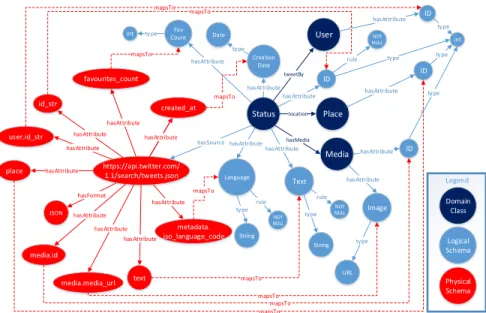
Figure3depicts a high level excerpt of the content stored in the MDM. In
643
dark and light blue, the domain knowledge and business vocabulary respectively
644
which has been provided by the Domain Expert. In addition, the data steward
645
has, possibly in a semi-automatic manner (Nadal et al., 2017), registered a
646
new source (Twitter Stream API4) and provided mappings for all JSON fields
647
to the logical attributes (in red). For the sake of brevity, only the relevant
648
subgraph of the ontology is shown. Importantly, to meet the Linked Open Data
649
principles, this ontology should be further linked to other ontologies (e.g., the
650
Open Provenance Model (Moreau et al.,2011)).
651
5.2. Data ingestion 652
As raw JSON events are pushed to the Stream Ingestion component, they are
653
temporary stored in the Event Queue. Once replicated, to guarantee durability
654
and fault tolerance, they are made available to the Dispatcher, which is aware on
655
how to retrieve and parse them by querying the MDM. Twitter’s documentation5
656
warns developers that events with missing counts rarely happen. To guarantee
657
data quality such aspect must be checked. If an invalid event is detected, it
658
4https://dev.twitter.com/streaming/overview
5https://dev.twitter.com/streaming/overview/processing
Legend Status ID Creation Date Fav Count Language hasAttribute hasAttribute hasAttribute hasAttribute User tweetBy ID hasAttribute Place Text hasAttribute location type ID hasAttribute type type String type String type Date type int type hasSource JSON hasFormat id_str https://api.twitter.com/ 1.1/search/tweets.json created_at metadata. iso_language_code mapsTo hasAttribute hasAttribute hasAttribute favourites_count hasAttribute text mapsTo mapsTo hasAttribute mapsTo mapsTo hasAttribute user.id_str place media.media_url mapsTo hasAttribute hasAttribute hasAttribute mapsTo NOT NULL rule NOT NULL rule NOT NULL rule Domain Class Logical Schema Physical Schema Legend int Media hasMedia ID hasAttribute type Image hasAttribute media.id hasAttribute mapsTo mapsTo URL type
Figure 3: Excerpt of the content in the Metadata Repository
should be discarded. After this validation, the event at hand must be registered
659
in the MDM to guarantee lineage analysis. Furthermore the Dispatcher sends
660
the raw JSON event to the Stream Processing and Data Lake components. At
661
this point, there is a last ingestion step missing before processing data. The
662
first workload presented in the benchmark concerns media analytics, however as
663
depicted in Figure3, the API only provides the URL of the image. Hence, it is
664
necessary to schedule a batch process periodically fetching such remote images
665
and loading them into the Data Lake.
666
5.3. Data processing and analysis 667
Once all data are available to be processed in both Speed and Batch Layers,
668
we can start executing the required workloads. Many of such workloads concern
669
predictive analysis (e.g., topic modeling, sentiment analysis, location prediction
670
or collaborative filtering). Hence, the proposed approach is to periodically refresh
671
statistical models in an offline manner (i.e., in the Batch Layer), in order to
672
assess predictions in an online manner (i.e., in the Speed Layer). We distinguish
673
between those algorithms generating metadata (e.g., Latent Dirichlet Allocation
674
(LDA)) and those generating data (e.g., PageRank). The former will store its
675
results in the MDM using a comprehensive vocabulary (e.g., OntoDM (Panov
676
et al., 2008)); and the latter will store them into Batch Views. Once events
677
have been dispatched, the required statistical model has to be retrieved from the
678
MDM to assess predictions and store outcomes into Real-time Views. Finally, as
679
described in (Zhang et al., 2015), the prototype application provides insights
based on tweets related to companies in the S&P 100 index. Leveraging on the
681
MDM, the Query Engine is capable of generating queries to Batch and Real-time
682
Views.
683
6. Bolster Instantiation 684
In this section we list a set of candidate tools, with special focus on the Apache
685
Hadoop and Amazon Web Services ecosystems, to instantiate each component
686
inBolster. In the case when few tools from such ecosystems were available,
687
we propose commercial tools which were considered in the industrial projects
688
where Bolster was instantiated. Further, we present a method to instantiate
689
the reference architecture. We propose a systematic scoring process driven by
690
quality characteristics, yielding, for each component, the most suitable tool.
691
6.1. Available tools 692
6.1.1. Semantic Layer 693
Metadata Management System. Two different off-the-shelf open source products
694
can instantiate this layer, namelyApache Stanbol6 andApache Atlas7.
Never-695
theless, the features of the former fall short for the proposed requirements of the
696
MDM. Not surprisingly, this is due to the novel nature ofBolster’s Semantic
697
Layer. Apache Atlassatisfies the required functionalities more naturally and it
698
might appear as a better choice, however it is currently under heavy development
699
as anApache Incubator project. Commercial tools such asCloudera Navigator8
700
orPalantir9 are also candidate tools.
701
Metadata Storage. We advocate for the adoption of Semantic Web storage
702
technologies (i.e. triplestores), to store all the metadata artifacts. Even though
703
such tools allow storing and reasoning over large and complex ontologies, that
704
is not the pursued purpose here, as our aim is to allow a simple and flexible
705
representation of machine-readable schemas. That is why triplestores serve
706
better the purpose of such storage. Virtuoso10is at the moment the most mature
707
triplestore platform, however other options are available such as 4store11 or
708
GraphDB12. Nonetheless, given the graph nature of triples, any graph database
709
can as well serve the purpose of metadata storage (e.g., AllegroGraph13 or
710 Neo4j14). 711 6 https://stanbol.apache.org 7http://atlas.incubator.apache.org 8https://www.cloudera.com/products/cloudera-navigator.html 9https://www.palantir.com 10http://virtuoso.openlinksw.com 11 http://4store.org 12http://graphdb.ontotext.com/graphdb 13http://allegrograph.com 14http://neo4j.com 22