Laghari, AA
and
He, H
and
Khan, A
and
Kumar, N
and
Kharel, Rupak
(2018)
Quality of Experience Framework for Cloud Computing (QoC).
IEEE
Access. ISSN 2169-3536
Downloaded from:
http://e-space.mmu.ac.uk/621383/
Version:
Published Version
Publisher:
Institute of Electrical and Electronics Engineers (IEEE)
DOI:
https://doi.org/10.1109/ACCESS.2018.2865967
Usage rights:
["licenses\_typename\_i" not defined]
Please cite the published version
Date of publication xxxx 00, 0000, date of current version xxxx 00, 0000.
Digital Object Identifier 10.1109/ACCESS.2017.Doi Number
Quality of Experience Framework for Cloud
Computing (QoC)
Asif Ali Laghari1, Hui He1, Asiya Khan2, Neetesh Kumar3, and Rupak Kharel4, Member, IEEE
1School of Computer Science & Technology, Harbin Institute of Technology, Harbin, China 2School of Marine Engineering, University of Plymouth, Plymouth, UK
3Indian Institute of Information Technology & Management, Gwalior, India 4School of Engineering, Manchester Metropolitan University, Manchester, UK
Corresponding author: Hui He (e-mail: [email protected]).
ABSTRACT Cloud computing provides platform for pay per use services such as software, hardware and
platforms. Previous cloud frameworks use fix policies that do not have the functionality to upgrade services on demand when the user do not receive services according to Service Level Agreement (SLA). Also, there was a lack of functionality to monitor external network and client device resources. This paper presents Quality of experience framework for Cloud computing (QoC) for monitoring the Quality of Experience (QoE) of the end user using video streaming services in the cloud computing environment. The management platform is used for administration purpose in QoC framework that provides facility to easily manage the cloud environment and provide services according to SLA via runtime policy change. The objective QoE/QoS section will automatically monitor the Quality of Service (QoS) data. It will also compare and analyze the subjective QoE submitted by the users and objective QoS data collected by agent based framework for accurate QoE prediction and proper management. The proposed QoC framework has new features of real time network monitoring, client device monitoring and allows changing policy in runtime environment which to our knowledge is currently not provided by existing frameworks.
INDEX TERMS Cloud computing, Service level agreement (SLA), Quality of Experience (QoE), Quality
of Service (QoS), QoC. I. INTRODUCTION
Multimedia usage on the Internet has increased dramatically over the last few years to access resources such as video tutorials, video-on-demand (VOD), video conferences, audio/video streaming, etc. Users can access free video services such as IPTV, online videos, video conferences etc. from the cloud servers including commercial services on a pay per use basis. In a client server architecture, the users can access these videos from video servers that have options of streaming with multiple bit rates e.g. YouTube. The user will simply make the selection or the service provider automatically defaults to a particular bit rate according to the network bandwidth and device compatibility [1, 2]. These are free of cost services, no service level agreement (SLA) between user and service provider exists for Quality of Service (QoS) provision and thus compensation on low services is irrelevant. Hence, less
storage is normally provided to users for uploading their personal contents. Free service providers such as Facebook has its own settings for videos and thus when users upload video, it is automatically converted to service provider’s predefined format, normally with reduced quality [3]. The free cloud service providers do not provide the QoS for video streaming but user can freely access their multimedia contents and also share publicly. Commercial cloud service provider allows video storage space on pay per use basis with better QoS for video streaming. The user can access video services (for stream, download and upload) using variety of user interfaces including mobile apps [4, 5]. Earning more revenues from the market is basic competition between the cloud service providers, so all providers try to offer better QoS to their customers to deliver better user satisfaction thus retaining the customer.
FIGURE 1. Cloud QoE/QoS Monitoring Scenario [11].
Poor QoS of video streaming and violation of SLA in commercial cloud infrastructure force users to move to other service provider that guarantee better QoS. However, migration of user from one provider to another is a loss of economy for the business as well as annoyance for user who have to move all the stored data from the previous cloud to a new cloud [6]. To avoid user migration problems, cloud organizations provide user feedback or user support page on their website to receive data about the user experience regarding their services or complaints about monitoring QoS and avoid violation of SLA. But organizations struggle to capture positive user experience for management of cloud services [7]. To capture positive and accurate QoE is cumbersome for cloud organizations because of the greedy behavior of the user and less knowledge of user’s QoE is a problem for cloud management [8]. There are so many autonomous tools developed by cloud organizations for QoS data monitoring in cloud environment limited to their firewall and are given in Fig. 1 [9, 10, 11]. A few cloud service providers also add
subjective Quality of Experience (QoE)/customer feedback/complaint pages on their websites and apps for customer feedback to improve the overall QoS and increase user experience level. Therefore, middleware network and QoS monitoring at user side are still not included in monitoring frameworks for cloud management.
QoC framework provides the solution of the above discussed problems. The proposed QoC framework based on the agent technology, automatically collects objective QoE/QoS from cloud to client device and user also have an option to subjective QoE to cloud management. The QoE data submitted by end users and objective QoE/QoS data collected by the system will be analyzed for service delivery according to SLA. The main contribution of this paper is to propose a QoE framework for Cloud computing (QoC) that is able to:
Collect data (status) of the internal cloud environment, client’s device and middle network environment from cloud to end user’s device automatically.
Submit complains and feedback about services and mobile app to access cloud services from remote locations.
Upgrade policy for the time being if the user does not get QoS according to SLA and extend package limitation for users to complete current task.
Distinguish the negative and positive QoE by comparison of current service delivery parameters when the user submits feedback which to our knowledge is currently not provided by existing cloud QoE frameworks.
The paper is organized as follows. In Section II, we provide related work based on the overview of the cloud infrastructure and existing QoE based frameworks. Section III depicts the architecture of the proposed framework, which contains QoE model of QOC framework and functionality. Section IV presents sequence diagram of the QoC framework and Section V provides details of the web and mobile app of QoC framework. Section VI illustrates results and discussions. Finally, in Section VII, we conclude the work and provide future research directions. II. RELATED WORKS
This section presents the related work and is further divided into two parts. It provides an over-view of the cloud infrastructure and summarizes the existing QoE-based cloud frameworks.
A. OVERVIEW OF THE CLOUD INFRASTRUCTURE
Cloud computing is an evolution of grid computing [12]. Grid computing is a collection of shared hardware resources such as computers, network routers managed via software from multiple locations for one common goal [13]. In grid computing, all resources are used for one specific large task or workloads like weather forecast and earth simulation for earthquake alerts. Whereas, cloud computing provides high computational power with more features such as permanent storage and hardware resources or infrastructure as a service (IaaS), application software as a service (SaaS) and platforms or operating systems for application development as a service (PaaS) [14, 15]. According to the NIST Cloud Computing Definition, “Cloud computing is a model for enabling convenient, on-demand network access to a shared pool of configurable computing resources (such as, networks, servers, storage, applications, and services) that can be rapidly provisioned and released with minimal management effort or service provider interaction” [16, 17]. Cloud computing is based on the three service models - SaaS, PaaS and IaaS. SaaS is a business and consumer type of service, which is used by end users e.g. for email, the application software of database and accounting but users do not necessarily need the technical information to manage the cloud [18, 19]. PaaS provides development tools for developers, which are technically managed and configured by the end user developers according to their requirement.
IaaS is fully dependent on access to cloud infrastructure and devices like servers, network and storage devices so in IaaS developer has full access to manage and change cloud infrastructure [20].
Cloud management monitor technical parameters to provide QoS to the user but customer satisfaction and accurate QoE still remains a big issue for cloud management. It is hard to capture user needs and manage the services according to their needs. There is no framework provided by industry or academia for cloud management, which provides complete solution to capture and distinguish between positive and negative QoE.
B. EXISTING QoE BASED FRAMEWORKS
QoE/QoS frameworks are designed and developed for cloud computing to analyze the user needs and their satisfaction level about cloud services. One such framework is proposed in [21], where the framework is based on the agent technology. The proposed framework works on two conditions, cloud-assisted adaptive video streaming and social-aware video prefetching. A private agent constructed in cloud center for each mobile user will analyze the network traffic and on the basis of network capacity, will adjust video quality (bitrate) by the scalable video coding technique.
CLAMS (Cross-Layer Multi-Cloud Application Monitoring as a Service Framework) is QoS monitoring based on the agent technology, which monitors applications and big data analytics in multi cloud environment and addresses the issue of cross layer monitoring of applications [22]. Follow Me Cloud: FMC Interworking Federated Clouds and Distributed Mobile Networks cloud framework presented by Tarik [23], this framework is based on the subjective evaluation of user for network delay when their services are migrated from one cloud data center to another. The idea of this framework is that services migrate to near location datacenter will enhance the QoE of the user and this will generate a high cost for cloud service providers.
Another QoE framework Cloud2Bubble is proposed by Costa, et. al [24]. This framework monitors the environment based on the user profile, addresses disconnect and service delivery status enabling the delivery of personalized services for users based on their preferences and needs. This framework proposed to provide QoS for every single user profile according to needs when multiple users use same devices in different times. QoE test is not conducted to validate the proposed framework.
Mobile Cloud Gaming (CMG) framework was proposed for multi user gaming environment for the mobile user via cloud server instead of client server architecture [25]. The purpose of the framework is providing an idea to shift mobile user load to cloud server due to the inherent hardware constraint of mobile devices (memory and graphics processing). The framework is based on the objective and subjective QoE measures. The objective factors analyzed which influence on QoE measure are four factors: cloud
server, source video, wireless network and client. The author set network based model for subjective QoE validation of framework and also propose Game Mean Opinion Score (GMOS) for measurement of end user’s QoE.
The proposed QoC framework is based on agent technology, the agent monitors environment from cloud to end users and technical data for performance analysis. Previous QoE based cloud framework has limited scope of
monitoring and analysis at cloud side but QoC framework monitor cloud as well as network environment and client side. No existing framework upgrades the policy in the runtime environment to provide QoS according to the SLA and is unable to differentiate between the positive and negative QoE of end users. Comparison of previous QoE frameworks with QoC framework is given in Table 1.
TABLEI
COMPARISONOFQOEFRAMEWORKOFCLOUDCOMPUTING QoE/QoE Cloud
Frameworks Wang [21] CLAMS [22] FMC [23] Cloud2Bubble [24] CMG [25] QoC
Parameters NQoS AQoS NQoS NQoS & AQoS NQoS & PSNR/ VQ NQoS & AQoS
Monitoring Support Yes Yes Yes Yes Yes Yes
Analysis Support Quantitative Quantitative Quantitative Quantitative Quantitative Quantitative & Qualitative
Reporting No No No Yes No Yes
Policy Change No No No No No Yes
Client Monitoring No No No No No Yes
Remarks Objective (QoS) Evaluation Objective QoS Evaluation Evaluation Subjective Evaluation Subjective
Objective & Subjective Evaluation Objective QoE/QoS & Subjective Evaluation
III. ARCHITECTURE OF THE PROPOSED QOC FRAMEWORK
This section presents the architecture of the proposed QoC framework and is further divided into two parts to describe the QoE model used in the QoC framework and the proposed QoC framework.
A. QUALITY OF EXPERIENCE (QoE)
Nowadays QoE is a major notion for organizations for developing products and providing services to end users. The QoE is a measurement of user factors like feelings enjoyment, perception, satisfaction and cognition for given service or product [26]. QoS was used in past for improvement in services and technical parameters were changed by vendors, but SLA violation and user satisfaction remains big problem [27]. SLA is a document which is signed by the user and vendor for QoS, but user needs evolve by time and vendor has fix policies for long period, so this is the main reason for merging QoE for service delivery and product development [28]. Using QoE notion vendor/service providers capture information of user needs in a timely manner for their performance of services and avoiding violation of SLA. There are two types of QoE, (i) subjective and (ii) Objective. Subjective QoE can be captured by using interviews, questionnaire, scales and web-based surveys [28]. Objective QoE is further divided into two parts, one is human physiological data which can be captured by MRI and EEG tests and other is technical parameter QoS data [29, 30]. Subjective QoE is costly and it is very difficult to distinguish
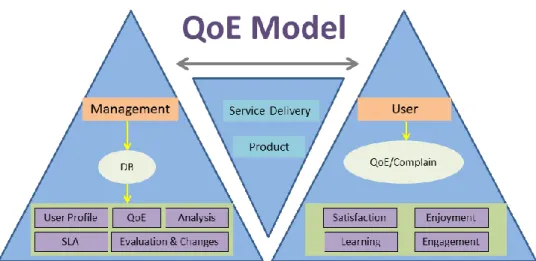
positive and negative feedback of users, but objective QoE provides almost accurate results without negative feedback. Vendors mostly use subjective QoE for services or products because it is easy to capture as compared to objective QoE, but few vendors also use objective QoE for more accurate data [31, 32]. The QoE model contains components associated with management and users. Generally, management side has the database, which contains information of user and SLA. When the user starts using services, they have an option to submit experience or complains via web page commonly given from all service providers. The user experience is based on the user’s level of satisfaction, learning ability, enjoyment and engagement [33-35], this feedback given for the service quality which end user received at the destination. When users submit the feedback, it is directly stored in the database and management analyze the feedback/complains. If any changes is required at their side, they manage within the limitation of SLA [28]. QoE model with detailed components are given in Fig. 2.
In Fig. 2, QoE model is based on the management side, client side and the network are in the middle of service delivery from cloud to client. Management section is based on the QoE database (DB). DB is further subdivided into user profile information, QoE data, SLA for particular user, record of evaluation and changes (log reports) and analysis section of subjective and objective QoE/QoS. User side components are QoE/complaint which is based on the user’s level of satisfaction, enjoyment, learning and engagement.
FIGURE 2. Proposed QoE Model.
Previously QoE has been used for network management in client server architectures to provide QoS to end users according to their needs [32], now academia and industry merge QoE features in cloud environment for better management and provide QoS to end users according to their needs. The proposed QoC framework automatically captures objective QoE in runtime environment from cloud management to end user and also provides a facility for the user to submit subjective QoE/complaints feedback via a web form. Objective QoE monitoring tool based on the agent technology which collects QoS data from cloud environment to destination user and finds problems.
B. THE PROPOSED QoC FRAMEWORK
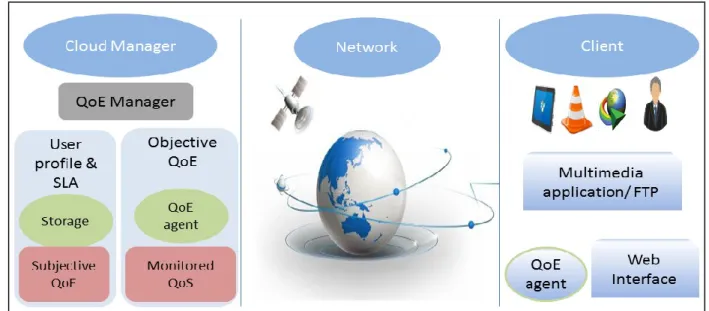
The proposed QoC framework is a semi-automatic management based on agent technology. In QoC framework, cloud side components are cloud manager, QoE manager, user profile & SLA, user storage, agent framework for monitoring objective, QoE/QoS and MySQL database for storing the subjective and objective QoE of end user shown in Fig. 3. Further, the QoC framework architecture contains cloud web interface and mobile app for user to access cloud features. We develop web-based tool “QoE test cloud” for testing subjective QoE validation of QoC framework for multimedia services. QoE test cloud web-based tool provides the facility of storage video on the cloud, share and download features to users. The QoE test cloud is based on different sections, every section facilitates users to manage their videos on the cloud. This tool provides facility to user to create an account for storage and makes his profile for QoE submission in the context of complaints, needs and decline of services (QoS) mentioned in signed SLA. If a user enters negative feedback or wrong information to get more QoS mentioned in SLA from the cloud, submitted subjective QoE of the user will be analyzed and compared with monitored objective QoE/QoS then QoC framework will not take any action on user’s feedback. QoC framework compares both
subjective and objective QoE for accurate analysis that QoS is provided according to SLA or not. If QoS is not according to SLA then alert to user about the problem at user side is sent, if problem is on the cloud side, i.e. network speed, network error, traffic burden on cloud internal network, or storage problem, VM migration issue then it will be solved and provide QoS according to SLA.
If the user did not get QoS according to SLA and the subjective QoE is positive then the objective system will search for the problem. If the problem is found within cloud environment then it sends alert to cloud administrator, but if problem is found outside from the cloud environment then QoC framework will search exact issue for the disturbance in providing QoS to end user. For example, QoC framework found a problem at user’s device and user facing the problem getting QoS because of low hardware configuration of the device or due to peak network traffic then QoC framework will send alert to the user about the problem. Sometimes end user will not get QoS from service providers due to the lack of free computational resources in their own devices. In this situation, QoC framework will send alert to the user to make their device free for use of cloud services. This is a major issue for cloud administration because nontechnical users are not always aware of resources on their side and may not understand the reason of QoS degradation and may claim for SLA violation to cloud management. The purpose of merging both subjective and objective QoE/QoS in QoC framework is that if a nontechnical user will not know about the submission of complaint using feedback form then objective QoE/QoS monitoring tool will automatically detect the services and compare to the signed SLA. If the user had not receive services according to SLA, the system will diagnose the problem and react on it. User perception could not give a precise evaluation of the problem and unable to detect accurate problem and level of performance. Users also provide negative feedback for getting more QoS because of greed, so objective QoE/QoS technical data will
FIGURE 3. Architecture of the proposed QoC framework.
provide accurate information about the performance. Subjective feedback helps administrator to understand user’s perception, complaints, future needs and objective QoE/QoS data will help to get final accurate user feedback for decision. IV. SEQUENCE DIAGRAM OF PROPOSED QOC
FRAMEWORK
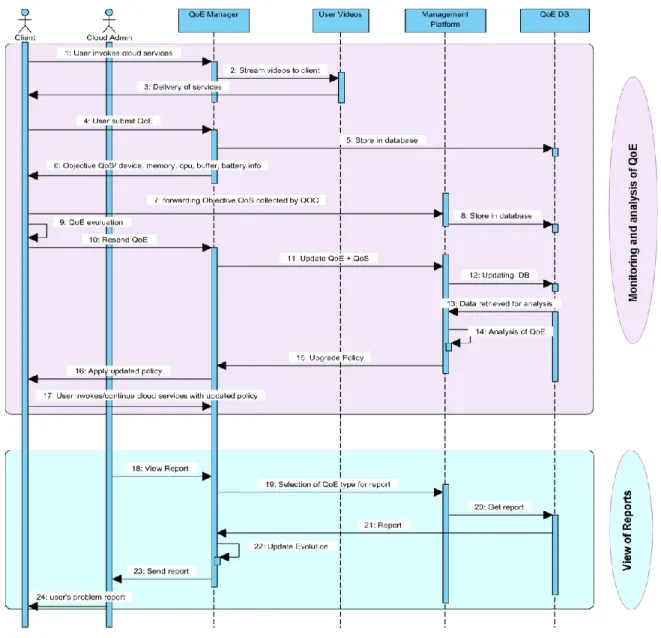
The sequence diagram in Fig. 4 explains how our proposed QoC framework operates, how agent code collects data at the end user’s device and internal cloud and the evaluation of subjective and objective QoE/QoS. The sequence diagram is based on the client and admin section. Admin section is further subdivided in 4 parts which contains QoE manager, user videos, management platform and QoE database. The operations of sequence diagram are presented in two actions.
The user invokes services to access the cloud, the request goes to QoE manager for account verification and policy activation and the user starts video streaming from his account. Cloud transfers video streaming data to end users and after perception user will submit QoE, which will be stored in QoE database (DB). QoE manager will automatically collect objective QoS data from cloud to end user’s device, which contains network information (e.g. delay, packet loss, reordering and number of routers between cloud and user), user device information (e.g., buffer information, device hardware information, battery status information and location) which is shown as 6 activity in diagram. This information will be compared by management platform with subjective QoE submitted by the user for analysis of services according to SLA and stored in QoE DB for future use. Objective QoE again is collected by agents and resent to management section for analysis, if services are low from the mentioned value in SLA then
management platform updates policy and the user will receive services with the upgraded policy.
Cloud admin will send request to QoE manager to check user reports and profile and QoE manager will forward the request to management platform to generate a report from QoE DB. Admin can select a particular user from management section and view the report. The problem report will also be forwarded to the end user for the device performance degradation for receiving services according to SLA.
V. MOBILE USER QOE MEASUREMENTS BASED ON QoC
A. CLOUD VIDEO SERVICE WEBSITE
Client side contains web interface for registration, for example a user Mike registers himself on the cloud using the web interface registration module. He must select a package for P1, or P2 etc., which contains storage data limit of 1GB and 2GB respectively on pay per use basis. Details of user like email, name and phone number will be stored in cloud database with his package. The user will log in using his ID and upload videos on the cloud storage using standard web interface.
The QoC framework supports all type of videos that contains different formats and codecs with high data volume. Other clouds support only few popular video codecs and during the upload file is compressed, decreasing the quality of the video from original quality [36]. After uploading videos on the cloud, the user has option to select a particular video to edit information, delete, move to other folder and share publicly on a different social media networks like Facebook, Twitter or Baidu. This QoC framework also provides facility for users to play online video. The user can manage and perform an operation on their uploaded videos.
FIGURE 4. Sequence diagram of Proposed QoC framework.
The mobile app is also developed for users because most users want access to videos via mobile phones during their travel. The mobile app contains all user based functionalities for accessing, upload and download of videos. QoC framework cloud based mobile app has all the same functions which are available for the desktop system so the user can access same features via desktop or mobile phones.
VI. RESULTS AND DISCUSSIONS
A. SUBJECTIVE EXPERIMENTS
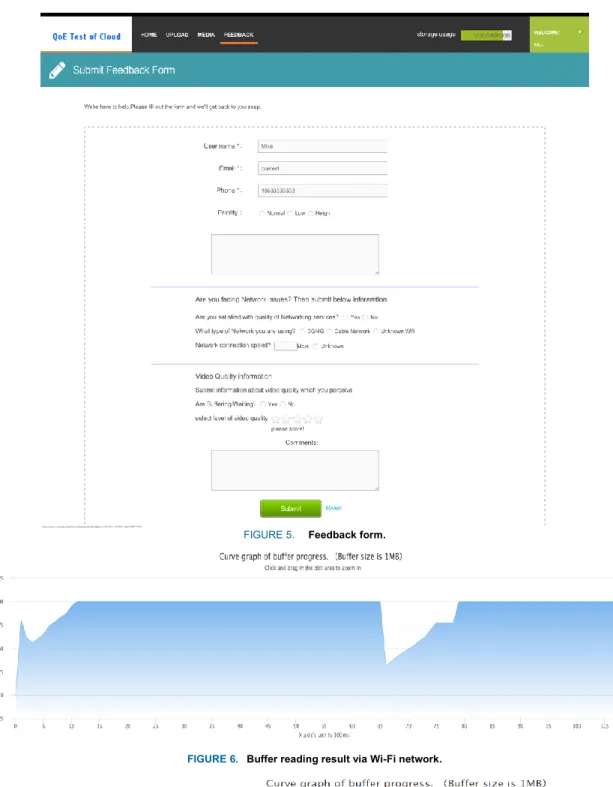
During the online playing of videos, the user feels the quality of the video is low from original or is facing delay/buffering issues then s/he can submit complaint/experience to cloud management by using the feedback form, which is also given in the QoC framework. The user will enter information about the problem currently being faced and also priority of problem that they have, either major issue to solve on the
emergency basis or low level issue solved on the normal routine of management. Other information includes QoS of network, user’s network connection speed, video quality information like facing buffering, low quality video and rank the quality of the video. User complaints will be submitted to the database with their profile for processing to provide QoS according to SLA. QoC framework feedback form is used to collect subjective QoE from user to analyze his problem; service delivered to user comparison with SLA and needs. Subjective QoE form of QoC framework is designed using standard web interface are shown in Fig 5.
Management Platform is another part of QoC framework, which is used for cloud administration to manage user’s accounts, set SLAs, and solve problems. Management platform depends on three parts: feedback, QoE data and Objective QoE/QoS data. Feedback list provides details of user submitted complaints from the start of using services to
FIGURE 5. Feedback form.
FIGURE 6. Buffer reading result via Wi-Fi network.
till date. The list will provide information including user ID, name, phone, email date, reply, status and option for view details of buffer and network information using standard web interface. These are the details of components which user can input during submission of QoE.
Subjective QoE section of QoC framework also has a functionality to read user buffer status and information of video, total playing, current and roaming time with data size of the video, when user submits complaint/subjective QoE. The buffer checking agent runs across the firewall of a user device in the same way as agent work in Globus toolkit of grid computing for resource discovery [37]. Fig. 6 shows that 1Mb buffer is not filled due to network delay when video content is playing and buffer code is tested by using Wi-Fi network. But test of buffer code on the local system in android virtual environment provides results that buffer is filled every millisecond while playing the video, see Fig. 7. The agent base code is also used to extract user’s device information and its power status and battery life and shown in the web interface alongside the buffer information.
B. OBJECTIVE MEASUREMENT
Objective QoE/QoS is a part of management platform of QoC framework administration side. Objective QoE monitoring is based on the agent technology and QoS data can be retrieved by applied functionalities, which are provided by simple network management protocol (SNMP) [16]. SNMP uses agents to retrieve QoS data of network such as route information from cloud to end user, number of packets in and out number of network interfaces. SIGAR
(https://support.hyperic.com/display/SIGAR/Home) is used for low level system information such as total memory, used memory, actual free memory, CPU utilization and specific information e.g memory and CPU consumed by a process [38]. In QoC framework, system management software will monitor cloud environment for free resources like computation, storage and load on the internal cloud network. Monitoring of QoS data from cloud to user contains distance from cloud to user, number of routers between them, specific delay on network traffic passing from router, network bandwidth, type of network, user device capability, OS, browser, CPU usage, memory usage, route queue delay, etc. CPU and memory usage have huge impact on the performance of accessing cloud while router queue delay is important information for administration to understand the deficiencies in QoS according to SLA.
Objective QoE/QoS part is based on monitoring function, which is subdivided into three parts such as monitoring of local cloud environment, network environment, user device and usage information. Other components of objective QoE/QoS contain task section, which provides information about the task (current task, start time, estimated time of completion and remaining time). User section provides details of the list of registered users and particular information of users like email, phone and registration date etc. SLA section contains signed SLA between user and services provider and status of SLA with policy change or previous policy for providing QoS. Objective
FIGURE 9. Monitoring network environment.
QoE/QoS also have a manual/automatic control system, in manual function administrator of cloud service provider will manage the operations for cloud management and in automatic cloud management software self-manage all operation of management like user complaint and reaction on the submitted complaints. Results of some objective QoE/QoS functions are given in Fig. 8 and Fig. 9.
The allocation of resources is provided to the user on the basis of task and previous usage pattern. For example, a user Alice always uses high computational power to process simulations for short time, so the system will manage to provide resources in the free rack where the load is minimum and the rack’s internal network traffic is low for high volume data upload, which will be used in the completion of this current task. User Bob always requires low computational resources for a long time to complete his task, therefore system management will shift his resources from those racks
which have less computational resources available for sharing. This approach in internal cloud management will provide better overall service to the end users. For example, if user starts the task of scientific simulation on the cloud and one hour estimated time for task completion is displayed to the user. After 50 minutes, 87% of the task is completed, but suddenly remaining time of the task is increased due to the increased traffic load on the network. The task of the user is still running on the cloud and the prepaid resources will finish after 5 minutes. The estimated time for task completion is still 40 minutes with 100% utilization of computation resources from cloud side. In this situation, cloud will provide additional time automatically for the task and it will be finished with flexible SLA. In this example, if strict SLA were to be applied, it will cause loss of 87% completed task together with uploaded data and these types of strict policies will force the user to migrate from the current provider.
FIGURE 11. Test sample 2.
FIGURE 12. Test sample 3.
C. MOBILE USER PERFORMANCE EXPERIMENTS
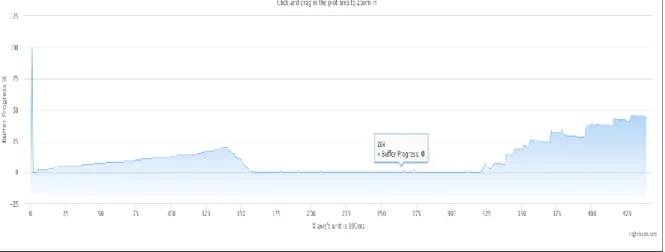
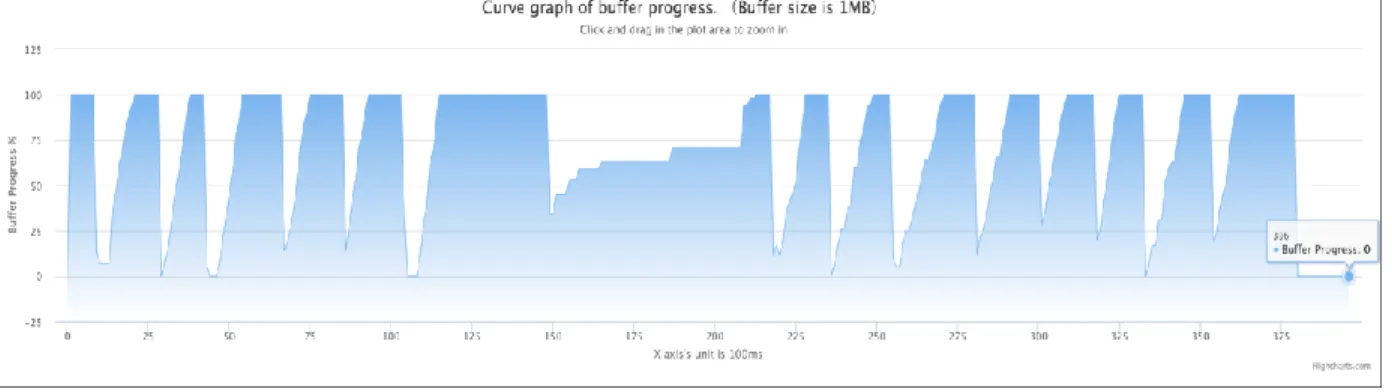
Mobile user performance was measured on different network conditions where speed limits are applied and here are the three test samples (1, 2, 3) are given in Figs. 10, 11 and 12.
The first test sample is in the limit speed under the condition of the test curve and buffer is full of proportion to 0%, plays with severe video Caton. The second test sample is in normal condition under the network environment but the user frequently switches playing time point of the curve test, switch to a play between the need of re-buffer, the buffer is full of 43%, video playback is not smooth. The third test sample is normally played test results and buffer is full of proportion was 78%, smooth video playback. So through the analysis of the buffer curves can be a certain degree of response to user's playback quality of experience, and the buffer is full of proportion can direct response the user's Caton.
VII. CONCLUSION AND FUTURE WORK
We have designed and developed a QoC framework for cloud services based on the agent technology for measuring user QoE and found the QoS according to SLA, thus, avoiding violation of SLA. The QoC framework provides web interface facility for the user to manage their information, upload and share videos with HD quality among their friends via QoC cloud and social media. The QoC framework provides feedback form for submission of user complaint and their experience when using services. Subjective QoE part will also extract the device information
of user and battery status if using cloud services via mobile phone or laptop. The framework also reads the buffer information of user device and measure the network speed and type of the network. The management platform is administrative part of QoC framework, which provides user interface facility to the administrator for management of cloud. The feedback, QoS data and reports of subjective QoE are submitted by the end user. The objective QoE/QoS part forms the management platform, which is only visible for the administrator of the cloud, collects QoS data such as monitoring the internal environment for computational and network resources. The QoC framework captures both subjective and objective QoE in runtime environment, analyze the captured QoE and change policy, if service degradation problem in internal cloud environment is found. In comparison with existing cloud frameworks, the proposed QoC framework provides functionality to monitor entire environment from cloud to end user’s device, collect QoS data using agents and store in database for analysis of service according to SLA. The QoC automatically upgrades the policy of user in runtime and extend package limitation for task completion avoiding negative experience with users thus preventing migration to different platform of competitors.
In the future, we will design and develop image and file hosting facility in QoC framework and test the user experience for quality and size of images. The database file hosting and SaaS applications will also be embedded for online database operations. This is ongoing research work with academia and industry and the results of performance of
objective metrics, such as video quality metric (VQM) and peak signal to noise ratio (PSNR), in assessing the provided video quality will be presented in the future.
Acknowledgment: The work is supported by the National Key R&D Program of China under grant No. 2017YB0801801, the National Science Foundation of China (NSFC) under grant No. 61472108 and 61672186.
REFERENCES
[1] W. zhang, Y. Zhang, and T. Kim. "Detecting bad information in mobile wireless networks based on the wireless application protocol." Computing 96, no. 9, pp 855-874. 2014.
[2] W. Zhang, G. Lu, H. He, Q. Zhang, and C. Yu. "Exploring large-scale small file storage for search engines." The Journal of Supercomputing 72, no. 8, pp 2911-2923. 2016.
[3] S. Schmiedeke, P. Kelm and T. Sikora, "DCT-based features for categorisation of social media in compressed domain," Multimedia Signal Processing (MMSP), 2013 IEEE 15th International Workshop on, Pula, 2013, pp. 295-300.
[4] J. He, D. Wu, Y. Zeng, X. Hei and Y. Wen, "Toward Optimal Deployment of Cloud-Assisted Video Distribution Services," in IEEE Transactions on Circuits and Systems for Video Technology, vol. 23, no. 10, pp. 1717-1728, Oct. 2013.
[5] A. Ahmed, A. H. Abdullah, O. Kaiwartya, Y. Cao, M. J. Usman, S. Kumar, D. K. Lobiyal, and R. S. Raw. "Cloud Computing in VANETs: Architecture, Taxonomy, and Challenges." IETE Technical Review (2017): 1-25. [6] V. C. Emeakaroha, T. C. Ferreto, M. A. S. Netto, I. Brandic and C.
A. F. De Rose, "CASViD: Application Level Monitoring for SLA Violation Detection in Clouds," IEEE 36th Annual Computer Software and Applications Conference, Izmir, 2012, pp. 499-508. [7] N. Samet, A. Ben Letaïfa, M. Hamdi and S. Tabbane, "Toward
Quality of Experi-ence models of cloud-based mobile services," 2015 International Wireless Commu-nications and Mobile Computing Conference (IWCMC), Dubrovnik, 2015, pp. 1510-1514.
[8] A. A. Laghari, H. Hui, M. Shafiq, A. Khan, “Assessment of quality of experience (QoE) of image compression in social cloud computing‖”, International Journal of Multiagent and Grid Systems, vol. 14, no. 2, 2018, DOI 10.3233/MGS-180284.
[9] A. Ahmed, A., A. H, Abdul, O Kaiwartya. M. J. Usman, and S. O. A. Rehman "Mobile Cloud Computing Energy-aware Task Offloading (MCC: ETO)." In Proceedings of the Communication and Computing Systems: Proceedings of the International Conference on Communication and Computing Systems (ICCCS 2016), p. 359. 2017.
[10] K. Alhamazani; R. Ranjan; P. P. Jayaraman; K. Mitra; F. Rabhi; D. Georgakopou-los; L. Wang, "Cross-Layer Multi-Cloud Real-Time Application QoS Monitoring and Benchmarking As-a-Service Framework," in IEEE Transactions on Cloud Computing , vol.PP, no.99, pp.1-1
[11] http://cloudessa.com/products/cloudessa-radius-service/
[12] S. M. Abdulhamid,, M. S. A. Latiff, and M. B. Bashir. "On-demand grid provi-sioning using cloud infrastructures and related virtualization tools: a survey and taxonomy." arXiv preprint arXiv: 1402.0696 (2014).
[13] S. M. Abdulhamid,, M. S. A. Latiff, and M. B. Bashir. "Scheduling techniques in on-demand grid as a service cloud: a review." Journal of Theoretical & Applied Information Technology 63, no. 1 (2014). [14] J. K. Verma, S. Kumar, O. Kaiwartya, Y. Cao, J. Lloret, C. P. Katti,
and R. Kharel. "Enabling green computing in cloud environments: Network virtualization approach toward 5G support." Transactions on Emerging Telecommunications Technologies (2018): e3434. [15] M. Abdullahi,, and M. A. Ngadi. "Symbiotic Organism Search
optimization based task scheduling in cloud computing environment." Future Generation Computer Systems 56 (2016): 640-650.
[16] M. A. Hadi, "Overview of Cloud Computing Towards to Future Net-works."International Journal of Computer Science and Innovation 2015, no. 2 (2015).
[17] A. A. Laghari, H. He, M. Shafiq, and A. Khan. "Impact of storage of mobile on quality of experience (QoE) at user level accessing cloud." In Communication Software and Networks (ICCSN), 2017 IEEE 9th International Conference on, pp. 1402-1409. IEEE, 2017. [18] S. M. Abdulhamid,, M. S. A. Latiff, and M. B. Bashir and I. Idris.
"Tasks schedul-ing technique using league championship algorithm for makespan minimiza-tion in IAAS cloud." arXiv preprint arXiv:1510.03173(2015).
[19] https://aws.amazon.com/what-is-cloud-computing/
[20] S. H. H. Madni, M. S. A. Latiff, and Y. Coulibaly. "Recent advancements in re-source allocation techniques for cloud computing environment: a systematic review." Cluster Computing (2016): 1-45.
[21] X. Wang, T. Kwon, Y. Choi, H. Wang and J. Liu, "Cloud-assisted adaptive video streaming and social-aware video prefetching for mobile users," in IEEE Wireless Communications, vol. 20, no. 3, pp. 72-79, June 2013.
[22] K. Alhamazani,, R. Ranjan, P. P. Jayaraman, K. Mitra, M. Wang, Z. G. Huang, L. Wang, and F. Rabhi. "Real-Time QoS Monitoring for Cloud-Based Big Data Analytics Applications in Mobile Environments," IEEE 15th International Confer-ence on Mobile Data Management, Brisbane, QLD, 2014, pp. 337-340.
[23] T. Taleb and A. Ksentini, "Follow me cloud: interworking federated clouds and distributed mobile networks," in IEEE Network, vol. 27, no. 5, pp. 12-19, Septem-ber-October 2013.
[24] P. M. Costa, J. Pitt, J. Falcão e Cunha, and T. Galvão, “Cloud2Bubble: Enhancing Quality of Experience in Mobile Cloud Computing Settings”, Proceedings of the Third ACM Workshop on Mobile Cloud Computing and Services, New York, NY, USA, 2012, pp. 45–52.
[25] S. Wang and S. Dey. "Cloud mobile gaming: modeling and measuring user experience in mobile wireless networks." ACM SIGMOBILE Mobile Computing and Communications Review 16, no. 1 (2012): 10-21.
[26] A. A. Laghari, I. H. Sadhayo, and M. I. Channa. "Enhanced autonomic network-ing management architecture (enama)." engineering, science & technology: volume 14, no. 1, Jan – June 2015. pp. 9.
[27] A. Laghari, H. He, M. Ibrahim, and S. Shaikh. "Automatic Network Policy Change on the Basis of Quality of Experience (QoE)." Procedia Computer Sci-ence 107 (2017): 657-659.
[28] A.A Laghari, K. R. Laghari, M. I. Channa, and T. H. Falk. "QON: Quality of expe-rience (QoE) framework for network services.” International Conference on Software Technology and Engineering (ICSTE 2012). ASME Press, 2012.
[29] A. A. Laghari,, H. He, S. Karim, H. A. Shah, and N. K. Karn. "Quality of Experi-ence Assessment of Video Quality in Social Clouds." Wireless Communications and Mobile Computing (2017). [30] A. Laghari,, H. He, S. Zardari, and M. Shafiq. "Systematic Analysis
of Quality of Experience (QoE) Frameworks for Multimedia Services." IJCSNS 17, no. 5 (2017): 121.
[31] www.witbe.net [32] www.qoesystems.com
[33] A. A, Laghari,, H. He, M. Shafiq, and A. Khan. "Assessing effect of Cloud dis-tance on end user's Quality of Experience (QoE)." In Computer and Communica-tions (ICCC), 2nd IEEE International Conference on, pp. 500-505. IEEE, 2016.
[34] L. Farhan, R. Kharel, O. Kaiwartya, M. Hammoudeh, and B. Adebisi, "Towards green computing for Internet of things: Energy oriented path and message scheduling approach," Sustainable Cities and Society, vol. 38, pp. 195-204, 2018.
[35] K. Adhikari, S. Tatinati, W. T. Ang, K. C. Veluvolu, and K. Nazarpour, "A quaternion weighted Fourier linear combiner for modeling physiological tremor," IEEE Transactions on Biomedical
Engineering, vol. 63, no. 11, pp. 2336-2346, 2016.
[36] Mascolo. "The Power of Mobile Computing in a Social Era," in Internet Compu-ting, IEEE , vol.14, no.6, pp.76-79, Nov.-Dec. 2010.
[37] M. J. Schop, P. Laura, M. Neill, K. Carl, I. Foster, M. D'Arcy, and A. Chervenak. "Monitoring the grid with the Globus Toolkit MDS4." In Journal of Physics: Confer-ence Series, vol. 46, no. 1, p. 521. IOP Publishing, 2006.
![FIGURE 1. Cloud QoE/QoS Monitoring Scenario [11] .](https://thumb-us.123doks.com/thumbv2/123dok_us/10133225.2914299/3.864.60.782.127.680/figure-cloud-qoe-qos-monitoring-scenario.webp)