Calhoun: The NPS Institutional Archive
Theses and Dissertations Thesis Collection
2014-06
Design and evaluation for the end-to-end detection
of TCP/IP header manipulation
Craven, Ryan M.
Monterey, California: Naval Postgraduate School
NAVAL
POSTGRADUATE
SCHOOL
MONTEREY, CALIFORNIA
DISSERTATION
DESIGN AND EVALUATION FOR THE END-TO-END DETECTION OF TCP/IP HEADER MANIPULATION
by Ryan M. Craven
June 2014
Dissertation Supervisor: Robert Beverly
REPORT DOCUMENTATION PAGE Form Approved OMB No. 0704–0188
Public reporting burden for this collection of information is estimated to average 1 hour per response, including the time for reviewing instruction, searching existing data sources, gathering and maintaining the data needed, and completing and reviewing the collection of information. Send comments regarding this burden estimate or any other aspect of this collection of information, including suggestions for reducing this burden to Washington headquarters Services, Directorate for Information Operations and Reports, 1215 Jefferson Davis Highway, Suite 1204, Arlington, VA 22202–4302, and to the Office of Management and Budget, Paperwork Reduction Project (0704-0188) Washington DC 20503.
1. AGENCY USE ONLY (Leave Blank) 2. REPORT DATE 06-20-2014
3. REPORT TYPE AND DATES COVERED Dissertation 09-27-2010 to 06-20-2014 4. TITLE AND SUBTITLE
DESIGN AND EVALUATION FOR THE END-TO-END DETECTION OF TCP/IP HEADER MANIPULATION 5. FUNDING NUMBERS NSF: CNS-1213155 SPAWAR: 2013-TIKI-030 6. AUTHOR(S) Ryan M. Craven
7. PERFORMING ORGANIZATION NAME(S) AND ADDRESS(ES)
Naval Postgraduate School Monterey, CA 93943
8. PERFORMING ORGANIZATION REPORT NUMBER
9. SPONSORING / MONITORING AGENCY NAME(S) AND ADDRESS(ES) National Science Foundation
4201 Wilson Blvd. Arlington, VA 22230 SPAWARSYSCEN Atlantic PO Box 190022 North Charleston, SC 29419 10. SPONSORING / MONITORING AGENCY REPORT NUMBER
11. SUPPLEMENTARY NOTES
The views expressed in this document are those of the author and do not reflect the official policy or position of the Department of Defense or the U.S. Government. IRB Protocol Number: N/A.
12a. DISTRIBUTION / AVAILABILITY STATEMENT Approved for public release; distribution is unlimited
12b. DISTRIBUTION CODE
13. ABSTRACT (maximum 200 words)
Understanding, measuring, and debugging IP networks, particularly across administrative domains, is challenging. One aspect of the challenge are transparent middleboxes, which are now common in today’s Internet. In-path middleboxes that modify packet headers are typically transparent to a TCP, yet can impact the end-to-end performance of its connections. Of equal importance, middleboxes cause architectural ossification that hinders network protocol evolution—new options or redefined header fields are often misconstrued, modified, or disabled. We develop TCP HICCUPS to reveal packet header manipulation to both endpoints of a TCP connection. HICCUPS adds a lightweight tamper-evident seal to TCP that is incrementally deployable and introduces no new options. HICCUPS provides an optional feature, AppSalt, that allows applications to request added protection for their connection’s integrity, making it more difficult for middleboxes to falsify integrity values. HICCUPS is implemented in both an operating system patch to the Linux TCP stack as well as a set of cross-platform user-space tools. To evaluate HICCUPS, we deploy it to a diverse set of Internet nodes spread across 197 networks and 48 countries, measuring packet header manipulations on over 26 thousand directed port/path pairs. We discover over 11 thousand instances of unique non-NAT in-path packet header modifications across those flows, all with the potential to negatively affect TCP performance.
14. SUBJECT TERMS
Computer networks, TCP/IP, Internet measurement, middleboxes, packet header modifications, HICCUPS
15. NUMBER OF PAGES 189 16. PRICE CODE 17. SECURITY CLASSIFICATION OF REPORT Unclassified 18. SECURITY CLASSIFICATION OF THIS PAGE Unclassified 19. SECURITY CLASSIFICATION OF ABSTRACT Unclassified 20. LIMITATION OF ABSTRACT UU
NSN 7540-01-280-5500 Standard Form 298 (Rev. 2–89)
Approved for public release; distribution is unlimited
DESIGN AND EVALUATION FOR THE END-TO-END DETECTION OF TCP/IP HEADER MANIPULATION
Ryan M. Craven
Civilian, Space and Naval Warfare Systems Center Atlantic B.S., Clemson University, 2007
M.S., Clemson University, 2010 Submitted in partial fulfillment of the
requirements for the degree of
DOCTOR OF PHILOSOPHY IN COMPUTER SCIENCE from the
NAVAL POSTGRADUATE SCHOOL June 2014
Author: Ryan M. Craven Approved by: Robert Beverly
Assistant Professor of Computer Science Dissertation Supervisor and Committee Chair Geoffrey Xie Mark Gondree
Professor of Computer Science Research Assistant Professor of Computer Science
Preetha Thulasiraman Steven Bauer Assistant Professor of Electrical
Engineering
Research Affiliate, MIT
Approved by: Peter Denning
Chair, Department of Computer Science Approved by: O. Douglas Moses
ABSTRACT
Understanding, measuring, and debugging IP networks, particularly across administrative domains, is challenging. One aspect of the challenge are transparent middleboxes, which are now common in today’s Internet. In-path middleboxes that modify packet headers are typically transparent to a TCP, yet can impact the end-to-end performance of its connec-tions. Of equal importance, middleboxes cause architectural ossification that hinders net-work protocol evolution—new options or redefined header fields are often misconstrued, modified, or disabled. We develop TCP HICCUPS to reveal packet header manipulation to both endpoints of a TCP connection. HICCUPS adds a lightweight tamper-evident seal to TCP that is incrementally deployable and introduces no new options. HICCUPS provides an optional feature, AppSalt, that allows applications to request added protection for their connection’s integrity, making it more difficult for middleboxes to falsify integrity values. HICCUPS is implemented in both an operating system patch to the Linux TCP stack as well as a set of cross-platform user-space tools. To evaluate HICCUPS, we deploy it to a diverse set of Internet nodes spread across 197 networks and 48 countries, measuring packet header manipulations on over 26 thousand directed port/path pairs. We discover over 11 thousand instances of unique non-NAT in-path packet header modifications across those flows, all with the potential to negatively affect TCP performance.
Table of Contents
1 Introduction 1
1.1 Middleboxes . . . 3
1.2 Problem Description . . . 4
1.3 Summary of Contributions . . . 6
1.4 Impact on Relevant Stakeholders . . . 7
1.5 Document Structure . . . 8
2 Background and Impact of Middleboxes 9 2.1 TCP/IP Background . . . 9
2.2 General Measurement Studies . . . 19
2.3 Explicit Congestion Notification . . . 21
2.4 ISN translation and SACK. . . 22
2.5 Negative impact on overall network security . . . 24
2.6 Impact on Protocol Innovation . . . 25
3 Solutions for Middlebox Issues 27 3.1 Tamper Prevention . . . 28
3.2 Avoidance . . . 35
3.3 Detection . . . 39
3.4 Advancing the State-of-the-Art . . . 45
3.5 Design Requirements. . . 46
3.6 Comparison with Solution Space . . . 48
4 Methods for transmitting integrity 53 4.1 Integrity Properties . . . 53
4.2 Protocol Layer Overview . . . 53
4.3 Application layer . . . 54
4.4 ICMP . . . 55
4.6 TCP/IP Options . . . 57
4.7 TCP/IP Fixed-length Fields . . . 58
4.8 Possibilities from Network Steganography . . . 62
4.9 Summary . . . 63
5 Transmitting Integrity with HICCUPS 65 5.1 Overview . . . 66
5.2 Overloading Header Fields . . . 67
5.3 Integrity Exchange. . . 68
5.4 Which fields to protect . . . 70
5.5 What Header Field Was Modified . . . 71
5.6 Complete Path Knowledge . . . 74
6 Protecting Integrity with AppSalt HICCUPS 77 6.1 An Ephemeral Secret . . . 78
6.2 AppSalt Operation . . . 80
6.3 API Changes . . . 83
7 Implementation and Validation 85 7.1 Implementation overview . . . 85
7.2 HICCUPS Linux API . . . 86
7.3 HICCUPS Details . . . 89
7.4 Testing in a Controlled Environment. . . 92
7.5 Demonstration of Debugging with HICCUPS . . . 94
8 Surveying Internet Paths with HICCUPS 97 8.1 Experimental Infrastructure . . . 97
8.2 Experimental Parameters . . . 98
8.3 Detected Modifications . . . 99
8.4 Expected Interactions Required. . . 105
9.1 Future Work: HICCUPS Protocol . . . 108
9.2 Future Work: Applying HICCUPS . . . 110
Appendix: Design Catalog 115 A.1 TCP design variants . . . 115
A.2 Variant 1: Opportunistic HICCUPS . . . 118
A.3 Variant 2: Offset Sequence Numbers . . . 122
A.4 Variant 3: Probabilistic Hashes . . . 126
A.5 Variant 4: Hash Striping with Resets. . . 129
A.6 Variant 5: Hash Rainbow . . . 133
A.7 Variant 6: CoinFlips . . . 136
A.8 Variant 7: HashCash . . . 138
A.9 Variant 8: Reverse Hash Chain . . . 141
A.10 Variant 9: HashCash with Reverse Hash Chain . . . 145
A.11 Variant 10: AppSalt . . . 148
References 151
List of Figures
Figure 1.1 Simplified scenario of two hosts communicating over the Internet 3 Figure 1.2 More realistic scenario of two hosts communicating over the Internet 5
Figure 2.1 The four layers of the TCP/IP protocol suite . . . 10
Figure 2.2 Example of what a packet looks like on the wire . . . 11
Figure 2.3 Structure of an IPv4 header . . . 12
Figure 2.4 Base structure of an ICMP header . . . 12
Figure 2.5 Example Path MTU Discovery scenario . . . 14
Figure 2.6 Structure of a TCP header . . . 15
Figure 2.7 Example of connection negotiation in TCP . . . 16
Figure 2.8 Example of sequence number usage in a TCP connection . . . . 17
Figure 2.9 Scenario showing how SACK helps improve performance . . . . 20
Figure 2.10 Scenario showing how SACK can be disrupted by poor implemen-tation of ISN translation . . . 23
Figure 3.1 Illustrations of the IPsec Authentication Header being applied . . 30
Figure 3.2 Fields that define the IPsec Authentication Header . . . 31
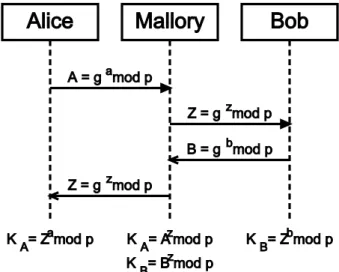
Figure 3.3 Example of a man-in-the-middle attack . . . 33
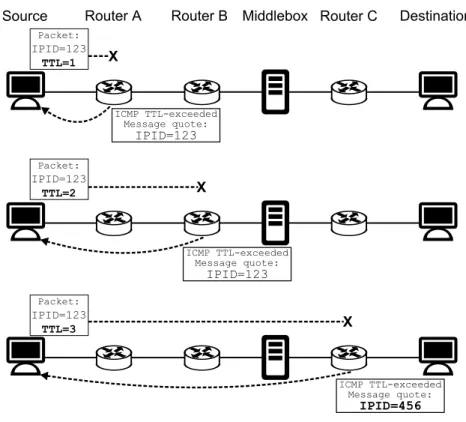
Figure 3.4 Detecting modifications with Tracebox . . . 44
Figure 3.5 Visual representation of properties of related work . . . 49
Figure 4.1 Trade-offs to balance when choosing a protocol for our design . . 55
Figure 5.2 Breakdown of IP and TCP header fields in relation to using
HIC-CUPS . . . 75
Figure 5.3 HICCUPS Search Strategy . . . 75
Figure 6.1 Cumulative fraction of application-layer payload lengths versus num-ber of flows . . . 81
Figure 6.2 HICCUPS AppSalt protection . . . 82
Figure 7.1 Diagram of Virtualbox testing . . . 93
Figure 7.2 Screenshot of packet capture from local host . . . 95
Figure 7.3 Screenshot of HICCUPS test client probing from one host to another with ECN enabled . . . 95
Figure 7.4 Screenshot of HICCUPS test client probing from one host to another without ECN enabled . . . 96
Figure 8.1 Distribution of matching probes, by path direction . . . 100
Figure 8.2 Distribution of HICCUPS-inferred ECN path properties . . . 104
Figure 8.3 Empirical HICCUPS RTTs required for complete path properties in-ference . . . 105
Figure 1 Standard notation for variant diagrams . . . 116
Figure 2 Timing diagram with no modifications . . . 119
Figure 3 Necessary actions to foolAandB . . . 121
Figure 4 Two HICCUPS hosts (no mods) . . . 122
Figure 5 B not HICCUPS host . . . 122
Figure 6 Necessary actions to foolAandB . . . 124
Figure 7 Timing diagram with no modifications . . . 127
Figure 9 Timing diagram with no modifications . . . 131
Figure 10 Hash and salt layout in header fields . . . 133
Figure 11 Timing diagram with no modifications . . . 134
Figure 12 Timing diagram with no modifications . . . 137
Figure 13 Necessary actions to foolAandB . . . 138
Figure 14 Timing diagram with no modifications . . . 139
Figure 15 Timing diagram with no modifications . . . 142
Figure 16 Timing diagram with no modifications . . . 146
List of Tables
Table 2.1 ECN code points in the IP header . . . 19
Table 2.2 Examples of Middlebox Interference . . . 25
Table 3.1 Categorized breakdown of the current solution space for inadver-tently adversarial middlebox packet header tampering . . . 28
Table 3.2 Summary of Related Work . . . 48
Table 4.1 Summary of fixed-length TCP/IP fields that can support overloading or re-purposing . . . 62
Table 5.1 Possible knowledge gained by remote host in performing the integrity check . . . 71
Table 5.2 Possible knowledge gained by initiating host in performing the in-tegrity check . . . 71
Table 5.3 List of all header fields protected by HICCUPS . . . 72
Table 5.4 Pre-defined coverage sets . . . 73
Table 7.1 Lines of code broken down by component functionality . . . 86
Table 7.2 HICCUPS functions and hooks, by TCP event . . . 89
Table 7.3 Function call graph in response to a SYN . . . 91
Table 7.4 Latencies of connection request sub-functions . . . 92
Table 7.5 Run time comparison between kernels . . . 92
Table 7.6 List of modifications made by middlebox simulator . . . 94
Table 8.1 Top ASNs represented . . . 98
Table 8.3 Experimental parameters for each trial . . . 99 Table 8.4 Summary of results by coverage type . . . 101 Table 8.5 Summary of HICCUPS-inferred header modifications on PlanetLab 102 Table 8.6 Summary of HICCUPS-inferred header modifications on Ark . . . 103 Table 1 Possible outcomes of the opportunistic check . . . 120
List of Acronyms and Abbreviations
3WHS three-way handshakeACK acknowledgment AH Authentication Header
API application programming interface AS autonomous system
BGP Border Gateway Protocol BTNS Better-than-nothing-security
CAIDA Cooperative Association for Internet Data Analysis CDN content delivery network
CE congestion encountered CRC cyclic redundancy check CWR congestion window reduced DF don’t fragment
DoS denial of service
DSCP differentiated services code point ECE ECN echo
ECN Explicit Congestion Notification ECT ECN-capable transport
EFF Electronic Frontier Foundation ESP Encapsulating Security Payload
FEC forward error correction FIN finish
HICCUPS Handshake-based Integrity Check of Critical Underlying Protocol Semantics HTTP Hypertext Transfer Protocol
ICMP Internet Control Message Protocol ICSI International Computer Science Institute ICV integrity check value
IDS intrusion detection system
IEEE Institute of Electrical and Electronics Engineers IETF Internet Engineering Task Force
IHL Internet header length IP Internet Protocol IPID IP identification
IPsec Internet Protocol Security ISN initial sequence number ISP internet service provider MAC message authentication code MITM man-in-the-middle
MSS maximum segment size NAT network address translation NS nonce sum
OSI Open Systems Interconnection PKI public key infrastructure
PMTUD path maximum transmission unit discovery RFC request for comments
RST reset
RTT round trip time
SACK selective acknowledgment SDN software-defined networking
SIMPLE Software-defIned Middlebox PoLicy Enforcement SSL Secure Sockets Layer
SYN synchronize
TCP Transmission Control Protocol TCP-AO TCP Authentication Option TFO TCP Fast Open
TLS Transport Layer Security ToS type of service
TTL time-to-live
UDP User Datagram Protocol URL uniform resource locator VPN virtual private network WAN wide area network XOR exclusive or
Executive Summary
Picture a scenario where two endpoints, Alice and Bob, communicate across the Internet. Traffic sent between Alice and Bob transit a variety of links, as well as through a diverse ar-ray of switches, routers, and intermediate network devices known as middleboxes. Alice’s TCP stack is responsible for utilizing this path to accomplish the reliable reassembly of her data stream at Bob’s end of the connection in as an efficient manner as possible. Prior to the connection, Alice’s TCP knows absolutely nothing about the conditions of the path to which her data will transit. In other words, Alice’s TCP has no ideaa priorihow to properly answer many critical decisions that must be made over the course of every connection:
• How fast can I send?
• How many segments should I send at once? • Did Bob receive my data intact?
• Was a piece missing?
• Was the data stream in the right order? • Was it free of transmission errors?
Various techniques have been integrated into TCP so that as the connection progresses, Alice’s TCP can infer the state of the path and then apply a strategy to best answer the above questions. Instrumentation such as congestion control, sequence numbers, duplicate acknowledgments, selective acknowledgments, and checksums all provide actionable end-to-end path information that contributes to the robustness and effective performance of TCP on the modern (and often messy) Internet.
In this dissertation, we posit that TCP must provide an answer to another critical question about the transit path in order to maximize performance: “Am I being misinterpreted?” As middleboxes become increasingly commonplace throughout the Internet, more and more data plane intelligence is added to the network resulting in a less flexible environ-ment that is subject to behaviors that ossify packet header semantics and options fields designed for extensibility. Such behaviors make it difficult for protocol designers to inno-vate within TCP. Furthermore, even small occurrences of misconfigurations, non-standard implementations, and legacy deployments can negatively impact protocol interactions. In
addition to the directly resulting cases of degraded performance and connectivity issues, the impact of even a small number of cases across the Internet deters large providers from deploying new extensions designed to increase security and performance.
Such interactions are an under-appreciated issue that can have a widespread impact on the Internet and the evolutionary trajectories of the protocols that define it. For instance, we examine several real-world examples in this dissertation:
• ISN translation and SACK: A “security-enhancing” feature of a firewall at our in-stitution was randomizing TCP initial sequence numbers, but not updating the corre-sponding selective acknowledgment blocks. The out-of-window SACK blocks con-fused TCP, resulting in poor performance.
• ECN: A network switch was assuming older semantics for the second byte of the IP header, overwriting ECN congestion status. The loss of feedback could result in congestion being inferred when there is none.
• Window Scaling: A middlebox operating on ports 80 and 443 was adding a window scaling option to SYNs that did not contain one, causing the remote TCP to assume the flow control was much smaller than it really was.
• Multipath TCP: A number of middleboxes stripped the initial MPCAPABLE op-tion, inhibiting deployment of Multipath TCP.
Currently, TCP lacks the necessary instrumentation to ensure that it is being properly in-terpreted by the remote endpoint (i.e., that its packet headers have not been altered while in transit). The current state-of-the-art is an array of underused methods—all with some combination of deployment, incentive, or consistency issues that preclude integration into TCP. In contrast, our solution provides the methodology and tools for an automated and generally usable platform within TCP to expose such changes to packet header fields. The TCP Handshake-based Integrity Check of Critical Underlying Protocol Semantics (TCP HICCUPS) would allow TCP to infer in-path alteration of packet header fields, contribut-ing to the body of end-to-end path information at its disposal and helpcontribut-ing to answer the question of correct interpretation by the remote TCP.
HICCUPS is cooperative with currently deployed middleboxes, applying a tamper-evident seal to packet headers that allows devices to continue modifying packet headers as desired,
but revealing that modification to a connection’s endpoints. HICCUPS is incrementally deployable and introduces no new options. HICCUPS benefits TCP by making it possible to reason about the correctness of how a path handles a specific protocol extension, let-ting TCP make more informed decisions about when it is safe to enable a new protocol extension, or disable one that is disrupted by a middlebox along a path.
HICCUPS also benefits users and network operators by enabling a new path diagnostic that can be generally used with any remote TCP that is HICCUPS-enabled. Such a diagnostic would not require any prior setup or cooperation and could be used in a manner similar to howpingandtracerouteare used in unpremeditated debugging today.
The operation of HICCUPS is summarized by the following sequence of events:
1. The TCP initiating the active open computes an integrity value over a selection of header fields in its SYN packet using a publicly-defined integrity function.
2. The TCPoverloadsthree fields within the IP and TCP headers: • the initial TCP sequence number
• the initial IP identification
• the initial TCP receive window size
with the computed integrity value and a code to denote which fields were included in the integrity calculation.
3. The HICCUPS-enabled SYN is sent to a remote TCP.
4. A remote HICCUPS-enabled TCP recomputes the integrity calculation over the re-ceived SYN, using the set of fields specified by the sender.
5. The remote TCP compares the recomputed integrity with the integrity received in the three overloaded header fields. If two or more fields match, then it is inferred that the SYN’s headers were unmodified.
6. After constructing the SYN-ACK, the remote TCP overloads the same three fields with an integrity check of the SYN-ACK, as well as a status code indicating whether the SYN’s integrity matched.
7. The HICCUPS-enabled SYN-ACK is sent to the initiating TCP.
8. The initiating TCP recomputes integrity over the SYN-ACK and compares the val-ues, returning the bi-directional header integrity status to the user.
At a high level, HICCUPS is specifically designed to be cooperative with middleboxes in order to minimize path traversal issues. We also readily allow middleboxes to continue their behavior modifying packet headers as they wish, but now inform each TCP of those changes. Our hope is that, by giving middleboxes no specific reason to disrupt HICCUPS, they will not try to alter its integrity values. However, middleboxes have a history of enforc-ing overly conservative security policies that block simple diagnostic traffic (e.g., ICMP), so we must take a realistic approach. We develop AppSalt as an additional layer of pro-tection for the integrity values sent by HICCUPS, making it more difficult for a middlebox to introduce packet header modifications and then falsify the integrity values to hide the modification.
HICCUPS is implemented in both an operating system patch to the Linux TCP stack as well as a suite of cross-platform user-space tools. To evaluate HICCUPS, we deploy it to a diverse set of Internet nodes spread across 197 networks and 48 countries, measuring packet header manipulations over 26 thousand directed port/path pairs. We discover over 11 thousand instances of unique non-NAT in-path packet header modifications across those flows, all with the potential to negatively affect TCP performance. Of particular notability, we discover and analyze a new instance of window scaling detected on a real Internet path. Using results from HICCUPS, we are able to ignore window scaling on that path and find that bulk transfer performance more than doubles.
Acknowledgements
I would like to acknowledge and thank everyone that helped me along in my path to com-pleting this dissertation. For everyone that contributed to this work, helped me solve a problem in my research, served as a sounding board for my ideas, or even just shared in mutual camaraderie with me over a beer at the Trident Room, I am profoundly grateful and sincerely appreciate your support.
First and foremost, I would like to thank my advisor, Dr. Robert Beverly. These last three years have been a challenging yet deeply rewarding experience and I can undoubtedly see that not only have I greatly improved as a researcher, but that your guidance and teaching have always been in my best interest. When I look back I notice tangible improvements in reading papers, writing, explaining my work and the works of others, and formulating good research ideas. All in all, I accomplished more with this work and gained more from the experience than I had ever thought I could—the sign of having had a truly great mentor. Professionally, a great deal of gratitude is owed to all of the members of my dissertation committee: Drs. Geoffrey Xie, Mark Gondree, Preetha Thulasiraman, and Steve Bauer. Every one of you has taken time away from your own work to help me and I am fortunate to have such a great committee. I would additionally like to thank Steve for allocating us a measurement server and assisting with the PlanetLab measurements.
Many thanks to kc claffy and Young Hyun of CAIDA for helping us run measurements on Ark and offering their comments and support for our research idea. The additional dataset afforded by the Ark measurements greatly enriched the breadth of results and afforded us another level of insight to middlebox modifications.
I would also like to give a tip of the cap to Mark Allman and Nick Weaver at ICSI, and Justin Rohrer at NPS. The input from their experience and clever ideas not only strengthened this work it helped form parts of the basis for what made it a success.
My personal thanks go out to all of the other Ph.D. students during my time here at NPS: Jeff, James, Mike B., Mike C., Andrew, Brian, Alan, Donna, and Travis. Specifically, all the study sessions preparing for quals, the support through all the hurdles, that first trip to
Tahoe, the BBQs, and all the other words of advice and sanity along the way. To Ricky Gaylard and Bruce Carter at SPAWAR, Drs. Brooks and Berg at Clemson, and all of my friends and family, I am truly appreciative of all the encouragement you gave me to pursue my doctorate and to get where I am today. To Heather, I could write an entire library and it would not be enough to recognize everything you do for me. Love you always.
Finally, none of this would have been possible without the support provided to me by the DOD SMART scholarship program and by my home agency, SPAWAR Systems Center Atlantic in Charleston, SC. I am genuinely humbled by their belief in me and willingness to help support me in this endeavor.
This work was supported in part by SPAWAR System Center Atlantic TIKIBAR project number 2013-TIKI-030 and NSF contract number CNS-1213155. Portions of this disser-tation also appear in [1, 2].
CHAPTER 1:
Introduction
Why is it that when one man builds a wall, the next man
immediately needs to know what’s on the other side?
George R.R. Martin,A Game of Thrones
Packet switching is one of the fundamental ideas behind the Internet. Any type of message that is to be sent from one application to another is broken down (i.e., packetized) into smaller chunks known as packets. Each packet that transits the Internet contains both data and one or more layers of control information known as headers. In the most basic sense, a packet’s headers provide routing and control information that tell intermediate network devices where the data needs to go.
In addition to routing information, higher level transport headers carry a great deal of addi-tional control information for connection-oriented protocols like the Transmission Control Protocol (TCP). In the case of TCP, the header provides for a number of extra features, such as connection negotiation, reliable stream reassembly, and flow control [3]. Each of these features was originally designed to operate on an end-to-end basis without assistance from the network. Traditionally, intermediate transit nodes were expected to ignore this information and simply focus on the transiting and routing portions of the headers [4]. In the modern Internet, packet transit is complicated [5] by a diverse abundance of network devices that violate this end-to-end principle—that intermediate network devices should not attempt to implement any functions that can be implemented “completely and correctly” by the endpoints [6]. We describe such devices in greater detail in Section 1.1, but for now note that they are able to introduce modifications to more than just the routing-related portions of a packet’s headers. These modifications are possible because, aside from a few exceptions that will be discussed later, packet header information is rarely encrypted or authenticated [7] and thus transits the network unprotected.
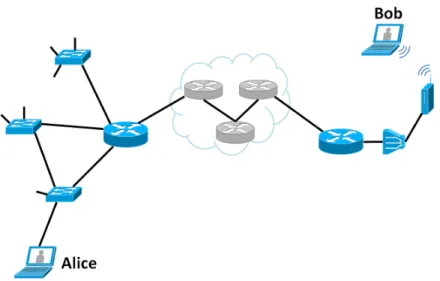
Internet. In the figure, Alice and Bob are endpoints. Alice is connected to the Internet through a series of devices on her network, connected to Bob’s network through a path of routers in the Internet (designated by a cloud), and finally to Bob by the infrastructure in Bob’s network. Any device along the path taken by her packets can view or alter her packets’ headers as it deems fit.
As we will show, packet headers may experience a variety of changes to their fields while in transit, both intentional and unintentional. Intentional changes, such as network address translation desired by a network administrator, are an acknowledged fact of life on the Inter-net. Unintentional packet modifications, however, can be the result of misconfigurations or legacy devices and are an often under-appreciated issue that can have a widespread impact on the Internet and the evolutionary trajectories of the protocols that define it.
Through numerous examples documented by related measurement studies, we review in Chapter 2 exactly how such inadvertent packet header modifications have led to cases of performance issues, unintended protocol interactions, and blackholes where misunderstood packets simply get discarded by a network device. Unintended interactions can occur when a device misinterprets the meaning of a field, incorrectly alters it, and interferes with the correct operation of that protocol.
The primary motivation behind this dissertation is to develop the methodology and tools needed to have the most automated and generally usable platform as possible to further expose such problematic changes to critical packet header fields. The development of such a platform would impact a wide cross-section of Internet stakeholders, as discussed in Section 1.4.
Prior to this work, such a platform did not exist. The current state-of-the-art (described in Chapter 3) is an array of underused methods—all with some combination of deployment, incentive, or consistency issues that keep it from being used in the general case and preclude integration into TCP. Since TCP does not know anything about the networks it is going to traverse, it must make inferences about the end-to-end network state. Methods exist for inferring information such as congestion [8] and transmission errors [9], but none have yet been applied to detect when connection control information gets modified. If a platform could be developed that did not suffer from the same types of previously mentioned issues
Figure 1.1: Simplied scenario of two hosts communicating over the Internet
(such as the solution advocated by this dissertation), it could fill that void and become another network state inference tool used by TCP.
1.1
Middleboxes
Finding the cause of inadvertent packet header modifications is difficult, since many differ-ent types of devices, in many differdiffer-ent administrative domains, interact with a packet as it traverses the Internet. Traditionally, the primary objective of these devices was only packet forwarding (i.e., determining the next best hop to send the packet to based on information in a forwarding table). It is increasingly common, however, for packets to encounter devices whose primary task is something other than just the forwarding or routing of packets. re-quest for comments (RFC) 3234 defines a term for these types of devices,middleboxes, and gives a taxonomy of the various types that existed at the time of publishing in 2002 [10]. The prevalence and diversity of middleboxes have only continued to grow since.
1.1.1
Types of Middleboxes
Some examples of well-known and commonly deployed middleboxes include: firewalls, network address translation (NAT) devices, performance-enhancing proxies, and transcoders that modify image files to reduce their size. Systems such as these are prevalent on the net-work, with each one having the ability to modify packets for its own purposes. A recent
study in 2012 showed that in networks of all sizes, the number of middleboxes is on par with the number of routers [11].
NAT devices, in particular, are extremely prevalent. Recent statistics from the network diagnostic tool Netalyzr show that about 90 percent of its sessions came from behind a NAT device [12]. Although Netalyzr’s results likely suffer from a population bias, NAT has become nearly ubiquitous on home and corporate networks in large part due to the decreasing availability of globally-routable IPv4 addresses.
Also in use on the Internet are a myriad of other more specialized “security-enhancing” devices like sequence number randomizers [13], fingerprint scrubbers [14], active war-dens [15, 16], and traffic normalizers [17]. Because these devices act as a man-in-the-middle (MITM), they can alter any bits within the entire packet header. NAT devices, for example, are expected to alter certain fields such as Internet Protocol (IP) addresses and TCP or User Datagram Protocol (UDP) port numbers, but nothing stops the same device from changing more header fields than that, such as sequence numbers and IP or TCP options. Any device acting as a MITM could also change payload data, but changes to pay-load data are already protected by other well-established solutions (e.g., Transport Layer Security (TLS)).
1.2
Problem Description
Middleboxes are difficult to manage and maintain. Networks of all sizes employ a diverse set of middleboxes that serve a variety of purposes. Even within the same network, the middleboxes are often from various vendors, usually run on separate physical hardware, and require configuration by a well-trained administrator. As a result, they can require a large support staff, which greatly adds to the already expensive cost of purchasing, licens-ing, and upgrading middlebox deployments [11]. In reality, the overly simplified commu-nication scenario between Alice and Bob from Figure 1.1 looks more like the situation in Figure 1.2, where a variety of middleboxes permeate each network. And, on any given end-to-end path, problematic middleboxes may reside in an external administrative domain, complicating both efforts to debug and fix connection issues.
All of the previously mentioned issues with maintaining middlebox deployments contribute to the introduction of misconfigured, nonstandard, or out-of-date legacy behaviors in
mid-Figure 1.2: More realistic scenario of two hosts communicating over the Internet
dleboxes. In a survey of 57 network administrators, the majority overwhelmingly cited misconfiguration as the most common cause of middlebox failure, most likely due to the management and upgrade complexity involved [11]. As a result, the situation illustrated in Figure 1.2 appears much more daunting as the potential that Alice and Bob experience any performance or connectivity issues increases.
With their prevalence and how much power they have to alter packets and their semantics, it is a problem when middleboxes operate incorrectly or make unintended changes. As we will show in Chapter 2, such changes can result in unexpected protocol interactions and end-to-end performance issues. Furthermore, even just the threat of encountering such is-sues can negatively influence protocol innovation, forcing designers to scale back improve-ments and take overly conservative deployment strategies [18–22]. Examples can be seen in the designs of modern up-and-coming protocol extensions such as TCP Fast Open [23], Tcpcrypt [24], SPDY [25], and Multipath TCP [21] as their documentation discusses neg-ative interactions with middleboxes. As we show in Chapter 2 and confirm in Chapter 8, such end-to-end traversal issues still occur and are a real problem on the Internet.
The existing solution space for this problem can be broken down into three primary cate-gories of approaches: prevention, avoidance, or detection. Prevention involves using strong cryptography to stop middleboxes from tampering with packet headers. Avoidance tries to
fix the middleboxes themselves before issues arise. The final category, detection, includes solutions that check to see whether any modifications were made to the packet headers in-flight. Chapter 3 describes examples of related work that fall under each category and the limitations they have.
In this dissertation, we advocate a strategy of detection. We feel that this strategy is the most flexible, most cooperative with current middleboxes, and will be the most likely type of approach to achieve widespread adoption. Achieving widespread adoption is critical to any type of new protocol enhancement so that it is usable between a larger number of endpoint pairs. Since our design ultimately hinges upon adoption, we take steps throughout to make adoption-friendly design choices.
1.3
Summary of Contributions
The following list summarizes the primary contributions in this thesis:
1. Design of a novel methodology for the end-to-end detection of TCP/IP packet header manipulation: TCP-HICCUPS. The Handshake-based Integrity Check of Critical Underlying Protocol Semantics (HICCUPS) is an incrementally deployable exten-sion to TCP that seeks to automate the question,“Did my packets arrive at their des-tination with the same headers as they were sent with?” As we will show throughout this dissertation, HICCUPS encompasses a unique set of design features, due to its specially tailored security model, that allow it to outperform the current state-of-the-art in areas such as general usability, efficiency, and in its ability to improve TCP:
• HICCUPS is cooperative with currently deployed middleboxes, applying a tamper-evident seal to packet headers that allows devices to continue modifying packet headers as desired, but revealing that modification to a connection’s endpoints. • HICCUPS is lightweight, requiring only a very small amount of processing overhead in our unoptimized kernel implementation that is on par with the over-head used for other packet processing functions in the Linux kernel.
• HICCUPS operates in-band within TCP, requiring no out-of-band protocols such as Internet Control Message Protocol (ICMP). Not using any additional protocols helps improve the consistency of HICCUPS over current state-of-the-art approaches. As such, the inferences gathered by HICCUPS can be more
effectively used by TCP to maximize its performance in the presence of mis-configured or non-standard middleboxes.
2. Real-world implementation and testing of HICCUPS in a modern version of the Linux TCP networking stack. We have also provided a user space tool set that mimics the kernel behavior to allow for widespread and immediate testing.
3. Design and implementation of AppSalt HICCUPS, an optional extension that uti-lizes a novel cross-layer integrity protection scheme to discourage HICCUPS’s in-tegrity values from being modified in transit by certain middleboxes, even after the HICCUPS integrity algorithm becomes public knowledge.
4. Deployment of, and measurements from, HICCUPS across 26,304 diverse directed port/path pairs on the live Internet.
5. Documented instances of degenerate middlebox behavior and the ways in which HICCUPS cooperation could improve transfer performance.
1.4
Impact on Relevant Stakeholders
The significance of this work is the impact it could have on our understanding of the global Internet architecture. Successful adoption of this technology would not only make debug-ging and troubleshooting easier, but yield new insights about the integrity of packet transit across a large portion of the network. It would also enable interesting future measurement studies that could clarify the impact of middleboxes and allow network administrators to implement new protocols more safely, without alienating a small set of users behind a faulty middlebox. This could accelerate the deployment of new protocols that enhance robustness, reliability, or offer new functionality.
Several incentives exist to promote adoption of our proposed solution. We envision HIC-CUPS benefiting all groups of key Internet stakeholders:
• End users and content providers want to know that their traffic is treated fairly by their transit providers (e.g., in the context of network neutrality [26]).
• Protocol designers want to know how their new designs will be affected by network middleboxes.
• Large Internet companies want to take advantage of new protocol extensions de-signed to increase performance, but do not have a means to tell if the extension
would be safe to use.
• System and network administrators would have access to a new diagnostic tool to troubleshoot more complex connectivity issues.
• The networking community would be able to draw upon a wealth of new information for measurement studies to better understand the global Internet.
• Any end host enabled with our detection code could instantly become a cooper-ating end point in a path integrity test. This would be similar to how ping and tracerouteare used today to enable network tests with a large number of hosts without requiring prior coordination with the system administrators.
1.5
Document Structure
The remainder of this dissertation is organized as follows:
Chapter 2 provides background information to fully explain the various network mecha-nisms discussed in this work, as well as related research on middleboxes and the issues they can cause.
Chapter 3 begins with a survey of the various existing solutions introduced in Section 1.2 and then synthesizes their shortcomings into a set of well-defined architectural design principles. These goals are then used to evaluate our methodology in the context of various relevant works.
Chapter 4 discusses methods for transmitting integrity information and the implications of various design considerations.
Chapter 5 presents our design for HICCUPS and describes its methodology in detail. Chapter 6 considers what can happen when a middlebox attempts to fake the integrity
information and details AppSalt, an optional extension that adds protection to the integrity values transmitted by HICCUPS.
Chapter 7 details our implementation in the Linux kernel and related design choices. Chapter 8 presents the results from experiments using our protocol on the Internet. Chapter 9 concludes our work by summarizing key points and discussing opportunities
CHAPTER 2:
Background and Impact of Middleboxes
Intermediaries make the web a hostile place for protocol changes.
Mike Belshe, designer of the SPDY protocol
In this chapter, we analyze the impact of misconfigurations and legacy behavior in mid-dleboxes on both the performance and evolutionary trajectory of the Internet. Prior to dis-cussing such issues with middleboxes, Section 2.1 covers relevant background information to help setup and more thoroughly understand how the affected protocols operate. Then, building upon the issues introduced in Section 1.2, we more closely examine the breadth of disruptions that can arise from misconfigured middleboxes (Section 2.2), going into depth on several selected issues (Sections 2.3–2.4). Finally, we conclude with a discussion of the impact that these disruptions have on overall network security (Section 2.5) and on protocol innovation going forward (Section 2.6).
2.1
TCP/IP Background
TCP/IP is the primary suite of protocols on which the Internet operates. The various ele-ments of communication on the network are broken out into four layers which make up the full protocol suite. In order from highest to lowest, the layers are: application, transport, network, and data link [27]. Each layer is responsible for a different aspect of communi-cation and has its own set of associated protocols. Figure 2.1 graphically represents the ordering of the layers for the TCP/IP model along with some exemplary protocols.
The application layer is the most flexible with respect to what bit structure the network will tolerate and transmit. The TCP/IP model treats any contents in the application layer portion of a packet as application data. Other popular network models such as the Open Systems Interconnection (OSI) model [28] further subdivide this layer, but we do not describe them here since the additional elements are out of scope; the work covered in this dissertation does not deal with any application layer elements. Traditional end-to-end philosophy holds
Figure 2.1: The four layers of the TCP/IP protocol suite (from [27])
that the network should completely ignore this layer and let end hosts handle any processing of the application layer [6].
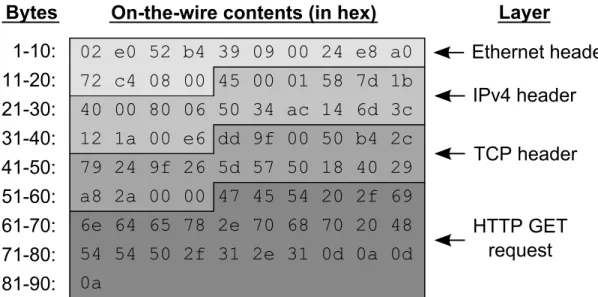
The transport layer provides port-based multiplexing services, as well as an optional set of end-to-end services that can help improve an application’s performance (e.g., flow con-trol and reliable stream reassembly—ordering and loss correction). Both UDP [29] and TCP [3] are provided by the TCP/IP protocol suite, with TCP being the one that provides the optional services just mentioned. We describe TCP in more detail in Section 2.1.3. The network and data link layers help network devices get a packet from one end host to another. These lower layers have considerably less context that is maintained end-to-end. Figure 2.2 shows an example of how a packet may look as it crosses the wire. This particular packet is a Hypertext Transfer Protocol (HTTP)GETrequest. Web browsers send this type of request in order to fetch a webpage from a remote webserver [30]. In the figure, each byte of the packet is shown as a pair of hexadecimal digits. Note the construction how each header is layered over the original application data (theGETrequest).
In the remainder of this section, we describe selected protocols and features that are relevant to the background middlebox work presented in the remaining sections of this chapter.
2.1.1
IP
The structure of an IPv4 header is shown in Figure 2.3. Working from the top line down, IP defines some control information about each packet, a pair of 32-bit addresses that rep-resent an interface on a particular end host, and an options block. The control information
Figure 2.2: Example of what a packet looks like on the wire (this specic packet is an HTTP request to get a webpage from a webserver)
held within the first 12 bytes include a version number, the length of the IP header, the differentiated services code point (DSCP), Explicit Congestion Notification (ECN), length of the total packet, fragmentation-related information, a hop expiration counter, the type of transport protocol being carried, and a 16-bit checksum of the header.
It is important for later to note the history with the DSCP and ECN fields. Before DSCP and ECN were standardized in 1998 and 2001, respectively, the entire second byte of the IP header (shown in the top row of Figure 2.3) was defined as the type of service (ToS) field. RFC 791, the specification for IP since 1981, shows the ToS field being used by gateways to hold indicators marking service and priority requirements for packets. When ECN was created, the semantics of the highest two bits in that second byte were redefined. No longer were they “reserved for future use” and to always be set to zero, but now possess meaning. ECN is described further in Section 2.1.3.
The field redefinition issues experienced with ECN were not a singular event. Other pro-posals are currently under consideration by the Internet Engineering Task Force (IETF) to reclaim other bits of the headers. Some features that were useful in the early years of TCP/IP design are rarely used in the modern Internet and may be subject to reuse. Some examples are fields related to fragmentation [34] or the TCP urgent pointer [35].
0
Version IHL Code PointsDiffServ Total Length Identification DF Fragment Offset
Time-to-Live (TTL) Protocol Header Checksum
Source IP Address Destination IP Address
Options and Padding
31 1 2 3 4 5 6 7 8 9 10 11 12 13 14 15 16 17 18 19 20 21 22 23 24 25 26 27 28 29 30 E C N IHL 20 bytes R MF
Figure 2.3: Structure of an IPv4 header (after [3133])
2.1.2
ICMP
ICMP [36] is primarily used to transmit status and error messages between systems on the Internet. For example, when a UDP datagram is sent to a port that is closed, the receiving host will respond with an ICMP destination port unreachable message to let the sender know that the port was closed. There are many different types of ICMP messages, which all use the base format shown in Figure 2.4. The format of the latter portion of the ICMP header depends on which type of message it is. Each message is defined by a type and a subtype, also called a code. For example, the destination port unreachable message is type three, code three. We next discuss two specific messages that will be referenced later in this document.
Figure 2.4: Base structure of an ICMP header (after [36])
TTL exceeded in transit
Thetime-to-live (TTL) exceeded in transit message is a subtype of the time exceeded mes-sage (type 11, code zero). This mesmes-sage is an error code sent by a router when it receives
a packet with a TTL value of one. After the router performs its decrement, the TTL is zero and the packet is considered to be expired. This particular message provides the ba-sis for a number of path diagnostic tools (e.g.,traceroute[37], Paris Traceroute [38], Tracebox [39], etc.).
traceroutewas originally developed by Van Jacobson in 1987. Its intuition is simple: starting with a TTL value of one, send a succession of packets with singly increasing TTL values. The packet will expire at each successive hop along a path and the sender will be able to enumerate the routers along the path by the ICMP TTL exceeded messages that come back in response.
Fragmentation needed and DF set
Thefragmentation needed and don’t fragment (DF) setmessage is a special subtype of the destination unreachable type (type three, code four). This message is an error response to a packet that is too large to traverse a link and cannot be fragmented because it has the DF flag set in its IP header, indicating that it is “not to be internet fragmented under any circumstances” [31]. Since the packet cannot be fragmented by the router, the router drops the packet and sends the resulting ICMP error message back to the packet’s sender.
This message is used by a technique to automatically discover the largest acceptable packet size that a path will accept: path maximum transmission unit discovery (PMTUD). PMTUD was developed as a means of being able to eliminate the act of transparent in-flight frag-mentation, which by 1987 was widely considered to be too inefficient, too complex, and too much of a performance hit to be worth supporting [40]. By the mid 2000s, transmission rates had largely exceeded the capacity allowed by the 16-bit IPID field to differentiate between fragments, further condemning the practice of transparent in-flight fragmenta-tion [41].
PMTUD works best when routers implement an accompanying change to their type three, code four messages introduced by RFC 1191: the definition and population of the Next-Hop MTU field. When it is the case that the MTU-restricting routers along a path imple-ment this improveimple-ment, the process of PMTUD is as shown in Figure 2.5. If a router does not provide such feedback, it is left up to the host to “search” the MTU space.
Figure 2.5: Example Path MTU Discovery scenario
In practice, a sizable number of occurrences of firewalls blocking the return of the ICMP feedback messages prevents PMTUD from operating properly. In a 2004 measurement study, Medina et al. found a mere 41 percent success rate of PMTUD where blocked ICMP messages were pinpointed as the presumable cause of failure for 18 percent of the servers tested [42, 43]. Luckie and Stasiewicz revisited the issue in 2010 to find a higher PMTUD success rate of 78–80 percent, nearly double that of the the 2004 result, but found other causes of PMTUD failure, such as a software bug where the DF flag was still being set for very small MTU values [44].
Ultimately, however, ICMP blocking and issues integrating with TCP [45] were so prob-lematic that PMTUD was rewritten to use TCP instead of ICMP [46]. The issues that PMTUD experienced with ICMP blocking are a notable example of issues with out-of-band feedback mechanisms, and as such, have highly influenced the design of our methodology. We elaborate more on this in Section 4.4.
2.1.3
TCP
The structure of a TCP header is shown in Figure 2.6. Working from the top line down, TCP defines: port numbers used for connection multiplexing, sequence and acknowledgment numbers used for stream ordering and reassembly, flags used for connection negotiation and teardown, a window size used for flow control, a 16-bit checksum and urgent pointer, and an options block that designers included so that the protocol could be expanded later. We explain each of these features in more detail in the following subsections.
0
Source Port Destination Port Sequence Number Acknowledgement Number Window Size Urgent Pointer TCP Options (0-40 bytes) 31 1 2 3 4 5 6 7 8 9 10 11 12 13 14 15 16 17 18 19 20 21 22 23 24 25 26 27 28 29 30 Offset * 4 20 bytes Checksum Offset Rsvd SY N C W R E C E U R G A C K P S H R S T F I N N S 0 0 0
Figure 2.6: Structure of a TCP header (after [3])
Connection negotiation
TCP is a connection-oriented protocol: all data is transmitted within the context of a con-nection between a pair of endpoints. New TCP concon-nections are created by a process known as the three-way handshake (3WHS) which is illustrated in Figure 2.7. In the figure, Alice is the endpoint that wishes to initiate the connection. To do so, she sends Bob an empty TCP segment with the synchronize (SYN) flag set. This action triggers the start of the 3WHS. If Bob has an application socket listening on the destination port, he responds with a SYN of his own with the acknowledgment (ACK) flag also set. To complete the handshake, Alice ACKs Bob’s SYN/ACK. Connections can be closed gracefully via the finish (FIN) flag, or abruptly via the reset (RST) flag.
Sequence numbers
In TCP, all application data is sequenced by byte so that it can be reliably transferred from one end host to another. TCP ensures that all data is both complete and in the proper order
Figure 2.7: Example of connection negotiation in TCP using a three-way handshake between two endpoints, Alice and Bob)
before handing it up to the application layer. One TCP informs another about the portion of the data stream that it has cumulatively intact by acknowledging the next byte that it needs in the acknowledgment number field.
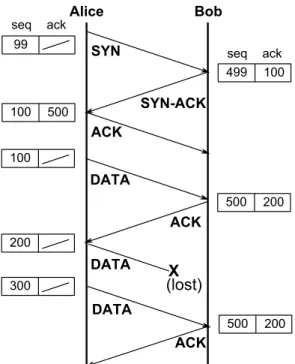
Figure 2.8 illustrated an example TCP session with simplified sequence and acknowledg-ment numbers. When Alice initiates the connection, she chooses an initial sequence num-ber (ISN) for her SYN. Bob acknowledges her ISN by setting his acknowledgment numnum-ber to the number of the next byte he expects to receive from Alice. Since TCP is bidirectional, Bob also chooses an ISN to represent the flow of bytes from him to Alice.
In the example in the figure, one of Alice’s data segments gets lost on its way to Bob. TCP’s usage of sequence numbers informs Bob of the lost data when the next packet he gets from Alice contains data beyond what he was expecting to receive next. Since Bob is missing a portion of the data stream, he must send a duplicate acknowledgment to Alice. One can already see how this can be inefficient if only one packet is lost and none of the successively received bytes can be acknowledged. This problem is solved by selective acknowledgment (SACK) which is discussed later with the TCP options.
Figure 2.8: Example of sequence number usage in a TCP connection between two endpoints, Alice and Bob)
Flow Control
Each TCP implementation maintains a receiver buffer that acts as a temporary hand-off area between TCP and an application. As new data arrives, it is queued in the buffer until the application makes a system call to retrieve it. TCP will only allow completely reassembled stream content to be read by an application, holding in the receive buffer any content that is not in the correct order or is missing a piece of data [3, 47].
The flow control window in TCP is used to keep a sending TCP from overwhelming a re-ceiver’s buffer capacity. The flow control window, also called a receive window, represents the maximum number of bytes that a TCP is willing to accept at a given time. The field is 16 bits in length, but can support larger window values through the scaling option discussed later in this section.
Consumption of the data in the receive buffer can be limited by an application, the system’s CPU usage, or by TCP’s stream reassembly behavior when data loss is experienced [47]. For the last cause, the worst case scenario is that a full window of data is sent from one
TCP to another, but the first packet of the window is dropped. Since TCP must reliably reassemble the data stream, the buffer on the remote TCP is left mostly full and there may not be enough buffer capacity to accept new packets, resulting in wasted bandwidth and retransmissions. If a TCP flow is throttled back due to the flow control window, it is considered to bereceive window-limited.
ECN
Traditionally, a TCP sender must rely solely on timeouts or lost segments in order to in-fer when a path is congested. ECN [33] is an improvement that allows routers to more actively assist in congestion control by marking packets as local buffer pressure increases. Indications from routers signal the receiver to alert the sender to reduce his rate before the router will be forced to drop packets, which is more inefficient than having the sender preemptively slow down.
At the bit level, the ECN semantics are transmitted via several fields within the IP and TCP headers. The congestion mark is made by setting a pair of bits in the IP header, shown in the middle of the top row of Figure 2.3. The two-bit field can take on three different meanings as shown in Table 2.1. When a router wants to mark congestion, and the packet is ECN-capable, the router changes the ECN-capable transport (ECT) code point in the IP header to the congestion encountered (CE) code point. A receiver that gets a packet with the CE code point set knows that congestion occurred and should tell the sender to reduce its rate. Feedback notification from the receiver to the sender is done by setting the ECN echo (ECE) flag in the TCP header of returning acknowledgment packets until the sender gets the message and reduces its congestion window. The sender can then inform the receiver that it has indeed reduced its window by setting the congestion window reduced (CWR) flag of the TCP header. Both flags are shown on the left side of the fourth row in Figure 2.6.
It is important to note that all of the bits occupied by these ECN flags had other meanings before ECN was standardized in 2001. The DiffServ and ECN code points fields shown in the top row of Figure 2.3 were originally a single byte known as the ToS field. The TCP flag bits shown on the left side of the fourth row of Figure 2.6 were listed as reserved and expected to always be zero. An experimental enhancement to ECN adds semantics to another bit in the TCP header, the nonce sum (NS) bit [48].
Bits Code Point Meaning 00 Non-ECT Not ECN-capable 10
ECT ECN-capable, no congestion 01
11 CE Congestion encountered Table 2.1: ECN code points in the IP header
Options
The original designers of IP and TCP wanted to allocate space within the headers to allow for future expansion and features. As a result, both IP and TCP allow their headers to be extended up to 40 additional bytes in length for placement of consistently formatted options. Since then, many enhancements that use this space have been proposed and several have become standards. Some of the more well-known standardized TCP options include:
• Maximum Segment Size: sent in the options block of the SYN; defines the largest sized segment that should be sent as part of that unidirectional flow [49, 50].
• Selective Acknowledgment: if its use is negotiated in the 3WHS, receivers can ad-ditionally acknowledge blocks of data received beyond the cumulative stream bound-ary [51]. An example of SACK operation is shown in Figure 2.9.
• Window Scaling: sent in the options block of the SYN; defines a power of two scaling factor to be applied to that unidirectional flow’s receive window [52].
• Timestamps: contain two four-byte long timestamp values and can be attached to any packet of a TCP connection to help stacks measure round trip times (RTTs). One of the timestamps is simply an echo of what was received from a remote TCP in an ACK [52].
• Multipath TCP: allows TCP to utilize multiple paths as part of a single connection in order to maximize efficiency of resource usage or swap between different types of networks such as Wi-Fi and cellular data networks [21].
2.2
General Measurement Studies
Architectural issues with middleboxes and their unintended consequences have long been documented [18, 19, 42, 43]. In 2004, Medinaet al.detailed several issues caused by unex-pected interactions on the part of a middlebox [42, 43]. In addition the issues with PMTUD previously described in Section 2.1.2, middleboxes were found to disrupt a number of other
Figure 2.9: Scenario showing how SACK helps improve performance
protocol features. For example, the usage of a non-standard IP option resulted in failure of over 70 percent of connections, with mixed results even for common options. The con-cern of such behavior is not just that the options were not propagated, but even worse that the entire packet was dropped at some point along the path (i.e., the “blackhole” problem). The authors also found that ECN was a problem area as well, where middleboxes overwrite flags, causing failures with negotiation and congestion notification. We look at ECN issues more closely in Section 2.3.
Hondaet al. used measurements taken by their tool, TCPExposure, to examine how TCP options are treated by middleboxes [19]. They found instances of TCP options, both known and unknown, being stripped from packets, sequence numbers being translated, and even some port-specific behaviors where options were stripped on a random high port, but not on port 80. Middleboxes along some paths were also found to be very fragile dealing with out-of-order data. Ultimately, they found that at least 25 percent of the paths seen in the study had a middlebox whose behavior depended on the transport-layer (e.g., TCP) of packets that passed through the middlebox. Not only is this interference detrimental to the validity of the protocol interactions, but it is also difficult to diagnose and makes troubleshooting a complex endeavor.
2.3
Explicit Congestion Notification
ECN [33] is an interesting TCP/IP enhancement worth closer examination as experiences with ECN distill the essence of the middlebox problem. Recall from Section 2.1.3 that ECN relies on a delicate series of cross-layer interactions to function properly:
1. Routers must be able to mark packets (at the IP layer)
2. The receiver must echo the congestion mark back to the sender (at the TCP layer) 3. The sender must properly acknowledge and slow down
There are many opportunities for the above series of interactions to be disrupted. Not only must the three parties involved (sender, receiver, and routers) properly follow the protocol, but any middleboxes along the path must retain all of the ECN semantics. For example, suppose a middlebox inadvertently clears the CWR flag, keeping the sender from acknowl-edging the receiver’s ECE and letting it know that the sender has reduced its congestion window. The sender would continue to see the ECE flag set on acknowledgments returning from the receiver and not realize that the receiver never saw the sender’s CWR acknowl-edgment. As such, the sender would infer that congestion was still occurring on the path and continue to reduce the size of its congestion window.
2.3.1
Issues with legacy devices and ECN
In addition to the complex series of interactions, issues with ECN are further exacerbated by the fact that every one of the header fields used by ECN has held other meaning. At least over 30 years went by between the first documentation of TCP and IP before ECN was devised and standardized in 2001. Each of the fields redefined by ECN is an opportunity for a legacy middlebox to misinterpret packet header bits and potentially disrupt the ECN interactions.
While the study by Medina et al. found occurrences of ECN-blocking middleboxes, it was performed in 2004 when ECN was fairly new and had not yet achieved widespread implementation. For example, 93 percent of the servers they tested did not even support ECN. Seven years later, in 2011, Baueret al.revisited ECN readiness in Internet hosts and found that even though many servers were capable of using ECN, a non-trivial number of problems with middleboxes disrupting the ECN fields still existed [20]. The most common
problem involved treating the 6-bit DSCP field and the 2-bit ECN field as the old 8-bit ToS field. Attempts to overwrite or clear what the network device thought was the ToS field resulted in accidentally overwriting the ECN information.
Such overwriting can also impact connection performance. For instance, if any of the con-gestion signaling bits are inadvertently set when there was not any concon-gestion to begin with, performance will suffer. As stated before in Section 2.3, ECN relies on a delicate se-ries of cross-layer interactions to properly communicate when congestion was experienced and when that communication was acted upon. Any spurious overwriting of its fields can corrupt the state between the two endpoints, confusing ECN and impacting performance. It is important to note that all of these issues are unintentional. None of the disruptive issues noted above and in the studies by Medina et al. and Bauer et al. were due to an active adversary attempting to harm the performance of connections. They were due to poorly configured switches or routers that have not been updated in years. In the case of Baueret al., when the authors notified the network operator for one of the issues they detected, the operator was unaware of the issue [20]. Examples such as with ECN serve to strengthen the argument that the model of the inadvertent adversary, even though under-appreciated when compared with an actively malicious adversary, can still be a greatly disruptive force on the Internet and a threat to overall network stability.
2.4
ISN translation and SACK
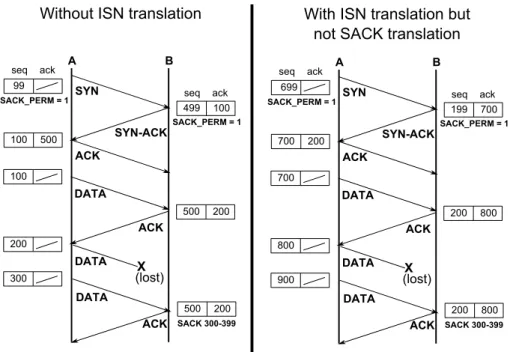
Another example of an Internet protocol being manipulated by a middlebox is found in the manner in which some firewalls implement TCP ISN randomization. ISN randomization is done by some firewalls to protect hosts behind them that insufficiently randomize their ISNs, leaving the values predictable and making the connection vulnerable to spoofing at-tacks and off-path resets (see Section 4.7.6 for more). Once an initial sequence number is changed, all sequence numbers must continue to be translated throughout the life of the TCP connection. However, in many cases this feature does not properly translate SACK values and passes the untranslated SACK blocks with translated ISNs (see Figure 2.10). En-abling this feature harms both performance and overall throughput since the out-of-window SACK blocks only confuse TCP and do not reduce any retransmissions. Documentation from one leading vendor now recommends disabling the module in their firewall [13].
Figure 2.10: Scenario showing how SACK can be disrupted by poor implementation of ISN translation
Problems such as a mismatch between SACK blocks and overwritten sequence numbers can be very difficult and time consuming to identify and fix. We encountered this very issue ourselves on our own organization’s network. In order to diagnose it, we required a cooperating endpoint remotely located outside our network to perform low-level compari-son between traffic sent and traffic received. In addition to requiring resources outside one’s administrative control to troubleshoot a problem within their own network, this problem is very subtle and requires the keen eye of a trained administrator to recognize and understand the issue. With the methodology we present in this work, the detection logic we build into TCP would alert both the user and the network stack itself to such issues, eliminated the need for a skilled administrator to troubleshoot.
Instances of SACK mismatches due to middleboxes are found in the academic literature as well. Honda et al. gives a general warning about sequence numbers being included in various TCP options due to the fact that they are often inconsistently overwritten by middleboxes [19]. Honda also notes that this issue could even become worse if any of the various proposals to expand the TCP options space [35] are ever adopted. Extending the



![Figure 3.1: Before and after illustrations of the IPsec Authentication Header being applied in either transport or tunneled mode (after [66])](https://thumb-us.123doks.com/thumbv2/123dok_us/10134924.2914495/59.918.238.683.244.490/figure-illustrations-ipsec-authentication-header-applied-transport-tunneled.webp)