Improving large-scale image retrieval through
robust aggregation of local descriptors
Syed Husain and Miroslaw Bober,
Member, IEEE
Abstract—Visual search and image retrieval underpin numerous applications, however the task is still challenging predominantly due to the variability of object appearance and ever increasing size of the databases, often exceeding billions of images. Prior art methods rely on aggregation of local scale-invariant descriptors, such as SIFT, via mechanisms including Bag of Visual Words (BoW), Vector of Locally Aggregated Descriptors (VLAD) and Fisher Vectors (FV). However, their performance is still short of what is required. This paper presents a novel method for deriving a compact and distinctive representation of image content called Robust Visual Descriptor with Whitening (RVD-W). It significantly advances the state of the art and delivers world-class performance. In our approach local descriptors are rank-assigned to multiple clusters. Residual vectors are then computed in each cluster, normalized using a direction-preserving normalization function and aggregated based on the neighborhood rank. Importantly, the residual vectors are de-correlated and whitened in each cluster before aggregation, leading to a balanced energy distribution in each dimension and significantly improved performance. We also propose a new post-PCA normalization approach which improves separability between the matching and non-matching global descriptors. This new normalization benefits not only our RVD-W descriptor but also improves existing approaches based on FV and VLAD aggregation. Furthermore, we show that the aggregation framework developed using hand-crafted SIFT features also performs exceptionally well with Convolutional Neural Network (CNN) based features. The RVD-W pipeline outperforms state-of-the-art global descriptors on both the Holidays and Oxford datasets. On the large scale datasets, Holidays1M and Oxford1M, SIFT-based RVD-W representation obtains a mAP of 45.1% and 35.1%, while CNN-based RVD-W achieve a mAP of 63.5% and 44.8%, all yielding superior performance to the state-of-the-art.
Index Terms—visual search, image retrieval, local descriptor aggregation, global descriptor
F
1
I
NTRODUCTIONThe explosive growth in the multimedia industry has created a need for effective and computationally efficient retrieval systems. Given a large collection of images and videos, the aim is to retrieve individual images and video shots depicting instances of a user-specified object (query). There are a range of important applications for image re-trieval including management of multimedia content, mo-bile commerce, surveillance, augmented automotive navi-gation etc. Despite formidable efforts, the performance of existing systems still lacks in terms of robustness, processing speed and detection rates; especially at the low false alarm rates required for immense databases.
The task of performing robust, accurate and scalable visual search is challenging. An object’s appearance can depend on many compounding factors such as object scale, illumination, occlusions, dissimilar backgrounds, varying viewpoints and compression artifacts. Additionally, today’s systems must be highly scalable due to the huge volumes of multimedia data, which can comprise billions of images.
A classical approach to object based image retrieval involves use of scale-invariant local descriptors such as SIFT [1] or later variants [2], [3], which achieve some robust-ness to scale changes, illumination conditions and occlu-sions. While the use of local descriptors increases the robust-ness against large visual distortions and partial occlusions, it also increases computational complexity of the search, as • M.Bober and S.Husain are with the Centre for Vision, Speech and Signal Processing (CVSSP), Department of Electrical Engineering, University of Surrey, Guildford, Surrey, GU2 7XH, UK.
E-mail:{sh0057, m.bober}@surrey.ac.uk
they need to be individually compared and matched. One solution is to form a single, global image representation, thereby simplifying the matching process and leading to an improved matching speed and lower memory usage.
Such global representation can be extracted either di-rectly from pixels in an image or by aggregating local image descriptors. The first category, represented for example by the GIST descriptor [4], has a significant drawback in that it lacks robustness to many common image transformations, such as partial occlusion, cropping and rotation [5]. In con-trast, successful techniques for image retrieval tend to focus on deriving image representations from local descriptors. For example, the Bag-of-Words (BoW) representation has been widely used in textual document classification and subsequently adapted to computer vision tasks, including retrieval [6]. Perronnin et al. [7] proposed a local descriptor aggregation based on the Fisher kernel framework, while Jegou et al. introduced a simplified version called VLAD [8]. Section 2 reviews global descriptors in detail.
In this paper we propose a novel aggregation scheme; Robust Visual Descriptor, with various extensions. The core RVD concept originates from robust statistics, and was introduced in a preliminary way in [9], [10], [11]. Here we present in-depth details of the core method, significantly expand the experimental evaluation, and - crucially - re-veal new insights on the reasons underpinning its strong performance. We then further extend the core method by introducing cluster-wise whitening and novel descriptor normalization, leading to world-class performance, signif-icantly out-performing any results published to date. Our main contributions include:
• The core RVD aggregation approach employing a
novel rank-based multi-assignment with a direction-based aggregation method.
• An RVD extension, where the variances of residual
vector directions are balanced, in order to maximize the discriminatory power of the aggregated vectors. This is achieved by a novel intra-stage pre-processing of the residual directions using cluster-wise PCA with a whitening operation. We call this represen-tation RVD-W.
• A new normalization approach applied after the
RVD-W vectors are transformed via global PCA. Our normalization involves L1-norm followed by a power-norm. We show that the aforementioned normalization is different from existing approaches including Whitening with L2 normalization [12] and power+L2 normalization [13], and offers significant benefits in terms of retrieval accuracy.
• We conduct an in-depth experimental study to il-lustrate the effects of various elements of the RVD-W pipeline, in order to understand the roots of its superior performance. For instance, we analyze the behavior of the rank-based multi-assignment and compare it to the well studied hard-assignment of VLAD and the soft-assignment used in the FV ap-proach. We also investigate the impact of apply-ing L1-normalization to residual vectors, cluster-wise PCA and cluster-wise whitening before aggregation into RVD-W.
• We combine our RVD-W framework with
CNN-based deep features, demonstrating performance be-yond the state of the art [14] [29] [34]. In particular, we show that RVD-W aggregation outperforms both FV and sum-pooling methods for CNN features, contrary to the recent views that sum-pooling [14] is preferred with deep features. Uniquely, we also present CNN based results on datasets with 1M distractors.
This paper is organized as follows: Section 2 provides insights into state-of-the-art local descriptor aggregation methods. In Section 3, we present our core RVD repre-sentation and its variants. The experimental setup and the detailed evaluation of our method is presented in Section 4. In Section 5 we compare our results with the state of the art demonstrating significant improvement over recent global descriptors on both the Holidays and Oxford datasets. On the large scale datasets, Holidays1M and Oxford1M, SIFT-based RVD-W representation obtains a mAP of 45.1% and 35.1%, while CNN-based RVD-W achieve a mAP of 63.5% and 44.8%, all significantly outperforming any results pub-lished up to date.
2
G
LOBALD
ESCRIPTORSThis section reviews state-of-the-art global representations that encode the distribution of local image descriptors in an image, namely the BoW, Fisher Vector, VLAD and Triangu-lation Embedding.
2.1 Bag of Words (BoW)
The Bag of Words representation is essentially a histogram, where each local descriptor is assigned to the nearest cluster or visual word. In the training stage, which is performed off-line, a codebook{µ1, ..., µn}ofncluster centers is learned via K-means clustering. Given an image, the extracted descriptors are vector quantized into a predefined visual vocabulary. To form a fixed lengthn-dimensional represen-tation of an image, a histogram of local descriptors withn bins (visual words) is constructed, where each descriptor is assigned to the closest (in the Euclidean space) cluster. The inverse document frequency (idf) [15] weighting is typically applied and an inverted list is used for efficient comparison of BoW representations. Several advances have been made to improve BoW scalability and robustness. Approximate K-means clustering [16] algorithm was proposed to produce large and discriminative vocabularies. The robustness of the BoW system was improved by using a soft assignment technique [17].
2.2 Fisher Vectors (FV)
Fisher Vector encoding aggregates local image descriptors based on the Fisher Kernel framework. More precisely, let X = {xt ∈Rd, t = 1...T} be the set of local descriptors, such as SIFT [1] or CNNs [18], extracted from an image I. Let uΘ be an image-independent probability density function which models the generative process ofX, where
Θrepresents the parameters ofuΘ.
Fisher Vector framework assumes uΘ to be a Gaus-sian Mixture Model (GMM) [7]:uΘ(x) =
n P
j=1
ωjuj(x). We
represent the parameters of the n-component GMM by
Θ = (ωj, µj,Σj : j = 1..n), where ωj, µj,Σj are respec-tively the weight, mean vector and covariance matrix of Gaussianj. The covariance matrix of each GMM component j is assumed to be diagonal and is denoted by σj2. The GMM assigns each descriptorxtto Gaussianjwith the soft assignment weight (τtj) given by the posteriori probability:
τtj= exp(−1 2(xt−µj) T Σ−j1(xt−µj)) n P i=1 exp(−1 2(xt−µi) T Σ−i1(xt−µi)) (1)
The GMM can be interpreted as a probabilistic visual vocab-ulary, where each Gaussian forms a visual word or cluster. Thed-dimensional derivative with respect to the mean µj of Gaussianjis denoted byζj: ζj= 1 T√ωj T X t=1 τtj xt−µj σj (2) The FV representation ζΘ of image I is obtained by con-catenating the gradientsζj for all Gaussianj = 1..nand is thereforeD=d×ndimensional.
Compared to the BoW, which only records the count of local descriptors in each visual word, the FV encodes the higher order statistics, resulting in a more discriminative representation and hence better performance.
While the FV descriptor is considered to represent the state-of-the art, it has its own limitations and can be im-proved upon significantly. We believe that these limitations
arise from several factors. Firstly, local descriptors actually rarely follow GMM distribution in the feature space, impact-ing negatively on the model performance. Secondly, as we show later in this paper, local descriptor cluster assignments in FV often degrade to a single-assignment, reducing the overall robustness to noise and outliers. This problem is addressed by our ranked-based multi-assignment.
2.3 Vector of Locally Aggregated Descriptors (VLAD)
Jegou et al. [8] proposed a simplified version of FV called VLAD. A codebook{µ1, ..., µn} ofncluster centers is ob-tained via K-means clustering and each descriptor xt∈Rd is hard-assigned to its nearest cluster centerN N(xt). The main idea here is to compute the cluster level represen-tations ζj∈Rd by aggregating the differences xt−µj (i.e. residual vectors) between the descriptors and their corre-sponding cluster centers:
ζj = X
xt:N N(xt)=j
xt−µj (3)
TheD-dimensional VLAD is obtained by concatenating all aggregated vectorsζjfor all clustersj= 1, .., n.
The main drawback of VLAD is its limited robustness to outliers. A single outlier descriptor located far from the cluster center can outweigh the combined contribution from many inlier descriptors located close to that center.
Recently several improvements have been made to the original VLAD representation. Husain et al. [10], [11] intro-duced the RVD global descriptor with rank based multiple assignment and L1-norm on residual vectors leading to sig-nificant gain in retrieval performance. In [19], Arandjelovic et al. introduced: (i) intra-normalization where the sum of residual vectors within a cluster is L2-normalized, (ii) extraction of multiple VLAD descriptors from sub-regions in an image, and (iii) a vocabulary adaptation algorithm to cor-rect inconsistent visual vocabularies. Delhumeau et al. [20] proposed to rotate the L2-normalized residual vectors inside each cluster center according to the local PCA basis. In [21], Xioufis et al. proposed to aggregate SURF and color SURF (CSURF) descriptors into a VLAD vector and observed that a VLAD+SURF significantly outperforms a VLAD+SIFT pipeline. Eggert et al. [22] suggested to apply cluster-wise PCA on aggregated residual vectors before concatenation and named their representation HVLAD. In [23], Liu et al. proposed the Hierarchical VLAD (HiVLAD), where the cluster centers obtained from the K-means clustering are further divided into sub-clusters and a VLAD vector is computed for each sub-cluster. Picard et al. [24], introduced Vector of Locally Aggregated Tensors (VLAT) descriptor, formed by aggregating tensor products of local descriptors. In [25], Negrel et al. proposed two extensions to VLAT: (i) PCA cluster-wise VLAT (PVLAT), which applies PCA to each flattened cluster representation and (ii) Compression of the PVLAT vector (CPVLAT).
2.4 Triangulation Embedding (TEmb) and Function
Ap-proximation embedding (FAemb)
Recently, Jegou et al. [13] proposed a local descriptor ag-gregation scheme using triangulation embedding. In this approach, each local descriptor xt is hard-assigned to all
cluster centers. The residual vectorsxt−µj are computed and subsequently L2-normalized to yield a set stj of nor-malized residual vectors:
stj = ( xt−µj ||xt−µj||2 ) for j= 1...n, (4)
where ||.||2 denote L2-norm. The vectors in set stj are stacked to form representations St = [s>t1, ....s>tn]> and eachStis whitened (centered, rotated and scaled based on eigenvalues) to form triangulation embeddingφ∆t∈Rnd:
φ∆t= Σ−1/2(St−S0) (5)
where S0 and Σ are respectively the expected value and covariance matrix associated with S. The φ∆t vectors are aggregated using sum aggregation to form a global image representationψs: ψs(X) = X xt∈X φ∆t= Σ−1/2 X xt∈X St ! −TΣ−1/2S0 (6) One drawback of sum aggregation is that the vectorψs is more influenced by common uninformative local descrip-tors rather than rare but informative ones. This problem is alleviated by aggregating descriptorsφ∆tusing democratic aggregation where a weightϕtis applied to eachφ∆tbefore aggregation into global signature ψd. The weights ϕt are learned using the modified Sinkhorn algorithm:
ψd(X) = X
xt∈X
ϕtφ∆t (7)
In [26], Do et al. introduced a local descriptors embed-ding approach named Function Approximation embedembed-ding (FAemb). In this method, each descriptorxtis assigned to a set ofnanchor pointsC={µ1, ..., µn}. The tensor products
(xt−µj)(xt−µj)>are computed and the upper triangles (including the diagonals) are unfolded to yield a setstj of vectors:
stj ={δµj(xt)V((xt−µj)(xt−µj))
>}
for j= 1...n, (8) whereδµj(xt)is coefficient corresponding toµj of descrip-tor xt and V(H) is a function that flattens the matrix H to a vector. As in TEmb, the vectors in the set stj are concatenated to form St and each St is whitened to yield FAemb representationφF t∈Rnd(d+1)/2. An image signature is computed by aggregating φF t vectors using democratic aggregation.
Experimental results presented in [13] show that Trian-gulation Embedding performs very well on all standard benchmarks, with φ∆ + ψd considerably outperforming
φ∆ +ψs. However, while the complexity of φ∆ +ψs is
similar to FV,φ∆+ψdis typically two orders of magnitude slower due to the complexity of Sinkhorn algorithm. The overall computational cost is prohibitively high; in fact it prevented the authors from performing experiments on datasets larger than 100K using 64 cluster centers. Also, as we show later in the experimental Section 4,φ∆+ψd perfor-mance deteriorates rapidly when the dataset size increases beyond 1M, particularly when the descriptor dimensionality is reduced, making it unsuitable for large scale retrieval. The computational complexity of FAemb signatureφF+ψd approach is even higher thanφ∆+ψd; no large scale results are reported in [26].
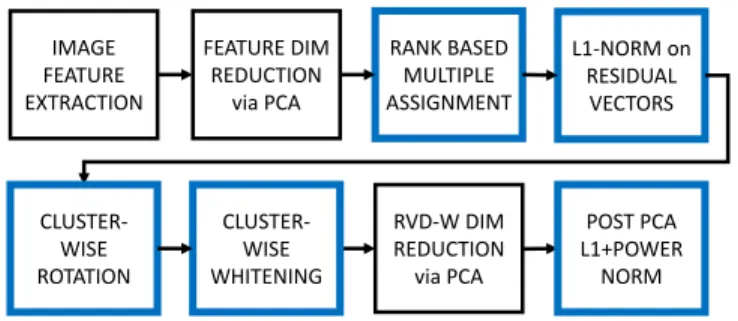
IMAGE FEATURE EXTRACTION FEATURE DIM REDUCTION via PCA RANK BASED MULTIPLE ASSIGNMENT L1-NORM on RESIDUAL VECTORS RVD-W DIM REDUCTION via PCA CLUSTER-WISE WHITENING POST PCA L1+POWER NORM CLUSTER-WISE ROTATION
Fig. 1. RVD-W extraction pipeline using rank-based multi-assignment, residual normalization, cluster-wise whitening and post PCA processing
3
R
OBUSTV
ISUALD
ESCRIPTOR(RVD)
Our RVD representation is inspired by concepts from Ro-bust Statistics. In retrieval, image pairs with matching vi-sual objects contain a certain proportion of matching local descriptors, contaminated by a large proportion of non-matching outliers. For example, in the Oxford dataset, the median percentage of inliers is only20%. Thus the task of image matching may be considered as detection of matching local descriptor pairs in the strong presence of outliers. The aim is therefore to develop a global representation of a set of local descriptors that will be both representative and robust in the mathematical sense, i.e. not affected by a large number of additional local descriptors.
The core RVD, introduced in a preliminary fashion in [9], [10], [11] builds a global image representation by ag-gregating the normalized residual vectors for descriptors that are rank-assigned to multiple cluster centers. This manuscript provides in-depth technical details, formulation and evaluation of the core RVD including a new study explaining why rank-based assignment is so effective. Fur-thermore, we significantly improve the performance of the core RVD representation by balancing the energy of the weighted residual vector dimensions. This is achieved by de-correlating and subsequently whitening the weighted residual vectors before aggregation into a cluster-wise RVD-W representation. In addition, the RVD-RVD-W global descriptor is projected via PCA and post-processed by L1-norm and power-norm, to increase the separability between matching and non-matching global descriptors. In order to reduce the memory requirement and complexity, the RVD-W signa-ture is encoded using the Optimized Product Quantization (OPQ) approach [27]. Finally, we also demonstrate how to effectively aggregate CNN-based features into the RVD-W representation. We will now describe in detail the compo-nents of the RVD-W pipeline, as shown in Figure 1.
Local descriptor assignment
RVD is a global image representation formed by robustly aggregating local descriptors. In this approach every de-scriptor is defined by its relative position with respect to a set of reference points (cluster centers) in ad-dimensional space. More precisely, thencluster centers, or the codebook {µ1, ..., µn}is computed and each descriptorxtis assigned to its K-nearest clusters N NK
γ (xt), where {γ = 1...K} denotes the rank of a particular nearest cluster. We introduce the following notation: for descriptorxt,N NK
γ (xt)returns
the cluster index that is rank γ from xt. In the following paragraph we will discuss several strategies of assigning descriptors to visual words and present our novel rank-based multi assignment.
1) Single Assignment (SA): In SA, each local
descrip-tor xt is assigned to one nearest cluster (K=1) with an assignment weight τtj = 1 if N N11(xt) = j and τtj = 0 otherwise. The drawback of single assignment is that it leads to high quantization error when matching descriptors are assigned to different clusters, due to inherent variability in the extracted descriptors (noise). Also the population of vectors assigned to each cluster is small, which is not desirable for robust statistical processing.
2) Multiple Assignment (MA): The aforementioned
quantization error can be reduced by assigning descriptors to multiple clusters (typicallyK=2, 3) with constant assign-ment weightτtj = 1 ifN NγK(xt) =j andτtj = 0 otherwise. However this approach doesn’t take into account that as-signments with lower ranks are more stable (in the sense of assignment repeatability) - the reliability and stability decreases as the assignment rankγincreases.
3) Soft Assignment (SoftA): In this method each
de-scriptorxtis assigned to clusterj with the soft assignment weight (τtj) given by the posteriori probability (refer to equation 1). While SoftA has been shown to deliver superior results and is generally considered the state-of-the-art, few studies exist on the local descriptor assignment patterns and behavior. We demonstrate later in this section that SoftA has a significant weakness and can be improved in the context of aggregation schemes. One issue is that SoftA often (60% of all the cases) degrades to single assignment. Another problem is that the assignment weights depend on the distances between a descriptor and cluster centers, meaning that the contributions from various descriptors are unbalanced and noise in descriptor values directly impacts the assignment weights. These observations motivate us to introduce our rank-based multiple assignment approach.
4) Rank-based multiple Assignment (RankA): The
RankA scheme aims to address the aforementioned draw-backs of the SA, MA and SoftA methods. Firstly, it reduces the assignment error by effectively quantizing descriptors to multiple cluster centers. Secondly, it increases the prob-ability that many clusters have a sizeable population of local descriptors assigned to them. Finally, the descriptors are assigned toK-nearest clusters with stable rank weights leading to a more balanced and reliable global image repre-sentation as compared to the MA and SoftA approaches.
In the proposed RankA, each descriptorxtis quantized to K-nearest cluster centers and the assignment weights used for aggregation are derived from the ranks. In our
experiments, K=3 was found to be optimum for many
datasets (retrieval results for Holidays dataset are presented in Figure 2(e)). We define assignment weights based on the empirical probability that two descriptors forming a matching pair (inliers) with specific rank are assigned to the same cluster. This probability depends on the proximity of descriptors to the cluster center in feature space, which can be approximated by the assignment rankγ. We expect rank 1 assignments to be more stable than rank 3.
Our procedure to determine the optimal assignment weights includes two steps: (1) finding a set of matching
(a) (b)
(c) (d)
SoftA weights 𝜏𝑡𝑗for 𝛾=1
Rank (ϒ) (e) Rank w eigh ts 1 2 3 4 5 6 7 0 0.2 0.4 0.6 0.8 1 0 0.2 0.4 0.6 0.8 1 0 0.2 0.4 0.6 0.8 1 0 0.2 0.4 0.6 0.8 1 0 0.2 0.4 0.6 0.8 1 1 2 3 0 0.2 0.4 0.6 0.8 1 𝐾 70 71 72 73 74 75 1 2 3 4 5 6 128 mA P (%)
Maximum number of clusters that a descriptor is assigned to (K) FV representation 70 71 72 73 74 75 1 2 3 4 5 mA P (%)
Maximum number of clusters that a descriptor is assigned to (K)
RVD representation
(f)
SoftA weights 𝜏𝑡𝑗for 𝛾=2
Fig. 2. Fisher Vectors and RVD statistics. The size of codebook is 128, (a) Probability distribution of the number of nearest clusters (K) that a descriptor is assigned to with soft assignment weight greater than 0.1 in FV, (b) Distribution of soft assignment weights corresponding toN NK 1
in FV. About 30% of descriptors are assigned with soft assignment weight of 1, (c) Distribution of soft assignment weights corresponding toN NK
2 in FV, (d) Rank assignment weights used in RVD encoding. In
RankA, each descriptorxtis assigned to three nearest clusters,N N1K,
N NK
2 andN N3K, with assignments weights equal to 1, 0.5 and 0.25
respectively, (e) Performance of RVD as a function of maximum numbers of assigned clusters, (f) Performance of FV as a function of the maximum numbers of assigned clusters.
descriptor pairs and the associated cluster rank-assignment data, and (2) estimating probabilities of the aligned cluster assignment, for each rankγ:
• For a training set of matching image pairs (MPEG
dataset [10]), local SIFT descriptors are extracted and a set of putative matches is computed based on Lowe’s [1] ratio test. For each image pair a RANSAC algorithm is applied on the putative SIFT matches to estimate an affine transformation and the set of inlier point pairs (Y) consistent with that transform.
• Given inlier point pairsya, yb∈Y and the associated rank-assignment data, we calculate the probabilities (Ωγ) such thatN NγK(ya) = N NγK(yb), forγ = 1..3. The assignment weights for eachγare calculated as:
Ωγ/Ω1.
We computed experimentally that in N N1K, N N2K and N NK
3 , the probability that an inlier point pair is assigned to
0.1 0.2 0.3 0.4 0.5 0.6 0.7 0.8 0.9 1 0.1 0.2 0.3 0.4 0.5 0.6 0.7 0.8 0.9 1 0.71 0.715 0.72 0.725 0.73 1 2 3 4 5 6 7
L1-Norms of residual vectors (𝑥𝑡-μ𝑗)
Α
Β
(a) (b)
Fig. 3. (a) Grid search for RankA weights (b) Distribution of L1-Norms of residual vectors in RVD scheme.
the same cluster center is approximately0.58,0.28and0.14. Therefore assignment weights used in RVD aggregation are: τtj= 1 ifN N1K(xt) =j,τtj = 0.5 ifN N2K(xt) =j,τtj = 0.25 ifN NK
3 (xt) =jandτtj= 0 otherwise.
To confirm that this approach indeed leads to optimal performance, we studied the retrieval accuracy on the Hol-idays dataset as a function of RankA weights. Since K is set to 3 and the weight corresponding to the nearest neighbor (τN N1
tj ) is set to one, the weights for N N2 and N N3are respectively computed asτtjN N2 =A×τ
N N1
tj and
τN N3
tj = B ×τ
N N2
tj . The values of A and B are varied
from 0.1 to 1. The grid search over the aforementioned 2D parameters space (Figure 3(a)) confirms that the weights derived from the assignment statistics are indeed optimal for the RVD representation. The red star indicates the se-lected RankA parameters based on these statistics. The space exhibits similar behavior for other datasets.
Analysis of SoftA and RankA
In order to better understand the difference between soft assignment (as employed in FV) and our rank-based assign-ment, we computed FVs for images in the Holidays dataset and analyzed cluster assignment statistics and behavior. The following observations are made; Figure 2(a) shows a discrete probability distribution of the number of nearest clusters (K) that a descriptor is assigned to with soft as-signment weight greater than 0.1. It can be observed that in 60% of all the cases the weight assignment in FV is such that only the first nearest cluster has a weight exceeding 0.1. This effectively means that SoftA frequently degrades to single assignment. In RankA, a descriptor is always assigned to three nearest centroids. Figure 2(b) and Figure 2(c) show the distribution of soft assignment weights corresponding to N N1K and N N2K respectively and it can be seen that inN NK
1 about 30% of descriptors are assigned with a soft assignment weight of 1. In RankA, each descriptor xt is assigned to three nearest clusters,N N1K,N N2KandN N3K, with assignments weights equal to 1, 0.5 and 0.25 respec-tively, as shown in Figure 2(d). In Fisher Vector encoding, many assignment weights τtj are likely to be very small or negligible. We evaluate the performance of FV on the Holidays dataset by setting to zero all but the K-largest assignments for each input descriptorxt. Figure 2(f) shows that there is no significant change in performance forK >3.
This means that there are no performance benefits arising from using more than three nearest neighbors.
Direction preserving mapping function
Each local descriptorxtis assigned to itsKnearest clusters with corresponding ranks and the residual vectorsxt−µj are calculated. Figure 3(b) shows the distribution of L1-norms of residual vectorsxt−µj, where it can be seen that the contribution of individual descriptors to cluster level representation varies significantly. We note that aggregating non-normalized residual vectors leads to suboptimal per-formance as the cluster level representations can be strongly influenced by outliers with higher magnitudes of residual errors.
To alleviate this problem, we propose that RVD ag-gregation encodes each local descriptor using only direc-tion, discarding magnitude. More precisely, for each lo-cal descriptor and the associated clusters µj with ranks γ, the residual vectors xt−µj are L1-normalized before aggregation. Our choice of L1-norm has been motivated by research showing that in high dimensional spaces the L1-norm exhibits more stable behavior, and is therefore preferable to L2. For example, Aggarwal et al. [28] show that in high dimensional spaces, the concepts of proximity, distance or nearest neighbor may not even be qualitatively meaningful. They examine the behavior of commonly used Lp-norms and show that the problem of meaningfulness in high dimensionality is sensitive to the value of p, with the Manhattan distance being the preferred metric for high dimensional data mining applications. Experimental results on Holidays (Figure 5(a)) and Oxford datasets with varying pcoefficient confirm that L1-norm indeed delivers optimal performance.
This direction-preserving mechanism limits the impact of outliers that happen to be located far from a cluster center. In effect, the influence of any single descriptor on the aggregated representative value is now limited and similar in impact to all other descriptors.
RVD formation
Each normalized residual vector belonging to cluster j is weighted based on rank assignment weights τtj to yield vectorrtj∈Rd.
rtj =τtj
xt−µj ||xt−µj||1
(9) where||.||1denote L1-norm.
The cluster level representation ζj∈Rd is computed by aggregating vectorsrtj across all ranksγ.
ζj= K X γ=1 X xt:N NγK(xt)=j τtj xt−µj ||xt−µj||1 (10) Eachζjis L2-normalized (intra-normalization [19]) in order to equalize contributions from all aggregated vectors ζj to the final RVD representation R. The dimensionality of vectorRisD=d×n. R= " ζ1 ||ζ1||2 ; ζ2 ||ζ2||2 ;...; ζn ||ζn||2 # (11)
µ
𝟏µ
𝟐µ
𝟑𝒙
𝟏𝒙
𝟒𝒙
𝟐𝒙
𝟓𝒙
𝟑𝒙
𝟔 (a) (b) (c) (d) 𝝉𝒕𝟏×𝒓𝒗𝟏 𝒓𝒗𝟐 𝒓𝒗𝟏 𝝉𝒕𝟏×𝒓𝒗𝟐 𝜻𝟏µ
𝟒 𝑵𝑵𝟑𝑲(𝒙𝟏) 𝑵𝑵𝟏𝑲(𝒙𝟏) 𝑵𝑵𝟐𝑲(𝒙𝟏) Rank 1 aggregationµ
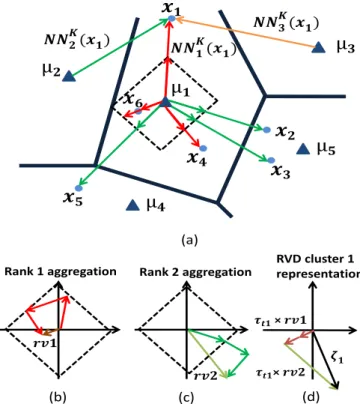
𝟓 Rank 2 aggregation RVD cluster 1 representationFig. 4. RVD aggregation approach: (a) rank-based cluster assignment and L1-normalization of residual vectors, (b) Aggregation of residual vectors belonging to Rank-1 of cluster 1, (c) Aggregation of residual vectors belonging to Rank-2 of cluster 1, and (d) RVD cluster-level representationζ1.
The final vectorRis L2-normalized to make the represen-tation invariant to the number of local descriptors extracted from each image. Furthermore, this also balances the energy of the aggregated vectors between clusters.
An example of the RVD aggregation is shown in Figure 4. The solid polygons indicate Voronoi cells. There are six local descriptors x1,..,x6 and five cluster centers µ1,..,µ5. The descriptor x1 is assigned to its three nearest clusters centers (µ1,µ2,µ3), and the corresponding residual vectors, (x1−µ1), (x1−µ2), (x1−µ3), are respectively shown as red, green and orange arrows. The descriptors {x1, x4, x6} are assigned to their first nearest cluster (µ1) and the residual vectors (xt − µ1) are L1-normalized (shown by scaling the red colored residual vectors to dashed unit square) in order to discard the magnitude information. The normalized residual vectors are aggregated intorv1as shown in Figure 4(b). Similarly, descriptors{x2, x3, x5}are quantized to their second nearest cluster µ1 and the L1-normalized residual vectors (shown by green arrows) are aggregated into rv2
(Figure 4(c)). Finally,rv1 andrv2 are combined with rank assignment weightsτtjinto RVD cluster level representation ζ1 (shown in Figure 4(d)). For simplicity, the figure only shows two ranks.
3.1 Improved RVD
Here we propose two extensions which increase the dis-criminatory power of the RVD signatures. The first one de-correlates residual vectorsrtj by applying cluster-level PCA before aggregation - (RVD-P). The second method aims to balance the variances in different dimensions of individual
74 75 76 77 78 0.6 0.8 1 1.2 1.4 1.6 1.8 2 2.2 mAP (%) Lp-norm factor p (a) (b) 1 10 20 30 40 50 60 RVD RVD-P RVD-W Dimensions of vector 𝑟𝑡𝑗 variance
Fig. 5. (a) Holidays performance as a function of Lp normalization applied to residual errors, (b) Energy distribution in each dimension of residual vectorsrtj before aggregation into RVD, RVD-P and RVD-W
respectively.
residual vectorsrtjafter the PCA transformation; it is called RVD with local Whitening (RVD-W).
RVD Local PCA (RVD-P)
We improved the performance of RVD signature by trans-forming the weighted residual vectors rtj = τtj||xxt−µj
t−µj||1
inside each cluster using a local PCA basisPj before aggre-gation into RVD-P. In the following, we describe the process of computing RVD-P representation.
Off-line stage: Given a set of N weighted residual
vectorsr1j, r2j, ..., rN jinRdextracted from training images, we compute the mean vectorηj=E[rtj]and the covariance matrixΣjfor each clusterj.
ηj = 1 Nj X I K X γ=1 X xt:N NγK(xt)=j rtj (12) Σj= 1 Nj X I K X γ=1 X xt:N NγK(xt)=j (rtj−ηj)(rtj−ηj)> (13)
For each cluster j, we compute a PCA matrix Pj whose columns consists of the orthonormal eigenvectors of Σj corresponding to thedlargest eigenvaluesλ1≥λ2...≥λd. On-line Stage: Given an image I, the vectors rtj are extracted for each clusterjas in the core RVD method. The mean subtracted rtj vectors are projected using Pj before aggregation into cluster level representationζj.
ζj= K X γ=1 X xt:N NγK(xt)=j Pj>(rtj−ηj) (14)
The final RVD-P representationRp
is formed by concatenat-ing the L2-normalizedζjvectors for all clusters.
RVD Local Whitening (RVD-W)
Figure 5 shows the energy distribution in each dimension of residual vectors rtj before aggregation into RVD (blue line), and it can be observed that the variances of different dimensions are not balanced, which negatively affects the discriminability of the final global representation. We solve the aforementioned problem by introducing whitening of the residual vectorsrtj before aggregation into cluster level representation.
More precisely, we compute the cluster level whitening matrixPw j asPjw=PjΛj− 1 2, whereΛj =diag(λ1, λ2..., λd). 0.2 0.3 0.4 0.5 Matching Non-matching KL-div=2.81
Similarity score Similarity score Similarity score
(a) (b) (c) 0.8 1 1.2 1.4 Matching Non-matching KL-div=2.57 0.8 1 1.2 1.4 Matching Non-matching KL-div=2.35
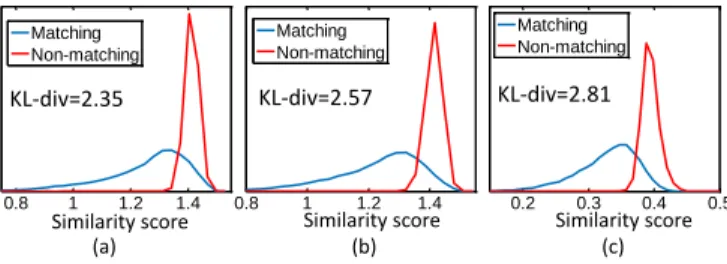
Fig. 6. Histogram of Euclidean similarity between matching and non-matching descriptors, for three post-PCA normalization methods (a) Whitening (b) P-L2 (β=0.5) (c) L1-P (β=0.7).
Given an image I, the vectors rtj are computed for each clusterj. The mean subtractedrtjvectors are then projected using Pj and subsequently whitened before aggregation intoζj. ζj = K X γ=1 X xt:N NγK(xt)=j Pjw>(rtj−ηj) (15)
The L2-normalizedζj vectors are stacked to form the final RVD-W representationRw
.
It can be observed from Figure 5(b) that in RVD-P ag-gregation, the application of local PCA onrtj concentrates the energy in the top few dimensions while in RVD-W, after performing PCA+Whitening the energy remains balanced between dimensions.
3.2 PCA transformation and L1+Power normalization
In order to improve the separability between matching and non-matching representations, we propose a new normal-ization approach applied after transforming the RVD-W vectors via PCA. Our normalization involves an L1-norm followed by a power-norm creating L1-P normalization. We show that the L1-P is different to the frequently used Whitening [12] and Power+L2 normalization and offers significant gains in terms of retrieval accuracy.
1) Whitening: In [12], Jegou et al. applied whitening operation on the VLAD vector in order to increases the contrast between matching and non-matching descriptors. We follow [12] and perform whitening on RVD-W vector to evaluate its impact on retrieval performance. More precisely, the mean-centeredRw
vector is first PCA-transformed, and subsequently whitened and re-normalized to form vector Rwl. Rwl= diag(λ −1/2 1 , .., λ −1/2 D0 )P>(Rw−R0) ||diag(λ−11/2, .., λ−D1/20 )P>(Rw−R0)||2 (16) where R0 is the mean of the signatures of Rw and P is a D×D0matrix (D0≤D) of eigenvectors associated with the largest eigenvalues of the covariance matrix of signatures of Rw.
2) Power+L2 normalization (P-L2): The whitening of
RVD-W vectors is only suitable when generating short signatures because the smallest eigenvalues produce ar-tifacts. Figure 11(c) demonstrates that the retrieval accu-racy initially increases up to 512 dimensions but then de-creases when the dimensionality of the RVD-W vector ex-ceeds 512. [13] addressed this problem by applying power-normalization on the PCA projected descriptor, followed
by L2-normalization. The power-norm is parametrized by a constantβ.
3)L1+Power normalization (L1-P): In our approach, the mean-centeredRwvector is first transformed using matrix P and then the resultant vector is L1-normalized to form Rwρ. Rwρ= P >×(Rw−R 0) ||P>×(Rw−R 0)||1 (17) Finally, the vectorRwρ = (R1wρ, .., RDwρ0)is processed using
power-normalization:Rwl i =sign(R wρ i )|R wρ i |β.
We use the class-separability between matching and non-matching descriptors to demonstrate the advantage of our approach, on MPEG dataset (10k matching and 100k non-matching image pairs) [10]. More precisely, the dimension-ality ofRw
is reduced to 512 and post-PCA normalization is applied. Let us denote P r(h|m) and P r(h|nm) as the probability density function (pdf) of observing a Euclidean distancehfor a matching and non-matching descriptor pair respectively. The distance between matching/non-matching pdfs is expressed in terms of KL-divergence. It can be observed from Figure 6 that L1-P method provides the best separability (maximum KL-Divergence) between matching and non-matching distributions, compared to Whitening and P-L2 approaches.
3.3 Compact RVD-W code
The descriptor size, expressed as bytes per image, has a major impact on the performance of an image retrieval system; ideally the descriptors for the entire dataset should fit in the RAM memory of the server for fast processing. Aggregating a 128-dimensional local descriptor (e.g. SIFT) using a small codebook of 64 cluster centers results in 8k-dimensional global descriptor. This size is too large for efficient retrieval in very large databases.
We followed [27] to compress RVD-W vectors into small codes for large scale retrieval. More precisely, the dimen-sions of vector Rwp are permuted using the Eigenvalue Allocation method [27]. The transformed vector is divided into g sub-vectors or groups of equal length D0/g. Each sub-vector is quantized using a separate K-means quantizer with n centroids (256) and encoded using k = log2(n) bits. The storage requirement of the embedded vector is B =g×k bits. The distance between the query vector and database vectors is computed using Asymmetric Distance Computation (ADC).
3.4 RVD-W based on Convolutional Neural Networks
(CNN)
Recent research has shown that image descriptors computed using deep CNNs achieve state-of-the-art performance for image retrieval and classification tasks. Babenko et al. [14] aggregated deep convolutional descriptors to form global image representations: FV, Temb and SPoC. The SPoC sig-nature is obtained by sum-pooling of the deep features. Razavian et al. [29] compute an image representation by the max pooling aggregation of the last convolutional layer.
We propose to encode CNN-based descriptors into the RVD-W representation. More precisely, an RGB image is first warped into a c×c square and a mean RGB value
(a) (b) 65 68 71 74 77 80 64 128 256 mAP (%) VOCABULARY SIZE (n) RVD-W RVD 60 63 66 69 72 75 78 16 32 64 96 128 mAP (%) SIFT DIMENSION (d) RVD-W RVD
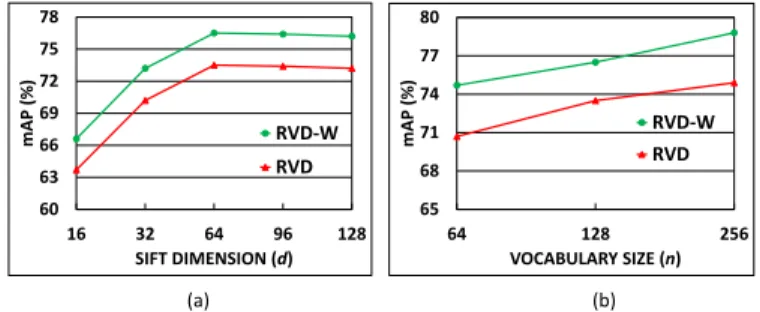
Fig. 7. Impact of parameters on the Holidays performance for RVD-W and RVD representations (a) as a function of SIFT dimensionsdand (b) as a function of vocabulary sizen(all results in mAP(%)).
is subtracted from each pixel. The image is then passed through a pre-trained network comprising of L convolu-tional layers. The output of al-th layer Llis a cl×cl×dl feature map, wheredlis the number of filters corresponding to Ll. A set Xl = {xl
1,1, xl1,2, .., xlcl,cl} of d
l-dimensional feature vectors is obtained at each location (a, b),1≤a≤cl and 1 ≤ b ≤ cl
, in the feature map. As in the SIFT-based approaches, a codebook {µl1, ..., µln}ofncluster centers is learned using a set of training images. For each centroid, the residual vectors xl
a,b −µ l
j are computed, normalized and whitened to form vector ζl
j (Equation 15), regarding layer Ll. The RVD-W representation is obtained by concatenating all aggregated vectorsζl
jfor allnvisual words.
4
EXPERIMENTS
The purpose of this section is to evaluate the RVD-W relative to other state-of-the-art global image representations. We first present the experimental setup which includes the datasets and evaluation protocols. Furthermore, we also define common conditions concerning local descriptor ex-traction, dimensionality reduction of local descriptors and selection of vocabulary size. We then analyze, based on SIFT features, the impact of the novel components that consti-tute our method, namely rank-based multiple assignment, the direction preserving mapping function, neighborhood rank weights, application of local PCA and whitening and normalization of the RVD-W vector. Finally, we show that the aggregation framework developed using SIFT features is also effective for CNN-based features. A comparison with the different global representations is presented at the end of this section.
Datasets
The performance of the proposed method is extensively evaluated on three standard image retrieval benchmarks.
TheINRIA Holidaysdataset [30] contains 1491 holiday
photos with a subset of 500 used as queries. Retrieval accuracy is measured by mean Average Precision (mAP), as defined in [16]. To evaluate system performance in a more challenging retrieval scenario, the Holidays dataset is augmented with 1 million distractor images obtained from Flickr, forming Holidays1M [30]. We also further extend Holidays1M with additional 9M distractor images [31], to test the robustness of our framework in a very large scale
(a) Holidays (c) Holidays1M (d) Oxford1M (b) Oxford5k 60 62 64 66 68 70 72 74 128 512 1024 4096 8192 mAP (%)
Global descriptor dimension
RankA (RVD) SoftA (FV) SA (VLAD) 40 44 48 52 56 60 64 128 512 1024 4096 8192 mAP (%)
Global descriptor dimension
RankA (RVD) SoftA (FV) SA (VLAD) 35 37 39 41 43 45 47 49 128 256 512 mAP (%)
Global descriptor dimension
RankA (RVD) SoftA (FV) SA (VLAD) 27 30 33 36 39 42 45 128 256 512 mAP (%)
Global descriptor dimension
RankA (RVD) SoftA (FV) SA (VLAD)
Fig. 8. Impact of rank-based aggregation on performance for (a) Hol-idays, (b) Oxford5k, (c) Holidays1M and (d) Oxford1M (all results in mAP(%))
case. The PCA transformation matrix and visual vocabulary is trained on the Flickr60K dataset [30].
The University of Kentucky Benchmark (UKB) [15]
dataset contains 10200 images of 2550 objects (4 images of each object). The performance measure is the average number of images returned in the first 4 positions (4 × Recall@4).
The Oxford5k dataset [16] contains 5062 images
gath-ered from Flickr by querying for particular Oxford land-marks. From this set of images, 11 distinctive landmarks are selected, with 5 distinct queries per landmark. The perfor-mance is evaluated using mAP. Unless stated otherwise, the SIFT descriptors, for the query images, are extracted from inside the ROIs. To test large scale retrieval, this dataset is combined with 100k and 1 million Flickr images [9], forming the Oxford105k [16] and Oxford1M dataset respectively. The Oxford1M dataset is also augmented with 9M distractor images [31] forming Oxford10M dataset. We have used the Paris6k dataset [17] for learning of parameters (PCA and vocabulary).
Local descriptor extraction
In all our experiments, key-points are detected using the Hessian affine detector [32] and local regions are encoded in a 128-dimensional SIFT descriptor [1]. We use the pub-licly available SIFT descriptors [30] for Holidays and Hol-idays1M datasets; while for Oxford datasets, the detector and the SIFT descriptors are computed as in [19]. Descrip-tors are extracted from the UKB and ImageNET datasets (Holidays10M) using software available on-line [8]. The SIFT descriptors are converted to RootSIFT [33] without any additional storage or memory.
The dimensionality of the RootSIFT descriptors is re-duced from 128 toddimensions using PCA matrix. It can be observed from Figure 7(a) that applying PCA and truncating the last 64 dimensions provides the optimum performance for both RVD and RVD-W representation.
(a) Holidays (b) Oxford5k
(c) Holidays (d) Oxford5k 60 62 64 66 68 70 72 74 128 512 1024 4096 8192 mAP (%) RVD DIMENSION L1-NORM NO NORM 43 46 49 52 55 58 61 64 128 512 1024 4096 8192 mAP (%) RVD DIMENSION L1-NORM NO NORM 60 62 64 66 68 70 72 74 128 512 1024 4096 8192 mAP (%) RVD DIMENSION RANK WEIGHTS UNIT WEIGHTS 43 46 49 52 55 58 61 64 128 512 1024 4096 8192 mAP (%) RVD DIMENSION RANK WEIGHTS UNIT WEIGHTS
Fig. 9. Impact of L1-normalization of residual vectors on performance of (a) Holidays dataset, (b) Oxford5k dataset. Impact of rank-based weighting on performance of (c) Holidays dataset, (d) Oxford5k dataset
Vocabulary size
In this experiment, the impact of vocabulary size on the re-trieval performance of RVD and RVD-W was studied. It can be observed from Figure 7(b) that the performance increases as we increase the number of centroids. Forn= 256RVD-W results in a mAP=77.2% on the Holidays dataset. However, for higher values ofn>256, the size of the global descriptor becomes prohibitive for large scale experiments. In all the following experiments, the size of codebook is fixed at 128 to provide a good trade-off between performance, extraction speed, complexity and memory use.
Comparison of descriptor assignment methods
In this section we evaluate the performance of our rank based multiple assignment (RankA) used in RVD, single assignment (SA) employed in VLAD and soft assignment (SoftA) employed in FV, as a function of global descriptor dimensionality D. All global representations are first pro-jected using aD×D0 PCA matrix and then L1-P normal-ization is applied. The similarity between two descriptors is computed using standard Euclidean distance. It can be seen from Figure 8 that RankA performs better than SA and SoftA approaches on all datasets. Compared to SoftA, the retrieval accuracy obtained using RankA is significantly higher on large scale datasets, resulting in an average gain of 3.6% and 1.9% on Holidays1M and Oxford1M respectively. Impact of direction-preserving mapping function and neighborhood rank weighting
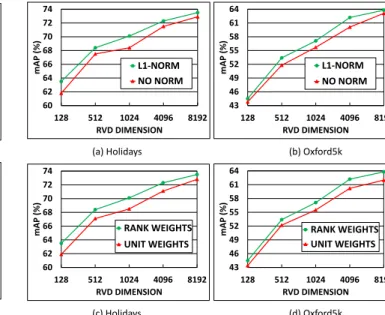
Figure 9(a) and Figure 9(b) shows the benefit of applying L1-normalization on residual vectors before aggregation. The use of L1-normalization brings an average gain of 1.1% and 1.3% in mAP on the Holidays and Oxford5k datasets respectively.
We performed experiments to show the advantage of neighborhood rank weighting in RVD aggregation process.
(a) Holidays (b) Oxford5k 60 63 66 69 72 75 78 128 512 1024 8192 mAP (%)
Global descriptor dimension
RVD-W RVD-P RVD FV 𝝓𝜟+ 𝝍𝒅 40 44 48 52 56 60 64 68 128 512 1024 8192 mAP (%)
Global descriptor dimension
RVD-W RVD-P RVD FV DEMO𝝓𝜟+ 𝝍𝒅 3.2 3.3 3.4 3.5 3.6 128 512 1024 4096 rec all@4
Global descriptor dimension
RVD-W RVD-P RVD FV DEMO𝝓𝜟+ 𝝍𝒅 30 35 40 45 50 55 60 65 128 512 1024 8192 mAP (%)
Global descriptor dimension
RVD-W RVD-P RVD FV DEMO 32 35 38 41 44 47 50 53 56 128 256 512 mAP (%)
Global descriptor dimension
RVD-W RVD-P RVD FV DEMO 30 32 34 36 38 40 42 44 46 128 256 512 mAP (%)
Global descriptor dimension
RVD-W RVD-P RVD FV 𝝓𝜟+ 𝝍𝒅
(c) UKB
(d) Oxford105k (e) Holidays1M (f) Oxford1M
𝝓𝜟+ 𝝍𝒅
Fig. 10. RVD-W comparison with RVD-P, RVD, FV andφ∆+ψd, (a) Holidays, (b) Oxford5k, (c) UKB, (d) Oxford105k, (e) Holidays1M and (f)
Oxford1M (all results in mAP(%) except for recall@4 for UKB);
In the RVD representation, the weights are:1,0.5and0.25
for the assignments with rank one, two and three respec-tively. It can be observed in Figure 9(c) and Figure 9(d) that weighted rank level combination gives an average improve-ment of 1.3% and 1.5% on the retrieval accuracy of Holidays and Oxford5k datasets compared to rank level combination with equal weights (as employed in MA approach).
Comparison of RVD/RVD-P/RVD-W/FV/TEmb
In this section we compare the best representation RVD-W with RVD, RVD-P, FV and TEmb (φ∆+ψd). It can be clearly seen from Figure 10 that RVD-W on average outperforms all global descriptors. Compared to FV, RVD-W offers an average gain of +4.5% and +3% in mAP on the Holidays and Oxford5k datasets. The average difference in retrieval performance is even more significant on large scale datasets of Holidays1M (+7%) and Oxford1M (+3.9%) compared to FV. We also compared RVD-W with the recent φ∆ +ψd representation. It can be observed that φ∆ +ψd obtains marginally better mAP than RVD-W on Holidays and Ox-ford datasets using a 8192 dimensional descriptor. However φ∆+ψddescriptor suffers significantly from dimensionality reduction and also the computation ofφ∆+ψdis typically three orders of magnitude slower than RVD-W. The retrieval performance of RVD-W is significantly better thanφ∆+ψd (+5.4% and +6% on Holidays and Oxford5k) after the global descriptors are dimensionally reduced toD0=128. On large scale dataset of Holidays1M, RVD-W offers a significant gain of +6% in mAP overφ∆+ψd.
PCA transformation and L1-P normalization
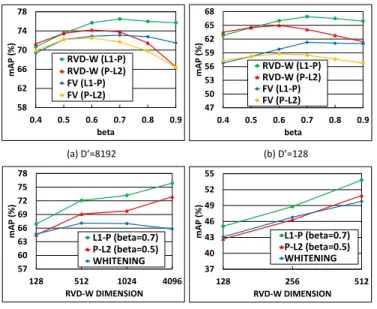
In this section we study how the power-normalization exponent β of P-L2 and L1-P normalizations, effects the retrieval performance of RVD-W and FV. From Figure 11(a) and Figure 11(b), it can be observed that L1-P normalization (β = 0.7), provides close to optimum performance for both large dimensional (D’=8192) and small dimensional (D’=128) RVD-W descriptor. It is interesting to note that similar behavior is also shown by the FV representation. We performed experiments to compare the performance of the three post PCA normalization methods: (i) Whitening, (ii) P-L2 normalization (β = 0.5), and (iii) L1-P normalization (β= 0.7). It can be clearly seen from Figure 11(c) and Figure 11(d) that normalizing the PCA-projected vector using L1-P normalization provides better retrieval accuracy on both the Holidays and the Holidays1M datasets.
Optimized Product Quantization
The purpose of this section is to evaluate the RVD-W repre-sentation when used with the joint dimensionality reduction and OPQ method of Section 3.3. The dimensionality of the global descriptor is reduced from 8192 to 128 using matrix P0. The truncated descriptor is L1-P normalized and finally the PQ algorithm is applied on the normalized vector. In all the experiments, we used g=16 sub-vectors and 8 bits to encode each sub-vector resulting in a small code of 16 bytes. The distance between the query descriptor and the database descriptor is computed using ADC. We repeat each experiment 10 times and report the mean performance.
(a) D’=8192 (b) D’=128 (c) Holidays (d) Holidays1M 58 62 66 70 74 78 0.4 0.5 0.6 0.7 0.8 0.9 mAP (%) beta RVD-W (L1-P) RVD-W (P-L2) FV (L1-P) FV (P-L2) 47 50 53 56 59 62 65 68 0.4 0.5 0.6 0.7 0.8 0.9 mAP (%) beta RVD-W (L1-P) RVD-W (P-L2) FV (L1-P) FV (P-L2) 57 60 63 66 69 72 75 78 128 512 1024 4096 mAP (%) RVD-W DIMENSION L1-P (beta=0.7) P-L2 (beta=0.5) WHITENING 37 40 43 46 49 52 55 128 256 512 mAP (%) RVD-W DIMENSION L1-P (beta=0.7) P-L2 (beta=0.5) WHITENING
Fig. 11. (a) Impact of power-norm exponent β on Holidays dataset usingD0 = 8192 descriptor. Note that P-L2 (β=0.5) is equal to L1-P (β=0.5), (b) Impact ofβon Holidays dataset usingD0= 128descriptor. Comparison of post-PCA normalization methods on (c) Holidays and (d) Holidays1M
Table 1 shows the performance of compact RVD, P, W and Fisher Vector. It can be seen that RVD-W consistently shows better performance on all datasets, achieving 5% higher mAP on the Holidays1M and the Oxford1M compared to FV.
Large scale experiments
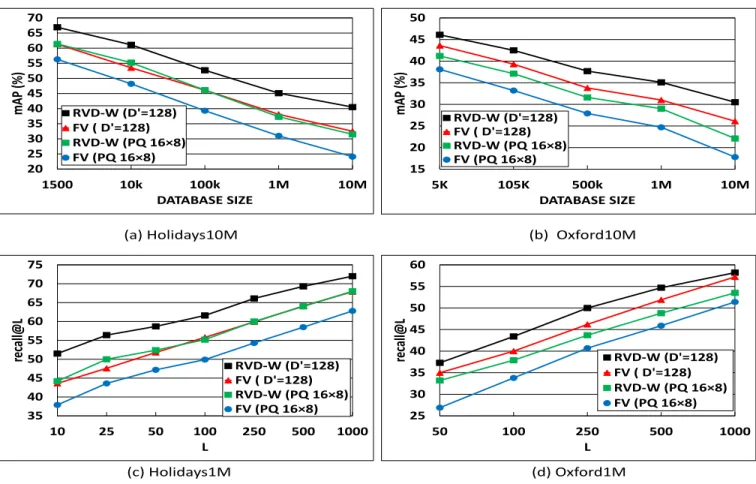
Figure 12(a) and Figure 12(b) display the performance of our method on the large scale datasets of Holidays10M and Oxford10M. The mAP performance is presented as a function of dataset size. We show the results for four cases:
• the RVD-W vector reduced toD0=128 by PCA;
• the Fisher Vector reduced toD0=128 by PCA; • the RVD-W vector compressed to 16 bytes using the
16×8 PQ scheme;
• the Fisher Vector compressed to 16 bytes;
The retrieval performance demonstrate that the RVD-W representation consistently and significantly outperforms FV for both Oxford10M and Holiday10M datasets, typically by a margin of6%in mAP. Interestingly, it can also be ob-served that the performance gap increases as the dataset size grows, particularly for the more difficult Oxford dataset, which indicates that RVD-W is more robust in large-scale retrieval. On the ultra-large-scale dataset of Holidays10M, RVD-W (D0=128) obtains a mAP of 40.5% which signifi-cantly outperforms any results published to date. To the best of our knowledge, this is the first time that the retrieval experiments have been performed on the Oxford dataset enlarged to 10M. In order to evaluate the performance of our global descriptor in a retrieval system where a short list of images retrieved by RVD-W is re-ranked using local de-scriptor matching with geometric verification, we evaluated Recall@L i.e. the number of relevant images retrieved in the top L returns. The results are shown in Figure 12(c) and
TABLE 1
RVD-W, RVD-P, RVD and FV performance using 16 bytes codes
Method Holidays Oxford5k Hol1M Oxf1M
FV 56.3 38.1 31.0 24.7
RVD 58.1 39.0 33.4 26.8
RVD-P 59.2 39.7 36.3 27.5
RVD-W 61.4 41.2 37.3 29.0
Figure 12(d) where it can be seen that the RVD-W is better than FV in returning correct matches.
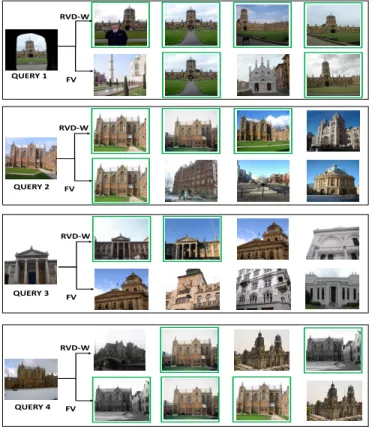
To illustrate the retrieval performance, we compress RVD-W and FV vectors of the Oxford1M dataset, using OPQ, to obtain small codes of 16 bytes. The distance be-tween a query vector and database vectors is computed using ADC, and for every query Recall@100 is calculated. We observe that, out of a total of 55 queries, RVD-W obtains better recall on 20 queries and FV has better recall on 7 queries: RVD-W outperforms FV by 3:1. For an intuitive understanding, Fig. 13 shows three queries where the dif-ference in recall between RVD-W and FV is most significant and one query where the difference in recall between FV and RVD-W is the biggest (maintaining the 3:1 ratio established before). We show the query and the top 4 ranked results ob-tained by the RVD-W and FV methods using these queries, where correct matches are indicated by a green frame.
5
C
OMPARISON WITH THE STATE OF THE ART In this section we compare the performance of the proposed method to the latest state-of-the-art algorithms.Medium footprint image representations (16k-1k dimen-sions)
Table 2 summarizes the results for medium footprint sig-natures. In practical applications, the use of medium foot-print representations is prohibitive due to search time and memory requirements; however the results are helpful in understanding the capabilities of each representation, and also serve as an upper bound on the expected performance of compact descriptors derived from them. It can be seen that the proposed RVD-W representation outperforms most of the prior-art methods; in particular it improves dra-matically (gain of +10% mAP) over the most advanced version of VLAD [20] (referred here as VLADLCS+RN) and also over FV (gain of +16%), on both Holidays and Oxford databases. Compared to the latest method based on trian-gulation embedding with sum aggregation (φ∆+ψs) [13], RVD-W (D = 8192) provides a significant improvement of +3.5%, +2% and +8.5% in mAP on the Oxford, Holidays and Oxford105k datasets. Theφ∆+ψdrepresentation performs marginally better than RVD-W on Holidays and Oxford datasets using a 8192 dimensional descriptor. However the φ∆+ψddescriptor suffers significantly from dimensionality reduction as shown by the sharp decrease in performance when the φ∆ +ψd descriptor is truncated from 8192 to 1024 dimensions (8k→1k), compared to RVD-W. Also the computation of φ∆ +ψd is typically two orders of mag-nitude slower than RVD-W. On the large scale dataset of Oxford105k, RVD-W offers a gain of +2.9% compared to φ∆+ψd. By increasing the number of cluster to 256 the
(a) Holidays10M (b) Oxford10M (d) Oxford1M (c) Holidays1M 20 25 30 35 40 45 50 55 60 65 70 1500 10k 100k 1M 10M mAP (%) DATABASE SIZE RVD-W (D'=128) FV ( D'=128) RVD-W (PQ 16×8) FV (PQ 16×8) 15 20 25 30 35 40 45 50 5K 105K 500k 1M 10M mAP (%) DATABASE SIZE RVD-W (D'=128) FV ( D'=128) RVD-W (PQ 16×8) FV (PQ 16×8) 35 40 45 50 55 60 65 70 75 10 25 50 100 250 500 1000 rec all@L L RVD-W (D'=128) FV ( D'=128) RVD-W (PQ 16×8) FV (PQ 16×8) 25 30 35 40 45 50 55 60 50 100 250 500 1000 rec all@L L RVD-W (D'=128) FV ( D'=128) RVD-W (PQ 16×8) FV (PQ 16×8)
Fig. 12. mAP as a function of the database size (a) Holidays10M and (b) Oxford10M. Quality of short-list: recall@L (c) Holidays1M and (d) Oxford1M.
RVD-W (16k) outperforms the φ∆ +ψd signature on all datasets. The FAemb (16k) has better retrieval accuracy on Oxford5k compared to RVD-W. However, its extraction time is significantly higher than RVD-W.
Compact image representations
We now focus on a comparison of compact representations which are practicable in large-scale retrieval, as presented in Table 3. The dimensionality of the RVD-W descriptor is reduced from 8192 to 128 via PCA. The results show that our method outperforms all presented methods by a large margin. The gain over the Fisher Vector is +16%
and+10% respectively for Oxford and Holidays datasets. RVD-W provides an improvement of13.9%and16%on the Oxford5k and Oxford105k datasets over VLADLCS+RN. Keep-ing the original descriptor dimensionality of 8192, RVD-W offers gains of+6% and+5%in mAP on the Oxford and Holiday datasets compared to the φ∆+ψd. It should be noted that no results are published for 8192 dimensional φ∆+ψdon Holidays1M dataset because of extremely high encoding times. Compared toφ∆+ψd(D=1920), our method provides an improvement of6.4% on Holidays1M. On the ultra large dataset of Holidays10M, RVD-W significantly outperforms the best published results (VLAD+SURF).
Table 4 shows the performance of our method using compact codes obtained by product quantization. Com-pared to VLADLCS+RN, the gain remains very significant on Oxford5k (+14%), Oxford105k (+16%) and Holidays1M
(+5%). The RVD-W provides a gain of 9.4% on largest Holidays10M dataset over VLAD+SURF.
Compact image representations based on CNN features This section compares the performance of CNN-based rep-resentations suitable for large-scale retrieval. We extract deep convolutional descriptors using the state-of-the-art CNN, OxfordNet [18]. Each image is resized to the size
586×586before passing through the network. The output of the last layer is a37×37×512feature map, forming a set of 1369 512-dimensional descriptors. We compare RVD-W to the state-of-the art methods successfully used with CNN features: Max-pooling [29], SpoC [14] and FV. We implement SPoC signature (without center prior) following [14]. For RVD-W and FV representations, a codebook of 8 cluster centers are learned via K-means clustering. All methods use final PCA to reduce the global descriptor dimensionality so that it is suitable for large scale retrieval. Training is performed consistently for all methods using the Paris dataset for Oxford, and the Flickr dataset for Holi-days. The performance is evaluated using Oxford5k (full query), Holidays, Holidays+1Million and Oxford+1Million datasets. Hol-r denotes a modified Holidays dataset, as used by Babenko et al. [14] (some images are manually rotated). Hol1M is formed by augmenting the original (un-rotated) Holidays images with 1 million distractors. The retrieval performance of the CNN-based representations is presented in Table 5. It can be seen that 256-dim RVD-W improves
QUERY 1 QUERY 2 QUERY 3 QUERY 4 RVD-W FV RVD-W FV RVD-W FV RVD-W FV
Fig. 13. Example retrieval results for the RVD-W and FV descriptors on the Oxford1M dataset. For each Query image (left) the corresponding ranked lists are shown for the RVD-W (top center-right) and FV (bottom center-right); images correctly retrieved are marked with green border. Both descriptors are quantized using OPQ to 16 bytes.
TABLE 2
Comparison with the state of the art using medium footprint signatures.
Method Size Oxf5k Oxf105k Hol UKB
VLAD Intra [19] 32k 55.8 - 65.3 -HiVLAD [23] 32k 63.8 - 72.1 3.56 VLAD+CSURF [21] 12k - - 71.7 3.52 CPVLAT [25] 9k - - 70.0 -VLAD* [20] 8k 50.0 44.5 62.2 -VLADLCS+RN ¯ [20] 8k 51.7 45.6 65.8 -HVLAD [22] 8k 47.2 - 69.1 -HiVLAD [23] 8k 57.6 - 66.6 3.48 φ∆+ψd[13] 16k 66.5 - 76.8 -φ∆+ψd[13] 8k 67.6 61.1 77.1 -φ∆+ψs[13] 8k 63.3 55.5 74.5 -FAemb [26] 16k 70.9 - 78.7 -FAemb [26] 8k 66.7 - 76.2 -RVD-W 16k 68.9 66.0 78.8 3.60 RVD-W 8k 66.8 64.0 76.5 3.59 VLAD [8] 4k 37.8 - 55.6 3.28 FV [8] 4k 41.8 - 60.5 3.35 VLAD+SURF [21] 4k 32.8 - 64.9 3.20 φ∆+ψd[13] 8k→1k 56.2 50.2 72.0 -RVD-W 8k→1k 59.0 56.1 73.2 3.56
over FV, delivering a gain of +7.8% on Oxford and 3.3% on Holidays. Compared to Max-pooling, RVD-W provides an improvement of +6.7% and 5.5% on Oxford and Holidays datasets. On large scale datasets Hol1M and Oxf1M, RVD-W offers a gain of +1.3% and +3.7% compared to the best performing state-of-the-art SPoC signature. Using cropped queries for Oxford5k (features extracted from ROI), RVD-W
TABLE 3
Comparison with the state of the art using 96/128 dimensional vectors
Oxf Oxf Hol Hol Hol
Method Size 5k 105k 1M 10M VLAD [8] 128 28.7 55.7 - -FV [8] 96 - - 56.0 31.8 28.0 FV [8] 128 30.1 - 56.5 - -VLAD* [20] 128 32.5 26.6 - 33.5 -VLADLCS+RN ¯ [20] 128 32.2 26.2 - 39.2 -CPVLAT [25] 256 - - 60.6 38.0 -VLAD+SURF [21] 96 - - 65.5 42.5 34.0 HiVLAD [23] 128 - - 64.0 43.0 -φ∆+ψd[13] 8k→128 40.0 33.9 61.5 O1 O φ∆+ψd[13] 2k→128 43.3 35.3 61.7 38.7 -RVD-W 128 46.1 42.5 66.9 45.1 40.5
1The symbolOindicates that the experiments could not be performed
because the encoding time is prohibitively large.
TABLE 4
Comparison with the state of the art with compact codes via PQ
Oxf Oxf Hol Hol Hol
Method Size 5k 105k 1M 10M VLAD [8] 40 B - - 49.5 - -FV [8] 16 B - - 50.6 28.7 21.0 VLAD* [20] 16 B 28.9 22.2 - 29.9 -VLADLCS+RN ¯ [20] 16 B 27.0 21.0 - 32.3 -VLAD+SURF [21] 10 B - - 58.0 30.2 22.1 RVD-W 16 B 41.2 37.1 61.4 37.3 31.5 TABLE 5
Comparison with the state of the art with CNN-based compact codes
Oxf Hol Hol-r Hol Oxf
Method Size 5k 1M 1M MOP-CNN [34] 512 - 78.4 - - -Max-pooling [29] 256 53.3 74.2 - - -SPoC [14] 256 58.9 78.5 80.2 62.2 41.1 FV 256 52.2 76.4 78.1 58.1 35.5 RVD-W 256 60.0 79.7 81.3 63.5 44.8 MOP-CNN [34] 2048 - 80.2 - - -Max-pooling [29] 2048 58.0 70.7 - - -FV 2048 64.1 81.9 - - -RVD-W 2048 67.5 84.5 - -
-256-Dim achieves 55.5% mAP compared to 53.1% of SPoC. The 2048-dimensional RVD-W outperforms all CNN-based approaches. It should be noted that the performance of SPoC deteriorates when a 512 dimensional signature is used (79.6% on Holidays and 55% on Oxford).
Razavian et al. achieved 89.6% and 84.3% mAP on Holidays and Oxford dataset using multi-resolution search and Jittering algorithm. The extraction time and matching complexity of their method is prohibitively high for large scale image retrieval. However for the sake of comparison, we performed experiments with RVD-W combined with the Multi-resolution search (3×3) and Jittering (3×3). The 16k dimensional RVD-W achieves 91.5% mAP on the Holidays dataset. Furthermore, a 256-dim RVD-W signature outper-forms their small footprint representation on all datasets.
6
C
ONCLUSIONThis paper presents a novel method for extraction of a robust and highly discriminative global descriptor called