153
Cloud computing and
its transforming power
Instituto das Telecomunicações, Universidade de Aveiro.
Susana Sargento
The article describes the vision of cloud computing along with the stakeholders’ position in the ecosystem. Main features and business opportunities are presented, as well as remaining open-issues that need to be addressed, such as QoS, trust, security and privacy, and network interaction. Due to the specific nature of Clouds, additional aspects related to multi-tenancy and control over data location arise. Handling data in Clouds is still complicated, in particular, as data size and diversity grows, pure replication is no viable approach, leading to consistency and efficiency issues, as well as the lacking control over data location and missing provenance poses security and legal issues. Several of these issues still remain because no standards exist which obviously «blocks» interoperability. Aspects related to green IT also need to be evolved, as the Cloud can work in a green way by reducing unnecessary power consumption, if good scaling be-havior and good economic models are employed.
In a system where services’ quality is an essential requirement, an active network intervention is fundamental. The amount of applications ported to large Cloud platforms is increasing, including new applications such as online games and video processing. Cloud computing is changing the way IT services and network are provided, and more impor-tantly, is changing the IT services and network themselves, with a complete restructuring on the business models to be provided. The plethora of new applications and challenges with the cloud environment will revolution the IT community.
154
Este artigo descreve a visão da computação em nuvem juntamente com a posição dos stakeholders no ecossistema. São apresentadas as principais caraterísticas e oportunidades de negócio, bem como todas as questões remanescentes que precisam de ser resolvidas, como a de qualidade de serviço, a confiança, a segurança e a privacidade, e a interação da rede. Devido à natureza específica das Nuvens, surgem aspetos adicionais relacionados com a multiguarda e o controlo sobre a localização dos dados. Lidar com dados em Nuvem continua a ser complicado, em especial dado que o tama-nho e diversidade dos dados vai crescendo e a replicação pura não é uma abordagem viável, levando a questões de con-sistência e de eficiência; além disso, a falta de controlo sobre a localização dos dados e a ausência de uma proveniência colocam questões legais e de segurança. Várias destas questões mantêm-se porque não existem padrões que «bloqueiem» de forma óbvia a interoperabilidade. Aspetos ligados às IT verdes também precisam de ser desenvolvidos, uma vez que a Nuvem pode funcionar de forma verde reduzindo consumos desnecessários de energia, desde que sejam usados bons modelos económicos e comportamento de escala.
Num sistema em que a qualidade dos serviços é uma exigência essencial, uma intervenção ativa na rede é uma exi-gência fundamental. A quantidade de aplicações portadas para grandes plataformas de Nuvem está a aumentar, in-cluindo novas aplicações como jogos online e processamento de vídeo. A computação em nuvem está a mudar a forma como os serviços e redes de TI são fornecidos e, mais importante ainda, traz uma completa reestruturação dos modelos de negócio a serem proporcionados. A miríade de novas aplicações e de desafios no ambiente de nuvem revolucionará a comunidade das TI.
155
Cloud computing overview
Today, Internet clients are used to run applica
-tions and query data that are stored in their per -sonal devices. A main advantage of this model lies on the fact of being possible, at least most of the times, to use applications and have access
to data without being connected to a company network, university network, or generically, to
the Internet.
However, this offline access is limited to the sharing of information, access to new applica -tions, services and content, and presents high
costs in licenses of software and infrastructure with capacity to run and host the applications,
services or content.
The constant evolution of access technologies,
whether wired, fiber optics, or wireless is mak -ing the access to Internet ubiquitous, faster and
with higher quality. The proliferation of Inter
-net access allows users to have the possibility to use services available directly through it, which
translates in a change of the paradigm of using
applications and in the way of communicating,
popularizing in this way the so-called Cloud Com -puting (CC) paradigm.
The concept of CC has no standard or official definition. Several definitions can be found in the literature, being the National Institute of Stand
-ards and Technology’s (NIST) definition the most mentioned one: «Cloud computing is a pay-per-use
model for enabling available, convenient,
on-de-mand network access to a shared pool of configu
-rable computing resources (e.g., networks, servers, storage, applications, services) that can be rapidly provisioned and released with minimal manage -ment effort or service provider interaction».
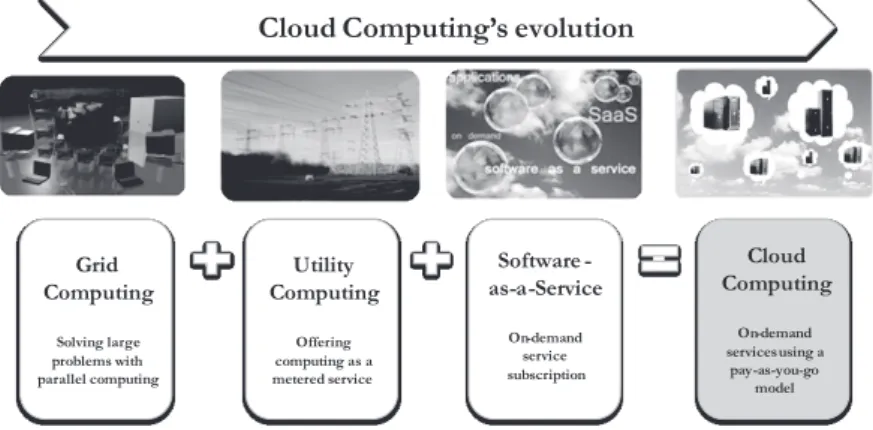
Even without definition, there is a common understanding: CC is not a revolutionary concept but rather an evolutionary one, as it has grown from concepts and frameworks such as Grid Computing, Utility Computing and Software-as-a-Service (SaaS) – Figure 1. In this sense, CC can
-not be seen as a technology but instead as a com -bination of technologies as it pulls together Grid
Computing resource’s sharing functionality, with Utility Computing’s business model, along with the SaaS’s subscription for services on-demand.
Figure 1 — The evolution of Cloud computing
Grid Computing Solving large problems with parallel computing Utility Computing Offering computing as a metered service Software -as-a-Service On-demand service subscription Cloud Computing On-demand services using a pay-as-you-go model
Cloud Computing’s evolution
CC takes computational resources and applica
-tions to a level where they can be provisioned as a service, just like water and electricity. In a CC
environment applications and data do not need
to be necessarily installed or stored in the user’s device, being available by the Cloud through
dedicated service providers, also referred to as Cloud Providers (CP). The CP is responsible, for example, for guaranteeing the storage,
mainte-nance and backup of the user’s data, while the
user limits itself to access the platform provided
and paying only for what he needs – a pay-as-you-go model.
Technically, the term «Cloud» refers to a com -putational infrastructure or platform, capable of
scaling dynamically according to the user’s need, resilient, providing ubiquity and guarantees of on-demand delivery of the services to the user
through the Internet. Clouds are of particular
156
trend to outsource IT so as to reduce manage-ment overhead and to extend current, limited
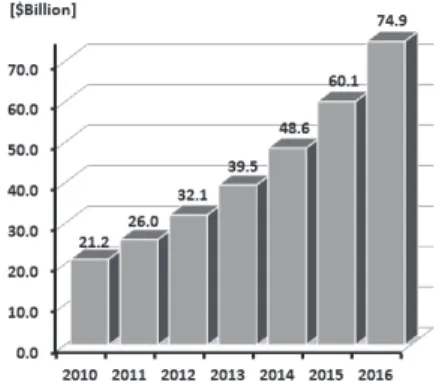
IT infrastructures «The global market for Cloud Computing technologies is going to grow by a robust Compound Annual Growth Rate (CAGR) of 23.4% over the next five years, with an ag
-gregate of over $300 Billion over that period» as Figure 2 shows. CC reduces the entrance bar
-rier (minimum infrastructure entry cost) and risks (reduced risk of wasting resources) for new service providers to launch their solutions.
Costs for business customers are shifted from CAPital EXpenditure (CAPEX) to OPerational EXpenditure (OPEX). Its provisioning
environ-ment stands out from classical ones by its high scalability. However, there are concerns, espe
-cially regarding security if a business places its valuable knowledge, information and data on an
external service.
Most important IT players and beyond (net
-work operators, device manufactures), such as Sun, Oracle, Google, EBay, and Microsoft, provide today various types of CC commercial
platforms. E.g.: Google Docs and Microsoft
Office 365 give users the ability to use tradi
-tional Office tools (e.g.: Word, Excel, Power
-Point, and OneNote) through a browser with no need to have any additional program installed
in the device.
Figure 2 — Cloud computing cumulative market — 2010/2016
Allowing all relevant features in a Cloud-based
architecture requires real-time access to the
In-ternet, which is becoming increasingly available through broadband access, not only in the wired domain (e.g. fiber) but also in the wireless do
-main (e.g. WiMAX, Wi-Fi and LTE). CC’s -main
features include:
• Unlimited computing capacity (theoretically;
it gives the user the illusion of unlimited);
• Offloads a great amount of computing and
storage from user devices;
• «Disconnects» the services from the user devices (device independency);
• On-demand self-service; • Pay per use business model.
In a user’s perspective, by not storing user or
service data on the device (there are of course exceptions, e.g. service address and access cre-dentials), the user relates to the service that it af-fords rather than to the device.
Mobile Cloud computing
Mobile Cloud computing (MCC) comes from the «adaptation» of Cloud computing to the
mo-bile environment. MCC refers to «anywhere any -time secure access to data and services». Mobile
refers to smartphones, e-book readers, netbooks, in-car entertainment systems, navigation systems and similar devices. The limited processing power
and storage capabilities of these devices are a stim-ulus for moving the core services of the devices
«into the Cloud», where services are made available to the user through browser-based user interfaces and deploying local capabilities of the devices.
The strong adoption of intelligent mobile
de-vices will continue to drive users to Cloud-based services and applications. A key feature of MCC is its capability to enable and enrich software ser
-vices by taking advantage of available informa
-tion and intelligence from mobile networks and systems. MCC is forecasted to have great impact
on the provisioning of mobile services, leading
to new opportunities for its stakeholders, includ
-ing Mobile Network Operators (MNOs). The In
-ternet’s core network has the means (bandwidth, robust security mechanisms and quality) to ad
-minister the demands of most CC services; how -ever, MCC demands particular requirements that
go beyond fixed-line CC service delivery, mainly due to significant mobile access bandwidth limi
-tations. In this sense, MNOs will naturally have a fundamental role in deploying and provision
157
At the same time, it is obvious that MCC is
not going to be the best solution for every need.
It poses challenges due to the intrinsic nature
and constraints of wireless networks and devic
-es. This is especially true when it comes to
rich-internet and immersive mobile applications, e.g.
online gaming and augmented reality that require high-processing capacity and minimum network latency. These will most probably continue to be partially processed locally on powerful smart -phones and mobile tablets. Mobile broadband
networks generally require longer execution times
for a given application to run in the Cloud, and
network latency issues may deem certain appli
-cations and services unfit for the mobile Cloud. As an example, it is a belief that CC will be
-come a disruptive force in the mobile world not only due to the number of users the technology has the power to reach, but also due to how it will change the applications’ distribution. Today’s
mobile applications are tied to the device’s
mar-ket – e.g. to have an Apple application the user
needs to have an Apple device such as an iPhone
or iPad (the same happens with Blackberry ap -plications and others). Android is the exception
to this rule, and that is probably the main reason why it is gaining market in such a short period of time. MCC breaks this relationship, since, as CC, the only requirement to a mobile application is the access to the web. With the huge market supply and constant evolution of devices (e.g.:
laptops, smartphones and tablets), users are
con-stantly switching devices. This can turn out to be
quite a headache for users: to change data from
one device to another, reconfigure settings; in
-compatibility issues between devices and appli
-cations/services. With MCC, the user can switch devices without witnessing data loss and can also have multiple devices (at home and at work; in
a laptop and a smartphone) able to support the
same service without synchronization problems. In this way, the service is no longer tied to the device but to the user – device independency.
Cloud computing and networks
As previously referred, the range of Cloud ser -vices can go from a simple storage or computing service to a video on-demand or gaming service.
Such diversity brings with it requirements at two different levels: at the Cloud level, where compu -tational resources must be able to guarantee the demand of such services; and at the access level, i.e., depending on the service being consumed
different quality levels to the services are required in the network. The Cloud is known by its scal
-ability and elasticity, which may suggest variation in the network requirements as the Cloud scales up or down. Moreover, the Cloud allows this to
be done on-demand.
However, the Cloud and network are two dif -ferent entities, i.e., a user may request a Cloud ser
-vice which inherently has certain access require
-ments that are not provisioned by the network. In some cases, when the typical best effort Internet
model is not enough, it can be done the purchase
of a network service that meets the Cloud ser -vice requirements, connecting the user and the
Cloud hosting the service. Obviously, the network service is static and cannot follow the dynamic
-ity of the Cloud (increase or decrease of qual-ity requirements). Furthermore, the Cloud assumes the concept of «anywhere, anytime access», and even with static network service the user faces the drawback of mobility. Network services are not mobile, and thus, cannot follow the user. This is a major drawback which certainly will disrupt the leverage of Cloud services, mainly as more
«heavy» services are not able to be attended in a
best-effort way appear.
CC today relies on the power of big data cent
-ers, which can in the future become a concern. Even though it was possible to provide network
services able to connect the users and the Cloud
effectively, at a certain point the network itself would not stand due to the centralized nature of today’s data centers.
In order to address the current limitations of
CC related to the network, a new concept arouse, the concept of Cloud Networking (CN). Similar to CC, CN has no standard definition, but we can say that it goes beyond classical networks to redefine scalability, administration and manage
-ment processes. Some key considerations of CN encompass scalability, guaranteed performance,
self-healing and extensible management. We
con-sider CN not only as the combination of network services with today’s Cloud (big data centers), but also as an evolution of the Cloud, where its con
-158
cept is extended to smaller Cloud data center’s
(which we call Cloud sites) distributed through the network, in strategic places, where some are located in network edges closer to users. With a
distributed Cloud it is possible to move content
between sites with the purpose of providing the user with better Quality of Experience (QoE), while at the same time optimizing the occupancy of the network infrastructure.
In order to clarify what we mean, we now pro -vide a small example: imagine a user consuming a Cloud service from a data center located in the
core of the network; suppose that the user has a network service able to provide the required quality for the service; at a certain point in time
several users in the same geographical area also
start consuming the service; this will increase the demand on the network. At this point, with
a Cloud site nearer the geographical area of the
users, it may be beneficial to move the service closer to the user along with the associated net
-work service, thus optimizing the whole service. With this approach, it will be possible to man
-age demand for network resources instantane
-ously, to meet the changing service needs, ena
-bling fast and efficient responses in a dynamic
environment.
Summary and conclusion
This section described the vision of cloud
com-puting along with the stakeholders’ position in the ecosystem. Main features and business opportu
-nities were presented, as well as remaining open-issues that need to be addressed, such as QoS, trust, security and privacy, and network interac
-tion. These aspects have always posed issues in any internet provision service, but due to the spe
-cific nature of Clouds, additional aspects related to multi-tenancy and control over data location
arise. Handling data in Clouds is still complicated
– in particular, as data size and diversity grows,
pure replication is no viable approach, leading to
consistency and efficiency issues. Also, the lacking
control over data location and missing provenance
poses security and legal issues. Several of these is
-sues still remain because no standards exist which obviously «blocks» interoperability. Aspects related
to green IT also need to be evolved, as the Cloud
can work in a green way by reducing unnecessary power consumption, if good scaling behavior and good economic models are employed. With computing centers among the biggest energy con
-sumer, reducing energy consumption will signifi
-cantly reduce ownership costs. Therefore, in such an environment autonomy becomes a key feature
for the Cloud architecture.
It has also been made clear that, in a system where services’ quality is an essential require
-ment, an active network intervention is funda -mental. The amount of applications ported to large Cloud platforms is increasing, including
new applications such as online games and video processing. These highly distributed applications raise new challenges. Being able to adjust rapidly and without human intervention to changes in the environment is highly important.
It is clear that cloud computing is changing the
way IT services and network are provided, and more importantly, is changing the IT services and network themselves, with a complete restructur -ing on the business models to be provided. The
plethora of new applications and challenges with the cloud environment will revolution the IT community.
References
[1] NIST Working Definition of Cloud Com
-puting, Google groups, May 2009. Retrieved, January 2011, from: http://groups.google.com/ group/Cloudforum/web/nist-working-defini -tion-of-Cloud-computing?pli=1.
[2] P. Neves, J. Soares, et al. «Cloud Comput -ing: Principais Conceitos e Tendências», Portugal Telecom Inovação, December 2010.
[3] M. Armbrust, I. Stoica, M. Zaharia, et al. «A
view of Cloud computing», Communications of
the ACM, vol. 53, 2010.
[4] J. Mathews, «The Future of Virtualization, Cloud Computing and Green IT – Global Tech
-nologies & Markets Outlook – 2011-2016». Mar
-ket Intel Group LLC, October 2010.
[5] M.A. Vouk, «Cloud computing; Issues, re
-search and implementations», ITI 2008 – 30th
International Conference on Information
Tech-nology Interfaces, Cavtat/Dubrovnik, Croatia,
159
[6] The Future of Cloud Computing: Oppor
-tunities for European Cloud Computing Beyond
2010, Expert Group Report, European
Commis-sion Information Society and Media.
[7] Google Docs, http://docs.google.com/.
[8] Microsoft office 365, http://office365.mi
-crosoft.com/en-US/online-services.aspx. [9] Opportunities and Challenges for Opera -tor in the Mobile Cloud. D1: Mobile Cloud
Tech-nologies and Trends. Eurescom Study Report,
October 2010.
[10] Dusan Belic, ABI Research: One billion people will use mobile Cloud services by 2014. Intomobile, September 2009. Retrieved, No
-vember 2010, from: http://www.intomobile. com/2009/09/09/abi-research-one-billion-peo
-ple-will-use-mobile-Cloud-services-by-2014/. [11] Jayshree Ullal, What is Cloud Net
-working? October 2008. Retrieved, January 2011, from: http://cloudnetworkarchitect. com/2008/10/10/jayshree-ullal-what-is-cloud-networking-.aspx.