Enhancement of Photovoltaic Performance by Utilizing Readily
Accessible Hole Transporting Layer of Vanadium(V) Oxide Hydrate in
a Polymer
−
Fullerene Blend Solar Cell
Youyu Jiang,
†Shengqiang Xiao,
*
,†Biao Xu,
†Chun Zhan,
†Liqiang Mai,
*
,†Xinhui Lu,
*
,‡and Wei You
*
,†,§ †State Key Laboratory of Advanced Technology for Materials Synthesis and Processing, Wuhan University of Technology, Wuhan,430070, People’s Republic of China
‡Department of Physics, the Chinese University of Hong Kong, Hong Kong, People’s Republic of China
§Department of Chemistry, University of North Carolina at Chapel Hill, Chapel Hill, North Carolina 27599-3290, United States
*
S Supporting InformationABSTRACT: Herein, a successful application of V2O5·nH2O
film as hole transporting layer (HTL) instead of PEDOT:PSS in polymer solar cells is demonstrated. The V2O5·nH2O layer
was spin-coated from V2O5·nH2O sol made from melting-quenching sol−gel method by directly using vanadium oxide powder, which is readily accessible and cost-effective. V2O5· nH2O (n ≈ 1) HTL is found to have comparable work
function and smooth surface to that of PEDOT:PSS. For the solar cell containing V2O5·nH2O HTL and the active layer of
the blend of a novel polymer donor (PBDSe-DT2PyT) and the acceptor of PC71BM, the PCE was significantly improved
to 5.87% with a 30% increase over 4.55% attained with
PEDOT:PSS HTL. Incorporation of V2O5·nH2O as HTL in the polymer solar cell was found to enhance the crystallinity of the
active layer, electron-blocking at the anode and the light-harvest in the wavelength range of 400−550 nm in the cell. V2O5·nH2O HTL improves the charge generation and collection and suppress the charge recombination within the PBDSe-DT2PyT:PC71BM solar cell, leading to a simultaneous enhancement inVoc, Jsc, and FF. The V2O5·nH2O HTL proposed in this work is envisioned to be of great potential to fabricate highly efficient PSCs with low-cost and massive production.
KEYWORDS: polymer solar cell, hole transporting layer, PEDOT:PSS, vanadium(V) oxide hydrate, melting-quenching sol−gel method
■
INTRODUCTIONThe interfaces between the electrodes (i.e., cathode and anode) and the photoactive layer (e.g., a blend of conjugated polymers with fullerene derivatives) play a very important role in determining the device output in a single-junction bulk heterojunction (BHJ) polymer soar cell (PSC).1−3 Both the hole transport layer (HTL) and the electron transport layer (ETL) require careful selection and optimization in order to facilitate the extraction of charge carriers, generated via the dissociation of excitons and the charge separation within the photoactive layer. The most commonly used material as HTL to modify the indium tin oxide (ITO) anode is poly-(ethylenedioxythiophene):poly(styrenesulfnate) (PE-DOT:PSS), benefiting from its well-established optical and electrical properties including high transparency, suitable work function, and excellent conductivity.4,5Moreover, PEDOT:PSS, commercially available as a water-based solution, is environ-mentally friendly and only requires low-temperature postbaking process to form a thinfilm of high quality. Unfortunately, the acidic nature of PEDOT:PSS poses a serious threat to the ITO layer (an oxide), which could deteriorate device performance
over time and negatively impact the stability of the practical devices.6,7
In recent years, semiconducting transition metal oxides (TMOs) such as NiOx, MoOx, VOx, WO3, ReOx, and CuOx
have stood out as promising alternatives to PEDOT:PSS, and they have demonstrated comparable device performance to the ones based on PEDOT:PSS, with improved environmental stability of these TMO-based devices.8,9Early studies on these metal oxides typically deposited them as thinfilms via vacuum-based processes, which are not only incompatible with high-throughput roll-to-roll process but are also not cost-effective. Consequently, solution-processed TMO films have been increasingly explored and significant progress has been made.9 However, achieving high quality thin films with these solution-processed metal oxides, in particular, NiOx,10−12 ReOx,13CrOx,14and CuOx,15often requires high-temperature
(300−600 °C) post annealing, O2-plasma/UV-ozone
post-Received: March 6, 2016 Accepted: April 22, 2016 Published: April 22, 2016
treatment, or a combination of both, to ensure a complete decomposition of inorganic/organic metal salt precursors to form metal oxides.
In this regard, V2O5 is particularly promising since its thin
film formation does not require such undesirable post-treatment processes (e.g., high-temperature annealing).16−20 For example, Lira-Cantú et al. recently applied V2O5·0.5H2O prepared from aging metavanadic acid solution over 20 days under ambient conditions, to replace PEDOT:PSS in PSCs.21 Although the V2O5·0.5H2O based device showed comparable
photovoltaic performance to that of PEDOT:PSS-based counterpart, and good outdoor stability under working conditions, the extremely long aging process (>20 days) to obtain the condensed V2O5hydrate sol severely hindered its
large scale application in PSCs. On the other hand, vanadium pentoxide sol can be directly made from vanadium oxide powder by a melting-quenching process, in which the molten liquid of V2O5prepared in a muffle furnace was quickly poured
into controlled amount of distilled water.22−25 The limited solubility of crystalline V2O5 in water and alcohol typically
prevents its direct use to prepare films of high quality from solution-based processes. Fortunately, in this melting− quench-ing process, the highly crystallized V2O5is transformed into an amorphous state upon heating at around 800°C (i.e., melting), which instead shows higher solubility and can provide target sols with controllable concentrations upon quenching with water. This would allow to directly use vanadium oxide powderas an alternative to inorganic salts or organometallic precursorsto prepare vanadium oxide sol in water at low cost. Further, this vanadium oxide sol displays high storage stability due to its moisture insensitivity.
We adopted this melt−quenching process to prepare V2O5
hydrate (V2O5·nH2O) thinfilm as HTL for PSCs. Indeed, the V2O5·nH2Ofilm after postannealing at 120°C is very smooth
and has a work function similar to that of PEDOT:PSS. When such V2O5·nH2Ofilms is used as the HTL for PSC device based
on a BHJ blend of a novel low-band gap polymer donor PBDSe-DT2PyT and [6,6]-phenyl-C71-butyric acid methyl
ester (PC71BM) acceptor, we observe a concurrent enhance-ment inVoc,Jsc, and FF of the solar cell devices, leading to a
power conversion efficiency (PCE) of 5.87%. This is a 30% increase in PCE over the 4.55% of the control device with PEDOT:PSS as the HTL. The role of V2O5hydrate HTL in e n h a n c i n g p h o t o v o l t a i c p e r f o r m a n c e o f P B D S e -DT2PyT:PC71BM solar cell over PEDOT:PSS HTL is discussed onfilm crystallinity of the active layer, hole mobility from space charge limited current, reduction in the recombination loss, and the photo-induced carriers generation rate at saturated photocurrent and the charge collection probability within the polymer solar cells.
■
EXPERIMENTAL SECTIONMaterials and Characterization. The V2O5·nH2O sol was
prepared by using an adapted version of melting-quenching process.23 V2O5powder (10 g) was added in a ceramic crucible and heated at 800 °C in a muffle furnace for 30 min. The molten liquid was then quickly poured into distilled water (500−1000 mL) at room temperature with vigorous stirring. The resultant mixture was filtered three times to affordfinal brownish V2O5hydrate sol.
The detailed synthesis and characterization of novel polymer PBDSe-DT2PyT was presented in Supporting Information. [6,6]-Phenyl-C71-butyric acid methyl ester (PC71BM, > 99%, EL device
grade) was purchased from Solenne. Thermogravimetric analysis (TGA) of V2O5·nH2O xerogel was carried out on a NETZSCH
syncthermogravimetric analyzer (STA449F3) at a heating rate of 10
°C min−1 under nitrogen. The X-ray photoelectron spectroscopy (XPS) measurement on V2O5·nH2O film was performed on a
VGScientific ESCA Lab220i-XL electron spectroscopy with an Al Kα X-ray source at an approximately pressure of 3 × 10⁻⁹ mbar.
Samples were prepared by spin-coating V2O5 sols on silicon wafers.
The binding energy of the XPS data was referenced to the C 1s peak at 284.8 eV. The ultraviolet photoelectron spectroscopy (UPS) measure-ments were carried out by using an equipment of Kratos Axis Ultra DLD with a He I (21.22 eV) excitation source in an ultrahigh 3.0× 10⁻⁸Torr vacuum. The samples were deposited on ITO substrate by spin coating and biased at−9 V to favorably identify the secondary-electron cutofffrom the UPS spectra. AFM morphology of thefilms was characterized through tapping mode on Multimode 8 SPM at ambient conditions. RTESPA (0.01−0.025Ωcm, antimony (n) doped silicon) tips with a spring constant of 20−80 N m−1and frequency of
305−356 kHz were used in imaging. X-ray diffraction (XRD) data of V2O5·nH2O was recorded by the out-of-plane XRD profile in reflection
mode with a PANalytical X’pert Pro type X-RAY Diffractometer using Cu Kα radiation (λ = 1.540598 Å) at room temperature. The GIWAXS measurements of the pristine polymerfilms and the blend
films of the polymer and PC71BM were conducted at 23A SWAXS
beamline of a superconductor wiggler at the National Synchrotron Radiation Research Center, Hsinchu, Taiwan, using a 10 keV beam incident at 0.15° and a C9728DK area detector. Verification of the crystalline structures of PEDOT:PSS or V2O5·nH2O were done by
referring the GIWAXS pattern of the published results to rule out the interference from the HTL.26−29
Device Fabrication and Characterization. PSC devices were fabricated with a conventional configuration of indium tin oxide (ITO)/ HTL/PBDSe-DT2PyT:PC71BM/Ca (20 nm)/Al (80 nm).
The patterned ITO glass substrates were first cleaned by ultra-sonication in DI water, acetone, and isopropyl alcohol sequentially for 10 min, followed by a UV−ozone treatment for 10 min. PEDOT:PSS solution was spin-coated onto the substrates at 4000 rpm for 60 s and baked at 150°C for 30 min. V2O5·nH2O was prepared by spin-coating
the vanadium pentoxide sol. The thickness of V2O5·nH2Ofilms was
adjusted through control the concentration of the sols. The vanadium pentoxide gel with different concentration (from 3 to 11 mg mL−1)
was spin-coated on precleaned ITO glass substrates to obtain V2O5· nH2O films with desired thickness (from 5 to 20 nm). The water
molecules in V2O5 hydrate are partially eliminated when the V2O5· nH2O thinfilms are formed on the glass/ITO substrate after annealing
at certain temperature. The substrates were then transferred into a glovebox under N2. Subsequently, the active layers were spin-coated
from the blend of PBDSe-DT2PyT and PC71BM ino-DCB solution
with afixed donor concentration of 10 mg mL−1and dried naturally in
the glovebox. Finally, Ca (20 nm) and Al (80 nm) were sequentially thermal evaporated on the top of the active layers as the cathode at a pressure around 4×10⁻⁶mbar through a shadow mask that defines 8 devices, each with an area of 9 mm2. The thicknesses of active layers
were recorded by a DEKTAK XT profilometer. The statistics of the photovoltaic performance were from at least 20 solar cell devices.
Solar cell performances were tested in a nitrogen-filled glovebox under AM 1.5G irradiation (100 mW cm−2) from a 450 W solar
simulator (Newport 94023A-U) calibrated by a NREL certified standard silicon cell. Current versus potential (J−V) curves were recorded with a Keithley 2420 digital source meter. For external quantum efficiency (EQE) tests, devices were transferred by a self-made testing box into the sample chamber of a 7-SCSpec Spectral Performance of Solar Cell Test System consisting of a 500-W SCS028-7ILX500 xenon light source, a 7ISW301 vertical grating spectrometer, a 71FW6filter wheel, a SR540 chopper and a SR810 lock-in amplifier. The calibration of the incident monochromatic light was carried out with a Hamamatsu S1337-1010 BQ Silicon photo detector.
■
RESULTS AND DISCUSSIONInformation, Scheme S1) according to our previous work on PBDSe-DTBT.30 PBDSe-DTBT displays both a low optical band gap of 1.71 eV and a deep HOMO level located at−5.37 eV. By introducing thiadiazolo[3,4-c]pyridine based acceptor unit (DT2PyT) to take the place of corresponding benzo[c]-[1,2,5]thiadiazole (DTBT) acceptor, PBDSe-DT2PyT shows a lower optical band gap of 1.53 eV while maintaining deep HOMO level at−5.44 eV (Supporting Information, Figure S1), which may improve light absorption for higherJscand matched energy level with PC71BM to afford higherVoc.
Vanadium oxides typically exist as layered structures with water molecules intercalated between the layers. The hydrated vanadium pentoxide (V2O5·nH2O) gel has an interlayer spacing ranging from 8.8 to 13.8 Å, which can be adjusted by controlling the amount of water inserted.31For this reason, the water content has a direct impact on its optolectronic properties. The formation of the V2O5·nH2O gel is a complex condensation process.24 Neutral precursors of VO(OH)3 are
obtained when the molten V2O5 is added into water. The coordination expansion then occurs when additional nucleo-philic water molecules are added, leading to a 6-fold vanadium coordination complex of VO(OH)3(H2O)2. Further
condensa-tions due to oxolation along the H2O−V−OH direction and oxolation reactions of the OH groups lead to thefinal vanadium pentoxide gel. To identify the value ofnfor the resulting V2O5· nH2Ofilms, we annealed thefilms at different temperatures in
ambient conditions according to the thermogravimetric analysis (TGA) of a V2O5·nH2O xerogel, which was obtained by a
freeze-drying process of the as-prepared sol to remove free water molecules. Based on the weight loss shown in the TGA curve (Supporting Information, Figure S2), water was totally eliminated after heating above 330 °C at which point the crystallization of V2O5into rhombic crystalline phase (α-V2O5) occurred.23The number of water molecules (n) in the V2O5·
nH2O gel can be estimated based on the weight loss as a function of temperature. For example,nis around 1.4 below 80
°C, 1.0 at 120°C, 0.8 at 150°C, 0.7 at 200°C, and 0 above 330
°C.
Photovoltaic Properties. Optimization of the PE-DOT:PSS based devices was undertaken first. Devices with t h e c o nfig u r a t i o n I T O / P E D O T : P S S / P B D S e -DT2PyT:PC71BM/Ca/Al were optimized by changing the
donor/acceptor weight ratio, the active layer thickness, and the concentration of a solvent additive. The optimal poly-mer:PC71BM weight ratio was found to be 1:1, and the optimal film thickness of the active layer was approximately 90 nm. Interestingly, the photovoltaic performance of the BHJ blend was not improved by the addition of a high boiling point solvent additive, 1,8-diiodooctane (DIO), but rather worsened overall (Supporting Information, Table S1). After optimizing
the active layer processing, the HTL was switched from PEDOT:PSS to V2O5·nH2O. Because the TGA results clearly show thatnis affected by temperature, and the number of water molecules in turn affects the optoelectronic properties, we studied the dependence of device performance on annealing temperature and HTL film thickness. The active layer conditions were kept the same as those optimized for the PEDOT:PSS based solar cells. The current−voltage (J−V) characteristics of the optimized BHJ solar cells containing V2O5·nH2O and PEDOT:PSS HTLs are displayed inFigure 2 and relevant photovoltaic parameters are summarized inTables 1and2.
The optimized solar cells with a PEDOT:PSS HTL displayed an average PCE of 4.55%, with aVocof 0.67 V, aJscof 12.53 mA cm−2, and a FF of 54%. After switching to V2O5·nH2O as a
HTL, significant improvement in the PCE was observed, mainly due to simultaneous enhancement of theVocto 0.72 V
and the FF to greater than 0.57. It is noteworthy that theJscof the V2O5·nH2O based solar cells are relatively sensitive to both
the annealing temperature and the thickness of the V2O5·nH2O HTL. We obtained the maximumJscof 13.96 mA cm−2when
10 nm of V2O5·nH2O was annealed at 120 °C, and therefore observed a remarkable average PCE of 5.87%, a 30% improvement over the PEDOT:PSS devices. Preliminary testing on the stability of the optimized device with HTL of PEDOT:PSS or V2O5·H2O was also investigated as a function of storage time in a glovebox in dark without any encapsulation at room temperature. As shown inFigure S3, The device with PEDOT:PSS HTL showed a variation of∼96% on both theVoc
andJscand a variation of∼75% of the FF after 500 h, leading to the PCE decreased to∼70%. In contrast, theVocandJscof the
device with V2O5·H2O HTL remains almost unchanged and only the FF decreased to∼93% after 500 h, leading to the PCE decreased to∼93% and indicating better device stability.
X-ray Photoelectron and Ultraviolet Photoelectron Spectroscopy Analysis. Given the effectiveness of V2O5· nH2O as a HTL, further characterization of the film was
performed. X-ray photoelectron spectroscopy (XPS) was used to study the chemical composition of the V2O5·nH2O film
annealed at 120°C, which had annof around 1. The V 2p3/2 and V 2p1/2spectra can befitted by different oxidation states
(V5+ and V4+) in V
2O5 following the Lorentzian−Gaussian
model. As shown in Figure 3a, the characteristic peaks with
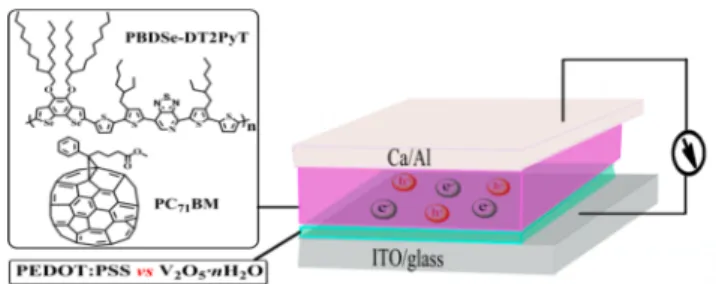
Figure 1.BHJ PSC devices composed of the active layer of PBDSe-DT2PyT:PC71BM, the HTL layer of V2O5·nH2O or PEDOT:PSS, and
the electrodes (ITO as the anode and Ca/Al as the cathode).
Figure 2. Current−voltage (J−V) curves of optimized PBDSe-DT2PyT:PC71BM solar cells with V2O5·nH2O HTL (10 nm, annealed
at 120°C) and PEDOT:PSS HTL respectively, under illumination of 1 sun at AM 1.5G (100 mW cm−2).
energies at 517.2 and 524.7 eV correspond to V5+, and lower
peaks at 516 and 523 eV are commonly attributed to V4+ states.21As calculated from the integral area of the V 2p peaks, the relative ratio of V5+to V4+is found to be around 8.95:1. On the basis of the integration of the O 1s peaks, the V:O ratio is around 1:2.45, indicating the existence of oxygen vacancies in the film, which implies a nonstoichiometric composition of V2O5·nH2O. The presence of the V4+ is due to the partial
decomposition of V2O5 when heated above its melting point and the reduction reaction with water molecules that can occur during the quenching process. Previous studies have shown that small amounts of oxygen vacancies can enhance the electrical properties of TMOs when they are employed as HTLs.19 Ultraviolet photoelectron spectroscopy (UPS) was further utilized to examine the energy band structures of the V2O5· nH2O film (Figure 3b). This is particularly relevant for
improving the interfacial energy level alignment in solar cells. The work function of the V2O5·nH2O film spin-coated on an
ITO substrate and then annealed at 120°C was found to be 5.04 eV, which is similar to that of PEDOT:PSS (∼5.1 eV).5 Work function of the interlayers can directly affect the ability to block electrons and the Voc, but the small variation in work
function between the V2O5·nH2O HTL and the PEDOT:PSS HTL indicates that such effects can be neglected in this study. Additionally, V2O5·nH2O thin films are highly transparent in the visible range, particularly 600−900 nm (Supporting Information, Figure S4), and thus do not directly affect the absorbance in the solar cell.
Morphological Analysis. The surface morphologies of V2O5·nH2O and PEDOT:PSS films spin-coated on bare ITO
substrates were examined by atomic force microscopy (AFM) as shown inFigure 4.Figure 4a indicates that PEDOT:PSS has
a uniform and smooth surface with a root-mean-square (RMS) roughness of 2.08 nm. As for the V2O5·nH2O film, it also exhibits a very smooth surface with a RMS roughness of 2.13 nm (Figure 4b). A smooth surface can improve the interface with the photoactive layer and reduce the contact resistance in the solar cells. In order to understand the effect of the HTL on the overall morphology, the effects of both HTLs on the
Table 1. Average Photovoltaic Characteristics of PBDSe-DT2PyT:PC71BM (1:1 Weight Ratio) Solar Cells Utilizing a V2O5·
nH2O HTL with a Fixed Film Thickness of 10 nm at Various Annealing Temperatures and Optimized Photovoltaic
Performance of PEDOT:PSS-based Device for Comparison
HTL (thickness) annealing temp (°C) Voc(V) Jsc(mA cm−2) FF (%) PCE (%)
V2O5·nH2O (10 nm) RT 0.72±0.01 12.47±0.20 0.57±0.01 5.14±0.11
120 0.72±0.01 13.96±0.12 0.59±0.02 5.87±0.16 150 0.72±0.01 12.71±0.11 0.59±0.01 5.38±0.10 200 0.72±0.01 12.40±0.16 0.60±0.01 5.37±0.18 PEDOT:PSS (40 nm) 150 0.67±0.01 12.53±0.12 0.54±0.01 4.55±0.11
Table 2. Average Photovoltaic Parameters of
PBDSe-DT2PyT: PC71BM Solar Cells Utilizing V2O5·nH2O HTL
Annealed at 120°C with Various Film Thicknesses
thickness of V2O5·
nH2O
HTL (nm) Voc(V) Jsc(mA cm−2) FF (%) PCE (%)
5 0.72±0.01 12.33±0.33 0.58±0.02 5.19±0.25 10 0.72±0.01 13.96±0.12 0.59±0.02 5.87±0.16 16 0.73±0.01 12.75±0.33 0.58±0.01 5.41±0.20 20 0.72±0.01 12.29±0.11 0.61±0.01 5.36±0.10
Figure 3.(a) XPS spectra of V 2p and O 1s of the V2O5·nH2Ofilm annealed at 120°C and (b) UPS spectra of ITO/V2O5·nH2Ofilm. Figure 4.AFM height images (5×5μm) of HTLfilms spin-coated on ITO: (a) PEDOT:PSS annealed at 150 °C and (b) V2O5·nH2O
morphology of both neat polymer films and the BHJ blend were studied. The corresponding AFM images of the photoactive layer deposited on both V2O5·nH2O and
PEDOT:PSS are shown in Figure S5 in Supporting Information. In both cases, the photoactive layer displays a smooth surface with RMS roughness of ∼1.9 nm and comparable phase morphology, implying that surface
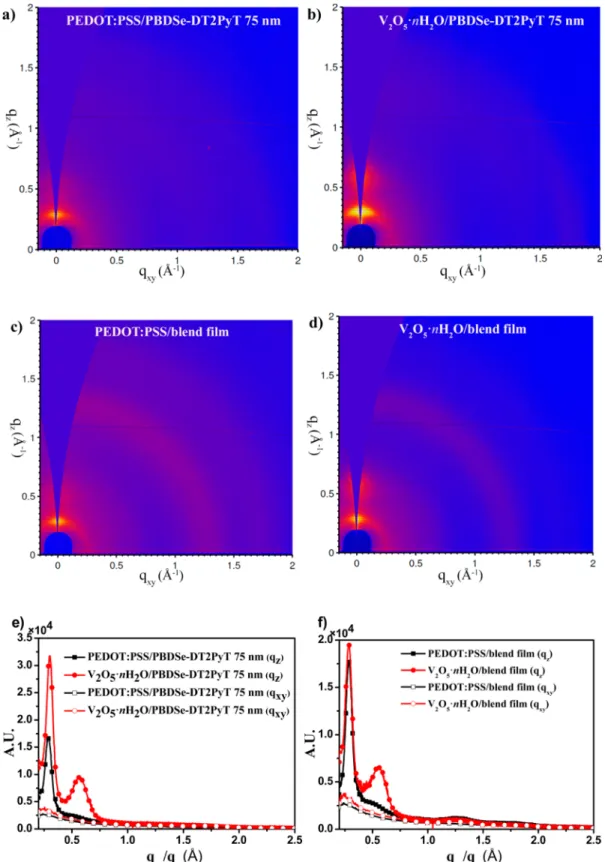
morphol-ogy of the HTL, and its effect on the surface morphology of the active layer, cannot explain the variation in device performance. Therefore, two-dimensional grazing incidence wide-angle X-ray scattering (2D-GIWAXS) was employed to explore the structural differences of neat polymerfilms and BHJ blendfilms when deposited on either V2O5·nH2O or PEDOT:PSS HTLs. Figure 5shows the detailed GIWAXS profiles in both
out-of-Figure 5.(a−d) 2D GIWAXS patterns and (e, f) out-of-plane and in-plane data of pristine PBDSe-DT2PyT films and blend films based on PEDOT:PSS and V2O5·nH2O.
plane and in-plane directions. The GIWAXS pattern of a pure PBDSe-DT2PyT film (∼75 nm) deposited on PEDOT:PSS only exhibited a diffraction (100) peak along theqz axis at a
value of qz of 0.29 Å−1(Figure 5e), indicating a preferential edge-on lamellar stacking with a lattice spacing of 21.65 Å. Surprisingly, when V2O5·nH2O was employed as an HTL instead, the intensities of this (100) peak were significantly enhanced compared to that of the PEDOT:PSS based film, indicating a significant increase in the crystallinity of the edge-on PBDSe-DT2PyT lamellae. This increased crystallinity due to the use of the V2O5·nH2O HTL was also evidenced by the presence of a clearly identifiable peak in a relatively thin PBDSe-DT2PyTfilm (∼5 nm;Supporting Information, Figure S6). This increase in crystallinity is also observed for PBDSe-DT2PyT:PC71BM blendfilms when PEDOT:PSS was replaced
with V2O5·nH2O as an HTL (Figure 5f). Owing to the higher
crystallinity, the hole carrier mobility of the V2O5·nH2O HTL based solar cell as measured by the space charge limited current (SCLC) method increased to 2×10⁻³cm2V−1s−1, almost 4
times the mobility of the PEDOT:PSS HTL based device, 0.54
× 10−3 cm2 V−1 s−1, (Supporting Information, Figure S7), which is beneficial for higher FF. In addition, relatively higher polymer crystallinity may minimize the leakage current loss and recombination loss.32Additionally, all the samples based on the PEDOT:PSS HTL show a weak and wide peak atqz= 0.56 Å−1,
which was ascribed to the (200) peak of PBDSe-DT2PyT. While for films based on the V2O5·nH2O HTL, although
stronger diffraction peaks were depicted, we cannot identify its influence on the (200) peak of PBDSe-DT2PyT since the diffraction peak of the layered structure with a correspondingd spacing of 11.18 Å in the V2O5·nH2O film overlapped in this
area (as determined in the X-ray diffraction pattern;Supporting Information, Figure S6). This is commonly observed for V2O5 hydrate.24,28,29 The identical, distinguishable yet weak halo centered at a value ofqzof 1.24 Å−1in all the BHJ blendfilms
originates from PC71BM. These results demonstrate that the V2O5·nH2O HTL improves the crystallinity of the donor
polymer in the BHJ morphology, which in turn enhanced the transport of holes within the solar cells.
Electrical Characteriaztion of Photovoltaic Devices.
Having understood the effect of the V2O5·nH2O HTL on the
morphology of the active layer, we next investigated the electrical properties of the devices. The Voc is normally
determined by the difference between the HOMO of the donor and the LUMO of the acceptor, and the work function difference between the anode and the cathode in a BHJ solar cell.33Because the components of the photoactive layer and the work function of the interlayers do not change for PEDOT:PSS and V2O5·nH2O, these cannot account for the observed increase inVoc. To gain deeper insight into the enhancedVoc, wefirst analyzed charge carrier recombination. Voc is
propor-tional to light intensity (I) as described byVoc∝(nkT/q) ln(I),
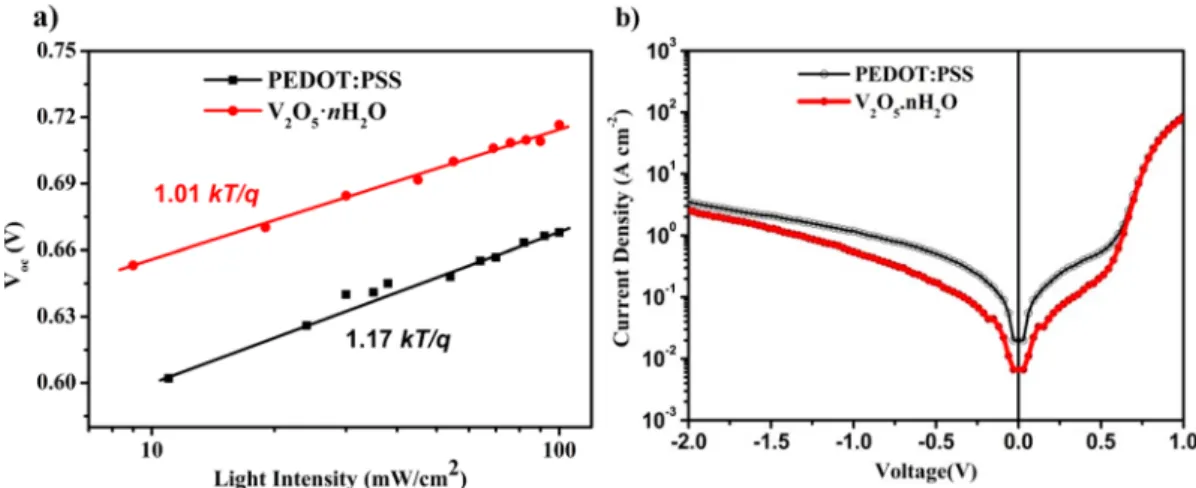
where k is the Boltzmann constant, T is the temperature in Kelvin, andqis the elementary charge.34As shown inFigure 6a, the solar cell with the V2O5·nH2O HTL exhibited a lower slope
of 1.01kT/q, compared to 1.17kT/qfor the PEDOT:PSS based device which implies reduced Shockley−Read−Hall (SRH) or trap-assisted recombination in the V2O5·nH2O-based
de-vice,30,35,36 which can be associated with the improved crystallinity of PBDSe-DT2PyT in the BHJ blend as discussed above. Annihilation of charge carriers by recombination, regardless of its type, would induce energy loss, and thus reduceVoc. Therefore, the observed reduced recombination in
the V2O5·nH2O device can help to explain the Voc
enhance-ment.
The decrease in recombination is further evidenced by the dark saturation current (Jsat) and the diode ideality factor (n), which reflect the recombination behavior of the devices. These were estimated byfitting the equivalent circuit equation to the dark J−V curves as shown in Figure 6b.37−39 The resulting parameters are summarized inTable 3. The V2O5·nH2O HTL effectively reduces the leakage current of the diode at reverse bias in comparison to that of the PEDOT:PSS HTL device, indicative of improved electron-blocking at the anode. Our calculated data show that the Jsat decreases by 1 order of Figure 6.(a) MeasuredVocas a function of light intensity and (b) darkJ−Vcharacteristics of the solar cells with either PEDOT:PSS or V2O5·nH2O.
Table 3. Diode Characteristics ofJsatand the Diode Ideality Factor (n) Calculated from DarkJ−VCurves and PredicatedVoc
and FF
HTL Jsat(10−9A cm−2) n Rsh(Ωcm2) Rs(Ωcm2) calcdVoc(V) calcd FF
PEDOT:PSS 26 2.2 322 9.7 0.74 0.52
V2O5·nH2O 1.7 1.84 588 8.8 0.75 0.59
magnitude, from 2.6×10⁻⁸A cm−2with PEDOT:PSS to 1.7× 10⁻⁹A cm−2with V2O5·nH2O. Additionally, the corresponding
diode ideality factor n improves to 1.84 from 2.2. These observed trends further indicate that recombination is sup-pressed in the V2O5·nH2O-based solar cell. On the basis of the simplified expression of Voc ≈ (nkT/q) ln(Jsc/Jsat) from the Shockley equation,40,41the changes inJsatandntrack well with the shift inVoc. In particular, a lowerJsatin a solar cell leads to a higherVoc. Indeed, the predictedVocis 0.74 V for PEDOT:PSS and 0.75 V for V2O5·nH2O respectively, which is consistent
with the trend exhibited by our experimental results. Thus, we can conclude that theVocis mainly influenced by the changes in
recombination in this BHJ system.
Because thefill factor of a solar cell is a function of the open circuit voltage (Voc) and the diode ideality factor (n),40,42
reduced recombination losses may also contributed to the improved FF for the solar cell with the V2O5·nH2O HTL.43
Additionally, however, the series resistance (Rs) and shunt
resistance (Rsh) are important factors that influence the FF in OPV devices. In a practical equivalent circuit model, FF is determined by such factors in a complex way (seeSupporting Information, eqs S2 and S3).40,42The V2O5·nH2O based device
showed a similarRs, but increasedRsh(588Ωcm2) relative to
the PEDOT:PSS based device (322Ωcm2, inTable 3). It has been reported that higher Rsh, which limits current loss in a
solar cell, is intimately correlated with larger FF. The calculated
FF of the solar cell with the V2O5·nH2O HTL is indeed higher
than the device with the PEDOT:PSS HTL (0.59 vs 0.52,Table S2). Based on the experimental and theoretical calculations, the FF enhancement in the V2O5·nH2O based solar cell is a result
of both reduced recombination losses and higher shunt resistance.
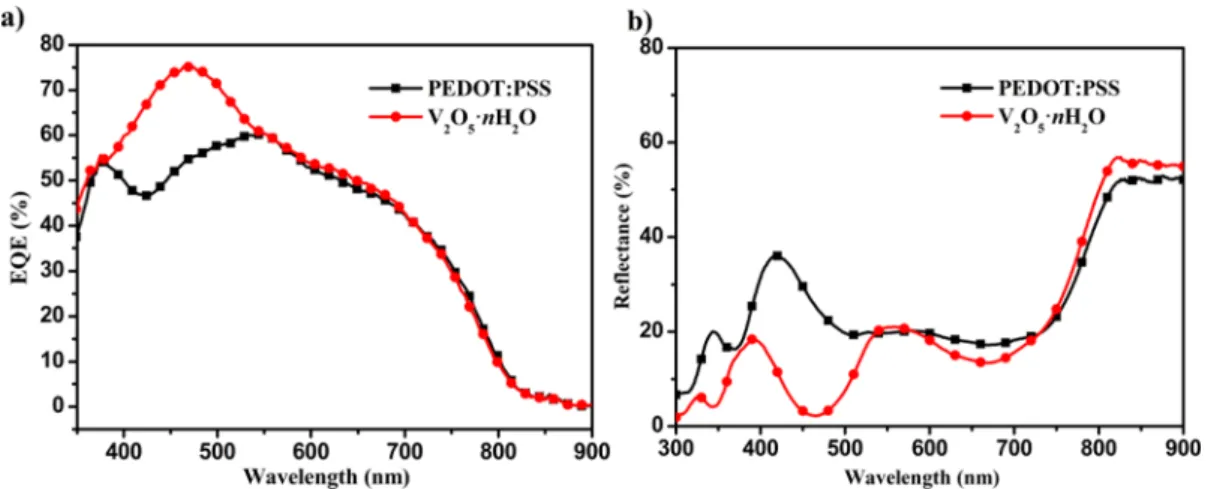
The suppressed charge recombination mentioned above also contributes to the larger Jsc of the solar cell with the V2O5· nH2O HTL. However, the optical effects of the V2O5·nH2O HTL on Jsc were also investigated. The external quantum efficiency (EQE) spectra of BHJ devices with PEDOT:PSS and V2O5·nH2O HTLs are shown inFigure 7a. The EQE spectrum
of the V2O5·nH2O-based solar cell has a strong peak in the
wavelength range from 400 to 550 nm, whereas the PEDOT:PSS device exhibits a deep valley-like response in the same region. We further measured the reflectance loss of the whole device for both devices in question. As shown in Figure 7b, a clear reflection peak was observed from 400 to 550 nm for the PEDOT:PSS-based solar cell, whereas there is significantly less reflectance in that range for the V2O5·nH2 O-based device. Because the thick cathode layer of Ca/Al is nontransparent, the reduced reflectance loss indicates more light-harvesting in the V2O5·nH2O HTL solar cell. Because
both cells utilize similar fabrication conditions and photoactive layers with similarfilm thicknesses, a direct contribution from the active layer is unlikely and can be ignored (Supporting
Figure 7.(a) EQE spectra and (b) reflectance spectra of devices with V2O5·nH2O and PEDOT:PSS, respectively.
Figure 8.(a) Photocurrent density (Jph) and (b) charge collection probability as a function of internal voltage (Vint) for the solar cells with
PEDOT:PSS and V2O5·nH2O.
Information, Figure S8). A more plausible explanation is an enhanced distribution of the optical electric field intensity within the active layer for V2O5·nH2O based device.13,44
As a result of increased absorbance, the maximum photo induced carrier generation rate per unit volume (Gmax) in the PSCs will be improved.45−47Figure 8a shows the plots of the Jph versus internal voltage (Vint) of devices with PEDOT:PSS and V2O5·nH2O respectively, where the Jph is determined by
subtracting the dark current density (JD) from illumination current (JL), and Vint is calculated by subtracting the applied
voltage (Vappl) from the built-in voltage (Vbi).34,48 The Jphof both devices saturate at highVint (>2 V), demonstrating that
this internalfield is large enough to sweep out all carriers in this system. The estimated saturated photocurrent (Jph,sat) of the
solar cell with PEDOT:PSS is 137.0 A m−2and is 148.6 A m−2
for the solar cell with V2O5·nH2O. The corresponding Gmax
(Gmax=Jph,sat/qL, whereLis the thickness of photoactive layer, andqis the elementary charge) of the solar cells is calculated as 0.95×1028m−3s−1and 1.03×1028m−3s−1, respectively. Such
enhancement inGmax is in good agreement with the improved
light harvesting in V2O5·nH2O HTL-based solar cell. We further compare the charge collection probability (PC = Jph/
Jph,sat) with respect toVintin solar cells with PEDOT:PSS and V2O5·nH2O HTLs. As shown inFigure 8b, in comparison with
PEDOT:PSS device, the V2O5·nH2O based device exhibited higherPCacross the fullVintrange below 1 V. In particular, the
PCof the V2O5·nH2O based solar cell rose to 96% under the short-circuit conditions, compared to the 88% of the PEDOT:PSS based solar cell. The increase in PC combined with the increase in light-harvesting lead to a higherJsc in the
solar cell with V2O5·nH2O HTL.
■
CONCLUSIONIn summary, we demonstrated successful application of high-quality V2O5·nH2O HTL in PSCs made from
melting-quenching sol−gel method by directly using vanadium oxide powder, which is readily accessible and cost-effective. Water content in V2O5·nH2O HTL can be adjusted by thermal
treatment, which gives rise to the deviation of photovoltaic performance of PBDSe-DT2PyT:PC71BM solar cells. When
annealed at 120 °C to afford n around 1, V2O5·nH2O HTL
embodied comparable work function and smooth surface to PEDOT:PSS HTL. With optimized thickness around 10 nm of V2O5·nH2O HTL, the PCE of PBDSe-DT2PyT:PC71BM solar
cell was significantly improved to 5.87% with a 30% increase over 4.55% attained with PEDOT:PSS HTL. Incorporation of V2O5·nH2O as HTL in the PSC was found to enhance the
crystallinity of the active layer, electron-blocking at the anode and the light-harvest in the wavelength range of 400−550 nm in the cell measured with reflectance spectroscopy and by the measurement of photo induced carriers generation rate. V2O5·
nH2O HTL thus improves the charge generation and collection
and suppress the charge recombination within the PBDSe-DT2PyT:PC71BM solar cell, leading to a simultaneous
enhancement in Voc, Jsc, and FF. The V2O5·nH2O HTL
proposed in this work is envisioned to be of great potential to fabricate highly efficient PSCs with low-cost and massive production.
■
ASSOCIATED CONTENT*
S Supporting InformationThe Supporting Information is available free of charge on the ACS Publications websiteat DOI:10.1021/acsami.6b02824.
Detailed experimental information for the preparation of PBDSe-DT2PyT and its basic optoelectronic properties, the table for average parameters of solar cells with PEDOT:PSS HTL, comparative device stability profiles (Voc,Jsc, FF, and PCE vs storage time). AFM topography of BHJ blends and 2D GIWAXS of pristine PBDSe-DT2PyT thinfilms with the thickness of 5 nm both on V2O5·nH2O and PEDOT:PSS HTL, XRD measurement
of V2O5·nH2O HTL, J−V plots for hole mobility measurement from space charge limited current method and the dependence of FF on related electrical parameters calculated from the J−V curve of solar cell with V2O5·nH2O and PEDOT:PSS HTL, respectively. (PDF)
■
AUTHOR INFORMATIONCorresponding Authors
*E-mail: [email protected].
*E-mail: [email protected].
*E-mail: [email protected].
*E-mail: [email protected]. Notes
The authors declare no competingfinancial interest.
■
ACKNOWLEDGMENTSWe are grateful forfinancial support from Wuhan University of Technology and the National Natural Science Foundation of China (NSFC). B. Xu thanks the support from the Under-graduate Training Programs for Innovation and Entrepreneur-ship of Wuhan University of Technology (20151049701027).
■
REFERENCES(1) Lu, L.; Zheng, T.; Wu, Q.; Schneider, A. M.; Zhao, D.; Yu, L. Recent Advances in Bulk Heterojunction Polymer Solar Cells.Chem. Rev.2015,115, 12666−12731.
(2) Kuang, C.; Tang, G.; Jiu, T.; Yang, H.; Liu, H.; Li, B.; Luo, W.; Li, X.; Zhang, W.; Lu, F.; Fang, J.; Li, Y. Highly Efficient Electron Transport Obtained by Doping PCBM with Graphdiyne in Planar-Heterojunction Perovskite Solar Cells.Nano Lett. 2015, 15, 2756− 2762.
(3) Liu, C.; Xu, L.; Chi, D.; Li, Y.; Liu, H.; Wang, J. Synthesis of Novel Acceptor Molecules of Mono- and Multiadduct Fullerene Derivatives for Improving Photovoltaic Performance.ACS Appl. Mater. Interfaces2013,5, 1061−1069.
(4) Dou, L.; You, J.; Hong, Z.; Xu, Z.; Li, G.; Street, R. A.; Yang, Y. 25th Anniversary Article: A Decade of Organic/Polymeric Photo-voltaic Research.Adv. Mater.2013,25, 6642−6671.
(5) Yip, H.-L.; Jen, A. K. Y. Recent Advances in Solution-Processed Interfacial Materials for Efficient and Stable Polymer Solar Cells.
Energy Environ. Sci.2012,5, 5994−6011.
(6) Norrman, K.; Madsen, M. V.; Gevorgyan, S. A.; Krebs, F. C. Degradation Patterns in Water and Oxygen of an Inverted Polymer Solar Cell.J. Am. Chem. Soc.2010,132, 16883−16892.
(7) Nardes, A. M.; Kemerink, M.; de Kok, M. M.; Vinken, E.; Maturova, K.; Janssen, R. A. J. Conductivity, Work Function, and Environmental Stability of PEDOT:PSS Thin Films Treated with Sorbitol.Org. Electron.2008,9, 727−734.
(8) Wang, F.; Tan, Z. A.; Li, Y. Solution-Processable Metal Oxides/ Chelates as Electrode Buffer Layers for Efficient and Stable Polymer Solar Cells.Energy Environ. Sci.2015,8, 1059−1091.
(9) Chueh, C.-C.; Li, C.-Z.; Jen, A. K. Y. Recent Progress and Perspective in Solution-Processed Interfacial Materials for Efficient and Stable Polymer and Organometal Perovskite Solar Cells.Energy Environ. Sci.2015,8, 1160−1189.
(10) Manders, J. R.; Tsang, S.-W.; Hartel, M. J.; Lai, T.-H.; Chen, S.; Amb, C. M.; Reynolds, J. R.; So, F. Solution-Processed Nickel Oxide Hole Transport Layers in High Efficiency Polymer Photovoltaic Cells.
Adv. Funct. Mater.2013,23, 2993−3001.
(11) Bai, S.; Cao, M.; Jin, Y.; Dai, X.; Liang, X.; Ye, Z.; Li, M.; Cheng, J.; Xiao, X.; Wu, Z.; Xia, Z.; Sun, B.; Wang, E.; Mo, Y.; Gao, F.; Zhang, F. Low-Temperature Combustion-Synthesized Nickel Oxide Thin Films as Hole-Transport Interlayers for Solution-Processed Optoelec-tronic Devices.Adv. Energy Mater.2014,4, 1301460.
(12) Steirer, K. X.; Ndione, P. F.; Widjonarko, N. E.; Lloyd, M. T.; Meyer, J.; Ratcliff, E. L.; Kahn, A.; Armstrong, N. R.; Curtis, C. J.; Ginley, D. S.; Berry, J. J.; Olson, D. C. Enhanced Efficiency in Plastic Solar Cells via Energy Matched Solution Processed NiOx Interlayers.
Adv. Energy Mater.2011,1, 813−820.
(13) Tan, Z. A.; Li, L.; Wang, F.; Xu, Q.; Li, S.; Sun, G.; Tu, X.; Hou, X.; Hou, J.; Li, Y. Solution-Processed Rhenium Oxide: A Versatile Anode Buffer Layer for High Performance Polymer Solar Cells with Enhanced Light Harvest.Adv. Energy Mater.2014,4, 1300884.
(14) Tu, X.; Wang, F.; Li, C.; Tan, Z. A.; Li, Y. Solution-Processed and Low-Temperature Annealed CrOx as Anode Buffer Layer for
Efficient Polymer Solar Cells.J. Phys. Chem. C2014,118, 9309−9317. (15) Xu, Q.; Wang, F.; Tan, Z. a.; Li, L.; Li, S.; Hou, X.; Sun, G.; Tu, X.; Hou, J.; Li, Y. High-Performance Polymer Solar Cells with Solution-Processed and Environmentally Friendly CuOxAnode Buffer
Layer.ACS Appl. Mater. Interfaces2013,5, 10658−10664.
(16) Zilberberg, K.; Trost, S.; Meyer, J.; Kahn, A.; Behrendt, A.; Lützenkirchen-Hecht, D.; Frahm, R.; Riedl, T. Inverted Organic Solar Cells with Sol−Gel Processed High Work-Function Vanadium Oxide Hole-Extraction Layers.Adv. Funct. Mater.2011,21, 4776−4783.
(17) Zilberberg, K.; Trost, S.; Schmidt, H.; Riedl, T. Solution Processed Vanadium Pentoxide as Charge Extraction Layer for Organic Solar Cells.Adv. Ene. Mater.2011,1, 377−381.
(18) Chen, C.-P.; Chen, Y.-D.; Chuang, S.-C. High-Performance and Highly Durable Inverted Organic Photovoltaics Embedding Solution-Processable Vanadium Oxides as an Interfacial Hole-Transporting Layer.Adv. Mater.2011,23, 3859−3863.
(19) Xie, F.; Choy, W. C. H.; Wang, C.; Li, X.; Zhang, S.; Hou, J. Low-Temperature Solution-Processed Hydrogen Molybdenum and Vanadium Bronzes for an Efficient Hole-Transport Layer in Organic Electronics.Adv. Mater.2013,25, 2051−2055.
(20) Huang, X.; Zhai, Z.; Yuan, J.; Peng, J.; Yang, T.; Wang, H.-Q.; Ma, W. A Facile Approach to Fabricate Solution-Processable Metal Oxides for Interfacial Layer in Polymer Solar Cells.Org. Electron.2014,
15, 1235−1243.
(21) Teran-Escobar, G.; Pampel, J.; Caicedo, J. M.; Lira-Cantu, M. Low-Temperature, Solution-Processed, Layered V2O5Hydrate as the
Hole-Transport Layer for Stable Organic Solar Cells.Energy Environ. Sci.2013,6, 3088−3098.
(22) Müller, E. Z. A New Method for Preparation of Colloidal Vanadic Dispersion.Chem. Ind. Kolloide1911,8, 302−303.
(23) Wei, Q.; Liu, J.; Feng, W.; Sheng, J.; Tian, X.; He, L.; An, Q.; Mai, L. Hydrated vanadium pentoxide with superior sodium storage capacity.J. Mater. Chem. A2015,3, 8070−8075.
(24) Livage, J. Vanadium Pentoxide Gels. Chem. Mater. 1991, 3, 578−593.
(25) Mai, L.; Tian, X.; Xu, X.; Chang, L.; Xu, L. Nanowire Electrodes for Electrochemical Energy Storage Devices.Chem. Rev. 2014,114, 11828−11862.
(26) Palumbiny, C. M.; Liu, F.; Russell, T. P.; Hexemer, A.; Wang, C.; Müller-Buschbaum, P. The Crystallization of PEDOT:PSS Polymeric Electrodes Probed In Situ during Printing. Adv. Mater. 2015,27, 3391−3397.
(27) Cruz-Cruz, I.; Reyes-Reyes, M.; Rosales-Gallegos, I. A.; Gorbatchev, A. Y.; Flores-Camacho, J. M.; López-Sandoval, R. Visible Luminescence of Dedoped DBU-Treated PEDOT:PSS Films.J. Phys. Chem. C2015,119, 19305−19311.
(28) Espinosa, N.; Dam, H. F.; Tanenbaum, D. M.; Andreasen, J. W.; Jørgensen, M.; Krebs, F. C. Roll-to-Roll Processing of Inverted
Polymer Solar Cells using Hydrated Vanadium(V) Oxide as a PEDOT:PSS Replacement.Materials2011,4, 169−182.
(29) An, H.; Mike, J.; Smith, K. A.; Swank, L.; Lin, Y.-H.; Pesek, S. L.; Verduzco, R.; Lutkenhaus, J. L. Highly Flexible Self-Assembled V2O5
Cathodes Enabled by Conducting Diblock Copolymers.Sci. Rep.2015,
5, 14166.
(30) Jiang, Y.; Yang, M.; Huang, X.; Gao, J.; Zhan, C.; Xiao, S. A Novel Donor-Acceptor Alternating Copolymer Based on Angular-Shaped Benzo[2,1-b:3,4-b]Diselenophene for Bulk Heterojunction Solar Cells.Polym. Chem.2015,6, 1383−1392.
(31) Whittingham, M. S. Lithium Batteries and Cathode Materials.
Chem. Rev.2004,104, 4271−4302.
(32) Liu, Y.; Zhao, J.; Li, Z.; Mu, C.; Ma, W.; Hu, H.; Jiang, K.; Lin, H.; Ade, H.; Yan, H. Aggregation and Morphology Control Enables Multiple Cases of High-Efficiency Polymer Solar Cells.Nat. Commun. 2014,5, 5293.
(33) Brabec, C. J.; Cravino, A.; Meissner, D.; Sariciftci, N. S.; Fromherz, T.; Rispens, M. T.; Sanchez, L.; Hummelen, J. C. Origin of the Open Circuit Voltage of Plastic Solar Cells. Adv. Funct. Mater. 2001,11, 374−380.
(34) Cowan, S. R.; Roy, A.; Heeger, A. J. Recombination in Polymer-Fullerene Bulk Heterojunction Solar Cells. Phys. Rev. B: Condens. Matter Mater. Phys.2010,82, 245207.
(35) Kyaw, A. K. K.; Wang, D. H.; Gupta, V.; Leong, W. L.; Ke, L.; Bazan, G. C.; Heeger, A. J. Intensity Dependence of Current−Voltage Characteristics and Recombination in High-Efficiency Solution-Processed Small-Molecule Solar Cells.ACS Nano2013,7, 4569−4577. (36) Proctor, C. M.; Kim, C.; Neher, D.; Nguyen, T.-Q. Nongeminate Recombination and Charge Transport Limitations in Diketopyrrolopyrrole-Based Solution-Processed Small Molecule Solar Cells.Adv. Funct. Mater.2013,23, 3584−3594.
(37) Vandewal, K.; Tvingstedt, K.; Gadisa, A.; Inganas, O.; Manca, J. V. On the Origin of the Open-Circuit Voltage of Polymer-Fullerene Solar Cells.Nat. Mater.2009,8, 904−909.
(38) He, Z.; Xiao, B.; Liu, F.; Wu, H.; Yang, Y.; Xiao, S.; Wang, C.; Russell, T. P.; Cao, Y. Single-Junction Polymer Solar Cells with High Efficiency and Photovoltage.Nat. Photonics2015,9, 174−179.
(39) Qi, B.; Wang, J. Open-Circuit Voltage in Organic Solar Cells.J. Mater. Chem.2012,22, 24315−24325.
(40) Qi, B.; Wang, J. Fill Factor in Organic Solar Cells.Phys. Chem. Chem. Phys.2013,15, 8972−8982.
(41) Sze, S. M.Physics of Semiconductor Devices. Interscience (Wiley): New York, 1969.
(42) Green, M. A. Accuracy of Analytical Expressions for Solar Cell Fill Factors.Sol. Cells1982,7, 337−340.
(43) Stuart, A. C.; Tumbleston, J. R.; Zhou, H.; Li, W.; Liu, S.; Ade, H.; You, W. Fluorine Substituents Reduce Charge Recombination and Drive Structure and Morphology Development in Polymer Solar Cells.
J. Am. Chem. Soc.2013,135, 1806−1815.
(44) Tan, Z. A.; Li, S.; Wang, F.; Qian, D.; Lin, J.; Hou, J.; Li, Y. High Performance Polymer Solar Cells with As-Prepared Zirconium Acetylacetonate Film as Cathode Buffer Layer.Sci. Rep.2014,4, 4691. (45) Mihailetchi, V. D.; Xie, H. X.; de Boer, B.; Koster, L. J. A.; Blom, P. W. M. Charge Transport and Photocurrent Generation in Poly(3-hexylthiophene): Methanofullerene Bulk-Heterojunction Solar Cells.
Adv. Funct. Mater.2006,16, 699−708.
(46) He, Z.; Zhong, C.; Su, S.; Xu, M.; Wu, H.; Cao, Y. Enhanced Power-Conversion Efficiency in Polymer Solar Cells Using an Inverted Device Structure.Nat. Photonics2012,6, 591−595.
(47) Kyaw, A. K. K.; Wang, D. H.; Wynands, D.; Zhang, J.; Nguyen, T.-Q.; Bazan, G. C.; Heeger, A. J. Improved Light Harvesting and Improved Efficiency by Insertion of an Optical Spacer (ZnO) in Solution-Processed Small-Molecule Solar Cells.Nano Lett.2013,13, 3796−3801.
(48) Cowan, S. R.; Street, R. A.; Cho, S.; Heeger, A. J. Transient Photoconductivity in Polymer Bulk Heterojunction Solar Cells: Competition between Sweep-out and Recombination.Phys. Rev. B: Condens. Matter Mater. Phys.2011,83, 035205.