PERSPECTIVE ON PRACTICE
Trainee perceptions of training
transfer: an empirical analysis
Irene Nikandrou, Vassiliki Brinia and Elissavet Bereri
Athens University of Economics and Business, Athens, Greece
Abstract
Purpose– The purpose of the paper is to present an empirical study based on a trainee-oriented systemic model for training transfer. The paper examines trainee characteristics which affect the motivation to learn and transfer and determine the trainees’ entry behavior. Then, during the training process, the complex interactions among the trainer, the trainees and the content and method used are taken into account to assess what are here termed direct and indirect training transfer. Finally, organizational factors affecting both the training transfer and the trainee him/herself are examined.
Design/methodology/approach– The authors used 44 in-depth interviews with trainees from different organizations who participated in a training program that was based on an innovative experiential training method (project method).
Findings– The results reveal the importance of trainee characteristics in the training transfer process and provide useful insights regarding the design and management of the training program.
Originality/value– The qualitative methodology used is a strong element of this study as it provides rich information regarding the training transfer process. The research design framework, i.e. interviewing trainees one year after the training took place, revealed important factors affecting the training transfer process.
KeywordsTraining, Training methods, Knowledge transfer
Paper typeResearch paper
The intensification of global competition, the changing marketplace and rapid technological advances demand a more flexible and competent workforce. Thus, the importance of organizational training has been recognized as a strategic force in the effort to raise competitiveness. Indeed, Stavrouet al.(2004) report that one of the main challenges human resource (HR) managers faced in the 1990s involved issues of training and development. The main goal of training is to provide, obtain and improve the necessary skills in order to help organizations achieve their goals and create competitive advantage by adding value to their key resources – i.e. employees.
With high investments in and allocation of resources to training, the need for justifying training effectiveness and documenting that employees can transfer and use the skills learnt to their work environment has accelerated. Therefore, what counts in every training program is whether the participants are able to transfer and apply the skills they learn to their work. Research has shown that 40 percent of the skills acquired during the training process are immediately transferred at work, 25 percent remain for a time period of six months and only 15 percent for a year (Burke and
Baldwin, 1999; Facteau et al., 1995). Baldwin and Ford (1988) define the training
transfer in terms of two factors:
(1) maintenance of new knowledge and skills in time; and (2) generalization of new knowledge and skills.
The current issue and full text archive of this journal is available at www.emeraldinsight.com/0309-0590.htm
Perceptions of
training transfer
255
Received 16 July 2008 Revised 23 September 2008 Accepted 12 January 2009Journal of European Industrial Training Vol. 33 No. 3, 2009 pp. 255-270
qEmerald Group Publishing Limited 0309-0590 DOI 10.1108/03090590910950604
Previous researchers report high failure rates on training transfer (Anthony and Norton, 1991; Garavaglia, 1993). The term “generalization” refers to whether the employee applies the new knowledge, skills and behavior to a range of different situations occurring outside the training program (Adams, 1987).
The aim of this study is to present an empirical study based on trainee perceptions of training transfer at work and to determine the factors that trainees perceive as important in affecting the training transfer. In the following, we briefly present a literature review supporting the training transfer variables under investigation in our study. The methodological concerns and the results of the present study are then discussed. Final remarks, limitations and suggestions for future research are presented in the concluding section.
Background and research framework
There is a variety of theoretical and empirical approaches that examine the issue of training transfer (Baldwin and Ford, 1988; Geilen, 1996; Huczynski and Lewis, 1980; Kontoghiorghes, 2004). These studies distinguish three categories of factors affecting training transfer at work:
(1) factors concerning the trainee;
(2) factors concerning the training and the planning of the training program; and (3) organizational factors affecting the transfer as well as the training and the
trainee.
Trainee characteristics
Research has shown that the characteristics of the trainee’s personality directly affect the training process and training transfer (Ford et al., 1992; Warr et al., 1999). The ability of the person to learn, synthesize, and connect what he has learnt to practice and transfer the skills and knowledge to work is the second factor for training transfer (Robertson and Downs, 1979). Previous studies have identified the following trainee characteristics as affecting training transfer:
. the motivation of the person to learn and transfer the skills to his work (Facteau et al., 1995; Kontoghiorghes, 2002);
. his perception of opportunities to apply the new skills (Noe, 1986);
. his personal career goals (Tzineret al., 1991);
. the perception of the trainee regarding the management of his career goals
through training (career utility), as well as the goals directly connected to his work (job utility) (Clarket al., 1993); and
. organizational commitment (Facteauet al., 1995; Kontoghiorghes, 2002).
Training design
In order to achieve successful training transfer to the workplace, the training program
must be relevant to the job (Axtell et al., 1997; Kontoghiorghes, 2002; Rouiller and
Goldstein, 1993). However, it is not enough for the content of training to be relevant. The trainee must also understand the relationship between training and work practice to be able to make the transfer (Bateset al., 1997). The planning of the training program is very important for its total success and therefore for training transfer at work. The
JEIT
33,3
goals and the extent of training, the training methods and means, as well as the training place and equipment, are important factors related to training program planning. The trainer himself must possess two essential characteristics. First of all he must be reliable, and secondly he must be effective. Finally, the content of the training must emphasize both theoretical and practical aspects, as well as the acquisition of knowledge and skills (Gauld and Miller, 2004). A good combination of all these is important and leads to increased training transfer.
Organizational characteristics
The prevailing organizational climate concerning new knowledge and skills greatly influences whether the transfer will be made or not (Rouiller and Goldstein, 1993; Traceyet al., 1995). A supportive climate increases the adoption of transfer strategies by the trainees as well as the transfer in general (Burke and Baldwin, 1999).
Superiors and colleagues are another important factor mentioned in the literature as affecting training transfer (Baldwin and Ford, 1988; Goldstein and Musicante, 1986; Noe and Schmitt, 1986). The existence of available equipment used at work will affect the training transfer. Culture will or will not allow the employee to experiment on his new skills in his working position. An organizational culture emphasizing performance orientation values training and learning and taking initiatives (Javidan, 2004). Moreover, in a highly humane-oriented organizational culture, practices reflect individualized consideration and informal relationships provide development opportunities to employees (Kabasakal and Bodur, 2004, p. 596). Thus, we expect that in performance-oriented and humane-oriented organizational cultures there will be more opportunities for employees to experiment and transfer newly acquired knowledge and skills. Internal and/or external rewards are related to training transfer
at work (Rouiller and Goldstein, 1993; Kontoghiorghes, 2001; Tracey et al., 1995).
Finally, a basic prerequisite for a company to undertake successful training programs is also its good reputation, not only regarding training, but its reputation in general (Switzeret al., 2005).
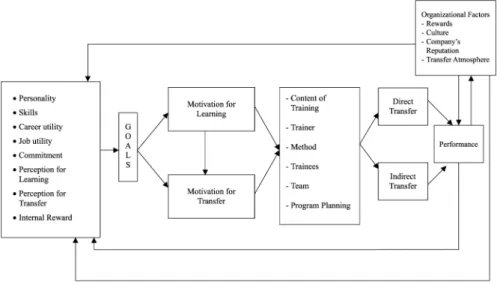
Research so far has focused on the determination of the characteristics of the trainee and the training transfer climate in the organization and on how these affect training transfer. A recent model developed by Kontoghiorghes (2004) proposes the investigation of learning transfer in a systemic approach. This model examines the impact of organizational factors unrelated to training but affecting working performance. In this study we emphasize the role of the trainee, his characteristics and how he perceives the training and the training transfer to his work. We propose a systemic model which examines the training transfer process based on the trainee’s perceptions. We assume that the trainee enters the training process having specific characteristics and motives. During the training process, the complex interactions among the trainer and the trainees influence trainee characteristics, knowledge, skills and abilities and result in direct or indirect training transfer to his work environment. Finally, organizational factors affect both training transfer rate and work performance, as well as the trainee himself, thus shaping his perception of learning and its transfer to the workplace.
Perceptions of
training transfer
The training transfer model
The model we suggest uses the systemic approach at the level of the trainee. For the model, the trainee is the basic inflow of the training system. Thus, to understand the training transfer process we need to understand all the factors affecting trainees as they enter training, during the training process and after training when they return to their work environment. The characteristics of the trainee, such as his personality, his ability to learn and transfer, his personal learning goals, job and career utility, his commitment to work, his perception for learning and its transfer at work are factors affecting the motivation of the trainee to learn and the transfer of training (Burke and Hutchins, 2007; Switzeret al., 2005). When the trainee has a vested personal interest in a training program, it is possible that the person will do anything he can to do well during the training and acquire the knowledge and skills he himself values. Furthermore, when the person has set work or career goals he wants to achieve through training, it is more probable he will transfer the training to work. According to Facteauet al.(1995), there is a significant differentiation in the degree of each person’s motivation, which depends on internal and external motives and the rewards provided. As expected, the research showed that internal motives led to greater motivation of the person to learn and transfer the training to his work in comparison to external motives. On the contrary, when training was obligatory there was a negative impact on the motivation of the person to learn as well as to the motivation and actual transfer to the workplace.
As trainees enter the training process, a number of factors affect the learning phase, such as, the content of training, the trainer, the trainees, the training methods and the program’s planning and design. The first theories on training transfer focused on the improvement of training planning and the content of the training (Huczynski and Lewis, 1980). Cumulatively, these theories show that the methods used, the variety of training stimuli, which is related to the usage of various instructional methods, as well as the interaction of the trainees with each other and with the trainer create the proper learning environment and play a defining role in the training transfer. The content of the training program can be related either to the immediate trainee’s work needs or to future career needs (Spitzer, 1984). More recently, Lim and Johnson (2002) support that training content and learning objectives are related to either developing job-related skills or to learning more theoretical and conceptual issues. When the training focus is on specific job-related skills, the instructional strategies in training design must emphasize the application of the training content to the job for training transfer to occur. On the other hand, when the emphasis is on learning more conceptual issues, then training design must concentrate on applying learning in different contexts. Thus, the content of training, training objectives, instructional methods, as well as the means, establishments and equipment of training are all factors affecting the training process and the trainees involved.
Transfer occurs when the trainee exits training and applies what he has learned directly or indirectly to work. Direct training transfer to the workplace means that the trained employee is able to apply the knowledge and skills acquired to his work. Indirect transfer means that the trained employee may transfer to the workplace skills or attitudes that were developed in training, not as part of the training objectives but as a result of the interactions and methods used. Thus, working in a group, promoting self-confidence, self-esteem, being responsible, reliable, punctual, etc., are all possible
JEIT
33,3
skills and attitudes developed indirectly through training and may contribute to enhanced work performance (Baldwin and Ford, 1988).
Finally, as the trainee enters the workplace after training he influences the organization directly or/and indirectly through the acquired knowledge and skills. He may influence job and organizational design by demanding more autonomy, task variety, and job involvement. Moreover, he may contribute to quality management and learning in the workplace. On the other hand, work- and people-related factors will influence trainees’ perceptions by giving them feedback regarding the value of training and its benefits for both the trainee and the organization. Kontoghiorghes (2004) examined the influence of organizational factors on motivation to learn and transfer and individual and/or organizational performance. In our study, we examine if and how the individual can affect organizational factors through training transfer to the workplace. Thus, a reciprocal relationship may exist between the trainee and the organization.
Research methodology
To examine our model (shown in Figure 1) and study the interdependence of the factors affecting training transfer to the workplace we conducted research. The research objectives were threefold.
The first objective was to examine whether and to what degree the participants in the training program transferred to their work the knowledge and skills acquired at the seminar.
The second objective was to study the factors that support and hinder the participants’ transfer of training to the workplace and to study the trainee himself and his characteristics and how these affect the training transfer.
We chose to study two groups of 21 persons and 23 persons, from different organizations, who participated in the training program “New challenges in the management of small and medium size commercial enterprises in the 21st century” of the Center for Promotion of Greek Commerce (KAELE). KAELE is the primary
Figure 1. A systemic model of training transfer
Perceptions of
training transfer
259
administrative and trade union organization of the Greek Union of Merchants. We selected this training program for the following reasons.
Two training groups following the same training program in the same time period were conducted. Forty-four trainees from different organizations, with different job positions and different educational backgrounds, followed the training program. This gave us the opportunity to examine simultaneously how the organizational and personal factors affect training transfer in a range of organizations.
An experiential training method, known as the project method, was used in the current study. Experiential training (project method) treats the trainee as an active researcher, as a co-researcher of his colleagues, assisting the undertaking of responsibility for the course of his training and the development of his critical thinking ability and his conscientiousness, whereas on the other hand it treats the researcher-trainer as a constructor and not as a consumer of knowledge which has been decided in advance and is ready for delivery (Brinia, 2008).
The “project method” is based on the needs and interests of the group members regarding the content of their training. Trainees, along with the trainer, plan the training activities according to the units to be covered. In particular, on 10 April 2006 within the framework of the closing day of another seminar on general management, the researcher-trainer discussed the possibility of a new training program with the trainees for an hour. The trainees would suggest and plan the training content according to their professional needs. The objective of this meeting was to arouse the trainees’ interest and to allow them to take an active part in the formation of their training. The trainees showed great interest and after discussing with each other for one more hour, they asked for the specific seminar by filling the respective application to KAELE. The training program took place from 22 May until 28 June 2006. The same holds for the second training program, which took place at the same time. It must be stressed that the subject of the training arose from the genuine interests of the trainees, after expressing their needs through the means of dialogue. The trainees were strongly concerned with management issues. They discussed, asked questions, and exchanged ideas. The trainer observed the undiminished interest of the trainees and provoked new discussions and thinking. The role of the trainer was to present the theoretical approach of the issue, using one third of the training time, whereas the rest of the time the trainees, in groups, decided to study and apply the knowledge acquired empirically to an enterprise of their own choice and to a product which was common to all the groups. The trainer and the trainees in cooperation planned training instructional strategies – i.e. interviews that the trainees themselves had to undertake with business executives, the collection of information from various organizations, literature review, case studies and field research. After formulating work groups and sharing responsibilities within groups, trainees started collecting material to be used as educational tools and training activities took place under the guidance of the trainer. The trainer during the whole training guided the trainees in their training process. At the end the participants gave and received feedback and evaluated the whole program.
According to Knoll (1997), this method assists trainees to develop independence and responsibility, and to practice social and democratic modes of behavior. Thus, the trainee is at the center of the training process and assumes responsibility for his training.
JEIT
33,3
The aims of the project method for the trainee are (Brinia, 2008):
. To learn without having the feeling that he is a passive receiver of
ready-to-consume knowledge from the trainer. The personal interests and motives of the trainees are important.
. To become able to fully develop him/herself (linguistically, mentally, socially,
emotionally, and technically).
. To become able to connect new knowledge to his already acquired experiences.
. To acquire skills in handling and solving problematic situations.
. To learn actively how to learn by developing research skills, cooperating in
teams, accepting responsibility of presenting work to the class and giving and receiving feedback.
Third, the specific training had taken place almost a year previously and we wanted to examine and evaluate this specific trainee-centered method in training transfer one year later. We considered this time period necessary for our research purpose, as trainees were able to assess training transfer and remember and evaluate the training acquired. Thus, we conducted in-depth personal interviews, which included semi-structured personal interviews of 2-3 hours with each person separately, and these were used to investigate the trainees’ perceptions regarding the degree of training transfer to their work, the knowledge, skills and attitudes acquired at the seminar, the factors that affected the transfer of training, and the personal characteristics of the trainees and how these affected the transfer.
Results
Participation and entry behavior in the training program
Due to the nature of the method used to identify the training need, the first questions examined the effect of trainees’ participation in the training program design and formulation. More specifically, trainees stressed that the reasons that had motivated them to participate were related to their current job position as well as to their personal needs. The majority of trainees emphasized personal needs for their participation, which also reflects the uniqueness of the training needs analysis process that resulted in the specific training program. Indeed, the fact that trainees themselves proposed and designed training according to their needs was a strong motive to participate actively in the training.
Factors related to trainees’ personal characteristics
The majority of the trainees stated that they participated in the program because their personal philosophy was that “knowledge is a power which is never wasted”. This statement reflects trainees’ perception about learning. Another argument revealing trainees’ learning perception is that “knowing management theory always is helpful in managing our own personal lives”. Furthermore, they mentioned reasons related to their personal growth. For example one participant stated that “knowledge becomes obsolete as time passes and I need to refresh my knowledge”, while another mentioned that it was “purely for personal growth; it has nothing to do with my job”. In addition, another participant had expressed that he wanted to apply management skills to his own work situation. Half of the trainees think that the internal rewards from
Perceptions of
training transfer
participating in a training program are important as they get more self-confident that they have the necessary knowledge and they are abreast of new knowledge. The need for communicating and developing social relationships was also mentioned, as were related trainees’ needs.
“Career utility”, which is the degree to which training can be useful in the career in general, is another factor affecting participation in the training program. Thus, when people believe that a specific training course will be useful in their current job position, they express interest and attend the program because they believe that it can be useful for their career in general. In our interviews, the majority of trainees mentioned that they wished to be prepared for any job that might come up and be able to find the job they dreamed of.
“Job utility”, which is the degree to which training can be useful in job performance, seems to be less important in trainees’ initial motivation to participate in the training program concerned. A significant proportion of participants expressed their initial interest in participating in training to acquire knowledge and skills which would help them in their jobs. Regardless of the initial trainees’ motivation to participate in the training program, the majority of the participants had positive expectations regarding training transfer to the workplace. These expectations formed trainee commitment and active involvement in the training process. These participants were thinking of how they could apply what they were learning to their work. They were interested in improving themselves at work, in enriching their job, in finding and suggesting new ways of operating, in getting their own voice heard in the company and getting credit for acquiring useful knowledge and skills.
A number of participants mentioned that they were motivated to participate in the training program due to their low level of job satisfaction. They wanted to enrich their skills and knowledge in order to find a new job. Thus, training was considered a significant alternative for personal growth, satisfaction and an opportunity for career prospects. Some of those participants also mentioned that they were thinking of starting their own company and therefore the knowledge and skills of the program would be directly useful to them. Thus, the training program’s utility for the job, as well as for the future goal of entrepreneurship, formed positive expectations, and thus the initial motivation to learn. Even though they were aware of the difficulties regarding training transfer to the workplace, their initial motivation for participating and learning was high due to their personal needs.
The training process
As was mentioned before, one of the reasons for selecting the specific training program for our study was the training method used. In the second part of the interviews, we focused on exploring the impact of the specific training method on training transfer. First, we examined how people judged the project method in comparison to other methods they had experienced in other training programs; second, whether this particular method helped them more than other methods in the transfer of new knowledge and skills to work; and third, what differentiated it in comparison to other methods. All persons had participated in other training programs but did not have much experience in experiential training methods.
The great majority of answers regarding satisfaction with the project method were positive. Out of the 40 participants who answered positively, 35 thought this was the
JEIT
33,3
best training method they had experienced. More specifically, they mentioned that with this method one has the opportunity to design one’s own training based on one’s learning preferences, and to discover his weak and strong points regarding learning. In particular, when they presented their findings to the class, the questions raised and the interactions among the participants gave them immediate feedback on their work. Moreover, they mentioned that during their training they had the opportunity to apply theory to a real-world situation. They supported that when organizational conditions favor training, this method helps training transfer more than any other method. They emphasized that the knowledge and skills acquired using the project method will be maintained due to the experiential nature of the training. “This rarely happens with other training methods”, they explained.
Only a few persons mentioned that training demands were sometimes exhausting and time-consuming, as they had to find relevant material and cases to bring into the classroom. However, one year later they realized that this was what they benefited from significantly. They argue that they have maintained what they had learned at that training, regardless of whether they had transferred it to their work.
Direct transfer
In our interviews one year after the training, almost all of these trainees expressed their disappointment as they did not manage to transfer the training to their work. Contrary to what we expected, the persons who said that they were thinking during training of how to apply what they were learning to their work finally transferred only a small percentage or even nothing at all. Even the persons who mentioned that they wanted to transfer their training to the companies they intended to start, never did start them. In those cases, trainees’ initial motivation to learn was high but direct transfer was not realized due to personal and market barriers (financial and family problems).
The only exception was one participant who mentioned that he had transferred almost everything he had learned and had greatly influenced his work environment. We think it is worth analyzing this case because it is important to understand the process and the specific characteristics of the trainee and how he affected the organization. This person had Bachelor’s and graduate degrees in chemistry and had been involved in quality management issues. He worked in a company whose main product is a depurative alcohol solution for the skin. The owner who managed the company was not educated; he was autocratic and very opinionated. The company was in a state of chaos. Employee turnover was very high, as they barely stayed for more than six months, and there were serious safety problems since the company had outdated equipment and the establishment did not comply with safety regulations. The participant mentioned that he expected the company to go bankrupt. So, after attending the seminar, he made the following changes: first of all, he differentiated the product as far as its chemical constitution was concerned. He had conducted a pilot customer survey and realized that the product caused xerodermia (dry skin). As a chemist, he added glycerin to the product, which makes peeling softer for the skin, and added some perfume too, so that the product would look more like a cosmetic product than an alcohol product. He also changed the packaging, so that it became more the packaging of a cosmetic and not an alcohol product. In terms of distribution, he made some agreements with supermarkets, inside and outside Athens. The production cost of the differentiated product was only 10 percent higher than the production cost of the
Perceptions of
training transfer
old product, whereas the selling price of the new product was much higher. The owner was finally convinced to adopt the new product and its marketing when he realized the financial situation the company was in. Moreover, the participant’s colleagues and subordinates were very encouraging in the implementation of the new plans.
Furthermore, the participant knew in advance the obstacles he would face with the owner as well as with the site and equipment, but he was prepared and willing to face them. His biggest motive for implementing his plan was not so much to prevent company from closing down, because he had no commitment to it. Rather, he wanted to try and see if he could make it as a businessman. This person had high self-esteem and self-efficacy.
Indirect transfer
It is certainly worth mentioning that the overwhelming majority of the people who did not transfer training to their work reported that they had benefited from the training. They report that they may not have transferred knowledge and skills directly, but indirectly there are some results evident in their work. More specifically, they refer to being more professional, consistent and careful in what they do. They feel that they are in a position to undertake a project and carry it through from start to finish, mainly because of the project method where they practiced such issues. Moreover, they feel that they can understand their colleagues more easily and work in a team. This, as we mentioned before, does not have to do so much with the content of the training itself, as with the way the training is conducted by means of the project method. Due to the experiential nature of the training they came in contact with practical issues, as well as with knowing themselves and their limitations better. They developed personal skills that were evident in their work performance.
Organizational factors
People who did not apply what they had learnt to their work focused on organizational factors that prevented them from transferring the training to their work. Organizational training culture seems to be the issue – that is, how companies approach training and what the underlying assumptions are regarding the value of training. Here, some examples from the interviews are provided to illustrate this idea. As one participant stated:
The company emphasizes learning . . . They want us all to go to all training programs suggested from the managers to the mere employees. . .However, when we return to the company we have to work as the owner and his son, who make all decisions, tell us.
Another participant mentioned:
They don’t even listen to our opinion. . .They don’t care about applying what we’re learning
. . .They don’t give us that opportunity in any case. . .Just as long as we go to the seminars.
Finally, another one said:
They decide. . .They’d rather be wrong and correct their mistakes to listen to our opinion. . .
They are OK, as long as they decide on their own. . .In the end, the company gets caught up with the developments in the market”.
In all these cases, we see the absence of training culture. For these companies training is an “obligation”, an investment without return, they have to follow. Analyzing and
JEIT
33,3
identifying training needs according to company’s objectives, determining training objectives and evaluating the effectiveness of training is a waste of time and money. They do not believe in training transfer as training is far from practice. Thus, training transfer is not an issue, training becomes obsolete and is considered a bad but necessary investment. Another important and related factor for trainees’ difficulty in training transfer is the role of the supervisor/manager. Some of the trainees’ replies were:
“My manager:
. does not accept other people’s opinions . wants us to be mere pawns
. has no education in order to understand the needs for training . is elder and does not understand the needs for training . does not want his subordinates to know more than he does. . . . he is afraid he might lose his position and in three years he is retiring”.
However, there are numerous negative implications for the company. The negative training climate has implications for the organizational climate, as employees feel they are not valued for what they know. Moreover, they feel angry and betrayed because they had been given a “false” opportunity to learn and develop and they are denied the right to exercise this knowledge and skills and prove their worth. In addition, they feel the company has money to waste, so their commitment and trust to the company and its management decreases. All these factors shape trainees’ attitudes toward training and job performance as well. In the next training program they are advised to attend, their entry behavior and motivation to learn and transfer will decrease dramatically. This is in line with our previous findings that trainees do not value training for helping the company meet its objectives, but for themselves. The company gets a bad reputation regarding the training programs it provides. As employees mentioned, in the majority of the training programs they attend, they just want to have a good time and exert the minimum amount of effort. Furthermore, persons with more than five years of work experience in the company they work for evaluated the seminar less positively in comparison with employees with less experience in the company. Other factors mentioned affecting trainees’ perception regarding transfer were the size of the company, and the job position (task significance, autonomy, feedback, etc.).
At this point we will refer once again to the “deviant” case of the person who not only transferred training to his work and his work performance but also affected organizational results.
In this case, we realized the important impact of the person in training transfer. More specifically, until the conduct of the specific interview we did not have in the model the influence of the “trainee” factor in the organizational factors. The impact of organizational factors on training transfer is well documented in the literature; however, in this extreme case, we realized that trainees can also affect organizational results.
Furthermore, in this case we experienced how the effect of personality is an important factor in overcoming the obstacles that may arise in a situation. This person told us he has worked as a sailor and a constructor in order to study and get his
Perceptions of
training transfer
postgraduate degree and explained that he was not afraid of work or of risk-taking. He mentioned emphatically:
The worst thing that can happen to anyone is to die. Are you going to die if you try to differentiate a product and put in practice things you have learnt in a seminar?
Generally, he had a high internal motivation concerning what he wanted and how he could achieve his goals. What he was after was challenges, and personal development and growth. Moreover, he mentioned that the reaction of his colleagues and subordinates, who believed in his plan and encouraged him, was important as well. That is, even though the attitude of management was not encouraging, the rewards he got compared with what he offered to the company were minimal; even though the means, the equipment and procedures to implement what he had planned were limited, the support of colleagues and subordinates in some degree and his personality finally led not only to training transfer, but also to good organizational results.
Conclusions
This study proposed a systemic model in training transfer by examining the trainee as he enters the training process, the training itself, as well as the outcome of the training, i.e. what was actually transferred to work and the factors affecting it. We investigated the training transfer process of 44 persons from different organizations attending a training program. The program was based on an innovative training design using the project method, which is an experiential training method and is based on the interests and needs of the participants. In fact, the participants themselves define their training need and the content of their training, while the trainer provides the theoretical framework and guidance to training activities. Even though the results of this qualitative study are not generalizable, they are interesting as they provide useful insights into the process and into factors that influence it.
One of the most important findings of our research is the significant impact of trainees’ goals and expectations regarding training transfer to the workplace at the beginning of the training. The person’s goals had the most decisive role in transferring the training to work or not. Almost 50 percent of the people interviewed participated in training with the goal of developing their own skills and knowledge to be prepared for a future job, and not thinking of their current position. Thus, it was expected that training transfer would be limited, which was exactly what happened. Furthermore, the perception of a person concerning the opportunities to apply his new skills also plays a decisive role. People who believe and know in advance that they will not have any opportunity to apply their new skills did not transfer training to work. Since people know they will not have any opportunities to apply their new skills, they set their own goals, and training transfer to their work is not considered significant. This is in line with previous research, emphasizing that clarifying training expectations and goal-setting according to trainee needs are important factors in the effectiveness of training and training transfer (Latham and Frayne, 1989; Wexley and Baldwin, 1986). The impact of job and career utility factors is also related to the above. We found that even when people feel that the knowledge and skills to be acquired in a seminar are irrelevant to their job (job utility), they finally want to get them because they believe that they might be useful in their career in general (career utility). Subsequently, the effect of the career utility factor is much bigger than the effect of the
JEIT
33,3
job utility factor, whereas both factors are independent of each other. This is in line
with the argument of Clarket al.(1993), which supports that when trainees perceive
that the training is useful to their career goals they are motivated to transfer the training to their work.
Moreover, the impact of “motivation to learn” and trainees’ goals is significant and the two related factors are important for the training process. However, it became apparent from our research that the motivation of the person to learn does not mean that the person will afterwards transfer what he wanted and managed to learn. In order for the person to transfer the knowledge and skills acquired through training, he must also have the so-called “motivation to transfer” what he is learning to work. We saw that in cases where there was great motivation to learn a but lack of motivation to transfer, no training transfer at work took place. This is in contrast with previous research supporting a positive relationship between learning and transfer (Holton, 1996).
In addition, we found that the person who makes the decision to participate in a training program is an important factor in the training transfer process. In our case it was not the organization that decided to conduct the training program for its employees. The employees decided for themselves to participate and played an active role in the content of their training. So, the motivation to learn was higher. However, we did not have the opportunity to examine in depth the influence of organizational factors in the motivation to learn and transfer. Moreover, training design and the specific method used, which was trainee-centered, play an important role in what we have called indirect training. Studies have seldom examined the impact of training design and methods on training transfer.
Throughout the interviews it was evident that the organizational culture regarding training is of great importance. Even though organizations encouraged the persons to participate in the seminar, supervisors were not actually interested in letting employees apply the skills and knowledge acquired to their work. Feelings of anger and disappointment prevailed which shaped the subsequent motivation to learn and transfer skills and knowledge to work, while the company acquired a bad reputation regarding training.
In addition, we found that the impact of the trainee’s personality on training transfer may be also significant for the training transfer process. The person who managed to transfer to the workplace everything he had learnt and had a significant impact on organizational performance, even though he had to face numerous organizational problems, is a good example of how personality can influence training transfer. Future research should focus more on analyzing the impact of personality on overcoming organizational barriers to training transfer.
Another important finding concerns the concept of indirect transfer. Previous research has distinguished two types of training transfer, i.e. near and far transfer (Spitzer, 1984). Moreover, Lim and Johnson (2002) suggest that training design, content and instructional strategies must be related to the objective of transfer, i.e. whether it is near or far transfer, for learning transfer to be realized. In our study, we distinguish two types of transfer, i.e. direct and indirect transfer. Thus, even though trainees mentioned they had not transferred what they had learned to work, these people felt that they had personal benefits from training, which they indirectly transferred to their work. More specifically, professionalism, punctuality, consistency, and team-working
Perceptions of
training transfer
are all characteristics acquired through training, due to the method used, and transferred to work. Future research must focus not just on direct training transfer, but also on measuring any existent indirect transfer and how this may be reflected in employees’ work performance.
The qualitative methodology used is a strong element of this study as it provided us with rich information regarding the training transfer process. Direct interaction with the participants allowed us to explore the issues of training transfer more dynamically. The research design framework, i.e. interviewing trainees one year after the training took place, revealed important factors affecting the transfer process. More studies, using a longitudinal methodology, are needed to examine the process of training transfer. Furthermore, our study did not allow us to examine the impact of training transfer on organizational performance. Future studies should also address this issue.
References
Adams, J. (1987), “Historical review and appraisal of research on the learning, retention, and transfer of human motor skills”,Psychological Bulletin, Vol. 101, pp. 41-74.
Anthony, P. and Norton, A. (1991), “Link HR to corporate strategy”,Personnel Journal, Vol. 7 No. 4, pp. 75-86.
Axtell, C., Maitlis, S. and Yerta, S. (1997), “Predicting immediate and longer-term transfer of training”,Personnel Review, Vol. 26, pp. 201-12.
Baldwin, T.T. and Ford, J.K. (1988), “Transfer of training: a review and directions for future research”,Personnel Psychology, Vol. 41 No. 1, pp. 63-105.
Bates, R.A., Holton, E.F. III and Seyler, D.L. (1997), “Factors affecting transfer of training in an industrial setting”, in Torraco, R. (Ed.),Proceedings of the 1997 Academy Human Resource Development Annual Conference, Academy of Human Resource Development, Baton Rouge, LA.
Brinia, V. (2008),Management and Emotional Intelligence, Stamoulis, Athens.
Burke, L.A. and Baldwin, T. (1999), “Workforce training transfer: a study of the effect of relapse prevention training and transfer climate”, Human Resource Management, Vol. 38, pp. 227-41.
Burke, L.A. and Hutchins, H.H. (2007), “Training transfer: an integrative literature review”,
Human Resource Development Review, Vol. 6 No. 3, pp. 263-96.
Clark, C., Dobbins, G. and Ladd, R. (1993), “Exploratory field study of training motivation”,
Group and Organization Management, Vol. 18, pp. 292-307.
Facteau, J., Dobbins, G., Russell, J., Ladd, R. and Kudisch, J. (1995), “The influence of general perceptions of the training environment on pretraining motivation and perceived training transfer”,Journal of Management, Vol. 21 No. 1, pp. 1-25.
Ford, J., Quinones, M., Sego, D. and Sorra, J. (1992), “Factors affecting the opportunity to perform trained tasks on the job”,Personnel Psychology, Vol. 45, pp. 211-527.
Garavaglia, P. (1993), “How to ensure transfer of training”,Training and Development, Vol. 47 No. 10, pp. 63-8.
Gauld, D. and Miller, P. (2004), “The qualifications and competencies held by effective workplace trainers”,Journal of European Industrial Training, Vol. 28 No. 1, pp. 8-22.
JEIT
33,3
Geilen, E.W. (1996), “Transfer of training in corporate setting: testing a mode”, in Holton, E.F. III (Ed.), Proceedings of the 1996 Academy of Human Resource Development Annual Conference, Academy of Human Resource Development, Austin, TX.
Goldstein, L. and Musicante, R. (1986), “The applicability of a training transfer model to issues concerning rater training”, in Locke, E.A. (Ed.),Generalizing from Laboratory to Field Settings, Lexington Books, Lexington, MA.
Holton, E.F. (1996), “The flawed four-level evaluation model”,Human Resource Development Quarterly, Vol. 7 No. 1, pp. 5-25.
Huczynski, A. and Lewis, W. (1980), “An empirical study into the learning transfer process in management training”,The Journal of Management Studies, Vol. 17 No. 2, pp. 227-40. Javidan, M. (2004), “Performance orientation”, in House, R.J., Hanges, P.J., Javidan, M., Dorfman,
P. and Gupta, V. (Eds),Culture, Leadership and Organizations: The Globe Study of 62 Societies, Sage Publications, Thousand Oaks, CA, pp. 239-81.
Kabasakal, H. and Bodur, M. (2004), “Humane orientation in societies, organizations, and leader attributes”, in House, R.J., Hanges, P.J., Javidan, M., Dorfman, P. and Gupta, V. (Eds),
Culture, Leadership and Organizations: The Globe Study of 62 Societies, Sage Publications, Thousand Oaks, CA, pp. 564-601.
Knoll, M. (1997), “The project method: its vocational education origin and international development”,Journal of Industrial Teacher Education, Vol. 34 No. 3, pp. 59-80. Kontoghiorghes, C. (2001), “A holistic approach toward motivation to learn in the workplace”,
Performance Improvement Quarterly, Vol. 14, pp. 3-17.
Kontoghiorghes, C. (2002), “Predicting motivation to learn and motivation to transfer learning back to the job in a service organization: a new systemic model for training effectiveness”,
Performance Improvement Quarterly, Vol. 15, pp. 114-29.
Kontoghiorghes, C. (2004), “Reconceptualizing the learning transfer conceptual framework: empirical validation of a new systemic model”,International Journal of Training and Development, Vol. 8 No. 3, pp. 1-25.
Latham, P. and Frayne, C. (1989), “Self-management training for increasing job attendance: a follow-up and a replication”,Journal of Applied Psychology, Vol. 74, pp. 411-6.
Lim, D.H. and Johnson, S.D. (2002), “Trainee perceptions of factors that influence learning transfer”,International Journal of Training and Development, Vol. 6 No. 1, pp. 37-49. Noe, A. (1986), “Trainees’ attributes and attitudes: neglected influences on training
effectiveness”,Academy of Management Review, Vol. 11, pp. 736-49.
Noe, R. and Schmitt, N. (1986), “The influence of trainee attitudes on training effectiveness: test of a model”,Personnel Psychology, Vol. 39, pp. 497-523.
Robertson, I. and Downs, S. (1979), “Learning and the prediction of performance: development of trainability testing in the United Kingdom”, Journal of Applied Psychology, Vol. 64, pp. 42-55.
Rouiller, Z. and Goldstein, I. (1993), “The relationship between organizational transfer climate and positive transfer of training”,Human Resource Development Quarterly, Vol. 4 No. 4, pp. 377-90.
Spitzer, D.R. (1984), “Why training fails”,Performance Instruction Journal, Vol. 9, pp. 6-11. Stavrou, E., Brewster, C. and Charalambous, C. (2004), “Human resource management as a
competitive tool in Europe”, working paper, Henley College, London.
Perceptions of
training transfer
Switzer, K.C., Nagy, M.S. and Mullins, M.E. (2005), “The influence of training reputation, managerial support, and self-efficacy on pre-training motivation and perceived training transfer”,Applied HRM Research, Vol. 10 No. 1, pp. 21-34.
Tracey, B., Tannenbaum, S. and Kavanagh, M. (1995), “Applying trained skills on the job: the importance of the work environment”, Journal of Applied Psychology, Vol. 80, pp. 239-52.
Tziner, A., Haccoun, R. and Kadish, A. (1991), “Personal and situational characteristics influencing the effectiveness of transfer of training improvement strategies”,Journal of Occupational Psychology, Vol. 64 No. 12, pp. 167-77.
Warr, P., Allan, C. and Birdi, K. (1999), “Predicting three levels of training outcome”,Journal of Occupational and Organizational Psychology, Vol. 72, pp. 351-75.
Wexley, N. and Baldwin, T. (1986), “Post-training strategies for facilitating positive transfer: an empirical exploration”,Academy of Management Journal, Vol. 29, pp. 503-20.
Corresponding author
Irene Nikandrou is the corresponding author and can be contacted at: [email protected]
JEIT
33,3
270
To purchase reprints of this article please e-mail:[email protected]