4 IEEE TRANSACTIONS ON CIRCUITS AND SYSTEMS— II: ANALOG AND DIGITAL SIGNAL PROCESSING, VOL. 48, NO. 1, JANUARY 2001
A CMOS Programmable Analog Memory-Cell Array
Using Floating-Gate Circuits
R e id R. H a rriso n , Ju lian A. B ragg,
S tu d e n t M em ber, IE E E ,
P au l H asler,
M em ber, IE E E ,
B rad ley A. M inch,
M em ber, IE E E ,
an d S tep h e n P. D ew eerth,
M em ber, IE E E
Abstract—The complexity of analog VLSI systems is often
limited by the number of pins on a chip rather than by the die area. Currently, many analog parameters and biases are stored off-chip. Moving parameter storage on-chip could save pins and allow us to create complex programmable analog systems. In this paper, we present a design for an on-chip nonvolatile analog memory cell that can be configured in addressable arrays and programmed easily. We use floating-gate MOS transistors to store charge, and we use the processes of tunneling and hot-electron injection to program values. We have fabricated two versions of this design: one with an nFET injection mechanism and one with a pFET injection mechanism. With these designs, we achieve greater than 13-bit output precision with a 39-dB power-supply rejection ratio and no crosstalk between memory cells.
I. DEFINITION OF AN E -P O T
M
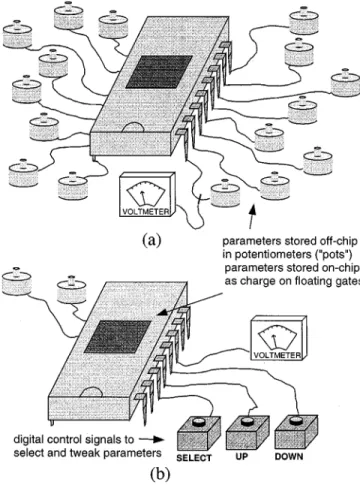
O D E R N a n a lo g , n e u r o m o r p h i c , o r m ix e d - m o d e V L S I c h ip s t y p ic a ll y h a v e la r g e n u m b e r s o f i n p u ts a n d a n a lo g p a r a m e te r s , a n d t h e n u m b e r o f a v a ila b le p i n s is o f t e n a lim itin g f a c to r i n t h e s e s y s te m s . O f te n , t h e s e p a r a m e te r s a n d o t h e r b ia s e s a r e s to r e d o f f - c h ip a s v o lta g e s p r o g r a m m e d b y p o te n tio m e te r s o r o t h e r s o u r c e s , o n e p in p e r v a r ia b le ( s e e F ig . 1 ). P in s a r e a ls o n e e d e d f o r i n p u ts a n d o u tp u ts . T h e n u m b e r o f p in s a v a ila b le o n a c h ip is l im i te d b y th e p e r im e t e r o f th e c h ip , w h ic h g r o w s a s th e s q u a r e r o o t o f d ie a r e a . I f w e c o u ld m o v e th e a n a lo g p a r a m e te r s a n d c ir c u it b ia s e s o n to t h e c h ip , w e w o u ld s a v e m o r e p in s f o r in p u t, o u tp u t, a n d d ia g n o s tic s ( s e e F ig . 1 ) . A ls o , s to r in g b ia s e s o n - c h ip c o u ld s ig n if ic a n tly r e d u c e c ir c u it b o a r d c o m p le x ity .I f w e t h in k o f p o te n tio m e te r s a s e a s ily m o d if i a b le v o lta g e s o u r c e s , t h e n w e w o u l d l ik e to b u i ld a n e le c t r o n i c v e r s io n o f t h e p o t, a n e -p o t, t h a t c a n b e p l a c e d o n th e c h ip its e lf . I f la r g e n u m b e r s o f t h e s e c e lls c a n b e p l a c e d o n o n e c h ip , th e n th e y w ill s u p p ly m o r e b i a s e s t h a n c o u ld t h e f e w p in s r e q u ir e d to p r o g r a m th e m . W e h a v e th e f o llo w in g r e q u ir e m e n t s f o r o u r e - p o t.
1) N o n v o la tile : A n e - p o t m u s t m a i n t a i n its s ta te in d e f in ite ly in th e a b s e n c e o f p o w e r.
Manuscript received April 2000; revised November 2000. This work was sup ported by the Center for Neuromorphic Systems Engineering under the National Science Foundation’s Engineering Research Center Program. The work of R. R. Harrison was supported by DARPA and NIMH under grants. This paper was recommended by Associate Editor T. S. Lande.
R. R. Harrison is with the Electrical Engineering Department, University of Utah, Salt Lake City, UT 84112 USA (e-mail: [email protected]).
J. A. Bragg, P. Hasler, and S. P. Deweerth are with the Department of Elec trical and Computer Engineering, Georgia Institute of Technology, Atlanta, GA 30332-0250 uSa (e-mail: [email protected]).
B. A. Minch is with the School of Electrical Engineering, Cornell University, Ithaca, NY 14853 USA.
Publisher Item Identifier S 1057-7130(01)02012-2.
Fig. 1. Using electronic potentiometers (e-pots). (a) On typical analog VLSI chips, many of the pins are consumed by bias voltages set with off-chip potentiometers. (b) By storing these voltages on-chip, many pins are freed for I/O. 2 ) S m a ll: W e w o u ld lik e to g e t r e a s o n a b l e n u m b e r s o f t h e s e d e v ic e s o n o n e c h ip in o r d e r to h a v e m a n y “ v i r tu a l p i n s .” 3 ) F e w P in s : B e c a u s e o u r g o a l is to s a v e p in s , a la r g e a r ra y o f e - p o ts s h o u ld r e q u ir e f e w p in s f o r I /O a n d b ia s e s . 4 ) W id e V o lta g e R a n g e : A n e - p o t s h o u ld b e a b le to s to r e a n y v o lta g e f r o m g r o u n d to t h e p o w e r - s u p p ly r a il. 5 ) “T w e a k a b le " : W e m u s t b e a b le t o m o v e a n e - p o t ’s v o lta g e u p o r d o w n s m o o th ly , j u s t lik e t u r n in g th e k n o b o n a p o te n tio m e te r . 6 ) I n d i v i d u a l ly A d d r e s s a b l e : W e m u s t h a v e c o n tr o l o v e r e a c h e - p o t, lik e a n a r r a y o f r e a l p o t e n t i o m e t e r s (i.e ., n o g lo b a l e r a s e n e c e s s a r y ) . 7 ) F le x ib le S u p p l y V o lta g e : T h e e - p o t a r r a y s h o u ld f u n c tio n u s in g a w id e r a n g e o f s u p p ly v o lta g e s a n d o n ly r e q u ir e a d d itio n a l v o lta g e s o u r c e s d u r in g th e p r o g r a m m i n g p r o c e s s . 1057-7130/01$10.00 © 2001 IEEE
HARRISON et al.: CMOS PROGRAMMABLE ANALOG MEMORY-CELL ARRAY 5
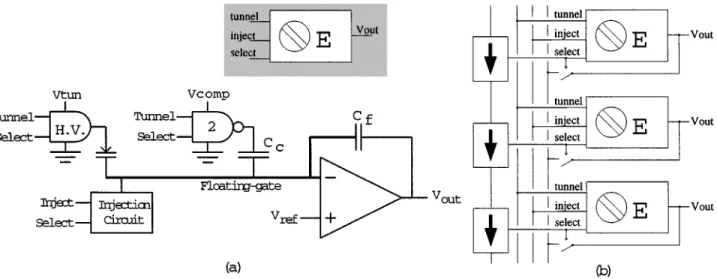
Fig. 2. E-pot circuit schematic, (a) Single e-pot cell. The floating gate is connected to the negative input of an amplifier with feedback capacitor C/ . This pins the floating-gate voltage to V'ror and allows V'out to be moved from rail to rail by changing the charge of the floating gate Qce . Charge is removed from the floating gate through tunneling. The tunneling voltage is switched with a high-voltage differential amplifier built with lightly doped-drain nFETs. The capacitive coupling of the tunneling voltage to the floating gate is counterbalanced by switching a lower voltage V'comp on a larger capacitor. Charge is added to the floating gate through hot-electron injection. Gate 2 is a pseudo-pMOS n a n d gate; we use these symbols for clarity. The high-voltage amplifier is shown in Fig. 5. The amplifier is a ten-transistor nFET-input wide-output-range transconductance amplifier [10]. (b) Array of e-pots with shift register used for addressing. The tunnel, inject, and select lines carry digital signals.
8 ) H ig h P r o g r a m m in g P r e c is io n : M o r e p r e c i s i o n is a lw a y s d e s ir a b le . R e c e n t a d v a n c e s in f l o a tin g - g a te C M O S c ir c u its o p e n u p th e p o s s ib i l it y f o r b u ild in g o n - c h ip n o n v o la tile e - p o ts [ 1 ] - [ 6 ] . In th is p a p e r , w e d e s c r i b e a f l o a t i n g - g a t e C M O S e - p o t a r r a y t h a t m e e ts t h e r e q u ir e m e n t s l is te d a b o v e . W e h a v e d e s c r i b e d p r e li m i n a r y te s tin g o f th e s e s tr u c tu r e s in [2]. A n e a r l ie r f lo a t i n g - g a t e m e m o r y c e ll w a s b u i lt b y D i o r i o e t a l .[5 ]. O u r e - p o t d e s i g n h a s m a n y a d v a n ta g e s o v e r th is d e s ig n . B y u s in g a h ig h - g a i n d if f e r e n tia l a m p l i f ie r in a f e e d b a c k c o n f ig u r a tio n , w e h a v e e x p li c it c o n tr o l o f t h e f l o a t i n g - g a t e v o lta g e . I n a d d itio n , th e o u t p u t a m p l i f ie r h a s n F E T in p u ts , p r e v e n tin g a n y l e a k a g e r e s u ltin g f r o m p F E T h o t - e l e c t r o n in je c tio n . O u r m e m o r y c e lls a r e c o n f ig u r e d a s a n a d d r e s s a b l e a r r a y w ith n o c r o s s ta lk , a n d h ig h - v o lt a g e s w itc h e s in e a c h e - p o t m a k e a g lo b a l e r a s e u n n e c e s s a r y . P r o g r a m m in g h a s b e e n f u r th e r s im p lif ie d b y c a n c e llin g t h e c a p a c itiv e c o u p lin g i n h e r e n t in t u n n e lin g , a llo w in g th e o u t p u t v o lta g e to b e m o n it o r e d d u r in g th e p r o g r a m m i n g p r o c e s s . F in a lly , o u r c e lls c a n b e d e s i g n e d to u s e e it h e r a n n F E T - in j e c t o r o r a p F E T - in j e c t o r s tr u c tu r e , a llo w in g f a b r i c a t i o n in s ta n d a r d C M O S p r o c e s s e s . II. Ci r c u i t De s c r i p t i o n T h e c ir c u it s c h e m a tic is s h o w n in F ig . 2 . W e d e s i g n e d a n d f a b r ic a te d a r r a y s o f e - p o ts in c o m m e r c ia lly a v a ila b le 2 .0 -//m B iC M O S a n d 1 ,2 -//m a n d 0 . 8 - /nm C M O S p r o c e s s e s . W e c o n f ig u r e d th e e - p o t c ir c u its in a o n e - d im e n s i o n a l ( 1 -D ) a r r a y a lo n g th e e d g e o f e a c h 2 .2 m m x 2 .2 m m c h ip . A d d r e s s in g c ir c u it r y w a s in c l u d e d in t h e a r r a y s [ s e e F ig . 2 ( b ) ] . I n t h e 2 .0 - / j m p r o c e s s , e a c h e - p o t m e a s u r e s 6 9 // in x 3 3 3 /nm , a llo w in g 2 3 e le m e n ts to b e p l a c e d in th e a rra y . T h e 1 ,2 -//m p r o c e s s r e d u c e d t h e e le m e n t s iz e t o 4 1 .4 /n m x 2 3 1 .6 /nm , a llo w in g u s to p l a c e 3 9 e l e m e n ts in th e a rra y . A n e - p o t a r r a y o f a r b it r a r y le n g th c o n s u m e s 11 p i n s f o r c o n tr o l s ig n a ls a n d o t h e r b ia s e s . O n c e p r o g r a m m in g is c o m p le te d , th e a r r a y n e e d s o n ly th r e e o f f - c h ip b ia s e s . I n o r d e r to m a k e th e e - p o ts n o n v o la tile , w e u s e f lo a tin g - g a te M O S tr a n s is to r s [1 ]. A f lo a tin g g a te is a p o l y s i li c o n n o d e s u r r o u n d e d b y S i 0 2, tr a p p in g c h a r g e o n t h e g a te in d e f in ite ly . T h e flo a tin g g a te is c o n n e c te d to th e n e g a tiv e i n p u t o f a h ig h - g a in a m p lif ie r w ith a f e e d b a c k c a p a c i t o r C f . T h is e f f e c tiv e ly p in s th e f l o a t i n g - g a t e v o lta g e a t V ref , th e p o s i t iv e i n p u t to th e a m p l i fier. A . C o n tr o llin g th e A r r a y T h e e - p o t e le m e n ts a r e a r r a n g e d in a 1 -D a rra y , w ith o n ly o n e o f t h o s e e le m e n ts b e in g “ a c tiv e ” a t a g iv e n tim e . I t is im p o r t a n t to n o t e t h a t e - p o ts a r e s till s o u r c in g v o lta g e in to th e c h ip w h e n th e y a r e n o t a c tiv e . T h e f ir s t c o n tr o l s ig n a l is a c lo c k t h a t a d v a n c e s t h e s h i f t r e g is te r d e p ic t e d in F ig . 2 ( b ) , c a u s in g t h e n e x t e - p o t in t h e a r r a y to b e c o m e a c tiv e . T h e V out p i n p r e s e n ts th e o u t p u t v o lta g e o f t h e a c tiv e e - p o t, w h i l e t h e s y n c o u t p u t p r e s e n ts th e l o g ic h i g h s ig n a l w h e n , a f te r s te p p in g t h r o u g h th e e n tir e a rra y , th e s h i f t r e g is te r r o lls o v e r a n d th e f i r s t e - p o t b e c o m e s a c tiv e a g a in . T h e t u n n e l a n d i n je c t i n p u t s ig n a ls c o n tr o l c h a r g e f lo w o n to a n d o f f o f t h e f lo a tin g n o d e , w h i c h in tu r n c o n tr o ls th e o u tp u t v o lta g e o f th e a m p lif ie r . T u n n e lin g , b y r e m o v in g e le c tr o n s f r o m th e f lo a tin g g a te , in c r e a s e s t h e f l o a tin g - g a te v o lta g e a n d r e d u c e s t h e o u t p u t v o lta g e . I n je c tio n , b y p la c in g e le c tr o n s o n to t h e f lo a tin g g a te , r e d u c e s t h e f l o a tin g - g a te v o lta g e a n d in c r e a s e s th e o u t p u t v o lta g e . F ig . 3 s h o w s a ty p ic a l tu n n e l / in j e c t c y c le f o r a n e - p o t f a b r i c a t e d in a 2 .0 - //m B iC M O S p r o c e s s ; e - p o ts f a b r i c a t e d in th e 1 ,2 -//m s ta n d a r d C M O S p r o c e s s p e r f o r m e d s im ila r ly . W h il e p r o g r a m m i n g in d iv id u a l e - p o ts , w e m e a s u r e d n o c r o s s t a lk to o t h e r e - p o ts d u e to t u n n e lin g o r i n je c ti o n in e it h e r o f th e tw o p r o c e s s e s . F ig . 4 i llu s tr a te s th e in d e p e n d e n t c o n tr o l a v a ila b le o v e r th e in d iv id u a l e - p o ts ; in th is e x a m p le , t h e p o ts h a v e b e e n p r o g r a m m e d in a c o s in e p a tte r n . W e h a v e s e t e - p o ts to v o lta g e s f r o m 10 m V a b o v e g r o u n d to th e p o w e r - s u p p ly r a il.
IEEE TRANSACTIONS ON CIRCUITS AND SYSTEMS— II: ANALOG AND DIGITAL SIGNAL PROCESSING, VOL. 48, NO. 1, JANUARY 2001
Fig. 4. Output voltages from all 39 e-pots from our 1.2-/.tm chip, after each Fig. 3. Experimental measurement illustrating e-pot operation. Digital signals element in the array had been programmed to a voltage proportional to the cosine c° ntr° l tunneling and hot-electron inj ection, moving the e-pot output voltage up of the e-pot position number. No crosstalk was observed between e-pot elements or down smoothly. during programming.
B . E le c tr o n T u n n e lin g a n d C a p a c itiv e C o m p e n s a tio n
T o d e c r e a s e a n e - p o t ’s o u t p u t v o lta g e , w e r e m o v e e le c tr o n s f r o m its f lo a tin g g a te b y th e p r o c e s s o f F o w l e r - N o r d h e i m t u n n e lin g [9 ]. T h is p r o c e s s u s e s a h i g h - v o lt a g e s o u r c e to c r e a te a n e n e r g y b a r r i e r th in e n o u g h t h a t e le c tr o n s c a n t u n n e l th r o u g h t h e g a te o x id e ; t y p ic a l t u n n e lin g v o lta g e s u s e d a r e 3 5 - 4 0 V in 2 .0 - //m p r o c e s s e s a n d 2 7 - 3 0 V in 1 ,2 -//m p r o c e s s e s ( b a s e d o n o t h e r m e a s u r e m e n t s , w e e x p e c t t u n n e lin g v o lta g e s in t h e r a n g e o f 1 0 - 1 2 V in 0 .5 -/n m p r o c e s s e s ) .
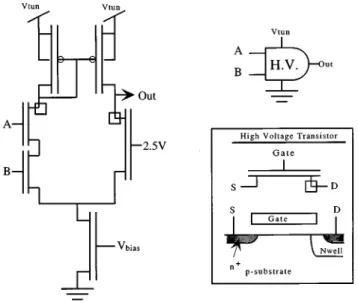
W e s w itc h h i g h v o lta g e s o n - c h ip w ith a h ig h - v o lt a g e d i f f e r e n tia l a m p l i f ie r b u i lt w ith lig h t l y d o p e d - d r a i n n F E T s , w h ic h u s e w e ll d if f u s io n a s t h e i r d r a in r e g io n s ( s e e F ig . 5 ). T h e r e s u ltin g h ig h - v o lt a g e n F E T s h a v e b r e a k d o w n v o lta g e s g r e a t e r t h a n 4 5 V. I n th e C M O S p r o c e s s w e u s e , i t is n o t p o s s ib l e to c r e a te h ig h - v o lt a g e p F E T s , s o w e s im p ly le t th e p F E T s in t h e d if f a m p b r e a k d o w n . T h is h a p p e n s a t a K i s o f 2 0 V, s o o u r h i g h - v o lt a g e d if f a m p c a n n o t c o m p l e te ly “ t u r n o f f .” T h e o u t p u t v a r ie s b e tw e e n a r o u n d 4 0 V in t h e “ o n ” m o d e to a r o u n d 15 V in th e “ o f f ” m o d e . H o w e v e r , t h e t u n n e lin g c u r r e n t d e p e n d s e x p o n e n t i a l ly o n th e r e c i p r o c a l o f t h e o x i d e v o lta g e , s o a t H u n = 15 V, th e r e is n o o b s e r v a b l e t u n n e lin g c u r r e n t. I t s h o u ld b e n o t e d t h a t a f te r th e e - p o ts a r e p r o g r a m m e d , t h e t u n n e lin g v o lta g e c a n b e r e m o v e d a n d th e r e is n o f u r t h e r n e e d f o r a h i g h - v o lt a g e s o u r c e . B y s w itc h in g t h e t u n n e lin g a n d in je c tio n v o lta g e s lo c a lly , w e a c h ie v e in d iv id u a lly p r o g r a m m a b l e m e m o r y c e lls , w ith n o n e e d f o r a g lo b a l e r a s e .
A m a j o r l im ita tio n o f f l o a t i n g - g a t e m e m o r y c e lls t h a t a r e p r o g r a m m e d b y t u n n e lin g r e s u l ts f r o m p a r a s i t i c c a p a c ita n c e s c o u p lin g b e tw e e n t h e t u n n e lin g n o d e a n d t h e f lo a tin g g a te . A lt h o u g h th is c a p a c i t a n c e is u s u a lly s m a ll c o m p a r e d to th e to ta l c a p a c i t a n c e o f t h e f lo a tin g g a te , th e v o lta g e c h a n g e a c r o s s th is j u n c t i o n is la r g e ( ty p ic a lly 2 5 - 3 5 V ) w h e n th e tu n n e lin g v o lta g e is s w it c h e d o n o r o ff. T h is v o lta g e c h a n g e c o u p le s in to t h e f lo a tin g g a te , c a u s in g a la r g e v o lta g e o f f s e t in th e m e m o r y - c e l l o u tp u t. S i n c e c a p a c ito r s c o n n e c te d to f lo a tin g g a te s a r e d c e le m e n ts , th is v o lta g e o f f s e t d o e s n o t d e c a y b u t
Fig. 5. High-voltage AND gate for connecting and disconnecting high voltages to tunneling junctions. Because the required tunneling voltages are often higher than the breakdown voltage of the source-drain regions to the substate, we need to use high-voltage transistors. A high-voltage transistor is formed by using a drain region made from a lightly doped n-well. These transistors should be made sufficiently long to eliminate punchthrough effects.
r a th e r is p r e s e n t f o r th e d u r a tio n o f tu n n e lin g . T h is m a k e s f o r in d ir e c t a n d a w k w a r d p r o g r a m m in g .
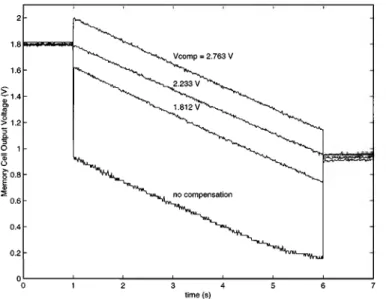
I n o r d e r to m a k e o u r m e m o r y c e lls “ tw e a k a b le , ” w e c o m p e n s a te f o r th is e f f e c t b y s w itc h in g a lo w e r v o lta g e o n a la r g e r c a p a c i t o r in th e o p p o s ite d ir e c tio n . W h e n w e s w itc h th e tu n n e lin g j u n c t i o n to a h i g h v o lta g e , w e s im u lta n e o u s ly s w itc h a n o th e r n o d e f r o m a p o s i t iv e “ c o m p e n s a ti o n v o lta g e ” to g r o u n d . T h is n o d e is c o u p le d to t h e f lo a tin g g a te w ith a c a p a c i t a n c e t h a t is m a n y t im e s la r g e r t h a n th e t u n n e lin g j u n c t i o n c a p a c ita n c e . T h e c o m p e n s a ti o n v o l ta g e V is s e t b y a n o f f - c h ip b ia s , s o th e c a p a c itiv e c o u p lin g c a n b e p r e c i s e ly n u l le d b y t h e u s e r ( s e e F ig . 6 ). T h is a p p r o a c h is a p r a c t ic a l s o lu tio n f o r e - p o t b ia s e s f o r a w id e r a n g e o f C M O S p r o c e s s e s .
6
HARRISON et al.: CMOS PROGRAMMABLE ANALOG MEMORY-CELL ARRAY 7
q|---1---1---,---1---1--- 1---1
0
1
2
3
4
5
6
7
time (s)
Fig. 6. Illustration of compensating for capacitive coupling during tunneling. Normally, capacitive coupling through the tunneling junction produces large offsets in V'out during tunneling. By tuning V'comp to the correct value, we can compensate for this effect.
C. H o t- E le c tr o n I n je c tio n T o in c r e a s e th e e - p o t o u t p u t v o lta g e , w e c a n a d d e le c tr o n s to th e f lo a tin g g a te b y th e p r o c e s s o f h o t - e l e c t r o n in je c tio n . T h e r e a r e t w o m e t h o d s o f p e r f o r m i n g h o t - e l e c t r o n in je c tio n : o n e u s in g a p F E T a s th e in je c tin g d e v ic e a n d o n e u s in g a n n F E T (s e e F ig . 7 ). W h il e a n y f a b r i c a t i o n p r o c e s s c a n b e u s e d to c r e a te a p F E T in je c to r , n F E T - in j e c t o r s tr u c tu r e s m u s t b e f a b r ic a te d in a B iC M O S p r o c e s s . A d d itio n a lly , m o d e r n f a b r i c a t i o n p r o c e s s e s m a k e u s e o f s tr u c tu r e s s u c h a s l ig h tly d o p e d d r a in s a n d c h a n n e l s p a c e r s th a t, w h i l e m a k i n g i t p o s s ib l e f o r n o r m a l C M O S c ir c u its to f u n c ti o n a t s u b m i c r o m e te r f e a t u r e s iz e s , p r e v e n t n F E T - in - j e c t o r s tr u c tu r e s f r o m o p e r a tin g p r o p e rly . T h e s e s tr u c tu r e s h a v e n o e f f e c t o n p F E T in je c to r s tr u c tu r e s , w h i c h h a v e b e e n f a b r i c a t e d in p r o c e s s e s w ith f e a t u r e s iz e s a s s m a ll a s 0 .5 / jm . T o p e r f o r m p F E T in je c tio n , w e p la c e a la r g e v o lta g e (6 V ) a c r o s s t h e s o u r c e a n d d r a in o f a n o r m a l p F E T , w h i l e h o l d in g th e g a te v o lta g e s lig h tly b e lo w t h a t o f t h e s o u r c e . H o le s , a f te r th e y h a v e d if f u s e d a c r o s s t h e c h a n n e l, a r e e x p o s e d to h i g h e le c tr ic f ie ld s a t t h e d r a in e d g e o f t h e d r a in - t o - c h a n n e l d e p le t io n r e g io n a n d l o s e la r g e a m o u n ts o f p o t e n t i a l e n e r g y a s th e y d r o p to th e d r a in v o lta g e . S o m e o f t h e s e h o le s s tr ik e S i a to m s in th e s e m i c o n d u c t o r la ttic e , g e n e r a tin g a n e le c t r o n - h o l e p a ir v i a h o t- h o le im p a c t io n iz a tio n . T h e s e e le c tr o n s tr a v e l b a c k i n to t h e c h a n n e l r e g io n , g a in in g e n e r g y a s th e y g o . W h e n t h e i r k i n e t i c e n e r g y e x c e e d s t h e 3 .1 - e V s i l ic o n - s i l ic o n - d i o x id e e n e r g y b a r rie r , th e “h o t ” e le c tr o n s c a n b e i n je c te d i n to t h e o x id e a n d tr a n s p o r te d to th e f lo a tin g g a te [4]. T o p e r f o r m n F E T in je c tio n , w e u s e a p - t y p e b a s e im p l a n t to c r e a te a n n F E T w ith a h i g h t h r e s h o ld v o lta g e ( a r o u n d 6 V ) . T h is im p l a n t is o n ly a v a ila b le in B iC M O S p r o c e s s e s , w h i c h is w h y w e a r e r e s t r ic te d to t h o s e p r o c e s s e s i f w e w is h to u s e n F E T - in - j e c t o r s tr u c tu r e s . W e c a n o p e r a t e th is d e v ic e in s u b th r e s h o ld w ith a g a te v o lta g e o f 5 .5 V a n d i n je c t e le c tr o n s to th e f lo a tin g g a te b y r a is in g th e d r a in v o lta g e to 4 V. E le c tr o n s a p p r o a c h in g th e d r a in g a th e r e n e r g y f r o m t h e s tr o n g e le c t r i c f ie ld , a n d s o m e g a in e n o u g h e n e r g y to s u r m o u n t t h e 3 .1 e V e n e r g y b a r r i e r im
-( b )
Fig. 7. Two methods for hot-electron injection programming. In both cases, an inverter is used in the compensation circuitry to offset the capacitive coupling into the floating gate through the drain-to-channel capacitor. Since we operate the MOSFETs in subthreshold, the overlap gate-to-drain capacitance is fixed, and therefore the matching in compensation circuitry is limited to gate-capacitor matching. (a) An nFET injection mechanism. (b) A pFET injection mechanism. p o s e d b y t h e g a te o x id e . T h e s e “h o t ” e le c tr o n s a r e a tt r a c t e d to th e f lo a tin g g a te , w h ic h is m o r e p o s i t iv e th a n th e d r a in . B e c a u s e th e f lo a tin g g a te m u s t b e a r o u n d 5 .5 V, w e u s e a 6 - V p o w e r s u p p ly f o r th e e - p o t a n d s e t th e f l o a tin g - g a te v o lta g e w ith th e f e e d b a c k c ir c u it d e s c r ib e d .
I n b o t h m e th o d s o f in je c tio n , s w itc h in g th e in je c tio n p r o c e s s o n c a u s e s a s te p c h a n g e in c h a n n e l v o lta g e , w h ic h , b y c a p a c itiv e c o u p lin g , c a u s e s a n o f f s e t in th e f lo a t i n g - g a t e v o lta g e . D r a i n - t o - g a te o v e r la p c a p a c i t a n c e c o n tr ib u te s a d d itio n a l c o u p lin g to th e f lo a tin g n o d e . T o c o u n te r a c t t h e s e e f fe c ts , w e tie th e s w itc h in g n o d e to th e i n p u t o f a n in v e rte r, th e o u t p u t o f w h ic h is a ls o c a p a c itiv e ly c o u p le d to t h e f lo a tin g g a te . B y a d ju s tin g t h e s iz e o f th is c o u p lin g c a p a c i t o r p r i o r to f a b r ic a tio n , w e c a n tu n e th e s y s te m to r e j e c t in je c tio n o f f s e t f o r a s p e c if ic c o m b i n a ti o n o f p o w e r - s u p p ly a n d i n je c ti o n v o lta g e s . T h e r e s u ltin g c o m p e n s a ti o n s y s te m w o r k s w e ll w ith in t h a t n a r r o w ly d e f in e d v o lta g e r a n g e , b u t a s e ith e r v o lta g e is c h a n g e d , th e o f f s e t v o lta g e b e c o m e s s ig n if ic a n t. In p r in c ip le , w e c o u ld c o m p e n s a te f o r th is o f f s e t in th e s a m e w a y t h a t w e d e a l w ith tu n n e lin g o f f s e t, b u t to d o so , w e w o u l d n e e d to s u p p ly a n o th e r o f f - c h ip b ia s .
III. CIRCUIT PERFORMANCE
I n th is s e c tio n , w e d is c u s s p e r f o r m a n c e i s s u e s o f u s in g th e s e e - p o t e le m e n ts : 1) p r o g r a m m i n g a c c u r a c y a n d p r e c is io n ; 2 ) o u t p u t v o lta g e n o i s e ; 3 ) o u t p u t v o lta g e p o w e r - s u p p ly r e je c tio n ; 4 ) lo n g - te r m d r if t o f th e o u t p u t v o lta g e .
IEEE TRANSACTIONS ON CIRCUITS AND SYSTEMS— II: ANALOG AND DIGITAL SIGNAL PROCESSING, VOL. 48, NO. 1, JANUARY 2001
8
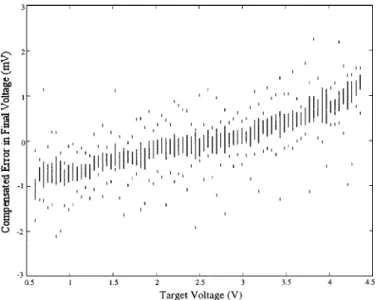
I n a ll c a s e s , th e 1 .2 -/m i n F E T - in j e c t o r a n d 2 .0 - / / m p F E T - in - j e c t o r s tr u c tu r e s s h o w e d s im ila r p e r f o r m a n c e . A . P r o g r a m m in g A c c u r a c y a n d P r e c is io n I n o r d e r to p r o g r a m v o lta g e s p r e c is e ly , w e u s e d a c o m p a r a t o r i n a f e e d b a c k l o o p w ith th e e - p o t o u t p u t v o lta g e , s o t h a t t h e t u n n e lin g o r in je c tio n c o n tr o ls w e r e tr ig g e r e d b y th e c o m p a r a t o r o u tp u t. T h e o n ly l im i ta t io n o f th is t e c h n i q u e is t h e o f f s e t v o lta g e o f th e c o m p a r a to r , t y p ic a ll y le s s t h a n 5 m V f o r th e p a r ti c u l a r c ir c u it t h a t w e u s e d . I n o r d e r to m e a s u r e th e a c c u r a c y o f th e m e m o r y c e ll, w e p r o g r a m m e d th e s a m e v o l ta g e m u lt i p le tim e s a n d m e a s u r e d th e e r r o r b e tw e e n th e r e s u ltin g v o lta g e a n d th e r e f e r e n c e v o lta g e . T o q u a n ti f y p r e c is io n , w e c o m p u t e d th e s ta n d a r d d e v ia tio n o f th e r e s u l ti n g v o lta g e s . T o m e a s u r e th e a c c u r a c y a n d p r e c i s i o n o f th e e - p o t o u t p u t o v e r a w i d e r a n g e o f t a r g e t v o lta g e s , w e p r o g r a m m e d a s in g le p F E T - in j e c t o r e - p o t to p r o d u c e a s e r ie s o f 7 9 v o lta g e s , u n i f o r m ly s p a c e d b e tw e e n 0 .6 a n d 4 .4 V. A t e a c h s te p , w e r e c o r d e d b o t h t h e t a r g e t v o lta g e a n d th e a c tu a l o u tp u t. P e r f o r m in g th is p r o c e d u r e 6 4 tim e s , w e f o u n d r e m a r k a b l y little d e v ia tio n f r o m i d e a l p e r f o r m a n c e a c r o s s th e t e s te d r a n g e . F ig . 8 s h o w s th e r e l a tio n s h ip b e tw e e n t a r g e t v o lta g e a n d m e a n o u t p u t v o lta g e . A s tr a ig h t- lin e f it to t h e s e p o i n ts s h o w s a g a in e r r o r o f 0 .0 5 % . W e o b s e r v e d a 1 9 .3 -m V d c o f f s e t b e tw e e n th e t a r g e t v o lta g e a n d th e a c t u a l o u tp u t, w h ic h c a n b e a tt r i b u te d t o i m p e r f e c t c o m p e n s a ti o n f o r th e o f f s e t in th e o u t p u t v o lta g e t h a t ta k e s p la c e d u r in g in je c tio n . T h e i n je c ti o n c o m p e n s a ti o n c a p a c i t o r b e in g u s e d in th e p F E T - in j e c t o r c ir c u it w a s s i z e d to c o m p e n s a te f o r th e s w itc h in g o f a n i n je c ti o n v o l ta g e r o u g h l y e q u a l t o th e s u p p ly v o lta g e f o r t h e r e s t o f th e c h ip . T h e s e m e a s u r e m e n t s w e r e ta k e n w ith a n i n je c ti o n v o lta g e o f 9 V a n d a s u p p ly v o lta g e o f 5 V — a m u c h g r e a t e r d if f e r e n c e t h a n o r i g in a l ly i n te n d e d . F u r t h e r te s tin g h a s s h o w n t h a t r e d u c i n g t h e d if f e r e n c e b e tw e e n t h e tw o v o lta g e s d o e s , in fa c t, r e d u c e th e d c o f f s e t e rro r. I n f u t u r e r e v is io n s , s te p s c a n b e ta k e n to r e d u c e th is e r r o r d e s p ite th is v o lta g e d if f e r e n c e , r a n g in g f r o m a n a d ju s ta b l e c o m p e n s a ti o n b ia s (a s is c u r r e n tly b e in g u s e d in th e t u n n e lin g c o m p e n s a ti o n c ir c u itr y ) to a c a p a c ito r s iz e d to c o m p e n s a te f o r w h a te v e r v o lta g e d if f e r e n c e is e x p e c t e d in th e f in a l a p p lic a tio n . F ig . 9 s h o w s h o w th e o b s e r v e d o u t p u t e r r o r v a r ie s a s a f u n c t io n o f t h e t a r g e t v o lta g e o n c e t h e p r e v io u s ly m e n t i o n e d d c o f f s e t h a s b e e n r e m o v e d . T h e v e r tic a l b a r s s h o w t h e s t a n d a r d d e v ia tio n o f th e e r r o r o v e r 6 4 tr ia ls , w h i l e th e p o in ts s h o w th e m i n im u m a n d m a x i m u m o b s e r v e d e r r o r s . T h e r e is a s y s te m a tic i n c r e a s e in t h e e r r o r a s th e t a r g e t v o lta g e in c r e a s e s , d u e to th e f i n i te c o m m o n - m o d e r e je c t i o n r a ti o o f th e o u t p u t a m p lif ie r . A s th e o u t p u t v o lta g e s h if ts in r e s p o n s e to i n je c ti o n s w itc h in g , th e g a in a p p li e d to t h a t s h if t is , to s o m e d e g r e e , a f u n c ti o n o f th e o u t p u t v o lta g e . F ig . 1 0 s h o w s t h e d is tr ib u tio n o f o u t p u t e r r o r s a f te r m u lt i p le a tte m p ts to s o u r c e a g iv e n ta r g e t v o lta g e ( 3 .0 V ) f o r e - p o ts u s in g b o t h n F E T - in j e c t o r a n d p F E T - in j e c t o r s tr u c tu r e s . I t a ls o s h o w s th e d is tr ib u tio n o f e r r o r s w h e n a tte m p tin g to t u n n e l to a ta r g e t. T h e s t a n d a r d d e v ia tio n s o f 4 5 0 /nV f o r n F E T i n je c ti o n a n d 4 7 0 /nV f o r t u n n e lin g c o r r e s p o n d to g r e a t e r th a n 1 3 - b it p r e c is io n o v e r th e 6 - V o p e r a tin g r a n g e o f th e e - p o t. T h e p F E T in je c tio n e - p o t d e m o n s tr a t e d a s t a n d a r d d e v ia tio n o f 1 7 5 / / V o v e r its 5 - V o p e r a tin g r a n g e , g iv in g a n e f f e c tiv e p r e c i s i o n o f 1 4 .8 b it. W e0.5
1
1.5
2
2.5
3
3.5
4
4.5
Target Voltage (V)
Fig. 8. Accuracy of programming 79 different voltages to the same e-pot element. The response follows a nearly straight line; the gain error is roughly 0.05% across the observed output range.
0.5
1
1.5
2
2.5
3
3.5
4
4.5
Target Voltage (V)
Fig. 9. Deviation of the e-pot programming voltages from their target voltages. We clearly see the 0.05 gain error in this plot. There is a systematic increase in the error as the target voltage increases, due to offset dependence in our amplifier circuit, responding to the injection switching offset [11]. We show how the observed output error varies as a function of the target voltage. The vertical bars show the standard deviation of the error over 64 trials, while the points show the minimum and maximum observed errors. This deviation comes from noise in both the floating-gate amplifier and the instrumentation circuitry. m a d e n o a tte m p ts to m e a s u r e t h e s e d a ta in a lo w - n o is e e n v ir o n m e n t, s o th is n u m b e r is m e r e ly a l o w e r b o u n d o n e - p o t p r e c is io n . T o v e r if y th e a b il i ty o f th e e - p o t s tr u c tu r e to p r o v i d e b ia s c u r r e n ts , a s w e ll a s b ia s v o lta g e s , th e o u t p u t o f o n e e - p o t e le m e n t w a s t ie d to a c u r r e n t s o u r c e . F ig . 11 s h o w s th e o u t p u t c u r r e n t as a f u n c tio n o f th e e - p o t o u t p u t v o lta g e , d is p la y in g b o t h th e s u b th r e s h o ld e x p o n e n t i a l I - V r e la ti o n s h ip a n d t h e q u a d r a t ic I - V r e la ti o n s h ip c h a r a c te r is tic o f a b o v e - t h r e s h o ld o p e r a tio n . B . E - P o t O u tp u t N o is e T h e to ta l r o o t m e a n s q u a r e n o i s e p r e s e n t o n t h e e - p o t- s u p p l ie d o u t p u t v o lta g e w a s o n t h e o r d e r o f 1 - 2 m V . I n o r d e r to
HARRISON et al.: CMOS PROGRAMMABLE ANALOG MEMORY-CELL ARRAY 9
Fig. 11. Measurements from using an e-pot for programming a current source. This application shows that we can program through the subthreshold and above-threshold regimes.
Fig. 10. (a) Histogram for programming with nFET hot-electron injection— 100 trials. (b) Histogram for programming with pFET hot-electron injection—64 trials. (c) Histogram for programming with tunneling— 100 trials. In all cases, the target voltage was 3.0 V. All three processes give a precision (V'dd range divided by cr) of greater than 13 bit; pFET injection gives the highest precision, with nearly 15 bit.
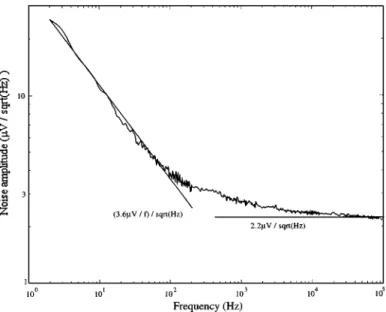
d e te r m in e th e n o i s e c o m p o n e n ts p r e s e n t in th e e - p o t v o lta g e , w e m e a s u r e d t h e f r e q u e n c y s p e c tr u m o f a p F E T - in j e c t o r e - p o t o u tp u t. T h e r e s u l ti n g s p e c tr u m , s h o w n in F ig . 12, s h o w s c o n v e n t io n a l 1 / / n o is e , w h ic h d o m in a te s a t lo w f r e q u e n c ie s , a s w e ll a s th e r m a l d e v ic e n o i s e a t h i g h e r f r e q u e n c ie s . T h is n o i s e c o u ld b e r e d u c e d b y u s in g la r g e r tr a n s is to r s in th e o u t p u t tr a n s c o n d u c ta n c e a m p lif ie r , a t th e c o s t o f i n c r e a s in g t h e e - p o t e le m e n t s iz e a n d t h e r e b y r e d u c i n g th e n u m b e r o f e - p o ts t h a t c o u ld b e p l a c e d o n a s in g le c h ip . T h e s e n o i s e p r o p e r t i e s a r e s im ila r to o t h e r f l o a t i n g - g a t e a m p lif ie r s [1 3 ], [1 2 ]. W e s h o w e d e ls e w h e r e t h a t th e t u n n e lin g a n d i n je c ti o n p r o c e s s e s d o n o t c o n tr i b u t e s ig n i f ic a n tly to t h e n o i s e le v e ls [1 3 ]. W e w a n t to in v e s tig a te h o w c h a n g in g th e e - p o t d e s ig n w ill c h a n g e t h e a m o u n t o f o u t p u t n o is e . F o llo w in g [1 4 ] a n d [1 2 ], w e c a n m o d e l th e t h e r m a l n o i s e c o m p o n e n t i 0 o f a s u b th r e s h o ld M O S F E T s c h a n n e l c u r r e n t b y (1 ) T h e s o u r c e o f n o i s e f r o m th e e - p o t c o m e s d i r e c tl y f r o m th e n o is e g e n e r a te d f r o m th e w id e - o u tp u t r a n g e t r a n s c o n d u c a n c e a m p l i f ie r [1 0 ]; th e e - p o t o u t p u t n o i s e is d u e to t h e e f f e c t o f s e v e ra l n F E T s a n d p F E T s . W e u s e t h e r e s u l t t h a t t h e e f f e c tiv e c u r r e n t n o i s e o f th is tr a n s c o n d u c ta n c e a m p l i f ie r is r o u g h l y 5 .3 tim e s
Fig. 12. Noise spectrum from an on-chip e-pot cell. We see two types of noise: the conventional 1 / / noise at low frequencies and the 1 //C 1/ 2) thermal noise characteristic of pFETs operating in weak or moderate inversion. We also plot lines showing curve fits to these regions of noise.
th a t o f th e b ia s c u r r e n t t r a n s is to r [1 5 ]. W e c o m p u te t h e o u tp u t v o lta g e n o i s e f r o m t h e i n p u t c u r r e n t n o i s e a n d th e a m p l i f ie r ’s e f f e c tiv e tr a n s c o n d u c ta n c e . T h e f l o a tin g - g a te v o lta g e is r e la te d to th e o u t p u t v o lta g e th r o u g h a c a p a c itiv e v o lta g e d iv id e r. T y p ic a lly , th e p a r a s i t i c c a p a c i t a n c e a t th e f lo a tin g g a te is 2 0 % o f th e f e e d b a c k c a p a c i t a n c e b e tw e e n th e f lo a tin g g a te a n d o u tp u t; th e r e f o r e , th e e f f e c tiv e t r a n s c o n d u c ta n c e o f th e i n p u t n F E T s is r o u g h l y 2 0 % le s s t h a n ty p ic a l n F E T d e v ic e s . U s in g th is r e d u c e d tr a n s c o n d u c ta n c e , w e e x p r e s s t h e s ig n a l p o w e r o f t h e o u t p u t- r e f e r r e d v o lta g e n o i s e l j ' lt as
5.3
il
(2)
10 IEEE TRANSACTIONS ON CIRCUITS AND SYSTEMS— II: ANALOG AND DIGITAL SIGNAL PROCESSING, VOL. 48, NO. 1, JANUARY 2001 j. W e c a n c a l c u l a te d ir e c tly t h e n o i s e
10.6gJ
(3 ) w h e r e r h is ( C L + C f ) / p e r u n i t b a n d w i d th ast i t
F r o m th is e x p r e s s io n , w e c a n c a l c u l a te t h e to ta l o u tp u t- n o is e p o w e r a sf o2ut =
J ™
____1
w h i c h e v a lu a te s to ■ d f (4 ) (5 ) T h e lo w e s t t o ta l o u t p u t- n o i s e p o w e r o c c u r s a t s u b th r e s h o ld c u r r e n t b ia s e s . T h e to ta l o u t p u t- n o i s e p o w e r is in v e r s e ly p r o p o r tio n a l to C L + C f ; th e r e f o r e , a la r g e r c a p a c i t o r c a n b e u s e d to d e c r e a s e th e to ta l n o is e . N o w , w e w o u l d l ik e to c a l c u l a te th e d y n a m i c r a n g e o f a n e - p o t. W e d e f in e d y n a m i c r a n g e ( D R ) a s th e r a ti o o f th e m a x i m u m p o s s ib l e l in e a r o u t p u t s w in g to th e to ta l o u t p u t- n o i s e p o w e r. F o r a 5 - V s u p p ly , w e c a n a s s u m e c o n s e r v a tiv e ly t h a t w e h a v e a 4 - V l in e a r r a n g e ( l max )• W ith th is d e f in itio n , a n d a s s u m in g t h a t t h e e - p o t is b i a s e d in s u b t h r e s h o l dI / g m
=U
t/
k,
w e c a n e x p r e s s t h e e - p o t d y n a m i c r a n g e a s V 2 D R = ^ 2 1 2^o 2ut(1.51 V 2)
k(
qUT
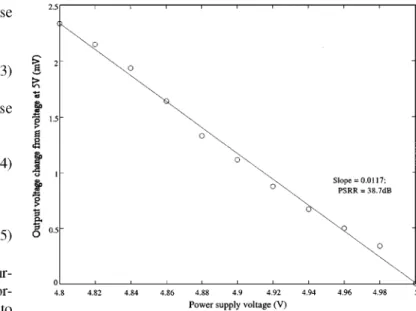
(6 ) w h i c h is s i m il a r to t h e f o r m f o r d y n a m i c r a n g e f o r t h e w id e - l in e a r - r a n g e a m p lif ie r . U s in g t y p ic a l C f c a p a c ito r s o f 2 p F a t r o o m t e m p e r a t u r e ( T = 3 0 0 K ) , w e c a l c u l a te th e d y n a m i c r a n g e a s a p p r o x im a t e ly e q u a l to 8 4 d B ( 1 4 b it). C. P o w e r - S u p p ly R e j e c t io n F ig . 13 s h o w s h o w t h e e - p o t o u t p u t v o l ta g e c h a n g e s in r e s p o n s e to v a r ia tio n in th e p o w e r - s u p p ly v o lta g e . A s th e s u p p ly v o lta g e d e c r e a s e s , th e o u t p u t v o lta g e in c r e a s e s lin e a rly , w ith a p o w e r - s u p p l y r e je c t i o n r a ti o ( P S R R ) o f 3 9 d B . T h is is a n o th e r a d v a n ta g e t h e e - p o t s tr u c tu r e h a s o v e r a c o n v e n tio n a l b a n k o f p o te n tio m e te r s , e a c h o f w h ic h h a s a n a v e r a g e P S R R o f 6 d B . S in c e th e o u t p u t tr a n s c o n d u c ta n c e a m p lif ie r is th e o n ly e - p o t c o m p o n e n t w ith a d i r e c t c o n n e c tio n to t h e s u p p ly v o lta g e , w e b e lie v e t h a t t h e s e v a r ia tio n s a r e d u e e n tir e ly to th is a m p lif ie r . B y o p tim iz in g d e v ic e le n g th s , a n d t h e r e b y in c r e a s in g th e o u t p u t a m p l i f ie r ’s o p e n - lo o p g a in , th e P S R R c o u ld b e f u r t h e r in c r e a s e d , a t th e c o s t o f in c r e a s in g th e s iz e o f e a c h e - p o t e le m e n t. D . L o n g - T e r m D r if t o f th e O u tp u t V o lta g e O n c e a v o lta g e h a s b e e n p r o g r a m m e d , i t is im p o r t a n t t h a t it r e m a in s ta b le f o r lo n g p e r io d s o f tim e . T o t e s t th e e - p o t ’s s t a b ility , w e m o n it o r e d t h e o u t p u t v o lta g e o f a s in g le e - p o t o v e r a 7 0 - h p e r io d . T h e o u t p u t v o lta g e in c r e a s e d a lm o s t 2 0 m V in th e f i r s t 3 6 - 4 0 h , a f te r w h ic h i t s e t tl e d to a s ta b le v a lu e . T h is in i tia l i n c r e a s e a p p e a r s to b e d u e to e le c tr o n d e tr a p p in g , a s e le c tr o n s t h a t h a d b e c o m e t r a p p e d i n th e g a te o x i d e d u r in g in je c tio n s lo w ly w o r k e d t h e i r w a y o u t o f t h e o x id e a n d i n to t h e f lo a tin gFig. 13. Deviations from ideal output voltage due to changes in the power-supply voltage. All e-pot bias voltages, which are ground referenced, were fixed for these measurements.
g a te its e lf . A f te r 4 0 h , th e p o p u l a t i o n o f t r a p p e d e le c tr o n s h a s b e e n s ig n if ic a n tly r e d u c e d , a n d th e o u t p u t v o lta g e s ta b iliz e s .
IV . CONCLUSIONS W e h a v e b u i lt a n d t e s te d tw o a r r a y s o f n o n v o la tile a n a lo g V L S I m e m o r y c e lls c a p a b le o f g r e a t e r th a n 1 3 - b it p r e c is io n . T h e a n a lo g v a lu e s a r e s to r e d a s c h a r g e o n a f lo a tin g g a te , w h ic h is m o d if i e d th r o u g h F o w l e r - N o r d h e i m t u n n e lin g a n d h o t - e l e c t r o n i n je c ti o n u s in g e it h e r a n n F E T - in j e c t o r o r p F E T - in j e c t o r s tr u c tu r e . T h e c e lls a r e in d iv id u a lly a d d r e s s a b l e a n d a r e c a p a b le o f s o u r c in g p r e c i s e ly c o n tr o l l e d v o lta g e s f o r lo n g p e r io d s o f tim e w ith v e r y little n o i s e o r d r i f t a n d a h i g h d e g r e e o f p o w e r s u p p ly n o i s e r e je c tio n . W e h a v e d e m o n s tr a t e d th e a b ility o f t h e s e s tr u c tu r e s to p r o v id e b ia s v o lta g e s a n d b ia s c u r r e n ts . W e in te n d to u s e t h e m to a llo w th e c o n s t r u c t i o n o f c o m p le x a n a lo g a n d m ix e d - m o d e c ir c u its w i t h o u t s a c r if ic in g a n e x c e s s iv e n u m b e r o f p in s f o r s e ttin g c ir c u it b ia s e s . T h e y w ill a ls o g r e a t ly s im p lif y b o a r d la y o u t, as a la r g e n u m b e r o f p o te n tio m e te r s c a n b e r e p la c e d b y a s im p le d i g it a l c o n tr o l s y s te m . T h e s e a r r a y s h a v e b e e n l a i d o u t in a s t a n d a r d f r a m e a n d f a b r i c a t e d in c o m m e r c i a l l y a v a ila b le 2 .0 -/n m B iC M O S a n d 1 ,2 -//m a n d ().8 -//in C M O S p r o c e s s e s . REFERENCES
[1] P. Hasler, B. A. Minch, and C. Diorio, “Adaptive circuits using pFET floating-gate devices,” in Proc. Advanced Research VLSI, Atlanta, GA, 1999, pp. 215-231.
[2] R. Harrison, P. Hasler, and B. A. Minch, “Floating-gate CMOS analog memory cell array,” in Proc. Int. Symp. Circuits and Systems, Monterey, CA, 1998, see alsohttp://users.ece.gatech.edu/phasler.
[3] P. Hasler, C. Diorio, B. A. Minch, and C. Mead, “Single transistor learning synapses with long term storage,” in Proc. Int. Symp. Circuits and Systems, vol. 3, Seattle, WA, 1995, pp. 1660-1663.
[4] P. Hasler, B. A. Minch, C. Diorio, and C. Mead, “An autozeroing ampli fier using pFET hot-electron injection,” in Proc. Int. Symp. Circuits and Systems, vol. 3, Atlanta, GA, 1996, pp. 325-328.
[5] C. Diorio, S. Mahajan, P. Hasler, B. A. Minch, and C. Mead, “A high resolution nonvolatile analog memory cell,” in Proc. Int. Symp. Circuits and Systems, vol. 3, Seattle, WA, 1995, pp. 2233-2236.
HARRISON et al.: CMOS PROGRAMMABLE ANALOG MEMORY-CELL ARRAY
11
[6] C. Diorio, P. Hasler, B. A. Minch, and C. Mead, “A complementary pair of four-terminal silicon synapses,” Analog Integr. Circuits Signal Process., vol. 13, no. 1/2, pp. 153-166, 1997.
[7] A. Thomsen and M. A. Brooke, “A floating gate MOSFET with tun neling injector fabricated using a standard double-polysilicon CMOS process,” IEEE Electron Device Lett., vol. 12, pp. 111-113, 1991. [8] H. V. Tran, T. Blyth, D. Sowards, L. Engh, B. S. Nataraj, T. Dunne, H.
Wong, V. Se rin, T. Lam, H. Hazarian, and G. Hu, “A 2.5V 256-level nonvolatile analog storage device using EEPROM technology,” in Proc. IEEE Int. Solid-State Circuits Conf., 1996, pp. 270-271.
[9] M. Lenzlinger and E. H. Snow, “Fowler-Nordheim tunneling into ther mally grown S i0 2," J. Appl. Phys., vol. 40, no. 1, pp. 278-283, 1969. [10] C. Mead, Analog VLSI and Neural Systems. Reading, MA: Addison-
Wesley, 1989.
[11] Y. Tsividis and P. Antognetti, Design o f MOS VLSI Circuits fo r Telecom munications. Englewood Cliffs, NJ: Prentice-Hall, 1985, pp. 145-170. [12] P. Hasler, “Foundations of learning in analog VLSI,” Ph.D. dissertation,
California Institute of Technology, Pasadena, CA, 1997.
[13] P. Hasler, B. A. Minch, and C. Diorio, “An autozeroing floating-gate bandpass filter,” in Proc. IEEE Int. Symp. Circuits and Systems, Mon terey, CA, 1998.
[14] R. Sarpeshkar, T. Delbruck, and C. A. Mead, “White noise in MOS tran sistors and resistors,” IEEE Circuits Devices, pp. 23-29, Nov. 1993. [15] R. Sarpeshkar, R. F. Lyon, and C. Mead, “A low-power wide-linear-
range transconductance amplifier,” Analog Integr. Circuits Signal Process., Nov. 1996.
Reid R. Harrison received the B.S. degree in electrical engineering from the University of Florida, Gainesville, in 1994 and the Ph.D. degree from the Cali fornia Institute of Technology, Pasadena, in 2000.
After working for a short time at the Jet Propulsion Laboratory and Los Alamos National Laboratory, he joined the Computation and Neural Systems at the California Institute of Technology. He is currently an Assistant Professor of Electrical Engineering at the University of Utah, Salt Lake City. His research interests include silicon implementations of biological sensory systems, low-power analog VLSI circuits, and neuroprosthetics.
Julian A. Bragg (S’00) received the B.S. degree in electrical engineering from The George Washington University, Washington, DC, in 1995. He is currently pursuing the M.D. and Ph.D. degrees in bioengineering from the Georgia Insti tute of Technology and Emory University School of Medicine, Atlanta.
His research interests include neuroscience, muscle physiology, and biolog ical motor control.
Mr. Bragg is a member of Tau Beta Pi and Eta Kappa Nu.
Paul Hasler (S’87-A’97-M ’01) received the B.S.E. and M.S. degrees in electrical engineering from Ari zona State University,Tempe, in 1991 and the Ph.D. degree in computation and neural systems from the California Institute of Technology, Pasadena.
He is currently an Assistant Professor in the Department of Electrical and Computer Engi neering at the Georgia Institute of Technology. His research interests include low-power electronics; mixed-signal integrated circuits and systems; the use of floating-gate MOS transistors to build adaptive information processing systems and “smart” sensor interfaces; the physics of deep submicrometer devices or floating-gate MOS devices; and analog VLSI models of neurobiological learning and sensory information processing.
Dr. Hasler received the IEEE Electron Devices Society's Paul Rappaport Award in 1996. He is active in the IEEE as a Cochair of the Atlanta section of the IEEE Electron Devices Society, as a Reviewer for IEEE TRANSACTIONS
on Circuitsand Systems and IEEE Transactionson Neural Networks, and as Cochair for special sessions in the IEEE International Symposium on Circuits and Systems in both 1998 and 1999.
Bradley A. Minch (S’90-M ’91) received the B.S. degree in electrical engineering (with distinction) from Cornell University, Ithaca, NY, in 1991 and the Ph.D. degree in computation and neural systems from the California Institute of Technology, Pasadena, in 1997.
He is currently an Assistant Professor in the School of Electrical and Computer Engineering, Cornell University. His research interests include the analog and digital integrated circuit design, translinear circuits, log-domain filters, and adaptive floating-gate MOS circuits.
Dr. Minch is a member of Tau Beta Pi, Eta Kappa Nu, and Phi Kappa Phi. He received the IEEE Electron Devices Society's Paul Rappaport Award in 1996.
Stephen P. Deweerth (S’85-M ’91) received the B.A. degree in mathematics and chemistry from Wartburg College, Waverly, IA, in 1985. He received the M.S. degree in computer science and the Ph.D. degree in computation and neural systems from the California Institute of Technology, Pasadena, in 1987 and 1991, respectively.
Since 1991, he has been with the Georgia Institute of Technology, Atlanta, where he is currently an Associate Professor of electrical and computer engi neering. His current research interests are in the area of highly collective com putation performed by physical systems. He is primarily involved in the mod eling of neurobiological systems that control movement.