Guideline
Autism
s
pectrum
d
isorders: A
s
tarting
g
uide for
t
eachers
This document is currently under review. Please direct any queries regarding this document to the policy
officer listed in Table 1.
Insert file number
Summary
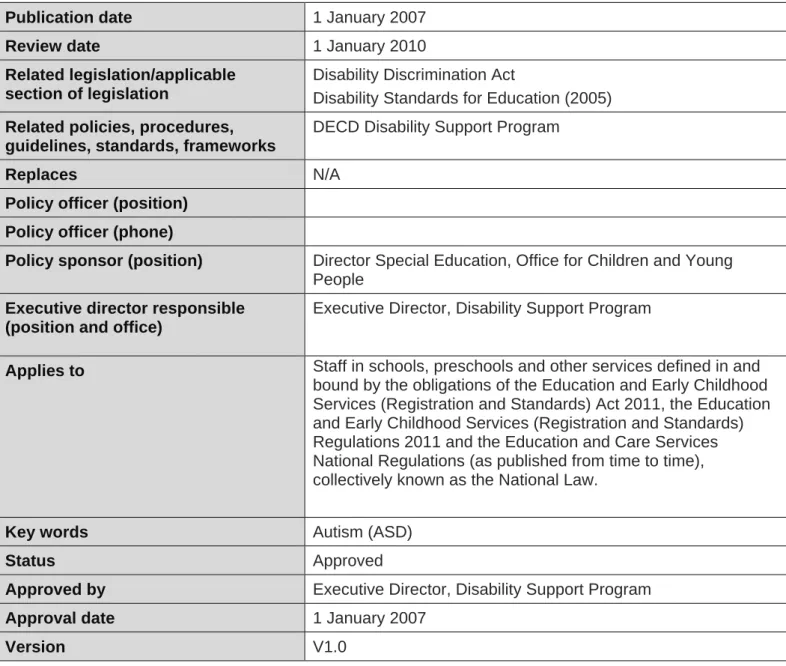
Table 1 - Document details
Publication date
1 January 2007
Review date
1 January 2010
Related legislation/applicable
section of legislation
Disability Discrimination Act
Disability Standards for Education (2005)
Related policies, procedures,
guidelines, standards, frameworks
DECD Disability Support Program
Replaces
N/A
Policy officer (position)
Policy officer (phone)
Policy sponsor (position)
Director Special Education, Office for Children and Young
People
Executive director responsible
(position and office)
Executive Director, Disability Support Program
Applies to
Staff in schools, preschools and other services defined in and
bound by the obligations of the Education and Early Childhood
Services (Registration and Standards) Act 2011, the Education
and Early Childhood Services (Registration and Standards)
Regulations 2011 and the Education and Care Services
National Regulations (as published from time to time),
collectively known as the National Law.
Key words
Autism (ASD)
Status
Approved
Approved by
Executive Director, Disability Support Program
Approval date
1 January 2007
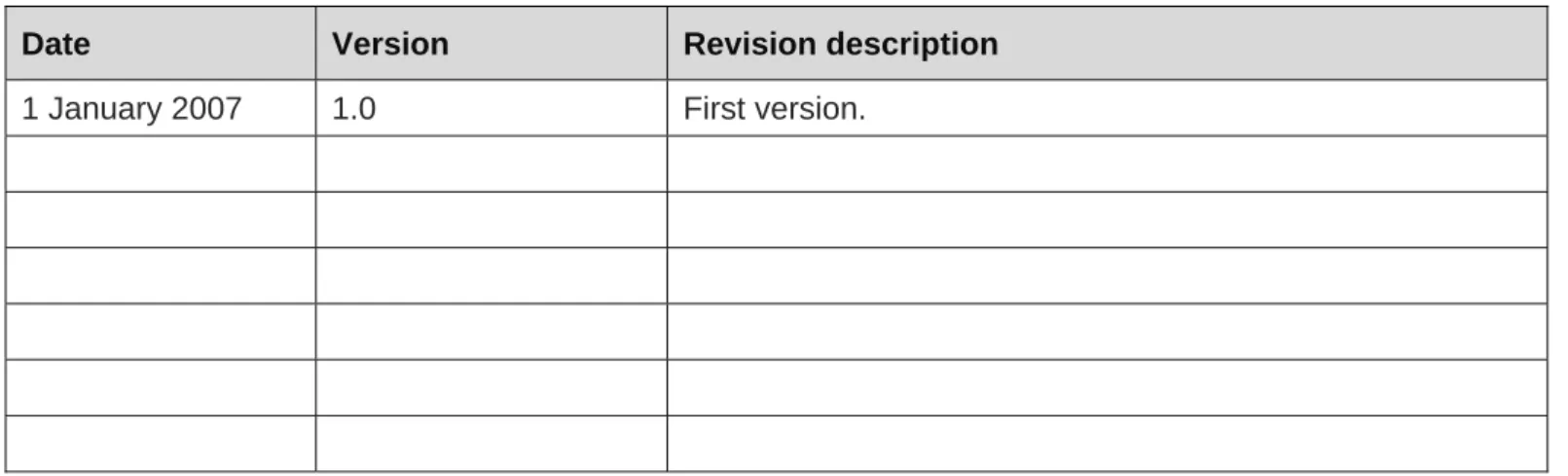
Table 2 - Revision record
Date
Version
Revision description
autism
Statewide Verification and Professional Support
Autism Spectrum Disorders
A starting guide for teachers
Contents
Foreword
Contents of CD-ROM
Resources teachers recommend [Video]PowerPoint slideshows
• Autism Spectrum Disorders—A starting guide for teachers
• Using visual strategies in classrooms
Autistic Disorder/Asperger’s Disorder Support Plan [Word template]
Autism Spectrum Disorders—A starting guide for teachers[Book pdf]
What are Autism Spectrum Disorders? 2
Support plan 2
Getting information 3
So ... I have a student in my class with
autism, what do I do? 3
Key skill areas 4
Communication 4 Social interaction 5 Behaviour and sensory issues 6
Key services 7
Special Education Resource Unit (SERU) 7
Autism SA 7
Disability SA 8
Starting resources 9
Recommended autism resources 9 Asperger syndrome resources 11
DECS Disability Support Program 12
Verification 12
What to do: A summary 13
References and resources 14
Appendix: Autistic Disorder/Asperger’s
Disorder Support Plan 17
As a teacher, you will be well aware that early intervention can make an enormous difference to the capacity of every child to achieve their potential in life.
By being better informed, and making connections with families and support services in our communities, you are better equipped to guide, teach and enable each child to have a better start.
This guide is designed to help you support children in your classroom who have been newly identified with Autistic Disorder and Asperger’s Disorder.
Central to the practical advice and information in this guide is the recognition that you are not alone. The guide highlights the value of making connections and partnerships with families, agencies and your colleagues to foster successful learning opportunities and outcomes for each child.
While the South Australian Government works in partnership with the Commonwealth Government to fund and assist children with an autism spectrum disorder, it is the commitment and professionalism of teachers working with families and agencies that make a real difference.
The guide offers a good start when you have a student with an Autism Spectrum Disorderin your class. You may already know about Autism Spectrum Disorders and have many teaching skills that support students. The guide may help you:
• increase your understanding and knowledge
• begin planning for your student
• enable you to make connections with further resources and people who may be of help. I commend the guide to you, and thank the many people and agencies who have contributed in the best interests of every child.
Hon Jane Lomax-Smith MP
The autistic spectrum includes a range of disorders, the most common being autism (also known as Autistic Disorder), and Asperger syndrome (also known as Asperger’s syndrome or Asperger’s Disorder). Although these disorders share common features, their presentation and severity of symptoms vary in each person across a spectrum of cognitive, social and communicative abilities and behavioural patterns. The pattern and extent of difficulties can also change over time.
Recent research by the Australian Advisory Board on Autism Spectrum Disorders (ASD) suggests that although there is considerable variation in estimates of incidence of ASD in each state and territory, the prevalence across Australia is approximately 62.5 per 10 000 population. This translates to one child in every 160 children (aged 6–12 years) having an ASD (MacDermott et al, 2007) or over 10 000 primary aged students in Australia, which is consistent with international trends. This incidence level makes ASD more common than the combinednumber of children with cerebral palsy, diabetes, deafness, blindness and leukaemia.
Autism and Asperger syndrome are present very early in a child’s development and usually have lifelong effects on the development of social relationships, community participation and education. Diagnosis of ASD is based on deficits occurring in the three major areas of communication, social skills and repertoire of play, hobbies and interests.
Cognitive difficulties often occur alongside ASD, and communication and language are consistently affected. Difficulties with motor coordination and organisational skills are also common. There are often sensory sensitivities resulting from the way the brain interprets sensory information (responses to sounds, touch, light, smells, tastes and textures). People with autism can experience overwhelming anxiety, frustration and confusion when faced with making sense of the everyday demands of life.
The cause for autism is unknown and, while there is no cure, there are treatments and strategies that are effective for improving the lives of children with autism.
Support plan
To assist you in catering for the individual needs of a child, the use of an Autistic Disorder/Asperger’s Disorder Support Plan, as a supportive document to the Negotiated Education Plan (NEP), is strongly recommended (see Appendix). The development of this support plan helps to organise all the information gathered about the student and identify key areas for consideration in his/her education such as:
• Safety and wellbeing
• Sensory sensitivities/anxiety and stress
• Strengths/interests/skills/motivations
• Challenges
• Social interaction
• Communication/literacy and numeracy
• Behaviour and supervision for safety
• Training requirements for staff.
Links
Autism SA website: http://www.autismsa.org.au NEP on SERU website: http://web.seru.sa.edu.au Australian Advisory Board on ASD:
http://www.autismadvisoryboard.org.au/
So ... I have a student in my class
with autism, what do I do?
1. Parents/caregiversare a valuable source of information and support, so talking with them and building positive relationships early in your contact with them is crucial. Effective communication between school staff and families helps everyone involved share an up-to-date understanding of how an Autism Spectrum Disorder (ASD) impacts on the individual student and his/her family, teacher and school context. This understanding supports identification of successes and difficulties and makes joint problem solving easier and more effective.
2. Read relevant assessment reports, so that you can be clear about the student’s diagnosis (ie autism/ Asperger) and the implications of ASD for the specific child. If the student has been verified, it is likely that the school guidance officer and/or speech pathologist will have already collected a considerable amount of information that you can discuss. It is clear that, although people with ASD share many common issues, what these ‘look like’ can be very different for each unique individual. How we respond to a student with ASD, therefore, needs to be tailored to the individual person and often also to the specific situation.
3. Seek out informationthat is available from the student’s last education setting, such as talking with last year’s class teacher or preschool teacher, and reading any plans that were in place. It is particularly helpful to get some ideas about the varying strategies and flexible approaches that made the most difference to the child’s success and wellbeing—that is, both the strategies that worked and the ones that didn’t.
4. Your Disability Coordinatormay also be able to support you in developing plans around intervention, managing change, curriculum provisions and providing resources. The Disability Coordinator can be contacted through referral from the school to support services at the local district education office, which can be found through the DECS website at http://www.decs.sa.gov.au/locs/.
5. Find out if the student is registered for services from the Autism SA‘School Program’ and seek permission from parents/caregivers to contact them. You may want to know what services are routinely available, as well as what support can be offered if you feel you are ‘getting stuck’. The Autism SA consultant who is allocated to your school will automatically be notified of a new client.
The Autism SA Info Line is available on 1300 288 476.
The DECS Special Needs Education Helpline is available on 1800 222 696.
Autism is a fascinating yet challenging area which is still being researched worldwide. The more you read, the more training you attend, the more you will grow in your understanding of the disorder, which will help you set up your classroom program for success!
Getting information
Parents/ caregivers are a valuable source of information and support,
so talking with them and building positive relationships early in your contact with
Communication
Communication means how you get messages across and how you understand or interpret what other people mean. We communicate in many ways. We talk, we use facial expressions, we use gestures, we change our tone of voice, we interpret symbols and we access written language as well.
Very often, our ability to understand what is required or what is meant is intuitive—we just know what people mean and we know what is expected of us in different situations. For example, we know to line up at the check-out, without standing too close to the person in front, usually without talking to them unless we know them and gradually moving forward as the line progresses until we have our turn taking our goods through the checkout.
Students with Autism Spectrum Disorders (ASD) experience a
range of communication difficulties. The first and
most pervasive problem is difficulty with this kind of intuitive understanding. People with ASD do not ‘read’ social cues, including reading facial expressions, body language and tone of voice. Authors describe this as the hidden curriculumof life and school and point out the need to explicitly teach these social responses and understandings.
Students with ASD also have difficulty using and understanding spoken language, although there is a huge variation in the actual communication skills of each individual. Students may or may not understand spoken language and it is important to be clear about not only how much speech the student understands but what happens to their understanding in situations of stress. Understanding language requires much greater effort on the part of the student with ASD so he/she will find comprehension more difficult in situations where his/her attention is divided amongst several things; for example, while working on the computer, or when stressed, or when involved in physical activities. In these situations, you will need to know how to get the student’s attention and how best to communicate information. Visual strategies will be a critical part of your communication.
An estimated 14 per cent of children with ASD will not develop spoken language (Lord, 2007) so will be relying on other systems of communication. This includes not only what the student does(eg using PECS or other symbol systems) but also how adults interpret
the student’s behaviour (eg a student whose hand mannerisms might indicate they are becoming stressed). When children with ASD do develop verbal communi-cation, it is likely they will still need visual strategies to support their understanding and their expression of thoughts and ideas. Improved communication often reduces the incidence of challenging behaviour and is critical to learning and socialising at school.
Speech pathologistsprovide support for communication issues. Find out if your student is supported by a DECS district speech pathologist, a private practitioner, Autism SA or other agency.
Some further reading in this area:
• Autism Spectrum Disorder and Communication in the Special Education Classroom. Michelle Homewood, 2004
• Visual Strategies for Improving Communication: Practical Supports for School and Home. L Hodgdon, 1995
• The Social Skills Picture Book: Teaching Play, Emotion and Communication to Children with Autism. Jed Baker, 2001
• The Hidden Curriculum. Practical Solutions for Understanding Unstated Rules in Social Situations. Brenda Smith Myles, M Trautman, R Schelvan, 2004
Key skill areas
People with ASD do not ‘read’ social cues, including reading facial expressions,
body language and tone of voice... [and]... have difficulty using and understanding spoken
language, although there is a huge variation in the
actual communication skills of each
Social interaction
Social interaction and the development of social skills can be major areas of difficulty experienced by people with ASD. In her keynote address at the 2007 Biennial Australian Conference on Autism Spectrum Disorder, Professor Rita Jordan outlined several components of these social difficulties, including:
• Core difference in early development which impacts both communication and social flexibility
• Difficulty interpreting social signals as they are not salient to people with ASD
• Poor sense of agency, that is difficulty understanding the impact that we and other people have on the world and each other
• Lack of an intuitive base to understanding which is even present in babies who do not react to adults in the automatic ways that lead to social learning (eg smiling when smiled at)
• Mutual issues in that non-ASD individuals do not intuitively understand people with ASD and vice versa. In other words, ASD and non-ASD people interact with and understand the world differently, so we both need to explicitly learn how ‘the other’ sees the world. This means that intuitive approaches to teaching (the ways we do things without having to think about it) may not work.
Social relationship and interaction difficulties are generally considered to arise from ‘theory of mind’ issues (Frith & Happe, 1994; Baron-Cohen, 1995) in conjunction with the effect of communication impairments. Theory of mind relates to difficulties with social perception; that is, understanding situations from another person’s point of view, or having a different perspective on many social situations. Frith and Happe also relate this difficulty to lack of central cohesion—an inability to synthesise fragments of information into meaningful wholes. Don’t
assumeunderstanding from people with ASD! For more information see Theory of Mind(Edelson, 1995).
Visual strategies are a critical and life-long
support strategy to help with social
understanding and the grasp of social skills. For example, they can be used to assist with choice making or in developing social stories to teach adaptive behaviours and appro-priate social skills. There are many excellent resources to support social understanding and learning, and to assist in teaching the skills for a student to be successful. For example:
• The Social Skills Picture Book: Teaching Play, Emotion and Communication to Children with Autism. Jed Baker, 2001
• Social Skills Picture Book for High School and Beyond. Jed Baker, 2006
• Revealing the Hidden Social Code: Social Stories™ for People with Autistic Spectrum Disorders. M Howley & E Arnold, 2005
• Autism and PDD Social Skills Lessons(various titles). P Reese, 1999–2002
• Asperger’s: What Does It Mean to Me?
(self-awareness) Catherine Faherty, 2000
• Playing It Right! Social Skills Activities for Parents and Teachers of Young Children with Autism Spectrum Disorders, Including Asperger Syndrome and Autism. R Barekat, 2006
• The New Social Story Book: Illustrated Edition. C Gray, 2000
• My Social Stories Book. C Gray & AL White, 2002
• Visual Tools Database CD(Uses Boardmaker for developing visual strategies, schedules, timetables and social stories, and requires the Boardmaker program to be loaded onto your computer. A subscription is required for Boardmaker.) Information from SERU.
Key skill areas
Behaviour and sensory issues
Gathering information about the student’s motivations and potential problems or ‘stressors’ from the Autistic Disorder/Asperger’s Disorder Support Plan is a good start to looking at your student’s behaviour issues. Ask the questions ‘What motivates the behaviour and what does it achieve?’ and ‘What environmental factors are causing anxiety or stress for the student?’.
Behaviour can often be attributed or related to:
• Sensorysensitivities (touch, light, sound, smells, textures, stimulation etc) or overload
• Movement disorder (vestibular movement)—an inability to control one’s movements
• Change to routine(sudden unpredicted), especially at transition times
• Anxiety or stress, state of arousal(note the individual causes for each person)
• Organisationor lack of organisation in their world
• Lack of social perceptionleading to the student being misunderstood or set up (see theory of mind), bullying, harassment (especially in the yard)
• Rigidityin thinking, wanting to have control over environment
• Inability to express feelingsor emotions, communication difficulties
• Processing of language—unable to ‘tune in’ to or focus on verbal instructions
• The teaching environment—teach what you want the student to do
• Being confronted or invasion of personal space—
wanting to escape.
Children with autism can be either over- or under-sensitive to sensory input such as noise, bright lights, the feel of certain textures or being touched. They may become distressed with sudden or loud noises or show agitation when there is a lot of activity around and wish to escape. Their state of arousal may increase or decrease. They may seek sensory input. Having a ‘sensory’ area set up for relaxation, calming and de-stressing activities is a good idea—low lighting, simple furniture, no distractions and low noise. Also, build regular movement and break times into the day’s timetable.
Dr Tony Attwood has produced two practical classroom strategy books which help develop programming for behaviour issues: Exploring Feelings—Anger(2005) and Exploring Feelings—Anxiety(2005).
See also Perfect Targets: Asperger Syndrome and Bullying. Practical Solutions for Surviving the Social World(Heinrichs, 2003).
Using a variety of visual strategies (see previous page) is highly recommended when teaching specific behaviour skills to the student. Having visual schedules, timetables, visual reward systems and using social stories are popular strategies to use for proactive behaviour management. A referral to the district Student Inclusion and Wellbeing Interagency Behaviour Management Coordinator
may be useful if you need additional help or advice for behavioural strategies. A coordinated team approach is recommended to address behaviour issues, using Autism SA teacher consultants, the school guidance officer and disability coordinators as part of the overall process.
The Positive Practicesnewsletters, edited by LaVigna and Willis, provide positive programming plans and strategies to support the behaviour of students with autism. LaVigna and Willis recommend looking at the ‘function’ or motivation behind behaviour, the use of non-aversive strategies, positive teaching skills (the
dosrather than the don'ts) and positive reinforcement schedules. Skills the student may be lacking need to be taught explicitlyusing schedules of reinforcement or reward systems for developing adaptive behaviours. These are a part of the recommended multi-element support plan. See The NAMB Project 2005: Non-aversive Approaches to Managing Behaviour
(see resources section of the SVPST website at http://www.decs.sa.gov.au/svpst).
Other useful resources are Solving Behavior Problems in Autism(Hodgdon, 1999) and Williams and
Shellenberger’s How Does Your Engine Run?(The ALERT program).
Autism SA also has a range of information sheets on their website:
• No 4: Challenging Behaviour
• No 6: Inappropriate Behaviours
• No 16: Obsessions.
Information from the NEP or support plan can be used to identify a motivation for the student to complete non-preferred work tasks first, to shape behaviour and negotiate compliance with work tasks and activities. See Motivating Students Who Have Autism Spectrum Disordersat http://www.iidc.indiana.edu/irca/education/ motivate.html.
Special Education Resource
Unit (SERU)
Phone(08) 8235 2871
Websitehttp://web.seru.sa.edu.au
SERU is a DECS support centre that provides a range of learning and teaching materials, resources and specialised services to support children and students with disabilities and learning difficulties. SERU can provide advice and support in a variety of ways. Resources are available for loan to preschool/school staff and parents/caregivers.
SERU has an information sheet about how to access resources and articles from databases through online services. Other information sources on the website include SERU website links, journal articles and current awareness issues.
Resources available through SERU include:
• Curriculum resources and professional texts
• Sensory resources/toys
• DVDs and videos
• Cause and effect/Switch toys
• Disability awareness resources
• Visual strategies training provided by the Communi-cation and Language Disorder Support Service
• Boardmaker program support.
The use of visual strategies, schedules, signs, cards etc is highly recommended for students within the autism spectrum in all aspects of school life. Visual supports can be used to help understanding, show what is required, show what will happen (eg timetables),
support communication including making choices, encourage independence, provide reassurance, teach
social skills and support development of appropriate classroom behaviour.
Information and communication technology (ICT), assistive technology equipment and access equipment are provided through a specific request and approval process. (Clicker 5 is an excellent program.)
Autism SA
Websitehttp://www.autismsa.org.au
The Resource Centre at Autism SA has great reading lists and books, resources, videos and DVDs available. Contact the Autism SA Info Line: 1300 288 476. Parents/caregivers and teachers are able to borrow books, toys and a variety of resources from the Autism SA Resource Centre.
• See their booklet An Introduction to Autism Spectrum Disorders.
• Their resource catalogue is available on their website http:// www.autismsa.org.au.
The following information sheets are also available from the Autism SA website.
Relaxation—pdf 14kb
Arousal: Does the Level Fit the Task?—pdf 12kb Awareness of Boundaries—pdf 11kb
Challenging Behaviours—pdf 10kb Developing Understanding and Expression of Object Names—pdf 21kb
Inappropriate Behaviours—pdf 10kb Gravitational Insecurity—pdf 21kb Early Communication Skills—pdf 14kb Preschool Holidays—pdf 9kb
Imitation Skills—pdf 18kb Coping with Change—pdf 10kb Prompting and Fading—pdf 16kb Reinforcement—pdf 11kb Mouthing—pdf 11kb No Hat, No Play—pdf 11kb Obsessions—pdf 10kb Classroom Issues—pdf 26kb
Supporting Students with an Autism Spectrum Disorder in the Classroom—pdf 17kb
Eating Difficulties—pdf 26kb Toileting—pdf 32kb
Sleeping Problems—pdf 20kb
Disability SA
Disability SA and Autism SA work in collaboration to support families and individuals with ASD. In metropolitan Adelaide, Disability SA provides a case management service for clients and families who are experiencing complex issues that require an intensive level of case management. In country SA, services vary from region to region.
Service information is available through the Department for
Communities and Social Inclusion website:
https://www.dcsi.sa.gov.au/
Key services
There are many sources of information that can provide you with a strong foundation to understanding the needs of students with Autism Spectrum Disorders (ASD). Most of these address both autism and Asperger syndrome, while some resources address Asperger syndrome as a specific group. Autism SA provides a far more compre-hensive list than is included here. You may find it useful to ask their advice when choosing resources. Jessica Kingsley Publishers have a wide variety of books on autism and Asperger syndrome (www.jkp.com/uk/autism-and-related-conditions.html) as do Resources at Hand (www.resourcesathand.com.au/).
The following list is referenced in detail in the ‘References and resources’ section of this document.
Recommended autism resources
Books
• Autism: The Facts. Simon Baron-Cohen & Patrick Bolton, 1993. A complete guide to autism for parents and the general public.
• Understanding and Teaching Children with Autism. Rita Jordon & Stuart Powell, 1995. Rita Jordan is considered an authority in this field and presented at a 2 day seminar in Adelaide in 2005.
• Understanding Autism. Susan Dodd, 2005
• Understanding the Nature of Autism. Janice E Janzen, 2003
• Educating Children with Autism. Catherine Lord & James McGee (Eds), 2001. This book explores: how diagnosis affects educational assessment and planning; support to families of children with autism; features of an effective program; preparation of school staff; and policy considerations.
Personal accounts by people
with autism
• Emergence: Labeled Autistic. Temple Grandin & Margaret Scariano, 1993
• Nobody Nowhere: The Extraordinary Auto-biography of an Autistic. Donna Williams, 1992
• Somebody Somewhere: Breaking Free from the World of Autism. D Williams, 1994
• Lucy’s Story: Autism and Other Adventures. L Blackman, 2001
Social stories
• My Social Stories Book. Carol Gray & AL White (Eds), 2002
• The New Social Story Book: Illustrated Edition. Carol Gray, 2000
• Revealing the Hidden Social Code: Social Stories for People with Autistic Spectrum Disorders. M Howley & E Arnold, 2005
Reports and articles
• Essential Components of Educational
Programming for Students with Autism Spectrum Disorders. Alberta Education, 2006,
http://www.education.gov.ab.ca/K_12/specialneeds/E CEP_Autism_Spectrum_Disorder.pdf
• Secondary Schooling for Students with Autism Spectrum Disorder. http://www.macswd.sa.gov.au/
Starting resources
There are many sources of information
that can provide you with a strong foundation
to understanding the needs of students with
Autism Spectrum Disorders (ASD).
• Early Intervention for Children with Autism Spectrum Disorders: Guidelines for Best Practice. M Prior & J Roberts, 2006, http://www.health.gov.au
• Overview of Autism. S Edelson, 1995,
http://autism.com/overview.html
• Teaching Students with Autism Spectrum Disorders. Alberta Learning, 2003,
http://www.education.gov.ab.ca/k%5F12/specialneed s/autism/autism.pdf
• Understanding Autism(transcript). Insight, SBS. 2006,
http://www.sbs.com.au/news/article/2006/08/08/ understanding-autism
Practical classroom resources
• In the Deep End. Gail Ilott, 2005. Survival strategies for beginning teachers of students with ASD.
• Autism for All Teachers. J Gardner, J Grant & P Webb, 2003. A teacher’s guide to working with students with ASD.
Websites with broad information
and resources
• Autism SA: http://www.autismsa.org.au Information about Autism Spectrum Disorders, frequently asked questions, Autism SA services, the resource centre, training and development and publications. Links to Autism SA brochures etc.
• Autism Spectrum Australia (Aspect): http://www.autismnsw.com.au/
• Autism Society of America: http://www.autism-society.org/
• Autism Education Network: http://autismeducation.net
Websites for practical classroom
resources
• http://www.suelarkey.com Sue Larkey is a well known special education teacher, resource developer and presenter from NSW. Her website is full of practical ideas and resource suggestions.
• http://annatullemans.com Anna Tullemans is also well known as a consultant and author who specialises in Asperger and has developed some resources jointly with Sue Larkey. Her website recommends a range of resources, sensory toys and includes articles for teachers, SSOs and parents.
• http://www.bry-backmanor.org/activitypages.html Activity page booklets.
• http://www.do2learn.com Good for making schedules.
• http://www.tinsnips.org A variety of special education resources for teachers.
• http://www.preschoolprintables.com Preschool activities.
• http://www.primarygames.com Primary age games and activities.
•
http://www.cesa7.org/sped/autism/05/
v
isualexamplesindex.htm
Great visual examples ofcurriculum modifications for students with AutismSpectrum Disorders.
• http://www.teachers.tv/search/node/autism Teachers TV from the UK has videos about teaching students with autism.
• http://www.Polyxo.com A good website for teaching students with autism.
Personal accounts
• Home page of Isabella at
http://isybeeautism.com/about/
• Home page of Donna Williams at http://www.donnawilliams.net
Videos
• What is Autism?Autism SA, 1990
• Towards a Better Understanding: A Seminar by Professor Rita Jordan. Autism SA, 2005
• Autism. The Teen Years. Autism Victoria, 2003
Starting resources
Asperger syndrome resources
Books
• Asperger Syndrome—What Teachers Need to Know. M Winter, 2003
• A Complete Guide to Asperger’s Syndrome. Tony Attwood, 2007
• A Curious Incident of the Dog in the Night-time. M Haddon, 2003. This is an essential, easy to read book for all ages to gain insight into a person with Asperger syndrome.
• All Cats Have Asperger Syndrome. K Hoopman, 2006. A delightful picture book.
Personal accounts by people with
Asperger syndrome
• Congratulations! It’s Asperger’s Syndrome. J Birch, 2003
• Finding a Different Kind of Normal: Misadventures with Asperger Syndrome. J Purkis, 2006
• Freaks, Geeks and Asperger Syndrome: A User Guide to Adolescence. L Jackson, 2002
Report
• Quality Educational Practices for Students with Asperger Syndrome. MAC/SWD, 2006, http://www.macswd.sa.gov.au/. A comprehensive practical resource for all educators, which also gives school case studies.
Websites
• Tony Attwood’s sitehttp://www.tonyattwood.com.au
• Asperger Syndrome Australian Information Centre
School’s package http://members.ozemail.com.au/ ~rbmitch/Asperger2.htm
• 10 Things You Need to Do After Diagnosis of Asperger Syndromehttp://members.ozemail.com. au/~rbmitch/Asperger8.htm
Videos and DVDs
• Understanding Asperger Syndrome. M Prior, 2000
• The Asperger Point of View. Autism SA, 2005
Starting resources
... one child in every 160 children (aged 6–12 years) [have]an ASD (MacDermott et al, 2007) or over 10 000 primary aged students in Australia,which is consistent with international
And as part of curriculum planning:
5. Contact Autism SA(1300 288 476)
If your student is registered as a client with Autism SA, the Autism Spectrum Disorder Consultant or Teacher Consultant allocated to your student can discuss information, training and support options. Country and metropolitan support options may differ.
6. Training sessionsare an efficient way to access information and often provide opportunities to talk with other teachers. Information about sessions is available on the Autism SA website
(http://www.autismsa.org.au) and the SVPST calendar (http://www.decs.sa.gov.au/svpst).
7. Understand everyone’s roles. It is important to describe these roles at meetings so that all people involved with the student are clear about who is accountable for what aspects of support and intervention.
8. Take a breath! You may feel swamped with all the information and support offered at first, so take things one step at a time. Follow the support plan. Your confidence, knowledge and skills will grow as you work through issues, plan, and talk with family and support providers.
Verification
Schools receive a variety of funding resources to support the diverse learning needs of students, including those with additional learning needs. The Disability Support Program (DSP) is one specific funding mechanism.
To access the DSP:
1. Involve DECS Support Services
District support services, including guidance, speech pathology, disability coordinators and interagency behaviour management coordinators, are accessed through the support services referral process using the SSRF02 form. Students with Autistic Disorder or Asperger’s Disorder who meet the DSP eligibility criteria can be verified by the DECS Guidance Officer or DECS Speech Pathologist as a Student with a Disability (ED040 Verification form).
2. If the student is verified, the district disability coordinator works with you and your school to discuss the student’s needs and level of support and to help complete relevant paperwork (ED040A Level of Support form). This is part of the negotiated education process which includes the development of a Nego-tiated Education Plan (NEP) to map the curriculum accommodations and adjustments required for the student. Allocation of resources to the school may also result, depending on the student’s support needs.
3. Negotiated Education Plan (NEP)
Your school is responsible for developing the student’s NEP with the parent/caregiver. You will need to make accommodations, adjustments and modifications to the curriculum you deliver, according to the student’s needs, and these need to be documented. The DECS Autistic Disorder/Asperger’s Disorder Support Planwill help you to work through this planning process.
4. If verification does not occur, an Individual Education Planning (IEP) process is recommended. DECS support services staff can also assist with this process.
DECS Disability Support Program
You may feel swamped with all the information and support offered at first, so take things one step at a time.
Follow the support plan.
1. Read and find out basic informationto understand Autism Spectrum Disorders (ASD) and the possible impact on your specific student.
2. Gather information about what support services
are available and contact them.
3. Listen to parents/caregiversand develop a positive working relationship with them.
4. Contact Autism SA’sConsultants or Consultant Teacher.
5. Organise whole staff training and development
through your disability coordinator or Autism SA. Consider what information your school staff needs because a whole school commitment and common approach provide the best support for the student. TAFE runs certificate courses in ASD from some campuses.
6. Consider what classroom curriculum modifications, equipment or specialised areas for support will be needed using the recommended DECS Autistic Disorder/Asperger’s Disorder Support Plan and Negotiated Education Plan.
7. Structure your classroomand consider the following checklist:
• Flexibilityof access for curriculum (choice, non-negotiables etc)
• The ecology of your classroom environment. Be aware of:
– physical sensitivities(sound, light, space) – interpersonal factors(expectations of others) – philosophical factors(discipline/control methods) – program factors(choice, predictability, method,
needs and interests of students)
• Routinesand the strategies that need to be in place for when routines change
• Communication needs, including adjustment to listening and speaking demands and the use of visual resources, timetables and schedules
• Dealing with anxietyand/or stress, and
sensory sensitivities
• Relaxation/sensory areas and sensory equipment (stress balls etc)
•Develop structures that support break times, which are often very challenging for students with ASD (eg designated play activities and ‘safe’ havens)
•The use of visual learning strategiesto support the student’s individual learning style (eg
Boardmaker program)
•Social skills: identify and teach specific skills using visual strategies (eg waiting)
•Homework: be very clear about reasonable expectations in terms of content and duration, and discuss this with parents/caregivers and support services
•Personal organisationof belongings
•Motor coordinationissues (eg handwriting)
•Technologysupport (contact SERU)
•Medication/healthand dietary details
•A mentorboth for in class and break times
•Positive behaviour managementstrategies (non-aversive, non-confrontational) and reward systems
•Behaviourmanagement structures to address possible issues of harassment or bullying and ‘melt-downs’.
8. Readmore, searchwebsites for information and
attendtraining. Every day, new research, articles, strategies, new interventions and resources become available about ASD.
We hope this has been a useful starter resource to help you continue your learning journey and plan for success!
Adelaide Children's Hospital Educational Resource Centre in conjunction with The Autistic Children's Association of South Australia (Inc) 1990, What is Autism?, Adelaide, SA.
Alberta Education 2006, Essential Components of Educational Programming for Students with Autism Spectrum Disorders, Alberta Education, Edmonton, Alberta, Canada.
Alberta Learning 2003, Teaching Students with Autism Spectrum Disorders, Alberta Learning, Special Programs Branch, Alberta, Canada.
Attwood, T. 2007, A Complete Guide to Asperger's Syndrome, Jessica Kingsley Publishers, London.
Attwood, T. 2005, Exploring Feelings—Anger, Future Horizons Inc, Texas.
Attwood, T. 2005, Exploring Feelings—Anxiety, Future Horizons Inc, Texas.
Autism SA 2006, An Introduction to Autism Spectrum Disorders(DVD), Adelaide, South Australia.
Autism SA 2005, The Asperger Point of View(DVD), Adelaide, South Australia.
Autism SA 2004, Making Sense of the Seven Senses, Autism SA, Adelaide, South Australia.
Autism SA 2005, Towards a Better Understanding: A Seminar by Professor Rita Jordan (Video), Autism SA, Adelaide, South Australia.
Autistic Family Support Association & Autism Victoria 2003, Autism. The Teen Years, Melbourne, Vic.
Baker, J. 2006, Social Skills Picture Book for High School and Beyond, Future Horizons Inc, Arlington, TX.
Baker, J. 2001, The Social Skills Picture Book: Teaching Play, Emotion and Communication to Children with Autism, Future Horizons Inc, Arlington, TX.
Barekat, R. 2006, Playing it Right! Social Skills Activities for Parents and Teachers of Young Children with Autism Spectrum Disorders, Including Asperger Syndrome and Autism, Autism Asperger Pub Co.
Baron-Cohen, S. 1995, Mindblindness: An Essay on Autism and Theory of Mind, MIT Press, USA.
Baron-Cohen, S. & Bolton, P. 1993, Autism: The Facts, Oxford University Press, USA.
Birch, J. 2003, Congratulations! It's Asperger's Syndrome, Jessica Kingsley Publishers Ltd, London.
Blackman, L. 2001, Lucy's Story: Autism and Other Adventures, Jessica Kingsley Publishers, London.
Department of Education and Children's Services Visual Tools Database CD, Special Education Resource Unit, Government of South Australia, Henley Beach, SA. Disability & Statewide Programs, DECS 2005, The NAMB Project 2005: Non-aversive Approaches to Managing Behaviour, Department of Education and Children’s Services, South Australia,
Dodd, S. 2005, Understanding Autism, Elsevier Australia, Marrickville, NSW.
Edelson, S. 1999, Overview of Autism[Homepage of Center for the Study of Autism], [Online]. Available:
http://www.autism.com [27/08/07].
Edelson, S. 1995, Theory of Mind. Available:
http://www.autism.com/understanding_theoryofmind [27/08/07].
Faherty, C. 2000, Asperger’s: What Does It Mean to Me? Future Horizons, Inc, Arlington, TX.
Frith, U. & Happe, F. 1994, ‘Autism: beyond “theory of mind”’, Cognition, vol. 50, pp. 115–132.
Gardner, J., Grant, J & Webb, P. 2003, Autism for All Teachers, KLIK Enterprises, WA.
Grandin, T. & Scariano, M. 1993, Emergence: Labeled Autistic, Updated Edn, Arena Press, Novato, CA.
Gray, C. 2000, The New Social Story Book: Illustrated Edition, Future Horizons, Inc, Arlington, TX.
Gray, C. & White, A.L. (Eds) 2002, My Social Stories Book, Jessica Kingsley Publishers, London.
Haddon, M. 2003, The Curious Incident of the Dog in the Night-time, Doubleday, USA.
Heinrichs, R. 2003, Perfect Targets: Asperger Syndrome and Bullying. Practical Solutions for Surviving the Social World, Autism Asperger Publishing Co, Kansas.
Hodgdon, L. 1999, Solving Behavior Problems in Autism(Visual Strategies Series), Quirk Roberts Publishing, Troy, Michigan.
Hodgdon, L. 1995, Visual Strategies for Improving Communication: Practical Supports for School and Home, Quirk Roberts, Troy, Michigan.
Homewood, M. 2004, Autism Spectrum Disorder and Communication in the Special Education Classroom, Certificate in Disability Studies Education, Flinders University. Available: http://www.decs.sa.gov.au/svpst. Hoopman, K. 2006, All Cats Have Asperger Syndrome, Jessica Kingsley Publishers, London.
Howley, M. & Arnold, E. 2005, Revealing the Hidden Social Code: Social Stories for People with Autistic Spectrum Disorders, Jessica Kingsley Publishers, London, UK.
Ilot, Gail A. 2005, In the Deep End, University Publishing Unit, Central Qld University, Queensland. Insight, SBS 2006, Understanding Autism(transcript). Available: http://www.sbs.com.au/news/
article/2006/08/08/understanding-autism [27/08/07].
Institute for Applied Behavior Analysis 1996, Positive Practices, [Online], vol. 1, no. 2.
Jackson, L. 2002, Freaks, Geeks and Asperger Syndrome: A User Guide to Adolescence, Jessica Kingsley Publishers, London.
Janzen, J. 2003, Understanding the Nature of Autism, Therapy Skill Builders.
Jordan, R. 2007, ‘Social Inclusion and Autism Spectrum Disorders: Keynote Address’, Creative Futures: The 2007 Biennial Australian Conference on Autism Spectrum Disorders, Gold Coast, Queensland.
Jordan, R. & Powell, S. 1995, Understanding and Teaching Children with Autism, Wiley.
LaVigna, G. & Willis, T.J. October 1995–July 1998, Positive Practices: The Institute for Applied
Behaviour Analysis Newsletter[Homepage of Institute for Applied Behaviour analysis], [Online]. Available: http://www.iaba.com/.
LaVigna, G. & Willis, T.J. 1995, ‘Challenging Behavior: A Model for Breaking the Barriers to Social and Community Integration’, Positive Practices, [Online], vol. 1, no. 1. May 14, 2007. Available: http://www.iaba.com/. Lord, C. 2007, ‘Autism Spectrum Disorders from 2–14 Years Old. Keynote Address.’ Creative Futures: The 2007 Biennial Australian Conference on Autism Spectrum Disorders. Gold Coast, Queensland.
Lord, C. & McGee, J.P. (Eds) 2001, Educating Children with Autism, National Academy Press, Washington, DC.
MacDermott, S., Williams, K., Ridley, G., Glasson, E. & Wray, J. 2007, The Prevalence of Autism in Australia. Can It Be Established from Existing Data?, Australian Advisory Board on Autism Spectrum Disorders. Ministerial Advisory Committee: Students with Disabilities 2006, Quality Educational Practices for Students with Asperger Syndrome, Government of South Australia.
Ministerial Advisory Committee: Students with Disabilities 2000, Secondary Schooling for Students with Autism Spectrum Disorder, Government of South Australia.
Prior, M. 2000, Understanding Asperger Syndrome (DVD), Melbourne, Vic.
Prior, M. & Roberts, J. 2006, Early Intervention for Students with Autism Spectrum Disorders: Guidelines for Best Practice, Department of Health and Ageing, Australian Government.
Purkis, J. 2006, Finding a Different Kind of Normal: Misadventures with Asperger Syndrome, Jessica Kingsley Publishers, London.
Reese, P. 2002, Autism and PDD Intermediate Social Skills Lessons: Middle School, Linguisystems.
Reese, P. 2002, Autism and PDD Intermediate Social Skills Lessons: Communication, Linguisystems.
Reese, P. 2002, Autism and PDD Intermediate Social Skills Lessons: Controlling Behaviour, Linguisystems.
Reese, P. 1999, Autism and PDD Primary Social Skills Lessons: School, Linguisystems.
Rozella, S. 1996, ‘Motivating students who have Autism Spectrum Disorders’, The Reporter, [Online], vol. 1, no. 3, May 14, 2007. Available:
http://www.iidc.indiana.edu/irca/education/motivate.html. Tullemans, A. & Larkey, S. 2005, The Essential Guide to Successful Secondary School: A Guide for Teachers and Families of Students with ASD, Tullemans, Australia.
Williams, D. 1994, Somebody Somewhere: Breaking Free from the World of Autism, Random House, NY. Williams, D. 1992, Nobody Nowhere: The Extraordinary Autobiography of an Autistic, Times Books, NY. Williams, M.S. & Shellenberger, S. 1996, How Does Your Engine Run? A Leader's Guide to the Alert Program for Self Regulation, Revised Edition, Therapy Works Inc. Available: http://www.alertprogram.com/.
Winter, M. 2003, Asperger Syndrome: What Teachers Need to Know, Jessica Kingsley Publishers, London.
References and resources
To be completed collaboratively by site, district support services and the parent/caregiver. This plan is intended to be a guide to common issues for students with Autism Spectrum Disorders. Where other plans are in place, such as the Negotiated Education Plan (NEP), Individual Education Plan (IEP), Health Support Plans or Student Development Plan, there is no need to duplicate that information on this form.
Name of student Date of birth / / Age
Site name
Date of this plan / / Review in
䡺
1 term䡺
6 months䡺
other Date for next review / /Diagnosis
䡺
Autistic Disorder䡺
Asperger’s Disorder Date of diagnosis / / Diagnosed byCURRENT SPECIALIST AND Describe involvement of services/support provided
SUPPORT SERVICES (eg names of services providers, how often seen, nature of their work)
䡺
Autism SA䡺
DECS Support Services䡺
Speech pathologist䡺
Medical practitioner䡺
Other providersSAFETY AND WELLBEING Details
Level of supervision required Places, times supervision requirements apply
䡺
Very high (risk, safety)䡺
Close supervision (small group)䡺
Moderate (some assistance)䡺
Low䡺
IndependentSupervison required at
䡺
Break times䡺
OtherStrategies in place for
䡺
Bullying䡺
Sleep disturbances䡺
Dietary requirements䡺
OtherSensory sensitivities Management strategies (immediate and long-term)
䡺
Light䡺
Touch䡺
Sound䡺
Taste/smellAutistic Disorder/Asperger’s Disorder Support Plan
Anxiety and stress Calming strategies—suggested response from staff
(eg teaching strategies/modifications to the physical environment, preparation for change, personal space, relaxation techniques)
䡺
Significant stressors (eg noise, crowds, change, specific lessons)What are signs of stress, including Ways to manage/de-escalate stress (eg distracter menu, stress cards, how
earliestsigns? do I feel, preferred activities menu, exit cards, relaxation processes, special measures required, quiet time)
Strengths interests/skills/ How they can be used effectively to support student motivations
(eg favourite topics, obsessions, preferred activities, rewards)
Challenges Management and support strategies
(eg issues, concerns, barriers to participation)
SOCIAL INTERACTION Implications for yard/classroom
Interaction and social skills
䡺
Socially competent䡺
Functionally social䡺
Engages with peers with support䡺
Can interact with familiar adults䡺
Group skill training required䡺
Needs high degree of support in social situations䡺
Specific skill programs requiredSpecific social skills to be taught Detail programs required
䡺
Waiting, turn-taking䡺
Interaction with adults/peers䡺
Other List:COMMUNICATION Recommended support
Communication used by student Include situations in which communication needs change (eg when stressed,
䡺
Language the student may need information presented visually rather than verbally).䡺
Gesture䡺
Behaviour䡺
OtherLevel of understanding
䡺
Verbal䡺
Preferred visual cues䡺
Extra processing timeAdults need to
䡺
Say student’s name for attention䡺
Offer choice䡺
Use simple instructions/key words䡺
Use picture cues䡺
OtherLITERACY AND NUMERACY Support and strategies (to be included in NEP)
䡺
Reading accuracy䡺
Reading comprehension, including written instructions䡺
Writing, including fine motor needs䡺
Specific programs䡺
Numeracy issuesBEHAVIOUR ISSUES Triggers Management strategy
Supervision for safety/risk What reactive strategies are needed to safely manage ‘melt-downs’?
䡺
Plan in place䡺
Plan to be developed䡺
Date / /What risk management strategies are required to manage potential crisis situations?
ROUTINES Details
䡺
School entry time䡺
Transition times䡺
Reminder cues䡺
Visual schedules required䡺
Break times䡺
School exitCommunication with parents/caregivers
䡺
Scheduled meetings䡺
Written (eg e-mail, communication book)Communication with other school staff (including TRTs)
䡺
Availability of support plan䡺
OtherManaging homework Strategies
䡺
Amount given/maximum time spent on homework䡺
When given: Daily? Weekly?䡺
Communication of requirements with parents/caregivers䡺
MotivatorsResources/technology required Details
Recommended training for staff In-service details
䡺
Class teacher(s)䡺
SSO䡺
Other support staff䡺
General school staffAdditional information attached to this plan
䡺
Individual emergency plan䡺
Health Support Plan䡺
OtherParticipants involved in developing plan Date: / /
Name Name Name Name
Produced by
Statewide Verification and Professional Support
Disability and Statewide Programs
Department of Education and Children’s Service Education Centre, 31 Flinders Street, Adelaide SA 5000
Phone(08) 8226 9925
Websitehttp://www.decs.sa.gov.au/svpst
© 2007, The State of South Australia,