-1
Testing an ecologically based classification tool on fruit-based agroforestry
in northern Thailand
Bradford A. Withrow-Robinson
1,* and David E. Hibbs
2 1Department of Forest Science, Oregon State University, Corvallis Oregon, OR 97330, USA;2Department of Forest Science, Oregon State University, Corvallis Oregon, OR 97330, USA; *Author for correspondence (e-mail: [email protected]; phone: +503-434-8914)
Received 10 July 2003; accepted in revised form 24 November 2004
Key words: Fruit trees, Multivariate analysis, Perennial crops, Southeast Asia
Abstract
Ecologists are increasingly using multivariate analytical approaches to reveal relationships between com-munities. These methods have promise in other fields as well. The use of multivariate methods to delineate relationships and classify an agroforestry system was tested among fruit-based agroforestry gardens in northern Thailand. Data on crop species composition, species abundance, perennial-crop age groups, and other physical and ecological factors from 82 gardens in three villages in a Highland watershed in northern Thailand were used in this study. Using Hierarchical Cluster Analysis the gardens were divided into clusters, each representing a different garden type (or fruit-based agroforestry subsystem). Non-metric multidimensional scaling (NMS) analysis was used to assist in the interpretation of classification groupings and analysis gradients. The NMS analysis shows overall crop diversity, herbaceous food crops, size and market potential of the fruit planting as important classifying factors. However, this analysis did not produce as clear distinctions as hoped among gardens in a continuum of gradually changing and over-lapping characteristics.
Introduction
The past several decades have seen a concerted effort by the Thai government and the interna-tional community to reduce opium production and curtail the use of slash-and-burn agriculture in the highland region of northern Thailand. In response to these and other sociopolitical, eco-nomic, and demographic influences, Highland farmers, including the ethnic-minority Hill Tribes, have been converting from shifting to sedentary farming practices, and they have also been entering the market economy (Rerkasem and Rerkasem 1994). An important element of
this change has been the expansion of fruit cropping and the development of fruit-based agroforestry (Enters 1992; Withrow-Robinson et al. 1999).
A number of agroforestry systems are used in the northern highlands, including some traditional systems that include trees as crops. Traditional systems such as forest tea gardens, some sparse orchards and home gardens are in limited use by different ethnic groups (Gypmantasiri 1998). Alley cropping and tree fruit crops were often part of a conservation farming package vigorously pro-moted by development projects (Enters 1992; Kanjunt 1998). Fruit trees have generally been
regarded as an acceptable Highland cropping op-tion by government and non-government agencies concerned with conservation or opium crop replacement (Poffenberger and McGean 1993). But the interest in and adoption of fruit produc-tion is not limited to project areas, and the fruit system is now an important component of the broader Highland agroforestry picture (Rerkasem and Rerkasem 1994).
Fruit cropping is an attractive option to High-land villagers. The fruit-based system can con-tribute products for market or home consumption, in contrast to some of the alley cropping practices that focused mainly on erosion control (Enters 1992). Also, because of the many possible combi-nations of crop components, the fruit-based sys-tem is highly adaptable and applicable to a wide range of physical and social conditions worldwide. The expansion of fruit crops across the Highlands and their increasing prevalence in both home and cash economic strategies reflects rural farmers’ interest in these crops and their willingness to adopt them to meet their needs.
The role of fruit crops in agroforestry has been examined, particularly in home gardens where the production of goods for home consumption as well as for sale as cash crops has been documented in Asia, Africa and Latin America (see Fernandes 1984; Christanty et al. 1986; Rico-Gray et al. 1990; Moreno-Black et al. 1996). There are also examples of other fruit systems such as mangoes (Mangifera indica L.) as multipurpose trees grown in associa-tion with herbaceous crops in Zimbabwe (Musvoto and Campbell 1995), deciduous fruit trees in fields and homesteads in the Tanzanian highlands, where they contributed to family income, establishment of land tenure, and erosion control (Delobel et al. 1991) and also fruit-based agroforestry using intercropped apples (Malus domesticaBorkh.) and oranges (Citrus reticulata Blanco) for commercial production in localized areas in highland Java, Indonesia (Suryanata 1994).
The description and classification of agrofor-estry systems and practices received much atten-tion during the first phase of agroforestry research. This was an important initial step toward recog-nizing existing traditional as well as new and emerging systems. Nair (1985) proposed a broad classification framework based on structural, functional, socioeconomic, and ecological charac-teristics. Much of the fruit-based cropping in
northern Thailand can be described under that framework as an agrisilvicultural, production-ori-ented system used on sloping lands in a highland, moist tropical ecological zone. Although common, the fruit-based system is not uniform, but made up of many different practices or subsystems.
Nair’s (1985) classification system was based on a functional approach for identifying major agro-forestry systems. It served general academic needs of communication among researchers quite well, and it has been widely applied. Alternative classi-fication schemes continue to be proposed to meet more specific needs and interests (see, for example Sinclair 1999). Ecologists are also interested in classification and are increasingly applying multi-variate analytical tools to their efforts.
We chose a multivariate analysis approach as a means of introducing more objective rigor to the process of classifying and relating the different highland gardens to one another. Multivariate analysis lends itself well to ecological studies be-cause it helps to uncover structure in the data and it provides relatively objective summarization of the data (Gauch 1982). Ecologists seeking to describe and understand complex patterns in plant communities often use multivariate methods to describe the composition of natural plant com-munities and their relationships. These techniques use an iterative process that groups sample units that are the most similar. It is not inferential or causal – the scope of inference is limited to explanations of the observed associations rather than descriptions of causal relationships. Multi-variate analysis has not been widely applied to agroforestry research but is now finding some applications (see, for example, Millat-E-Mustafa et al. 1996; Lauriks et al. 1999).
The objective of this paper is to investigate use of multivariate analytical approaches toward classifying and understanding relationships among agroforestry subsystems. This is a revision of an earlier classification effort (Withrow-Robinson et al. 1999) that was based on a functional ap-proach. More specifically, our objectives are to (i) classify gardens in the study area into fruit-based agroforestry subsystem types, (ii) describe each subsystem type, and (iii) investigate relationships among the subsystem types, each using multivari-ate analysis tools. The scope of the survey and classification was limited to the fruit-based system used in one watershed area in the Highlands.
Methods
Survey and sampling
A survey was conducted in three Highland villages to examine the nature of tree fruit-based cropping practices employed by the villagers. The study villages were located in the Mae Taeng Watershed Management District of the Royal Forest Department’s Thung Jaw Watershed Management Unit. The district was formerly part of the Thai-United Nations Sam Mun Highland Development Project. The Thung Jaw Management Unit is lo-cated about 100 km northwest of Chiang Mai city in Pai District, Mae Hong Son Province, in northern Thailand. It is situated at approximately 1910¢N, 9835¢E.
The three sample villages were chosen to include a range of environmental, social and ethnic con-ditions. Khun Sa Nai (KSN) is a Hmong village of about 445 people, lower Mae Muang Luang (LMML) is a Karen village of about 380 people, and upper Mae Muang Luang (UMML) is a Lisu village of about 130 people. The three villages are located at elevations of approximately 1200, 900 and 1300 m, respectively. Data were collected from July to September, 1996 and June to August, 1998.
Ten households in each village were randomly selected as sample households. The number, loca-tion, type (paddy versus upland), and approximate size of each parcel of land held by the family for cultivation was established in 1996. If a parcel included fruit trees, the age of planting, the type and number of trees planted, information on fer-tilizer or pesticide use, and other details of crop-ping history were determined.
Each upland parcel was visited and information on location, aspect, and crop type was recorded. Parcels with fruit trees were of particular interest to this study; a parcel with ten or more fruit trees was defined as a ‘garden,’ the sample unit for classification. Thus, sample unit area varied. In each fruit garden we recorded crop species com-position and abundance, approximate ages and range of ages of fruit trees, and spatial arrange-ment of crops within the garden.
Cultivated trees and shrubs were counted, identified to genus and when possible, species. Tree and shrub species were separated into groups by crop type: fruit trees, other trees (generally
non-domesticated species retained in gardens), and living fences. Within the category of fruit trees we also included some additional cultivated perennial crops such as banana, papaya, bamboo, tea and coffee.
We identified 149 parcels held by the 30 house-holds in the study, including home sites. Of these parcels, 34 were wet rice paddy and 115 were up-land (hillside) sites. Of the 115 upup-land parcels, 82 (71%) were fruit gardens (parcels with 10 or more fruit trees), another 13 parcels (11%) had 1–10 fruit trees, and 20 sites (17%) had no fruit trees. Of the 82 garden parcels, 41 were located in Khun Sa Nai, 19 in Lower Mae Muang Luang, and 22 in upper Mae Muang Luang.
Cultivated herbaceous crops were also identified when possible as to genus and species and classi-fied into one of two crop type groups: herbaceous food crops (vegetables, roots, or grains), and medicinal or culinary herbs. The abundance of each species was estimated on a 5-step scale indi-cating the area occupied by or given to the crop (<1 m2, 1–16 m2; 17–80 m2; 81–400 m2; >400 m2). Species considered ornamentals were not identified and listed but were tallied on a per-garden basis. Each per-garden was classified for pat-tern and distribution of the crop species (mixed or separate; rows or disorderly), and age distribution (single or multiple ages; if multiple, approximate ages).
Garden data were revised in 1998, when each garden was revisited and another crop census made. The 1996 survey resulted in a preliminary grouping of gardens (Withrow-Robinson et al. 1999). The 1998 data serves as the basis of this analysis. There were some changes in the parcels between 1996 and 1998, so that three fewer parcels were included in the 1998 survey. Nine parcels were withdrawn due to abandonment, destruction (fire or livestock), or sale, and another six were added. Cropping history and site information were gathered for the new gardens in 1998. Classifica-tion was based on the characteristics of fruit gar-dens on upland parcels held by the sample households.
Data analysis
Multivariate analysis methods were used to separate gardens into clusters and investigate
relationships within and among these clusters. Hierarchical Cluster Analysis was used to sepa-rate the gardens into clusters, each representing a different garden type (or fruit-based agroforestry subsystem). Non-metric multidimensional scaling (NMS) analysis was used to assist in the inter-pretation of classification groupings and analysis gradients. The analyses were conducted on 1998 field survey data and 1996 background informa-tion. Clusters of related gardens represented different types of fruit-based agroforestry sub-systems in the study area.
NMS is an ordination process, used for orga-nizing sample units along gradients. This iterative process arranges data points by maximizing the rank order correlation, seeking a solution that minimizes the ‘stress’ in a reduced multidimen-sional configuration. Stress is described as the departure from monotonicity, or the difference between the rank order of distances in the data matrix and the rank order of distances in the reduced-dimensional space of the ordination matrix (McCune and Mefford 1999).
NMS is suited to data sets that are non-normal and are on arbitrary or discontinuous scales, be-cause it replaces assumptions of linearity with a less problematic assumption of monotonicity (Gauch 1982). The Sorensen distance measure was used to calculate distances in ordination space between the sample units.
The initial data set included many types of data: counts of individual trees and shrubs by species, estimates of abundance of herbaceous crops, sums of the number of species in a crop-type group, number of fruit crops with a ‘market unit’ (crops that reached an estimated market-able threshold), number of herbaceous market units, age structure of garden (number of age classes, range in age of classes), spatial arrange-ment (rows, blocks, dispersed, etc.), and inter-cropping history. The initial data set had 129 variables. We needed a smaller data set for analysis, and therefore we used NMS analysis to select variables to be included in the smaller ‘classification data set.’
The initial data matrix was adjusted before the NMS screening procedure: missing values were filled with column means and rare vari-ables (occurring in <6% of sample units) de-leted; and data based on counts (i.e., abundance of each tree species, total number of species,
abundance of all fruit trees) were relativized by sample unit totals (general procedure in PC-ORD, McCune and Mefford 1999) to adjust for influences of variable sample unit sizes. Once combined in a single matrix, all variables were then relativized by variable maximum to equalize means and variances, so all would carry equal weight in the analysis (algorithms of Mather 1976 and Kruskal 1964 as adapted for PC-ORD software by McCune and Mefford 1999).
The initial NMS screening procedure produced a three-dimensional solution that minimized and stabilized stress by the 58th iteration. Values from Pearson correlation with the ordination axes were then used to select variables for a smaller data set for classification and other analysis. A correlation coefficient of 0.45 or larger in any of the three ordination axes was used as the threshold to se-lect variables. Twenty-two variables were sese-lected for the ‘classification data set,’ which was used as the primary matrix (Table 1) and adjusted for analysis in the same manner as for the initial NMS screening procedure: data based on counts were relativized by sample unit totals before being combined with other variables into a single matrix (22 variables· 82 sample units) which was then relativized by variable maximum. Another 18 categorical and quantitative data variables that included environmental factors, indices of economic purpose, and cultural practices were similarly prepared and selected as a secondary matrix.
The data set used in the classification proce-dure was then analyzed using NMS to investigate relationships among fruit-based agroforestry gardens in the study area. A three-dimensional solution was selected with a final stress of 10.63 and a final instability of 0.00046 after 61 itera-tions.
Hierarchical Cluster Analysis was used to clas-sify the garden types according to characteristics represented in the classification data set. Cluster analysis defines groups based on their similarities by minimizing distances in the distance matrix. We used PC-ORD software to cluster the gardens by means of the Euclidean (Pythagorean) distance measure and Ward’s linkage method, a sequential, hierarchical, agglomerative, polythetic technique (Ward 1963, as adapted by McCune and Mefford 1999).
Results
General characteristics of gardens
There was considerable variation in characteristics of gardens in the study area. The number of trees (planting size) of the average garden was 82.8 individual fruit trees (range 11–484) per garden (Table 2). The abundance of the single most abundant (dominant) fruit tree species averaged 48.9 trees per parcel (range 3–327). Gardens were situated at between 800 and 1500 m elevation and were located anywhere from immediately adja-cent to the dwelling to 7.5 km away. Garden size averaged 0.56 ha (range 0.06–2.9 ha). Tree plant-ing density averaged 208 trees/ha (range13– 710 trees/ha).
Crop diversity (number of cultivated species counted) totaled 96 species in the 82 gardens sur-veyed in 1998. Of the 96 cultivated species, 31 were considered fruit trees. There were also 20 other trees, mostly indigenous tree (or shrub) species found in the gardens which were retained for minor products three of which were used as living fences. Also identified were 34 herbaceous food crops and 11 herbaceous medicinal or culinary
herbs. Ornamental species were also quite com-mon, with as many as 14 in a garden.
Total crop diversity at the garden level averaged 12.0 cultivated crop species per parcel, with an overall range from 1–33 species per garden. There was an average of 6.7 fruit tree species (range 1– 17) and less than one other tree (mean = 0.6, range 0–4) or living fence species (mean = 0.3, range 0–3 species) per garden. There was an average of 3.5 herbaceous food crop species (range 0–11) and 1.0 medicinal and culinary species (range 0–7). Crop diversity by mean number of species in each crop-type group by village unit is shown in Table 2.
The five most abundant tree fruit species in all the gardens overall were peach, litchi, Japanese apricot, coffee, and mango. Totals for these species in all garden plots were 1528, 1322, 794, 772, and 632 trees, respectively). The most frequently planted tree fruit species, by the percentages of all gardens in which they are growing, were mango, jackfruit, banana, peach, Japanese apricot, and litchi (73.1, 57.3, 57.3, 53.7, 53.7 and 52.4%, respectively, Table 3). Six fruit species were pres-ent in more than 50% of the gardens, while eight species were present in 5% or fewer.
Table 1. Twenty-two variables selected as the ‘classification data set’ from an initial set of 129 variables for multivariate analysis of fruit-based agroforestry garden types in the Tung Jaw Watershed Management Unit, Mea Hong Son Province, northern Thailand.
Variable Measurement Unit Variable Type
LimeCitrus aurantifolia Trees Quantitative
Japanese apricotPrunus mume Trees Quantitative
TamarindTamarindus indica Trees Quantitative
PineappleAnanas comosus Abundance Quantitative
SquashCucurbitaspp. Abundance Quantitative
MaizeZea mays Abundance Quantitative
Lemon grassCymbopogon ciratus Abundance Quantitative
HerbZingiber cassumnar Abundance Quantitative
Total crop diversity Species Quantitative
Fruit tree Species Quantitative
Living fence Species Quantitative
Herbaceous food crop Species Quantitative
Medicinal and culinary Species Quantitative
Planting size Trees (fruit) Quantitative
Dominant fruit Trees (fruit) Quantitative
Number of market fruit species Species Quantitative
Number of market vegetable species Species Quantitative
Number of Age classes of fruit trees Years Quantitative
Range of age classes for major fruits Years Quantitative
Total range of age classes of fruit Years Quantitative
Years intercropped Years Quantitative
Non-metric multidimensional scaling
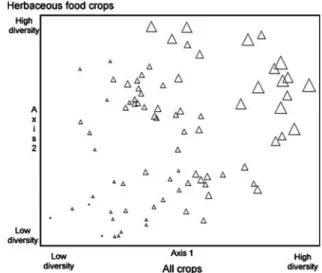
An NMS analysis using the classification data set (22 selected variables) as the primary matrix re-vealed many strong correlations with the ordina-tion axes. The strongest correlaordina-tion appeared along axis 1 (Figure 1) with the variable for total crop diversity (r= 0.84), the total number of fruit tree species (r= 0.83), and the abundance of the dominant fruit species (r= 0.80). Axis 1 was also correlated with the number of age classes
(r= 0.59), the number of herbaceous medicinal and culinary species (r= 0.55), the number of years of intercropping (r= 0.55), the number of living fence species (r= 0.53), the range in ages of fruit trees (r= 0.51), the species variable for tamarind (r= 0.50), and the number of Japanese apricot trees (r= 0.50). Axis 1 can be inter-preted as reflecting the overall crop diversity of the gardens, and particularly the diversity of the fruit tree component. Along this axis there are corre-lations suggesting a pattern of low crop diversity
Table 3. Frequency of some characteristic crop species, as % of gardens in which they were present in 1998, in the Tung Jaw Watershed Management Unit, Mea Hong Son Province, northern Thailand.
Species (units) Village
ALL KSN LMML UMML
(n) 82 (41) (19) (21)
Jack fruitArtocarpus heterophyllus(%) 57.3 63.4 63.6 36.8
LimeCitrus aurantifolia(%) 24.4 14.6 45.5 21.1
CoffeeCitrus arabica(%) 20.7 14.6 31.8 21.1
LitchiLitchi chinensis(%) 52.4 63.4 50.0 31.6
MangoMangifera indica(%) 73.2 73.2 86.4 57.9
BananaMusacvs (%) 57.3 53.7 77.3 42.1
Japanese apricotPrunus mume(%) 53.7 56.1 27.3 78.9
PeachPrunus persica(%) 53.7 75.6 22.7 42.1
GuavaPsidium guajava(%) 25.6 12.2 54.5 21.1
PearPyrus pyrifolia(%) 28.0 34.1 18.2 26.3
TamarindTamarindus indica(%) 29.3 19.5 63.6 10.5
PineappleAnanus comosus(%) 23.2 19.5 45.1 0.0
SquashCucurbitaspp. (%) 46.3 46.3 40.9 52.6
MaizeZea mays(%) 43.9 43.9 36.4 52.6
Lemon grassCymbopogon ciratus(%) 24.4 22.0 36.4 15.8
HerbZingiber cassumnar(%) 11.0 4.9 31.8 0.0
All three villages combined (ALL), Khun Sa Nai (KSN), lower Mae Muang Luang (LMML) and upper Mae Muang Luang (UMML).
Table 2. General characteristics of garden parcels in the Tung Jaw Watershed Management Unit, Mea Hong Son Province, northern Thailand.
Variable (units) Village
ALL KSN LMML UMML
Planting size (trees) 82.8 115.2 50.1 51.1
Dominant fruit species (trees) 48.9 69.7 23.6 33.2
Total crop diversity (species) 12.0 11.7 15.0 9.4
Fruit tree (species) 6.7 7.2 7.6 4.7
Other tree (species) 0.6 0.3 1.3 0.3
Living fence (species) 0.3 0.2 0.7 0.1
Herbaceous food (species) 3.5 3.2 4.0 3.5
Medicinal and culinary herb (species) 1.0 0.8 1.4 0.7
Number of market vegetables (species) 0.5 0.8 0.1 0.1
Mean values of variables for garden parcels in 1998, shown for three villages combined (ALL), Khun Sa Nai (KSN), lower Mae Muang Luang (LMML) and upper Mae Muang Luang (UMML).
and high numbers of the dominant fruit tree spe-cies on the left-hand side, and high crop diversity and low numbers of the dominant tree species on the right-hand side.
Fewer variables had strong correlation values with axis 2. Axis 2 was correlated with the number of herbaceous food crops (r= 0.80), the abun-dance of squash (r= 0.77) and maize (r= 0.69), total crop diversity (r= 0.60), and planting size (r= 0.52). Thus, axis 2 appears to reflect the importance of herbaceous food crops, and partic-ularly those used in the household, as might be found in the smaller gardens.
Axis 3 had the weakest correlation with the variables. This axis was correlated with planting size (i.e., number of fruit trees planted, r= 0.67), number of market fruit species (r= 0.54), range of age classes of major fruits (r= 0.55), years of herbaceous intercropping (r= 0.54), number of age classes (r= 0.52), and ratio of years of intercropping to age of planting (r= 0.52). Axis 3 seems to reflect an inverse relationship with the increasing size of the fruit planting, which may relate in part to farmers’ interest in potential market production of the fruit component.
A secondary matrix analysis using data that included environmental factors, and mostly
cate-gorical indices of economic purpose, and cultural practices revealed few strong correlations. Only three environmental variables showed significant correlations with the ordination axes, and none of them was very strong. All these correlations are negative and along the first axis. The variables are the log of distance to house (r= 0.64), log of parcel size in hectares (r= 0.64), and slope (r= 0.51). These correlations suggest that crop species diversity increases as distance from the garden to the house and parcel size and slope all decrease.
Cluster analysis of gardens
The cluster analysis developed linkages among the 82 sample gardens from 22 variables in the clas-sification data set. Individual sample units were progressively joined with other sample units or clusters of units according to similarities in their characteristics. These relationships are illustrated by the hierarchical dendrogram (Figure 2). A re-searcher must decide where to make a division of the clusters. We chose a point (near 50% of the information remaining) producing seven clusters, each representing a different type of fruit-based agroforestry subsystem or garden type. In making
Figure 1. Distribution of individual gardens along analysis gradients of axis 1, representing overall crop diversity (particularly of the tree crop component) and axis 2, representing diversity of herbaceous food crops for gardens studied in the Tung Jaw Watershed Management Unit, Mea Hong Son Province, northern Thailand. Non-metric multidimensional scaling sorts species by patterns of commonness of occurrences, creating orthogonal axes that are interpreted based on species location in graphs. An overlay of a variable, here total crop diversity, produces a graph in which the size of the triangle indicates the strength of a garden’s correlation with that variable.
this division, we tried to keep a manageable number of groups that appeared to have good integrity among the individual gardens that com-prised them. Membership in clusters ranged from 6 to 22 garden parcels. Garden types are numbered 1, 2, 3, 4, 5, 6, and 7, with memberships of 13, 8, 22, 6, 6, 19, and 7 gardens, respectively.
Garden types
Garden type characteristics are also expressed in the graphic arrangement of the seven garden types in ordination space (Figure 3), where the garden types tended to form distinguishable groups, al-though some spread widely along the axes. There was considerable overlap among garden types in one or two dimensions. Separation was best in the graph of axes 1 and 2 (Figure 3) and better in the graphs of axes 2 and 3 than in those of 1 and 3 (not shown). Overlap tended to be strongest among related groups on the same cluster string. Char-acteristics of the seven garden types are summa-rized by crop diversity variables (Table 4), abundance of important fruit species (Table 5) and frequency of woody and herbaceous crop species (Table 6).
Garden type 1 is made up of gardens with moderate total crop diversity (9.6 species per
parcel, Table 4). Other crop diversity values are also moderate. Parcels are small (0.23 ha) and the planting size is small (28 trees per parcel). The dominance of the most abundant tree species is low (39% of all fruit trees) and the number of trees of individual species per parcel is low (Table 5). In ordination space (Figure 3), garden type 1 lies in a space of moderate to high species diversity (axis 1), a moderate to high number of herbaceous food crops (axis 2), and a small planting size (axis 3). Garden type 1 can be characterized as a group of small gardens generally close to the dwelling, rel-atively high in total diversity and fruit crop diversity, with many age classes and no single fruit species in great abundance. Although there is a long history of intercropping, market crops are rare and herbaceous crop species diversity is moderate.
Garden type 2 has the greatest total crop diversity and highest number of species in each crop type category. The abundance of the domi-nant tree species is low (31.4% of all fruit trees). The number of trees of individual species is gen-erally low, although jackfruit, lime, and guava (fruits of low average abundance but of domestic value) are most abundant in this garden type. Garden parcels are very small (0.18 ha), but planting size is not (61 trees per parcel). The fre-quency of most tree species is high, which may
Figure 2. Classification of seven fruit-based agroforestry garden types in the Tung Jaw Watershed Management Unit, Mea Hong Son Province, northern Thailand. Hierarchical Cluster analysis grouped plots with similar characteristics which were then separated, at the vertical dashed line, into seven clusters representing different garden types (garden type indicated by corresponding number).
reflect that special or new species are collected and tried here. In ordination space, garden type 2 lies in an area of high species diversity and low abundance of the dominant fruit (axis 1), moder-ate to high herbaceous food crop diversity (axis 2)
(Figure 3), and moderate to large plantings rela-tive (in this case) to parcel size (axis 3, not shown). This garden type is made up of small, fenced gardens, very close to the dwelling, which are diverse in both fruit crop and herbaceous crop
Figure 3. Members of the seven garden types (GT) identified by cluster analysis tended to form recognizable groups in ordination space as indicated by lines enclosing symbols for each garden type (here along axis 1 and axis 2). Groups of gardens studied in the Tung Jaw Watershed Management Unit, Mea Hong Son Province, northern Thailand were not discrete in ordination space, but overlapped in one or two dimensions with greatest overlap occurring among related groups on the same cluster string.
Table 4. Crop diversity and plot variables differed among the seven garden types identified through cluster analysis in the Tung Jaw Watershed Management Unit, Mea Hong Son Province, northern Thailand, showing a correlation suggesting a decline in diversity with increasing distance to the house and plot size.
Variable Garden type
All 1 2 3 4 5 6 7
(n) (82) (13) (8) (22) (6) (7) (19) (7)
Total crop diversity (species) 12.0 9.6 24.1 10.9 2.5 13.3 14.0 8.0
Fruit tree (species) 6.7 6.5 11.1 7.6 2.2 7.6 6.5 2.9
Other tree (species) 0.6 0.8 1.5 0.7 0.3 1.1 0.3 0.3
Living fence (species) 0.3 0.5 1.4 0.3 0.0 0.4 0.1 0.0
Herbaceous food (species) 3.5 2.2 6.1 1.6 0.0 3.3 6.1 4.6
Medicinal and culinary herb (species) 1.0 0.3 4.0 0.6 0.0 0.9 1.1 0.3
Planting size (trees) 82.8 28.4 61.6 124.6 56.0 77.3 110.8 29.5
Dominant fruit (trees) 48.9 12.5 16.6 72.8 52.8 45.1 70.5 19.7
Parcel size (ha) 0.56 0.22 0.18 0.46 0.62 0.47 1.1 0.59
Total crop diversity (species/ha) 50.5 68.9 177.6 46.1 5.0 31.1 21.8 20.8
Fruit tree (species/ha) 27.5 45.6 79.9 29.0 4.5 17.9 9.5 7.0
Herbaceous food (species/ha) 13.3 16.5 47.1 7.2 0.0 8.2 10.2 12.7
Medicinal and culinary herb (species/ha) 4.8 1.6 31.3 3.5 0.0 1.6 1.3 0.8
Density (trees/ha) 208.0 149.4 339.8 340.5 102.9 167.0 134.8 79.5
Percent dominant fruit (%) 58.8 39.2 31.4 61.3 94.6 59.5 64.1 72.7
Distance to dwelling (m) 1228 981 134 1496 1566 592 1973 421
Table shows data for garden parcels in 1998, in three villages combined (ALL) and by the garden type. Variables expressed as means, with maximum mean value for each variable in bold.
species, particularly culinary and medicinal herbs. Fruit trees are in are many age classes, and no one species is in great abundance. The emphasis on household crops is high and market crops are rare. Garden type 3 is made up of moderate total crop diversity and tree fruit diversity (10.9 and
7.6 species per parcel, respectively). Diversity of other crop categories is low. Garden parcels are medium-sized (0.46 ha) but have the largest mean planting size (124 trees) and so a high density (340.5 trees/ha). The most abundant tree crop makes up more than half (61%) of the planting.
Table 6. Frequency of certain crop species (as a percentage of gardens in which they appeared) among the seven garden types identified through cluster analysis in the Tung Jaw Watershed Management Unit, Mea Hong Son Province, northern Thailand, illustrating commonness of particular crop species in different garden types.
Variable Garden Type
All 1 2 3 4 5 6 7
(n) (82) (13) (8) (22) (6) (7) (19) (7)
Jack fruitArtocarpus heterophyllus(%) 57.3 69.2 87.5 59.1 33.3 85.7 52.6 0.0
LimeCitrus aurantifolia(trees) 24.4 7.7 87.5 36.4 0.0 42.9 5.3 0.0
CoffeeCoffea arabica(%) 20.7 7.7 62.5 45.5 0.0 0.0 5.3 0.0
LitchiLitchi chinensis(%) 52.4 46.2 62.5 68.2 0.0 42.9 73.7 0.0
MangoMangifera indica(%) 73.2 84.6 87.5 77.3 16.7 100.0 73.7 42.9
BananaMusacvs (%) 57.3 61.5 87.5 50.0 16.7 85.7 57.9 42.9
Japanese apricotPrunus mume(%) 53.7 30.8 25.0 50.0 100.0 42.9 57.9 100.0
PeachPrunus persica(%) 53.7 76.9 37.5 59.1 16.7 14.3 73.7 28.6
GuavaPrunus guajava(%) 25.6 38.5 100.0 22.7 0.0 28.6 5.3 0.0
PearPyrus pyrifolia(%) 28.0 30.8 37.5 31.8 0.0 14.3 36.8 14.3
TamarindTamarindus indica(%) 29.3 38.5 75.0 36.4 0.0 28.6 15.8 0.0
PineappleAnanas comosus(%) 23.2 7.7 100.0 22.7 0.0 28.6 15.8 0.0
SquashCucurbitaspp. (%) 46.3 46.2 62.5 9.1 0.0 0.0 100.0 85.7
MaizeZea mays(%) 43.9 0.0 25.0 4.5 0.0 100.0 100.0 100.0
Lemon grass Cymbopogon citratus (%) 24.4 15.4 62.5 18.2 0.0 42.9 31.6 0.0
Zingaber cassumnar(%) 11.0 0.0 75.0 9.1 0.0 14.3 0.0 0.0
Table shows data for garden parcels in 1998, in three villages combined (ALL) and by the garden type. Variables expressed as a percentage of gardens in that type (column) in which a species occurred, with maximum mean value for each variable in bold.
Table 5. Abundance of important fruit species varied among the seven garden types identified through cluster analysis in the Tung Jaw Watershed Management Unit, Mea Hong Son Province, northern Thailand, showing characteristics such as higher numbers of species commonly planted for market reasons, such as Japanese apricots and litchi, in certain garden types.
Variable Garden Type
All 1 2 3 4 5 6 7
(n) (82) (13) (8) (22) (6) (7) (19) (7)
Jack fruitArtocarpus heterophyllus(trees) 2.6 2.4 6.5 2.0 0.5 4.7 2.7 0.0
LimeCitrus aurantifolia(trees) 0.5 0.1 2.1 0.5 0.0 2.0 0.1 0.0
CoffeeCoffea arabica(trees) 9.4 0.2 5.1 33.0 0.0 0.0 0.1 0.0
LitchiLitchi chinensis(trees) 16.1 2.5 6.8 20.2 0.0 3.1 40.5 0.0
MangoMangifera indica(trees) 7.7 4.7 11.3 7.0 0.7 31.7 4.1 3.3
BananaMusacvs (clumps) 6.4 2.3 3.1 7.8 0.2 23.3 5.9 3.4
Japanese apricotPrunus mume(trees) 9.7 2.0 5.3 5.8 52.8 4.6 6.4 18.3
PeachPrunus persica(trees) 18.6 8.2 3.1 32.2 1.5 0.3 34.6 2.9
GuavaPsidium guajava(trees) 0.9 1.7 4.4 0.6 0.0 0.4 0.1 0.0
PearPyrus pyrifolia(trees) 2.5 0.8 1.5 5.2 0.0 0.1 3.6 0.1
TamarindTamarindus indica(trees) 0.8 0.5 1.5 1.6 0.0 0.3 0.4 0.0
Table shows data for garden parcels in 1998, in three villages combined (ALL) and by the garden type. Variables expressed as mean number of trees, with maximum mean value for each variable in bold.
Peach, coffee, and litchi are all abundant. Garden type 3 lies in an ordination space that stretches broadly from moderate to low species diversity (axis 1), a low number of herbaceous food crops (axis 2), and moderate to large planting size (axis 3). This garden type tends to consist of mid-sized parcels with many fruit trees. The tree component of the gardens is mixed, with several abundant species for market; there is moderate tree diversity. No market vegetables are grown, and herbaceous crop diversity is low.
In Garden type 4, mean total diversity and fruit diversity are both very low. These are medium-sized plantings dominated by Japanese apricot (95% of trees in garden). There are no herbaceous intercrops. This garden type lies in an ordination space of low species diversity and high abundance of the dominant fruit (axis 1), low herbaceous food crops (axis 2), and small planting size (axis 3). These gardens are basically simple orchards of Japanese apricot with little active herbaceous in-tercropping, few herbaceous crops of any kind, and no market vegetables. Diversity is very low.
Garden type 5 is a non-descript group of gar-dens with moderate total diversity (13.5 species) and fruit tree diversity (7.6 species). Over half the trees in the garden (59.5%) are on average of one species. Mangos and bananas are abundant and frequent, and maize is raised in all the gardens. Garden type 5 lies in an indistinct location near the middle of ordination space for total diversity (axis 1) and herbaceous food crops (axis 2). It spreads across the third ordination axis from mid-sized to large plantings (axis 3). Thus these are mid-sized, moderately diverse gardens, fairly close to the dwelling, with moderate numbers of the dominant fruit trees and several fruit species being grown in market quantities. Maize is grown, along with some other herbaceous crops, mostly for home consumption.
In garden type 6, total diversity (14 species) and tree fruit diversity (6.5 species) are moderate, but the number of herbaceous food crops is high (6.1 species). The most abundant fruit accounts for 64.1% of the trees in the garden. Parcel size (1.1 ha) and fruit tree planting size (110.8 trees) are both large. Both peaches and litchi have high mean abundances and frequencies. There are some plantings where both are present, but generally one or the other is abundant. Maize and squash are both always present. Garden type 6 lies in an
ordination space of moderate to low species diversity (axis 1), moderate to high numbers of herbaceous food crop species (axis 2), and a broad, medium to large planting size (axis 3). Thus, type 6 can be characterized as large, moderately diverse gardens far from the dwelling, with high numbers of the dominant fruit but several fruit species in marketable quantities. These gardens are actively intercropped, and maize is grown along with other herbaceous crops. They are similar to type 5 gar-dens, but have more marketable fruit crops and are further distinguished by the presence of squash and a high number of market vegetable crops.
Gardens in type 7 are generally small plantings (29.5 trees) with low total crop diversity (8.0 spe-cies) and fruit diversity (2.9). Herbaceous food crop diversity is fairly high (4.6 species). The most abundant tree species is quite dominant (72% of all trees). Japanese apricot and corn are always present and squash is very common. Garden type 7 lies in an ordination space of moderate to low species diversity, moderate to high abundance of the dominant fruit (axis 1), moderate to high herbaceous food crop diversity (axis 2), and moderate planting size (axis 3). Gardens in type 7 are mid-sized and moderately diverse, though more so in herbaceous crops than in tree crops. Like garden types 5 and 6, they are intercropped with corn and other food crops, but are smaller and closer to the dwelling. Garden type 7 is clearly distinguished from 5 and 6 by the tree crop com-ponent, and due to the dominance of Japanese apricots it more closely resembles garden type 4, although it is distinguished from type 4 by the importance of herbaceous crops. Maize is grown along with squash, but few vegetables are grown for market.
Discussion
Some of the seven groups identified by our analysis are familiar from other classification systems. Garden types 1 and 2 can be readily recognized as home gardens (see Withrow-Robinson et al. 1999). Both types tend to be small parcels close to the dwelling, with high crop species diversity. They seem to be used primarily to meet domestic needs, which is consistent with characteristics of home gardens described in the literature (Fernandes
et al. 1984; Millat-E-Mustafa et al. 1996; Moreno-Black et al. 1996; and Rico-Gray et al. 1990).
Two other garden types (4 and 7) also seem recognizable as forms of conventional commercial orchards. Each is a type of Japanese apricot orchard that differs on the basis of its herbaceous crop component. Each has a simple, low-diversity tree fruit component. Garden type 4 is dominated by Japanese apricot (95%) with little active her-baceous intercropping, few herher-baceous crops of any kind and no market vegetables. Garden type 7 has a little more tree fruit diversity, but stands out for its maize and other herbaceous intercrops.
These two commercial orchards were narrowly defined, with a single species a key part of the characterization. No broad category emerged to include low-diversity plantings of market species as a group. Nor did other species-specific orchard groups appear. The groups defined by this multi-variate approach are quite different from those in more subjective functional descriptions, in which commercial orchards of any species tend to be classified as a group. So what has this multivariate approach contributed?
At the outset of the study, we worked from the assumption that there were separate and distinct garden types and that they emerged as a result of cropping decisions made by local farmers in re-sponse to physical and socioeconomic conditions. In particular, it appeared as if people were orga-nizing their gardens by function, which was reflected in garden composition. Functional orga-nization was central to the development of our preliminary classification, in which we identified 11 subsystems (Withrow-Robinson et al. 1999). This approach was consistent with that of Nair (1985) but at a finer scale.
The multivariate analysis produced a classifica-tion with fewer distincclassifica-tions between groups than we anticipated. The relationship among groups was not clear. This seems to indicate that these gardens do not represent categories as discrete as we first presumed. Rather, there is a high degree of overlap in characteristics of individual gardens. This idea is supported by the somewhat weak ecological clustering (Figure 2) indicating low variation between the groups. This was also re-flected in the grouping patters of the clusters in ordination space (Figures 1 and 3) which were rather separated with lots of overlap. It seems that the different garden components (crop species)
were largely interchangeable. Few were greatly limited in distribution within the study area. It is still possible to draw lines of separation to form groups and impose a structure, for there are some clear differences among the groups thus identified. The question remains, however, if groups pro-duced this way are meaningful or as useful as those produced through a more subjective classification process.
Why did this analysis not work as well as we thought it would, given its ecological applications? Perhaps we expected that differences in aspect, slope and elevation of the garden sites along with characteristics of the crop species (such as chilling requirements of fruit trees or shade tolerances of herbaceous crops) would influence patterns and associations more than they did. Alternatively, although there certainly are ecological constraints to the development of gardens, cropping decisions may also be very strongly influenced by social and economic management factors. Some loss of pro-ductivity or increase risk associated with planting away from an ecological optimum may be acceptable if production at an ecological margin (such as high elevation) gave enough market advantage (such as off season crop production).
We should also note that we are observing a young system, one still evolving. Many new crops and management ideas are being tried in new places, planted outside of what may later be determined to be their ecological optimal zones. It is possible to argue that differences could become more detectable as the system matures: unpro-ductive species will be removed and replaced with others as identified, and so associations of more suited plants might gradually be chosen to fit the local micro-climate.
In the end, it is not clear that the multivariate approach can combine social and economic and also the ecological relationships as well as a func-tional/structural approach can. The ability to make grouping decisions may make a subjective functional classification (such as devised by Nair 1985) a more flexible and valid method even at a finer scale.
Acknowledgements
The authors wish to acknowledge the people Khun Sa Nai, Ban Lisu Mea Muang Luang and Ban
Karieng Mea Muang Luang for their cooperation and hospitality. Thanks also to the National Security Education Program and the National Research Council of Thailand for their support. Special thanks Mr Chaleo Kanjunt and the Royal Forest Department and also to Mr Phrek Gyp-mantasiri and the Multiple Cropping Center, Chiang Mai University. This is paper number 3596 of the Forest Research Laboratory, Oregon State University.
References
Christanty L., Abdoellah O.S., Marten G.G. and Iskandar J. 1986. Traditional agroforestry in West-Java: the pekerangan (homegarden) and kebun-talan (annual-perennial rotation) cropping system. In: Marten G.G. (ed), Traditional Agri-culture in Southeast Asia: a Human Ecology Perspective. East–West Environment and Policy Institute, University of Hawaii, USA. Westview Press, Boulder, 358 pp.
Delobel T.C., Evers G.R. and Maerere A.P. 1991. Position and functions of deciduous fruit trees in the farming systems at Upper Mgeta, Uluguru Mountains, Tanzania. Acta Hort. 270: 91–102.
Enters T. 1992. Land Degradation and Resource Conservation in the Highlands of Northern Thailand: The Limits to Eco-nomic Evaluations. Ph.D. Dissertation. The Australian Na-tional University, .
Fernandes E.C., Oktingati A. and Maghembe J. 1984. The Chagga homegardens: a multi-storied agroforestry cropping system on Mt. Kilimanjaro (Northern Tanzania). Agrofor. Syst. 2: 73–86.
Gauch H.G.Jr. 1982. Multivariate Analysis in Community Ecology. Cambridge University Press, Cambridge, New York, 298 pp.
Gypmantasiri P. 1998. Multiple Cropping Centre. Personal communication. Faculty of Agriculture, Chiang Mai Uni-versity.
Kanjunt C. 1998. Mae Taeng Watershed Management District. Personal communication. Royal Forest Department, Chiang Mai.
Kruskal J.B. 1964. Nonmetric multidimensional scaling: a numerical method.Psychometrika29: 115–129.
Lauriks R., De Wulf R., Carter S.E. and Niang A. 1999. A methodology for the description of border hedges and the analysis of variables influencing their distribution: a case study in western Kenya. Agrofor. Syst. 44: 69–86.
Mather P.M. 1976. Computational Methods of the Multivari-ate Analysis in Physical Geography. J. Wiley and Sons, London; New York, 532 pp.
McCune B. and Mefford M.J. 1999. Multivariate Analysis of Ecological Data, Version 4.02. MJM Software, Gleneden Beach, Oregon, USA.
Millat-E-Mustafa M.D., Hall J.B. and Teklehaimanot Z. 1996. Structure and florisitcs of Bangladesh homegardens. Agrofor. Syst. 33: 263–280.
Moreno-Black G., Somnasang P. and Thamathawan S. 1996. Cultivating continuity and creating change: women’s home garden practices in northeastern Thailand. Agric. Hum. Val. 13(3): 3–11.
Musvoto C. and Campbell B.M. 1995. Mango trees as com-ponents of agroforestry systems in Mangwende, Zimbabwe. Agrofor. Syst. 32: 247–260.
Nair P.K.R. 1985. Classification of agroforestry systems. Ag-rofor. Syst. 3: 97–128.
Poffenberger M. and McGean B. (eds), 1993. Community Al-lies: Forest Co-Management in Thailand. Research Network Report Number 2, Center for Southeast Asia Studies. Uni-versity of California, Berkeley, California, USA, 62 pp. Rerkasem K. and Rerkasem B. 1994. Shifting Cultivation in
Thailand: its Current Situation and Dynamics in the Context of Highland Development. IIED Forestry and Land Use Series No. 4. International Institute for Environment and Development, London, 139 pp.
Rico-Gray V., Garcia-Franco J.G., Chemas A., Puch A. and Sima P. 1990. Species composition, similarity and structure of Mayan homegardens in Tixpeual and Tixcacaltuyub, Yuca-tan, Mexico. Econ. Bot. 44(4): 470–487.
Sinclair F.L. 1999. A general classification of agroforestry practice. Agrofor. Syst. 46(2): 161–180.
Suryanata K. 1994. Fruit trees under contract: tenure and land use change in upland Java, Indonesia. World Dev. 22: 1567– 1578.
Ward J.H. 1963. Hierarchical grouping to optimize an objective function. J. Am. Stat. Assoc. 58(301): 236–244.
Withrow-Robinson B., Hibbs D.E., Gypmatasiri P. and Tho-mas D. 1999. A preliminary classification of fruit-based agroforestry in a highland area of northern Thailand. Agrofor. Syst. 42: 195–205.