FES IntErnal SourcEBook
Ecological
REstoRation
A Source Book
for
ECOLOGICAL RESTORATION
Update 2008
Table of Contents
Page No.
PART –A Eco-Restoration
Section 1
Introduction
1
What is Ecological Restoration
51.1 Why eco-restoration? 5
1.2 How is it different from other approaches? 6 1.3 Our aim is planting or Eco-restoration? 6
2
FES’ Experience
72.1 Change Detection Study in selected locations of Madanapalle district
7 2.2 Change detection study in selected micro watershed of
Lakhundar Gadganga project in Madhya Pradesh
8 2.3 Change detection study in two watersheds of Bhilwara
project in Rajasthan
8
3
Approaches to Eco-restoration
93.1 Ecosystem V/S Species 9
3.2 Protection of individual species or all the species? 9
3.3 Is ecosystem approach ultimate? 9
3.4 Is landscape approach ultimate? 9
Section 2: Eco-restoration Methods and Skills
101
How to do Eco-restoration, stepwise?
112
Components of Eco-restoration
132.1 Revegetation 13
2.2 Regeneration 18
3
Planting methods
193.1 Natural regeneration 19
3.2 Some important principles 19
3.3 Post planting activities 20
3.4 Stepwise establishment and management techniques of plantations
21
4
Nursery Techniques
314.1 Nursery establishment and development 31 4.2 Techniques of nursery operations in semi-arid areas 31
4.3 Seedling production 37
5.3 Mechanical measures for soil and water conservation 49 6
Monitoring Indicators
51 6.1 Sustainability 51 6.2 Invasibility 51 6.3 Productivity 51 6.4 Nutrient Rotation 51 6.5 Biotic Interaction 51 7Special Plantations
52 7.1 Introduction 527.2 Windbreaks and shelterbelts 52
7.3 Design of wind breaks and shelterbelts 52 7.4 Selection of tree and shrub species 53
7.5 Planting techniques 53
7.6 Management practices 54
7.7 Sand dune stabilization 54
7.8 Stabilization of coastal dunes 55
7.9 Stabilization of inland dunes 55
7.10 Planting techniques 56
7.11 Canal side plantations 56
7.12 River bank plantation 57
8
Rehabilitation of saline environment
58 8.1 Aims of saline environment rehabilitation program 588.2 Salt tolerant shrub resources 58
8.3 Plant selection 59
8.4 Establishment 59
9
Management aspects of Eco-restoration
62 9.1 Ecological succession and management 629.2 Grazing management 63
9.3 NTFP (non-timber forest products) management 67
9.4 Involvement of local people 72
PART – B- Some Basic Concepts
751
Ecosystem Concept
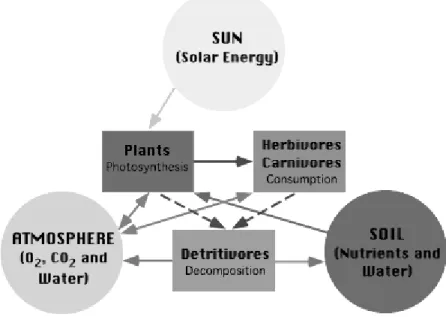
761.1 Major components of ecosystems 76
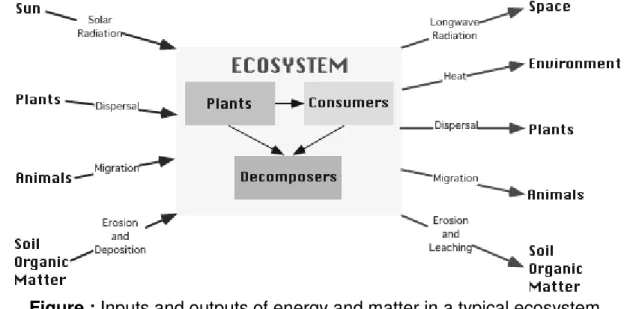
1.2 Energy and matter flow in ecosystems 77
1.3 Ecosystem health 78
2
Biodiversity
802.1 Levels of biodiversity 81
2.2 Genetic biodiversity 81
2.3 Species diversity 81
2.4 Community and ecosystem diversity 81
2.5 Important General Principles Associated With Ecological Succession
82
2.6 Types of ecological succession 83
3
Drylands: Concept
853.1 Extent of drylands (Arid-semi arid-dry sub-humid) in India
85
3.2 Forests of dryland 86
3.3 Arid zones 86
3.4 Semi arid zones 87
3.5 Degradation of drylands 87
3.6 Deforestation 88
3.7 Causes of deforestation 88
4
Land Degradation
894.1 Causes for land degradation 89
4.2 Desertification 90
4.3 The implications of deforestation, degradation and desertification on environment and livelihood
91
Section I: Introduction
1. What is Ecological restoration?
According to the Society for Ecological Restoration, the process of assisting the recovery of an ecosystem that has been degraded, damaged or destroyed is called ecological restoration or eco-restoration. Eco-restoration involves: To bring back original normalcy of function, structure, potential, service and process of eco system. Eco-restoration focuses on rectification of four basic component of ecosystem: 1 Mineral cycle, 2. Water cycle, 3. Energy flow and 4. Succession
Other similar terms
Rehabilitation-The action of restoring a thing to a previous condition or status is called rehabilitation.
Remediation-It is the act of remedying. To remedy is: ‘to rectify, to make good’ here the emphasis is on the process rather than on the endpoint reached.
Reclamation-Reclamation is a term used for making of land fit for use or to bring back to a proper state. Here there is no implication of returning to an original state but rather to a useful one.
Restoration-The act of restoring a land to a former original state or position is called restoration.
1.1 Why Eco-restoration?
Ecological restoration is usually carried out for one of the following reasons:
• To restore highly disturbed, but localized sites, such as abandoned mines.
Restoration often entails amelioration of the physical and chemical characteristics of the substrate and ensuring the return of vegetation cover.
• To improve productive capability in degraded productive lands. Degradation of
productive land is increasing worldwide, leading to reduced agricultural, range, and forest production. Restoration in these cases aim to return the system to a sustainable level of productivity, e.g., by reversing or ameliorating soil erosion or salinization problems in agricultural or rangelands.
• To enhance nature conservation values in protected landscapes. Conserved
lands are being reduced in value worldwide by various forms of human-induced disturbance, including the effects of introduced stock, invasive species (plant, animal, and pathogen), pollution, and fragmentation. In these cases, restoration aims to reverse the impacts of these degrading forces, e.g., by removing an introduced herbivore from a protected landscape. In many areas, there is also a recognized need to increase the areas of particular ecosystem types - for instance, attempts are being made to increase the area of native woodlands in the United Kingdom, in order to reverse past trends of decline and to increase the conservation value of the landscape.
• To restore ecological processes over broad landscape-scale or regional
areas. In addition to the need for restoration efforts within conservation lands, there is also a need to ensure that human activities in the broader landscape do not adversely affect ecosystem processes. There is an increasing recognition that protected areas alone will not conserve biodiversity in the
1.2 How is it different from other approaches?
Ecological restoration differs from other approaches of restoration in the fact that it tries to restore the original biodiversity and ecosystem processes that existed before the degradation or disturbance. Any ecosystem has an inherent capacity and potential to regenerate on its own. Here emphasis is given to help natural ecological processes regenerate the ecosystem structure and functions through giving inputs that are ecologically safe. These inputs tend to only shorten the regeneration time, which would have been longer without these inputs.
1.3 Our aim is planting or eco-restoration?
Planting is definitely not a synonym of eco-restoration but only a component of it. As we know, the word ecosystem covers the biological and non-biological elements occurring together in a particular area. When term eco-restoration is being referred to, the suggestion is that we are particularly interested in the restoration of the fundamental process by which ecosystem works.
We also talk about restoration of quality. This is particularly true in discussions of soil or water restoration, perhaps because the species in these habitats are multifarious and their individual occurrences difficult to predict. The implication is therefore different. It is the perceived attributes of what is in an area, or of a component of the environment, which are considered to be important.
While planning for eco-restoration, our attention should always be to focus on: (i) Restoration of function of ecosystem
(ii) Restoration of process of ecosystem (iii) Restoration of structure of ecosystem
(iv) Restoration of services of ecosystem
Attributes of an ecosystem are mainly its structure and functions. It may be possible, perhaps to restore the functions fairly completely, but achieving the original structure may be more difficult.
In above light, level of restoration may be of following types: (1) Full restoration or complete restoration
(2) Restoration of only certain attributes (3) Only rehabilitation or
(4) Reclamation
Obviously, full restoration is very complicated and time consuming; and sometimes very resource consuming also. No doubt, full restoration or complete restoration may be seen ethically the most justifiable and therefore the most obvious to adopt. But at the same time it is not an easy task to achieve the goal of complete restoration. However, for all practical purpose we can go for partial restoration. Once initial recuperation is achieved, we should conserve the same and let it allow repairing the remaining damages itself.
Some points to remember
• A healthy ecosystem needs biologically fertile soil, full of microfauna and
flora. Hence, in situ soil conservation is necessary.
• Utmost care should be taken to protect the local soils. If soil is protected,
vegetation will generate again by natural succession or we can expedite the process by artificial methods like enhanced natural regeneration or artificial regeneration (sowing and planting) or both. Soil erosion can be checked through watershed treatment principles.
• While resorting to artificial regeneration, discourage exotics and prefer
local species. While planting, utmost care should be taken to place every species at right place.
• Proper species selection is a prerequisite for successful restoration.
• Do not plant such species, which never existed in the area in remote past
also. If area is under secondary succession know about original species by various tools given ahead.
• Care should be given to create and support the microhabitats of the
various animal species in the restored area. Animals, right from bacteria to mammals are a must to keep the ecosystem functional.
• Utmost care should be taken to check further biodiversity loss.
Section 2. FES’ s Experience
2.1.Change detection study in selected locations of Madnapalle project in Andhra Pradesh
In Andhra Pradesh, in the Sadhukonda Reserve Forest land of 6380 hectares (ha), the changes are important in bringing out an increase in tree cover in terms of area under dense (472 ha) and open forests (442 ha). Apart from this there is also a considerable increase in shrub coverage (437 ha), all of which is attributable to the rootstock responding to protection. Out of the total area of about 6,380 ha of the RF, an area of 1,968 ha has retained its vegetative cover over the six-year period. The comparison of vegetative cover in 1996 and 2002 for the Yerrakonda revenue wasteland of 465 ha shows an increase of 17 ha of Open forest (from 47 Ha) and 96 ha of mixed degraded forest (from 143 ha). This is mainly due to natural regeneration. The available woody biomass has been found above the average biomass for a dry deciduous forest and has been proven as contributing to the sequestration of a huge amount of carbon. As far as water resources are concerned, one noticeable impact has been with regards to cattle ponds, which are small water harvesting structures tapping seepage water. It may be mentioned that in times of drought, when most tanks have run dry, some of these cattle ponds are the only source of water for cattle. The team in AP is now focusing on strategies to manage the extraction and selling of fuel wood within sustainable limits, keeping in mind the energy needs of the dependent habitations. While the interventions by communities are enhancing the availability of water, the extraction of it remains in the private
while integrated land use planning at the village level is the need of the hour, some simultaneous regulatory mechanisms for utilization of biomass and water across all categories of lands forming a larger resource constituency are needed.
2.2. Change detection study in selected micro watershed of Lakhundar Gadganga Project in Madhya Pradesh
From Madhya Pradesh, in the Salri Micro-watershed there has been a significant improvement in the vegetation cover since 1996. There has been an improvement in the wastelands, scrub lands and mixed degraded forests and another 2 ha of dense forests and 32 hectares of open forests in 2002, categories that were non-existent in 1996. The riverine vegetation has improved from being under the open category to dense category (24 ha in 1996 to 65 ha in 2002). Another significant improvement has been seen in the mixed degraded category of forest, which has increased by 57 ha from 71 ha in 1996 to 128ha in 2002. On the other hand, there is a decrease in the wastelands from 399 ha to 270 ha during this period. This is a result of protection and soil and water conservation measures taken up by the communities on the common lands since 1998. Though, there is a marginal increase in agricultural area by 8 ha, the rabi crop area has been reduced by 22 ha which is primarily due to the three years of drought. There would have been a further decrease in this category had it not been for newer areas brought under Rabi cultivation owing to their proximity to water harvesting structures.
Similarly in Ladwan Micro watershed of MP, there is an improvement in the hectarage under open forests from 4 ha in 1996 to 78 ha in 2002. The vegetation along the valley also shows considerable improvement, as the open riverine forest has become dense riverine forests. The dense riverine forests have increased from 21 ha in 1996 to 111 ha in 2002 while the open riverine forests have decreased from 87 ha to 22 ha in the same time period. The area under scrub has been converted to mixed degraded forest and thus increased the area under this category by 196 ha. Another change is the reduction of wasteland from 1334 ha in 1996 to 1213 ha in 2002. Wasteland constitutes almost 40% of the total geographical area in these watersheds. Due to drought, re-vegetative methods were relatively less successful than regeneration of rootstock by protection.
2.3. Change detection study in two watersheds of Bhilwara project in Rajasthan
From Rajasthan, in the Lilri Watershed, an important change is the increase in tree cover in terms of the area under open forests that increased by 192 ha. There has also been an increasing trend in the category of Mixed degraded forest category that has increased by 464 ha. This implies that when under protection, the rootstock available in the watershed can grow out to develop into a more dense vegetation cover. Scrubland has also increased by 133 ha and consequently wasteland has decreased by 750 ha in 2002. Area covered by water bodies has decreased in the
3. Approaches to Ecorestoration
3.1 Ecosystem v/s speciesAn Ecosystem does support a variety of floral and faunal species to remain in functional state. Not even a single species of an ecosystem can survive its own in isolation. Interdependency among species is so intricate that one can’t think of their survival away from ecosystem for long. One species influence other species present in the surroundings and get influenced from others those are surrounding it. Each species is useful to other species in many ways like:
• Fulfillment of needs of food • Fulfillment of habitat needs
• Fulfillment of system dynamics needs • Fulfillment of system cybernetics needs
Every species has its specific role in the ecosystem. All species function on the principle of “division of labour” in the ecosystem. Extinction or extermination or insufficient number of individual species will affect “quantum of service” being rendered by the species to the ecosystem. Every species has its own ability, potential and adaptability to perform a specific role in the ecosystem.
3.2 Protection of individual species or all the species?
It has been already mentioned that no species can survive in isolation. Existence of every species is inextricably linked to the existence of other species. .
If we want to save one species, we have to save all those species which have linkage with targeted species; and all the species can be saved only when if ecosystem is intact, sound and functional. Hence instead of “Species Conservation Approach”, “Ecosystem Conservation Approach” should be ideally followed.
3.3 Is ecosystem approach ultimate?
An ecosystem does have many species and all the species of a particular ecosystem have multiple linkages from other species. Broadly speaking, an ecosystem is a self sufficient unit of the nature, but in reality, every ecosystem has linkages with other ecosystems present in its surroundings. To maintain an ecosystem in its best condition, maintenance of all ecosystems, present in the vicinity is must. It means, instead of protecting single ecosystem we will have to protect all the ecosystems. In other words, we will have to protect the whole landscape. This is known as “LANDSCAPE APPROACH”. It is a refined and enlarged edition of ecosystem approach.
3.4 Is landscape approach ultimate?
There is a series of ecosystems in the nature. One ends, another starts. Now question arises, how many ecosystems should we protect or restore? One, few or all! Nothing in the nature is present in airtight compartments. All ecosystems are linked with each other in one way or the other. Zone of influence of different ecosystem sometimes touches each other or sometimes even overlaps. It means, protection of every ecosystem is needed. Hence our approach should be global. So thinking globally and acting locally should be our motto. To restore the degraded
1. How to do eco-restoration, stepwise?
Certain steps of intervention are needed to start with the eco-restoration process in a particular area. Our step would be as following
STEP I : Understand the extent and nature of degradation of the ecosystem This can be approached through examination of the species composition of the area, soil analyses, landscape analysis, water testing etc.
Analysis of Bio-physical factors
Study of local bio-physical factors is necessary to understand the intensity of problems, nature of limiting factors and ways of restoration. After doing a reconnaissance survey of the area, in depth survey is required. During survey following information should be collected.
Physical Factors Biotic Factors Additional Information
Climatic Factors Temperature
• Maximum and Minimum temperature • Mean January temperature
• Mean Annual temperature • Presence of Frost
• Rainfall • Annual Rainfall
• Length of rainy season • No. of rainy days
• Tentative arrival date of monsoon • Tentative departure date of monsoon • Relative Humidity • Frequency of drought • Presence of Fog • Perenniality of streams • Presence of springs Wind velocity Loo condition Storm condition Edaphic Factor • Type of soil • Texture of soil • Structure of soil • pH of soil • Soil profile • Humus conditions • Soil Minerals • Salinity
• Depth of water table and its behaviour • Presence of impervious rocks
• Nutritional deficiency in soil
Biological spectrum of the area? 1. Vegetation composition 2. Animal communities • Parasite • Epiphytes. • Weeds • Exotics • Pathogenic Organisms • Influence of wild animals • Anthropogenic activities • Fire
• Insects
• Impact of wild animals
• Type of Forests • Type of Grasslands • Stage of plant secession • Stratification in forests • Climate vegetation of the
area
• Fragmentation status of
forest
• Corridor problems of the
area
• Crop raiding status • Ecological signification of
the area (Ecological criticality of the area)
• Endemism in the area • Red data species of the
area
• Threatened species of the
area
• Protected area in and
around of targeted area
• Top predators
(i) During past (ii) At present
• Species lost from the area
(i) Animals (ii) Plants
• Species new to the area
(i) Animals (ii) Plants Five Steps 1. Biophysical analysis 2. Studying factors 3. Setting eco-restoration objectives
Analysis of Data
After collection of data, the analysis and interpretation of data is necessary to extract relevant information from the data collected. Analysis paves our path for planning, implementation and monitoring. How inference is drawn from the data can be understood from examples given in annexure.
Take notice of Ecological Indicators:
An ecological or biological indicator is a species, the presence or observes of which is indicative of a particular set of environmental conditions. Ecological indicators are very often the plant species, which form ground flora. Different ecosystems and different stages of ecosystem have different indicators. Indicators always give important information about ecosystem. Few indicators are given below:
S.No Name of indicator Indicative of which condition
1. Indigofera pulchela If present in Sal forests, indicates that soil condition is getting drier.
2. Woodfordia floribunda If present in Sal forests, indicates that soil condition is getting drier.
3. Holarrhena antidysentrica Unfavorable conditions for Sal 4. Helicteres isora Unfavorable conditions for Sal
5. Clerodendron viscosum Favorable soil condition for Sal regeneration 6. Moghania chapper Favorable soil condition for Sal regeneration
7. Leea sambucina Favorable conditions of regeneration of Dipterocarpus macrocarpa.
8. Urochloa reptans Indicate overgrazed grasslands 9. Sporobolus spp. Indicate overgrazed grasslands 10. Cassia tora Indicate overgrazed grasslands
11. Aristida spp. Indicator of overgrazed and depleted site 12. Melanocenchrus jacquemontii Indicator of overgrazed and depleted site 13. Saccharum spontaneum Indicates poor soil drainage
14. Capparis spinosa Indicates intense soil erosion in forest area 15. Carissa spinarnum Indicates intense soil erosion in forest area 16. Butea monosperma (Pure crop) Badly drained clay soil
STEP II -Trace the causal factor or factors responsible for the degradation.
Factor(s) may be internal or external, anthropogenic or natural, periodic or continuous and so on.
STEP III - Think of ecologically sound remedies and ways to minimize or completely check the causal factor(s)
Make an exhaustive plan to restore the site. STEP IV - Review the plan
Think about its impact on ecosystem and local people. Discuss it with locals also. If there is any apprehension do needful alterations and rectifications.
2. Components of Ecorestoration
2.1 Revegetation
2.1.1 Eco-restoration and Regeneration of vegetation:
Vegetation cover is an important factor to keep ecosystem in normal condition. Normal vegetation cover of an area can protect soil, moisture, and animals effectively. If vegetation cover is under pressure and degradation is going on, the loss of soil, moisture and animal populations will take place automatically. A degraded ecosystem loses its many microhabitat and their inhabitants. Regeneration of vegetation is comparatively easy, however once regenerated vegetation helps in the propagation of both the plants and animals alike. The vegetation regeneration should therefore be done in the best way possible.
2.1.2 Process of Revegetation Plan:
Following steps are taken while preparing and launching a regeneration plan. 1. Mapping of Biophysical factors.
2. Proper plant species selection, which is based on (i) Species survey of site
(ii) Ecological concerns (iii) Community preference (iv) Past learnings
3 Treatment plan, which include detail planning about: (i) Soil and moisture conservation
(ii) Sowing (iii) Planting
(iv) Natural regeneration (v) After care.
4. Time budgeting for timely implementation. 5. Implementation in the field
6. Monitoring
7. Learning and re-planning
Promoting Plant Diversity
A diversity of desirable native plants will establish more quickly if the aggressive erosion hardy grasses are not established on the site. This includes rabbitbrush, alfalfa, yellow sweetclover, forage kochia, and some wheatgrass and brome cultivars developed for seedling vigor, emergence, or stand establishment. Seeding of aggressive species should be limited to areas of high risk for revegetation failure or erosion. The revegetation plan should at least allow for islands of diversity within the disturbed area to be seeded. Planting should consist of non-aggressive shrubs, forbs and /or grass species. Fertilizer should rarely be used within these islands of diversity. Small or long, linear disturbances, such as roads or pipelines, can revegetate naturally without seeding if good topsoil handling techniques are practiced. This is beneficial because it reduces cost and promotes establishment of a native vegetation community similar to the surrounding area.
1. Revegetation
2. Seed collection and Nursery
Limitations to this approach are areas that are susceptible to: a.) Invasions of noxious or pervasive weeds
b.) Sedimentation to streams or rivers c.) Rill and gully erosion
Diversity in soils, slopes, and aspects will create diversity in plant communities. Do not blend all the salvaged soils into one soil. Instead, keep the rocky soils for slopes and deep loams for bottomlands.
2.1.3. Selection of Plant species:
Selection of restorations plant species depends on:
(i) The environmental or biophysical characteristics of the disturbed site. (ii) Species life-history characteristics
(iii) Present successional stage (iv) Restoration goals
There may be many situations in front of us while going for species selection in a particular area. We have to opt specific method for species selection for specific site conditions like below:
If site has degraded rootstock or remnant of original or previous vegetation is available:
FES is mostly working in the dry uplands, which consists of hilly and undulating terrain. Obviously, a hilly zone has different types of plant species and stratification pattern at its foothill, slope and top zone i.e. in vertical direction. Similarly, if foothills are extensive, then, horizontal vegetation pattern will be different near foothills and far-foot hills. Obviously, vegetation of dry, moist and wet streams will be different. In a hilly zone, step by step species selection pattern will be as following:
Divide the area in different hypothetical segments in both the plains-vertical and horizontal, according to availability of broad set of biophysical characteristics. Soil depth, water regime, pebbleness, slope etc. is good criteria for zonation. Suppose there are three zones in vertical plain, namely, top zone, middle zone and foothill zone. Similarly, three zones may be in horizontal plain, namely (i) foothill zone, (ii) low-lying area and stream zone and (iii) far foothill zone. Foothill zone will be common in both the directions.
Thus, after identifying 5 net zones, we'll go to record the occurrence of species in each zone. For this, a transect survey of 20 m width is desirable. While walking on a transect line, observe species occurrence in the right and left strip of 10 m width each (Fig.-). Linear survey of stream is necessary to know about bank and bed species. Record biophysical factors of every segment for planning.
Points to Remember:
1. Select transact line randomly.
2. Don't rely on single survey. Survey from 2 to 3 directions will give better results.
If we don't want to go for an elaborate species selection survey, than one should go atop of hills and a bird's eye view can give us the idea about species of different zones (Fig.). This method, though is less time consuming but requires sufficient skill to identify the species from distance by seeing their crown and height pattern. Needless to say, survey from single hill would serve little purpose. It is always advisable that if area is of bigger size (e.g.100 ha), at least 5-6 hills or spot should scrutinized.
If site is quite barren:
Method 1:Observations in nearest patch in isoclimatic zone:
If site is more or less barren, then it is not possible to get some clues about species suitability because representative species of original or previous stage are not available there. In such conditions, nearest sites in good condition can be visited to have clues about species. The site should be in isoclimatic zone so that one can get true picture of the species.
Method 2 : Reconstruction of Past :
If observation in nearest patch of isoclimatic zone is not possible, we can go for "reconstruction of past" method or, both the methods can be adopted for better understanding.
" Reconstruction of past" is a good tool to understand the flora lost from the area. Success of this method depends on knowledge level of local people and ability of the surveyor. Steps in this method are as following:
Step1: Organize a meeting at some suitable common place or near planting site and invite all the elders and headmen of the village.
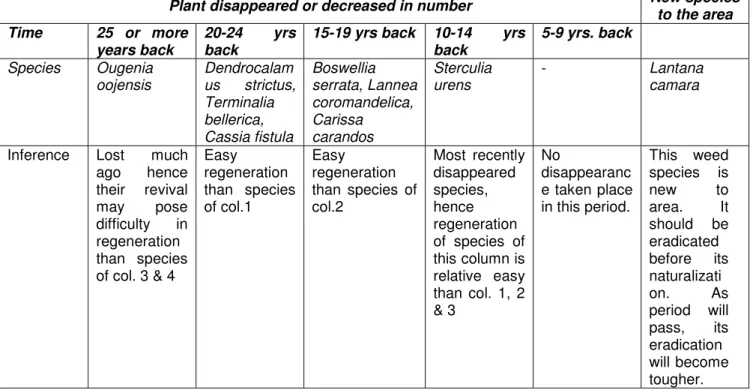
Step2: Ask about all the possible species, when they were present in the area? Why they were lost? Use following format to collect the information. Results of survey conducted during 2004 at Labua Baosi VFPMC in Udaipur district of Rajasthan are depicted below:
S. No.
Local
Name Botanical name
Past status (in opinion of locals) Present Status (Our observation) Appx. Year of this change (People's opinion) Factors responsible for change 1. Bans Dendrocalamus strictus ++++ - 2004-20 (i.e.20yrs. back)
Locally extracted for house and fence making.
2. Tan Ougenia oojensis ++ + 2004-25 Habitat loss, extraction for plough making
3. Kadaya Stereulia urens + - 2004-10 Gum extraction
4. Salar Boswellia serrata ++ + 2004-15 Extraction for fire wood
and gum
5. Godal Lannea corom
andelica ++ + 2004-15
Extraction for fire wood
3.Field data, collected in step 2, are arranged in a "time zone wise extermination" table as given below:
4. If few pockets in area are still good, species of higher successional level can be planted in such pockets.
2.1.4 Silvicultural characteristics of species & options of species selection
Different species have different autecological characteristics. Presence of different biophysical factors guides us for selection of certain species. In nature different type of species are available which provide many options to us as given below:
S.No. Character Favourable Species
1. Alkaline and saline soil Acacia nilotica, Agave spp., Prosopis juliflora, Eucalyptus robusta
2. Laterite soil Ancardium occidentale, Swietenia mahogani, Xylia xylocarpa, Azadirachta indica, Eucalyptus hybrid, Alstonia scholaris
3. Lime rich soil Cupressus torulosa, Cleistanthus collinus, Ixoro parviflora
4. Stiff kankar clay Acacia leucophloea, Prosopis spicigera, Balanites aegyptica,Capparis spp., Chloroxylon swietenia, Soymida febrifuga
5. Coastal sands Casuarina equisetifolia, Anacardium occidentale
6. Marshy/water logged/ water high regime zone
Salix tetrasperma, Sesbania grandiflora, Sizygium cumini,S. heynianum, Bischofia javanicaBambusa arundinacea, Lagerstroemia flosreginae, Terminalia tomentosa, Pongamia pinnata, Terminalia arjuna, Vitex negundo, Ficus glomerata, Eucalyptus sp., Phoenix sylvestris,Pandanus odoratissimus
7. Salty marshes and mud flates
Mangrove species, Bruguiera conjugata, Sonneratia apetala, Heritiera minor, Aquilaria agallocha,Pandanus fruitescence,P. nipa, Rhizophora muconata,
Avincinia spp., Xylocarpus mollecensis
8. High concentration of soluble salts
Prosopis juliflora, Acacia nilotica,Tamarix aphylla, Salvadora oleoides, S. persica, Sporobolus marginatory, Thespesia polulnia, Phoenix paludosa, Salvadora oleoides,
Plant disappeared or decreased in number New species
to the area Time 25 or more
years back
20-24 yrs back
15-19 yrs back 10-14 yrs back 5-9 yrs. back Species Ougenia oojensis Dendrocalam us strictus, Terminalia bellerica, Cassia fistula Boswellia serrata, Lannea coromandelica, Carissa carandos Sterculia urens - Lantana camara
Inference Lost much ago hence their revival may pose difficulty in regeneration than species of col. 3 & 4 Easy regeneration than species of col.1 Easy regeneration than species of col.2 Most recently disappeared species, hence regeneration of species of this column is relative easy than col. 1, 2 & 3 No disappearanc e taken place in this period. This weed species is new to area. It should be eradicated before its naturalizati on. As period will pass, its eradication will become tougher.
species (Syn. B. glabra), Dichrostachys cinerea, Emblica officinalis, Phoenix dactylifera, Millingtonia hortensisMiliusa tomentosa
14. Moist forest areas Grewia tilaefolia, Kydia calycina , Terminalia tomentosa, Dalbergia latifolia, Adina cordifolia, Dendrocalamus strictus, Pterocarpus marsupium, Bombax ceiba,Anogeissus latifolia, Desmodium spp.,Lagerstroemia parviflora,Bridelia retusa,Syzygium
cumini,Mellotus philippensis, Helicteres isora,Phoenix acaulis, Emblica officinalis, Albizia procera, Terminalina bellerica
15. Swampy forest areas Pandanus odoratissimus, Ficus glomerulata, Syzygium cumini, Toona ciliata, Putranjiva roxburghii, Salix tetrasperna, Pongamia pinnata, Terminalia arjuna
16. Best pollarding species Terminalia tomentosa, Grewia oppositifolia, Delonix alata, Salix spp., Hardwickia binata
17. Root sinker species Acacia nilotica, Prosopis spicigera
18. Root spreader species Tectona grandis, Phoenix sylvestris
19. Light demander species Tectona grandis, Adina cordifolia, Bombex ceiba, Melia azedarach
20. Shade bearer species Toona ciliata, Dalberigia latifolia, Pterocarpus marsupium, Albizia lebbeck, (Tolerates light shade in early life), Azadiradta indica, (Tolerates light shade in early life), Mitragyna parvifolia, Pithocellobium dulce, Santalum album, Syzygium cumini, S. heyneanum, Mesua ferea, Shorea robusta (shade tolerate when young, shade bearer in later stage).
21. Shade demander species
Mellotus philippinensis , Epiphytic orchids
22. Fire resistant species Gmelina arborea, Tectona grandis, Emblica officinalis, Bombex ceiba,
23. Moderately fire resistant Acacia catechu
24. Fire sensitive species Santalum album
25. Good coppicer species Acacia catechu, Albizzia spp., Anogeissus spp., Azadirachta indica, Butea monosperma, Cassia fistula,Dalbergia spp., Emblica officinalis,Garuga pinnata, Melia azidarachta, Ougeinia oojenensis, Salix tetrasperma,Robinia pseuidacacia, Sapium sebiferum, Shorea robusta, Syzygium cumini, Tectona grandis, Toona ciliata, Gmelina arborea, Morus alba, Prosopis juliflora, Prosopis spicigera, Terminalia tomentosa, Broussonetia popyrifera, Cleistanthus collinus
26. Fairly coppicing species Pterocarpus marsupium, Terminalia bellerica, T. tomentosa, Aesculus indicus, Chloroxylon swietinia, Hardwiakia binata, Juglans regia, Quercus incana,Q. lanuginosa,Q.
semicarpifolia,
27. Poorly coppicing species Adina cordifolia, Bombax ceiba, Madhuca indica, Casuarina equisetifolia, Populus ciliata, Acacia nilotica
28. Non coppicing species Phoenix sylvestris, and other palms, Abies pindrow, Cedrus deodara, Picea smithiana, Pinus roxburghii, P. wallichiana
29. Frost hardy/Frost resistant species
Acacia catechu, Anogeissus pendula, Dalbergia sissoo, Diospyros melanoxylon, Madhuca indica, Stereospermum suaveolens, Toona ciliata, Ziziphus jujuba, Albizia procera, Morus alba, Hardwickia binata, Ougenia oojeinensis, Pinus roxburghii, Schlechera oleasa
30. Moderately frost hardy species
Pterocarpus marsupium, Adina cordifolia, Morus alba, Anogeissus latifolia, Bombax ceiba, Dalbergia latifolia, Gmelina arborea, Pongamia pinnata, Acacia senegal, Terminalia tomentosa, Bischofia javanica, Butea monosperma, Cassia fistula, Prosopis juliflora, P. spicigera
31. Frost tender species Acacia nilotica, Azadirachta indica, Boswellia serrata, Garuga pinnata,Tectona grandis, Terminalia arjuna,T. tomentosa, Adina cordifolia, Albizia lebbeck, Anthocephalus kadamba,Santalum album, Tamaridus indicus
32. Drought hardy species Acacia nilotica, A catechu, Bombax ceiba, Hardwickia binnata, Miliusa velutina, Schleichera oleosa, Boswellia serrata, Dalbergia latifolia,Diospyrus melanoxylon, D. tomentosa, Kydia calicina, Lagerstroemia parviflora, Lannea coromandelica, Mellotus philippinus, Ougenia oojeinensis, Pongamia pinnata, Sterospermum suaveolens, Syzygium cumini, Zizyphus jujuba, Z. xylopyrus, Adina cordifolia, Albizzia lebbeck, A. procera, Melia azedirachta, Mitragyna parvifolia, Moringa oleifera, Pithocollobium dulce, Prosopis juliflora, P. spicigera, Tamarindus indicus,
33. Moderately drought hardy species
Acacia catechu, Adina cordifolia, Albizzia procera,Anogeissus pendula, Dalbergia sissoo, Gmelina arborea, Mitragyna parviflora, Cassia fistula, Morus alba, Santalum album, Terminalia tomentosa
34. Drought sensitive species
Anogeisus latifolia, Madhuca indica, Mangifera indica, Pterocarpus marsupium Tectona grandis, Terminalia tomentosa, T arjuna, Toona ciliata, Anthocephalus cadamba, Bischofia javanica, Shorea robusta
35. Nitrogen fixing species Dalbergia spp., Bauhinia spp., Acacia spp.,Albizzia spp., Erythrina spp., Tephrosia spp.,Indigofera spp., Leucaena spp.
2.1.5 Why appropriate species selection is necessary:
Planting and sowing is of two types- mechanical and ecological. In mechanical planting only planting/sowing target is kept in focus and ecological suitability of species, selected for regeneration is neglected. Without judging suitability of species
When ecological regeneration is in focus, species specific selection is ensured for top zone, middle slopes, foothills, low-lying area, streams, etc. such regeneration process give better survival results in future and low casualties are met with after rains.
2.2. Regeneration
Regeneration is the act of originating and establishment of young individuals of a species. It can be broadly categorized into two categories viz. Artificial regeneration and Natural regeneration. Each of it has its own pros and cons in the ecorestoration plans. These are briefly discussed below:
2.2.1. Natural Regeneration vs Artificial Regeneration Natural Regeneration
Advantages
Less expensive than planting
Species and trees well adapted to site
“Natural” root morphology Disadvantages
Dependent upon seed crop, seedbed and environment (difficult to control)
May take longer to regenerate a stand
May create stands with variation in species composition, distribution and age
Artificial Regeneration
Advantages
Provide direct control of species, and distribution of trees in the stand
Can introduce genetically superior material
Can shorten establishment period achieving prompt regeneration Disadvantages
Costly
Requires substantial infrastructure (growing, storage and transportation) and organization for successful planting programs
Though the natural regeneration is always preferable to artificial regeneration, it is rarely available in sufficient quantity to meet the restoration goals. Therefore more frequently than not, artificial regeneration methods are adopted.
2.2.2. Planting
Planting differs from seeding, in that live plants are planted as part of the remedial action versus the planting of seeds. While more costly than seeding, planting has a number of advantages. Plants are often: (i) quick to establish, (ii) often carry microbial and mycorrhizal associations indigenous to the species, (iii) can allow for establishment of species difficult to seed and can be planted in areas inaccessible to mechanized equipment. Planting is most typically applied to tree and shrub species,
3 Planting methods
3.1 Natural Regeneration:Natural regeneration can be defined as the renewal of a forest crop by self-sown or by coppicing or root suckers. Few important ways of natural regeneration are as following:
• Micro-catchment / crescent / Thawla making: In this method, a micro catchment
is made around the seedling by soil readjustment so that it harvest the water for the plant growth
• Wildling Protection: Wild seedlings are protected from the various factors like
grazing animals.
• Through Suckers: In this method shoot from lower parts of the stem (suckers) are
used for the propagation of plant species.
• Through Coppice (Seedling coppice and stool coppice): In this method applicable
only for the coppicing species, coppices origination from cut stems are used for the regeneration purpose.
• Pollarding: This method is use to promote the growth of lateral branches in trees.
It also provides the tree fodder for the animals.
• Closure making: Closures are made to protect the plants from grazing and
browsing animals,
• Advance closure making: to protect regeneration from animals sometimes the
area is closed in advance of the regeneration period of the year.
• Protection of seed trees (standards) and their proper distribution
• Controlled burning: to reduce the fire hazard, controlled burning is adopted to do
away with litter and dry grasses.
• Cutting back: it is a method in which stems/branches are cut to promote the
regrowth of the plant.
• Stump dressing: The stump of the plant also requires treatment to prevent
moisture loss and infection by air and soil borne pathogens.
• Bamboo culture
• Protection of seed traps: Seed traps are used to determine the amount of seeds
which particular tree species produce per year.
• Protection of safe sites
Pollard: A tree whose top branches have been cut back to the trunk so that it may produce a dense growth of new shoots.
Sucker: A shoot from the root or lower part of a stem.
3.2. Some important principles:
• In rocky soils, the plants should be spaced in suitable soil pockets, in such
case the distance between plants will vary considerably.
• The lesser the rainfall, the wider the spacing recommended.
• Where naked-root seedlings are used, closer planting is recommended. Pit
planting require bit wide spacing.
• According to time, planting is of following types: • Pre- Monsoon planting:
• Advance Planting:
During pre-monsoon showers i.e. just before on set of monsoon, broad-leaved species can be planted. Avoid planting of thorny species if rains are less.
• Early planting:
Necked or poly-bag seedlings, root-shoot cuttings, branch cuttings planting should be completed as early as possible (within 7 to 10 days) so that whole growing period can be utilized by the seedling for growth.
• Late planting:
During rains, seasonal streams become fluvial. Early planting is sometimes not possible in such streams. After receding water, bit late planting can be done is the streams.
• Retreat planting:
It is casualty replacement work in pits. In many pockets of south India, retreating monsoon can be used for casualty replacement or even for fresh planting.
• Winter planting:
Some hill species are best planted before snowfall. Some more types of planting are as follows:
• Aerial planting:
One-meter long cuttings of Tinospora cordifolia are kept on trees/ shrubs one meter (or more) above the ground to induce aerial roots. The physiological lower end should be towards ground while placing the cuttings.
• Wildling planting:
During rainy season, wild seedlings are dug out from the forest or other places and they are planted in pits or notches where needed. This method is not always good.
• Wildling in-situ conservation:
Instead of uprooting the wildling to use somewhere else, it is better we prepare a crescent around it to harvest water for the wildling.
• Planting inside trench ditches:
If rainfall is less, high water demanding species like Mangifera indica, Terminalia bellirica etc. should be planted in ditches of the trenches.
• Mound planting:
If area is low lying and water stagnates, we can prepare heap of earth before rains and planting should be done on earth heaps during rainy season.
3.3. Post planting activities:
• Protection: Check on grazing, trampling and fire is a must.
• Weeding: After planting 1 to 3 weeding is needed to minimize completion.
Weeds compete for water, light, minerals and space. If budget permits, 1 or 2 weeding can be done during second year also.
3.4 Step wise establishment and management techniques of plantations
To appreciate the need for forest plantations in arid zones, the roles played by these plantations must be defined. Quite often, there are a number of roles (such as fuelwood or fodder production) which, through careful planning, can be combined to achieve multiple benefits. This section of the manual describes the techniques for the establishment and management of forest plantations in arid zones.
Site reconnaissance
The more information there is available about the site conditions in the area being considered for tree and shrub planting, the better are the chances of selecting the tree and shrub species best suited to the area. Information most commonly included in site reconnaissance is:
- Climate - temperature, rainfall (amount and distribution), relative humidity, and wind.
- Soil - depth of soil and its capacity to retain moisture, texture, structure, parent material, pH, degree of compaction, and drainage.
- Topography - important for it’s modifying effects on both climate and soil.
- Vegetation - composition and ecological characteristics of natural and (when present) introduced vegetation. On areas which have not been degraded by man, the vegetation can provide an indication of the site. Unfortunately, over much of the arid world, the vegetation has been so disturbed that it is no longer a reliable indicator of potential planting sites; in these situations, site selection should be based on soil surveys.
- Other biotic factors - past history and present land use influences on the site, including fire, domestic livestock and wild animals, insects and diseases.
- Watertable levels - a knowledge of the depth and variation of the watertable levels in the wet and dry seasons is valuable and can be crucial in determining the tree and shrub species that can be grown. Watertable levels can be estimated from observations in wells or by borings made for this purpose.
- Availability of supplementary water sources - ponds, lakes, streams, and other water sources.
- Distance from nursery.
Apart from the above biophysical information, socio-economic factors also play an important role. Among these factors are:
- The availability of labour.
- Motivation of the local population.
- The distance of the forest plantation to the market and consumer centers. - Land ownership and tenure.
Selection of the planting site
Where to plant is generally a collective decision made by policy makers, foresters, and the planting crews, based on information obtained in the site reconnaissance. The key is to select the site that, when planted, will lead to the establishment of a successful forest plantation. Often, the choice of the planting site is limited to lands which are not suited for agriculture or livestock production; when this is the case, the site reconnaissance information gains importance.
Once a forest plantation is well established and the trees are sufficiently tall, the fences can be removed and reused at another planting site.
When roads and other passageways traverse the planting site, they should also be contained with fences.
In many instances, tree and shrub planting is undertaken to protect fragile sites from degradation. However, in some situations, the fragile sites should not be planted; it may be better not to disturb the soil in these areas. Where gullies have been severely degraded by erosion, protective measures other than the planting of vegetation (such as building small checkdams) may be necessary.
Species selection
When the best possible information has been collected on the characteristics of the site to be planted, the next step is the selection of the tree or shrub species to plant. The aim is to choose species which are suited to the site, will remain healthy throughout the anticipated rotation, will produce acceptable growth and yield, and will meet the objectives of the plantation (fuelwood production, protection, etc.).
For a successful planting, performance data may have to be extrapolated from one locality to another. Results from a locality where a tree or shrub species is growing (either naturally or as an exotic) strictly apply only to that locality; their application in another locality involves the assumption of site comparability, an assumption which may or may not be justified. When reliable information shows a close similarity between the site to be planted and that on which the species is already successful, it is generally possible to proceed to large-scale planting with confidence.
In practice, the above data are seldom available, and planting on the new site becomes (in effect) experimental and should proceed on a small scale; when this occurs, detailed performance records should be maintained throughout the experimental planting period.
The selection of tree or shrub species through the use of analogous climates is important as a first step; but this must be amplified by an evaluation of localized factors which can be more important (for example, soil, slope, and biotic factors). However, the ability to match closely a planting site and a natural habitat may not preclude the need for species trials, since climatological or ecological matching may not reveal the adaptability of a species. It cannot be emphasized too strongly that, without such trials, the choice of tree or shrub species is (in most cases) a risky business. Since planting in arid environments is normally an expensive undertaking, large-scale failures which result from the wrong choice of species or failure to test them can prove costly.
Preparation of the planting site
- Create conditions that will enable the soil to catch and absorb as much rainfall as possible. Surface runoff should be reduced to increase the moisture in the soil. - Provide good rooting conditions for the planting, including a sufficient volume of
rootable soil. Hardpans must be eliminated.
- Create conditions where danger from fire and pests is minimized.
Site preparation is directed toward giving the seedlings a good start with rapid early growth. In general, the methods used to achieve site preparation will vary with the type of vegetation, amount and distribution of rainfall, presence or absence of impermeable layers in the soil, the need for protection from desiccating winds, and scale of the planting operations. Additionally, the value of the tree or shrub crop to be grown is important in determining the amount of expense that may be justified in plantation establishment.
Methods of site preparation
In general, preparation of the site by hand is possible and economical only for relatively small-scale projects, where the labour of clearing the competing vegetation and working the soil is not too time-consuming. Under certain conditions, animal-drawn ploughs and harrows can also be economical for small-scale operations. Mechanical soil preparation, used increasingly in large-scale planting programmes, has become a common practice in many areas; often, this is because the supply of labour and the time available for ground preparation are too limited to permit large-scale projects to be undertaken by hand. Some operations, such as deep subsoiling and the breaking up of hardpans, can only be done by machines.
Whatever method of site preparation is used, a planting pit (of an appropriate size) should be prepared. The objective of creating planting pits is to aerate and loosen the soil in which the plants will grow. When these planting pits are prepared, they should not be left empty with the excavated soil lying on the ground, but refilled immediately, otherwise sun and wind will dry out the soil completely (Figure 4.1 A & B).
Sometimes, spot preparation may be sufficient, but the spots should be large (for example, 1 to 1.5 meters in diameter). Also, it is important that the work be done thoroughly.
Other methods of soil preparation by hand are the ash-bed method, tie-ridging, contour trenching and terracing, and the "steppe" method.
The ash-bed technique consists of piling the debris from harvesting or clearing the land into long lines or stacks. After drying, the debris is burned and vegetation is planted in the ash patches. Sometimes, the lines or stacks of debris are covered with "clods" to obtain a more intense heat when burning. Advantages of this method are that the burning kills the competing vegetation, the area remains free of this vegetation for an appreciable period, and the ash provides a useful fertilizer for the planted trees or shrubs.
The tie-ridging technique involves the cultivation of the entire area and the establishment of ridges at specified intervals. The main ridges, aligned along the contours, are joined by smaller ridges at right-angles to create a series of more-or-less square basins which retain rainwater and prevent erosion. The ridges are generally 3 meters apart. The trees and shrubs are planted on the ridges. This method is suitable for flat or gently sloping ground and can be combined with an agricultural crop during the initial years of plantation establishment (Figures 4.2 and 4.3).
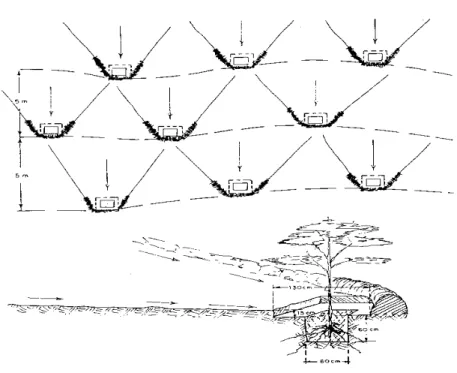
Trenching techniques along the contours are used in site preparation in hilly country. The trenches can be continuous (Figure 4.4), divided by cross banks, or consist of short discontinuous lengths (Figure 4.5), arranged so that the gaps between the trenches in one row are opposite those in the next row; in this latter instance, runoff from rainfall is caught. Trenches are formed manually or mechanically. On gently sloping ground, the herring-bone technique can be used (Figure 4.6).
Terraces, which are wider and flatter than trenches, can be either manually or mechanically formed on the side of a hill by digging soil from the uphill side and depositing it on the downhill side. Usually, the bottom of the terrace is made to slope into the hillside. The purpose of terracing is to retard and collect water runoff between the terraces. Because of the improved soil moisture conditions, the terrace provides improved conditions for plant growth. Planting is done on the ridge of soil, at the base of the ridge, or in patches at the bottom of the trench, according to moisture conditions. Terraces are used widely on moderate to severe slopes. Terraces can be 2 to 3 meters or several hundred meters in length (Figure 4.7). If short, they can be staggered on the hillside wherever convenient. Sometimes, crescent-shaped terraces are constructed with the two tips of the crescent pointing uphill.
Figure 4.6 Herring-bone technique for soil preparation.
The "steppe method of site preparation is designed to promote growth of trees and shrubs in extremely dry areas. In this method, the surface of the soil is modified by breaking-up and stirring the deep layers of the soil with rooters, rippers, or large discs, and then building widely-spaced, parallel ridges following the contour. Ridges are built with the topsoil, and trees or shrubs are planted on the lower half of the ridges facing the slope; here, the depth of moist soil is greatest, due to accumulation of water after rain. The purpose of the "steppe" method is to maintain a reserve of moisture in the deep layers of the soil. Spacing between ridges is greater with lower rainfall, as the catchment area between the ridges is increased.
Time of planting
The planting season generally coincides with the rainy season; usually, planting is started as soon as a specified quantity of rain has fallen. This amount of precipitation must be judged on the basis of local knowledge. Planting can also be initiated when the soil is wet to a specified depth (approximately 20 centimeters).
A common mistake is to start planting too soon. On the other hand, if planting is started too late, it may be difficult to complete a large planting programme in the scheduled time, and the plants will lose the maximum benefit of rains after planting; this can be a serious matter where the rainfall is low and erratic.
Planting of containerized stock
Planting of containerized stock is usually done in holes that are large enough to take the containers or the root-balls when the plants are removed from the containers. It is essential that the surrounding soil is firmed down around the plant immediately after planting to avoid the formation of air gaps which can lead to root desiccation. A good practice for the preparation of planting holes is to surround the planting pit with a small ridge (15 to 20 centimeters in height) of soil, to obtain a small basin (about 80 centimeters in diameter); this is especially helpful when the plants are watered individually after planting. The small prepared basin can also be covered with a plastic sheet (held in place on the ground with stones or earth), with an opening in the center for the plant, as illustrated in Figure 4.8. The plastic sheet impedes evaporation of ground water from the planting hole; also, dew collects on its surface and runs to the central opening of the sheet to irrigate the roots. Through conservation of soil moisture, plastic films facilitate more rapid establishment and growth of trees and shrubs during the initial, and most critical years. Another benefit of opaque plastic films is that they inhibit weed growth by reducing light penetration. With the suppression of weeds in the immediate vicinity of the plants, labour also can be saved.
Figure 4.8 A planting hole with plastic apron to impede evaporation of ground water.
A threat to newly-planted trees in arid zones is the high rate of transpiration. Unless the plants can establish themselves quickly and compensate for the transpiration by taking water through their root systems, they will wilt soon after planting. This explains why even a single watering immediately after planting can be useful. In general, containerized seedlings have a distinct advantage over barerooted seedlings, in that the earthball surrounding the roots provides protection during transport and enables the plant to establish itself quickly and easily.
The restriction of lateral root extension, a result of using containers, can cause root malformation, coiling, and spiralling (Figure 4.9). In extreme cases, the coiling can lead to strangulation of the roots and the death of the plant (Figure 4.10). In other situations, it may reduce wind-firmness or lead to stunted growth. Unfortunately, the symptoms may not become apparent until 4 to 5 years after planting.
To reduce the damage of root malformation in containerized plants, a common practice is to remove the container from the soil cylinder before planting and make two or three vertical incisions to a depth of one centimeter with a knife to cut "strangler" roots. As a further precaution, the bottom 0.5 to 1 centimeter of the soil cylinder can be sliced off. Care must be used to ensure that the soil does not disintegrate and expose the roots to desiccation.
Spacing of plantings
By observing trees and shrubs growing under natural conditions, it is often found that plants grow widely apart in low rainfall areas. Therefore, wide spacing of plantings in arid zones generally should be practiced to avoid competition for soil moisture.
The amount of water available to a tree or shrub in a plantation is proportional to the stand density. On dry sites, it is necessary to plant widely apart and to remove all competing ground vegetation; this increases infiltration of rainwater and decreases water losses through transpiration by plants and evaporation from the soil. When irrigation or mechanical cultivation is practiced, it is necessary to adjust spacing to the width of the machinery used and to ensure that plants are placed in straight rows. Actual spacing varies with species, site, and the purpose of the forest plantation. In fuel wood plantations, for example, one might prefer closer spacings than employed in other kinds of plantations. Seldom can a spacing of less than 3 x 3 meters be applied, however.
The number of trees per hectare, according to the spacing between the lines in a plantation and the spacing of plants within a line, is given in Annexure. For example, with a spacing between lines of 3 meters and a spacing of plants within a line of 3 meters, a planting density of 1,111 trees per hectare will be required.
Some of the other applications that help in planting and can be resorted to help the regeneration process are discussed briefly as following:
Mulching can be accomplished before or after seeding and is important for preventing water erosion, reducing wind erosion, reducing soil crusting, decreasing rainfall impact, insulating the soil surface, and decreasing evaporation. Mulching will be most critical on slopes where erosional concerns require temporary stabilization prior to establishment of seeded or planted vegetation. Mulching materials include straw, native grass, erosion control fabric, and others. Application of straw or grass mulch should be performed in low wind conditions to allow for uniform application. Noxious weeds are nonnative weeds that invade an area of vegetation outcompeting the native species, thereby replacing valuable native vegetation with useless weedy vegetation. Wildlife generally do not eat noxious weeds and will be forced out of invaded areas in search of food. In addition, livestock do not generally eat noxious weeds that invade rangelands. Erosion is often times more severe in areas infested with noxious weeds due to decreased cover. Because of these serious impacts, reclamation activities should take rigorous precautions against the infestation of noxious weeds. Prevention of noxious weed invasion at each site will require integrative management of many different factors including, preexisting weedy vegetation, proximity of weed seed source, density of vegetation established during reclamation, grazing practices following reclamation, competition between other species present, herbicide control programs, biological controls indigenous to the site, and other factors.