Trajectory-based differential expression analysis
for single-cell sequencing data
Koen Van den Berge
1,2,3, Hector Roux de Bézieux
4,5, Kelly Street
6,7, Wouter Saelens
1,8,
Robrecht Cannoodt
8,9,10, Yvan Saeys
1,8, Sandrine Dudoit
3,4,5,11✉
& Lieven Clement
1,2,11✉
Trajectory inference has radically enhanced single-cell RNA-seq research by enabling the study of dynamic changes in gene expression. Downstream of trajectory inference, it is vital to discover genes that are (i) associated with the lineages in the trajectory, or (ii) differen-tially expressed between lineages, to illuminate the underlying biological processes. Current data analysis procedures, however, either fail to exploit the continuous resolution provided by trajectory inference, or fail to pinpoint the exact types of differential expression. We intro-duce tradeSeq, a powerful generalized additive model framework based on the negative binomial distribution that allowsflexible inference of both within-lineage and between-lineage differential expression. By incorporating observation-level weights, the model additionally allows to account for zero inflation. We evaluate the method on simulated datasets and on real datasets from droplet-based and full-length protocols, and show that it yields biological insights through a clear interpretation of the data.
https://doi.org/10.1038/s41467-020-14766-3 OPEN
1Department of Applied Mathematics, Computer Science and Statistics, Ghent University, Ghent, Belgium.2Bioinformatics Institute Ghent, Ghent University, Ghent, Belgium.3Department of Statistics, University of California, Berkeley, CA, USA.4Division of Biostatistics, School of Public Health, University of California, Berkeley, CA, USA.5Center for Computational Biology, University of California, Berkeley, CA, USA.6Department of Data Sciences, Dana-Farber Cancer Institute, Boston, MA, USA.7Department of Biostatistics, Harvard T.H. Chan School of Public Health, Boston, MA, USA.8Data mining and Modelling for Biomedicine, VIB Center for Inflammation Research, Ghent, Belgium.9Center for Medical Genetics, Ghent University Hospital, Ghent, Belgium. 10Department of Biomolecular Medicine, Ghent University, Ghent, Belgium.11These authors contributed equally: Sandrine Dudoit, Lieven Clement.
✉email:[email protected];[email protected]
123456789
S
ingle-cell transcriptome sequencing (scRNA-seq) hasrevo-lutionized modern biology by allowing researchers to profile
transcript abundance at the resolution of an individual cell. This has opened new avenues of research to study cellular pathways during the cell cycle, cell-type differentiation, or cellular activation. Indeed, scRNA-seq can provide a snapshot of the transcriptome of thousands of single cells in a cell population, which are each at distinct points of the dynamic process under study. This wealth of transcriptional information, however, pre-sents many data analysis challenges. Until recently, statistical and computational efforts have focused mostly on trajectory inference
(TI) methods, which aim tofirst allocate cells to lineages and then
order them based on pseudotimes within these lineages. A wide range of TI methods have been proposed; 45 of which are
extensively benchmarked in Saelens et al.1. Note that we use the
term ‘trajectory’ to refer to the collection of ‘lineages’ for the
process under study.
Most TI methods share a common workflow: dimensionality
reduction followed by inference of lineages and pseudotimes in
the reduced dimensional space2. In that reduced dimensional
space, a cell’s pseudotime for a given lineage is the distance, along
the lineage, between the cell and the origin of the lineage. As such, while pseudotime can be interpreted as an increasing function of true chronological time, there is no guarantee that the two follow a linear relationship. Recent developments have allowed the
inference of complex trajectories3–5. These advances enable
researchers to study dynamic biological processes, such as com-plex differentiation patterns from a progenitor population to
multiple differentiated cellular states6,7, and have the promise to
provide transcriptome-wide insights into these processes. Unfortunately, statistical inference methods are lacking to identify genes associated with lineage differentiation and to
unravel how their corresponding transcriptional profiles are
driving the dynamic processes under study. Indeed, differential expression (DE) analysis of individual genes along lineages is often performed on discrete groups of cells in the developmental pathway, e.g., by comparing clusters of cells along the trajectory or clusters of differentiated cell types. Such discrete DE approa-ches do not exploit the continuous expression resolution that can be obtained from the pseudotemporal ordering of cells along lineages provided by TI methods. Moreover, comparing cell clusters within or between lineages can obscure interpretation: it is often unclear which clusters should be compared, how to properly combine the results of several pairwise cluster compar-isons, or how to account for the fact that not all of these com-parisons are independent of each other.
A number of methods have been developed for the analysis of bulk RNA-seq time-series data, which can exploit the temporal
resolution of samples assayed at different times8–10. However, in
scRNA-seq, the relationship between gene expression and pseu-dotime is more complex. In addition, the pseupseu-dotimes are con-tinuous, and cells are never at the exact same pseudotime value. A few methods have been published with the aim of improving trajectory-based differential expression analysis by modeling gene expression as a smooth function of pseudotime along lineages.
Monocle11 tests whether gene expression is associated with
pseudotime by fitting additive models of gene expression as a
function of pseudotime. However, the method can only handle a
single lineage. A similar approach has been adopted by TSCAN12.
GPfates4relies on a mixture of overlapping Gaussian processes13,
where each component of the mixture model represents a dif-ferent lineage. For each gene, the method tests whether a model
with a bifurcation significantly increases the likelihood of the data
as compared with a model without a bifurcation, essentially testing whether gene expression is differentially associated with
the two lineages. Similarly, the BEAM approach in Monocle 25
allows users to test whether differences in gene expression are associated with particular branching events on the trajectory. These trajectory-based methods improve upon discrete cluster-based approaches by (1) exploiting the continuous expression resolution along the trajectory and (2) comparing lineages using a
single test based on entire gene expression profiles. However,
both GPfates and Monocle 2 lack interpretability, as they cannot
pinpoint the regions of the gene expression profiles that are
responsible for the differences in expression between lineages. Moreover, the GPfates model is restricted to trajectories con-sisting of just one bifurcation, essentially precluding its applica-tion to biological systems with more than two lineages (i.e., a multifurcation or more than one bifurcation). BEAM is restricted to the few dimensionality reduction methods that are imple-mented in the Monocle 2 software, namely, independent
com-ponent analysis (ICA) and DDRTree5. Hence, novel methods to
infer differences in gene expression patterns within or between transcriptional lineages with complex branching patterns are vital
to further advance thefield.
In this paper, we introduce tradeSeq, a method and software
package for trajectory-based differential expression analysis for
sequencing data. tradeSeq provides aflexible framework that can
be used downstream of any dimensionality reduction and TI method. Unlike previously proposed approaches, tradeSeq pro-vides several tests that each identify a distinct type of differential expression pattern along a lineage or between lineages, leading to
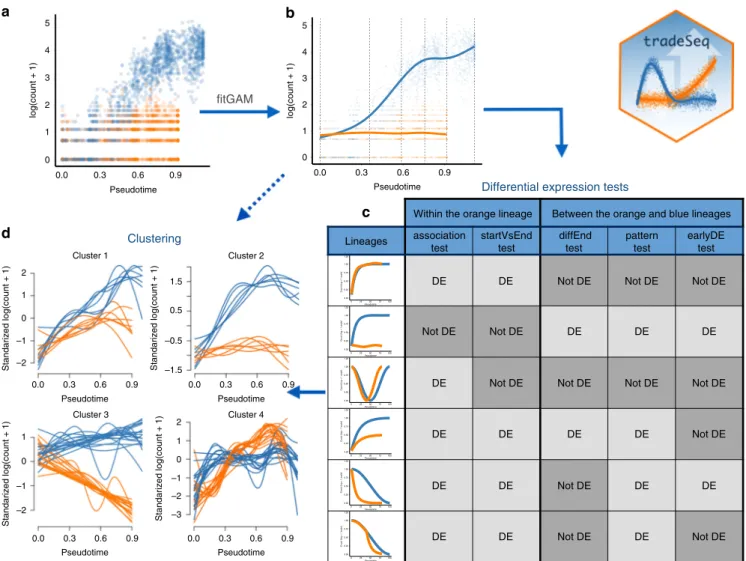
clear interpretation of the results (Fig. 1). In practice, tradeSeq
infers smooth functions for the gene expression measures along pseudotime for each lineage using generalized additive models and tests biologically meaningful hypotheses based on parameters of these smoothers. By allowing cell-level weights for each indi-vidual count in the gene-by-cell expression matrix, tradeSeq can
handle zero inflation, which is essential for dealing with dropouts
in full-length scRNA-seq protocols14. As it is agnostic to the
dimensionality reduction and TI methodology, the approach scales from simple to complex trajectories with multiple bifur-cations: tradeSeq only requires the original expression count matrix of the individual cells, estimated pseudotimes, and a hard or soft assignment (weights) of the cells to the lineages to infer the
lineage-specific smoothers. We benchmark our method against
current state-of-the-art methods using simulated data sets (with cyclic, bifurcating, and multifurcating trajectories) and demon-strate its functionality and versatility on four real data sets. These
case studies highlight the enhanced interpretability of tradeSeq’s
results, which lead to improved understanding of the underlying biology.
Results
Statistical model and inference using tradeSeq. We model gene
expression measures as nonlinear functions of pseudotime using a generalized additive model (GAM). In the GAM, each lineage is
represented by a separate cubic smoothing spline, and thefl
ex-ibility of GAMs allows us to adjust for other covariates or
con-founders asfixed effects in the model. The read countsYgi, for a
given geneg∈{1,…,G} across cellsi∈{1,…,n} are modeled
using a negative binomial GAM (NB-GAM) with cell and
gene-specific meansμgiand gene-specific dispersion parametersϕg:
YgiNBðμgi;ϕgÞ logðμgiÞ ¼ηgi ηgi¼PL l¼1sglðTliÞZliþUiαgþlogðNiÞ: 8 > > < > > : ð1Þ
The gene-wise additive predictor ηgi consists of lineage-specific
smoothing splines sgl, that are functions of pseudotime Tli, for
l ∈{1, …, L}, i ∈{1, …, n}) assigns every cell to a particular
lineage based on user-supplied weights (e.g., from slingshot3 or
GPfates4, see details in Supplementary Methods). We let L
l ¼
fi:Zli¼1g denote the set of cells assigned to lineage l. In
addition, we allow the inclusion of pknown cell-level covariates
(e.g., batch, age, or gender), represented by an n×p matrixU,
with ith row Ui corresponding to the ith cell, and regression
parameters αg of dimension p× 1. Differences in sequencing
depth or capture efficiency between cells are accounted for by
cell-specific offsetsNi.
The smoothing splinesgl, for a given genegand lineagel, can
be represented as a linear combination ofKcubic basis functions,
sglðtÞ ¼
XK k¼1
bkðtÞβglk; ð2Þ
where the cubic basis functionsbk(t) are enforced to be the same
for all genes and lineages.
Since a separate smoothing spline is estimated for every lineage in the trajectory, we can assess DE within or between lineages by
comparing the parameters βglk of these smoothing splines, see
“Methods”for details. In tradeSeq, we have implemented Wald
tests to assess DE and provide a range of different testing
procedures that allow biologists to interpret complex trajectories
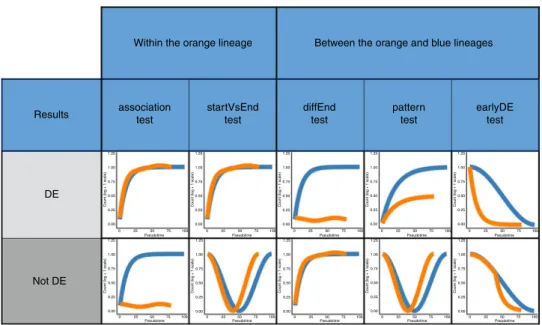
in dynamic biological systems (see Fig.2).
Simulation study. To benchmark relevant differential expression
methods, we generated multiple data sets, spanning three distinct
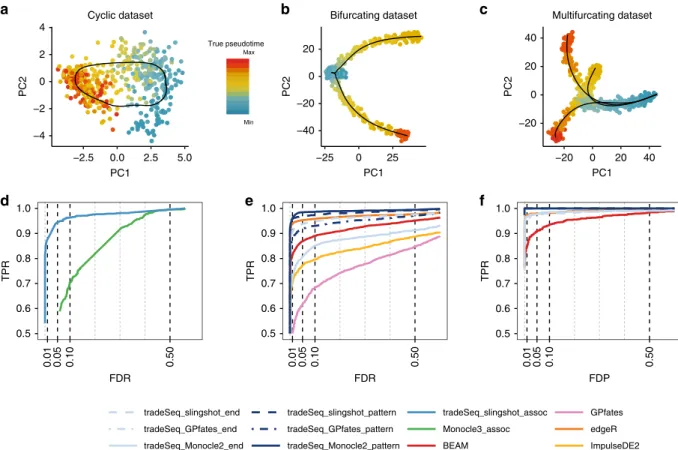
trajectory topologies (Fig. 3a–c), using the independently
devel-oped dynverse toolbox1(see“Methods”). Note that the simulated
data sets are relatively“clean”, as reflected by the high sensitivity
and specificity of most methods. In particular, cells are
approxi-mately uniformly distributed along each lineage and often balanced between lineages. The data sets are, however, still useful to provide a relative ranking of the methods.
We demonstrate the versatility of tradeSeq by using it
downstream of three trajectory inference methods, slingshot3,
Monocle 25, and GPfates4, which will be denoted by
tradeSeq_-slingshot, tradeSeq_Monocle2, and tradeSeq_Gpfates,
respec-tively. However, we find that GPfates fails to recover the
expected trajectory topology if run in an unsupervised way (Supplementary Fig. 3a). Feeding the true pseudotimes as input to GPfates may, however, result in meaningful trajectories (Supple-mentary Fig. 3b). We therefore adopt this approach in the simulation study, but note that this may provide an a priori
0 1 2 3 4 5 0 1 2 3 4 5 a b c d 0.0 0.3 0.6 0.9 Pseudotime 0.0 0.0 2 1.5 0.5 –0.5 –1.5 1 0 –1 –2 2 1 1 0 –1 –2 0 –1 –2 –3 0.3 0.3 0.6 0.6 0.9 0.9 Pseudotime fitGAM Pseudotime Cluster 1 Clustering
Standarized log(count + 1) Standarized log(count + 1)
Standarized log(count + 1) Standarized log(count + 1) Cluster 2 Cluster 4 Cluster 3 0.0 0.3 0.6 0.9 Pseudotime 0.0 0.3 0.6 0.9 Pseudotime 0.0 0.3 0.6 0.9 Pseudotime log(count + 1) log(count + 1) 0.00 0.25 0.50 0.75 1.00 1.25 0 25 50 75 100 Pseudotime
Count (log + 1 scale)
0.00 0.25 0.50 0.75 1.00 1.25 0 25 50 75 100 Pseudotime
Count (log + 1 scale)
0.00 0.25 0.50 0.75 1.00 1.25 0 25 50 75 100 Pseudotime
Count (log + 1 scale)
0.00 0.25 0.50 0.75 1.00 1.25 0 25 50 75 100 Pseudotime
Count (log + 1 scale)
0.00 0.25 0.50 0.75 1.00 1.25 0 25 50 75 100 Pseudotime
Count (log + 1 scale)
0.00 0.25 0.50 0.75 1.00 1.25 0 25 50 75 100 Pseudotime
Count (log + 1 scale)
Differential expression tests
Within the orange lineage Between the orange and blue lineages
Lineages association test startVsEnd test diffEnd test pattern test earlyDE test
DE DE Not DE Not DE Not DE
Not DE Not DE DE DE DE
DE Not DE Not DE Not DE Not DE
DE DE DE DE Not DE
DE DE Not DE DE DE
DE DE Not DE DE Not DE
Fig. 1 Overview of tradeSeq functionality. aA scatterplot of expression measures vs. pseudotimes for a single gene, where each lineage is represented by a different color (top left).bA negative binomial generalized additive model (NB-GAM) isfitted using thefitGAMfunction. The locations of the knots for the splines are displayed with gray dashed vertical lines.cThe NB-GAM can then be used to perform a variety of tests of differential expression within or between lineages. In the table, we assume that theearlyDETestis used to assess differences in expression patterns early on in the lineage, e.g., with optionknots=c(1, 2), meaning that we test for differential patterns between thefirst and second dashed gray lines from panel (b).dInteresting genes canfinally be clustered to display the different patterns of expression.
competitive advantage to GPfates over other TI methods and that this would be impossible for real data sets.
Existing frameworks for differential expression analysis are not modular, in the sense that the DE method is tied to the TI method implemented in the same software package. Because of this, the comparison of DE methods is confounded with the quality of the upstream trajectory inference. We therefore also evaluate all trajectory-based DE methods by using the simulation ground truth as input for the DE analysis, which avoids such a confounding. GPfates was left out of this comparison, since we were not able to input the simulation ground truth to the method. Within-lineage DE: First, we look for genes whose expression is associated with pseudotime for data sets with a cyclic topology
(e.g., Fig. 3a). We compare the associationTest of a
tradeSeq_slingshot analysis to the Moran’s I test implemented in
Monocle 3. We apply tradeSeq using 5 knots, as determined using the AIC (Supplementary Fig. 4). We only consider Monocle 3 because it is the only method that provides a test of the association between gene expression and pseudotime within a single lineage. For each TI method, we use the default/ recommended dimensionality reduction method, which is PCA for slingshot and UMAP for Monocle 3.
Monocle 3, however, often fails to reconstruct the cyclic
topology and instead may fit a disconnected or branching
trajectory (Supplementary Fig. 5). The Moran’s I test still has
reasonably high sensitivity, possibly because it relies on nearest neighbors in the reduced dimensional space and not on the inferred trajectory. tradeSeq downstream of slingshot provides superior performance to discover genes whose expression is
associated with pseudotime (Fig. 3d). We also compared both
methods using the same dimensionality reduction input, by having slingshot infer trajectories in the UMAP space that is used by Monocle 3. The performance of tradeSeq was generally similar for both dimensionality reduction methods, except for two out of ten data sets (Supplementary Fig. 6). In all data sets, tradeSeq had better performance than Monocle 3. Finally, we evaluate an
edgeR-based associationTest through fitting the
NB-GAMs with edgeR instead of with mgcv (method edgeR_assoc,
see “Methods” for details), and note that its performance is
similar to the tradeSeq associationTest (Supplementary
Fig. 7). This could be expected because few basis functions were selected for this simulation setting. In applications that require a rich basis, however, the edgeR implementation will be prone to
overfitting.
Between-lineage DE: For the bifurcating data sets (e.g., Fig.3b),
we assess differential expression between lineages using the
diffEndTestand the patternTestfrom tradeSeq, down-stream of TI methods slingshot, Monocle 2, and GPfates. We apply tradeSeq with four knots, as determined using the AIC (Supplementary Fig. 8). We compare these tests with available approaches for trajectory-based differential expression analysis, namely, BEAM (implemented in Monocle 2), GPfates, and ImpulseDE2. Furthermore, we compare against the discrete DE method edgeR, where we supervise the test to assess DE between the clusters at the true endpoints of each lineage, as derived
throughk-means clustering in PCA space. For each TI method,
we use the default/recommended dimensionality reduction, which is PCA for slingshot, GPLVM for GPfates, and DDRTree for Monocle 2. For ImpulseDE2, we use the same input as for tradeSeq, i.e., derived by slingshot TI.
Monocle 2 and GPfates fail to detect the correct topology of the trajectory (i.e., a bifurcation) in, respectively, three and four out of the ten data sets (Supplementary Figs. 9 and 10). In addition, out of the remaining seven data sets, Monocle 2 misplaces the bifurcation in four of them, causing the two simulated lineages to be merged into the same lineage and creating another incorrect lineage (Supplementary Fig. 9). This strongly obscures the DE
testing results. slingshot, on the other hand, correctly identifies
the topology and reconstructs the trajectory for all ten data sets.
Figure3e shows performance curves for the three data sets for
which all methods are able to recover the true topology of the
simulated trajectory. The tradeSeq patternTesthas superior
performance regardless of the TI method. Only edgeR achieves a similar performance. This is not surprising since the edgeR analysis is supervised to compare the true cell populations at the
endpoints of the lineages. Interestingly, tradeSeq’s
diffEndT-estbased on the slingshot trajectory performs comparably with
a supervised edgeR analysis. This is especially encouraging, since
Within the orange lineage
Results DE 1.25 1.00 0.75 0.50
Count (log + 1 scale)
0.25 0.00 1.25 1.00 0.75 0.50
Count (log + 1 scale)
0.25 0.00 1.25 1.00 0.75 0.50
Count (log + 1 scale)
0.25 0.00 1.25 1.00 0.75 0.50
Count (log + 1 scale)
0.25 0.00 1.25 1.00 0.75 0.50
Count (log + 1 scale)
0.25 0.00 1.25 1.00 0.75 0.50
Count (log + 1 scale)
0.25 0.00 1.25 1.00 0.75 0.50
Count (log + 1 scale)
0.25 0.00 1.25 1.00 0.75 0.50
Count (log + 1 scale)
0.25 0.00 1.25 1.00 0.75 0.50
Count (log + 1 scale)
0.25 0.00 0 25 50 Pseudotime 75 100 0 25 50 Pseudotime 75 100 0 25 50 Pseudotime 75 100 0 25 50 Pseudotime 75 100 0 25 50 Pseudotime 75 100 0 25 50 Pseudotime 75 100 0 25 50 Pseudotime 75 100 0 25 50 Pseudotime 75 100 0 25 50 Pseudotime 75 100 0 25 50 Pseudotime 75 100 1.25 1.00 0.75 0.50
Count (log + 1 scale)
0.25 0.00 Not DE association test startVsEnd test diffEnd test pattern test earlyDE test Between the orange and blue lineages
Fig. 2 Tests currently implemented in the tradeSeq package.Each column corresponds to a test. Tests are broken down into two categories, depending on whether they concern a within-lineage comparison, i.e., properties of the orange curve, or a between-lineage comparison, i.e., contrasting the blue and orange curves. For each test, we have two toy examples of gene expression patterns. The top one corresponds to a differentially expressed gene according to the test, while the bottom one does not.
thediffEndTestis a smoother-based analog of discrete DE.
For TI methods Monocle 2 and GPfates, diffEndTest
performs poorly, which is not surprising since the endpoints
are typically ill-defined or artificially extended in the inferred
trajectories for these methods (Supplementary Figs. 9 and 10). In general, BEAM, ImpulseDE2, and GPfates are outperformed by the other methods. Across all methods, tradeSeq_slingshot has the best performance. Finally, we recapitulate that the
perfor-mance curves in Fig. 3e do not provide a complete view of
method performance, since seven out of ten data sets were not used because at least one method failed to recover the simulated trajectory. Supplementary Fig. 11 shows mean performance curves across all ten data sets for all methods, which clearly demonstrates the superiority of tradeSeq as a DE method and of slingshot as an upstream TI method. The performance and trajectories for all ten individual data sets are shown in Supplementary Fig. 12.
In order to avoid the comparison of DE methods being obscured by differences in the upstream dimensionality reduction and trajectory inference methods, we compared tradeSeq, BEAM,
and ImpulseDE2 on the simulation ground truth. We fit the
tradeSeq NB-GAM once with three knots, for comparability with the BEAM approach that also uses three knots, and once with
four knots, which was found to be optimal according to the AIC
(Supplementary Fig. 8). The tradeSeq patternTest is
unaffected by the change in the number of knots and outperforms all other methods for differential expression analysis
(Supple-mentary Fig. 13). The performance of the tradeSeq
diffEndT-estis somewhat sensitive to the number of knots, but still better
than that of ImpulseDE2 and BEAM. Generally, ImpulseDE2 performs better than the BEAM approach.
For the multifurcating data set, we forego a comparison with GPfates, since it is restricted to discovering only a single
bifurcation (Supplementary Fig. 14). We fit tradeSeq with three
knots, as determined using the AIC (Supplementary Fig. 15). The
patternTest from tradeSeq_slingshot and tradeSeq_Mono-cle2 have highest performance, closely followed by edgeR and the
diffEndTestfor these respective TI methods (Fig.3f). BEAM was found to have the lowest performance.
Taken together, these results suggest that tradeSeq is a
powerful and flexible procedure for assessing DE along and
between lineages. Although tradeSeq is modular and can be used downstream of any TI method that provides pseudotime estimates, the choice of dimensionality reduction and TI method is crucial for the performance of the downstream analysis. The best performance was found for a tradeSeq_slingshot analysis, so
−4 −2 0 2 4 −2.5 0.0 2.5 5.0 PC1 PC2 Cyclic dataset a −40 −20 0 20 −25 0 25 PC1 PC2 Bifurcating dataset b −20 0 20 40 −20 0 20 40 PC1 PC2 Multifurcating dataset c 0.5 0.6 0.7 0.8 0.9 1.0 0.01 0.05 0.10 0.50 FDR TPR d 0.5 0.6 0.7 0.8 0.9 1.0 0.01 0.05 0.10 0.50 FDR TPR e 0.5 0.6 0.7 0.8 0.9 1.0 0.01 0.05 0.10 0.50 FDP TPR f tradeSeq_slingshot_end tradeSeq_GPfates_end tradeSeq_Monocle2_end tradeSeq_slingshot_pattern tradeSeq_GPfates_pattern tradeSeq_Monocle2_pattern tradeSeq_slingshot_assoc Monocle3_assoc BEAM GPfates edgeR ImpulseDE2 True pseudotime Max Min
Fig. 3 Simulation study results.PCA plots for the (a) cyclic, (b) bifurcating, and (c) multifurcating simulated trajectories. The plotting symbol for each cell is colored according to its true pseudotime; trajectories (in black) were inferred by princurve in (a) and slingshot in (b) and (c).d–fScatterplot of the true positive rate (TPR) vs. the false discovery rate (FDR) or false discovery proportion (FDP) for various DE methods applied to the simulated data sets. Panel (d) displays the average performance curves of DE methods across seven out of ten cyclic data sets for which all DE methods worked (Monocle 3 errored on three data sets). TheassociationTestfrom tradeSeq has superior performance for discovering genes whose expression is associated with pseudotime, as compared with Monocle 3. When investigating differential expression between lineages of a trajectory, thepatternTestof tradeSeq consistently outperforms thediffEndTestacross all three TI methods, since it is capable of comparing expression across entire lineages. Panel (e) displays the average performance curves across the three bifurcating data sets where all TI methods recovered the correct topology. Here, all tradeSeq
patternTestworkflows, tradeSeq_slingshot_end, and edgeR have similar performance and all are superior to BEAM, ImpulseDE2, and GPfates. Note that the performance of tradeSeq_Monocle2_end deteriorates as compared with tradeSeq_slingshot_end; the curve for tradeSeq_GPfates_end is not visible in this panel due to its low performance. For the multifurcating data set of panel (f), tradeSeq_slingshot has the highest performance, closely followed by tradeSeq_Monocle2 and edgeR.
we will mainly focus on slingshot as TI method for the real data sets.
Computation time and memory-usage benchmark. To assess
time and memory requirements, scRNA-seq data sets with a bifurcating trajectory were simulated using the same framework
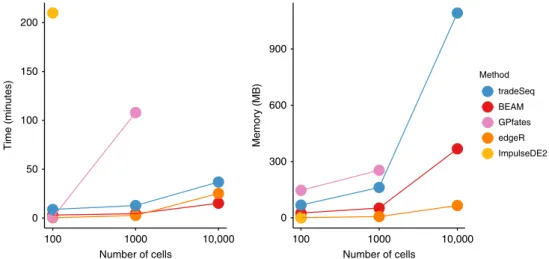
as in the simulation study; the results are shown in Fig. 4, and
more extensively described in Supplementary Note 1. Briefly,
ImpulseDE2 is by far the slowest, taking over 3.5 h to run on a small data set of 100 cells. GPfates runs fast ( ~30 s) on the small data set, but scales poorly. BEAM, edgeR, and tradeSeq are quite fast and scale very well, even to large data sets, with BEAM scaling the best. In terms of memory requirements, all methods scale well to 10,000 cells.
Case studies. We analyze four case study data sets with tradeSeq:
a bulk RNA-seq time-course and scRNA-seq MARS-seq, Smart-Seq, and 10× data sets. While we discuss the MARS-seq and Smart-seq data sets in the main paper and their corresponding Supplementary Notes (see below), we only report the results for the bulk RNA-seq time-course and 10× data sets in Supple-mentary Notes 2 and 3, respectively.
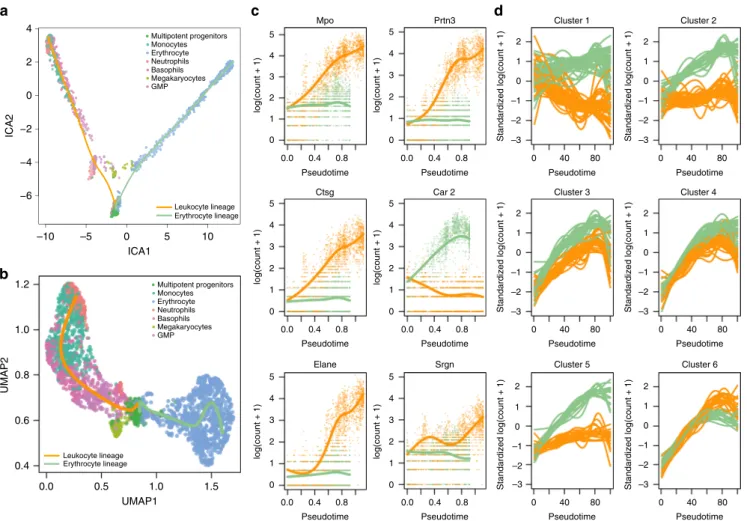
Mouse bone marrow data set. Paul et al.15study the evolution of
gene expression for myeloid progenitors in mouse bone marrow. They construct a reference compendium of marker genes that are indicative of development from myeloid multipotent progenitors to erythrocytes and several types of leukocytes.
In order to compare our approach with BEAM, we are restricted to the dimensionality reduction procedures
implemen-ted in Monocle 2. We thereforefirst used ICA as dimensionality
reduction method (Fig.5a) in the“Discovering cell type markers”
paragraph, but observed that this approach does not fully preserve the underlying biology (Supplementary Note 4). In subsequent sections, we will therefore demonstrate the powerful interpretation of a tradeSeq_slingshot analysis based on UMAP
dimensionality reduction (Fig. 5b). This additionally illustrates
the flexibility of tradeSeq (and slingshot) to be applied
down-stream of any dimensionality reduction method.
In this case study, we apply tradeSeq with six knots, as found to
be optimal by the AIC (Supplementary Fig. 22). Wefirst identify
marker genes for the progenitor and differentiated cell types in
the “Discovering cell type markers”paragraph. Next, we assess
which genes behave differently along the two lineages in the
“Discovering progenitor population markers”paragraph. Finally,
we demonstrate how one can group genes in clusters that share
similar expression patterns in the “Gene expression families”
paragraph.
Discovering cell type markers: tradeSeq provides theflexibility
to test several interesting and distinct hypotheses for this data set, that cannot always be considered with other methods. For
instance, we can find marker genes for the progenitor cell
population vs. the differentiated leukocytes or erythrocytes with the startVsEndTest procedure (results shown in Supple-mentary Fig. 23). By contrasting the endpoints of the smoothers
with the diffEndTest procedure, i.e., comparing the
differ-entiated leukocyte and erythrocyte cells themselves, we can also discover marker genes for the differentiated cell types. For the
latter, tradeSeq finds 2233 significantly differentially expressed
genes at a 5% nominal FDR level, while BEAM discovers 584 genes at a 5% nominal FDR level when testing whether the association between gene expression and pseudotime depends on
the lineage (Benjamini-Hochberg FDR-controlling procedure16).
In Supplementary Note 4, we confirm that tradeSeq provides
relevant biological results as compared with both BEAM and a cluster (cell type)-based comparison with edgeR. tradeSeq can thus provide relevant biological results without using the cell-type labels. Moreover, while cluster-based comparisons can be
powerful in some cases, many hypotheses are difficult to assess
with discrete DE, as demonstrated in the following paragraphs. Discovering progenitor population markers: In addition to looking for markers at the differentiated cell-type level, we could
also look for markers of developing myeloid cells. tradeSeq’s
patternTestcan accommodate this by identifying genes with
significantly different expression patterns between lineages.
Remarkably, the top six genes (Mpo, Prtn3, Ctsg, Car2, Elane,
andSrgn, Fig.5c) are all confirmed as biomarkers in the extensive
analysis of the original manuscript of Paul et al.15, confirming the
relevant ranking ofpatternTest. Indeed,Prtn3was found to
be monocyte-specific, whileMpoandCar2discriminated between
erythroid lineage progenitors and myeloid lineage progenitors.
The cluster of genes Elane, Prtn3, and Mpowere the strongest
markers for myeloid lineage progenitors and monocytes. In
summary, all six top genes were labeled as “key genes” for
hematopoiesis15.
It might also be interesting to examine genes with significantly
different expression patterns between lineages, that show little
● ● ● ●● ● ● ● ● ● ● ● ● ● ● ● 0 50 100 150 200 100 1000 10,000 Number of cells Time (minutes) ● ● ● ● ● ● ●● ● ● ● ● ● ● ● 0 300 600 900 100 1000 10,000 Number of cells Memory (MB) Method ● ● ● ● ● tradeSeq BEAM GPfates edgeR ImpulseDE2
Fig. 4 Benchmark of computation time and memory usage.Data sets with 100, 1000, and 10,000 cells are simulated and each method is evaluated, respectively, 10, 2, and 2 times on each data set to assess computation time and memory usage. The average across iterations is plotted for each method. Methods that went over a 4-h mark were stopped and deemed taking too long.
evidence for DE at the endpoints. In Supplementary Note 4, we
show how the combination of the results from patternTest
and diffEndTest yields highly informative genes showing transient expression differences between the lineages. Note that this analysis is not possible with any other method available, since these only test for global differential gene expression between lineages.
Gene expression families: Modeling gene expression in terms of smooth functions of pseudotime opens the door for additional downstream interpretation of results that are impossible with discrete DE methods, such as the clustering of genes based on
theirfitted expression patterns. In general, we found that RSEC
clustering provides a more stable clustering than partitioning around medoids (PAM) (Supplementary Fig. 25), the latter of which is also used by Monocle to cluster genes. For example, we can cluster the expression patterns for genes that were deemed
significant by tradeSeq’spatternTest(see“Methods”, section
“Clustering gene expression patterns”). This identifies gene
families that have similar expression patterns within every lineage, and also similar fold changes between the two lineages
(Fig.5d shows six clusters). These gene sets can then be further
screened for interesting patterns and validated by the biologist. Note that, for instance, the expression smoothers can be used to
assess specific transient changes in expression during
develop-ment, the signal for which might be diluted in cluster-based DE.
Mouse olfactory epithelium data set. Fletcher et al.17study the
development of horizontal basal cells (HBC) in the olfactory epithelium (OE) of mice. They activate the HBCs to be primed for development, which subsequently give rise to three different cell types: sustentacular cells, microvillous cells, and olfactory sensory
neurons (Fig.6a, b). The olfactory sensory neurons are connected
to the olfactory bulb for signal transduction of smell, and the sustentacular cells are general supportive cells in the OE. The function of microvillous cells, however, is not well understood; while some cells have axons ranging to the olfactory bulb, potentially indicating a sensory neuron function, others lack a
basal process or axon18. The samples from Fletcher et al.17were
processed using the Fluidigm C1 system with SMART-Seq library
preparation, hence we expect zero inflation to be present in this
data set. We therefore fit ZINB-GAMs to analyze the data using
tradeSeq downstream of slingshot. Zero inflation weights are
estimated with the ZINB-WaVE method19, using the cluster
labels and batch as covariates. Wefit tradeSeq with six knots, as
determined using the AIC (Supplementary Fig. 26). We were
unable to fit a model for 0.8% of all 14,261 genes due to
con-vergence issues of the ZINB-GAM. Note that currently no other
trajectory-based DE method can account for zero inflation or
provide the range of tests available in tradeSeq; hence, we forgo a comparison with other methods aside from a ZINB-edgeR
analysis14. Multipotent progenitors Monocytes Erythrocyte Neutrophils Basophils Megakaryocytes GMP Multipotent progenitors Monocytes Erythrocyte Neutrophils Basophils Megakaryocytes GMP –10 –5 0 5 10 −6 −4 −2 0 2 4 ICA1 ICA2 UMAP2 Leukocyte lineage Erythrocyte lineage a b c d 5
Mpo Prtn3 Cluster 1 Cluster 2
Cluster 4 Cluster 3 Cluster 5 Cluster 6 Car 2 Ctsg Elane Srgn 4 3 1 2 0 0.0 0.4 Pseudotime 0.8 0.0 0.4
Pseudotime Pseudotime Pseudotime
Pseudotime Pseudotime Pseudotime Pseudotime 0.8 0 40 80 0 40 80 0 40 80 0 40 80 0 40 80 0 40 80 0.0 0.4 Pseudotime 0.8 0.0 0.4 Pseudotime 0.8 0.0 0.4 Pseudotime 0.8 0.0 0.4 Pseudotime 0.8 5 2 1 0 –1 –2 –3 2 1 0 –1 –2 –3 2 1 0 –1 –2 –3 2 1 0 –1 –2 –3 2 1 0 –1 –2 –3 2 1 0 –1 –2 –3 4 3 1 2 0 5 4 3 1 2 0 5 4 1.2 1.0 0.8 0.6 0.4 0.0 0.5 1.0 UMAP1 1.5 3 log(count + 1) log(count + 1) log(count + 1)
Standardized log(count + 1) Standardized log(count + 1)
Standardized log(count + 1)
Standardized log(count + 1)
Standardized log(count + 1) Standardized log(count + 1)
log(count + 1) log(count + 1) log(count + 1) 1 2 0 5 4 3 1 2 0 5 4 3 1 2 0 Leukocyte lineage Erythrocyte lineage
Fig. 5 Mouse bone marrow case study. aTwo-dimensional representation of a subset of the data using independent components analysis (ICA). The myeloid trajectory inferred by slingshot is displayed.bTwo-dimensional representation of a subset of the data using UMAP. The myeloid trajectory inferred by slingshot is displayed. The UMAP dimensionality reduction method better captures the smooth differentiation process than ICA.cEstimated smoothers for the top six genes identified by the tradeSeqpatternTestprocedure on the trajectory from (b).dSix clusters for the top 500 genes with different expression patterns between the two lineages (as identified bypatternTestfrom tradeSeq).
In this case study, we first consider differential expression
within each lineage in the“Within-lineage DE”paragraph, after
which we assess differences between the three developmental
lineages in the“Between-lineage DE”paragraph.
Within-lineage DE: We first consider differential expression
along the neuronal lineage (the orange lineage in Fig. 6a). Using
the associationTestimplemented in tradeSeq, we recover 2730 genes at a 5% nominal FDR level. Within the top DE genes,
clear clusters of expression can be observed (Fig. 6c), that are
more active either at the beginning of the lineage, at specific
locations along the lineage, or at the end of the lineage. Since
Fletcher et al.17observed that cells associated with the neuronal
lineage undergo mitotic division during differentiation, we investigate whether we can recover the cell cycle biology using the associationTest. Indeed, many of the top genes are related to the cell cycle (Supplementary Fig. 27).
We also seek biological markers that differentiate the progenitor cells from the differentiated cell types in any of the
three lineages using thestartVsEndTestprocedure as part of
a global test (i.e., gene expression is compared between the start and end states for each lineage and the evidence is aggregated
across the three lineages using a global test; see“Methods”) and
then look for enriched gene sets for the top 250 genes. The results
for the top 20 gene sets (Supplementary Table 1) clearly reflect
the biology of the experiment (Supplementary Note 5).
Between-lineage DE: Next, we compare the three lineages by assessing differences in their expression patterns through
stage-wise testing with thepatternTestprocedure (see“Methods”).
At the screening stage, wefirst test whether any two lineages have
significantly different expression patterns. The genes that pass the
screening stage are then further assessed to discover which
specific pairs of lineages are deviating in their expression pattern.
The screening stage identifies 3275 genes that have different
expression patterns between any pair of lineages, at a 5% nominal FDR level (as reference, the top six genes are plotted in Supplementary Fig. 28). As could be expected, a large majority
of the genes (2481) are significant in the neuronal–sustentacular
lineage comparison. However, remarkably, we discover more DE
HBC ΔHBC1 ΔHBC2 iSUS mSUS GBC MV1 MV2 INP1 INP2 INP3 iOSN mOSN Neuronal Microvillous Sustentacular a b c d Celltype HBC HBC1 HBC2 GBC INP1 INP2 INP3 iOSN mOSN –2 0 2 4 Neuronal lineage Microvillous lineage Sustentacular lineage 0 100 200 300 400 0 2 4 6 8 10 Sox11 Pseudotime log(count + 1) Neuronal Microvillous Sustentacular 0 100 200 300 400 0 2 4 6 8 10 Elf5 Pseudotime 0 100 200 300 400 Pseudotime 0 100 200 300 400 Pseudotime log(count + 1) Neuronal Microvillous Sustentacular 0 2 4 6 8 10 Bcl11b log(count + 1) Neuronal Microvillous Sustentacular 0 2 4 6 8 10 Cebpb log(count + 1) Neuronal Microvillous Sustentacular
Fig. 6 Mouse olfactory epithelium case study. aThree-dimensional PCA plot of the scRNA-seq data, where cells are colored according to their cluster membership as defined in the original paper (see“Methods”). The simultaneous principal curves for the lineages inferred by slingshot are displayed. This Figure is reprinted from Fletcher et al.17with permission from the publisher.bSchematic of the cell types and their ordering along the lineages.cHeatmap
for the top 200 genes that are associated with the neuronal lineage, as identified with theassociationTestprocedure from tradeSeq. Five clear gene clusters can be identified, each with a different region of activity during the developmental process.dFour transcription factors discovered by the
earlyDETestbetween the pseudotimes of knots one and three (knots indicated with vertical dashed lines) and that are involved in epithelial cell differentiation.
genes when comparing the microvillous and neuronal lineages (2149 genes) than when comparing the microvillous and sustentacular lineages (1374 genes), even though the microvillous lineage shares a longer path with the neuronal lineage. Out of all
significant genes, 827 genes were identified in all three pairwise
comparisons. Investigating the top 20 enriched gene sets based on the MSigDB database reveals that 12/20 of the top gene sets are related to the mitotic cell cycle (Supplementary Table 2). This is reassuring, since only the neuronal and microvillous lineages go
through the cell cycle, according to Fletcher et al.17. In addition,
we find gene sets related to neurogenesis, referring to the
development of olfactory sensory neurons. The functional interpretation of the results from the combined ZINB and
tradeSeq analysis hence confirms the biology of the experiment
and the battery of possible tests unlock a more detailed and meaningful interpretation of the results.
None of the previously developed trajectory-based methods for assessing differential expression between lineages can currently
accommodate zero inflation. In Supplementary Note 5, we
compare the ZINB-tradeSeq analysis with a ZINB-edgeR analysis, and demonstrate the relevance of the genes uniquely found by tradeSeq. In addition, we illustrate the functionality of the
earlyDETestto identify genes that may drive the
differentia-tion around thefirst branching point.
Discussion
We have proposed tradeSeq, a novel suite of tests for identifying dynamic temporal gene regulation using single-cell RNA-seq data. These tests allow researchers to investigate a range of hypotheses related to temporal gene expression, ranging from the
general to the highly specific. Whereas previous methods only
provide global tests of differential expression along or between
lineages, tradeSeq offers a highlyflexible framework that can be
adapted to a single lineage, multiple lineages, or specific points or
ranges along lineages. The flexibility provided by tradeSeq is
crucial, as trajectory-based DE is often the final (or near final)
step in a much longer analysis pipeline.
Our analyses are based on the NB-GAM of Eq. (1), which
conditions on cell pseudotimes and hence ignores the fact that pseudotimes are typically inferred random variables. We there-fore expect some uncertainty in pseudotime values, which may or
may not be quantified by a particular TI method. Even when
measures of pseudotime variability are available, neither tradeSeq nor other methods such as BEAM and GPfates currently make use of this information. Instead, all of these methods treat the
pseudotimes as fixed and known. The BranchedGP method
allows for uncertainty in the assignment of cells to lineages and
relies on branching Gaussian processes to identify gene-specific
branching dynamics20. However, it is computationally very
intensive, with reported computation time of 2 min per gene on a
data set that has been subsampled to 467 cells20; we therefore did
not consider this method in our evaluation.
While we generally assume that pseudotime values are on similar scales across lineages, this may not always be the case.
Furthermore, Trapnell et al.11noted that any trajectory inference
method can produce pseudotime values that are not necessarily
reflective of true biological time. At best, pseudotime values
represent some monotonic transformation of the true maturity of each cell. Therefore, some authors have proposed the use of dynamic time warping to align pseudotime values from different
experiments on potentially different scales21. This approach can
be beneficial in cases where, for example, one lineage is much
longer or shorter than another. If a gene, in reality, has a similar pattern of expression along two such lineages, this pattern could, for instance, consume 75% of the shorter lineage, but only 25% of
the longer lineage. As such, the gene could be called DE by the
patternTestprocedure. However, applying the same test after dynamic time warping may yield a negative result. Since tradeSeq only requires the estimated pseudotimes as input, which could be warped or not, it is compatible with any form of warping between lineages. We urge users to carefully consider whether pseudotime values across lineages are comparable and, if not, consider such warping strategies before comparing patterns of expression with tradeSeq.
Moving forward, it may be possible tofit ZINB-GAMs in a
single step by numerically maximizing the ZINB-GAM like-lihood. This could improve upon the two-step approach that we have taken in this paper, where (i) posterior probabilities of zero
inflation are first estimated using ZINB-WaVE and (ii)
subse-quently used to unlock the NB-GAM for DE analysis in the presence of excess zeros.
In this paper, we have demonstrated tradeSeq on several scRNA-seq data sets. However, the tests that we provide
down-stream of thefitGAMfunction are applicable beyond this setting.
Indeed, the framework may also be applicable to, e.g., downstream analysis of chromatin accessibility trajectories in scATAC-seq data
sets (e.g., Chen et al.22) or bulk RNA-seq time-course studies; we
have demonstrated the latter in Supplementary Note 2.
While we propose a number of tests based on the NB-GAM, it is important to realize that users may also implement their own
statistical tests related to their specific hypotheses of interest. We
therefore welcome contributions of new tests to the GitHub
repository (https://github.com/statOmics/tradeSeq) of the package.
Single-cell RNA-seq tends to produce noisy data requiring long
analysis pipelines in order to glean biological insight. While“
all-in-one”tools that simplify this analysis may be attractive from a
user’s standpoint, they are not guaranteed to offer the best
methods for each individual step. We therefore propose a more modular approach that expands upon previous work and opens up new classes of questions to be asked and hypotheses to be tested.
Methods
Negative binomial generalized additive model. We build on the generalized
additive model (GAM) methodology to model gene expression profiles as
non-linear functions of pseudotime for the different lineages in a complex trajectory. In our GAM framework, each lineage is represented by a separate cubic smoothing spline, i.e., a linear combination of cubic basis functions of pseudotime. The
flexibility of GAM also allows us to easily adjust for other covariates or
con-founders such as treatment and batch. The discrete nature and the overdispersion
of read counts is addressed by modeling the expression measuresYgi, for a given
geneg∈{1,…,G} across cellsi∈{1,…,n}, using a negative binomial (NB)
distribution with cell and gene-specific meansμgiand gene-specific dispersion
parametersϕg. Hence, we propose a gene-wise negative binomial generalized
additive model (NB-GAM), represented by Eq. (1) (see Results section), where
the meanμgiof the NB distribution is linked to the additive predictorηgiusing
a logarithmic link function. The gene-wise additive predictor consists of
lineage-specific smoothing splinessgl, that are functions of pseudotimeTli, for lineages
l∈{1,…,L}. The binary matrixZ=(Zli∈{0, 1}:l∈{1,…,L},i∈{1,…,n})
assigns every cell to a particular lineage based on user-supplied weights (e.g.,
from slingshot3or GPfates4, see details in Supplementary Methods). We letL
l¼
fi:Zli¼1gdenote the set of cells assigned to lineagel. In addition, we allow the
inclusion ofpknown cell-level covariates (e.g., batch, age, or gender), represented
by ann×pmatrixU, withith rowUicorresponding to theith cell, and regression
parametersαgof dimensionp× 1. Differences in sequencing depth or capture
efficiency between cells are accounted for by cell-specific offsetsNi.
The smoothing splinesgl, for a given genegand lineagel, can be represented as
a linear combination ofKcubic basis functions (Eq. (2), see Results section), where
the cubic basis functionsbk(t) are enforced to be the same for all genes and
lineages. Our default computational implementation setsK=6. Thus, for each
gene and each lineage in the trajectory, we estimateK=6 regression coefficients
βglk. The number of parameters in the gene-wise model isL×K+p+1, which is
typically much lower than the number of cellsnin the data set.
The NB-GAM isfitted gene by gene using thefitGAMfunction from the
tradeSeq package, which relies on the mgcv package in R. We build upon recent developments in mgcv that allow the joint estimation of the NB regression
smoothness of the spline, the coefficientsβglkare shrunken by substracting a
penaltyλgβTgSβg from the log-likelihood function, whereβgdenotes the
concatenation of theLK-dimensional column vectorsβglof lineage-specific
smoother coefficients andSis an (LK) × (LK) diagonal matrix that indicates which
coefficients inβgare to be penalized. The magnitude of penalization is controlled
by the smoothing parameterλg, which is selected using generalized
cross-validation24. Note that we enforce identical basis functions between lineages, i.e.,
bkdoes not depend onl, as well as identical smoothing parameterλg, in order to
ensure that the smoothers are comparable across lineages.
Importantly, the model of Eq. (1) can accommodate zero-inflated counts typical
for full-length scRNA-seq protocols by using observation-level (i.e., cell-level)
weights obtained, for instance, from the zero-inflated negative binomial (ZINB)
approach of Van den Berge et al.14and Risso et al.19.
Choosing an appropriate number of knots. Ideally, the number of knotsKshould be selected to reach an optimal bias-variance trade-off for the smoother, where one explains as much variability in the expression data as possible with only a few
regression coefficients (see Supplementary Fig. 1). In practice, the number of knots
Kmay be selected by evaluating the Akaike information criterion (AIC) using the
evaluateKfunction implemented in tradeSeq. We have deliberately chosen the AIC as evaluation criterion, since the Bayesian information criterion (BIC) seemed to favor overly complex models (i.e., an excessively high number of knots). The knots are by default positioned according to the quantiles of the pseudotime values.
For example, if a smoother isfit with three knots, then there will be a knot at the
minimum, median, and maximum pseudotime values. The knots may be inter-preted as relative markers of progress along the trajectory. However, it is important to realize that this might not necessarily linearly correlate with true
chronological time.
Statistical inference. We propose a general andflexible testing framework for
(linear combinations of) the parametersβg, which allows us to pinpoint specific
types of differences in gene expression both within and between lineages; see Fig.1
for an overview. Wefirst present the general approach and then detail the
implementation and interpretation of specific DE tests.
All proposed DE procedures involve testing null hypotheses of the form
H0:CTβg=0 using Wald test statistics
Wg¼^β T gCðCTΣ^^βgCÞ 1 CT^β g; ð3Þ
where^βgdenotes an estimator ofβg,^Σβg^ represents an estimator of the covariance
matrixΣ^βg of^βg, andCis an (LK) ×Cmatrix representing theCcontrasts of
interest for the DE test.
For each gene, we computep-values based on the nominal chi-squared
asymptotic null distribution of the Wald statistics (with degrees of freedom equal to
the column rank ofC). Rather than attaching strong probabilistic interpretations to
thep-values (which, as in most RNA-seq applications, would involve a variety of
hard-to-verify assumptions and would not necessarily add much value to the
analysis), we view thep-values simply as useful numerical summaries for ranking
the genes for further inspection. There arefive tests currently implemented in the
tradeSeq package, which are introduced in detail in the sections below. Fig.2
provides a visual overview of the scope of each test.
Within-lineage comparison tests.associationTest: A relevantfirst ques-tion is whether gene expression is associated with pseudotime along a given lineage,
i.e., whether the smoother isflat or varying along pseudotime. To address this
question, theassociationTesttests the null hypothesis that all smoother
coefficients within the lineage are equal, i.e.,H0:βglk¼βglk0for all
k≠k02 f1;¼;Kg. This null hypothesis can be encoded in several ways; here, we
chose the contrast matrixCto be anLK×L(K−1) matrix, where each column
corresponds to a contrast between two consecutiveβglkandβgl(k+1)and where we
haveK−1 contrasts per lineage for a total ofL(K−1) contrasts.
startVsEndTest: By default, thestartVsEndTestcompares mean expression at the progenitor state (i.e., the start of the lineage) to mean expression
at the differentiated state (i.e., the end of the lineage). Specifically,Cis an (LK) ×L
matrix, whose entry in rowk+(l−1)Kand columnlencodes the contrast for
lineageland knotkand is defined bybkðTl;maxÞ bkðTl;minÞ, whereTl,max=
maxfi:i2LlgTliandTl,min=minfi:i2LlgTlidenote, respectively, the maximum and
minimum pseudotime across all cells assigned to lineagel. Other entries ofCare
set to zero. Therefore, thelthelement of the vectorCTβgis
PK
k¼1ðbkðTl;maxÞ bkðTl;minÞÞβglk¼sglðTl;maxÞ sglðTl;minÞ, which contrasts mean
expression at the beginning and at the end of the lineage. Note that contrasting the start and endpoints of a lineage is a special case of a more general capability of tradeSeq to compare the mean expression between any two regions of a given lineage. As such, this test can be considered a generalization of cluster-based
discrete DE within a lineage (e.g., Risso et al.25).
Between-lineage comparison tests.diffEndTest:ThediffEndTest compares average expression at the differentiated states of multiple lineages, i.e., it
compares the endpoints of different lineage-specific smoothers. It can be viewed as
an analog of discrete DE for the differentiated cell types. The test is implemented
using a Wald test statistic, as described above, whereCis an (LK) ×L(L−1)∕2
matrix. Each column ofCencodes a pairwise contrast between the endpoints of
two lineages, such that the corresponding element ofCTβgiss
gl1ðTl1;maxÞ
sgl2ðTl2;maxÞfor lineagesl1andl2.
patternTest: This test compares the expression patterns along pseudotime
between lineages by contrasting afixed set of equally spaced pseudotimes (M=100
by default). First selecting the pseudotimes and subsequently comparing their expression levels between lineages, allows for comparisons between smoothers of
different lengths. Specifically, for lineagel, letPlmdenote themth equally spaced
pseudotime betweenTl;minandTl;max. The contrast ofMpoints corresponds to
testing the null hypothesis that a gene has the same expression pattern along pseudotime across the lineages under comparison, while normalizing for the length of the lineages. The test is implemented using a Wald test statistic, as described
above, whereCis an (LK) ×L(L−1)M∕2 matrix. Each column ofCencodes a
pairwise comparison between two pseudotimes of two different lineages, such that
the corresponding element ofCTβgiss
gl1ðPl1mÞ sgl2ðPl2mÞfor lineagesl1andl2
andm∈{1,…,M}. The test is implemented through the eigendecomposition of
the estimated variance–covariance matrix of the contrasts to avoid singularity
problems26(see Supplementary Methods). It should be noted that this test is a
general test, able to identify both differences in patterns of expression as well as genes with similar patterns but different mean expression across the pseudotime range. It is therefore most useful as a screening test to identify any form of differential expression between the lineages.
earlyDETest: TheearlyDETestaims to identify genes that are differentiating around a branching of the trajectory. It is similar to the patternTest, in that it also compares the expression patterns along pseudotime
between lineages by contrasting afixed set of equally spaced pseudotimes (M=100
by default). However, instead of using points distributed from the beginningTl;min
to the endTl;maxof the lineages as in thepatternTest, it relies on points over a
shorter range of time. In the current implementation, this range is delimited by the
pseudotimes of two user-specified knots. The knots should be chosen to enclose the
branching event (or any event of interest) and do not need to be consecutive. Global testing. While the statistical tests introduced above can assess DE within one lineage or between a pair of lineages, one may want to investigate multiple (i.e., more than two) lineages. For example, if a trajectory consists of three lineages, one may wish to test the global null hypothesis that, for each of the three lineages, there
is no association between gene expression and pseudotime using the
associa-tionTest. The null hypothesis that would be tested can be expressed as
H0:8land8k≠k0;βglk¼βglk0, i.e., within each of the three lineages, allK
regression coefficients are equal. We refer to such a test as a“global test”. The
tradeSeq package provides functionality for global testing for each of the within and between-lineage tests described above. For within-lineage tests, the user can specify whether the test should be done for each lineage individually or at the global level (i.e., for all lineages). For between-lineage tests, the user can specify if a global test should be performed or whether all pairwise comparisons should be performed.
Stage-wise testing. For the mouse olfactory epithelium case study17, we apply
stage-wise testing, as implemented in stageR27,28, to assess DE between lineages
using multiple tests for each gene. Stage-wise testing aims to control the overall
false discovery rate (OFDR)27, i.e., the expected proportion of genes with at least
one falsely rejected null hypothesis among all genes declared DE. In our case, the
OFDR can be interpreted as a gene-level FDR28. Stage-wise testing is performed in
two stages, a screening and a confirmation stage. At the screening stage, each gene
is screened by performing a global test across all null hypotheses of interest, essentially testing whether at least one of these hypotheses can be rejected. At that
stage, the FDR is controlled across genes at levelαI. At the confirmation stage, each
specific hypothesis is assessed, but only for the genes that have passed the screening
stage. For each gene, the family-wise error rate (FWER) is controlled across
hypotheses at levelαII¼RGαI, whereRdenotes the number of genes that had their
global null hypothesis rejected at the screening stage andGthe total number of
genes assessed. Heller et al.27proved that this procedure controls the overall FDR
at levelαI. It should be noted that, while the stage-wise testing paradigm
theore-tically controls the OFDR (given underlying assumptions are satisfied), the
resultingp-values might still be too liberal since the same data are used for
tra-jectory inference and differential expression. As mentioned before, we usep-values
simply as numerical summaries for ranking the genes for further inspection. Clustering gene expression patterns. The NB-GAM can also be used to cluster
genes according to their expression patterns, as shown in Fig.1. Specifically, for
each gene, we extract a number offitted values for each lineage (100 by default).
We can then use resampling-based sequential ensemble clustering (RSEC), as
principal components of) the standardizedfitted values matrix (i.e., thefitted values are standardized to have zero mean and unit variance across cells for each gene). Importantly, we allow for any clustering algorithm that is built-in into cluster-Experiment or chosen by the user to perform the clustering. This clustering
approach is implemented in the tradeSeq package (clusterExpressionPatterns
function) for downstream analysis facilitating the interpretation of DE genes. Implementation. The above describedfitting procedure, DE tests, and clustering of expression patterns are implemented in the open-source R package tradeSeq,
available through the Bioconductor Project (http://www.bioconductor.org/
packages/release/bioc/html/tradeSeq.html). We provide an extensive vignette along
with the package, as well as a cheat sheet describing the different types of DE patterns detected with each test.
Methods comparison. slingshot is a fast and robust method for TI that was shown to be among the top-performing methods in a recent large-scale benchmarking
study1. Hence, we evaluate tradeSeq downstream of a slingshot analysis, which can
work with any dimensionality reduction and clustering methods. slingshot builds a cluster-based minimum spanning tree (MST) to infer the global lineage topology and make an initial assignment of cells to lineages. This structure is then smoothed
byfitting simultaneous principal curves, which refine the assignment of cells to
lineages. This process results in lineage-specific pseudotimes and weights of
assignment for each cell.
GPfates4is a Python package that adopts Gaussian processes in reduced
dimension to infer trajectories. Dimensionality reduction is performed using
Gaussian process latent variable models (GPLVM)29. GPfates is able to identify
bifurcation points and assess how well a bifurcationfits the expression pattern of
each gene, i.e., whether the patterns of gene expression are different between the
lineages. This allows us to compare a slingshot+tradeSeq analysis with a GPfates
analysis. In addition, we also evaluate a tradeSeq analysis downstream of TI with GPfates, since GPfates also calculates posterior probabilities that each cell belongs to a particular lineage. We then compare the complete GPfates (TI and DE)
analysis to a GPfates+tradeSeq analysis.
Monocle 25applies reverse graph embedding to infer trajectories and yields a
principal graph that is allowed to branch. It provides a similar approach as tradeSeq with the branch expression analysis modeling (BEAM) method. It assumes a gene-wise negative binomial model for gene expression, where the mean is expressed in terms of lineage-dependent smooth functions of pseudotime, i.e.,
logðμgiÞ ¼
XL l¼1
ðβ0glþsglðTliÞÞ: ð4Þ
In this model, the lineage-specific interceptsβ0glaccount for mean differences in
expression between lineages, while the lineage-specific smootherssgl(t) model the
expression change along pseudotime. To test for lineage-dependent expression, the full model is compared with a null model of the form
logðμgiÞ ¼βg0þsgðTiÞ
using a likelihood ratio test. Thus, BEAM tests whether the smooth functions of gene expression along pseudotime are different between lineages. Importantly, BEAM is restricted to the dimensionality reduction methods that are implemented
in Monocle 2, namely DDRTree5and Independent Components Analysis (ICA). In
addition, it only provides a screening test (like thepatternTestin tradeSeq), as
it only allows testing for any difference in expression profiles between lineages and
does not specify the exact type of divergence.
An alpha release for Monocle 3 is available online (downloaded August 30, 2018
from thehttps://github.com/cole-trapnell-lab/monocle-release/tree/
monocle3_alphaMonocle GitHub repository) which, unlike Monocle 2, performs
uniform manifold approximation and projection (UMAP)30dimensionality
reduction upstream of the trajectory inference. In addition, Monocle 3 implements
the Moran’s I test to discover genes whose expression is significantly associated
with pseudotime; a functionality that is unavailable in Monocle 2.
ImpulseDE231also assumes a gene-wise negative binomial model for the
expression counts, where the mean is expressed as a weighted combination of two
sigmoid functions. This model essentially allows the estimation of three“
state-specific expression values”, where the transitions between the states are modeled
with the two sigmoid functions. The DE method is not linked to any trajectory inference procedure since it assumes that the pseudotime for each cell is known. In
this paper, we use ImpulseDE2 downstream of slingshot. Prior to thefitting,
ImpulseDE2 relies on DESeq2 for normalization and estimation of the NB dispersion parameter. However, DESeq2 cannot handle genes having at least one zero count, which is common in scRNA-seq. In such a scenario, we therefore
“manually”estimate size factors and dispersion parameters using the DESeq2
poscountsnormalization, which was developed to deal with this issue14,32.
edgeR33is a discrete differential expression method, where the groups under
comparison must be defined a priori. It is therefore useful for assessing DE
between, for example, annotated clusters or different treatment groups. For such comparisons, edgeR is a powerful method with high sensitivity. Note that, while edgeR was originally developed for group-based differential expression, it would be possible to incorporate the basis functions of the smoothers as continuous covariates in the model. However, no regularization would be performed on the
estimation of the smoother regression coefficients, hence the model would be prone
to overfitting. A similar approach was evaluated in Fischer et al.31, where DESeq234
was used tofit splines by incorporating natural cubic basis functions in the linear
predictor. In addition, edgeR does not provide an implementation of the DE tests
in tradeSeq. Only theassociationTestis readily available in edgeR by testing
whether all basis function parameters are equal to zero; the other tests would require a similar development as presented in tradeSeq. Hence, while it is possible
tofit smoothers by using edgeR, instead of mgcv, we emphasize that this would
merely be an alternative and less general approach tofitting the NB-GAMs we
propose in our paper.
Simulation study. The simulation study evaluates methods that (differentially) associate gene expression with pseudotime for three different trajectory topologies, i.e., a cyclic, a bifurcating, and a multifurcating trajectory. As independent eva-luation, we use the extensive trajectory simulation framework dynverse that
pre-viously served for benchmarking trajectory inference methods in Saelens et al.1.
Interested readers should refer to the original publication for details on the data
simulation procedure. Data set characteristics are listed in Table1.
For each of the cyclic and bifurcating topologies, we generate and analyze ten data sets. Since the multifurcating topology is very variable across simulations due
to itsflexible definition, its analysis requires substantial supervision. Therefore, we
analyze only one representative multifurcating data set.
Prior to trajectory inference, the simulated counts are normalized using
full-quantile normalization35,36. For TI with slingshot, we apply principal component
analysis (PCA) dimensionality reduction to the normalized counts andk-means
clustering in PCA space. For the bifurcating and multifurcating trajectories, the start and end clusters of the true trajectory are provided to slingshot to aid it in inferring the trajectory. For the edgeR analysis, we assess DE between the end clusters that are also provided to slingshot. The BEAM method can only test one bifurcation point at a time. For the multifurcating data set, we therefore assessed
both branching points separately and aggregated thep-values using Fisher’s
method37. For the tradeSeq and edgeR analyses of the multifurcating data set, we
perform global tests across all three lineages.
We assess performance based on scatterplots of the true positive rate (TPR) vs.
the false discovery proportion (FDP), according to the following definitions
FDP¼ FP
maxð1;FPþ TPÞ
TPR¼ TP
TPþ FN;
whereFN,FP, andTPdenote, respectively, the numbers of false negatives, false
positives, and true positives. FDP-TPR curves are calculated and plotted with the
Bioconductor R package iCOBRA38.
Table 1 Overview of simulated data sets.
Cyclic data set Bifurcating data set Multifurcating data set
Simulation framework dyngen dyntoy dyntoy
Number of cells 505–508 500 750
Number of genes 312–444 5000 5000
% of DE genes 42–47% 20% 20%
Number of lineages 1 2 3
Topology Cyclic Bifurcating Multifurcating
Number of data sets 10 10 1
Each data set is simulated using one of the frameworks from the dynverse toolbox (dyngen or dyntoy), which are designed to simulate scRNA-seq data according to trajectory topologies. Each data set can be characterized by the topology of the trajectory, as well as the number of cells and genes. Low-dimensional representations of representative data sets can be found in Fig.3. Note that the cyclic data sets have some variation in the numbers of genes and cells and in the amount of differential expression, which is inherent to the dyngen simulation framework.