Reclassifying the SILL: Validation Using Exploratory and
Confirmatory Factor Analysis
Su-ching Wu* Shan-mao Chang
The Department of English, National Changhua University of Education, No.1, Jin-De Road, Changhua City 50007, Taiwan
* E-mail of the corresponding author: [email protected]; [email protected]
Abstract
For decades, the Strategy Inventory of Language Learning (SILL) has been extensively used in the previous studies on foreign/second language (L2) learners’ learning strategies, which have yielded a substantial amount of empirical findings in the field of L2. The conventional classification of the SILL questionnaire, however, has not gone without challenges, especially given the tremendous diversity of the EFL context. In this study, we revisited the SILL and reclassified the language learning strategies in this popular questionnaire. The data were collected in an EFL context in which a total of 282 Taiwanese senior high school students filled out the SILL questionnaire. Validity was the paramount concern during reclassifying and was demonstrated via exploratory factor analysis (EFA) and confirmation factor analysis (CFA). EFA was first used to extract factors from the SILL, which helps to conceptualize the new classification. CFA was then performed to confirm the exploratory model. At the end of the study, the SILL was reclassified into the 6 dimensions which were labeled as: 1) Social Strategies, 2) Metacognitive Strategies (Type I), 3) Metacognitive Strategies (Type II), 4) Affective Strategies, 5) Cognitive Strategies and 6) Memory Strategies.
Keywords: Language learning strategy, the Strategy Inventory of Language Learning, exploratory factor analysis, confirmatory factor analysis
1. Introduction
Language learning strategies (LLS) have been considered one crucial tool to second/foreign language (L2) learning (Cohen & Macaro, 2007; Dörnyei, 2005; Griffiths, 2003; Rahimi, Riazi, & Saif, 2008; Rivera-Mills & Plonsky, 2007). Among a variety of questionnaires that have been used to investigate the L2 learning strategies, the Strategy Inventory of Language Learning (SILL) has been a widely used instrument for measuring learners’ language learning strategies because of its high reliability and validity.
Although the SILL (1989) has been regarded as the most comprehensive classification of learning strategies (Ellis, 2008), doubts or criticisms about the SILL have been raised by researchers (e.g., Macaro, 2006). In particular, SILL has been criticized for a biased reliability and an ambiguous classification of the six subcategories (Macaro, 2006; Woodrow, 2005). Much of previous research adopting the conventional SILL classification of language learning strategies might sink into the crisis of being unfair in that exploratory factor analysis on the SILL may show different. This equivocal and unstable classification of the SILL does exist and highlights the necessity for pre- and post-testing for both the overall scale and the subscales reliability.
The SILL has been constantly challenged for its biased reliability because it derived from its overall scale without explicit evidence (Woodrow, 2005). Oxford’s response to the biased reliability of the SILL – the six categories were correlated with one another – further led to another controversy in the SILL, namely, the ambiguous classification. The major component causing the ambiguity of classification in the SILL may ascribe to the process of “reasoning” when learners use learning strategies. Metacognitive Strategies, for example, help students regulate their own cognition by assessing how they are learning and by planning for future language tasks; however, metacognitive self-assessment and planning often require reasoning, which is itself a cognitive strategy. Metacognitive Strategies may overlap Cognitive Strategies. Moreover, Compensation Strategies obviously used to make up for missing knowledge also require reasoning, as well as involving sociocultural sensitivity typically gained through Social Strategies. In addition, researchers consider compensation strategies a type of language use strategy rather than a category of language learning strategy (Cohen, 2011; Macaro 2006) because language use strategy is used to compensate the gap between learners’ current knowledge and given material but not to learn any language material (Cohen, 2011).
In this study, we revisited the SILL questionnaire in an EFL context and our intention was reclassify the language learning strategies of the SILL using the data collected in the specific context into relevant constructs or categories by conducting exploratory factor analysis. Six items of Compensation Strategies were eliminated because they are regarded as language use strategies rather than language learning strategies. The reliability and validity of the overall construct and each sub-construct of the SILL reclassified by using exploratory factor analysis were assessed by using confirmatory factor analysis.
2. An overview of language learning strategies
Since the 1970’s, much research has been devoted to investigating what language learning strategies are and how they contribute to learning outcomes. The particular strategies used by the so called “good language learners” convinced both learners and scholars of their usefulness in L2 acquisition (Rubin, 1975; Stern, 1975). For decades, researchers have identified the strategies through behaviors of effective language learners and summarized these categories into several broad categories (Naiman, Frohlich, Stern, & Todesco, 1978; Rubin, 1981; O’Malley et al., 1985; Oxford, 1990).
2.1 Naiman et al.’s classification of language learning strategies
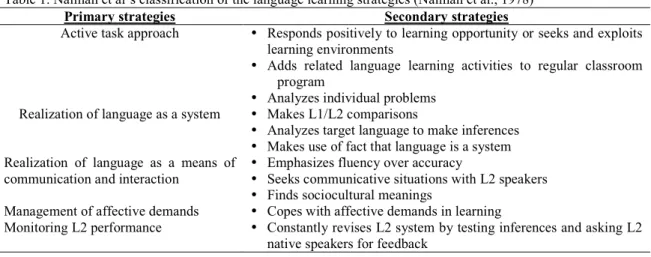
Naiman et al. (1978) classified learning strategies into two broad categories: Primary strategies and secondary strategies. The primary strategies referred to 5 broad aspects of learning strategies, including active task approach, realization of language as a system, realization of language as a means of communication and interaction, management of affective demands, and monitoring of second language performance. The secondary strategies were composed of a number of secondary categories (see Table 1).
Table 1. Naiman et al’s classification of the language learning strategies (Naiman et al., 1978)
Primary strategies Secondary strategies
Active task approach Responds positively to learning opportunity or seeks and exploits
learning environments
Adds related language learning activities to regular classroom program
Analyzes individual problems
Realization of language as a system Makes L1/L2 comparisons
Analyzes target language to make inferences
Makes use of fact that language is a system Realization of language as a means of
communication and interaction
Emphasizes fluency over accuracy
Seeks communicative situations with L2 speakers
Finds sociocultural meanings
Management of affective demands Copes with affective demands in learning
Monitoring L2 performance Constantly revises L2 system by testing inferences and asking L2
native speakers for feedback
2.2 Rubin’s classification of language learning strategies
Rubin (1981) classified the language learning strategies into two broad categories according to whether they affected language learning directly or indirectly. Those directly affecting language learning included clarification/verification, monitoring, memorization, guessing/inductive reasoning, deductive reasoning, and practice while the strategies indirectly affecting language learning referred to creating opportunities to practice language use and using production tricks such as communication strategies (see Table 2).
Table 2. Rubin’s classification of language learning strategies (Rubin, 1981)
Primary classification Secondary classification
Strategies that directly affect learning Clarification/verification
Monitoring
Memorization
Guessing/inductive inferencing
Deductive reasoning
Practice
Processes that contribute indirectly to learning Creates opportunities for practice
Production tricks 2.3 O’Malley et al’s classification of language learning strategies
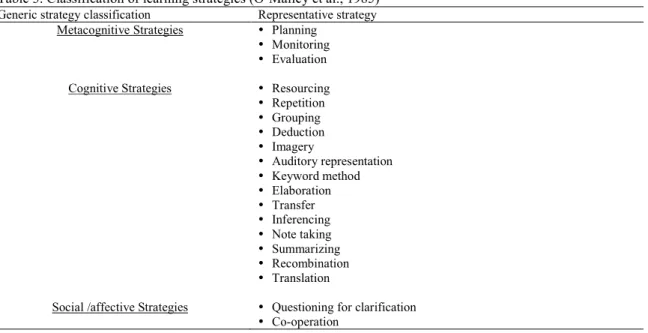
With the notion of Production System, specifying the dynamics of the system during the skill acquisition process (Anderson, 1983, 1985), O’Malley et al. (1985) classified learning strategies into three categories upon the level of processing (from higher order to lower order): Metacognitive Strategies, Cognitive Strategies, and Social/affective strategies (see Table 3).
Table 3. Classification of learning strategies (O’Malley et al., 1985)
Generic strategy classification Representative strategy Metacognitive Strategies Planning
Monitoring
Evaluation Cognitive Strategies Resourcing
Repetition Grouping Deduction Imagery Auditory representation Keyword method Elaboration Transfer Inferencing Note taking Summarizing Recombination Translation
Social /affective Strategies Questioning for clarification
Co-operation
2.4 Oxford’s Classification of Language Learning Strategies
Oxford’s (1989) classification of language learning strategies contains two classes: direct and indirect class. Direct class is for dealing with the new language while indirect class is for general management of learning. Direct class consists of three categories of strategies: Memory Strategies, Cognitive Strategies and Compensation Strategies. Indirect class is composed of three categories of strategies: Metacognitive Strategies, Affective Strategies and Social Strategies. The function of each category of strategies is distinct. Memory Strategies is for remembering and retrieving new information. Cognitive Strategies is for understanding and producing the language. Compensation Strategies is using the language despite knowledge gaps. Metacognitive Strategies is for coordinating the learning process. Social Strategies is for learning with others. Affective Strategies is for regulating emotions, encouraging and cheering the learners. The classification of language learning strategies presented by Oxford is shown in Table 4.
Table 4. The Strategy Inventory of Language Learning (SILL) (Oxford, 1989) Direct Class
Category Subcategory
Memory Strategies Creating mental linkages
Applying images and sounds
Reviewing well
Employing action
Cognitive Strategies Practicing
Receiving and sending messages
Analyzing and reasoning
Creating structure for input and output
Compensation Strategies Guessing intelligently
Overcoming limitations in speaking and writing Indirect Class
Category Subcategory
Metacognitive Strategies Centering your learning
Arranging and planning your learning
Evaluating your learning
Affective Strategies Lowing your anxiety
Encouraging yourself
Taking your emotional temperature
Social Strategies Asking questions
Cooperating with others
3. Method 3.1 Participants
A total of 282 EFL students from a boys’ senior high school situated in central Taiwan participated in the survey. The participants were recruited in two waves for the purpose of the study. Data collected from the first wave of participants (N=132) were analyzed with EFA while the data from second wave of participants (N=150) were analyzed via CFA. In the first phase of sampling, one class was randomly chosen from each grade and the number of the participants was 132 after 4 invalid questionnaires were eliminated. In the second phase of sampling, another 50 participants were randomly chosen from each grade, totaling 150 participants.
3.2 Measure
The Strategy Inventory of Language Learning version 7.0 (Oxford, 1989) was adapted and administrated to investigate these senior high school EFL students’ L2 learning strategy use. There are six categories of language learning strategies, including 1) Memory (Item S1–S9), 2) Cognitive (Item S10–S23), 3) Metacognitive (Item S30–S38), 4) Compensation Strategies (S24–S29), Affective (Item S39–S44) and 5) Social Strategies (Item S45– S50). We simply deleted the six items of Compensation Strategies (Item S24–S29) because they have been considered language use strategies rather than language learning strategies (Cohen, 2011). As a result, the new 44-item questionnaire was formed and administered to the participants to measure their language learning strategy use. The questionnaire items were rated on a scale ranging from “never or almost never true of me= 1 point” to “always or almost always true of me = 5 points.”
3.3 Data Analysis Procedures
Two statistical packages were used for data analysis: 1) the Statistical Packages with the Social Sciences (SPSS) for Windows 22.0 and 2) Lisrel 8.80, Simplis. The data analysis started with eliminating the invalid items by examining the descriptive statistics (i.e., the normal distribution and item-total correlation coefficient) and the inferential statistics (i.e., independent t-test and Measures of Sampling Adequacy). If the absolute values of the skewness and kurtosis are less than 3 and 10 respectively, the data distribution is considered normality (Kline, 2005). Item-total correlation coefficient refers to the correlation between a single item and its entire construct. To avoid the deviation of marginally better reliability, any items with item-total correlation coefficient below .30 are not suggested to execute factor analysis (Chiu, 2005). Independent t-test for each questionnaire item was performed and the items were eliminated if t values did not reach the significant level when comparing item means of the high-group (the top 27% of the L2 Learning Strategy Questionnaire scores) and the low-group (the bottom 27% of the L2 Learning Strategy Questionnaire scores).
Furthermore, Measures of Sampling Adequacy (MSA) indicate the appropriateness of each single questionnaire item (Kaiser, 1970; Wang, 2004). If the appropriateness index of a single item (MSA) is greater than .60 at least, this item is considered mediocre for exploratory factor analysis (EFA). In order to understand the efficiency of eliminating the invalid items during the process of extracting the fit items, it is necessary to perform EFA twice with the first EFA including the invalid items and then the second EFA excluding the invalid ones. Followed by the second EFA, confirmatory factor analysis (CFA) was performed to verify the validity of each construct extracted by EFA. According to Bagozzi and Yi (1988), the Preliminary Fit Criteria, the Overall Model Fit and the Fit of Internal Structural of Model were adopted to assess the extracted constructs or factors.
4. Results and Discussion
4.1 Descriptive and Inferential Statistical Analysis
Both skewness (SK) and kurtosis (Ku) of the 44 items of the SILL were assessed. The |SK| values of the 44 items
were less than 3 while their |Ku| values were less than 10, indicating that the distribution of the 44 items was
within the normal bell-shape graph. Three items (S5, S6 and S9) were eliminated because of the following three reasons. First, the item-total correlation coefficients were less than .30. Second, the t values of independent t-test were insignificant. Third, the MSA values were less than .60.
4.2 Exploratory factor analysis (EFA)
After the three items were eliminated, EFA was performed on the questionnaire data to extract factors. We selected the Maximum Likelihood (ML) as the extraction method, with oblique rotation (Promax) and extraction of the eigenvalues greater than one. Three criteria were considered: 1) Bartlett’s test of sphericity suggesting whether the correlation coefficients are acceptable for EFA (Bartlett, 1950; Chiu, 2005), 2) Kaiser-Meyer-Olkin (KMO) Measure of Sampling Adequacy representing the appropriateness of the whole questionnaires (Kaiser, 1974; Chiu, 2005), and 3) Factor Loadings explaining the variance of percentage (Hair, Black, Babin, & Anderson, 2010). Following the three considerations, the three different versions of the same questionnaire were analyzed so the best one can be decided for further factor analyzed.
appropriate for EFA (see Table 5 for comparing the indices among the three versions).
Table 5. Indices of estimating for strategy factors
Versions of the questionnaire KMO Bartlett’s Test of
Sphericity
Total Variance Explained Cumulative % Cronbach’s α S1–S50a (44 Items) .84 Sig. 55.72 .94 S1–S50 (S6 and S9 eliminated; 42 Items) .85 Sig. 56.02 .95 S1–S50 (S5, S6 and S9
eliminated; 41 Items) .86 Sig. 56.77 .95
Note.α=.05; a:S24–S29 were excluded; KMO= Kaiser-Meyer-Olkin Measure of Sampling Adequacy; Sig.= Significant.
As can be seen in Table 5, with the elimination of the 3 invalid items, the four major indices of estimating for strategy factors increased. First, KMO values increase from .84 to .86, which indicates an overall appropriateness of the entire items (if KMO >.80). Second, each Bartlett’s test of sphericity is significant, suggesting that the variables are fit for EFA (Bartlett, 1950). Third, the Total Variance Explain Cumulative Percentage increases from 55.72% to 56.77%. Fourth, Cronbach’s α values are from .94 to .95, indicating high reliability.
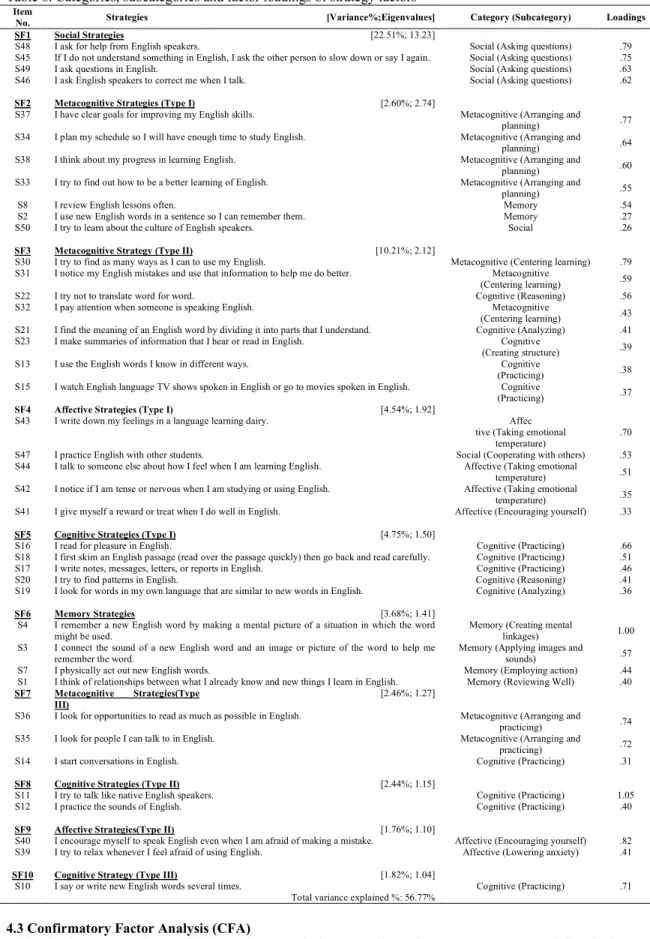
Factor loadings greater than ±.50 are generally considered necessary for practical significance (Hair et al., 2010). However, the inflation of item loadings by using different extraction methods should be considered. Different from Principle component analysis (PCA), ML does not seem to inflate the variance estimates (Costello & Osborne, 2005). Therefore, this study adopted a rule of thumb that only variables with loadings of .32 and above are interpreted (Tabachnick & Fidell, 2006). Through ML, 41 items of the L2 Learning Strategy Questionnaire were analyzed with EFA and ten factors were extracted with a total variance percentage, 56.77% (see Table 6).
Table 6 lists the 10 strategy factors. The first strategy factor (SF1) consists of 4 items, all of which conceptually originate from Social Strategies. Thus, SF1 is labeled Social Strategies. The second factor (SF2) and third factor (SF3) were labeled Metacognative Strategies Type I and Metacognative Strategies Type II respectively. Three items were eliminated from SF2. The two items, S2 and S50, were eliminated because the factor loadings of are less than .32. S8 was eliminated because it is more of a memorizing strategy. The remaining 4 items of SF2 all refer to students’ strategies of arranging and planning their own learning. On the other hand, SF3 consists of 3 metacogntive strategies and 3 cognitive strategies. The 3 metacognitive strategies (S30, S31 and S32) are conceptually different from those 4 metacognitive strategies of SF2 in that notion of S30, S31 and S32 is about “centering learning” rather than arranging and planning language learning. The 3 cognitive strategies are used by the students to analyze (S21), reason (S22), and create structures (S23), which are actually deep congnitive strategies and clustered together with the metacognitive strategies.
The fourth factor (SF4) characterized affective aspect of language learning strategies and therefore is labeled Affective Strategies (Type I). It is noted that the item S47 was eliminated for it in nature belongs to the category of Social Strategies. All the 5 items of the fifth factor (SF5) describe cognitive strategies with focus on practicing and therefore without any doubt is labeled Cognitive Strategies (Type I). The sixth factor (SF6) contains 4 items that specify how students memorize new words or new things and therefore labeled Memory Strategies. SF7 contains three items (S14, S35 and S36). S14, which derives from Cognitive Strategy, is totally different from S35 and S36, both of which are strategies that students use to intentionally seek opportunities to practice English. Accordingly, S14 was eliminated from SF7. The feature of SF7 is the same as that of SF2. Therefore, both S35 and S36 are integrated into SF2. SF8, SF9 and SF10 are also labeled according to the category of each factor. SF8 is labeled Cognitive Strategies (Type II) while SF9 is named Social Strategies (Type II). SF10, only consisting of one item, S10, is labeled Cognitive Strategies (Type III).
To summarize, after the 3 inappropriate items with factor loadings below .32 (S2, S14 and S50) and 2 items with inconsistent category (S8 and S47) were eliminated, the factor loadings of the 36 items ranged from .33 to 1.05. As a result, a total of 9 meaningful strategy factors remained: 1 factor of Social Strategies, 1 factor of Memory Strategies, 2 factors of Metacognitive Strategies (Type I & II), 2 factors of Affective Strategies (Type I & II) and 3 factors of Cognitive Strategies (Type I, II & III). This 9-factor model was further analyzed via CFA, as described in the following sections.
Table 6. Categories, subcategories and factor loadings of strategy factors
Item
No. Strategies [Variance%;Eigenvalues] Category (Subcategory) Loadings
SF1 Social Strategies [22.51%; 13.23]
S48 I ask for help from English speakers. Social (Asking questions) .79 S45 If I do not understand something in English, I ask the other person to slow down or say I again. Social (Asking questions) .75 S49 I ask questions in English. Social (Asking questions) .63 S46 I ask English speakers to correct me when I talk. Social (Asking questions) .62
SF2 Metacognitive Strategies (Type I) [2.60%; 2.74]
S37 I have clear goals for improving my English skills. Metacognitive (Arranging and
planning) .77 S34 I plan my schedule so I will have enough time to study English. Metacognitive (Arranging and
planning) .64 S38 I think about my progress in learning English. Metacognitive (Arranging and
planning) .60 S33 I try to find out how to be a better learning of English. Metacognitive (Arranging and
planning) .55
S8 I review English lessons often. Memory .54
S2 I use new English words in a sentence so I can remember them. Memory .27 S50 I try to learn about the culture of English speakers. Social .26
SF3 Metacognitive Strategy (Type II) [10.21%; 2.12]
S30 I try to find as many ways as I can to use my English. Metacognitive (Centering learning) .79 S31 I notice my English mistakes and use that information to help me do better. Metacognitive
(Centering learning) .59 S22 I try not to translate word for word. Cognitive (Reasoning) .56 S32 I pay attention when someone is speaking English. Metacognitive
(Centering learning) .43 S21 I find the meaning of an English word by dividing it into parts that I understand. Cognitive (Analyzing) .41 S23 I make summaries of information that I hear or read in English. Cognitive
(Creating structure) .39 S13 I use the English words I know in different ways. Cognitive
(Practicing) .38 S15 I watch English language TV shows spoken in English or go to movies spoken in English. Cognitive
(Practicing) .37
SF4 Affective Strategies (Type I) [4.54%; 1.92]
S43 I write down my feelings in a language learning dairy. Affec tive (Taking emotional
temperature)
.70
S47 I practice English with other students. Social (Cooperating with others) .53 S44 I talk to someone else about how I feel when I am learning English. Affective (Taking emotional
temperature) .51 S42 I notice if I am tense or nervous when I am studying or using English. Affective (Taking emotional
temperature) .35 S41 I give myself a reward or treat when I do well in English. Affective (Encouraging yourself) .33
SF5 Cognitive Strategies (Type I) [4.75%; 1.50]
S16 I read for pleasure in English. Cognitive (Practicing) .66 S18 I first skim an English passage (read over the passage quickly) then go back and read carefully. Cognitive (Practicing) .51 S17 I write notes, messages, letters, or reports in English. Cognitive (Practicing) .46 S20 I try to find patterns in English. Cognitive (Reasoning) .41 S19 I look for words in my own language that are similar to new words in English. Cognitive (Analyzing) .36
SF6 Memory Strategies [3.68%; 1.41]
S4 I remember a new English word by making a mental picture of a situation in which the word might be used.
Memory (Creating mental
linkages) 1.00 S3 I connect the sound of a new English word and an image or picture of the word to help me
remember the word.
Memory (Applying images and sounds) .57 S7 I physically act out new English words. Memory (Employing action) .44 S1 I think of relationships between what I already know and new things I learn in English. Memory (Reviewing Well) .40 SF7 Metacognitive Strategies(Type
III)
[2.46%; 1.27]
S36 I look for opportunities to read as much as possible in English. Metacognitive (Arranging and
practicing) .74 S35 I look for people I can talk to in English. Metacognitive (Arranging and
practicing) .72 S14 I start conversations in English. Cognitive (Practicing) .31
SF8 Cognitive Strategies (Type II) [2.44%; 1.15]
S11 I try to talk like native English speakers. Cognitive (Practicing) 1.05 S12 I practice the sounds of English. Cognitive (Practicing) .40
SF9 Affective Strategies(Type II) [1.76%; 1.10]
S40 I encourage myself to speak English even when I am afraid of making a mistake. Affective (Encouraging yourself) .82 S39 I try to relax whenever I feel afraid of using English. Affective (Lowering anxiety) .41
SF10 Cognitive Strategy (Type III) [1.82%; 1.04]
S10 I say or write new English words several times. Cognitive (Practicing) .71 Total variance explained %: 56.77%
4.3 Confirmatory Factor Analysis (CFA)
convergent validity and discriminant validity. Convergent validity is assessed by: 1) standardized loading estimates (λ>.50) with the t-value of λ at significant level, 2) composite reliability (CR >.70), and 3) average variance extracted (AVE >.50) (Fornell & Larcker, 1981). The Preliminary Fit Criteria, the Overall Model Fit and the Fit of Internal Structural of Model were assessed respectively.
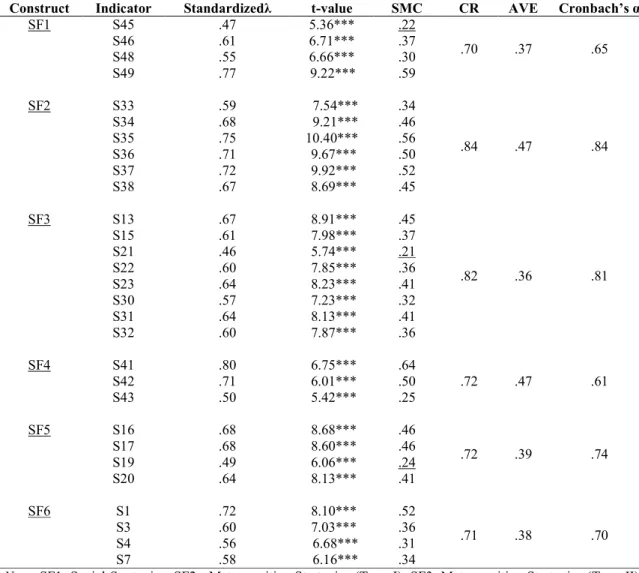
Table 8 lists the indices of convergent validity and reliability for the 6 strategy factors (SF1 to SF6), with the other factors (SF8 to SF10) being eliminated. The three strategy factors (SF8, SF9 and SF10) were eliminated because of the following reasons. P-values of the first order CFA for the three strategy factors were less than .05, which may be ascribed to the insufficient numbers of indicators for the latent variables. There were only one or two indicators for the construct of SF10, SF9 and SF8. Furthermore, two items, S18 and S44, were eliminated from SF5 and SF4 respectively. Since SMC is regarded as item reliability, which is suggested to greater than .25 (Bagozzi & Yi, 1988), the SMC values of S18 (SMC=.13) and S44 (SMC=.15) were much lower than .25, indicating poor item reliability.
The indices of convergent validity and reliability for the 6 extracted strategy factors generally suggested good convergent validity except AVE. All the standardized loading estimates (λ) are greater than .50 at significant level (***p <.001) except S45 (λ=.47), S21 (λ=46) and S19 (λ=.49). The SMC values of the three indicators (S45, S21 and S19) are slightly lower than .25. The three items (S45, S21 and S19) remain in the 6-factor model because their 6-factor loadings and item reliability are both acceptable.
4.3.1 the preliminary fit criteria
The Preliminary Fit Criteria for the 29 items of the new language learning strategy questionnaire is considered good. First, all the standardized λ values are greater than .30. Second, the correlation coefficients (Cronbach’s α) between the 36 items are between .01 and .65. Moreover, only the correlation coefficients between S3 and S4 (Cronbach’s α=.64) and between S37 and S38 (Cronbach’s α=.65) are greater than .60 while the correlation coefficients between other items are from extreme low (below .20) or low (.20 < Cronbach’s α<.40) to medium (.40< Cronbach’s α<.60).
4.3.2 the overall model Fit
The Overall Model Fit of the one order CFA for the 6-factor model is good. Multiple indices are often reported for Good-fitting model (Tabachnick & Fidell, 2006). Among the indices, the Comparative fit index (CFI) and Root-mean-square error of approximation (RMSEA) are the most frequently reported fit indices (Tabachnick & Fidell, 2006). Hu and Bentler (1999) suggest that report two types of fit indices for Good-fitting model: the SRMR and CFI. Therefore, in addition to RMSEA and CFI, this study also adopted SRMR. The five indices of the three measures all indicate a good fit for the 6 factor model (see Table 7).
Table 7. Fit measures of the 6-factor model
Measures Absolute Fit Incremental Fit Parimonious Fit
Indices RMSEA SRMR CFI NFI χ2/df (p-value)
Assessing Norms <.050 <.080 >.900 >.900 1<χ2/df <3 (p>.05)
6-factor Model .029 .060 .985 .934 371.34/329 (p=.05367)
Note. RMSEA=Root-mean-square error of approximation, SRMR=Standardized root-mean-square residual, CFI=Comparative fit index, NFI=Normed fit index, df=degree of freedom.
4.3.3 the fit of internal structural of model
The Fit of Internal Structural of Model for the 6-factor model is assessed by 1) composite reliability (CR >.70), 2) average variance extracted (AVE >.50) and 3) squared multiple correlation (SMC) of each indicator. SMC suggests the extent to which a measured indicator’s variance is explained by a latent factor and it is regarded as item reliability, which is suggested to be greater than .25 (Hair et al, 2010).
Composite reliability of the 6 strategy factors are within appropriate range (from .70 to .84). AVE are all less than acceptable range (AVE >.50). The SMC values of S19, S21 and S45 are less than .25. The three items are preserved because their factor loadings are still within the minimally acceptable standard (standardized λ >.30). To further verify the Fit of Internal Structural of Model, it is necessary to assess the discriminant validity of each strategy factor. The matrix of correlation coefficients, R2 and AVE of each construct are listed in Table 9.
Table 8. Indices of Convergent Validity and Reliability for Strategy Factors
Construct Indicator Standardizedλ t-value SMC CR AVE Cronbach’s α
SF1 S45 .47 5.36*** .22 .70 .37 .65 S46 .61 6.71*** .37 S48 .55 6.66*** .30 S49 .77 9.22*** .59 SF2 S33 .59 7.54*** .34 .84 .47 .84 S34 .68 9.21*** .46 S35 .75 10.40*** .56 S36 .71 9.67*** .50 S37 .72 9.92*** .52 S38 .67 8.69*** .45 SF3 S13 .67 8.91*** .45 .82 .36 .81 S15 .61 7.98*** .37 S21 .46 5.74*** .21 S22 .60 7.85*** .36 S23 .64 8.23*** .41 S30 .57 7.23*** .32 S31 .64 8.13*** .41 S32 .60 7.87*** .36 SF4 S41 .80 6.75*** .64 .72 .47 .61 S42 .71 6.01*** .50 S43 .50 5.42*** .25 SF5 S16 .68 8.68*** .46 .72 .39 .74 S17 .68 8.60*** .46 S19 .49 6.06*** .24 S20 .64 8.13*** .41 SF6 S1 .72 8.10*** .52 .71 .38 .70 S3 .60 7.03*** .36 S4 .56 6.68*** .31 S7 .58 6.16*** .34
Note: SF1=Social Strategies, SF2= Metacognitive Strategies (Type I), SF3=Metacognitive Strategies (Type II), SF4=Affective Strategies, SF5=Cognitive Strategies, SC6=Memory Strategies. SMC=Squared Multiple correlation; CR=Composite Reliability; AVE=Average Variance Extracted; *** p<.001.
In Table 9, the coefficients in the upper part of the matrix are Pearson correlation coefficients while in the lower part are R2. The AVE of each strategy factor displays in the diagonal line. The AVE of the strategy factor is greater than R2 of the other 5 strategy factors, indicating good discriminant validity between the 6 strategy factors except SF2, SF3 and SF5. Although the AVE of SF2 (.47) is less than the R2 of SF3 (.56) while the AVE of SF3 (.36) is less than R2 of SF5 (.48), the comparison of AVE and R2 still suggest good discriminant validity for the 6-factor model. Namely, the Fit of Internal Structural of Model for the 6-factor model is proven to be good.
Table 9. Pearson correlation coefficients, AVE and R2 of Strategy Factors
Construct SF1 SF2 SF3 SF4 SF5 SF6 SF1 .37 .60** .60** .39** .57** .47** SF2 .36 .47 .75** .49** .64** .50** SF3 .36 .56 .36 .48** .69** .53** SF4 .15 .24 .23 .47 .45** .37** SF5 .32 .40 .48 .20 .39 .51** SF6 .22 .25 .28 .13 .26 .38
Note: SF1=Social Strategies, SF2= Metacognitive Strategies (Type I), SF3=Metacognitive Strategies (Type II), SF4=Affective Strategies, SF5=Cognitive Strategies, SF6=Memory Strategies; AVE=Average Variance Extracted; R2= Squared correlation coefficients; ** p<.05.
strategies, a 6-factor model of the new language learning strategy questionnaire is formed, including 29 items. The composite reliability, discriminant validity, reliability and total variance explained percentage of the new language learning strategy questionnaire is presented (see Appendix A).
5. Conclusion
By using exploratory factor analysis and confirmatory factor analysis, we proposed a 6-factor model of the new language learning strategy questionnaire and reclassified the SILL questionnaire within a particular EFL context. The new questionnaire consists 29 items were formed, which are subsumed into 6 broad strategy factors: one factor of Social Strategies (SF1, 4 items), two factors of Metacognitive Strategies (SF2, 6 items and SF3, 8 items), one factor of Affective Strategies (SF4, 3 items), one factor of Cognitive Strategies (SF5, 4 items) and one factor of Memory Strategies (SF6, 4 items). Adequate validity and reliability of the model were demonstrated in the study. Construct validity was supported by the convergent validity and discriminant validity evidence. Confirmatory factor analysis supports the Preliminary Fit Criteria, the Overall Model Fit and the Fit of Internal Structural of Model. The overall reliability for the 6-factor model is quite satisfying, and so is the Cronbach’s α of each factor.
It is hoped that the 6-factor model of language learning strategy and the new questionnaire may be used for further research on strategy use/training and on further exploration of its relationships with other crucial variables in the field of and L2 learning, such as motivation, learning style and learning autonomy. It is worth noting that the results of the study should be treated as temporary and the generalization of results may be limited since the data were collected from one particular sample of male EFL learners at a senior high school. Therefore, for the further studies we propose several suggestions as follows. First, important factors such as gender, age and proficiency levels need to be considered. Data may be collected from female learners and/or learners at different age and proficiency levels. Second, the goals of EFL learners may vary from one learning context to another. In our study, passing the entrance examinations with high scores was an important goal to the senior high school student participants. It is suggested that in the further studies, data may be collected from participants whose goal is to pursue communicative ability instead of high examination scores.
References
Anderson, J. (1983). The architecture of cognition. Boston, MA: Harvard University. Anderson, J. (1985). Cognitive psychology and its implications. New York, NY: Freeman.
Bagozzi, R. P., & Yi, Y. (1988). On the evaluation of structural equation models. Journal of the Academy of Marketing Science, 16, 74–94. Bartlett, M. S. (1950). Tests of significance in factor analysis. British Journal of Mathematical and Statistical Psychology, 3 (2), 77–85. Chiu, H. C. (2005). Quantitative research and statistical analysis in social & behavioral sciences. Taipei: Wu Nan.
Cohen, A. D. (2011). Strategies in learning and using a second language (2nd
Ed.). New York, NY: Pearson Education Limited.
Costello, A. B., & Osborne, J. W. (2005). Best practices in exploratory factor analysis: Four recommendations for getting the most from your analysis. Practical Assessment, Research & Evaluation, 10 (7), 1–9.
Cohen, A. D., & Macaro, E. (Eds). (2007). Language learner strategies: Thirty years of research and practice. New York, NY: Oxford University Press.
Dörnyei, Z. (2005). The psychology of the language learner: Individual differences in second language acquisition. Mahwah, NJ: Lawrence Erlbaum.
Ellis, R. (2008). The study of second language acquisition (2nd
Ed). Oxford, England: Oxford University Press.
Fornell, C. R. & Larcker, F. F. (1981). Structural Equation Models with Unobservable Variables and Measurement Error. Journal of Marketing Research, 18, 39–51.
Griffiths, C. (2003). Patterns of language learning strategy use System, 31, 367–383.
Hair, Jr. J. F., Black, W. C, Babin, B. J., & Anderson, R. E. (2010). Multivariate data analysis (7th
ed.). Trenton, NJ: Pearson Education, Inc. Hu, L. T., & Bentler, P. M. (1999). Cutoff criteria for fit indexes in covariance structure analysis: Conventional criteria versus new
alternatives. Structural equation modeling: A Multidisciplinary Journal, 6(1), 1–55. Kaiser, H. F. (1970). A second generation little Jiffy. Psychometrika, 35(4), 401–415. Kaiser, H. F. (1974). An index of factorial simplicity. Psychometrika, 39(1), 31–36.
Kline, R. B. (2005). Principles and practice of structural equation modeling. New York, NY: Guilford.
Macaro, E. (2006). Strategies for language learning and for Language Use: Revising the Theoretical Framework. The Modern Language Journal, 90 (3), 320–337.
Naiman, N., Frohlich, M., Stern, H. H., & Todesco, A. (1978). The good language learner. Toronto: Ontario Institute for Studies in Education.
O’Malley, J. M., Chamot, A. U., Stewner-Manzanares, G.., Kupper, L., & Russo, R. P. (1985). Learning strategy used by beginning and intermediate ESL students. Language Learning, 35(1), 21−46.
Oxford, R.L. (1989). Strategy inventory for language learning. Alexandria, VA: Oxford Associates.
Oxford, R.L. (1990). Language learning strategies: What every teacher should know. New York, NY: Newbury House/Harper Collins. Rahimi, M., Riazi, A., & Saif, S. (2008). An investigation into the factors affecting the use of language learning strategies by Persian EFL
learners. CJAL, 11(2), 31–60.
Rivera-Mills, S. V., & Plonsky, L. (2007). Empowering students with language learning strategies: A critical review of current issues. Foreign Language Annals, 40(3), 535−548.
Rubin, J. (1975). What the “good language learner” can teach us. TESOL Quarterly, 9(1), 41−51.
Rubin, J. (1981). Study of cognitive processes in second language learning. Applied Linguistics, 11(2), 118−131. Stern, H. H. (1975). What can we learn from the good language leaner? Canadian Modern Language Review, 31, 304−318. Tabachnick, B. G., & Fidell, L. S. (2006). Using multivariate statistics (5th
Woodrow, L. (2005). The challenge of measuring language learning strategies. Foreign Language Annals, 38(1), 90–98.
Appendix A
The New Language Learning Strategy Questionnaire Item
No. Strategies
The number of Items [Variance%;
Eigenvalues] CR AVE vs R
2
Cronbach’s α
SF1 Social Strategies 4 items [22.51%; 13.23]
S45 If I do not understand something in English, I ask the other person to slow down or say I again.
.70 .37 > R2
.65 S46 I ask English speakers to correct me when I talk.
S48 I ask for help from English speakers. S49 I ask questions in English.
SF2 Metacognitive Strategies (Type I) 6 items [5.06%; 2.74]
S33 I try to find out how to be a better learning of English.
.84 .47 < R2
.84 S34 I plan my schedule so I will have enough time to study English.
S35 I look for people I can talk to in English.
S36 I look for opportunities to read as much as possible in English. S37 I have clear goals for improving my English skills.
S38 I think about my progress in learning English.
SF3 Metacognitive Strategy (Type II) 8 items [10.21%; 2.12]
S13 I use the English words I know in different ways.
.82 .36 < R2
.81 S15 I watch English language TV shows spoken in English or go to movies spoken
in English.
S21 I find the meaning of an English word by dividing it into parts that I understand.
S22 I try not to translate word for word.
S23 I make summaries of information that I hear or read in English. S30 I try to find as many ways as I can to use my English.
S31 I notice my English mistakes and use that information to help me do better. S32 I pay attention when someone is speaking English.
SF4 Affective Strategies (Type I) 3 items [4.54%; 1.92]
S41 I give myself a reward or treat when I do well in English.
.72 .47 > R2
.61 S42 I notice if I am tense or nervous when I am studying or using English.
S43 I write down my feelings in a language learning dairy.
SF5 Cognitive Strategies (Type I) 4 items [4.75%; 1.50]
.72 .39 > R2
.74 S16 I read for pleasure in English.
S17 I write notes, messages, letters, or reports in English.
S19 I look for words in my own language that are similar to new words in English. S20 I try to find patterns in English.
SF6 Memory Strategies 4 items [3.68%; 1.41]
S1 I think of relationships between what I already know and new things I learn in English.
.71 .38 > R2
.70 S3 I connect the sound of a new English word and an image or picture of the
word to help me remember the word.
S4 I remember a new English word by making a mental picture of a situation in which the word might be used.
S7 I physically act out new English words.
Total variance explained %: 50.75%
Reliability of the overall construct: .87
Note. CR=Composite Reliability; AVE=Average Variance Extracted; R2= Squared Pearson correlation coefficients of the other constructs.
Acknowledgement: I would like to express my eternal gratitude to those who contributed to this study. But for their positive support and encouragement, I would have not been able to complete the study. First, I would like to convey my heartfelt thanks to Dr. Stephen G. Craft, of Embry-Riddle University, who was very patient with my manuscript and spared no pains in offering invaluable suggestions and having considerable discussion across national boundaries. Moreover, I owe my utmost appreciation to all the English teachers of the chosen senior high school in central Taiwan for their voluntary help towards the data collection of the study. Finally, I would like to dedicate this study to my supportive family. I learn from you, I admire you and I love you.