INFORMATION EXTRACTION OF +/-EFFECT
EVENTS TO SUPPORT OPINION INFERENCE
by
Yoonjung Choi
B.E., Korea Advanced Institute of Science and Technology, 2007
M.S., Korea Advanced Institute of Science and Technology, 2010
Submitted to the Graduate Faculty of
the Kenneth Dietrich School of Arts and Sciences
in partial fulfillment of the requirements for the degree of
Doctor of Philosophy
in Computer Science
University of Pittsburgh
2016
UNIVERSITY OF PITTSBURGH
DIETRICH SCHOOL OF ARTS AND SCIENCES
This dissertation was presented
by
Yoonjung Choi
It was defended on
August 29th 2016
and approved by
Janyce Wiebe, PhD, Professor, Department of Computer Science
Diane Litman, PhD, Professor, Department of Computer Science
Milos Hauskrecht, PhD, Associate Professor, Department of Computer Science
Rebecca Hwa, PhD, Associate Professor, Department of Computer Science
Tessa Warren, PhD, Associate Professor, Department of Linguistics
Dissertation Advisors: Janyce Wiebe, PhD, Professor, Department of Computer Science,
Copyright cby Yoonjung Choi 2016
INFORMATION EXTRACTION OF +/-EFFECT EVENTS TO SUPPORT OPINION INFERENCE
Yoonjung Choi, PhD
University of Pittsburgh, 2016
Recently, work in NLP was initiated on a type of opinion inference that arises when opin-ions are expressed toward events which have positive or negative effects on entities, called
+/-effect events. The ultimate goal is to develop a fully automatic system capable of recog-nizing inferred attitudes. To achieve its results, the inference system requires all instances of +/-effect events. Therefore, this dissertation focuses on +/-effect events to support opin-ion inference. To extract +/-effect events, we first need the list of +/-effect events. Due to significant sense ambiguity, our goal is to develop a sense-level rather than word-level lexicon. To handle sense-level information, WordNet is adopted. We adopt a graph-based method which is seeded by entries culled from FrameNet and then expanded by exploiting semantic relations in WordNet. We show that WordNet relations are useful for the polarity propagation in the graph model. In addition, to maximize the effectiveness of different types of information, we combine a graph-based method using WordNet relations and a standard classifier using gloss information. Further, we provide evidence that the model is an effective way to guide manual annotation to find +/-effect senses that are not in the seed set. To exploit the sense-level lexicons, we have to carry out word sense disambiguation. We present a knowledge-based +/-effect coargrained word sense disambiguation method based on se-lectional preferences via topic models. For more information, we first group senses, and then utilize topic models to model selectional preferences. Our experiments show that selectional preferences are helpful in our work. To support opinion inferences, we need to identify not
+/-effect event detection and affected entity identification. Since +/-effect events and their affected entities are closely related, instead of a pipeline system, we present a joint model to extract +/-effect events and their affected entities simultaneously. We demonstrate that our joint model is promising to extract +/-effect events and their affected entities jointly.
Keywords: Sentiment Analysis, Implicit Opinion, Opinion Inference, Lexical Acquisition, Word Sense Disambiguation.
TABLE OF CONTENTS
1.0 INTRODUCTION . . . 1
1.1 Research Summary . . . 6
1.2 Contributions of this work . . . 12
1.3 Outline . . . 14
2.0 BACKGROUND . . . 15
2.1 Word Sense and WordNet. . . 15
2.2 FrameNet. . . 19
2.3 Machine Learning Methods . . . 22
2.3.1 Graph-based Semi-Supervised Learning . . . 22
2.3.2 Topic Model . . . 23
2.3.3 Structured Prediction . . . 26
3.0 GENERAL INFORMATION ABOUT SENTIMENT ANALYSIS . . . 28
4.0 OPINION INFERENCE AND +/-EFFECT EVENT . . . 31
4.1 Opinion Inference . . . 31
4.1.1 +/-Effect Corpus . . . 33
4.2 +/-Effect Event . . . 36
4.2.1 +/-Effect Events, Sentiment Terms, vs. Connotation Terms . . . . 36
4.2.2 Sense-level +/-Effect Ambiguity . . . 37
4.2.3 Lexical Category of +/-Effect Events . . . 41
5.1 Seed Lexicon . . . 46
5.2 Evaluation Metrics . . . 48
5.3 Bootstrapping Method . . . 51
5.4 Corpus Evaluation . . . 52
5.5 Sense Annotation Evaluation . . . 54
5.6 Related Work . . . 56
5.7 Summary . . . 58
6.0 EFFECTWORDNET: SENSE-LEVEL +/-EFFECT LEXICON . . . . 60
6.1 Data . . . 62
6.1.1 Word-level +/-Effect Lexicon . . . 62
6.1.2 Sense-level +/-Effect Seed Lexicon . . . 62
6.1.3 Data for Guided Annotation . . . 64
6.2 Evaluation Metrics . . . 64
6.3 Graph-based Semi-Supervised Learning for WordNet Relations . . . 66
6.3.1 Graph Formulation . . . 66
6.3.2 Label Propagation . . . 69
6.3.3 Experimental Results . . . 70
6.4 Supervised Learning applied to WordNet Glosses . . . 74
6.4.1 Features . . . 74 6.4.2 Gloss Classifier . . . 74 6.4.3 Experimental Results . . . 75 6.5 Hybrid Method . . . 77 6.5.1 Experimental Results . . . 77 6.5.2 Model Comparison . . . 78 6.6 Guided Annotation . . . 82 6.7 Related Work . . . 85 6.8 Summary . . . 87 7.0 ENHANCED EFFECTWORDNET . . . 90
7.1 New Annotation Study . . . 92
7.3 Framework . . . 94
7.4 Experimental Results . . . 97
7.5 Related Work . . . 99
7.6 Summary . . . 100
8.0 COARSE-GRAINED +/-EFFECT WORD SENSE DISAMBIGUA-TION . . . 102
8.1 Data . . . 105
8.2 Evaluation Metrics . . . 106
8.3 Task Definition. . . 107
8.4 +/-Effect Word Sense Disambiguation System . . . 108
8.4.1 Sense Grouping . . . 108
8.4.2 Arguments for Selectional Preferences . . . 110
8.4.3 Topic Model . . . 111
8.4.4 Word Sense Disambiguation . . . 113
8.5 Experiments . . . 113
8.5.1 Baselines . . . 114
8.5.2 Experimental Results . . . 114
8.5.3 The Role of Word Sense Clustering . . . 119
8.5.4 The Role of Manual +/-Effect Sense Labels . . . 121
8.6 Related Work . . . 122
8.7 Summary . . . 124
9.0 JOINT EXTRACTION OF +/-EFFECT EVENTS AND AFFECTED ENTITY . . . 126
9.1 Data . . . 129
9.2 Evaluation Metrics . . . 130
9.3 Task Definition. . . 131
9.4 Joint Extraction using Structured Perceptron . . . 132
9.4.1 Representation . . . 132
9.5 Features . . . 139
9.5.1 Basic Features . . . 139
9.5.2 Features for EffectWordNet . . . 140
9.5.3 Features for Relations between +/-Effect Events and Affected Entities141 9.6 Experiments . . . 142
9.6.1 Baseline System . . . 142
9.6.2 Experimental Results . . . 143
9.7 Related Work . . . 145
9.8 Summary . . . 146
10.0 CONCLUSION AND FUTURE WORK . . . 148
LIST OF TABLES
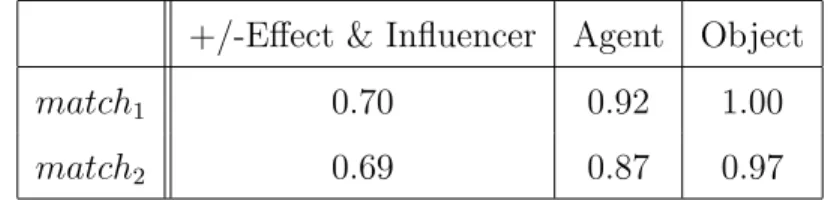
1 The agreement score about a span of +effect events & influencers, agents, and
objects. . . 35
2 Results after the simple lexicon expansion . . . 53
3 Results against sense-annotated data. . . 55
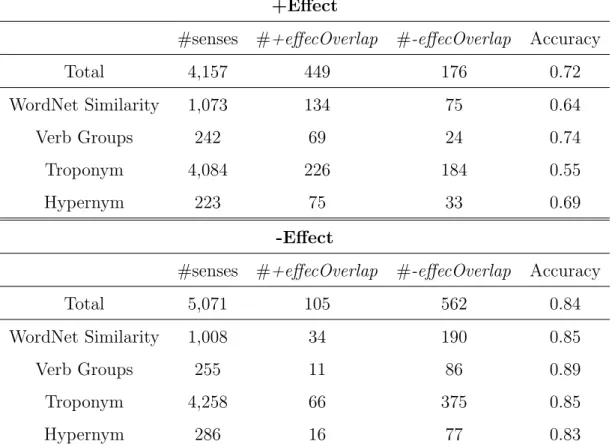
4 Accuracy broken down for +/-effect . . . 56
5 Distribution of annotated sense-level +/-effect seed data. . . 63
6 Frequency of the top 5% for each iteration. . . 64
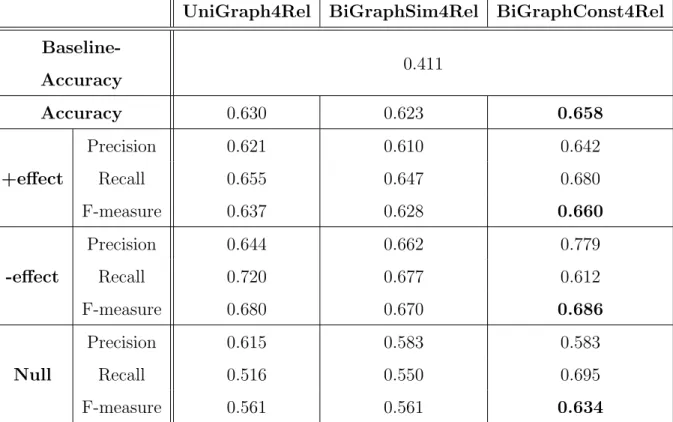
7 Results of UniGraph4Rel, BiGraphSim4Rel, and BiGraphConst4Rel. . . 71
8 Effect of each relation in BiGraphConst4Rel. . . 73
9 Results of Classifier4Gloss with the ablation study. . . 76
10 Results of BiGraphConst4Rel, Classifier4Gloss and Hybrid4AllFea. . . 78
11 Comparison to Classifier4Gloss, Hybrid4AllFea, and Classifier4AllFea. . . 80
12 Comparison to BiGraphConst4Rel, Hybrid4AllFea, and BiGraph4AllFea.. . . 81
13 Results of an iterative approach for BiGraphConst4Rel. . . 83
14 Results of an iterative approach for Hybrid4AllFea.. . . 83
15 Accuracy and frequency of the top 5% for each iteration. . . 85
16 Results of Enhanced EffectWordNet. . . 98
17 Results of BiGraphConst4Rel in Chapter 6. . . 99
18 Experimental results forAll and Conf set. . . 116
21 Comparison among fine-grained WSD (No Groups), a fixed number of sense groups (Fixed), and a variable number of sense groups (Our Method) onConf
set. . . 120
22 Precision, Recall, and F-measure figures broken down per +/- effect. . . 121
23 The structure of inputs and outputs in our system. vi and aj are inputs and
ei and ri,j are outputs.. . . 133 24 The representation of the sentence, Improving care for seniors after they leave
the hospital. . . 134
25 Results of +/-Effect Event Detection. . . 144
LIST OF FIGURES
1 The example like in WordNet. . . 18
2 The example semantic frame Creating in FrameNet. . . 20
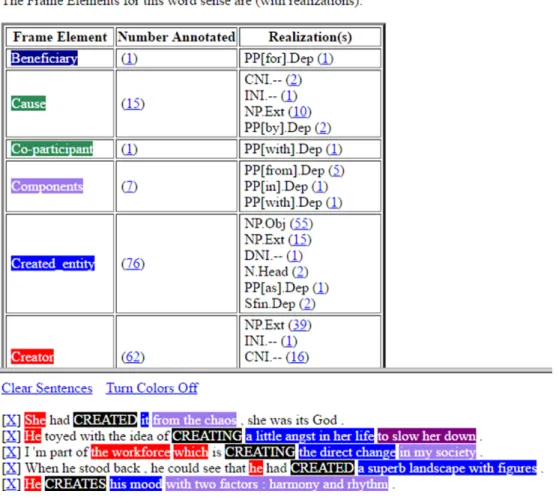
3 The example lexical entry create of the Creating frame in FrameNet. . . 21
4 The graphical Probabilistic Latent Semantic Analysis (pLSA) Model. . . 25
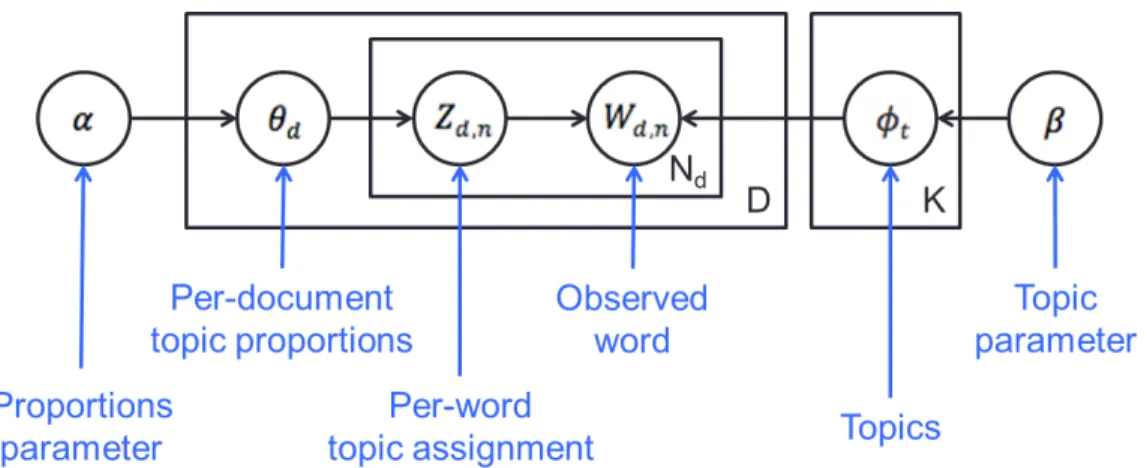
5 The graphical Latent Dirichlet Allocation (LDA) Model. . . 25
6 Part of constructed graph. . . 67
7 The distribution of which entities are affected for the +effect and -effect labels. 93 8 Plate notation representing our topic model. . . 112
LIST OF ALGORITHMS
1 Learning algorithm for averaged structured perceptron with beam search and early update. . . 136
2 Beam search decoding algorithm for a joint +/-effect event and affected entity extraction. . . 138
1.0 INTRODUCTION
Opinions are commonly expressed in many kinds of written and spoken text such as blogs, reviews, new articles, discussions, and tweets. Sentiment Analysis is the computational study to identify opinions, evaluations, attitues, affects, and emotions expressed in such texts [Liu, 2010]. There are many names and tasks with somewhat different objectives and models such as opinion mining, sentiment mining, subjectivity analysis, affect analysis, emotion detection, and so on.
Here is the example of reviews presented by [Liu, 2010]:
(a) I bought an iPhone a few days ago. (b) It was such a nice phone. (c) The touch screen was really cool. (d) The voice quality was clear too. (e) Although the battery life was not long, that is ok for me. (f ) However, my mother was mad with me as I did not tell her before I bought the phone. (g) She also thought the phone was too expensive, and wanted me to return it to the shop.
In this example, the sentence (a) has no sentiment while others have sentiment informa-tion. We can say that the sentence (a) is the objective sentence because it presents some factual information; others are subjective sentences because they express some personal feel-ings, views, emotions, or beliefs. In addition, each sentence except the sentence (a) has different sentiment information. In the sentence (b), the writer has a positive sentiment toward an iPhone. Also, in the sentence (c) and (d), the writer has a positive sentiment toward attributes (i.e., the touch screen and the voice quality) of theiPhone. On the other hand, in the sentence (g), the writer’s mother has a negative sentiment toward the iPhone.
Recently, there have been a surge in research in sentiment analysis. It has been ex-ploited in many application areas such as review mining, election analysis, and information extraction. Especially, with growing interest in social media such as Facebook, Twitter, and blogs, which contain various opinionated user contents, sentiment analysis has become increasingly important because it can be applied for a variety of applications such as opinion summarization, opinion spam detection, advertisement, and customized recommendation.
Sentiment analysis consists of three subtasks. The basic subtask is classifying the opinion orientation (i.e., polarity) of a given text at the document/sentence/phrase/aspect-level. That is, it determines whether the expressed opinion in the given text is positive, negative, or neutral. For instance, the sentence (b), (c), and (d) in the previous example should be classified into positive sentences while the sentence (f) and (g) should be classified into negative sentences. In the sentence (e), even though the polarity of the sentence is neutral, in the phrase-level classification, the battery life should be classified into a negative phrase.
Other subtasks are the opinion holder detection which extracts the person or organization that expresses the opinion and the opinion target extraction which identifies objects or their aspects on which opinions are expressed. For example, in the sentence (b), the opinion holder is a writer and the opinion target is iPhone; in the sentence (c), (d), and (e), the opinion holder is a writer and the opinion target is the touch screen, the voice quality, and
the battery life which are attributes of iPhone. On the other hand, in the sentence (f), the opinion holder is a writer’s mother (i.e.,my mother) and the opinion target is a writer (i.e.,
me); in the sentence (g), the opinion holder is a writer’s mother (i.e., She) and the opinion target isthe phone, which indicates iPhone.
Thus, in other words, sentiment analysis aims to determine the opinion orientation of an opinion holder with respect to an opinion target. There are various studies for sentiment analysis with different research topics (i.e., document/sentence/phrase/aspect-level polarity classification [Pang et al., 2002, Pang and Lee, 2005, Riloff et al., 2005, Wilson et al., 2004, Mei et al., 2007], opinion holder and target identification [Kim and Hovy, 2006], and sentiment lexicon construction [Kim and Hovy, 2004, Baccianella et al., 2010]) and various domains such as review texts [Turney, 2002], new articles [Wilson et al., 2005], blog data [Godbole et al., 2007], and tweets [Barbosa and Feng, 2010].
There are two types of opinions: explicit opinion and implicit opinion. The explicit opin-ion means that an opinopin-ion toward an opinopin-ion target is explicitly expressed by an opinopin-ion holder in a given text. The example (1) is one of example of explicit opinions.
(1) The voice quality of this phone is fantastic.
In this example, the opinion toward the target,the voice quality of this phone, is explicitly expressed with a word, fantastic, which is the key clue to determine an opinion orientation. These words or expressions which are used to express peoples subjective feelings and senti-ments/opinions are called assentiment lexicon. (It is also known as polarity words, opinion words, or opinion-bearing words.) Here are examples of positive and negative terms. Not just individual words but also phrases and idioms can be the sentiment lexicon such as cost an arm and a leg. That is, the explicit opinion is expressed with clues such as sentiment lexicon.
Positive terms: wonderful, elegant,amazing
Negative terms: horrible, bad
On the other hand, the implicit opinion means that an opinion toward an opinion target is implicitly expressed by an opinion holder in a given text. In the example (2), although it doesn’t express an opinion explicitly, we can know that a writer has a negative opinion toward the entity,the headset.
(2) The headset broke in two days.
Still, research in sentiment analysis has plateaued at a somewhat superficial level, provid-ing methods that exhibit a fairly shallow understandprovid-ing of subjective language as a whole. In particular, past research in NLP has mainly addressed explicit opinion expressions [Pang et al., 2002, Turney, 2002,Hu and Liu, 2004,Kim and Hovy, 2004, Wilson et al., 2005,Mei et al., 2007, Davidov et al., 2010, Barbosa and Feng, 2010], ignoring implicit opinions
ex-Recently, to determine implicit opinions, Wiebe and Deng [Wiebe and Deng, 2014] ad-dress a type of opinion inference that arises when opinions are expressed toward events which have positive or negative effects on entities. They call such events benefactive and malefac-tive, or, for ease of writing, goodFor and badFor events. While the term goodFor/badFor is used in their paper, we have decided that +/-effect is a better term. Thus, in this research, we call such events +/-effect events instead of goodFor/badFor.
[Deng and Wiebe, 2014] show how sentiments toward one entity may be propagated to other entities via opinion inference rules. They give the following example:
(3) The bill would curb skyrocketing health care costs.
The writer expresses an explicitnegativesentiment (byskyrocketing) toward the entity,
health care costs. The existing sentiment analysis system can determine it. However, the existing explicit sentiment analysis system cannot determine the sentiment toward the bill. With opinion inference rules, not only the sentiment toward health care costs but also the sentiment toward the bill can be inferred. The event, curb, has a negative effect (i.e., -effect) on skyrocketing health care costs, since they are reduced. We can reason that the writer is positive toward the eventbecause it has a negative effect on costs, toward which the writer is negative. From there, we can reason that the writer ispositivetowardthe bill, since it conducts the positive event.
Now, consider the another example:
(4) Oh no! The voters passed the bill.
Here, the writer expresses an explicit negative sentiment toward the passing event because ofOh no!. Although we cannot know the sentiment towardthe bill with the existing sentiment analysis system, we can infer it with opinion inference rules. The passing event is a positive effect(i.e., +effect) on the bill since it brings into existence. Since the writer is negative toward an event that benefits the bill, we can infer that the writer is negative toward the bill itself.
The ultimate goal is to develop a fully automatic system capable of recognizing such inferred attitudes. The system will require a set of implicature rules and an inference mech-anism. [Deng and Wiebe, 2014] present a graph-based model in which inference is achieved via propagation. They show that such inferences may be exploited to significantly improve explicit sentiment analysis systems.
To achieve its results, the inference system requires all instances of +/-effect events. However, the system developed by [Deng and Wiebe, 2014] takes manual annotations as input; that is, it is not fully automatic system. The ultimate system needs to recognize a span of +/-effect events and their polarities (i.e., +effect, -effect, or Null) automatically. For that, we first need the list of +/-effect events. Although there are similar lexicons such asSentiWordNet[Esuli and Sebastiani, 2006] and connotation lexicons [Feng et al.,
2011, Kang et al., 2014], sentiment, connotation, and +/-effects are not the same.
Moreover, the information about which entities are affected is important since the senti-ment toward an entity can be different. In the example (3), as we senti-mentioned, the given event,
curb, is -effect on the theme (i.e., the affected entity is the theme), and the writer’s sentiment toward the theme is negative. Thus, we know that the writer has a positive sentiment toward the event, and the sentiment toward the agent is positive.
Consider the following example:
(5) Yay! John’s team lost the first game.
We know that the writer expresses an explicit positive sentiment toward the event because of Yay!. The event, lost, has a negative effect (i.e., -effect) on the entity, John’s team, since it fails to win. That is, the affected entity is the agent, not the theme. We can infer that the writer has negative sentiment toward John’s team because the event, that the writer is positive, has anegative effect on John’s team. Compared to the sentence (3), even though both are -effect events and the writer has a positive sentiment toward these events, the sentiment toward the agent (i.e., the bill in the example (3) andJohn’s team in the example (5)) is different according to what the affected entity is. Such as these examples,
As we mentioned, for the opinion inference system to be fully automatic, +/-effect event extraction also must be fully automated. At this time, we have to consider which entities are affected by +/-effect events since the sentiment toward an entity can be different. Thus, the goal of this research is to develop resources and methods for information extraction of a general class of events, +/-effect events, which are critical for detecting im-plicit sentiment and which are also important for other tasks such as narrative understanding.
1.1 RESEARCH SUMMARY
As we mentioned, to recognize a span of +/-effect events and their polarities (i.e., +effect, -effect, or Null) automatically, we first need the list of +/-effect events. Since +/-effect lexicon is the new types of lexicons, there is not available resource for +/-effect events. Thus, we first have to create a +/-effect lexicon.
One task of this dissertation is to build +/-effect lexicons. Since a word can have one or more meanings, the +/-effect polarity of a word may not be consistent. We discover that there is significant sense ambiguity, meaning that words often have mixtures of senses among the classes +effect, -effect, and Null.
In the +/-effect1 corpus [Deng et al., 2013], +/-effect events and their agents and themes are annotated at the word-level. In this corpus, 1,411 +/-effect instances are annotated; 196 different +effect words and 286 different -effect words appear in these instances. Among them, 10 words appear in both +effect and -effect instances, accounting for 9.07% of all annotated instances. They show that +/-effect events (and the inferences that motivate this work) appear frequently in sentences with explicit sentiment. Further, all instances of +/-effect words that arenotidentified as +/-effect events are false hits from the perspective of a recognition system.
The following is an example of a word with senses of different classes:
carry:
S: (v) carry (win in an election) “The senator carried his home state” ⇒ +Effect toward the agent,the senator
S: (v) carry (keep up with financial support) “The Federal Government carried the province for many years”
⇒ +Effect toward the theme, the province
S: (v) carry (capture after a fight) “The troops carried the town after a brief fight” ⇒ -Effect toward the theme, the town
In the first sense, carry has positive polarity toward the agent, the senator, and in the second case, it has positive polarity toward the theme, the province. Even though the po-larity is the same, the affected entity is different. That is, in the first sense, the affected entity is the agent while the affected entity is the theme in the second sense. In the third sense, carry has negative polarity toward the theme, the town, since it is captured by the troops. Moreover, although a word may not have both +effect and -effect senses, it may have mixtures of (+effect or -effect) and Null. Consider pass.
pass:
S: (v) legislate, pass (make laws, bills, etc. or bring into effect by legislation) ⇒ +Effect toward the theme
S: (v) travel by, pass by, surpass, go past, go by, pass (move past) ⇒ Null
The meaning of pass in the example (4) is the first sense, in fact, +effect toward its theme. But consider the following example:
In this case, the meaning of pass is the second sense. This type of passing event does not (in itself) positively or negatively affect the thing passed. This use ofpass does not warrant the inference that the writer is negative toward the bridge.
A purely word-based approach is blind to these cases. Thus, to handle these ambiguities, we firstly develop a sense-level +/-effect lexicon. There are several resources with sense information such as WordNet and FrameNet. WordNet [Miller et al., 1990] is a computational lexicon of English based on psycholinguistic principles. Nouns, verbs, adjectives, and adverbs are organized by semantic relations between senses (synsets). There are several types of semantic relations such as hyponym, hypernym, troponym, and so on. Also, each sense has gloss information which consists of a definition and optional examples. FrameNet [Baker et al., 1998] is a lexical database of English based on a theory of meaning called Frame Semantics. In general, WordNet can cover more senses since it is a large database that groups words together based on their meanings. Moreover, senses in WordNet are interlinked by semantic relations which may be useful information to acquire +/-effect events. Thus, for +/-effect lexicon acquisition, we adopt WordNet which is a widely-used lexical resource. We first explore how +/-effect events are organized in WordNet via semantic relations and expand the seed set based on those semantic relations using a bootstrapping method.
One of our goals is to investigate whether the +/-effect property tends to be shared among semantically-related senses, and another is to use a method that applies to all word senses, not just to the senses of words in a given word-level lexicon. Thus, we build a graph-based model in which each node is a WordNet synset, and edges represent semantic WordNet relations between synsets. In addition, we hypothesize that glosses also contain useful information. Thus, we develop a supervised gloss classifier and define a hybrid model which gives the best overall performance. Moreover, we provide evidence that the graph-based model is an effective way to guide manual annotation to find new +/-effect senses.
Based on the constructed +/-effect lexicon, we can extract +/-effect events from a given text. If the constructed lexicon is a word-level lexicon, events can be determined directly; however, the constructed lexicon is a sense-level lexicon. Thus, to extract +/-effect events with a sense-level lexicon, we have to carry out Word Sense Disambiguation (WSD) to find specific senses.
In this dissertation, we develop a WSD system which is customized for +/-effect events. We address the following WSD task: given +/-effect labels of senses, determine whether an instance of a word in the corpus is being used with a +effect, -effect, or Null sense. Consider a word W, where senses {S1, S3, S7} are -effect; {S2} is +effect; and {S4, S5, S6} are Null.
For our purposes, we do not need to perform fine-grained WSD to pinpoint the exact sense; to recognize that an instance ofW is -effect, for example, the system only needs to recognize that W is being used with one of senses {S1, S3, S7}. Thus, we can perform coarse-grained
WSD, which is often more tractable than fine-grained WSD.
Though supervised WSD is generally the most accurate method, we do not pursue a supervised approach, because the amount of available sense-tagged data is limited. Instead, we conduct a knowledge-based WSD method which exploits WordNet relations and glosses. We use sense-tagged data (i.e., SensEval) only as gold-standard data for evaluation.
Our WSD method is based on selectional preferences, which are preferences of verbs to co-occur with certain types of arguments [Resnik, 1996, Rooth et al., 1999, Van de Cruys, 2014]. We hypothesize that preferences would be fruitful for our task, because +/-effect is a semantic property that involves affected entities. Consider the following WordNet informa-tion for climb:
climb:
S1: (v) climb, climb up, mount, go up (go upward with gradual or continuous progress)
“Did you ever climb up the hill behind your house?” ⇒ Null
S2: (v) wax, mount, climb, rise (go up or advance) “Sales were climbing after prices were
lowered”
⇒ +Effect toward the theme
S3: (v) climb (slope upward) “The path climbed all the way to the top of the hill”
⇒ Null
S4: (v) rise, go up, climb (increase in value or to a higher point) “prices climbed steeply”;
Senses S1 &S3 are both Null. We expect them to co-occur with hill and similar words
such as ridge and mountain. And, we expect such words to be more likely to co-occur with
S1 &S3 than with S2 &S4. Senses S2 & S4 are both +effect, since the affected entities are
increased. We expect them to co-occur with sales, prices, and words similar to them. And, we expect such words to be more likely to co-occur with S2 & S4 than with S1 & S3. This
example illustrates the motivation for using selectional preferences for +/-effect WSD. We model sense-level selectional preferences using Topic Models, specifically Latent Dirichlet Allocation (LDA) [Blei et al., 2003]. We utilize LDA for modeling relations be-tween sense groups and their arguments, and then carry out coarse-grained +/-effect WSD by comparing the topic distributions of a word instance and candidate sense groups and choosing the sense group which has the highest similarity value.
To support inference, not only +/-effect event information but also the information about which entity is affected is important since the sentiment toward an entity can be different. As we mentioned, in the example (3) and (5), even though both are -effect events and the writer has a positive sentiment toward these events, the sentiment toward the agent is different according to what the affected entity of the given event is. In the example (3), because the affected entity of the given event, curb, is a theme, the writer’s sentiment toward the agent is positive by the inference. On the other hand, in the example (5), the writer has negative sentiment toward the agent because the given event, lost, is -effect event on the agent. Such as these examples, it is important to know which entity is affected by a given event in opinion inferences.
In this dissertation, for opinion inferences, we also address the affected entity identifica-tion. The +/-effect event detection and the affected entity identification might be regarded as independent tasks, so they can be placed in a pipeline system such as firstly detecting +/-effect events and then identifying their affected entities. [Deng et al., 2014] includes such approach. They simply check the presence of +/-effect words in a word-level lexicon (not a sense-level lexicon) for the +/-effect event detection, and they adopt the semantic role labeler and generate simple rules to identify affected entities.
However, we hypothesize that there are dependencies between +/-effect events and their affected entities. As [Choi and Wiebe, 2014, Choi et al., 2014] mentioned, since words can have a mixture of +effect, -effect and Null, it is important to grasp the meaning of the given word. So, contexts, especially affected entities, are important information to detect +/-effect events. For example, in the sentence (5), because the affected entity is John’s team, we can know the meaning of lost is to fail to win which is a -effect event. On the other hand, to identify the affected entity, +/-effect event information is also important. For instance, in the sentence (3), the affected entity is health care costs, which is the theme of the event,
curb. However, in the sentence (5), since the event is lost, the affected entity is John’s team, which is the agent of the event, not the first game (which is the theme of the event). Thus, the +/-effect events and the affected entity can help each other.
Therefore, we propose a joint model to extract both +/-effect events and their affected entities. There are several works to successfully adopt a joint model in NLP tasks such as joint text and aspects ratings for sentiment summarization [Titov and McDonald, 2008], joint parsing and named entity recognition [Finkel and Manning, 2009], joint word sense disambiguation and semantic role labeling [Che and Liu, 2010], and joint event and entity extraction [Li et al., 2013, Li and Ji, 2014]. [Deng and Wiebe, 2015] also presents the joint prediction model using probabilistic soft logic models to recognize both explicit and implicit sentiments toward entities and events in the text. For implicit sentiments, they extract +/-effect events and their agents and themes. However, as we mentioned, depending on +/-effect events and contexts, an affected entity can be different (e.g., while an affected entity is a theme in the sentence (3), an agent is an affected entity in the sentence (5)). Thus, the important information is which entity is affected by the given event. We focus on the affected entity, not an agent and a theme. In addition, we suggest lexical or syntactic relations between +/-effect events and their affected entities, which they don’t consider.
We adopt the structured perceptron suggested by [Collins, 2002] for a joint model. Struc-tured perceptron is a machine learning algorithm for strucStruc-tured prediction problem. Since our input (i.e., a sentence) has structures and our output (i.e., +/-effect events and their affected entities) also has structures such as sequences and trees, we hypothesize that the
1.2 CONTRIBUTIONS OF THIS WORK
The research in this dissertation contributes to the opinion inference system which is to extract implicit opinions. The main contribution is the study of +/-effect events, which is critical for detecting implicit sentiment and which are also important for other tasks such as narrative understanding.
Ours is the first NLP research into developing a lexicon for events that have positive or negative effects on entities (i.e., +/-effect). We first present that +/-effect events have substantial sense ambiguity; that is, some words have mixtures of +effect, -effect, and Null. Due to significant sense ambiguity, we need a sense-level approach to acquire +/-effect lexicon knowledge, leading us to employ lexical resources with fine-grained sense rather than word representations. In this research, we adopt WordNet which is widely-used lexical resource since WordNet can cover more words and senses than other resources and it also contains all possible senses of given words. Moreover, WordNet provides a synonym set, called synsets, and synsets are interlinked by semantic relations which are useful information to acquire +/-effect events. We first present the feasibility of using WordNet for +/-effect lexicon acquisition with a bootstrapping method. We explore how +/-effect events are organized in WordNet via semantic relations and expand the seed set based on those semantic relations. We present that WordNet is promising for expanding sense-level +/-effect lexicons.
Then, we investigate methods for creating a sense-level +/-effect lexicon, called Effect-WordNet. We utilize WordNet resource with two assumptions: (1) each sense (or synset)
has only one +/-effect polarity and (2) +/-effect polarity tends to propagate by semantic relations such as hierarchical information. One of our goals is to develop the method that applied to many verb synsets. Also, another goal is to build a lexicon with a small number of seed data. In addition, we want to investigate whether the +/-effect property tends to be shared among semantically-related synsets. We adopt a graph-based learning method for WordNet relations and show that WordNet relations can be used for the polarity prop-agation with a small number of seed data. Moreover, we build a standard classifier with bag-of-word features and sentiment features for gloss information. In addition, to maximize the effectiveness of different types of information, we combine a graph-based method using
WordNet relations and a classifier using gloss information. With the hybrid method, all senses in WordNet can be labeled with a small number of seed data. We provide evidence for our assumption that different models are needed for different information to maximize ef-fectiveness. Further, we provide evidence that the model is an effective way to guide manual annotation to find +/-effect senses that are not in the seed set.
Moreover, we construct the enhanced sense-level +/-effect lexicon. The information about which entities are affected is important since the sentiment can be different in opinion inferences. Thus, we refineEffectWordNetwith consideration of affected entities, called Enhanced EffectWordNet. We adopt a graph-based method such as the previous
work. We represent that considering the information about which entities are affected is helpful to construct more refined sense-level +/-effect lexicon.
To extract +/-effect events with a constructed sense-level lexicon, we have to carry out Word Sense Disambiguation (WSD). Thus, we investigate +/-effect WSD approach, which identifies the +/-effect of a word sense based on its surrounding context. We develop a knowledge-based coarse-grained WSD which has large coverage without any sense-tagged training data. Our WSD method is based on selectional preferences, which are preferences of verbs to co-occur with certain types of arguments. Selectional preferences are modeled using a topic model. We show that selectional preferences are very helpful in our work since +/-effect is a semantic property that by its nature involves affected entities. Moreover, we present that a coarse-grained WSD approach is more appropriate for our work than a fine-grained WSD approach.
In addition, we conduct a pilot study to extract +/-effect events and their affected en-tities. We hypothesize that there are inter-dependencies between +/-effect events and their affected entities. Thus, we suggest a joint model to extract both +/-effect events and their af-fected entities. Since our input (i.e., a sentence) has structures and our output (i.e., +/-effect events and their affected entities) also has structures such as sequences and trees, we hypoth-esize that the approach for the structured prediction is appropriate for our task. Therefore, we adopt the structured perceptron and present several features for the +/-effect event de-tection and the affected entity identification. We show that our joint model is promising to
1.3 OUTLINE
In the remainder of this dissertation, Chapter2provides the background knowledge on NLP resources such WordNet and FrameNet which are utilized in our research and some ma-chine learning methods which are adopted in our research. Then, we present the general information about sentiment analysis in Chapter3. Chapter 4introduces opinion inferences briefly and explains +/-effect events which are the main part in our research. In Chap-ter 5, we present the feasibility of using WordNet for +/-effect events. Chapter 6 presents a method to acquire +/-effect lexicon (called EffectWordNet) and Chapter 7 describes Enhanced EffectWordNet with consideration of affected entities. Then, Chapter 8
presents the word sense disambiguation method for sense-level +effect events. As we de-scribed, the affected entity information is also important for +/-effect events. In Chapter9, we describes the joint extraction method to identify both +/-effect events and their affected entity. Finally, we summarize our research and discuss future work in Chapter10.
2.0 BACKGROUND
In this chapter, we introduce two lexical resources used in this dissertation: WordNet and FrameNet. Both are widely used in research related Natural Language Processing (NLP). In Section 2.1, we first explain the concept of word senses and introduce WordNet resource. In Section2.2, we describe the concept of frames and FrameNet. Finally, in Section 2.3, we explain machine learning methods utilized in this dissertation.
2.1 WORD SENSE AND WORDNET
In linguistics, a wordsenseis one of meanings of a word. Some words have only one meaning, that is, one sense. We say these are monosemous. However, words can have more than one meaning. Sometimes, these meanings of a word may be related to each other; we say these are polysemous. For instance, a noun mouth has two meanings such as “an organ of the body” and “the entrance of a cave” but they are related. On the other hand, a word may have entirely different meanings; called homonymous. For instance, a noun skate has two different meanings such as “sports equipment” and “the kind of fish”.
The following is an example of a word with multiple senses:
bank:
S: (n) bank (sloping land (especially the slope beside a body of water)) “they pulled the canoe up on the bank”; “he sat on the bank of the river and watched the currents”
S: (n) depository financial institution, bank, banking concern, banking company (a fi-nancial institution that accepts deposits and channels the money into lending activities) “he cashed a check at the bank”; “that bank holds the mortgage on my home”
S: (n) bank, bank building (a building in which the business of banking transacted) “the bank is on the corner of Nassau and Witherspoon”
In this example, the first sense and the second sense are homonymous since they are completely different meaning. On the other hand, the second sense and the third sense are polysemous because they are related to each other. Since the meaning of a word is important in NLP, we have to handle polysemous and homonymous cases such as the given example. For that, we first need a sense inventory such as a dictionary.
WordNet [Miller et al., 1990] is one sense inventory which is widely used in NLP. It is a computational lexicon of English based on psycholinguistic principles for English. It considers nouns, verbs, adjectives, and adverbs (and ignores others such as prepositions). Words are grouped into sets of cognitive synonyms, called synsets. Each synset expresses a distinct concept, that is, words in the same synset are interchangeable. Synsets provide not only words but also a short definition and one or more usage examples, called gloss information. Moreover, synsets are interlinked by means of conceptual-semantic and lexical relations. There are several relations for each lexical category (some are shared by lexical categories, but some are not):
Nouns:
- Hypernym: The generic term used to designate a whole class of specific instances. Y is a hypernym of X if X is a (kind of) Y.
- Hyponym: The specific term used to designate a member of a class. X is a hyponym of Y if X is a (kind of) Y.
- Meronym: The name of a constituent part of, the substance of, or a member of some-thing. X is a meronym of Y if X is a part of Y.
- Holonym: The name of the whole of which the meronym names a part. Y is a holonym of X if X is a part of Y.
Verbs: - Hypernym
- Troponym: A verb expressing a specific manner elaboration of another verb. X is a troponym of Y if to X is to Y in some manner.
- Entailment: A verb X entails Y if X cannot be done unless Y is, or has been, done. - Groups: Verb senses that similar in meaning and have been manually grouped together.
Adjectives and Adverbs:
- Antonym: A pair of words between which there is an associative bond resulting from their frequent co-occurrence.
- Pertainym: Adjectives that are pertainyms are usually defined by such phrases as ”of or pertaining to” and do not have antonyms. A pertainym can point to a noun or another pertainym.
Figure 1 shows the example like in WordNet. It presents several senses for each lexical category: two senses as a noun, five senses as a verb, and four senses as an adjective. Each sense of a word is in a different synset S. As we mentioned, each synset contains words, a short definition, and usage examples. For instance, in the first synset of like as a verb, it includes interchangeable words (i.e., wish, care, like), a short definition in parentheses (i.e.,
prefer or wish to do something), and one or more usage examples with quotation marks (i.e.,
“Do you care to try this dish?”; “Would you like to come along to the movies?”). Moreover, it provides several relations such as troponym in a verb, hypernym in a verb, and antonym in an adjective.
WordNet has been used for several NLP tasks such as word-sense disambiguation, ma-chine translation, information retrieval, question answering, and information extraction be-cause of its availability and coverage. WordNet contains more than 150,000 words organized in more than 100,000 synsets. In this research, we utilize WordNet 3.01.
2.2 FRAMENET
FrameNet[Baker et al., 1998] is a lexical database of English containing more than 10,000 word senses with annotated examples. FrameNet is based on a theory of meaning called Frame Semantics which is developed by Charles J. Fillmore [Fillmore, 1977]. The basic idea is that the meanings of words can be understood based on a semantic frame such as a description of a type of event, relation, entity, and the participants in it. In FrameNet, a lexical unit is a pairing of a word with a meaning, i.e., it corresponds to a synset in WordNet. For instance, the concept of creating involves a person or an entity to create something (i.e., Creator) and an entity that is created (i.e., Created entity). Also, additional elements such as components to create an entity, a place where a creator creates an entity, and a purpose for which a creator creates an entity can be involved depending on a context. In FrameNet, The concept of creating is represented as a semantic frame called Creating and related elements such as Creator and Created entity are called frame elements. For each semantic frame, they provide a definition of each frame, possible frame elements, and the list of lexical units. Figure 2shows the semantic frame Creating. The definition of Creating
frame is that a Cause leads to the formation of a Created entity. It has two core frame elements such as Created entity and Creator, and several additional frame elements such as Beneficiary, Circumstances, and so on. In addition, this frame contains 10 lexical units such as assemble, create, and so on.
The lexical entry of lexical unit is derived from annotations. Each lexical entry includes an associated frame and its frame elements with annotated example sentences. Figure 3
shows the example create of the Creating frame. It consists of a short definition of the lexical unit (i.e.,bring into existence) and possible frame elements such as Created entity and Creator. Then, there are several annotated example sentences such as She had CREATED it from the chaos. In each sentence, frame elements (represented by a color in the figure) are annotated; in the first sentence, She is the Creator, it is the Created entity, and from the chaos is the Components.
2.3 MACHINE LEARNING METHODS
In this research, we adopt three kinds of machine learning methods with different purposes. In Section 2.3.1, we first explain graph-based semi-supervised learning, which is used for sense-level lexicon acquisition. We describe topic models, which is utilized for coarse-grained word sense disambiguation, in Section 2.3.2. Then, structured prediction that is adopted for the joint extraction is briefly explained in Section 2.3.3.
2.3.1 Graph-based Semi-Supervised Learning
Semi-supervised learning falls between supervised learning, which requires labeled training data, and unsupervised learning, which do not need any labeled training data. Typically, a small number of training data is labeled while a relatively large number of training data is unlabeled. Since the training data contains unlabeled data, semi-supervised learning algo-rithms make one or more of the following assumptions [Subramanya and Talukdar, 2014]:
• Smoothness Assumption: If two points are close to each other, their outputs (i.e., labels) are also close.
• Cluster Assumption: If two points are in the same cluster, they are more likely to share a label.
• Manifold Assumption: The data lie approximately on a manifold of much lower dimen-sion than the input space.
Among various semi-supervised learning algorithms, graph-based learning algorithms have received much attention recently due to their good performance and ease of implemen-tation [Liu et al., 2012]. In graph-based semi-supervised learning, each labeled and unlabeled data is represented by a node in a graph and edges between these nodes can be built based on the similarity between the corresponding pairs. After constructing a graph, with seed data which is a small number of labeled nodes, we can predict the labels of the unlabeled nodes via
graph partition or information propagation. There are several graph-based semi-supervised learning algorithms such as graph cuts [Blum and Chawla, 2001, Blum et al., 2004], graph-based random walks [Azran, 2007], manifold regularization [Belkin et al., 2006], and graph transduction [Zhou et al., 2004, Zhu et al., 2003].
There are several reasons why graph-based semi-supervised learning algorithms are very attractive in our research. Firstly, synsets in WordNet which is the important resource in our research can be represented by a graph via semantic and lexical relations. As we men-tioned, it only needs a small number of labeled data as seed data, so it doesn’t require lots of human power for annotation works. In addition, as [Subramanya and Talukdar, 2014] mentioned, graph-based semi-supervised learning algorithms are effective in practice.
[Subramanya and Bilmes, 2008] present that graph-based semi-supervised learning
algorithms outperform other semi-supervised learning algorithms and supervised learning algorithms.
2.3.2 Topic Model
The topic model is based on the key idea that documents are mixtures of latent topics, where a topic is a probability distribution over words [Steyvers and Griffiths, 2007]. Each document may concern multiple topics in different proportions. For instance, there is a document that is 80% about sports and 20% about foods. Then, the given document would probably be four times more sport-related words than food-related words. A topic model captures this intuition.
The early topic model, Probabilistic Latent Semantic Analysis (pLSA), is presented by [Hofmann, 1999]. Each word is generated from a topic, and different words in the docu-ment may be generated from different topics; and each docudocu-ment is represented as a list of mixing proportion of different topics. Figure 4 presents the pLSA model. PLSA models the probability of each co-occurrence as a mixture of conditionally independent multinomial
P(d, w) = P(d)X
z
P(w|z)P(z|d) (2.1)
where d is a document, z is a topic, and w is a word. That is, for each document d, a topic z is chosen from a multinomial conditioned on d (i.e., from P(z|d)) and a word w is chosen from a multinomial conditioned on z (i.e., from P(w|z)).
Even though this model allows multiple topics in each document, pLSA doesn’t make any assumptions about how the mixture weights θ are generated. Moreover, number of latent topics to learn grows linearly with the growth of the number of documents [Bao, 2012].
Thus, [Blei et al., 2003] extend pLSA model by adding Dirichlet priors to parameters for more reasonable mixtures of topics in a document. This model is called as Latent Dirichlet Allocation (LDA). Figure 5 shows the graphical LDA model where D is the number of documents, Nd is the number of words in document d, K is the number of topics, α is the
parameter of the Dirichlet prior on the per-document topic distributions,β is the parameter of the Dirichlet prior on the per-topic word distribution, θd is the topic distribution for
documentd,φtis the word distribution for topict,zd,nis the topic forn-th word in document
d, and wd,n is the n-th word in document d (i.e., the observed word).
The generative process is as follows:
1. Choose θd∼Dir(α), whered∈DandDir(α) is the Dirichlet distribution for parameter
α.
2. Choose φt∼Dir(β), where t∈K.
3. For each of the word positions (d, n) where d∈D and n∈Nd
a. Draw a topic zd,n ∼θd
Figure 4: The graphical Probabilistic Latent Semantic Analysis (pLSA) Model.
Thus, topic modeling can be used for discovery of hidden semantic structures (e.g., hid-den topics) in a text. In our research, we assume that the selectional preference information is useful for our +/-effect word sense disambiguation task. The selectional preference in-formation is hidden inin-formation such as hidden topics. Thus, we adopt a topic model to capture selectional preference.
2.3.3 Structured Prediction
Structured Prediction is machine learning techniques that involve predicting structured out-puts. There are many tasks that output is represented by some structures such as sequences, trees, or graphs, especially, in NLP. For example, the Part-Of-Speech (POS) tagging task is to produce a sequence of POS tags for a given input sequence. The parsing task is an-other example since it builds a tree to represent some grammar for a given input sequence. In addition, there are many other NLP tasks related structured prediction such as entity detection, machine translation, and question answering.
While these tasks can be solved by independent classification of each word, this approach can not consider neighbors (i.e., contexts). The context is an important clue to resolve ambiguity. For instance, as you see in Figure 1, like can be a noun, a verb, and an adjective. Also, for each lexical category, there are several meanings. To disambiguate these words, the context information is important. Thus, structured prediction is required.
The basic formula of structured prediction is as follows:
ˆ
y= arg max
y∈Y(x)
f(x, y) (2.2)
where x= (x1, x2, ..., xm)∈X is a input sequence of lengthm,y= (y1, y2, ..., ym)∈Y is
an output sequence of the same length (i.e., yi is a label for word xi),Y(x) is the set of all
ˆ
yindicates the possible labeled sequence inY that maximizes the compatibility. With linear models, a score functionf can be defined by weightsw such as:
ˆ
y= arg max
y∈Y(x)
w·Φ(x, y) (2.3)
where Φ denotes a feature vector in Euclidean space.
In our research, we adopt a structured prediction to extract both +/-effect events and their affected entity since inputs and outputs of our task are inter-related labels.
3.0 GENERAL INFORMATION ABOUT SENTIMENT ANALYSIS
With a growing interest in sentiment analysis, many researchers put some efforts for this task. Most previous works are document-level or sentence-level sentiment analysis. That is, the task is to identify whether a document/sentence expresses opinions or not and whether the opinions are positive, negative, or neutral if a document/sentence is opinionated.
The early work by [Wiebe et al., 1999] develops the probabilistic classifier to automat-ically discriminate the subjective and objective category. The subjective sentence refers to aspects of language used to express opinions. They utilize the Naive Bayes classifier with several features: the presence of a pronoun, an adjective, a cardinal number, a modal other than will, and an adverb other than not, whether the sentence begins a new paragraph, and the co-occurrence of words and punctuation marks. [Hatzivassiloglou and Wiebe, 2000] study the benefit of dynamic adjectives (oriented adjectives) and gradable adjectives for the sentence-level subjectivity classification. [Yu and Hatzivassiloglou, 2003] study separating opinions from facts at the document-level and the sentence-level on TREC 8, 9, and 11 collections. They also apply the Naive Bayes and multiple Naive Bayes classifier; and the presence of semantically oriented words, the average semantic orientation score of the words, and the N-grams are used for features. [Riloff and Wiebe, 2003] suggest bootstrapping meth-ods for the subjectivity classifier. From the labeled data, they generate patterns to represent subjective expressions, and these patterns are utilized to identify more subjective sentences. Then, based on these patterns, they classify subjective sentences. In [Wiebe and Riloff, 2005], they develop the learning method for the rule-based subjectivity classifier which looks for subjective clues. [Stepinski and Mittal, 2007] also develop the new sentence classification using a Passive-Aggressive algorithm trained on unigram, bigram, and trigram features.
Although many previous sentiment analysis works are conducted in a document-level or a sentence-level, a single sentence (or a document) may contain multiple opinions. [Wilson et al., 2004, Wilson et al., 2005] suggest phrase-level sentiment analysis. They classify clauses of each sentence by the strength of opinions being expressed in individual clauses.
Recently, researchers have become increasingly interested in social media sentiment anal-ysis. For example, one of the earlier studies is [Go et al., 2009]. They build classifiers with unigram, bigrams, and POS information features. For training data, they consider tweets ending in good emoticons as positive examples and tweets ending in bad emoticons as neg-ative examples. They show the unigram is the most useful feature. [Barbosa and Feng, 2010] consider not only meta-features (e.g., sentiment lexicon, and POS) but also tweet syntax features (such as retweet, hashtag, and emoticon) to detect sentiments in tweets. [Paltoglou and Thelwall, 2012] propose an unsupervised lexicon-based classifier to estimate the intensity of negative and positive emotion in informal text. Linguistic Inquiry and Word Count (LIWC)1 is used as the emotional dictionary, and the emotional score is modified by several functions such as negation detection, capitalization detection, emoticon detection, and so on. Sentiment analysis on social media is helpful to monitor political sentiment and to predict political elections. For example, [O’Connor et al., 2010] attempt to con-nect measures of public opinion derived from polls with detected sentiment from Twitter. They provide evidence that social media can be substituted for traditional polling with more advanced NLP techniques.
One of important information for sentiment analysis and opinion extraction is sentiment lexicons. Especially, lexicons are important in social media settings where texts are short and informal. There are several studies to construct word-level sentiment lexicon. [Kim and Hovy, 2004] and [Peng and Park, 2011] expand manually selected seed words using WordNet’s
syn-onym and antonym relations for sentiment analysis.
[Strapparava and Valitutti, 2004] also utilize WordNet relations, such as antonymy, sim-ilarity, derived-from, pertains-to, attribute, and also-see, to expand AFFECT, which is a lexical database containing terms referring to emotional states.
Many studies show that word-level sentiment lexicon is efficient. However, the recent work [Wiebe and Mihalcea, 2006] consider relations between word sense disambiguation and subjectivity. Thus, there is a limit with word-level sentiment lexicon. To handle sense-level subjectivity classification, [Esuli and Sebastiani, 2006] construct SentiWordNet. They
first expand manually selected seed synsets in WordNet using WordNet lexical relations such asalso-see anddirect antonymy and train a ternary classifier. This ternary classifier is applied to all WordNet synsets to measure positive, negative, and objective score. [Gyamfi et al., 2009] label the subjectivity of word senses using the hierarchical structure and domain information in WordNet. [Akkaya et al., 2009, Akkaya et al., 2011, Akkaya et al., 2014] present the subjectivity word sense disambiguation task which is to automatically determine which word instances are being used with subjective senses and which are being used with objective senses.
Such sentiment lexicons are helpful for detecting explicitly stated opinions, but are not sufficient for recognizing implicit opinions. As we mentioned in Chapter 1, inferred opinions often have opposite polarities from the explicit sentiment expressions in the sentence; explicit sentiments must be combined with +/-effect event information to detect implicit sentiments. Thus, in this research, we focus on +/-effect event information.
4.0 OPINION INFERENCE AND +/-EFFECT EVENT
In this chapter, we explain opinion inference briefly and introduce the +/-effect corpus in Section 4.1. Then, in Section 4.2, we describe +/-effect events in detail because it is the main part in our research.
4.1 OPINION INFERENCE
As we mentioned in Chapter1, [Deng et al., 2013,Deng and Wiebe, 2014] introduce opinion inferences. Remind the following example:
(3) The bill would curb skyrocketing health care costs.
With an explicit sentiment analysis system, we can recognize only one explicit sentiment expression,skyrocketing. Thus, we can know that the writer expresses an explicit negative sentiment (by skyrocketing) toward the entity, health care costs while we cannot know the writer’s sentiment toward the bill with an explicit sentiment analysis system. However, the sentiment toward the bill can be inferred. The event, curb, has a negative effect (i.e., -effect) on skyrocketing health care costs, since they are reduced. We can reason that the writer is positive toward the eventbecause it has a negative effect on costs, toward which the writer is negative. From there, we can reason that the writer ispositivetowardthe bill, since it conducts the positive event.
For that, [Deng et al., 2013, Deng and Wiebe, 2014] have built a rule-based opinion implicature system that includes default inference rules. There are ten rule schemes imple-mented in the system. Among them, two opinion inference rules are utilized in the given example, which are given below. In rules, sent(S, α) =β means that S’s sentiment toward
α is β where α is one of a +/-effect event, an object of an event, and a agent of an event and β is either positive or negative. P →Q means to infer Q from P.
RS2: sent(S, object) → sent(S, +/-effect event) 2.1 sent(S, object) = positive → sent(S, +effect) = positive 2.2 sent(S, object) = negative →sent(S, +effect) = negative 2.3 sent(S, object) = positive → sent(S, -effect) = negative 2.4 sent(S, object) = negative →sent(S, -effect) = positive
RS3: sent(S, +/-effect event) → sent(S, agent) 3.1 sent(S, +effect) = positive → sent(S,agent) = positive 3.2 sent(S, +effect) = negative →sent(S,agent) = negative 3.3 sent(S, -effect) = positive → sent(S,agent) = positive 3.4 sent(S, -effect) = negative →sent(S,agent) = negative
In summary, we can know sent(writer, costs) = negative with an explicit sentiment analysis system. Then, we can know that there is -effect event, lower. Thus, we can infer
sent(writer, -effect) = positive via Rule 2.4, and we can infer sent(writer, the bill) = positive
via Rule 3.3.
However, to achieve its results, their system requires an explicit sentiment and +/-effect information. For the system to be fully automatic, it needs to be able to detect an explicit sentiment and +/-effect events automatically. For an explicit sentiment analysis system, there are several systems such as OpinionFinder [Wilson et al., 2005]1. However, there is no resource related +/-effect events. Therefore, this research focuses on +/-effect events to support opinion inference.
4.1.1 +/-Effect Corpus
[Deng et al., 2013] introduce an annotation scheme for +/-effect events and for the sentiment of the writer toward their agents and objects. Each event is representable as a triple of text spans, h agent, +/-effect event, object i. The agent should be a noun phrase or implicit
when the given text doesn’t have the agent information explicitly. The object also should a noun phrase.
Another component is the influencer, a word whose effect is to either retain or reverse the polarity of +/-effect event. Consider the below example:
(8) The reform prevented companies from hurting patients.
In this example, we know there is -effect event, hurt. However, prevented reverses the polarity. That is, in hurting patients, it has a negative effect on patients, but in prevented companies from hurting patients, it has positive effect on patients. We call such event (i.e.,
prevented) a reverser. Now, consider:
(9) John helped Mary to save Bill.
In this sentence, helped is an influencer which retains the polarity. That is, in save Bill, it has a positive effect on Bill, and inhelped Mary to save Bill, it also has a positive effect onBill. Such event (i.e.,helped) is a retainer.
Each influencer is also representable as a triple of text spans,hagent, influencer (retainer or reverser), object i. The agent of an influencer should be a noun phrase or implicit such as the agent of +/-effect events. The object of an influencer should be another influencer or a +/-effect event.
Therefore, there are two types of annotations; triple information related +/-effect events and triple information related influencers. For instance, in the example (9), there is one triple for +/-effect and one triple for influencer such as:
John helped Mary to save Bill.
⇒ h Mary, save (+effect), Bill i
⇒ h John, helped (retainer), h Mary, save (+effect), Bill i i
Based on this annotation scheme, +/-effect corpus2 is created. This corpus is based on the arguing corpus [Conrad et al., 2012]3, which consists of 134 documents from blogs and editorials about a controversial topic,the Affordable Care Act.
To validate the reliability of the annotation scheme, Lingjia Deng, who is involved in developing this annotation scheme, and I conduct the agreement study. We firstly annotate 6 documents and discuss about disagreement parts. Then, for the agreement study, we independently annotate 15 randomly selected documents.
For the agreement of text spans, we adopt two measures. The first one is that if two spans a and b overlap, it is counted as 1, otherwise 0 such as:
match1(a, b) = 1 if |a∩b|>0 (4.1)
where |a∩b| provides the number of tokens that two spans have in common. Another measure is to measure the percentage of overlapping tokens as follows:
match2(a, b) =
|a∩b|
|b| (4.2)
where |b|is the number of tokens in the given span b.
2+/-Effect corpus (also call goodFor/badFor corpus), http://mpqa.cs.pitt.edu/corpora/gfbf/ 3Arguing Corpus, http://mpqa.cs.pitt.edu/corpora/arguing/
+/-Effect & Influencer Agent Object
match1 0.70 0.92 1.00
match2 0.69 0.87 0.97
Table 1: The agreement score about a span of +effect events & influencers, agents, and objects.
Table1shows the agreement score about a span of +effect events and influencers, agents, and objects. It shows high agreement scores with two measures.
To measure agreement for polarities (i.e., +effect vs. -effect, and retainer vs. reverser), we use κ [Artstein and Poesio, 2008]. κ is a statistic to measure inter-rater agreement for qualitative labels. The equation for κ is:
κ = p0−pe
1−pe
= 1− 1−p0 1−pe
(4.3)
wherep0 is the relative observed agreement among annotators andpeis the hypothetical
probability of chance agreement. The change agreement pe can be calculated with the
observed data by calculating the probabilities of each annotator randomly saying each label.
If annotators are in complete agreement, κ score is 1; if there is no agreement between annotators, it is equal or less than 0. We get 0.97 κ agreement score about polarities of +/-effect events and influencers.
4.2 +/-EFFECT EVENT
+Effect events mean events that have positive or negative effect on entities. There are many varieties of +effect events (e.g., save and create) and -effect events (e.g., lower and hurt).
[Anand and Reschke, 2010] present six verb classes as evaluability functor classes: cre-ation, destruction, gain, loss, benefit, and injury. Creation/destruction events result in states involving existence that means a participant has/lacks existence. Gain/loss events result in states involving possession that means one participant has/lacks possession of an-other. Benefit/Injury events result in states involving affectedness that means a participant has a positive/negative property.
Among six verb classes, the creation, gain, and benefit classes are +effect events based on the definition. As we said, in creation events, a participant has existence. It indicates these events have a positive effect on the participant. For example, in the sentence baking a cake,
baking has a positive effect onthe cake because it is created. The gain and benefit classes are also +effect events. In the sentence increasing the tax rate, increasing has a positive effect on thethe tax rate; and in the sentencecomforting the child, comforting has a positive effect onthe child.
The antonymous classes of each (i.e., destruction, loss, and injury) are -effect events. In the sentence destroying the building, destroying has a negative effect on the building since it is disappeared. In the sentence demand decreasing, decreasing has a negative effect on
demand; and in the sentencekilling Bill, killing has a negative effect on Bill.
4.2.1 +/-Effect Events, Sentiment Terms, vs. Connotation Terms
There are several lexicons related as lexicons of +/effect events. The first one is sentiment lexicons [Wilson et al., 2005, Esuli and Sebastiani, 2006, Su and Markert, 2009]. As we mentioned in Chapter1, the sentiment lexicon consists of words or expressions which are used to express subjective feelings and sentiments/opinions such as wonderful, elegant, horrible, and bad.
Another one is lexicons of connotation terms [Feng et al., 2011,Kang et al., 2014]. Con-notation lexicon is a new type of lexicon that list words with connotative polarity. For examples, award and promotion are positive connotation; cancer, war are negative con-notation. Connotation lexicons differ from sentiment lexicons. Sentiment lexicons express sentiments while connotation lexicons concern words that evoke or even simply associate with a specific polarity of sentiment.
Even though these lexicons seem similar with +/-effect events, they are different. Con-sider the following example:
perpetrate:
S: (v) perpetrate, commit, pull (perform an act, usually with a negative connotation) “perpetrate a crime”; “pull a bank robbery”
In this example, perpetuate is an objective term according to SentiWordNet
[Esuli and Sebastiani, 2006, Baccianella et al., 2010] 4, that is, it is neutral. Then, as the definition already mentioned, it has anegativeconnotation by [Kang et al., 2014]. However, it has a positive effect on a crime since performing a crime brings it into existence. Like this, a single event may have different polarities of sentiment, connotation, and +/-effect. Therefore, we need to acquire a new type of lexicon of +/-effect events to make opinion inference.
4.2.2 Sense-level +/-Effect Ambiguity
As we mentioned, a word may have one or more meanings. To handle these, we utilize WordNet explained in Section2.1. We assume that a synset is exactly one of +effect, -effect, or Null. Since words often have more than one sense, the polarity of a word may or may not be consistent, as the following WordNet examples show.