Electronic copy available at: http://ssrn.com/abstract=1122310 Towards Pattern-based Reasoning for Friendly Ontology Debugging
Mustafa Jarrar HPCLab, University of Cyprus STARLab, Vrije Universiteit Brussel
[email protected] Stijn Heymans
DERI, University of Innsbruck, Austria [email protected]
Reasoning with ontologies is a challenging task specially for non-logic experts. When checking whether an ontology contains rules that contradict each other, current description logic reasoners can only provide a list of the unsatisfiable concepts. Figuring out why these concepts are unsatisfiable, which rules cause conflicts, and how to resolve these conflicts, is all left to the ontology modeler him-self. The problem becomes even more challenging in case of large or medium size ontologies, because an unsatisfiable concept may cause many of its neighboring concepts to be unsatisfiable.
The goal of this article is to empower ontology engineering with a user-friendly reasoning mech-anism. We propose a pattern-based reasoning approach, which offers 9 patterns of constraint contra-dictions that lead to unsatisfiability in Object-role (ORM) models. The novelty of this approach is not merely that constraint contradictions are detected, but mainly that it provides the causes and sugges-tions to resolve contradicsugges-tions. The approach is implemented in the DogmaModeler ontology engineer-ing tool, and tested in buildengineer-ing the CCFORM ontology. We discuss that, although this pattern-based reasoning covers most of contradictions in practice, compared with description logic based reasoning, it is not complete. We argue and illustrate both approaches, pattern-based and description logic-based, their implementation in the DogmaModeler, and conclude that both complement each other from a methodological perspective.
Keywords: Ontology Engineering; Reasoning; Satisfiability; Model Verification; Debugging; Ontol-ogy Tools; Object Role Modeling; ORM;
1. Introduction and Motivation
In many domains the ontology building process is difficult and time consuming. Typically, this is because it is difficult for domain experts to understand and use ontology languages. Current ontology languages (and tools) require an understanding of their underpinning logic. The limitation of these types of ontology languages and tools is not that they lack expressiveness or logical foundations. Instead, it is in their capability to be used by subject matter experts.
Furthermore, reasoning on ontologies is a difficult task not only for non-logic experts, but even for ontology engineers themselves. For example, when checking whether an ontol-ogy contains rules that contradict each other,current description logic reasoners can only provide a list of the unsatisfiable concepts14,40,42,38. Figuring out why these concepts are unsatisfiablea, which rules cause conflicts, and how to resolve these conflicts, are all left to
aWe say that a concept is unsatisfiable in case this concept cannot be instantiated, e.g. because of some contradic-tions in the ontology. We shall explain unsatisfiability in the next seccontradic-tions.
Electronic copy available at: http://ssrn.com/abstract=1122310
the ontology engineers themselves. The problem becomes even more challenging in case of large or medium size ontologies, because an unsatisfiable concept may cause many of its neighboring concepts to be unsatisfiable.
In previous research26,31,30,29,35, we have proposed the use of the ORM conceptual modeling method as a graphical notation for ontology modeling. As we shall explain in the next section, the graphical expressiveness, the well-defined semantics, and the methodolog-ical and verbalization capabilities of ORM make it a good candidate as a graphmethodolog-ical notation for modeling and representing ontologies. With this, non-IT trained industrial experts will be able to build axiomatized theories (such as ontologies, business rules, etc.) in a graphical manner, without having to know the underpinning logic or foundations.
The goal of this article is to empower ORM with a user-friendly reasoning mechanismb. We propose a pattern-based reasoning approach, which offers 9 patterns of constraint con-tradictions that lead to unsatisfiability. The novelty of this approach is not merely to de-tect constraint contradictions, but also to provide aclear explanationabout: the detected contradictions, the causes, and suggestions on how to resolve these contradictions. In other words, our approach is motivated by the requirement that reasoning should be very friendly for non-logic experts, and should be easily implemented ininteractive modeling.
This approach is implemented in the DogmaModeler ontology engineering tool, and tested in building the CCFORM ontology (a medium size legal ontology about customer complaints), which has been built by many lawyers. We shall illustrate (in section 4) how DogmaModeler guides ontology modelers to quickly detect unsatisfiability in early phases and does not require these modelers to have any background knowledge about logic or reasoning. One of the interesting lessons we have learned in the CCFORM project is that lawyers were able to intuitively understand their modeling mistakes and how to avoid it for next time. Some of them even admitted that they understood some logics from their experience in using DogmaModeler.
As we shall discuss in section 4.1, although our approach covers the most common unsatisfiability cases in practice, it cannot be complete. In other words, from a theoretical viewpoint there is no absolute guarantee that by passing all of the 9 patterns it means that the schema is strongly satisfiable. However, this is not the goal of this article. For complete reasoning, DogmaModeler also support description logic based reasoning using Racer, which acts as a background reasoning engine. We shall come back to this issue in section 4 and argue that the two (pattern-based and DL-based) approaches complement each other from a methodological viewpoint.
The need to trace the causes of contradictions is realized by several researchers in the context of debugging OWL ontologies14,40, and in the context of ontology evolution42. Some researchers suggested to modify the internals and the tableau algorithms of the rea-soning engines, which is calledglass box. Other researchers suggested not to add this overhead to the reasoners internals, but ablack boxapproach that analyze the reasoner’s responses to allocate the sources of unsatisfiability. However, none of these approaches yields a user-friendly reasoning, and none is proven to be complete as they are mainly based on heuristics or certain types of conflicts. We shall comeback to this issue in section 6.
The remainder of the paper is organized as follows. In section 2 we give a background introduction about ORM, its formal semantics, and the types of satisfiability. In section 3, we introduce the 9 patterns of constraint contradictions that lead to unsatisfiability of ORM models. Section 4 presents the implementation of the patterns in DogmaModeler. Our experience and the lessons we learned during the CCFORM project are presented in
Section 4.1. Section 5 discusses related work from the DL and the ORM communities. Finally, section 6 presents our conclusions and directions for future work.
2. Object-Role Modeling (ORM)
ORM is a conceptual modeling method that allows a semantics of a universe of discourse to be modeled at a highly conceptual level and in a graphical manner. ORMc has been used commercially for more than 30 years as a database modeling methodology, and has recently becoming popular not only for ontology engineering but also as a graphical nota-tion in other areas such as the modeling of business rules19,39,12,27, XML-Schemes7, data warehouses41, requirements engineering23,6, web forms26,13, web engineering9, etc.
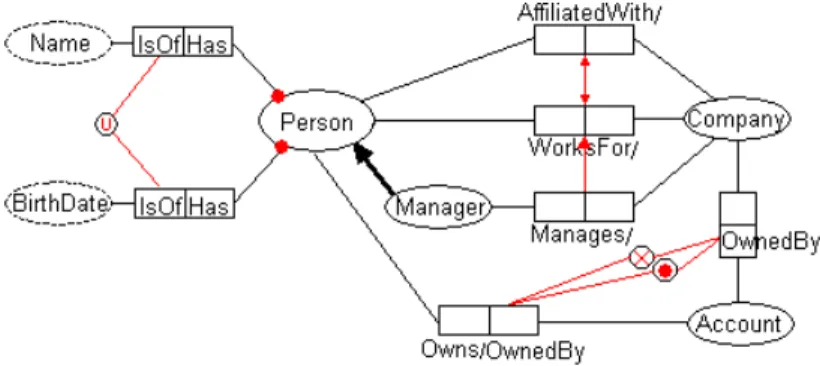
ORM has an expressive and stable graphical notation. It supports not onlyn-ary re-lations and reification, but also a fairly comprehensive treatment of many “practical” and “standard” business rules and constraint types. These include identity, mandatoriness, uniqueness, subsumption, totality, exclusivity, subset, equality, exclusion, value, frequency, symmetry, intransitivity, acyclicity, derivation rules, and several others. Furthermore, com-pared with, for example, EER or UML, ORM’s graphical notation is more stable since it is attribute-free; in other words, object types and value types are both treated as concepts. This makes ORM immune to changes that cause attributes to be remodeled as object types or relationships. Figure 1 shows an example of an ORM diagram. Concepts (also called
Fig. 1. Example of an ORM Schema.
object-types) are represented as ellipses, andrelationsare represented as rectangles. Each relation in ORM consists of one or moreroles. For example, the relationship between the concepts Person and Account consists of the two co-roles, Owns and OwnedByd. In de-scription logic, this relation can be formalized as (P erson v ∀Owns.Account,Account v ∀OwnedBy.P erson,OwnedBy v Owns−). The thick arrow between Manager and Person denotes a subsumptionrelation (M anager v P erson). The dot (•) on the line connect-ing Person and Name represents amandatoryconstraint (P ersonv ∃Has.N ame). The (U) represents anexternal uniqueness, meaning that a person can be uniquely denoted by the combination of his Name and Birthdate. The arrow between the relationships WorksFor/
cMany commercial and academic tools that support ORM solutions are available, including the ORM solu-tion within Microsoft’s Visio for Enterprise Architects15, VisioModeler4, NORMA3,CaseTalk1, Infagon2, and DogmaModeler20. DogmaModeler and its support for reasoning will be presented in section 4
dNotice that the notion of role in ORM means an argument/component of a relationship. This is unlike e.g. description logics, where the notion of role means a binary relation. Furthermore, relationships in ORM do not have names, but at least one of its roles should have a linguistic label.
and Manages/ represents asubset constraint (M anages vW orksF or), which means that if a person manages a company then this person must be employed by that company. The double-headed arrow between WorksFor/ and AffiliatedWith/ represents anequality con-straint (W orksF or≡Af f iliatedW ith), which means that each person who works for a com-pany is also affiliated with that comcom-pany and vice versa. The (⊗) between the two OwnedBy roles is anexclusionconstraint that means: an account cannot be owned by a company and a person at the same time (OwnedBy.P ersonv ¬OwnedBy.Account). The dot (¯) on the two OwnedBy roles is called adisjunctive mandatory, it means each account must be owned by at least a company or a person (Accountv ∃OwnedBy.P ersont ∃OwnedBy.P erson).
ORM diagrams can be automatically verbalized into pseudo natural language sentences, i.e., all rules in a given ORM diagram can be translated into fixed-syntax sentences. For ex-ample, the mandatory constraint in Figure 1 is verbalized as: “EachPerson Hasat least oneName”. The subset constraint is verbalized as: “If aPerson ManagesaCompanythen thisPerson WorksForthatCompany”, etc. Additional explanation can be found in21and 34which provide sophisticated and multilingual verbalization templates. From a method-ological viewpoint, this verbalization capability simplifies the communication with non-IT domain experts and allows them to better understand, validate, or build ORM diagrams. It is worthwhile to note that ORM is the historical successor of NIAM (Natural Language Information Analysis Method), which was explicitly designed (in the early 70’s) to play the role of a stepwise methodology, that is, to arrive at the “semantics” of a business appli-cation’s data based on natural language communication.
ORM Formal Semantics. ORM’s formal specification and semantics are well-defined16,46,44,10,11. The most comprehensive formalization in first-order logic (FOL) was carried out by Halpin16in 1989. Later on, some specific portions of this formalization were re-examined, such as subtypes22, uniqueness18, objectification20, and ring constraints17.
Since reasoning on first-order logic is undecidable5, the above formalizations do not enable automated reasoning on ORM diagrams, which comprises services such as detec-tion of constraint contradicdetec-tions (i.e. satisfiability), constraint implicadetec-tions, or inference.
ORM Satisfiability. Satisfiability checking (to detect constraint contradictions) is an important service in ontology modeling. Given a concept/role in a schema, is there a model (an interpretation/population of the schema that satisfies all constraints) such that the con-cept/role has a non-empty population. From a practical perspective, such reasoning proce-dures help the developer in analyzing thevalidityof the constructed schema for the domain. In particular, it allows to detect concepts and roles in a schema that always have an empty population, symptoms of a faulty model: there are too many constraints or constraints are too harshe.
To illustrate such contradictions, consider Figure 2, stating that Students and Employ-ees are types of Persons where no Student can be an Employee (and vice versa), and a PhD Student is both a Student and an Employee. Thus, the PhDStudent type cannot be populated. Otherwise, a PhD Student would be both a student and an employee which con-tradicts with the fact that Student and Employee need to be disjoint types (by the exclusion constraint). Although there are types in the schema in Figure 2 that cannot be satisfied, there is a formal model satisfying the global schema: e.g. let PhDStudent have an empty population, Student and Employee disjoint populations, and Person some superset of the union of the populations of Student and Employee.
eWe assume the universe of discourse (UoD) itself is consistent, such that faults in the model have their origin in the modeling and not in the UoD.
Fig. 2. Unsatisfiability of ORM Schema.
Types of Satisfiability. Formally, there are three types of satisfiability of an ORM schema46. First,schema satisfiability checking of an ORM schema is checking whether there exists a model of the schema (or less abstract, some population for the schema) as a whole. A satisfiable ORM schema does not need to satisfy any concepts or roles per se, as exemplified in Figure 2. The only condition is that all constraints are satisfied by the (possibly empty) populations. Second,concept satisfiabilitychecking amounts to checking whetherallconcepts (i.e. object-types) are satisfied (can be populated) by a model (by a population) of the schema. Concept satisfiability is thus stronger than schema satisfiabil-ity as a model of the schema that satisfies all concepts is, by definition, also a model of the schema. Finally,role satisfiabilitychecking amounts to checking whether there exists a model of the schema that satisfies (populates)allroles in the schemaf. This is the strongest form of satisfiability checking as it implies concept satisfiability: if a role is satisfied, the corresponding concept that plays the role is also satisfied. Given these implications (role then concept then schema satisfiable), we refer to role satisfiability as strong satisfiabil-ityand to schema satisfiability asweak satisfiability. Notice that role satisfiability implies concept satisfiability only when all concepts are connected to roles.
In this context, we are particularly interested in strong satisfiability: checking whether all roles in the schema are satisfiable: since a weakly satisfiable model may contain empty roles, problems with contradictory constraints are not necessarily detected. Note that if the schema does not contain roles we will also look at concept satisfiability.
3. Unsatisfiability Patterns in ORM Conceptual Schemes
This section presents the 9 patterns of constraint contradictions that lead to unsatisfiability in an ORM conceptual schemag. Each pattern is explained by example, formal definition, and a Java-like algorithm that generates a message explaining the detected contradiction, its causes, and suggestions to resolve the contradiction. We adopt the ORM formaliza-tion and syntax as found in16,17, except three things. First, although ORM supportsn-ary predicates, only binary predicates are considered. Second, our approach does not support objectification, or the so-called nested fact-types in ORM. Finally, our approach does not support the derivation constraints that are not part of the ORM graphical notation.
fFigure 5 shows an ORM schema where all concepts are satisfiable (and thus the schema as a whole is satisfiable) but it fails because of role unsatisfiability (because role r3 cannot be satisfied).
gThe first version of this work appeared in26. The second version33was presented at the IFIP.26 conference 2006, and at the Belgian-Dutch Database Day 2006. This version extends the previous versions in many directions, and benefits from the discussions and encouragements we received from many colleagues.
3.1. Pattern 1 (Top Common Supertype)
In this pattern, subtypes that do not have a top common supertype are detected. In ORM, all object-types are assumed by definition to be mutually exclusive, except those that are subtypes of the same supertype. Thus, if a subtype has more than one supertype, these su-pertypes must share a top supertype; otherwise, the subtype cannot be satisfied. In Figure 3 the object-typeCcannot be satisfied because its supertypesAandBdo not share a com-mon supertype, i.e.,AandBare mutually exclusive.
Fig. 3. Subtype without a Top Common Supertype.
Definition 1Given a subtypeT, let{DirectSuper1, ...,DirectSupern}be the set of all and only the direct supertypes ofT. LetSupers(DirectSuperi)be the set of all possible super-types of thei-th direct supertype ofT, where1≤i≤n. IfSupers(DirectSuper1)∩. . .∩
Supers(DirectSupern) ={}, then the object-typeT cannot be satisfied.
Algorithm-1:For each subtype T[x]{
Let T[x].DirectSupers = The set of all and only the direct supertypes of T[x] n = T[x].DirectSupers.size
If (nÂ1){ For (i= 1toi=n){
Let T[x].DirectSupers[i].Supers = the set of all possible supertypes of T[x].DirectSupers[i]} // if the intersection of all T[x].DirectSupers[i].supers is not empty,
// then the composition is not satisfiable.
if (Intersection(T[x].DirectSupers[1].supers, T[x].DirectSupers[n].supers)) is empty{ Satisfiability = false
Message=(Contradiction!! Nothing can be an instance ofT[x], because nothing can be a
T[x].U pperT ype[1](..and aT[x].U pperT ype[n]) at the same time, which are the supertypes of
T[x]. These supertypes are disjoint by definition as they don’t share a common top supertype. Either you introduce a new top supertype, or you remove some of the supertypes ofT[x]}}} 3.2. Pattern 2 (Exclusive Constraint between Types)
In this pattern, subtypes of mutually exclusive supertypes (caused by an exclusive con-straint) are detected. Figure 4 shows a case whereDcannot be satisfied because its super-types are mutually exclusive. The set of instances ofDis the intersection of the instances ofBandC, which is an empty set according to the exclusive constraint betweenBandC.
Definition 2For each exclusive constraint between a set of object-types{T1, . . . , Tn}, let Subs(Ti)be the set of all possible subtypes of the object-typeTi,1 ≤i≤n. For everyi
andj, letX =Subs(Ti)∩Subs(Tj), wherei6=j. IfX 6={}, then all objects-types inX
cannot be satisfied.
Algorithm-2:For each exclusive constraint Exv[x]{ Let Exv[x].T = the set of the object-types participating in Exv[x].
//For each pair of object-types participating in the exclusion constraint: For (i = 1 to i = Exv[x].T.size){
Fig. 4. Subtype with Exclusive Supertypes.
For (j = 1 to j = Exv[x].T.size){ If (i not equal j){
Let Exv[x].T[i].Subs = the set of subtypes of the object-type Exv[x].T[i]. Let Exv[x].T[j].Subs = the set of subtypes of the object-type Exv[x].T[j].
X=X+ (IntersectionOf(Exv[x].T[i].Subs, Exv[x].T[j].Subs))}}} If (Xis not empty){
Satisfiability = false
Message=(Contradiction!! The concept(s)X[1](.., andX[n]) cannot be instantiated because of the exclusive constraint between (its/their) upper types. Either some subtype links should be dismissed, or the exclusive constraint should be remove.)}}
3.3. Pattern 3 (Exclusive-Mandatory)
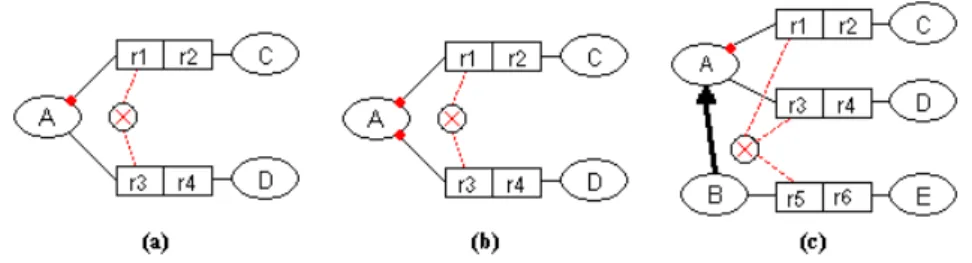
In this pattern, contradictions between exclusion and mandatory constraints are detected. In Figure 5, we show three examples of unsatisfiable schemes. In the first case (a), the roler3will never be played. The mandatory and the exclusion constraints restrict that each instance ofAmust play r1 and the instance that plays r1cannot playr3. In the second case (b), bothr1andr3will never be played. According to the two mandatory constraints, each instance ofAmust play bothr1andr3. At the same time, according to the exclusion constraints, an instance ofAcannot playr1andr3together. Likewise, in the third case (c), r3andr5will never be played. AsBis a subtype ofA, instances ofBinherit all roles and constraints fromA. For example, if an instance ofBplaysr5, then this instance, which is also instance ofA, cannot playr1orr3. However, according to the mandatory constraint, each instance ofAmust playr1and, according to the exclusion constrain, it cannot play r1,r3andr5all at the same time. In general, a contradiction occurs if an object-type plays a mandatory role that is exclusive with other roles played by this object-type or one of its subtypes.
Fig. 5. Subtype with Exclusive Supertypes.
Tibe the object-type connected to the roleri(where1≤i≤n); and,Subs(Ti)be the set
of all possible subtypes ofTi. For every (ri,rj) wherei6=jandriis amandatoryrole, if
(Ti=Tj) or (Tj∈Subs(Ti)) thenrjcannot be satisfied.
Algorithm-3:For each exclusion constraint Exs[x] between a set of single roles{ Let XRoles = the set of all roles participating in Exs[x].
Let ManRoles = the set of all mandatory roles in XRoles. If (ManRoles is not empty)
For (i=1 to ManRoles.Size){
Let ManRoles[i].T = the object-type that plays the role ManRoles[i] Let ManRoles[i].T.Subs = the set of all subtypes of ManRoles[i].T For (j=1 to XRoles.Size){
Let XRoles[j].T = the object-type that plays the role XRoles[j]
If ((ManRoles[i].T = XRoles[j].T) OR (In(XRoles[j].T, ManRoles[i].T.Subs)) AND (i6=j)
X=X+ XRoles[j]} } If (Xis not empty){
Satisfiability = false
Order(X) //the super of the object types playingXfirst, then the mandatory roles, etc. Message=(Contradiction!! between the exclusion and mandatory constraints. While the
exclusion means that an instance of aX[1].Tthat isX[1]aX[1].T2cannot beX[2]aX[2].T2 (,.. and cannot beX[n]aX[n]) at the same time, the Mandatory means that this instance must beX[1]aX[1].T2(,.. and must beX[n]aX[n].T2). This implies that role(s)X[1] (,.. andX[n]) will never be played. Either the exclusion or the mandatory constraints should be dismissed.)}}
3.4. Pattern 4 (Frequency-Value)
In this pattern, contradictions between value and frequency constraints are detected. In Figure 6, the roler1cannot be populated. If the frequency constraint FC(3−5) onr1 is satisfied, each instance ofAmust playr1at least three times, and thus three different in-stances ofBare required. However, there are only two possible instances ofB, which are declared by the value constraint{x1, x2}.
Fig. 6. Contradiction between value and frequency constraints.
Definition 4For each fact-type(ArB), letc be the number of possible values ofB that can be calculated from its value constraint, and let FC(n−m) be a frequency constraint on the roler. Ifc < n, thenrcannot be satisfied, as the value and the frequency constraints contradict each other.
Algorithm-4:For each frequency constraint F[x]{
Let F[x].min = the lower bound of the frequency constraint F[x]. Let T = the object-type that is played by the role holding F[x]. Let T2.Values = the value constraint on the object-type related to T. // if there is no value constraint on T, then T.Values = null If (T2.Values is not null) and (T2.Values.size<F[x].min){
Message=(Contradiction!! between the frequency and the value constraints. The value constraint implies thatT shouldT.r1at leastF[x].mindifferentT2(s), but there are onlyT2.V alues.size
possible values ofT2. In other words, there is no enoughT2(s) to fulfill the frequency constraint. Either the frequency or the value constraints should be changed or maybe dismissed.)}} 3.5. Pattern 5 (Value-Exclusion-Frequency)
In this pattern, contradictions between value, exclusion, and frequency constraints are de-tected. Figure 7 shows a particular contradiction between those three constraints. Due to the frequency constraint, there should be at least two different values to populater1. In order to populater3, we need, by the exclusion constraint, a value different from the two for roler1. In total, we thus need three different values in order to be able to populate bothr1andr2, but this contradicts with the value constraint on object-typeA: we only have2values at our disposal. Note that any combination with only two of the three constraints does not amount to unsatisfiability; we explicitly need the combination of the three of them. A special case
Fig. 7. Contradiction between value,
exclu-sion, and frequency constraints. Fig. 8. Contradiction between value and ex-clusion constraints. occurs in the absence of frequency constraints, e.g., Figure 8: according to the exclusion constraint, there should be at least 3 different values ofAto playr1,r2andr3. However, according to the value constraint, there are only two possible values ofA.
Remark: An exclusion constraint betweenn roles (where n > 2) can be split into n(n−1)/2separate exclusion constraints between two roles (see17). For example, the ex-clusion constraint in Figure 8 is thecompact formof three different exclusion constraints: betweenr1andr3,r3andr5, andr1andr5. In this article, we assume that exclusion con-straints are always in their most compact form.
Definition 5For each exclusion constraint, letr = {r1, . . . , rn}be the set of roles par-ticipating in this constraint. With each of those rolesri, we associate the inverse rolesi,
and we letfi be the minimum of the frequency constraint onsi(if there is no frequency
constraint on si, we takefi equal to 1). Let T be the object-type that plays all roles in r. LetC be the number of the possible values ofT, according to the value constraint.C must always be more than or equal tof1+. . .+fn. Otherwise, some roles inrcannot be
satisfied.
Note that this pattern is actually a generalization of the previous pattern where there are no exclusion constraints. However, the current pattern explicitly focuses on the exclusion con-straints attached to a role, taking into account the frequency concon-straints, to decide whether some roles are unsatisfiable. As pattern 4 does not contain exclusion constraints, a similar strategy would not work.
Let XRoles = the set of roles participating in the exclusion Exs[x]. Let InvRoles = the set of inverse roles of XRoles.
For ( 1 to InvRoles.size){
If (InvRoles[i].frequency is not Null) F = F + InvRoles[i].frequency.min. else F = F+1;}
Let T = the object-type that plays all roles in XRoles. Let T.Values = the value constraint on T.
// if there is no value constraint on T, then T.Values = null If (T.Values is not null) and (T.Values.size<F){
Satisfiability = false.
If (T.Values is not null) Message =(Contradiction!! between the value, the exclusion, and the frequency constraints. In order to fulfill the frequency and the exclusion constraints, at least
Fdifferent values ofTare needed, However there are onlyT.V alues.sizevalues ofTare available according the value constraint. Either the value, the exclusion, and/or the frequency constraints should be changed.)
else Message =(Contradiction!! between the value and the exclusion constraints. In order to fulfill the exclusion constraints, at leastFdifferent values ofTare needed, However there are onlyT.V alues.sizevalues ofTare available, according to the value constraint. Either the value and/or the exclusion constraints should be changed.)}}
3.6. Pattern 6 (Set-comparison constraints)
In this pattern, contradictions between exclusion, subset, and equality constraints are de-tected. These three kinds of constraints are called set-comparison constraints. Figure 9 shows a contradiction between the exclusion and the subset constraints. This contradiction implies that both relations cannot be populated. The exclusion constraint between the two
Fig. 9. Contradiction between subset and exclusion constraints.
rolesr1andr3means that their populations should be distinct. However, in order to satisfy the subset constraint between the relations(r1, r2)and(r3, r4), the populations ofr1and r3 should not be distinct. In other words, the exclusion constraint between rolesr1 and r3 implies an exclusion constraint between the relations (r1, r2) and(r3, r4)16, which contradicts any subset or equality constraint between both predicates.
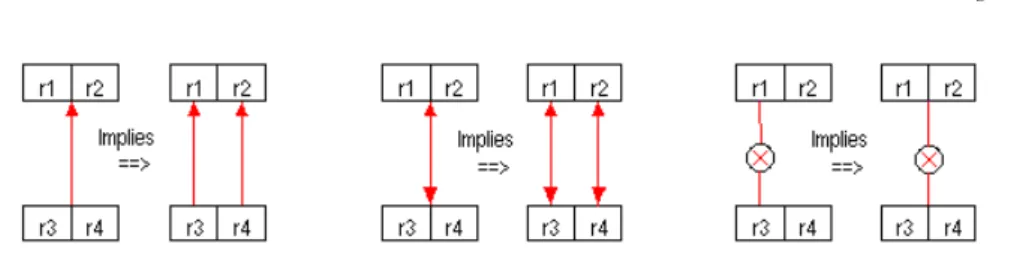
Figure 10 shows the implications for each set-comparison constraint that might be de-clared between roles or relations. These implications are taken into account when reason-ing for contradictions between the three set-comparison constraints. In addition, an equality constraint is equivalent to two subset constraints opposing each other. Hence, we shall refer to a path of subset or an equality constraint as aSubsetPath. In the following we provide a formal definition of this pattern, which is divided into two definitions, one in case the exclusion constraint is declared between two roles, and the other between to relations.
Definition 6’: For each exclusion constraint between two roles, there should not be any
Role-SubsetPathbetween them, neither (ri ⇒ rj) nor (rj ⇒ ri). Otherwise, these roles
are unsatisfiable. ARole-SubsetPathbetween two roles (ri⇒rj) is a directed edge that is
Fig. 10. Implications between the set-comparison constraints.
• If there is a subset constraint between them explicitly, such that (ri → rj); or
implicitly through another rolerh, such that (ri→rh) and (rh→rj).
• If there is an explicit subset constraint between the relations including them, such that (Ra(ri, rx)→Rb(rj, ry)); or implicitly through another relationRc(rh, rz),
such that (Ra(ri, rx)→Rc(rh, rz)) and (Ra(rh, rz)→Rb(rj, ry)), whereri,rj
andrhhave the same type.
• If there is an equality constraint between them explicitly, such that (ri ↔rj); or
implicitly through another rolerh, such that (ri↔rh) and (rh↔rj).
• If there is an explicit equality constraint between the relations including them, such that (Ra(ri, rx) ↔ Rb(rj, ry)); or implicitly through another relation Rc(rh, rz), such that (Ra(ri, rx)↔Rc(rh, rz)) and (Ra(rh, rz)↔Rb(rj, ry)),
whereri,rjandrhhave the same type.
Definition 6”: For each exclusion constraint between two relations, there should not be any Relation-SubsetPathbetween them, neither (Ri ⇒ Rj) nor (Rj ⇒ Ri). Otherwise,
these relations (and thus their roles) are unsatisfiable. ARelation-SubsetPathbetween two relations (Ri⇒Rj) is a directed edge that is constructed as the following:
• If there is a subset constraint between them explicitly, such that (Ri → Rj); or
implicitly through another relationRh, such that (Ri→Rh) and (Rh→Rj). • If there is an equality constraint between them explicitly, such that (Ri↔Rj); or
implicitly through another relationRh, such that (Ri↔Rh) and (Rh↔Rj). Algorithm-6:For each exclusion constraint Exs[x] between roles or relations{
If (Exs[x] between relations){
Let XRelations = the set of all relations participating in Exs[x]. //For each pair of relations participating in the exclusion For (i = 1 to i = XRelations.size)
For (j = 1 to j = XRelations.size) If (i6=j)
If (Relation-SubsetPath(XRelations[i], XRelations[j]) is not Null){ Satisfiability = false.
Message=(Contradiction!! between the exclusion and the subset/equality constraints. In order to fulfill the exclusion constraint, theXRelations[i].TthatXRelations[i]
aXRelations[i].T2must be different from theXRelations[i].TthatXRelations[j]that
XRelations[j].T2.However the subset/equality constraint implies that thisXRelations[i].T
should be the same. Either the exclusion or the subset/equality constraints should be dismissed.}}
Else{// then the Exs[x] is between roles
Let XRoles = the set of all roles that are participating in Exs[x]. // For each pair of roles participating in the exclusion constraint For (i = 1 to i = XRoles.size)
For (j = 1 to j = XRoles.size) If (i6=j)
If (Role-SubsetPath(XRole[i], XRole[j]) is not Null){ Satisfiability = false.
Message=(Contradiction!! between the exclusion and the subset/equality constraints. In order to fulfill the exclusion constraint, theXRole[i].TthatXRole[i]aXRole[i].T2must be different from theXRole[i].TthatXRole[j]aXRole[j].T2. However the subset/equality constraint implies that thisXRole[i].Tshould be the same. Either the exclusion or the subset/equality constraints should be dismissed.}}}
3.7. Pattern 7 (Uniqueness-Frequency)
In this pattern, all occurrences of a uniqueness constraint that contradicts with a frequency constraint on the role are detected. E.g., in Figure 11 the uniqueness constraint indicates that the roler1should be played by at most one element, while the frequency constraint de-mands that there are at least2and at most5participants in the role (denoted as FC(2−5)). It is thus impossible to populater1.
Fig. 11. Unsatisfiability of frequency and uniqueness constraint.
Definition 7Given a rolerwith a frequency constraint FC(n−m) and a uniqueness con-straint on it at the same time, ifn >1thenrcannot be satisfied.
Algorithm-7:For each frequency constraint F[x] on a role{ Let F[x].min = the lower bound of the frequency constraint F[x]. Let r = the role on which the F[x] is placed.
If (r.uniqueness is not Null) and ( F[x].min>1 ){ Satisfiability = false
Message= (Contradiction!! between the frequency and the uniqueness constraints. The frequency implies thatr.Tshouldrat mostF[x].minand at leastF[x].max r.T2(s). However, the uniqueness implies thatr.Tshouldrat most oner.T2. Either the frequency or the uniqueness constraints should be changed.)}
3.8. Pattern 8 (Ring constraints)
ORM allows ring constraints to be applied to a pair of roles that are connected directly to the same object-type in a fact-type, or indirectly via supertypes. Six kinds of ring constraints are supported by ORM: antisymmetric (ans), asymmetric (as), acyclic (ac), irreflexive (ir), intransitive (it), and symmetric (sym)17,16. For example, Figure 12 shows an example of two ring constraints (symmetric and acyclic) placed on theManagesrole. These constraints contradict each other because the symmetric implies that if personAmanages personB, then personBalso manages personA. However, the acyclic implies that a person cannot be directly (or indirectly through another person) a manager of himself.
The relationships between the six ring constraints are formalized by17using the Euler diagram as shown in Figure 13. This formalization indeed helps to visualize the implication and incompatibility between the constraints. For example, one can see that acyclic implies reflexivity, intransitivity implies reflexivity, the combination between antisymmetric and irreflexivity is exactly asymmetric, and acyclic and symmetric are incompatible, i.e. their combination leads to unsatisfiability.
Fig. 12. the roleM anagesis unsatisfiable
Fig. 13. Relationships between ring constraints.
In general, a role is unsatisfiable if it has two ring constraints, and these constraints are disjoint in the Euler diagram. Notice that there are only three combinations of ring constraint that are disjoint, and that lead to unsatisfiability, which are (symmetric, antisym-metric), (symmetric, asymantisym-metric), and (symmetric, acyclic).
Definition 8.Given a rolerwith a set RC of ring constraints on it, if(sym∈RC∧ans∈ RC)∨(sym∈ RC∧as ∈RC)∨(sym∈ RC∧as ∈RC)then the rolercannot be satisfied.
Algorithm-8:For each rolerwith more than two ring constraint{ Letr.RC= the set of ring constraints onr. LetT empbe an empty set. if (sym∈r.RC){
if (ans∈r.RC) Temp.add(”antisymmetric”). if (as∈r.RC) Temp.add(”asymmetric”). if (ac∈r.RC) Temp.add(”acyclic”). if (T empis not Null){
Satisfiability = false.
Message= (Contradiction!! between the ring constraints. The symmetric implies that ifr.TAr r.T B, thenr.T Balsor r.T A. However, this symmetry contradicts the
T emp[1](..,T emp[n]) constraint(s). Either the symmetric or the other ring constraints should be dismissed.)} } }
3.9. Pattern 9 (Loops in Subtypes)
As Subtypes in ORM are proper subtypes, the subtype relationship is acyclic. In other words, the population of a subtype is a strict subset (but not equal) of the population of its supertype17, loops are illegal in ORM. Otherwise, one would have that a population is a strict subset of itself, which is not possible. In Figure 14, none of the object-typesA,B, or
Ccan be satisfied since they form a loop.
Notice that there is no analogous pattern for subset constraints; no strict subset relation is required for subset constraints, such that loops in subset constraints imply equality of the involved roles but do not lead to unsatisfiability in generalh.
Fig. 14. Loop in subtypes.
Definition 9. Given a subtype T, let Supers(T) be the set of all supertypes of T. If T ∈Supers(T), then the object-typeT cannot be satisfied.
Algorithm-9:For each subtypeT{
T.Supers= the set of all super types ofT. If (T∈T.Supers){
Satisfiability = false.
Message= (Contradiction!! There is a loop of subtypes, which implies, e.g. thatTis a subtype ofT. One of the subtype links in this loop should be removed.)}}}
4. Implementation: DogmaModeler and the CCFORM case study
This section illustrates the DogmaModeler’s implementation of all patterns in interactive modeling. As an empirical usability experiment, we report our experience in applying the patterns during the development of the customer complaint ontology, and the lessons learned from the lawyers who built this ontology. At the end of this section, we compare this pattern-based reasoning approach with the description logic-based reasoning that we also support in DogmaModeler, and we argue thatthe two approaches complement each other from a methodological viewpoint.
DogmaModeleris a software tool for modeling and engineering ontologies. The phi-losophy of DogmaModeler is to enable non-IT experts to model ontologies with little or no involvement of an ontology engineer. This challenge is tackled in DogmaModeler through well-defined methodological principles: the double-articulationi and the modularizationj
hFurthermore, unlike ORM, subtypes in most of the specification languages (e.g. OWL) are not proper subtypes, thus loops imply equality of the involved concepts.
iTheontology double-articulation principlesuggests that an application axiomatization should be build in terms of (i.e. commits to) a domain axiomatization. While a domain axiomatization focuses on the characterization of the intended meaning (i.e. intended models) of a vocabulary at the domain level, application axiomatizations mainly focus on the usability of this vocabulary according to certain application/usability perspectives. An application axiomatization is intended to specify the legal models (a subset of the intended models) of the application(s) interest. For simplicity, one can imagine WordNet as a domain axiomatization, and ORM schema as an application axiomatization, where all terms/object-types in the schema are linked with terms/synsets in WordNet. The idea here is to enable: reusability of domain knowledge and usability of application knowledge, interoperability of applications, etc. See26,28for more details.
jTheontology modularization principlesuggests that application axiomatizations be built in a modular manner. Application axiomatizations (e.g. ORM schemes) should be developed as a set of small modules and later com-posed to form, and be used as, one modular axiomatization. DogmaModeler implements a well-defined composi-tion operator for automatic composicomposi-tion of modules. It combines all axioms introduced in the composed modules. See26,25for more details.
principles. Furthermore, DogmaModeler supports the use of ORM as a graphical notation for ontology modeling; the verbalization of ORM diagrams into pseudo-natural language (supporting flexible verbalization templates for 11 human languages, including English, Dutch, German, French, Spanish, Arabic, Russian, etc.) that allows non-experts to check, validate, or build ontologies; the automatic composition of ontology modules, through a well-defined composition operator; the incorporation of linguistic resources in ontology engineering; the automatic mapping of ORM diagrams into the DIG description logic in-terface and reasoning using Racerk; and many other functionalities.
Ontology validation in DogmaModeler is made simple and user friendly. Although users can use Racer for complete formal reasoning on ORM diagrams, also non-IT/logic experts are supported with an easy to understand reasoning approach (using the patterns), which explain them constraint contradictions, the cause of these contradictions, and sug-gestions of how to resolve these contradictions. DogmaModeler implements all patterns
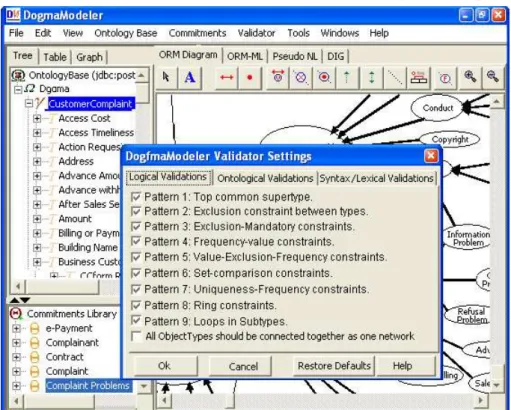
Fig. 15. DogmaModeler’s support of patten-based reasoning.
described in this paper. Figure 15 displays these patterns as a menu in the DogmaMod-eler Validator Settings window. Users can choose to enable or disable the enforcement of these validation patterns when reasoning about the satisfiability of an ORM schema. The DogmaModeler typically implements the satisfiability algorithms that we have presented in section 3.One can see, from these algorithms, that not only unsatisfiability is detected, but also, some details about the detected problems (through the generated message), including which constraints cause the unsatisfiability, the problems with the other constraints, and
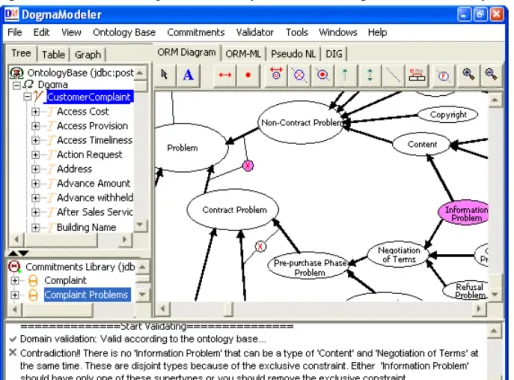
some suggestions to resolve the problem. Figure 16 and 17 illustrate unsatisfiable ORM diagrams and the result of the reasoning. When a user reason about an ORM schema, Dog-maModeler first runs the pattern-based approach, if the schema passes all patterns and no problems are catched, then it runs the DL-based approach (using Racer) for completeness. DogmaModeler calls these patterns not only while a modeling mistake is made by a
on-Fig. 16. An example of a satisfiable schema from the CCFORM project.
tology modeler, but also when an ORM diagram is composed with another. As we shall report shortly, the main source of unsatisfiability problems is when two incompatible ORM diagrams are composed with each other.
Although it is developed as a research prototype26DogmaModeler has been used in many projects for ontology and business rule modeling, including CCFORM, FFPOIROT, InnovaNet, and SCOPE. In the following we present our experience in using DogmaMod-eler (focusing on the application of the pattern-based reasoning) in the CCFORM project.
4.1. The CCFORM case study
CCFORM is an EU funded project (IST-2001-38248) with the aim of studying the foun-dation of a central European customer complaint portal. The idea is that any consumer can register a complaint against any party about any problem in one portal. This portal should: support 11 languages, be sensitive to cross-border business regulations, dynamic, and can be extended by companies. To manage this dynamicity and to control companies’ extensions, a customer complaint ontology (CContology) has to be built as the basis of the CC portal. In other words, the complaint forms are generated based on the ontologyl.
The CContology24comprises classifications of complaint problems, complaint resolutions, complainant, complaint-recipient, “best-practices”, rules of complaint, etc. The main uses of this ontology are 1) to enable consistent implementation (and interoperation) of all soft-ware complaint management mechanisms based on a shared background vocabulary, which can be used by many stakeholders. 2) to play the role of a domain ontology that encom-passes the core complaining elements and that can be extended by either individual or groups of firms; and 3) to generate CC-forms based on its ontological commitments and to enforce the validity (and/or integrity) of their population. More information about the CContology, including the ontology content itself, can be found in24,26,36.
The CContology is developed in 11 human languages, and it is a result of six groups (about 55 experts), including lawyers, consumer-affairs and e-business experts. None of these experts was really aware of what an ontology is or how it can be used. Our role in the project was to lead the ontology (and the multilingual) engineering tasks. We trained about 10 of those experts on how to use DogmaModeler and build ontologies. The training was done in two sessions, each of 3 hours. We basically focused on explaining the ORM notation that was easily understood. We have found that the verbalization of the ORM rules was a great mechanism to communicate with these experts. To enable collaborative development (and also improve the reusability), the CContology was developed as a set of 7 modules. Each module focuses on a certain subject matter, such as classifications of complaint problems, classifications of complaint resolutions, etc.
Although the CContology is a medium size ontologym, it illustrates the value of the pattern-based reasoning in interactive modeling. We have found that the experts did many modeling mistakes (i.e. constraint contradictions) at the beginning, but the final version of ontology did not contain any contradiction indeed. As constraint contradictions are detected in DogmaModeler during the modeling process and in an interactive manner, we found that this interaction is a self-learning mechanism. In other words, one of the interesting lessons we have learned in this project is that the implementation of the patterns (in an interactive manner during the ontology modeling process) enabled the lawyers to learn how to avoid such mistakes the next time. Some of them even admitted that they understood some logics from their experience in using DogmaModeler.
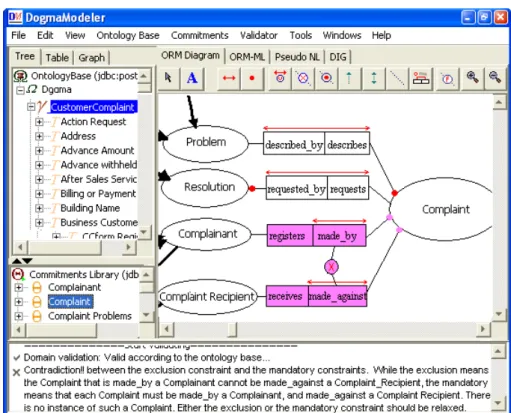
The source of these mistakes was mostly due to the lack of ORM understanding, which is natural in our opinion. Figure 17 is an example of such a mistake. In this diagram, the lawyers intended to model that a complainant cannot register a complaint against him-self, so instead of placing an exclusion constraint between the two relationships regis-ters/made by and receives/made against, they place it between the tworolesmade by and made against. This mistake was discovered by DogmaModeler as it contradicts the manda-tory constraints (see pattern 3). The second source of contradictions is the autonomous development of modules. When composing modules, the resulted composition might be unsatisfiable due to contradicting constraints among these modules. This is true although each module individually is satisfiable. Figure 16 was an example of this mistake. In one module the ’Information Problem’ was a subtype of ’content’ and in the second module it was also a subtype of ’negotiation of terms’. The resulted composition of these two modules, where ’Information Problem’ became subtype of two disjoint concepts, which generates unsatisfiability.
The coverage of the patterns for the CContology was sufficient. Although the lawyers did many modeling mistakes but all of these mistakes were discovered by DogmaModeler. In fact, we found only 4 patterns were violated, which are: pattern 1, pattern 2, pattern 3, and pattern 4. Pattern 2 was the most violated pattern in general. However, we also found
Fig. 17. Another example of a satisfiable schema from the CCFORM project.
that Pattern 3 was the most violated pattern during the modeling processes, and pattern 2 was still the most violated during the composition. Pattern 4 was violated only two times, which is due to limited use of the value constraint in the CContology.
The messages that DogmaModeler generates when a problem is discovered was un-derstandable. Although such messages cannot always be grammatically correct, as they depend mostly on the linguistic labels used the schema, but we did not face any unclear message. The suggestions provided in each message -on how to resolve the contradiction-were always correct, from a logic viewpoint. However, from a methodological viewpoint, one cannot really know what is the best solution to resolve the problem. For example, al-though the message in figure 17 says “Either the exclusion or the mandatory constraint should be relaxed”, which is true from a formal viewpoint, but the real reason of this con-tradiction was the incorrect placing of the constraint. For such reasons, we try to make the message as clear and expressive as possible so that users can spot (i.e. between the lines) their real mistakes.
4.2. Pattern-based verses DL-based reasoning in DogmaModeler
As we have mentioned earlier, we have also tackled the ORM satisfiability problem in another way. We have mapped ORM into both theDLR30and theSHOIN/OWL29 de-scription logics, which are powerful and decidable fragments of first order logic. Based on these mapping, DogmaModeler maps32ORM diagrams automatically into DIG, which is a description logic interface (XML-based language) that most reasoners (such as Racer, FaCT++, etc) support. DogmaModeler is integrated with the Racer description logic
rea-Fig. 18. DogmaModeler’s support of description logic-based reasoning.
soning server, which acts as a background reasoning engine. Figure 16 shows a screen shot of this implementation. The first window shows an ORM diagram, while the second win-dow shows the reasoning results on this diagram. The results indicate that the role Reviews cannot be satisfied.
This mappingninto description logics provides a complete reasoning support for ORM schemes, i.e. users are able to check (strong and weak) satisfiability of an ORM schema by satisfiability checking of the corresponding DL knowledge base.
When a user reason about an ORM schema, DogmaModeler first calls the pattern-based approach, if all patterns passed and no problems are catched, then DogmaModeler calls Racer (the DL-based approach) for complete reasoning.
On comparison between pattern detection approaches and a complete reasoning pro-cedure in description logic, we find that both approaches complement each other. Pattern detection approaches are easy and cheap to implement, which allows speedy reasoning in interactive modeling tools. More importantly is that unsatisfiability/contradiction messages can be customized for the ease of non-IT domain experts, explaining the sources of the un-satisfiability, and offering solutions to these contradictions. On the other side, description logic based reasoning offer complete solutions, so that it is guaranteed at least theoretically that there are no undiscovered contradictions. However, these complete solutions cannot offer more than a list of the unsatisfiable concepts. In DogmaModeler, even in the presence
nSome ORM constrains cannot be mapped into description logic or they are not yet supported by any DL reasoner, such as external uniqueness, ring, multiple-role frequency, etc. Please refer to30,29,32for the details.
of a complete reasoner, the patterns are used to quickly detect any “trivial” inconsistencies, before calling the more expensive (but complete) procedure.
In the next section we discuss some efforts by other researchers who tried to modify the internals of DL reasoners for generating unsatisfiability messages in an easy to understand way and to propose solutions.
5. Related Work
Related Work in description logics
As we have mentioned before, the need to trace the causes of unsatisfiability and conflicts has recently been realized by several research communities. In the context of debugging OWL ontologies, a group from the university of Manchester has developed a software14 based on heuristics for identifying the sources of unsatisfiability for OWL ontologies. This software is based on a list of common errors and mistakes that have been gathered43by a group of researchers during tutorials and courses. The authors claimed that this system is independent of any particular reasoner, they call it “Black Box”.
A “Glass Box” approach to debug OWL ontologies and diagnose inconsistencies has been proposed40 by a group from the university of Maryland. This approach suggests to modify the internals of the Pellet reasoner, which is developed by the same group. This approach offers browse-able messages to help users identify the sources of the inconsis-tencies themselves. The authors of this approach explained the fundamental challenge of computing the sources of unsatisfiability for an unsatisfiable ontology, and concluded that only some situations can be improved, which are: “inconsistency of assertions about indi-viduals”, “individuals related to unsatisfiable concepts”, “defects in class axioms involving nominals”. Related to this approach, another methods8,38 have been proposed to explain some reasoning on ontologies, but these approach are mainly concerned with explaining subsumptions. It also worth to note that identifying the causes of conflicted is becoming an important goal in evolution management42,37. However these approaches are not in its infancy and are not concerned with explaining messages to users.
Compared with our approach, we have found that none of the above mentioned is con-cerned with providing suggestions to resolve unsatisfiability. Furthermore, as the screen-shots, from the above cited articles show, the results are not convenient for a non-IT domain experts. In terms of completeness, neither our approach, nor the above approaches can be complete, which is due the nature of the problem. In addition, one cannot also compare the comprehension of the approaches to each other, because of the disparities between the OWL and the ORM constructs. For example, many of the common errors in OWL43are considered syntax violations and thus detected by the ORM parser before any reasoning.
Related Work in ORM
In16, 7 formation rules for constraints on ORM conceptual schemes are described. We discuss to which extent these rules can also be used for detecting unsatisfiability of roles and how they relate to the patterns described in section 3.
Formation rule1(A frequency constraint of1is never used (the uniqueness constraint must be used instead)) and rule2(A frequency constraint cannot span a whole predicate) prefer one syntactical form over another (rule1) or prohibit a, from a logical perspective, nonsensicalofrequency constraint (rule2). Rule1is, however, not relevant, where we call a rule relevant if it is relevant from an unsatisfiability detection perspective, i.e. a rule is relevant, if in case it is violated, there is an unsatisfiable role. Regarding rule2, as the
oNonsensical, since predicates are interpreted as sets, where each element in a set is, by definition of sets, unique in that set.
population of an ORM predicate is basically a set, any frequency constraint FC(min −
max) where min is strictly greater then1leads to unsatisfiability. Rule2is, however, too strict in the sense that a frequency constraint FC(1−max), although redundant, does not lead to unsatisfiability. Pattern7 takes care of the latter case (where it is assumed, as is implicit in ORM, that a predicate is spanned by a uniqueness constraint). Note that we are only interested in unsatisfiability; from a modeling perspective, the formation rules are most certainly useful, in the sense that they, e.g., avoid adding redundant constraints to the schema.
Rule3(No role sequence exactly spanned by a uniqueness constraint can have a fre-quency constraint) is again too strict by itself to be relevant for unsatisfiability. For exam-ple, a constraint FC(1−5) and a uniqueness constraint on the same role do not yield an unsatisfiable role. They are, however, equivalent with FC(1−1) or with a mandatory plus a uniqueness constraint, thus, from a modeling perspective, formation rule3makes sense, but it does not necessarily lead to an unsatisfiable role. We loosened up rule3to take this into account in pattern7.
Rule4(No uniqueness constraint can be spanned by a longer uniqueness constraint) is again not relevant for unsatisfiability. Rule5(An exclusion constraint cannot be specified between roles if at least one of these roles is marked as mandatory) is exactly pattern 3; we made it explicit that the rule applies to subtypes as well.
Rule 6 (An exclusion constraint cannot be specified between two roles attached to object-types one of which is specified as a subtype of the other) is not relevant for un-satisfiability. There are ORM conceptual schemes violating rule 6, although all roles are satisfiable (see Figure 19). For example, populater5with some ’a’, then ’a’, by the
sub-Fig. 19. ORM schema violating formation rule6but with satisfiable roles.
typing, must play one of the rolesr1orr3. It cannot playr3due to the exclusion constraint but nothing keeps it from playingr1.
The last formation rule, rule7(A frequency constraint with upper boundncannot be specified on a role sequence if n is less than the product of the maximum cardinalities of the other role populations for the predicate), is covered by pattern4 since we restrict ourselves to binary predicatesp. The7ORM formation rules thus provide useful criteria for constructing ORM schemes: in a lot of cases they avoid unsatisfiability as well as implied (redundant) constraints. However, the rules mix both syntactical and semantical criteria, occasionally yielding too strict criteria for detecting unsatisfiability. The constraint patterns, described in Section 3, focus on the semantical aspect of unsatisfiability only.
In45, the RIDL-A module of theRIDL∗workbench, a database engineering tool based on the NIAM methodology 47, checks whether a conceptual schema is correctly con-structed. Since NIAM is the predecessor of ORM, it is interesting to compare the crite-ria RIDL-A employs to our patterns. Of particular interest in the RIDL-A module are the Validity Analysis (rules V1-V6) and Set Constraint Analysis (rules S1 - S4) parts.
It appears that none of the Validity Analysis rules are relevant for unsatisfiability. The Set Constraint Analysis part contains4rules dealing with three types of constraints: subset, equality, and exclusion. S1 and S3 say that a subset (resp. equality) constraint may not be superfluousq. Although interesting from a modeling perspective, neither S1 nor S3 lead to unsatisfiability of roles in itself. S2 (A subset constraint may not contain any loops) is not relevant for unsatisfiability; the population of the roles would be equal but can be non-empty. Note that we use the definition of subset constraints on predicates as in16, i.e., a roler1is a subset ofr2if every element playing roler1also playsr2. In particular,r1does not need to be a strict subset ofr2: they may be equal. S2 is relevant for subset constraints between subtypes since those are strict; we covered this with pattern9.
Finally, S4 (The OTSETSrinvolved on an exclusion constraint may not have a common subset) is a valid condition for detecting inconsistency. It is, however, too general, in the sense that it is actually the definition of an exclusion constraint, and does not indicate how the exclusion might yield unsatisfiable roles.
6. Conclusions and Further Research
We presented a pattern-based reasoning approach that offers a user-friendly reasoning mechanism. 9 patterns of constraint contradictions that lead to unsatisfiability in ORM models are identified. Not only detecting constraint contradictions, but also focused on pro-viding a clear explanation about the detected contradictions, the causes, and suggestions on how to resolve these contradictions.
We illustrated the DogmaModeler’s implementation of all patterns in interactive mod-eling. As an empirical usability experiment, we reported our experience in applying the pat-terns during the development of a customer complaint ontology. We compared this pattern-based reasoning approach with the description logic-pattern-based reasoning that we also support in DogmaModeler, and we argued that the two approaches complement each other from a methodological viewpoint.
In the future, we intend to devise more patterns for unsatisfiability checking, e.g., check-ing which combinations that involve more than 2 constraints lead to unsatisfiability while leaving out one constraint would not lead to unsatisfiability (as in pattern 5). Moreover, we intend to extend our approach to detect unsatisfiability for ORM derivation rules, asser-tional knowledge, etc.
One may notice that our patterns can be easily translated to other knowledge repre-sentation languages, especially for ontology and business-rules modeling tools. We plan to apply these patterns for reasoning on OWL ontologiess.
Acknowledgment: We are indebted to Pieter De Leenheer, Robert Meersman and Olga De Troyer for their suggestions during this research. We wish to thank specially the anonyms reviewers of this article who give us many ideas and very helpful suggestions that turn the paper to be more precise and mature. This research is partially supported by the SEARCHiN (MTKD-CD-2006-042467) and the Knowledge Web (IST-2004-507482) projects.
References
1. CaseTalk http://www.casetalk.com/php/ (Visited Oct 2006).
qA constraint is superfluous -or implied- if it can be derived from other constraints. rThe OTSET of a role corresponds, roughly, to the population of a role.
sOne of our master students aims to implement these patterns in Protg (an ontology modeling tool), as part of his thesis on interactive ontology modeling.
2. Infagon http://www.mattic.com/Infagon.html (Visited Oct 2006). 3. NORMA http://sourceforge.net/projects/orm, (Visited Oct 2006).
4. VisioModeler http://www.microsoft.com/downloads/ results.aspx?displaylang=en&freeText =VisioModeler (Visited Oct 2006).
5. Franz Baader, Diego Calvanese, Deborah McGuinness, Daniele Nardi, and Peter Patel-Schneider.The Description Logic Handbook: Theory, Implementation and Applications. Cam-bridge University Press, 2003.
6. A. Berztiss and J. Bubenko. A software process model for business reengineering. InProce. of the IFIP 8.1 conf on Info Sys Development, pages 184–200, Norway, 1995.
7. L. Bird, A. Goodchild, and T.A. Halpin. Object role modelling and xml-schema. InProc. of the 19th Int. Conf. on Conceptual Modeling, LLNCS. Springer, 1999.
8. Alexander Borgida, Enrico Franconi, Ian Horrocks, Deborah L. McGuinness, and Peter F. Patel-Schneider. Explaining alc subsumption. InDescription Logics, 1999.
9. Casteleyn S. Plessers P. De Troyer, O. Using orm to model web systems. InProc. of OTM Workshops (ORM’05), Cyprus, 2005. Springer.
10. Olga de Troyer. A formalization of the binary object-role model based on logic.Data and Knowl-edge Engineering, 19:1–37, 1996.
11. Olga de Troyer and Robert Meersman. A logic framework for a semantics of object-oriented data modelling. InProc. of 14th Int. Con. Object-Orientation and Entity-Relationship Modelling. LNCS 1021, Springer., 238-249 1995.
12. Jan Demey, Mustafa Jarrar, and Robert Meersman. A conceptual markup language that sup-ports interoperability between business rule modeling systems. InProc. of the 10th Int Conf on Cooperative Information Systems (CoopIS 02), number 2519 in LNCS, pages 19–35. Springer, 2002.
13. Marlon Dumas, Lachlan Aldred, Mitra Heravizadeh, and Arthur H.M. ter Hofstede. Ontology markup for web forms generation. InWWW’02 Workshop on Real-World Applications of RDF and the Semantic Web, 2002.
14. A. Rector N. Drummond H. Wang, M. Horridge and J. Seidenberg. Debugging owl-dl ontolo-gies: A heuristic approach. InProc of the Int Semantic Web Conf, 2005.
15. T. Halpin, K. Evans, P. Hallock, and W. MacLean.Database Modeling with Microsoft Visio for Enterprise Architects. Microsoft Visio, San Francisco., 2003,.
16. Terry Halpin.A logical analysis of information systems: static aspects of the data-oriented per-spective. University of Queensland, PhD Thesis, 1989.
17. Terry Halpin.Information Modeling and Relational Databases, 3rd edn. Morgan-Kaufmann, 2001.
18. Terry Halpin. Join constraints. InProc. of the 7th International IFIP WG8.1 Workshop ( EMM-SAD’02), June 2002.
19. Terry Halpin. Business rule verbalization. InProc. of Info Sys Technology and its Applications (ISTA’2004), pages 39–52, 2004.
20. Terry Halpin. Objectification. In John Krogstie Terry Halpin, Keng Siau, editor,Proceddings of the 10th International Workshop on Exploring Modeling Methods in Systems Analysis and Design (EMMSAD05) at CAiSE 2005, 2005.
21. Terry Halpin and Matt Curland. Automated verbalization for orm 2. InProc of the OTM 2006 Workshops(ORM’06). Springer Verlag, 2006.
22. Terry Halpin and Erik Proper. Subtyping and polymorphism in object-role modelling.Data and Knowledge Engineering, 15(3):251–281, 1995.
23. A. Bleeker H.Proper and S. Hoppenbrouwers. Object-role modelling as a domain. InProc. of the Workshop on Evaluating Modeling Methods for Systems Analysis and Design, volume 3, page 317328, 2004.
24. Mustafa Jarrar. Towards Effectiveness and Transparency in e-Business Transactions, An On-tology for Customer Complaint Management. Chapter x, in Garcia R.(eds): Web Methodologies for E-Business Applications: Ontologies, Processes and Management Practices. Idea Group Inc. (2008).
25. Mustafa Jarrar. Modularization and automatic composition of object-role modeling (orm) schemes. In OTM 2005 Workshops, Proc of (ORM’05)., volume LNCS 3762, page 613. SPRINGER, 2005.
26. Mustafa Jarrar.Towards Methodological Principles for Ontology Engineering. PhD thesis, Vrije Universiteit Brussel, Brussels, Belgium, May 2005.
27. Mustafa Jarrar. Orm markup language, version 3. Technical report, Vrije Universiteit Brussel, Brussels, Belgium, August 2006.