Epigenetic inheritance
in apomictic dandelions:
Stress-induced and heritable modifications
in DNA methylation and small RNA
2
Thesis committee
PromotorProf. Dr W.H. van der Putten Professor of Functional Biodiversity Wageningen University
Co-promotor Dr K.J.F. Verhoeven Senior scientist
Netherlands Institute of Ecology, Wageningen
Other members
Prof. Dr J.J.B. Keurentjes, University of Amsterdam Prof. Dr P.G.L. Klinkhamer, Leiden University Dr O. Paun, University of Vienna, Austria Prof. Dr B.J. Zwaan, Wageningen University
This research was conducted under the auspices of the Graduate School of Experimental Plant Sciences (EPS)
3
Epigenetic inheritance
in apomictic dandelions:
Stress-induced and heritable modifications
in DNA methylation and small RNA
Veronica Preite
Thesis
submitted in fulfillment of the requirements for the degree of doctor at Wageningen University
by the authority of the Rector Magnificus Prof. Dr A.P.J. Mol,
in the presence of the
Thesis Committee appointed by the Academic Board to be defended in public
on Wednesday 7 September 2016 at 4 p.m. in the Aula
Veronica Preite
Epigenetic inheritance in apomictic dandelions: Stress-induced and heritable modifications in DNA methylation and small RNA,
152 pages.
PhD thesis, Wageningen University, Wageningen, NL (2016) With references, with summary in English
ISBN 978-94-6257-871-5
5
Content
Abstract 6
Chapter 1 General introduction 7
Chapter 2 Transgenerational epigenetic inheritance in two widespread apomictic dandelion lineages
17
Chapter 3 Small RNAs reflect grandparental environment in apomictic dandelions 45
Chapter 4 Testing heritable DNA methylation effects upon transplanting apomictic dandelions to native versus non-native field habitats
65
Chapter 5 The epigenetic footprint of poleward range-expanding plants in apomictic dandelions
87
Chapter 6 General discussion 115
References 127
Summary 141
Acknowledgements 146
Curriculum vitae with publication list 148
Education statement 150
6 Abstract
Epigenetic variation, such as changes in DNA methylations, regulatory small RNAs (sRNAs) and chromatin modifications can be induced by environmental stress. There is increasing information that such induced epigenetic modifications can be transmitted to offspring, potentially mediating adaptive transgenerational responses to environmental changes. However, it is unclear if this phenomenon is common and relevant for adaptation under natural conditions. My thesis study aimed to examine epigenetic inheritance in common and widespread apomictic dandelions (Taraxacum officinale Wig.). Due to their asexual reproduction mode by producing clonal seeds offspring from seeds are genetically uniform and thus suitable to investigate epigenetic effects that are not confounded with genetic variation.
I exposed apomictic dandelion lineages to drought and salicylic acid (SA) stress, which induces plant defense responses following pathogen attack, and found effects on patterns of DNA methylation up to two stress-free offspring generations after exposure. However, a heritable stress signal was not present in all tests and was stress- and lineage-dependent. Drought stress triggered a weak and lineage-dependent signal that was lost again in the second offspring generation. SA treatment revealed a stress-related increased rate of DNA methylation changes in the two offspring generations, but no stress signal was found in the stressed generation itself. I also observed changes in small RNA production due the drought and SA stress experienced two generations ago. These transgenerational sRNA effects showed association with gene functions related to grandparental drought and SA stress, which suggests functional relevance of the transgenerational effects.
I used a reciprocal transplantation field experiment to investigate whether exposing dandelions to natural field stresses also triggers DNA methylation changes. The experiment revealed evidence of adaptive divergence between the populations, suggesting that non-native habitats are experienced as more stressful. However, under these field conditions no induction-based DNA methylation changes were found that persisted into offspring.
By using AFLP and MS-AFLP screening of natural apomictic dandelion populations across a north-south transect in Europe I examined if natural, heritable DNA methylation variation reflects underlying genetic variation, or if it shows patterns that are not predictable from underlying genetics. I found that a large part of heritable DNA methylation differentiation along the north-south transect was correlated with genetic differentiation. However, a fraction of differentiation in heritable DNA methylation was independent from genetic variation. This suggests a potential of epigenetics to play an evolutionary role independently, at least to some extent, from underlying genetics. Overall, I found indications of epigenetic inheritance in apomictic dandelions. Whether epigenetic variation would result in adaptive phenotypic variation in nature and whether it would persist long enough to play a relevant role in adaptation remains unclear and requires further study.
7
8
Organisms are subjected constantly to changing environmental conditions, for instance to diurnal and seasonal changes. In the past ten thousand years regional climatic conditions changed dramatically and with it whole ecosystems changed as well. Species of each kingdom, Monera, Protista, Fungi, Plantae and Animalia evolved in these changing abiotic and biotic conditions. Species managed to survive and reproduce due to their variety of morphological, physiological and behavioural traits that have been continuously shaped by natural selection. The species that were most adapted to changes, for instance through phenotypic plasticity and evolution of adaptive traits, survived.
The phenotypic variety that one genotype can express depending on its environment is known as phenotypic plasticity. However, plastic responses alone may not suffice to cope with rapid climate change, and evolution of mean trait values is needed (Nicotra et al. 2010). Besides adjusting their phenotype to environmental changes, organisms that evolved locomotion can also respond with behavioural changes, such as for instance escaping from extreme conditions. Interestingly, also plant species can escape unsuitable conditions by migration over evolutionary timescales towards more suitable habitats. The processes of migration towards suitable conditions and adaptation to changing conditions are intermingled; for example, at the leading edge of the migration front during climate change-induced range expansion, plants have to adapt to novel biotic and abiotic conditions (Davis & Shaw 2001). For organisms to successfully adapt to environmental changes it needs natural selection acting on variation in fitness-related traits that are at least partially heritable (Houle 1992).
In recent years it became more and more clear that non-genetic mechanisms can have major effects on heritable trait variation and they might play a role in adaptation in addition to, or in interaction with, the classical genetic adaptation. Non-genetic mechanisms include molecular changes to DNA that affect gene expression, referred to as epigenetics, which means literally: epi- (greek for “on top of”) genetics. Epigenetic variation can result in altered phenotypes without changing the underlying genetic code. This means that epigenetic effects can generate additional variation on top of genetic variation that could be subjected to natural selection. Variation in epigenetic information can derive through spontaneous changes, just as random genetic mutations do, but also through environmental induction. One source of phenotypic plasticity, the range of phenotypes that one genetic code can produce in different environments, is thought to be epigenetic variation that is sensitive to environmental cues (Latzel & Klimešová 2010; Massicotte & Angers 2011; Richards et al. 2010). In addition to mediating phenotypic plasticity, epigenetic modifications can also arise stochastically (Van der Graaf 2015). Both spontaneous and environmentally induced epigenetic variation could become especially important for organisms to cope with changing conditions when genetic variation is limited. This could be true for, for instance, asexual plant species which are thought to be evolutionary dead-ends because of their limited genetic variation.
Classically, heritable epigenetics is defined as gene regulatory effects that persist through cell divisions. Heritable epigenetics can be understood as epigenetic-mediated gene regulation that is induced by environmental changes that persists even if the initial stimulus is transient. Furthermore, epigenetic effects can also persist across generations
Chapter 1 General Introduction
9
and this so called transgenerational epigenetic inheritance is the focus of my thesis. Environmentally sensitive epigenetic inheritance could facilitate and fine-tune the short-term adaptation to fast-changing conditions such as may occur under climate change. One important aim of my thesis is to investigate this suggested role of epigenetic variation in nature by screening standing epigenetic variation in plant populations and by performing multi-generational stress experiments.
Epigenetic mechanisms
There are a variety of epigenetic mechanisms which regulate gene expression and they are widespread in different taxa. Epigenetic mechanisms include DNA methylations, histone modifications, and small RNAs (sRNA). Spontaneous and environmentally induced changes and reversions add a dynamic feature to these mechanisms. This dynamics generates variation in gene regulation within generations during different developmental stages and across generations. Epigenetic variation has therefore been proposed to influence a large percentage of phenotypic variation (Manolio et al. 2009; Becker & Weigel 2012).
DNA methylations, histone modifications and sRNAs are often interlinked and together regulate gene expression through regulation of promoter regions, transcription factors, chromatin accessibility, chromosome organisation or DNA repair (Cedar & Bergman 2009; Jablonka & Raz 2009). DNA methylation studies in plants showed that cytosines are methylated mostly in the di-nucleotide combination of CG, but also in CHG and CHH context, where H can stand for a C, A or T nucleotide (Law & Jacobsen 2010). Experimentally removed DNA methylations through chemicals resulted in an increase of phenotypic variation, indicating the epigenetic importance for gene regulation (Bossdorf et al. 2010). Studying the late flowering mutant in Arabidopsis revealed that DNA methylations at the 5’ flanking region of a homeodomain gene regulated this mutant phenotype (Soppe et al. 2000). The mechanistic idea behind the regulatory feature of DNA methylation is that highly methylated gene promoters or transcription factors impede the binding to the transcriptomic protein complex. Alternatively, DNA methylation might attract proteins that alter histone modifications, e.g. specific histone tail modifications can change how densely the DNA strand is packed around the nucleosomes. Thus a more loosened DNA structure would show more accessibility to the transcriptional enzymes. One important function of DNA methylations in plant genomes is to suppress the transcriptional activity of transposable elements (TEs) and thus preventing the jumping of TEs which can cause deleterious consequences to the DNA (Fedoroff 2012). A demethylated, activated TE can thus jump and insert its genomic region into other parts of the genome where it can disrupt gene activity (Richards 2006; Zilberman et al. 2007; Bucher et al. 2012). Gene regulation involving sRNAs is thought be mainly based on sRNAs that degrade target mRNA molecules (posttranscriptional gene silencing) and on sRNAs that guide other epigenetic marks, such as methylation, towards specific loci in the genome and thereby silencing such loci (transcriptional gene silencing).
10
The methylome is usually demethylated and reprogrammed during gametogenesis and/or embryogenesis in order to transmit only the important DNA methylations to the next generation. In plants not all DNA methylations are reset during this process, and in particular DNA methylation in CG context is thought to be relatively resistant to re-setting (Saze et al 2003). Thus, DNA methylation patterns can be shared between parents and offspring either because they escape re-setting during gametogenesis/embryogenesis, or because they are re-set and subsequently rebuilt in offspring in the same way as in parents. Which, why and how DNA methylations are chosen to be transmitted is, however, unclear. Studies revealed that mostly TE-silencing DNA methylations are faithfully transmitted (Becker et al. 2011; Schmitz et al. 2011). Moreover, also transgenerational stress-induced DNA methylation changes (Verhoeven et al. 2010b) and transgenerationally stable stochastic DNA methylation changes (Van der Graaf 2015) have been observed.
Epigenetic phenotypes
Several plant studies investigated heritable phenotypic consequences of DNA methylation variation and discovered naturally occurring epialleles. For instance, Cubas et al. (1999) revealed cytosine methylations on a floral morphology gene which were correlated with a naturally occurring floral mutant of Linaria vulgaris. No genetic mutations were found that correlated with the phenotype and furthermore, both floral types were found growing on different branches but together on same individuals. Flowers that developed on cuttings from these branches kept their original flower type. Genetic mutation was excluded and the floral mutants were therefore explained by pure, genetically un-confounded, epialleles. These epialleles and the floral mutant phenotypes showed occasional reversion to the wild type by demethylation. Similar short-term heritable DNA methylations have been found in the flowering genes of Arabidopsisthaliana (Jacobsen & Meyerowitz 1997) and in the fruit ripening genes of tomato (Manning et al. 2006).
The most convincing experimental evidence for epigenetic inheritance comes from studies on epigenetic Recombinant Inbred Lines in Arabidopsis (epiRILs). These isogenic lines differ in their DNA methylation patterns, since they derive from crosses between genetically very similar parents, but one parent is a mutant that leads to a lack of DNA methylations. After backcrossing the F1 to the wildtype parent, a panel of epiRILs was derived, that did not carry the mutation themselves. These epiRILs showed heritable phenotypic variation and DNA methylations that were stably transmitted for at least eight generations (Johannes et al. 2009; Zhang et al. 2013; Cortijo et al. 2014). EpiRIL studies provide a possibility to investigate phenotypic variation under almost uniform genomes, and heritable phenotypic differences between lines could be convincingly attributed to heritable DNA methylation differences (Cortijo 2014). The only downside is that the epiRILs shed little light on the relevance of natural epigenetic variation since they derive from an artificial DNA methylation mutant. Indications for functionally important epigenetic variation in nature are based on the fully sequenced epigenome of Arabidopsis mutation accumulation lines which showed heritable epimutations that accumulate over time (van der Graaf et al. 2015; Becker et al. 2011; Schmitz et al. 2011). However, a large
Chapter 1 General Introduction
11
proportion of such stochastic epimutations may be heritable but not for a large number of generations (Becker 2011; Schmitz 2011).
Heritable DNA methylations changes and phenotypic diversity in plants can arise through environmental induction or through spontaneous epigenetic mutations. In few plant studies indications for epigenetic and transgenerational responses to stress were found, for instance in the form of heritable sRNA signals (Bilichak et al. 2015) or as heritable DNA methylation changes (Verhoeven et al. 2010b; Luna et al. 2012). However, also stochastic epimutations can have important influences: a modeling study based on empirically observed epimutation rates in the Arabidopsis mutation accumulation lines suggests that they arise fast enough to uncouple epigenetic variation from genetic variation but revert slow enough to sustain long-term selection responses (van der Graaf et al. 2015). Both spontaneous and environmentally-induced epimutations can have effects on evolutionary processes, since natural selection could target next to heritable genetic variation also heritable epigenetic variation (Richards et al. 2010).
Relation of epigenetic variation with underlying genetic variation
One difficulty in studying the importance of epigenetic variation in nature is to disentangle effects that are deriving from genetic variation versus effects that are autonomous from genetic variation. Genetic and epigenetic variation can both provide a target for natural selection and therefore play a role in adaptation. Only epigenetic variation that is not fully determined by underlying genetic variation has the potential to explain any adaptation or phenotype that is not explained already from genetics. However, many epigenetic effects were so far found to be associated with genetic variation (Dubin et al. 2015; Becker & Weigel 2012). Recent studies and discussions contribute to the understanding of how common and important epigenetic variation is that is autonomous or at least partially unlinked from genetic effects (Richards 2011).
In my thesis I tested the importance of epigenetic inheritance in genetically uniform asexual lineages to minimize the genetic variation. For my transgenerational experiments I used offspring grown from field-collected seeds from apomictic dandelion lineages. Apomictic plants produce asexually through clonal seeds, which develop to genetic copies of the mother plant. Variation generated by epigenetic mechanisms has been proposed to compensate, at least to some extent, for the lack of genetic variation in asexuals (Angers et al. 2010). Asexually reproducing plants are, in theory, constrained in their potential to adapt to changing environments due to their limited genetic variation. However, quite some asexual plants are highly successful invaders and colonized vast areas sometimes with just a single genotype (Hollingsworth & Bailey 2000; Ahmad et al. 2008). The success of asexual plants as biological invaders could be explained by preadaptation of the genotypes to conditions in the new habitat, possibly through high phenotypic plasticity (Baker 1965) which could be mediated by epigenetics. After the last retreat of land ice, approximately 10,000 years ago, obligate apomicts migrated from glacial refugia towards Northern Europe (Comes & Kadereit 1998). Nowadays, apomictic dandelions are numerous and widespread in Europe and their populations consist of many different apomictic lineages.
12
Adaptive potential of epigenetic variation in nature
Epigenetic inheritance is particularly interesting to study in plant species given their sessile life style and late differentiation of the germline. Plants, which set apart their germline relatively late in their development, could for instance accumulate stress-induced epimutations during their life that subsequently enter the germline which develops from somatic tissue only during flower development. Epigenetic variation has shown to be induced by environmental factors, such as herbivory, pathogen attack or extreme temperature conditions. For instance, Arabidopsis thaliana revealed transgenerational fungal resistance (Luna et al. 2012) and in Mimulus guttatus increased trichome density was observed upon herbivory stress (Scoville et al. 2011). In both examples the physiological or phenotypic adjustments were suggested to be linked with gene regulation, which are possibly affected by epigenetic modifications. It may be envisioned that also an increase of variation, rather than a shift in trait mean value, could be beneficial for the survival of a plant population (Herman et al. 2014). With unpredictably fluctuating environmental conditions plants could focus on spreading their risk of “maladaptation” through increasing the phenotypic variation in their offspring, also named bet-hedging (Nevoux et al. 2010). A theoretical modeling approach supported the importance of increased epigenetic variation that derives through incomplete resetting of DNA methylations and generates methylation variation in the offspring. They suggested that incomplete resetting may be especially adaptive in fast changing environments, since it prevents mismatched phenotypes (English et al. 2014).
Whether epigenetic variation may or may not play an important role in adaptive processes also depends on the persistence of epigenetic changes (Herman et al. 2014). Only selection on epialleles that persist in the long-term could produce an epigenetically-derived adaptation. It is however questionable to what extent such long-term stable epialleles exist. However, also selection on transient epialleles can strongly affect the dynamics of adaptation, possibly causing rapid initial adaptive responses which are subsequently ‘solidified’ by genetic mutations (Klironomos et al. 2013). A theoretical model on evolution that combines genetic effects and non-genetic inheritance, even if transient, was explaining scenarios that could not be explained by classical Mendelian genetic evolution alone. These scenarios are describing phenomena where the parental environment had affected the offspring phenotype: such as transgenerational epigenetic inheritance, maternal effects, RNA-mediated inheritance and also cultural inheritance (Bonduriansky et al. 2012). Recently another modelling study came to the same conclusions, but with stochastically derived epimutations instead of environmentally-related epimutations (Kronholm & Collins 2015).
So far, there are indications but no tangible evidence that epigenetic inheritance is important in adaptation of natural plant population. The role of epigenetics in nature should be tested on field-collected material and/or with experiments that are conducted under natural conditions (Bossdorf et al. 2008). Natural populations of Viola cazorlensis for example revealed pronounced epigenetic variation, which showed a higher diversity than the populations’ genetic variation. Additionally, and more importantly some DNA
Chapter 1 General Introduction
13
methylations showed association with the on-site observed herbivory (Herrera & Bazaga 2011). Natural populations of Fallopia japonica clones, an invasive plant species in Europe, also revealed a correlation between DNA methylation variation and the expressed phenotypic plasticity (Richards et al. 2012). It is expected that asexual lineages, such as F. japonica, harbor almost no genetic variation. The observed phenotypic polymorphism in F. japonica might therefore be attributed to pure epigenetic effects. In both cases an association was observed between ecological factors and DNA methylation variation, suggesting that epigenetics might enable plants to cope better with various habitats. These are important discoveries to help understanding the role of epigenetics in nature, but we are just beginning to comprehend the effects of natural epigenetic variation. Detailed follow-up studies are needed to pinpoint functional epigenetic loci that cause relevant phenotypic effects, and to evaluate the link between this epigenetic variation and underlying genetics.
Apomictic dandelions as model system for natural epigenetic variation
I used apomictic dandelions (Taraxacum officinale), a widespread grassland plant species, to investigate heritable epigenetic effects that are not confounded with genetic variation. The common dandelion exists in two variants that differ in their reproductive mechanisms: there are diploids that reproduce sexually and polyploids (mostly triploids) that reproduce asexually via unfertilized seeds, named apomixis (Mogie & Ford 1988). The offspring of these apomicts are genetic clones of the mother plant. New apomictic dandelion lineages are constantly produced through crossings between sexual (diploid) mothers and pollen from apomictic (triploid) fathers in mixed populations. Some of these newly generated apomictic dandelion lineages could migrate away from these mixed populations along latitudinal or altitudinal gradients, for example from Central towards Northern Europe (Richards 1973). Apomictic dandelions provide therefore a variety of clonal lineages and accessions from different geographic and climatic regions. For my transgenerational experiments I used offspring from field-collected apomictic individuals. Barring effects of novel genetic mutations, any phenotypic deviation between the mother and the daughter thus could be attributed to non-genetic effects.
In theory, stress-induced epigenetic inheritance could link gene regulation with the environment and together shape the phenotype. For example a previous study on an apomictic dandelion lineage revealed stress-induced (most notably chemical induction of herbivore and pathogen defenses) DNA methylation changes that were transmitted to the subsequent generation (Verhoeven et al. 2010b). And in Brassica rapa a heat-stress induced effect on the small RNAs of the stressed plant and their unstressed progeny was observed (Bilichak et al. 2015). In my thesis I investigated stress-induced epigenetic changes (DNA methylations and small RNAs) in several apomictic dandelion lineages by applying drought stress and salicylic acid, which mimics pathogen attack. Both drought stress and pathogen attack can be devastating for plant populations when reaching an extreme level. Additionally, under the pace and impact of the current climate change drought events are predicted to become more severe and more frequent. The rapidly changing environment will promote that organisms migrate and establish in previously
14
cooler areas (Walther et al. 2009), which in turn affects the composition of organisms living together (Van der Putten 2012). Consequently, we can predict that range-shifting plant species will also encounter new pathogens or that pathogen attack in synergy with abiotic stresses becomes more severe for the plant.
One drawback of using a non-model species is that, in contrast to Arabidopsis thaliana, the dandelion genome is not yet fully known. I therefore used AFLPs to screen the genetic structure of apomictic dandelion populations and methylation-sensitive AFLPs to screen their methylation pattern. Furthermore, since small RNAs are involved in the transmission of epigenetic information, I performed additionally a small RNA screening to test for transgenerational effects.
The aim of my thesis is to further the understanding of the evolutionary role of stress-induced and heritable epigenetic effects. For this purpose I performed greenhouse and field experiments. With multi-generation greenhouse experiments using plants from genetically uniform apomictic dandelion lineages I investigate stress-induced epigenetic effects such as changes in DNA methylation (using MS-AFLPs) and sRNAs. Based on previous findings in apomictic dandelions and other plant species I hypothesize that stress-induced epigenetic effects can be transgenerationally inherited. In addition to the artificially added stresses I also investigated transgenerational effects in response to natural stresses as perceived under natural field conditions. For this purpose I conducted a reciprocal transplantation experiment which tested whether heritable DNA methylations can be induced by transplantation to a novel but natural growing site. And at last I investigated the pattern of epigenetic and genetic variation in natural populations using offspring from seeds that were collected along a south-north transect in Europe. My hypothesis is that epigenetic variation, just like genetic variation, shows geographic differentiations in natural populations. Furthermore, since epigenetic variation could be unlinked from genetic variation I specifically tested if epi-variation simply mirrors genetic variation, or if it shows a deviating pattern. The below thesis outline summarizes each of the four experiments conducted in my work.
Chapter 1 General Introduction
15 Thesis outline
Chapter 2
How much transgenerational DNA methylation variation can be environmentally induced and for how many generations they can persist is to date unclear. In chapter 2, I present results from a multi-generation experiment: drought and salicylic acid (which mimics pathogen attack) were applied to two apomictic dandelion lineages, deriving from three sampling locations. This first generation (G1) was then propagated in an unstressed environment for two generations (Fig. 1.1). With the methylation sensitive restriction enzyme HpaII I screened the DNA for stress-induced DNA methylation changes in G1 and tracked these motifs back to see if they are persisting to the generations G2 and G3.
Chapter 3
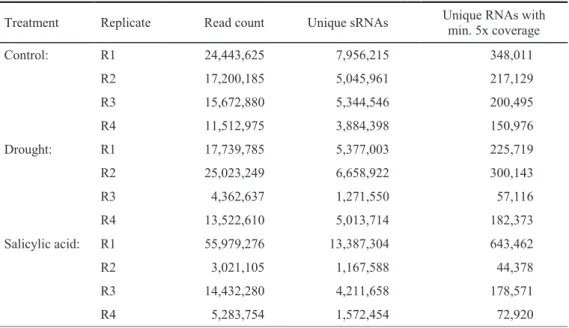
Small RNAs can maintain and regulate epigenetic information, such as DNA methylations. Following from the same multi-generation experiment in chapter 2 I screened for small RNA changes in G3 after stress induction by drought and salicylic acid stress. The here addressed question is whether environmental stress leaves a sRNA footprint that is sustained over two stress-free generations.
Chapter 4
Based on previous greenhouse experiments, which showed that stress can trigger heritable DNA methylation changes, I investigated transgenerational effects in response to natural stresses as perceived under natural field conditions. I reciprocally transplanted several apomictic dandelion lineages, collected in The Netherlands and Czech Republic into their own and each other’s natural habitat. The prediction of the reciprocal transplantation experiment is that growing in a novel environment is more stressful than growing in native environment, which will be reflected in more DNA methylation changes (detected with HpaII screening) in plants that are transplanted to non-native sites.
Figure 1.1 Multi-generation experiment: the
offspring, (G1), of the mother plant, (G0), is equally distributed over the three treatments, control, drought and salicylic acid. The subsequent two generations were grown under unstressed conditions
16
Chapter 5
In this chapter the standing heritable variation of DNA methylations in natural populations of apomictic dandelions along a south-north transect in Europe is investigated (see sampling design Fig. 1.2). Habitat-specific DNA methylations could have evolved if epigenetic information plays an important role for asexually reproducing plants to adapt to environmental changes. This can be either due to heritable, environment-induced epigenetic modifications or due to environment-specific selection of epigenetic variants. To find such an environmental footprint in the DNA methylome, AFLP and MS-AFLPs (HpaII and MspI) were screened to capture the plants’ genetic and epigenetic structure. This experiment tests if patterns of heritable DNA methylation variation simply mirror underlying patterns of genetic variation, or if epi-variation shows unique patterns that deviate from genetic patterns.
Figure 1.2 Map of North West Europe. Boxes represent the ten areas and the filling represents the regions (North, Center, South) where apomictic dandelions were sampled.
17
Transgenerational epigenetic inheritance
in two widespread apomictic dandelion lineages
V. Preite, C. Oplaat, A. Biere, J. Kirschner, W.H.van der Putten, K.J.F. Verhoeven
18
Abstract
DNA methylation is one of the mechanisms underlying epigenetic modifications. DNA methylations can be environmentally induced and transmitted to successive generations. However, it remains unclear how common such environmentally-induced transgenerational DNA methylation changes are and for how many generations they can persist. We exposed multiple accessions of two different apomictic dandelion lineages of the Taraxacum officinale group (Taraxacum alatum and T. hemicyclum) to drought and plant pathogen stress, the latter mimicked by adding salicylic acid (SA). Using methylation-sensitive amplified fragment length polymorphism markers (MS-AFLPs) we screened genome-wide methylation changes after stress treatments and assessed the heritability of induced changes for two subsequent unexposed offspring generations. Irrespective of the initial stress treatment, a clear build-up of heritable DNA methylation variation was observed across three generations. Environmental treatments affected DNA methylation patterns in a stress-specific way: drought stress showed some evidence for a directional, accession-specific methylation change, but only in the exposed generation. By contrast, SA stress did not cause a detectable response in the exposed generation but increased the rate of methylation changes in their offspring. While the functional consequences of the MS-AFLP-detected DNA methylation changes remain to be demonstrated, our study shows that environmental stress can affect DNA methylation patterns not only in exposed plants but also in their unexposed progeny. Less than one third of the changes observed in stress-exposed plants were faithfully transmitted to the third generation. We conclude that stress-induced transgenerational DNA methylation modification in dandelions is genotype and context-specific.
Chapter 2 Stress-induced and heritable DNA methylations
19
Introduction
Epigenetic modifications, such as DNA methylation, can affect gene activity without changing the underlying DNA sequence and are involved in transposable elements (TEs) silencing (Lippman & Martienssen 2004). Exposure to biotic and abiotic stress has been shown to alter DNA methylations (Aina et al. 2004; Choi & Sano 2007), and some stress-induced methylation changes were found to be transmitted to successive generations (Cheng et al. 2004; Boyko et al. 2007; Verhoeven et al. 2010b; Kou et al. 2011). Such a transgenerational ʽmemoryʼ of stress could play a role in adaptation by generating epigenetic variants that cause specific tolerance to the environmental stress that triggered them (Luna et al. 2012; Rasmann et al. 2012). In addition to genetic variation, DNA methylation could increase the range of variation for selection to act on and is thought to be one of the underlying mechanisms for phenotypic plasticity (Angers et al. 2010; Richards 2011).
To be transgenerationally effective epigenetic information needs to be transmitted through genome resetting and reprogramming during gametogenesis and zygote development. Unlike in mammals, in plants a considerable part of the DNA methylations appear to be meiotically stable (Feng et al. 2010) and may be transmitted between generations via small RNAs that could guide re-establishment of parental DNA methylation patterns in offspring (reviewed in Bond & Baulcombe 2014 and Iwasaki & Paszkowski 2014). For instance, Rasmann et al. (2012) showed that an induced defense against herbivory was transmitted in an Arabidopsis wild type but not in small-RNA-deficient mutants. Recent studies are providing first estimates of the rate and transgenerational stability of spontaneous DNA methylation modifications (Becker et al. 2011; van der Graaf et al. 2015). But it remains unclear to what extent the rate of heritable modifications is affected by stress exposure, and for how many generations DNA methylations can persist. It is also unclear what level of persistence is necessary to have an important impact on adaptive processes (Rapp & Wendel 2005; Herman & Sultan 2011; Herman et al. 2014).
Variation in DNA methylation can arise spontaneously (Becker et al. 2011; Schmitz & Ecker 2012) or induced by environmental signals (Dowen et al. 2012). Methylations that adjust gene regulation as a specific response to an environmental stress can be regarded as a directed epigenetic effect. Alternatively, stress can also cause non-directed, random, methylation changes that result in phenotypic differences contributing to natural variation. If ecologically important DNA methylation effects are transgenerationally stable, then natural selection can act on these epigenetic phenotypic differences (Rapp & Wendel 2005). Little is known about the role of spontaneous versus stress-induced DNA methylations, as well as directional versus random response to stress in evolutionary processes of plant populations.
DNA methylation changes can be mediated by nearby (cis) and distant (trans) sequence information, but they can also be autonomous, independent of genetic variation (sensu Richards 2006). It has been proposed that such autonomous heritable methylations could explain evolutionary processes in ways that cannot be explained by sequence variation alone (Richards 2006; Bossdorf et al. 2008). In practice, it is difficult to distinguish autonomous from genetically-mediated epigenetic variation since it is possible that genetic changes that influence a particular epigenotype remain undetected (Richards 2006 and 2011; Johannes et al. 2009). Populations that lack significant genetic variation, such as asexually
20
propagating lineages, might therefore be well suited to investigate the potential of autonomous epigenetic inheritance (Bossdorf et al. 2008). In addition, for asexually reproducing plants epigenetic variation might be relatively important because their potential to adapt to changing environments is constrained by limited genetic variation. The additional variation generated by epigenetic mechanisms has been proposed to compensate, at least to some extent, for the lack of genetic variation in asexuals (Angers et al. 2010). This might contribute to the ecological success of some asexual invaders that colonize vast areas as a single dominant genotype (Hollingsworth & Bailey 2000; Ahmad et al. 2008; Zhang et al. 2010).
To investigate heritable DNA methylations we used apomictic, i.e. asexually reproducing, dandelions of Taraxacum Wigg. sect. Taraxacum (commonly also called Taraxacum officinale Wigg., see Kirschner & Štěpánek 2011). Dandelions show geographic parthenogenesis where the distribution of apomictic lineages exceeds the distribution of sexually reproducing dandelions towards northern regions. In Europe many different obligate apomictic lineages colonized northern regions after the retreat of land ice, approx. 10,000 years ago (Comes & Kadereit 1998). This particular geographical distribution pattern provides a natural study system of widespread apomictic dandelion lineages, with each lineage harboring limited potential to adapt through genetic variation. Previous research on a newly synthesized apomictic dandelion showed that stress exposure can cause DNA methylation changes and moreover, that these changes could be stably transmitted to the next generation (Verhoeven et al. 2010b). The present study aims to investigate the persistence and the generality of inheritance of stress-induced epigenetic modification in apomictic dandelion lineages.
To study stress-induced heritable DNA methylations we carried out a controlled experiment exposing apomictic dandelions to two different stresses and investigated the persistence of induced methylation changes in two successive unexposed generations. Two apomictic dandelion lineages were used that were collected from three different sites which we hereafter abbreviate as: FI, which stands for a high latitude site in Finland, CZH for a medium altitude site in East Czech Republic and CZL for a low altitude site in Central Czech Republic. Since northern and mountainous regions may represent more stressful (abiotic) environmental conditions we hypothesized that in those habitats plants may have been selected for higher levels of plasticity. Such a higher plasticity might be partly mediated by a higher capacity for stress-induced methylation modifications. By stressing apomictic dandelions at an early vegetative stage and studying methylation changes propagating beyond the first offspring we ensure the detection of epigenetic effects beyond maternal effects.
We used drought as abiotic stress and salicylic acid (SA) to mimic biotic stress of e.g. biotrophic pathogens (Delaney et al. 1994). Drought and SA-induced stress represent important environmental factors for plants in all sampling regions in Central Bohemia, the White Carpathian region and South Finland. Spring droughts occur regularly, although in relatively mild form, in CZ and in continental Finland (Potop et al. 2014). Pathogen pressure is a very common biotic stress and intensifies towards lower latitudes in Europe (Schemske et al. 2009; Verhoeven & Biere 2013). Moreover, these stresses are predicted to become more severe and frequent as the current climate change proceeds (IPCC 2013; Pautasso et al. 2012).
Chapter 2 Stress-induced and heritable DNA methylations
21
Using asexually reproducing dandelions as a model enables the detection of stress-induced and heritable epigenetic variation that is not likely to be confounded with genetic variation. And SA treatment induced the strongest DNA methylation response among a series of treatment in a previous transgenerational stress experiment in dandelions (Verhoeven et al. 2010b). Based on methylation-sensitive amplification polymorphisms (MS-AFLPs) that detect DNA methylation variation at genome-wide (anonymous) marker loci, we specifically tested three hypotheses: 1) upon stress application DNA methylation patterns change, 2) these methylation modifications are inherited to next generations, and 3) plant accessions originating from the higher latitude and altitude sites show higher levels of methylation variation than plants from low latitude and altitude sites.
Material and methods Study species
The apomictic common dandelion of sect. Taraxacum, the T. officinale group, is a common perennial forb in lawns, meadows and pastures that has spread worldwide, especially in temperate zones but also reaching into polar and alpine zones (Richards 1973). Dandelions form taproots with rosettes and produce wind- dispersed seeds. In apomictic dandelions these seeds are produced from unreduced egg cells via embryogenesis without fertilization by male gametes (parthenogenesis). Likewise, the endosperm develops autonomously without fertilization (Koltunow 1993). Most apomicts are polyploid (Mogie & Ford 1988; Asker & Jerling 1992). In the case of T. officinale the apomicts are mostly triploid while the sexuals are diploid (Richards 1973, 1989; Riddle & Richards 2002). New apomictic lineages arise in mixed populations of apomictic and sexual dandelions when pollen from apomicts fertilizes sexual dandelions (Richards 1973). This results in offspring of various ploidy levels, some of which are functionally apomicts (Tas & Van Dijk 1999). In the regions without sexual common dandelions, local populations consist of few to numerous distinct apomictic lineages, morphologically and genetically recognizable entities, sometimes referred to as microspecies, under binomials. Hundreds of microspecies within the T.officinale group have been described in Europe (Kirschner & Štěpánek 2011).These apomictic dandelion lineages are often widespread with a distribution that extends from western to eastern Europe, and from the southern Central Europe to Northern Europe. The distribution pattern in the sect. Taraxacum resembles a classical geographic parthenogenesis, since the distribution of the apomicts extends the one of the sexually reproducing dandelions (Menken et al. 1995; Verduijn et al. 2004).
22
Plant material and growing conditions
Seeds were collected from two widespread apomictic lineages of apomictic dandelions: T. alatum H. Lindb. and T. hemicyclum G. E. Haglund. Seed heads were collected in spring 2013 from three locations in North-Eastern Europe: from two locations in Czech Republic, that differed in elevation, and from one location in Finland (Fig. 2.1). Throughout this study we refer to the descendants of a single field-sampled individual as an accession. The collection of seeds in the field was done by taxonomic specialists that recognize these geographically widespread Taraxacum microspecies by specific phenotypic traits. After having the seeds propagated for one generation under common greenhouse conditions we confirmed the clonal identity of the T. alatum and T. hemicyclum plants with eight microsatellite markers which showed nearly identical multilocus genotypes for all accessions within a microspecies (Table 2.S2, supporting information).
Throughout all generations of the experiment we used the same protocol for seed collection and seed sterilization and the same temperature and light conditions for the germination, growth and vernalization stages.
Seeds derived from the first produced seed head per plant; seeds were surface-sterilized for 5 minutes with 0.5% sodium hypochlorite including 0.05% Tween20 (Sigma-Aldrich, Zwijndrecht, The Netherlands) and afterwards washed with demineralized water. Sterilized seeds were germinated on 0.8% agar plates for 10 days (14 h light / 10 h dark, 18 °C / 14 °C, 60% relative humidity on average, daylight maintained at a minimum of 30 µmol/m2/s).
Seedlings were individually transplanted to 9 x 9 x 10 cm pots containing a mixture of 80% potting soil and 20% pumice that was equalized to 210 ± 5 g. Nutrients were supplied with 1.5 g of Osmocote granules (15 N + 3.5 P + 9.1 K + 1.2 Mg + trace elements; Osmocote exact Mini, Everris international BV, The Netherlands). Afterwards the seedlings were grown under the same condition as during germination but with a light level of approximately 315 µmol/m²/s and were watered several times per week, depending on the rate of water loss. Prior to vernalization, rosette leaves were clipped back to 4-5 cm and the plants were put in a cold room at 4 °C (16 h daylight) for 5 weeks, with occasional watering depending on moisture loss.
Figure 2.1 Map of the sampling sites. Seeds of T.alatum and T.hemicyclum were collected in the Bohemian lowlands (CZL, circle), the Carpathians (CZH, triangle) and in Finland (FI, rectangle).
Chapter 2 Stress-induced and heritable DNA methylations
23
Stress experiment
For each of the six accessions used in this study (2 apomictic lineages x 3 sampling sites) seeds were derived from a single greenhouse-propagated individual. Seeds were germinated and propagated as described before and 36 seedlings per accession were distributed over control, drought stress and salicylic acid (SA) stress (12 replicate plants per treatment). All plants of T. alatum were grown together in one climate chamber; the same applies to plants of T. hemicyclum. Within each apomictic lineage plants from all three accessions were randomized within treatment. Plants from a treatment group (control, drought, salicylic acid) were placed in rows to ensure a better application of the stress treatments and a non-touching between plants from different treatments, which we think was especially crucial for the application of the SA treatment. After four weeks of growth in the climate chamber the drought stress started: water was withheld from the ‘drought’ treatment until at least 80% of all ‘drought’ plants showed wilted leaves, at which moment all ‘drought’ pots were fully saturated with water. While the other groups were regularly watered, the ‘drought’ group experienced this deprivation of water ten times within a period of four weeks. After five weeks of growth, a one-time SA treatment was applied: 0.5 ml of a 10 mM SA solution (Sigma S-7401, dissolved in 0.1% Triton X-100 surfactant solution, pH = 2.3) was spread over three medium-sized leaves. The third, control, group received no treatment, also no mock treatment, since these plants were also used as control for the drought treatment. After eight weeks of growth, leaf punches were collected from the third fully developed leaf of each individual plant and put on ice for subsequent DNA isolation. Subsequently the plants were moved to a cold room for vernalization. All plants flowered approximately six weeks after the end of the vernalization period and seeds were collected from each plant. Using single-seed descent the subsequent two generations, G2 and G3, were grown under common control conditions in the greenhouse following the same experimental design and separated per genotype (as described for G1). For the drought experiment we evaluated DNA methylation for all plants in G1 and G3, to specifically address the question whether drought-induced DNA methylation changes exist that persist for two subsequent unexposed generations. For the SA experiment we evaluated DNA methylation in all three generations, but we limited this analysis to the T. alatum and T. hemicyclum plants from only one accession, the northern accession, FI. DNA was isolated from leaf punches taken after 7 weeks of growth for G2 and taken after 4 weeks of growth in G3.
DNA isolation and MS-AFLP
DNA was isolated following the CTAB procedure by Rogstad (1992) with minor modifications (Vijverberg et al. 2004) using approximately 1 cm2 of fresh leaf tissue. During
sampling, the leaf tissue was kept on ice in microtubes containing two 1/8” steel balls and after grinding, the samples were homogenized in CTAB buffer using a Tissuelyser II (Qiagen, The Netherlands) followed by washing and DNA precipitation steps. The final DNA pellet was dissolved in 50 µl TE and stored at -20°C until DNA was collected for all generations.
24
For the MS-AFLP analysis the isolated DNA was digested with the methylation sensitive enzymes HpaII as frequent cutter and EcoRI as rare cutter following Keyte et al. (2006) with some modifications. HpaII recognizes the tetranucleotide sequence, 5´-CCGG, which can be methylated on one or both DNA strands and at the internal and/or external cytosine. HpaII cuts if the restriction site is free from methylations or if the external cytosine is hemi-methylated (e.g. see Schulz et al. 2013). Usually MS-AFLPs are run with a combination of the methylation-sensitive restriction enzymes HpaII and MspI, which enables the distinction between methylation polymorphisms and DNA sequence polymorphisms. However, in samples where genetic variation can be assumed to be negligible, such as under apomictic reproduction as in our experiment, variation in HpaII and MspI fingerprint profiles can be interpreted directly as methylation polymorphisms (Verhoeven et al. 2010b). We therefore used only HpaII to capture methylation variation. Based on previous testing we selected eight EcoRI/HpaII primer combinations (Table 2.S3). The digestion mix contained ten units of each EcoRI (100,000 U/ml) and HpaII (50,000 U/ml) and the corresponding buffer (all from New England BioLabs, 180 Bioke, The Netherlands) in a total volume of 20 µl containing 50 ng of DNA. The digestion ran for three hours at 37°C. Afterwards adapters were ligated in a total reaction volume of 30 µl containing: 1 Unit of T4 DNA ligase and ligase buffer (ThermoFisher scientific, The Netherlands), 3.75 pmol of EcoRI adapter and 37.5 pmol of HpaII adapter for 18 hours at 22 °C followed by 10 minutes at 65°C. The ligation product was diluted to 15% in water (Sigma Aldrich, the Netherlands). Pre-amplification was performed in a total volume of 50 µl using: 1 x buffer, 125 nmol MgCl2, 2.5 U Taq DNA polymerase (all
from GC biotech BV, The Netherlands), 10 nmol dNTPs (ThemoFisher scientific), 15 pmol of each pre-selective primer and 10 µl of diluted ligation product. The reaction started with 2 minutes hold at 72°C followed by 20 cycles of 30 sec at 94°C, 30 sec at 56°C, 2 min at 72°C and finished with 10 min incubation at 60°C and hold at 10°C. These pre-amplified products were diluted to 5% and proceeded to the selective amplifications in a total volume of 25 µl containing: 1 x buffer, 37.5 nmol MgCl2, 1.25 U Taq DNA polymerase (all from GC biotech
B.V., the Netherlands), 7.5 nmol dNTPs (ThermoFisher scientific, the Netherlands), 10µg BSA, 5 pmol labelled selective EcoRI primer, 20 pmol selective HpaII primer and 5 µl diluted pre-amplified product. The selective amplification was started with 2 min hold at 94°C, followed by 10 cycles of 30 sec at 94°C, 30 sec at 65°C, 2 min at 72°C and 25 cycles with 30 sec at 94°C, 30 sec at 56°C, 2 min at 72°C and ended with 10 min at 60°C before hold at 10°C. The final PCR product was diluted to 2.5% in sterile water and analyzed on the ABI 3130 genetic analyzer (Life Technologies Europe BV, The Netherlands).
MS-AFLPs were screened in a total number of 320 plants, of which 317 plants yielded readable MS-AFLP fragments (see Table 2.S1 for number of samples per accession). Within each apomictic lineage, all selected samples were run through the MS-AFLP lab protocol in fully randomized order. We used for all samples of an apomictic lineage one digestion mix and after digestion proceeded directly with the ligation and pre-amplification steps. Technical duplicates of MS-AFLP analysis were performed for a randomly chosen subset of 15% samples in order to quantify the MS-AFLP error rates, and negative controls were included (10%) to check for peaks that indicate contamination signals and carry-over effects (Bonin et al. 2007).
Chapter 2 Stress-induced and heritable DNA methylations
25
Fragment Scoring
Fragments between 100 – 500 base pairs were scored using GeneMapper 5.0 (Life technologies Europe BV, the NL). Using overlaying peak profiles in GeneMapper, polymorphic loci were identified and included if at least one of the samples showed a peak height exceeding 25. After visually checking each locus a threshold peak height of 25 or 50 was chosen for each locus to score individual peaks as “present” if peak height exceeded the threshold. Loci were discarded if they were monomorphic or if they contained fragments that showed up in any of the negative controls. Loci were also discarded if they showed too many mismatches among technical duplicates: we allowed a maximum of three mismatches among the set of 24 pairs of technical duplicates. This resulted in MS-AFLP error rates of 1.65 % for T. alatum and 2.72 % for T. hemicyclum. The final data sets consisted of 49 polymorphic loci for T. alatum and 53 polymorphic loci for T. hemicyclum.
Statistical Analysis
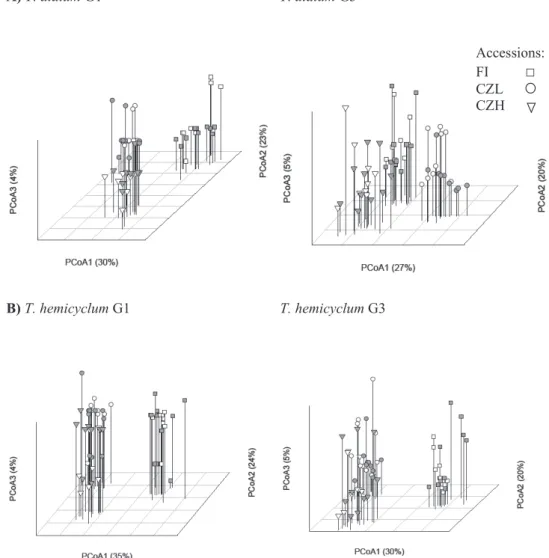
Within apomictic lineage and per generation the status of each single marker was analysed using logistic regression models to test for significant stress and accession effects (R-function glm() with binomial error distribution and logit link function). P-values were corrected for multiple testing using false discovery rate control at FDR=0.05 (R-function p.adjust()). Multivariate analyses were performed based on pairwise distances calculated by counting the absolute number of inconsistent loci between individuals (R-function designdist()). Based on this distance matrix permutational multivariate analysis of variance (R-function adonis()) and analysis of multivariate homogeneity of group dispersions were performed (R-function betadisper()). The former analysis tests for different mean positions of experimental groups in multivariate MS-AFLP space while the latter analysis tests for differences between experimental groups in their amount of MS-AFLP variation irrespective of group mean positions. A principal coordinate analysis was plotted to visualize the multidimensional data (R-function pcoa() from package Ape).
To track individual methylation changes over generations we first inferred a consensus epigenotype, which represents the hypothesized MS-AFLP profile at the beginning of G1 of all plants from the same accession. We defined this consensus as the methylation state that was observed in plants from the control treatment in G1, for each accession separately, including only loci for which none or maximum one out of the 10 replicate plants showed a deviating marker status. This criterion excluded 1-3 loci per accession from the consensus analysis because they were too polymorphic across the G1 group to confidently call the consensus state. Any deviations of the detected MS-AFLP from the consensus that were observed in stress treatments and later generations were assumed to have arisen during the experiment. These methylation changes were counted and checked for their persistence in the next generations. For each accession separately, we fitted a generalized linear mixed model to test on the plant’s proportion of MS-AFLP loci that deviated from consensus for effects of generation, G1 treatment, and the interaction generation x G1 treatment (PROC GENMOD in SAS 9.2, using type 3 analysis and likelihood ratio tests for significance).
26
Results
Drought and accession effects on methylation
The HpaII profiles clustered by accession but not by stress treatment: no clear differentiation was found between the methylation profiles of drought-stressed and control plants (Table 2.1, visualized in Fig. 2.2). However, in both apomictic lineages the drought x accession interaction in the first generation was marginally significant (T. alatum P-value = 0.059, T. hemicyclum P-value = 0.074), suggesting that a weak drought effect may be present but not equally expressed in all accessions. Visual inspection of the PCoA clustering with group centroids in the first generation (supporting information, Fig. 2.S1) indicated that for T. alatum the lowland Czech accession (CZL) may be most responsive to drought while for T. hemicyclum the northern (FI) and medium-altitude (CZH) accession might be more responsive. But even in these accessions the response was weak, and any accession-dependency of the response to drought was not inherited, since the interaction effect had disappeared in the third generation.
Table 2.1 Permutational Multivariate Analysis of Variance based on MS-AFLP profiles of two apomictic dandelion lineages. Per generation and stress treatment, drought and salicylic acid, the proportion of variance explained is shown.
T. alatum T.hemicyclum df G1 G2 G3 G1 G2 G3 Drought experiment: Accession 2 0.913 *** 0.816 *** 0.914 *** 0.833 *** Drought 1 0.001 ns 0.008 ns <0.001 ns 0.002 ns Accession x Drought 2 0.007 . 0.003 ns 0.006 . 0.005 ns Salicylic Acid experiment:
SA 1 0.073 ns 0.032 ns <0.001 ns 0.049 ns 0.058 ns 0.045 ns Based on function adonis () from R-package Vegan with 10,000 permutation steps.
Shown are R2: proportion of variance explained and significance codes:
Chapter 2 Stress-induced and heritable DNA methylations
27
A) T. alatum G1 T. alatum G3
B) T. hemicyclum G1 T. hemicyclum G3
Figure 2.2 Principal Coordinate Analysis (PCoA) based on MS-AFLP profiles of drought stressed (grey symbols) and control plants (no fill) in the first, stressed generation and the unstressed progeny of the third generation. A) MS-AFLP profiles of T. alatum, B) MS-AFLP profiles of T. hemicyclum.
Accessions: FI □ CZL CZH
28
T. alatum G1 T. alatum G3
T. hemicyclum G1 T. hemicyclum G3
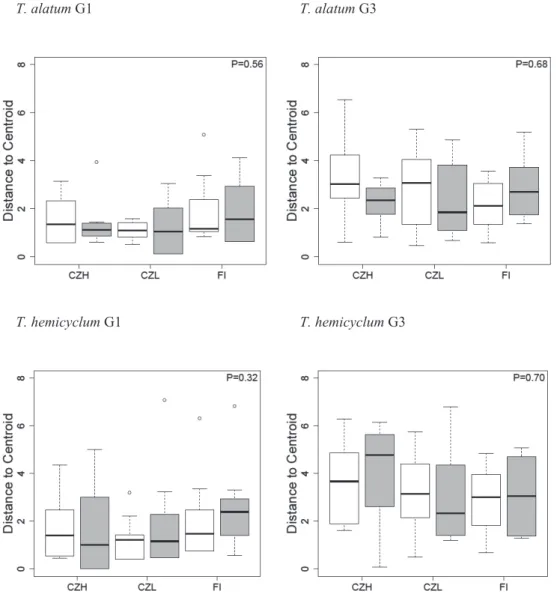
Figure 2.3 Drought stress- and accession-specific epigenetic variation. Values are distances to group centroids calculated by multivariate dispersion analysis on MS-AFLP profiles of two apomictic dandelion lineages from first and third generation. From left to right the boxplots show the dispersion of distances to centroid of the three accessions either in white boxplots = control or grey boxplots = drought stress conditions. P indicates the p-value of the treatment effect based on a permutation test with all accessions pooled together.
Chapter 2 Stress-induced and heritable DNA methylations
29
Figure 2.4 Salicylic acid stress-specific epigenetic variation. Values are distances to group centroids calculated by multivariate dispersion analysis on MS-AFLP profiles of two apomictic dandelions lineages and from three generations. From left to right the boxplots show the dispersion of distances to centroid of the accession FI separated in C (white boxplot) = control group and S (grey boxplot) = salicylic acid stressed group. P indicates the p-value of the treatment effect based on 1,000 permutations.
30
Besides causing a directed shift in methylation variation, treatments might also trigger an increased level of undirected (random) methylation changes. An increase in the number of random changes would promote differentiation in methylation profiles between replicate plants from the same experimental group. However, no such effect was observed in response to drought stress: multivariate dispersion did not differ significantly between control and drought groups (Fig. 2.3). Nevertheless, despite the lack of an inherited treatment effect, a clear buildup of methylation variation was observed between the first and third generation in both the control and the drought groups (Fig. 2.3). When pooled over treatments in order to test for generation differences, multivariate dispersion analysis revealed a significant increase of DNA methylation variation over generations for four of the six accessions: lowlands (CZL: T. alatum P-value: 0.003, T. hemicyclum P-value: 0.006) and medium altitude (CZH: T. alatum P-value: 0.014, T. hemicyclum P-value: 0.002); not significant for high latitude (FI: T. alatum P-value: 0.139, T. hemicyclum P-value: 0.198).
In addition to these multivariate analyses, we also performed a marker-by-marker analysis to test if MS-AFLP marker status associates with treatment or accession. After controlling for multiple testing at a false discovery threshold of 0.05 the single marker testing revealed that approximately a third of the analyzed loci show an accession effect (T. alatum: 16 loci in G1 and 17 loci G3, T. hemicyclum: 20 loci in G1 and 19 loci in G3), but none showed a drought effect.
Salicylic acid effect on methylation
The multivariate analysis of methylation variation following salicylic acid (SA) application (high latitude accessions, FI, only) showed no overall distinction between the control group and the SA-stressed plants, neither in the first generation that experienced the stress, nor in the subsequent generations (Table 2.1). Multivariate dispersion analysis (distance to centroid) showed no significant difference between SA-stressed and control plants, although a marginally significant trend was observed that offspring of SA-treated plants showed increased levels of dispersion compared to offspring of control plants (Fig. 2.4). We observed a buildup of DNA methylation variation over generations (pooled across control and stress groups, the generation effect for T. alatum: P-value = 0.017; for T. hemicyclum: P-value = 0.009).
The single marker tests revealed that only a few loci showed a response to salicylic acid treatment (T. alatum: 3 loci in G2 and 3 loci in G3, T. hemicyclum: 1 locus in G3), however they did not stand up to the multiple testing correction (false discovery rate > 0.05).
Tracking deviations from consensus
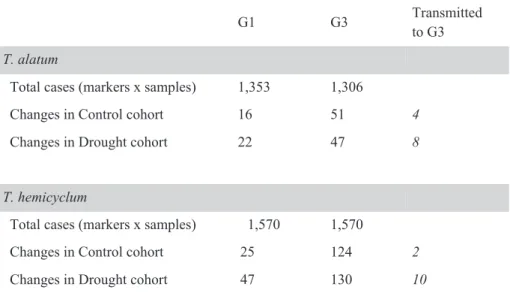
By comparing the status of MS-AFLP markers to an accession-specific consensus profile, which was based on G1 control plants, individual loci could be identified that showed a methylation change during the experiment. In both the drought and the SA experiments, methylation deviations were observed with a frequency of approximately 1-3% in G1 and up to 4-9% in G3 (Tables 2.2 and 2.3).
Chapter 2 Stress-induced and heritable DNA methylations
31
Table 2.2 Methylation changes observed in two apomictic dandelion lineages, that were exposed to drought stress in generation 1 and were propagated in a common environment to generation 3
G1 G3 Transmitted to G3 T. alatum
Total cases (markers x samples) 1,353 1,306
Changes in Control cohort 16 51 4
Changes in Drought cohort 22 47 8
T. hemicyclum
Total cases (markers x samples) 1,570 1,570
Changes in Control cohort 25 124 2
Changes in Drought cohort 47 130 10
In Generation 1 the presence⁄absence profiles of methylation-sensitive amplified fragment length polymorphism (MS-AFLP) loci were evaluated against the consensus epigenotype. The counted changes represent the pooled sum over all accessions (~ 30 samples) and italic numbers show the changed methylations of G1 that were transmitted to G3.
32
Table 2.3 Methylation changes observed in two apomictic dandelion lineages, that were exposed to salicylic acid stress in generation 1 and propagated in a common environment to generation 3
G1 G2 Transmitted to G2 G3 Transmitted to G3 T. alatum
Total cases (markers x samples) 460 460 460
Changes in Control cohort 7 12 3 10 1
Changes in SA cohort 6 24 1 21 1
T. hemicyclum
Total cases (markers x samples) 530 530 530
Changes in Control cohort 12 16 2 35 0
Changes in SA cohort 16 26 4 46 2
In Generation 1, the presence⁄absence profiles of methylation-sensitive amplified fragment length polymorphism (MS-AFLP) loci were evaluated against the consensus epigenotype. Italic numbers show the deviating methylations in G1 (= 10 samples) that were transmitted to G2 and G3 respectively.
Chapter 2 Stress-induced and heritable DNA methylations
33
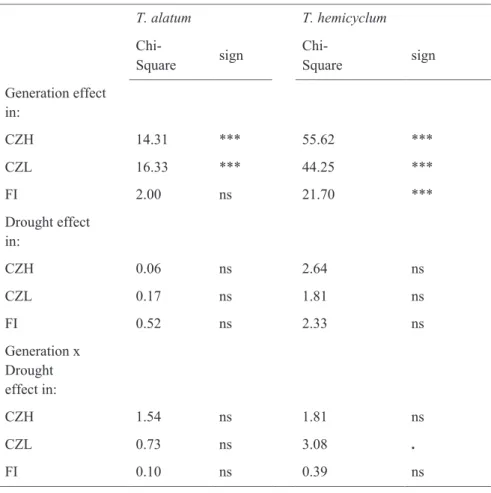
For T. hemicyclum the total number of deviations from consensus per individual was significantly higher in the SA-treated plants and SA-descendants than in control plants and control-descendants (P < 0.05; Table 2.4). This SA effect was also marginally significant in T. alatum (P-value: 0.086; Table 2.4). No effect of drought stress was detected on the number of methylation changes per individual (Table 2.5). These analyses, that test deviations from the MS-AFLP consensus profile established for control plants in G1, were performed across all generations, meaning that the observed SA-effect is not necessarily restricted to the first generation. In fact the frequency of deviations from the consensus profiles showed more pronounced differences between control and SA group in G2 and G3 compared to G1 (Tables 2.2 and 2.3). For both drought and SA stress, the generation effect on deviations from the consensus was highly significant (Tables 2.4 and 2.5), showing increasing deviations from the consensus from G1 to G3 (see also Fig. 2.2). Of the methylation changes that occurred in G1 in response to drought or SA, 13%-36% were observed to remain in the changed state until the G3 generation (Tables 2.2 and 2.3).
Table 2.4 Generalized linear mixed model tests of treatment and generation effects on the number of deviating MS-AFLP (HpaII) loci per individual.
T. alatum T. hemicyclum
Df Chi- Square sign Chi- Square Sign Generation
effect 2 10.60 ** 30.28 ***
SA effect 1 2.95 . 3.95 *
Generation x
SA effect 2 2.11 ns 0.31 ns
Chi-square and significance for accession N.
34
Table 2.5 Generalized linear mixed model tests of treatment and generation effects on the number of deviating MS-AFLP (HpaII) loci. Separate analyses were done per accession: H, L and N.
T. alatum T. hemicyclum Chi- Square sign Chi- Square sign Generation effect in: CZH 14.31 *** 55.62 *** CZL 16.33 *** 44.25 *** FI 2.00 ns 21.70 *** Drought effect in: CZH 0.06 ns 2.64 ns CZL 0.17 ns 1.81 ns FI 0.52 ns 2.33 ns Generation x Drought effect in: CZH 1.54 ns 1.81 ns CZL 0.73 ns 3.08 . FI 0.10 ns 0.39 ns
Chi-square and significance per accession (CZH: Czech Republic medium altitude, CZL: Czech Republic lowlands, FI: Finland). All degrees of freedom = 1, Significance codes: *** < 0.001; ** < 0.01; * < 0.05; . < 0.1; ns=significant
Chapter 2 Stress-induced and heritable DNA methylations
35
Discussion
The aim of this study was to evaluate the heritability of DNA methylation changes in response to environmental stimuli within apomictic dandelion lineages, which harbor limited genetic variation to adapt to changing environments. In addition we aimed at evaluating if the capacity for such inheritance is different in lineages that have successfully migrated into medium-altitude or high-latitude habitats. In two apomictic dandelion lineages drought stress showed marginally significant, accession specific direct stress effects in the methylation profile (accession x drought effect), but no transgenerational effect when screening responses of the third generation to the original stress treatments. Salicylic acid, which mimics effects of defense induction by biotrophic pathogens, promoted seemingly undirected DNA methylation changes in offspring plants leading to an increase in methylation variation in subsequent generations. This SA-induced methylation increase in subsequent generations was not detectable in the stressed plants themselves, suggesting a more complex underlying mechanism of the plants’ response to SA than transgenerational stability of stress-induced modifications.
This study provides support for the induction of DNA methylation modifications by environmental stresses, both as a direct effect in stressed plants and via an (unidentified) inherited effect causing novel changes in their unstressed progeny. Depending on genotype and environmental exposure, up to one third of the DNA methylation changes observed in the first generation were stably inherited for at least two subsequent offspring generations, indicating the potential for epigenetic divergence within apomictic lineages. However, this estimate includes spontaneous DNA methylation changes that are unrelated to the environmental signal, and the effect of experimental treatments was generally weak, genotype-dependent, environment-specific and may involve different underlying mechanisms. An additional important finding of this study is that considerable levels of heritable DNA methylation variation build up irrespective of environments from generation to generation in this apomictic system.
Unambiguous demonstrations of environmentally-induced transmission of DNA methylations that result in a functional “stress memory” have remained elusive (Pecinka et al. 2010; Boyko & Kovalchuk 2011; Mirouze & Paszkowski 2011; Paszkowski & Grossniklaus 2011). Field studies have revealed associations between methylation variation and biotic, as well as abiotic characteristics of the habitat (Gao et al. 2010; Herrera & Bazaga 2010; Lira-Medeiros et al. 2010). However, in a widespread Arabidopsis thaliana haplotype, Hagmann et al. (2015) observed that heritable DNA methylation differences accumulated in a stochastic manner, like genetic divergence, while no inherited environmentally induced effects were detected. However, they used propagated plants that were several generations removed from the field-collected material. Thus the environmental epigenetic induction might have been only transient and disappeared again. In the case of the clonally reproducing Japanese knotweed plants were grown from field-collected roots directly, which revealed a substantial DNA methylation variation that was clustered by habitat while the plants showed limited genetic variation (Richards et al. 2012). In addition, (Schmitz et al. 2011) revealed the ability of DNA methylation variation to generate substantial transgenerational diversity in the extent