
000 001 002 003 004 005 006 007 008 009 010 011 012 013 014 015 016 017 018 019 020 021 022 023 024 025 026 027 028 029 030 031 032 033 034 035 036 037 038 039 040 041 042 043 044 045 046 047 048 049 050 051 052 053 054 055 056 057 058 059 060 061 062 063 064 065 066 067 068 069 070 071 072 073 074 075 076 077 078 079 080 081 082 083 084 085 086 087 088 089 090 091 092 093 094 095 096 097 098 099 100 101 102 103 104 105 106 107
Generalising Fine-Grained Sketch-Based Image Retrieval
Anonymous CVPR submission
Paper ID 698
Abstract
Fine-grained sketch-based image retrieval (FG-SBIR) addresses matching specific photo instance using free-hand sketch as a query modality. Existing models aim to learn an embedding space in which sketch and photo can be di-rectly compared. While successful, they require instance-level pairing within each coarse-grained category as anno-tated training data. Since the learned embedding space is domain-specific, these models do not generalise well across categories. This limits the practical applicability of FG-SBIR. In this paper, we identify cross-category generali-sation for FG-SBIR as a domain generaligenerali-sation problem, and propose the first solution. Our key contribution is a novel unsupervised learning approach to model a univer-sal manifold of prototypical visual sketch traits. This man-ifold can then be used to paramaterise the learning of a sketch/photo representation. Model adaptation to novel cat-egories then becomes automatic via embedding the novel sketch in the manifold and updating the representation and retrieval function accordingly. Experiments on the two largest FG-SBIR datasets, Sketchy and QMUL-Shoe-V2, demonstrate the efficacy of our approach in enabling cross-category generalisation of FG-SBIR.
1. Introduction
Fine-grained sketch-based image retrieval (FG-SBIR) aims to find a specific photo instance given a human free-hand sketch input. This has been actively studied in recent years due to its challenge as a vision problem, and commer-cial relevance [18,35,23,19,40]. The key challenge is the sketch/photo domain gap. Photos are perspective projec-tions of visual objects represented as dense pixels, while sketches are subjectively and abstractly rendered iconic line-drawings. Recent FG-SBIR methods [23,35,27,21] address this issue by learning a deep network embedding of sketch and photo that makes them directly comparable. This embedding is often trained by a triplet ranking loss to ensure that the network embeds positive pairs nearby, and nega-tive pairs farther apart. This line of work has made great
progress, with state-of-the-art approaching human perfor-mance [21] on the Sketchy benchmark [23].
Nevertheless, existing work has thus far implicitly as-sumed that instance-level annotations of positive and nega-tive pairs are available for every coarse category to be eval-uated. This assumption limits the practical applicability of FG-SBIR. More specifically, as we shall show in this pa-per, in practice FG-SBIR generalises very poorly if training and testing categories are disjoint. This is of course unsatis-factory for potential users of FG-SBIR such as e-commerce, where it would be desirable to train a FG-SBIR system once on an initial set of product categories, and then have it de-ployed directly to newly added product categories – with-out needing to collect and annotate new data and retrain the FG-SBIR model. Compared to other category-level tasks such as object recognition in photo images, this annotation barrier is particularly high for FG-SBIR as instance-specific sketches are expensive and slow to collect.
To understand why the existing FG-SBIR models have limited cross-category generalisation ability, consider that the task of FG-SBIR as essentially binary classification – to differentiate corresponding and non-corresponding sketch-photo tuples. In this sense, a change of category is a domain-shift [7] from the perspective of the machine learn-ing model trained to perform matchlearn-ing. For example, a model trained on fine-grained matching of car photos and sketches, would struggle to perform fine-grained matching of bicycle images, due to inexperience with handlebars and saddles. Exposed to such out-of-sample data, the triplet-trained sketch/photo embedding networks may no longer place matching images nearby and vice-versa. Having iden-tified the challenge as one as domain-shift, this suggests two categories of approaches to alleviating this issue: (1) Unsu-pervised domainadaptationapproaches [7,33] would use unlabelled target data to adapt the model to better suit the target data; and (2) domaingeneralisationapproaches [25] aim to train a model that is robust enough to immediately generalise to the new domain’s data off-the-shelf. In this pa-per we will address the harder domain generalisation setting – due to the practical value of not requiring target domain (category) data collection and model retraining.
108 109 110 111 112 113 114 115 116 117 118 119 120 121 122 123 124 125 126 127 128 129 130 131 132 133 134 135 136 137 138 139 140 141 142 143 144 145 146 147 148 149 150 151 152 153 154 155 156 157 158 159 160 161 162 163 164 165 166 167 168 169 170 171 172 173 174 175 176 177 178 179 180 181 182 183 184 185 186 187 188 189 190 191 192 193 194 195 196 197 198 199 200 201 202 203 204 205 206 207 208 209 210 211 212 213 214 215 0 10 20 0 20 40 0 10 20 0 10 20 0 5 10 0 10 20 0 10 20 0 20 40 0 10 20 0 20 40 2nd 195th 17th 117th 140th ... ... ... Fuse TRN ... ... Fuse TRN VTD Seen Unseen Fuse TRN Fuse TRN VTD 0 20 40 0 10 20 0 5 10 0 5 10 0 10 20 0 50 100 0 5 10 0 5 10 0 10 20 0 20 40 32nd 249th 152nd 207th 222nd ... ... ... ... ... Seen Unseen
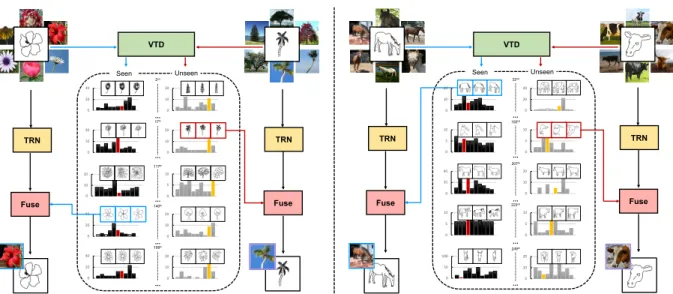
Figure 1: Illustrations of our proposed method using four categories, organised into two related pairs. TRN: triplet ranking network. VTD: visual trait descriptor. Each sketch is uniquely assigned to one VTD that describes a category-agnostic abstract sketch traits. In each subfigure, the training (seen) category is on the left and testing (unseen) on the right. Both training and testing sketches are mapped to their VTD, which are in turn used to dynamically paramaterise the TRN so as to adapt it to the query sketch. Best viewed in colour and zoom.
To address the identified issue of cross-category FG-SBIR generalisation (CC-FG-FG-SBIR), we propose a new framework that automatically adapts the deep feature ex-traction to a given query sketch. This ensures a good rep-resentation is produced at testing-time, even when dealing with out-of-sample data in the form of sketches and pho-tos from novel categories. The key idea is to learn an auxiliary unsupervised embedding network that maps any given sketch to a universal dictionary of prototypical sketch traits or manifold embeddings. We call this universal be-cause it is a representation that cuts across categories. This network can thus be used to provide a latent visual trait descriptor (VTD) of any sketch (from either a training or novel category). This descriptor is in turn used to para-materise both photo and sketch feature extractors to adapt them to the current query sketch category. Fig.1illustrates the unsupervised embedding learned by our auxiliary net-work via an illustrative five (of 300) learned embeddings (dictionary words). One can see how categories (such as flowers) span multiple embeddings and how individual em-beddings group thematically similar sketches. For exam-ple descriptor 2 and 140 encompass “complicate-dense” and “simple-sparse” visual patterns for flowers and trees; while descriptor 207 and 249 model “leftwards full-body view” and “frontal face view” respectively for cows and horses. We can also see how both training (left subgroups) and dis-joint testing sketch category (right subgroups) are assigned to the same descriptor according to common sketch traits.
The introduction of this auxiliary universal embedding network is inspired by the pioneering Noise As Targets
(NAT) [3] model. NAT proposes to pre-generate the set of all embeddings randomly – as noise – and then learn a network to map the data to this fixed noise distribution. This has the advantage of ensuring the training set’s repre-sentation spans the embedding space well. However NAT approximately solves a cumbersome and costly discrete as-signment problem to match images with embeddings at each back-propagation iteration. In contrast, we propose a novel approach to learning an embedding network based on the Gumbel-Softmax [14] reparameterisation trick. As a result, the learning is faster and more stable; and more flexible in that several alternative objectives can be consid-ered in the same formulation. Overall our framework can be considered as a solution to domain generalisation [25] that adapts a model via a domain-descriptor, but where the de-scriptor is estimated from a single data instance rather than assuming it is given as metadata [31, 32]; and where the perspective on descriptor definition is one of latent-domain discovery [30].
Our contributions are two-fold: (1) For the first time, the cross-category FG-SBIR generalisation (CC-FG-SBIR) problem is identified and tackled. (2) A solution is intro-duced based on a novel universal prototypical visual sketch trait for instance-specific latent domain discovery. We eval-uate our model using the semantic categories in Sketchy [23] and Shoe-V2 [36] – the two largest FG-SBIR datasets to date in terms of the overall and single-category size re-spectively. In contrast to their original within-category eval-uation setup, we establish a new more challenging cross-category-FG-SBIR evaluation protocol that is more in line
216 217 218 219 220 221 222 223 224 225 226 227 228 229 230 231 232 233 234 235 236 237 238 239 240 241 242 243 244 245 246 247 248 249 250 251 252 253 254 255 256 257 258 259 260 261 262 263 264 265 266 267 268 269 270 271 272 273 274 275 276 277 278 279 280 281 282 283 284 285 286 287 288 289 290 291 292 293 294 295 296 297 298 299 300 301 302 303 304 305 306 307 308 309 310 311 312 313 314 315 316 317 318 319 320 321 322 323 with real-world requirements. Extensive experiments
val-idate the efficacy of our method compared to a variety of competitors including direct transfer, other approaches to defining instance-embeddings, and state-of-the-art domain generalisation methods.
2. Related Work
Fine-grained SBIR Most earlier SBIR studies [9,4,13,
37,6,19] focus on category-level cross-domain matching. The finer-granularity retrieval of FG-SBIR recently became topical given the potential for real-world application – users would like to retrieve a specific object (e.g., an e-commerce product photo) given a mental picture. This was first stud-ied in the case of pose [18] using deformable-part models and graph-matching. Subsequent research has focused is-sues surrounding multi-branch deep learning methods that learn to extract comparable features from these heteroge-neous domains [23,35,27,21]. For example heterogeneous vs. Siamese branches [21], instance matching losses (pair-wise vs. triplet), attention [27] and improving efficiency via hashing [39]. All of these studies assumed training data was available for the specific categories within which fine-grained retrieval is to be performed. This makes the prob-lem easier (no train-test domain shift), but the models less practically valuable.
Generalisable SBIR Generalising to novel categories
be-yond the training set is an important capability for computer vision to move out of the lab and impact the real world. This motivates, for example, extensive research in zero-shot ob-ject recognition [10,41,5]. Nevertheless, in the context of SBIR, only two previous works studied cross-category gen-eralisation. Shenet al. focused on a three branch hashing network for efficient SBIR [26]. Yelamarthiet al.presents a deep conditional generative model, where a sketch is taken as input, and corresponding photo features are generated. Both studies make use of category levelfeatures to guide learning: [26] uses word-vectors to form an adjacency ma-trix to regularise the hidden representation, and [34] extracts ImageNet pre-trained photo features as guidance for sketch-feature regression. Our work differs from these in that our unique visual trait descriptors are learned automatically rather than provided externally, and they correspond to ab-stract traits shared across categories (see Fig.1) – thus bet-ter facilitating their generalisation to novel categories. Most importantly, we are the first to study cross-category gener-alisation in FG-SBIR rather than in category-level SBIR as addressed by prior methods.
Domain Generalisation The CC-FG-SBIR challenge can
be seen as a special case of Domain Generalisation (DG) [15,25,17]. DG aims to train models that work ‘out of the box’ on testing data that is out-of-sample with respect to the training data. For example by careful training regularisa-tion [25,17], or assumptions about how to remove
domain-specific biases [15]. A related line of work uses external meta-data about the new domain to synthesise an appropri-ate model on the fly [31,12]. In the context of deep net-works, such dynamic parameter synthesis has been termed hypernetworks [11] – where one network synthesises the weights of another [11,2]. Our approach addresses the DG problem in CC-FG-SBIR by embedding the query sketch in our universal embedding space, and using this embedding as the descriptor of the new domain (in place of external descriptors [31,12]) from which parts of the feature extrac-tion network of both photo and sketch are synthesised (as per hypernetworks [11,2]).
Fine-grained SBIR Dataset Collecting human free-hand
sketches for FG-SBIR is cumbersome as sketches must be manually drawn given a mental picture of a pre-established corresponding photo. Thanks to crowdsourcing, two commonly-used FG-SBIR benchmarks have been con-tributed, Sketchy [23] and QMUL-Shoe-V2 [36]. These are respectively the largest to date in terms of the overall and single category size (i.e., breadth and depth respectively). Sketchy and QMUL-Shoe-V2 have noticeable differences rooted in their different matching granularity. Sketchy tries to cover many everyday objects (the photo gallery is a sub-set of ImageNet), where pose and general shape play a major role. In contrast, QMUL-Shoe-V2 is motivated by a more commercial application to focus on a single cate-gory, where subtle details like the particular ankle straps or buckles are crucial distinguishing factors, but pose is not salient. In our experiments, we make use of both datasets, to demonstrate that our generalisation contribution applies across both everyday object categories (e.g., cat to dog) in Sketchy and fine-grained sub-categories (e.g., flat sandal to wedge sandal) in QMUL-Shoe-V2.
3. Methodology
Overview Our framework consists of two main
compo-nents. Firstly, our unsupervised embedding networkmaps any sketch sinto one of Kunique visual trait descriptors
Ds via an encoder-decoder framework Ds = φ(s). So
the full set ofM-dimensional trait descriptors defines a ma-trixD ∈RK×M. This serves to provide the description of
any sketch’s query domain. Secondly, adynamically para-materised feature extractor with triplet lossis formulated, which actually performs FG-SBIR by using the generated descriptor to adapt the feature extraction and retrieval to any query sketch. Denotingψ(·)as Deep CNN feature extrac-tor, FG-SBIR is performed by finding the photopthat min-imises the distancedpsi(s)(s, p) =||ψφ(s)(s)−ψφ(s)(p)||22 to query sketchs. The unsupervised embedding network is trained in an unsupervised way on the training sketch categories. And the dynamically paramaterised FG-SBIR model is trained in a supervised way on the training sketch categories. No components touch the held out testing
cate-324 325 326 327 328 329 330 331 332 333 334 335 336 337 338 339 340 341 342 343 344 345 346 347 348 349 350 351 352 353 354 355 356 357 358 359 360 361 362 363 364 365 366 367 368 369 370 371 372 373 374 375 376 377 378 379 380 381 382 383 384 385 386 387 388 389 390 391 392 393 394 395 396 397 398 399 400 401 402 403 404 405 406 407 408 409 410 411 412 413 414 415 416 417 418 419 420 421 422 423 424 425 426 427 428 429 430 431 S #$ R E … … … … … … … … … … … … %& D '( )( …
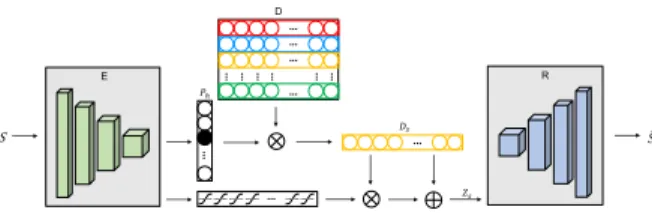
Figure 2: Schematic illustration of our proposed unsuper-vised encoder-decoder model. See details in text.
gory data until evaluation. In the following two sections we describe each of these components in detail.
3.1. Universal Visual Trait Embedding
The unsupervised embedding network will map any sketch to an entry in a dictionary of descriptorsD. Inspired by NAT [3], we pre-generate the descriptor dictionary at random so that each row ofD, denotedDiis sampled from
the standard Gaussian and then`2normalised. This ensures that the descriptor dictionary spans the availableM dimen-sional space well. The network’s goal is then to learn to map any sketch onto one of theseK(random) dictionary el-ements so that the representations of the full sketch dataset spread out over the whole embedding space.
Encoder-Decoder We start by feeding an input sketchs
into a CNN encoderE(s). We then use one fully-connected (FC) layer to predict a K-dimensional vector of unnor-malised probabilitiespand select the most probable one as sketchs’s descriptorDsout of the full dictionaryD
p=WpE(s) +bp
ph= onehot(argmax(softmax(p)))
Ds=phD, ˆs=R(Ds)
(1)
To ensure that each descriptor corresponds to a visually meaningful trait, the assigned descriptor is then decoded by decoderRwith de-convolutional layers that reconstruct the input sketchsˆ ≈ s. We denote the extraction of a sketch trait descriptor in this way asDs=φ(s).
A Practical Consideration Since the number of
descrip-torsK(300) is much less than sketches (tens of thousands), our approach means that sketches will be coarsely quan-tised, and reconstruction error will be high. (The clusters do not contain enough information to accurately reconstruct each sketch). Therefore we modify this approach with the following skip connection to improve the decoding viaR.
Zs=Ds(1 +αtanh(WskE(s) +bsk))
ˆ
s=R(Zs)
(2)
where we setα= 0.02. This passes through some detailed features of the sketch to augment the coarse dictionary en-coding. See Fig.2for an intuitive illustration.
Optimisation The method as presented so far is hard
to optimise because: (i) The use of argmax is non-differentiable and would naively require Monte Carlo esti-mates and a REINFORCE-type algorithm [29], which suf-fers from high variance. (ii) A trivial minimiser of the re-construction loss is to output one or few constant one-hot vectors ph. Especially in the early phase of training, this
will trap the model in a local minima forever. To alleviate this problem, we employ a low-variance gradient estimated based on a reparameterisation trick.
Hard Assignment via Gumbel-Softmax Applying the
Gumbel-Softmax reparameterisation trick [14] and straight-through (ST) gradient estimator,phis replaced as
pg= softmax((p+g)/τ)
phg= onehot(argmax(pg))
(3)
whereg ∈ RK withg1...gk are i.i.d samples drawn from
Gumbel(0,1), and τ is the temperature1. We further en-force a uniform categorical prior onps = softmax(p)to
avoid sketches being assigned to only a subset of dictionary elements, and form a Kullback-Leibler loss as:
qy= [1/K,1/K, ...,1/K]∈RK DKL(ps||qy) = 1 B B X i=1 psi,:log(psi,:/qy) (4)
whereBis the batch size. For simplicity, we use boldpsto
denote the batch counterpart ofps, withpsitheithexample
andpsi,jas itsjthelement. We will follow this convention
for other symbols. This ensures that across the batch as a whole, sketches are assigned to diverse descriptors.
Soft Assignment via Entropy Constraint We also
ex-plore an alternative strategy, which is to adopt a soft assign-ment approach during training. By replacingph withps,
each sketch takes a linear combination ofD, rather than se-lecting a row ofDfor representation learning. In this soft assignment of sketches to descriptors, we want to motivate sparse probabilities so that eachstends to receive one dom-inant label assignment. Thus we add a row entropy loss:
Hrow=− 1 B B X i=1 K X j=1
psi,jlog(psi,j) (5)
Eq.5achieves its minimum0only ifpsiis an one-hot
vec-tor specifying a deterministic distribution. We further
en-1Since we are using straight-throughargmax,τ will not adaptively
adjust the “confidence” of proposed samples during the training process. For the forward pass,phgis used thus a real one-hot vector is generated, while for the backward pass, it is replaced bypsto make the (estimated) gradient flows back. In practice, we just assign it a mild value like1.0.
432 433 434 435 436 437 438 439 440 441 442 443 444 445 446 447 448 449 450 451 452 453 454 455 456 457 458 459 460 461 462 463 464 465 466 467 468 469 470 471 472 473 474 475 476 477 478 479 480 481 482 483 484 485 486 487 488 489 490 491 492 493 494 495 496 497 498 499 500 501 502 503 504 505 506 507 508 509 510 511 512 513 514 515 516 517 518 519 520 521 522 523 524 525 526 527 528 529 530 531 532 533 534 535 536 537 538 539 courage equal usage of allps:,j via a column entropy term:
pc = 1 B B X i=1 ps:,j ∈RK Hcol=− K X j=1 pcjlog(pcj) (6)
Eq. 6 achieves its maximum1 only if elements in pc are
uniformly distributed. However, the row entropy constraint is only valid for a large enough minibatch and we em-pirically find that on average around 30% of ph are still
empty, (no assignments of any sketches). Therefore, we dy-namically replace the stale and inactiveDi during training
and bring them back in to compete with over-active ones. Specifically, we extractphof all training sketches after each
epoch, and select the most concentratedDi. A small
ran-dom perturbation is then added to define a new centre, i.e.,
Di(1+βN(0,1)). We find this simple strategy works well2.
Summary Depending on which assignment strategy we
use (Gumbel-Softmax vs. Entropy), and combined with re-construction lossLrec =||s−ˆs||2, we obtain our two opti-misation objectives:
minEs∼S[Lrec+λKLDKL(ps||qy)]
minEs∼S[Lrec+λrowHrow−λcolHcol]
(7)
where hyper-parametersλKL, λrow, λcolcontrol the relative
weighting importance. In summary, optimising the un-supervised objective Eq. 7 trains an autoencoder that in-ternally represents sketches in terms of a pre-defined K -element dictionary D. In the following section, we will re-use the sub-network that assigns sketches to dictionary elementsDs =φ(s)as a descriptor for dynamically
para-materising our FG-SBIR network.
3.2. Dynamic Parameterisation for FG-SBIR
The unsupervised embedding network shown in Fig.2
extracts a visual trait descriptor (VTD), φ(s), from each sketch, which is then used to parameterise a triplet rank-ing network (TRN),ψ(·), for learning domain-generalisable representations for sketch and photo, as illustrated in Fig.1. Note that sketch and photo feature extractorsψis Siamese – applied to both sketch and photo for FG-SBIR. Denoting
ψφ(s)(·)as the feature extractor calibrated to sketchs, and
F(·)as a vanilla CNN feature extractor, we have:
ψφ(s)(·) =η(φ(s))F(·) +F(·) (8)
The above can be interpreted as a small hypernetwork [11], where we generate a sketch-conditional diagonal weight
2A side effect is to trade quality with time. We spend almost
one-third of the time extracting representations for all training sketches. We set
β= 0.05throughout the experiments and find it works well empirically.
layer to adapt the conventional CNN featureF to the cur-rent sketch, along with a residual connection. It can also be interpreted as a generating a sketch-specific soft attention mask on F whereη indicates salient dimensions. Using this dynamically paramaterised feature extractor, we finally apply a standard triplet loss to match photos and sketches:
Ltri= max(0,∆ +d(ψφ(s)(s), ψφ(s)(p+))
−d(ψφ(s)(s), ψφ(s)(p−)))
(9)
A Stochastic Paramaterisation A standard solution for
the weight generatorη(·) in Eq.8 is to transform the in-put sketch embedding through a few FC layers [11]. How-ever, as the input is a discrete set of descriptor vectors, this causes discontinuity in weight generation. We take in-spiration from [38] and mitigate this by introducing layers that predict a Gaussian mean and variance, and then sample these to more smoothly generate the target parameters.
µs=Wµφ(s) +bµ σs= exp( Wσφ(s) +bσ 2 ) η(φ(s)) =µs+σs N(0,1). (10)
Optimisation and Inference Finally, to avoid generative
model overfitting [8], we add the commonly applied varia-tional regularisation term,Lcon =DKL(η(φ(s))||N(0, I)),
weighted by a small valueλcon. Our FG-SBIR objective is:
minEt∼T[Ltri+λconLcon] (11)
wheretstands for a triplet tuple, consisting of{s, p+, p−}. During testing, for a query sketch s, we sample η(φ(s)) ten times to calculate distance for each sketch-photo gallery pair and take the smallest as the final measure.
4. Experiments
4.1. Experimental Settings
Dataset and Pre-processing We use the public Sketchy
[23] and QMUL-Shoe-V2 [36] to evaluate our methods. Sketchy contains125categories with100photos each and at least5 sketches per photo. We follow the same dataset split as [34] and partition Sketchy into104train and21test categories to ensure the test ones are not present in 1000 ImageNet Challenge classes [22]. For QMUL-Shoe-V2, we test generalisation by transferring between fine-grained sub-categories and design five groups of such experiments as shown in Table2. We scale and centre the sketches to 64×64when training the UEN, while for FG-SBIR, the inputs of all three branches are resized to299×299.
Implementation Details We implement both models in
Tensorflow on a single NVIDIA 1080Ti GPU.
Unsuper-vised Embedding Network: Our CNN-based
540 541 542 543 544 545 546 547 548 549 550 551 552 553 554 555 556 557 558 559 560 561 562 563 564 565 566 567 568 569 570 571 572 573 574 575 576 577 578 579 580 581 582 583 584 585 586 587 588 589 590 591 592 593 594 595 596 597 598 599 600 601 602 603 604 605 606 607 608 609 610 611 612 613 614 615 616 617 618 619 620 621 622 623 624 625 626 627 628 629 630 631 632 633 634 635 636 637 638 639 640 641 642 643 644 645 646 647 Competitor Acc.@ 1 Acc.@ 5 Acc.@ 10 Competitor Acc.@ 1 Acc.@ 5 Acc.@ 10
Hard-Transfer [35] 16.0% 40.5% 55.2% Ours-WordVector 18.0% 43.5% 58.7% CVAE-Regress [34] 2.4% 9.5% 17.7% Ours-Edge-Hard 15.4% 39.3% 54.3% Reptile [1] 17.5% 42.3% 57.4% Ours-Edge-Soft 16.8% 41.3% 56.2% CrossGrad [25] 13.4% 34.9% 49.4% Ours-Full-Hard 20.1% 46.4% 61.7% Ours-VAE 12.7% 34.5% 49.7% Ours-Full-Soft 22.6% 49.0% 63.3% Ours-VAE-Kmeans 17.6% 41.9% 56.9% Upper-Bound 29.9% 65.5% 81.4%
Table 1: Comparative Cross-Category FG-SBIR results on Sketchy [23].
five fractional-convolutions with stride 1/2, with one1×1 convolution at the end and start of each. BatchNorm-Relu activation is applied to every convolutional layer, except the output ofRwith Tanh. All hyper-parameters are set to un-dergo a warm-up phase, so that reconstruction loss dom-inates the training at the beginning. We train the models for 200 epochs under all settings with λkl, λrow, λcol
lin-early increasing from0,1,1to1.5,2,10respectively. The dictionaryDhasM = 256dimensions andK = 300 el-ements throughout. We use Adam optimiser with learning
rate0.0002. FG-SBIR: we fine-tune ImageNet-pretrained
Inception-v3 [28] to obtainF with the final classification layer removed. We enforce`2 normalisation on the output of η to stabilise triplet learning and set hyper-parameters ∆ = 0.1, λcon= 0.004. We train for20epochs on Sketchy,
and10epochs on QMUL-Shoe-V2 with a learning rate of 0.0001and Adam optimiser under all settings.
Evaluation Metric We use Acc.@Kto measure the
FG-SBIR performance, which is the percentage of sketches whose true-match photos are ranked in the topK.
4.2. Competitors
Sketchy If not otherwise mentioned, all competitors are
implemented based on Inception-v3, and our model is trained with soft assignment. Hard-Transfer[35] trains a vanilla Siamese triplet ranking model and is directly tested on unseen categories. CVAE-Regress3 [34] is the
state-of-the-art zero-shot SBIR method by learning a conditional generative model to regress ImageNet-pretrained photo fea-tures to their corresponding sketch feafea-tures. Reptile [1] is a recent meta-learning algorithm that repeatedly samples tasks, trains them, and moves the initialisation towards the trained weights. We integrate it in [35] by each time ran-domly sampling 52 categories to form two subtasks and train parallelly for500iterations.CrossGrad[25] is a state-of-the-art domain generalisation method that trains both a label and a domain classifier on examples perturbed by each other’s loss gradients. For our task, we regard each of 104 training categories as a unique domain and100 inter-category photo ids as labels. Ours-VAE corresponds to training a conventional variational autoencoder (VAE) [16] without our visual trait descriptor and using the per-instance
3This method is designed for category-level characterisation, so is
ex-pected to perform poorly.
latent representation as the descriptorφto parameterise the FG-SBIR model. Ours-VAE-Kmeans performs K-means clustering in the VAE latent space, to generate a dictionary of sketch descriptors analogous to our approach, but with-out end-to-end learning. Ours-WordVector replaces our descriptor with the category-level descriptor drawn from its class name [20]. Lastly, we compareOurs-Edge-Hard
andOurs-Edge-Soft, that train our VTD on edgemaps with
hard and soft assignment strategies respectively, while our two full models, Ours-Full-HardandOurs-Full-Softare trained on human freehand sketches.
QMUL-Shoe-V2 This is a very-fine-grained single
cate-gory dataset, so we do not have enough data to train a dic-tionaryDfrom scratch. Therefore we take the advantage of the best visual trait descriptor trained on Sketchy and introduce two variants Ours-Sketchyand Ours-Sketchy-Ft. They differ in if we directly use the Sketchy dictionary or further fine-tune it on the seen sub-category of QMUL-Shoe-V2.Hard-Transferis the competitor.
4.3. Results on Sketchy
We compare the performance of different models in Ta-ble14 and make the observations: (i) The gap between
di-rect transfer (16%) and a model trained using data from the target (unseen) categories (Upper-Bound, 30%) is large, confirming the cross-category generalisation gap. (ii) Our model beats all 10 competitors in bridging this gap. (iii) For DG meta-learning competitors, CrossGrad [25] fails to improve on the direct transfer baseline, but Reptile [1] does improve on it. However both are worse than our full model. (iv) Comparing our two proposed optimisaton meth-ods, soft assignment outperforms hard. We attribute this to the rigid approach of the latter – it enforces a uniform distribution over assignment to descriptors, which may not hold in practice since some will be more common than oth-ers. (v) Our visual trait descriptor approach is beneficial as manifested by the dramatic performance gap between ours and the conventional VAE and VAE-Kmeans alternatives in particular. (vi) Using visually abstract but neat human free-hand sketches as source data to train our descriptor is impor-tant. Replacing these with the detailed but noisy edgemaps
4Here we use all images within one category for constructing a
chal-lenging test set. The Upper-Bound is therefore likely a slight overestimate, as it uses half of these for training before testing on all. Same for Table2.
648 649 650 651 652 653 654 655 656 657 658 659 660 661 662 663 664 665 666 667 668 669 670 671 672 673 674 675 676 677 678 679 680 681 682 683 684 685 686 687 688 689 690 691 692 693 694 695 696 697 698 699 700 701 702 703 704 705 706 707 708 709 710 711 712 713 714 715 716 717 718 719 720 721 722 723 724 725 726 727 728 729 730 731 732 733 734 735 736 737 738 739 740 741 742 743 744 745 746 747 748 749 750 751 752 753 754 755 Pa rr ot G iraf fe D eer
100thDescriptor 155thDescriptor 209thDescriptor
31stDescriptor
29thDescriptor
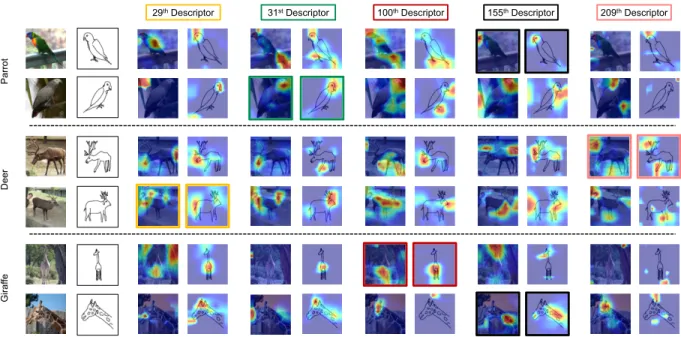
Figure 3: Visualisation of how the VTD adapts the sketch-photo matching process. Coloured image box border indicates when the correct (corresponding to query sketch) descriptor is used to paramaterise the embedding space.
(a) 0 0.01 0.02 0.03 0.04 0.05 0.06 0.07 2 31 35 36 51 100 150 249 276 295 Giraffe Saxophone Vis-Sim = 0.768 Sem-Sim = 0.144 0 0.01 0.02 0.03 0.04 0.05 0.06 0.07 0.08 0.09 0.1 43 51 83 124 132 180 242 249 261 276 Rocket Wine-bottle Vis-Sim = 0.757 Sem-Sim = 0.130 0 0.01 0.02 0.03 0.04 0.05 0.06 12 36 60 96 111 115 155 264 273 292 Sea_turtle Shark (b) Vis-Sim = 0.245 Sem-Sim = 0.552 (c) 0 0.005 0.01 0.015 0.02 0.025 0.03 0.035 0 31 51 99 151 154 165 188 198 201 Cat Dog Vis-Sim = 0.852 Sem-Sim = 0.761
Figure 4: Word-Vector vs. Visual-Semantics. Comparing illustrative category pairs: (a) Visually close but semantically far. (b) Semantically related but visually far. (c) Visually and semantically related. Vis-Sim is cosine distance between the histograms, and Sem-Sim is the cosine distance between word-vectors. Histograms shown here are the ten most similar / dissimilar descriptors jointly shared between two categories. Best viewed in colour and zoom.
extracted from natural photos hurts the performance under both hard and soft assignment strategies (Ours-Edge-Hard, Ours-Edge-Soft). This suggests that the model is able to exploit the clean and iconic free-hand sketches to learn ab-stract visual traits more effectively.
Qualitative Impact of Descriptors We now qualitatively
examine how a visual trait descriptorDs = φ(s)impacts
sketch photo matching and how retrieval is affected if us-ing another sketch descriptorDsˆ,sˆ6=sinstead. To achieve
this, we select one dimension from ψφ(s) that contributes the most to successful matching and use Grad-Cam [24] to propagate gradients back to highlight discriminative image regions. This can be seen as a visualisation of the implicit attention mechanisms that different visual trait descriptors define to adapt the feature extraction. We illustrate this in Fig.3across five differentDss for each of six sketch-photo
pairs. It shows that (i) The correspondingDshelps focus
756 757 758 759 760 761 762 763 764 765 766 767 768 769 770 771 772 773 774 775 776 777 778 779 780 781 782 783 784 785 786 787 788 789 790 791 792 793 794 795 796 797 798 799 800 801 802 803 804 805 806 807 808 809 810 811 812 813 814 815 816 817 818 819 820 821 822 823 824 825 826 827 828 829 830 831 832 833 834 835 836 837 838 839 840 841 842 843 844 845 846 847 848 849 850 851 852 853 854 855 856 857 858 859 860 861 862 863 Sub-category Fine-grained Transfer No. Train / Test Competitor Acc.@ 1 Acc.@ 5 Acc.@ 10
Sandal Flat→Wedge 560 / 227
Hard-Transfer 9.25% 32.2% 48.0% Ours-Sketchy 13.2% 34.3% 50.4% Ours-Sketchy-Ft 15.4% 37.9% 54.6% Upper-Bound 28.6% 56.8% 72.2%
Toe-shape Closed→Fish-mouth 400 / 351
Hard-Transfer 14.8% 44.7% 61.5% Ours-Sketchy 22.2% 50.4% 65.0% Ours-Sketchy-Ft 24.2% 54.5% 66.7% Upper-Bound 29.3% 56.7% 71.8% Shoe-height Ankle-→Knee-high 2010 / 245
Hard-Transfer 10.6% 32.2% 43.3% Ours-Sketchy 14.7% 38.0% 51.0% Ours-Sketchy-Ft 18.4% 40.8% 55.1% Upper-Bound 25.3% 54.3% 71.8%
Heel-shape Thick→Thin 828 / 411
Hard-Transfer 12.2% 35.0% 48.7% Ours-Sketchy 15.1% 41.4% 59.4% Ours-Sketchy-Ft 17.3% 41.1% 57.7% Upper-Bound 26.3% 61.8% 80.5% Topline Small→Big 5015 / 1543
Hard-Transfer 7.25% 22.9% 34.5% Ours-Sketchy 12.2% 28.9% 39.7% Ours-Sketchy-Ft 15.5% 31.4% 43.8% Upper-Bound 19.6% 44.2% 61.5% Table 2: Comparative Cross-Category FG-SBIR results on QMUL-Shoe-V2 [36]
No. Hard Soft
Acc.@ 1 Acc.@ 5 Acc.@ 10 Acc.@ 1 Acc.@ 5 Acc.@ 10
20 18.4% 43.3% 58.4% 19.5% 46.0% 60.4%
100 19.6% 45.7% 60.9% 20.7% 47.7% 62.7%
300 20.1% 46.4% 61.7% 22.6% 49.0% 63.3%
1000 17.8% 42.3% 57.6% 18.3% 43.8% 59.0%
Table 3: Effects of the number of descriptors on Cross-Category FG-SBIR performance on Sketchy [23].
andp+, while a mismatchedD ˆ
sfails to do this; (ii)
Individ-ual descriptorsDi are useful for multiple categories, e.g.,
the155thdescriptor for parrots and giraffes.
How Many Descriptors? We investigate the impact of
the descriptor dictionary size K on CC-FG-SBIR perfor-mance in Table3. We can see that our model is not very sensitive toKunder either hard and soft assignment strate-gies, and a few hundred suffices for good performance.
Descriptor-Category Spread We can verify that VTDs
cross-cut rather than mirror the category breakdown of sketches. On average, training sketches from each category are assigned to138±30unique descriptors. Testing cate-gory sketches (upon which the embedding is not trained) are assigned to129±33descriptors, indicating that the cross-cutting spread is retained despite the train/test domain-shift.
Word-Vector vs. Visual-Semantics The quantitative
re-sults (Table1) showed that word-vector descriptors do im-prove performance over hard-transfer, albeit much less than our approach. We can contrast similarity as estimated by word-embeddings, with that of our VTD. Fig.4(a) shows a pair of categories which are far in semantic word similar-ity, but near in visual visual trait descriptor similarity. Here category level visual similarity is measured by the num-ber of sketches (y-axis) from different categories (bars)
co-assigned to a single descriptor (x-axis). In contrast, Fig.4(b) shows semantically related categories that are visually dis-tinct (shark/sea turtle) and Fig.4(c) illustrates categories that are both semantically and visually related (dog/cat).
4.4. Results on QMUL-Shoe-V2
In this section, we borrow the best VTD dictionary D
(Ours-Full-Soft) trained on Sketchy and use it to help trans-fer between sub-categories in QMUL-Shoe-V2. To test gen-eralisation on this benchmark, we design five groups of ex-periments, each defining a different type of train/test gap, and with diverse split sizes. We report their performance in Table 2 and find that compared with Hard-Transfer, even when directly applyingDto this novel dataset, Ours-Sketchy improves performance in all experiments. This is promising as a Sketchy-trained dictionary is generally ap-plicable and it has potential to benefit other specific FG-SBIR applications. When further fine-tuned on the train data split of each experiment, we also usually improve per-formance (Ours-Sketchy-Ft and Ours-Sketchy).
5. Conclusion
We have for the first time identified the generalisation problem in cross-category FG-SBIR and proposed a novel solution via learning a universal visual trait descriptor em-bedding. This embedding dictionary is mapped to a set of latent domains that cross-cut sketch categories, and enable a retrieval network to be suitably paramaterised given a query sketch – by mapping query sketches to the correspond-ing descriptor in the dictionary. Extensive experiments on Sketchy and QMUL-Shoe-V2 demonstrate the superiority of our proposed method for cross-category FG-SBIR.
864 865 866 867 868 869 870 871 872 873 874 875 876 877 878 879 880 881 882 883 884 885 886 887 888 889 890 891 892 893 894 895 896 897 898 899 900 901 902 903 904 905 906 907 908 909 910 911 912 913 914 915 916 917 918 919 920 921 922 923 924 925 926 927 928 929 930 931 932 933 934 935 936 937 938 939 940 941 942 943 944 945 946 947 948 949 950 951 952 953 954 955 956 957 958 959 960 961 962 963 964 965 966 967 968 969 970 971
References
[1] N. Alex and S. Johnn. Reptile: A scalable meta-learning algorithm. https://blog.openai.com/reptile/, 2018.
[2] L. Bertinetto, J. F. Henriques, J. Valmadre, P. Torr, and A. Vedaldi. Learning feed-forward one-shot learners. In NIPS, 2016.
[3] P. Bojanowski and A. Joulin. Unsupervised learning by pre-dicting noise. InICML, 2017.
[4] Y. Cao, C. Wang, L. Zhang, and L. Zhang. Edgel index for large-scale sketch-based image search. InCVPR, 2011. [5] S. Changpinyo, W.-L. Chao, B. Gong, and F. Sha.
Synthe-sized classifiers for zero-shot learning. InCVPR, 2016. [6] J. Collomosse, T. Bui, M. J. Wilber, C. Fang, and H. Jin.
Sketching with style: Visual search with sketches and aes-thetic context. InICCV, 2017.
[7] G. Csurka.Domain Adaptation in Computer Vision Applica-tions. Springer, 2017.
[8] C. Doersch. Tutorial on variational autoencoders. arXiv preprint arXiv:1606.05908, 2016.
[9] M. Eitz, K. Hildebrand, T. Boubekeur, and M. Alexa. Sketch-based image retrieval: Benchmark and bag-of-features descriptors.TVCG, 2011.
[10] A. Frome, G. S. Corrado, J. Shlens, S. Bengio, J. Dean, T. Mikolov, et al. Devise: A deep visual-semantic embed-ding model. InNIPS, 2013.
[11] D. Ha, A. Dai, and Q. V. Le. Hypernetworks. InNIPS, 2017. [12] J. Hoffman, T. Darrell, and K. Saenko. Continuous mani-fold based adaptation for evolving visual domains. InCVPR, 2014.
[13] R. Hu and J. Collomosse. A performance evaluation of gra-dient field hog descriptor for sketch based image retrieval. CVIU, 2013.
[14] E. Jang, S. Gu, and B. Poole. Categorical reparameterization with gumbel-softmax. InICLR, 2017.
[15] A. Khosla, T. Zhou, T. Malisiewicz, A. Efros, and A. Tor-ralba. Undoing the damage of dataset bias. InECCV, 2012. [16] D. P. Kingma and M. Welling. Auto-encoding variational
bayes. InICLR, 2014.
[17] D. Li, Y. Yang, Y.-Z. Song, and T. M. Hospedales. Learning to generalize: Meta-learning for domain generalization. In AAAI, 2018.
[18] Y. Li, T. M. Hospedales, Y.-Z. Song, and S. Gong. Fine-grained sketch-based image retrieval by matching de-formable part models. InBMVC, 2014.
[19] L. Liu, F. Shen, Y. Shen, X. Liu, and L. Shao. Deep sketch hashing: Fast free-hand sketch-based image retrieval. In CVPR, 2017.
[20] T. Mikolov, I. Sutskever, K. Chen, G. S. Corrado, and J. Dean. Distributed representations of words and phrases and their compositionality. InNIPS, 2013.
[21] K. Pang, Y.-Z. Song, T. Xiang, and T. Hospedales. Cross-domain generative learning for fine-grained sketch-based im-age retrieval. InBMVC, 2017.
[22] O. Russakovsky, J. Deng, H. Su, J. Krause, S. Satheesh, S. Ma, Z. Huang, A. Karpathy, A. Khosla, M. Bernstein,
A. C. Berg, and L. Fei-Fei. ImageNet Large Scale Visual Recognition Challenge.IJCV, 2015.
[23] P. Sangkloy, N. Burnell, C. Ham, and J. Hays. The sketchy database: Learning to retrieve badly drawn bunnies. SIG-GRAPH, 2016.
[24] R. R. Selvaraju, M. Cogswell, A. Das, R. Vedantam, D. Parikh, D. Batra, et al. Grad-cam: Visual explana-tions from deep networks via gradient-based localization. In ICCV, 2017.
[25] S. Shankar, V. Piratla, S. Chakrabarti, S. Chaudhuri, P. Jyothi, and S. Sarawagi. Generalizing across domains via cross-gradient training. InICLR, 2018.
[26] Y. Shen, L. Liu, F. Shen, and L. Shao. Zero-shot sketch-image hashing. InCVPR, 2018.
[27] J. Song, Q. Yu, Y.-Z. Song, T. Xiang, and T. M. Hospedales. Deep spatial-semantic attention for fine-grained sketch-based image retrieval. InICCV, 2017.
[28] C. Szegedy, V. Vanhoucke, S. Ioffe, J. Shlens, and Z. Wojna. Rethinking the inception architecture for computer vision. In CVPR, 2016.
[29] R. J. Williams. Simple statistical gradient-following algo-rithms for connectionist reinforcement learning. Machine learning, 1992.
[30] Z. Xu, W. Li, L. Niu, and D. Xu. Exploiting low-rank structure from latent domains for domain generalization. In ECCV, 2014.
[31] Y. Yang and T. M. Hospedales. A unified perspective on multi-domain and multi-task learning. InICLR, 2015. [32] Y. Yang and T. M. Hospedales. Multivariate regression on
the grassmannian for predicting novel domains. InCVPR, 2016.
[33] H. A. P. G. H. L. F. L. M. M. V. L. Yaroslav Ganin, Ev-geniya Ustinova. Domain-adversarial training of neural net-works. InJMLR, 2016.
[34] S. K. Yelamarthi, S. K. Reddy, A. Mishra, and A. Mittal. A zero-shot framework for sketch based image retrieval. In ECCV, 2018.
[35] Q. Yu, F. Liu, Y.-Z. Song, T. Xiang, T. M. Hospedales, and C. C. Loy. Sketch me that shoe. InCVPR, 2016.
[36] Q. Yu, Y.-Z. Song, T. Xiang, and T. M. Hospedales. SketchX! - Shoe/Chair fine-grained SBIR dataset. http:
//sketchx.eecs.qmul.ac.uk, 2017.
[37] H. Zhang, S. Liu, C. Zhang, W. Ren, R. Wang, and X. Cao. Sketchnet: Sketch classification with web images. InCVPR, 2016.
[38] H. Zhang, T. Xu, H. Li, S. Zhang, X. Huang, X. Wang, and D. Metaxas. Stackgan: Text to photo-realistic image synthe-sis with stacked generative adversarial networks. InICCV, 2017.
[39] J. Zhang, F. Shen, L. Liu, F. Zhu, M. Yu, L. Shao, H. T. Shen, and L. Van Gool. Generative domain-migration hashing for sketch-to-image retrieval. InECCV, 2018.
[40] J. Zhang, F. Shen, L. Liu, F. Zhu, M. Yu, L. Shao, H. Tao Shen, and L. Van Gool. Generative domain-migration hashing for sketch-to-image retrieval. InECCV, 2018. [41] Z. Zhang and V. Saligrama. Zero-shot learning via joint
![Table 1: Comparative Cross-Category FG-SBIR results on Sketchy [23].](https://thumb-us.123doks.com/thumbv2/123dok_us/1985216.2794825/6.918.116.778.110.217/table-comparative-cross-category-fg-sbir-results-sketchy.webp)
![Table 2: Comparative Cross-Category FG-SBIR results on QMUL-Shoe-V2 [36]](https://thumb-us.123doks.com/thumbv2/123dok_us/1985216.2794825/8.918.116.783.108.426/table-comparative-cross-category-sbir-results-qmul-shoe.webp)
