TOWARDS PRACTICAL ACCESS CONTROL AND
USAGE CONTROL ON THE CLOUD USING
TRUSTED HARDWARE
by
Judicael Briand Djoko
M.S. Computer Engineering, University of Pittsburgh, USA, 2015
B.S. Computer Engineering, The University of Akron, USA, 2013
Submitted to the Graduate Faculty of
School of Computing and Information Sciences Department of
Computer Science in partial fulfillment
of the requirements for the degree of
Doctor of Philosophy
University of Pittsburgh
2019
UNIVERSITY OF PITTSBURGH
DEPARTMENT OF COMPUTER SCIENCE
This dissertation was presented
by
Judicael Briand Djoko
It was defended on
Nov 15th 2019
and approved by
Adam J. Lee, Associate Professor, University of Pittsburgh
Jack Lange, Associate Professor, University of Pittsburgh
Panos K. Chrysanthis, Professor, University of Pittsburgh
Balaji Palanisamy, Associate Professor, University of Pittsburgh
Dissertation Advisors: Adam J. Lee, Associate Professor, University of Pittsburgh,
TOWARDS PRACTICAL ACCESS CONTROL AND USAGE CONTROL ON THE CLOUD USING TRUSTED HARDWARE
Judicael Briand Djoko, PhD
University of Pittsburgh, 2019
Cloud-based platforms have become the principle way to store, share, and synchronize files online. For individuals and organizations alike, cloud storage not only provides resource scalability and on-demand access at a low cost, but also eliminates the necessity of provisioning and maintaining complex hardware installations.
Unfortunately, because cloud-based platforms are frequent victims of data breaches and unauthorized disclosures, data protection obliges both access control and usage control to manage user authorization and regulate future data use. Encryption can ensure data security against unauthorized parties, but complicates file sharing which now requires distributing keys to authorized users, and a mechanism that prevents revoked users from accessing or modifying sensitive content. Further, as user data is stored and processed on remote machines, usage control in a distributed setting requires incorporating the local environmental context at policy evaluation, as well as tamper-proof and non-bypassable enforcement. Existing cryptographic solutions either require server-side coordination, offer limited flexibility in data sharing, or incur significant re-encryption overheads on user revocation. This combination of issues are ill-suited within large-scale distributed environments where there are a large number of users, dynamic changes in user membership and access privileges, and resources are shared across organizational domains. Thus, developing a robust security and privacy solution for the cloud requires: fine-grained access control to associate the largest set of users and resources with variable granularity, scalable administration costs when managing policies and access rights, and cross-domain policy enforcement.
To address the above challenges, this dissertation proposes a practical security solution that relies solely on commodity trusted hardware to ensure confidentiality and integrity throughout the data lifecycle. The aim is to maintain complete user ownership against external hackers and malicious service providers, without losing the scalability or availability benefits of cloud storage. Furthermore, we develop a principled approach that is: (i) portable across storage platforms without requiring any server-side support or modifications, (ii) flexible in allowing users to selectively share their data using fine-grained access control, and (iii) performant by imposing modest overheads on standard user workloads. Essentially, our system must be client-side, provide end-to-end data protection and secure sharing, without significant degradation in performance or user experience.
We introduce NeXUS, a privacy-preserving filesystem that enables cryptographic pro-tection and secure file sharing on existing network-based storage services. NeXUSprotects the confidentiality and integrity of file content, as well as file and directory names, while mitigating against rollback attacks of the filesystem hierarchy. We also introduce Joplin, a secure access control and usage control system that provides practical attribute-based sharing with decentralized policy administration, including efficient revocation, multi-domain policies, secure user delegation, and mandatory audit logging. Both systems leverage trusted hardware to prevent the leakage of sensitive material such as encryption keys and access control policies; they are completely client-side, easy to install and use, and can be readily deployed across remote storage platforms without requiring any server-side changes or trusted intermediary. We developed prototypes for NeXUS and Joplin, and evaluated their respective overheads in isolation and within a real-world environment. Results show that both prototypes introduce modest overheads on interactive workloads, and achieve portability across storage platforms, including Dropbox and AFS. Together, NeXUS and Joplin demonstrate that a client-side solution employing trusted hardware such as Intel SGX can effectively protect remotely stored data on existing file sharing services.
TABLE OF CONTENTS
1.0 INTRODUCTION . . . 1
1.1 Current Approaches . . . 3
1.2 Challenges . . . 5
1.3 Approach and Contributions . . . 6
1.4 Roadmap . . . 9
2.0 BACKGROUND . . . 10
2.1 Cryptographic Preliminaries . . . 10
2.1.1 Encryption and Hashing . . . 11
2.1.2 Symmetric and Asymmetric Encryption . . . 11
2.1.3 Cryptographic Notation . . . 12
2.2 Trusted Execution Environments . . . 13
2.3 Intel Software Guard Extensions . . . 14
2.3.1 Isolated Execution . . . 15
2.3.2 Sealed Storage . . . 16
2.3.3 Remote Attestation . . . 17
2.3.4 SGX Limitations . . . 18
2.4 Access and Usage Control . . . 19
2.4.1 Traditional Access Control . . . 20
2.4.2 Attribute-Based Access Control . . . 21
2.4.3 Usage Control . . . 24
3.0 SYSTEM AND THREAT MODEL . . . 25
4.1 Introduction . . . 28
4.2 Background and Protection Model . . . 31
4.2.1 SGX Design Space. . . 31
4.2.2 Cryptographic Filesystem Design. . . 32
4.2.2.1 Strawman Construction . . . 33 4.2.2.2 Practical Implications . . . 33 4.2.3 Our Approach . . . 34 4.3 System Design . . . 34 4.3.1 Design Goals . . . 34 4.3.2 High-Level Architecture . . . 36 4.3.3 Filesystem Interface . . . 37 4.3.3.1 Metadata Structures . . . 38 4.3.3.2 Metadata Encryption . . . 40 4.3.3.3 Metadata Traversal . . . 41
4.3.3.4 Virtual Filesystem Operations . . . 41
4.3.4 Authentication and User Sharing . . . 43
4.3.4.1 User Sharing . . . 44 4.3.5 Access Control . . . 47 4.3.6 Rollback Protection . . . 48 4.3.6.1 Verifying Metadata . . . 49 4.3.6.2 Updating Metadata . . . 49 4.4 Implementation . . . 50 4.4.1 AFS Implementation . . . 51 4.4.2 FUSE Filesystem . . . 51 4.4.3 Consistency Considerations . . . 52 4.4.4 Optimizations . . . 53 4.5 Evaluation . . . 54 4.5.1 Microbenchmarks . . . 54 4.5.2 Macrobenchmarks . . . 56
4.5.4 Bulk Metadata Operations . . . 57
4.5.5 Revocation Estimates . . . 58
4.5.6 Comparing FUSE Overhead . . . 59
4.5.7 Takeaway Discussion . . . 60 4.6 Related Work . . . 61 4.6.1 SGX-Enabled Storage . . . 61 4.6.2 Cryptographic Filesystems . . . 61 4.7 Conclusions . . . 62 5.0 JOPLIN . . . 64 5.1 Introduction . . . 64
5.2 Background and Related Work . . . 68
5.2.1 Attribute-Based Access Control . . . 68
5.2.2 Usage Control . . . 69
5.2.3 Decentralized Policy Management . . . 70
5.2.4 Hardware-Assisted Access Control . . . 71
5.3 System Design . . . 71
5.3.1 Design goals . . . 71
5.3.2 Client-side Approach . . . 72
5.3.3 ABAC Model . . . 73
5.3.4 Policy Language . . . 75
5.3.5 Support for Obligations . . . 78
5.3.6 High-Level Architecture . . . 79
5.4 Implementation . . . 81
5.4.1 Metadata . . . 81
5.4.2 System Initialization. . . 83
5.4.3 Enforcing Access Policies . . . 84
5.4.3.1 Preprocessing . . . 85
5.4.3.2 Evaluation . . . 86
5.4.4 Implementation Details . . . 87
5.5 Evaluation . . . 88 5.5.1 Use cases . . . 88 5.5.1.1 Case study 1 . . . 88 5.5.1.2 Case study 2 . . . 89 5.5.2 Performance . . . 89 5.5.2.1 Microbenchmarks . . . 91 5.5.2.2 End-to-end Latency. . . 91 5.5.3 Takeaway Discussion . . . 92 5.6 Conclusions . . . 93 6.0 SECURITY ANALYSIS . . . 94
6.1 Confidentiality and Integrity . . . 95
6.2 Authorization: Access to keys . . . 95
6.3 Attacking the Filesystem Structure . . . 96
6.4 Forward and Backward Secrecy . . . 97
7.0 SUMMARY AND FUTURE WORK . . . 98
7.1 Summary . . . 99
7.2 Future work . . . 103
LIST OF TABLES
1 Cryptographic primitives and their respective key sizes . . . 13
2 NeXUSFilesystem API. The arguments typically include the directory path(s), and file name(s). . . 38
3 Latency(s) for copying PDFs and videos. . . 56
4 Database benchmark results on AFS. . . 59
5 Joplin Administrative ABAC commands . . . 74
LIST OF FIGURES
1 Encrypted file synchronization setting model . . . 2
2 Client requestingstraff.txt file from the server . . . 4
3 Isolated Execution. The enclave (grey) has a separate stack, heap, and code sections that are independent of the untrusted portion.. . . 15
4 SGX Remote Attestation example for simple ECDH key exchange. The enclave quote contains the client-generated nonce and both public ECDH keys. In the end, both the client and enclave generate the shared key K. . . 17
5 ABACα . . . 22
6 Reference monitor Architecture . . . 24
7 Different architectures for enabling SGX security in a client-server environment. Each architecture shows a different combination of enclave location and enclave provenance. . . 31
8 Architecture of a typical cryptographic filesystem. Encrypted file data are protected by a lockbox, which are in turn cryptographically restricted to authorized users. . . 32
9 NeXUS architecture. . . 37
10 Authenticated user view. Directory traversal by NeXUS to present the plain contents of the user’s data files. . . 38
11 Metadata Layout. The encryption key is protected with the volume rootkey, which is only accessible within the enclave. . . 40
13 Key Exchange protocol diagram for Owen sharing hisNeXUS volume rootkey
with Alice. . . 45
14 Metadata update after writing to bar/cake.c (right). After propagating the MAC values to the root dirnode, the root MAC and version are then stashed locally. . . 48
15 Microbenchmarks comparing file and directory operations. . . 55
16 Copying 150 MP3s at different directory depths. . . 57
17 Git cloning of Redis and Julia. . . 58
18 Taxonomy of Obligations from prior work focusing on Applicability and Imple-mentation [132]. Black circles can be readily supported by Joplin.. . . 77
19 Joplin High-Level Design . . . 80
20 Joplin Metadata Structures. . . 82
21 Joplin Microbenchmarks. . . 90
DEDICATION
To my parents, Thérese and Alphonse. To those who believed in me.
ACKNOWLEDGEMENTS
My deepest gratitude goes to Adam Lee. I still remember attending his security seminar class as a first year graduate student with little background in Computer Security. Adam exposed me to various aspects of security research, and his dedication inspired me to pursue the work that eventually led to this dissertation. This thesis will not be possible without his constant feedback and great patience. Overall, his love for teaching and work ethic are habits that I hope to replicate in my career and personal life.
I am also very thankful for my co-advisor Jack Lange. His high standard for clearness and simplicity in writing and presentation are amongst my most cherished lessons from graduate school. In our interactions, Jack’s relentless feedback significantly improved the quality of this dissertation and my other publications.
I want to thank my committee members Panos Chrysanthis and Balaji Palanisamy in agreeing to an inconvenient time, and great feedback on my proposal and dissertation.
My time at the University of Pittsburgh will not have been possible without my friends at the security and database groups. I want to thank Nick, Daniel, Cory, Anatoli, Pranut, Injung for many engaging discussions and a few beers. I also thank Keena Walker for always being helpful and sorting through administrative hurdles.
I am especially thankful to my dearest friends for being there when it mattered: Jeff, David, Edem, Sheriff, Paterne, Bodie, Carey, Patrick, and Mike. I am also grateful for all my soccer friends — it was essential to my well-being. I am very indebted to Isaac Gamwo for inspiring and fostering my interest in advanced studies.
Above all, I owe everything to my family. My parents always believed me and made great sacrifices in order that I pursue my path in life. I also thank Hermann, Stephanelle, and Cyntiche for being a constant source of encouragement and consolation.
1.0 INTRODUCTION
Today, cloud-based file sharing platforms are amongst the most popular services on the Internet. For instance, mainstream file sharing services already boast hundreds of millions in daily users and host millions of gigabytes in stored files [1, 2, 3, 4]. Through these services, users gain access to large amounts of highly available storage and can collaborate with other users globally. Furthermore, by outsourcing data to the cloud, organizations can eliminate the cost and expertise required for provisioning and maintaining complex hardware installations, while only paying for what they use. Given other benefits like data backup and recovery, and the fact that these come at a low cost, it becomes clear why both individuals and organizations increasingly store private information on the cloud [5].
However, relying on cloud storage poses serious threats to data ownership. File sharing services are often built on top of third-party object storage platforms (e.g., Amazon S3, Google Cloud), which distribute user private information across a global network of servers and authorized client machines. Due to limited operational transparency, users have no clear control on where their data is stored, who has access, or whether certain operations are allowed. Unfortunately, even with the provider’s best intentions, cloud-based platforms are frequent victims of external hackers, malicious cloud insiders, and unexpected disclosures [6,7,
8,9, 10, 11, 12]. These high profile incidents indicate that the very concentration of sensitive information on these platforms not only creates an attack target, but also engenders a situation whereby a vulnerability affecting a few providers can have a substantial user impact. For example, in 2015, a vulnerability on Dropbox, Box, and Google Drive allowed third-party access to shared files after the URL was indexed on search engines [13]. Furthermore, users have to be wary of unscrupulous service providers, who are legally permitted by their terms of service to mine and distribute private information without requiring user
owner user
Figure 1: Encrypted file synchronization setting model
consent [14, 15, 16, 11]. Thus, as individuals and organizations store more personal and private information on cloud-based storage platforms, this dissertation develops a real-world data security solution that is independent of the service provider or any trusted intermediary, while maintaining the ability to store, share, and synchronize files across user machines.
Existing cryptographic solutions to data security provide confidentiality and integrity by distributing encryption keys to authorized users, but do not address the practical issues of user revocation or dynamic access control updates over data stored on the cloud. To prevent a revoked user from accessing and making future updates, a naive revocation mechanism involves: (i) downloading the file from the server, (ii) re-encrypting the file with a new key, (iii) uploading the file to the server, and (iv) distributing the new key to users who are still authorized. When considering a large-scale environment with thousands of users and files that change frequently, revoking users through bulk file re-encryption and key distribution will incur significant computational and network penalties [17]. Thus, scalable access control on the cloud requires sophisticated key management enabling users to manage vast amounts of resources across administrative domains.
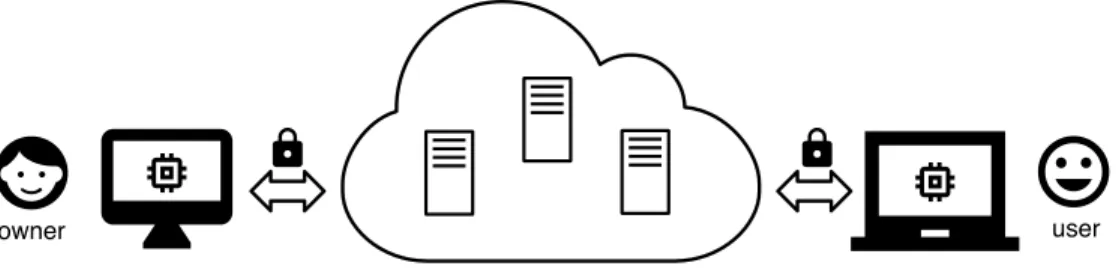
This dissertation focuses on data security in the file synchronization setting, whereby users employ a client application to manage and share files that are stored on a remote server (Figure 1). There is no direct user-to-user communication, users have no control over the server infrastructure, and the server is responsible for synchronizing file changes across individual client machines. Examples include mainstream file sharing services such as Dropbox and Google Drive, as well as traditional network filesystems like AFS and NFS. We
argue that users can still benefit from these services without compromising on data ownership. Our goal is to ensure data protection against other users of the service, external hackers, malicious cloud administrators, and unscrupulous service providers, such that confidentiality and integrity is guaranteed even in the event of a data breach or unauthorized disclosure. Furthermore, for mass user adoption, a practical security solution must fulfill the following high-level requirements: (i) Portability, for deployment across storage providers without requiring any server-side modifications or trusted intermediaries; (ii) Flexibility, whereby users can selectively dictate the conditions for data access using fine-grained policies; and (iii) Performance, in that typical user workloads run with modest overheads. Esseentially, given the key role of user sharing in the growth of cloud services, dynamic policy changes must be efficient, and should not significantly degrade system performance.
1.1 CURRENT APPROACHES
Consider an organization outsourcing internal documents to the cloud for shared access with employees and other external organizations. Notwithstanding the scalability and availability of cloud storage, the organization still wishes to keep their data as private as if it were stored on-premise. Access control is the ability to prevent unauthorized operations over sensitive information, while ensuring data confidentiality, integrity, and availability. In a client-server model, enforcement could be provided by: (i) deploying a server-side monitor that mediates every access request against a centralized policy database, or (ii) applying privacy-preserving techniques over sensitive data without any changes to the existing infrastructure.
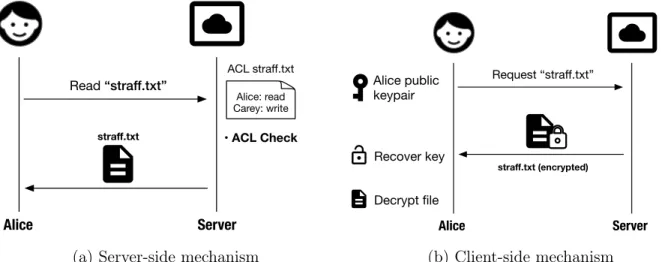
Using a server-side reference monitor, Figure 2a depicts a user requesting read access to the “straff.txt” file. To prevent unauthorized access, every file is protected using an Access Control List (ACL) that contains the list of authorized users and their corresponding permissions (e.g., read, write, delete). In this example, the ACL shows that Alice can read the file. Upon receiving the request, the monitor checks the user’s identity and permission within the ACL before returning the requested file to the user. However, this approach requires implicit trust on the server to: (i) enforce the access control policy faithfully, and (ii)
Alice: read Carey: write
straff.txt • ACL Check
Read “straff.txt”
ACL straff.txt
Alice Server
(a) Server-side mechanism
straff.txt (encrypted) Request “straff.txt” Alice Server Recover key Decrypt file Alice public keypair (b) Client-side mechanism
Figure 2: Client requestingstraff.txt file from the server
protect the file contents at rest and in transit. Unfortunately, the threats surrounding cloud infrastructure makes such trustworthy assumptions non-trivial on the part of the organization.
Alternatively, data protection could be performed before uploading documents unto the server. A natural protection mechanism is to encrypt the file using a symmetric key, and distributing the key to authorized users. By protecting the file encryption key, symmetric encryption provides both data confidentiality and integrity to prevent attackers (who do not possess the key) from recovering or (undetectably) tampering with the file contents. Figure2b
shows the client-side mechanism for requesting the “straff.txt” file, which the server simply returns as an encrypted file without performing any extra permission checks. Once on their local machine, an authorized user in possession of the symmetric key can then proceed to decrypt the file and recover its contents. Since possession of the encryption key grants access to the contents, revoking a user essentially consists in re-encrypting the file with a new key, and re-distributing the new symmetric key to users who are still authorized. However, a naive implementation could incur significant computational and network penalties, especially as the number of users and resources explodes.
1.2 CHALLENGES
Authorization represents the set of permitted actions a user can exercise over objects [18]. Although authorization has been extensively researched within static scenarios where the set of users and resources is known, the unique characteristics of the cloud imposes several challenges. (i) First, user private data is stored and processed on remote machines that lie outside the owner’s control. Consequently, in addition to protecting data at rest and during use, the security framework must support the inclusion of the user’s environmental context (e.g., time) when evaluating authorization requests. (ii) Second, large-scale cloud deployments have thousands of users accessing an unlimited number of files across organizational domains. Thus, policy specification should provide administrators and data owners enough flexibility in associating users and resources with arbitrary granularity, without requiring a priori knowledge of specific entities. (iii) Third, permissions and policies change dynamically as users and resources are added, removed, and modified; therefore, policy administration costs must be scalable when updating access permissions and revoking users.
Addressing the above challenges requires a careful combination of privacy-preserving techniques and distributed usage control. The former transforms data in a manner that preserves confidentiality and integrity, whereas the latter extends access control notions to prevent data misuse even after authorization is granted. Essentially, usage control not only empowers users to selectively share data with arbitrary granularity, but also ensures continuous policy enforcement as the access context changes throughout the data lifecycle. For example, the usage control policy “delete the file after 10 writes” could abort an ongoing access request under satisfying conditions.
Privacy-preserving computation can be achieved using cryptography or isolated execution that relies on software and hardware mechanisms to prevent untrusted access. Much research has been done on cryptographic access control to protect sensitive data [19,20,21,22,23,24,
25,26]. However, when employed in a distributed setting, encryption turns user authorization into a key management problem; existing solutions either require server-side coordination, impose burdensome key management on users, or incur severe bulk re-encryption overheads on access revocation. Furthermore, incorporating environmental factors during policy evaluation
is not achievable using cryptography alone, but requires a tamper-proof and non-bypassable mechanism to enforce context-aware policies on remote machines.
Recently, Trusted Execution Environments (TEEs) such as Intel SGX and ARM Trust-zone that provide isolated execution, sealed storage, and remote attestation have become standard security features in commodity machines and mobile devices; with a small TCB and minimal performance overheads, they provide a tamper-proof environment to securely manage sensitive applications secrets [27, 28, 29, 30, 31]. Existing work employing TEEs to secure untrusted storage require trusted hardware support on the server, which may not possible for users of typical file sharing platforms [32,33, 34, 35, 36,37]. In this dissertation, it is our hypothesis that the widespread availability of hardware-enabled trusted execution environments on consumer devices can provide data confidentiality and integrity, as well as scalable access and usage control within an untrusted cloud environment, while improving portability, flexibility, and performance over unmodified remote storage platforms.
1.3 APPROACH AND CONTRIBUTIONS
The high-level approach consists in combining the benefits of hardware-enabled TEEs and cryptographic protection to ensure confidentiality and integrity throughout the data lifecycle. TEEs perform arbitrary computations in a manner that cannot be subverted by any (trusted or untrusted) party, whereas cryptography relies on mathematical theory to protect persistent data. We employ TEEs to encrypt sensitive user information inside metadata objects without leaking key material. This prevents an attacker from recovering any sensitive information as encrypted content is only decryptable within the TEE, which can leverage its isolated runtime to enforce access control. Also, because the TEE controls key material, the user is not subject to the data retention policies of the service provider, since deleting the encryption key essentially makes the file content irrecoverable.
We propose two systems: NeXUS, a stackable filesystem that provides cryptographic protections to shared files, and Joplin, an access and usage control system for dynamic and fine-grained data sharing. NeXUS ensures confidentiality and integrity of file content,
alongside the names of files and directories. On the other hand, Joplin protects access control information, including user privileges and policies. Both systems are completely client-side, do not require any server-side changes, and leverage trusted hardware to enable transparent security protections over unmodified storage. Unlike prior solutions that require server-side hardware support or rely on a service provider enclave, our approach is novel in that a user-controlled TEE protects private information on individual client machines. As such, NeXUS and Joplin provide a solid foundation for developing user-centric and decentralized policy enforcement using trusted hardware. Our contributions are as follows:
Implementation and Evaluation. Building a scalable system requires taking into account TEE runtime limitations, as well as the I/O characteristics of the underlying storage platform. For example, current real-world TEEs have limited memory and restricted network access, whereas cloud storage imposes significant network latency. We developed prototypes for bothNeXUS and Joplin using Intel SGX as the TEE. Notably, NeXUS manages a virtual filesystem, whereas Joplin hosts a policy engine that evaluates user-specified policies. We ported NeXUS to run atop FUSE to allow unmodified applications access to protected files on any storage platform. This allows users to maintain their typical workflow, without requiring any modifications to the OS or underlying filesystem. The Joplin prototype builds upon this for expressive access control and usage control over shared files. To demonstrate the effectiveness of our approach, we evaluated both prototypes over unmodified network storage such as Dropbox and AFS. Specifically, we measured the network latency under different scenarios using a variety of microbenchmarks and end-to-end tests. Results show that both prototypes are applicable to a wide range of user workloads, and provide scalable data protection when processing filesystem data and access control information. Therefore, users can manage protected data on existing storage platforms without significant performance degradation in their typical workflow.
Expressiveness and Obligations. Developing a robust access control and usage control solution for a large-scale cloud environment requires a fine-grained model for formulating policies, while also accommodating the local user context. Attribute-Based Access Control (ABAC) has been proposed as an expressive and dynamic model for open collaborative environments; ABAC determines access requests by evaluating a set of policies against user
attributes, object attributes, and relevant environmental conditions. Obligations pertain to usage control, and are mandatory actions or requirements that are fulfilled as part of a request (e.g., delete the file after 20 reads). Joplin provides continuous enforcement using cryptographically-protected metadata and a policy interpreter, while addressing other the practical challenges of decentralized policy enforcement, such as efficient revocation, multi-domain policies, secure user delegation, and mandatory audit logging. Access control information is completely managed and protected by the TEE, which enforces authorization requests using an ABAC model and performs obligations. As a result, data owners can manage sensitive content on the cloud using fine-grained authorization and obligation policies independently of the service provider or any trusted intermediary.
Portability and Performance. For maximum user adoption, it is essential that our system does not lock users into any particular service provider in order to achieve scalable access control. Therefore, we minimize our storage assumptions and treat the cloud storage as another generic layer providing a filesystem interface, while enabling efficient user revocation and access right updates. Specifically, both access control information and sensitive key material are stored inside cryptographically-protected metadata files that are only decryptable within the TEE. This approach requires no server-side changes, and allows seamless key distribution as the server synchronizes the encrypted metadata files across client machines. Furthermore, because key material remains under TEE control, revocation only requires updating and re-encrypting relatively small metadata, thereby obviating the bulk re-encryption and key redistribution overheads typically associated with purely cryptographic solutions. Overall, our approach allows for arbitrary deployment scenarios as it is seamlessly portable across remote storage platforms, while introducing minimal policy management costs.
Rollback protection. NeXUS prevents rollback attacks against protected files and directo-ries. Because sensitive information is stored as a collection of files on the server, a malicious service provider may perform a rollback attack whereby older versions of the metadata are returned to the user. Although the returned metadata is cryptographically valid, this attack not only violates metadata freshness, but also the consistency of the entire protected state. To provide stronger integrity guarantees, we maintain a hash tree alongside filesystem information within the metadata files. A hash tree is an efficient method for authenticating a
collection of items using a cryptographic digest. When decrypting metadata at access time, the TEE can validate that the metadata is fresh with respect to a known local version and other metadata in the filesystem hierarchy. With these defenses, users can ensure that every filesystem state results from a valid sequence of changes, while limiting the server’s ability to move/rename files and hide file updates.
1.4 ROADMAP
The remainder of this thesis follows a chronological organization. In Chapter 2we cover the necessary background for cryptography, trusted hardware, and access control. Chapter 3
outlines our system and threat model. We discuss the design of NeXUS in chapter 4, and elaborate on how we enable cryptographic file sharing on existing cloud-based platforms. After giving some background and problem description, we proceed with a system design of its overall architecture, and implementation using Intel SGX. This chapter closes with a performance evaluation, related work, and conclusions. Chapter 5 introduces Joplin, a secure access and usage control system. We begin with some background and related work in decentralized policy enforcement. Then, we describe its design and implementation showing how its client-side approach can provide secure and scalable enforcement. We evaluate our SGX-based prototype via use cases and performance benchmarks. Chapter 6 demonstrates how NeXUSand Joplin meet their security guarantees in protecting filesystem information and enforcing access control. We conclude this dissertation in 7 with a summary of our contributions and some discussion of future work.
2.0 BACKGROUND
This chapter covers the necessary background in privacy-preserving computation and decen-tralized access enforcement. The former can be achieved either with cryptography (Section2.1) or isolated execution. On the cloud, virtualization provides isolated resource management (i.e., CPU, memory, storage), but requires including the hypervisor and other untrusted software components as part of the trusted computing base. We explore how novel trusted hardware extensions can alleviate these security concerns (Section 2.2), and focus on Intel SGX (Section 2.3) as our target real-world instantiation. We close the chapter with an exploration of access and usage control (Section 2.4).
2.1 CRYPTOGRAPHIC PRELIMINARIES
This dissertation employs encryption and hashing primitives as building blocks in providing confidentiality, integrity, and freshness within a scalable system. Confidentiality prevents an attacker from recovering the plaintext, whereasintegrity detects any improper or unauthorized modification of the ciphertext. Unlike confidentiality, integrity cannot prevent the attacker from tampering the file, but only provides detection. Integrity can be extended with a monotonic counter or random nonce to provide freshness. In exchanges involving multiple rounds (e.g., key exchange), freshness ensures that a given message is not a replay from a stale version. Consider that Carey stores tax return documents in an encrypted filesystem hosted on the server. Upon encrypting each file: (i) Confidentiality ensures that an attacker cannot see how much Carey made that year, (ii) Integrity guarantees that the contents are authentic and tamper-evident, and (iii) Freshness detects if the server is returning an older
version of the tax documents by comparing it with a known version. Moreover, we assume these cryptographic primitives are theoretically secure, and treat them as blackboxes.
2.1.1 Encryption and Hashing
At a high level, a encryption algorithm takes a sensitive plaintext (P) and an encryption key (K) as inputs, and outputs a random stream of bytes as ciphertext (C), such that C =E(K, P). Conversely, a decryption algorithm uses the decryption key (K−1) to recover the original plaintext as follows: P =D(K−1, C). Encryption mainly provides confidentiality, and the ciphertext length is a function of the encryption algorithm and the plaintext.
On the other hand, a hashing algorithm is a one-way function takes an input message (M) to return cryptographically secure hash of a given length: H(M) → {0,1}l. Hashing
provides integrity, and can be combined with a key to produce Message Authentication Code (MAC) or tag, such that MAC(K, M)→ {0,1}l. The MAC or tag output is small and fixed
(e.g., usually 32 bytes), and cannot be reverted to the original message.
2.1.2 Symmetric and Asymmetric Encryption
Cryptographic protection relies on the secrecy of encryption keys, which must be large, unique, and unpredictable. As such, key generation relies on a good source of randomness (e.g., CPU temperature) to ensure that the cryptographic operation is semantically secure,
and the attacker cannot feasibly guess the encryption key.
Symmetric encryption uses the same key for both encryption and decryption. There exists 2 types: block ciphers that split messages into blocks, and stream ciphers that consume messages as a bitstream. The Advanced Encryption Standard (AES) is the state of the art symmetric key algorithm, and enjoys hardware acceleration support on various instruction sets [38, 39]. Further, symmetric primitives can be combined with a hashing function to provide both confidentiality and integrity. AES-GCM is an Authenticated Encryption with Associated Data (AEAD) cipher that combines the AES cipher and the GHASH hashing function [40, 41]. Although fast at encrypting large amounts of data, symmetric encryption requires establishing a common secret between the parties.
Asymmetric encryption uses different keys for encryption and decryption. The process relies on a (public, private) keypair, such that any plaintext encrypted with the public key is only decryptable using the corresponding private key, and vice versa. Although there exist a mathematical relation between the keys, the public key that can be released without compromising the private key, which must remain in the possession of the owner. A notable application of public key encryption is unforgeable signatures, which are the created using a signing algorithm with the hash of a message and a user’s private key as inputs. RSA is an example of a signing algorithm [42]. Signatures are only verifiable using the corresponding public key, and provide origin authenticity (i.e., integrity) as the private key is only accessible to its owner. Although they use larger keys and are significantly slower than symmetric encryption, public key algorithms are mostly used to encrypt small pieces of data (e.g., encryption keys). Another example is hybrid encryption over untrusted storage, whereby a copy of the file encryption key is encrypted with the user’s public key. At access time, the authorized user employs their private key to recover the file encryption key, before decrypting the file. RSA is also an encryption algorithm. As such, asymmetric encryption perfectly suitable to establish a secure communication channel in open environments where there is no preexisting shared secret. Elliptic-curve cryptography [43] can be used in a key exchange protocol to generate a common secret over an insecure channel. Elliptic-curve Diffie-Hellman (ECDH) is an example of a key exchange protocol [44]; it is usually coupled with nonces and
a signature algorithm to ensure freshness and origin authenticity, respectively.
2.1.3 Cryptographic Notation
Table 1 lists the cryptographic primitives employed in this dissertation. Each primitive is used with their recommended key size, along with necessary additional information (e.g., using initialization vectors). We denote a (public, private) keypair as {pk, sk}, and use PKGEN() to indicate public keypair generation. SIGN(sk, m) represents a signature over m using sk, and VERIFY(pk, s) indicates the verification of a signature s using pk. Lastly, ENC/DEC(k, m) denotes symmetric encryption/decryption. Note that by using AES-GCM AEAD symmetric encryption, we gain confidentiality alongside integrity.
Algorithm Key size (bits) Guarantees
AES-GCM 128 Confidentiality, Integrity (Tag), Freshness
RSA 2048 Integrity (signatures)
ECDH 256 Freshness (Key exchange)
Table 1: Cryptographic primitives and their respective key sizes
2.2 TRUSTED EXECUTION ENVIRONMENTS
A Trusted Execution Environment (TEE) is a secure, integrity-protected environment, con-sisting of processing, memory, and storage capabilities [45]. TEEs facilitate the instantiation of trusted applications that are isolated within a hardware-protected context. Specifically, by placing the trusted application binary within a hardware-protected memory region, the CPU ensures confidentiality and integrity of both code and data against all untrusted system components, including other system processes, OS or hypervisor, and even external hardware devices. The TEE runs at the highest privilege level within the CPU context, and updates its state dynamically as the trusted application updates registers and memory locations. For cloud-based applications, TEEs can be remotely attested to prove the authenticity of the trusted application and the underlying platform.
Although early instantiations of trusted hardware were provided via secure co-processors like the TPM, they only provided a fixed set functions and a limited interface for processing cryptographic material [46]. However, recent years have witnessed several TEEs providing general purpose secure computation such as Intel SGX on x86 machines, and ARM Trustzone on mobile and IoT devices (e.g., Samsung KNOX) [27,28,29,30,31]. ARM Trustzone splits the processor into two logical modes: a secure world containing the TEE, and anormal world containing the normal OS runtime [27]. Each world has separate registers and memory, such that the normal world cannot observe the memory accesses of the secure world. Trustzone ensures that only the secure world can be executing at any time on a given chip, thereby
preventing potential side-channel attacks from untrusted software. This is unlike Intel SGX, which multiplexes hardware resources between trusted and untrusted software [28]. Sanctum and Keystone are open source TEE design that target the RISC-V hardware; their main improvement over SGX is the prevention of a class of side-channel attacks [30].
These features has inspired extensive work on TEE-enabled secure remote computation, including blockchains, machine learning, databases, IoT, and remote data storage [47, 32,
48, 49, 34,35, 37, 50, 51,52]. However, extending trusted hardware protections beyond the isolated runtime environment unto persistent storage poses several challenges. Although the main idea behind TEEs is encompassing security-critical functionality within a small container that exposes a minimal interface (e.g., cryptography), a full fledged application requires integration with the rich execution environment provided by the OS and other untrusted applications. Specifically, data protection must persist across TEE restarts and data migrations, while accommodating runtime restrictions such as limited memory (e.g., SGX provides about 96MB) and no direct access to system software functionality (e.g., networking, time). Therefore, the trusted application must perform proper sanity-checks and apply cryptographic protections when copying sensitive data across the TEE boundary.
2.3 INTEL SOFTWARE GUARD EXTENSIONS
Intel SGX [28, 53] is a set of x86-based processor extensions that provide secure execution environments called enclaves. These extensions enable clients to both measure and verify the code running within an enclave, while also providing very strong isolation guarantees. The measurement is a hash of the initial enclave code and data to denote the enclave identity, which is verified by the CPU to detect any tampering at launch time. Further, the enclave measurement is also used to generate reports during enclave attestation. When activated, enclaves execute in user space and are protected from inspection or modification by other processes, the OS and hypervisor, BIOS, or even hardware peripherals. At the hardware level, enclaves exist as a special CPU context that ensures data privacy by blocking access from other hardware devices and encrypting the contents of enclave-managed memory as it leaves
stack heap code Enclave Process process stack process heap process code CPU prevents any
non-enclave access
enclave has complete access to process’ memory but, cannot call untrusted code
applications invoke enclave by using gated instruction that jumps into a predefined location in the enclave code
…
…
=
Figure 3: Isolated Execution. The enclave (grey) has a separate stack, heap, and code sections that are independent of the untrusted portion.
the CPU boundary. Secure execution is achieved by placing both the code and data contents needed for a given computation inside the protected memory region, thus ensuring both confidentiality as well as integrity of the execution. With such guarantees, the SGX platform effectively limits an application’s Trusted Computing Base (TCB) to the CPU package and the enclave code. We now describe the SGX features relevant to this dissertation: Isolated Execution, Sealed Storage, and Remote Attestation. For a more in-depth discussion of SGX, we refer the reader to the following publications [29, 54,28, 53, 55].
2.3.1 Isolated Execution
An SGX application is comprised of an untrusted portion and an enclave. The untrusted portion coordinates the enclave lifecycle by invoking both system calls (e.g., enclave creation and destruction) and userspace SGX instructions (e.g., entering the enclave). Note that the untrusted portion does not have access to any application secrets (e.g., encryption keys, passwords), but simply serves as a proxy for enclave communication (e.g., network access) and integration (e.g., file interface). On the other hand, the enclave exposes a set of entry functions, which are invoked by the untrusted portion to perform specific operations.
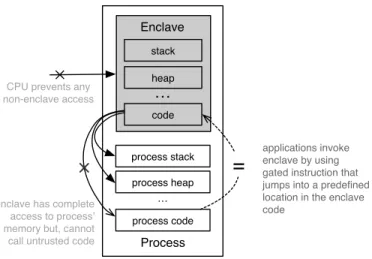
Depicted in Figure 3, an enclave is set to be an isolated region within a userspace application. When creating the enclave, the CPU performs a secure hash measurement of its contents as they are copied into a protected region of physical memory called theEnclave Page Cache (EPC). The EPC is encrypted and inaccessible from untrusted code, including OS/hypervisor, and hardware devices. Because SGX assumes a multiprocess environment, it allows privileged software to control the assignment of EPC pages unto multiple enclave instances. The CPU prevents unauthorized cross-enclave access by tagging each EPC page with their assigned enclave instance and checking this at runtime. On termination, the enclave’s EPC pages are cleared to prevent any leakage of sensitive information.
The application enters the enclave by invoking an SGX ecall that switches the CPU context and jumps to a predefined entrypoint of the enclave code. While executing, the enclave code performs arbitrary computations, accesses enclave memory, and can read and write to untrusted memory. By allowing access to untrusted buffer pointers, an enclave can efficiently exchange data with the host application. However, the enclave code is not allowed to directly call untrusted functions, but must invoke an SGX ocall that explicitly switches from enclave mode before calling the untrusted function. The enclave memory is defined as a linear range within the virtual space the host application. Per virtual memory semantics, the OS is responsible for translating enclave virtual addresses into their corresponding EPC page, but the CPU ensures that enclave memory can only be accessed from enclave code. The enclave code exits once execution is completed, and can be re-entered on subsequent invocations. The enclave memory state is preserved across invocations, but is lost once the enclave is terminated.
2.3.2 Sealed Storage
From the description above, the enclave loses all data on termination. To securely persist sensitive data across executions, SGX allows enclaves to derive a sealing key from platform keys burned in the CPU fuses. The sealing key is symmetric, and can then be used to encrypt and seal sensitive data before copying it to untrusted memory. On restart, the enclave regenerates the sealing key to decrypt the sealed information. The sealing key can only be
{a, g^a} {b, g^b} g^a | nonce g^b | QUOTE(g^a | g^b | nonce) QUOTE Verification result K=g^ab ENC(K, secret) Intel Attestation
Service Client RemoteEnclave
Figure 4: SGX Remote Attestation example for simple ECDH key exchange. The enclave quote contains the client-generated nonce and both public ECDH keys. In the end, both the client and enclave generate the shared key K.
generated within enclave memory, and is unique to the enclave identity and the particular CPU within which the enclave is executing. More specifically, this sealing key cannot be derived in any other SGX machine or by a different enclave on this particular SGX machine. As a result, SGX sealing is especially useful to protect long-term secrets on the local machine in a manner that prevents access outside of an enclave context as offline migration to other SGX platforms. For example, the enclave could generate a public-private keypair and seal the private key to local disk. At runtime, the enclave private key is unsealed within trusted space, and then used as cryptographic material to establish secure communication channels.
2.3.3 Remote Attestation
Remote attestation allows a challenger to validate the identity of a remote enclave, and its underlying platform. Specifically, attestation confirms that the trusted hardware is still considered valid (e.g., CPU model is not blacklisted), and the secure software runtime
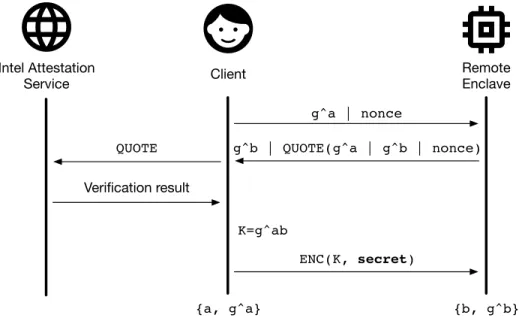
is initialized correctly. In SGX, this process relies on two Intel-provisioned enclaves: a Provisioning Enclave that verifies the platform with Intel’s attestation service to fetch a unique asymmetric attestation key, and a Quoting Enclave that uses the attestation key to generate quotes. A quote is a signature of the target enclave’s measurement along with enclave-generated data (e.g., nonce, ECD public key), which is used to ensure freshness. This allows the challenger to verify the quote using an Intel-provided public certificate, and ascertain the enclave identity by checking its measurement and the additional data. Figure 4
depicts a simple ECDH key exchange, where the client generates a nonce and the remote enclave generates a quote. A critical step in the exchange is to verify the quote via the Intel attestation service, which ensures that the quote is from a valid enclave running on SGX hardware. Once the quote is validated, the client then uses the contained enclave public ECDH key to derive a common secret that is only derivable within the enclave. As such, remote attestation is essential in bootstrapping secure communication channels with a remote enclave, before provisioning any secrets (e.g., sending a password).
2.3.4 SGX Limitations
The Intel SGX SDK provides a complete toolchain for building and distributing enclaves. Its programming model relies on the programmer to carefully split the application into trusted and untrusted portions, as well as define an interface for exchanging data across the enclave boundary. This is specified as a set of ecalls and ocalls within an EDL file. The enclave runtime is managed by system software, which shares hardware resources between other applications and device drivers. Therefore, beyond resource contention, understanding the limitations of SGX hardware is critical to design a practical and secure enclave.
• The EPC memory has a current maximum size of 128MB, which leaves about 96MB for application enclaves (some is used for SGX metadata). For larger enclave workloads or in situations of high memory pressure, the OS can swap EPC pages with main memory using SGX privileged instructions. Before copying EPC pages into main memory, the CPU encrypts and applies freshness protections to prevent replay attacks from privileged software. This paging mechanism incurs significant performance overheads of up to 40K
cycles, especially when the enclave working set exceeds 128MB [56,57].
• Because the enclave cannot directly invoke untrusted functions, access to system services (e.g., file I/O, time) requires exiting the enclave, executing the system call, copying the results into enclave memory, and re-entering the enclave. These enclave transitions are expensive as they require flushing and restoring the CPU context to prevent data leaks. Although library OSes can facilitate enclave communication with system software, such an approach not only explodes the enclave TCB, but may also conversely affect overall application performance [58,59,60]. Conversely, we argue that enclave applications can be tailored to operate within a dynamic cloud environment, without requiring any server-side support for trusted hardware.
• The enclave runtime can be interrupted at any time (e.g., page fault, exception), which triggers an Asynchronous Enclave Exit (AEX). SGX handles this by safeguarding the enclave state for resumption once the fault is handled. Each AEX overhead is minor but repeated exits could seriously slow down the enclave execution.
• SGX sealing does not offer any rollback protection to prevent sensitive state replay in between enclave restarts. Therefore in practice, applications desiring strong freshness guarantees have either resorted to slow and write-limited hardware monotonic counters, or relied on a distributed quorum of enclaves [47, 61, 62].
• Several side-channel attacks have been identified on SGX, including cache attacks, page-fault attacks, branch prediction attacks, and speculative execution. These attacks exploit the fact that the SGX architecture collocates enclave execution on the same hardware as other system resources. In this dissertation, SGX side-channel attacks are considered out-of-scope. However, work on defense measures is currently the subject of active research [63, 64, 65,
66, 67, 68,69], and can be applied orthogonally to our work.
2.4 ACCESS AND USAGE CONTROL
Access control is employed to enforce security requirements such as confidentiality and integrity of data resources (e.g., files, database tables) to prevent unauthorized use of resources (e.g.,
programs, processor time, expensive devices), or to prevent denial of service to legitimate users [18]. The decision to authorize or deny a given operation is guided by a security policy. Examples of practical violations that can be prevented are students seeing the grade files or an employee tampering documents. Thus, an access control system is comprised of: (i) policies that dictate the authorization conditions, (ii) a formal model that defines core access control elements and their relations (e.g., users, attributes), and (iii) an enforcement mechanism that provides low-level functions and implements system policies according to the model. Because policy expressiveness is ultimately dictated by the access control model, selecting one that is suitable for the target use-case is critical. On the other hand, a reference monitor unifies policy enforcement by mediating all object accesses, but its implementation is typically a function of system constraints and environmental factors. We go over existing access control models and reference architectures to explore how they can be practically implemented within a dynamic cloud environment.
2.4.1 Traditional Access Control
Discretionary Access Control (DAC) is a model whereby data owners can grant or revoke access to their objects, such that authorization consists in validating the user’s identity within an access structure [70]. DAC is popular within OS and database system as ACLs or user capability lists, where each file/row has an owner who can share access with other users or groups in the system using predefined permissions. For example, Alice might create a shared folder within her home directory on a shared server, and specify that the “work” group has both read and write access. This form of decentralized management alleviates the administrative burden, as users can discretely delegate their assigned privileges to others. However, because the data owner cannot prevent leakage of assigned privileges, DAC is more suitable for environments where the set of users and their possible operations are known.
Mandatory Access Control (MAC) eliminates user discretion and restricts information flow using security classifications and system-wide policies [71]. For example, in the Bell-LaPadula confidentiality model, the administrator assigns a clearance level to each user and a sensitivity level to each object, such that users cannot read objects at a higher classification nor write
to objects at inferior classifications. To inhibit data modifications, the Biba Integrity model allows a users to read objects at a higher classification, but can only write to lower classified objects. However, MAC models are best suited for rigid environments such as military and government agencies, where there is no concept of user ownership, and data confidentiality and integrity are of primary concern. Unfortunately, this cannot be feasibly applied to open environments where user membership and access rights are dynamic.
Role-Based Access Control (RBAC) is an approach whereby administrators define roles; grant permissions to roles according to tasks; and assign users to roles based on their duties [72]. Users can activate a subset of their assigned roles for a given session, and then access the objects permitted by the activated roles. RBAC improves permission management over MAC and DAC, as roles group users by responsibility and users can control how roles access objects they own. For additional flexibility, roles can be organized in a hierarchy to inherit permissions between junior and senior roles, and extended with constraints to provide rich semantics (e.g., separation of duty). However, RBAC is more suited for organizations where the role definitions are static, and user responsibilities do not change frequently. Because permission management only depends on role assignment and requires knowledge of the user or object entity, RBAC does not readily support multi-domain policies where entities are not known in advance, and environmental context is required for multi-modal access control.
2.4.2 Attribute-Based Access Control
Attribute-Based Access Control (ABAC) is an emergent model that determines authorization requests using user attributes, object attributes, environment attributes, and policies expressed as logical sentences over those attributes [73,74,75, 76, 77, 73,78,79]. Attributes are traits that are either statically assigned by the administrator (e.g., role, clearance), or dynamically set by the runtime (e.g., time, IP). For example, after assigning the necessary atttributes, an organization can specify the given policy to protect internal documents: “Insiders can write Feedback documents before 1PM”. As a result, attributes can group users and objects with arbitrary granularity and without the explicit identification of pairwise relationships between entities. Policies then combine attributes to provide fine-grained access control,
U Auth O
UA OA
P
Policies
Figure 5: ABACα
such that expressiveness is only limited by the policy language and the richness of attributes. With such flexibility, administrators can formulate a concise set of policies to regulate user authorization, without a priori knowledge of individual user or object entities. Attributes and their values are captured as users and objects are provisioned unto the system, while keeping the pairwise relationships encoded within the existing policies. As a result, ABAC provides dynamic access control as changes in attributes may result in a different evaluation result between requests.
Many ABAC variants exist, but in this dissertation we focus on ABACα[75], a foundational
model with minimal assumptions on system attributes and administrative control. The state of an ABAC system consists of users (U), objects (O), user attributes (UA), object attributes (OA), permissions (P), and authorization policies. Users are authenticated individuals requesting access, and objects are protected resources. Attribute are key-value pairs, and operate as functions that takes a user or object entity to return an atomic value or a set of values. Each user is associated with a set of user attributes that are assigned by the system administrator (e.g., name, occupation). Objects are created by users, and likewise have a corresponding set of object attributes (e.g., type, format). Permissions are simply the possible actions that users can perform on objects (e.g., read, write, delete). Policies govern access to system resources, and are expressed as a boolean combination of attributes. Each authorization policy takes the permission, user, and object as inputs; returns a true or false depending on their attributes. A user is permitted access on an object if there exist a policy
that satisfies a subset of the user and object attributes.
Despite its simplicity, ABACα still provides enough expressive power to configure MAC,
DAC, and even RBAC. For instance, ACLs could be represented by associating each object with as many attributes as there are permissions; each attribute maps to a set of authorized users. Likewise, capabilities are user attributes that map permissions to a set of objects. MAC security labels can be handled by atomic-valued user (e.g., clearance) and object (e.g., sensitivity) attributes. To support RBAC, each user has an associated user attribute function that returns a set of roles, while objects are assigned attributes that map each permission to a list of roles. This has resulted in several works proposing enhancements of traditional access control models with attributes [80, 81].
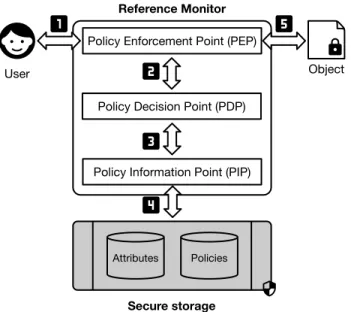
Traditionally encompassed within a trusted reference monitor, the enforcement mechanism must be integrated with other security components such as authentication, administration, cryptographic protection, and audit logging, while also distributing access control information via the storage infrastructure. In Figure 6, a minimal reference monitor consists of the Policy Decision Point (PDP), Policy Information Point (PIP), and Policy Enforcement Point (PEP). The PIP is responsible for fetching and updating access control information such as attributes and policies. On each access request from the PEP, the PDP communicates with the PIP to fetch the necessary access control information before updating its internal state and evaluating system policies. The PEP enforces the PDP result, and only releases the object if the user is authorized.
However, access control is restricted to one-time request-response authorization, such that once a user is granted access, there’s no further action that regulates future data usage. As usage spans over a longer time period, a policy such as “do not read consumer report after 30days,” could invalidate future data access. Unlike traditional closed-world settings in which users are known beforehand and enforcement occurs within a trusted subsystem, this may be problematic in an open setting whereby data storage and processing occurs on remote machines. Thus, in a distributed cloud environment, the security framework should allow data owners to specify what factors to continuously re-evaluate while access is ongoing.
Policy Enforcement Point (PEP)
Policy Decision Point (PDP)
Policy Information Point (PIP)
Attributes Policies
User Object
Reference Monitor
Secure storage
Figure 6: Reference monitor Architecture
2.4.3 Usage Control
Usage control (UCON) extends traditional access control notions with attribute mutability and continuous enforcement [82,83,84,85]. Mutability refers to the fact that the user’s access may change while access is in progress. This may be the result of the usage or a static update from the administrator. Continuous enforcement ensures that usage policies are re-evaluated throughout the usage period, and may result in a termination if considered invalid. With attribute-based authorization model, UCON also introduces obligations and conditions as part of a usage policy. Obligations denote mandatory action or requirements that have to be fulfilled before, during, and after usage, whereas conditions define the necessary environment context before and during usage. Usage control can be enforced using the same architecture as access control. However usage control in distributed cloud environments present two principal challenges: (1) integrating environmental factors beyond user and object attributes, and (2) tamper-proof and verifiable enforcement mechanism [86,87, 88, 89, 90, 91, 92]. In this dissertation, we leverage the isolation and attestation features of commodity trusted hardware to enable distributed usage control.
3.0 SYSTEM AND THREAT MODEL
We consider a typical cloud storage service, in which the service’s users download and run a client-side program to access the remote storage platform. Data is stored on remote cloud-based systems that are under the control of the service provider. In addition to ensuring data persistence and availability, the cloud service typically provides authentication and access control, but in a way that requires the user to trust the service implicitly. Users interact with their data via their local file system API, thus allowing arbitrary applications on their systems to access and operate on remotely-stored data. Beyond regular file system access, many services also provide auxiliary sharing capabilities with other users of the service.
We follow prior work in cryptographic storage by considering an owner who sets up a securevolume inside a synchronized directory, and shares this with multipleusers [93]. System actions are a combination of key-management operations and cryptographic protections, which are observed as encrypted reads and writes on the server. Within this context, we aim to provide users with additional security guarantees against unauthorized disclosure or modification of their files without hindering their ability to share these files with other authorized users.
Security Objective. Unless granted explicit access by the owner, file contents along with access control information must be inaccessible to unauthorized entities and tamper-evident. In this case, unauthorized entities may include other users of the storage service, entities monitoring communication between the user and the storage service, and the storage service provider itself. We are concerned solely with the protection of user-created content: i.e., the confidentiality and integrity of the contents of files, file names, and directory names, as well as the integrity of the directory structure. Additionally, we aim to provide: (i) Forward secrecy to prevent revoked users from accessing future access control updates even when they
are in possession of older files, and (ii) Backward secrecy to prevent newly added users from accessing older data versions.
Threat Model. We consider an attacker who has complete control of the server (including the OS or hypervisor) and can thus access or alter any files stored on the server. The attacker may also tamper with, delete, reorder, or replay all network packets exchanged between the server and the client. We do not consider availability attacks (e.g., denial-of-service), as our primary concern is protecting the confidentiality and integrity of file system contents. We do not protect against access pattern attacks, which can be addressed using orthogonal techniques [33, 94,36]. Users can read/write data they are allowed to, and may attempt to read and modify files to which they do not have access. Since authorized users ultimately gain access to decrypted file contents, we do not consider client-side malware that may maliciously leak files that have been decrypted by authorized users.
We assume that each user has access to an SGX-enabled CPU running a commodity OS. Our enclave is assumed to be correctly implemented and free of any security-relevant vulnerabilities. Also, we assume the enclave attestation and memory protection features of the SGX hardware function properly: i.e., once the enclave’s identity is established, enclave-provisioned secrets are not accessible from untrusted code. However, SGX does not explicitly defend against software and hardware side-channels, and existing defenses against are orthogonal to our work. We assume side-channel attacks are considered out-of-scope and would apply solutions from the literature. Overall, these assumptions are in line with the standard SGX threat and widely adopted by prior work [60].
4.0 NEXUS
We present NeXUS, a stackable filesystem that leverages trusted hardware to provide confidentiality and integrity for user files stored on untrusted platforms. NeXUS is explicitly designed to balance security, portability, and performance: it supports dynamic sharing of protected volumes on any platform exposing a file access API without requiring server-side support, enables the use of fine-grained access control policies to allow for selective sharing, and avoids the key revocation and file re-encryption overheads associated with other cryptographic approaches to access control. This combination of features is made possible by the use of a client-side Intel SGX enclave that is used to protect and share NeXUS volumes, ensuring that cryptographic keys never leave enclave memory and obviating the need to re-encrypt files upon revocation of access rights. We implemented two client-sideNeXUS prototypes: AFS and FUSE that allow unmodified user applications to access protected volumes as directories. Although our AFS-based prototype required minimal changes to the AFS client for efficient cache management, porting to FUSE demonstrates the generality of our design as well as facilitate the migration of volumes across arbitrary filesystems. We provide stronger freshness guarantees by maintaining a hash tree alongside the filesystem hierarchy to mitigate against rollback attacks, without requiring direct communication between users. Our evaluation reveals a×2 overhead for a variety of interactive user workloads and improved portability over AFS and Dropbox filesystems, while offering reasonable performance overheads when comparing our FUSE prototype to the AFS implementation.
4.1 INTRODUCTION
File-sharing services such as Dropbox and Google Drive have received widespread adoption in recent years [95, 4]. Through these services, users gain access to large amounts storage, and can collaborate with sharing capabilities enforced by the service provider. However, the recurrence of data breaches and unplanned disclosures has raised concerns about user privacy on these platforms (e.g., [6,8,9]). Another source of concern is the fact that service providers are legally permitted to modify and distribute sensitive data without requiring user discretion (e.g., [14, 15, 16,11]). Consequently, it is evermore critical to provide a security solution that
addresses these risks [96] as more users store sensitive information on these services.
Much research has been done to provide cryptographic access control over untrusted storage. The canonical approach is to encrypt the file end-to-end, and distribute the encryption key to authorized users. However, purely cryptographic access control solutions either require server-side coordination, impose burdensome key management on users, or incur severe bulk re-encryption overheads on access revocation [19, 20,21, 22, 23,24, 25, 26]. Recently, other works have used trusted hardware to provide strong security primitives over untrusted storage [32,33,34,35,36,37]. However, these typically require trusted hardware on the server or do not consider user sharing. This limits their applicability, especially when users cannot readily modify the server-side components and consider dynamic sharing as an essential part of their workflow.
We propose a practical security solution that: (1) allows for user deployment without requiring any server-side coordination or trusted intermediary, (2) supports user sharing with custom access controls, and (3) performs with comparable overheads on typical user workloads. Our goal is to protect the confidentiality and integrity of a user’s files against all untrusted parties, including unauthorized users, external attackers, and even the service provider.
To address this need, we present NeXUS, a privacy-preserving filesystem that provides cryptographically secure data storage and sharing on top of existing network-based storage services. NeXUSis novel in that it leverages the Intel SGX extensions to provide efficient access control and policy management, in a manner that is not possible using a software-based