Impact of the ‘Contributing Factors in Construction
Accidents’ (ConCA) Model
Eleanor Harvey1[0000-0002-6154-2095], Patrick Waterson1 and Andrew Dainty2 1 Human Factors and Complex Systems Research Group, Loughborough University, UK
[email protected], [email protected] 2 School of Architecture, Building and Civil Engineering, Loughborough University, UK
Abstract. In 2005 the ‘Contributing factors in Construction Accidents’ frame-work (ConCA) introduced a sociotechnical systems approach to risk management in construction. ConCA demonstrated the value of exploring distal factors and identifying underlying or latent causes: It promoted an understanding of con-struction accidents as systemic accidents and challenged an industry-wide culture of blaming frontline workers. A decade later the original article has been cited by research from 37 countries, shaping inquiries and initiatives to improve safety in both the UK and Australia. But to what extent has systems thinking infiltrated practitioners and policy-makers’ views? Despite broader views of contributing factors, many practitioners still view workers in a negative light, holding them responsible for accidents because of complacency, cynicism about safety, or a high-tolerance for risk. This paper evaluates the impact of the ConCA frame-work, updates it, and develops our understanding of the relationships between immediate circumstances and distal factors, as seen by an expert panel of partic-ipants (n = 32). A more in-depth ‘ConCA+’ framework is proposed. It challenges the negative perceptions of workers, and supports shifting the emphasis of risk management away from worker behaviors and towards resolving wider systemic issues. New directions are proposed which show how knowledge management, job design, technological innovation, empowerment and collaboration should be the focus of future work.
Keywords: Construction, Occupational Safety, Systems.
1
Introduction
Over the last century occupational safety and health (OSH) in construction has im-proved significantly, yet recently progress has stalled and it remains the second most dangerous industry, recording around 40 fatalities each year and costing the UK econ-omy £1.1 billion [1]. The sector is litigious, infamous for ‘blacklisting’ whistle-blowers [2] and blaming individuals as the ‘root cause’ of accidents.
This perception of people as the cause of construction’s poor safety performance means the industry takes an orthodox approach to OSH management – controlling hu-man variability [3]. Many interventions focus on individual characteristics and
competence-based models [4] and there has been a surge of behavior-based programs which misinterpret and oversimplify safety culture as a tool to manipulate workers’ attitudes [5], [6]. A recent plateau in accident rates [7] provides clear evidence that these methods are no longer having the desired results and there is a need for the con-struction industry to rethink its strategy.
Systems thinking stresses that accidents do not have a root cause but result from dynamic interactions between people, technology and policies at many different levels. Specifically within construction, Haslam et al. [8] proposed the Construction Accident Causation (ConCA) model which promotes a holistic view of accident causation and highlights relationships between distal and immediate causes in accordance with Rea-son’s ‘Swiss Cheese’ metaphor [9].
This study builds on the ConCA model by applying systems thinking in the analysis of interviews with construction professionals. These interviews discussed the causes of risk in construction at length, exploring both immediate circumstances at the frontline and originating influences in the industry and externally. Relationships between these were identified which provide an alternative perspective, challenging the notion that workers are the cause of accidents, with a view to a change in direction. Full details of this work can be found in a journal article [10].
2
ConCA’s Impact
The impact of the ConCA model has been widespread in academia, industry, and government. According to Scopus, the original article has been cited 283 times by 160 institutions in 36 countries. 13 years after its original publication the article continues to attract more attention year-on-year, confirming its position as a seminal paper in construction safety; however, its influence goes beyond this having also been cited in engineering, medicine, social science, and business journals – reflecting the breadth of ergonomics’ and its applications.
The research was funded by the UK’s Health and Safety Executive (HSE) who have incorporated its findings in shaping their strategy for improving safety in the construction sector. It has been used as the basis for investigations, ensuring regulators account for the breadth of causal factors at all levels of the system, and informing the development of a construction-specific HFACS. Beyond the UK, the model has also been used by Toyota Australia to investigate a fatality in upgrades to their manufacturing facilities.
A significant discovery of the ConCA model was the contribution of political originating influences – such as education and economic climate. As such, this research went on to inform a government inquiry which recognised:
“The HSE cannot succeed in eliminating fatalities without the support of the population as a whole and the Government. This is a social issue and is too important to be confined to the narrower focus of health and
The influence of the ConCA model is clear in Donaghy’s report which not only recognises the need for change to come from outside the industry, but also the breadth of causal factors. It includes an extensive list of recommendations for many accident causes – from equipment and working conditions to unions and directors’ responsibilities.
3
Data Collection and Analysis
A draft interview schedule was developed based on investigator’s notes from a focus group (n = 14) discussing key issues facing OSH in construction. After piloting, semi-structured interviews were conducted with 25 participants (8 of whom had taken part in the focus group). These participants were recruited through researchers’ contacts and then snowballing the invitation to participants’ colleagues. Interviews were audio rec-orded, transcribed verbatim, and analyzed thematically.
Judgement sampling was exercised to include construction OSH professionals with a breadth of experience, different roles within the risk management process, and from a variety of organizations. All the participants had experience of working for (or re-searching) multinational tier-1 suppliers0F
1 on large projects with a mature safety man-agement program.
4
Findings
Responses to the question “How do construction workers’ view risk?” were categorized as seeking, denying, accepting, or avoidant in accordance with Brace, Gibb, Pendlebury, & Bust (2009). Risk averse and risk seeking construction workers were considered the exceptions within a majority population of risk deniers – meaning con-struction workers are inclined to ignore the potential for harm if the rewards are great enough.
The puzzle of course is that there are so many in construction- and not just construction, but so many with a peculiar attitude…so they’re not able to or not wanting to appreciate the dangers that they are putting
themselves into. Academic
In conjunction with this, almost half of those interviewed said construction workers, rather than choosing to ignore the risks, were simply oblivious to the risks they faced. Probing into this, many participants gave reasons such as a lack of training, compe-tence, experience and communication, all of which focus on an individual’s capacity to manage risk. Others took a more holistic perspective, including a range of factors which could cause a worker to miss a hazard – distractions, competing pressures, the influence of peers, and overfamiliarity or complacency. This range of explanations indicate that construction workers’ risk-taking may be less a result of their risk-tolerant personality,
and more a result of industry-wide issues which need further investigation. Participants’ responses were consolidated into a revised ConCA model which adds depth and updates the original model for today’s industry. This is shown in Figure 1.
Figure 1 – The updated ConCA model (ConCA+)
Expanding on this model, the relationships between factors shaping attitudes to risk at all levels of the system were identified. Below, four ‘weaknesses’ of construction workers which make them prone to risk-taking are expanded upon to demonstrate their origins within the construction industry: Lack of competence, lack of communication, high risk-tolerance, and lack of engagement with safety.
4.1 Lack of Competence
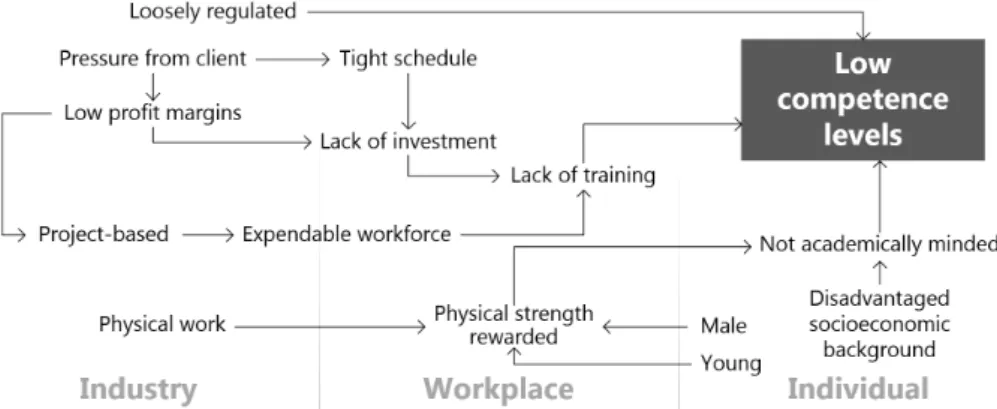
Figure 1 illustrates the links between low competence levels at the front line and an industry which is loosely regulated, client-driven, and based on physical processes.
Figure 2 - Factors contributing to construction workers' low competence levels While some construction trades are highly-skilled, the requirements for entry onto site, especially for general labor, are low. Participants highlighted this as a pertinent issue when work is sub-sub-contracted to smaller organizations where competence is not rigorously monitored. Competence varies widely because the industry itself is highly varied, both in terms of the organizations within it and the projects they com-plete: The UK Standard Industrial Classification for construction includes building and civil engineering, from site preparation to demolition, in all domains, and on all scales of project.
Last week they were building and extension in somebody’s garden, and now all of a sudden they’re expected to be steel erectors and civil
engi-neers! Construction Director
The reliance on physical labor is not only an issue because of its low skill require-ments but also has implications for the workforce it attracts: Agility, stamina, and strength are favored over intellect, language, and social skills which play a role in sup-porting risk management. The resulting dominance of young men in the workforce con-tributes to the macho culture and cavalier attitude to hazards.
Primarily, lack of competence was attributed to a lack of training, however, in a project-based industry – where people move between projects and are rarely directly-employed – training workers is seen as a wasted investment. Operating as a network of specialist organizations ensures the project is profitable and companies survive in a competitive industry, but there remains a question around who should be held respon-sible for training and competence development.
4.2 Lack of Communication
Similarly, figure 2 shows that a lack of communication can be traced to the structure of the industry as a dynamic network. Many similar contributory factors were identified such as tight schedules which limit investment in building relationships, as well as training.
Figure 3 - Factors contributing to construction workers' lack of communication Short contracts and frequent moves mean workers rarely appreciate the significance of their role in relation to the project as a whole. This can make them vulnerable to accidents because they fail to see the ‘big picture’ – how their work and the risks they take might interact with or impact others on site. This compartmentalization of risk has developed because of difficulties coordinating complex projects where accountability is a contentious subject. As well as limiting communication, this ‘silo mentality’ limits workers’ awareness of risks outside their specialism, and cultivates mistrust between trades.
Inter-trade relationships are important for communication, but also loyalty and en-gagement which can in turn impact on safety.
When they’re just treated as a part in a much bigger picture- jigsaw, and your part isn’t that important…then their interest in that project
and that organisation, and risk, is diminished. Academic
Workers who do not feel valued are less likely to engage with risk management or challenge others’ unsafe practice. Several participants said those who worked most safely were often those who felt their trade was a significant part of the final output which they could be proud of.
4.3 High Risk-Tolerance
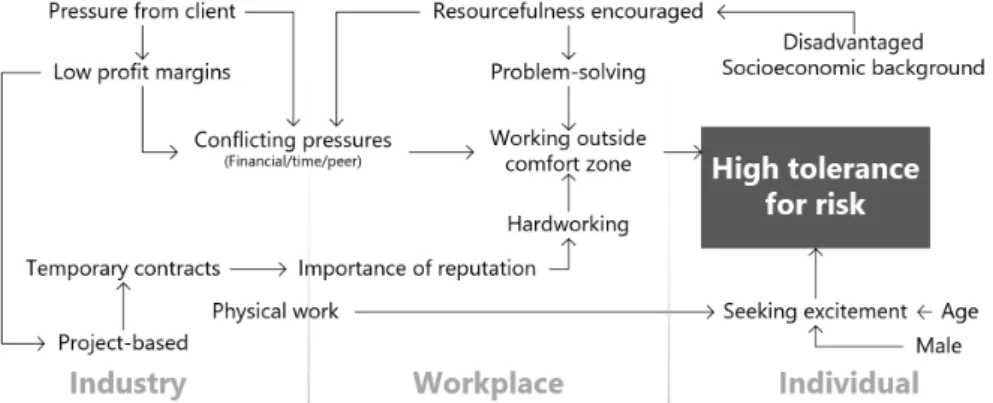
The construction sector is renowned for physical work in dangerous environments (at heights, underground, alongside highways), so this naturally attracts people with a ‘risk-tolerant’ personality. A degree of risk is a significant factor in their job satisfac-tion: They enjoy working in new and varied environments, thrive on problem solving, and take pride in facing challenges others might think too difficult. While these traits are desirable from a production perspective, unfortunately, they can make the work-force more difficult to manage and, in turn, the sector more hazardous. The male-dom-inance of the industry, and resulting macho culture, encourages workers to show they
can cope with challenges, and younger workers can be complacent about their physical abilities.
Figure 4 - Factors contributing to construction workers' high risk-tolerance
However, participants also highlighted that risk-tolerance is highly variable within individuals. When asked about what shapes attitudes to risk, a wide range of factors were identified effective in the long (experience, responsibilities, personality), medium (training, culture) and short (time-pressure, distractions, groupthink) term. Many of these factors can be attributed to this competitive industry: Financial and time-pressure means resourcefulness and problem-solving are encouraged, but this can also lead workers to take potentially risky shortcuts. This is combined with a need to achieve – based on a disadvantaged background and the importance of reputation to secure work – which pushes workers to engage in risk denial.
Some people are very keen- which is an admirable trait- very keen to help others, and almost jump in when they can’t- when they haven’t got
the competence to do that particular task, to try and help out. Safety Manager
4.4 Lack of engagement with safety
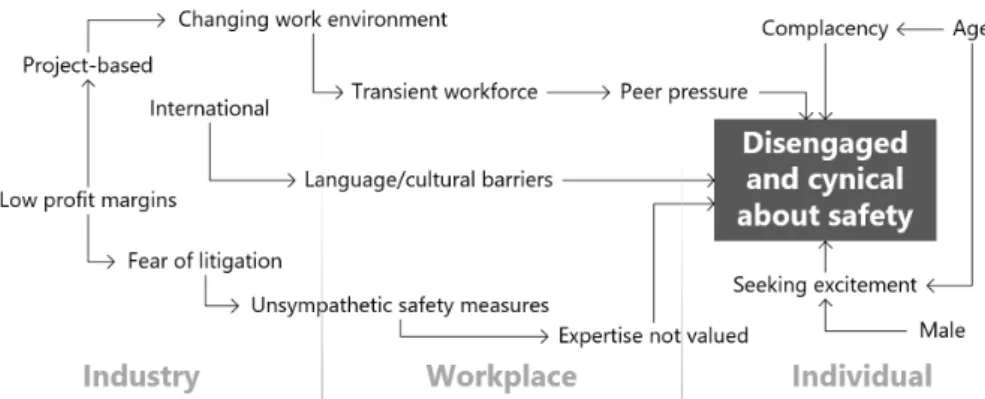
Finally, workers’ attitude to risk was blamed on a lack of interest in safety and there-fore a failure to engage. To some extent this can be attributed to the workforce of young men construction attracts, but figure 4 shows other causes again stemming from the structure of the industry.
Figure 5 - Factors contributing to construction workers' lack of engagement
A macho culture is expected in a male-dominated industry, but this is exacerbated by the short-term contracts which mean being able to fit in quickly is especially im-portant. The effect of peer pressure is powerful and drives workers to disregard safety and instead take risks to gain acceptance.
Fast moving schedules and low profit margins limit time to consult with builders in the design phase. Combined with a fear of litigation, safety policies make broad gener-alizations about the nature of construction work; they are reactive, insensitive, and rely on personal protective equipment (PPE) – the ‘last line of defense’. Poorly designed policies and unsuitable equipment breed cynicism in the workforce. They become re-sentful because their expertise is not valued, disengaged, and disobedient – at least in the eyes of the rule-makers.
As well as risk tolerance and denial, disengagement can also come about through a lack of awareness. This can be through a lack of competence or communication, as discussed already, but also language or cultural barriers which become more significant as international collaborations grow in size and number.
Discussion and Recommendations
A systems perspective reveals why OSH in construction is so difficult to manage: Alt-hough workers are blamed for taking risks, this research shows how the risks they take are shaped by a range of pressures ingrained in the industry; primarily, the competitive financial climate and the physical nature of work.
Building a unique output for a client means profit must come from savings in the supply chain and building processes. To keep costs down, work is contracted out to specialized tradesmen employed on a temporary basis. This networked structure under-pins many of the reasons risk is difficult to manage. A workforce and workplace which is constantly changing limits investment in innovation, well-designed safety policies, competence, culture, and inter-trade relationships. The way safety information evolves and knowledge ‘flows’ presents a challenge for networked organizations [13]. Work is competitive and workers expendable so a reputation as hardworking and able to impro-vise is more valuable than a reputation for working safely.
Physical nature of work exacerbates these issues because it attracts a workforce which is difficult to manage: They are strong, but susceptible to peer pressure and com-placency, and motivated to the point they deny risks to get work done. It could be ar-gued that the physical nature of work is again a product of the industry’s structure which stifles innovation and therefore the potential to design out physical hazards.
By tracing these issues to their roots in the industry, this approach highlights the difficulty of influencing safety in a network where organizations are temporary. Con-struction will always be driven by making a profit so the ‘root cause’ is impossible to address. However, by exploring the relationships between this and how is it precipitated at the frontline, some interesting opportunities are revealed to help refocus construc-tion’s OSH strategy. Some new or emerging areas which could benefit from further research are:
• Job enlargement and enrichment [14] to raise awareness of risks from other trades.
• Innovation to reduce reliance on physical strength and the esteem in which it is held.
• Learning legacies like that of London 2012 [15] to transfer knowledge between projects in a fragmented industry.
The findings support an emerging trend within safety research which, contrary to behavioral safety, sees diversity in people’s thought and behavior an asset [16], [17]. There is a clear need for an approach to safety which is sympathetic to the workforce demographic – their background and ambitions – attracted to this industry. Further-more, empowering workers and collaborating with them in risk management not only ensures safety is integrated into primary operations, but increases engagement, loyalty and job satisfaction as their expertise is valued and integrated.
5
Conclusion
Looking at the system as a whole sheds light on the complex reasons why construc-tion workers take risks. Their decisions and attitudes are shaped by a vast number of factors embedded in the nature of work, the industry, and the workforce. The constantly changing workplace limits workers’ knowledge, skills, and awareness of risks, and competing pressures mean safety is sacrificed to save time and money. Behavioral safety does not account for the complexity of these decisions: It ignores diversity and uses a reward-punishment paradigm to manipulate behavior, controlling the variability which could support organizational resilience [18].
To overcome the plateau in accident rates construction should move away from be-havioral safety and instead look to value, engage, and empower the workforce. There is also potential in developing innovative technology, job design, and knowledge man-agement to address the challenges of risk in temporary organizations.
6
References
1. HSE, “Health and Safety in Construction in Great Britain, 2014,” 2014.
2. House of Commons, “Blacklisting in Employment: Final Report,” London, 2015. 3. T. Marsh, A Definitive Guide to Behavioural Safety. Abingdon, UK: Routledge,
2017.
4. E. Harvey, P. Waterson, and A. R. J. Dainty, “Comparing safety intelligence in air traffic management and construction: A conceptual comparison,” in Proceedings 31st Annual ARCOM Conference, 7-9 September, 2015, pp. 1115–1124.
5. F. W. Guldenmund, “(Mis)understanding Safety Culture and Its Relationship to Safety Management.,” Risk Anal., vol. 30, no. 10, pp. 1466–80, Oct. 2010.
6. R. Long, For The Love of Zero. Kambah, ACT: Scotoma Press, 2012.
7. Bureau of Labor Statistics, “Illnesses, Injuries and Fatalities,” 2015. [Online]. Available: https://www.bls.gov/iif/. [Accessed: 22-Mar-2017].
8. R. A. Haslam, S. A. Hide, A. G. F. Gibb, D. E. Gyi, T. Pavitt, S. Atkinson, and A. R. Duff, “Contributing factors in construction accidents.,” Appl. Ergon., vol. 36, no. 4, pp. 401–15, Jul. 2005.
9. J. Reason, “Human Error: Models and Management,” Br. Med. J., vol. 320, pp. 768–770, 2000.
10. E. J. Harvey, P. Waterson, and A. R. J. Dainty, “Beyond ConCA: Rethinking Causality and Construction Accidents,” Appl. Ergon.
11. R. Donaghy, “One Death is too Many: Inquiry into the Underlying Causes of Construction Fatal Accidents,” London, UK, 2009.
12. C. Brace, A. G. Gibb, M. Pendlebury, and P. Bust, “Phase 2 Report: Health and safety in the construction industry: Underlying causes of construction fatal accidents – External research,” London, UK, 2009.
13. P. Bust, A. Gibb, A. Dainty, A. Cheyne, R. Hartley, J. Glover, A. Finneran, R. Haslam, and P. Waterson, “Health and safety knowledge in networked organisations,” in Health and Safety in a Changing World, S. Frost and R. Dingwall, Eds. Abingdon, UK: Routledge, 2017, pp. 85–100.
14. S. K. Parker, A. Van den Broeck, and D. Holman, “Work Design Influences: A Synthesis of Multilevel Factors that Affect the Design of Jobs,” Acad. Manag. Ann., vol. 11, no. 1, 2017.
15. Olympic Delivery Authority, “Learning Legacy: Lessons Learned from the London 2012 Construction Project,” London, 2011.
16. E. J. Harvey, P. Waterson, and A. R. J. Dainty, “Applying HRO and resilience engineering to construction: Barriers and opportunities,” Saf. Sci., Aug. 2016. 17. F. Emuze and J. Smallwood, Valuing People in Construction. Abingdon, UK:
Routledge, 2018.
18. E. Hollangel, Safety-I and Safety-II: The Past and Future of Safety Management. Farnham: Ashgate Publishing Limited, 2014.