KIT SCIENTIFIC WORKING PAPERS
Motivational and Affective Aspects in
Technology Enhanced Learning (MATEL)
Proceedings of the MATEL Workshop 2013-2014
by Teresa Holocher-Ertl
1, Christine Kunzmann
2, Lars Müller
3,
Verónica Rivera-Pelayo
3,
Andreas P. Schmidt
4,
Carmen Wolf
5(Ed.)
1
ZSI Center for Social Innovation, Vienna/Austria
2Pontydysgu Ltd., Pontypridd/UK
3
FZI Research Center for Information Technology, Karlsruhe/Germany
4University of Applied Sciences, Karlsruhe/Germany
5
Karlsruhe Institute of Technology, Karlsruhe/Germany
Proceedings of the MATEL Workshops taken place in conjunction with the
EC-TEL Conferences 2013 & 2014
MATEL website:
http://matel.professional-learning.eu/
Impressum
Karlsruher Institut für Technologie (KIT) www.kit.edu
Diese Veröffentlichung ist im Internet unter folgender Creative Commons-Lizenz publiziert: http://creativecommons.org/licenses/by-nc-nd/3.0/de
Institute of Vocational and Gerneral Education Department of Vocational Education and Training Research Group Engineering Didactics
Neuer Zirkel 3, Geb. 20.53 76131 Karlsruhe, Germany
Foreword
The main purpose and focus of the MATEL workshop series on Motivational and Affective Aspects in Technology Enhanced Learning has been to stimulate interdisci-plinary exchange and joint research activities on understanding and addressing motiva-tional factors and emotions in learning solutions. There is hardly any opposition to the importance of these factors for the success of these solutions. However, there was al-ways a major lack in systematic support and scientific rigor in the interdisciplinary field so that it was characterized through anecdotal evidence and hard-to-generalize results. In 2013 and 2014, From Art to Engineering has become the major motto of the MATEL workshop series. In this report, we bundle the 2013 and 2014 contributions that show steps on this journey.
Contents
MATEL Workshop Series
5
MATEL 2013
9
Towards Personalised Gamification for Learning
Environ-ments.
Baptiste Montserrat, Elise Lavoué, Sébastien George
10
Exploring Motivational Aspects for Technology-Enhanced
In-formal Learning in the Construction Sector.
Christine
Kunz-mann, Patric Rieker, Andreas P. Schmidt
15
A Short Introduction on Patterns.
Teresa Holocher-Ertl
21
MATEL 2013: From Art to Engineering with Motivational
De-sign Patterns.
Teresa Holocher-Ertl, Christine Kunzmann, Lars
Müller, Verónica Rivera-Pelayo, Andreas P. Schmidt
25
MATEL 2014
27
Reflections on the acceptance and success of RadioActive 101:
Motivation through problematisation, improved well-being,
emancipation and extreme learning.
Ingo Dahn, Andrew
Ra-venscroft, Colin Rainey, Maria Brites, Silvio Correia Santos
and James Dellow
28
The Trouble with Systemic Solution-oriented Self E-Coaching
- Emotions as a key factor in changing patterns.
Carmen Wolf
37
Comparing Objective and Subjective Methods to Support
Re-flection: an Experiment on the Influence on Affective Aspects.
Verónica Rivera-Pelayo and Marc Kohaupt
48
MATEL 2014: Towards Developing a Pattern Collection.
Te-resa Holocher-Ertl, Christine Kunzmann, Verónica
Rivera-Pelayo, Andreas P. Schmidt, Carmen Wolf
MATEL Workshop Series:
International Workshop on Motivational and Affective
Aspects of Technology Enhanced Learning (MATEL)
1
Introduction: Objectives and History
Motivational and affective aspects are frequently neglected in Technology Enhanced Learning although they are one of the most important factors when it comes to ac-ceptance and success of TEL solutions. This becomes even more important as we move towards more open, independent, and informal learning settings. However, our under-standing of these aspects and the implication this underunder-standing would have on concrete solutions for learning is very fragmented:
Pedagogical models emphasize the importance of holistic perspectives on learning, but still (implicitly) consider these aspects as peripheral. Psychology has investigated this topic area in depth from a theoretical and experimental point of view, but often there is a gap between generic theories of motivation and emotions, and concrete im-plications for didactical settings, tool design, and organizational guidance. We also know little, e.g., about reflection on emotions and one’s own motivation.
On the technology side, it is often unclear where and how to consider these aspects in the tool design as it requires a much wider perspective. Here, the affective computing strand has concentrated on tackling emotions, but so far has had little relationship to learning. CSCW research (particularly as part of the Web 2.0 hype) had a closer look at the influences on collaboration. The (serious) games approach to learning is mainly a response to the motivational success of gaming, but struggles with how to combine this effect with a didactical approach. In workplace settings, particularly in knowledge management, motivation has been recognized as key success factor to ensure that in-troduced instruments and tools are getting used. However, many approaches have con-centrated only on incentives, both in terms of monetary rewards and other extrinsic motivation schemes which are designed mainly as top-down instruments – with mixed success.
We are convinced that we can meet these challenges only in an interdisciplinary way. Therefore we want to bring together in this workshop the different perspectives on the topic in order to foster the formation of a community between psychology, sociology, pedagogy, human resources, CSCW and computer science.
The MATEL workshop has a successful history with its first edition at EC-TEL 2010 and continued to provide an engaged forum for the subject area, which helped to form a community around the topic, set up a mailing list with more than 130 interested indi-viduals and a website under http://matel.professional-learning.eu.
2
Workshop Concept
After identifying topics and research challenges to structure the field in 2010 and 2011, the main theme “from art to engineering” in 2012 and publishing the results of the first three editions at EC-TEL 2013, we wanted to develop the format further towards cre-ating an structured experience base. The foundations for this experience base were par-ticipants’ concrete examples, including both, prototypes and systems as well as experi-ence reports from the introduction and usage of approaches, services and tools that ad-dress motivational and affective aspects in technology enhanced learning. Together with participants we took these contributions as starting point for further discussions and sharing of good and bad practice from different contexts. Similar to other engineer-ing disciplines, we explored how patterns as aggregation and systematic descriptions of good practices can help to sustain and systematize these experiences for reuse. These socio-technical patterns comprise practices to inform both tool design as well as strat-egies for adoption.
Within a one day workshop, we complemented one session on full research papers, position statements and experience reports, with a second session on tool demonstra-tions where participants analysed and discussed the motivational and affective aspects of those tools. More or less in-depth evaluation results by the presenters were welcome, but not a prerequisite. The participants were given the opportunity for an intense mod-erated discussion, leading to first motivational socio-technical patterns as one of the outcomes from the collaborative sharing of experiences within the group. Where pos-sible, we encouraged presenters of tools to provide access to the tools prior to the work-shop to allow workwork-shop participants to prepare themselves. As a concluding session of the workshop, we synthesized the discussion results and further developed research priorities from last year’s edition of the workshop.
All this lead to a rough (and flexible) workshop schedule: Keynote presentation on patterns in similar fields Full papers with discussion slot
Informal experience discussion
Short scientific contributions and experience reports with discussion slot Tool demonstration and discussion
Development of a pattern-based approach to addressing motivational and affective aspects in design for TEL
Concluding discussion slot synthesizing the results
We had a wide range of participants from multiple disciplines, especially bridging technical and non-technical audiences, and multiple projects. In total, we expected around 15-20 participants based on previous experiences. The workshop proceedings would be published in an open access proceedings volume.
3
Topics
3.1 Topics for Position Statements and Scientific Contributions
Topics encompass the following:
• Experience reports and lessons learnt from introduction/usage of tools related to learning or knowledge development/engineering (success and failures), e.g.,
◦ Knowledge management and workplace learning
◦ Semantic technologies
◦ CSCL, CSCW and Web 2.0
◦ Enterprise 2.0
◦ Serious games
◦ MOOCs in educational and workplace learning contexts
◦ E-Coaching and other areas of technology-enhanced consultation
• Pattern-based capturing of design knowledge of soft factors, particularly re-lated to motivation and affective factors, but also in adjacent areas
• Design methodologies for incorporating motivational and affective factors
◦ Experiences with participatory design
◦ Engineering socio-technical systems
◦ Experiences with concrete research instruments
◦ Indicators for evaluation
• Approaches, services, or tools to address motivational and affective aspects
◦ Feedback mechanisms
◦ Organizational incentives
◦ Detecting affective states via sensors
◦ Exploiting curiosity
◦ Life logging and Quantified Self inspired approaches
◦ Learning about emotions (e.g., coping strategies) through reflection and resource activation
◦ Gamification and playful design
• Organizational aspects
◦ Role of context (social, cultural) on motivation to learn or share knowledge
◦ Role of affective aspects for daily work routines
• Models for understanding motivational and affective aspects/emotions from dis-ciplines like pedagogy, psychology, human resources management and econom-ics, sociology, usability engineering (e.g., joy of use driven approaches), or com-puter science (e.g., context ontologies for affective and motivational factors)
3.2 Topics for Tool Demos and Discussions
We invite developers and researchers of tools and systems in the area of Technology Enhanced Learning to present them under the perspective of motivational and affective aspects, such as:
• Tools for supporting individual or team reflection and coaching
• Quantified Self approaches and use of sensors
• Mobile learning support apps, e.g., for e-coaching, e-learning
• Personal Learning Environments
• Tools for informal learning and knowledge management in organizations
• Innovative enterprise social media approaches
4
thInternational Workshop on Motivational and
Affective Aspects in Technology Enhanced Learning
September 17-18, 2013
Paphos, Cyprus
Organizers
Teresa Holocher-Ertl (ZSI Center for Social Innovation, Austria) Christine Kunzmann (Pontydysgu, UK)
Lars Müller (FZI Research Center for Information Technology, Germany) Verónica Rivera-Pelayo (FZI Research Center for Information Technology, Germany)
Andreas Schmidt (Karlsruhe University of Applied Sciences, Germany)
Programme Committee
Jenny Bimrose, University of Warwick, UKAlan Brown, University of Warwick, UK
Steffen Lohmann, University of Stuttgart, Germany Johannes Moskaliuk, University of Tübingen, Germany Alexander Richter, Uni BW Munich, Germany
René Peinl, Hof University of Applied Sciences, Germany Cüneyt Sandal, Karlsruhe Institute of Technology
Kristin Knipfer, TU Munich, Germany
Michael Prilla, Ruhr University of Bochum, Germany Katja Niemann, Fraunhofer FIT, Germany
Erik Duval, Katholieke Universiteit Leuven, Belgium
José Luis Santos Odriozola, Katholieke Universiteit Leuven, Belgium Abelardo Pardo, University of Sydney, Australia
Barbara Kieslinger, ZSI Center for Social Innovation, Austria Graham Attwell, Pontydysgu, UK
Carmen Wolf, Karlsruhe Institute of Technology, Germany Sandra Burri Gram Hansen, Aaalborg University, Denmark Christian Voigt, ZSI Center for Social Innovation, Austria
Toward Personalised Gamification for Learning
Environ-ments
Baptiste Monterrat1, 2, Élise Lavoué1, 3, Sébastien George1, 2
1Université de Lyon, CNRS
2INSA-Lyon, LIRIS, UMR5205, F-69621, France
{sebastien.george, baptiste.monterrat}@insa-lyon.fr 3IAE Lyon, Université Jean Moulin Lyon 3, MAGELLAN, LIRIS, UMR5205
Abstract. Many learning environments are deserted by the learners, even if they are effective. Gamification is a growing approach used to raise learners’ motiva-tion by adding game elements in their environment, but it still pays little attenmotiva-tion to the individual differences among learners’ motivations. This paper presents a gamification system designed to be plugged on various learning environments. It can be automatically personalised, based on an analysis of the interaction traces.
Keywords: gamification, learning environment, personalisation.
1
Introduction
Many learning environments have been shown to be effective when used, but are quickly deserted by learners. This paper aims to propose a way to raise motivation in learning contexts that are not intrinsically motivating, by using a gamification system. The difficulty comes from the fact that people do not have the same expectations about games, and do not have the same emotional responses to a given stimulus. That is why we aim at developing a motivational system that can be automatically personalised.
2
State of the Art: User Models in Game Based Learning
2.1 Gamification or Serious Game
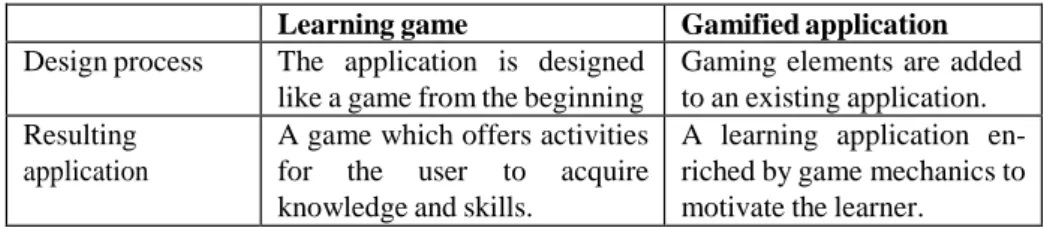
Two approaches are used to add fun in game based learning activities: learning games, and more recently gamification. Learning games refers to the use of digital games for learning purposes [1]. Gamification is “the use of game design elements in non-gaming contexts” [2]. These two approaches are often poorly distinguished one from the other. However, they differ by their design process and by the resulting application (Table 1). In this work, we focus on gamification because, firstly, it can be based on existing en-vironments. Secondly with gamification, the game elements seem not to be central but
peripheral, which fosters a generic implementation of the game. This view is a first step toward a “fun layer” that could be plugged on several applications.
Learning game Gamified application
Design process The application is designed like a game from the beginning
Gaming elements are added to an existing application. Resulting
application
A game which offers activities for the user to acquire knowledge and skills.
A learning application en-riched by game mechanics to motivate the learner.
Table 1. Differences between a learning game and a gamified application.
2.2 A User Model for a Gamified System
Some attention is paid to basic data about users, like their age and gender, as it as an influence on their levels of attention and motivation [3] [4]. Researches on learner mod-els focus on the relation between the learner and the knowledge. For example, Conati et al. [5] built a user model to assess the learner’s self-explanations. In the game-based learning field, many studies have been conducted about the way people play games. Bartle [6] identified four player types: killer, achiever, socialiser, and explorer. Yee [7] identified three main motivation components: achievement, social and immersion. Laz-zaro [8] observed four motivational factors for playing games: hard fun, easy fun, al-tered state and people factor. The user model we propose in part 3 is based on these three types of user data (basic data, learner model, and the way people play).
Kobsa et al. [9] suggest distinguishing three forms of adaptation: to user data, to usage data and to environment data. All these parameter types have to be taken into account to personalise the game elements of an environment. Whether they focus on learning features or playing features, usage data should be based on the users’ traces of interactions with the environment. Bouvier et al. [10] define a typology of engaged behaviours, to determine if a player is engaged or not. Finally, some research help to understand the influence of environment data, which we can call context. For example, Cheng [11] tried to find the good moments to play at work.
3
Architecture for a Personalised Gamification
In order to personalise the fun features of the system, we need it to be able to work with or without these features. That is why we propose to use epiphytic functionalities: ap-plications that are plugged in another application without being necessary. Giroux et al. [12] describe epiphyte systems as follow: (1) the epiphytic system cannot exist without a host, (2) the host can exist without the epiphyte, (3) the host and the epiphyte have independent existences, and (4) the epiphyte does not affect its host.
By implementing the fun functionalities that way, we can enable or disable them inde-pendently for the users, in order to personalise their interface without affecting the learning application. We provide below 3 examples of such functionalities to be acti-vated in some cases:
A leader board of fast learners for competitive users. Badges and cups for achievers.
A chat feature for users interested in socializing.
An overview of the proposed architecture is presented in Figure 1, which shows the way the gamification system can be plugged in an existing learning environment. Epi-phyte functionalities can be part of the existing learning environment, or can be brought with the gamification system. The first option fosters the creation of specific function-alities well integrated in the user activity. The advantage of the second option is the use of generic functionalities, usable by different learning environments. Both types of functionalities can be managed by a gamification engine. The role of this engine is to decide when and how to able or unable the functionalities, based on (1) the static infor-mation of the user model, (2) the dynamic inforinfor-mation of the user model, and (3) con-textual information.
1. The static part of the user model only contains the features “age”, “gender”, and some administrative information if necessary.
2. The dynamic part of the user model is divided into two parts: the learner model and the player model. We assume that the learner part is handled by the exist-ing environment core that manages the learnexist-ing activity. The gamification sys-tem focuses on the player part. It identifies the player’s preferences, to manage motivation by gaming. These features are calculated from the interaction traces with the epiphytic functionalities. As some functionalities do not require interactions, the engine has to find a correlation between the engagement of the learner and the activation of the functionalities, to measure their effective-ness. Thus the level of engagement has to be calculated and communicated to the gamification engine.
3. In addition, some contextual information are crucial for the gamification en-gine. Firstly, is the learner at school, at work, or on free time? If the learners are all in the same room with a teacher to help them, a chat feature could be useless. We also can look at the device used, as some features are more rele-vant on mobile devices, and others on computers.
Figure 1. Architecture of the gamification system, plugged on the learning environment
The Gamification Process is divided into three steps:
1. The interaction traces are permanently collected, and the player model is regu-larly updated, based on these traces. At the same time, a regular analysis of the user engagement is performed.
2. When the learner seems to be disengaging, the gamification engine starts work-ing and selects an appropriate epiphytic functionality.
3. The selected functionality is introduced and integrated in the user activity.
4
Conclusion
In this article, we propose a system architecture to motivate learners by integrating game elements in existing learning environments. We do not aim to turn every learning activity into a game, because games need to be played voluntary and people in some contexts are already motivated to learn. This system should be used with non-intrinsi-cally motivating activities, like memorizing vocabulary or mathematical rules.
References
1. Prensky, M.: Digital game based learning. New York: McGraw-Hill. 442 p. (2001). 2. Deterding, S. et al.: "Gamification: Toward a definition." CHI 2011 Gamification Workshop
Proceedings. 2011.
3. Charlier, N., Ott, M., Remmelle, B., & Whitton, N.: Not Just for Children: Game-Based Learning for Older Adults. In: 6th European Conference on Games Based Learning (ECGBL), pp. 102-108. Cork, Ireland (2012)
4. Hainey, T., Boyle, E., & Connolly, T., Stansfield, M.: Gender Differences in Motivations for Playing Computer Games: A Combined Analysis of Three Studies. In: 5th European Conference on Games Based Learning (ECGBL), pp. 111-119. Athens, Greece (2011) 5. Conati, C., Gertner, A., & Vanlehn, K.: Using Bayesian networks to manage uncertainty in
student modeling. User modeling and user-adapted interaction 12, 371–417 (2002). 6. Bartle, R.: Hearts, Clubs, Diamonds, Spades: Players Who Suit MUDs. Journal of MUD
Research 1, 1 (1996).
7. Yee, N.: Motivations for play in online games. CyberPsychology & Behavior 9, 772–775 (2006).
8. Lazzaro, N.: Why we play games: 4 keys to more emotion. Paper retrieved June 8, 2013 from http://www.xeodesign.com/xeodesign_whyweplaygames.pdf (2004).
9. Kobsa, A., Koenemann, J. & Pohl, W.: Personalized hypermedia presentation techniques for improving online customer relationships. Technical report No. 66 GMD, German National Research Center for Information Technology, St. Augustin, Germany (1999).
10. Bouvier, P., Lavoué, É., Sehaba, K. & George, S.: Identifying Learner’s Engagement in Learning Games: a Qualitative Approach based on Learner’s Traces of Interaction. 5th In-ternational Conference on Computer Supported Education, Aachen, Germany, 6-8 May (2013).
11. Cheng, L. et al.: "Finding Moments of Play at Work" CHI 2011 Gamification Workshop Proceedings (2011).
12. Giroux, S., Pachet, F., Paquette, G. & Girard, J. Des systèmes conseillers épiphytes. Revue d’intelligence artificielle 9, 165–190 (1995).
Exploring Motivational Aspects for
Technology-En-hanced Informal Learning in the Construction Sector
Christine Kunzmann1, Patric Rieker2, Andreas P. Schmidt2
1Pontydysgu, UK
[email protected] 2 Karlsruhe University of Applied Sciences, Germany [email protected]
Abstract. Introducing technology support into informal learning at the work-place in the construction sector requires investigation into the motivation struc-tures of the involved stakeholders. In this contribution, we present the results of an exploratory, qualitative interview study. It shows the current state and differ-entiated attitudes towards technology and its use in work processes. It also points towards areas that need further investigation.
Keywords: motivation, informal learning
1
Introduction
Motivation has been recognized to be a key factor for any technology-enhanced learn-ing solution [1], but it has also been found that motivation to learn, to share knowledge or to adopt a certain technology solution is a complex issue that requires deep contex-tual investigations.
As part of the LAYERS project [2], we have been exploring the potential of support-ing informal learnsupport-ing in the construction sector. As in other job areas, informal learnsupport-ing constitutes the majority of learning activities, but its support faces several peculiarities compared to other professions that have been so far in the focus of TEL solutions: work practice is less computer-based, and the physical environment dominates and puts re-strictions on usage of learning tools. To explore the potential novel technology-en-hanced learning approaches and to understand the conditions for their successful adop-tion, an exploratory study has been conducted to better understand motivational struc-tures, design and acceptance factors for solutions, and possible ways of appropriation.
2
Method
Given the complexity of the context with various trades and stakeholders, an interview-based was chosen. In total, 8 interviews were conducted with craftsmen in various po-sitions in the southwest of Germany. They covered various trades/professions, such as a carpenter, a systems mechanic, an electrician (“Meister”), a medical technology
elec-trician (“Meister”), an all-rounder specialized in refurbishing older houses (self-em-ployed), a bathroom specialist, a kitchen specialist, and a construction engineer. The interviews took between 22 and 57 minutes.
The interviews were transcribed and analysis using Qualitative Content Analysis techniques from Mayring [3].
3
Results
In the following sections, we summarize the results from analysing the interview tran-scripts. The discussion is structured along (i) structure of communication channels, (ii) current state of using technology at the workplace,
3.1 Use of Technologies
The results of the use of mobile technology was mixed; the majority (6 out of 8) regu-larly use a smartphone, primarily for taking pictures at the construction site, for access-ing emails and calendar and messagaccess-ing (text messages via operator or replacement ser-vices such as WhatsApp). In the sample, most serser-vices used were free serser-vices. Internet search is usually not used on site, rather by foremen, owners of the company, or similar at their desks. Videos on YouTube are not considered useful as not reliable.
Problems with smartphones in particularly are lack of connectivity, particularly in buildings and in rural areas. Some features of smartphones are not used and instead a separate device is carried along (e.g., a voice recorder) because they have not found out how to use it.
As barriers to introducing new technology, purchasing costs, but also training costs were mentioned. But there were also concerns about introducing dependability on tech-nology, which is not seen as really reliable.
3.2 Usage of Forums
One particular area that was explored within the interviews was the usage of forums and the experiences with it. These were not very positively perceived by the interview-ees:
Time. Search in forums was found to be time-consuming. There is no guar-antee to receive a response to inquiry, and the time to get a response is usually not within a short time frame.
Quality. A big challenge for using informal exchange forums in the con-struction domain is how to judge the quality and reliability of the contribu-tions. Sometimes products or companies badmouthed without a reason so that there is general mistrust towards the information found in forum. This is at the heart of informal learning where natural authority does not exist.
3.3 Competition
The construction sector is characterized by a large number of small and medium sized companies where learning particularly has to be considered also in a cross-organiza-tional perspective. Therefore, within the interviews, also issues of competition have been analysed. While competition is an issue, the importance as a barrier has been very mixed. Some do not see competition as a major issue and view as a give-and-take situ-ation and rather see quality issues with other companies. Others expressed competition to be critical, particularly within the electrician trade.
In general, the closer companies are, the more difficult knowledge exchange might become. Closeness can be geographical, but also same trade or adjacent trade. More investigation will be needed to extract the factors that influence the competition situa-tion.
3.4 Heterogeneous Hierarchies
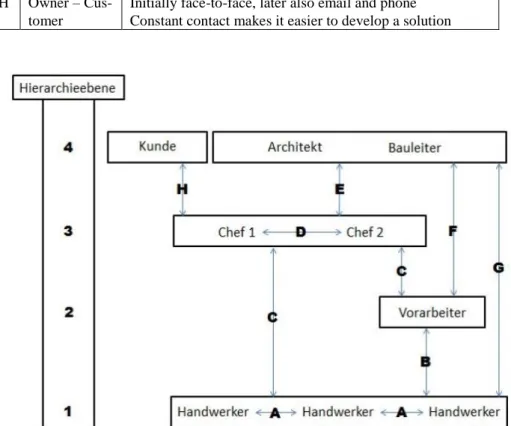
One important result of the analysis was the heterogeneity of the communication rela-tionships and associated motivational structures.
Communication
channel Current practice
A Craftsman – Craftsman
Predominantly face-to-face communication
Degree of discussion between peers (esp. across companies) depends on trust
B Craftsman – Foreman
face-to-face (if on-site), otherwise mobile phone
Craftsmen are often expected to check with their superior in case of doubt, or lack the willingness to take over responsi-bility
C Craftsman – Owner
Mobile phone
Craftsmen are often expected to check with their superior in case of doubt, or lack the willingness to take over responsi-bility
D Owner – Owner
Mobile phone or email
depends a lot on trust, competition situation (or its percep-tion) varies across different trades (and maybe regions) E Owner –
Architect/ Site manager
Mobile phone or email
F Foreman – Architect/ Site manager
Mobile phone, email, face-to-face
G Craftsman – Architect/ Site manager
In general difficult and very little
However, it can be an important source of learning for site managers that get along well with craftsmen
H Owner – Cus-tomer
Initially face-to-face, later also email and phone Constant contact makes it easier to develop a solution
Figure 1: Hierarchical communication structures
3.5 Attitude towards Technology Support
With respect to technology support, at first sight the results have been as expected. The younger generation is very inclined to use technology (and usually owns a Smartphone and uses it regularly, also at the workplace), but older generation not so familiar with and are rather reluctant to use it. A closer investigation, however, has shown that apart from familiarity, there is also a deeper issue that is related to expected usefulness.
More experienced craftsmen evaluate the potential usefulness of technology by ob-serving the use by the younger generation. They find that this often do not contribute to increasing productivity or similar, which does not lie in the technology itself, but in its appropriation. Increased and better communication possibilities are outweighed by lack of commitment in communication, and by disturbing productive communication on-site, potential for ubiquitous access to information are outweighed by distractive use of it, and by lack of preparation. One example is the interviewee who deliberately does not own a mobile phone, and who forces the other craftsmen at the construction site that they put their mobile phone into a box in separate room during on-site meetings. He feels committed to delivering the best value in the time charged to the customer,
Even the most technology-critical interviewees, whoever, do make use of the possi-bilities of the Internet. The higher in the hierarchy, the more they research on various aspects. Here trust in the information found is an issue, but it seems that experience can help in making an informed decision about the value and credibility of the information. Actively contributing to forums, e.g., was not very common. One obvious issue is time; the other issue is related to data privacy (having to sign in with personal details).
3.6 Summary
Throughout the interviews, the following main factors could be identified. On the pos-itive side, promoting motivation to adopt technology solutions for supporting informal learning at the workplace were (rather immediate) benefits for saving time for carrying out tasks. Also helping others is mostly viewed positively, particularly where their ex-pertise is honoured as “expert knowledge”, however, the prerequisite was expected rec-iprocity. An interesting factor for technology adoption is that private benefits resulting from business use are seen as very positive, e.g., being able to use a smartphone or tablet not only at the workplace. While this creates issues of data protection, this obser-vation could also help to overcome the pressure of immediate benefit, which is hard to realize.
As informal learning heavily depends on empower learners that take responsibility for their own learning, some challenging aspects could be identified. One aspect relates to the overall communication culture in the construction sector. Hierarchies and the predominantly hierarchical organization of communication hinders efficient knowledge exchange, particularly at SMEs which most often do not have any institutionalised ways of knowledge development. Here liability and competition are to be explored further. The second aspect relates to a general observation of decreasing willingness to take over responsibility in the younger generation. Most experienced interviewees com-plained about this, which leads to a reinforcement of the hierarchical communication patterns and decreases also chances for informal learning at the lower levels.
Finally, introducing technology without consciously and reasonably changing work processes, communication behaviour and personal routines will most likely not deliver any benefit. This also seems to be a barrier for the more experienced craftsmen to em-brace new technologies as they do not see how the technology could solve the problems at the workplace, based on their observation how the more technology-savvy younger generation makes use of technology.
4
Conclusions and Outlook
The interviews have yielded a rich picture of the way of thinking in the construction sector. While the study is clearly limited by its sample size, it still has uncovered im-portant aspects for further exploration.
Any technology-enhanced learning solution needs to be a package of devices, soft-ware solutions, and appropriation patterns. Especially the latter two need to be part of a co-evolution process in which the users themselves and the solution providers are part
of a learning process that changes work process and personal habits on the one side, and design elements on the other side.
Clear value, time-saving, and trust in sources were the main adoption criteria that interviewees expressed. Particularly the latter is a key research challenge that will be further addressed in the LAYERS project: how can we foster (appropriate) trust both as part of the interaction with other people and the interaction with digital material.
Currently, the interview results are being condensed into narratives which can then be used to transport the rich understanding to the other members of the project who have not been involved in the interviews and do not have direct contact with users. While direct contact is always preferable, the constraints do not always for allow suffi-cient interaction possibilities so that narratives are a promising compromise.
Acknowledgements. This work is supported by the European Commission under the FP7 project LAYERS (no. 318209), http://www.learning-layers.eu.
References
1. Holocher-Ertl, Teresa, Kunzmann, Christine, Müller, Lars, Pelayo, Verónica Rivera, Schmidt, Andreas: Motivational & Affective Aspects in Technology Enhanced Learning: Topics, Results, and Research Route In: EC-TEL 2013, Lecture Notes in Computer Science, Springer, 2013
2. Ley, Tobias, Cook, John, Dennerlein, Sebastian, Kravcik, Milos, Kunzmann, Christine, Laanpere, Mart, Pata, Kai, Purma, Jukka, Sandars, John, Santos, Patricia, Schmidt, Andreas:
Scaling Informal Learning: An Integrative Systems View on Scaffolding at the Workplace.
In: EC-TEL 2013, Paphos, Cyprus, Lecture Notes in Computer Science, Springer, 2013 3. Mayring, P.. Qualitative Content Analysis. Forum Qualitative Sozialforschung / Forum:
Qualitative Social Research, 1(2), 2000. Retrieved from http://www.qualitative-re-search.net/index.php/fqs/article/view/1089
A Short Introduction on Patterns
Teresa Holocher-Ertl11ZSI – ZSI Center for Social Innovation, Austria [email protected]
1
Introduction
The work with pattern languages began in the field of building architecture, when Christopher Alexander had the idea of capturing design guidelines in the form of design patterns and published two books: A Pattern Language [1] and The Timeless Way of Building [2].
In Alexander's own words, a pattern „describes a problem which occurs over and over again in our environment, and then describes the core of the solution to that prob-lem, in such a way that you can use this solution a million times over, without ever doing it the same way twice” [1, p. 10].
A pattern has always the same format, which has two objectives: The first objective is to make understandable for the reader that patterns are connected with each other and form a language, which allows for “an infinite variety of combinations” [1, p. xi]. The second objective is that problem and solutions of the patterns are presented in a way that the individual reader can individually judge and adapt it for him/herself without losing “the essence that is central to it” (ibid).
A pattern language is a network of patterns that call upon one another. It is a generic language, which is dynamic and interacts with the context. It allows people to start with the existing context and combine different patterns to create solutions, which relate to this context [3].
Alexander ordered and numbered his patterns sequentially. He started with the most general ones (in the case of his architectural patterns these were patterns for regions and towns), going down to the most specific ones (in his case patterns for buildings, rooms, ending with details of constructions). Patterns are linked conceptually and ac-tually with each other. Each pattern is connected to “larger patterns” which it belongs to and consists of a certain number of smaller patterns, which come below. In Alexan-der’s words: “Each pattern can exist in the world, only to the extent that is supported by other patterns: the larger patterns by which it is embedded, the patterns of the same size which surround it, and the smaller pattern which are embedded in it” [1, p. 13].
Patterns are identified or mined (pattern mining) after numerous implementations of the same solution in a given problem, usually by different people. A pattern tries to describe the essence of a solution, which is derived from a number of different good practice examples. This kind of abstraction of best practice examples, allows transfer-ring to solution to other contexts. Using on of Alexander’s patterns, I would like to exemplify this abstraction level:
Pattern number 112 “Entrance transition”. The design problem of this pattern was described as: “Buildings, and especially houses, with a graceful transition between the street and the inside, are more tranquil than those which open directly off the street.”
The design solution was described as: “Make a transition space between the street and the front door. Bring the path which connects street and entrance through this transition space, and mark it with a change of light, of sound, of direction, a change of surface, of level, perhaps by gateways which make a change of enclosure, and above all with a change of view.” Pictures then show good practice examples, which illustrate imple-mentation examples of the proposed design solution.
Having this abstracted design solution, each designer can adapt it to the specific context he is confronted with, without losing the essence, which is the transition from private to public space.
Bauer and Baumgartner [4] provide a description on how patterns are discovered, suggesting that pattern designers start with the analysis of a solution. As patterns help to solve recurrent problems in a specific context, one can only talk from a pattern when there are two independent application scenarios of a certain solution or at least three good practice examples, which describe the solution of a specific problem. Having an-alysed solutions to recurrent problems, the pattern author starts describing the problem and the system of forces that operate in the specific context and need to be brought into balance to solve the problem. In this analysis the pattern designer extracts the tacit knowledge, which helps experts to take the right decision, and makes it explicit and thus applicable by other persons.
It is “a process of reverse-engineering the systems that embed good design in order to make that design explicit, and be able to communicate it to other designers, so that it becomes common practice” [5, p. 16].
The typical format of a pattern is shown in the following figure:
Figure 2: A typical pattern format [6]
Patterns are alive and evolving. They are dynamic and ideally amended and im-proved by the community of experts working in the field, which the pattern language tries to describe. “The patterns are the basic vocabulary of a pattern language, which is continually refined and enhanced” [4, p. 17, translated from German].
Alexander’s idea behind the pattern language was not only to identify and describe some physical structures, which would make the environment positive for human be-ings living in it. He wanted to do it in a way, which would allow this to happen on a really large scale, in a way that this would be in everybody’s hand.
Therefore the pattern language that he began creating in the 1970s had three essential features. “First, it has a moral component. Second, it has the aim of creating coherence {…}. And third, it is generative” [2, p. 74].
For Alexander patterns are not only representations of some detached ideas about how to solve problems in a certain domain. Patterns, taken as a system, have in addition a moral implication and the aim to generate coherence. Taking the moral component, it deals with the question “under which circumstances something is good?” In the case of the architectural patterns the question is “under which circumstances the environment is good?” In the case of software patterns the question should be under which circum-stances the program that is created has the capacity to make human life better, instead on focusing on technical efficiency only. The coherence component requires the pattern designers to ask themselves if the whole system of patterns creates coherence, thus go-ing beyond the presentation of fragmentary ideas and solutions. In his keynote at the 1996 ACM Conference on Object-Oriented Programs, Systems, Languages, and Appli-cations (OOPSLA), Alexander criticised the software-engineering pattern community of neglecting these two factors of pattern languages.
In his keynote Alexander also referred to the fifteen properties. “These 15 properties seemed to define a more fundamental kind of stuff; similar to the patterns we had de-fined earlier, but more condensed, more essential – some kind of stuff that all good patterns were made of.” [2, p. 76]. He started to investigate these properties when he realized that the buildings, which were generated using his and his colleagues’ patterns, were “not profound” and “something fundamental seemed to be missing from the pat-tern language.”
The 15 properties are geometric properties that form the basis of particular individual patterns and appear whenever buildings had more living structure. “Living structures are the result of a structure preserving process of becoming.” [7, p. 4].
“Life arises from a system of constituents that contribute to a shared identity and purpose, a concept Alexander names wholeness where each part’s structure and func-tion flows into a continuity of the whole” [7, p. 8]. Under building that having more living structure Alexander refers to structures that consider human feelings, where peo-ple feel „more whole“, „more alive“ in the presence of these things [2, p. 76].
The 15 properties not only help to describe the structure of things that are well-de-signed but also to define the process that leads to a good structure. Alexander admitted that he was not sure if these 15 geometric structures could be transferred to other do-mains like software-engineering, but stressed the importance of these properties as fun-damental basis of his pattern language.
References
[1] Alexander, C., Ishikawa, S., & Silverstein, M. (1977). A pattern language: towns, buildings, construction. New York, NY, USA: Oxford University Press.
[2] Alexander, C. (1979). The timeless way of building (Vol1 ed.). New York , NY , USA: Oxford University Press.
[3] Alexander, C. (1999). The origins of pattern theory: The future of the theory, and the generation of a living world. In Software, IEEE (pp. 71–82).
[4] Bauer, R., & Baumgartner, P. (2012). Schaufenster des Lernens: Eine Sammlung von Mustern zur Arbeit mit E-Portfolios. . Waxmann Verlag.
[5] Avgeriou, P., & Papasalouros, A. (2006). Towards a Pattern Language for Learning Management Systems. Educational Technology & Society, 6(2), 11–24.
[6] Goodyear, P. (2005). Educational design and networked learning: Patterns, pattern languages and design practice. Australasian Journal of Educational Technology, 21(1), 82–101. Retrieved from http://ascilite.org.au/ajet/ajet21/goodyear.html
[7] Alexander, C. (2002). The Nature of Order An Essay on the Art of Building and the Nature of the Universe: Book II - The Process of Creating Life. Berkeley, CA: The Center for Environmental Structure.
MATEL 2013: From Art to Engineering with
Motivational Design Patterns
Teresa Holocher-Ertl (ZSI Center for Social Innovation, Vienna, Austria) Christine Kunzmann (Pontydysgu, UK)
Lars Müller (FZI Research Center for Information Technology, Germany) Verónica Rivera-Pelayo (FZI Research Center for Information Technology, Germany)
Andreas P. Schmidt (Karlsruhe University of Applied Sciences, Germany)
The 2013 edition of the workshop has concentrated on identifying the key elements that would help the community around motivational and affective aspects to advance from “art to engineering”. This has led to a map of future research activities with centre around motivational design patterns:
Design process patterns, capturing experiences how to incorporate these aspects into the design process
Feature patterns, describing technical features and how they contribute to motivation & emotions
Measurement patterns, describing how to measure and assess interventions Roll-out patterns, describing how to best introduce new solutions with
re-spect to motivation and emotions
The discussion had a particular focus on the measurement aspect and identified mul-tiple purposes:
Diagnosis and analysis, i.e., finding out about problems that need to be ad-dressed
Effect assessment, i.e., judging how the intervention has changed the situ-ation
Scientific rigor, i.e., for producing scientifically valid results This has yielded a route for further study.
5
thInternational Workshop on Motivational and
Affective Aspects in Technology Enhanced Learning
September 16, 2014
Graz, Austria
Organizers
Teresa Holocher-Ertl (ZSI Center for Social Innovation, Vienna, Austria) Christine Kunzmann (Pontydysgu, UK)
Verónica Rivera-Pelayo (FZI Research Center for Information Technology, Germany) Andreas P. Schmidt (Karlsruhe University of Applied Sciences, Germany)
Carmen Wolf (Karlsruhe Institute of Technology, Germany)
Programme Committee
Graham Attwell, Pontydysgu, UKAlan Brown, University of Warwick, UK
Sandra Burri Gram Hansen, Aaalborg University, Denmark Derick Leony, University Carlos III de Madrid, Spain
Simone-Nadine Löffler, Karlsruhe Institute of Technology, Germany Steffen Lohmann, University of Stuttgart, Germany
Abelardo Pardo, University of Sydney
René Peinl, Hof University of Applied Sciences, Germany Michael Prilla, Ruhr University of Bochum, Germany Andrew Ravenscroft, University of East London, UK Alexander Richter, University BW, Munich, Germany Cüneyt Sandal, Karlsruhe Institute of Technology, Germany José Luis Santos Odriozola, KU Leuven, Belgium
Alexander Stocker, Joanneum Research, Austria Gudrun Wesiak, Graz University of Technology, Austria
Reflections on the acceptance and success of
RadioActive101: Motivation through problematisation,
improved well-being, emancipation and extreme learning
Andrew Ravencroft1
Colin Rainey1
Maria José Brites2
Sílvio Correia Santos2
Ingo Dahn3
James Dellow1
1International Centre for Public Pedagogy (ICPuP), University of East London, UK {a.ravenscroft,c.rainey, j.dellow}@uel.ac.uk
2Media and Journalism Research Centre (CIMJ), Portugal {britesmariajose, silviocorreiasantos}@gmail.com
3Knowledge Media Institute, Universität Koblenz-Landau, Germany [email protected]
Abstract. One way to tackle the often neglected and also ‘slippery’ and complex concept of motivation in Technology Enhanced Learning (TEL) is to reflect on what motivational and affective factors led, or may have led, to the acceptance and success of a TEL innovation. This article does this, through presenting the implementation and evaluation of a ‘radical’ TEL intervention, called RadioAc-tive101, an active international internet radio hub that is an educational interven-tion which promotes inclusion and informal learning through giving a voice to disenfranchised groups in mostly urban areas throughout Europe, with a particu-lar focus on at-risk and unemployed young people. This paper will: contextualize RadioActive101 from a motivation perspective; describe this project along with its strikingly positive evaluation so far; and, reflect on the motivational and af-fective factors that are implicated. These motivational factors and forces, as our title indicates, are linked to our design approach (the problematisation), improve-ments in confidence and well-being, the perceived and actual value of the ing (as emancipation) and the motivation bought about through ‘extreme’ learn-ing.
1 Motivation, TEL and 21C Learning
Motivational and affective factors are becoming increasingly important in Technology Enhanced Learning (TEL) as the field shifts to focus increasingly on more open, inde-pendent and informal learning approaches [1]. Arguably, these approaches are more
the appropriateness of pre-structured, pre-defined and ‘staged’ curricula seem often un-suitable and out of date. This is also linked to how the TEL Community has emphasised the need to focus on 21C skills (e.g. The Proceedings of EC-TEL 2012, [1]), which is also similar to the idea of ‘Fusion Skills’ [2], to meet the changing needs of what is required to become educated and work in the digital age. These skills prioritize, in ad-dition to traad-ditional ones, competencies such as communication, digital media literacy, social skills and awareness, initiative and entrepreneurship, and cultural awareness, which are also part of the EU Key Competencies for Lifelong Learning1. However, a
missing link in how this learning occurs and how these competencies are acquired is the motivational and affective factors that, in certain ways, are the ‘engine’ that drives the learning process. But how do we establish the key motivational and affective factors that are at play and complicit in realising 21C learning? Can we design for motivation? Or does motivation come from a complex interplay of relations between emotions, val-ues, personal situations and complex reward relations between the learner and their environment? Arguably, instead of theorising about motivation, or trying to design for it, a more pragmatic approach is to perform a reflective analysis of accepted and suc-cessful TEL innovations, from a motivational perspective. The rest of this paper does this, through treating RadioActive as a nuanced Case Study we: describe a ‘radical’ TEL innovation (RadioActive101); describe its successful adoption and evaluation; and, then reflect on the motivational and affective factors that led, or may have led, to its acceptance and success.
2 The RadioActive Model: Linking Inclusion, Informal Learning
and Employability
The ‘RadioActive101 model’ is ambitious and relatively wide-ranging as it combines inclusion, informal learning and employability through creatively articulating the pro-cesses, practices and technologies associated with the ‘whole space’ of radio. Key to this is that the operations of this space are catalysed through the need to produce a quality broadcast according to a pre-defined timetable. Or, putting this in a more eve-ryday vernacular, the ‘buzz’ of creating and broadcasting radio shows creates an en-gaging and motivating framework to develop and marshal the requisite digital media, communicative and organisational skills and practices that are implicit in radio produc-tion and broadcasting.
Central to the whole approach is the notion of ‘learning by doing’ that is theoretically informed through a synthesis of emancipatory learning through ‘lived experience’ that was proposed by Paulo Friere [3], Vygotsky’s [4] notion of scaffolding and learning within zones of proximal development, socio-technical design [5] and learning through
1 These are: communication in the mother tongue, communication in foreign languages,
math-ematical competence and basic competences in science and technology, digital competence, learning to learn, social and civic competences, sense of initiative and entrepreneurship, cul-tural awareness and expression
dialogic and dialectic dialogue [6]. A simple way to conceive of the way these are ar-ticulated, is to think of the ‘whole space’ of radio production and implementation being a nuanced ‘learning lab’, that articulates these theoretical underpinnings in terms of the learning achieved through practically producing radio, and ‘accrediting’2 the processes
in terms of the EU key competencies for Lifelong Learning that are recognised through a system of electronic badges. The way in which ‘the badges process’ in particular aims to motivate learning is given below. These are a relatively recent development within the project that is currently being implemented, but has not yet been evaluated. How-ever, their rationale and design are particularly important from a learning and motiva-tion perspective.
RadioActive101 has designed a set of 39 Mozilla Open Badges (see http://radioac-tive101.eu/podcasts/radioactiveproject/ActivitiesForBadges_en.html) that are being awarded. These cover technical, journalistic and organisational competencies. Each of these badges is linked to several observable real-life activities that must be completed to earn the respective badge. Activities are evaluated by learning facilitators and expe-rienced senior education practitioners at each site. Also, the whole Badge process, from negotiation to awarding is deliberately open and encourages motivational dialogues be-tween radio-activists, facilitators and senior practitioners. Badges come in Bronze, Sil-ver and Gold to motivate the learner to achieve higher levels. Additionally, the possi-bility to easily publish Open Badges to Facebook and Twitter has a motivating effect for the many learners which are active in these networks. The modular, specific and profession-oriented character of the RadioActive101 badge system is designed for bot-tom-up usage in informal learning contexts where the learner decides which badges they are motivated to strive for.
The practical processes that are involved in the RadioActive model which lead to the badge acquisition are: recruiting and engaging participants who see how RadioA-vtive101 is relevant to their lives; negotiating the roles that the radio-activists play, from the range of radio production and broadcast roles; training and scaffolding in radio production; ‘learning by doing’ of radio production that is facilitated and orchestrated through scaffolding; the planning and creation of show content and related promotional materials; broadcasting of live shows that are then archived; and, reflective and critical debriefs on shows linked to planning the next show.
Linking RadioActive101 badges to EU Key Competencies for Lifelong Learning or to the ESCO European Skills Competences, Qualifications and Occupations Frame-work (https://ec.europa.eu/esco/home) points the learner to the broader context and opens up further perspectives for lifelong learning.
All the above is concisely captured by our project slogan, which states: "RadioActive101: Learning through radio, learning for life!"
Summarising, the RadioActive Model links attested notions of learning and informal learning to real-life situations covered by RadioActive101 programming. These are ar-ticulated through the development and application of digital media literacies and 21C
skills, which are in turn accredited in ways that are relevant to gaining employment or further education.
3 RadioActive101? Its Implementation and Evaluation
Actively developing, implementing and running the national RadioActive 'stations' (or hubs). We use the word 'station' circumspectly to describe our national internet radio initiatives, as the traditional concept of a radio station is deliberately questioned by RadioActive's radical approach to educational intervention. Its low-cost, extensibility and sustainability, are key factors in the success of the project. It is realised through the application of state-of-the-art thinking in Community Action Research, Socio-technical design (e.g. [4]) and Technology Enhanced Learning (TEL), and is described in detail in Ravenscroft et al. [7].
The implementation thus far is realised through five national hubs (web-sites) and one international hub (web-site) that provides access to the national ones (see radioac-tive101.eu). Over three hundred and fifty radio-activists have participated thus far, with many of these being constantly involved since their first broadcasts (so over eighteen months in some cases). Five excluded and disenfranchised groups have been participat-ing so far – young people linked to youth organisations, older people (typically over 50 years old), school children from schools with high drop-out rates, HE students linked to church outreach organisations, and Learning Disabled young people. These radio-activists have engaged in 1,321 hours of preparation and broadcasting, which has led to 27,178 page views and 17,0355 unique web-hits/listeners.
The following section briefly presents the key evaluation findings so far, that are later reflected upon from a motivational perspective.
An early evaluation of RadioActive101 [8], showed its impact during a pilot phase in the UK, that was a four month intervention within a youth organization, that was striking. During this time: the number of new young people attending the centre in-creased from 5 - 28 (approx. 560% increase3); more at-risk young people were retained,
increasing from 2 - 10 (approx. 500% increase); and, perhaps most striking was that the number of young people moving from ‘NEET (Not in Education, Employment or Training) to EET (in Education, Employment and Training), increased from 3 - 24 (ap-prox. 800% increase). The trend of these improvements also ‘accelerated’ during the later months as pre-recorded and live shows were broadcast. Although these numbers are relatively small, they are highly significant within a challenging youth work context, and clearly demonstrate the positive social impact of RadioActive101 at one site. Of course, these figures do not represent the outcomes of a well-defined empirical study, that was not possible at this early stage of the project, but both the Director of the youth organization and the youth worker who was centrally involved stated that these im-provements were due to ‘the radio project’ and not to other activities within the youth centre. These early findings inspired the ongoing work in the UK (funded by the Nomi-net Trust) that led to the European version of the project (funded by the EC LLP). The
3 We are aware that the numbers given are relatively small, so the percentages given are
later evaluation of RadioActive Europe is described below, with a focus on disenfran-chised young people in the UK and Portugal.
A second evaluation of RadioActive101, working with disenfranchised young peo-ple in two countries, the UK and Portugal, have shown strikingly positive and compeo-ple- comple-mentary findings. A study in the UK [9], was conducted first, as a ‘prototype’ evalua-tion for the other internaevalua-tional partners. It had a representative sample (n=48) of learn-ers (or radio-activists as we call them) and showed the delivery of additional impact and value beyond the informal learning of technical and employability skills. Addition-ally they found improvements in confidence, self-esteem and general well-being of in-dividuals, groups and organizations involved with the project. Indeed the necessity of, and model for, developing a ‘platform’ of improved ‘well-being’ prior to and alongside the informal learning of digital literacy and employability skills was a key preliminary finding of the project. It appears that once our excluded groups developed the confi-dence and competence to perform activities they previously thought were beyond them, such as the production and broadcasting of live radio content, they seem then empow-ered, to learn many other things and to develop a number of key competencies4. In the
UK evaluation, confidence levels were assessed by questionnaires which identified that on average (across different groups) over 50% of respondents felt they were more con-fident after being involved with RadioActive. The data across a range of mixed methods highlighted the significant impact the project had on the skills and social outcomes for these young people as well as on their well-being. For example the scores on the Ros-enberg Self-Esteem Scale identified that all respondents scored in the normal or above normal range except two. The evaluation also highlighted the skills acquisition that participating in the project had brought about.
The evaluation conducted by partners in Porto (Portugal) was a pilot that used the same methodology as the UK as they were working with the same demographic, so their sample size was smaller (n=12). For the purposes of this paper we will present a synthesis of findings from both studies and then consider the implications.
Firstly, as mentioned earlier in the context of the UK groups, both groups noted the importance of developing greater 'confidence' and 'well-being' within their radio-activ-ists, and that this was a platform for further engagement and skills development. In other words, RadioActive seems not just to be an educational intervention, but there are signs that it is also a positive psychological intervention (in terms of confidence, well-being, dialogue and digital discourse). Secondly, the groups noted wider positive im-pact than was initially envisaged. Whilst improvements in the informal learning of 21C skills leading to potentially greater employability was expected, the deeper psycholog-ical improvements within individuals and groups alongside broader organizational and social improvements and developments were not initially envisaged to the degree to which they occurred. These two national groups reported developments in improved communication and literacy skills linked to a greater confidence and propensity to use their voices, with this in turn, leading to more competent, confident and coherent group
and organizational thinking and communication. Then, building on these improved communicative, digital and media literacy competencies the youth organizations in par-ticular seemed to, as a ‘unit’, become better organized and drew greater attention to their activities. Thirdly, the groups noted that RadioActive was also a social and/or cultural, intervention, in the sense that it produces positive changes and impact at broader social and cultural levels beyond the organizations in which it is used, e.g. put-ting organizations on the cultural map, attracput-ting attention and involvement from exter-nal agencies, and increasing very pragmatic dimensions – such as the capacity to attract further funding (that has happened in the UK). Fourthly, in achieving and realizing the above, the radio-activist groups felt a clear sense of ‘ownership’ of their shows, and that they are the central part of, and not ‘performing for’ RadioActive101.
A difference noted between these groups, was that the Portuguese young people un-derlined the benefits of exploiting family structure more, and related to this, engaging an audience that is perceived as a sort of ‘outer circle’ of potential radio-activists.
Taking these two evaluations of learning, well-being and general experience collec-tively, we also noted another particularly interesting and positive finding that over-arched more specific findings. The radio-activist groups seemed inspired to have am-bitious and ‘high-minded’ thoughts through being a part of the medium of RadioActive radio. It seems that, potentially, the RadioActive model can inspire ‘dreams, curiosity and imagination’ in a powerful and yet practical way (through devising and performing the shows). These ambitious ideas can then motivate the acquisition of conceptual and communication skills, related to collaborative and critical or creative discourses and voices, that are in turn expressed through acquiring concrete employability and tech-nical skills, such as things like team-working and sound recording and editing respec-tively. In other words, RadioActive seems to have the capacity to inspire expressing 'dreams and ambitions' in ways that can then be realized as concrete and quality radio and media content.
4 Reflections from a Motivation Perspective
Given these particularly positive evaluation findings above – what motivational and affective factors led, or may have led, to the success of RadioActive101?
Firstly, and generally, the central idea and concept – of learning within and through the ‘space’ of radio – is perceived as attractive, ‘cool’ and directly relevant to the radio-activist learners involved. This was helped by the central idea being tangible, under-standable and highly meaningful, e.g. through having dialogue based magazine shows about knife crime, drug abuse, the bullying of learning disabled young people etc. (see http://uk2.radioactive101.eu/broadcast/). It is important to note that this feature was not due to a ‘novelty effect’ that is often noted when new technologies are introduced. Many of the radio-activists are involved in a series of shows, which span months, and over eighteen months in some cases. For example, some Radio presenters of the UK shows have been involved in the project for over 18 months, since the first live UK broadcast. Indeed, the repeating rhythm and cycle of radio production, over which the radio-activists themselves have control, is itself a motivating feature.

![Figure 2: A typical pattern format [6]](https://thumb-us.123doks.com/thumbv2/123dok_us/10987405.2986495/24.892.129.765.650.858/figure-a-typical-pattern-format.webp)
![Table 1. Advantages and disadvantages (not structured) of Self-E-Coaching [10]](https://thumb-us.123doks.com/thumbv2/123dok_us/10987405.2986495/41.892.192.708.219.541/table-advantages-disadvantages-structured-self-e-coaching.webp)