© 2015. Nidhi Sanghavi & Rajesh S. Bansode. This is a research/review paper, distributed under the terms of the Creative Commons Attribution-Noncommercial 3.0 Unported License http://creativecommons.org/licenses/by-nc/3.0/), permitting all non-commercial use, distribution, and reproduction inany medium, provided the original work is properly cited.
Global Journal of Computer Science and Technology:
ENetwork, Web & Security
Volume 15 Issue 5 Version 1.0 Year 2015Type: Double Blind Peer Reviewed International Research Journal Publisher: Global Journals Inc. (USA)
Online ISSN: 0975-4172 & Print ISSN: 0975-4350
Improving IEEE 802.11 Wlan Handoff Latency by Access
Point-based Modification
By Nidhi Sanghavi
& Rajesh S. Bansode
Mumbai University, India
Abstract-
IEEE 802.11 WLAN provides multimedia services like live telecast, video streaming, video
conferencing, Voice over IP (VoIP) to its users. For deployment of these fast real time services, it
needs stringent Quality of service (QoS) requirement such as delay time less than 150ms for VoIP,
and packet loss rate of 1%. The mobility service for users come with cost of handoff process required
when mobile stations get connected from 1 Access point (AP) to another for continuous service. In
existing 802.11 IEEE handoff procedure, the scanning phase can exceed duration of 200ms and
packet loss can exceed 10%. Thus, proposed methodology focuses on achieving reduced overall
handoff latency by implementing handoff delay duration less than 150ms which is the need for
seamless service in IEEE 802.11 WLAN.
Keywords:
IEEE 802.11 wlan, handoff latency, delay, access point, mish, seamless handoff, ns2.
GJCST-E Classification :
C.2.6
ImprovingIEEE80211WlanHandoffLatencybyAccessPointbasedModification
Improving IEEE 802.11 Wlan Handoff Latency by
Access Point-based Modification
Nidhi Sanghaviα & Rajesh S. Bansodeσ Abstract- IEEE 802.11 WLAN provides multimedia
services like live telecast, video streaming, video conferencing, Voice over IP (VoIP) to its users. For deployment of these fast real time services, it needs stringent Quality of service (QoS) requirement such as delay time less than 150ms for VoIP, and packet loss rate of 1% . The mobility service for users come with cost of handoff process required when mobile stations get connected from 1 Access point (AP) to another for continuous service. In existing 802.11 IEEE handoff procedure, the scanning phase can exceed duration of 200ms and packet loss can exceed 10%. Thus, proposed methodology focuses on achieving reduced overall handoff latency by implementing handoff delay duration less than 150ms which is the need for seamless service in IEEE 802.11 WLAN.
I.
I
ntroductionhe IEEE 802.11 WLAN is widely used for its simple deployment and low cost. There are two operating modes in this network namely, ad-hoc and infrastructure mode. In ad-hoc mode, two or more mobile stations (STA) establish and interact via peer-to-peer communication whereas in infrastructure mode, there is a fixed entity called Access Point (AP). The AP bridges data between the mobile stations (STA) associated to it. The Mobile stations and the associated AP together form a Basic Service set (BSS), also collection of APs extends BSS into Extended Service Set (ESS).
Within IEEE 802.11 wireless Local Area Networks (WLANs), a handoff occurs when a mobile station (STA) moves beyond the radio range of associated AP, and enters another BSS at the MAC layer. Mobile station moves its association from one Access Point to another. Thus, when mobile station changes its APs, it starts a process called as handoff. Now, during this handoff process, the client station is unable to send or receive any data packets. This is called as handoff latency which can exceed the duration of 200 milliseconds. For applications like VoIP, it is Author α : Master of engineering in Information technology, TCET, Mumbai university, India. e-mail: [email protected] Authorσ:Associate professor in Department of Information technology TCET, Mumbai university, India.
e-mail: [email protected]
required that a delay of less than 150 milliseconds and packet loss less than 3% should persist [1]. Thus there is a need to provide fast handoff solutions to support VoIP services and other multimedia traffic without disruptions to mobile users.
This paper is organized as follows: in Section II, overview of the basic handoff process and related work done is described. In Section III, there is briefing of methodology used. In Section IV, simulation set-up and results are discussed. Finally, paper is concluded in the section V.
II.
B
ackground &R
elatedW
orka) Basic Handoff Procedure
The basic handoff procedure is explained in the Fig 1, where a station is connecting to an access point. The probe request, probe response, authentication and re-association messages are communicated between the station and Access Point (AP).
Station AP
Figure 1 : Basic Handoff Procedure
A handoff occurs when a mobile station moves beyond the radio range of one AP, and enters another BSS at the MAC layer. In this process, there are three entities participating namely moving station, a prior-AP, a posterior-AP [2]. The AP to which station has connectivity prior to handoff process is prior-AP and the new AP to which it associates after handoff process is
T
37
Global Journal of C omp uter S cience and T echnology Volume XV Issue V Version I
( ) E
Y
ear
2015posterior-AP. The handoff procedure is divided into two phase [3].
Keywords: IEEE 802.11 wlan, handoff latency, delay,
Phase 1: Discovery process can be active or passive scanning of the neighboring APs which the mobile station can be associated with. Active scanning mobile station sends probe request to APs and waits for probe responses, whereas passive scanning includes waiting for beacon messages sent periodically by AP.
Phase 2: Re-Authentication process, it entails Authentication and Re-association to new AP. There authentication involves transfer of credentials from old-AP to new-old-AP. Thus, handoff latency is blend of Scan-delay during Discovery phase, and Authentication Scan-delay and re-association delay during Re-authentication phase.
b) Related work
The related work is broken into two distinct categories: 1. Modifications inculcated on stations (mobile-nodes)
configuration to improve handoff latency.
2. AP-based modification to reduce handoff interruption and duration time and thus improve handoff latency.
To reduce handoff latency many approaches such as, [4]-[6] have been proposed which involve modifications at mobile node. In [4], the author has introduced a concept called as neighbor graph (NG). With help of NG, mobile node has to scan only the current AP’s neighbor. In this algorithm, cache size is to be considered while storing the NG on it. Reference [5], a new approach called Synscan is proposed, where clients passively scan all the channels by switching its current channel. There is time synchronization for beacon messages, thus it eliminates the need of AP discovery in handoff procedure. In paper [6], author has used two radios in mobile node, where one radio scans all APs and other keeps communicating with current AP.
Other category, where algorithms propose modification at AP –side are described in references [7]-[9]. In the paper [7] by authors F.Rousseau and Y.Grunenberger proposes the concept of virtual access points to manage mobile station in infrastructure networks. In this scheme, stations are not aware that they move, and all the complexity is pushed back inside the network. It is then possible to control mobility from a global point of view, to optimize network resources for mobile stations, hence providing a better quality of
composed of two phases : 1.Channel selection phase 2.
AP search phase in order to accelerate AP-finding process. In this paper, two algorithms are developed to improve scanning latency i:e near best-fit and first-fit algorithm. Near best-fit algorithm helps the scanning station to find AP providing the highest data rate among neighboring APs. First-fit algorithm enables scanning
station stop its scanning when it discovers an AP that satisfies its requirements.
In this paper [9], a novel scanning scheme for IEEE 802.11 by equipping Access Points (APs) with multiple Wireless Network Interface Cards (Multi-WNICs) is proposed, where one is set to operate in an exclusively reserved channel for the scanning purpose. In this environment, a Station (STA) can easily search neighboring APs by scanning the reserved channel.
III.
M
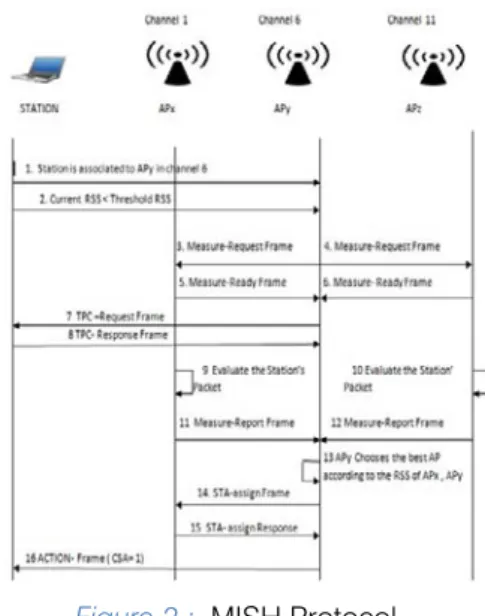
ethodologyThe Fig 2 below describes the MISH protocol [10], Multiple –Interface Seamless handoff where Each AP has multiple WNIC (Wireless Network Interface cards) working in different channels
Figure 2 : MISH Protocol ALGORITHM :
Step 1 : Station is associated to APy in Channel 6
Step 2 : The current RSS of Station’s packets < Threshold RSS ( thus need for handoff)
Step 3 & 4 : Associated AP i:e APy sends a MEASURE-Request Frame to other neighbor APS
Step 5 & 6 : Neighboring APS send MEASURE-Ready Frame to Associated AP
Step 7 : Associated AP, APy sends A TPC-Request Frame to connected Station
M
EASURE-Request Frame MAC address of connected StationMEASURE-Ready Frame
Confirmation & Ready to receive packets from connected Station
TPC-Request Frame
Transmit Power control (defined by 802.11h) all 802.11 devices support
Improving IEEE 802.11 Wlan Handoff Latency by Access Point-based Modification
© 2015 Global Journals Inc. (US)1
38
Global Journal of C omp uter S cience and T echnology Volume XV Issue V Version I
( ) E
Y
ear
2015In this paper [8], the authors S.Jin, M.Choi, S.Choi and L.Wang define a scanning scheme
Step 8 : Station sends TPC-Response Frame to Channel 6( Associated APy), now this TPC- Response Frame is also received by APx and APz because their 1WNIC is listening on channel 6.
Step 9 & 10 : By receiving TCP-Response Frame from Station, neighboring APs i:e APx & APz measures RSS of packet received from the Station
Step 11 & 12 : Neighboring APs i:e APx and APy send a MEASURE-Report Frame to associated AP (APy)
Step 13 : After receiving Measure-Report Frame from neighboring APs, Associated AP chooses the best next AP ( according to the value of RSS)
ASSUME APy CHOSE APx
Step 14 : Old AP( APy) sends a STA-Assign Frame to new chosen AP( APx)
Step 15 : New chosen AP ( APx) sends STA- assign Response Frame to old AP (APy)
Step 16 : Finally. Old AP( APy) sends a ACTION-frame to the station
IV.
S
imulationS
et-up &R
esultsA simulation model using ns2 has been developed to evaluate the methodology mentioned in previous section.
The simulations were performed using Network Simulator 2 (NS-2.34). The traffic sources are Constant Bit Rate (CBR). The source destination pairs are spread randomly over the network. The mobility model uses ‘random waypoint model’ in a rectangular field of 1000m x 1000m with 100 nodes.
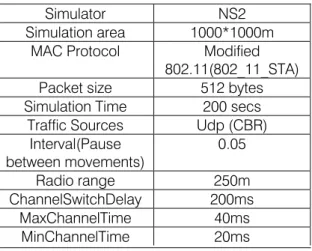
The various simulation parameters and the values used are described in the table below
Table 1 : Simulation Parameter List
Simulator NS2
Simulation area 1000*1000m MAC Protocol Modified
802.11(802_11_STA) Packet size 512 bytes Simulation Time 200 secs
Traffic Sources Udp (CBR) Interval(Pause between movements) 0.05 Radio range 250m ChannelSwitchDelay 200ms MaxChannelTime 40ms MinChannelTime 20ms
The design of simulation includes Grid topology, there are 16 APs(Access Points) and 4 MN(Mobile Nodes) in the simulation area that has been considered. Fig 3 depicts the grip topology .
Fig 4 demonstrates the handoff procedure as the mobile nodes starts their random mobility movement. The circles depict the radio range of each AP in the grid topology in the simulation
MEASURE-Report Frame
RSS value of the packet( TPC-Response) received from station
STA-Assign Frame 1 .MAC address of station
2. Messages Station’s previous authentication and association messages
STA- assign Response
1. To give confirmation to old AP
2. Assign an Association ID to the Station ACTION-frame
CSA ( Channel Switch announcement) here, CSA= 1
( because station has to switch association from channel 6 to channel 1).
To Notify the Station about following changes to be done;
© 20 15 Global Journals Inc. (US) 39
Global Journal of C omp uter S cience and T echnology Volume XV Issue V Version I
( ) E
Y
ear
2015Figure 4 : Handoff simulation as mobile nodes start
Moving
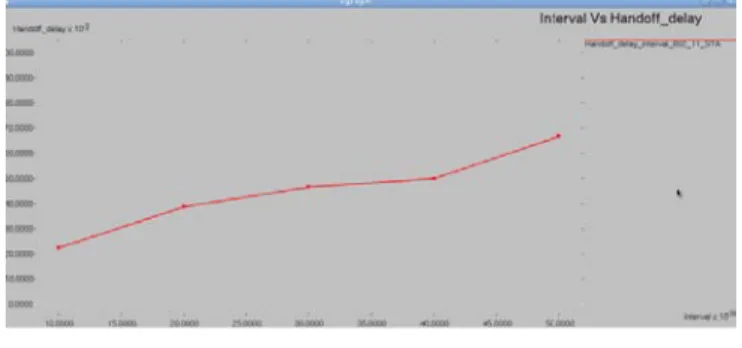
The total handoff delay duration for 200sec simulation is 0.0366024 seconds. The MinChannelTime and Max Channel Time is considered as 20ms and 40ms respectively. The ChannelSwitchDelay is 200ms. The handoff Interruption time is 0.022362 secondsFig 5 shows the graph of interval plotted against handoff Delay. As the time interval between the sending of packets increases, handoff delay duration also gradually increases.
Fig 6 depicts a graph that plots handoff delay duration against packetsize of the data packet. As the size of datapacket decreases, the handoff delay duration also decreases.
V.
C
onclusionThe mobility management is an important factor IEEE 802.11 provides to the users. For seamless services like video conferencing, VoIP, there is stringent requirement of less than 150ms handoff delay. The legacy handoff protocol provides handoff delay for more than 200ms. Thus there is a need for Seamless handoff protocol that would provide continuous services without interruption to clients in IEEE 802.11 WLAN. Thus the MISH protocol have been successful in meeting this Qos requirements since handoff delay is 36.6024 ms.
R
eferencesR
éférencesR
eferencias1. Hongqiang Zhai, Xiang Chen, and Yuguang Fang. “How well can the IEEE 802.11 wireless LAN support quality of service?,” IEEE Trans. Wireless Communications, vol. 4, pp.3084–3094, Dec. 2005. 2. A. Mishra, M. Shin, and W. Arbaugh,“An empirical
analysis of the IEEE 802.11 MAC layer handoff
process,”SIGCOMM Comput. Commun. Rev, vol. 33, no. 2, pp. 93–102, 2003.
3. Y. Pawar and V. Apte, “Improving the IEEE 802.11 MAC Layer Handoff Latency to Support Multimedia
Traffic”, in IEEE Conference on Wireless
Communication and Networking Conference, pp. 1-6, 2009.
4. Minho Shin, Arunesh Mishra, and William A. Arbaugh, “ Improving the latency of 802.11 hand-offs using neighbor graphs,”in Proc. MobiSys ’04: Proceedings of the 2nd international conference on Mobile systems, applications, and services, pp. 70-88, ACM, New York, 2004.
5. S. Ramani, I. Savage. (2005).“Syncscan: Practical fast handoff for 802.11 infrastructure networks.”, INFOCOM 2005. 24thAnnual Joint conference of the
IEEE computer & communication societies, Proc. IEEE 1, pp. 675-689, vol 1.
6. A. Mishra V. Brik and S. Banerjee. “ Eliminating handoff latencies in 802.11 WLANS using multiple radios: Applications, experience, and evaluation.”, ACM IMC, Oct. 2005.
7. S. Jin, M. Choi, L. Wang and S. Choi, “Fast scanning schemes for IEEE 802.11 WLANs in virtual AP environments,” Computer Networks, vol. 55, pp. 2520– 2533, July 2011.
8. Y. Grunenberger and F. Rousseau, “Virtual access points for transparent mobility in wireless LANs,” in Proc. IEEE Wireless Communications and Networking Conference, April 2010, pp. 1-6.
9. S. Jin, M. Choi, and S. Choi, “Multiple WNIC-based handoff in IEEE 802.11 WLANs,” IEEE Communication Letters, vol. 13, no. 10, pp. 751-754, Oct. 2009.
10. Yi-Cheng Chan and Dai-Jiong Lin, “The Design of an AP-Based Handoff Scheme for IEEE 802.11 WLANs,”J.e-Education, e-Business, e-Management and e- Learning, vol. 4, no. 1, Feb. 2014
Improving IEEE 802.11 Wlan Handoff Latency by Access Point-based Modification
© 2015 Global Journals Inc. (US)1
40
Global Journal of C omp uter S cience and T echnology Volume XV Issue V Version I
( ) E
Y
ear
2015Figure 5 : Handoff delay vs. Interval between packets