Developing a Framework for Creating Effective
Instructional Video Podcasts
http://dx.doi.org/10.3991/ijet.v9i1.3335
R. H. Kay
University of Ontario Institute of Technology, Oshawa, Ontario
Abstract—The purpose of the following study was to develop a comprehensive, theory-based framework for creating in-structional video podcasts designed to present worked ex-amples. Sixteen design characteristics, organized according to four categories (establishing context, providing effective explanations, minimizing cognitive load, and engaging stu-dents), were used to develop 59 pre-calculus videos for 856 first-year university students. Overall, the vast majority of students noted that the video podcasts were useful and helped them understand mathematics better. With respect to establishing context, the evidence suggested that problem selection was appropriate and video podcasts were clear, straightforward, and detailed. Regarding the quality of ex-planations, a number of students commented on the effec-tiveness of the step-by-step presentation of solutions and the use of visuals to support learning. Students agreed that vid-eo podcasts were easy to read, but did not directly mention other issues involving cognitive load. Students also noted that video podcasts were engaging and better than using textbooks. They also enjoyed working on the interactive student-problems. Finally, significant gains were observed in all five pre-calculus knowledge categories evaluated. It is concluded that the framework proposed in this study is a reasonable starting point for creating effective worked-example video podcasts.
Index Terms—instructional design, effectiveness, frame-work, video podcasts, worked examples.
I. INTRODUCTION A. Overview
Video podcasts are audiovisual files that are distributed in a digital format through the Internet to personal com-puters or mobile devices [1]. According to a recent review of the literature [2], at least four different kinds of instruc-tional video podcasts are used in higher education includ-ing lecture-based [3], enhanced [4], supplementary [1], and worked examples [5]. The current paper focuses on worked-example video podcasts which provide video ex-planations of procedural problems often associated with mathematics or science courses [6]. Video podcasts pro-vide a potentially effective teaching method for addressing gaps in student knowledge. Public acceptance of this form of teaching is reflected by recent grants of seven million dollars from the Gates and O'Sullivan foundations to the Khan Academy (http://www.khanacademy.org), one of the largest and best known, non-profit depositories of worked-example video podcasts [7]. Limited research has been conducted on identifying characteristics that maxim-ize effectiveness of these tools [5, 8]. The purpose of the following study was to develop and assess a
comprehen-sive, theory-based framework for designing worked-example video podcasts.
B. The Role of Video Podcasts in Education
Since 2006, research on the use of video podcasts in higher education has grown markedly [3, 5]. Students have reported that this medium is motivating [9-10], use-ful, helpuse-ful, and effective with respect to improving learn-ing [4, 11-13]. Students especially like controlllearn-ing when and where they learn [10, 14, 15], what they need to learn [3, 10], and the pace of learning [3, 16, 17]. In addition, researchers have observed that the use of video podcasts has resulted in significant increases in skills [9, 18], test scores [5, 19] and grades [20, 21].
While previous research suggests that video podcasts have had a positive impact on student attitudes and learn-ing performance, the format of presentation has been pre-dominantly passive (e.g. lectures, PowerPoint summaries, or supplementary materials). Very few studies have exam-ined video podcasts designed to present worked-examples [1-3].
C. Worked-Example Based Video Podcasts
As stated earlier, worked-example video podcasts are relatively short (e.g., under 10 minutes) video explana-tions of how to complete procedural problems in subject areas such mathematics or science [6]. To date, only two peer-reviewed studies have been conducted on this type of podcast. Loomes et al. [8] discussed the potential benefits of worked-example video podcasts but did not formally study their impact on student attitudes or learning. Crip-pen & Earl [5] reported that students had positive attitudes toward the use of video podcasts in an undergraduate chemistry class and that there was a significant correlation between the use of problem-solving video podcasts and test scores.
In spite of the limited research, the use of worked-example video podcasts has increased rapidly since 2005 and the launch of You Tube [22]. As of January 2012, YouTube was viewed over four billion times per day [23]. Often used for entertainment purposes, YouTube is also a free source of numerous worked-example video podcasts. In addition, new portals such as the Khan Academy, ex-clusively designed to distribute worked-example video podcasts, are used extensively (see http://www.khanacademy.org). However, limited attention has been directed toward improving the effectiveness of worked-example video podcasts. If students are going to use these tools, it is critical to identify characteristics that influence their quality and impact on learning.
D.Criteria for Creating Effective Worked-Example Video Podcasts
In order to identify key features that might alter the ef-fectiveness and impact of worked-example videos, three tangential areas of research were consulted: written worked examples [6, 24-27], multimedia learning [24, 28], and how people learn [29, 30]. Based on an extensive re-view of the research, sixteen features were identified as potentially important in designing effective video pod-casts. These features were organized under four main cat-egories including establishing context, creating effective explanations, minimizing cognitive load, and engaging students. Each category and its sub-components will be discussed in turn.
E. Establishing Context
To establish the context of worked-example video pod-casts, a review of tangential research indicates that the following areas need to be addressed: problem type, ap-propriate problem labels, background information, and identification of key problem elements.
Problem type. Creating well-designed problems is a
critical first step to establishing an effective learning con-text [31-34]. Willingham [34] claims that teachers concen-trate far too much on answers and solutions to procedural problems and do not devote enough time to creating meaningful and effective questions. Ball & Bass [31] add that acquiring the requisite knowledge for understanding how to create effective problems is extremely challenging and illusive for many teachers. Greer [32] notes that not enough detail or context is provided in mathematical word problems for students to establish personal meaning or connection to what is being asked.
Clear problem label. According to Bransford et al.'s
[29] extensive review of how people learn, well-structured, organized knowledge leads to better problem solving and retention than memorizing a series of facts or procedures. Clear, meaningful labels for problems within a larger organized framework are an important aspect of setting the context for student learning with worked-example video podcasts. Catrambone [35] adds that care-ful labelling of problems and sub-goals are influential in guiding effective problem solving.
Background information. Eliciting pre-existing
knowledge and conceptions related to concepts being taught is an important aspect of teaching students to solve problems, because it provides opportunities to build on or challenge current understanding [29]. Willingham [34] suggests that it is also important to establish why a specif-ic question is important in order to engage and motivate students in the problem solving process.
Explain key elements. Willingham [34] advocates that
enough time needs to be spent on explaining what a prob-lem is asking before delving into a solution. If the student does not understand the structure of the problem, what is being asked, and the necessary key elements required to solve the problem, he/she will have difficulty proceeding. With respect to multimedia presentation of problems, Clark & Mayer [24] maintain that it is essential that the student understand key pre-concepts before solving a problem so that he/she is not cognitively overwhelmed. They refer to this guideline as the pretraining principle.
F. Creating Effective Explanations
Once a student has been primed to solve a worked-example video podcast, an effective explanation has to be provided. Minimally, this process should include breaking problems into meaningful cognitive steps, explaining the reasoning for each step, and using visual supports.
Meaningful steps. Considerable evidence suggests that procedural problems, typically used in worked-example video podcasts, need to be broken down into explicit, meaningful, bite-size chunks, particularly when taught to novice learners [24-26, 35-37]. However, more experi-enced or knowledgeable learners may not find detailed, step-by-step, worked examples particularly helpful be-cause the explanations are too slow and simple [24].
Explain all steps. Once a problem has been broken down into meaningful steps, it is critical to explain the reasoning for each step and avoid abrupt cognitive leaps. Renkl [25] supports the use of principled explanations where each step is meaningfully connected to the entire explanation.
Use of visuals. The use and benefits of visual aids to in-crease the effectiveness of problem solving is well docu-mented in the literature [6, 38, 39]. Clark & Mayer [24] refer to the multimedia principle and suggest that words and graphics be used together as opposed to words alone. However, they also note that graphics should be chosen carefully to help the learner understand the material, as opposed to simply decorating the page.
G. Minimizing Cognitive Load
When presenting procedural problems, instructors need to minimize extraneous cognitive load (engaging in pro-cesses that are not beneficial to learning) and optimize germane cognitive load (engaging in processes that help to solve the problem at hand) [40-42]. In worked-example video podcasts, extraneous cognitive load can be mini-mized by clear presentation of text, writing down key in-formation, providing a clear, well-organized layout, and highlighting key areas of the page when they are being explained.
Readability. The writing in a worked-example video
podcasts needs to be clearly legible or students will spend excessive processing time trying to decipher words and symbols. This fact is particularly important in mathemat-ics-based video podcasts which are typically hand written.
Write down key information. Writing down key
ref-erence information is also critical when solving procedural problems so that the student's working memory is not overloaded. Clark & Mayer [24] add that the instructor needs to be selective in what is written down and what is spoken (modality principle). Writing down too much in-formation can result in cognitive overload.
Layout. Keeping the layout well organized, clear, and
uncluttered is particularly important when presenting a procedural-based problem. Crowded, dense displays of text over numerous screens can overwhelm a novice stu-dent [24]. Referred to as the coherence principle, Clark & Mayer [24] suggest that instructors should avoid adding any information that is not relevant to the instructional goal.
Highlighting. The final way to minimize extraneous
cognitive load in worked-example video podcasts is to highlight key areas of the screen when providing an
ex-planation. Without the highlighting, students can spend an inordinate amount of time trying to figure out what aspect of the problem is being discussed. Willingham [34] adds that if a student's attention is not fully directed to the area of a problem being presented, learning is unlikely to oc-cur.
H.Engaging Students
Student engagement is also critical when creating worked-example video podcasts and instructors need to be cognizant of features such as voice intonation, pace and length of explanations, potential distractions, and oppor-tunities for interaction.
Engaging voice. Research on discourse processing
[43], the voice principle [44], and the personalization principle [24, 45,46] suggest that worked-example video podcasts need to be communicated with an engaging voice. According to Beck et al. [43], students work harder on problems when information is presented in a conversa-tional manner. Atkinson et al. [44] add that students per-form better when human, personal voices are used com-pared to computer generated voices. Finally, Clark & Mayer [24] maintain that a conversational speech is sig-nificantly more effective than formal speech with respect to improving student performance.
Pace. The pace of explanation can have a significant impact on learning, particularly with respect to cognitive load [40-42]. While the impact of pace can be partially moderated by the pause and rewind features of video pod-casts, the overall flow of learning may feel somewhat dis-jointed. Willingham [34] suggest that effective pace is critical for avoiding working memory overload.
Length of Clip. According to Tapscott [47], today’s
students, referred to as the Net Generation, are quick switchers who like to multitask and take frequent mental breaks. Lengthy worked-example video podcasts might be problematic in sustaining student attention. Medina [48] provides some evidence to suggest that the human atten-tion span wanes after about ten minutes of listening to passively presented instructional material. Finally, Renkl [25] advocates the use of minimalist explanations, focus-sing on relevant meaningful details and minimizing extra-neous information that could increase cognitive load.
Distractions. Clark & Mayer [24] provide considerable
evidence to suggest that distractions in the form of dra-matic stories, pictures and background music have a det-rimental impact on student problem solving in a multime-dia environment. It is argued that these distractions, often intended to garner interest or entertain, shift attention away from learning.
Student problem. Proponents of constructivist learning
might argue that worked-example video podcasts over emphasize passive presentation of content instead of ac-tive problem solving and knowledge building [25, 26]. However, considerable research suggests that complex learning tasks require more extensive guidance, particular-ly for novice learners (see Kirschner [26] for a review). Presenting worked examples in conjunction with relevant practice problems increases problem solving effectiveness [49].
I. Summary
The schema proposed for creating worked-example video podcasts consists of four key areas: establishing
context, creating effective explanations, minimizing ex-traneous cognitive load, and maintaining student engage-ment. This schema is summarized in table 1.
TABLE I.
KEY COMPONENTS OF MODEL FOR DEVELOPING VIDEO PODCASTS Establishing the Context
Problem Type: An appropriate problem is chosen for the concept being presented (e.g., focuses student on specific concept, numbers are select carefully) [31-34]
Clear Problem Label: The problem is clearly labeled and displayed at the beginning of the clip [29,35]
Background Information: The context and type of problem is clearly articulated at the beginning of the clip.[29, 34, p. 20 & p. 84]
Explain Key Elements: Key elements are clearly articulated before
trying to solve it. Don’t not simply read the problem, Rather, high-light key features that learners should attend to [24, 34, p.75]
Creating Effective Explanations
Meaningful Steps: Problem is broken down into meaningful chunks [24-26,28,35-37]
Explain all steps: The reason for conducting each step is explained (so students can understand why a procedure/step is being used) [25]
Use of Visuals: Diagrams /pictures/tables used in the clips helped organize /clarify / illustrate key aspects of the problem.
[6,24,38,39,50,51]
Minimizing Cognitive Load
Readability: The writing in the clips is easy to read. [40-42, 52]
Write down key information: The important elements (terms /definitions /formulas/ procedures) are written down as needed (not all at once). [24, 40-42, 52]
Layout: The layout of the clips is easy to follow (e.g., well orga-nized, not crowded, even horizontal lines) [24, 40-42, 52]
Highlighting: Key areas of problem are visually emphasized (e.g., different colour, highlighting, circled) [34, p.53,55, 40-42, 52]
Engagement
Engaging Voice: The tone of the voice is engaging (e.g., was not flat or monotone). [24,43- 45, 46]
Pace: The pace of the clip is good for learning. [34, 40-42, 52]
Length of Clip: The clip is an appropriate length (5 minutes is about right). [25,47,48]
Distractions: There were no behaviours/habits that would distract a student. [24, 40-42, 52]
Student problem: Student worked on their own problem while lis-tening to the explanation of a teacher problem [49,54,59] J. Research Questions
The preliminary framework for creating worked-example video podcasts in Table 1 was used to develop and deliver 59 pre-calculus problems to university stu-dents. Two primary research questions were used to assess effectiveness of the proposed video podcast design framework:
1. What were student attitudes toward worked-example video podcasts? (survey data and comments)
2. How did student knowledge change as a result of us-ing video podcasts? (self-report data)?
II. METHOD A. Sample
Students. The student sample (n=856) was chosen
from a small university located within a large, metropoli-tan area of over three million people. Over 70 percent (n=603) of the sample population were males. Students coming from engineering (n=463), science (n=342) or education (n=51) backgrounds were enrolled in a first year university Calculus course and reported high school grades of 50-59% (4%, n=34), 60-69 (13%, n=107), 70-79% (36%, n=309), 80-89% (35%, n=295) and 90+ (13%, n=101).
B. Video Podcasts
Development. Two female secondary school
instruc-tors with advanced knowledge in mathematics were trained to develop video podcasts based on the framework outlined in this study (Table 1). Practice video podcasts were developed, evaluated and discussed to ensure con-sistent quality and adherence to the 16 key design princi-ples (Table 1). The training process took place over a pe-riod of two weeks. During the subsequent two months, 59 video podcasts were created using a screen casting pro-gram called Camtasia (version 5). Each finished recording took approximately 60 to 90 minutes to complete. All vid-eo podcasts were then loaded and organized on a central web page for students to access when needed. See Kay [60] for a link to the complete library of video podcasts developed and delivered.
Content. The course instructor created 59 problems
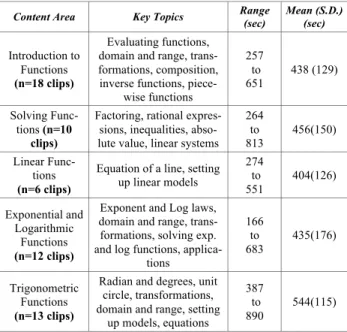
based on difficulties that students had experienced over the previous two years in the first year university Calculus course. Care was taken to select the correct problem type and challenge level (Table 1, Item 1). Five content areas were covered including operations with functions, solving equations, linear functions, exponential and logarithmic functions, and trigonometric functions. A detailed descrip-tion of five pre-calculus content areas covered by the 59 worked-example video podcasts is provided in table 2.
Length. An effort was made to provide high quality,
ef-fective explanations that where less than 10 minutes in length, as prescribed by Medina [48] and Tapscott [47] (Table 1, Item 13). The length of video podcasts ranged from 166 seconds (2:46) to 890 seconds (14:50) with a mean of 460 seconds (7:40) and a standard deviation of 143 seconds (2:23).
Design. Each video podcast had the following design
features based on the schema outlined in Table 1: clear problem label (Table 1, Item 2), a coherent exposition of the key elements and context of each problem (Table 1, Items 3 and 4), step-by-step explanations (Table 1, Items 5 & 6), clear writing of important elements in an easy-to-follow layout (Table 1, Items 8, 9 and 10), effective use of visuals and highlighting when appropriate, (Table 1, Items 7 & 11), a steady pace (Table 1, Item 13), and an engaging tone of voice (Table 1, Item 12).
Problem format. Each video podcast included the
problem solved by the teacher in a step-by-step fashion (teacher problem) and a corresponding problem to be solved by the student (student problem). The student prob-lem was included to increase engagement and accommo-date the recommendation for students to solve problems in conjunction with the instructor's explanation (see Table 1,
TABLE II.
DESCRIPTION OF WORKED EXAMPLE VIDEO PODCASTS CONTENT Content Area Key Topics Range (sec) Mean (S.D.) (sec)
Introduction to Functions
(n=18 clips)
Evaluating functions, domain and range, trans-formations, composition, inverse functions,
piece-wise functions 257 to 651 438 (129) Solving Func-tions (n=10 clips)
Factoring, rational expres-sions, inequalities, abso-lute value, linear systems
264 to 813 456(150) Linear Func-tions (n=6 clips)
Equation of a line, setting up linear models 274 to 551 404(126) Exponential and Logarithmic Functions (n=12 clips)
Exponent and Log laws, domain and range,
trans-formations, solving exp. and log functions,
applica-tions 166 to 683 435(176) Trigonometric Functions (n=13 clips)
Radian and degrees, unit circle, transformations, domain and range, setting
up models, equations
387 to
890 544(115)
Item 16). The teacher would start by explaining the nature of the problem to be solved and then proceed to discuss the first step. The video podcast would then automatically stop so that the student would have time to work through the first step of his/her assigned problem. When the stu-dent wished to continue, he/she would click a button and the answer for the first step to the student solution would be presented. The process of explaining a step and pausing the clip to allow the student to complete the corresponding step in his/her assigned problem continued until the full solution was presented. Students could also control the video podcast with a pause, stop, or play button as well as a dragging tool which a permitted movement to anywhere in the clip (see http://tiny.cc/calcvp1 for a sample clip).
C. Procedure
Students were sent a link to the video podcast deposito-ry three weeks prior to a pre-calculus diagnostic test. They were also reminded of the link, posted on the course web site, during the first week of classes. After they received their results from the diagnostic test, they were asked to fill in a 10 to 15 minute survey inquiring about their use of and attitudes toward video podcasts. Participation in this study was voluntary, anonymous and in no way impacted a student’s grade. The survey questions about video pod-casts are presented in Appendix A.
D. Data Collection
Data was collected in two formats: a formal student survey focussing on overall attitudes toward video pod-casts and an open-ended question asking students why they used video podcasts. Specific questions targeting the four categories(establishing context, explanation, cogni-tive load, and engagement - see Table 1) outlined in the framework for developing video podcasts were not asked in order to keep the learning environment as natural as possible and avoid leading students toward answers they would not have provided on their own. For example, it is unlikely that students would notice the impact of a clear problem label or that key information was being written down in order to reduce extraneous cognitive load.
E. Data Sources
Background information. Students were asked their
gender, program of study, and Calculus grade in high-school.
Open-ended response question. Students were asked
to explain why they chose to use video podcasts. These qualitative comments were reviewed and categorized by theme. The coding scheme is presented in Appendix B.
Survey Data. Students were asked to rate overall
use-fulness and six features of video podcasts (Appendix A). The internal reliability of the scale was 0.83. However, each item in the scale was analysed individually in order to gain specific insights about student attitudes toward video podcasts.
Student knowledge. Students were asked to assess
their pre-calculus knowledge before and after using the video podcasts in five areas: working with functions, solv-ing equations, linear functions, exponential and logarith-mic functions, trigonometric functions. This approach to assessing performance, while less precise than an actual test, was used to preserve anonymity and authenticity of the survey data. It is worth noting that Kuncel, Crede, & Thomas [61] conducted a meta-analysis on self-reported outcomes and concluded that students are accurate with respect to predicting their actual grades.
III. RESULTS A. Use of Video Podcasts
Almost 60% (n=488) of the student sample chose to use video podcasts in at least one of the five content areas. Regarding specific content area, 41% (n=352) selected functions, 36% (n=304) chose solving equations, 33% (n=278) picked linear equations), 43% (n=366) opted for exponents and logarithms, and 38% (n=322) used trigo-nometric functions. Total time spent using video podcasts ranged from 8 to 240 minutes with an average of 67.2 minutes (SD=70.0).
B. Student Attitudes Video Podcasts
Five categories of student attitudes will be discussed based on the developmental framework for creating video podcasts proposed in this study: general impact, establish-ing context, explanation, minimizestablish-ing cognitive load, and engagement.
General impact. Overall, nearly three quarters of the
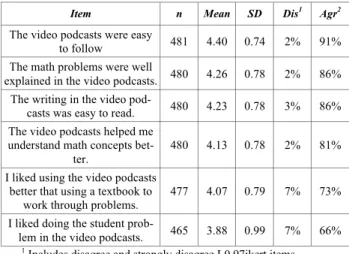
453 students who used video podcasts rated them as being useful (n=130; 29%) or very useful (n=203; 45%). Only three students rated video podcasts as not at all useful. Students rated the worked-example video podcasts very highly with average item scores ranging from 3.9 to 4.4 on a five-point Likert scale (1=Strongly Disagree, 5 = Strong-ly Agree). Just over 80% of the students agreed or strong-ly agreed that the video podcasts helped them understand mathematics concepts better (see Table 3). Based on the student comments, almost 50 students noted that the video podcasts were helpful or useful. Typical comments were:
“I used them and found them helpful."
“[They were] very detailed, interesting, and helpful." "The clips were useful and informative."
"I thought that they were very helpful and clear."
TABLE III.
STUDENT RATINGS OF WORKED-EXAMPLE VIDEO PODCASTS
Item n Mean SD Dis1 Agr2
The video podcasts were easy
to follow 481 4.40 0.74 2% 91% The math problems were well
explained in the video podcasts. 480 4.26 0.78 2% 86% The writing in the video
pod-casts was easy to read. 480 4.23 0.78 3% 86% The video podcasts helped me
understand math concepts
bet-ter. 480 4.13 0.78 2% 81%
I liked using the video podcasts better that using a textbook to
work through problems. 477 4.07 0.79 7% 73% I liked doing the student
prob-lem in the video podcasts. 465 3.88 0.99 7% 66%
1 Includes disagree and strongly disagree L0.97ikert items 2 Includes agree and strongly agree Likert items
Establishing context. Student comments suggested that
problem selection was effective. The problems helped them review (n=22 comments) or remember (n=11 com-ments) previously forgotten pre-calculus concepts, address specific gaps in knowledge (n=23 comments), or solve problems in which they were having difficulty (n=19). Sample comments were:
"The clips helped [me] to remember operations." "If I didn't remember how to solve a problem, watching
the videos helped me."
"They were a good way to review."
"The clips where great tools as they helped me with the problems that I was having related to certain topics." "I used to it help me in solving some of the questions on
the practice tests.
Students were divided on the level of problem difficul-ty. Some (n=10) regarded the problems as being too easy (e.g. "I wanted to see the more complicated problems.", "The examples were too easy.") while others (n=7) thought they provided a sufficient level of depth (e.g., "They showed how to do harder questions.", " The clips were very useful in bringing some depth").
Indirect evidence of establishing context came from survey data and student comments about the quality of explanations (n=39 comments). In the survey, approxi-mately 90% of the students agreed or strongly agreed that video podcasts were easy to follow and of high quality (Table 3).
Students also commented that the video podcasts were easy to follow, clear, simple, straightforward, and detailed. Sample comments included:
“I used the clips because it was easy to follow along." "The clips [were] very thoroughly explained."
"I used them because it broke everything down and went quite slow."
"Because they gave a good explanatory guide to many problems."
In addition, students noted that the video podcasts were beneficial for understanding new concepts. Again, this is tangential evidence that the approach to creating video podcasts was effective in terms of establishing the overall problem context and key features. Sample comments were:
"[The clips] helped me to grasp the knowledge." "[They] to better understand the material."
"They helped me understand clearly how to approach the problem."
"It helped me understand how to actually apply my knowledge when given certain questions."
Explanation. In addition to commenting on the overall
quality of explanations and increasing understanding, stu-dents explicitly and frequently noted the effectiveness of the step-by-step process. This was the feature emphasized most by students (n=75). Typical comments were:
"I used the mini clips because I liked to have seen the example being done so I know what steps to take figur-ing out the question."
"They help[ed] me and guided me step by step and that is what lead to my greater understanding of how to an-swer the question."
"I used them because they go through all the examples making sure to go through all the simple and complex math."
“I used the mini clips because it showed step by step so-lutions."
Students also reacted positively to the use of diagrams and other visuals to help organize, clarify, and/or illustrate key aspects of problems (n=35 comments). Representative comments were:
“They helped a lot to visualize and understand what was happening."
“It helped watching a visual of the concept."
“I used the clips because they illustrated the written documentation."
“The visual aids helped me see how to do the prob-lems."
Minimizing cognitive load. Almost 90% of the
stu-dents agreed or strongly agreed that the writing in the vid-eo podcast was easy to read (Table 3). However, students did not address cognitive load issues such as writing down key information, layout, or highlighting directly with their comments. Indirectly, numerous comments about step-by-step explanations indicated that many students were not overwhelmed by the cognitive load experienced while watching video podcasts.
Engagement. Three quarters of the students agreed or
strongly agreed that using video podcasts was better than using textbooks and that good learning tips were provided. Nearly two thirds of the students agreed or strongly agreed that they liked doing the student problems (Table 3). In addition, open-ended responses indicated that students liked completing the student problem (n=25 comments). Typical comments were:
“I liked these because you actually got to try the prob-lems with someone there helping you along."
"[I liked that] every mini-clip has a sample question to answer on our own with the solution being provided later on.
“Having the chance to solve the problem before the an-swer was given was great."
Furthermore, a number of students (n=24 comments) preferred video podcasts over textbooks noting that "It's easier to understand when you see it being done than when you look at an already finished solution" or that "It's much easier to focus on and interesting than reading in-structions on how to do something".
Moreover, some students felt that the video podcasts were engaging (e.g., "[The clips" kept your attention" or "[The clips were] much more fun and interesting") and personal (e.g., " [I] like having someone right there to walk me through it ... kind of like my own personal teach-er").
Additionally, a sizeable number of students were more engaged because video podcasts suited their personal learning style (n=22 comments). Sample comments were:
"I am a very visual learner, and to fully understand a concept I need to see it being done."
"I am a visual learner, they helped a lot."
"Having the voice explaining and seeing it happen works well."
It should be noted that a handful of students (n=5) ap-peared to disengage because they thought the video pod-casts went too slow ("She goes really, really slow and it’s quite frustrating", "At times the person spoke too slow-ly").
C. Video Podcasts and Student Understanding
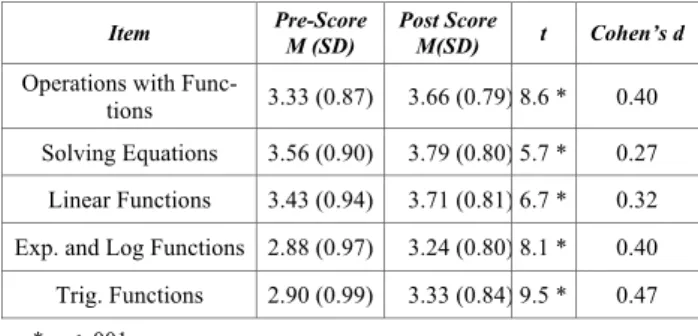
Students self-assessed five areas of pre-calculus knowledge before and after a two week period of using video podcasts. Paired t-tests revealed significant gains in all five pre-calculus knowledge categories evaluated (Ta-ble 4). The effect sizes (based on Cohen’s d) ranged from 0.30 to 0.53 and are considered to be moderate [62, 63].
TABLE IV.
PRE VS.POST RATINGS OF PRE-CALCULUS KNOWLEDGE (N=396)
Item Pre-Score M (SD) Post Score M(SD) t Cohen’s d
Operations with
Func-tions 3.33 (0.87) 3.66 (0.79) 8.6 * 0.40 Solving Equations 3.56 (0.90) 3.79 (0.80) 5.7 * 0.27 Linear Functions 3.43 (0.94) 3.71 (0.81) 6.7 * 0.32 Exp. and Log Functions 2.88 (0.97) 3.24 (0.80) 8.1 * 0.40 Trig. Functions 2.90 (0.99) 3.33 (0.84) 9.5 * 0.47 * p < .001
IV. DISCUSSION A. Overall Impact on Student Attitudes
The evidence from this study suggests that worked-example video podcasts were well used with almost 60% of the student population viewing this medium for over an hour, on average, to prepare for the pre-calculus
diagnos-tic test. Both survey data and open-ended comments indi-cated that the vast majority of students rated the worked-example video podcasts as useful tools that helped them learn mathematics concepts better. It is reasonable to con-clude most students had positive attitudes toward worked-example video podcasts created using the framework out-lined in Table 1. It is important, though, to examine stu-dent ratings and comments in more detail to determine whether specific criteria outlined in the design framework proposed for the current study contributed to positive atti-tudes experienced by students. Each of the four main cat-egories in Table 1 will be addressed (establish context, creating effective explanations, minimizing cognitive load, and engagement).
B. Design Framework and Student Attitudes
Establishing context. While there was some debate on
the difficulty level of questions, many students in this study responded positively to the problem selection claim-ing that the video podcasts were successful in helpclaim-ing them remember or review, previously forgotten topics. In other words, the knowledge was relevant and helpful to students with respect to bridging learning gaps in targeted content areas. Specific comments about the use of clear problems labels (Table 1, Item 2), providing sufficient background knowledge (Table 1, Item 3), and explaining key elements before solving a problem (Table 1, Item 4) was not offered by students. Nonetheless, survey data and student comments strongly suggested that worked-example video podcasts were easy to follow and of high quality. If sufficient context was not developed, it is un-likely students would have rated ease of use and quality so highly.
Regarding difficulty level, some students thought that the problems selected were too easy while others noted that they provided the correct level of depth. This result is consistent with research suggesting that worked examples are effective for beginner level students and frustrating for more knowledgeable peers [24-26, 28, 35-37].
Creating effective explanations. The data from this
study indicated that large number of students noted and appreciated the effectiveness of the step-by-step explana-tions. This result was predicted by previous literature [24-26, 28, 35-37] but has not been explicitly confirmed in a worked-example video podcast learning environment. Furthermore, visual aids offered significant learning sup-port. There was a clear preference for the dynamic visuali-zation of a problem as opposed to the static presentation of a text-based format. This result is consistent with previous research claiming that visual information is advantageous in the problem solving process [6, 24, 50, 51]. It is reason-able to conclude that students were positive about step-by step explanations and visual supports provided in worked-example video podcasts.
Minimizing cognitive load. Students did not comment
directly about cognitive load issues such as writing down key information (Table 1, Item 9), layout (Table 1, Item 10), or highlighting (Table 1, Item 11). A majority of stu-dents agreed that the writing in the video podcasts was clear, although a direct link to cognitive load was not es-tablished. An argument could be made that extraneous cognitive load was effectively managed because most students rated video podcasts as useful, clear, easy to fol-low, and effective at helping them understand and learn pre-calculus concepts previously forgotten. If students
were experiencing high extraneous cognitive load, they would have commented that the video podcasts were dif-ficult to understand, hard to follow, went too fast, or were confusing. No such comments were made. Nonetheless, more research is needed to directly establish a link be-tween minimizing extraneous cognitive load and the effec-tiveness of worked-example video podcasts.
Engagement. Students in this study commented
spar-ingly if at all on specific design features such as voice (Table 1, Item 12), pace (Table 1, Item 13), length of clip (Table 1, Item 14), and distractions (Table 1, Item 15). However, nearly two thirds of the students enjoyed work-ing through the student problem as the video podcast was being presented. A number of students added that attempt-ing the student problem assisted their learnattempt-ing. Other evi-dence that students were engaged included direct com-ments about the video podcasts keeping their attention and being interesting. In addition, three quarters of the stu-dents noted that working with worked-example video podcasts was better than using textbooks. As was the case when analyzing student attitudes regarding cognitive load, the evidence does not explicitly support the impact of spe-cific design features used to increase engagement, with the exception of incorporating a student problem. Neverthe-less, the data suggest that students were engaged when using worked-example video podcasts.
C. Learning Performance
Significant increases were observed for all five catego-ries of pre-calculus knowledge areas with a moderate ef-fect size. This result is consistent with student beliefs that that the worked-example video podcasts had a significant impact on their learning. Gains in understanding and knowledge are consistent with previous research and the impact of lecture-based video podcasts [5, 9, 18, 19] as well as the single study conducted using worked-example video podcasts [5]. It is important to emphasize that any conclusions about knowledge gains are limited because the data collected was based on self-assessment. In addi-tion, it would be spurious to assume that the only influ-ence on learning was the use of worked-example video podcasts. Students may have consulted textbooks, other web- based resources and friends to augment there knowledge of pre-calculus concepts. A more rigorous evaluation would involve the completion of actual pre- and post tests.
D. Summary
Based on a thorough review of the literature on written worked examples, multimedia learning, and Bransford et al.'s model of how people learn, 16 criteria for designing worked-example video podcasts were proposed and orga-nized under four main categories: establishing context, explaining the problem, cognitive load, and engagement. A holistic as opposed to an experimental approach was used to evaluate the general impact of the proposed design characteristics. The results indicated that, overall, students had positive attitudes toward the use of worked-example video podcasts, noting they were useful and improved their understanding of pre-calculus concepts. In addition, self-assessed knowledge in five pre-calculus concepts increased significantly, based on pre and post evaluations. Direct evidence from survey and open-ended questions suggested that specific design features such a problem selection, step-by-step explanations, use of visual
sup-ports, and providing a corresponding student problem to work through during the video podcasts were effective. However, more research needs to be conducted to estab-lish a direct link between the remaining design features, student attitudes, and learning performance.
E. Caveats and Future Research
This study is a first attempt to examine and evaluate a research-based framework for designing and creating worked-example video podcasts. A concerted effort was made to ensure the quality of the analysis by conducting a comprehensive review of video podcasts design princi-ples, providing a detailed description of the video podcasts used, collecting data from a large sample, and employing multiple data collection tools. Nonetheless, several notable caveats are worth mentioning to guide future research.
First, actual student behaviours and reactions while us-ing worked-example video podcasts need to be examined in order to determine whether specific design features are having their intended impact. For example, the use of think-aloud protocols where a student talks out loud while using a video podcast could provide more detailed infor-mation on what students attend to while solving problems and the impact of various design elements on cognitive load. In addition, collecting data using interviews or focus groups with a small sub-sample of students might help gather more information on which characteristics of video podcast use are associated with negative and positive out-comes. Furthermore, data collection tools on the attitudes of students toward video podcasts could be further refined to target specific design components of the proposed framework. Finally, formal and post-tests on pre-calculus would provide more persuasive data regarding the impact of video podcasts on learning performance.
REFERENCES
[1] O. McGarr, “A review of podcasting in higher education: Its influ-ence on the traditional lecture”, Aust. J. of Educ. Tech., vol.25, no.3, pp. 309-321, 2009.
[2] R. H. Kay, “Exploring the use of video podcasts in education: A comprehensive review of the literature”, Comp. in Hum. Beh., vol. 28, no. 3, pp. 820-831, 2012.
[3] S. B. Heilesen, “What is the academic efficacy of podcasting?”, Comp. in Educ., vol. 55, no. 3, pp. 1063-1068, 2010. http://dx.doi.org/10.1016/j.compedu.2010.05.002
[4] J. Holbrook and C. Dupont, “Making the decision to provide en-hanced podcasts to post-secondary science students”, J. of Sci. Educ. and Tech., vol. 20, no. 1, pp. 233-245, 2010.
[5] K. J. Crippen and B. L. Earl, “Considering the effectiveness of web-based worked-example in introductory chemistry”, J. of Comp. in Math and Sci. Teach., vol. 23, no. 2, pp. 151-167, 2004. [6] R.K. Atkinson, S. J., Derry, A. Renkl and D. Wortham, “Learning
from examples: Instructional principles from the worked examples research”, Rev. of Educ. Res., vol. 70, no. 2, 181-214, 2000. http://dx.doi.org/10.3102/00346543070002181
[7] A. Watters, “Khan Academy gets $5 million to expand faculty & platform & to build a physical school”, Hack Education. Internet: www.hackeducation.com/2011/11/04/khan-academy-gets-5-million-to-expand-faculty-platform-to-build-a-physical-school/, [Nov. 4, 2011]
[8] M. Loomes, A. Shafarenko and M. Loomes, “Teaching mathemat-ical explanation through audiographic technology”, Comp. & Educ., vol. 38, no. 1-3, pp. 137-149, 2002. http://dx.doi.org/10.1016/S0360-1315(01)00083-5
[9] E. Alpay and S. Gulati, “Student-led podcasting for engineering education”, Eur. J. of Eng. Educ., vol. 35, no. 4, pp. 415-427, 2010. http://dx.doi.org/10.1080/03043797.2010.487557
[10] J. L. Hill and A. Nielsen, “New technology, new pedagogy? Em-ploying video podcasts in learning and teaching about exotic eco-systems”, Env. Educ. Res., vol. 17, no. 3, pp. 393-408, 2011. http://dx.doi.org/10.1080/13504622.2010.545873
[11] P. Bennett and P. Glover, “Video streaming: Implementation and evaluation in an undergraduate nursing program”, Nurse Educ. Today, vol. 28, no. 2, pp. 253-258, 2008. http://dx.doi.org/10.1016/j.nedt.2007.04.005
[12] S. Lonn and S. D. Teasley, “Podcasting in higher education: What are the implications for teaching and learning?”, vol. 12, no. 3, pp. 88-92, 2009.
[13] P. P. Pilarski, D. A., Johnstone, C. C., Pettepher and N. Osheroff, “From music to macromolecules: Using rich media/podcast lecture recordings to enhance the preclinical educational experience”, Medical Teacher, vol. 30, no. 6., pp. 630-632, 2008. http://dx.doi.org/10.1080/01421590802144302
[14] C. Jarvis and J. Dickie, “Podcasts in support of experiential field learning”, J. of Geog. in Higher Ed., vol. 34, no. 2, pp. 173-186, 2010. http://dx.doi.org/10.1080/03098260903093653
[15] S. Winterbottom, “Virtual lecturing: Delivering lectures using screencasting and podcasting technology”, Planet, vol. 18, pp. 6-8, 2007. http://dx.doi.org/10.11120/plan.2007.00180006
[16] A. Chester, A, Buntine, K. Hammond and L. Atkinson, “Podcast-ing in education: Student attitudes, behaviour and self- efficacy”, Educ. Tech. & Soc., vol. 14, no. 2, pp. 236-247, 2011.
[17] D. K. Griffin, D. Mitchell and S. J. Thompson, “Podcasting by synchronising PowerPoint and voice: What are the pedagogical benefits?”, Comp. & Educ., vol. 53, no. 2, pp. 532-539, 2009. http://dx.doi.org/10.1016/j.compedu.2009.03.011
[18] W. W. So, J. W., Pow and V. H. Hung, “The interactive use of a video database in teacher education: Creating a knowledge base for teaching through a learning community”, Comp. & Educ., vol. 53, no. 3, pp. 775-786, 2009. http://dx.doi.org/10.1016/ j.compedu.2009.04.018
[19] T. Traphagan, J. V., Kusera and K. Kishi, “Impact of class lecture webcasting on attendance and learning”, Educ. Tech. Res. & Dev., vol. 58, no. 1, pp. 19-37, 2010. http://dx.doi.org/10.1007/s11423-009-9128-7
[20] S. Vajoczki, S. Watt, N. Marquis and K. Holshausen, “Pod-casts:Are they an effective tool to enhance student learning? A case study from McMaster University, Hamilton Canada”, J. of Educ. Mult. And Hyper., vol. 19., no. 3, 349-362, 2010.
[21] M. Wieling and W. Hofman, “The impact of online video lecture recordings and automated feedback on student performance”, Comp. & Educ., vol. 54, no. 4, 992-998, 2010. http://dx.doi.org/10.1016/j.compedu.2009.10.002
[22] YouTube, In Wikipedia. Internet:
http://en.wikipedia.org/wiki/YouTube, [Oct. 14, 2013].
[23] E. Limer, “YouTube hits 4 billion pageviews per day, just keeps
growing”, Geekosystem, Internet: http://www.geekosystem.com/youtube-4-billion-pageviews, [Jan,
23, 2012]
[24] R. C. Clark and R. E. Mayer, E-Learning and the Science of In-struction, San Francisco: Pfeiffer, 2008.
[25] A. Renkl, “The worked-out examples principle in multimedia learning” in The Cambridge handbook of multimedia learning, R. E. Mayer, Ed. New York: Cambridge University Press, 2005, pp. 229-245. http://dx.doi.org/10.1017/CBO9780511816819.016 [26] P. A. Kirschner, J. Sweller and R. E. Clark (2006). “Why minimal
guidance during instruction foes not work: An analysis of the fail-ure of constructivist, discovery, worked example, experiential, and inquiry-base teaching”, Educ. Psychologist, vol. 41, no. 2, pp. 75-86, 2006. http://dx.doi.org/10.1207/s15326985ep4102_1
[27] X. Zhu and H. Simon, “Learning mathematics from examples and by doing”, Cognition and Instruction, vol. 4, no. 3, 137-166, 1987. http://dx.doi.org/10.1207/s1532690xci0403_1
[28] R. E. Mayer, “Principles for managing essential processing in multimedia learning: Segmenting, pretraining, and modality prin-ciples” in The Cambridge handbook of multimedia learning, R. E. Mayer, Ed., New York: Cambridge University Press, 2005, 169-182.
[29] J. D. Bransford, A. L. Brown and R. C. Cocking, How People Learn: Brain, Mind, Experience, and School. Washington, DC: National Academy Press, 2000.
[30] R. K. Sawyer, Ed., Cambridge Handbook of the Learning Scienc-es. New York: Cambridge University Press, 2006.
[31] D. Ball & H. Bass, “Interweaving content and pedagogy in teach-ing and learnteach-ing to teach: Knowteach-ing and usteach-ing mathematics” in Multiple perspectives on the teaching and learning of mathemat-ics, J. Boaler, Ed., Westport, CT: Ablex, 2000, pp. 83-104. [32] B. Greer, “Modelling reality in mathematics classrooms: The case
of word problems”, Learning and Instruction, vol. 7, no. 4, pp. 293-307, 1997. http://dx.doi.org/10.1016/S0959-4752(97)00006-6 [33] A. H. Schoenfeld, “Learning to think mathematically: Problem
solving, metacognition, and sense-making in mathematics” in Handbook for research on mathematics teaching and learning, D. Grouws, Ed. New York: MacMillan, 1992, pp. 334-370.
[34] D. T. Willingham, Why Don't Students Like School, San Francis-co: Jossey-Bass, 2009.
[35] R. Catrambone, “The effects of labels in example on problem solving transfer” in Proceedings of the Sixteenth Annual Confer-ence of the Cognitive SciConfer-ence Society, A. Ram, & K. Eiselt, Eds. Hillsdale, NJ: Erlbaum, 1994, 159-164].
[36] R. Catrambone, “Aiding subgoal learning: Effects on transfer”, J. of Educ. Psy., vol. 87, no. 1, pp. 5-17, 1995. http://dx.doi.org/10.1037/0022-0663.87.1.5
[37] R. Catrambone and K. J. Holyoak, “Learning and subgoals and methods for solving probability problems”, Memory & Cognition, vol. 18, no. 6, pp. 593-603, 1990. http://dx.doi.org/10.3758/BF03197102
[38] B. Rittle-Johnson and K. R. Koedinger, “Designing knowledge scaffolding to support mathematical problem solving”, Cognition and Instruction, vol. 23, no. 3, 313-349, 2005. http://dx.doi.org/10.1207/s1532690xci2303_1
[39] R. A. Tarmizi and J. Sweller, “Guidance during mathematical problem solving”, J. of Educ. Psy., vol. 80, pp. 424-436, 1988. http://dx.doi.org/10.1037/0022-0663.80.4.424
[40] L. Kester, L. Lehnen, P. W. M. Van Gerven and P. A. Kirschner, “ Just-in-time schematic supportive information presentation during cognitive skill acquisition”, Comp. in Hum. Beh., vol. 21, no. 1, pp. 93-116, 2006.
[41] J. Sweller, “Cognitive load during problem solving: effects on learning”, Cognitive Science, vol. 12, pp. 257–285, 1988. http://dx.doi.org/10.1207/s15516709cog1202_4
[42] J. Sweller, J. J. G. Merriënboer and F. Paas, “Cognitive architec-ture and instructional design”, Educ. Psy. Rev., vol. 10, 251-296, 1998. http://dx.doi.org/10.1023/A:1022193728205
[43] I. Beck, M. G. McKeown, C. Sandora, L. Kucan and J. Worthy, “Questioning the author: A year-long classroom implementation to engage students in text”, Elementary School Journal, vol. 96, no. 4, pp. 385-414, 1996. http://dx.doi.org/10.1086/461835
[44] R. K. Atkinson, R. E., Mayer and M. M. Merill, “Fostering social agency in multimedia learning: Examining the impact of an ani-mated agent's voice”, Cont. Educ. Psy., vol. 30, no. 1, pp. 117-139, 2005. http://dx.doi.org/10.1016/j.cedpsych.2004.07.001 [45] R. Moreno and R. E. Mayer “Engaging students in active learning:
The case for minimizing irrelevant sounds in the design of multi-media instructional messages”, vol. 92, no. 4, pp. 724-733, 2000. [46] R. Moreno and R. E. Mayer, “Personalized messages that promote
science learning in virtual environments”, J. of Educ. Psy., vol. 96,
no. 1, pp. 165-173, 2004. http://dx.doi.org/10.1037/0022-0663.96.1.165
[47] D. Tapscott. Grown up digital. Toronto, Ontario: McGraw Hill, 2009
[48] J. Medina, J. (2008). Brain Rules. Seattle, WA : Pear Press, 2008 [49] J. G Trafton and B. J. & Reiser, “The contributions of studying
examples and solving problems to skill acquisition” in Proceed-ings of the Fifteenth Annual Conference ~ the Cognitive Science Society, M. Poison, Ed., Hillsdale, NJ: Erlbaum, 1993, pp. 1017-1022.
[50] R. E. Mayer and R. B. Anderson, “The instructive animation: Helping students build connections between words and pictures in multimedia learning”, J. of Educ. Psy., vol. 84, no. 4, pp. 444-452, 1992. http://dx.doi.org/10.1037/0022-0663.84.4.444
[51] R. E. Mayer, W. Bove, A. Bryman, R. Mars and L. Tapangco, “When less is more: Meaningful learning from visual and verbal summaries of science textbook lessons”, vol. 88, no. 1, pp. 64-73, 1996.
[52] P. Chandler and J. Sweller, “ Cognitive load theory and the format of instruction.”, Cog. and Instr., vol. 8, no. 4, pp. 293–332, 1991. http://dx.doi.org/10.1207/s1532690xci0804_2
[53] H. Jeung, P. Chandler and J. Sweller, “The role of visual indica-tors in dual sensory mode instruction”, Educ. Psy., no. 3, pp. 329-433, 1997.
[54] J. Bruner. Actual Minds, Possible worlds, Cambridge, MA: Har-vard University Press, 1986.
[55] J. Bruner. Child's Talk. Learning to Use language, Toronto, Ontar-io: George J. McLeod Ltd, 1983.
[56] J. B. Carroll. The Nurnberg Funnel. Cambridge, MA: MIT Press, 1990
[57] L. Steffe and J. Gale, J., Eds. Constructivism in Education. Hills-dale, NJ: Lawrence Erlbaum Associates Inc, 1995.
[58] R. A. Vannatta and B. Beyerbach, “Facilitating a constructivist vision of technology integration among education faculty and pre-service teachers”, J, of Res. on Comp. in Educ., vol. 33, no. 2, pp. 132-148, 2000
[59] L. S. Vygotsky. Mind in society. Cambridge, M.A.: Harvard Uni-versity Press, 1978.
[60] Kay, R. H. “ Pre-Calculus Course Website Containing Video Podcasts” Internet: http://faculty.uoit.ca/kay/precalc/math1000 [Oct 25, 2013]
[61] N. R. Kuncel, M. Crede and L. L. Thomas “The validity of self-reported grade point averages, class ranks, and test scores: A me-ta-analysis and review of the literature”, Rev. of Educ. Res., vol. 75, no. 1, pp. 63-82, 2005. http://dx.doi.org/10.3102/0034 6543075001063
[62] J. Cohen. Statistical Power Analysis For The Behavioural Scienc-es (2nd edition). New York: Academic PrScienc-ess, 1988.
[63] J. Cohen, (1992), “A power primer”, Psychological Bulletin, vol. 112, no. 1, 155-159, 1992. http://dx.doi.org/10.1037/0033-2909.112.1.155
AUTHOR
R. H. Kay is with the Faculty of Education, UOIT,
Osha-wa, Ontario, Canada (e-mail: [email protected]).
Submitted 11 November 2013. Published as re-submitted by the au-thor 11 February 2014.