thE suCCEssfuL aND
CoNsIstENt growth of
MEDICLINIC CoNtINuED DurINg
thE yEar uNDEr rEvIEw
ChaIrMaN’s rEPort
it is a privilege to report on the progress of Mediclinic during the last financial year. Mediclinic is a company that was listed on the JSe in 1986 with a market capitalisation of r170m which has currently grown to around r24bn. during the year under review growth continued: in dubai it was remarkable, in Southern africa it was solid and in the eastern region of Switzerland it was satisfactory. the Berne hospitals in the western region of Switzerland are, however, not operating at an optimal level due to the reasons as explained in the operational review of Mediclinic Switzerland. the successful and consistent growth of Mediclinic over many years could only be achieved through a business model based on solid pillars which continues to be executed efficiently.
the operational highlights and challenges of the past year are included in the group’s Ceo report and the operational reviews of the three operating platforms. the group’s CFo report provides detailed information regarding the year’s financial performance. it is not my intention to duplicate or summarise any of the information provided in these five reports. i shall rather try to provide our shareholders with some of the reasons – in terms of the business model and its execution – why i believe they can have faith in the longer-term outlook of the group.
thE busINEss MoDEL
to fulfil its vision of being respected internationally and preferred locally, the group continues to focus on:
• Providing cost-effective, quality healthcare by operating acute care, specialist-orientated, multi-disciplinary hospitals.
although hospital services form the backbone of the group’s activities, it is also not averse to venture into profitable related services, such as the eight outpatient clinics it currently operates across dubai or the Medical human resources
• Being regarded by doctors, patients and healthcare funders as the most trusted and respected healthcare services provider. the increase in bed days sold across all three operating platforms during the last year is an indication of continued success in this regard. • Ensuring that the quality of life of our patients
is improved.
the group’s Clinical governance programme monitors many aspects of the clinical services delivered. although this is a huge task and still work in progress across the globe, the group regards itself as a leader in the field.
• Being an ethical and responsible corporate citizen.
the group’s track record speaks for itself. • Building strong positions in attractive
geographical markets.
to have started the group in the complex Southern african market, where affordability is a major issue, provided many advantages. the group managed to grow in a relatively short period to one of the three leading private hospital operators in this region. From there it moved on to dubai, where in a period of about five years it became the biggest provider of private healthcare services in this vibrant Middle east market. with its expansion to Switzerland in 2007 the group established itself as the biggest private hospital group in this mature and financially stable country.
• Taking a long-term outlook, which is shared by the group’s founding and majority shareholder, remgro.
For this reason the group also owns virtually almost all of its hospital properties and continues to invest substantial amounts in their proper upkeep. C hie F exe C uti V e o FF iC er ’S repor t C hie F F inan C ial
foCusED oN ProvIDINg thE
bEst PossIbLE faCILItIEs, wIth
tEChNoLogy of aN
INtErNatIoNaL staNDarD
ChaIrMaN’s rEPort
continued
ExECutIoN of thE MoDEL
healthcare services are basically provided by the people, infrastructure and technology involved (along with the necessary pharmaceutical supplies). to ensure a sound future, the group continues to: • Attract, retain and support the right number of
doctors providing the right quality of services at its facilities.
the model by which they provide their services vary: in South africa virtually all the doctors are in independent practices. in dubai virtually all the doctors are employed by the group and in Switzerland some of the doctors are employed but most are not.
• Attract, retain and train the right management, nurses and other hospital staff.
the group has had remarkable stability amongst its senior management members over nearly three decades. the turnover of nursing staff in South africa, and especially dubai, has also dropped remarkably over the last number of years to a level which no longer causes concern.
• Maintain and upgrade its buildings according to a scheduled programme, spending funds according to internationally recommended norms.
• Invest in maintaining and upgrading the technology available at its facilities according to formulae, which have proved itself within the group over many years.
• Expand its activities and investment in the field of clinical governance. in the healthcare world of today, patients need to satisfy themselves that their clinical outcomes are what they can reasonably expect. For this reason, many different indicators of the patient’s hospital experience and clinical outcome have to be measured and followed up, where necessary. More details in this regard are provided in the Clinical governance report.
• Investigate ways of implementing further cost-effective centralisation of services and best practices on regional, operating platform and group level.
ProsPECts
healthcare is fortunately not a fashion item or a commodity where demand or price can suddenly surge or decline. however, affordability remains a big issue all over the world and shortages of skilled human resources, negative regulatory or political environments as well as vigorous competition often create great challenges. on the other hand, universal positive factors for the industry such as ageing populations, new technologies, better clinical outcomes, greater affluence and better informed members of the public all assist the group.
For the group its three major operational challenges in the year ahead will in all likelihood remain the new health services payment system with all its implications in Switzerland, the regulatory environment in South africa and
potential new competition in dubai. the refinancing of the group’s debt structure will also continue to receive focused attention in the year ahead. the improvement of operational efficiencies across the group remains ongoing, but will receive special attention in the Berne hospitals.
overall, we believe that the group’s successful track record and proven abilities will stand it in good stead to not only face the year ahead with optimism, but also the longer term.
DIrECtoratE MattErs*
there were no changes to the Board of Mediclinic during the period under review.
Mr thys Visser, who served as a non-executive director since 2005 representing remgro limited, tragically passed away on 26 april 2012. Mr Visser was an exceptional leader and businessman. he will be long remembered, both for his significant contribution to the group and as a person. Ms Zodwa Manase and prof. wynand van der Merwe (both independent non-executive directors), as well as dr Mamphela ramphele (non-executive director), will retire on 26 July 2012. we are thankful to them for the significant contribution they have made over a long period to the group.
the filling of these vacancies is receiving the attention of the Board.
i will retire as an executive director in august 2012, but will remain on the Board as a non-executive chairman. a further announcement will be made in due course confirming the exact date.
C hie F exe C uti V e o FF iC er ’S repor t C hie F F inan C ial
aPPrECIatIoN
My sincere thanks to every person in the Mediclinic team who has contributed to the ongoing success of the group during the past year. they include the directors, management, doctors, nurses and other hospital as well as office staff.
the support of the patients who preferred our services is much appreciated and i would like to thank our shareholders for the confidence bestowed in us.
Edwin hertzog
DEsPItE ChaLLENgEs aND
uNCErtaINtIEs, thE grouP
aChIEvED gooD rEvENuE
growth
ChIEf ExECutIvE offICEr’s rEPort
Danie Meintjes Chief Executive Officer
C hie F exe C uti V e o FF iC er ’S repor t C hie F F inan C ial
the period under review was a challenging year, especially with the various regulatory changes in Switzerland. despite the challenges and uncertainties, the group achieved good revenue growth in Southern africa and Switzerland and exceptional growth in dubai. Switzerland had satisfactory growth despite operating in a very competitive and a low-inflation environment.
stratEgIC PrIorItIEs
Mediclinic international’s continued growth and success have been achieved through our long-standing commitment to delivering a sustainable business model that will continue to improve the quality of life and care of our patients and to create shareholder value for generations to come. For information about the group’s sustainability initiatives and performance, please refer to the abridged Sustainable development report included in this integrated annual report, and the detailed report published on our website at www.mediclinic.com.
during the period under review the group focused on the following strategic priorities:
• ensuring it constantly meets the needs of patients;
• driving volume growth and managing costs without ever compromising on patient safety; • constantly monitoring and evaluating changes
to the economic and regulatory environments to ensure the group is well positioned; and
• unlocking synergies between the Group’s three operating platforms, with an overall aim of becoming a successful international hospital group rather than a group of associated hospitals.
the group made good progress in respect of each of these priorities during the period under review.
PErforMaNCE agaINst obJECtIvEs
MEEtINg PatIENts’ NEEDs
patient satisfaction is one of the group’s highest priorities, and we are committed to accumulate accurate and reliable data on patient satisfaction levels. independent consultants continuously measure patients’ views in Southern africa and Switzerland, and the group follows a similar in-house process in dubai.
the group targets different inpatient satisfaction levels in the three operating platforms based on historical performance. irrespective of the targets, the aim is to continuously improve on performance and we are pleased to report that all three platforms increased their performance in this regard. Southern africa achieved a 76% (2011: 75%), dubai 89% (2011: 89%) and Switzerland 91% (2011: 85%) satisfaction levels for inpatients. the patient satisfaction results for Switzerland are based on the anQ (the Swiss national association for Quality development) satisfaction survey. previously the results were based on the picker review. at the time of preparing this report, the picker results were not available and the results are therefore not comparable to those of the previous year. to further improve on the reliability of these measurements, we established a task group to investigate the possibility of contracting a single independent consulting group to standardise the methodology and the actual measurement for all platforms in order to establish better global benchmarking.
Mediclinic Southern africa embarked on a project to improve the overall patient experience in the hospitals. the project will involve a multi-disciplinary task team, who will conduct an in-depth investigation to evaluate all processes and touch points of the patient journey during any hospital visit, with the aim to improve the overall service experience.
ChIEf ExECutIvE offICEr’s rEPort
continued
DrIvINg voLuME aND MaNagINg
Costs
the group achieved satisfactory growth compared to the previous year. revenue increased by 18% to r21 986m (2011: r18 625m). at constant exchange rates, revenue was 9% higher.
it is particularly pleasing to report that the group experienced satisfactory growth in bed days sold: Mediclinic Southern africa increasing by 3.3%, Mediclinic Switzerland by 1.7% and emirates healthcare by 24.3%.
the group’s normalised eBitda margin remains a constant focus, as it shows the effectiveness of its cost management. normalised eBitda was 14% higher at r4 659m (2011: r4 103m), equating to a margin of 21.2%, compared to 22.0% in 2011. the Berne hospitals in Switzerland faced a number of challenges which impacted the margin, details of which are covered in the Switzerland operational report.
normalised headline earnings per ordinary share increased by 7% to 193.0 cents (2011: 179.6 cents).
MoNItorINg aND EvaLuatINg
thE rEguLatory aND ECoNoMIC
ENvIroNMENt
rising healthcare costs and the impact of this on the affordability of healthcare are a global concern. Cost drivers include ageing populations, new technology, consumerism and specific diseases such as hiV/aidS. each country has its own regulations and proposals for reform, which potentially influence the market for healthcare services. during the period under review the group
continued its participation in numerous research, discussions and lobbying activities in all three operating platforms.
SOUTHERN AFRICA
Members of South african medical schemes are still the key target market for Mediclinic Southern africa, and it is comforting to note that membership continues to grow, albeit at a moderate rate. according to the Council of Medical Schemes’ quarterly report, the total medical aid membership was 8.47 million by the end of September 2011 with a Cagr of 4.1% between 2005 and 2010.
the department of health (doh) published a green paper on the national health insurance (nhi) scheme in august 2011. Mediclinic is of the opinion that an nhi, and specifically the initial activities to institute an nhi, will not have any significant effect on the medical schemes market or the private sector industry in the immediate future. reinstating good access to quality care in the public sector requires addressing major systemic issues in the public sector and a significant increase in human resource capacity. these can only be properly addressed in the longer term. the Minister of health acknowledges these constraints and has identified them as critical challenges that have to be addressed as a priority in order for the nhi to achieve its aims. initiatives such as reopening nursing colleges, increasing the capacity of medical schools and better management of hospitals are planned by the department of health.
we remain confident about the business
environment in Southern africa. this is confirmed by the significant Capex investments we made during the year and which we plan for the new financial year.
SWITZERLAND
the long-awaited and much debated healthcare regulatory changes for Switzerland were
implemented with effect 1 January 2012. although there are still uncertainties on some issues, the key changes involved the implementation of:
i. a revision of the hospital planning for the country that led to new lists of hospitals which specify those that are eligible to treat patients with mandatory insurance;
ii. a new hospital financing system which redefines the funding proportions of the cantons versus the health insurance companies; and
iii. the introduction of fixed fees for inpatient services based on diagnosis related grouping (drg).
the implementation of the new regulatory changes necessitated significant administrative and
information system changes. this was hampered by the lack of timeous information, and local management did well to ensure a rather smooth transition under these circumstances.
Further information on the regulatory changes is reported in the operational review: Switzerland.
UNITED ARAB EMIRATES (UAE)
no major regulatory changes were implemented during the year under review. we are of the opinion that dubai and some of the other emirates might introduce compulsory healthcare insurance for expatriates in line with the system that was introduced by abu dhabi around five years ago. Management is monitoring the developments and specifically the drg process in abu dhabi.
the recent political unrest in some of the Middle eastern countries had no negative impact on business or on the political stability of the uae. on the contrary, the uae is actually seen as a safe haven where the impact on our business was rather positive.
uNLoCkINg syNErgIEs
Mediclinic international contracted the services of a professional consulting firm to assist with the formal evaluation of our existing international operating model. the key objective of the project is to increase collaboration across the organisation so that synergies can be leveraged, best practices be shared, and to drive international alignment through clearly defined management structures and levels of responsibility.
we plan to complete the project towards the middle of the new financial year.
grouP PErforMaNCE
with the exception of some hospitals in
hirslanden’s western region, the group is pleased with its financial performance during the period under review.
southErN afrICa
Mediclinic Southern africa contributed 43% of the group’s revenue and 42% of its normalised eBitda (2011: 46% and 45% respectively).
availability of specialists, especially for some outlying hospitals is an ongoing challenge. Mediclinic Southern africa has a well-established doctor recruitment programme to assist with the early identification of practice opportunities at the different hospitals, as well as a web-based doctor recruitment facility to identify newly qualified doctors. C hie F exe C uti V e o FF iC er ’S repor t C hie F F inan C ial
wE rEMaIN foCusED oN
MEEtINg thE NEEDs of
our PatIENts
ChIEf ExECutIvE offICEr’s rEPort
continued
the continued shortage of skilled nurses in South africa remains a challenge and Mediclinic Southern africa is focused on the retention and recruitment of skilled nurses. it is pleasing to report that the recruitment programme of specialist nurses from india proved to be very successful. an additional group of indian nurses will join towards the end of 2012, with a further number in the recruitment pipeline. the longer-term and more sustainable solution is to train more South africans to bridge the shortage. For this reason Mediclinic Southern africa is making meaningful investments in nurse training.
Mediclinic Southern africa retained its BBBee level 3 contributor status during the period under review, and it is particularly pleasing to note the progress that was made in terms of transformation at management levels.
For more information regarding our initiatives to address the shortage of skilled nurses and BBBee refer to the abridged Sustainable development report.
swItZErLaND
hirslanden contributed 49% of the group’s revenue and 50% of its normalised eBitda (2011: 47% and 49% respectively). as discussed in the Chief Financial Officer’s Report, the fluctuation of the rand against the Swiss franc influenced the reported figures. excluding some hospitals in the western region, all the other hirslanden hospitals performed satisfactorily despite the uncertainties related to the regulatory changes.
the construction of the new southern wing at the flagship Klinik Hirslanden in Zurich is progressing according to plan, and the facilities are planned to open towards the end of the year.
Klinik Stephanshorn in the Canton of St. gallen, which was acquired during the previous financial year, outperformed its budget for the year. Further investments will be made in the construction of new doctor consulting rooms to attract and accommodate more doctors at the hospital.
uNItED arab EMIratEs
emirates healthcare contributed 8% of the group’s revenue and 8% of its normalised eBitda (2011: 7% and 6% respectively).
performance in dubai was again very strong. the City hospital opened a further 30 beds of the available 70 beds that were previously used as office space, and managed to utilise the new capacity well.
the three clinics that were acquired from emirates healthcare during January 2011 are now fully integrated and well positioned to further improve their performance.
outLook
the affordability of healthcare continues to be a global challenge. however, the group has a three-decade track record of successfully managing private hospitals and has proved its resilience, despite past regulatory changes and severe economic declines.
the regulatory changes in Switzerland are still in flux, and it is difficult to predict the exact final impact of the changes going forward, but we do not foresee major upheavals.
we are optimistic about the growth potential of the dubai operations, as the City hospital is planning to commission the remaining unutilised capacity (outpatient as well as inpatient) during the course of the year ahead.
C hie F exe C uti V e o FF iC er ’S repor t C hie F F inan C ial
we will stay focused on meeting the needs of our patients in the most cost-effective way and will also continue to explore innovative ways to add value to our broader stakeholder community.
our continuous investment in creating new capacity along with the upgrading of our infrastructure in all three platforms, confirm our belief in the future of our industry and the group.
i would like to thank all our supporting doctors, management and staff for their contributions towards the success we achieved during the year.
Danie Meintjes
thE grouP DELIvErED soLID
fINaNCIaL rEsuLts aND growth
ChIEf fINaNCIaL offICEr’s rEPort
INtroDuCtIoN
the group delivered solid financial results and growth for 2012, despite continuing challenging global economic conditions.
grouP ovErvIEw
grouP fINaNCIaL PErforMaNCE
the group uses normalised eBitda, normalised headline earnings and normalised headline earnings per share as non-iFrS measures in
evaluating performance and as a method to provide shareholders with clear and consistent reporting. these non-iFrS measures are defined as reportable eBitda, headline earnings and headline earnings per share in terms of accounting standards, excluding one-off items. the term ‘normalised’ used herein has replaced the term ‘core’ used in previous reports.
rEsuLts ovErvIEw
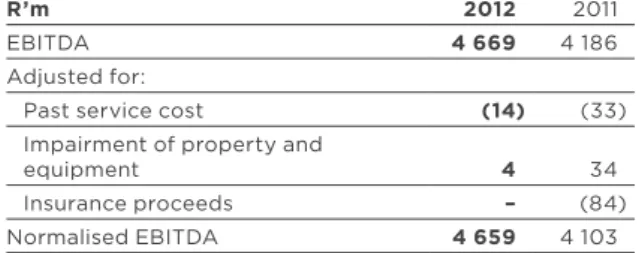
group revenue increased by 18% to r21 986m (2011: r18 625m) for the year under review. normalised operating income before interest, tax, depreciation and amortisation (“normalised eBitda”) was 14% higher at r4 659m
(2011: r4 103m). normalised headline earnings rose by 12% to r1 211m (2011: r1 082m).
fIgurE 1: EbItDa rECoNCILIatIoN
r’m 2012 2011
eBitda 4 669 4 186
adjusted for:
past service cost (14) (33)
impairment of property and
equipment 4 34
insurance proceeds – (84)
normalised eBitda 4 659 4 103
normalised basic headline earnings per ordinary share increased by 7% to 193.0 cents (2011: 179.6 cents), reflecting the increase in shares in issue after the rights offer in august 2010. at constant exchange rates, normalised eBitda increased by 4%, normalised headline earnings increased by 7%, and normalised headline earnings per share increased by 3%. the calculations of normalised eBitda (see
figure 1), normalised headline earnings and normalised basic headline earnings per share are before the effects of an impairment charge of r4m and r2m after share of minorities taken into account together with a one-off past service cost credit of r14m (ChF1.7m) and r11m (ChF1.3m) after provisioning for tax relating to the integration of Klinik St. anna pension fund.
Before taking these adjustments into account, reported eBitda increased by 12% to r4 669m (2011: r4 186m).
excluding current and prior year re-measurements relating to normalised headline earnings, headline earnings rose by 10% to r1 222m (2011: r1 110m) and basic headline earnings per ordinary share increased by 6% to 194.9 cents (2011: 184.2 cents). as indicated in previous annual reports, the group is moving towards a targeted dividend cover of three times, based on group headline earnings. the total dividend per share for the period under review is 78.0 cents (2011: 73.0 cents). C hie F exe C uti V e o FF iC er ’S repor t C hie F F inan C ial
fIgurE 2: rEvENuE (r’M) 2012
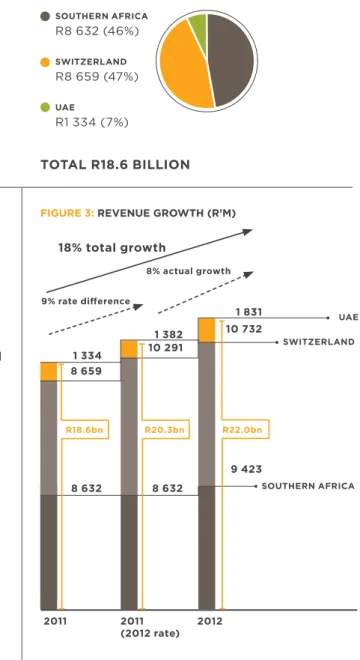
fIgurE 3: rEvENuE growth (r’M)
18% total growth 9% rate difference 8% actual growth r18.6bn r20.3bn r22.0bn 2011 2011 2012 (2012 rate) southErN afrICa swItZErLaND uaE 8 659 1 334 10 732 1 831 10 2911 382 8 632 9 423 8 632 totaL r22.0 bILLIoN uaE r1 831 (8%) swItZErLaND r10 732 (49%) southErN afrICa r9 423 (43%)
rEvENuE
the geographical composition of the group’s revenue for 2012 and 2011 is shown in figure 2. as shown in figure 3, revenue increased by 18% to r21 986m (2011: r18 625m).
NorMaLIsED EbItDa
the group’s normalised eBitda margin decreased from 22.0% in 2011 to 21.2% in 2012. the eBitda margins of the group’s platforms were 20.8% for Southern africa, 21.9% for Switzerland and 19.2% for the united arab emirates.
the geographical composition of the group’s normalised eBitda for 2012 and 2011 is shown in
figure 4.
as shown in figure 5, normalised eBitda increased 14% to r4 659m (2011: r4 103m).
fINaNCE Cost
the group’s finance cost was r1 642m, compared with r1 491m in 2011. included in the finance cost is r81m (2011: r78m) of amortisation charges in respect of raising fees paid on the group’s debt. these fees are amortised over the terms of the corresponding loans in line with future cash payments, as prescribed by iaS 39 Financial instruments.
the geographical composition of the group’s finance cost for 2012 is shown in figure 6.
ChIEf fINaNCIaL offICEr’s rEPort
continued
2011 totaL r18.6 bILLIoN uaE r1 334 (7%) swItZErLaND r8 659 (47%) southErN afrICa r8 632 (46%)
2011 2011 2012 (2012 rate) 14% total growth 10% rate difference 4% actual growth fIgurE 5: NorMaLIsED EbItDa growth (r’M)
1 837 2 026 240 1 957 2 350 352 1 837 2 408 248 r4.1bn r4.5bn r4.7bn southErN afrICa swItZErLaND uaE C hie F exe C uti V e o FF iC er ’S repor t C hie F F inan C ial totaL r4.7 bILLIoN uaE r352 (8%) r2 350 (50%) totaL r4.1 bILLIoN uaE r240 (6%) r2 026 (49%)
fIgurE 6: fINaNCE Cost (r’M) 2012 totaL r1.6 bILLIoN uaE r29 (2%) swItZErLaND r1 244 (76%) southErN afrICa r369 (22%) 2011 totaL r1.5 bILLIoN uaE r39 (2%) swItZErLaND r1 068 (72%) southErN afrICa r384 (26%)
CoNtrIbutIoN to grouP
NorMaLIsED hEaDLINE EarNINgs
the geographical composition of the group normalised headline earnings for 2012 and 2011 is shown in figure 7.
Cash fLow
Cash flow continued to be strong. The Group converted 92% (2011: 102%) of normalised eBitda into cash generated from operations, compared with a target of 100%. the cash conversions of the individual platforms are discussed below.
Cash and cash equivalents increased to r2 099m at year end, compared with r1 567m at 31 March 2011.
INtErEst-bEarINg borrowINgs
interest-bearing borrowings (“debt”) increased from r22 248m at 31 March 2011 to r24 794m at year end, mainly as a result of the change in the closing rand/ChF exchange rate. the ChF closing exchange rate moved from r7.42 at 31 March 2011 to r8.50 at year-end.
the geographical composition of the group’s debt at 31 March 2012 is shown in figure 8.
the foreign debt of the group’s Swiss and Middle eastern operations, amounting to r21 162m, is matched with assets in the same currencies. this debt also has no recourse to the Southern african operations’ assets, as stipulated by the South african reserve Bank, as well as applicable financing arrangements.
assEts
property, equipment and vehicles increased from r30 409m at 31 March 2011 to r34 808m at 31 March 2012 and intangible assets increased from r5 565m at 31 March 2011 to r6 350m at 31 March 2012. these increases are mainly as a result of the change in the closing rand/ChF exchange rate, as mentioned above.
trEasury sharEs
during the year the group utilised 1 110 422 treasury shares for the executive share option scheme and the management incentive scheme. Furthermore, 300 000 shares were acquired during the year.
forEIgN ExChaNgE ratEs
the rand experienced substantial volatility during the year against both the Swiss franc (ChF) and the united States dollar, to which the uae dirham is pegged at aed3.675.
the ChF spot rate moved from r7.42 at 31 March 2011 to r8.50 at 31 March 2012, and averaged r8.45 for the year (2011: r7.11). the aed spot rate moved from r1.85 at 31 March 2011 to r2.09 at 31 March 2012, and averaged r2.03 (2011: r1.96) for the year. accounting convention requires the group to convert its offshore statement of financial position at the year-end spot rate, while its offshore income statements are converted at the average rate for
ChIEf fINaNCIaL offICEr’s rEPort
continued
totaL r1.2 bILLIoN
fIgurE 7: NorMaLIsED hEaDLINE EarNINgs (r’M) 2012 CorPoratE r14 (1%) uaE r114 (9%) swItZErLaND r296 (25%) southErN afrICa r787 (65%) totaL r1.1 bILLIoN 2011 CorPoratE r7 (1%) uaE r62 (6%) swItZErLaND r286 (26%) southErN afrICa r727 (67%)
the year. the difference between the spot rates and the average rates results in distortions, when ratios between the balance sheet and the income statement items are calculated in rand. the spot rate should therefore also be used for translating, for example, eBitda, when calculating such ratios. exchange rate movements also had a significant impact on the statement of financial position. the resulting currency translation difference, which is the amount by which the group’s interest (including non-controlling interests) in the equity of the two foreign platforms increased as a result of the spot rate’s movement, amounted to r1 405m (2011: r488m) and was credited to the statement of comprehensive income.
hIrsLaNDEN PENsIoN fuNDs
hirslanden provides defined contribution pension plans in terms of Swiss law to employees, the assets of which are held in separate trustee-administered funds. these plans are funded by payments from employees and hirslanden, taking into account the recommendations of independent qualified actuaries. Because of the strict definition of defined contribution plans in iaS 19, in terms of iFrS, these plans are classified as defined benefit plans, since the funds are obliged to take some investment and longevity risk in terms of Swiss law.
the iaS 19 pension liability was valued by the actuaries at the end of the year and amounted to r471m (ChF55.4m) (2011: r71m (ChF9.5m)), included under “retirement benefit obligations” in the group’s statement of financial position. however, the pension funds were, for Swiss statutory purposes, estimated to be 105% (2011: 106%) funded at 31 March 2012. From an economic and legal point of view, this amount as calculated in terms of iaS 19 does not lead to a liability for hirslanden at 31 March 2012.
the higher pension liability resulted in an amount of r413m (ChF49m) being charged (2011: r86m (ChF11.6m)) to the consolidated statement of comprehensive income for the year. an amount of r114m (ChF13.5m) (2011: r102m (ChF14.3m)), which is the employer’s contribution exceeding the current service cost, was credited to the consolidated income statement. in addition, a one-off past service cost credit of r14m (ChF1.7m) was made relating to the integration of Klinik St. anna pension fund.
DErIvatIvE fINaNCIaL INstruMENts
The Group uses floating-to-fixed interest rate swaps to hedge against interest movements which have the economic effect of converting the interest-bearing borrowings to fixed interest rate borrowings. the group applies hedge accounting and therefore fair value movements are booked to the consolidated statement of comprehensive income. the overall decline of interest rates led to the increase of the fair value liability of the group’s interest rate swaps from r2 214m at 31 March 2011 to r3 739m at year end and an amount of r1 126m (2011: credited r246)
C hie F exe C uti V e o FF iC er ’S repor t C hie F F inan C ial totaL r24.8 bILLIoN uaE r440 (2%) r20 723 (84%) totaL r22.2 bILLIoN uaE r408 (2%) r18 083 (81%)
oPEratIoNs IN southErN afrICa
MEDICLINIC southErN afrICa
figure 10 shows Mediclinic Southern africa’s eBitda performance over recent years.the Southern african group revenue increased by 9% to r9 423m (2011: r8 632m) for the year under review (figure 9). normalised eBitda was 7% higher at r1 957m (2011: r1 837m).
after incurring depreciation charges of r256m (2011: r229m), net finance charges of r328m (2011: r348m), taxation of r434m (2011: r388m) and deducting the interest of minority shareholders in the attributable income of the Southern african group amounting to r152m (2011: r141m), the Southern african operations contributed r787m (2011: r731m) to the normalised attributable income of the group.
the Southern african operations’ eBitda margin decreased slightly from 21.3% to 20.8%. the margin was negatively affected by 0.2% because of the straight-lining of a major lease renewal; furthermore the margin was negatively affected by a non-recurring 0.3% which resulted from the launch of the new Mediclinic brand.
The Southern African operations’ cash flow
continued to be strong despite some major medical schemes payments being received a few days after the financial year end since 31 March 2012 was not a business day (Saturday). the Southern african operations converted 97% (2011: 111%) of eBitda into cash generated from operations.
Cash and cash equivalents increased from r755m at 31 March 2011 to r821m at year end.
interest-bearing borrowings decreased from r3 757m at 31 March 2011 to r3 631m at year end.
oPEratIoNs IN swItZErLaND
hIrsLaNDEN
hirslanden’s reported results for 2012 were affected by exchange rate movements. the average
rand/ChF exchange rate for the year fell from r7.11 in 2011 to r8.45 in 2012.
hirslanden’s revenue increased by 24% (4% at constant foreign exchange rates) to r10 732m (ChF1 270m) (2011: r8 659m (ChF1 218m)) for the year under review. normalised eBitda was 16% higher (2% lower at constant foreign exchange rates) at r2 350m (ChF278m) (2011: r2 026m (ChF285m)).
ChIEf fINaNCIaL offICEr’s rEPort
continued
fIgurE 9: MEDICLINIC southErN afrICa rEvENuE (Zar’bN) Cagr: 12% 2008 6 .1 2009 6. 8 2010 7. 7 2011 8 .6 2012 9. 4
fIgurE 10: MEDICLINIC southErN NorMaLIsED EbItDa (Zar’bN) 2012 Cagr: 11% 2008 1. 3 2009 1. 5 2010 1.7 2011 1. 8 2 .0 21.5% 21.5% 21.5% 21.3% 20.8%
after incurring depreciation charges of r556m (ChF66m) (2011: r433m (ChF61m)), net finance charges of r1 239m (ChF147m) (2011: r1 060m (ChF149m)) and tax of r260m (ChF31m) (2011: r251m (ChF35m)) and income from associates of r1m (ChF0.1m) (2011: r4m (ChF1m), hirslanden contributed r296m (ChF34m) (2011: r286m (ChF41m)) to the attributable income of the group. hirslanden’s historical pro forma revenue
performance is set out in figure 11.
the normalised eBitda margin of the group decreased from 23.4% to 21.9%.
the margin was affected by the following factors: • The implementation of a revised labour law
during the year and the additional staff required in the fields of medical coding and controlling as a result of the introduction of the new Swiss diagnosis related grouping (drg) added r46m (ChF5.5m) to personnel expenses. Management is focusing on overall personnel costs to mitigate the impact of these developments. • The trend of a gradually increasing percentage
of generally insured patients is continuing. the
• The Berne hospitals faced a number of challenges:
o administrative challenges in first
implementing the all patient drg (apdrg) system in 2010 and then the Swiss drg system in 2012 were substantial. this led to increases in staff costs and trade debtors. o Cost structures were furthermore increased
as a result of the capacity creation at Klinik Beau Site without achieving the budgeted initial revenue increases.
o Moderate tariff declines have been experienced since the implementation of apdrgs in 2010 and Swiss drgs in 2012. o Berne is a competitive market where
the numerous uncertainties regarding the hospital list status created general recruitment and retention challenges with doctors.
hirslanden converted 84% (2011: 94%) of normalised eBitda into cash generated from operations. an expected temporary increase in trade debtors as the result of the implementation of the new drg system had a negative effect on the cash conversion. Furthermore, an iaS 19 pension fund adjustment of r114m (ChF13.5m) (2011: r102m (ChF14.3m)), being the employer contributions
2010 23.4% 2009 245 22.5% 2008 222 22.2% 2012 21.9% 2011 23.4%
NorMaLIsED EbItDa NorMaLIsED EbItDa MargIN
C hie F exe C uti V e o FF iC er ’S repor t C hie F F inan C ial 2008 1 0 2009 1 0 2010 2011 2012
Cash and cash equivalents decreased from r699m (ChF94m) at 31 March 2011 to r588m (ChF69m) at year end.
interest-bearing borrowings increased from r18 083m (ChF2 437m) at 31 March 2011 to r20 723m (ChF2 438m) at year end, mainly because of the increase in the spot rate of the rand/ChF exchange rate.
hirslanden’s historical pro forma eBitda performance, excluding one-off items, is set out in figure 12.
oPEratIoNs IN uNItED arab
EMIratEs
EMIratEs hEaLthCarE
emirates healthcare’s reported results for 2012 were affected by exchange rate movements. the average rand/aed exchange rate for the year fell from r1.96 in 2010 to r2.03 in 2012.
revenue increased by 37% (32% at constant foreign exchange rates) to r1 831m (aed902m) (2011: r1 334m (aed681m)) for the year under review. emirates healthcare’s historical revenue performance is set out in figure 13.
normalised eBitda increased by 47% (43% at constant exchange rates) to r352m (aed174m) (2011: r240m (aed122m)) and the eBitda margin increased from 18.0% to 19.2%.
after incurring depreciation charges of r98m (aed48m) (2011: r76m (aed38m)), net finance charges of r27m (aed14m) (2011: r38m (aed19m)) and the sharing of minority shareholders in the attributable income of emirates healthcare amounting to r113m (aed56m) (2011: r63m (aed32m)), emirates healthcare contributed r114m (aed56m) (2011: r63m (aed33m)) to the attributable income of the group.
emirates healthcare converted 119% (2011: 100%) of eBitda into cash generated from operations. Cash and cash equivalents increased from r114m (aed61m) at 31 March 2011 to r325m (aed155m) at year end.
interest-bearing borrowings increased from r408m (aed221m) at 31 March 2011 to r440m (aed210m) at year end mainly as a result of the change in the closing rand/aed exchange rate.
emirates healthcare’s historical eBitda performance is set out in figure 14.
ChIEf fINaNCIaL offICEr’s rEPort
continued
fIgurE 13: EMIratEs hEaLthCarE rEvENuE (aED MILLIoN) Cagr: 38% 2008 249 2009 3 4 1 2010 52 9 2011 6 8 1 2012 9 02
fIgurE 14: EMIratEs hEaLthCarE CorE EbItDa growth aND MargIN (aED MILLIoN)
Cagr: 61% 2010 62 11.8% 2009 -3 -0.9% 2008 2 6 10.4% 2012 174 19.2% 2011 12 2 18.0%
grouP DIvIDEND PoLICy
although the group’s ability to pay dividends is dictated by the Southern african operations’ cash flow, the Group is targeting a dividend cover of three times, based on group normalised headline earnings, which is in line with levels prior to the hirslanden acquisition. this does not imply a reduction in dividend per share, only an indicative target which the Board will seek to achieve over time.
rIsk MaNagEMENt
risk management receives top priority throughout the group. the group-wide risk management policy is benchmarked against the international Committee of Sponsoring organisations of the treadway Commission framework and complies with the recommendations of the King iii report. the group’s risk management process is summarised in the risk Management report, the Sustainable development report and notes 3.1 and 3.3 to the annual financial statements on pages 128 to 130.
aCCouNtINg PoLICIEs
the annual financial statements have been prepared in accordance with iFrS. the accounting policies are based on reasonable judgements and estimates, are in accordance with international Financial reporting Standards (iFrS) and are consistent with those applied in the prior year.
C hie F exe C uti V e o FF iC er ’S repor t C hie F F inan C ial