Author: Michail-Alexandros Kourtis Supervisors: Fidel Liberal, Charilaos Koumaras
2018
A
R
EDUCED
R
EFERENCE
V
IDEO
Q
UALITY
A
SSESSMENT
M
ETHOD FOR
P
ROVISION
A
S
A
S
ERVICE
O
VER
SDN/NFV-E
NABLED
N
ETWORKS
12
1.1 CONTEXT AND MOTIVATION ... 26
1.2 CHALLENGES AND MAIN OBJECTIVES ... 28
1.3 STRUCTURE OF THE DOCUMENT... 30
2 VIDEO QUALITY ASSESSMENT METHODS ... 33
2.1 SUBJECTIVE VIDEO QUALITY ASSESSMENT METHODS ... 35
2.2 OBJECTIVE VIDEO QUALITY ASSESSMENT METHODS ... 38
2.3 APPROXIMATIONS OF FR METHODS BY RR METHODS... 41
2.4 CONCLUSIONS ... 42
3 THE PROPOSED REDUCED REFERENCE VIDEO QUALITY ASSESSMENT METHOD 43 3.1 OVERVIEW OF THE PROPOSED METHOD ... 43
3.2 FEATURE EXTRACTION USING SSIM ... 44
3.3 QUALITATIVE INTERPRETATION OF THE PROPOSED VIDEO QUALITY METRIC ... 48
3.4 PERFORMANCE COMPARISON OF SRR TO SSIM ... 49
3.5 PERFORMANCE COMPARISON OF SRR TO SUBJECTIVE DMOS AND OTHER ASSESSMENT METHODS... 54
3.6 PERFORMANCE EVALUATION WITH OTHER RELATIVE COLORS ... 59
3.7 CONCLUSIONS ... 60
4 APPLICABILITY OF THE PROPOSED SRR AS A SERVICE ON TOP OF NFV/SDN-ENABLED NETWORKS ... 62
4.1 ANALYSIS OF NFV, SDN AND SRR AS A SERVICE ... 63
4.2 DEPLOYMENT OF THE PROPOSED SRR METHOD AT AN NFV ENVIRONMENT ... 66
4.2.1 REQUIREMENTS OF THE PROPOSED SDN/NFV-ENABLED NETWORK ... 66
4.2.2 PROPOSED SDN/NFV SRRAAS ARCHITECTURE ... 66
4.3 PROPOSED ARCHITECTURE IMPLEMENTATION ... 72
4.4 PERFORMANCE EVALUATION OF THE PROPOSED IS-QOE METHOD ... 75
4.5 CONCLUSIONS ... 78
5 VALIDATING THE SRRAAS METHOD OVER A SMALL CELL MOBILE NETWORK . 79 5.1 VIDEO QUALITY ASSESMENT IN 5GSMALL CELL NETWORKS ... 79
5.2 DEPLOYMENT OF THE PROPOSED SRR METHOD AT AN SMALL CELL ENVIRONMENT ... 82
5.2.1 REQUIREMENTS OF THE PROPOSED NFV-ENABLED SMALL CELL ARCHITECTURE. ... 82
5.2.2 PROPOSED NFV-ENABLED SMALL CELL ARCHITECTURE ... 83
5.3 PROPOSED NFV-ENABLED SMALL CELL ARCHITECTURE IMPLEMENTATION ... 84
5.4 PERFORMANCE EVALUATION OF SRR IN SMALL CELL NETWORKS ... 88
5.5 CONCLUSIONS ... 90
6 CONCLUSIONS AND FUTURE LINES ... 91
6.1 MAIN CONTRIBUTIONS ... 91
6.2 FUTURE LINES ... 97
7 PUBLICATIONS OF THE AUTHOR ... 100
8 ANNEX ... 103
8.1 VIDEO PROCESSING BASICS ... 103
8.2 PRINCIPLES OF VIDEO CODING ... 104
8.3 VIDEO CODING STANDARDS EVOLUTION ... 115
List of Figures
Figure 1.1 - Structure of the document ... 31
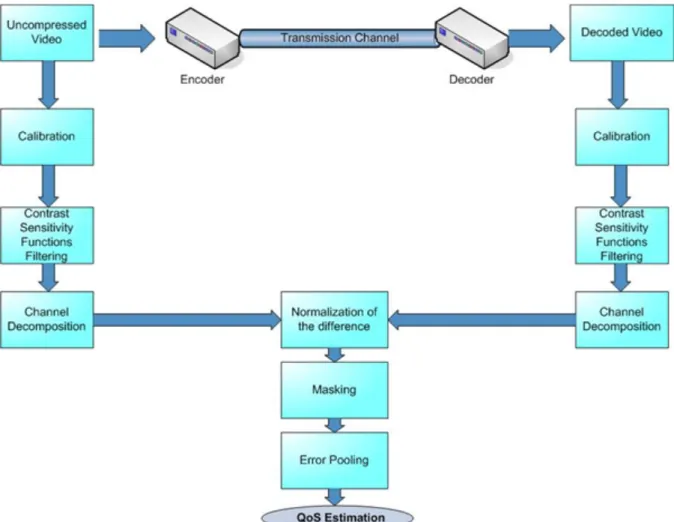
Figure 2.1 - Full Reference Methods with multiple channels ... 38
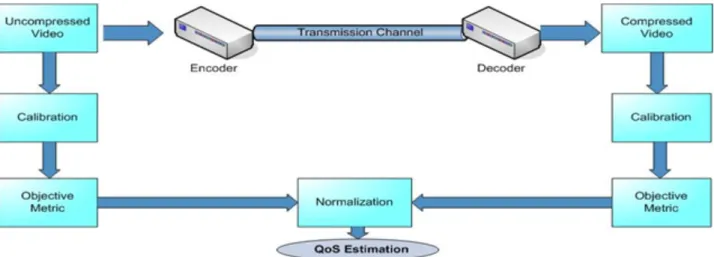
Figure 2.2 - Full Reference Methods with single channel ... 39
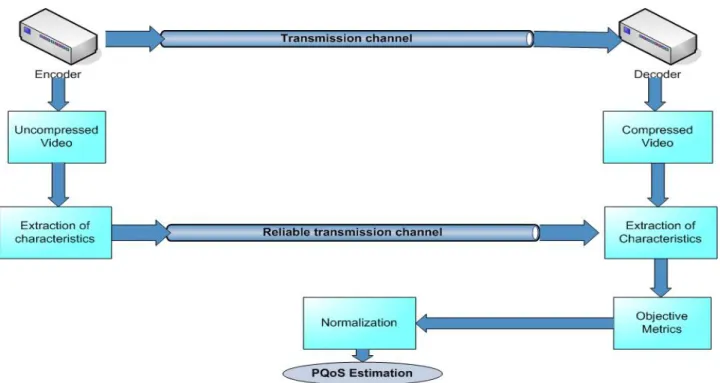
Figure 2.3 - Reduced Reference Methods ... 40
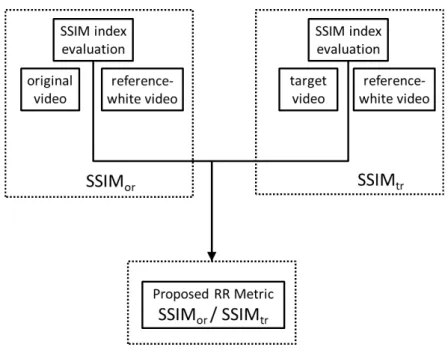
Figure 3.1 - Overview of the proposed VQA Metric ... 43
Figure 3.2 - Typical SSIM index evaluation with original and target video sequences available at the same site ... 45
Figure 3.3 - SRR evaluation method using a reference video pattern as reference at both the service provider and end-user sites... 47
Figure 3.4 - Variation of : (a) SSIMot (b) ideal SSIMtr (c) real conditions SSIMtr vs QP ... 48
Figure 3.5 - Representative Frames of the 40 test signals of the evaluation process ... 50
Figure 3.6 - Qualitative comparison of SRR and SSIM index applied on Kristen&Sara video sequence with QP=32 ... 51
Figure 3.7 - Variation of MAPD vs QP : (a - solid line) Experimental, (b - dotted) Theoretical ... 53
Figure 3.8 - Scatter plot of objective SRR scores vs. DMOS v with the best fitting logistic function ... 55
Figure 3.9 - Basketball Pass SSIM vs SRR for QPs 12-32 ... 57
Figure 3.10 - BQSquare SSIM vs SRR for QPs 12-32 ... 58
Figure 3.11 - BQMall SSIM vs SRR QPs 12-32 ... 59
Figure 4.1 - NFV architecture according to ETSI ... 63
Figure 4.2 - Overview of the proposed reference SDN/NFV architecture ... 67
Figure 4.3 - An overview of the experimental topology ... 74
Figure 4.4 - Openflow-based traffic steering within Openstack platform ... 74
Figure 4.5 - Label used to show the SDN-based traffic steering commands per hop ... 75
Figure 4.6 - Video quality degradation due to packet loss ... 76
Figure 4.7 - Video Quality is reinstated ... 78
Figure 5.1 - Architectural framework for combined PNF and VNF systems ... 83
Figure 5.2 - Virtualization of a Small Cell and split of functions between PNF and VNF . 84 Figure 5.3 - An overview of the experimental testbed ... 86
Figure 5.4 - SRR variation vs frame sequence number without source adaptation for videos (a) KristenandSara and (b) BasketballDrill for various values of the backhaul bandwidth ... 89
Figure 6.1 - SRR variation vs frame sequence number with source adaptation for videos (a) KristenandSara and (b) BasketballDrill for various values of the backhaul bandwidth ... 99
Figure 8.1 - GOP Structure ... 105
Figure 8.2 - Example of variable block size coding ... 105
Figure 8.3 - A frame where motion vectors appear denoting the position of the best matching region ... 106
Figure 8.5 - Steps of the Intra-Coding Prediction ... 108
Figure 8.6 - H.264/AVC Intracoding Prediction Modes ... 109
Figure 8.7 - H.264/AVC prediction example ... 109
Figure 8.8 - Example of DCT efficiency. Figure a is the source image, while b is reconstructed using only 1 ... 111
Figure 8.9 - Huffman Coding Algorithm ... 114
Figure 8.10 - Timeline of video coding standards evolution ... 116
Figure 8.11 - H.261 Coding and Decoding steps ... 116
List of Tables
Table 2.1 - Overview of the Subjective Quality Assessment Methods ... 36
Table 3.1 - MAPD for SRR and SSIM index for a white-video reference pattern ... 51
Table 3.2 - Comparison of the performance of VQA algorithms – LCC and SROCC... 55
Table 3.3 - MAPD for the 40 Test Signals with Different Relative Colors ... 60
Table 7.1 - Resulting publications and relation to the PhD work ... 100
List of Abbreviations
Abbreviation Meaning
3GPP 3rd Generation Partnership Project
AVC Advanced Video Coding
CABAC Context Based Arithmetic Coding CAPEX Capital Expenditure
CAVLC Context Adaptive Variable Length Codes CESC Cloud Enabled Small Cell
COTS Commercial off the Shelf C-RAN Cloud Radio Access Network
CU Coding Unit
DCT Discrete Cosine Transform DMOS Difference Mean Opinion Score DPDK Data Plane Development Kit
DSCQS Double Stimulus Continuous Quality Scale DSIS Double Stimulus Impairment Scale
eNB (or
eNodeB) Evolved Node B
EPA Enhanced Platform Awareness EPC Evolved Packet Core
FAT Factory Acceptance Test
FCAPS Fault Configuration Accounting Performance Security FPGA Field Programmable Gate Arrays
FR Full Reference
GOP Group of Pictures
GTP GPRS Tunnelling Protocol HEVC High Efficiency Video Coding HOT HEAT Orchestration Template HTTP Hypertext Transfer Protocol
HVS Human Visual System
IPTV Internet Protocol Television
ITU-R International Telecommunication Union - Radiocommunication Sector JCT-VC Joint Collaborative Team on Video Coding
KPI Key Performance Indicator
LCC Pearson’s Linear Correlation Scale
LTE Long-Term Evolution
MAC Media Access Control
MANO Management and Orchestration System MAPD Mean Absolute Percentage Deviation
MEC Mobile Edge Computing
ML2 Modular Layer 2
MME Mobility Management Entity MOCN Multi-Operator Core Network
MOS Mean Opinion Score
MPEG Moving Pictures Experts Group
MSE Mean Square Error
NFP Network Forwarding Path NFV Network Function Virtualization NFVI NFV Infrastructure
NIC Network Interface Card
NMS Network Management System
NR No Reference
NS Network Service
NSD Network Service Descriptor NUMA Non-Uniform Memory Access
ODL OpenDaylight
OPEX Operational Expenditure
OVS Open vSwitch
PES Packetized Elementary Stream P-GW (or
PDN-GW) Packet Data Network Gateway PNF Physical Network Function PSNR Peak Signal to Noise Ratio
QoE Quality of Experience QoS Quality of Service
RAN Radio Access Network
REST Representational State Transfer
RR Reduced Reference
SAT Site Acceptance Test
SDN Software Defined Networking SFC Service Function Chain S-GW (or
Serving-GW) Serving Gateway
SLA Service Level Agreement SNR Signal to Noise Ratio
SR-IOV Single Root I/O Virtualization
SROCC Spearman Rank Order Correlation Coefficient SSCQE Single Stimulus Continuous Quality Evaluation SSIM Structural Similarity Index Metric
TCP Transmission Control Protocol TR Technical Report (by 3GPP) TS Technical Specification (by 3GPP)
TS Transport Stream
TU Transformation Unit
UE User Equipment
VCEG Video Coding Experts Group VIM Virtualised Infrastructure Manager VLD Virtual Link Descriptor
VNFD Virtual Network Function Descriptor
VNFFG Virtual Network Function Forwarding Graph VNFM Virtual Network Function Manager
VoD Video on Demand
VQA Video Quality Assessment
Abstract
The proliferation of multimedia applications and services has generated a noteworthy upsurge in network traffic regarding video content and has created the need for trustworthy service quality assessment methods. The recent market success of media services and the rising consumer demand, pushed innovation in the fields of video encoding techniques and adaptation and eventually the requirement for in service quality evaluation.
Facing new challenges in the multimedia and mobile network field, telecom operators and content providers have focused their interest towards novel technology approaches which can improve their customers’ satisfaction and be easily deployable in the modern telecommunication networks. Currently, predominant position among the technological trends in telecommunication networks are Network Function Virtualization (NFV), Software Defined Networking (SDN) and 5G mobile networks equipped with small cells. In particular, the paradigm of SDN/NFV is based upon decoupling physical appliances from the network functions that operate on them and has gained significant attention due to its potential to reduce Operating Expenses (OPEX) and Capital Expenses (CAPEX), as well as extending the flexibility of network services. Similarly, the envision to build a diverse and “hyper-connected” network environment has led to the evolution of 5G. Notably, 5G proposes a joint radio-cloud architecture in an effort to place intelligence at the network edge by utilizing virtualization technologies.
Video Quality Assessment (VQA) methods are a very useful tool for both content providers and network operators, to understand of how users perceive quality and thus study the feasibility of potential services and adapt the network available resources to satisfy the user requirements. Full Reference (FR) VQA methods are accurate in measuring the end user’s satisfaction, but they are not appropriate for implementation in commercial video distribution networks, because they need the original video at the customers’ site, in order to compare it to the received video. Reduced Reference (RR) methods are less accurate, but they are appropriate for implementation in commercial telecommunication networks. Furthermore, to be successful, VQA methods must be able to be integrated in modern networks based on SDN/NFV and 5G technologies. The thesis proposes a new RR method for Video Quality Assessment for as a Service provision, which combines the accuracy of a full reference metric, such as Structural Similarity Index (SSIM) Metric, with the advantage of being appropriate for deployment in modern telecommunication networks, based on Network Function Virtualization and SDN technologies, such as the forthcoming 5G networks. Initially, the novel VQA method is described as a standalone metric (i.e. SRR), analysed in detail and its performance is evaluated in comparison to other related VQA metrics. Then, it is proposed the advancement of the metric with additional features in order to be provided as a Service (i.e. SRRaaS), taking advantage of its integration within an SDN/NFV environment. Lastly, the further adoption of the SRRaaS method in 5G mobile networks equipped with
small SDN/NFV-enabled small cells is presented, along with the study of the challenges tackled. The deployment environment evolves as new technologies emerge, but the primary goal of the thesis is to provide an agile, efficient and appropriate video quality method for provision as a service over SDN/NFV networks. The thesis not only offers an innovative VQA algorithm, but also offers a thorough insight on current technologies which pave the future of telecommunications.
Resumen
La proliferación de servicios multimedia ha generado un incremento en el tráfico de red asociado al video y suscitado la necesidad de mecanismos confiables de evaluación de la calidad del servicio. La mayor demanda por parte del cliente y el reciente éxito comercial de los servicios multimedia ha promovido la innovación en las técnicas de codificación y transmisión adaptativa así como en los mecanismos de evaluación de la calidad.
Al mismo tiempo, de cara a afrontar los retos del mercado multimedia móvil los operadores de telecomunicaciones y los proveedores de contenidos han centrado su interés en aquellas tecnologías que puedan mejorar la satisfacción de los usuarios y, al mismo tiempo, garanticen un despliegue sencillo en las redes modernas. En la actualidad, las tendencias predominantes en dichas redes de telecomunicación consisten en la virtualización de funciones de red (Network Function Virtualization NFV) y en el uso de redes móviles 5G.
El paradigma NFV consiste en desacoplar los elementos hardware de las funciones de red que operan en ellos y ha ido ganando adeptos conforme se confirma su flexibilidad y capacidad para reducir el coste de adquisición (CAPEX) y de operación (OPEX).
Del mismo modo, la tendencia de crear un entorno de red diversa e “hiper conectada” ha llevado a la evolución hacia las tecnologías 5G, que propone también una arquitectura radio-cloud y desplegar inteligencia en los extremos de la red utilizando técnicas de virtualización.
Los métodos de evaluación de la calidad de video ( Video Quality Assessment (VQA)) resultan una herramienta muy útil para proveedores de contenido y operadores de red de cara a entender cómo perciben la calidad los usuarios finales y, a partir de esa comprensión, analizar las posibilidades de hipotéticos nuevos servicios y adaptar los recursos disponibles para satisfacer los requisitos de esos usuarios.
Los métodos de evaluación de referencia completa (Full Reference –VQA-) generalmente proporcionan una medida acertada de la satisfacción de los usuarios pero no se pueden implementar de forma razonable sobre las redes comerciales de distribución de video al requerir de la fuente de video original en el equipamiento de usuario de cara a compararlo con el contenido recibido. Las métodos de referencia reducida (Reduced Reference –RR-), en cambio, son menos precisos pero su implementación en entornos comerciales resulta más sencilla. En cualquier caso, esos métodos de evaluación deberían poderse integrar en redes NFV y 5G.
Esta tesis propone un nuevo método de evaluación de la calidad de video de referencia reducida que trata de combinar la precisión de las métricas de referencia completa como SSIM (Structural Similarity Index) con la capacidad de poder desplegarse en redes modernas basadas en NFV o/y 5G. Para ello, inicialmente se presenta un nuevo método RR de evaluación de la calidad de video. Tras su descripción se compara su rendimiento
con otros métodos de evaluación. A continuación se plantea su integración en un entorno NFV y se describe cómo se puede aprovechar de dicho enfoque. Finalmente se analizan los retos de cara a su adopción en las futuras redes 5G. Puesto que el entorno tecnológico continúa en permanente evolución este trabajo de tesis se centra en desarrollar un método ágil y eficiente de evaluación de la QoE de los usuarios adaptable a esos cambios. En definitiva, esta tesis no sólo propone un método de evaluación de la calidad de video sino una revisión profunda de posibles mecanismos de despliegue de cara a garantizar que su evolución va emparejada a esos cambios.
Resumen Ejecutivo
El creciente interés de los consumidores por el contenido de video ha resultado a su vez en un universo cada vez mayor de servicios de provisión de video digital. Hoy, los proveedores de contenido pueden ofrecer su contenido a través de varios tipos de redes (televisión digital terrestre, satélite, Internet, redes móviles, etc. ) y los operadores de red pueden desplegar sistemas de telecomunicaciones más eficientes y ubicuos, para hacer frente al enorme volumen de tráfico transportado a través de sus redes. El objetivo común tanto de los proveedores de contenido como de los operadores de red es mantener la satisfacción de los usuarios finales lo más alta posible.
Una evaluación confiable de la calidad del video juega un papel indispensable en el cumplimiento de la calidad de servicio comprometida (Quality of Service o QoS) y en la mejora de la calidad de la experiencia (Quality of Experience o QoE ) del usuario final . Más específicamente, en un sistema de transporte de video, es importante monitorizar la QoS de transporte de red tanto a través de los parámetros de QoS de la red (como el retardo de paquetes y las tasas de pérdida de paquetes), como la QoS específica del servicio de video a través de parámetros más directamente relacionados con video (como el retardo en la reproducción de video y la calidad de codificación del mismo) que en última instancia contribuyen a la QoE del usuario .
La evaluación de calidad de video (Video Quality Assessment o VQA) permite comprender cómo perciben los usuarios la calidad y, por lo tanto, estudiar la viabilidad de posibles servicios y adaptar los recursos disponibles de la red para satisfacer los requisitos del usuario. La evaluación subjetiva de la calidad se considera generalmente como la técnica más confiable para evaluar un servicio multimedia ya que se basa en datos recopilados a partir de pruebas de opinión de observadores humanos. Desgraciadamente, estos métodos implican una cantidad considerable de recursos (principalmente tiempo y personas) y se consideran costosos y difícilmente escalables. Por lo tanto, los métodos subjetivos no resultan útiles por sí solos, para los operadores de redes ya que son imposibles de implementar y explotar en tiempo real en redes comerciales de distribución multimedia.
En paralelo a la evolución de los sistemas de distribución de contenido multimedia, en el campo de la creación de redes han surgido nuevos paradigmas que han transformado los nodos de red desde plataformas hardware de propósito específico a entornos virtualizados basados en tecnologías de redes definidas por software (Software Defined Networks o SDN) y virtualización de funciones de red (Network Function Virtualization o NFV) sobre hardware de propósito general . Además, las redes de acceso se están moviendo lentamente hacia la tecnología 5G. Uno de los elementos clave previstos del marco tecnológico de 5G es la capacidad de entregar inteligencia directamente a la red, en forma de dispositivos de red virtualizados, explotando conjuntamente esos paradigmas emergentes de NFV y Edge Cloud Computing. Siguiendo este cambio de paradigma, cada vez surgen más casos de uso de alto valor añadido a través de infraestructura o aplicaciones que tengan el potencial de ofrecerse como 'Servicio'. De lo anterior, se puede concluir que un requisito crucial para que un método de VQA tenga éxito en la nueva era de las telecomunicaciones no solo es preciso que sea fiable, sino que también debe integrarse adecuadamente dentro de las infraestructuras de virtualización y redes móviles 5G y desplegarse fácilmente en tales infraestructuras. Esta tesis propone un nuevo método de VQA que cumpla con los requisitos anteriores . Más
precisamente, define, implementa y evalúa el rendimiento de un VQA denominado de referencia reducida (Reduced Reference o RR). Dicha métrica se calcula a partir de la ampliamente conocida Métrica de Similitud Estructural (SSIM) . Además, se propone una arquitectura que define cómo la métrica de VQA puede integrarse dentro de infraestructuras virtualizadas basadas en tecnologías SDN y NFV e implementa el método como VNF sobre un banco de pruebas experimental y evalúa su desempeño. Capítulo 1 introduce el alcance de la tesis, las motivaciones principales de la investigación y presenta una lista de los retos a los que se dirigen, junto con los objetivos de la tesis.
El Capítulo 2 se centra en la revisión de la literatura en el campo relacionado de Video Quality Assessment. Presenta las principales categorías de métodos VQA y analiza las ventajas y desventajas de cada una, de acuerdo con el tipo de aplicación en el que van a ser utilizados. La primera clasificación es entre métodos subjetivos y objetivos. Los métodos subjetivos se basan en la opinión de un grupo de espectadores con respecto a la degradación visual de una secuencia de video codificada en comparación con la secuencia original en bruto (no comprimida). En este capítulo, se describen varios métodos (según sus denominaciones en inglés Double Stimulus Impairment Scale, the Double Stimulus Continuous Quality Scale, the Absolute Category Rating, the Stimulus Comparison, the Single Stimulus Continuous Quality Evaluation, the Simultaneous Double Stimulus for Continuous Evaluation and the Subjective Assessment Methodology for Video Quality) , junto con las escalas respectivas de calidad y el proceso seguido en cada uno. Este capítulo destaca que los métodos subjetivos son muy precisos para expresar la satisfacción de los usuarios finales, pero son caros (en tiempo y personas) y no apropiados para redes de distribución de video.
Los métodos objetivos de VQA son modelos computacionales matemáticos que utilizan varias características de las imágenes con el fin de aproximarse lo mejor posible a los resultados de pruebas subjetivas de una manera eficiente y rentable. Los métodos objetivos se clasifican en tres grandes grupos determinados por su enfoque y la métrica utilizada para la evaluación de la calidad: los de referencia completa (FR), los de referencia reducida (RR) y los de no referencia (NR). En la tesis, se describen las tres categorías anteriores, junto con las métricas correspondientes (por ejemplo, PSNR, SSIM, etc. ) y las diversas características de las señales de video que se utilizan en cada procedimiento de evaluación. El análisis muestra que los métodos FR proporcionan una mayor precisión en comparación con RR y NR, pero no son apropiados para la integración en la cadena de provisión del servicio, dado que generalmente la señal original no está disponible en el sitio del usuario final. Por otro lado, los métodos RR son menos precisos, pero son apropiados para las redes de distribución de video, ya que solo requieren unas pocas características extraídas del video original en el sitio del usuario final. Los métodos NR son incluso algo menos precisos que los anteriores, pero en contrapartida no requieren ninguna información de la señal de video original. A este respecto, existe un compromiso entre la precisión y la idoneidad para las redes de distribución de video comerciales.
Esta tesis trata de hacer frente a este compromiso mediante un nuevo método de RR basado en el cálculo de SSIM, (que es una métrica FR), pero utilizando sólo unas pocas características extraídas del vídeo original, por lo que puede ser categorizado como RR. El método propuesto ofrece por tanto una respuesta equilibrada entre la precisión de una métrica FR y la flexibilidad de una métrica RR (en términos de ser apropiada para la implementación en una red comercial de distribución de video).
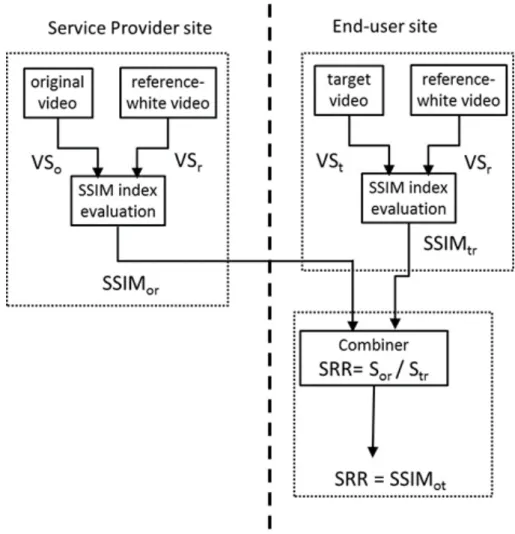
En el Capítulo 3, se describe en detalle el método RR y se evalúa su rendimiento mediante un conjunto experimental de referencia. El método propuesto comprende el uso de características basadas en la evaluación del índice SSIM extraído tanto del fotograma de video original como del objetivo. Más específicamente, el índice SSIM se calcula para cada fotograma del video original utilizando como referencia un patrón de video estático , es decir, un video cuyos fotogramas son todos iguales. Por razones explicadas más adelante en la Sección 3 inicialmente se utiliza un patrón blanco. El índice SSIM ( SSIMor ) para cada cuadro se transmite luego al usuario final. En el terminal del usuario final, se calcula el índice SSIM entre cada cuadro del video recibido (objetivo) y el mismo video estático patrón ( SSIMtr ). La métrica RR propuesta (denominada SRR) es la relación de los dos índices SSIM, es decir:
!"" = !!$%&'/!!$%)'
El proceso se muestra en la figura a continuación.
Descripción general de la métrica de VQA propuesta.
Como se describe en ese capítulo, el rendimiento del método propuesto se evaluó comparando la SRR con el índice SSIM original ( SSIMot ) para una gran cantidad de cuadros de video. Se seleccionó una amplia gama de videos, que incluyen cuarenta secuencias de video de diversa duración, resolución y contenido. Las secuencias de vídeo seleccionados, incluyen once secuencias de vídeo de referencia clásicas, dos secuencias de larga duración y veinte y siete secuencias de vídeo no de referencia obtenidos de tráilers de películas. El número total de cuadros únicos que se usaron para evaluar el método propuesto es 60,866.
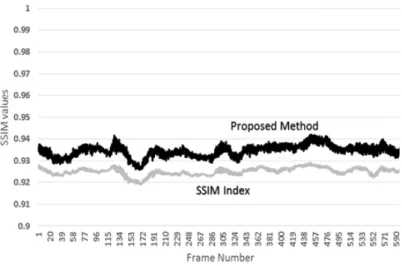
Las secuencias de video originales sin comprimir se codificaron en tres valores de QP: 12, 22 y 32, que cubren satisfactoriamente el rango de calidad de video típicamente alcanzados en las señales de video codificadas / comprimidas. Los valores más altos de QP no se examinaron, ya que conducen a una calidad de video inaceptable. En la Figura siguiente se muestra una comparación cualitativa inicial entre el índice SRR y SSIM , que muestra la variación del índice SRR y SSIM para cada cuadro de una secuencia de video ( Kristen y Sara ) con QP = 32. De la figura a continuación es obvia la similitud cualitativa del índice SRR propuesto y SSIM.
Comparación cualitativa del índice SRR y SSIM aplicado en lasecuencia de video deKristen & Saracon QP = 32.
Para la medición cuantitativa de la actuación del método propuesto, se calculó la desviación promedio absoluta porcentual (MAPD) para cada trama i entre SRR y el índice de SSIM. Los resultados experimentales muestran que la precisión del método propuesto varía de 0.62% (QP = 12) a 2.56% (QP = 32), lo que representa el peor de los casos. Los resultados también muestran que el método de SRR propuesto mantiene un rendimiento satisfactorio en todo el rango potencial de valores de QP, aunque se logra una mayor precisión en valores de QP más bajos. La comparación entre la correlación de QP y la verdad del terreno (es decir, MOS) versus la correlación de los puntajes de SRR y la verdad del terreno proporciona el resultado de 28.65, que muestra la ventaja y el mejor rendimiento de la métrica propuesta.
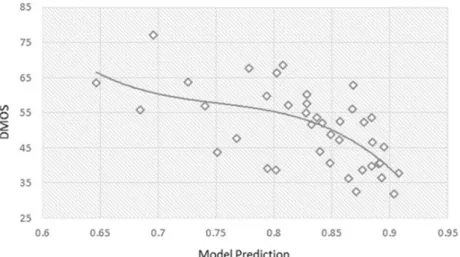
El rendimiento del método SRR se comparó con el DMOS subjetivo y otros métodos de evaluación, utilizando el Coeficiente de correlación lineal (LCC) de Pearson, el coeficiente de correlación de Spearman (SROCC). Los resultados experimentales muestran que la precisión del método SRR propuesto resulta superior a los métodos RR VQA RR-LHS , J.246 y método de Yang tanto en términos de LCC como de monotonicidad, excepto en la métrica RR , que proporciona mejores resultados. De manera similar, la precisión del método de SRR propuesto es mejor que los métodos de VQA de referencia completa de PSNR y VSNR en términos de LCC, mientras que es ligeramente menor en rendimiento repescto VQM y el índice de SSIM, como se esperaba, debido a la naturaleza de referencia reducida del metodología propuesta. En términos de monotonicidad (SROCC), el método propuesto funciona mejor que el PSNR, pero inferior al resto de los métodos de VQA, aunque sin desviarse significativamente de su rango de rendimiento.
Finalmente, una ventaja importante del método propuesto reside en el bajo bitrate de la señal de información de referencia que debe enviarse al usuario final. Éste oscila entre 400-600 bps, significativamente menor que la tradicionalmente necesaria para otros métodos de RR, de 15 kbps a 256 kbps,.
El Capítulo 4 se encarga de examinar cómo se puede aplicar el método SRR propuesto a un entorno de provisión de servicio, combinando la agilidad que ofrecen la virtualización de funciones de red (NFV) y las redes definidas por software (SDN), con el fin de proporcionar “métrica SRR como servicio (SRRaaS)”. Inicialmente, se analizan los requisitos específicos, a fin de permitir el despliegue de la SRR propuesta en forma de VNFaaS, a partir de los cuales se propone la siguiente arquitectura de referencia.
Descripción general de la arquitectura de referencia SDN / NFV de referencia
La implementación de SRRaS se realiza de acuerdo con las especificaciones de ETSI NFV, a fin de proporcionar un servicio de red operativo compatible a un sistema habilitado para NFV.
Basado en la arquitectura de referencia anterior se implementó un banco de pruebas de prueba de concepto para realizar Pruebas de Aceptación en Fábrica (FAT), utilizando Openstack, Opendaylight y OVS para desplegar las tecnologías SDN / NFV. El banco de pruebas también debía cumplir los requisitos de la implementación de tres fases del método SRR de la siguiente manera: En la fase I , se evalúa un valor SSIMor inicial en el sitio del proveedor del servicio y se puede implementar como un VNF en ese sitio. En la fase II, se evalúa un valor SSIMtr y en la fase III, la combinación de SSIMor y SSIMtr proporciona la métrica SSR. La Fase II y III pueden implementarse dentro de una VNF en el sitio del consumidor. Por otra parte, la puesta en práctica en el servicio de SRRaaS, requiere que el tráfico debe ser dirigido adecuadamente a través de las VNFs. La arquitectura del banco de pruebas se representa en la siguiente figura. Se compone de dos puntos de presencia (PoPs) NFVI-, uno en la entrada (proveedor de servicios) y el otro en los puntos de salida (usuario final). Cada uno de estos dominios de red integra un switch virtual compatible con SDN (OVS), que está bajo la administración y el control del controlador SDN de OpenDaylight . En ambos puntos de entrada y salida del dominio, una plataforma cloud Openstack instancia las VNFs que soportan los PoPs NFVI .
Una visión general de la topología experimental
La Fase I se implementa en la VNF1, mientras que las Fases II y III en la VNF3. La VNF2 es un transcodificador de video para limitar la tasa de bits del video dentro del ancho de banda del canal de transmisión.
Al introducir tráfico de fondo para provocar la degradación de la calidad del video, se demostró en varios experimentos que el método de SRR propuesto se puede implementar de manera distribuida como un grupo de VNFs, sin que esta división afecte al rendimiento o la capacidad de respuesta del método.
Al ofrecer el método de SRR propuesto como una métrica QoE en servicio (IS- QoE ), que se puede implementar como una VNF ( VNFaaS ) se mejora su aplicabilidad en redes de distribución de video comerciales. Así, SRRaaS se puede instanciar en cualquier punto dentro de la cadena de distribución de video, que es una característica muy importante para los operadores de red ya que les permite encontrar la ubicación dentro de su red, donde se produce una degradación de calidad de video y aplicar acciones correctivas específicas para solucionar el problema.
El Capítulo 5 valida el método SRRaaS , que se probó en el capítulo anterior en un entorno FAT, en una red realista “5G” basada en una arquitectura de small cells para expandir el proceso de validación en las Pruebas de aceptación en Sitio (SAT). Más específicamente, se muestra que el método SRRaaS es adecuado para su implementación como una VNF dentro de una infraestructura de TI ubicada en la proximidad de la small cell. El enfoque propuesto permite la supervisión en servicio de la calidad de video entregada, lo que resulta una herramienta muy útil para los operadores de redes móviles, para monitorizar la satisfacción de sus clientes. Una ventaja del método propuesto, cuando se aplica en una red de este tipo, es que el proceso complejo de evaluación de calidad de video y que consume energía se realiza en el borde de la red, y no en el propio UE, reduciendo significativamente su consumo de energía.
Para la experimentación con SAT, se ha desplegado una plataforma experimental LTE, basada en productos comerciales de Evolved Packet Core (EPC) y Small Cell enfocado a probar y evaluar el rendimiento del método propuesto. Al entorno se hanincoporado dos PoPs NFVI-, que alojan a las VNFs, de los cuales se compone el SRR. En el trabajo realizado se analiza también el problema del proceso de (des)encapsulado GTP de los paquetes de datos en el enlace S1 y se plantea una solución.
Inicialmente, se propone una arquitectura de small cells con capacidades NFV (ver figura a continuación), que se basa en el marco general elaborado en el Small Cell Forum (SCF).
Descripción general de la arquitectura general propuesta , basada en el marco SCF
En base a la arquitectura general anterior, se implementó una prueba de concepto para realizar pruebas SAT, utilizando Openstack y Open Virtual Switches, así como una EPC y Small Cells comerciales. El banco de pruebas también debía cumplir con los requisitos de la implementación de tres fases del método SRR como se describió anteriormente y un rutado de tráfico apropiado entre los diversos componentes. En la siguiente figura, se representa la arquitectura implementada. El primer NFVI-PoP estaba ubicado entre el servidor de video y el EPC y el otro era el Central Small Cell NFVI- PoP , ubicado entre el EPC y la small cell remota.
Las fases SRR de SSIMor , SSIMtr y su relación se representan como VNFC1, VNFC2 y VNFC3, respectivamente. También se creó una instancia de OVS en la small cell central NFVI- PoP
El rendimiento de SRR se ha evaluado en una situación de reducción del ancho de banda del backhaul. Los resultados experimentales muestran que el método propuesto es capaz de detectar con éxito la reducción de la calidad del video cuando se degrada el enlace. Otra conclusión es que la reducción de la calidad de video está asociada a la variación de ancho de banda para videos de baja actividad, mientras que no está vinculada a la variación del ancho de banda, para videos de alta actividad. El método de SRR propuesto se puede ofrecer como un servicio a los operadores de redes móviles y les proporciona una herramienta para monitorizar la satisfacción de sus clientes.
El Capítulo 6 presenta las conclusiones de la tesis y las líneas futuras. A este respecto, la tesis presentada muestra cómo el método SRR puede ser instanciado en una infraestructura virtualizada pero no analiza en detalle la interacción de las correspondientes VNFs con las capas superiores de gestión y control del entorno virtualizado. Un trabajo futuro, más allá del alcance de esta tesis, es el desarrollo de los VNF que comprenden SRR para que sean compatibles con la arquitectura MANO. Otra línea futura es incluir la métrica SRR en un marco de monitorización de NFV más general, que proporcione métricas de VQA a los sistemas de gestión definidos en la arquitectura MANO, que a su vez aplicará las acciones correctivas. Especialmente en redes 5G, las métricas recopiladas de los elementos de radio / nube / software, junto con las métricas de SRR, permitirán una administración más eficiente de los recursos de red 5G y una QoE más alta para los usuarios finales.
Una dirección futura adicional del método SRR propuesto en un despliegue comercial es la provisión en un mecanismo de adaptación de lazo cerrado. Más específicamente, en este enfoque futuro no se permitiría que la calidad del video disminuyera significativamente, a fin de retener la QoE de los clientes. Se aplicaría un mecanismo de adaptación de la tasa de origen, protección contra pérdidas (por ejemplo, FEC) o técnicas de ocultación de errores, para mantener la degradación de la calidad del video lo más pequeña posible. Para adaptarse a tal evento, dentro del propio trabajo del doctorando se realizaron experimentos adicionales, en presencia de un mecanismo de adaptación de velocidad de fuente a través de un transcodificador. Los resultados experimentales preliminares muestran que el método propuesto, cuando se aplica en una arquitectura de circuito cerrado, proporciona mediciones precisas, que logran una degradación de la calidad del video muy pequeña, cuando se aplican los mecanismos de adaptación de la tasa de origen.
Capítulo 7 , se presenta las publicaciones resultados y relación con el trabajo de doctorado, como se muestra en la siguiente tabla.
Capítulo relacionado Publicación científica
Capítulo 3 Kourtis, M.-A.; Koumaras, H. & Liberal, F.
Reduced-reference video quality assessment using a static video pattern, Journal of Electronic Imaging, SPIE-Intl Soc Optical Eng, 2016, 25, 043011
Capítulo 4 Koumaras, H.; Kourtis, M.-A.; et al.
2016 23rd International Conference on Telecommunications (ICT), IEEE, 2016
Capítulo 4
Kourtis, M.-A.; McGrath, M. J.; et al.
T-NOVA: An Open-Source MANO Stack for NFV Infrastructures, IEEE Transactions on Network and Service Management, Institute of Electrical and Electronics Engineers (IEEE), 2017, 14, 586-602
Capítulo 5 Kourtis, M.-A.; Koumaras, H.; Xilouris, G. & Liberal, F. An NFV-Based Video Quality Assessment Method over 5G Small Cell Networks IEEE MultiMedia, Institute of Electrical and Electronics Engineers (IEEE), 2017, 24, 68-78
Capítulo 5 Khodashenas, P. S.; Blanco, B.; Kourtis, M.-A.; Taboada, I.; Xilouris, G.; et al., Service Mapping and Orchestration Over Multi-Tenant
Cloud-Enabled RAN, IEEE Transactions on Network and Service Management, Institute of Electrical and Electronics Engineers (IEEE), 2017, 14, 904-919 Capítulo 4 Trajkovska, I.; Kourtis, M.-A.; et al.
SDN-based service function chaining mechanism and service prototype implementation in NFV scenario
Computer Standards & Interfaces, Elsevier BV, 2017, 54, 247-265
Finalmente , el Capítulo 8 proporciona a modo de anexo una visión general de los conceptos básicos de los métodos de codificación de video que se necesitan para comprender completamente los aspectos tratados en esta tesis.
Laburpena
Multimedia zerbitzuen ugaritzeak bideokonferentzia bidezko trafikoa handitu du eta, ondorioz, zerbitzuaren kalitatea ebaluatzeko mekanismo fidagarrien beharra agertu da. Bezeroen eskariaren handitzeak eta azkenaldiko multimedia zerbitzuen arrakasta komertzialak berrikuntza nabarmenak sustatu ditu kodifikazio eta transmisio moldatzaile tekniketan eta baita kalitatea ebaluatzeko mekanismoetan ere.
Aldi berean, sakelako multimedia merkatuaren erronkei begira, telekomunikazio operadoreek eta eduki hornitzaileek erabiltzaileen asebetetzea hobetu dezaketen eta, aldi berean, sare modernoetan hedatze erraza bermatzen duten teknologietan zentratu dute beraien interesa. Gaur egun, telekomunikazio sare horietan ematen ari diren joera nagusienak sare funtzio birtualizazioa (NFV Network Function Virtualization) eta 5G sare mugikorren erabilera dira.
NFV paradigma hardware elementuak eta beraien gainean dabiltzaten sare funtzioak banatzean datza, eta bere malgutasuna eta eskuratze kostua (CAPEX) eta eragiketa kostua (OPEX) murrizteko ahalmena baieztatzen joan den gisa, jarraitzaileak lortzen joan da
Era berean, sare ingurugiro aniztuna eta eta "hiper-konektatua" sortzeko joera 5G teknologiarantz bideratzen duen eboluzioa bultzatu du, birtualizazio teknikak erabiliz cloud-irrati arkitektura eta baita sare muturrean inteligentzia hedatzea ere proposatzen duena.
Bideoaren kalitatea ebaluatzeko metodoak (Video Quality Assessment (VQA)) oso tresna baliagarriak dira edukien hornitzaileentzat eta sare operadoreentzat, azken erabiltzaileek kalitatea nola hautematen duten ulertu ahal izateko eta, ulertze horretatik aurrera, zerbitzu berri hipotetikoen aukerak eta erabiltzaile horien eskakizunak betetzeko erabilgarri dauden baliabideen egokitzea aztertzeko.
Erreferentzia osoko ebaluaketa metodoak (Full Reference -VQA-), oro har, erabiltzaile asebetetze neurri ona ematen dute baina ezin dira bideo banaketa sare komertzialetan ezarri arrazoizko modu baten jatorrizko bideo-iturria erabiltzailearen ekipamenduan behar dutelako jasotako edukiekin alderatzeko. Erreferentzia-metodo murriztuak (Reduced Reference -RR-), ordea, ez dira hain zehatzak, baina ingurune komertzialetan ezartzea errazagoa da. Edonola ere, ebaluazio-metodo horiek NFV eta 5G sareetan integratu ahal izango lirateke.
Tesi honek bideo-kalitatea ebaluatzeko erreferentzia-metodo murriztu berri bat proposatzen du, SSIM (Structural Similarity Index) bezalako erreferentzia osoko metriken prezisioa eta NFV eta/edo 5G sare modernoetan hedatzeko gaitasuna konbinatzen dituena. Horretarako, hasieran bideoaren kalitatea ebaluatzeko RR metodo berri bat aurkezten da. Bere deskribapenaren ondoren, errendimendua beste ebaluazio metodo batzuekin alderatzen da. Hurrengo urratsa NFV ingurune batean integratzea da eta hurbilketa hori nola erabili daitekeen azaltzea. Azkenean, etorkizunean 5G sareetan ezartzeko erronkak aztertuko dira. Ingurune teknologikoak eboluzio jarraian dagoenez, tesi lan hau aldaketa horietara moldatzen den erabiltzaileen QoE ebaluaketa metodo malgu eta eraginkorraren garapenean oinarritzen da. Laburbilduz, tesi honek bideo-kalitatea ebaluatzeko metodo bat ezezik, hedatze
mekanismo autagarrien berrikusketa sakona ere proposatzen du, bere eboluzioa aldaketa horiekin bat datorrela bermatzeko.
1 INTRODUCTION
1.1 CONTEXT AND MOTIVATION
The thriving interest of consumers for video content has brought the world to the universe of digital video provision closer than ever before. Today, content providers are able to offer their content over various types of networks (digital terrestrial TV, satellite, Internet, mobile networks etc) and network operators are able to deploy more efficient and ubiquitous telecommunication systems, in order to confront with the ever increasing traffic volume though their networks. The common target of both content providers and network operators is to keep the end users’ satisfaction as high as possible.
The reliable assessment of video quality plays an important role in meeting the promised quality of service (QoS) and in improving the end user's quality of experience (QoE). More specifically, in a video transport system, it is important to monitor the network transport QoS through network QoS parameters, such as packet delay and packet loss rates, as well as the QoS of the video service through video related parameters, including start-up delay of the video playback and video quality, which ultimately contribute to the user's QoE.
Video Quality Assessment (VQA) enables the understanding of how users perceive quality and thus study the feasibility of potential services and adapt the network available resources to satisfy the user requirements. Subjective quality assessment is usually regarded as the most reliable technique to evaluate a multimedia service since it is based on data gathered from opinion tests with human viewers. Subjective VQA methods are very accurate in expressing the end users’ satisfaction and they are very useful tools for the video content providers and video encoding vendors, in their effort to provide higher and higher video quality. However, these methods usually involve a considerable amount of resources (mainly time and people) and are considered expensive. Thus, subjective methods are not useful for networks operators as they are impossible to be implemented and exploited in commercial multimedia distribution networks.
Considering the above restriction and the relevance of QoE for video platform services (like Youtube or Netflix - as it can decide the success or fail of these platforms), the scientific community has devoted particular attention to this area, developing objective metrics that automatically evaluate the quality of the video, trying to model the subjective analysis of humans. Furthermore, during the service provision the video stream may need to be dynamically transcoded at different formats/profiles. This may be required because multimedia services need to fit in the current network conditions and the terminal device specifications. However, this in-service transcoding process introduces to the multimedia service a wide variety of encoding impairments that degrade the quality level of the consumed multimedia service. So, it is desired by both
the content providers and the network operators to be able to assess the quality not only during the initial coding process of the source signal, but also across the media service delivery path till the end-user, providing useful feedback for service adaptation actions and also optimal traffic steering decisions.
Objective quality assessment methods are based on mathematical estimators of the quality. They usually require a set of subjective scores to build the estimation model, but then they can compute quality without further human intervention. Objective methods also yield the same quality estimation every time a certain video sample is given as input. This is not true for subjective methods due to the inherent nature of human judgements. Furthermore, these methods are cheaper, faster and easier to be applied on commercial multimedia networks, offering in-service monitoring of the video content.
From the above, it is evident that there is a need for objective VQA methods, which can fulfil the content providers’ as well as the network operators’ needs for offering high levels of QoE to their customers. Furthermore, with the advent of new technologies like virtualisation, SDN (Software Defined Networking), Network Function Virtualisation (NFV) and new generation mobile networks (5G), the VQA methods have to fulfil additional requirements. They have to be easily deployed in current and future telecommunication networks. Up to now, the telecom operators’ infrastructures are based on fixed hardware platforms in their core networks and 3g/ 4G systems in their access networks. Their main concern, until now, was to offer higher bandwidth, better management of network resources and improved coverage and capacity.
However, technology advent has transformed the core networks from hardware platforms to virtualised environments based on SDN and NFV technologies. Also, the access networks are slowly moving towards 5G technology. One of the envisaged key elements of the 5G technological framework is the capability to deliver intelligence directly to network’s edge, in the form of virtual network appliances, jointly exploiting the emerging paradigms of NFV and Edge Cloud Computing. 5G network infrastructures need to offer rich virtualisation capabilities and support dynamic processing capabilities on-demand, optimally deployed close to the user. The potential benefits from such an approach trigger the interest of evolving business entities like Communications Service Providers (CSPs), Mobile Network Operators (MNO), Mobile Virtual Network Operators (MVNO) and Over-The-Top (OTT) content and service providers, allowing them to gain an extra share in the network market by pursuing emerging business models. Following this direction, novel business cases will produce added value from any kind of infrastructure or application that has the potential to be offered ‘as a Service’.
From the above, it can be concluded that a crucial requirement for a VQA method to become successful in the new telecommunications era, is not only to be accurate, but also to be integrated within virtualisation infrastructures and 5G mobile networks and to be easily deployed in such infrastructures. This thesis proposes a new VQA method that is compliant with the above requirements.
1.2 CHALLENGES AND MAIN OBJECTIVES
The main challenge addressed in this PhD deals with the problem of measuring the quality of encoded video signals over modern network infrastructures in an accurate and efficient manner, while minimizing the required information from the original video signal. It also addresses the problem of implementing an innovative video quality assessment method in a virtualised environment and offer it as a Virtual Network Function (VNF). Finally the thesis addresses the problem of integrating the proposed method over 5G networks, while evaluating its performance in each of the above cases. More specifically the thesis addresses the following challenges:
C1. Define an efficient yet accurate objective VQA method: Most widely used VQA methods are either Full Reference ones, i.e. need to have the original video signal on site to perform the assessment, or Reduced Reference ones, i.e. require a set of features extracted from the original video signal. FR methods are more accurate, but are not appropriate for video distribution networks, since the original signal is not available at the user’s site. This thesis will address this challenge by proposing a VQA method that is based on the evaluation of a FR metric (Structural Similarity Index Metric-SSIM), but it is also suitable to be implemented in video distribution networks, since it does not require the original video signal as the user’s site, but only a single feature extracted from it.
C2. Ensure the applicability of the proposed method in NFV/SDN environments. Most VQA methods do not take under consideration their applicability in virtualised environments, based on NFV/SDN technologies.
C3. Analyse how multimedia applications should be coupled and interwork with the 5G network components and how to deliver a fully operational 5G-ready NFV enabled system with QoS/QoE capabilities. The research efforts in currently evolving 5G networks are mainly focused on the required advances in network technologies, such as spectrum, radio access, SDN, NFV, flexible management etc. Less effort has been allocated on the multimedia applications and services that will make use of and exploit advanced 5G network capabilities. Based on the above challenges, the objectives of this thesis are the following:
Primary objective Secondary objectives
Objective 1 To define, implement and evaluate an accurate and efficient Reduced Reference video quality evaluation
• To define the proposed video quality metric. • To define its fundamental relation to SSIM. • To identify the evaluation metrics and assess its
performance.
• To compare its performance with relative work in the VQA field.
metric, based on the calculation of the Structural Similarity Index Metric (SSIM), which is a par excellence FR metric. Objective 2 To implement the proposed SSIM Reduced Reference (SRR) metric as a VNF, suitable to be instantiated in an NFV infrastructure (NFVI), and assess its performance.
• To define conversion aspects of the proposed VQA method into a VNF.
• To define the functionalities of the required VNFs to implement the proposed method in a
virtualized environment.
• To identify traffic steering problems between the various VNFs and propose a solution, based on SDN techniques.
• To implement the proposed SRR method over an experimental testbed, employing two NFVI Points of Presence (NFVI-PoPs).
• To evaluate its performance over the NFV/SDN enabled testbed. Objective 3 To implement and evaluate the performance of the proposed SRR method in a 5G network, based on small cells topology, enhanced with virtualisation
capabilities, in order to deliver a fully operational 5G NFV enabled system with QoE capabilities .
• To propose an energy efficient 5G network
architecture that supports VQA at the edge of the network, thus reducing the power consumption of the UE.
• To investigate virtualization aspects in 5G networks following the small cell deployment architecture.
• To implement the proposed SRR method as a VNF over an experimental testbed, deployed with small cells, which are enhanced with virtualization capabilities.
• To evaluate its performance over the above 5G enabled testbed..
• To evaluate its performance in a closed loop architecture, where the SRR metric is used to trigger a source video rate adaptation
mechanism.
Thus, Challenge 1 (C1) will be addressed by proposing a VQA method that is based on the evaluation of a FR metric (Structural Similarity Index Metric-SSIM), but it is also suitable to be implemented in video distribution networks, since it does not require the original video signal as the user’s site, but only a single feature extracted from it.
Later, Challenge C2 (efficient deployment) will be faced by implementing the proposed method as a VNF, which can be instantiated in a virtualised Network Function Virtualisation Infrastructure (NFVI). Furthermore, being implemented as a VNF the
proposed method addresses the challenge of monitoring the video quality in real-time and across the service provision chain.
Regarding Challenge C3, among the various 5G network architectures that are candidates for the commercial deployment of 5G, this thesis addresses challenges related to how a VQA method, such as the one proposed, can be integrated in a 5G network architecture based on small cells, supported by a virtualised environment. The main reason for this selection is that any VQA method is a complex and power consuming process, so it is better to be performed at the edge of the network, rather than at the UE itself, because it will significantly reduce the impact on UE’s battery life. As explained later in section 5, it is equivalent to the corresponding VQA at the UE, because, the main reason for video quality degradation in 5G small cell architectures is due to the unreliable backhaul link over the Internet, and not on the RF link between the UE and the small cell.
1.3 STRUCTURE OF THE DOCUMENT
The document is structured in 6 main sections, organized and related among them as depicted in Figure 1.1.
Figure 1.1 - Structure of the document
• Section 1: Introduction
Section 1 states the main motivations of the PhD work, identifies a series of open issues and challenges that need to be addressed and closes with a description of the objectives of the thesis.
• Section 2: Video Quality Assessment Methods
Section 2 provides the literature review of video quality assessment mechanisms. It also presents the categorization of video quality assessment methods and describes the motivation of introducing the proposed algorithm.
• Section 3: The Proposed Reduced Reference Video Quality Assessment Method Section 3 describes the novel Reduced Reference Video Quality Assessment Method proposed, which is based upon the widely-used Image Quality Metric SSIM. The section also evaluates the performance of the proposed metric and compares it to a set of other VQA algorithms. The experimental process followed is explained in detail. Finally, the bit rate of the reference signal is calculated and its advantage over other Reduced Reference methods is discussed.
• Section 4: Applicability of the proposed SRR method in NFV/SDN networks This section investigates the applicability of the proposed VQA method in modern telecommunication networks and more specifically, it examines the implementation of the proposed method in an NFV/SDN environment. The experimental testbed is described in detail and specific traffic steering issues are discussed and a solution is proposed. Additionally, the implementation of the proposed SRR method in a virtualized infrastructure gives the ability to perform Factory Acceptance Tests (FATs) for the proposed metric in the designed testbed. Section 4 also evaluates the performance of SRR as an in-service QoE metric, which can be instantiated as a VNFaaS in any point within the video distribution chain and discusses its importance for network operators, for identifying the location within their networks, where video quality is degraded.
• Section 5: Applicability of the proposed SRR method over 5G small cell networks This section investigates the implementation and performance evaluation of the SRR method in 5G networks, supporting small cells and virtualisation capabilities. The experimental testbed is described in detail and performance of SRR is evaluated for different types of video signals and as a next step in the validation process of the proposed method Site Acceptance Tests (SAT) are performed. The advantage of the
proposed architecture as a monitoring mechanism in Small Cell NFV enabled architectures is discussed in detail.
• Section 6: Conclusions and Future Lines
Finally, Section 6 summarizes the main conclusions of the research activities in this thesis and identifies future research lines. Among, the future steps a set of initial experimental results are presented in the scope of a Forward Error Correction (FEC) mechanism developed on top of the proposed VQA method.
2 VIDEO QUALITY ASSESSMENT METHODS
Currently the available video quality assessment methods are divided into two major categories, the subjective and the objective ones. More specifically, the subjective video quality assessment methods [Seshadrinathan-2010] are based upon the opinion score of a group of viewers regarding the visual degradation of an encoded video sequence compared to the original uncompressed sequence, establishing them as the primary choice for video quality evaluation tests in terms of reliability. The subjective video quality evaluation methods are expensive and time-consuming mainly due to their demanding setup within a controlled room/environment with sophisticated apparatus, which leads to the fact that they cannot be commercially exploited and especially within the service provision chain for monitoring purposes of the delivered video service. Correspondingly, the objective video quality assessment techniques are mathematical computational models that utilize various image characteristics (e.g. luma, chroma) [Wang-2011; Wang-2006; Wang-2005; Li-2009; Cover-1991; Ma-2011; Soundararajan-2011; Redi-2010; Zeng-2010_a; Zeng-2010_b], or other image statistics (e.g. blockiness [Le-Callet-2010]), in order to approximate as best as possible the subjective test results in an efficient and cost effective way. The objective methods are categorized into three groups determined by their approach and the metric used for the quality assessment: the Full Reference ones (FR), the Reduced Reference ones (RR), and the No-Reference ones (NR).
The FR methods evaluate the video quality by comparing the frames of the original video and the target video. The methods perform multiple channel decomposition of the video signal, where the objective method is applied on each channel, which features a different weigh factor according to the characteristics of the Human Visual System, using Contrast Sensitivity Functions (CSF), Channel Decomposition, Error Normalization, Weighting and finally Minkowski error pooling for combining the error measurements into single perceived quality estimation [Wang-2003]. Also, in the bibliography it has been proposed full reference methods of single channel, where the proposed objective metric is applied on the video signal, without considering varying weight functions. Some full reference metrics that are based on the video structural distortion have been proposed [Wang-2004_b], among which the widely known Structural SIMilarity or SSIM index, which has a very wide range of applicability across many different fields [Gunawan-2003; Gunawan-2008]. All FR methods, including SSIM, provide higher accuracy and credibility in comparison to the rest categories (RR and NR), but in the evaluation process they require both the original and the encoded video sequences at the same site, making them inappropriate for integration in the service provision chain, where the original signal is not available at the end user site.
The RR methods are able to evaluate the video quality level based on metrics, which use only some extracted structural features from the original signal [Wolf-1999; Wolf-2005].
The concept of the RR metrics was introduced by [Wang-2005; Kusuma-2003], where the RR metric was based upon the extraction of various spatial and temporal features of the reference video, which are easily exposed to distortions added by the standard video compression process. RR metrics can be roughly categorized into three categories:
• The first category includes all methods based upon models of low level statistical properties of the original natural image. An RR metric that belongs to this category, is described in [Gunawan-2003], which provides a condensed amount of RR information obtained by the comparison of the marginal probability distribution of wavelet coefficients in different wavelet sub bands with the probability density function of the wavelet coefficients of the decoded signal, while using the Kullback-Leiber divergence as a distance between distributions. • The second category of RR metrics includes methods that capture visual
distortions, in order to quantify the decoded signal’s quality [Chono-2008; Carnec-2003; Carnec-2005; Barlow-1961]. However, this type of metrics performs well only, when there is sufficient knowledge about the degradation process the signal underwent. It is not efficient to apply these techniques on general cases, whose distortion has not been previously assumed.
• The third and last category of RR metrics is based upon models of the viewer’s perception, for example the HVS [Simoncelli-2001; ITU-T2008; Pinson-2004; Ma-2012]. These models exploit and apply different psychological and psychological vision studies on the end users, in an attempt to imitate the behaviour of subjective test groups.
RR methods are more flexible for in-service integration, since they require only partial information of the original video signal, but they have reduced accuracy and credibility in comparison to the FR metrics.
Finally, the NR methods evaluate the video quality on the basis of processing the frames of the target video, alone. As they do not require any information from the original video sequence, they can be easily integrated within the service provision chain. However, their performance is limited to specific visual artifacts (e.g. tiling), restricting its range of applicability to special cases only. Thus, from the family of the objective methods, the RR and the NR metrics are more suitable for in-service integration, but they suffer from limited efficiency in comparison to the FR, which offer high accuracy, but applicability limitations, since they require the original video sequence for assessing the video quality. It is evident that RR methods require an additional communication channel within the network architecture, to transmit the extracted features from the video provider site to the end-user terminals. It is obvious that the required bandwidth depends of the specific RR method. A bandwidth in the range of 1kbps to 150kbps is usually required, depending of the RR method and the feature extraction type [Wolf-1999; Razaak-2014]. However, the method described in [Razaak-2014], which requires under 1kbps bandwidth, performs very poorly in terms of absolute difference compared to subjective tests.
An alternative technique is that the extracted features (or in general the reference information) will be encapsulated inside the forward link, along with the video transmission. The more features are extracted and transmitted to the end-user, the more accurate is the objective video quality. However, more features require higher bandwidth of the communication network. So, in RR methods there is a trade-off between the accuracy of the video quality assessment and the constraints in the network bandwidth.
Currently, the evaluation of the video quality is a matter of objective and subjective evaluation procedures, each time taking place after the encoding process. Subjective video quality evaluation processes require large amount of human resources, establishing it as a time-consuming process (e.g. large audiences evaluating video/audio sequences). Objective evaluation methods, on the other hand, can provide video quality evaluation results faster, but require large amount of machine resources and sophisticated apparatus configurations. Towards this, objective evaluation methods are based and make use of multiple metrics, which are related to the content’s artifacts (i.e. tilling, blurriness, error blocks, etc.) resulting during the encoding and transmission process. These two categories of video quality evaluation methods will be analyzed and discussed hereby briefly.
2.1 SUBJECTIVE VIDEO QUALITY ASSESSMENT METHODS
The subjective test methods, which have mainly been proposed by International Telecommunications Union (ITU) and Video Quality Experts Group (VQEG), involve an audience of people, who watch a video sequence and score its quality as perceived by them, under specific and controlled watching conditions. Afterwards, the statistical analysis of the collected data is used for the evaluation of the perceived quality. The Mean Opinion Score (MOS) is regarded as the most reliable method of quality measurement and has been applied on the most known subjective techniques.
Subjective test methods are described in ITU-R Rec. T.500-11 (2002) and ITU-T Rec. P.910 (1999), suggesting specific viewing conditions, criteria for observers and test material selection, assessment procedure description and statistical analysis methods. ITU-R Rec. The BT.500-11 described subjective methods that are specialized for television applications, whereas ITU-T Rec. P.910 is intended for multimedia applications.
The most known and widely used subjective methods are:
§ Double Stimulus Impairment Scale (DSIS) -- This method proposes that observers are shown multiple reference and degraded scene pairs. The reference scene is always first. Scoring is on an overall impression scale of impairment: imperceptible, perceptible but not annoying, slightly annoying, annoying, and very annoying. This scale is commonly known as the 5-point scale with 5 being imperceptible and 1 being very annoying.
§ Single Stimulus Methods -- Multiple separate scenes are shown. There are two
approaches: SS with no repetition of test scenes and SS where the test scenes are repeated multiple times. Three different scoring methods are used:
o Adjectival: the aforementioned 5-grade impairment scale, however half-grades may be allowed.
o Numerical: an 11-grade numerical scale, useful if a reference is not available.
o Non-categorical: a continuous scale with no numbers or a large range, e.g. 0 100.
§ Stimulus Comparison Method: Usually accomplished with two well matched monitors, where the differences between scene pairs are scored in one of two ways:
o Adjectival: a 7-grade, +3 to -3 scale labeled: much better, better, slightly better, the same, slightly worse, worse, and much worse.
o Non-categorical: a continuous scale with no numbers or a relation number either in absolute terms or related to a standard pair.
§ Single Stimulus Continuous Quality Evaluation (SSCQE)
According to this method, the viewers watch a program of typically 20–30 minutes without the original reference to be shown. The test program has been processed by the system under test. The subjects/viewers using a slider continuously rate the instantaneously perceived quality on scale from ‘bad’ to ‘excellent’, which corresponds to an equivalent numerical scale from 0 to 100.
§ Double Stimulus Continuous Quality Scale (DSCQS)
At DSCQS the viewers watch multiple pairs of quite short (i.e. 10 seconds) reference and test sequences. Each pair appears twice, with random order of the reference and the test sequence. The viewers/subjects are not aware of the reference/test order and they are asked to rate each of the two separately on a continuous quality scale namely ranging from ‘bad’ to ‘excellent’, which corresponds to an equivalent numerical scale from 0 to 100. This method is usually used for evaluating slight quality differences between the test and the reference sequence.
The aforementioned methods are described in the ITU-R Rec. T.500-11 document and are mainly indented for television signals. Based on slight modifications and adaptations of these methods, some other subjective evaluation methods (namely Absolute Category Rating (ACR), Degradation Category Rating (DCR) etc.) for multimedia services are described in ITU-T Rec. P.910. In Table 2.1 a detailed overview of Subjective VQA methods, along with their descriptions, can be found.