Final Report
Date: 28 September 2015 ESMA/2015/1464
Table of Contents
1. EXECUTIVE SUMMARY ...14
2. TRANSPARENCY ...15
2.1. Transparency requirements in respect of shares, depositary receipts, exchange-traded funds, certificates and other similar financial instruments ...15
2.1.1 Pre-trade transparency for trading venues ...15
I. Pre-trade information to be made public by type of trading system ...15
II. Most relevant market in terms of liquidity ...17
III. Negotiated transactions ...19
IV. Order management facility waiver ...23
V. Large in scale waiver ...24
2.1.2 Pre-trade transparency for investment firms in respect of equity an equity-like financial instruments ...31
I. Arrangements for the publication of a firm quote ...31
II. Quotes reflecting prevailing market conditions ...32
III. Standard market size ...33
2.1.3 Trading obligation for shares ...36
I. Transaction in shares that do not contribute to the price discovery process ...36
2.1.4 Post-trade transparency for trading venues and investment firms ...39
I. Content of the information to be made public ...40
II. Identifiers ...42
III. Timing ...44
IV. Securities financing transactions and other transactions determined by factors other than the current market valuation of the financial instrument...46
V. Large in scale thresholds – shares and depositary receipts ...47
VI. Large in scale thresholds – ETFs ...51
VII. Large in scale thresholds – Certificates ...53
2.2. Transparency requirements in respect of bonds, structured finance products, emission allowances and derivatives ...54
2.2.1 Liquidity and pre-trade and post-trade transparency for non-equity instruments...54
I. Feedback to the CP and revised proposal applicable across all asset classes ...54
II. Asset class specific analysis ...94
A. Bonds ...94
C. Securitised Derivatives ... 102
D. Interest Rate Derivatives ... 104
E. Foreign Exchange (FX) Derivatives ... 109
F. Credit Derivatives ... 111
G. Equity Derivatives ... 117
H. Commodity derivatives ... 122
I. Exotic Derivatives (including C10 derivatives and emission allowance derivatives) . 125 J. Contracts for Difference ... 131
K. Emission Allowances ... 133
2.2.2 Elements common to all asset classes: analysis and approach ... 135
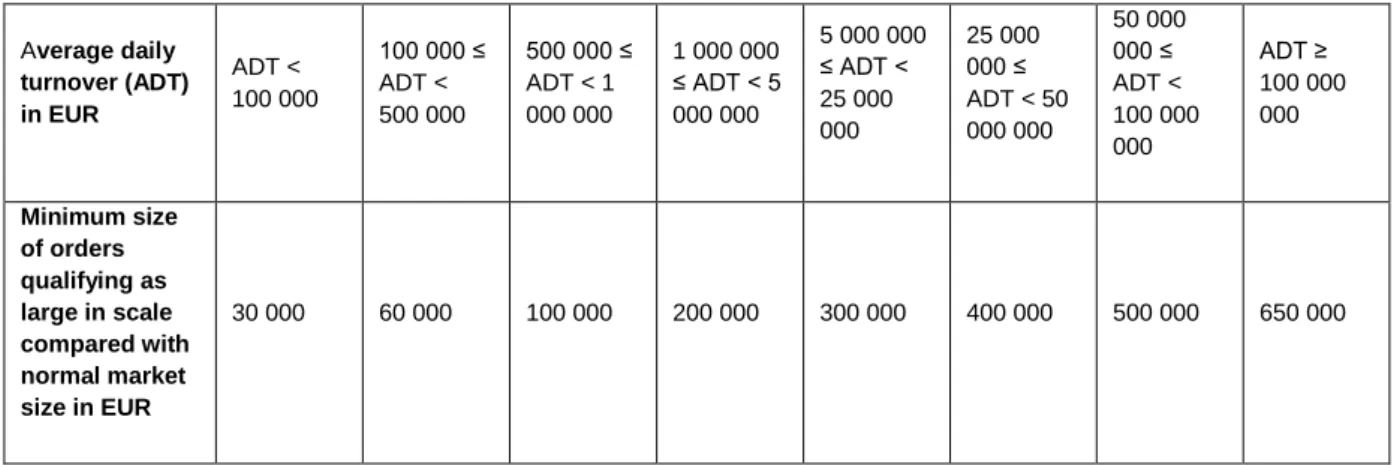
I. Trading Models ... 135
II. SSTI – Indicative prices ... 138
III. Order management facility waiver ... 139
IV. Content and timing of post-trade transparency requirements ... 140
V. Application of post trade transparency regime to certain OTC transactions ... 144
VI. Identification of the investment firm making the transaction public ... 146
VII. Discretionary deferral regime ... 149
VIII. Package transactions ... 155
IX. Temporary suspension of transparency requirements ... 157
X. Exemptions from transparency requirements in respect of transactions executed by a member of the ESCB ... 161
2.2.3 Implementing the new non-equities liquidity and transparency regime ... 163
I. Data collection, calculations and publication ... 163
II. Reference data, treatment of newly issued instruments and instruments traded for the first time ... 167
III. Transition ... 168
2.3. Double volume cap mechanism and the provision of information for the purposes of transparency and other calculations ... 169
2.3.1 Double volume cap mechanism ... 169
2.3.2 Article 22, MiFIR: Providing information for the purposes of transparency and other calculations ... 179
2.4. Criteria for determining whether derivatives should be subject to the trading obligation (Article 32(6) of MiFIR)... 184 2.5. Criteria for determining whether derivatives have a direct, substantial and
3. MICROSTRUCTURAL ISSUES ... 194
3.1. Organisational requirements for investment firms engaged in algorithmic trading, providing direct electronic access and acting as general clearing members ... 194
3.2. Organisational requirements of regulated markets, multilateral trading facilities and organised trading facilities enabling or allowing algorithmic trading through their systems 207 3.3. Market making, market making agreements and market making schemes ... 225
3.4. Ratio of unexecuted orders to transactions ... 237
3.5. Requirements to ensure co-location and fee structures are fair and non-discriminatory... 241
3.5.1 Co-location ... 241
3.5.2 Fee structures ... 244
3.6. Tick size regime for shares, depositary receipts and exchange traded funds ... 249
3.7. Material markets in terms of liquidity relating to trading halt notifications ... 256
4. DATA PUBLICATION AND ACCESS ... 260
4.1. Authorisation, organisational requirements and the publication of transactions for data reporting service providers ... 260
4.1.2 Periodic reconciliations ... 261
4.1.3 Maximum recovery times ... 262
4.1.4 Operational Hours ... 263
4.1.5 General comments ... 263
4.1.6 Publication chain ... 265
4.1.7 Technical arrangements facilitating the consolidation of information - Machine readability ... 266
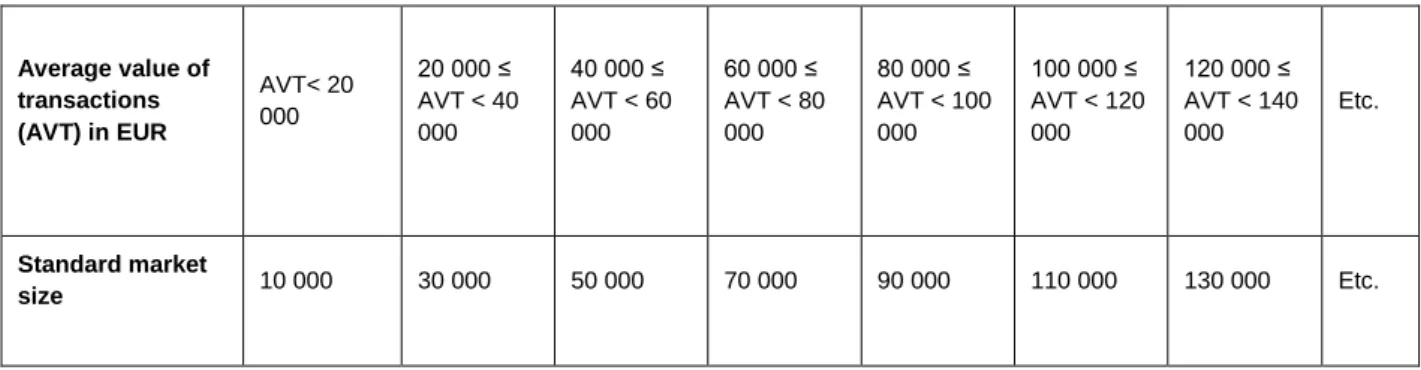
4.1.8 Consolidation of information specific to equities and equity-like instruments ... 267
4.1.9 Content of the information published by the equity CTP and the APA ... 268
4.1.10 Publication time for CTPs when trades take place on trading venues ... 270
4.1.11 Accuracy of the publication timestamp ... 271
4.1.12 Identification of the source contributing to the CTP ... 271
4.2. Data disaggregation ... 273
4.3. Access in respect of central counterparties and trading venues ... 275
4.3.1 Denial of access by a CCP or trading venue ... 275
4.3.2 Conditions under which an access request may be denied by a CCP to a trading venue – Article 35(6)(a) ... 276
4.3.3 Conditions under which an access request may be denied by a trading venue to a CCP – Article 36(6)(a) of MiFIR ... 282
4.3.4 Conditions under which granting access will threaten the smooth and orderly
functioning of the markets or would otherwise adversely affect systemic risk ... 283
4.3.5 Conditions under which access is granted ... 285
4.3.6 Conditions for non-discriminatory treatment of contracts ... 288
4.3.7 Notification procedure and calculation of notional amount with regard to transitional provisions ... 294
4.4. Access in respect of benchmarks ... 297
4.4.1 Benchmark information ... 297
4.4.2 Other conditions under which access must be granted ... 298
4.4.3 New benchmarks ... 301
5. REQUIREMENTS APPLYING ON AND TO TRADING VENUES ... 302
5.1. Admission of financial instruments to trading on regulated markets ... 302
5.2. Suspension and removal of financial instruments from trading – connection between a derivative and the underlying financial instrument ... 311
5.3. Description of the functioning of MTFs and OTFs ... 314
6. COMMODITY DERIVATIVES... 317
6.1. Establishing when an activity is to be considered ancillary to the main business .. 317
6.1.1 Trading activity thresholds (or Market Share test) ... 322
6.1.2 Minority of activities – ‘main business threshold’ ... 327
6.1.3 Privileged transactions ... 332
6.1.4 Period for calculation in relation to exemption ... 334
6.2. Methodology for the calculation and application of position limits for commodity derivatives traded on trading venues and economically equivalent OTC contracts ... 337
6.2.1 Methodology for calculating position limits ... 337
6.2.2 Application of position limits ... 350
7. MARKET DATA REPORTING ... 360
7.1. Reporting obligations under Article 26 of MiFIR ... 360
7.2. Obligation to supply financial instrument reference data under Article 27 of MiFIR 379 7.3. Maintenance of relevant data relating to orders in financial instruments ... 382
7.4. Clock synchronisation ... 386
8. POST-TRADING ISSUES ... 389
8.1. Obligation to clear derivatives traded on regulated markets and timing of acceptance for clearing (STP) ... 389
Acronyms and definitions used
ADT Average daily turnover
ADNA Average daily notional amount
AIFMD Directive 2011/61/EU of the European Parliament and of the Council of 8 June 2011 on Alternative Investment Fund Managers (AIFMs)
Aii Alternative instrument identifier
ANNA Association of national numbering agencies
APA Approved publication arrangement
AVT Average value of transactions
BIPM Bureau International des Poids and Mesures
CDS Credit default swap
CESR Committee of European Securities Regulators
CCP Central counterparty
CFD Contract for difference
CFI Classification of Financial Instruments
CFTC U.S. Commodities Futures Trading Commission
COFIA Classes of financial instrument approach
Commission European Commission
CP Consultation Paper (2014/1570) published by ESMA on 19 December 2015 and its addendum (2015/319) published on 18 February 2015
CRD IV Directive 2013/36/EU of the European Parliament and of the Council of 26 June 2013 on access to the activity of credit institutions and the prudential supervision of credit institutions and investment firms, amending Directive 2002/87/EC and repealing Directives 2006/48/EC and 2006/49/EC
CRR Regulation (EU) No 575/2013 of the European Parliament and of the Council of 26 June 2013 on prudential requirements for credit institutions and investment firms and amending Regulation (EU) No 648/2012
CSD Central securities depositary
CT Consolidated tape
CTP Consolidated tape provider
DEA Direct electronic access
DMA Direct market access
DP Discussion Paper (2014/548) published on 22 May 2014
EBA European Banking Authority
EC European Commission
ECB European Central Bank
EEA European Economic Area
EEOTC Economically equivalent OTC contracts
EFP Exchange for physical
EIOPA European Insurance and Occupational Pension Authority
EMIR European Market Infrastructures Regulation – Regulation (EU) 648/2012 of the European Parliament and Council on OTC derivatives, central counterparties and trade repositories – also referred to as “the Regulation”
EOD End of the day
ESMA European Securities and Markets Authority
ESMA Regulation Regulation (EU) No 1095/2010 of the European Parliament and of the Council of 24 November 2010 establishing a European Supervisory Authority (European Securities and Markets Authority), amending Decision No 716/2009/EC and repealing Commission Decision 2009/77/EC
ETD Exchange-traded derivative
ETF Exchange-traded fund
ETNs Exchange traded notes
EU European Union
FC Financial counterparty
FCD Financial Collateral Directive – Directive 2002/47/EC of the European Parliament and the Council.
FESE Federation of European securities exchanges
FIX Financial information exchange
FIXML Financial information exchange markup language
FpML Financial products markup language
FRA Forward rate agreement
FSB Financial Stability Board
FX Foreign exchange
HFT High frequency trading
ISIN International Securities Identification Number: a 12-character alpha-numerical code that uniquely identifies a security. It is defined by ISO code 6166
IBIA Instrument by instrument approach
ICAAP Internal Capital Adequacy Assessment Process
IOI Indication of interest
IOSCO International Organisation of Securities Commissions
IPO Initial public offering
IRS Interest rate swap
LEI Legal entity identifier
LIS Large in scale
LOI letters of intent
MAD Directive 2014/57/EU of the European Parliament and of the Council of 16 April 2014 on criminal sanctions for market abuse MAR Regulation (EU) No 596/2014 of the European Parliament and of the Council of 16 April 2014 on market abuse (market abuse regulation).
MIC Market identifier code
MiFID or MiFID I Markets in Financial Instruments Directive – Directive 2004/39/EC of the European Parliament and the Council
MiFID II Directive 2014/65/EU of the European Parliament and of the Council on markets in financial instruments and amending Directive 2002/92/EC and Directive 2011/61/EU
MiFIR Regulation (EU) No 600/2014 of the European Parliament and of the Council on markets in financial instruments and amending Regulation (EU) No 648/2012
MO Market operator
MS Member State
MTF Multilateral trading facility
MTN Medium-term note
NCA National Competent Authority
NDA Non-disclosure agreements
NDF Non deliverable forward
NTW Negotiated trade waiver
OIS Overnight index swap
OJ The Official Journal of the European Union
OTC Over-the-counter
OTF Organised trading facility
PPRB Person with proprietary rights to a benchmark
Q&A Questions and Answers
RDS Reference data system
RFQ Request for quote
RM Regulated market
RPO Recovery point objective
RPW Reference price waiver
RTO Recovery time objective
RTS Regulatory Technical Standards
SA Sponsored access
SFI Structured finance instrument
SFP Structured finance product
SI Systematic internaliser
SME Small and medium sized enterprise
SME-GM Small and medium sized enterprise – growth market
SMS Standard market size
SMSG Securities and Markets Stakeholder Group
SSTI Size specific to the instrument
SREP Supervisory Review and Evaluation Process
STP Straight through processing
TFEU Treaty on the Functioning of the European Union
TREM Transaction reporting exchange mechanism
UPI Universal product identifier
TV Trading venue
UCITS Directive 2009/65/EC of the European Parliament and of the Council of 13 July 2009, on the coordination of laws, regulations and administrative provisions relating to undertakings for collective investment in transferable securities (UCITS)
UTC Coordinated universal time
1. EXECUTIVE SUMMARY
Reasons for publication
Directive 2014/65/EU and Regulation (EU) No 600/2014 (MiFID II and MiFIR) require ESMA to develop a multitude of Regulatory Technical Standards (RTS) and Implementing Technical Standards (ITS). The package of standards subject to this report was consulted upon in a Discussion Paper (DP) published in May 2014 and two Consultation Papers (CP) published in December 2014 and February 2015. With this report ESMA publishes its final proposals for a total of 28 draft technical standards.
Contents
This final report deals with technical standards from the areas of transparency (Standards 1-5), market microstructure (Standards 6-12), data publication and access (Standards 13-16), requirements applying on and to trading venues (Standards 17-19), commodity derivatives (Standards 20 and 21), market data reporting (Standards 22-25), post-trading (Standard 26) and investor protection (Standards 27 and 28). It describes the feedback received in the public consultations and the rationale behind ESMA’s final proposals.
Annexed to this final report are the draft technical standards themselves (Annex I) and the ESMA cost-benefit-analysis (Annex II).
Next Steps
The final report has been submitted to the European Commission on 28 September 2015. The Commission has three months to decide whether to endorse the technical standards.
2. TRANSPARENCY
2.1. Transparency requirements in respect of shares, depositary
receipts, exchange-traded funds, certificates and other similar
financial instruments
2.1.1 Pre-trade transparency for trading venues
Background/Mandate
Article 4(6) of MiFIR
1. ESMA shall develop draft regulatory technical standards specifying the following:
(a) the range of bid and offer prices or designated market-maker quotes, and the depth of trading interest at those prices, to be made public for each class of financial instrument concerned in accordance with Article 3(1), taking into account the necessary calibration for different types of trading systems as referred to in Article 3(2);
(b) most relevant market in terms of liquidity of a financial instrument in accordance with paragraph 1(a);
(c) specific characteristics of a negotiated transaction in relation to the different ways the member or participant of a trading venue can execute such a transaction;
(d) negotiated transactions that do not contribute to price formation which avail of the waiver provided for under paragraph 1(b)(iii);
(e) the size of orders that are large in scale and the type and the minimum size of orders held in an order management facility of a trading venue pending disclosure for which pre-trade disclosure may be waived under paragraph 1 for each class of financial instrument concerned;
I. Pre-trade information to be made public by type of
trading system
1. MiFID II provides for two types of trading venues for shares, depositary receipts, exchange traded funds (ETFs), certificates and other similar financial instruments: regulated markets and multilateral trading facilities (MTFs). Under current MiFID within each of those two categories of trading venues, different types of trading systems may be operated in order to bring together buying and selling trading interests, such as quote driven systems, continuous auction order book systems and periodic auction systems.
2. ESMA, consistently with current MiFID, is of the view that the type of trading system should be the starting point for determining the appropriate level of pre-trade transparency which must be made public. In that regard Article 3(2) of MiFIR requires that “the transparency requirements referred to in paragraph 1 shall be calibrated for different types of trading systems including order-book, quote-driven, hybrid and periodic auction trading systems”. As a consequence and in order to ensure uniform applicable
conditions between trading venues, the same pre-trade transparency requirements, calibrated according to the type of trading system operated, should apply equally to regulated markets and MTFs.
3. MiFIR empowers ESMA to calibrate the proper pre-trade transparency regime by defining the range of bid and offer prices or designated market-maker quotes, and the depth of trading interest at those prices, to be made public for each class of financial instrument concerned.
4. In the CP and based on the assumption that equity-like products are traded principally through the same trading systems as shares, ESMA proposed to calibrate the content of the pre-trade transparency requirements based on an amended version of Table 1 in Annex II of Implementing Regulation (EC) No 1287/2006 (which only applies to shares admitted to trading on a regulated market) regardless of the type of equity financial instrument traded. Furthermore, ESMA proposed to include in the table a definition of request for quote (RFQ) systems together with the pre-trade transparency requirements applicable to those systems.
Analysis following feedback from stakeholders
5. The majority of responses supported the definition of RFQ systems and the corresponding pre-trade transparency requirements. Some respondents, which in principle agreed with the proposal, suggested that RFQ systems should not be permitted to bring together buying and selling interest for equities. Instead, they suggested that this trading system should be limited to equity-like instruments. The main concern was that RFQ systems for equities will have similar levels of transparency to systems operating under the pre-trade transparency waivers, but will not be regulated as such.
6. ESMA is of the view that RFQ systems will be subject to a prescribed level of pre-trade transparency under the draft RTS, as other trading systems were under Table 1 of Annex II of Implementing Regulation (EC) No 1287/2006 and will not be able to waive pre-trade transparency like systems operating under waiver programmes.
7. There was broad support for the pre-trade transparency requirements proposed for RFQ systems, albeit some respondents suggested that publishing quotes should not be part of the definition of the trading system; instead it should be part of the transparency requirements. ESMA agrees with the comments and has modified the definition of RFQ systems accordingly in Table 1 of Annex I of the draft RTS.
8. Some respondents were of the opinion that the proposed requirements would have a detrimental effect on the quality and quantity of the quotes provided on RFQ systems, and instead proposed a range of amendments to the pre-trade transparency requirements to make the requirement workable (i.e. publishing the average bids and offers and a volume band, and giving the system operator a window period to collect the quotes before making them available). ESMA is of the view that the proposed pre-trade transaprency requirements for RFQ systems should be sufficiently flexible to allow for differences between trading protocols, and to maintain the actual level of liquidity.
9. A number of respondents did not agree with the definition of hybrid systems due to the lack of clarity about the type of systems that would be caught under this category. Given the constant evolution of markets, and consequently of trading systems, ESMA proposes to retain the hybrid systems definition so as to have a category for trading systems that may develop in the future.
Proposal
10. ESMA, in line with the CP, proposes to retain the amendment to the current Table 1 in Annex II of Implementing Regulation (EC) No 1287/2006 for the purpose of establishing the content of pre-trade information that trading venues shall make public depending on the type of trading system operated, extending the requirements to actionable indication of interests (IOIs) which are, according to Article 2(1)(33) of MiFIR, messages between members or participants of a trading venues containing all the necessary information to agree to a trade.
11. ESMA also proposes to retain the definition of RFQ systems as presented in the CP with one caveat, publishing quotes will be part of the requirements instead of part of the definition. Additionally, and in order to provide further flexibility and to avoid that members or participants who are providing their quotes to the requester first are put at a disadvantage, the final draft RTS allows for the publication of all submitted quotes in response to a RFQ at the same time, i.e. once all quotes have been provided and the moment they become executable, whereas in the CP ESMA proposed that those systems should disclose all executable bids and offers the moment they are received.
II. Most relevant market in terms of liquidity
12. Under MiFIR, systems operating a trading methodology where orders are matched on the basis of a price derived from another system (the so-called reference price) can operate under a pre-trade transparency waiver provided that certain conditions are met. Firstly, the reference price must be widely published and regarded by market participants as a reliable reference price. Secondly, the set of eligible prices for matching orders within the systems operated by the trading venue is limited to the mid-point within the current bid and offer price or where not available, the opening or the closing price of the relevant session. Finally, the reference price can only be sourced from the trading venue
where that financial instrument was first admitted to trading or the most relevant market in terms of liquidity.
13. MiFIR empowers ESMA to draft regulatory technical standards specifying the most relevant market in terms of liquidity for the purpose of the reference price waiver. In the CP, ESMA noted that the concept of the most relevant market in terms of liquidity is also relevant in the context of the obligation of investment firms to report transactions under Article 26 MiFIR. However, in the CP, ESMA emphasised the different purposes of the most relevant market in terms of liquidity for transaction reporting and for pre-trade transparency and proposed to adopt two different definitions. In the CP, ESMA proposed that the most relevant market in terms of liquidity for a financial instrument should be the trading venue with the highest level of liquidity for that financial instrument measured by the total value of transactions executed by the trading venue during the relevant calendar year. ESMA also proposed, in order to strike an appropriate compromise between accuracy and operational costs, that the determination of the most relevant market in terms of liquidity would occur on an annual basis.
Analysis following feedback from stakeholders
14. While the majority of respondents were in favour of having a methodology to determine the most relevant market in terms of liquidity based on the trading venue with the highest turnover, some respondents stated that the most relevant market in terms of liquidity should only be sourced from systems that provide continuous trading, excluding auctions and RFQ systems. It was also suggested that the calculation of turnover should include transactions executed under a pre-trade transparency waiver, especially transactions executed under an order management facility. With respect to the frequency, all respondents agreed with determining the most relevant market in terms of liquidity on an annual basis.
15. Finally, a few respondents expressed concerns about how to determine the most relevant market when ETFs are dually listed in different currencies. ESMA appreciates that there might be merit in treating ETFs listed in several currencies as different financial instruments as they may have different liquidity profiles. However, the mandate of ESMA is limited here to defining the most relevant market in terms of liquidity and does not include the definition of what constitute a financial instrument.
Proposal
16. ESMA proposes that the most relevant market in terms of liquidity for a share, depositary receipt, ETF, certificate and other similar financial instrument should be the trading venue with the highest turnover for that share, depositary receipt, ETF, certificate or other similar financial instrument and regardless of the trading system (e.g. continuous trading order book, RFQ systems, etc.) under which the trading venue operates. The calculations shall take into account all relevant trading sessions (i.e. continuous and
that has benefitted from a large in scale waiver and where the transaction’s size is above the applicable large in scale threshold).
III. Negotiated transactions
17. A negotiated transaction is a transaction involving one or more members or participants of a trading venue who negotiate privately the terms of the transaction which is then reported under the rules of the trading venue. For example, two members or participants bilaterally agree the price and volume of a trade before transmitting it to the trading venue. In some circumstances, the trade could not be executed under the systems operated by the trading venue (e.g. a consolidated limit order book) because of special conditions or requirements attached to the trade (e.g. portfolio trades or contingent transactions like delta-neutral equity hedges of a derivative) or because the transaction does not constitute liquidity addressable by market participants other than the counterparties negotiating the transaction (e.g. a give-up or give-in). The trading venue to which the negotiated transaction is reported remains responsible for ensuring that the negotiated transaction meets the relevant conditions for the negotiated trade and all other applicable requirements.
18. MiFIR allows, under certain circumstances, pre-trade transparency obligations to be waived for systems that formalise negotiated transactions. In particular Article 4(1) of MiFIR specifies that:
Article 4, MiFIR
1. Competent authorities shall be able to waive the obligation for market operators and investment firms operating a trading venue to make public the information referred to in Article 3(1) for:
[…]
(b) systems that formalise negotiated transactions which are:
(i) made within the current volume weighted spread reflected on the order book or the quotes of the market makers of the trading venue operating that system, subject to the conditions set out in Article 5;
(ii) in an illiquid share, depositary receipt, ETF, certificate or other similar financial instrument that does not fall within the meaning of a liquid market and are dealt within a percentage of a suitable reference price, being a percentage and a reference price set in advance by the system operator; or
19. Under MiFIR, negotiated transactions are subject to some restrictions on admissible execution prices depending on the type of the transaction and the characteristics of the financial instrument being traded.
20. Negotiated transactions which are subject to conditions other than the current market price can be executed at any price where otherwise permitted by the rules of the trading venue.
21. Negotiated transactions which are subject to the current market price must instead comply with price conditions depending on whether or not there is a liquid market for the instrument being traded:
i. for liquid financial instruments, negotiated transactions must be executed within the spread - negotiated transactions falling under this limb are subject to the double volume cap mechanism as described in the relevant section of this document. ii. for illiquid financial instruments, negotiated transactions can be executed at any
price falling within a certain percentage of a suitable reference price, provided both the reference price and the percentage are set in advance by the system operator. In ESMA’s view, this implies that operators of trading venues should set the reference price and the percentage in an objective and clear manner having regard to the nature of the market in the financial instrument and its overarching obligation to maintain fair and orderly trading.
22. With respect to negotiated transactions, MiFIR empowers ESMA to draft RTS specifying (i) the characteristics of a negotiated transaction in relation to the different ways the member or participant of a trading venue can execute such a transaction and (ii) the negotiated transactions that do not contribute to price formation which avail the waiver provided for under Article 4(1)(b)(iii) of MiFIR.
Analysis following feedback from stakeholders
23. In the CP, ESMA clarified that negotiated transactions shall be executed under the rules of a trading venue and negotiated privately by members or participants of a trading venue and that negotiated trades shall not be restricted to transactions between members or participants dealing on own account but may involve a client or clients of the member or participants. For that reason, and consistently with the existing framework for negotiated transactions under the Implementing Regulation (EC) No 1287/2006, ESMA proposed that a member or participant of a trading venue can execute such a negotiated transaction by undertaking one of the following tasks:
i. dealing on own account with another member or participant who acts for the account of a client;
iii. acting for the account of both the buyer and seller;
iv. acting for the account of the buyer, where another member or participant acts for the account of the seller; and
v. trading for own account against a client order.
24. Respondents to the CP were in support of maintaining the current approach (i.e. the approach adopted under Article 19 of the Implementing Regulation (EC) No 1287/2006) with regard to the different ways a member or participant of a trading venue can execute a negotiated transaction. However, a number of respondents suggested including circumstances where an investment firm is dealing on own account with another member or participant on behalf of a client, and not just for the account of a client. ESMA agrees that this is a possible characteristic of a negotiated transaction and, in order to take this concern into account, has replaced the expression “acting for the account of a client” with “acting on behalf of a client,” which should encompass all possible circumstances. 25. With regard to the negotiated transactions that do not contribute to price formation, in the
CP, ESMA proposed to include a transaction that:
i. is executed in reference to a price that is calculated over multiple time instances according to a given benchmark, such as volume-weighted average price or time-weighted average price;
ii. is part of a portfolio trade that involves the execution of 10 or more financial instruments from the same client and at the same time and the components of the trade are meant to be executed only as a single lot;
iii. is a give-up or a give-in;
iv. is contingent on a derivative contract having the same underlying and where all the components of the trade are meant to be executed only as a single lot; or
v. is contingent on technical characteristics of the transaction which are unrelated to the current market valuation of that financial instrument.
26. A large number of respondents opposed having an exhaustive list of negotiated transactions as the evolution of market practices may result in new types of transactions which need to be accommodated by the negotiated trade waiver. ESMA acknowledges the need to cater for future market developments and has added a final item in the list to provide sufficient flexibility to include new types of transactions that may develop in the future whilst providing legal clarity and a harmonized regulatory framework.
27. Furthermore, some respondents suggested that the list of transactions under Article 2 (transactions not contributing to the price discovery process for the purpose of the trading obligation for shares) and Article 6 (negotiated transactions subject to conditions
other than the current market price) of the draft RTS should be closely aligned where possible on the basis that there is no reason to exclude transactions outside the scope of Article 23 of MiFIR from the possibility of being traded under the rules of a trading venue, and thereby subjecting them to more control and surveillance, through the negotiated trade waiver.
28. Most respondents were in favour of the inclusion of non-standard/special settlement trades to the list of transactions that do not contribute to the price formation process. However, after careful consideration, ESMA remains unconvinced that the arguments brought forward during the consultation constitute sufficient legitimate reasons to consider those transactions as not contributing to the price formation process. ESMA is also concerned about the potential risk of circumvention such an inclusion would represent and, hence, has decided not to add those types of transactions to its list. 29. Lastly, during the consultation, it was brought to ESMA attention that other types of
transactions should benefit from the negotiated trade waiver and be excluded from the trading obligation:
i. transactions carried out by a CCP or trading venue as part of its default management processes, including liquidations of securities held originally as margin or transactions in instruments to close out the positions of defaulting members; and ii. transactions carried out under the rules of a trading venue, CCP or Central
securities depositary (CSD) to effect buy-in of unsettled transactions.
30. ESMA recognises that there is some merit in including those types of transactions to the list of transactions not contributing to the price discovery process since they are usually taking place in emergency situations that may require to have access to all possible trading channels and to trade in a non-transparent manner. For this reasons, ESMA has decided to add those specific transactions to the lists of:
i. transactions not contributing to the price discovery process as specified for the purposes of the trading obligation; and,
ii. negotiated transactions subject to conditions other than the current market price.
Proposal
31. ESMA proposes to amend the specific characteristics of a negotiated transaction in relation to the different ways a member or participant of a trading venue can execute such transaction in order to include instances when an investment firm is dealing on behalf of a client.
32. With regard to the types of negotiated transactions that do not contribute to the price formation process, ESMA proposes an exhaustive list to have a clear regulatory
framework, with the last item providing some flexibility to include types of trades that may appear in the future. The proposed list includes a transaction that:
i. is executed in reference to a price that is calculated over multiple time instances according to a given benchmark, including transactions executed by reference to a volume-weighted average price or a time-weighted average price;
ii. is part of a portfolio trade;
iii. is contingent on the purchase, sale, creation or redemption of a derivative contract or other financial instrument where all the components of the trade are meant to be executed only as a single lot such as exchanges for related positions;
iv. is executed by a management company as defined in Article 2(1)(b) of Directive 2009/65/EC or an alternative investment fund manager as defined in Article 4(1)(b) of Directive 2011/61/EU of the European Parliament and of the Council which transfers the beneficial ownership of financial instruments from one collective investment undertaking to another and where no investment firm is a party to the transaction;
v. is a give-up or a give-in transaction;
vi. has as its purpose the transferring of financial instruments as collateral in bilateral transactions or in the context of central counterparty (CCP) margin or collateral requirements or as part of the default management process of a CCP;
vii. results in the delivery of financial instruments in the context of the exercise of convertible bonds, options, covered warrants or other similar financial derivative; viii. is a securities financing transaction;
ix. is carried out under the rules or procedures of a trading venue, a CCP or a central securities depository to effect buy-in of unsettled transactions in accordance with Regulation (EU) No 909/2014;
x. any other transaction equivalent to those described in points (a) to (i) and which is contingent on technical characteristics which are unrelated to the current market valuation of the financial instrument traded.
IV. Order management facility waiver
33. The order management facility waiver refers to functionalities operated by trading venues where certain orders are exempted from pre-trade transparency pending their disclosure to the market (i.e. subject to being released to an order book prior execution). In absence of more specific requirements under MiFID I, CAs and ESMA have elaborated opinions aimed at ensuring supervisory convergence on the set of
functionalities deemed to be compliant with the waiver. In accordance with those opinions, contingent orders such as reserve or iceberg orders and stop orders are currently considered orders held on an order management facility compliant with MiFID I. 34. MiFIR empowers ESMA to draft RTS specifying the type and minimum size of orders
held in an order management facility.
Analysis following feedback from stakeholders
35. The vast majority of respondents agreed with ESMA’s definition of the key characteristics of orders held in an order management facility, and with the minimum sizes proposed.
Proposal
36. ESMA proposes to retain the proposed definition of the relevant characteristics of orders held in an order management facility and not to restrict it to reserve and stop orders. With regard to the minimum size, ESMA maintains the proposal set in the CP that for all orders held in an order management facility, including stop orders, the minimum size should be, at the point of entry of the order, the minimum tradable quantity established by the trading venue. For reserve orders, the minimum size should be, at the point of entry and following any amendment, not smaller than EUR 10,000.
V. Large in scale waiver
37. Under MiFID I, orders that are large in scale (LIS) can benefit from a waiver from pre-trade transparency. The waiver is designed to protect large orders from adverse market impact and to avoid abrupt price movements that can cause market distortions. MiFIR recognises that mandatory public display of large orders can increase execution costs to the detriment of market liquidity and end-investors.
38. MiFIR empowers ESMA to draft RTS to specify the size of orders that are LIS compared with normal market size for each class of shares, depositary receipts, ETFs, certificates and other similar financial instruments.
39. In the CP ESMA proposed to adopt for all equity and equity-like financial instruments an approach using the average daily turnover (ADT) as a proxy for liquidity and market impact and allowing, for each financial instrument, the calibration of orders which may be considered LIS compared to the normal market size on this basis.
Shares and depositary receipts
40. With respect to shares and depositary receipts, ESMA maintained in the CP the proposal made in the DP published in May 2014 and proposed to use for both shares and depositary receipts the following ADT classes and corresponding thresholds:
Table 1: Shares and depositary receipts orders large in scale compared with normal market size (as proposed in the CP)
Average daily turnover (ADT) in EUR ADT < 100 000 100 000 ≤ ADT < 500 000 500 000 ≤ ADT < 1 000 000 1 000 000 ≤ ADT < 5 000 000 5 000 000 ≤ ADT < 25 000 000 25 000 000 ≤ ADT < 50 000 000 50 000 000 ≤ ADT < 100 000 000 ADT ≥ 100 000 000 Minimum size of orders qualifying as large in scale compared with normal market size in EUR 30 000 60 000 100 000 200 000 300 000 400 000 500 000 650 000
41. In line with the responses received to the May 2014 DP1, responses to the CP were split reasonably evenly between those supporting the ESMA proposal and those advocating a revision of the proposal.
42. The first group of respondents agreed that the ADT remains a valid measure which has worked in the past, is easy to calculate and well understood by market participants. They pointed out that, since building upon the existing regime, the proposal was also easy to implement for market participants who have already in place appropriate systems and procedures.
43. The second group of responses reiterated the arguments put forward in the responses to the DP against the use of the ADT which is viewed as a too simplistic measure of liquidity and market impact and proposed using different measures to substitute or to complement the ADT, such as the average value of transactions (AVT) or the depth of the order book. Some respondents also noted that the proposed yearly calculation fails to take into consideration the erratic variation of liquidity.
44. In concordance with the CP proposal, ESMA appreciates that approaches different from the proposed one based on the ADT are possible. However, it remains convinced that any approach has different pros and cons and that, for instance, the approaches based on order book data would be significantly more complex to use in practice. In ESMA’s views, while the ADT may not provide the best metric on which to establish the LIS threshold in all circumstances, it is a reliable metric positively correlated with liquidity which, from an operational perspective, can be collected and processed in a relatively simple way. Therefore, ESMA considers that the rationale provided in the CP supporting
the use of ADT is still valid and has decided to maintain its initial proposal to use ADT as a proxy.
45. Similarly to the responses received to the DP, respondents expressed concerns about the proposed thresholds for each class of ADT and in particular for less liquid shares (which often are shares issued by small and medium enterprises). In their views, the proposed thresholds would fail to capture a sufficient proportion of the orders as LIS and would entail very high trading costs in particular for the smallest ADT class (according to some responses, transaction costs might reach up to 200 bps for the class below EUR 100,000). ESMA appreciates those concerns and agrees that it is important that LIS thresholds are appropriate and in particular for less liquid shares such as SME shares. ESMA notes that, in the CP’s proposal, the greater level of granularity and the new ADT categories (and related thresholds) which have been added to the current MiFID I regime partially addressed those concerns. It is worth noting in this respect that under MiFID I the threshold for the shares with an ADT lower than EUR 100,000 (and up to EUR 500,000 EUR) is EUR 50,000 whereas under the proposed regime it was set at EUR 30,000.
46. However, ESMA appreciates that there is some merit in introducing further granularity into the system in order to better take into consideration the less liquid shares such as SME shares. Therefore, in its final table, ESMA has added a new ADT category for shares with an ADT of less than EUR 50,000 with a corresponding threshold of EUR 15,000. The thresholds for deferred publication have also been modified on that basis. 47. Finally, some respondents asked for further clarification with respect to the transactions
that should be taken into consideration for the ADT calculations, supporting a broad approach in this respect, i.e. the inclusion of lit, dark and OTC transactions. ESMA confirms that the ADT calculations should include all transactions executed in the relevant financial instrument, regardless whether they are traded on- or off-venue.
Proposal
48. In respect of shares and depositary receipts, ESMA reiterates its proposal to use the ADT as the relevant metric to establish orders that are large in scale. However, the table presented in the CP has been slightly amended and a new ADT category for shares with an ADT below EUR 50,000 has been added.
Table 2: Shares and depositary receipts orders large in scale compared with normal market size (as proposed in the final draft RTS)
Average daily turnover (ADT) in EUR ADT < 50 000 50 000 ≤ ADT < 100 000 100 000 ≤ ADT < 500 000 500 000 ≤ ADT < 1 000 000 1 000 000 ≤ ADT < 5 000 000 5 000 000 ≤ ADT < 25 000 000 25 000 000 ≤ ADT < 50 000 000 50 000 000 ≤ ADT < 100 000 000 ADT ≥ 100 000 000
Minimum size of orders qualifying as large in scale compared with normal market size in EUR 15 000 30 000 60 000 100 000 200 000 300 000 400 000 500 000 650 000
49. ESMA also proposes to maintain the current recalibration frequency where the ADT of each financial instrument is determined on an annual basis.
ETFs
50. The large in scale regime for ETFs proposed in the CP was similar to the one for shares and depositary receipts in that the LIS thresholds would increase with the ADT of the financial instrument. However, following feedback received to the DP, ESMA also sought views in the CP on an alternative option under which a single large in scale threshold (EUR 1,000,000) would apply to all ETFs regardless of their liquidity or the liquidity of their underlying.
Analysis following feedback from stakeholders
51. Similarly to the feedback received on the post-trade deferrals, respondents rejected almost unanimously an LIS regime based on ADT and agreed with the alternative option to adopt a single large in scale threshold for ETFs that will apply across the board. In line with the comments on the DP received in May 2014, respondents stressed the unsuitability of the ADT as a measure of liquidity and market impact for ETFs, arguing for instance that ADT would not capture the actual liquidity of ETFs where the creation/redemption mechanism inherent to ETFs allows liquidity providers to access additional, non-displayed liquidity. They also noted that an ADT-based approach could result in having two ETFs with the same underlying assets being treated differently. 52. With respect to the threshold to be set, the vast majority of respondents supported the
EUR 1,000,000 threshold proposed by ESMA in the CP which is thus maintained as the final proposal.
53. It is worth noting that some respondents recommended ESMA to differentiate between ETFs for which the creation/redemption process occurs just after the closing auction and those for which the creation/redemption process occurs at least 3 hours after the closing auction (e.g. ETFs which have an underlying trading in a different time zone - e.g. European ETF on Malaysian stock). However, ESMA believes that such a differentiation would bring too much complexity into the system and thus maintains its proposal to adopt a single threshold for all ETFs.
54. ESMA proposes to establish a single EUR 1,000,000 LIS threshold for all ETFs regardless of their underlying or their liquidity.
Certificates
Analysis following feedback from stakeholders
55. Certificates are defined by MiFIR as transferable securities which are negotiable on the capital market and which, in case of repayment of investment by the issuers, are ranked above shares but below unsecured bond instruments and other similar financial instruments. ESMA identified two types of financial instruments traded in the Union that would be considered certificates under the above definition: Spanish Participationes Preferentes and German Genusscheine.
56. For the DP, ESMA collected data on the trading of those instruments and proposed two possible scenarios based on a different classification of the ADT but did not advance any proposal for LIS thresholds. Based on feedback to the DP, ESMA proposed in the CP to establish a very simple regime for LIS orders for certificates with only two ADT classes and LIS thresholds. As for the other instruments, ESMA proposed to determine the ADT of each instrument on an annual basis.
57. ESMA received limited feedback on certificates, probably related to the fact that those financial instruments are available in very few jurisdictions. Some respondents highlighted that where a certificate is economically equivalent to a share issued from the same issuer, the calibration of the classes and the LIS thresholds should follow those applicable to shares. On the contrary, where the certificate is a distinct instrument (i.e. with different payoffs from the shares issued by the same issuer), then the LIS threshold should be calibrated based on its own liquidity features.
58. During the consultation, ESMA also received feedback suggesting including additional instruments in this category and in particular Rabobank-certificates. As stated in the advice to the Commission with respect to liquidity thresholds for equity instruments, ESMA believes that those instruments should indeed fall into the certificate category.
Proposal
59. ESMA remains of the view that certificates have different payoffs from shares and are hence separate financial instruments which ought to be subject to a different transparency regime. ESMA has decided to maintain the table presented in the CP and which is reproduced below.
Table 3: Certificates orders large in scale compared with normal market size
Average daily turnover (ADT) in EUR ADT < 50
000
ADT ≥ 50 000
Minimum size of orders qualifying as large in scale compared with normal market size in
EUR 15 000 30 000
Stubs
Analysis following feedback from stakeholders
60. A stub usually refers to the reminder of an order (i.e. a limit order that is not immediately executed under prevailing market conditions) that was LIS at the time it was submitted to a trading venue and that was partially executed. Following partial execution, the order may fall below the relevant LIS threshold. In such circumstances it is not clear whether the LIS waiver continues to apply to the stub and, hence, whether the order has to be made transparent if and when remaining on the order book.
61. In the DP, ESMA evaluated the pros and cons of requiring stubs to meet the relevant LIS threshold following partial execution to continue to be eligible to the LIS waiver. On the one hand, ESMA considered that allowing stubs to remain protected under the LIS waiver would result in a more consistent treatment of the whole order, greater protection for large orders and greater incentive to execute transaction on order books and ultimately in better quality of execution. On the other hand, requiring stubs to be made transparent when falling below the relevant threshold was considered as conducive to greater transparency and consistent with an approach where similar sized orders are, ceteris paribus, subject to equivalent transparency requirements. As a compromise, ESMA’s proposal in the DP was to require stubs to be made transparent only when, following partial execution, the size of the stub would fall below 75% of the relevant LIS threshold.
62. Overall, respondents to the DP did not support ESMA’s proposal to make stub orders transparent when falling below a certain level below the LIS threshold and supported an approach where stubs would remain protected under the LIS waiver. The main reasons were that the proposed approach would hinder investors’ ability to execute large orders through order books by revealing sensitive information to the market and would be too complex and difficult to implement and, hence, would be disproportionate to the marginal benefits.
63. ESMA therefore proposed in the CP to clarify that LIS orders may remain protected under the LIS waiver regime even when, following partial execution, they fall below the relevant LIS threshold provided that the price or other relevant conditions for execution are not amended following execution.
64. The majority of the respondents agreed with the new proposal. A few respondents were in favour of having stubs transparent. However, ESMA remains of the view that subjecting stubs to transparency is difficult to implement and the costs of such an approach would be disproportionate to the benefits.
2.1.2
Pre-trade transparency for investment firms in respect of
equity an equity-like financial instruments
Background/Mandate
Article 14(7) of MiFIR
7. In order to ensure the efficient valuation of shares, depositary receipts, ETFs, certificates and other similar financial instruments and maximise the possibility of investment firms to obtain the best deal for their clients, ESMA shall develop draft regulatory technical standards to specify further the arrangements for the publication of a firm quote as referred to in paragraph 1, the determination of whether prices reflect prevailing market conditions as referred to in paragraph 3, and of the standard market size as referred to in paragraphs 2 and 4.
I. Arrangements for the publication of a firm quote
66. SIs are required to publish firm quotes in respect of equity and equity-like instruments traded on a trading venue for which there is a liquid market, when dealing below standard market size (SMS). MiFIR already specifies or delegates through implementing measures various aspects of the obligation to make those quotes public. Those aspects include, among other things, the means by which a quote is made public such as the facilities of any regulated market that has admitted the financial instrument to trading, an approved publication arrangement (APA) or through proprietary arrangements.
Analysis following feedback from stakeholders
67. The vast majority of respondents agreed with ESMA’s proposal to require SIs to adopt arrangements for the publication which ensure that the information is sufficiently reliable and free of errors, that the information is capable of being consolidated with other similar data from other sources and that it is made available to market participants on a non-discriminatory basis. Additionally, there was broad support for requiring SIs to make public the time quotes are entered or updated, supporting the two objectives of this provision:
i. A timestamp assigned by the SI might help to ensure its quotes are firm and reliable by improving the audit chain of the publication to the benefit of market participants. It aims at avoiding potential disputes that may arise when a quote is changed close to the time a client order is entered and when, due to this change the client order fails to match the new systematic internaliser's quote. The risk is particularly serious when SIs use a website (which is allowed as a proprietary arrangement according to
Article 17(3)a of MiFIR) as the publication of quotes may suffer from the website page slowing down and displaying outdated quotes.
ii. Moreover, the inclusion of the timestamp in the pre-trade information published by the SI is a key information for the client to better analyse ex-post the quality of prices quoted by SIs, and in particular to assess with accuracy the responsiveness of the SI and the validity periods of quotes. Without a timestamp assigned by the SI itself, market participants would need to rely on the information potentially provided by data vendors, the timestamps of which would be less accurate, especially when quotes are published through a website as pointed out by some respondents to the question on access to the quotes of SIs.
Proposal
68. Given the broad support from the respondents, ESMA is maintaining the proposal to adopt arrangements for the publication which ensure that the information is sufficiently reliable and free of errors, that the information is capable of being consolidated with other similar data from other sources and that it is made available to market participants on a non-discriminatory basis. Moreover, SIs will be required to timestamp their quotes.
II. Quotes reflecting prevailing market conditions
69. Under Article 14(3) of MiFIR the prices published by SIs in accordance with Article 14(1) of MiFIR must reflect the ‘prevailing market conditions’ for each financial instrument for
which the investment firm is a SI. However, Article 15(2) of MiFIR permits SIs ‘in justified cases’ to execute orders at a better price than those quoted at the time of reception of
the order, ‘provided that this price falls within a public range close to market conditions’. Analysis following feedback from stakeholders
70. Most respondents agreed to maintain the existing definition of prevailing market condition of Article 24 of the Implementing Regulation (EC) No 1287/2006, according to which a quote or quotes reflect prevailing market conditions when they are close in price to comparable quotes for the same share on other trading venues. However, some respondents expressed concerns that SIs are not required to meet tick size requirements, which can create regulatory arbitrage. ESMA notes that although it appreciates the concern, it has no empowerment under Level 1 to mitigate this risk. 71. Other comments received by ESMA considered that the definition was too vague and
thus subject to diverging interpretations. ESMA appreciates the concern and shares the view that a more specific provision will provide more legal certainty and facilitate harmonised application across the Union. To this end, ESMA has slightly modified its original proposal so as to to provide further clarity by specifying the benchmark (most relevant market) and other elements of the comparability (time and the size elements)
Proposal
72. ESMA has slightly amended the definition proposed in the CP. Under this revised provision, a price reflects prevailing market conditions if it is close in price to quotes of equivalent sizes for the same financial instrument on the most relevant market in terms of liquidity for that financial instrument at the time of publication.
III. Standard market size
73. A key aspect of the SI regime is the concept of the SMS. MiFIR requires SIs to compy with pre-trade transparency requirements when dealing in sizes up to the SMS and to make public quotes - a firm bid and a firm offer – for sizes of at least 10% of the SMS for the share, depositary receipt, ETF or certificate for which they are SIs.
74. Article 14(4) of MiFIR requires shares, depositary receipts, ETFs and certificates to be grouped together in classes on the basis of the arithmetic average value of the orders executed in the market for that financial instrument. The SMS must be of a size representative of the arithmetic average value of the orders executed in the market for the financial instruments included in each class.
Analysis following feedback from stakeholders
75. On the basis of the responses to the DP and with the objective of maintaining and enhancing transparency, ESMA proposed in the CP to establish equivalent classes by AVT for financial instruments with an AVT larger than €20,000. The SMS for the class with an AVT between 0 and €20,000 would be €10,000, the SMS for the next class (€20,000 - €40,000) would be €30,000 and so forth. ESMA also favoured a recalculation of the AVT for each financial instrument on an annual basis. In other words, ESMA proposed to amend the SMS under current MiFID I and to group the two smallest classes into a single class for shares with an AVT between zero and €20,000 and set a SMS of €10,000.
76. To recall, this corresponded to the second of the three option presented by ESMA in its DP, which were;
i. Option 1: maintain the existing classes while lowering the SMS for the smallest class by AVT from €7,500 to €5,000;
ii. Option 2: group the two smallest classes into a single class for shares with an AVT between zero and €20,000 and set an SMS of €10,000; or
iii. Option 3: maintain the current classes and SMSs for each class as under Table 3 of Annex II of the Implementing Regulation (EC) No 1287/2006 (status quo option). 77. A slight majority of respondents disagreed with the ESMA proposal. However, within
the contrary in favour of a more stringent regime. The arguments put forward included the following:
i. Those supporting lower SMSs stressed that, as showed in the DP, around 95% of all trades have a volume of up to EUR 10,000. The introduction of a class with an AVT of up to EUR 20,000 and an SMS of EUR 10,000 as proposed by ESMA would hence result in almost every trade falling below the SMS. Whilst this would lead to increased transparency this must be, in the respondents’ view, weighed against the protection of SIs against unreasonable risks. For them, the right equilibrium cannot be achieved if nearly all trades are below the SMS.
In this regard, ESMA would like to stress that, as already highlighted in the DP, it is vital to further reinforce the objective of increased transparency for SIs through well-targeted implementing measures. However, ESMA is unconvinced that the reduction in the average size of transaction necessarily reflects greater market risk for SIs. ii. Those supporting higher SMS thresholds stressed in particular that it is crucial to
avoid creating significantly less rigorous transparency regime for SIs compared to the one generally enforced by trading venues in respect to market makers. Some suggested an alignment of the quantitative thresholds between SIs (SMS thresholds) and trading venues (LIS threshold). In their view, the methodology for the calculation should be changed, with ADT also applied to the SI instead of AVT. For them, the weakness of the AVT approach is simply that as liquidity increases for a specific share, the average size of transaction usually tends to decrease, resulting in lower SMS threshold for that share above which one can trade in the dark, which is completely counter-intuitive.
ESMA notes that MiFIR defines how the SMS should be calculated for shares and equity-like instruments and that that size shall reflect the average size of transaction for each class of financial instruments.
78. More generally, ESMA appreciates the concern raised by certain respondents with regard to the unintended consequences that a significant misalignment of the respective transparency regimes for trading venues and SIs could have. Respondents noted in this respect that SIs do not truly contribute to price formation. Due to the volume caps that will apply to dark trading on trading venues and to the trading obligation for shares, SIs might become an increasingly attractive option for accommodating current trading activity. In order to address such a development, which would go against the Level 1 framework objective to foster transparency, a key point for regulators and policymakers should be to ensure the bilateral nature of SI activity.
79. According to those respondents, some recitals in MiFID II/MiFIR may be used by market participants to argue that riskless counterparty trading can be undertaken by SIs, thus providing an alternative home for current OTC broker crossing business. Such a
trading venues) together with their new ability to provide price improvement under MIFID II, would effectively see the re-introduction of an organised trading facility (OTF) category within the equity space. This is because, if ultimately allowed for the SI, riskless principal trading would de facto enable the matching of two client orders by interposing the SI own account between them for a fraction of time, i.e. taking very limited market/counterparty risk.
80. ESMA believes that this would indeed go against the political, technical and legal agreement underpinning the Level 1 text. It is worth noting that ESMA has acknowledged this is an issue and raised it in its December 2014 Technical Advice to the Commission but ESMA cannot provide further clarity in the final draft RTS as it has no relevant empowerment to do so.
Proposal
81. After careful consideration, ESMA has decided to maintain the proposal presented in the CP which represents the best possible compromise between those requesting more stringent thresholds and those advocating for a more accommodating regime for SIs. The proposal is summarised in the table below.
Table 4: Standard market size
Average value of transactions (AVT) in EUR AVT< 20 000 20 000 ≤ AVT < 40 000 40 000 ≤ AVT < 60 000 60 000 ≤ AVT < 80 000 80 000 ≤ AVT < 100 000 100 000 ≤ AVT < 120 000 120 000 ≤ AVT < 140 000 Etc. Standard market size 10 000 30 000 50 000 70 000 90 000 110 000 130 000 Etc.
82. In order to ensure consistent implementation in the Union, the methodology to be used for calculating the average value of transactions has been specified in the final draft RTS which also clarifies that calculations should take into consideration all transactions executed in the Union whether executed on or outside a trading venue excluding reference price, negotiated and post-trade LIS transactions. In that context, post-trade LIS transactions are transactions for which deferred publication is permitted or, in other words, the smallest threshold for each ADT class set out in table 4 of Annex II of the final draft RTS.