University of Wollongong University of Wollongong
Research Online
Research Online
University of Wollongong Thesis Collection
2017+ University of Wollongong Thesis Collections
2018
Perceptions of multiple stakeholders on the effectiveness of ability
Perceptions of multiple stakeholders on the effectiveness of ability
grouping of gifted and talented
grouping of gifted and talented
Bushra NoorUniversity of Wollongong
Follow this and additional works at: https://ro.uow.edu.au/theses1
University of Wollongong University of Wollongong
Copyright Warning Copyright Warning
You may print or download ONE copy of this document for the purpose of your own research or study. The University does not authorise you to copy, communicate or otherwise make available electronically to any other person any
copyright material contained on this site.
You are reminded of the following: This work is copyright. Apart from any use permitted under the Copyright Act 1968, no part of this work may be reproduced by any process, nor may any other exclusive right be exercised, without the permission of the author. Copyright owners are entitled to take legal action against persons who infringe
their copyright. A reproduction of material that is protected by copyright may be a copyright infringement. A court may impose penalties and award damages in relation to offences and infringements relating to copyright material.
Higher penalties may apply, and higher damages may be awarded, for offences and infringements involving the conversion of material into digital or electronic form.
Unless otherwise indicated, the views expressed in this thesis are those of the author and do not necessarily Unless otherwise indicated, the views expressed in this thesis are those of the author and do not necessarily represent the views of the University of Wollongong.
represent the views of the University of Wollongong.
Recommended Citation Recommended Citation
Noor, Bushra, Perceptions of multiple stakeholders on the effectiveness of ability grouping of gifted and talented, Master of Philosophy in Education thesis, School of Education, University of Wollongong, 2018. https://ro.uow.edu.au/theses1/616
Research Online is the open access institutional repository for the University of Wollongong. For further information contact the UOW Library: [email protected]
PERCEPTIONS OF MULTIPLE STAKEHOLDERS ON
THE EFFECTIVENESS OF ABILITY GROUPING OF
GIFTED AND TALENTED
Bushra Noor
Supervisors:
Principal Supervisor Wilma Vialle
Co-Supervisor Catherine Wormald
This thesis is presented as part of the requirement for the conferral of the degree:
Master of Philosophy in Education
The University of Wollongong
School of Education
ii
Abstract
Every school in the world has a mission to help children reach their potential. In practice, however, many teachers do not always attend to the needs of gifted students as they think that the students can achieve by themselves and do not need any individual attention. An Australian Parliamentary Senate Inquiry (2001) warned that there is a problem with gifted education in Australia and that the needs of gifted students are not being met. In New South Wales, there are academically selective classes in Years 5 and 6 of primary school (known as “opportunity classes”) and selective high schools for gifted students. However, there is still resistance to ability grouping of gifted students. The purpose of this qualitative study was to investigate the perceptions of students, parents, teachers and principal as to the effects of being in opportunity classrooms on students’ academic performance and their social and emotional well-being by comparing the students’ experiences in their last two years of primary school in an “opportunity classroom” with their prior experiences in comprehensive classrooms. Research has shown that gifted students can perform better when grouped with their like-minded peers resulting in high academic achievement and an increase in social and emotional development (Kulik & Kulik, 1982; Rogers, 2002b). For several years, costs and gains related to ability grouping have been a controversial issue (Neihart, 2007; Slavin & Oakes, 1985). This study aimed to answer the question, What do students, parents, teachers and principals perceive as the effects of being in opportunity classrooms on students’ academic performance and their social and emotional wellbeing, by comparing their experiences in both settings.
A qualitative phenomenological design was designed to address the research questions. This approach utilised dialogue and open-ended questions through personal interviews with the teachers, students and parents to obtain the comprehensive detail and description of the
phenomena. The findings of the study indicated that ability grouping allowed improvements in the academic performance of the gifted and talented students, however, social-emotional issues
iii
such as pressure, competition, and bullying were evident. Nevertheless, all participants favoured the ability group setting over the comprehensive school setting.
Based on the data from the study, it was suggested that future research should focus on examining the connection of gifted programs, services and needs with gifted and talented students at the primary level, as they can be vulnerable to underachievement. In area of gifted education research, motivational theories should be studied to learn more about gifted and talented students.
iv
Acknowledgements
In the pursuit of this research project nobody has been worth praising and more valued than my family. I would like to thank especially my husband Muhammad Imran who always encouraged and supported me and uplifted my spirit in this research journey and my two little daughters, Fatima Imran and Zainab Imran who were too little but understood all the time, accompanied me anywhere during research and showed high level of cooperation and love, I am really proud of you.
This study was impossible without the best supervision and professional guidance of my supervisor Prof Wilma Vialle; her dedication, encouragement, appreciation and commitment, enabled me to complete this milestone. I am also thankful to my co supervisor Dr Catherine Wormald for her instructions.
I am grateful to all the parents, teachers, principals, and students with whom I have had the pleasurable experience of working throughout this research project.
vi
List of Abbreviations
DMGT – Gagné’s Differentiated Model of Giftedness and Talent OC – Opportunity Class selective classes.
DEECD - Department of Education and Early Childhood Development, Department of Education and Training Victoria
IMTD - Integrative model of Talent Development (Gagné, 2018) G & T - Gifted and Talented
ACARA - Australian Curriculum, Assessment and Reporting Authority NSW DET - New South Wales Department of Education
SERAP - State Education Research Applications Process BFLPE - Big Fish Little Pond Effect
vii Table of Contents Abstract ... ii Acknowledgements ... iv Certification ... v List of Abbreviations ... vi
Table of Contents ... vii
Chapter 1 Introduction ... 1
1.1 Background of the problem ... 1
1.2 Aim of the study ... 2
1.3 Research Question ... 2
1.4 Theoretical framework ... 3
1.4.1 Rogers’ best-evidence synthesis ... 3
1.4.2 Differentiated Model of Giftedness and Talent (DMGT) ... 5
1.5 Significance of the study ... 6
1.6 Current research framework ………6
1.7 Definitions of key terms ... 8
1.8 Organisation of chapters ... 9
Chapter 2 Literature Review ... 11
2.1 Definition of giftedness and policy in Australia for gifted and talented students ... 11
2.2 Educational provision for gifted and talented students ... 14
2.3 Controversy on ability grouping ... 19
viii
2.5 Conclusion ... 24
Chapter 3 Method ... 26
3.1 Introduction ... 26
3.2 Research Design ... 26
3.3 Site and participants ... 28
3.4 Data collection tools ... 32
3.5 Procedure ... 33 3.5.1 Ethical Considerations ... 33 3.6 Data analysis ... 36 3.7 Conclusion ... 37 Chapter 4 Findings ... 39 4.1 Teachers’ perceptions ... 39 4.2 Students’ perceptions ... 46 4.3 Parents’ perceptions ... 52 4.4 Conclusion ... 60
Chapter 5 Discussion and Conclusion ... 61
5.1 Need for a challenging learning environment ... 61
5.2 Role of gifted and non-gifted peers in social and academic context ... 63
5.3 Teaching performance ... 64
5.4 Pressure ... 65
5.5 Effectiveness of ability grouping ... 66
5.6 Limitations and recommendations ... 68
5.7 Conclusion ... 70
ix
Appendices ... 88
Appendix 1 ... 88
Appendix 2 ... 89
x
List of Tables
Table 3.1 Participants’ attributes
31
Table 4.1 Teachers’ and principal’s perceptions of ability grouping
40
Table 4.2 Summary of students’ perceptions
47
Table 4.3 Summary of parents’ perceptions
54
List of Figures
Figure 1.1 Research framework
8
1
Chapter 1
Introduction
1.1 Background of the problem
Educational policy on gifted and talented students in NSW, Australia, is based on Gagné’s (2000) Differentiated Model of Giftedness and Talent (DMGT). Gagné’s model noted that children have potential or giftedness in one or more domains and that some students may have giftedness but not develop talent either at school or in their lives beyond school. This could be because the catalysts discussed in Gagné’s model may negatively affect the development of talent. In circumstances where the catalysts are not favorable, the question remains as to how students’ progress from potential to performance.
Most schools have a mission to help children reach their potential, but research in Australia has showed that in practice many teachers do not consistently address the needs of gifted students and many believe that gifted students can progress by themselves and do not need particular attention (see, e.g., Walsh & Jolly, 2018). For many teachers, the priority of getting children to achieve their potential is more about lifting the children who are struggling to perform. The Australian Parliamentary Senate Inquiry (2001) noted that there is a problem with gifted education in Australia and that the needs of gifted students are not being met. Walsh and Jolly (2018) commented:
Gifted education in the Australian context has often ebbed and flowed in relation to outside forces, particularly at the federal level (e.g., institution of a national curriculum, lack of federal mandate for gifted education), that impinge on those charged with providing education to those who are gifted and with advanced abilities. (p.87)
The question remains as to how we target the students with high potential and best cater to the needs of these high potential students. One way in which this could be achieved is through ability
2
grouping classes in NSW. Rogers’ (1991) meta-analysis indicated that full-time grouping is the most effective for accelerating talent development in gifted students. However, ability grouping is resisted by many educators, many of whom view ability grouping as elitist or detrimental to other students’ needs. Hendrick (2009) observed that “in a postmodern constructivist era, children must be seen as individuals. It is not acceptable to disregard the needs of one for the greater good” (p. 3). While research has focused on educator perspectives, the views of students and their parents are under-researched. There is need for a study, therefore, that investigates the impact of ability-grouping in terms of the students’ academic achievement and social-emotional wellbeing among all the key stakeholders, including the affected students and their families.
1.2 Aim of the study
Coleman, Micko, and Cross (2015) emphasized the need for educational researchers to ensure that the perceptions of gifted students on their educational settings was examined in order to fully understand their educational contexts. Following their advice, the aim of the current study was to explore the effectiveness of the academic program from multiple stakeholders’ perspectives, by comparing their present experience of homogeneous classroom settings with the students’ previous heterogeneous setting. Moreover, as there are numerous types of educational programs for gifted students in Australian schools, it was anticipated that this study would contribute to Australian research on the effectiveness of ability grouping through a focus on Opportunity Classes for gifted students in Years 5 (age 10-11) and 6 (age 11-12) of NSW government primary schools. The study aimed to determine the stakeholder perceptions of the best practices for gifted students in relation to their academic achievement and social-emotional development.
1.3 Research Question
The primary research question is:What do students, parents, teachers and principals perceive as the effects of being in opportunity classrooms on students’ academic performance and their social and emotional wellbeing?
3
1.4 Theoretical framework
Gifted and talented education creates some debate among educators due to a lack of consensus on definition, identification, programs and provisions. The ability grouping debate is one example of this. Becker, Neumann, Tetzner, Böse, Knoppick, Maaz, et al. (2014) stated that gifted education is complex and warned that it must not be evaluated on one construct only. Further, Fetterman (1988) argued that:
One of the least discussed but most glaring holes in gifted and talented education is the lack of a theory. No overarching theoretical framework exists for the development of gifted and talented programs. The absence of a theoretical base makes the development of gifted and talented programs a vulnerable and shaky proposition at best. (p. 62)
Nevertheless, this study utilised the extensive work of Karen Rogers (2007) along with Gagné’s (1991) Differentiated Model of Giftedness and Talent (DMGT) as a theoretical framework for the research, as their work underpins the view that the individual differences in gifted students require specialised instruction in order to meet their needs and thereby maximise their potential.
1.4.1 Rogers’ best-evidence synthesis
Rogers (2007) has conducted extensive best-evidence syntheses on research related to gifted programming. She has highlighted significant themes in the light of the research literature and recommended that educators consider five lessons, which demonstrate how to best serve these intellectual learners. In the first lesson, Rogers stressed that challenging learning opportunities and environments in their particular area of talent on a daily basis are essential for gifted and talented students. Brighton, Moon, and Huang (2015) argued that the absence of a challenging educational environment has a negative impact on gifted students’ affective and cognitive domains; the researchers found that the students demonstrated their best performance when
4
provided a consistently challenging environment (Hendrick, 2008).
Rogers’ second lesson was that gifted and talented students frequently prefer to work independently and should be able to work at their own pace. Therefore, instruction strategies and curriculum models such as the Autonomous Learner Model (Betts & Neihart, 2004), the Schoolwide Enrichment Model (Reis & Renzulli, 1985) and the Parallel Curriculum Model (Tomlinson et al., 2009) that assist self-directed learning among gifted students are useful approaches. In the third lesson, Rogers emphasised the use of acceleration in different and appropriate forms such as subject-based and grade-based acceleration (Gross et al., 2004). Acceleration plays an important role in building a sense of social support, gaining early career pathways and achieving academic excellence (Gross, 2004; Kulik, 2004; Lubinski, 2004; VanTassel-Baska, 2004).
She further recommended in the fourth lesson that gifted and talented students must be provided with opportunities to spend regular amounts of time with their like-minded peers. Rogers argued that such grouping has significant impact on the students’ academic and social-emotional well-being and develops their positive association with school and educational programs (Bate & Clark, 2013; Hendrick, 2008; Shield, 2002). In the fifth lesson, Rogers pointed out that differentiated curriculum and instructional delivery are crucial with emphasis on developing faster pace and teaching conceptually (Santangelo et al., 2009; Tomlinson, 2005).
Another meta-analysis by Rogers (2002) provided a conceptual framework for resolving many issues related to grouping. Rogers (2002) investigated 13 research studies that support sustained periods of instruction in like-ability groups for gifted and talented students. Rogers (1998) had previously observed that ability grouping would increase a deeper sense of processing material and help in acquiring advanced knowledge (Adams-Byers et al., 2004; Adodo & Agbayewa, 2011; Rance-Roney, 2010). Rogers proposed important questions to consider in relation to ability grouping include: the range of grouping options, the effect of grouping on academic outcomes,
5
problems in grouping, and the cost of ungrouping for gifted students. Responding to these questions, she concluded that there are a number of options, ranging from full-time grouping to within-class ability grouping. She further added that gifted students can achieve academic gains by using many of the different grouping options. Finally, she argued that there would be a negative effect on the achievement and attitude of gifted students if they were placed for instruction in heterogeneous grouping (Peterson & Ray, 2006a).
1.4.2 Differentiated Model of Giftedness and Talent (DMGT)
The DMGT (1991, 2000) distinguishes gifts from talent as potential and realisation of potential, respectively. According to the DMGT, later renamed as the Integrative Model of Talent Development (IMTD; Gagné, 2018), giftedness comprises largely innate natural abilities that are transformed into talents under circumstances systematically influenced by a number of catalysts. The three sets of catalysts that have impact on development are: 1) interpersonal factors, such as motivation, personality, and work habits; 2) environmental factors, such as family, school, teachers, programs, provision, and activities for formal and informal learning; and, 3) chance factors. These catalysts play important roles in the transformation of giftedness into talent.
The reason for choosing this model for the research study is that it highlighted the role of the environment, including family, teachers and schools, and programs and provisions, in children’s development. This model suggests that ability exists but there is a need to nurture it with the help of the factors outlined above. Environmental factors related to classrooms and programs are essential in order to understand the needs of gifted and talented students to help them realise their potential into performance. These programs and provisions include enrichment, acceleration, extension and grouping. Massé and Gagné (1983) argued that whatever the field of talent, enrichment should be taken as the basic aim of every provision available for gifted and talented youngsters. According to these authors, we cannot provide equal services to all students who are identified as gifted because while gifts may be equal, the development of talents may not take place equally.
6
1.5 Significance of the study
In 2014, the Victorian Department of Education highlighted the importance of nurturing gifted and talented children and young people: “The chance to realise their potential, pursue a passion and develop a love of learning…” along with the more common general benefits their talents can contribute to society: “…gifted and talented children and young people are the potential leaders of tomorrow” (DEECD, 2014, p. 5). This statement reflects the importance of nurturing gifted and talented students’ intellect. Thus, this study aimed to play an important role in highlighting provisions that foster gifted students’ intellect.
For educational institutions, this study also aimed to create a sound understanding of the impact of specialist provisions on gifted students’ development and, ultimately, to assist in identifying programs that appropriately address the needs of gifted students. By investigating the way that parents, students, teachers and administrators perceive and experience the Opportunity Classes provided for gifted students in the latter stages of primary schools in NSW, key stakeholders will be able to analyse the pros and cons of the program and have a chance to alter and introduce the most appropriate programs and strategies in the future. Additionally, this study is significant for gifted educators and educational policy makers to design system-wide gifted programs and individualised plans of education appropriate for gifted students in Australia.
1.6 Current research framework
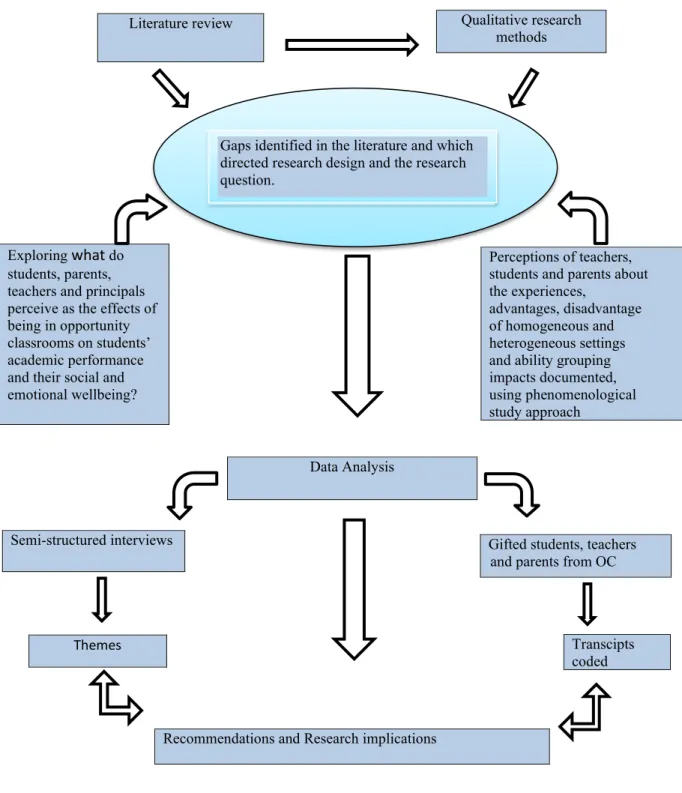
The research framework (see Figure 1.1) was used for the current study’s development, design and its analysis. In the first phase, through a literature review, I identified the gap and then developed research questions. The literature review helped to identify the controversy on ability grouping and its academic and social emotional benefits, along with determining inconsistent results from past research regarding ability grouping.
7
A phenomenological study approach was used to explore the in-depth understanding of the effectiveness of ability grouping for gifted and talented students through the perceptions of teachers, pupils and parents in opportunity classes. The last phase involved data analysis of the semi-structured interviews and led to the research recommendations and implications for future research.
8
Literature review
Figure 1.2 Research framework
1.7 Definitions of key terms
Comprehensive classroom. A classroom that includes students of all ability levels.
Gifted. A student who possesses exceptional cognitive and creative ability requiring special programs and services beyond regular classrooms.
Qualitative research methods
Recommendations and Research implications Data Analysis
Gifted students, teachers and parents from OC
Transcipts coded Semi-structured interviews
Perceptions of teachers, students and parents about the experiences,
advantages, disadvantage of homogeneous and heterogeneous settings and ability grouping impacts documented, using phenomenological study approach Themes Exploring what do students, parents, teachers and principals perceive as the effects of being in opportunity classrooms on students’ academic performance and their social and emotional wellbeing?
Gaps identified in the literature and which directed research design and the research question.
9
Gifted education. The programs and services designed to address the needs of gifted students. Gifted underachievement. This may occur when gifted students’ needs are not met and discrepancies exist between their abilities and achievement levels over a period of time (Siegle et al., 2012).
Homogeneous grouping. Students with similar ability levels are placed together to work at their level. Such grouping is also termed “ability grouping”.
Heterogeneous grouping. Students are grouped with mixed ability levels in the classroom. Instructional practices. Instructional practices refer to the strategies used by teachers to develop their pupils’ interests and abilities (Dai & Chen, 2013).
Like-minded peers. When students work or study with other students at the same intellectual level.
Opportunity classes (OCs). In New South Wales, these are self-contained classes for gifted and talented students, with full-time ability grouping, and operating in Years 5 and 6 of primary schooling.
Selective schools. “Selective high schools cater for the specific needs of high achieving gifted students who may otherwise be without sufficient classmates at their own academic and social level” (NSW DOE,2019). Students enter selective high schools in year 7.
1.8 Organisation of chapters
The current study was organized into five chapters. Chapter One presented the introduction to the study, including the background context, problem statement and identified research questions. Moreover, I outlined the theoretical framework of the study. The aim of the research and its significance was also discussed in this chapter. Key terms were defined for readers’ understanding and clarity.
Chapter Two details the literature relevant to the research. This involved the analysis of previous research on gifted and talented education in the Australian context, definitions of giftedness, the
10
educational needs of gifted and talented students, the controversy on ability grouping and the benefits of ability grouping.
The research method is outlined in Chapter Three. This chapter provides descriptions of the research design, site selection, participants and their recruitment, the research tools and procedures used to conduct the current study. A description of the data analysis procedures was also included. Chapter Four presented the results of the data gathered following the data analysis. In Chapter Five, I presented discussions of the current study’s findings and outlines the limitations with recommendations for future practice and research. Finally, the conclusion of this study is presented.
11
Chapter 2
Literature Review
2.1 Definition of giftedness and policy in Australia for gifted and talented students
The definition of giftedness has been in a state of evolution for a long time within Australia and the rest of the world (Stephens & Karnes, 2000). Reis and Renzulli (2004) commented that the numerous definitions and conceptions in educational research increase the complexity in terms of deciding who is gifted and who is not.In Australia, the conceptions of the gifted and talented proposed by Tannenbaum (1983), Renzulli (1978) and Gagné (2008) are widely accepted with all mentioned in the Australian curriculum (ACARA, 2016). Tannenbaum’s model incorporates five factors, which include a sliding scale of general intelligence, distinctive special aptitudes, intellective traits, environmental, and chance. The Tannenbaum Model divided the gifted and talented population into two types, producers and performers. These two types of gifted people demonstrate their talent either creatively or proficiently, respectively. Renzulli’s Three-Ring Model (1978) defined giftedness in terms of three basic traits: a) task commitment, b) above average ability, and c) creativity. Moreover, he sees gifted individuals as those who possess or can develop this composite set of traits and apply them to any potentially valuable area of human performance. Reis and Renzulli (2010) argued that the current concept and definition of giftedness has become more multidimensional and broader and ranges from general to more specific based on intellectual and non-intellectual traits.
Gagné (2000) provided the connection between potential achievement and performance in his DMGT model. It is widely accepted in Australia due to its logical connection with the teaching and learning process. Recently this model was renamed as the Integrative Model of Talent Development (IMTD; Gagné, 2018). According to Gagné, giftedness consists of the four domains of natural abilities: intellectual, creative, socio-affective and sensorimotor. Gagné posited that
12
“these four domains entertain only low or null correlations with one another: thus, intellectually gifted individuals are not necessarily gifted creatively, socially, or physically” (Gagné, 2007, p. 94). He further added that commitment and effort is necessary for giftedness and talent so if the right learning environment is provided the individual may be able to demonstrate abilities in other areas. Gagné did not accept the “one term fits all” use of talent. His model described a broader meaning rather than a description of properties.
Schools must have a clear understanding about the type of gifted programs they can offer and the students attending these programs. In this way teachers can better meet the needs of gifted students who are gifted irrespective of their cultural background, diversity, special needs and behaviour. According to Gagné (2000), when a student participates in systematic learning and practice, talent develops. The talent development process is affected by the catalysts, intrapersonal (physical, motivation, self-management, and personality) and environmental (milieu, persons, provisions, and events). Matthews and Dai (2014) encapsulated Gagné’s idea of giftedness in this statement:
a dynamic, domain-specific and socially mediated process, resulting from the complex interactions of disposition, aptitudes and social-cultural environment, leading to diverse pathways and outcomes. (p. 347)
Another important aspect of the DMGT model is chance, which Gagné suggests plays an important role in the transformation of giftedness into talent. He further emphasised that training and practice are crucial mediating elements.
Although there has been research into gifted education policy in terms of curriculum, programs, and school reform in the UK and USA, there are fewer studies conducted in Australia. Frydenberg and Mullane (2000) stated that in 1973 the Australian Government observed the “desirability of providing special educational opportunities to students who have demonstrated their abilities in
13
particular field of studies including scientific, literary, artistic or music studies” (p. 79). The movement for gifted and talented education in Australia gained momentum after the first world conference on gifted and talented in London (Braggett, 1993). Despite all efforts such as the establishment of conferences, out-of-school programmes, associations for gifted and talented children, publications in journals and family counselling, there was at that time a lack of co-ordination on educational policies for gifted and talented in all states and territories because of issues of definition, identification, educational needs, ways of differentiating provisions, state level programs and a source of funding. The Australian Senate considered a national educational policy for gifted and talented students as an “appropriate goal” in 2001. This committee concluded that there had been some positive development since 1989 but much remained to be achieved. In 2008 the Melbourne Declaration on Educational Goals for Young Australians included two goals of “excellence and equity” and “successful learners, confident and creative individuals, and active and informed citizens”. The document recommended that we should “promote a culture of excellence in all schools, by supporting them to provide challenging, and learning experiences and opportunities that enable all students to explore and build on their gifts and talents” (p. 7).
Many states and territories in Australia have updated their educational policies for gifted and talented education but still there is an absence of specific policy at the national level, with disagreement remaining about the equitable educational environment that would best cater for their needs. It is a common assumption in Australian culture that gifted students can do well at school without any exceptional intervention (Porter, 2005). VanTassel-Baska (1992) noted that gifted and talented students have the right to consistently receive educational treatment designed for their academic needs. She outlined that well-informed educational leadership plays a significant role in creating an organised, thoughtful plan of curriculum development. Leadership must understand that high potential learners are effective in increasing the GDP of the country. James Heckman, a Nobel prize winning economist, stated that high ability learners have a significant impact on economy and society (Wai & Worrell, 2017). Since 2000 the performance of Australia in International Mathematics and Science Study (TIMMS) and PISA has been
14
decreasing significantly which shows high concerns for highly intellectual students (Masters, 2015).
By Year 4, the top 10% of Australian students in mathematics perform at about the same level as the top 40% of students in Singapore, Korea, and Hong Kong. By Year 8, this gap has widened, with the top 10% of Australian students performing at about the same level as the top 50% of students in Singapore, Korea, and Chinese Taipei. (Masters, 2015, para. 4)
Like general education, there should be organised policies and plans for gifted and talented education in Australia.
2.2 Educational provision for gifted and talented students
Gifted and talented educational programs and provisions sometimes are ignored due to insufficient funding and lack of administration (Rogers, 2002) but in Australia despite the variation among state policies and programs, services for gifted and talented have not been completely ignored. Kronborg (2002) noted that the Australian community has more informed understanding and attitudes are becoming more open and accepting to the needs of gifted and talented students.
The second Australian Senate Inquiry on the Education of Gifted Children (2001) highlighted the importance of teacher education, educational provisions for gifted and talented students, identification of high intellectual potential and provision of opportunities to foster talent by avoiding negative outcomes (Collins, 2001; Plunkett & Kronborg, 2007; Roth, 2017). The Australian Curriculum (ACARA, 2016) acknowledges that gifted and talented students “are entitled to rigorous, relevant and engaging learning opportunities drawn from the Australian Curriculum and aligned with their individual learning needs, strengths, interests and goals” (p.1).
15
For the last 10 years, the number of classes for gifted students has been increased and a mentor links program and talent development project have been introduced. According to the NSW Government Department of Education and Training (2015b), there are selective secondary schools (17 fully and 25 partial selective schools), 75 primary (opportunity classes) and students in rural and remote areas have virtual selective stream (NSW DET, 2015a). These are all provisions which are available on a highly competitive basis. The NSW Department of Education and Training introduced the new policy for gifted and talented education in 2004 with the aim of “identifying gifted students, implementing professional learning, developing school policy and establishment of procedure for evaluation of gifted programs in schools”. This educational policy was revised recently in 2017 and stressed the practice of gifted education in order to provide rich learning environments to foster gifted students. Landrum (2006) commented on the importance of gifted educational provisions:
All aspects of gifted education programming and services…must emanate from highly able students’ recognizable educational needs that manifest themselves in their cognitive, psychosocial and physiological development. (p. 1)
Extensive literature has emphasised that gifted and talented students have the capability to learn more rapidly and at a level of complexity in advance of their age peers, in an appropriately challenging environment that develops their academic skills systematically (Rogers,2007). Kronborg and Plunkett (2015) conducted a study on high ability students to determine the effectiveness of an Extended Curricular Program. They concluded that these students need appropriate educational provisions including ability grouping, acceleration and differentiated curriculum.
Research has suggested that due to a consistent lack of challenge in the school environment, the intellectual ability and motivation of gifted students may decline as early as the first year of schooling (Karaduman, 2013). This is seen as the cause of increasing gifted underachievement at the elementary or primary level over a period of time (Gibbons et al, 2012).
16
When Kanevsky and Keighly (2003) interviewed gifted and talented students about their experience of schooling many reported boredom at school. I concluded that gifted students needed more choice and learning control, a higher level of challenge and complexity, and teachers who care. Hence the optimal educational or learning environments are required to provide appropriate educational pathways and challenging experiences such as grouping arrangements, individual research, mentoring, online learning, professional development, along with enrichment, extension and acceleration. VanTassel-Baska stated that “acceleration is appropriate curriculum services at a level commensurate with gifted child’s demonstrated readiness and need. It is a rapid rate of a child’s cognitive process” (cited in Brody, 2004, p. 70). Acceleration includes early entrance at any schooling level, grade skipping, subject-acceleration and advanced placement courses. Further acceleration options include self-paced classes, fast-paced classes, and compressed classes with a goal to cover two years of material in one academic year.
Research evidence (Gross, 2004, 2006; Kulik, 2004) has showed that acceleration has an overwhelming positive effect on the academic achievement of gifted students. Enrichment involves activities that are designed to expand interests and talent identification of gifted children. The goal of enrichment classes is to engage gifted and talented students in more depth as compared to traditional classes (Subotnik et al, 2011). Kim (2016) stated in her meta-analysis that enrichment programs have a positive effect on gifted students’ academic achievement and socioemotional development. Extension activities are beneficial for those gifted students who have already mastered a subject in which others in the class need additional work (Rogers & Vialle, 2009). Additionally, gifted students’ participation in enrichment and accelerated classes create a sense of social support and diminish their feelings of uniqueness and loneliness (Rinn, 2018). Tieso (2005) stressed that it is important that challenging curriculum and enduring concepts are provided for high ability students whether they are in enrichment, honours or regular classrooms.
17
Gifted teenagers may be affected by psychological distress or boredom when they cannot move forward; their level of stress will be high when they do not find challenging classroom settings. Kulik and Kulik (1992) warned schools that if they eliminated acceleration from classes the damage would be profound. The US Department of Education presented a report in 1993 which stated that the curriculum taught to gifted students in regular classrooms failed to challenge them because they had already “mastered” it with the result that it created boredom, stress and depression for students when they were forced to learn it again. Such academic approaches can lead to a loss of interest, lack of motivation and underachievement (Delisle & Galbraith, 2002). Therefore, Karnes and Bean (2009) questioned whether “given aspirations for preparing young people to be outstanding contributors, are there pedagogical practices that are appropriate only for gifted children?” (cited by Subotnik, Olszewski-Kubilius, & Worrell, 2011, p. 23).
The purpose of the curriculum should be to provide opportunities at an optimum level for the gifted learner as their needs are different from typical learners and the curriculum must therefore be designed accordingly. VanTassel-Baska and Stambaugh (2006) mentioned the three successful curriculum dimensions, i) content mastery dimension, ii) the process and product dimension, and iii) the epistemological concept dimension, for gifted learners. Appropriate programming and curriculum have a positive effect on student achievement in terms of lifelong learning and talent development (Hendrick, 2008). VanTassel-Baska (2003) highlighted that gifted students’ precocity, intensity, and their complexity are such characteristics that must be considered to plan and develop their curriculum. Rogers (2007) pointed out that “every identified gifted child must be given consistent, progressively more difficult curriculum that has been articulated across grade and building levels and has been consciously delivered” (p. 385). If gifted and talented students are forced to move at the same pace as others, their achievement level would be reduced (Kulik & Kulik, 1992). Tieso (2002) believed that learning suffers when all students are taught one curriculum without understanding their readiness. As mentioned earlier, a challenging curriculum and faster pace contribute significantly to the talent development of gifted students but “time with like-minded peers” is another important factor which can be achieved through cluster grouping,
18
peer dyads or like-ability co-operative groups. According to Hendrick (2008) “allowing gifted students to have adequate time with their intellectual peers in a challenging and supportive environment promotes enthusiasm for learning and a positive attitude towards school” (p. 84).
Research studies have emphasised that gifted students benefit from spending most of their time with like-performing classroom peers as it helps them take social emotional risks and to spark one another’s potential (Bate & Clark, 2013), to develop innovative ideas, to become more mastery-oriented and self-directed in their approach to learning (Moon et al., 2004). These result in enhancing the gifted students’ cognitive and social skills. Gifted students need an educationally supportive and challenging environment that gives them the opportunity to develop academic talent and enhance social and emotional well-being. Vygotsky’s (1978) concept of the ‘zone of proximal development’ is relevant to the needs of high ability learners. The zone of proximal development is “the distance between the actual developmental level as determined by independent problem solving and the level of potential development as determined through problem solving under adult guidance or in collaboration with more capable peers” (Boblet, 2012, p. 3). In the case of ability grouping, teachers should be careful in delivering curriculum and instruction that is suitable to the gifted and talented students and what these students are capable of, within the zone of proximal development. There are a number of grouping options available such as full-time ability grouping (opportunity classes and selective schools), within-class grouping, cluster grouping, cooperative grouping and pull-out programs to teach gifted and talented students in groups. Rogers (2007) emphasised that “there is no single practice or panacea that will work in every school setting and with every gifted and talented learner” and “there are many different ways in which these options for gifted learners can be offered…it is completely up to schools to select those…work best with its current philosophy, staff and school community” (p. 382).
19
2.3 Controversy on ability grouping
Ansalone (2000) stated that after the introduction of the Binet Intelligence Test, the practice of ability grouping of students became popular in 1920 in American schools. The implementation of the Harris Plan in public schools that introduced “segregation by ability” had made the history of ability grouping controversial (Ansalone, 2000). According to Loveless (1998), ability grouping lost popularity due to the perceived negative impact on the self-esteem of low ability students. The conflict about ability grouping was exacerbated in the 1980s due to political change rather than pedagogical reasons with the label of “elitist”, “racist” and “socioeconomic inequalities” being often applied to the practices of grouping (Oakes, 1986; Slavin, 1987). Collins and Gann (2013) claimed that low ability students experience poor quality instruction in homogeneous grouping.
The arguments against ability grouping may result in the degradation of educational opportunities and a lack of concern for gifted students who need extra assistance. The attack on ability grouping is due to polemic and socio-political interference rather than evaluative and educational issues (Gross, 2001). Fiedler et al. (2002) clearly warned that “eliminating ability grouping because of inequitable identification procedures is tantamount to throwing out the baby with the bath water” (p. 110).
Opponents of ability grouping label it as “tracking” (Oakes, 1986)). However, research showed that there is a difference between ability grouping and tracking, with the former defined as an organising mechanism (Tieso, 2003; VanTassel-Baska, 1992) by which students of similar ability or achievement level (Miller & Druden, 1992) within a school curriculum are together for instruction. However, tracking is a process that ordinarily implies assignment to a special sequence or program of class with other students of similar general ability for a relatively long period of time. Borland et al. (2002) stated that tracking is a rigid and static practice as compared to ability grouping, which is flexible and involves grouping students according to their needs rather than a “caste like” system or “sorting”. Oakes (1986) stated that there is no gain in ability
20
grouping and children with low aptitude have negative academic outcomes when in homogeneous grouping (Kelley, 2018). She suggested that ability grouping has devastating effects, overall zero effects on every group of learners, is unsuitable for preparing students for higher education or employment, lowers academic expectation and quality of education, students became disillusioned, demotivated and respond badly under pressure and competition, and restrictive to the opportunity of some students.
Opponents suggest the elimination of ability grouping would improve academic achievements and cultural development in the classroom (Cagnole et al., 2004; Hallam & Ireson, 2005; Slavin, 1986). Slavin (1990a) stated that “I am practically opposed to any school organization plans in which programs for the gifted create de facto ability grouping” (cited by Brody, 2004). The inclusion philosophy is another challenge to the practice of ability grouping for gifted and talented students. Stainback and Stainback (1996) argued in favour of inclusion:
Exclusion in schools sows the seeds of social discontent and discrimination ... (whereas) inclusive schooling is the practice of including everyone, irrespective of talent,
disability, socioeconomic background, or cultural origin, in supportive mainstream schools and classrooms where all student needs are met ... society makes the conscious decision to operate according to the social values of equality for all people with the consequent results of enhanced social peace. (p. 3)
The movement of inclusion emerged with an attempt to ensure that all students with special learning needs get maximum benefit from heterogeneous grouping. Sermier Dessemontet and Bless (2013) advocate for inclusion by stating that disadvantaged students can attain high academic achievement with inclusion in the regular classroom setting. The proponents of the inclusion movement believe that high ability students must learn with students of a diverse range of abilities to get life experience and a sense of community building in the classroom (Bikarian, 2009).
21
The research literature highlights that placing students in a heterogeneous setting has a negative impact on high ability students. The “one size fits all” strategy of the inclusion movement is not the best practice for the gifted learner. They might become bored and frustrated due to lack of challenges and repetition and as a result fail to reach their potential (Rogers, 1998). On the other hand, low ability students may experience the interruptions and less allocation of time for reading (Heltemes, 2009) with a result of detrimental effects on academic progress and self-esteem of low ability students. Additionally, many teachers cannot meet the needs of such a diverse group in an inclusive classroom. Gifted students should be placed in an appropriate setting according to their needs and abilities (Benson, 2002; Robinson et al., 2000; Rogers, 2002; Shields, 2002). Allan (1991) pointed out that “the thorniest issue concerning grouping and the gifted is whether the gifted are needed in the regular classroom to act as role models for other students and whether this use of gifted students is more important than their own educational needs” (p. 64).
Tieso (2003) was concerned that equity and racism issues for gifted students have degraded their “educational opportunities” and showed a “lack of concern for extra assistance”. She further pointed out that equity is a noble goal but not at the expense of some students. The movement of tracking and inclusion are two major challenges that gifted and talented students are facing today with also issues of identification, provisions and policies. Such practices of grouping of gifted students might detract the educators from basic quality gifted programs (VanTassel-Baska, 1992). Due to a lack of enough stimulation, gifted students are the most disadvantaged group when it comes to meeting their full potential according to some researchers (Braggett, 1985, cited by Merrotsy, 2003). The movements of tracking and inclusion sabotaged the potential, performance and motivation of gifted students and placed them in unchallenging and less productive settings by labelling them “dummies”. The plight of the gifted student has increased with research showing that some schools have completely ignored them. Tolan (1996) best described the state of the disadvantaged gifted child:
22
A cheetah running forty miles per hour might be impressive to some observers, but it is drastically underachieving in comparison to its potential. Similarly, if a cheetah only has to chase after rabbits who run 20 m.p.h., it won't run 70 m.p.h.… If a cheetah is kept in a small cage and fed only a steady diet of zoo chow, it will cease to run at all. By not providing special instruction, schools offer gifted students the academic equivalent of zoo chow. (p.32)
2.4 Research on ability grouping of gifted and talented students
Research on ability grouping of gifted and talented students consists of several studies and meta-analyses, which shows its effectiveness. Ability grouping is important to fulfil the needs of gifted students whether it is full-time or part-time and where they are engaged in learning by encouragement, stimulus, and expression of their abilities (Vidergor & Azar, 2015). Rogers (2007) stated that “the more time this occurs for gifted children, the more positive the effects” (p. 389).
High ability grouping influences the motivation of students, increases their self-confidence and self-regulation and as a result, teachers are more willing to cover curriculum at faster pace. Hence, students work as a team with equal contributions because they have similar ability levels. Moreover, when teachers use practices like ability grouping, revised and differentiated curriculum to enhance high level thinking skills of gifted students, there are always positive academic gains (Delisle, 1997; Kulik & Kulik, 1990; Wiggins & McTighe, 1998, cited in Tieso, 2005). The meta-analysis by Kulik and Kulik (1992) examined ability grouping for gifted and talented students. This meta-analysis was based on five different instructional programs that grouped students by ability. The purpose of this meta-analysis was to answer the opponents of ability grouping who advocated de-tracking and were calling on schools to eliminate ability grouping. The analysis highlighted that if only multilevel classes were removed then there would be relatively little negativity. The high ability students would face a small decrease in their achievement level in the case of replacement of multilevel classes into mixed ability classes, however, there would be no
23
effect on the achievement level of other students. If schools eliminated ability grouping programs the result would be broadly felt and the academic achievement levels of both high ability and low ability students would fall dramatically. This would be a great harm academically and emotionally. Johnson and Johnson (1989) noted that “there are times when gifted students should be segregated for fast paced accelerated work. There are times when gifted students should work alone. There are times when gifted students should compete to see who is best” (p. 1).
However, Brody (2004) pointed out that the achievement of gifted students is negatively affected when they are grouped in heterogeneous settings. Adodo and Agbayewa’s (2011) argument about the effectiveness of ability grouping for high and low achievers challenged the opponents’ views on the disadvantages of ability grouping for low achievers:
When students are grouped heterogeneously, there is the possibility that the low achievers and the slow learners will be denied the opportunity to receive attention from the teacher as the general assumption of the teachers is that all is well with all members of the class. Students are also not motivated to learn because of the personal fear of poor performance. From this study, the average- and low-ability students benefit
academically from homogeneous grouping science class settings than the heterogeneous group. (p. 53)
The research on gifted students showed that there is a positive relationship between poor social emotional development and academic underachievement (Blass, 2014). However, advocates of ability grouping argued that high and low ability students can get maximum benefits from social interaction when grouped with like-ability peers and achieve high scores as compared to heterogeneous classrooms for gifted students (Clark, 2013; Cohen et al., 2010; Goldring, 1990; Rogers, 1991, 2001, 2002b). Reis and Renzulli (2004) raised the concern that mismatched environments which are unresponsive to pace and level of gifted students have a detrimental effect on their social and emotional well-being. They described different practices that promote healthy social-emotional relationships including an accelerative learning environment and time to learn
24
with others of similar abilities, interest and motivation. Cross and Swiatek (2009) found that if schools provide the opportunity to work with intellectual ability peers then gifted students showed high levels of social acceptance and psychosocial adjustment. There are gains in the social and emotional development of gifted students when their needs are met through appropriate ability grouping practices (Smith & Laura, 2009). Rance-Roney (2010) stated:
When the objective is for learners to work with a problem and achieve consensus on a solution, this homogeneous grouping scheme will maximize chances for all group members to engage in conversation (p.23).
This shows that ability grouping is useful for gifted learners to accept and understand differences (Winebrenner & Devlin, 2001). Many studies raised objections against full-time ability grouping in terms of student isolation, pressure to perform, the Big-Fish-Little-Pond-Effect (Seaton, Marsh, & Craven, 2009), actual reduction in heterogeneity (Slavin, 1987) and social-emotional suffering (Gross, 2004). However, the literature on full-time or part-time ability grouping is scarce but it has a significant impact on school-related interests, academic development, less disruptive behavior, high degree participation, student teacher relationship and socio-emotional support (Delcourt et al., 2007; Hattie, 2002; Neihart, 2007; Rogers, 2007; Vidergor & Azar, 2015; Vogl & Preckel, 2014). Moreover, most of the gifted student participants in the study of Moon et al. (2004) responded that the homogeneous environment was a “safe haven, a place they could be themselves without fear of ridicule” (p. 7). Shield (2002) argued that gifted students in gifted classes showed more development in their career of interest.
2.5 Conclusion
In such a controversial climate, it is difficult to decide the benefits of ability grouping for gifted and talented learners. Some studies (Clark, 2013; Kulik & Kulik, 1992; Rogers, 2002, 2007; Tieso, 2003, 2005) showed the positive effect of ability grouping while other studies (Oakes, 1986; Slavin, 1986, 1990) showed contradictory assertions about ability grouping. Due to the lack of research in the NSW context and the prevailing controversy about ability grouping, research
25
on ability grouping in this context is essential in the field of gifted and talented education. Moreover, as the students in opportunity classes have come from heterogeneous classroom settings beforehand, they can best compare their experiences. Thus, it is important to investigate the effectiveness of gifted programs (Coleman et al., 2015) such as ability grouping in NSW. The factors of effectiveness such as social-emotional development and academic achievement are not widely researched in previous studies in NSW Australia. There should be individualised educational plans for gifted students. Kanevsky (2013) stated that:
Ideally, every student’s education should be personalized and authentic. It should take full advantage of all of the students’ potentials (academic and nonacademic), passions and interests, strengths, struggles, and preferences. (p.1)
26
Chapter 3
Method
3.1 Introduction
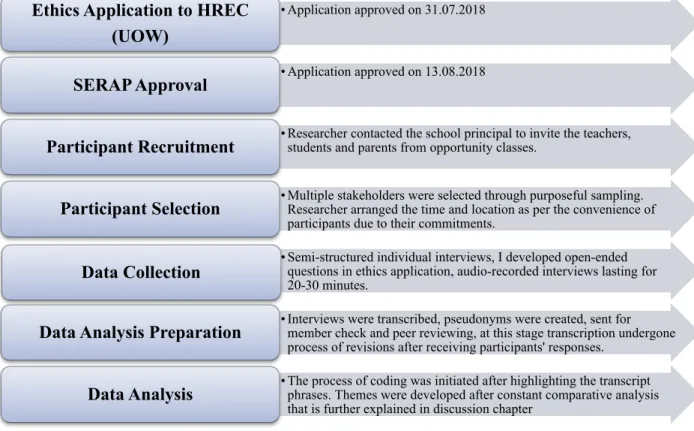
The purpose of this qualitative study was to investigate the perceptions of multiple stakeholders about the effectiveness of ability grouping of the gifted student in NSW primary schools. This research approach, according to Denzin and Lincoln (2011), helps to make the world visible by exploring complex issues. For several years, the costs and gains related to ability grouping have been a controversial issue (Neihart, 2007; Slavin & Oakes, 1985). This research was especially interested in how ability grouping impacts the social and emotional well-being and academic achievement of gifted students. Research has showed that gifted students can perform better with their like-minded peers, and that ability grouping results in high academic achievement and an increase in social and emotional development (Kulik & Kulik, 1982; Rogers, 2002b). This study helped to answer the question of whether ability grouping is effective for gifted students in terms of their social-emotional well-being and academic development through the perceptions of multiple stakeholders (Parents, Teacher, Students, and Principal). This chapter describes the research design, research questions, setting of the investigation, data collection and analysis. Moreover, it addressed the issues of trustworthiness and ethics. Permission and ethical approval were sought from the University of Wollongong Ethics Committee and from SERAP, Department of Education (NSW).
3.2 Research Design
The research question, as indicated earlier, was What do students, parents, teachers and principals perceive as the effects of being in opportunity classrooms on students’ academic performance and their social and emotional wellbeing? The design of this study sought to gain in-depth understanding of the lived experience of gifted students in full time gifted classes along with their parents and teachers. Creswell and Clark (2007) described the research design as “the
27
plan of action that links the philosophical assumptions to specific methods” (p. 4). Therefore, the research design of the current study drew on Gagné’s DMGT model and Rogers’ grouping synthesis, and utilised a qualitative research method to explore the relationships among related components.
The study utilized a qualitative phenomenological design, which means that dialogue and open-ended questions were used during the participants’ interviews and comprehensive detail and description of the investigated phenomena were taken (Giorgi, 2008; Moustakas, 1994). In this study, the perceptions of multiple stakeholders regarding their experience in ability grouping was the phenomenon in question. Phenomenology was chosen to gain understanding of the subjective experience of the participants, gaining insight into their motivations and actions (Lester, 1999). The study sought to gain knowledge as to the effect that ability grouping has on the academic and social-emotional outcomes for gifted students. Moustakas (1994) stated that:
the aim of phenomenological research is to determine that what an experience means for the people who have had the experience and are able to provide a comprehensive description of it. From the individual descriptions general universal meaning are derived, in other words the essences or structures of the experience. (p. 13)
In this study, the data collected from multiple stakeholders including families, teachers and administration enabled me to get the broader understanding about the effectiveness of ability grouping in terms of academic and social emotional development. Moreover, the study sought to gather the information that could assist educational researchers, school leadership and teacher to implement the strategies that might helpful in resolving the academic and social emotional issues faced by gifted and talented students.
In line with this approach, I was involved in the whole study. I conducted all data collection, transcription and data analysis processes. Data were collected through open-ended questions and in-depth interviews with participants, including students, teachers, parents, and the school
28
principal. I audio-recorded interviews with the permission and consent of the interviewees and then transcribed them. The verbal assents were also given by students before starting interview. Member checks by participants were conducted after the completion of recording, and the transcription of their interview to ensure that they agreed on the correctness and accuracy of the work. With strict confidentiality, pseudonyms were used in all note-taking and in the transcription of the interviews. The interviews rested on the framework supplied by research questions mentioned in the introduction of the method chapter. I ensured that I adopted careful listening and understanding of the perceptions of participants, through careful data analysis. I was able to become closer to the core of essence as I moved from details to themes during data analysis.
3.3 Site and participants
In NSW, the Department of Education is responsible for the public, private, non-government and independent schools (DOE NSW, 2015). At the time of writing, there were 76 public schools operating self-contained opportunity classes (OCs) and 22 full selective and 24 partial selective government secondary schools serving gifted and talented students (DOE NSW, 2018). Entrance to these OCs is highly competitive and based on the students’ academic merits as measured by placement tests and assessment tasks in the regular class. Opportunity classrooms represent one form of ability grouping and, as the focus for this study, was how ability grouping was operationalised. The DOE’s educational policy for gifted and talented students was based on Gagné’s DMGT, which defines giftedness as a broad concept and reflects that gifted students vary in nature and abilities such as intellectual, creative, leadership, social and physical skills. The policy emphasised that appropriate opportunity, stimulation and experiences are important to address the students’ potential (DOE NSW, 2004). This model indicated that school communities must be sensitive to the giftedness and talent development of these young students by observing the factors that positively or negatively affect such development.
29
Currently there are various programs running in NSW schools to deal with the social-emotional and academic development of these high-potential students because of the recognition that without special attention, underachievement may occur. The NSW Education Standards Authority is responsible for teaching accreditation and introduced the requirement for professional learning for all teachers to maintain accreditation. This has led to an increase in professional learning courses in recent years (Howard et al,2016). While all public schools run staff development days, currently pre-service courses in gifted and talented are limited. As a result, many teachers are not equipped to address the issues faced by gifted and talented students. It is within this political context that the study was conducted and the site selected.
The site was selected from the NSW DOE website, which listed all schools that included OCs for gifted and talented students. The location of the site was a public primary school located in the inner west suburb of Sydney, where the population is highly multicultural. The inclusive learning environment and diverse community that promoted academic achievements and social development was the predominant reason to conduct the study in this specific school. The vision of the school reflects innovative and creative 21st century educational instructional practices in an inclusive, engaging, enriched and supportive classroom environment (School website [deidentified], 2019). The school has been serving gifted and talented students through the OC structure for two years. Its population consisted of 460 students with 75% of the students from a non-English speaking background.
The selection of participants was based on the notion that these stakeholders were experiencing ability grouping so they could better explain the effectiveness of ability grouping compared to their prior experience of heterogeneous grouping. The choice of the participants was made with a view to those who understand the study’s research problem and could therefore respond to the research questions accordingly (Crotty, 1998). By doing this, I was enabled to gain insight and rich information from gifted students, their teachers and their parents. Considering time
30
availability and travel cost, it was a “convenient sampling” because the school was located conveniently close to the researcher and met the criteria for inclusion in the study.
The participants for this study were ten gifted students from grade 5 (10-11 years old) and grade 6 (11-12 years old), five from each class. The teachers and vice principal invited the students in the OC class to participate through a self-nomination approach. All the participants voluntarily agreed to take part in the study. Ten parents of the gifted students were also invited to participate. Some parent participants found it difficult to schedule an interview due to their working commitments. The population of parents were living in Sydney and came from Asian, European and Australian backgrounds, and most of them were residing near the school. Parents of the gifted students were literate and fully equipped with information in the area of gifted education. Two fathers and eight mothers were interviewed about the effectiveness of ability grouping for their children. The two teachers of the two opportunity classes, who had both completed professional courses in gifted and talented education from universities, were invited for interview. The school principal has also completed a postgraduate degree in gifted and talented education and several other professional training courses in gifted education. For selection of participants purposeful sampling was used. A summary of the participants is illustrated in Table 3.1.
31 Table 3.2 Participants’ attributes No. of Participants Participants sampling Gender Qualifications in gifted education Additional Information one
principal Administration F Postgraduate degree and training courses Experienced in teaching gifted students, currently supervising OC teachers and running successful projects for G&T students.
two
teachers Grade 5 F Professional training Experienced to teach gifted students, Australian cultural background
Grade 6 F Professional
training Experienced to teach gifted students, Australian cultural background Ten
students 5 from Grade 5 8F 2M N/A Asian, European and Australian cultural backgrounds 5 from Grade 6
Ten parents 5 from Grade 5
5 from Grade 6 8F 2M Literate, knowledgeable about gifted education
Asian, European and Australian cultural backgrounds, 7 mothers and 2 fathers were full time working parents, 1 mother casual worker.