Pseudonymity, and Identity Management
(Version v0.34 Aug. 10, 2010)Andreas Pfitzmann
Marit Hansen
TU Dresden ULD, Kiel
[email protected] [email protected]
Archive of this document
http://dud.inf.tu-dresden.de/Anon_Terminology.shtml (v0.5 and all succeeding versions) Starting with v0.20, color is essential to understand the figures and part of the translations. Abstract
Based on the nomenclature of the early papers in the field privacy by data minimization, we develop a terminology which is both expressive and precise. More particularly, we define anonymity, unlinkability, linkability, undetectability, unobservability, pseudonymity (pseudonyms and digital pseudonyms, and their attributes), identifiability, identity, partial identity, digital identity and identity management. In addition, we describe the relationships between these terms, give a rationale why we define them as we do, and sketch the main mechanisms to provide for the properties defined. Table of contents 1 Introduction...6
2 Setting ...6
3 Anonymity...9
4 Unlinkability ...12
5 Anonymity in terms of unlinkability ...14
6 Undetectability and unobservability...16
7 Relationships between terms ...19
8 Known mechanisms for anonymity, undetectability, and unobservability...20
9 Pseudonymity...21
10 Pseudonymity with respect to accountability and authorization ...24
10.1 Digital pseudonyms to authenticate messages ...24
10.2 Accountability for digital pseudonyms...24
10.3 Transferring authenticated attributes and authorizations between pseudonyms...24
11 Pseudonymity with respect to linkability ...25
11.1 Knowledge of the linking between the pseudonym and its holder ...25
11.2 Linkability due to the use of a pseudonym across different contexts...26
12 Known mechanisms and other properties of pseudonyms...28
13 Identity management...29
13.1 Setting...29
13.2 Identity and identifiability...29
13.3 Identity-related terms ...31
Partial identity...31
Digital identity ...32
Virtual identity...32
13.4 Identity management-related terms ...33
Identity management...33
Privacy-enhancing identity management ...33
Privacy-enhancing identity management enabling application design...33
User-controlled identity management ...34
Identity management system (IMS) ...34
Privacy-enhancing identity management system (PE-IMS) ...34
User-controlled identity management system ...34
14 Overview of main definitions and their opposites ...35
15 Concluding remarks ...35
References ...35
Appendices...38
A1 Relationships between some terms used...38
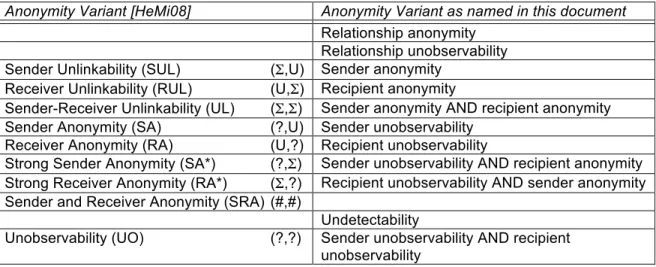
A2 Relationship to the approach of Alejandro Hevia and Daniele Micciancio ...38
A3 Relationship of our definitions of anonymity and of identifiability to another approach ...40
Index...41
Translation of essential terms ...44
To Czech ...44
To Dutch ...49
To French ...54
To German...59
To Greek...64
To Italian ...69
To Japanese ...74
To Russian...79
To Slovak...85
To Turkish ...90
To <your mother tongue> ...95
Table of figures Fig. 1: Setting ...7
Fig. 2: Example of an attacker’s domain within the setting ...8
Fig. 3: Anonymity sets within the setting ...10
Fig. 4: Anonymity sets w.r.t. attacker within the setting ...11
Fig. 5: Unobservability sets within the setting ...18
Fig. 6: Unobservability sets w.r.t. attacker within the setting...18
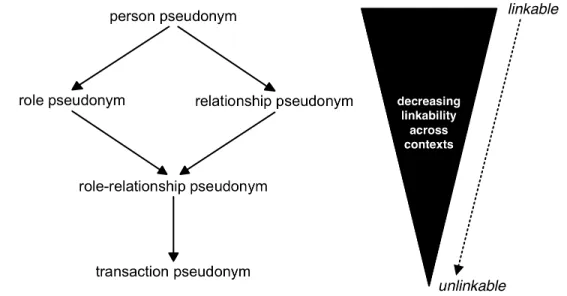
Fig. 7: Pseudonymity...23
Fig. 8: Lattice of pseudonyms according to their use across different contexts...27
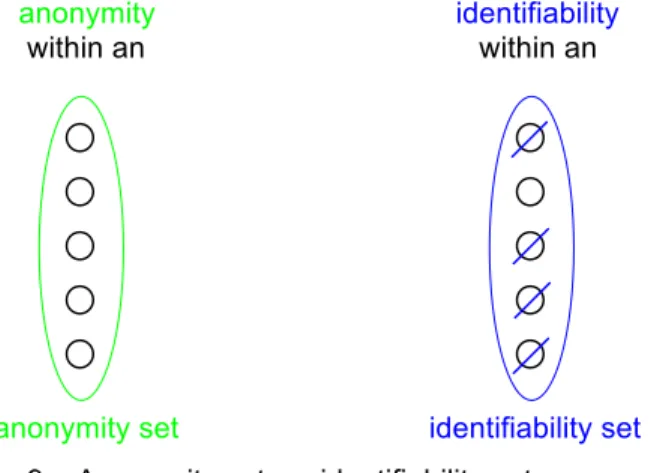
Fig. 9: Anonymity set vs. identifiability set...30
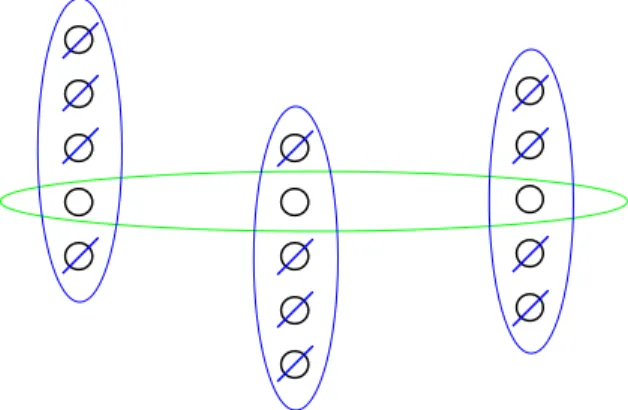
Fig. 10: Relation between anonymity set and identifiability set...32
Table of tables Table 1:
Close matches between terms...39
List of abbreviations
DC-net Dining Cryptographers network iff if and only if
IHW Information Hiding Workshop IMS Identity Management System IOI Item Of Interest
ISO International Standardization Organization LAN Local Area Network
MMORPG Massively Multiplayer Online Role Playing Game MUD Multi User Dungeon
PE-IMS Privacy-Enhancing Identity Management System PETs Privacy-Enhancing Technologies
PGP Pretty Good Privacy w.r.t. with respect to Change history
v0.1 July 28, 2000 Andreas Pfitzmann, [email protected] v0.2 Aug. 25, 2000 Marit Köhntopp, [email protected] v0.3 Sep. 01, 2000 Andreas Pfitzmann, Marit Köhntopp v0.4 Sep. 13, 2000 Andreas Pfitzmann, Marit Köhntopp:
Changes in sections Anonymity, Unobservability, Pseudonymity v0.5 Oct. 03, 2000 Adam Shostack, [email protected], Andreas Pfitzmann,
Marit Köhntopp: Changed definitions, unlinkable pseudonym v0.6 Nov. 26, 2000 Andreas Pfitzmann, Marit Köhntopp:
Changed order, role-relationship pseudonym, references v0.7 Dec. 07, 2000 Marit Köhntopp, Andreas Pfitzmann
v0.8 Dec. 10, 2000 Andreas Pfitzmann, Marit Köhntopp: Relationship to Information Hiding Terminology
v0.9 April 01, 2001 Andreas Pfitzmann, Marit Köhntopp: IHW review comments v0.10 April 09, 2001 Andreas Pfitzmann, Marit Köhntopp: Clarifying remarks v0.11 May 18, 2001 Marit Köhntopp, Andreas Pfitzmann
v0.12 June 17, 2001 Marit Köhntopp, Andreas Pfitzmann: Annotations from IHW discussion v0.13 Oct. 21, 2002 Andreas Pfitzmann: Some footnotes added in response to
comments by David-Olivier Jaquet-Chiffelle, [email protected] v0.14 May 27, 2003 Marit Hansen, [email protected], Andreas Pfitzmann:
Minor corrections and clarifying remarks
v0.15 June 03, 2004 Andreas Pfitzmann, Marit Hansen: Incorporation of comments by Claudia Diaz; Extension of title and addition of identity management terminology v0.16 June 23, 2004 Andreas Pfitzmann, Marit Hansen: Incorporation of lots of comments by
Giles Hogben, Thomas Kriegelstein, David-Olivier Jaquet-Chiffelle, and Wim Schreurs; relation between anonymity sets and identifiability sets clarified
v0.17 July 15, 2004 Andreas Pfitzmann, Marit Hansen: Triggered by questions of Giles
Hogben, some footnotes added concerning quantification of terms; Sandra Steinbrecher caused a clarification in defining pseudonymity
v0.18 July 22, 2004 Andreas Pfitzmann, Marit Hansen: Incorporation of comments by Mike Bergmann, Katrin Borcea, Simone Fischer-Hübner, Giles Hogben, Stefan Köpsell, Martin Rost, Sandra Steinbrecher, and Marc Wilikens
v0.19 Aug. 19, 2004 Andreas Pfitzmann, Marit Hansen: Incorporation of comments by Adolf Flüeli; footnotes added explaining pseudonym = nym and
identity of individual generalized to identity of entity
v0.20 Sep. 02, 2004 Andreas Pfitzmann, Marit Hansen: Incorporation of comments by Jozef Vyskoc; figures added to ease reading
v0.21 Sep. 03, 2004 Andreas Pfitzmann, Marit Hansen: Incorporation of comments at the PRIME meeting and by Thomas Kriegelstein; two figures added v0.22 July 28, 2005 Andreas Pfitzmann, Marit Hansen: Extension of title, adding a footnote
(on pseudonyms and credentials), by Giles Hogben (on identities), by Vashek Matyas (on the definition of unobservability, on pseudonym, and on authentication), by Daniel Cvrcek (on knowledge and attackers), by Wassim Haddad (to avoid ambiguity of wording in two cases), by Alf Zugenmair (on subjects), by Claudia Diaz (on robustness of anonymity), and by Katrin Borcea-Pfitzmann and Elke Franz (on evolvement of (partial) identities over time)
v0.23 Aug. 25, 2005 Andreas Pfitzmann, Marit Hansen: New first page; adding list of abbreviations and index, translation of essential terms to German, definitions of misinformation and disinformation, clarification of liability broker vs. value broker; some clarifying remarks suggested by Thomas Kriegelstein on credentials, identity, complete identity, system, subject, digital pseudonyms, and by Sebastian Clauß on unlinkability
v0.24 Nov. 21, 2005 Andreas Pfitzmann, Marit Hansen: Incorporating clarification of whether organizations are subjects or entities; suggestion of the concept of linkability brokers by Thomas Kriegelstein; clarification on civil identity proposed by Neil Mitchison; corrections of 2 typos found by Rolf
Wendolsky; Stefanos Gritzalis, Christos Kalloniatis: Translation of essential terms to Greek
v0.25 Dec. 06, 2005 Andreas Pfitzmann, Marit Hansen: Clarification of how to consider the possible change of attributes in time; Giovanni Baruzzi: Translation of essential terms to Italian
v0.26 Dec. 13, 2005 Yves Deswarte: Translation of essential terms to French
v0.27 Feb. 20, 2006 Vashek Matyas, Zdenek Riha, Alena Honigova: Translation of essential terms to Czech; Stefanos Gritzalis, Christos Kalloniatis: Improved translation of essential terms to Greek; Giovanni Baruzzi, Giuseppe Palumbo: Improved translation of essential terms to Italian
v0.28 May 29, 2006 Andreas Pfitzmann, Marit Hansen: Abbreviation ID deleted, “consolidated proposal”, new def. “undetectability”, changed defs. “unobservability” and “pseudonym(ous)”; “relationship anonymity set” and “unobservability sets” clarified; Sections 6, 8, and 10.2 renamed; Appendix “Relationships between some terms used” added – all that triggered by discussions with Katrin Borcea-Pfitzmann, Sebastian Clauß, Giles Hogben, Thomas Kriegelstein, Stefan Schiffner, Sandra Steinbrecher; a few Italian terms corrected
v0.29 July 31, 2007 Sandra Steinbrecher constructed – for one might-be interpretation of the attacker model – a counterexample against “sender anonymity ⇒ relationship anonymity” and “recipient anonymity ⇒ relationship
anonymity” in Section 7: “If many senders send a message each, enjoying perfect sender anonymity, but all these messages go to the same recipient, no relationship anonymity is given, since each of these senders knows the recipient(s) of his/her message. And vice versa: If many recipients receive a message each, enjoying perfect recipient anonymity, but all these messages come from the same sender, no relationship anonymity is given, since each of these recipients knows the sender of his/her message received.” This is not what we (Andreas Pfitzmann, Marit Hansen) meant – it teaches us to slightly revise the definition of relationship anonymity: Each sender does, of course, not enjoy sender anonymity against him/herself nor does any of the recipients enjoy recipient anonymity against
him/herself. Therefore, the implications cited above are – as we may say after careful discussion: of course – only valid w.r.t. outsiders, i.e., attackers being neither the sender nor one of the recipients of the messages under consideration. Andreas Pfitzmann, Marit Hansen: the mixture of “absolute” and “relative” definitions of anonymity, unlinkability, undetectability, and unobservability unified by distinguishing from the very beginning between two defs. for each property: one with the original name
and the other followed by “delta”; incorporating comments by Katrin Borcea-Pfitzmann, Sebastian Clauß, Maritta Heisel, Thomas Kriegelstein, Katja Liesebach, Stefanie Pötzsch, Sandra Steinbrecher, and Thomas Santen
v0.30 Nov. 26, 2007 Andreas Pfitzmann, Marit Hansen: More precise wording, demanded by Thomas Santen and Maritta Heisel, in the discussion of the “delta” properties. Remark on the relationship between “anonymity of sets of subjects” and “attributes of subjects”; Vladimir Solovjov, Yuri Yalishev: Translation of essential terms to Russian; Jozef Vyskoc: Translation of essential terms to Slovak
v0.31 Feb. 15, 2008 Andreas Pfitzmann, Marit Hansen: Discussing the distinction between global anonymity and local anonymity / individual anonymity; to gain clarity, deletion of the term “individual” used as a noun; replacing “uniquely
characterizes” by “sufficiently identifies” in Section 13.3 to make it better fit with the defs. of anonymity in Section 3; Wim Schreurs: Translation of essential terms to Dutch
v0.32 Dec. 18, 2009 Andreas Pfitzmann, Marit Hansen: More descriptive title; Explaining identity in terms of negation of anonymity and in terms of negation of unlinkability; Adding Appendices A2 and A3 to clarify the relationship between the definitions developed here and other approaches; distinction between “attributes” and “attribute values” made more explicit throughout this text
v0.33 April 8, 2010 Andreas Pfitzmann, Marit Hansen: Citing our favorite classical defs. of “privacy” and “data protection”. Demanded by Manuela Berg, Katrin Borcea-Pfitzmann and Katie Tietze, we did several clarifications and improvements: Adding footnote 3 to early motivate the relationship between “data minimization” and “anonymity” and footnote 4 to early motivate the relationship between “data minimization” and “unlinkability”. Adding footnote 47 to justify the definition of unobservability as the definition providing “data minimization” in the setting described in Section 2. Mentioning a too narrow definition of “anonymity” equating anonymity with unlinkability to special kinds of “identifiers” in footnote 57. Clarification in Fig. 8 and its description; Translators: all translations complete
v0.34 Aug. 10, 2010 Andreas Pfitzmann, Marit Hansen: More crisp and systematic defs. of identity management terms; clarification about IOIs w.r.t. types and anonymity in terms of unlinkability, both triggered by Manuela Berg and Katrin Borcea-Pfitzmann; Akiko Orita, Ken Mano, Yasuyuki Tsukada: Translation of essential terms to Japanese; Emin Tatli: Translation of essential terms to Turkish
1 Introduction
Early papers from the 1980ies about privacy1 by data minimization2 already deal with anonymity3, unlinkability4, unobservability, and pseudonymity and introduce these terms within the respective context of proposed measures. We show relationships between these terms and thereby develop a consistent terminology. Then we contrast these definitions with newer approaches, e.g., from ISO IS 15408. Finally, we extend this terminology to identity (as the opposite of anonymity and unlinkability) and identity management. Identity management is a much younger and much less defined field – so a really consolidated terminology for this field does not exist. But nevertheless, after development and broad discussion since 2004, we believe this terminology to be the most consolidated one in this rapidly emerging field.
We hope that the adoption of this terminology might help to achieve better progress in the field by avoiding that each researcher invents a language of his/her own from scratch. Of course, each paper will need additional vocabulary, which might be added consistently to the terms defined here.
This document is organized as follows: First the setting used is described. Then definitions of anonymity, unlinkability, linkability, undetectability, and unobservability are given and the relationships between the respective terms are outlined. Afterwards, known mechanisms to achieve anonymity, undetectability and unobservability are listed. The next sections deal with pseudonymity, i.e., pseudonyms, their properties, and the corresponding mechanisms.
Thereafter, this is applied to privacy-enhancing identity management. To give an overview of the main terms defined and their opposites, a corresponding table follows. Finally, concluding remarks are given. In appendices, we (A1) depict the relationships between some terms used and (A2 and A3) briefly discuss the relationship between our approach (to defining anonymity and identifiability) and other approaches. To make the document readable to as large an audience as possible, we did put information which can be skipped in a first reading or which is only useful to part of our readership, e.g., those knowing information theory, in footnotes.
2 Setting
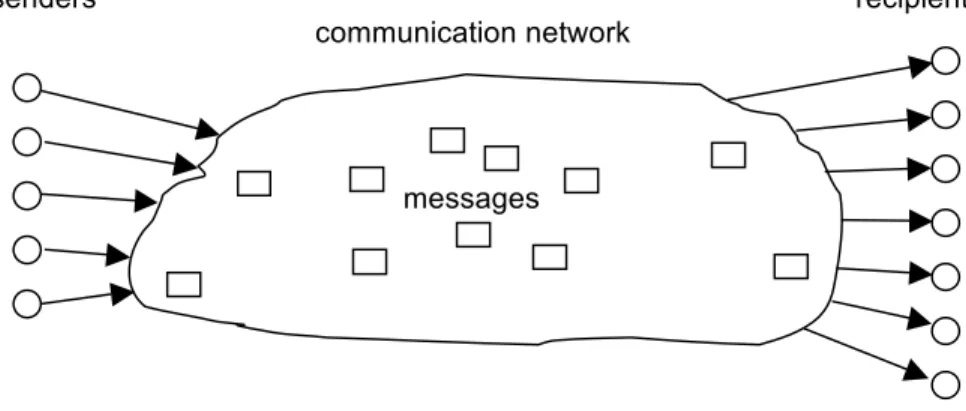
We develop this terminology in the usual setting of entities (subjects and objects) and actions, i.e., subjects execute actions on objects, cf. Appendix A1. In particular, subjects called senders send objects called messages to subjects called recipients using a communication network, i.e., stations5 send and receive messages using communication lines6. For other settings, e.g., users
1 “Privacy is the claim of individuals, groups, or institutions to determine for themselves when,
how, and to what extent information about them is communicated to others. Viewed in terms of the relation of the individual to social participation, privacy is the voluntary and temporary withdrawal of a person from the general society through physical or psychological means, either in a state of solitude or small-group intimacy or, when among larger groups, in a condition of anonymity or reserve.” [West67 p. 7]
2 Data minimization means that first of all, the possibility to collect personal data about others
should be minimized. Next within the remaining possibilities, collecting personal data should be minimized. Finally, the time how long collected personal data is stored should be minimized.
3 If we exclude providing misinformation (inaccurate or erroneous information, provided usually
without conscious effort at misleading, deceiving, or persuading one way or another [Wils93]) or disinformation (deliberately false or distorted information given out in order to mislead or deceive [Wils93]), data minimization is the only generic strategy to enable anonymity, since all correct personal data help to identify.
4 If we exclude providing misinformation or disinformation, data minimization is the only generic
strategy to enable unlinkability, since all correct personal data provide some linkability.
5 To keep the setting as simple as possible, usually, we do not distinguish between human
querying a database, customers shopping in an e-commerce shop, the same terminology can be derived by abstracting away the special names “sender”, “recipient”, and “message”. But for ease of explanation, we use the specific setting here, cf. Fig. 1. For a discussion in a broader context, we speak more generally about subjects, which might be actors (such as senders) or actees acted upon (such as recipients).7
Irrespective whether we speak of senders and recipients or whether we generalize to actors and actees, we regard a subject as a human being (i.e., a natural person), a legal person, or a computer. An organization not acting as a legal person we neither see as a single subject nor as a single entity, but as (possibly structured) sets of subjects or entities. Otherwise, the distinction between “subjects” and “sets of subjects” would completely blur.8
If we make our setting more concrete, we may call it a system. For our purposes, a system has the following relevant properties:
1. The system has a surrounding, i.e., parts of the world are “outside” the system. Together, the system and its surrounding form the universe.
2. The state of the system may change by actions within the system. senders recipients communication network
Fig. 1: Setting
All statements are made from the perspective9 of an attacker10,11 who may be interested in monitoring what communication is occurring, what patterns of communication exist, or even in usually, we assume that each station is controlled by exactly one human being, its owner. If a differentiation between human communication and computer communication is necessary or if the assumption that each station is controlled by exactly one human being is wrong, the setting has to be more complex. We then use sender and recipient for human beings and message for their communication. For computers and their communications, we use stations sending bit strings. If we have to look even deeper than bits which are “abstractions” of physical signals, we call the representation of bit strings signals.
6 Communication “lines” are not necessarily wires or optical fibers, but may be just free space in
case of radio networks.
7 Note that these terms intended to generalize the setting are by no means fixed yet. In a
communication it is easy to define the counterparts sender and recipient(s), and so are actors and actees counterparts. An actee could be a subject or object addressed by an actor.
8 Having a clear distinction between subjects and sets of subjects is very useful to sensibly define
group pseudonyms in Section 9.
9 The perspective describes the set of all possible observations. In the following, a property holds
“from an attacker’s perspective” iff it holds for all possible observations of that perspective.
10 “Attacker” is the historical name of the set of entities working against some protection goal like
anonymity. To underline that conflicts of interests are commonplace, “adversary” is used as a synonym for “attacker” in part of the more recent literature on security. In this text, we stay as
manipulating the communication. The attacker may be an outsider12 tapping communication lines or an insider13 able to participate in normal communications and controlling at least some
stations, cf. Fig. 2. We assume that the attacker uses all information available to him to infer (probabilities of) his items of interest (IOIs), e.g., who did send or receive which messages.14 Attributes (and their values) are related to the IOIs because these attribute values may be items of interest themselves or their observation may give information on IOIs: An attribute is a quality or characteristic of an entity or an action. Some attributes may take several values. Then it makes sense to make a distinction between more abstract attributes and more concrete attribute values. Mainly we are interested in attributes of subjects. Examples for attributes in this setting are “sending a message” or “receiving a message”.
senders recipients communication network
attacker
(his domain depicted in red is an example only) Fig. 2: Example of an attacker’s domain within the setting
Throughout the Sections 3 to 12 we assume that the attacker is not able to get information on the sender or recipient from the message content.15 Therefore, we do not mention the message content in these sections. For most applications it is unreasonable to assume that the attacker forgets something. Thus, normally the knowledge16 of the attacker only increases.
close to the terminology of the early papers in the field. Therefore, we will use the term “attacker”, but without any ethical or legal connotation, i.e., what the attacker does may be highly ethical and/or completely legal.
11 The attacker’s perspective depends on the information the attacker has available. If we assume
some limits on how much processing the attacker might be able to do, the information available to the attacker will not only depend on the attacker’s perspective, but on the attacker’s processing (abilities), too.
12 An outsider is a non-empty set of entities being part of the surrounding of the system
considered.
13 An insider is a non-empty set of entities being part of the system considered.
14 At this level of description, intentionally we do not care about particular types of IOIs. The given
example would be an IOI which might be a 3-tupel of actor, action, and object. Later we consider attribute values as IOIs.
15 Of course, encryption of messages provides protection of the content against attackers
observing the communication lines and end-to-end encryption even provides protection of the content against all stations passed, e.g., for the purpose of forwarding and/or routing. But
message content can neither be hidden from the sender nor from the recipient(s) of the message.
16 As usual in the field of security and privacy, “knowledge” can be described by probabilities of
IOIs. More knowledge then means more accurate probabilities, i.e., the probabilities the attacker assumes to be true are closer to the “true” probabilities.
3 Anonymity
To enable anonymity of a subject, there always has to be an appropriate set of subjects with potentially the same attributes17. This leads to a first kind of a definition:
Anonymity of a subject means that the subject is not identifiable18 within a set of subjects, the anonymity set.19
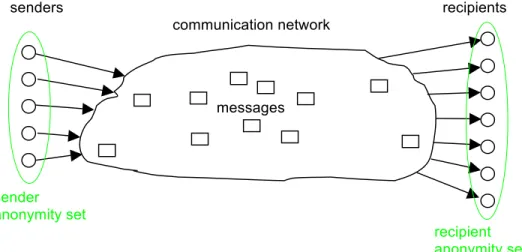
The anonymity set is the set of all possible subjects20. With respect to actors, the anonymity set consists of the subjects who might cause an action. With respect to actees, the anonymity set consists of the subjects who might be acted upon. Therefore, a sender may be anonymous (sender anonymity) only within a set of potential senders, his/her sender anonymity set, which itself may be a subset of all subjects worldwide who may send a message from time to time. The same for the recipient means that a recipient may be anonymous (recipient anonymity) only within a set of potential recipients, his/her recipient anonymity set, cf. Fig. 3. Both anonymity sets may be disjoint, be the same, or they may overlap. The anonymity sets may vary over time.21 Anonymity of a set of subjects within an (potentially larger) anonymity set means that all these individual subjects are not identifiable within this anonymity set.22
17 Since sending and receiving of particular messages are special cases of "attributes" of senders
and recipients, this is slightly more general than the setting in Section 2. This generality is very fortunate to stay close to the everyday meaning of "anonymity" which is not only used w.r.t. subjects active in a particular context, e.g., senders and recipients of messages, but w.r.t.
subjects passive in a particular context as well, e.g., subjects the records within a database relate to.
18 “not identifiable within the anonymity set” means that only using the information the attacker
has at his discretion, the subject is “not uniquely characterized within the anonymity set”. In more precise language, only using the information the attacker has at his discretion, the subject is “not distinguishable from the other subjects within the anonymity set”.
19 From [ISO99]: “[Anonymity] ensures that a user may use a resource or service without
disclosing the user’s identity. The requirements for anonymity provide protection of the user identity. Anonymity is not intended to protect the subject identity. [...] Anonymity requires that other users or subjects are unable to determine the identity of a user bound to a subject or operation.” Compared with this explanation, our definition is more general as it is not restricted to identifying users, but any subjects.
20 I.e., the “usual suspects” :-) The set of possible subjects depends on the knowledge of the
attacker. Thus, anonymity is relative with respect to the attacker.
21 Since we assume that the attacker does not forget anything he knows, the anonymity set
cannot increase w.r.t. a particular IOI. Especially subjects joining the system in a later stage, do not belong to the anonymity set from the point of view of an attacker observing the system in an earlier stage. (Please note that if the attacker cannot decide whether the joining subjects were present earlier, the anonymity set does not increase either: It just stays the same.) Due to linkability, cf. below, the anonymity set normally can only decrease.
22 In this definition, “set of subjects” is just taken to describe that the anonymity property holds for
all elements of the set. Another possible definition would be to consider the anonymity property for the set as a whole. Then a semantically quite different definition could read: Anonymity of a set S of subjects within a larger anonymity set A means that it is not distinguishable whether the subject whose anonymity is at stake (and which clearly is within A) is within S or not.
senders recipients communication network sender anonymity set recipient anonymity set largest possible anonymity sets
Fig. 3: Anonymity sets within the setting
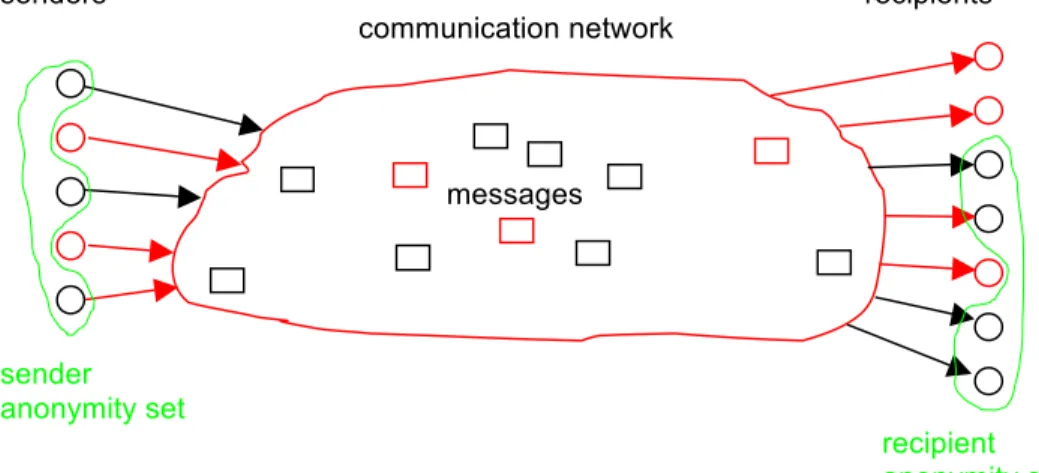
The definition given above for anonymity basically defines anonymity as a binary property: Either a subject is anonymous or not. To reflect the possibility to quantify anonymity in our definition and to underline that all statements are made from the perspective of an attacker (cf. Fig. 4), it is appropriate to work with a slightly more complicated definition in the following:
Anonymity of a subject from an attacker’s perspective means that the attacker cannot sufficiently identify the subject within a set of subjects, the anonymity set.
In this revised definition, “sufficiently” underlines both that there is a possibility to quantify anonymity and that for some applications, there might be a need to define a threshold where anonymity begins.
If we do not focus on the anonymity of one individual subject, called individual anonymity23, but on the anonymity provided by a system to all of its users together, called global anonymity, we can state: All other things being equal, global anonymity is the stronger, the larger the respective anonymity set is and the more evenly distributed the sending or receiving, respectively, of the subjects within that set is.24,25 For a fixed anonymity set, global anonymity is maximal iff all subjects within the anonymity set are equally likely. Since subjects26 may behave quite distinct from each other (and trying to persuade them to behave more equally may both fail and be not compatible with basic human rights), achieving maximal anonymity or even something close to it
23 Gergely Tóth, Zoltán Hornák and Ferenc Vajda were the first to draw attention to measuring
this important property which they called “local anonymity” [ToHV04]. We decided not to use their term, since firstly, this property has little to do with location, and secondly, the term “local
anonymity” has been defined in 1999 to mean anonymity within a LAN, cf. [Mart99].
24 The entropy of a message source as defined by Claude E. Shannon [Shan48] might be an
appropriate measure to quantify global anonymity – just take who is the sender/recipient as the “message” in Shannon’s definition. For readers interested in formalizing what we informally say: “No change of probabilities” means “no change of knowledge” and vice versa. “No change of probabilities” (or what is equivalent: “no change of knowledge”) implies “no change of entropy”, whereas “no change of entropy” neither implies “no change of probabilities” nor “no change of knowledge”. In an easy to remember notation: No change of probabilities = no change of knowledge ⇒ no change of entropy.
25 The definition of anonymity is an analog to the definition of “perfect secrecy” by Claude E.
Shannon [Shan49], whose definition takes into account that no security mechanism whatsoever can take away knowledge from the attacker which he already has.
26 Who are – hopefully – in the same anonymity set.
usually is impossible. Strong or even maximal global anonymity does not imply strong anonymity or even maximal anonymity of each particular subject27: Even if global anonymity is strong, one (or a few) individual subjects might be quite likely, so their anonymity is weak. W.r.t. these “likely suspects”, nothing is changed if the anonymity set is made larger and sending and receiving of the other subjects are, e.g., distributed evenly. That way, arbitrarily strong global anonymity can be achieved without doing anything for the “likely suspects” [ClSc06]. So there is need to define anonymity measures not only for the system as a whole, but for individual subjects (individual anonymity) or small sets of subjects.
senders recipients communication network sender anonymity set recipient anonymity set largest possible anonymity sets w.r.t. attacker
Fig. 4: Anonymity sets w.r.t. attacker within the setting
From the above discussion follows that anonymity in general as well as the anonymity of each particular subject is a concept which is very much context dependent (on, e.g., subjects
population, attributes, time frame, etc). In order to quantify anonymity within concrete situations, one would have to describe the system in sufficient detail, which is practically not (always) possible for large open systems (but maybe for some small data bases for instance). Besides the quantity of anonymity provided within a particular setting, there is another aspect of anonymity: its robustness. Robustness of anonymity characterizes how stable the quantity of anonymity is against changes in the particular setting, e.g., a stronger attacker or different probability distributions. We might use quality of anonymity as a term comprising both quantity and robustness of anonymity. To keep this text as simple as possible, we will mainly discuss the quantity of anonymity in the following, using the wording “strength of anonymity”.
The above definitions of anonymity and the mentioned measures of quantifying anonymity are fine to characterize the status of a subject in a world as it is. If we want to describe changes to the anonymity of a subject if the world is changed somewhat, e.g., the subject uses the
communication network differently or uses a modified communication network, we need another definition of anonymity capturing the delta. The simplest way to express this delta is by the observations of “the” attacker.
An anonymity delta (regarding a subject's anonymity) from an attacker's perspective specifies the difference between the subject's anonymity taking into account the attacker's observations (i.e., the attacker’s a-posteriori knowledge) and the subject's anonymity
27 What maximal anonymity of one individual subject (maximal individual anonymity, for short)
means is unclear. On the one hand, if her probability approaches zero, her Shannon entropy (as a measure for anonymity) gets larger and larger. On the other hand, if her probability gets zero, she is outside the anonymity set.
given the attacker's a-priori knowledge only.28
As we can quantify anonymity in concrete situations, so we can quantify the anonymity delta.29 Since anonymity cannot increase21,25, the anonymity delta can never be positive. Having an anonymity delta of zero means that anonymity stays the same.30 To be able to express this conveniently, we use wordings like “perfect preservation of a subject’s anonymity”.31 Having a negative anonymity delta means that anonymity is decreased.
4 Unlinkability
Unlinkability only has a meaning after the system in which we want to describe anonymity properties has been defined and the attacker has been characterized. Then:
Unlinkability of two or more items of interest (IOIs, e.g., subjects, messages, actions, ...) from an attacker’s perspective means that within the system (comprising these and possibly other items), the attacker cannot sufficiently distinguish whether these IOIs are related or not.32,33
Linkability is the negation of unlinkability:
Linkability of two or more items of interest (IOIs, e.g., subjects, messages, actions, ...) from an attacker’s perspective means that within the system (comprising these and possibly other items), the attacker can sufficiently distinguish whether these IOIs are related or not.
28 In some publications, the a-priori knowledge of the attacker is called “background knowledge”
and the a-posteriori knowledge of the attacker is called “new knowledge”.
29 This can be done by just defining:
quantity(anonymity delta) := quantity(anonymity_a-posteriori) – quantity(anonymity_a-priori) If anonymity_a-posteriori and anonymity_a-priori are the same, their quantification is the same and therefore the difference of these quantifications is 0. If anonymity can only decrease (which usually is quite a reasonable assumption), the maximum of quantity(anonymity delta) is 0.
30 This means that if the attacker has no a-priori knowledge about the particular subject, having
no anonymity delta implies anonymity. But if the attacker has an a-priori knowledge covering all actions of the particular subject, having no anonymity delta does not imply any anonymity at all. If there is no anonymity from the very beginning, even preserving it completely does not yield any anonymity.
31 It might be worthwhile to generalize “preservation of anonymity of single subjects” to
“preservation of anonymity of sets of subjects”, in the limiting case all subjects in an anonymity set. An important special case is that the “set of subjects” is the set of subjects having one or several attribute values A in common. Then the meaning of “preservation of anonymity of this set of subjects” is that knowing A does not decrease anonymity.
32 From [ISO99]: “[Unlinkability] ensures that a user may make multiple uses of resources or
services without others being able to link these uses together. [...] Unlinkability requires that users and/or subjects are unable to determine whether the same user caused certain specific
operations in the system.” In contrast to this definition, the meaning of unlinkability in this text is less focused on the user, but deals with unlinkability of “items” and therefore takes a general approach.
33 As the entropy of a message source might be an appropriate measure to quantify (global)
anonymity (and thereafter “anonymity” might be used as a quantity), we may use definitions to quantify unlinkability (and thereafter “unlinkability” might be used as a quantity as well).
Quantifications of unlinkability can be either probabilities or entropies, or whatever is useful in a particular context.
E.g., in a scenario with at least two senders, two messages sent by subjects within the same anonymity set are unlinkable for an attacker if for him, the probability that these two messages are sent by the same sender is sufficiently close to 1/(number of senders). In case of unicast the same is true for recipients; in case of multicast it is slightly more complicated.
An unlinkability delta of two or more items of interest (IOIs, e.g., subjects, messages, actions, ...) from an attacker’s perspective specifies the difference between the
unlinkability of these IOIs taking into account the attacker’s observations and the unlinkability of these IOIs given the attacker’s a-priori knowledge only.
Since we assume that the attacker does not forget anything, unlinkability cannot increase.34 Therefore, the unlinkability delta can never be positive. Having an unlinkability delta of zero means that the probability of those items being related from the attacker’s perspective stays exactly the same before (a-priori knowledge) and after the attacker’s observations (a-posteriori knowledge of the attacker).35 To be able to express this conveniently, we use wordings like “perfect preservation of unlinkability w.r.t. specific items” to express that the unlinkability delta is zero.36
E.g., the unlinkability delta of two messages is sufficiently small (zero) for an attacker if the probability describing his a-posteriori knowledge that these two messages are sent by the same sender and/or received by the same recipient is sufficiently (exactly) the same as the probability imposed by his a-priori knowledge.37
Roughly speaking, no unlinkability delta of items means that the ability of the attacker to relate these items does not increase by observing the system or by possibly interacting with it.
The definitions of unlinkability, linkability and unlinkability delta do not mention any particular set of IOIs they are restricted to. Therefore, the definitions of unlinkability and unlinkability delta are very strong, since they cover the whole system. We could weaken the definitions by restricting them to part of the system: “Unlinkability of two or more IOIs from an attacker’s perspective
34 Normally, the attacker’s knowledge cannot decrease (analogously to Shannon’s definition of
“perfect secrecy”, see above). An exception of this rule is the scenario where the use of
misinformation (inaccurate or erroneous information, provided usually without conscious effort at misleading, deceiving, or persuading one way or another [Wils93]) or disinformation (deliberately false or distorted information given out in order to mislead or deceive [Wils93]) leads to a growing uncertainty of the attacker which information is correct. A related, but different aspect is that information may become wrong (i.e., outdated) simply because the state of the world changes over time. Since privacy is not only about to protect the current state, but the past and history of a data subject as well, we will not make use of this different aspect in the rest of this paper.
35 If the attacker has no a-priori knowledge about the particular IOIs, having an unlinkability delta
of zero implies unlinkability. But if the attacker has a-priori knowledge covering the relationships of all IOIs, having an unlinkability delta of zero does not imply any unlinkability at all. If there is no unlinkability from the very beginning, even preserving it completely does not yield any
unlinkability.
36 It might be worthwhile to generalize “preservation of unlinkability of two IOIs” to “preservation of
unlinkability of sets of IOIs”, in the limiting case all IOIs in the system.
37 Please note that unlinkability of two (or more) messages of course may depend on whether
their content is protected against the attacker considered. In particular, messages may be unlinkable if we assume that the attacker is not able to get information on the sender or recipient from the message content, cf. Section 2. Yet with access to their content even without deep semantical analysis the attacker can notice certain characteristics which link them together – e.g. similarities in structure, style, use of some words or phrases, consistent appearance of some grammatical errors, etc. In a sense, content of messages may play a role as “side channel” in a similar way as in cryptanalysis – i.e., content of messages may leak some information on their linkability.
means that within an unlinkability set of IOIs (comprising these and possibly other items), the attacker cannot sufficiently distinguish whether these IOIs are related or not.”
5 Anonymity in terms of unlinkability
To describe anonymity in terms of unlinkability, we have to augment the definitions of anonymity given in Section 3 by making explicit the attributes anonymity relates to. This is best explained by looking at an example in detail. In our setting, cf. Section 2, we choose the attribute “having sent a message” as the example. Then we have:
A sender s is anonymous w.r.t. sending, iff s is anonymous within the set of potential senders, i.e., within the sender anonymity set.
This mainly is a re-phrasing of the definition in Section 2. If we make the message under consideration explicit, the definition reads:
A sender s sends a message m anonymously, iff s is anonymous within the set of potential senders of m, the sender anonymity set of m.
This can be generalized to sets of messages easily:
A sender s sends a set of messages M anonymously, iff s is anonymous within the set of potential senders of M, the sender anonymity set of M.
If the attacker’s focus is not on the sender, but on the message, we can define:
A message m is sent anonymously, iff m can have been sent by each potential sender, i.e., by any subject within the sender anonymity set of m.
Again, this can be generalized to sets of messages easily:
A set of messages M is sent anonymously, iff M can have been sent by each set of potential senders, i.e., by any set of subjects within the cross product of the sender anonymity sets of each message m within M.
Of course, all 5 definitions would work for receiving of messages accordingly. For more
complicated settings with more operations than these two, appropriate sets of definitions can be developed.
Now we are prepared to describe anonymity in terms of unlinkability.
We do this by using our setting, cf. Section 2. So we consider sending and receiving of messages as attributes; the items of interest (IOIs) are “who has sent or received which message”. Then, anonymity of a subject w.r.t. an attribute may be defined as unlinkability38 of this subject and this attribute.39
38 In the wording of the definition of unlinkability: a subject s is related to the attribute value “has
sent message m” if s has sent message m. s is not related to that attribute value if s has not sent message m. Same for receiving.
39 Unlinkability is a sufficient condition of anonymity, but it is not a necessary condition. Thus,
failing unlinkability w.r.t. some attribute value(s) does not necessarily eliminate anonymity as defined in Section 3; in specific cases (i.e., depending on the attribute value(s)) even the strength of anonymity may not be affected.
So we have: Sender anonymity of a subject means that to this potentially sending subject, each message is unlinkable.40
Correspondingly, recipient anonymity of a subject means that to this potentially receiving subject, each message is unlinkable.
Relationship anonymity of a pair of subjects, the potentially sending subject and the potentially receiving subject, means that to this potentially communicating pair of subjects, each message is unlinkable. In other words, sender and recipient (or each recipient in case of multicast) are unlinkable. As sender anonymity of a message cannot hold against the sender of this message himself nor can recipient anonymity hold against any of the recipients w.r.t. himself, relationship anonymity is considered w.r.t. outsiders only, i.e., attackers being neither the sender nor one of the recipients of the messages under consideration.
Thus, relationship anonymity is a weaker41 property than each of sender anonymity and recipient anonymity: The attacker might know who sends which messages or he might know who receives which messages (and in some cases even who sends which messages and who receives which messages). But as long as for the attacker each message sent and each message received are unlinkable, he cannot link the respective senders to recipients and vice versa, i.e., relationship anonymity holds. The relationship anonymity set can be defined to be the cross product of two potentially distinct sets, the set of potential senders and the set of potential recipients42 or – if it is possible to exclude some of these pairs – a subset of this cross product. So the relationship anonymity set is the set of all possible sender-recipient(s)-pairs.43 If we take the perspective of a subject sending (or receiving) a particular message, the relationship anonymity set becomes the set of all potential recipients (senders) of that particular message. So fixing one factor of the cross product gives a recipient anonymity set or a sender anonymity set.
40 The property unlinkability might be more “fine-grained” than anonymity, since there are many
more relations where unlinkability might be an issue than just the relation “anonymity” between subjects and IOIs. Therefore, the attacker might get to know information on linkability while not necessarily reducing anonymity of the particular subject – depending on the defined measures. An example might be that the attacker, in spite of being able to link, e.g., by timing, all encrypted messages of a transactions, does not learn who is doing this transaction.
41 First the easy direction: For all attackers it holds: Sender anonymity implies relationship
anonymity, and recipient anonymity implies relationship anonymity (This is true if anonymity is taken as a binary property: Either it holds or it does not hold. If we consider quantities of
anonymity, the validity of the implication possibly depends on the particular definitions of how to quantify sender anonymity and recipient anonymity on the one hand, and how to quantify relationship anonymity on the other.). Then the more complicated direction: There exists at least one attacker model, where relationship anonymity does neither imply sender anonymity nor recipient anonymity. Consider an attacker who neither controls any senders nor any recipients of messages, but all lines and – maybe – some other stations. If w.r.t. this attacker relationship anonymity holds, you can neither argue that against him sender anonymity holds nor that recipient anonymity holds. The classical MIX-net (cf. Section 8) without dummy traffic is one implementation with just this property: The attacker sees who sends messages when and who receives messages when, but cannot figure out who sends messages to whom.
42 In case of multicast, the set of potential recipients is the power set of all potential recipients. 43 For measures to quantify relationship anonymity, if they shall be comparable with quantifying
sender and recipient anonymity, you have to compensate for the multiplication of possibilities in forming the cross product. For the simplest metric (we do not advocate to use) just counting the size of the set, you have to take the square root of the size of the set of possible
6 Undetectability and unobservability
In contrast to anonymity and unlinkability, where not the IOI, but only its relationship to subjects or other IOIs is protected, for undetectability, the IOIs are protected as such.44
Undetectability of an item of interest (IOI) from an attacker’s perspective means that the attacker cannot sufficiently distinguish whether it exists or not.45,46
If we consider messages as IOIs, this means that messages are not sufficiently discernible from, e.g., “random noise”.47
Undetectability is maximal iff whether an IOI exists or not is completely indistinguishable. We call this perfect undetectability.
An undetectability delta of an item of interest (IOI) from an attacker’s perspective specifies the difference between the undetectability of the IOI taking into account the attacker’s observations and the undetectability of the IOI given the attacker’s a-priori knowledge only.
The undetectability delta is zero iff whether an IOI exists or not is indistinguishable to exactly the same degree whether the attacker takes his observations into account or not. We call this “perfect preservation of undetectability”.
Undetectability of an IOI clearly is only possible w.r.t. subjects being not involved in the IOI (i.e., neither being the sender nor one of the recipients of a message). Therefore, if we just speak about undetectability without spelling out a set of IOIs, it goes without saying that this is a statement comprising only those IOIs the attacker is not involved in.
As the definition of undetectability stands, it has nothing to do with anonymity – it does not mention any relationship between IOIs and subjects. Even more, for subjects being involved in an IOI, undetectability of this IOI is clearly impossible.48 Therefore, early papers describing new
44 Undetectability can be regarded as a possible and desirable property of steganographic
systems (see Section 8 “Known mechanisms for anonymity, undetectability, and
unobservability”). Therefore it matches the information hiding terminology [Pfit96, ZFKP98]. In contrast, anonymity, dealing with the relationship of discernible IOIs to subjects, does not directly fit into that terminology, but independently represents a different dimension of properties.
45 What we call “undetectability” starting with Version v0.28 of this document, has been called
“unobservability” before. From [ISO99]: “[Unobservability] ensures that a user may use a resource or service without others, especially third parties, being able to observe that the resource or service is being used. [...] Unobservability requires that users and/or subjects cannot determine whether an operation is being performed.” As seen before, our approach is less user-focused and insofar more general. With the communication setting and the attacker model chosen in this text, our definition of unobservability shows the method how to achieve it: preventing distinguishability of IOIs. Thus, the ISO definition might be applied to a different setting where attackers are prevented from observation by other means, e.g., by encapsulating the area of interest against third parties.
46 In some applications (e.g. steganography), it might be useful to quantify undetectability to have
some measure how much uncertainty about an IOI remains after the attacker’s observations. Again, we may use probabilities or entropy, or whatever is useful in a particular context.
47 A slightly more precise formulation might be that messages are not discernible from no
message. A quantification of this property might measure the number of indistinguishable IOIs and/or the probabilities of distinguishing these IOIs.
48 Remembering that we had this before in the context of relationship anonymity (cf. Section 5),
we could describe relationship anonymity (against outsiders) as undetectability of the communication relationship.
mechanisms for undetectability designed the mechanisms in a way that if a subject necessarily could detect an IOI, the other subject(s) involved in that IOI enjoyed anonymity at least.49 Undetectability by uninvolved subjects together with anonymity even if IOIs can necessarily be detected by the involved subjects has been called unobservability:
Unobservability of an item of interest (IOI) means
• undetectability of the IOI against all subjects uninvolved in it and
• anonymity of the subject(s) involved in the IOI even against the other subject(s)
involved in that IOI.
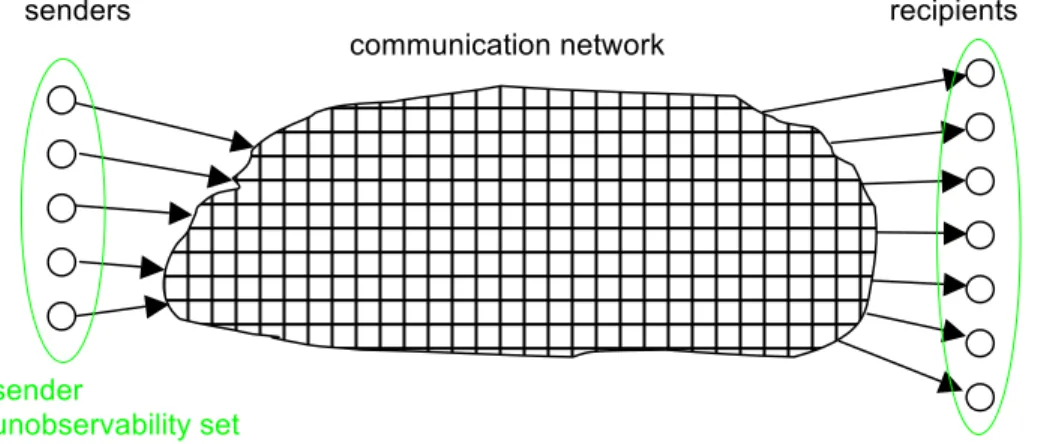
As we had anonymity sets of subjects with respect to anonymity, we have unobservability sets of subjects with respect to unobservability, cf. Fig. 5.50
Sender unobservability then means that it is sufficiently undetectable whether any sender within the unobservability set sends. Sender unobservability is perfect iff it is completely undetectable whether any sender within the unobservability set sends.
Recipient unobservability then means that it is sufficiently undetectable whether any recipient within the unobservability set receives. Recipient unobservability is perfect iff it is completely undetectable whether any recipient within the unobservability set receives.
Relationship unobservability then means that it is sufficiently undetectable whether anything is sent out of a set of could-be senders to a set of could-be recipients. In other words, it is
sufficiently undetectable whether within the relationship unobservability set of all possible sender-recipient(s)-pairs, a message is sent in any relationship. Relationship unobservability is perfect iff it is completely undetectable whether anything is sent out of a set of could-be senders to a set of could-be recipients.
All other things being equal, unobservability is the stronger, the larger the respective unobservability set is, cf. Fig. 6.
49 The rational for this is to strive for data minimization: No subject should get to know any
(potentially personal) data – except this is absolutely necessary. Given the setting described in Section 2, this means: 1. Subjects being not involved in the IOI get to know absolutely nothing. 2. Subjects being involved in the IOI only get to know the IOI, but not the other subjects involved – the other subjects may stay anonymous. Since in the setting described in Section 2 the attributes “sending a message” or “receiving a message” are the only kinds of attributes considered, 1. and 2. together provide data minimization in this setting in an absolute sense.
50 Mainly, unobservability deals with IOIs instead of subjects only. Though, like anonymity sets,
unobservability sets consist of all subjects who might possibly cause these IOIs, i.e. send and/or receive messages.
senders recipients communication network sender unobservability set recipient unobservability set largest possible unobservability sets
Fig. 5: Unobservability sets within the setting
senders recipients communication network sender unobservability set recipient unobservability set largest possible unobservability sets w.r.t. attacker
Fig. 6: Unobservability sets w.r.t. attacker within the setting An unobservability delta of an item of interest (IOI) means
• undetectability delta of the IOI against all subjects uninvolved in it and • anonymity delta of the subject(s) involved in the IOI even against the other
subject(s) involved in that IOI.
Since we assume that the attacker does not forget anything, unobservability cannot increase. Therefore, the unobservability delta can never be positive. Having an unobservability delta of zero w.r.t. an IOI means an undetectability delta of zero of the IOI against all subjects uninvolved in the IOI and an anonymity delta of zero against those subjects involved in the IOI. To be able to express this conveniently, we use wordings like “perfect preservation of unobservability” to express that the unobservability delta is zero.
7 Relationships between terms
With respect to the same attacker, unobservability reveals always only a subset of the information anonymity reveals.51 We might use the shorthand notation
unobservability ⇒ anonymity
for that (⇒ reads “implies”). Using the same argument and notation, we have sender unobservability ⇒ sender anonymity
recipient unobservability ⇒ recipient anonymity relationship unobservability ⇒ relationship anonymity As noted above, we have
sender anonymity ⇒ relationship anonymity recipient anonymity ⇒ relationship anonymity
sender unobservability ⇒ relationship unobservability recipient unobservability ⇒ relationship unobservability
With respect to the same attacker, unobservability reveals always only a subset of the information undetectability reveals
unobservability ⇒ undetectability
51 [ReRu98] propose a continuum for describing the strength of anonymity. They give names:
“absolute privacy” (the attacker cannot perceive the presence of communication, i.e.,
unobservability) – “beyond suspicion” – “probable innocence” – “possible innocence” – “exposed” – “provably exposed” (the attacker can prove the sender, recipient, or their relationship to others). Although we think that the terms “privacy” and “innocence” are misleading, the spectrum is quite useful.
8 Known mechanisms for anonymity, undetectability, and unobservability
Before it makes sense to speak about any particular mechanisms52 for anonymity, undetectability, and unobservability in communications, let us first remark that all of them assume that stations of users do not emit signals the attacker considered is able to use for identification of stations or their behavior or even for identification of users or their behavior. So if you travel around taking with you a mobile phone sending more or less continuously signals to update its location
information within a cellular radio network, don’t be surprised if you are tracked using its signals. If you use a computer emitting lots of radiation due to a lack of shielding, don’t be surprised if observers using high-tech equipment know quite a bit about what’s happening within your machine. If you use a computer, PDA, or smartphone without sophisticated access control, don’t be surprised if Trojan horses send your secrets to anybody interested whenever you are online – or via electromagnetic emanations even if you think you are completely offline.
DC-net [Chau85, Chau88] and MIX-net [Chau81] are mechanisms to achieve sender anonymity and relationship anonymity, respectively, both against strong attackers. If we add dummy traffic, both provide for the corresponding unobservability [PfPW91].53
Broadcast [Chau85, PfWa86, Waid90] and private information retrieval [CoBi95] are mechanisms to achieve recipient anonymity against strong attackers. If we add dummy traffic, both provide for recipient unobservability.
This may be summarized: A mechanism to achieve some kind of anonymity appropriately combined with dummy traffic yields the corresponding kind of unobservability.
Of course, dummy traffic54 alone can be used to make the number and/or length of sent messages undetectable by everybody except for the recipients; respectively, dummy traffic can be used to make the number and/or length of received messages undetectable by everybody except for the senders.
As a side remark, we mention steganography and spread spectrum as two other well-known undetectability mechanisms.
The usual concept to achieve undetectability of IOIs at some layer55, e.g., sending meaningful messages, is to achieve statistical independence of all discernible phenomena at some lower implementation layer. An example is sending dummy messages at some lower layer to achieve, e.g., a constant rate flow of messages looking – by means of encryption – randomly for all parties except the sender and the recipient(s).
52 Mechanisms are part of the system in general and the communication network in particular, cf.
Section 2.
53 If dummy traffic is used to pad sending and/or receiving on the sender’s and/or recipient’s line
to a constant rate traffic, MIX-nets can even provide sender and/or recipient anonymity and unobservability.
54 Misinformation and disinformation may be regarded as semantic dummy traffic, i.e.,
communication from which an attacker cannot decide which are real requests with real data or which are fake ones. Assuming the authenticity of misinformation or disinformation may lead to privacy problems for (innocent) bystanders.
55 Modern computer and communication networks are implemented in layers of functionality,
where each upper layer uses the services of the lower layers to provide a more comfortable service, cf. e.g., [Tane96].
9 Pseudonymity
Having anonymity of human beings, unlinkability, and maybe unobservability is superb w.r.t. data minimization, but would prevent any useful two-way communication. For many applications, we need appropriate kinds of identifiers:
A pseudonym56 is an identifier57 of a subject58 other than one of the subject’s real names59.
We can generalize pseudonyms to be identifiers of sets of subjects – see below –, but we do not need this in our setting.
The subject which the pseudonym refers to is the holder of the pseudonym60.
A subject is pseudonymous if a pseudonym61 is used62 as identifier instead of one of its real names.63,64
56 “Pseudonym” comes from Greek “pseudonumon” meaning “falsely named” (pseudo: false;
onuma: name). Thus, it means a name other than the “real name”. To avoid the connotation of “pseudo” = false, some authors call pseudonyms as defined in this paper simply nyms. This is nice and short, but we stick with the usual wording, i.e., pseudonym, pseudonymity, etc. However the reader should not be surprised to read nym, nymity, etc. in other texts.
57 A name or another bit string. Identifiers, which are generated using random data only, i.e., fully
independent of the subject and related attribute values, do not contain side information on the subject they are attached to, whereas non-random identifiers may do. E.g., nicknames chosen by a user may contain information on heroes he admires; a sequence number may contain
information on the time the pseudonym was issued; an e-mail address or phone number contains information how to reach the user.
58 In our setting: sender or recipient.
59 “Real name” is the antonym to “pseudonym”. There may be multiple real names over lifetime, in
particular the legal names, i.e., for a human being the names which appear on the birth certificate or on other official identity documents issued by the State; for a legal person the name under which it operates and which is registered in official registers (e.g., commercial register or register of associations). A human being’s real name typically comprises their given name and a family name. In the realm of identifiers, it is tempting to define anonymity as “the attacker cannot sufficiently determine a real name of the subject”. But despite the simplicity of this definition, it is severely restricted: It can only deal with subjects which have at least one real name. It presumes that it is clear who is authorized to attach real names to subjects. It fails to work if the relation to real names is irrelevant for the application at hand. Therefore, we stick to the definitions given in Section 3. A slightly broader discussion of this topic is given in Appendix A3.
Note that from a mere technological perspective it cannot always be determined whether an identifier of a subject is a pseudonym or a real name.
60 We prefer the term “holder” over “owner” of a pseudonym because it seems to make no sense
to “own” identifiers, e.g., bit strings. Furthermore, the term “holder” sounds more neutral than the term “owner”, which is associated with an assumed autonomy of the subject’s will. The holder may be a natural person (in this case we have the usual meaning and all data protection regulations apply), a legal person, or even only a computer.
61 Fundamentally, pseudonyms are nothing else than another kind of attribute values. But
whereas in building an IT system, its designer can strongly support the holders of pseudonyms to keep the pseudonyms under their control, this is not equally possible w.r.t. attributes and attribute values in general. Therefore, it is useful to give this kind of attribute a distinct name: pseudonym.
62 For pseudonyms chosen by the user (in contrast to pseudonyms assigned to the user by
others), primarily, the holder of the pseudonym is using it. Secondarily, all others he
communicated to using the pseudonym can utilize it for linking. Each of them can, of course, divulge the pseudonym and all data related to it to other entities. So finally, the attacker will utilize the pseudonym to link all data related to this pseudonym he gets to know being related.
Defining the process of preparing for the use of pseudonyms, e.g., by establishing certain rules how and under which conditions civil identities of holders of pseudonyms will be disclosed by so-called identity brokers65 or how to prevent uncovered claims by so-called liability brokers (cf. Section 11), leads to the more general notion of pseudonymity66:
Pseudonymity is the use of pseudonyms as identifiers.67,68
So sender pseudonymity is defined as the sender being pseudonymous, recipient pseudonymity is defined as the recipient being pseudonymous, cf. Fig. 7.69
Hopefully, the appropriate use of pseudonyms primarily by the holder (cf. Pseudonymity w.r.t. linkability, Section 11, and Identity management, Section 13) and secondarily by others will keep the sensitivity of the linkable data sets to a minimum.
63 We can also speak of "pseudonymous usage" (i.e., use of a pseudonym instead of the real
name(s)) and of "pseudonymous data" (i.e., data belonging to a subject where a pseudonym is used instead of its real name(s)).
64 Please note that despite the terms “anonymous” and “pseudonymous” are sharing most of their
characters, their semantics is quite different: Anonymous says something about a subject with respect to identifiability, pseudonymous only says something about employing a mechanism, i.e., using pseudonyms. Whether this mechanism helps in a particular setting to achieve something close to anonymity, is a completely different question. On the level of subjects, “anonymous” should be contrasted with “(privacy-enhancingly) identity managed”, cf. Section 13.4. But since “anonymous” can be defined precisely whereas “(privacy-enhancingly) identity managed” is at least at present hard to define equally precise, we prefer to follow the historical path of research dealing with the more precise mechanism (pseudonym, pseudonymity) first.
65 Identity brokers have for the pseudonyms they are the identity broker for the information who is
their respective holder. Therefore, identity brokers can be implemented as a special kind of certification authorities for pseudonyms. Since anonymity can be described as a particular kind of unlinkability, cf. Section 5, the concept of identity broker can be generalized to linkability broker. A linkability broker is a (trusted) third party that, adhering to agreed rules, enables linking IOIs for those entities being entitled to get to know the linking.
66 Concerning the natural use of the English language, one might use “pseudonymization” instead
of “pseudonymity”. But at least in Germany, the law makers gave “pseudonymization” the meaning that first personal data known by others comprise some identifiers for the civil identity (cf. footnote 71 for some clarification of “civil identity”) and later these identifiers are replaced by pseudonyms. Therefore, we use a different term (coined by David Chaum: “pseudonymity”) to describe that from the very beginning pseudonyms are used.
67 From [ISO99]: “[Pseudonymity] ensures that a user may use a resource or service without
disclosing its user identity, but can still be accountable for that use. [...] Pseudonymity requires that a set of users and/or subjects are unable to determine the identity of a user bound to a subject or operation, but that this user is still accountable for its actions.” This view on pseudonymity covers only the use of digital pseudonyms. Therefore, our definition of
pseudonymity is much broader as it does not necessarily require disclosure of the user’s identity and accountability. Pseudonymity alone – as it is used in the real world and in technological contexts – does not tell anything about the strengths of anonymity, authentication or
accountability; these strengths depend on several properties, cf. below.
68 Quantifying pseudonymity would primarily mean quantifying the state of using a pseudonym
according to its different dimensions (cf. the next two Sections 10 and 11), i.e., quantifying the authentication and accountability gained and quantifying the anonymity left over (e.g., using entropy as the measure). Roughly speaking, well-employed pseudonymity could mean in e-commerce appropriately fine-grained authentication and accountability to counter identity theft or to prevent uncovered claims using, e.g., the techniques described in [BüPf90], combined with much anonymity retained. Poorly employed pseudonymity would mean giving away anonymity without preventing uncovered claims.