PAPER TITLE:
New Lighting Technology: Plasma –V-‐ LED and HMI ABSTRACT:
Plasma Lighting technology has just been released as a working product for the film and television industries. It is claimed to be superior to both Light Emitting Diode (LED) and hydrargyrum medium-‐
arc iodide (HMI) in colour temperature, spectral response by camera sensors, and no flicker when
used with high frame rates. What is the reality?
This paper will give head to head technical and production comparisons and at SMPTE will show video replays of the three types of lights side by side compared to daylight.
INTRODUCTION:
Two major technical innovations have transformed film and television image capture.
The first was the introduction of economical easy to use single chip complementary metal–oxide–
semiconductor (CMOS) based cameras as a significant replacement to film cameras in the early part
of this century. CMOS cameras highlighted the shortcomings of existing lighting technology, showing up the flicker problems of HMI lighting when used at high frame rates, the major lighting source for film and television production, and the new kid on the block, LED lighting with its colour shift and colour artifact problems.
The second was the introduction in 2011 of Light Emitting Plasma (LEP) lights that conformed to the work flow and requirements of film and television productions. It claimed to have excellent colour rendition with no flicker problems for high frame rate cameras.
This paper “shines a light” on these technologies.
We will begin by defining some common terms and concepts. LIGHTING:
Lighting or illumination is the deliberate use of light to achieve a practical or aesthetic effect. Lighting includes the use of both artificial light sources like lamps and light fixtures, as well as natural
illumination by capturing daylight. Daylighting (using windows, skylights, or light shelves) is
sometimes used as the main source of light during daytime in buildings and location (outdoors) for filming and photography. This can save energy in place of using artificial lighting, which represents a major component of energy consumption in buildings. Proper lighting can enhance task performance, improve the appearance of an area, or have positive psychological effects on occupants. Since the beginning of photography, lighting has been a critical component for cinema, stage and photography. LIGHTING ON SET AND STAGE:
Lighting illuminates the performers and artists in a live theatre, cinema production, photography shoot, dance, or musical performance, and is selected and arranged to create dramatic effects.
Motion picture and television production use many of the same tools and methods of stage lighting. In the early days of these industries, very high light levels were required and the heat produced by lighting equipment presented substantial challenges. Modern cameras require less light, and modern light sources emit less heat. However, the latest versions of the digital cameras record images at very high frame rates that require large quantities of light and where the inherent light flicker becomes visible. HMI high frequency ballasts have partly alleviated this problem, but for frame rates above 500fps it still creates problems. LED technology delivers almost flicker free lighting, but suffers from colour shift and low intensity. The introduction of LEP technology is opening up a whole new frontier for film and television lighting with excellent colour, high intensity and flicker free. MEASUREMENT:
A totally new problem has arisen with the introduction of single chip CMOS based cameras which use the BAYER filter principle for colour rendition. If the Red Green Blue (RGB) curves of the BAYER pattern line up with the gaps in the RGB spectrum of the light source you often see colour artifacts or colour shift in rendered DE-‐BAYERED image files. Because of this the traditional measurements applied to light don’t always tell the true story. More on this later.
Measurement of light or photometry is generally concerned with the amount of useful light falling on a surface and the amount of light emerging from a lamp or other source, along with the colours that can be rendered by this light. The human eye responds differently to light from different parts of the visible spectrum, therefore photometric measurements must take the luminosity function into account when measuring the amount of useful light.
COLOUR PROPERTIES:
To define light source colour properties, the lighting industry predominantly relies on two metrics, correlated colour temperature (CCT), commonly used as an indication of the apparent "warmth" or "coolness" of the light emitted by a source, and colour rendering index (CRI), an indication of the light source’s ability to make objects appear natural.
However, these two metrics, developed in the last century, are facing increased challenges and criticisms as new types of light sources, particularly light emitting diodes (LEDs), become more prevalent in the market.
For example, in order to meet the expectations for good colour rendering in cinematic, photographic or retail applications, research suggests using the well-‐established CRI along with another metric called gamut area index (GAI). GAI represents the relative separation of object colours illuminated by a light source; the greater the GAI, the greater the apparent saturation or vividness of the object colours. As a result, light sources which balance both CRI and GAI are generally preferred over ones that have only high CRI or only high GAI.
LIGHT EXPOSURE:
Directors of Photography (DP) and photographers use light meters to measure the quantity of light. However light meters don't measure the quality of the light. A colour temperature meter is required for that, but even that does not tell the whole story.
In order to be a good DP or photographer today where most cameras are single chip CMOS based technology, you also need to know the colour spectrum and Spectral Energy Distribution (SED) Curves. If you have a good understanding of all of this, you can then plan the lighting “look” of you
production and be confident of the end result without having to spend a fortune on fixes in post production.
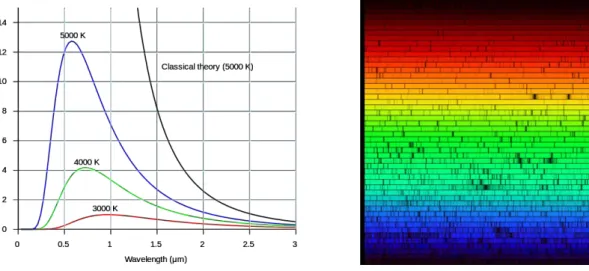
A spectral energy distribution (SED) is a graph of the energy emitted by an object as a function of different wavelengths. The graph below is a typical SED curve of our sun, called a blackbody curve. It shows that the amount of energy emitted by the object at all wavelengths varies with the
temperature of the object. Hotter objects emit more light at shorter wavelengths than cooler objects; therefore the hotter the object, the more the peak wavelength is shifted toward the left of the graph.
Fig. 1 Blackbody curve of the Sun. Fig 2 Full Visible Spectrum of the Sun. LUMINOUS EFFICACY:
Luminous efficacy is a measure of how well a light source produces visible light. It is the ratio of luminous flux to power. Depending on context, the power can be either the radiant flux of the source's output, or it can be the total power (electric power, chemical energy, or others) consumed by the source. Which sense of the term is intended must usually be inferred from the context, and is sometimes unclear. The former sense is sometimes called luminous efficacy of radiation, and the latter luminous efficacy of a source.
The luminous efficacy of a source is a measure of the efficiency with which the source provides visible light from electricity. The luminous efficacy of radiation describes how well a given quantity of
electromagnetic radiation from a source produces visible light: the ratio of luminous flux to radiant flux. Not all wavelengths of light are equally visible, or equally effective at stimulating human vision, due to the spectral sensitivity of the human eye; radiation in the infrared and ultraviolet parts of the spectrum is useless for illumination. The overall luminous efficacy of a source is the product of how well it converts energy to electromagnetic radiation, and how well the emitted radiation is detected by the human eye.
DAYLIGHT:
Daylight or the light of day is the combination of all direct and indirect sunlight outdoors during the daytime. This includes direct sunlight, diffuse sky radiation, and (often) both of these reflected from the Earth. Daylight is present at a particular location whenever the sun is above the horizon at that location. However, the outdoor illuminance can vary from 120,000 lux for direct sunlight at noon, which may cause eye pain, to less than 5 lux for thick storm clouds with the sun at the horizon. and terrestrial objects. Daytime is the period of time each day when daylight occurs.
Fig. 3 World map showing the areas of the Earth receiving daylight around 13:00 UTC, April 2nd.
Daylight intensity in different conditions
Illuminance Example
120,000 lux Brightest sunlight 110,000 lux Bright sunlight
20,000 lux Shade illuminated by entire clear blue sky, midday 10,000 -‐ 25,000 lux Typical overcast day, midday
<200 lux Extreme of darkest storm clouds, midday
400 lux Sunrise or sunset on a clear day (ambient illumination). 40 lux Fully overcast, sunset/sunrise
<1 lux Extreme of darkest storm clouds, sunset/rise For comparison, nighttime illuminance levels are:
Illuminance Example
<1 lux Moonlight
0.25 lux Full Moon on a clear night 0.01 lux Quarter Moon
0.002 lux Starlight clear moonless night sky including airglow 0.0002 lux Starlight clear moonless night sky excluding airglow 0.00014 lux Venus at brightest
0.0001 lux Starlight overcast moonless night sky
Daylight is widely accepted to have a positive psychological effect on the human being, [and consequently more cases of mental health problems are registered during the winter months than during the summer months due to the shortened periods of daylight. Cases of depression specifically linked to limited daylight are referred to as seasonal affective disorder.
Daylighting is lighting an indoor space with openings such as windows and skylights that allow daylight into the building. This type of lighting is chosen to save energy, to avoid hypothesized adverse health effects of over-‐illumination by artificial light, and also for aesthetics. The amount of
daylight received into an indoor space or room is defined as a daylight factor, being the ratio
between the measured internal and external light levels. Artificial lighting energy use can be reduced by simply installing fewer electric lights because daylight is present, or by dimming/switching electric lights automatically in response to the presence of daylight, a process known as daylight harvesting. In recent years, work has taken place to recreate the effects of daylight artificially. This is however expensive in terms of both equipment and energy consumption and is applied almost exclusively in specialist areas such as filmmaking, where light of such intensity is required anyway.
THE HUMAN EYE:
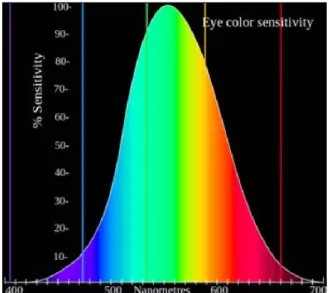
Fig. 4 The Human Eye Fig. 5 The Spectral Response of the Human Eye Wavelengths of light outside of the visible spectrum are not useful for illumination because they cannot be seen by the human eye, but many new digital cameras can capture imagery that has elements of near infrared (NIR) and ultraviolet (UV) exposure, leading to images that have artifacts that distort what we consider to be the normal or ideal.
Furthermore, the eye responds more to some wavelengths of light than others, even within the visible spectrum. This response of the eye is represented by the luminosity function. This is a standardized function which represents the response of a "typical" eye under bright conditions (photopic vision) which is further explained below in the BAYER pattern section of the paper. One can also define a similar curve for dim conditions (scotopic vision). This also explains why directors and DPs when sometimes filming under very low light conditions the results are not representative of what they thought they saw with their own eyes. When neither is specified, photopic conditions are generally assumed.
Luminous efficacy of radiation measures the fraction of electromagnetic power which is useful for lighting. It is obtained by dividing the luminous flux by the radiant flux. Light with wavelengths outside the visible spectrum reduces luminous efficacy, because it contributes to the radiant flux while the luminous flux of such light is zero. Wavelengths near the peak of the eye's response contribute more strongly than those near the edges.
In SI, luminous efficacy has units of lumens per watt (lm/W). Photopic luminous efficacy of radiation has a maximum possible value of 683 lm/W, for the case of monochromatic light at a wavelength of
555 nm (green). Scotopic luminous efficacy of radiation reaches a maximum of 1700 lm/W for narrowband light of wavelength 507 nm.
To account for this response level in the human eye, Dr BAYER, from Kodak developed the BAYER filter principle so that electronic delivery of image files could best replicate the colour sensitivity of the human eye, hence the BAYER pattern of RGB filters. In the BAYER pattern configuration there are two green receptors compared to only one each for red and blue.
Fig. 6 Typical Bayer Pattern Sensor Filter. Fig. 7 Typical Spectral Response – Bayer Pattern Filters
HMI TECHNOLOGY:
Hydrargyrum medium-‐arc iodide lamp, or HMI, is an Osram brand metal-‐halide gas discharge
medium arc-‐length lamp manufactured for the film and entertainment industry. Hydrargyrum is Latin for mercury (Hg).
An HMI lamp uses mercury vapour mixed with metal halides in a quartz-‐glass envelope, with two tungsten electrodes of medium arc separation. Unlike traditional lighting units using incandescent light bulbs, HMIs need electrical or electronic ballasts, which are separated from the head via a header cable, to limit current and supply the proper voltage. The lamp operates by creating an electrical arc or gas plasma between two electrodes within the bulb that excites the pressurized mercury vapour and metal halides, and provides very high light output with greater efficacy than incandescent lighting units. The efficiency advantage is near fourfold, with approximately 85–108 lumens per watt of electricity.
History
In the late 1960s German television producers sought out lamp developer OSRAM to create a less expensive replacement for incandescent lights for the film industry who developed HMI bulbs at their request. Multi-‐kilowatt HMI lights are used in the film industry and for large-‐screen slide projection because of their approximate daylight-‐balanced light output, as well as their efficiency.
Flicker and colour temperature
HMI lamps present problems with colour temperature when used for film or video lighting With HMI bulbs, colour temperature varies significantly with lamp age with nominal values of between 5600 K to 6400 K. HMI bulbs (like all arc bulbs) need a current limiting unit to function. Two possibilities to do that are described in the ballast section below. The problem of flickering exists only when using the bulb in combination with magnetic ballast (electronic ballasts produce almost flicker free light).
HMI bulbs (running with magnetic ballast) present an inherent problem of possibly producing light on film or video with a noticeable flicker. This is more pronounced with the current use of high frame rate cameras.
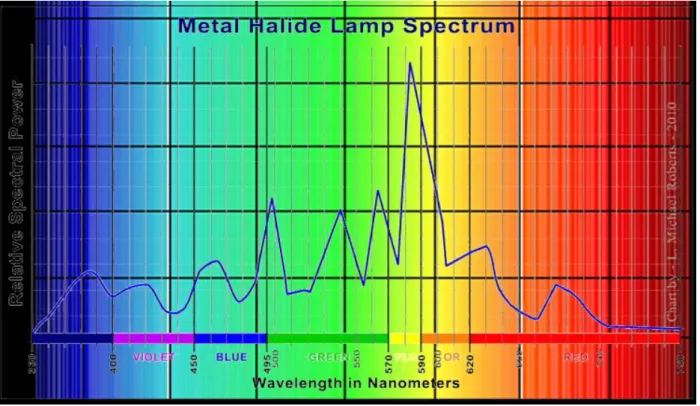
Fig. 8 Typical Hydrargyrum Medium-‐Arc Iodide Lamp (HMI) Spectral Response.
LIGHT EMITTING DIODE (LED) TECHNOLOGY:
A light-‐emitting diode (LED) is a semiconductor light source. When a light-‐emitting diode is switched on, electrons are able to recombine with holes within the device, releasing energy in the form of photons. This effect is called electroluminescence and the colour of the light (corresponding to the energy of the photon) is determined by the energy band gap of the semiconductor.
A LED is often small in area (less than 1 mm2), and integrated optical components may be used to shape its radiation pattern. LEDs present many advantages over incandescent light sources including lower energy consumption, longer lifetime, improved robustness, smaller size, and faster switching. As LED technology grew more advanced, light output rose, with improved efficiency and reliability. The invention and development of the high-‐power white-‐light LED led to use for illumination, and is fast replacing incandescent and fluorescent lighting especially in film and television filming.
The development of LED technology has caused their efficiency and light output to rise exponentially, with a doubling occurring approximately every 36 months since the 1960s, in a way similar to
Moore's law. This trend is generally attributed to the parallel development of other semiconductor technologies and advances in optics and has been called Haitz's law after Dr. Roland Haitz.
Efficiency and operational parameters
One of the key advantages of LED-‐based lighting sources is high luminous efficiency. White LEDs quickly matched and overtook the efficacy of standard incandescent lighting systems. Cree issued a press release on February 3, 2010 about a laboratory prototype LED achieving 208 lumens per watt at
room temperature. The correlated colour temperature was reported to be 4579 K. In December 2012 Cree issued another press release announcing commercial availability of 200 lumens per watt LED at room temperature. The future of LED development is white and bright (no pun intended).
White light LED
There are two primary ways of producing white light-‐emitting diodes (WLEDs), LEDs that generate high-‐intensity white light. One is to use individual LEDs that emit three primary colours—red, green, and blue—and then mix all the colours to form white light. The other is to use a phosphor material to convert monochromatic light from a blue or UV LED to broad-‐spectrum white light, much in the same way a fluorescent light bulb works. Because of metamerism, it is possible to have quite different spectra that appear white. But the appearance of some objects may be more sensitive to details of the light spectrum illuminating them.
This is a major problem for DOPs – LEDs while they appear white the camera sees the spectrum gaps in LED light and produces the real colours which lead to colour shift in the resulting images. RGB LEDs
White light can be formed by mixing differently coloured lights; the most common method is to use red, green, and blue (RGB). Hence the method is called multi-‐colour white LEDs (sometimes referred to as RGB LEDs). Because these need electronic circuits to control the blending and diffusion of different colours, and because the individual colour LEDs typically have slightly different emission patterns (leading to variation of the colour depending on direction) even if they are made as a single unit, these are seldom used to produce white lighting. Nevertheless, this method is particularly interesting in many uses because of the flexibility of mixing different colours, and, in principle, this mechanism also has higher quantum efficiency in producing white light..
Fig. 9 Typical Light Emitting White Diode (LED) Spectral Response
LIGHT EMITTING PLASMA (LEP) TECHNOLOGY:
Plasma lamps are a type of electrodeless lamp energized by radio frequency (RF) power. They are distinct from the novelty plasma lamps that were popular in the 1980s.
The electrode-‐less lamp was invented by Nikola Tesla after his experimentation with high-‐frequency currents in an evacuated glass tube for the purpose of studying high voltage phenomena. The first practical plasma lamps were the sulfur lamps manufactured by Fusion Lighting. These problems have gradually been overcome by manufacturers such as Ceravision and Luxim, and high-‐efficiency plasma (HEP) lamps have been introduced to the general lighting market.
Modern plasma lamps are a family of light sources that generate light by exciting a plasma inside a closed transparent burner or bulb using radio frequency (RF) power. Typically, such lamps use a noble gas or a mixture of these gases and additional materials such as metal halides, sodium, mercury or sulfur. In modern plasma lamps, a waveguide is used to constrain and focus the electrical field into the plasma. In operation, the gas is ionized, and free electrons, accelerated by the electrical field, collide with gas and metal atoms. Some atomic electrons circling around the gas and metal atoms are excited by these collisions, bringing them to a higher energy state. When the electron falls back to its original state, it emits a photon, resulting in visible light or UV, depending on the fill materials. In the year 2000, a system was developed that concentrated radio frequency waves into a dielectric waveguide made of ceramic, which energized light-‐emitting plasma in a bulb positioned inside. This system, for the first time, permitted an extremely compact yet bright electrode-‐less lamp.
Heat and power
The use of a high-‐dielectric waveguide allowed the sustaining of plasmas at much lower powers— down to 100 W in some instances. It also allowed the use of conventional gas-‐discharge lamp fill materials which removed the need to spin the bulb. The only issue with the ceramic waveguide was that much of the light generated by the plasma was trapped inside the opaque ceramic waveguide. In 2009, Ceravision introduced an optically clear quartz waveguide that appears to resolve this issue.
High-‐efficiency plasma (HEP)
High-‐efficiency plasma lighting is the class of plasma lamps that have system efficiencies of 90 lumens per watt or more. Lamps in this class are potentially the most energy-‐efficient light source for
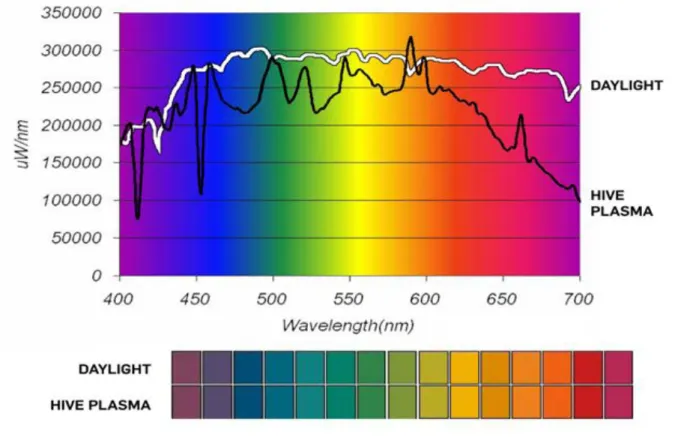
outdoor, commercial, industrial and film production lighting. This is due not only to their high system efficiency but also to the small light source they present enabling very high luminaire efficiency. Many modern plasma lamps, such as those manufactured by Ceravision and Luxim, have very small light sources—far smaller than HID bulbs or fluorescent tubes—leading to much higher luminaire efficiencies also. High intensity discharge lamps have typical luminaire efficiencies of 55%, and fluorescent lamps of 70%. Plasma lamps typically have luminaire efficiencies exceeding 90%. The Hive brand of plasma film lighting is more efficient than LED and at least equal to HMI. It is claimed to be the future of Light. The quality of light from a Hive plasma is reminiscent of the light
quality not seen since the carbon arc period. Hive Plasma is designed to be flicker free to
225,000,000 fps. It has been camera tested in the USA to 1,000,000 fps and in Australia to 100,000 fps and found to be flicker free ...they claim they are waiting for camera technology to catch up!
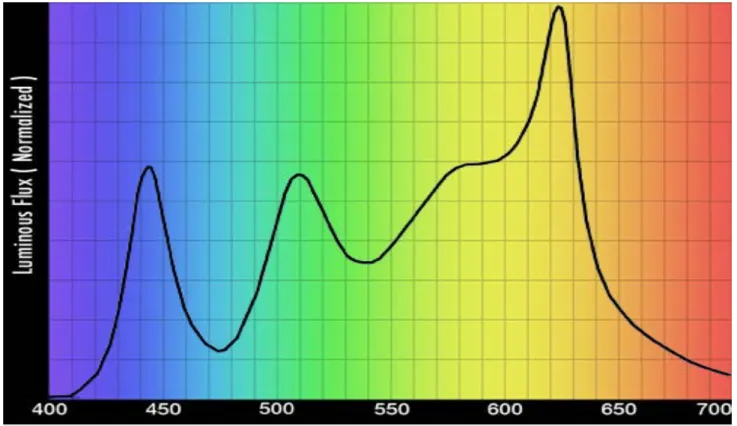
Fig. 10 Typical Light Emitting Plasma (LEP) Spectral Response
DIRECT COMPARISON:
Fig. 11 DAYLIGHT 5,380Deg.Kelvin, 1000fps @ f5.6/8:
Figs. 12 and 13, HIVE LIGHT EMITTING PLASMA WASP LIGHT with 10Deg lens, 1000fps @ f2.8, 5,420 Deg.Kelvin with spectral response.
Figs. 14 and 15 FLICKER FREE HMI 575 WATT narrow beam focused,1000fps @ f2, 5,880 Deg.Kelvin with spectral response
Figs. 16 and 17, VISIO 5000 LED LIGHT 10Deg. Lens, 1000fps @ f2, 6,200Deg.Kelvin with spectral response
REAL CAMERA TESTS:
The Camera
A Weisscam HS2 Mk11 was used for the real camera tests.
The Methodology:
The camera was calibrated at 5,380deg. Kelvin, the sunlight colour temperature for Sydney at 1PM on Monday 1st July, 2013, using a Kodak Grey Card filling 100% of the camera visible area. The camera was set to 1000 frames per second (fps) with a Zeiss 50mm CP2 lens at f5.6/8 and the camera was operated in film mode. The camera then recorded a 2 second image sequence @ 1000fps of each light source with a Macbeth Chart filling the camera frame. The light sequences were filmed in a darkened room with only illumination from the light source which was 3 meters from the subject. The video clips were saved as DPX 10bit uncompressed image sequences from which the attached images were selected as a single frame. The video clips will be played in full at SMPTE 2013.
Colour Temperature was measured by a Sekonic C-‐500 Prodigi Colour Meter.
All camera exposures were set with whites at 95% wave form monitor reading
SUMMARY:
Light Emitting Plasma LEP provided significantly better image quality over the HMI and was flicker free whereas the HMI showed flicker. The Plasma CRI and color temperatures were superior to HMI, 95+ compared to about 90 for HMI. HMIs advantage lies in the fact that it is the incumbent
technology for high lumen white lighting. When fixture replacements are scheduled to be made, the case for replacing HMI with Plasma technology is obvious. The existing energy and bulb maintenance savings with Plasma over HMI is a strong financial argument for replacing incumbent technologies such as HMI even before the incumbent technologies have reached their end of life. While some new HMI ballasts provide dimming and high frequency capability, dimming with HMI causes a decrease in expected lifetime, an unwelcome trade off and with high frame rate cameras, frame rates above 500fps still see lamp flicker. On the other hand, dimming with Plasma technology actually results in an extension beyond rated lifetime and there is no lamp flicker. Our testing showed that Plasma is about 50% more efficient than HMI in the amount of light delivered per watt of power consumed. LEP –V-‐ LED
Light Emitting Plasma (LEP) and Light Emitting Diode (LED) provide similar reliability and lifetime efficiencies. The colour temperature and light quality of Plasma is far superior to current LED
technology and while the directionality of LED light is improving with added lenses, LEP directionality and lensing is excellent, comparable with HMI. Properly balanced high-‐end LED fixtures are beginning to achieve satisfactory CRI and colour temperatures, although this comes at a significant premium. Lumen density of LED’s is still low compared with Plasma. It still takes about 25 typical high lumen LEDs to produce similar lumen output to 1 Plasma source. This high component count combined with high thermal sensitivity which requires large heat sinks yields fixtures which are typically larger, heavier, and more expensive than a Plasma fixture for the same lumen output. LED does have the advantage of instantaneous turn on. LED is a good fit for lower lumen applications such residential indoor and accent lighting, but not high lumen applications.
CONCLUSIONS:
In my 45 years as a working cameraman I have seen many changes. When I first started the lighting sources were predominantly daylight photo bulbs or tungsten. The power usage and heat given off was enormous, but then power was cheap.
The introduction of HMI was a quantum leap in both efficiency and sheer lumen output. It
revolutionised film production, making it more efficient and easier on set. HMI quickly became the industry standard delivering lighting that was equal to the old carbon arc lamps and in many ways it copies the luminaire designs from the carbon arc period.
This century has seen an explosion of technological advancements in lighting, from LED, flicker free HMI, DMX control and last the introduction of LEP or Plasma.
Plasma is certainly set to challenge HMI to become the industry standard. It has superior colour rendition, it is totally flicker free and it is more efficient, delivering about 50% more lumens of light for each watt of power consumed, a bit cost saving in power.
King HMI is not yet dead as it still delivers the big luminares required for that huge grunt of light that is sometimes needed. However, I see the development of Plasma following the same timeline that HMI followed in its earlier days. I am certain we will see the development of more powerful plasma lamps delivering even more light per unit, and, as this happens I am confident Plasma will become the industry standard for quality powerful light sources.
LED also is not finished, while it has difficulty delivering high intensity well focused beams of light in the way HMI and Plasma can, it certainly has a strong future in the documentary, news and current affairs and low budget indie film production areas. It is light, portable, rugged and easy to use, and these attributes alone will ensure it survives and develops further.
References:
• US patent 3971065, Dr. Bryce E. Bayer, "Color imaging array",
• R. W. G. Hunt (2004). The Reproduction of Colour (6th ed.). Chichester UK: Wiley–IS&T Series in Imaging
Science and Technology. pp. 11–2. ISBN 0-‐470-‐02425-‐9.
• Box, Harry. Set Lighting Technician's Handbook 3rd Ed., Focal Press, 2003.
• Technology and Application: Metal Halide Lamps, Photo Optic. OSRAM Lighting Handbook 1984
• "The life and times of the LED — a 100-‐year history". The Optoelectronics Research Centre, University of
Southampton. April 2007. Retrieved September 4, 2012.
• "A lightbulb powered by radio waves". cnet. 2007-‐08-‐23.
• “Vision, Composition & Photography” Weber • Wikipedia
David Adermann
Measurement & Analysis Camera Systems P\L Level 1, 16-‐18 Carlotta St, Artarmon NSW 2064.
Tel 1300 539 808 INT: 612 94385836 Mob: 0418 689 336 www.macsimage.com.au