by Robert A. Leadbetter, Michael S. Shutty, Jr., Patricia B. Hlggins, and Diane Pavalonis
Abstract
The syndrome of psychosis, in-termittent hyponatremia, and polydipsia (PIP syndrome), seen in the seriously mentally ill, can result in severe biopsychosocial impairment, including an exces-sive death rate if not identified early. Because of its impact on the health, functioning, and quality of life of the seriously mentally ill patient, all mental health care providers must be aware of the signs and symp-toms of PIP syndrome. Phys-iological, psychological, be-havioral, self-care, and social factors all play a role in the manifestation of the syndrome; it follows that a multidisciplinary approach is crucial to ensure early detection, monitoring, and treatment of this problem both in the hospital and in the com-munity. This article explains how we have incorporated the
strengths of various disciplinary strategies into a unified treat-ment model for managing PIP syndrome and its sequelae.
Schizophrenia Bulletin, 20(2): 375-385, 1994.
Excessive fluid consumption was first noted as a complication of se-vere mental illness in the 1930s (Hoskins and Sleeper 1933; Sleeper and Jellinek 1936). Recent studies have focused primarily on the eti-ology of associated hyponatremia and on treatment of affected pa-tients (Goldman 1991; Riggs et al. 1991). Up to 70 percent of institu-tionalized patients with schizophre-nia consume greater than average amounts of water; approximately 7 percent also suffer from episodes of intermittent hyponatremia (Vieweg et al. 1988a, 1989a).
These latter patients are said to suffer from the syndrome of psy-chosis, intermittent hyponatremia, and polydipsia (PIP syndrome) (Vieweg et al. 1985a).
The progression from the onset of psychosis to water intoxication follows a predictable course in schizophrenia (Vieweg et al. 1989b). An increase in water con-sumption is noted early in the ness. After 5 or more years of ill-ness, episodic hyponatremia can occur, perhaps dependent on en-vironmental variables (Bugle et al. 1992). Numerous medical compli-cations may be associated with episodic hyponatremia, and an ex-cessive death rate in otherwise healthy patients has been docu-mented (Vieweg et al. 1985b). Ad-ditional studies have noted that PIP syndrome can impair the pa-tient's cognitive and social func-tioning (Snider and Boyd 1991; Shutty et al., in press b). Unfor-tunately, the diagnosis of PIP syn-drome is frequently missed until a generalized seizure occurs (Vieweg et al. 1984<J). It is vital that pa-tients be identified early and that intervention begin before the onset of the severe biopsychosocial com-plications of PIP syndrome.
The wide range of disabilities associated with PIP syndrome can be seen in a variety of mental health settings, crossing discipli-nary boundaries. The lack of clear instruction and education of various disciplines contributes to the poor identification and man-agement of the syndrome. Because of its impact on the health,
func-Reprint requests should be sent to Dr. R.A. Leadbetter, Western State Hospital, P.O. Box 2500, Staunton, VA 24401.
tioning, and quality of life of the seriously mentally ill patient, all mental health care providers must be aware of the signs and symp-toms of PIP syndrome. These pa-tients have complicated needs and require comprehensive treatment planning. Physiological, psychologi-cal, behavioral, self-care, and social factors all play a role in the man-ifestation of the syndrome; it fol-lows that each mental health disci-pline has an important role in meeting the unique needs of pa-tients with PIP syndrome.
This article explains how we have incorporated the strengths of various disciplinary strategies into a unified treatment model for managing PIP syndrome and its sequelae. The following sections of the article highlight the unique contributions of medicine, nursing, psychology, and social work to the treatment of the syndrome. Each section outlines how a discipline manages the PIP syndrome patient through assessment, monitoring, and intervention as summarized in table 1. Our emphasis is on
inte-grating these contributions into a comprehensive care plan.
Medicine and the PIP Syndrome Patient
The physician concentrates on ap-plying knowledge of the patho-physiology of PIP syndrome to the care of the patient. The physician's tasks include detecting the signs and symptoms of the disorder, performing a differential diagnosis, overseeing physiologic monitoring such as body weight and serum sodium level, and prescribing pharmacologic treatment. Addi-tionally, the physician educates other disciplines about the physiol-ogy of PIP syndrome and super-vises coordination of all caregiving aspects.
PIP syndrome is manifest clinically as polydipsia and inter-mittent hyponatremia. Studies of the pathophysiology of PIP syn-drome have found defects involv-ing abnormal thirst regulation, in-appropriate arginine vasopressin (AVP) secretion, and excessive
re-sponse to AVP by the renal tu-bules (Goldman et al. 1988; Riggs et al. 1991). The degree to which a patient becomes acutely hypo-narremic is determined by hormo-nal dysregulation, not just exces-sive water consumption. A rapid decrease in serum sodium presents the most serious risk to the pa-tient. Acute signs of hyponatremia include impaired cognition, sei-zures, delirium, coma, and death. Alternatively, chronic medical se-quelae that may present include hypotonic bladder, urinary inconti-nence, urinary tract infections, hy-dronephrosis, renal dysfunction, hypocalcemia, osteopenia, fractures, abdominal/gastric/bowel disten-tion, vomiting, malnutridisten-tion, edema, and congestive heart failure (Vieweg et al. 1984b, 1987; Delva et al. 1989).
Physicians must be cognizant of the early signs and symptoms of PIP syndrome. Besides polydipsia, a morning specific gravity of less than 1.003 is an early sign of PIP syndrome (Vieweg et al. 1984a). Late afternoon exacerbation of
Table 1. Contributions to treatment by discipline
Discipline Assessment Monitoring Intervention
Medicine Identify acute and chronic medical complications. Per-form differential diagnosis.
Nursing Evaluate self-care abilities and deficits.
Psychology Evaluate neuropsychological, behavioral, and personality functioning.
Social work Evaluate psychosocial func-tioning and environmental de-terminants.
Oversee weight and serum sodium monitoring. Ensure comprehensive treatment plan-ning.
Implement weight protocol. Identify needed adjustments to privileges and treatment plans. Observe patterns of fluid con-sumption. Identify psychologi-cal and behavioral changes. Ensure realistic strategies transferable to less restrictive settings.
Treat hyponatremia and medi-cal sequelae. Manage phar-macologic intervention. Ensure implementation of psychoso-cial interventions.
Restrict fluid access. Adminis-ter treatment for hyponatremia and sequelae.
Develop individual, group, and wardwide psychological and behavioral interventions. Plan discharge. Coordinate re-sources and services. Educate community care providers.
psychiatric symptoms also may suggest undetected hyponatremia. Factors that might precede hypo-natremia include nicotine and caf-feine abuse, treatment with anti-cholinergic or certain psychotropic medications, and substance abuse. Patients who have concurrent diag-noses of schizophrenia and alcohol abuse are particularly prone to PIP syndrome (Ripley et al. 1989). A history with these factors along with suspected polydipsia indicates the need for further evaluation.
In the differential diagnosis of hyponatremia, the physician needs to rule out other medical condi-tions and medication effects that can mimic PIP syndrome (Vieweg et al. 1984b; Illowsky and Kirch 1988; Goldman 1991). Carbamaze-pine therapy, commonly used in the seriously mentally ill, is a fre-quent cause of hyponatremia. Pa-tients with hypothyroidism, those with adrenal insufficiency, those undergoing diuretic therapy (Miiller and Lann 1991), those with syndrome of inappropriate antidiuretic hormone (due to cer-tain carcinomas, head injury, etc.), or those using nicotine (Allon et al. 1990) also can present with hy-ponatremia. Polydipsia and poly-uria may be caused by conditions that lead to diabetes insipidus (hy-pothalamic disorders, certain renal disorders, and medication side effects, particularly lithium treat-ment), by diabetes mellitus, or by anticholinergic medication.
Once other causes of polydipsia and hyponatremia have been ruled out, one must develop a treatment plan that is comprehensive enough to detect acute hyponatremia. Care of a PIP syndrome patient requires careful monitoring of body weight and periodically checking the serum sodium level. We use the patient's diurnal body weight
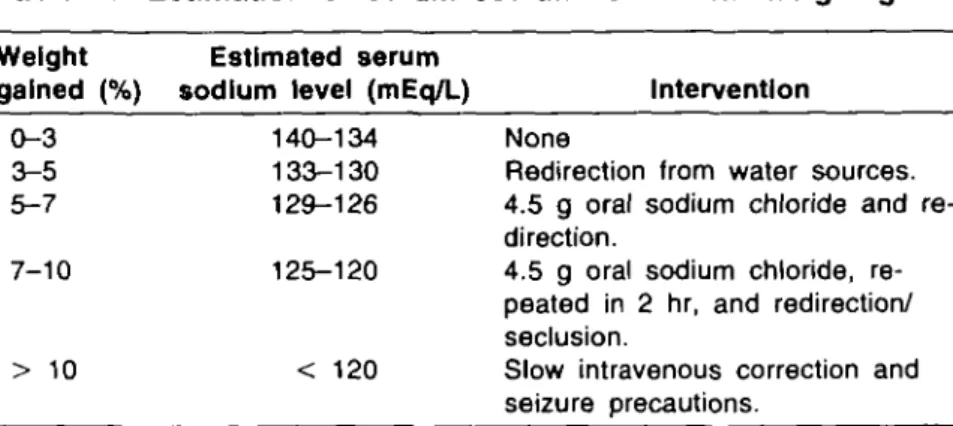
change to estimate the serum so-dium level. A 5 percent gain in body weight is roughly equivalent to a 10 mEq/L drop in serum so-dium (Godleski et al. 1989). Table 2 outlines how the patient's change in body weight is used to estimate the serum sodium level. For example, if a patient weighs 150 pounds in the morning and 157.5 pounds in the afternoon or evening (a 5% weight gain), the serum sodium level can be esti-mated as 130 mEq/L. This method assumes a normonatremic or "dry" weight in the morning. When ap-plying this formula, it is important to remember that it is the rapidity of the change in serum sodium level that presents the greatest risk to the patient (Koczapski and Mill-son 1989).
To prevent persistent fluid con-sumption, short-term interventions include redirection or restriction of free access to water. Whenever the patient surpasses the target weight that indicates a serum sodium level of 130 mEq/L, we measure the level from a blood specimen, if feasible. Otherwise, we estimate the serum sodium as described above to direct further interven-tion. For a level between 126 and 129 mEq/L (or a 5% to 7%
in-crease in body weight), we give 4.5 g oral sodium chloride; for a level of 125 mEq/L or less (or greater than 7% increase in body weight), we repeat the salt dose in 2 hours. If oral salt is contraindi-cated, as in hypertension or heart failure, we restrict fluid intake un-til the excess body weight is lost. When the serum sodium level is 120 mEq/L or less, we may choose to use slow intravenous correction in an emergency room or medical unit setting. Use of hy-potonic solutions may be indicated to avoid rapid correction of hypo-natremia, though the risk for cen-tral pontine myelinolysis is unclear in this population (Cheng et al. 1990).
Long-term treatment objectives include optimizing medication management, increasing patient awareness and self-monitoring, and decreasing nicotine abuse through cessation plans and voluntary reg-ulation of access. First, we rely on optimal antipsychotic and anxiolyt-ic treatment to address the impul-sive, psychotic, and anxiety-driven nature of water consumption. If this approach is not effective, we next add lithium, which blocks AVFs effect on the renal tubules, increasing free water excretion.
Table 2. Estimation of serum sodium level from weight gain
Weight gained (%) 0-3 3-5 5-7 7-10 > 10 Estimated serum sodium level (mEq/L)
140-134 133-130 129-126 125-120 < 120 Intervention None
Redirection from water sources. 4.5 g oral sodium chloride and re-direction.
4.5 g oral sodium chloride, re-peated in 2 hr, and redirection/ seclusion.
Slow intravenous correction and seizure precautions.
Lithium may lessen the severity of hyponatremic episodes (Vievveg et al. 1988b), although the effective-ness of this treatment is debated and requires further study (Alex-ander et al. 1991; Riggs et al. 1991). Third, we add phenytoin to decrease AVP release (Fichman et al. 1970) as well as to prevent seizures.
If these measures are ineffective, alternative treatments may be con-sidered. Demeclocycline, which also blocks AVPs effect on the kidneys, has been used with some success (Nixon et al. 1982; Vieweg et al. 1988c), although a recent study has raised doubts about the efficacy of this treatment (Alex-ander et al. 1991). Other phar-macologic interventions that have been successful include naloxone (Nishikawa et al. 1992), captopril (Lawson et al. 1988), propranolol (Goldstein and Folsum 1991), and enalapril (Sebastian and Bemardin 1990), although large groups have not been systematically studied.
Last, we recently found dramatic improvement in both hyponatremia and polydipsia in patients with clozapine. Eight patients were monitored for 6 months before treatment and 6 months of clozapine treatment. We observed significant improvement in rou-tinely obtained 6 a.m. and 4 p.m. serum sodium levels, as well as the average lowest levels. The esti-mated amount of fluid drunk was 6.67 L pre-clozapine and 4.66 L post-clozapine; the difference ap-proached statistical significance. Seven of eight patients no longer required monitoring for PIP syn-drome and were subsequently dis-charged (Spears et al. 1993). Though clozapine treatment re-quires further study, this agent may be the first identified phar-macologic intervention effective in
preventing not only hyponatremia but polydipsia as well.
Although the physician is pri-marily responsible for ensuring ap-propriate medical care, the unique expertise of other disciplines is vi-tal to the comprehensive treatment of the PIP syndrome patient. The management of such patients re-quires well-informed staff who co-operate in monitoring and inter-vention. Thorough nursing care plans must provide daily assess-ment and monitoring necessary to prevent sequelae. Because charac-terological, behavioral, and neuro-psychological factors affect patient functioning and behavioral inter-ventions, the help of a psycholo-gist is necessary. When planning future placement options, social work staff must anticipate how changes in the social environment can affect water-seeking behavior. The physician must ensure that these factors are integrated into a well-coordinated and comprehen-sive treatment plan.
Nursing and the PIP Syndrome Patient
The nurse contributes to the multi-disciplinary approach to PIP syn-drome by providing assessment of the patient's functioning during day-to-day activities. Nursing staff assess the effectiveness of interven-tions, ensure modification of the treatment plan as necessary, and aid in educating the patient about PIP syndrome and self-monitoring. (Lapierre et al. 1990; Snider and Boyd 1991). To perform these tasks, the nurse must be familiar with the physiology of the disor-der and how it is reflected in daily monitoring. Knowledge of how behavioral and psychological factors influence patient care, and
how the social environment affects drinking behavior, is critical. Influ-encing how these factors affect the day-to-day functioning of the PIP syndrome patient requires careful coordination of nursing care with the other mental health disciplines.
At our facility, nurses base their assessments and treatment plan-ning on Orem's (1985) self-care model. This model delineates four domains of patient functioning based on a patient's capacity for self-care and provision of daily needs. It serves as a schema to highlight the areas of self-care in which the patient requires inter-vention. The four domains of the self-care model are (1) air, food, and fluid; (2) hygiene and elimina-tion; (3) activity and rest; and (4) solitude and social interaction. The nurse intervenes when disease or disability interferes with the pa-tient's self-care abilities in one or more domains.
Patients with PIP syndrome have alterations in each domain. In the air, food, and fluid domain, water loading may result in increased blood pressure or pulse, shortness of breath, edema, or abdominal distention. Vital signs should be assessed if severe water loading is suspected. Fluid intake patterns can change dramatically, as esti-mated by frequent measurement of body weight. When weight has not been carefully monitored, we have observed gains of more than 20 pounds over 10 hours. The drive for fluid intake may lead to dangerous behaviors such as drinking out of toilets, consuming urine, and using other nonpotable sources of water. We carefully monitor bathroom privileges in pa-tients who are actively water-seeking. Vomiting of clear liquids and malabsorption can occur, and patients who prefer fluid
rion to food may become mal-nourished. Direct monitoring at meals may be required to ensure adequate nourishment.
In the hygiene and elimination domain, skin integrity may suffer if the patient is incontinent. Pa-tients with nocruria are awakened during the night to void; patients with daytime incontinence are re-minded to void before leaving the ward or attending activities. Uri-nary frequency up to several times an hour can be seen. Patients can develop hypotonic bladders and have residual volumes of up to 1 L of urine. We have found that in and out catheterization can cor-rect bladder hypotonia over time. Gastric and bowel distention is sometimes seen, exacerbating nutri-tional problems.
In the activity and rest domain, the nurse may suspect that a tient is hyponatremic when the pa-tient has afternoon exacerbation of the underlying psychiatric symp-toms. Other signs of hyponatremia include restlessness, confusion, agi-tation, aggressiveness, and pacing. Patients can become somnolent be-cause of frank central nervous sys-tem dysfunction. In the solitude and social interaction domain, pa-tients isolate themselves to hide their drinking. They spend inordi-nate amounts of time in the bath-room or near the water fountains collecting cans, cups, and other containers to store in their bed areas or hide in the bathroom. Preventing such behavior requires frequent redirection and active ob-servation by nursing staff.
Relying on information from the self-care-based assessment, we use an established protocol to monitor patients at risk for hyponatremia. We measure body weights at 6 a.m. and 4 p.m. using specific guidelines. Patients void and then
are weighed in everyday attire without footwear or extras such as sweaters or purses. Depending on the amount of weight gained, pa-tients may have blood drawn im-mediately to determine serum so-dium level. In addition, nurses may observe and document indi-vidual behavioral changes that can be integrated into nursing care plans.
Nursing care plans outline strat-egies for individual patients. When formulating care plans, we con-sider the extent to which the therapeutic environment affects the patient, the patient's ability to par-ticipate in meeting self-care de-mands, and the knowledge deficits of the patient. Individualized weight gain protocols are set up with guidelines for interventions including restricting fluids, placing patients on one-on-one observation, or isolating patients until a certain weight loss occurs. Because of their continuous interaction with patients, nurses are in an excellent position to evaluate patients' level of functioning. The team adjusts patient privileges accordingly each week.
Nurses use several parameters to evaluate the effectiveness of plans. Physiologic factors include the fre-quency of low serum sodium lev-els in specific patients, as well as the incidence of seizures. Thera-peutic milieu factors include how often patients exceed their estab-lished weight protocols and how able patients are to maintain a consistent level of functioning. Educational factors include the ability of patients to identify and follow through on fluid restriction strategies such as requesting medi-cation when necessary or volun-tarily restricting water intake.
Nurses must coordinate their in-terventions with the other mental
health disciplines. They should un-derstand the indications for, and use of, medications such as lithium and phenytoin for PIP syndrome. Nurses also need to know when to use low-dose benzodiazepines to treat agitation or anxiety associ-ated with water craving, and oral sodium chloride to maintain serum sodium level within the normal range. Nurses' observation of pa-tients' self-care ability can aid in formulating behavioral reinforce-ment plans with token reinforcers (Pavalonis et al. 1992). Before dis-charge, the nurse ensures that the patient is familiar with the medica-tion and can participate in self-monitoring as available in the new setting. In coordination with the social worker, the nurse helps educate community providers about PIP syndrome and how to monitor the patient.
By gathering data, assessing in-terventions, and implementing treatment, the nurse attempts to optimize the patient's day-to-day functioning to maximize self-care and minimize the adverse con-sequences of PIP syndrome. The nurse shares findings with other disciplines to coordinate future treatment planning, behavioral strategies, milieu management, and community reentry.
Psychology and the PIP Syndrome Patient
The unique training the psycholo-gist brings to the multidisciplinary team includes personality, behav-ioral, and neuropsychological as-sessment skills as well as expertise in group therapy and behavioral interventions. These skills are ap-plied to better evaluate the psy-chological and behavioral variables of water-seeking and the psycho-logical sequelae of water
tion. In our setting, the psycholo-gist works closely with the treat-ment team to design both individ-ual and wardwide interventions that capitalize on individual pa-tient differences uncovered during assessment. To cooperate effec-tively, the psychologist must be able to understand the physiology of the disorder; nursing assess-ments, monitoring, and treatment; and how the social environment affects the behaviors associated with the syndrome.
The psychologist uses knowledge of patient behavior in developing wardwide monitoring and treat-ment interventions in PIP syn-drome patients. Wardwide inter-ventions include environmental changes (e.g., limiting water sources) and the development of ward policies such as setting times for daily weight protocols. Though often considered primarily a moni-toring tool, the weight protocol also operates as a behavioral inter-vention. Patients are rewarded with increased privileges for being within protocol, and access to rein-forcers is removed when patients are over protocol. The ward-level system, which governs access to off-ward, off-grounds, and pass privileges is also tied into the weight protocol. The psychologist monitors the effectiveness of these wardwide interventions and ap-plies individualized behavioral in-terventions when needed.
Individualized psychological as-sessment includes evaluation of the patient's unique personality, be-havioral, and neuropsychological characteristics. Personality assess-ment typically involves a struc-tured interview and test admin-istration if the patient can respond to a questionnaire. We have devel-oped a structured interview to col-lect information on patient
self-report of drinking patterns and preferences, the complications of PIP syndrome, and the reasons pa-tients give for drinking (Hinson et al. 1991). This information provides a basis for understanding patients' experience of drinking and for judging how a particular patient may respond to educational inter-ventions. Education is directed at improving self-monitoring of drink-ing and facilitatdrink-ing behavioral in-terventions to reduce fluid intake. Standardized personality measures such as the Minnesota Multiphasic Personality Inventory (Golden and Meehl 1979) provide supplemental information about psychological functioning and coping skills that may facilitate or impede planned interventions.
In addition to personality assess-ment, we use an intensive behav-ioral observation protocol (Shurty et al. 1992). Behavioral assessment allows for direct confirmation of patients' ability to report accu-rately how much they have drunk during a specified period. We un-obtrusively observe patient drink-ing and monitor concomitant psy-chiatric functioning to understand idiosyncratic responses that follow the ingestion of large amounts of water. This assessment is essential in tailoring behavioral interventions aimed at modifying drinking pat-terns to individual patients. Also, this information provides corrective feedback to patients, improves self-monitoring skills, and maintains compliance with behavioral inter-ventions. Researchers have re-ported several behavioral inter-ventions that focus on reducing fluid intake (Klonoff and Morre 1984; McNally et al. 1988; Pavalonis et al. 1992).
The psychologist also performs neuropsychological assessment of patients during both
normonatre-mic and hyponatrenormonatre-mic states. We have developed a brief neuropsy-chological screening exam (Shurty et al. 1993) that assesses rudimen-tary cognitive functions including sustained attention, concentration, immediate and delayed memory, mental flexibility, and visual spa-tial skills. We compare nor-monatremic baseline scores with neuropsychological functioning dur-ing acute hyponatremic episodes to characterize the patient's expe-rience when hyponatremic. This information is used to determine which clinical signs may indicate that a particular patient is de-veloping hyponatremia, as well as to plan intervention strategies for acutely hyponatremic patients. Fi-nally, neuropsychological assess-ment helps us understand patients' self-reports of experience during hyponatremia while providing use-ful information about the nature of water intoxication and its poten-tially reinforcing properties.
The psychologist also works with direct care staff to provide ongoing education about PIP syn-drome in a therapeutic group set-ting. Weekly group therapy for PIP syndrome patients primarily involves helping the patients iden-tify their polydipsia as a health problem; therapy encourages them to talk freely about their drinking patterns and efforts to reduce drinking. We have found that pa-tients can become readily engaged in talking about their PIP syn-drome and can learn basic facts about the syndrome and its com-plications within a brief period (approximately 4 to 6 weeks). Con-sequently, group topics typically include repeated progress checks on patients' ability to self-monitor and control their drinking during the past week, education about hy-ponatremic states, and the
velopment of strategies to reduce drinking. Finally, group therapy provides corrective feedback and encouragement to patients involved in intensive behavioral protocols.
The psychologist's expertise aids the treatment team in determining the mental abilities and deficits of the individual patient. This knowl-edge helps in determining how much the patient can cooperate with medical management, how in-tensively to monitor the patient, and the social structure the patient needs to avert episodes of
hyponatremia.
Social Work and the PIP Syndrome Patient
The clinical social worker provides a variety of unique services, in-cluding individual, group, and family therapy, and education. At the core of these services is the discharge-planning component of the treatment process. The social worker's view of the client's strengths and needs within the context of the client's environment is important in planning treatment and discharge for the PIP syn-drome patient. The social worker has a unique understanding of so-cial and environmental characteris-tics and how they affect a pa-tient's communication, compliance with treatment, comfort, and access to services (Schilling and Schilling 1987). The social worker is the hospital's link to community re-sources and the patient's link to community living.
This link ensures that patient management is consistent with the applied knowledge gained from medicine, nursing, and psychology and prevents service gaps. Persons with a serious mental illness or-dinarily require extensive discharge planning and community case
management. The combination of a severe mental illness and the po-tentially dangerous electrolyte im-balance associated with PIP syn-drome requires the development of intensive and well-coordinated dis-charge plans. For effective care management, both in and out of the hospital, the social worker must have a basic understanding of the physiology of PIP syn-drome, its behavioral manifesta-tions, and available treatment strategies.
The social worker is acquainted with the biopsychosocial function-ing of individual PIP syndrome patients and thus understands their level of insight, investment in rehabilitation, and ability to moni-tor their own mental illness (as well as the manifestations of PIP syndrome). During the treatment-planning process, social work input is critical in developing behavioral treatment plans and educational interventions. A com-plex and staff-intensive plan imple-mented in the hospital may not be a suitable intervention in an adult home. Restrictive interventions that do not mimic community life, such as fluid regulation protocols, are unrealistic in the community set-ting. The social worker acts as a troubleshooter, helping the treat-ment team develop treattreat-ment plans that are realistic in a community-based setting.
As the multidisciplinary team changes its focus from hospital treatment to discharge planning, several issues arise. Managing the PEP syndrome patient in the com-munity requires careful review of the placement setting and its re-sources. The level of structure and supervision the patient will require outside the hospital environment is evaluated according to the individ-ual patient's strengths and needs.
Patients who can weigh themselves several times a day and volun-tarily restrict fluid intake will re-quire significantly less supervision and structure than patients who are limited in these abilities. Dur-ing community placement evalua-tion, the team must consider ac-cess to medical services for regular and emergency determination of serum sodium levels.
Educating the patient, family members, and community care providers is another fundamental function of the social worker. The social worker works closely with the patient's community support system (family, mental health serv-ice providers, group homes, etc.) to educate them about PIP syn-drome and the patient's particular needs. Typically, each patient has an individualized weight protocol to track diurnal weight gain and estimated serum sodium level. The social worker communicates these plans to community care provid-ers. Essential, but often over-looked, is access to a scale for implementing the weight protocol. Educational objectives include fa-miliarizing aftercare providers with the patient's particular PIP symp-toms. To avoid unnecessary changes in antipsychotic medica-tions after discharge, it is impor-tant to differentiate between symp-toms related to hyponatremia and those related to the patient's pri-mary illness, because PIP syn-drome can mimic an exacerbation of the underlying mental disorder.
After discharge, the patient will receive services from a variety of mental health and medical provid-ers. Community-based aftercare providers need to be aware of the interventions offered to the patient, particularly because these services are often fragmented and require careful coordination. The social
worker coordinates the education of these various aftercare providers to avoid mismanagement of the patient. For example, phenytoin, typically prescribed for persons with seizure disorders, might be discontinued if the patient has no documented seizure disorder. Dis-continuation may lead to hypo-natremic episodes and readmission.
The social worker's role is to ensure that the required resources are in place so that the patient's transition to new surroundings goes smoothly. This role requires awareness of the mechanics of ap-propriate medical management, monitoring strategies, and how the patient's psychological strengths and weakness affect water-seeking behavior. These factors must be in-tegrated to ensure constancy and protection during changes in the patient's living situation, as well as the preservation of the patient's quality of life.
Discussion
To highlight the efficacy of a mul-tidisciplinary approach to PIP syn-drome, we have examined changes in clinical variables and successful management of individual cases. Variables reflecting good outcome include a decrease in severity of hyponatremia initially and dis-charge success ultimately. Since in-stituting a multidisciplinary ap-proach, we have admitted 15 PIP syndrome patients to our unit. Five have been admitted recently (less than 3 months ago) and are undergoing continuing intervention. Comparing the initial 6 months of management with the most recent 6 months (or the 6 months before discharge) for the remaining 10 patients, 7 had significant improve-ment in severity of hyponatremia. Seven patients in another group
have been discharged and to our knowledge have not required rehospitalization.
Successful outcome depends on coordinated management during hospitalization. Typically a patient referred to our unit has been hav-ing persistent problems in control-ling fluid intake, either in the hos-pital or in the community. Often these patients have received acute medical intervention for hyponatre-mia or have had a hyponatrehyponatre-mia- hyponatremia-induced seizure. Normally the patient will have several measure-ments of serum sodium level in the 120-130 mEq/L range before transfer. Once accepted, the patient is immediately placed into our multidisciplinary program. The se-verity of the patient's dysfunction is evaluated, and adjustment of medications considered. The pa-tient is redirected from water sources, most of which are observ-able from the central nursing sta-tion. Body weight is obtained ev-ery 2 hours while the patient is awake, and 6 a.m. and 4 p.m. serum sodium levels are measured to begin establishing a protocol as outlined above. Patients are not allowed to have cups or other drinking materials.
Once patients have shown good control of fluid intake, as reflected by body weight, they are allowed increasing amounts of time off the unit. Psychological assessments take place as indicated, and a comprehensive and individualized treatment plan and weight protocol are developed. About this time, patients are also incorporated into a weekly group for patients with PIP syndrome to begin supportive and educational interventions. Staff encourage patients to weigh them-selves and be familiar with their protocols. If a patient continues to have hyponatremia despite these
interventions, further medication changes (such as addition of lith-ium and phenytoin) and more restrictive interventions are considered.
If a patient has shown good ability to control fluid consump-tion, discharge options are pur-sued. The patient is typically al-lowed a series of passes away from the hospital, during which time the patient or care provider ensures at least diurnal body weight measurements, which the hospital staff review on the pa-tient's return. Once consistency is attained and care providers in the community are educated, the pa-tient is discharged. Continued monitoring of patients in the com-munity is important to ensure that further morbidity is avoided and optimal functioning continues.
An example is a 41-year-old Hispanic woman with a diagnosis of schizoaffective disorder. She had 21 previous psychiatric hospitaliza-tions but was never noted to have polydipsia or hyponatremia. During this hospitalization, she presented with delusions of pregnancy, paranoid delusions, pressured speech, and labile affect. On the admissions unit she was noted to have excessive water con-sumption with daytime inconti-nence and nocturia. The admis-sions staff initiated diurnal weight monitoring and noted bizarre be-haviors during times of excessive water consumption. At the begin-ning of her fourth month of hospi-talization, she was transferred to our unit for further intervention because persisting polydipsia inter-fered with discharge planning. Ini-tially her weight was measured every 2 hours, and she was as-signed to a water drinkers' group. Workup for hyponatremia revealed lithium-induced hypothyroidism,
which was successfully treated and determined to be unrelated to her hyponatremia. Within 5 months, the patient attained excellent con-trol of her polydipsia as reflected by minima] diurnal weight gain, and discharge planning was be-gun. Staff at the group home were educated about PIP syndrome. On an initial discharge pass, the pa-tient began to have reexacerbation of her psychiatric symptoms that was associated with increased wa-ter intake, thought to be due in part to the amount of unstructured time during the day. She was re-turned to the hospital, and the weight protocol was reinstituted. The group home staff were in-structed in the use of the weight protocol and interventions. Within 2 weeks, she was successfully re-mtroduced to the group home and to our knowledge has not required rehospitalization.
Other typical patients are those who are chronically hospitalized and cannot be discharged. Apply-ing our multidisciplinary approach, we recently reported on the suc-cessful management of such a pa-tient through a token system that rewards lack of excessive weight gain. Mean diurnal weight gain was 7.1 pounds during a 23-week baseline; it dropped to 4.1 pounds following 23 weeks of treatment and at a 1-year followup. Esti-mated fluid consumption dropped from 10 to 4 L daily, and inci-dents of hyponatremia decreased by 62 percent. This marked im-provement in hyponatremia made possible a decrease in restrictive staff interventions and blood draw-ing, significantly improving the pa-tient's quality of life (Pavalonis et al. 1992).
In summary, the multidiscipli-nary approach to PIP syndrome requires coordination of services
from all disciplines. Patients with PIP syndrome clearly suffer from an increased morbidity related to biopsychosocial dysfunction. Medi-cal complications; poor self-care; cognitive, behavioral, and psycho-logical impairments; and social dysfunction together contribute to patients' poor level of functioning. By optimizing patients' functioning through coordinated multidiscipli-nary interventions, we have found that we can reduce the negative impact of PIP syndrome on pa-tients' quality of life.
References
Alexander, R.C.; Karp, B.I.;
Thompson, S.; Khot, V.; and Kirch, D.G. A double blind, placebo-controlled trial of demeclocycline treatment of polydipsia-hypona-tremia in chronically psychotic patients. Biological Psychiatry, 30:417-420, 1991.
Allon, M.; Allen, H.M.; Deck, L.V.; and Clark, M.L. Role of cigarette use in hyponatremia in schizo-phrenic patients. American Journal of Psychiatry, 147:1075-1077, 1990. Bugle, C; Andrew, S.; and Heath, J. Early detection of water intox-ication. Journal of Psychosocial Nursing, 30:31-34, 1992.
Cheng, J.C; Zikos, D.; Skopicki, H.A.; Peterson, D.R.; and Fisher, K.A. Long-term neurologic out-come in psychogenic water drinkers with severe symptomatic hyponatremia: The effect of rapid correction. American Journal of Medicine, 88:561-566, 1990.
Delva, N.J.; Crammer, J.L.; Jarzylo, S.V.; Lawson, J.S.; Owen, J.A.; Sribney, M.; Weir, B.J.; and Yendt, E.R. Osteopenia, pathological frac-tures, and increased urinary cal-cium excretion in schizophrenic
patients with polydipsia. Biological Psychiatry, 26:781-793, 1989. Fichman, M.P.; Kleeman, C.R.; and Bethune, J.E. Inhibition of ADH secretion by diphenylhydantoin. Archives of Neurology, 22:45-53, 1970.
Godleski, L.S.; Vieweg, W.V.R.; Leadbetter, R.A.; Hundley, P.L.; Harrington, D.P.; and Yank, G.R. Day-to-day care of chronic schizo-phrenic patients subject to water intoxication. Annals of Clinical Psy-chiatry, 1:179-185, 1989.
Golden, R.R., and Meehl, P.E. De-tection of the schizoid taxon with MMPI indicators. Journal of Abnor-mal Psychology, 88:217-233, 1979. Goldman, M.B. A rational ap-proach to disorders of water bal-ance in psychiatric patients. Hos-pital and Community Psychiatry, 42:488-494, 1991.
Goldman, M.B.; Luchins, D.J.; and Robertson, G.L. Mechanisms of al-tered water metabolism in psy-chotic patients with polydipsia and hyponatremia. New England Journal of Medicine, 318:397-403, 1988. Goldstein, R.J., and Folsom, J. The successful treatment of psychogenic polydipsia and water intoxication with propranolol: A case report. Minnesota Medicine, 74:29-32, 1991. Hinson, P.; Shurty, M.S.; and Lead-better, R.A. "Patient Self-Reported Experiences and Psychosocial Cor-relates of the Polydipsia, Intermit-tent Hyponatremia, and Psychosis Syndrome." Presented at the An-nual Meeting of the Virginia Psy-chological Association, Richmond, VA, October 1991.
Hoskins, R.G., and Sleeper, F.H. Organic functions in schizophrenia. Archives of Neurology and Psychia-try, 30:123-140, 1933.
Illowsky, B.P., and Kirch, D.G. Polydipsia and hyponatremia in psychiatric patients. American Jour-nal of Psychiatry, 145:675-683, 1988. Klonoff, E.A., and Morre, D.J. Compulsive polydipsia presenting as diabetes insipidus: A behavioral approach. Journal of Behavioral Therapeutics and Experimental Psy-chiatry, 15:353-358, 1984.
Koczapski, A.B., and Millson, R.C. Individual differences in serum so-dium levels in schizophrenic men with self-induced water intoxica-tion. American Journal of Psychiatry, 146:1614-1615, 1989.
Lapierre, E.; Berthot, B.D.; Gur-vitch, M.; Rees, I.; and Kirch, D.G. Polydipsia and hyponatremia in psychiatric patients: Challenge to creative nursing care. Archives of Psychiatric Nursing, 4:87-92, 1990. Lawson, W.B.; Williams, B.; and Pasion, R. Effects of captopril on psychosis and disturbed water reg-ulation. Psychopharmacology Bulletin, 24:176-178, 1988.
McNally, R.J.; Calamari, J.E.; Hansen, P.M.; and Kaliher, C. Be-havioral treatment of psychogenic polydipsia. Journal of Behavioral Therapeutics and Experimental Psy-chiatry, 19:57-61, 1988.
Miiller, R.J., and Lann, H.D. Thiazide diuretics and polydipsia in schizophrenic patients. [Letter] American Journal of Psychiatry, 148390, 1991.
Nishikawa, T.; Tsuda, A.; Tanaka, M.; Nishikawa, M.; Koga, I.; and Uchida, Y. Naloxone attenuates drinking behavior in a schizo-phrenic patient displaying self-induced water intoxication. Clinical Neuropharmacology, 15:310-314, 1992.
Nixon, R.A.; Rothman, J.S.; and Chin, W. Demeclocycline in the prophylaxis of self-induced water intoxication. American Journal of Psychiatry, 139:828-830, 1982. Orem, D.E. Nursing Concepts of Practice. 3rd ed. New York, NY: McGraw-Hill Book Company, 1985. Pavalonis, D.L.; Shutty, M.S.; Lead-better, R.A.; Hundley, P.A.; and Vieweg, W.V.R. Behavioral inter-vention to reduce water intake in the syndrome of psychosis, inter-mittent hyponatremia, and polydip-sia. Journal of Behavior Therapy and Experimental Psychiatry, 23:265-267, 1992.
Riggs, A.T.; Dysken, M.W.; Kin, S.W.; and Opsahl, J.A. A review of disorders of water homeostasis in psychiatric patients. Psychosomatics, 32:133-148, 1991.
Ripley, T.L.; Millson, R.C; and Koczapski, A.B. Self-induced water intoxication and alcohol abuse. American Journal of Psychiatry, 146:102-103, 1989.
Schilling, R.F., Jr., and Schilling, R.F. Social work and medicine: Shared interests. Social Work, 32:231-234, 1987.
Sebastian, C.S., and Bemardin, A.S. Comparison of enalapril and cap-topril in the management of self-induced water intoxication. Biolog-ical Psychiatry, 27:787-790, 1990. Shutty, M.S.; Hundley, P.L.; and Leadbetter, R.A. Development and validation of a behavioral observa-tion measure for the syndrome of psychosis, intermittent hyponatre-mia, and polydipsia. Journal of Behavior Therapy and Experimental Psychiatry, 23:213-219, 1992.
Shutty, M.S.; Leadbetter, R.A.; and Pavalonis, D.L. Neuropsychiatric
manifestations of hyponatremia in chronic schizophrenic patients with psychosis, intermittent hypo-natremia, and polydipsia. Schizo-phrenia Research, 10:125-130, 1993. Sleeper, F.H., and Jellinek, E.M. A comparative physiologic, psycho-logic, and psychiatric study of polyuric and nonpolyuric schizo-phrenic patients. Journal of Nervous and Mental Disorders, 158:557-563, 1936.
Snider, K., and Boyd, M.A. Nurs-ing interventions for patients with disordered water balance. Journal of Psychosocial Nursing, 29:10-16, 1991.
Spears, N.; Leadbetter, R.; and Shutty, M. "Impact of Clozapine on Polydipsia and Hyponatremia." Presented at the 1993 American Psychiatric Association Convention, San Francisco, CA, May 1993. Vieweg, W.V.R.; David, J.J.; Rowe, W.T.; Canterbury, R.J.; and Spradlin, W.W. Hypocalcemia: An additional complication of the syn-drome of self-induced water intox-ication and psychosis (SIWLP). Psy-chiatric Medicine, 4:291-297, 1987. Vieweg, W.V.R.; David, J.J.; Rowe, W.T.; Peach, M.J.; Veldhuis, J.D.; Kaiser, D.L.; and Spradlin, W.W. Psychogenic polydipsia and water intoxication: Concepts that have failed. Biological Psychiatry, 20:1308-1320, 1985a.
Vieweg, W.V.R.; David, J.J.; Rowe, W.T.; Wampler, G.J.; Burns, W.J.; and Spradlin, W.W. Death from self-induced water intoxication among patients with schizophrenic disorders. Journal of Nervous and Mental Disorders, 173:161-165, 1985b.
Vieweg, W.V.R.; Godleski, L.S.; Graham, P.; Barber, ].; Goldman,
F.; Kellogg, E.; Bayliss, E.V.; Glick, J.; Hundley, P.L.; and Yank, G.R. Abnormal diurnal weight gain among long-term patients with schizophrenic disorders.
Schizo-phrenia Research, 1:67-71, 1988a.
Vieweg, W.V.R.; Godleski, L.S.; Graham, P.; Kellogg, E.; Goldman, F.; Barber, J.; Bayliss, E.V.; Glick, J.; Hundley, P.L.; and Yank, G.R. Diurnal weight gain in chronic psychosis. Schizophrenia Bulletin, 15:501-506, 1989a.
Vieweg, W.V.R.; Godleski, L.S.; Pulliam, W.R.; Schofield, W.P.; Saathoff, G.B.; Hundley, P.L.; and Yank, G.R. Development of water dysregulation during Arieti's third stage of schizophrenia? Biological Psychiatry, 26:775-780, 1989b. Vieweg, W.V.R.; Rowe, W.T.; David, J.J.; and Spradlin, W.W. Hyposthenuria as a marker for self-induced water Intoxication and schizophrenic disorders. American
journal of Psychiatry, 141:1258-1260,
1984<J.
Vieweg, W.V.R.; Rowe, W.T.; David, J.J.; Sutker, L.H.; and Spradlin, W.W. Evaluation of pa-tients with self-induced water in-toxication and schizophrenic disor-ders (SIWIS). Journal of Nervous
and Mental Disorders, 172:552-555,
1984&.
Vieweg, W.V.R.; Weiss, N.M.; David, J.J.; Rowe, W.T.; Godleski, L.S.; and Spradlin, W.W. Treatment of psychosis, intermittent hypo-narremia, and polydipsia (PIP syn-drome) using lithium and pheny-toin. Biological Psychiatry, 23:25-30, 19886.
Vieweg, W.V.R.; Wilkinson, E.C.; David, J.J.; Rowe, W.T.; Hobbs, W.B.; and Spradlin, W.W. The use of demeclocycline in the treatment of patients with psychosis, inter-mittent hyponatremia, and polydip-sia (PIP syndrome). Psychiatric Quarterly, 59:62-68, 1988c.
Acknowledgments
The authors acknowledge the efforts of the staff of the Clinical Studies Unit of Western State Hos-pital, without whom this article would never have been envisioned.
The Authors
Robert A. Leadberter, M.D., is Di-rector, Clinical Studies Unit, West-ern State Hospital, Staunton, VA, and Assistant Professor of Psychia-try, University of Virginia, Char-lortesville, VA. Michael S. Shutty, Jr., Ph.D., is Senior Psychologist, Clinical Studies Unit, Western State Hospital. Patricia B. Higgins, M.S.W., is Clinical Social Work Supervisor, Clinical Studies Unit, Western State Hospital, and As-sistant Professor of Psychiatry, University of Virginia. Diane Pavalonis, M.S.N., M.B.A., is Nurse Coordinator, Clinical Studies Unit, Western State Hospital.