Master Thesis
Electrical Engineering
November 2011
School of Computing
Blekinge Institute of Technology
Security Techniques for Protecting Data in
Cloud Computing
Venkata Sravan Kumar Maddineni
Shivashanker Ragi
This thesis is submitted to the School of Computing at Blekinge Institute of Technology in
partial fulfillment of the requirements for the degree of Master of Science in Software
Engineering. The thesis is equivalent to 40 weeks of full time studies.
Contact Information:
Author(s):
Venkata Sravan Kumar Maddineni
Karlskrona, Sweden [email protected]Shivashanker Ragi
Karlskrona, Sweden
[email protected]
External advisor(s):
Mj Jens Kvarnberg
Swedish Armed Forces
[email protected]
Mr. Ross W Tsagalidis Swedish Armed Forces [email protected]University advisor:
Prof. Lars Lundberg, PhD
School of Computing
[email protected]
School of Computing
Blekinge Institute of Technology
Internet : www.bth.se/com
Phone
: +46 455 38 50 00
A
BSTRACT
Context: From the past few years, there has been a rapid progress in Cloud Computing. With the increasing number of companies resorting to use resources in the Cloud, there is a necessity for protecting the data of various users using centralized resources. Some major challenges that are being faced by Cloud Computing are to secure, protect and process the data which is the property of the user.
Aims and Objectives: The main aim of this research is to understand the security threats and identify the appropriate security techniques used to mitigate them in Cloud Computing.
The main objectives of this research are:
To understand the security issues and the techniques used in the current world of Cloud Computing.
To identify the security challenges, those are expected in the future of Cloud Computing.
To suggest counter measures for the future challenges to be faced in Cloud Computing.
Research Methodology: In this study, we have used two research methods.
Systematic Literature Review.
Survey and interviews with various security experts working on Cloud Computing.
Result: As a result, we have identified the total of 43 security challenges and 43 security techniques. The most measured attribute is confidentiality (31%) followed by integrity (24%) and availability (19%). The impact of identified mitigation techniques is mainly on security (30%), followed by performance (22%) and efficiency (17%). Also we have identified 17 future challenges and 8 mitigation practices.
Conclusion: The identification of security challenges and mitigation techniques in large number of services of Cloud Computing is a very challenging task. In the process of identification from research methods (SLR and Survey), we had identified a satisfactory number of challenges and mitigation techniques which are being used at present and also in future Cloud Computing.
A
CKNOWLEDGEMENT
Any attempt at any level can‟t be satisfactorily completed without the support and guidance of our professor. We would like to express our immense gratitude to our Prof. Lars Lundberg for his constant support and motivation that has encouraged us to come up with this project. We are very thankful to our professor who has rendered their whole hearted support at all times for the successful completion of this thesis “Security Techniques for Protecting Data in Cloud Computing”. Furthermore, we are very much thankful to Mr. Jens Kvarnberg and Mr. Ross W Tsagalidis for their support and help throughout the research.
We would also like to thank our survey participants who have contributed towards survey part of this thesis. Finally, we are greatly thankful to our beloved parents and friends for their relentless support that they had given us to reach our goals.
Yours truly,
Venkata Sravan Kumar Maddineni, Shivashanker Ragi.
C
ONTENTS
SECURITY TECHNIQUES FOR PROTECTING DATA IN CLOUD COMPUTING ...I
ABSTRACT ... III
ACKNOWLEDGEMENT ... IV
CONTENTS ... V
LIST OF FIGURES ... VII
LIST OF TABLES ... VIII
1 INTRODUCTION ... 2
1.1 AIMS AND OBJECTIVES ... 3
1.2 RESEARCH QUESTIONS ... 4
1.3 THESIS OUTLINE ... 4
2 BACK GROUND ... 6
2.1 WHAT IS CLOUD COMPUTING? ... 6
2.1.1 Definition of Cloud Computing ... 6
2.1.2 Essential Characteristics of Cloud Computing ... 6
2.1.3 Service Models of Cloud Computing ... 7
2.1.4 Deployment Models of Cloud Computing ... 7
2.2 DRIVERS OF CLOUD COMPUTING ... 8
2.3 IMPORTANCE OF SECURITY IN CLOUD COMPUTING ... 9
2.4 IMPORTANT SECURITY ISSUES IN THE CLOUD ... 10
3 RESEARCH METHODOLOGY ... 12
3.1 SYSTEMATIC LITERATURE REVIEW (SLR) ... 13
3.1.1 The rationale for SLR ... 13
3.2 SURVEY ... 13
3.3 DATA ANALYSIS METHODS ... 14
3.3.1 Narrative Analysis ... 14
3.3.2 Comparative Analysis ... 14
4 SYSTEMATIC LITERATURE REVIEW (SLR) ... 16
4.1 PLANNING THE REVIEW ... 16
4.1.1 The need for a Systematic Literature Review ... 16
4.1.2 Defining the research questions ... 16
4.1.3 Defining Keywords ... 17
4.1.4 Study Quality Assessment ... 17
4.1.5 Review Protocol ... 18
4.1.6 Selection Criteria and Procedures ... 18
4.2 CONDUCTING THE REVIEW ... 18
4.2.1 Data Extraction Strategy ... 18
4.2.2 Identification of Research ... 19
4.2.3 Study Selection Criteria ... 19
4.2.4 Reliability of Inclusion ... 25
5 SURVEY ... 27
5.1 RATIONALE FOR SURVEY ... 27
5.2 SOURCE OF DATA COLLECTION ... 27
5.3 SURVEY QUESTIONS FORMATION ... 27
6 RESULTS AND ANALYSIS... 29
6.1 SLRRESULTS ... 29
6.1.1 Identified Challenges ... 29
6.1.2 Identified Mitigation Techniques ... 30
6.2 SURVEY RESULTS ... 31
6.2.1 Reported challenges ... 33
6.2.2 Reported Mitigation Techniques ... 33
7 VALIDITY THREATS ... 36
7.1 CONSTRUCT VALIDITY... 36
7.2 INTERNAL VALIDITY ... 36
7.2.1 Data Gathered Through Interview ... 36
7.3 EXTERNAL VALIDITY ... 37 7.4 CONCLUSION VALIDITY ... 37 8 CONCLUSION ... 39 8.1 FOR RESEARCH QUESTION:1 ... 39 8.2 FOR RESEARCH QUESTION:2 ... 39 8.3 FOR RESEARCH QUESTION:3 ... 40 8.4 FOR RESEARCH QUESTION:4 ... 41 8.5 FUTURE WORK ... 41 9 REFERENCES ... 43 APPENDIX A ... 50 APPENDIX B ... 56 APPENDIX C ... 63 APPENDIX D ... 66 APPENDIX E ... 67
L
IST OF FIGURES
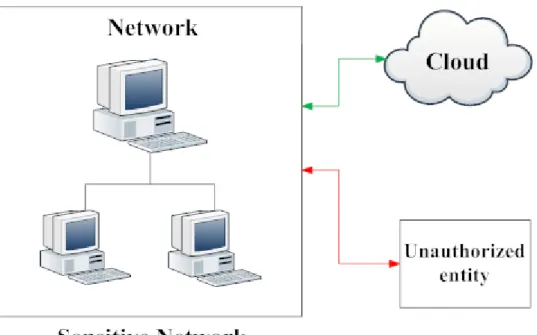
Figure 1.1 Unauthorized access of data between the network and Cloud ... 2
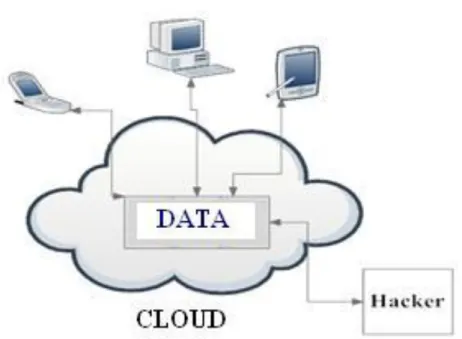
Figure 1.2 Unauthorized access of data within the Cloud ... 3
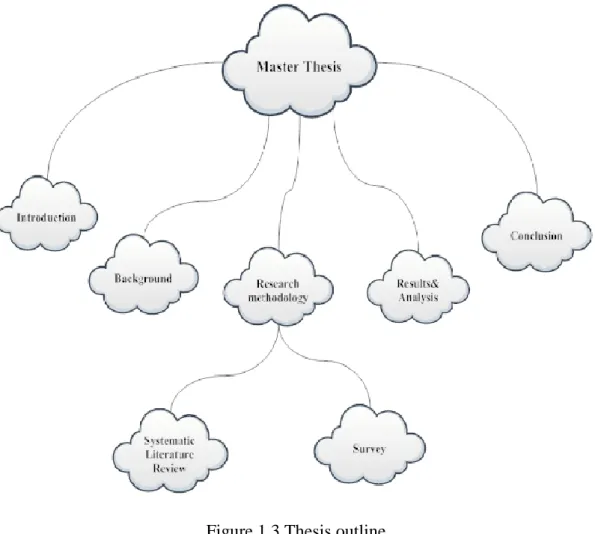
Figure 1.3 Thesis outline ... 4
Figure 2.1 Importance of Security in Cloud Computing ... 9
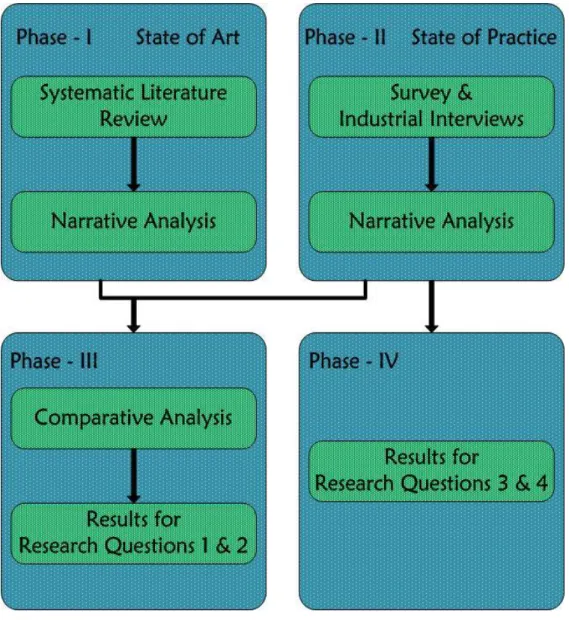
Figure 3.1 Research Design ... 12
Figure 4.1 Steps of Systematic Literature Review ... 20
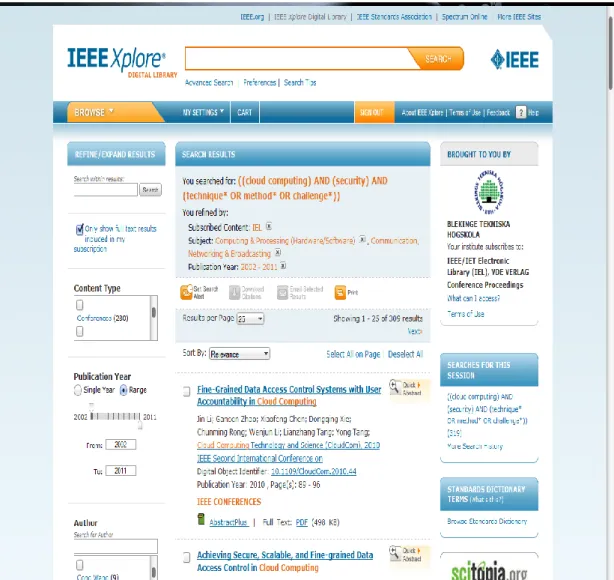
Figure 4.2 IEEE search interface ... 21
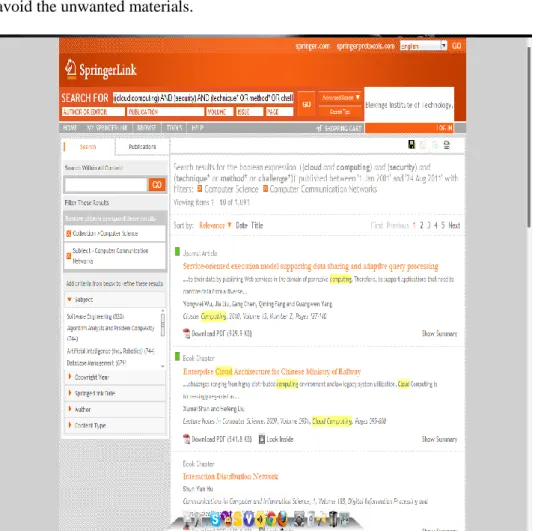
Figure 4.3 Springer link search interface ... 22
Figure 4.4 Science Direct search interface ... 23
Figure 4.5 Scopus search interface ... 23
Figure 6.1 Number of papers published in year wise ... 29
Figure 6.2 List of Compromised attributes ... 30
LIST
OF
TABLES
Table 4.1 Defining Research Questions ... 17
Table 4.2 Quality assessment checklist ... 17
Table 4.3 Selection Criteria ... 18
CHAPTER 1
1
I
NTRODUCTION
From the past few years, there has been a rapid progress in Cloud Computing. Cloud Computing delivers a wide range of resources like computational power, computational platforms, storage and applications to users via internet. The major Cloud providers in the current market segment are Amazon, Google, IBM, Microsoft, Salesforce, etc... With an increasing number of companies resorting to use resources in the Cloud, there is a necessity for protecting the data of various users. Some major challenges that are being faced by Cloud Computing are to secure, protect and process the data which is the property of the user. Below, we have described the two main states that hold your data is out in the Cloud: when the data is in motion (transit) and when the data is at rest, where the data is much expected to be more secure. The below illustrated are the two main scenarios which we have focused to understand the security of the data in the Cloud.
Figure 1.1 Unauthorized access of data between the network and Cloud
The above figure 1.1 describes a scenario where a local network is connected to a Cloud network, in which some part of the network data is broken out from the local network and placed in the Cloud, but the critical data resides in the local network itself. In this case, the Cloud provider does not have any privilege of accessing the data physically which is in the local network. But in some cases, the Cloud needs to access some information which is in the local network, during that access; there exists a possibility of unauthorized access of the local network resources. It describes the typical problem in network security where the information can face active attacks and passive attacks. The active attacks include masquerading, replay attack, modification of messages and denial of service. Passive attacks include traffic analysis. These attacks are likely to happen when the stream of information leaves the client network to the Cloud network.
Figure 1.2 Unauthorized access of data within the Cloud
The above figure 1.2 describes the scenario where the total data of the local network resides within the Cloud, where the local network and the authorized users can access their data physically in the Cloud. At that instant of time, there exists a possibility for unauthorized users to enter and access the data in the Cloud. In this situation, the virtual machines are allotted to users of the Cloud. These machines have valid logins. However, these logins can be abused and cracked. The data may also be accessed in other perverted ways.
Regarding this area of study, most of the research papers followed a normal traditional literature survey method. Few papers gave an innovative idea and proposed a security model. However, there are very few works, which considered the opinions of various security experts in Cloud Computing. This study proposes that, reader gets the true reflection of the security practices followed by various Cloud Computing companies in the current era. There are very few papers which focus on the security techniques for specified applications. Our work provides more knowledge in this dimension and also predicts the future threats likely to be faced by Cloud Computing and solutions to these threats.
1.1
Aims and Objectives
The main aim of this research work is to identify and understand the security issues which affect the performance of Cloud Computing. Also, to understand the security techniques which are being used to mitigate these security issues. Thereby providing the standard guidelines for the Cloud service providers and as well as Cloud users.
The main objectives of this research are:
To understand the security issues and to identify the appropriate security techniques those are being used in the current world of Cloud Computing.
To identify the security challenges those are expected in the future of Cloud Computing.
To suggest some counter measures for the future challenges to be faced in Cloud Computing.
1.2 Research Questions
Research Question 1: what are the various security techniques being used by the leading Cloud Computing providers, to prevent active and passive attacks when the data is being transferred between the Cloud and a local network?
Research Question 2: what are the various security techniques being used to prevent unauthorized access to data within the Cloud?
Research Question 3: what are the major security challenges we expect in future Cloud Computing?
Research Question 4: How can we handle security problems that are expected in future Cloud Computing?
1.3 Thesis outline
Figure 1.3 Thesis outline
The document is organized as follows: Chapter 1 discusses a brief introduction of the concepts used in this thesis and Chapter 2 discusses the background of Cloud Computing. The research methodologies and the data analysis used are presented in chapter 3. The process of Systematic Literature review is discussed in chapter 4 followed by a brief overview of Survey is discussed in chapter 5. The results from the Systematic Literature Review and Survey are presented in chapter 6. The validity threats of our thesis from various perspectives are discussed in chapter 7. Finally, the conclusion and future directions are discussed in chapter 8. The references used are cited and appendixes are referred at the end of the document.
CHAPTER 2
2
B
ACK
G
ROUND
This chapter provides a brief overview about background of Cloud Computing. Section 2.1 provides the standard definition of Cloud Computing and its essential characteristics, services, deployment models respectively. The section 2.2 gives brief information about the Cloud Computing providers. Section 2.3 deals with the importance of security in the Cloud Computing, whereas section 2.4 provides the major security issues in Cloud.
2.1
What is Cloud Computing?
Cloud is a computing model that refers to both the applications derived as services over the Internet, the hardware and system software in the datacenters that provide those services. Cloud Computing is treated as the high potential paradigm used for deployment of applications on Internet. This concept also explains the applications that are broaden to be accessible through the Internet. Cloud applications use large data centers and effective servers that host web applications and services.
2.1.1
Definition of Cloud Computing
Cloud Computing is rapidly being accepted as a universal access appliance on the Internet. A lot of attention has been given to the Cloud Computing concept in deriving standard definitions. However, the definitions of Cloud Computing remain controversial. But here we have considered the standard definition which was given by the National Institute of Standards and Technology (NIST):
“Cloud Computing is model for enabling ubiquitous, convenient, on demand network access to a shared pool of configurable computing resources (e.g., networks, servers, storage, applications and services) that can be rapidly provisioned and released with minimal management effort or service provider interaction”, [44].
2.1.2
Essential Characteristics of Cloud Computing
According to NIST, the Cloud model is composed of five essential characteristics:
On-demand self-service: A consumer can unilaterally provision computing capabilities, such as server time and network storage, as needed automatically without requiring human interaction with each service provider [44].
Broad network access: Capabilities are available over the network and accessed through standard mechanisms that promote use by heterogeneous thin or thick client platforms (e.g., mobile phones, tablets, laptops, and workstations) [44].
Resource pooling: The provider’s computing resources are pooled to serve multiple consumers using a multi-tenant model, with different physical and virtual resources dynamically assigned and reassigned according to consumer demand. There is a sense of location independence in that the customer generally has no control or knowledge over the exact location of the provided resources but may be able to specify location at a higher level of abstraction (e.g., country, state, or datacenter). Examples of resources include storage, processing, memory, and network bandwidth [44].
Rapid elasticity: Capabilities can be elastically provisioned and released, in some cases automatically, to scale rapidly outward and inward commensurate with demand. To the consumer, the capabilities available for provisioning often appear to be unlimited and can be appropriated in any quantity at any time [44].
Measured service: Cloud systems automatically control and optimize resource use by leveraging a metering capability (pay-per-use basis) at some level of abstraction appropriate to the type of service (e.g., storage, processing, bandwidth, and active user accounts). Resource usage can be monitored, controlled, and reported, providing transparency for both the provider and consumer of the utilized service [44].
2.1.3
Service Models of Cloud Computing
According to NIST, the cloud model is composed of three service models:
Software as a Service (SaaS): The capability provided to the consumer is to use the provider’s applications running on a cloud infrastructure. The applications are accessible from various client devices through either a thin client interface, such as a web browser (e.g., web-based email), or a program interface. The consumer does not manage or control the underlying cloud infrastructure including network, servers, operating systems, storage, or even individual application capabilities, with the possible exception of limited user-specific application configuration settings [44].
Platform as a Service (PaaS): The capability provided to the consumer is to deploy onto the cloud infrastructure consumer-created or acquired applications created using programming languages, libraries, services, and tools supported by the provider. The consumer does not manage or control the underlying cloud infrastructure including network, servers, operating systems, or storage, but has control over the deployed applications and possibly configuration settings for the application-hosting environment [44].
Infrastructure as a Service (IaaS): The capability provided to the consumer is to provision processing, storage, networks, and other fundamental computing resources where the consumer is able to deploy and run arbitrary software, which can include operating systems and applications. The consumer does not manage or control the underlying cloud infrastructure but has control over operating systems, storage, and deployed applications; and possibly limited control of select networking components (e.g., host firewalls) [44].
2.1.4
Deployment Models of Cloud Computing
According to NIST, the cloud model is composed of four deployment models:
Private cloud: The cloud infrastructure is provisioned for exclusive use by a single organization comprising multiple consumers (e.g., business units). It may be owned, managed, and operated by the organization, a third party, or some combination of them, and it may exist on or off premises [44].
Community cloud:The cloud infrastructure is provisioned for exclusive use by a specific community of consumers from organizations that have shared concerns (e.g., mission, security requirements, policy, and compliance considerations). It may be owned, managed, and operated by one or more of the organizations in the community, a third party, or some combination of them, and it may exist on or off premises [44].
Public cloud: The cloud infrastructure is provisioned for open use by the general public. It may be owned, managed, and operated by a business, academic, or government organization, or some combination of them. It exists on the premises of the cloud provider [44].
Hybrid cloud: The cloud infrastructure is a composition of two or more distinct cloud infrastructures (private, community, or public) that remain unique entities, but are bound together by standardized or proprietary technology that enables data and application portability (e.g., cloud bursting for load balancing between clouds) [44].
2.2
Drivers of Cloud Computing
Cloud Computing is rapidly growing area in the IT security space because Cloud architectures are popping up all over. The major driving thought Cloud providers present in the current market segment are Amazon, Microsoft, Google, IBM, Oracle, Eucalyptus, VMware, Eucalyptus, Citrix, Salesforce, Rackspace and there are many different vendors offering different Cloud services. The cloud providers are having different forms to provide their services [18]:
Amazon: Amazon Web Services including the Elastic Compute Cloud (EC2), Amazon Simple Storage Service (S3), etc.
- Provides a highly scalable computing platform to the customer with high flexibility and availability to build a wide range of applications.
Google: Google App Engine
- It supports application programming interfaces for the data store, image manipulation, Google accounts and e-mail services.
Microsoft: Windows Azure Platform
- Windows Azure platform is a group of Cloud technologies which provides a specific set of services to application developers.
Eucalyptus
- Eucalyptus is an open source software infrastructure to create private Cloud architecture on existing enterprise.
IBM: Lotus Live (Platform as a Service)
Salesforce: (Software as a Service)
Rackspace Cloud: (formerly Mosso)
2.3
Importance of Security in Cloud Computing
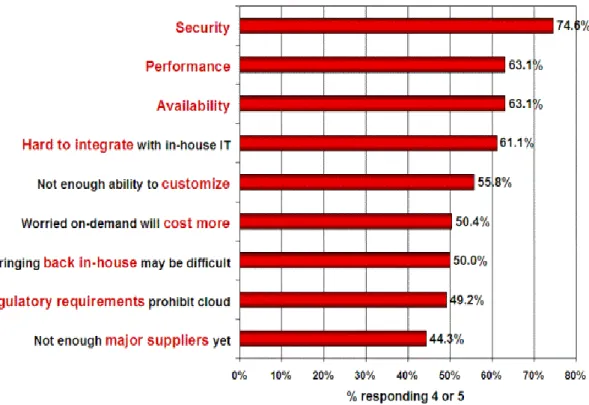
Figure 2.1 Importance of Security in Cloud Computing
(Source: http://www.csrc.nist.gov/groups/SNS/cloud-computing/cloud-computing-v26.ppt at slide 17.)
The above statistical resulted graph represents the results of the survey which was conducted by the IDC (International Data Corporation) in August, 2008 amongst senior business executives and IT professionals regarding the challenges/issues which mainly affect the performance of Cloud Computing. And the survey results show security at the top of the list which declares its importance compared to other parameters of Cloud Computing.
During a keynote speech to the Brookings Institution policy forum, “Cloud Computing for Business and Society”, Microsoft General Counsel Brad Smith also highlighted data from a survey commissioned by Microsoft for measuring attitudes on Cloud Computing among business leaders and the general population in January 2010. The survey found that while 58% of the general population and 86% of the senior business leaders are very much excited about the potential of Cloud Computing and more than 90% of these same people are very much concerned about the security, access and privacy of their own data in the Cloud. (Source: http://www.microsoft.com/ presspass/press/2010/jan10/1-20BrookingsPR.mspx).
The survey results show that the security is the major challenge amongst all the parameters that affect the performance and growth of Cloud Computing.
2.4
Important Security Issues in the Cloud
Even though, the virtualization and Cloud Computing delivers wide range of dynamic resources, the security concern is generally perceived as the huge issue in the Cloud which makes the users to resist themselves in adopting the technology of Cloud Computing. Some of the security issues in the Cloud are discussed below:
Integrity: Integrity makes sure that data held in a system is a proper representation of the data intended and that it has not been modified by an authorized person. When any application is running on a server, backup routine is configured so that it is safe in the event of a data-loss incident. Normally, the data will backup to any portable media on a regular basis which will then be stored in an off-site location [71].
Availability: Availability ensures that data processing resources are not made unavailable by malicious action. It is the simple idea that when a user tries to access something, it is available to be accessed. This is vital for mission critical systems. Availability for these systems is critical that companies have business continuity plans (BCP‟s) in order for their systems to have redundancy [71].
Confidentiality: Confidentiality ensures that data is not disclosed to unauthorized persons. Confidentiality loss occurs when data can be viewed or read by any individuals who are unauthorized to access it. Loss of confidentiality can occur physically or electronically. Physical confidential loss takes place through social engineering. Electronic confidentiality loss takes place when the clients and servers aren‟t encrypting their communications [71].
CHAPTER 3
3
R
ESEARCH
M
ETHODOLOGY
In this research work, we reviewed the previous work in order to acknowledge the
current knowledge to answer the research questions 1 and 2. Most of the previous research works were done with traditional literature review which has low scientific value due to non- rigorous and unfair approach. Where the systematic literature review has is of highly defined characteristics with more clear scientific perspective. So we have undertaken the systematic literature review (SLR) as a primary research method, survey and interviews are considered as secondary research method. The outlook of the research methods which are used to answer the research questions is shown in figure 3.13.1
Systematic Literature Review (SLR)
The following section provides description about the rationale for SLR and survey.
3.1.1
The rationale for SLR
A Systematic literature review is a means of identifying, evaluating and interpreting all available research relevant to a particular research question, topic or phenomenon of interest [34]. Systematic reviews aims to present a fair evaluation of a research topic by using a trustworthy, rigorous and auditable methodology. A systematic literature review synthesizes existing work in a manner that is fair and seen to be fair. Systematic review must be undertaken in accordance with a predefined search strategy. The search strategy must allow the completeness of the research to be assessed. In particular, researchers performing a systematic review must make every effort to identify and report research that does not support their preferred research hypothesis as well as identifying and reporting research that supports it [34]. Systematic reviews are mainly undertaken to summarize the existing evidence, identifying the gaps in current research and providing a framework for new research activities [34].
The main features that differentiate a systematic literature review from a traditional literature review are:
Systematic Literature Review addresses the specified research questions by defining a review protocol.
Systematic review defines search strategy that aims to detect as much of the relevant literature as possible.
Systematic reviews require inclusion and exclusion criteria to assess each potential primary study.
We adopted the guidelines and systematic process by kitchenham [34] in this research work.
Systematic review is conducted mainly in three phases:
Planning the review: Associated with identification of need for a review and developing the review protocol.
Conducting the review: Associated with selection of primary studies, quality assessment, data extraction and data synthesis.
Reporting the review: Associated with reporting the results and documenting the process.
3.2
Survey
Survey is also one of the potential research methods. Survey represents one of the most common types of quantitative scientific research. In survey research, the researcher selects respondents from population and maintains a standardized questionnaire. The questionnaire can be a written document that is completed by the person being surveyed.
The different types of surveys are:
Written surveys
Oral surveys
Electronic surveys
In this research, we have undertaken the electronic survey. In electronic survey questionnaire can be send via electronic mails to a potential respondent.
3.3
Data Analysis Methods
Data analysis or Data synthesis is a means of collecting and summarizing the results of the studies. Data analysis methods are used to structure the data properly based on the findings. In our thesis, initially we have focused on Narrative Analysis for analyzing the results which are obtained from doing Systematic Literature Review and thereafter we have used the Comparative Analysis method for comparing the results of the SLR with the results obtained from the Survey.
3.3.1
Narrative Analysis
Narrative analysis is a method of non-quantitative synthesis which represents the extracted information about studies should be tabulated in a manner consistent with the review questions. Tables should be structured to highlight similarities and differences between study outcomes. It is important to identify whether results from studies are consistent with one another (i.e. homogeneous) or inconsistent (e.g. heterogeneous). Results may be tabulated to display the impact of potential sources of heterogeneity [34].
The Frame work for Narrative analysis is:
Developing a theory
Developing a preliminary synthesis
Exploring relationships in the data
Assessing the robustness of the synthesis.
3.3.2
Comparative Analysis
Identifying the similarities and differences in the literature with real world context can be yielded through Comparative Analysis. Qualitative Comparative Analysis (QCA) was developed by Charles Ragin [50] [7] [8].
QCA was used to find the relation and dissimilarities between the contexts of study [39]. QCA focuses on recognizing “similarities, differences, and associations between entities” [39]. We have observed QCA fits liable to our study as we are focusing on identifying the challenges and mitigation strategies related to security in Cloud Computing both from literature and surveys.
CHAPTER 4
SYSTEMATIC LITERATURE
REVIEW
4
S
YSTEMATIC
L
ITERATURE
R
EVIEW
(SLR)
Systematic Literature Review (SLR) is one of the main research methodologies in this research work. The main reason for undertaking SLR is to summarize the existing information about security threats and to bridge a gap, to get the true reflection of the security techniques used in the current world in Cloud Computing. And to provide a frame work to suggest counter measures for the future challenges to be faced in Cloud Computing. Systematic reviews are based on a defined search strategy that aims to detect as much of the relevant literature as possible. We followed different steps in Systematic Literature Review. The review process phases are illustrated as follows:
4.1
Planning the review
The below section describes the planning of systematic literature review.
4.1.1
The need for a Systematic Literature Review
Prior to identify if any systematic reviews exists or not, we searched the databases IEEE, Science direct, Scopus and Springer link with following search string:
{Cloud Computing} OR {Cloud security techniques} OR {security challenges} AND {systematic review} OR {systematic literature review} OR {research review}.
Fortunately, there were no hits with this search. So the we confirmed that there is a need for systematic review.
4.1.2
Defining the research questions
To achieve the research aims and objectives, research questions are classified and developed as shown in table 1. The main aim of research questions is to identify the threats and security techniques used to mitigate them in Cloud Computing.
Research Questions
Purpose
RQ-1: What are the security techniques being used by leading Cloud Computing companies, to prevent active and passive attacks when the data is being transferred between Cloud and home network?
RQ-2: What are the security methods being used to prevent unauthorized access to data within the Cloud?
RQ-3: What are major security challenges we expect for the future of Cloud
To identify the security attacks and mitigation techniques that are being used in present Cloud Computing environment when data is at transit state.
To identify the security techniques those are used when the data resides within the Cloud.
To discuss the future security challenges to be faced in Cloud Computing.
RQ-4: how do we handle the security problems that may be expected in future of Cloud Computing?
To suggest the security methods to handle the security problems in future of Cloud Computing.
Table 4.1 Defining Research Questions
4.1.3
Defining Keywords
In this we used PICO criteria [34] to define keywords which have impact on this research.
PICO – Population Intervention Comparison Outcomes
Population: The population might be any of the specific role, application and area. We had chosen the “Cloud Computing” as Population for this research.
Intervention: The intervention is the tool or technology or procedure that addresses a specific issue. “Security” is of the Intervention for this research.
Comparison: This is the tool or technology or procedure with which intervention is being compared. In this research, we are not comparing any of the technology or procedure.
Outcomes: Outcomes should relate to factors of importance of specific tool or technology. All relevant outcomes should be specified. We should have different security techniques and challenges as outcomes.
4.1.4
Study Quality Assessment
The main goal of quality assessment is to ensure that appropriate and relevant primary studies were included during the process and should fulfill the overall aim and research objectives. We prepared quality assessment checklist based on guidelines from [34] as shown in table. If a study fulfills assessment criteria then it is filled with value „Yes‟ else with „No‟.
No.
Quality Assessment Criteria
Yes/No
1 Does the Aims and objectives are clearly stated? - 2 Does the data collection methods fairly described? - 3 Are the limitations and constraints discussed? - 4 Are the citations in the paper clearly expressed? -
4.1.5
Review Protocol
A review protocol specifies the methods that will be used to undertake a specific systematic review [34]. In this research the SLR is undertaken to discover published papers related to the security challenges and mitigation techniques in Cloud Computing associated with security attacks. To achieve the research objectives we selected the papers published between 2001 and 2010.
4.1.6
Selection Criteria and Procedures
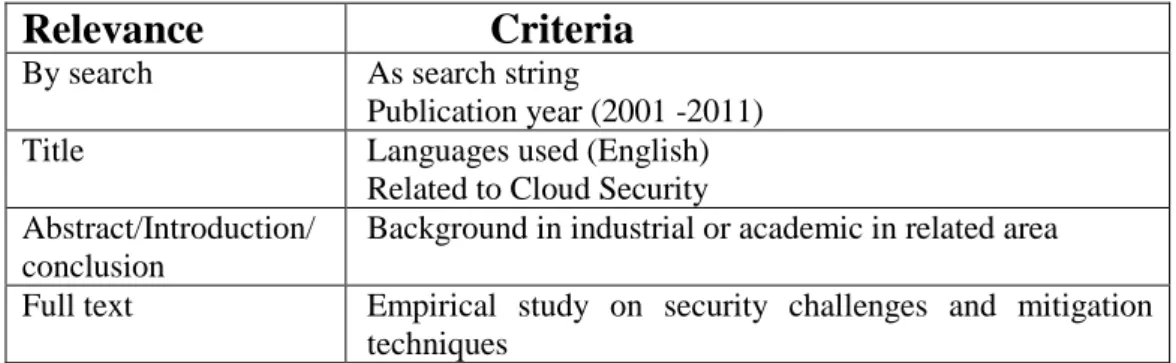
We followed the selection criteria as mentioned in kitchenham [34]. We ensured that the selected papers are relevant to our research work. The inclusion and exclusion of papers is done, to filter the papers which do not contain the information about security attacks, challenges and mitigation techniques in Cloud Computing. The selection procedure is mentioned in table below.
Relevance
Criteria
By search As search string
Publication year (2001 -2011)
Title Languages used (English)
Related to Cloud Security Abstract/Introduction/
conclusion
Background in industrial or academic in related area Full text Empirical study on security challenges and mitigation
techniques
Table 4.3 Selection Criteria
4.2
Conducting the Review
The below section describes the conducting of systematic literature review.
4.2.1
Data Extraction Strategy
We developed the data extraction form which is used during the study as shown in table 4.3.
The main aim is to extract the data concerned with Cloud security issues, techniques and future challenges. The data was extracted using inclusion and exclusion selection criteria from the well-known databases. Initially, our search has begun by constructing a suitable search string related to the Cloud security. The search for the papers were further refined from the year 2001-2011. However, our main study was focused on empirical and collaboration studies. Moreover, the investigation was filtered from the case studies, experiments and survey approaches. The methodology extraction was done on by security attacks, challenges and mitigation techniques in Cloud Computing.
4.2.2
Identification of Research
The primary aim of the systematic review is to form a search strategy to find out the primary studies related to research questions [34]. In search strategy we formulated search strings based on the keywords which are discussed in section 4.1.2 and constructed by using Boolean ANDs and ORs.
By the following search strategy, we find required information in Systematic Literature Review (SLR) exploiting the data bases IEEE Xplore, SpringerLink, ScienceDirect and Scopus.
Major keywords that are used to construct the search string are:
Cloud Computing
Security attacks
Security methods
Cloud security techniques
Cloud Security challenges
The following search string was constructed and used to find the required information during the SLR.
((Cloud Computing) AND (security) AND (techniques* OR method* OR challenge*))
4.2.3
Study Selection Criteria
Study selection criteria identify the primary studies which provide evidence about research questions [34]. Study selection for this research includes inclusion and exclusion criteria for selection and filtering of papers.
Initially a study selection criterion excludes the searches by title and abstract. The study selection process followed by refining the search according to defined inclusion and exclusion criteria, that reflects the information related to security attacks and challenges in Cloud environment.
Inclusion criteria:
Studies covering security issues of Cloud Computing when data is at rest and when data is at transit state.
Studies that formalize the security techniques which are currently being used in Cloud Computing environment.
Studies that includes the future security challenges and preventions in Cloud Computing.
Exclusion criteria:
Studies in languages which are not in English.
Studies which are not replicating security techniques and challenges in Cloud Computing.
We used the search string to explore papers published between 2001 and August 24, 2011. The study selection process has various steps that are shown in figure 4.1.
Step 1:
To identify the papers, the search is followed by four databases which include IEEE Xplore, Springerlink, Science direct and Scopus using search string. The papers which are relevant to research are taken as references and maintained in IEEE referencing standard. Here is a small discussion about four databases subsequently.
IEEE Xplore:
IEEE Xplore is a simple, flexible and user friendly data base. It consists of many advanced search options include logical operators AND/OR/NOT to easily combine the search keywords or phrases. With this, we combined the entire search phrase to use as a single search string as shown in the below figure.
Springer link:
Springerlink database hosts in a number of scientific fields. It requires a lot of caution when searching through the springerlink. It is fictional to many topics. The search tool identifies every article matched to even a single word in search string shown in Fig. We searched with specific keyword “Cloud Computing” and so on to avoid the unwanted materials.
ScienceDirect:
ScienceDirect is also one of the most useful databases, which has different search characteristics from the above databases. We have selected advanced search, which enables us to enter the combination of search phrases with the AND/OR/NOT operators as shown in the below figure.
Figure 4.4 Science Direct search interface
Scopus:Scopus is another database which is used during the search. Scopus has an option to enter the entire search phrase as shown in figure.
Step 2:
In this step, we had identified the total number of 2657 papers from all the four databases after refining the search using the configured search string and by year wise from 2001-2011and by subject wise which are related. From those, we have filtered out 753 papers and removed 1904 papers which are not having the keyword “Cloud” in title of the paper. We had also reduced the huge volume of materials after initial search which are described in the further steps.
Step 3:
In this step, we had identified the total number of 753 papers which are having the keyword “Cloud‟ in title of the paper. In this step, regarding the papers in SpringerLink database, we got access to only 500 papers out of 1091.
Step 4:
In this step, we had identified the total number of 283 papers which are having the titles that are related to Cloud security and removed the remaining 470 papers which are having the titles that are irrelevant to the topic.
Step 5:
In this step, we had merged all the papers (283 papers) that are obtained by filtering through the titles that are related to Cloud security from all the four databases.
Step 6:
In this step, we had filtered out the total number of 229 papers out of 283 papers by removing the duplicates and the papers which are not in English language. The procedure used in this step is inclusion and exclusion criteria based on duplicated materials and papers that were not published in English. This is because of same search string is used in different databases; we find the same papers which exploit same information.
Step 7:
In this step, we had filtered out the papers by reading through their:
Abstract
Introduction and Conclusion
By following the above, we had identified the total number of 144 papers which are containing the relevant content in their abstract, introduction and conclusion. We had removed the remaining 85 papers which are not having related content to the topic.
Step 8:
In this step, we had filtered out the papers by reading through their full text and identified the total number of 69 papers that are most relevant to the topic and which are mostly discussing about the following:
Cloud Computing concept
Cloud Security issues and attacks
Security techniques and methods used to protect data in a Cloud
From these 69 papers, we finally collected and analyzed the information to identify the security attacks and mitigation techniques which are currently using in Cloud Computing environment.
4.2.4
Reliability of Inclusion
In this thesis, we followed inclusion-exclusion criteria. As a part of it, total search results after screening by title, duplicates and language are studied individually by both of us to exclude the final papers. In this process, the final individually selected papers are approximately equal. This shows the mutual understanding between both of us in selecting the final outcome. Normally, this relation between both of us is calculated with the kappa analysis approach.
CHAPTER 5
SURVEY
5
S
URVEY
In research, Survey is a method of gathering information in the real life from individuals who are working in that particular field. Survey comes under non experimental method. It applies to collect the information surrounding a particular topic which helps the researchers.
5.1
Rationale for Survey
To answer the research questions we choose the survey method to collect the information from expert‟s personnel who involved and experienced their real life in Cloud Computing, and in related areas of security.
The survey was conducted using a questionnaire developed from the knowledge gain after SLR. From the responses of the questionnaire, we experienced knowledge about current industrial practices in Cloud Computing.
5.2
Source of data collection
We have used the direct mailing procedure to send the prepared questionnaire to the experts and few of responses are taken from direct interaction with the experts who is currently having industrial experience in Cloud Computing.
5.3
Survey Questions Formation
In this process, we designed the questionnaire to answer the research questions. The process involves that we designed questionnaire and discussed with Prof. Lars Lundberg and Mr. Jens Kvarnberg and Mr. Ross W Tsagalidis to make the questionnaire error free and correctness that ensures the designed questionnaire truly reflects the aims and objectives of the research. During this process, we designed the questionnaire according to specification and research requirements.
5.4
Survey Administration
In this research, we have adapted the method of electronic survey. This process includes the identification of experts in cloud computing with relevant experience in security, and sent the requesting mail which contains the brief introduction of us, topic area and purpose of conducting the survey and requesting to participate in the survey. After the acknowledgement from the experts, we sent them questionnaire to answer them. This survey is conducted in between May 2011 and October 2011. It has taken a long time to get a more number of responses because of unavailability of experts during summer. The questionnaire starts with the name of the expert, organization name, experience in Cloud Computing and the experience in security. The detailed description about the survey participants is explained in the results.
CHAPTER 6
6
R
ESULTS
A
ND
A
NALYSIS
The Reporting review consist the results from SLR and Survey. In this we have reported the identified security challenges and mitigation techniques from SLR also given information about survey participants and explained the analyzed results from the survey.
6.1
SLR Results
In recent years, the huge amount of research has been done in the area of Cloud Computing. In the process of SLR, we have extracted 69 papers relevant to meet the goals of the research from the large number of papers published since the year 2001. This section covers the results and analysis of the papers that were extracted in the process of SLR. We have given a detailed description of the list of identified challenges and mitigation techniques in appendix section.
In the past years, research is followed the distributed computing and mainly focused on service like grid computing. From the last decade, there is a rapid increase in research on new paradigm Cloud Computing which is the next generation computing. We mainly focused on security aspects of the Cloud Computing in last 10 years. Totally 69 papers are retrieved during the literature study. Mostly the selected papers are in between the year 2010 and 2011 which revealed 52 papers and 25 papers respectively. Others include 3 papers published in 2009. The figure below shows the empirical evidence of research on security in Cloud Computing in the last 10 years.
Figure 6.1 Number of papers published in year wise
6.1.1
Identified Challenges
From the analysis, we have identified 43 security challenges during the SLR. The detailed description of these challenges is presented in Appendix A. The list of identified challenges are WS- security, Phishing attack, Wrapping attack, Injection attack, IP spoofing, Tampering, Repudiation, Information Disclosure, Denial of
service, Elevation of privilege, Physical security, WLAN‟s security, Direct attacking method, Replay attack, Man-in-the middle attack, Reflection attack, Interleaving, Timeliness attack, Self adaptive storage resource management, Client monitoring, Lack of trust, Weak SLAs, Perceived lack of reliability, Auditing, Back door, TCP hijacking, Social engineering, Dumpster diving, Password guessing, Trojan horses, Completeness, Roll back attack, Fairness, Data leakage, Computer network attack, Denial of service, Data security, Network security, data locality, Data segregation, Backup, Data integrity, Data manipulation.
In the part of the analysis, we find some of the Cloud Computing attributes which are threats to Cloud Computing. As a part of the result the compromised attributes in Cloud Computing is described in appendix A, they are Confidentiality, Integrity, Availability, Security, Accountability, Usability, Reliability and Auditability. The records of the most threaten attributes are in fig. the fig. shows that Confidentiality 31% and Integrity 24% recorded most threaten, while comparing with usability, reliability, accountability and audit ability which recorded less than the 10%.
Figure 6.2 List of Compromised attributes
6.1.2
Identified Mitigation Techniques
From the analysis, we have identified 34 security techniques during the SLR. The detailed description of these techniques is presented in Appendix B. The summary include Identity based authentication, RSA algorithm, Dynamic Intrusion detection system, Multi tenancy based access control model, TLS Handshake, Public key homomorphic, Third party auditor, probabilistic sampling technique, Diffle – Hellman key exchange, Private face recognition, MACs, Data coloring and water marking, A novel Cloud dependability model, KP-ABE, RBAC, ARVTM, Security assertion markup language, TPM, Proof of retrievability, Fair MPNR protocol, Sobol sequence, Redundant array of independent Net storages, Handoop distributed file system, self cleansing intrusion tolerance,
searchable symmetric encryption, Provable data
possession, Privacy manager, Time bound ticket based mutual authentication
scheme, Security Access Control Service, The Service Level Agreement,
Intrusion detection system.
The above mentioned mitigation techniques have strong impact on the
Performance, Security, Efficiency, QoS, Privacy and Access control of Cloud
Computing. The defined mitigation techniques somehow improve the overall
services in Cloud Computing environment. The result is shown in figure 6.3.
Figure 6.3 Impact of mitigation techniques
6.2
Survey Results
Cloud Computing is a new paradigm. Cloud Computing became popular since decade. To find out the security experts in Cloud Computing is complex. In total, we got 16 number of partially and completed responses from the real time survey. However, many do have relevant experience in Cloud Computing and IT security. The adopted experts have experience from 1 to 31 years.
The Name, country, professional role and experience in relevant field is presented in the table 6.1 below:
Name
Country
Professional Role
Experience in IT
Sector (Years)
Experience in
Cloud
Computing
(Years)
Experience in
Security domain
(Years)
Martin BerglingSweden Information security
consultant, IBM 23 1 23
Dan Ahlstrom Sweden Former CISO,
Jan Hendler Sweden IT-Security Manger,
Swedish Custom 20 4 20
Bengt Ackzell
Sweden Security Expert 31 0 20 +
Daniel Gustafsson
Sweden Technical advisor
Blackberry, Logica N/A N/A N/A
N/A N/A N/A N/A N/A N/A
Arun Taman USA Software Engineer, Oracle
14 4 4
N/A N/A N/A 18 0 11
Prajwal Kumar
India Data base Developer 20 8 10
Johan Trodsson
Sweden Researcher & Lead Architecture
8 4 0
Pethururaj India Enterprise Architect, Sify Software Ltd.
5 3 1
N/A N/A N/A N/A N/A N/A
Omar Abduljabbar
India Infrastructure Architect, MTN.
15 3 10
Sherif Egypt Manager Mobinil 10 0 10
Bengt akeclaesson
Sweden Operational manager 10 3 6
N/A N/A N/A N/A N/A N/A
N/A
- Not Available
Table 6.1 List of experts interviewed
6.2.1
Reported challenges
In the part of the Survey, we have identified totally 18 Security challenges which are possible to be faced in the future of Cloud Computing. We summarized these future security challenges based on the opinions from experts. The results are included:
Eaves dropping
Hypervisor viruses
Legal Interception point
Virtual machine security
Trusted transaction
Risk of multiple Cloud tenants
Smart phone data slinging
Abuse and nefarious use of Cloud Computing
Insecure application programming interfaces
Malicious insiders
Shared technology vulnerabilities
Service and traffic hijacking
Privacy – Personal information about many people will be handled by IT companies all over the world. No one will know who is accessing user data.
Espionage – National secret information might be handled by IT companies in other countries, but do we really know who is working at these companies?
Business intelligence – Business confidential will be handled by IT companies all over the world. No one knows who is accessing user company‟s data.
Data ownership – When data is transferred to the Cloud it is important for many organizations to be assured of the continued control of the data, i.e. their ownership should never be challenged.
Availability – The availability must be at least as high as for traditional solutions. Probably higher, since downtime probably will affect many users simultaneously and thus be covered by media. Compare the difference between small accidents (e.g. car) and large accidents (e.g. airplane). Even though many small accidents may be worse than one large, the media coverage (and other things) make the larger ones seem so much worse.
Transparency – Using Cloud services has to be as simple as traditional solutions.
The compromised attributes are confidentiality, security, availability and integrity.
6.2.2
Reported Mitigation Techniques
From analysis of results from survey, we have identified totally 9 security techniques. The major security techniques that are used in the current world are:
SSL (Secure Socket Layer) Encryption: Encryption between browser and web server. It usually provides enough security from the workstation to the browser. The use of SSL does not require Cloud service provider for any functionality. It is all in how you have defined your website. It is easy available as it is very inexpensive. All Cloud customers should require encrypted communication. Optical fiber is another tool, since fibers are harder to manipulate than electrical cables.
VPN (Virtual Private Network): VPNs are most commonly used for home based or mobile applications. When users connect to the internet from home or any public place like airport, hotel etc., then he will be signed into his VPN and get secure communication. Many Cloud providers offer VPNs to cover the area from the work station in user facility to user connection to the internet and across the internet.
IPSec (Internet Protocol Security): IPSec is a prominent appearance of VPN, usually used between facilities where there is a large amount of traffic. In the case of Cloud, Cloud service provider will define and usually facilitate the IPSec device to install user network where it connects to the internet and to facilitate high speed encryption and decryption without keeping workload on servers.
A proper use of encryption can give good protection against eaves dropping. Traffic analysis is harder, but on the other hand, not only that many need protection against this kind of threat.
A proper use of encryption can give good protection against active attacks. In order to protect against man-in-the middle attacks, one should observe if there are any delayed response times, in order to detect if there is any “Middle-Man”.
Intrusion Detection system
Third party auditor
Message Digesting
Kerberos, SSH and MD5 for authentication
Monitoring Agent
Service management API (SMAPI)
Also, we have summarized suggested practices from experts to mitigate future challenges to be faced in Cloud Computing. The summary includes:
Increased efforts in risk management – One should have a better risk awareness in order to take proper risks.
Standardized security methods and solutions.
Increased efforts to mitigate harmful code; Legal responsibility, and increased security measurements at levels of objects and elements of objects.
Analyze the security model of Cloud provider interfaces.
Ensure strong authentication and access controls are implemented in concert with encrypted transmission.
Enforce strict supply chain management and conduct a comprehensive supplier assessment.
Implement strong API access control.
Analyzes data protection at both design and run time.
Better algorithms, define a security strategy and decouple the security
architecture with technical infrastructure, third party compliance, light, but yet effective encryption techniques.
CHAPTER 7
7
V
ALIDITY
T
HREATS
For any research there are mainly four types of threats as discussed by Wohlin et al [14], they are: Construct validity External Validity Internal validity Conclusion Validity
7.1
Construct Validity
- Construct validity involves generalizing from your program or measures to the concept of your program or measures [68].
In our research, we have data from Systematic Literature Review (SLR), survey and interviews. Comparison of results from SLR, interviews and survey is hard. We have considered this threat due to inconsistency in data. To overcome this we have used Narrative Analysis for Systematic Literature Review and interview data for proper organization of the data. After receiving the survey data we have thoroughly compared the Narrative Analysis results with the survey results, by this we were able to remove redundancy and inconsistencies in our data.
7.2
Internal Validity
- Internal Validity is the approximate truth about inferences regarding cause-effect or causal relationships [70].
There are several problems with conducting survey. One of the major challenges is the redundancy in data interpretation by the practitioners. The redundancy occurs when understanding the question and the answers might be interpreted in another sense which might not be relevant for our work. Based on the understanding of the question her/his answers might differ. To overcome this threat we made sure that the questionnaire is clearly understandable,
We have used terminologies related to Cloud computing which are mostly used in the industrial context.
We have conducted a pilot test with Cloud Computing professionals.
Based on the feedback of Cloud Computing professionals, survey questionnaire was reformulated. Hence, the chance of internal validity has been reduced.
7.2.1
Data Gathered Through Interview
While conducting interview with Cloud Computing Security Experts, we have prepared notes in order to avoid misunderstanding while data gathering. Data was recorded with the permission of the interviewee which was used as a proof for validation when analyzing the data. As a proof during data validation and not to miss some key points we have asked the interview participant to fill the questionnaire and send it which was used as a validation.
During the interview we faced some problems regarding identifying the information regarding security implementation and practices being followed. Most of the practitioners were not willing to disclose this particular data as it was against to their organization rules. This might pose a threat to some aspects of our study regarding the challenges and mitigation strategies.
7.3
External Validity
- External validity is the degree to which the conclusions in your study would hold for other persons in other places and at other times [69].
The external validity threat of this research describes how well our research conclusions are applicable in general to other related technological areas. In relation to that, the security challenges and techniques of Cloud Computing that we have identified are almost similar to the issues faced in normal traditional network Computing. The security policies are different at different times in different places in the world, and because of that it is difficult to standardize the conclusions in an overall perspective, and this may be a valid threat. To overcome this threat, we have conducted a survey and interviews amongst various security experts across the world, considered their answers and opinions and collectively presented as the conclusion in a condensed way. Hence, the chance of external validity has been reduced.
7.4
Conclusion Validity
- Conclusion validity refers to the statistically significant relationships between the treatment and outcome [67].
One possible threat to conclusion validity is the biasness in the selection of papers and the data gathered through interviews. For reducing biasness during SLR we have used a detailed inclusion and exclusion criteria for deleting the articles. For selecting the primary studies a quality assessment criteria was selected based on yes or no.
For the challenges and mitigation strategies identified from SLR we have conducted interviews and survey with practitioners to check whether the same set of challenges and mitigation strategies are being followed or not. In this way we have reduced the conclusion validity.
CHAPTER 8
CONCLUSION
8
C
ONCLUSION
The identification of security challenges and mitigation techniques in Cloud Computing is challenged by considering the large number of services. Most of the responses from survey, noted that Cloud Computing will place dominant and expandable information transactions. Because it offers many flexible services, provides easy, individualized and instant access control to the services and information where they are for the users. In the process of identification from the research methods SLR and Survey, we have identified satisfactorily number of challenges and mitigation techniques in current and future Cloud Computing.
8.1
For Research Question: 1
In the case of some part of local network data placed in the Cloud the security challenges and mitigation techniques were discussed in a Systematic method. Most of the security challenges and techniques that are being used in current Cloud Computing environment are listed in appendix. Few of the popular security techniques that are identified in SLR are Identity based authentication, Service Level Agreement (SLA), Third party auditor, Message authentication codes, Role based access control mechanism, Proof of retrievability, Time bound ticket based authentication scheme. The impact of these security techniques include on Confidentiality, Integrity, Availability and security described in the section 2.4.
If you need to exchange sensitive or confidential information between a browser and a web server, Encryption is an obvious tool to protect communication. Proper encryption of data and encryption of transmission is necessary.
The mitigation techniques identified from the survey is as follows:
SSL (Secure Socket layer)
VPN (Virtual Private Network)
IPSec (Internet Protocol Security)
A proper use of encryption can give good protection against active attacks. In order to protect against Man-in-the-middle attacks, one should observe if there are any delayed response times, in order to detect if there is any “Middle-Man”.
A proper use of encryption can give good protection against eaves dropping. Traffic analysis is harder, but on the other hand, not only that many need protection against this kind of threat.
8.2
For Research Question: 2
We have identified the security techniques that are used in the case of when data resides in the Cloud in Systematic process. The identified challenges, mitigation techniques and compromised attributes are described in Appendix section. The few popular security methods are Secure Socket Layer (SSL) Encryption; Multi Tenancy based Access Control, Intrusion Detection System, Novel Cloud dependability model, Hadoop Distributed File System and Hypervisor.
From the analysis of results from survey we have identified the following security challenges