Organizational Knowledge Sharing
in ERP Implementation:
Lessons from Industry
Mary C. Jones, University of North Texas, USA R. Leon Price, University of Oklahoma, USA
ABSTRACT
This study examines organizational knowledge sharing in enterprise resource planning (ERP) implementation. Knowledge sharing in ERP implementation is somewhat unique because ERP requires end users to have more divergent knowledge than is required in the use of traditional systems. Because of the length of time and commitment that ERP implementation requires, end users are also often more involved in ERP implementations than they are in more traditional ERP implementations. They must understand how their tasks fit into the overall process, and they must understand how their process fits with other organizational processes. Knowledge sharing among organizational members is one critical piece of ERP implementation, yet it is challenging to achieve. There is often a large gap in knowledge among ERP implementation personnel, and people do not easily share what they know. This study presents findings about organizational knowledge sharing during ERP implementation in three firms. Data were col-lected through interviews using a multi-site case study methodology. Findings are analyzed in an effort to provide a basis on which practitioners can more effectively facilitate knowledge sharing during ERP implementation.
Keywords: organizational knowledge sharing; enterprise resource planning; large scale information systems
INTRODUCTION
Enterprise resource planning (ERP) is a strategic tool that helps companies gain a competitive edge by streamlining busi-ness processes, integrating busibusi-ness units, and providing organizational members greater access to real-time information. Many firms are using ERP systems to cut costs, standardize operations, and leverage common processes across the organization. ERP allows firms to have a more
conver-gent view of their information by integrat-ing processes across functional and divi-sional lines using a centralized database and integrated sets of software modules (Scott and Kaindl, 2000; Zheng et al., 2000).
However, the convergence that ERP affords at the organizational level often sults in a divergence of the knowledge re-quired at the individual level (Baskerville et al., 2000). ERP imposes a new frame-work on the organization (Robey et al., 2002). It requires end users to have 701 E. Chocolate Avenue, Suite 200, Hershey PA 17033-1240, USA
Tel: 717/533-8845; Fax 717/533-8661; URL-http://www.idea-group.com
broader knowledge than is required in the use of traditional systems. They must un-derstand how their tasks fit into the overall process and how their process fits with other organizational processes (Lee and Lee, 2000). Thus, knowledge sharing is one critical piece of ERP implementation. An organization begins to build the foundation during implementation on which end users can understand enough about the ERP framework to realize its benefits (Robey et al., 2002). Because of the time commit-ments and the extensive knowledge shar-ing that must take place durshar-ing ERP imple-mentation, end users are often more in-volved in the implementation than they are in more traditional implementations. In some cases, ERP implementations are managed and led by end users and end user managers, and IT staff serves primarily as technical advisors (Jones, 2001). Unfortu-nately, there is usually a significant gap in knowledge among these implementation personnel, and people do not easily share what they know (Constant et al., 1994; Jarvenpaa and Staples, 2000; Osterloh and Frey, 2000; Soh et al., 2000).
This study was undertaken to exam-ine how firms ensure that organizational knowledge is shared during ERP implemen-tations. One objective is to identify facilita-tors of organizational knowledge sharing. Another is to synthesize findings into les-sons about knowledge sharing during imple-mentation that other firms can apply in their own ERP implementations.
THEORETICAL BACKGROUND
Knowledge sharing in ERP imple-mentation is somewhat unique because ERP redefines jobs and blurs traditional intra-organizational boundaries (Lee and Lee, 2000). Knowledge must be shared across functional and divisional boundaries,and the knowledge required during ERP implementation entails a wider variety of experiences, perspectives, and abilities than traditional information systems implemen-tations (Baskerville et al., 2000; Robey et al., 2002). Knowledge sharing is challeng-ing because much knowledge is embedded into organizational processes (Davenport, 1998). The way people actually do their jobs is often different from the formal pro-cedures specified for even the most rou-tine tasks (Brown and Duguid, 2000). It is also challenging because there are gaps between what people do and what they think they do (Brown and Duguid, 2000). Some tasks are so routine, and people have done them for so long, that many of the steps involved are subconscious (Leonard and Sensiper, 1998). However, there is a variety of factors that can facilitate knowl-edge sharing during ERP implementation. In order to present a coherent and logical view of knowledge sharing, we iden-tify factors that influence knowledge shar-ing that are linked by a common concep-tual underpinning, which allows individuals to share observations and experiences across traditional boundaries. Most ERP implementation activities center around the ERP implementation team (Baskerville et al., 2000). ERP implementation teams typi-cally consist of organizational members from a variety of functional areas and or-ganizational divisions. Each team member must understand what the others do in or-der to effectively map processes during the implementation (Baskerville et al, 2000). Team members must work to achieve this level of understanding. The knowledge sharing required does not come automati-cally with team membership; it must be facilitated. Thus, facilitation of knowledge sharing on the team is one factor exam-ined.
users to gather relevant information about processes and to keep end users and user managers informed about changes to ex-pect when the ERP is implemented (Robey, Ross, and Boudreau, 2002). Ideally, there is an intensive exchange of knowledge be-tween the team and these users that they represent (Baskerville et al., 2000). Inad-equate knowledge sharing between these two groups leads to unsuccessful implemen-tation (Soh et al., 2000). One key to a smooth ERP implementation is effective change management (Andriola, 1999; Harari, 1996). Because of the complexity and cost of ERP, it must be visibly planned and implemented (Hammer, 1990). One way to communicate plans, share knowl-edge with end users, and gather knowlknowl-edge from end users is through careful change management (Clement, 1994). Therefore, change management is another knowledge sharing factor examined.
A large part of change management is training. Those affected by the imple-mentation should receive training to develop new and improved skills to deal with new challenges brought about by the change (Andriola, 1999). Users must gain knowl-edge about the business rules and processes embedded in the ERP software (Lee and Lee, 2000). They also must understand the integrative nature of ERP in order to use it effectively. ERP requires end users to understand that they are no longer work-ing in silos, and whatever they do now im-pacts someone else (Welti, 1999). Entire departments must be retrained with this in mind (Caldwell and Stein, 1998; Al-Mashari and Zairi, 2000). Training on transactions and on the integrative nature of ERP is another factor examined.
Most firms hire external consultants (integration partners) that know the ERP software to help them through the imple-mentation (Soh et al., 2000). This involves
knowledge sharing because the organiza-tional implementation team seeks ways for the know-how and skills possessed by in-tegration partner staff (IPS) to be shared with them so that they are not lost when the IPS leaves (Al-Mashari and Zairi, 2000). This goes beyond written documen-tation and training manuals. For example, consultants are assigned to work side by side with organizational team members so that the members can learn what the con-sultants know about the package that can not easily be written down (Osterloh and Frey, 2000). One source of failure in ERP implementation is the IPS who works alone, and fails to share knowledge with organi-zational members (Welti, 1999). When the IPS fails to share what they know, the firm often has trouble supporting the ERP after they leave. Thus, it is important that the firm capture as much of the IPS’s knowl-edge as possible before they transition off the team. Transition of IPS knowledge is another knowledge sharing factor exam-ined. In summary, several factors that may influence knowledge sharing are examined. These are facilitation of knowledge shar-ing on the implementation team, change management activities, type of training end users receive (i.e., transactional or integra-tive), and use of formal knowledge trans-fer from integration partner staff when they leave the organization.
Finally, the extent to which a firm is beginning to alter its core knowledge com-petency after SAP implementation is ex-amined. The active sharing of organizational members’ knowledge is linked to a firm’s ability to alter its core knowledge compe-tencies (Kogut and Zander, 1992; Grant, 1996; Hine and Goul, 1998). Altering knowledge competency involves sharing knowledge across the organization in a way that preserves existing knowledge compe-tencies and at the same time absorbs new
knowledge that expands and strengthens those competencies (Stein and Vandenbosch, 1996). An innovation that impacts the entire organization and facili-tates major changes in a firm’s processes, as ERP does, provides an opportunity for firms to do this (Brown and Vessey, 1999). Evidence of this alteration is found in fun-damental changes in the way a firm per-forms its core processes. ERP benefits are the result of ongoing efforts to continuously improve processes (Ross, 1999). At the time of data collection, these firms were still too early in their use of ERP to have realized extensive change. They were, how-ever, making efforts to integrate processes and thereby alter core knowledge compe-tency. Thus, change in core knowledge competency in this study is assessed as the extent to which processes were being changed as a result of ERP, rather than the extent to which they had changed.
METHODOLOGY
Data were collected as part of a larger study using a multiple case study of firms in the petroleum industry that had implemented SAP R/3. Focusing on a single package helps minimize bias that might be introduced into findings across packages. However, because the focus is on knowl-edge sharing, rather than on technical as-pects of the package itself, findings should be generalizable to implementation of other ERP software in other industries. The CIO or top IS executive of 10 firms in the in-dustry were contacted to determine if they had implemented or were implementing SAP, and if so, whether they would agree to participate in the study. In some cases, a division of the firm was included rather than the whole firm. Because of size, structure, or geographic dispersion, some firms have conducted completely separate
implemen-tations in divisions around the world, with little or no communication between the implementation teams. In those cases, the division seemed to be a more appropriate case site than the entire organization. We collected data from those that did agree to participate, and that met two other criteria. We eliminated firms that had implemented only one or two modules with no plans to implement more. We also eliminated firms that had not implemented across the orga-nization or the specific division in which we were interested. Each firm in the study implemented the major modules of SAP including FI/CO (financial accounting and controlling), AM (fixed assets manage-ment), PS (project systems), PM (plant maintenance), SD (sales and distribution), MM (materials management), and PP (pro-duction planning). These criteria helped to ensure that the case sites were comparable, and that differences in findings were not due to the scale of implementation.
In order to minimize bias that the re-searchers might introduce into the process of analyzing findings, a rigorous and struc-tured approach to analysis was followed (Yin, 1989). For example, the interviewer took notes and taped each interview. Tapes and notes were transcribed by a third party, reviewed by the interviewer, and respon-dents were asked for clarification on points that seemed vague or missing. The tran-scriptions were then summarized, reviewed by another researcher to help ensure that the transcriptions flowed well and made sense. Finally, the primary contacts in each firm reviewed summaries to help ensure that what was recorded represented ac-tual events and perceptions. A case study database consisting of interview notes, documentation provided by respondents, tables summarizing findings, and an exact narrative transcription of all interviews were
guide are provided in Appendix A. A within case analysis was performed where data were extracted using the interview ques-tions as a guide to get a clearer picture of knowledge sharing in each firm. Then, a cross-case analysis was performed in which knowledge sharing across the firms was compared.
Because of the size of the project teams, interviewing a sample of key mem-bers was deemed more manageable than attempting to interview each member. In addition, many members had left the firm, or moved out of the areas in which they had originally worked. Thus, we asked each of the top IS executives to identify key members of their SAP project team that were still involved with SAP in some way, including support and post-implementation process redesign. This method of identify-ing respondents has been demonstrated to be acceptable because professionals in a field have been shown capable of nomi-nating key respondents that have a consis-tent set of attributes appropriate for a study such as this (Nelson et al., 2000). A series of semi-structured interviews were con-ducted with 8 to 10 members of each firm. The number of interviewees was chosen based on the concept of theoretical satura-tion, where “incremental learning is mini-mal because the researchers are observ-ing phenomena seen before” (Eisenhardt, 1989, p. 545). In these interviews, the re-searchers often heard the same examples from most of the respondents in a site re-gardless of functional background, when they came on the team, or their job at the time of the interview. In addition, the re-spondents often used the same phrases to express their perceptions. This was true of respondents who were not located at the same physical locations at a site or who were not all on the team at the same time. Thus, it was deemed that additional
inter-views would not yield significantly differ-ent insights. For example, all the respon-dents at USWhole used the phrase “psy-chological effort” when referring to how they approached the project. They indicated one guiding tenant of their project was that the implementation was as much a “psy-chological effort as a technical effort.” In another example, the phrase “the accountants always cleaned up after everyone” came up in most interviews at each case site.
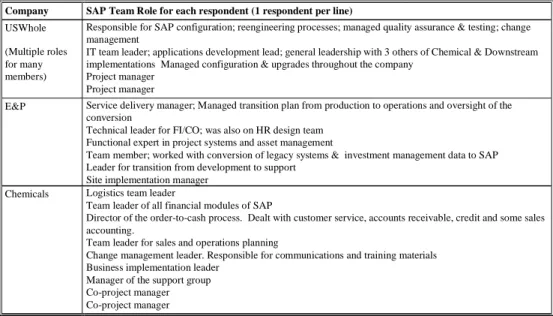
The interviews lasted between one and two hours each over a period of seven months between July, 2000 and February, 2001. Each person was interviewed once in person for one to two hours, and then was contacted by e-mail or by telephone for additional information or clarification. In addition to the face-to-face interviews, the researchers also preceded and followed up the interviews with e-mail and telephone calls for background information, clarifica-tion, and points not covered in the interviews. Respondents included both informa-tion systems staff and business/funcinforma-tional staff. Some had been on the team from the beginning, while others joined at various points in the project. These people repre-sented a variety of perspectives on SAP, including some who were pleased with it, some who hated it, and others who were indifferent. They also represented a vari-ety of levels in the firm ranging from CIO and/or project manager to lower level em-ployees, and included people from such functional areas as accounting, purchasing, refineries, sales and distribution, and a va-riety of engineering functions (Table 1).
PROFILE OF COMPANIES
USWhole is the U.S. division of one
of the world’s leading oil companies. It in-cludes upstream (exploration & production), downstream (marketing, refining, and
transportation), and chemical segments. The firm has exploration and production interests in many countries, with a large concentration in the U.S., and it markets its products worldwide. USWhole per-formed five SAP implementations for each of its major business units, including a small pilot test site, and corporate headquarters. It began its SAP project in early 1995, and completed its first implementation in March 1996. The final two implementations were completed simultaneously in July 1998. There are approximately 15,000 SAP us-ers in USWhole.
E&P is the North American
explora-tion and producexplora-tion division of an interna-tional petroleum company that has annual revenues in excess of US$90 billion. This particular division is engaged in the explo-ration and production of crude oil and natu-ral gas worldwide, and accounts for ap-proximately US$6.8 billion of the corporation’s revenue. Although SAP has been implemented in various units of the parent company throughout the world, each project has been a separate activity from all the others. The teams, scope, budget,
and timelines have been managed sepa-rately, and SAP has been designed and configured differently for each, with very little or no collaboration among the units. Therefore, focusing only on E&P’s appli-cation in this firm seems to provide a unit of analysis that is comparable to that in the other sites. E&P began its project in 1996, using a big bang implementation where all modules were implemented at one time, and finished the implementation in mid-1998, for approximately 3,000 users.
Chemicals is the chemical division of
an international petroleum company with annual revenues of approximately US$16 billion. Chemicals accounts for approxi-mately one-fourth of its parent company’s revenue, with annual revenues of approxi-mately US$4 billion. It is a leading chemi-cal manufacturer with interests in basic chemicals, vinyls, petrochemicals, and spe-cialty products. Its products are largely commodity in nature, in that they are equiva-lent to products manufactured by others and are generally available in the market-place. They are produced and sold in large volumes, primarily to industrial customers Company SAP Team Role for each respondent (1 respondent per line)
USWhole (Multiple roles for many members)
Responsible for SAP configuration; reengineering processes; managed quality assurance & testing; change management
IT team leader; applications development lead; general leadership with 3 others of Chemical & Downstream implementations Managed configuration & upgrades throughout the company
Project manager Project manager
E&P Service delivery manager; Managed transition plan from production to operations and oversight of the conversion
Technical leader for FI/CO; was also on HR design team Functional expert in project systems and asset management
Team member; worked with conversion of legacy systems & investment management data to SAP Leader for transition from development to support
Site implementation manager Chemicals Logistics team leader
Team leader of all financial modules of SAP
Director of the order-to-cash process. Dealt with customer service, accounts receivable, credit and some sales accounting.
Team leader for sales and operations planning
Change management leader. Responsible for communications and training materials Business implementation leader
Manager of the support group Co-project manager Co-project manager Table 1: Profile of Respondents
for use as raw materials. Chemicals began its SAP project in late 1996, with the first of nine implementations in January 1998. The implementations occurred approxi-mately every two to three months until all implementations were finished in Decem-ber 1999. There are approximately 5,000 SAP users in Chemicals. A summary of profiles is provided in Table 2.
DATA ANALYSIS
In the sections that follow is a de-scription of knowledge sharing factors in each firm, including facilitation of knowl-edge sharing on the team, change manage-ment/training, and transition of IPS knowl-edge. The extent to which firms had
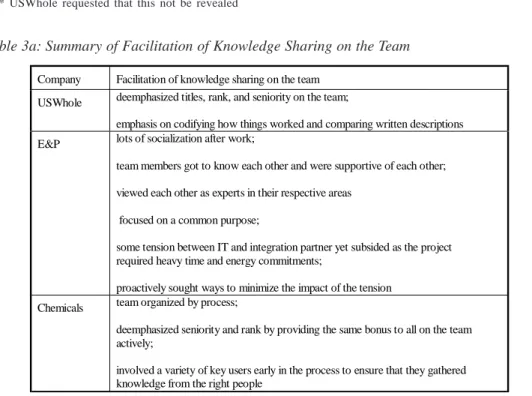
changed or were beginning to change their core knowledge competencies through changes in processes as a result of the SAP implementation is also discussed. A sum-mary of points covered is provided in Tables 3a, 3b, and 3c. Table 3a provides a summary of facilitation of knowledge shar-ing on the team. Table 3b provides a sum-mary of change management and training activities, and IPS knowledge transition activities. Table 3c provides a summary of changes in core knowledge competency.
USWhole
Facilitation of Knowledge Sharing on the Team. Teams at USWhole had a
negative connotation prior to the SAP Table 2: Corporate Profile
Corporate Identity
Revenue (U.S. $)
Began SAP Implementation Date
Number of Users
USWhole * 1995 1996-1998 15,000
E&P 6.8 Billion 1996 1998 3,000
Chemicals 4 Billion 1996 1998-1999 5,000
* USWhole requested that this not be revealed
Table 3a: Summary of Facilitation of Knowledge Sharing on the Team
Company Facilitation of knowledge sharing on the team USWhole deemphasized titles, rank, and seniority on the team;
emphasis on codifying how things worked and comparing written descriptions E&P lots of socialization after work;
team members got to know each other and were supportive of each other; viewed each other as experts in their respective areas
focused on a common purpose;
some tension between IT and integration partner yet subsided as the project required heavy time and energy commitments;
proactively sought ways to minimize the impact of the tension Chemicals team organized by process;
deemphasized seniority and rank by providing the same bonus to all on the team actively;
involved a variety of key users early in the process to ensure that they gathered knowledge from the right people
project. They were often used as dumping grounds for weak employees. This was a major obstacle to overcome in facilitating knowledge sharing on the SAP implemen-tation team. Top management strongly sup-ported SAP, so the project managers were able to ask for and get the “best people in most cases” for the implementation team. They sent people back to their units if they did not work out. Thus, they put together team members that had reasonably good
knowledge about their own processes. USWhole facilitated knowledge sharing on the team by eliminating seniority and func-tional distinctions. For example, senior people worked alongside hourly workers on the team, and if the lower level employ-ees had an idea or wanted to try some-thing, the senior people listened to them, and in some cases took direction from them. As one person said, before this project “a lower level person wouldn’t say Table 3b: Summary of Change Management/Training for End Users and Transition of IPS Knowledge
Company Change Management Training
Transition of IPS Knowledge
USWhole Team communicated with end users about how SAP would change their jobs; Identified end users to be change agents within the units, Relied on change agents to
communicate as well
Identified power users among end users to train;
Power users helped train other users; Focused largely on transactions Limited focus on integration
Worked with IPS throughout the project;
Documented lessons learned at the end of each go-live; Used no formal transfer process at the end
E&P Team went to change management training; Followed a change management strategy; Focused on
communicating project status to the company; Made sure end users who were not directly part of the team had input into the project
Identified power users among end users to train;
Power users helped train other users; Focused largely on transactions Limited focus on integration
Used formal transfer process with checklists on how to configure and on which things triggered what; Transferred knowledge from IPS to 3rd party consultant, then from that consultant to E&P support team
Chemicals Focused on helping end users understand how their jobs would change after SAP Focused on how end users would use SAP
Identified power users among end users to train;
Power users helped train other users; Focused on integration in addition to
transactions
Built knowledge transfer into the contract with the IPS; Focused on how they solved problems & where they looked for answers; Team members gradually took on more responsibility so they could learn what the integration partner knew
what they thought in front of a more senior person. But with the shared goal of getting the project done quickly, they did.” Lower level people also challenged senior people if they didn’t agree or thought there was a better way of doing something. USWhole provided a structure to the team that al-lowed people to share knowledge openly and freely. This helped to resolve conflicts and to map processes to SAP effectively. As one person said, “the bad thing was to have an idea and not express it.” USWhole also relied heavily on codifying knowledge, and writing down how pro-cesses worked. For example, “If someone said we can’t do it this way, we said, ‘Why can’t you? Is it really unique?’ We’d get them to list what they do and to look at what others have listed, and identify the commonalities.” USWhole used several approaches to facilitating knowledge shar-ing on the team, includshar-ing codifyshar-ing knowl-edge, structuring the team to remove bar-riers to knowledge sharing, and proactively seeking to overcome the stigma associated with teams.
Change Management/Training.
USWhole had a strong change manage-ment team from the beginning of the project to communicate with the rest of the orga-nization about project status, issues, ideas, managing expectations, and training. As one said, “It’s all about change management. That’s the name of the game.” Another person indicated that “we had to break down cultural barriers (to common pro-cesses) through communication.” The team shared their knowledge about SAP with the users in order to do so. They used several verbal and written communication means to reach users at all levels of the organization. The change management team helped users and managers under-stand how SAP would impact them, gath-ered feedback on user perceptions, con-cerns, and issues, and helped overcome resistance to change.
USWhole used a power user concept for training users. They identified users in each of the business units that were influ-ential in their units and that were interested in SAP, and trained them extensively in how Table 3c: Summary of Changes in Core Knowledge Competency
Company Changes
USWhole Gradually eliminating silo behavior;
Some units adapted better than others, thus have seen more changes than others;
Adaptation across the firm seems to be occurring; "it's not like I do a job anymore, but I perform a step in a process"
E&P Slowly moving away from silo behavior;
People are beginning to understand the integration points better, particularly in the financials area; Adaptation limited by corporate budget cuts unrelated to SAP;
Are still in the learning cycle, but changes are ongoing
Chemicals Majority of Chemicals units have embraced the concept of common processes, particularly in financials and purchasing;
Have completed development of a common master file for parts, and units are designing purchasing around families of parts;
Processes in general are now more well defined and better understood across functions within and across divisions
to do transaction processing as well as in how processes were changing and being integrated. However, there was more em-phasis on the ‘how-to’ than on process changes. Users largely learned the latter on the job as they began to use the system. As power users shared their knowledge with other users, knowledge about how to use SAP began to permeate the organiza-tion. However, this was more difficult in some streams than in others. For example, one unit had old technology, and went from “1960’s technology to 1990’s technology in one fell swoop. Some had never used a mouse before, and one guy was moving his mouse over the screen to choose an icon.” Thus, it was harder for them to learn how to use the new system even at the most basic level.
Transition of IPS Knowledge.
Be-cause of the sheer size of the project, USWhole had several integration partners. They did not use a formal knowledge trans-fer process when IPS left, but they did document how to configure and perform all major activities, and they documented lessons learned with each implementation. USWhole people worked with each inte-gration partner throughout the project so that the knowledge transfer took place over time. In addition, although integration part-ners may have been different for each busi-ness unit, the core team from USWhole was the same throughout. Thus, knowledge gained in one implementation was not lost, but rather, was enhanced as the project progressed.
Changes in Core Knowledge Com-petency. Team members gained knowledge
about the organization as a result of SAP as they learned about the “linkages and in-efficiencies between processes.” How-ever, the organization has had mixed re-sults in altering core knowledge competen-cies to change the way they perform
pro-cesses. “Different streams have adapted differently.” The downstream operations are the most complex to do in SAP, and this stream had experienced the least change in the past. In the beginning, it had the greatest difficulty in adapting to inte-grated, common processes. “Downstream adapted very poorly early on.” The chemi-cals division was used to change because it operates in an “acquisition and trade en-vironment.” It also was running SAP R/2, so it was more familiar with the integrated process approach. Thus, it has had an easier time adapting. Similarly, “upstream is primarily accounting based, so with the changing economy they grew used to change,” and this stream has adapted to the changes more readily. Thus, USWhole has experienced mixed results in its efforts to alter core knowledge competencies, but is continually working toward change.
One explanation for this is that USWhole did not recognize early enough differences in the streams’ abilities to adapt to change. Their change management ap-proach was not tailored to each stream, and even though they received feedback from each, if a stream was resistant, it may not have shared enough of what it knew so that the team could make the transition more effective. Although USWhole worked hard, to ensure effective knowledge shar-ing took place on the team, its efforts to ensure knowledge sharing between the team and the rest of the organization may not have been strong enough to impact change in core processes.
E&P
Facilitation of Knowledge Sharing on the Team. E&P used informal team
building activities to help solidify team mem-ber relationships in an effort to foster knowl-edge sharing. Team members frequently
socialized together after work, and at the end of major milestones, the company treated the entire team at various dinners, parties, and other outings. The team was also solidified because team members “knew the legacy systems on the business and technical side, and they were highly capable and credible in their areas.” They viewed each other as experts in their ar-eas, and thus, were willing to listen to and learn from each other.
However, E&P had a somewhat unique obstacle to knowledge sharing to overcome in its implementation. The infor-mation technology (IT) division of the par-ent company is managed as a separate company, and must contract with E&P and in competition with other outsourcing ven-dors for jobs. The IT company bid to be the integration partner on the SAP project, yet the E&P project leader chose another firm to be the primary integration partner because it had more experience with SAP. However, the IT staff had extensive knowl-edge about and experience with the E&P legacy systems that SAP replaced. In some cases, the IT staff had as much or more knowledge about how processes worked than the E&P business unit employees. Thus, they were selected to be part of the SAP team in order not to lose their knowl-edge. At first, there was some tension between IT staff and the IPS because the IT staff felt that they should have been chosen as the primary integration partner. However, there was a strong corporate culture of working in teams, thus this ten-sion was minimized, and team members focused primarily on the common purpose of completing the project rather than on themselves. In addition, as new people came on the team throughout the project, they were not aware of the earlier tension, which also helped to dissipate it. As one said “we didn’t have time to draw lines in
the sand. We were concerned with meet-ing deadlines, and we all had the same goal —making SAP work.”
Change Management/Training.
E&P had a change management team in place whose responsibility was to make sure that current project status was communi-cated to all company employees, and to make sure that people not directly tied to the project felt like they also had some own-ership. There was particular emphasis on this communication because “our experi-ence on these large implementations has a very checkered past.” E&P had imple-mented “fairly well conceived” large sys-tems in the past where the change man-agement people did not handle the change well. As a result, organizational members did not like the systems, and sometimes the systems were perceived as becoming the “butt of a lot of jokes.” Thus, senior man-agement placed a high priority on manag-ing change in the SAP project, and a large piece of the budget was devoted to it. The change management team went through change management training classes, and the integration partner “brought in a very strong change management plan.” The “change management piece was very ma-ture, very well thought out, very strong.” The change management team handled all communication, using a variety of written and verbal communication techniques rang-ing from e-mail to town hall meetrang-ings. “We got some good input (through this commu-nication) that helped us restore some things that may have caused trouble later on.”
Training was done using the power user concept . The emphasis in training was more on how to perform transaction pro-cessing than on the way processes were changing or the integrative nature of pro-cesses. The project budget provided for the latter aspect of training after
implementa-tion to give the users a chance to first un-derstand how to use the system for basic transactions. However, the budget for all training at E&P, not just SAP, was cut, and they did not get to do as much of that as they wanted. This hurt the change man-agement team’s ability to share knowledge with the organization. One site was able to do more training because they had some additional resources that they could use. Even though “it wasn’t much more train-ing, you can really see the difference in how much better they are able to take ad-vantage of SAP than other locations are.”
Transition of IPS Knowledge. When
it came time to transition the IPS off the team, the original tension regarding choice of partner began to resurface. Although most of the team members had either got-ten past it or were unaware of it through-out the project, the project manager still had reservations about the firm’s internal IT ca-pabilities to support SAP after implemen-tation. He wanted to hire the integration partner to continue working with the firm indefinitely as the SAP support team, even though this was a more expensive long run option. Because of the expense and the tension the decision created, senior man-agement overrode the project manager’s decision and hired the IT division to do long-term support. To ensure that the transition was smooth, they removed the project manager from the project and transferred him laterally to another part of the organi-zation that had nothing to do with SAP. They appointed an experienced, senior IT man-ager to oversee the transition of knowledge from the integration partner to the team, and to manage the establishment of the support team. This was a strong, proactive attempt to overcome an obstacle that could have negatively impacted the rest of the project.
Another choice that helped minimize
effects of this situation is that E&P hired another consulting firm with experience in SAP to help transition the IPS off the team and ensure that their knowledge was not lost to E&P. Because the support team members had worked throughout the SAP project, they already understood the pro-cesses quite well, but were missing techni-cal information such as how to configure particular processes, or where to look for certain technical or operational information. The integration partner transferred their knowledge to the third-party consultant, and then the third-party consultant transferred that knowledge to the E&P support team. In their knowledge transfer model, “it was transferring SAP knowledge from one SAP experienced group to another SAP experi-enced group, then that group transitioned the knowledge to us in a way we could understand.” While some knowledge was surely lost because of the varying percep-tions, experiences, and communication bar-riers involved in getting second-hand or third-hand knowledge, this may have been the best way E&P could gain integration partner knowledge, given the situation in which they were working. Thus, E&P took strong steps to minimize knowledge loss when it recognized a potential problem with knowledge sharing.
Changes in Core Knowledge Com-petency. The extent to which E&P has
in-tegrated the results of its knowledge shar-ing to alter core knowledge and processes is somewhat lacking in consistency. One person indicated that for a long time “people didn’t really try to exploit SAP; they just tried to get their jobs done.” However, several months after implementation that began to change. The support team is “get-ting more requests from people looking at how to use SAP to change the business.” Part of that is because budget cuts and lay-offs that occurred about the time SAP was
implemented (not SAP related), created a strain on employee’s time and motivation to learn something new. The pressure on the budget has eased, yet the emphasis on cost cutting remains. Thus, end users have renewed their efforts to find opportunities to run the business more cost effectively. They are asking the SAP support team questions about how to identify and make use of these opportunities in SAP. They have also begun to understand that what they do in their process now affects some-one else in another process, and are look-ing for ways to take advantage of that. The SAP support team continues to encourage people to exploit SAP opportunities. E&P has continued sharing knowledge and seek-ing ways to exploit old certainties and ex-ploring new possibilities long after imple-mentation. Thus, changes to the core knowledge competency are ongoing. Us-ers are now trying to use SAP to change the way they perform processes and are thus beginning to alter core knowledge com-petencies. One explanation for this may be the efforts E&P made throughout the imple-mentation to facilitate knowledge sharing on the team and with the rest of the orga-nization. These knowledge sharing efforts helped make the organization ready to fa-cilitate change in processes, and that readi-ness lasted through corporate budget cuts.
Chemicals
Facilitation of Knowledge Sharing on the Team. Chemicals’ project manager
said that “one of the things I always tell my folks is that SAP is a team sport. If you don’t play as a team, you can’t win.” One of the things in place to discourage indi-vidual hoarding of knowledge was that each member of the team received the same bonus at the end of an implementation re-gardless of rank in the organization, and
the bonus was based on the quality of the work, and how well the implementation deadlines were met. Thus, there was in-centive for each member to work with oth-ers to accomplish a common goal. “We had a foxhole mentality” whereby team mem-bers were united around a common cause. The team was also organized by pro-cess, rather than by function or SAP mod-ule, to facilitate knowledge sharing. Chemi-cals built overlap between modules and functions into the project, and often two or more groups worked together on a particu-lar piece. For example, logistics is in the SD (sales and distribution) module, but Chemicals broke it out and had a subteam manage the logistics process separately from the sales and distribution people. Much of that data was also in the order-to-cash process performed by the customer ser-vice area. Thus, the logistics group had to work closely with the order-to-cash group to make sure that the logistics pieces fit. They also did cross-team training to help ensure that people working on one piece understood how their piece impacted oth-ers. Although this approach required more effort in many cases than a module-oriented approach they believed that “if you get too module oriented, you get too focused on the modules you’re working on,” and lose sight of the big picture, which is the pro-cesses. Thus, the SAP team was organized to focus on the transfer of knowledge across functions, processes, and units, and to eliminate silo behavior within the team and between the team and the organiza-tion. Although they did not use formal team-building activities, “everyone on the team had to rely on everyone else,” because no one person or group knew all the things it took to do the project.
The SAP team also decided to bring the key end users across plants into imple-mentation planning meetings where each
team gave a basic overview of how each process would work in SAP, which included SAP terminology and basic concepts. They went through an exhaustive set of detailed questions about how processes worked and how they did their jobs. They built these questions over time, based on the integra-tion partner’s experience, and on what they learned with each implementation. Thus, by the last few implementations, they had developed a set of questions that allowed them to cover almost every conceivable part of the business processes. “We’d talk about the pros and cons of each decision these plant people made. And we’d try to make people understand what it actually meant, and document the decision. We’d distrib-ute mindistrib-utes of the meeting and have people either agree or not with what we’d decided on.” This allowed the business people in multiple plants to share knowledge and make decisions about common processes across the plants. As a result, there was more uniformity of processes across plants, and there was a better understanding of how to handle exceptions or things that had tra-ditionally been ‘workarounds’ in the legacy system. “We had some consultants who said our method was non-standard and shouldn’t be used, but it worked well for us.”
Change Management/Training.
Chemicals had a very strong change man-agement process in place, and although they had a formal team in place for this, much of the change management was an overall SAP team responsibility rather than that of just one subgroup. “We had never worked so hard on cultural readiness,” one person said. “We worked really hard on commu-nications,” through email, memos, ‘lunch and learns,’ and television monitors with an animated video presentation that ran continually in the cafeterias in plants. The on-site planning meetings were also viewed
as an important part of change manage-ment. “We had decision makers from ev-ery functional group in the plants in each design and implementation,” which went a long way toward the cultural readiness on which change management was focused. Although there was some use of the power user concept for training, the team members who implemented also trained the users on site during the implementation us-ing materials the change management group had developed. Training involved the trans-actional based skills and a “heavy focus on the integration points” to help people un-derstand “where they fit in the chain of events and why their piece was important and how it had downstream processes.” They originally thought that the training would be more focused on the how-to, transactional skills, yet when they realized that “if we were going to get the wins we hoped were there, it was predicated on everybody doing their job.” Thus, the train-ing role changed considerably. “We spent more time and money around training than we originally planned, and we had planned to train much heavier than we had in any previous system.”
Transition of IPS Knowledge.
Chemicals built knowledge sharing into their contract with the integration partner. Team members focused both on how the partner solved problems and on where they looked for answers. This provided them with not only “how-to” knowledge, but also with more experiential knowledge about how to solve problems. Another way that Chemi-cals ensured knowledge sharing with its integration partner is that team members took on more responsibility as the imple-mentation progressed so they could learn what the integration partner knew, and so they could develop shared SAP experiences with the partner.
Com-petency. Chemicals has made substantial
progress toward integrating what it had learned through the knowledge sharing in the SAP project into its core knowledge, and its processes have begun to change. “A lot more people are aware of the inte-gration and dependencies among processes....Our business processes have become much more well-defined and un-derstood.” They are beginning to see sub-stantial financial savings from leveraging common processes across units. For ex-ample, the purchasing process is now uni-form throughout all the plants, and Chemi-cals has negotiated better prices on parts by buying the same part for all plants through fewer suppliers. To do this, the plants had to work together to change their nomenclature for parts to create a com-mon master file of parts across plants, which was a major hurdle to cross because of the vast number of parts involved. Chemicals hired a consulting firm that had experience with this type of task to help them. The firm now has a uniform on-line catalog of parts and vendors. Buyers are now called alliance owners who “negotiate contracts, approve changes from vendors, and moni-tor the business flow with the vendors” across Chemicals for a particular family of parts rather than buying all the parts for a given plant. “We’re still not over the hump on all of these (standards). The process works, but there’s room for improvement.” One explanation for this is the strong knowledge sharing facilitators that Chemi-cals built throughout the implementation. It began from a process focus in which func-tional boundaries were removed, and team members from a variety of processes had to work together and share their knowl-edge. This process focus also engaged end users from across the organization to en-sure that their knowledge about processes was incorporated into the implementation.
In addition, users that were not directly in-volved in the implementation were trained not only on transactions, but also on the integrative nature of performing processes in ERP. Based on this evidence, Chemi-cals had the strongest knowledge sharing during implementation and seems to have been able to move more quickly than the other two firms in altering core knowledge competencies through changing the way they perform processes.
LESSONS LEARNED
The firms that have had success with knowledge sharing during the implementa-tion process are making great strides to-ward taking advantage of ERP to change the way they perform key processes. Al-though it is too early for these companies to have realized substantial benefits, they have mechanisms in place that put them well on the road to doing so. They have formed cross-functional, cross-unit net-works of employees to alter core knowl-edge competencies by standardizing no-menclature, leveraging common processes, and eliminating silo behavior between units. These networks have arisen out of the knowledge sharing that took place during the implementation project among team members, other organizational members, and integration partners. Thus, there are several valuable lessons from these find-ings (see Table 4 for a summary).
One lesson learned is that when firms start to implement an ERP, they should iden-tify organizational facilitators of and ob-stacles to knowledge sharing, and proactively seek to overcome the obstacles. For example, team members at E&P rec-ognized a potential problem in the tension between two organizational units, and made a conscious decision to minimize it, thus successfully ensuring it was not passed on
to new team members. One of Chemicals’ goals was to engage a large number of the appropriate end users in the implementa-tion to ensure that they captured the right knowledge. Chemicals and USWhole both worked to overcome traditional barriers to knowledge sharing such as rank, seniority, titles, and physical workspace. Barriers or obstacles that a firm has had in the past on large scale projects will not disappear by themselves, and ignoring them in an ERP project may magnify them. These firms took actions that were different from, if not counter to, organizational norms and pat-terns in order to ensure that the ERP imple-mentation could successfully integrate pro-cesses and eliminate silos.
Lesson two is that firms should focus on integration from the beginning of the ERP project. Because ERP requires inte-gration of processes in the end, the transi-tion from silos is easier if the entire imple-mentation effort is built around this inte-gration. Implementing by module may feel more natural because it’s how organiza-tional members are used to working. How-ever, it only prolongs the inevitable change to integrated processes necessary to real-ize significant ERP benefits. For example, Chemicals sought to overcome the divisions
among functional areas and business units from the very beginning of its project. Chemicals’ employees were educated about integration of processes from the beginning of the project because they were involved in integrated groups as they worked with the SAP team to map out pro-cesses and as they were trained to use SAP. Furthermore, the firms that primarily fo-cused on “how-to” training said that they regret not having realized the importance of focusing on integration points with users earlier.
Lesson three is that firms should learn from the past and not be afraid to acknowl-edge prior project weaknesses or failures. For example, E&P recognized that it had not been good at change management in the past, and took steps to correct this weak-ness. USWhole recognized that its man-agement of teams in the past was not good, and took deliberate steps to build a strong SAP team.
Lesson four is that firms should fo-cus on knowledge sharing both on the team and with the rest of the organization. For example, USWhole may not have recog-nized the differences in the ability of its streams to adapt to changes brought about by SAP early enough because it did not Table 4: Summary of Lessons Learned
Identify and eliminate obstacles to success
e.g., cultural barriers such as stigma associated with teamwork or tensions between units; structural barriers that promote silo behavior or inhibit knowledge sharing between levels
Focus on integration from the beginning of the project
e.g., implement by process rather than by module;
focus training on integration points in addition to how to process transactions
Focus on finding the best solutions to problems
e.g., don't 'sweep problems under the rug' and hope to fix them later;
resist pressures to meet deadlines simply to mark milestones
Build organizational knowledge sharing throughout the project
e.g., foster knowledge sharing among team members with formal & informal activities; encourage knowledge sharing between team and other organizational members;
minimize knowledge lost when consultants or other team members leave through formal roll- off procedures
Learn from the past
e.g., acknowledge prior project weaknesses and look for ways to do better; recognize prior strengths and build on those
tailor its change management activities to the different streams. As a result, differ-ent streams adapted differdiffer-ently, and the team had to work harder with some than others to begin to affect change in pro-cesses. On the other hand, E&P and Chemicals worked hard to facilitate knowl-edge sharing among all relevant stakehold-ers in their implementations. Both organi-zations have begun to change core pro-cesses and alter core knowledge compe-tencies.
Thus, the findings from this study pro-vide several lessons firms may apply in their own ERP implementations. Even firms that already have implementations in progress or that are struggling to make ERP work after the initial implementation can apply these lessons to their own situations. ERP is a long term solution, and once imple-mented, it is difficult, if not impossible, to go back to the way things were prior to ERP. Thus, it is never too late to look at other firms’ success stories to find what we can learn from them.
LIMITATIONS OF THE STUDY
AND DIRECTIONS FOR FUTURE
RESEARCH
One limitation of the study is that only one industry and one package was exam-ined. Although this helps to minimize bias that could be introduced across industries and packages, there is a trade-off between generalizability of findings and minimizing bias. Minimizing bias helps eliminate many factors that might confound the results and provides a clearer view of the phenomenon of interest. Selection of appropriate case sites controls extraneous variation and helps define the limits for generalizing findings (Eisenhardt, 1989). If consistent results are found across similar case sites, then we can be surer that the theory that led to the
case study originally will also help identify other cases to which results are analyti-cally generalizable (Eisenhardt, 1989; Yin, 1989). However, using one industry ig-nores difficulties or challenges in implemen-tation that may be unique to a given indus-try. One avenue for future research is to examine these constructs in this study across industries and using different ERP packages to determine whether industry or package mediate the findings in this study. Another limitation is the number of respondents interviewed. Although many of the same phrases were heard from re-spondents, indicating that theoretical satu-ration had been reached, one direction for future research is to examine the phenom-ena of interest in this study using a larger sample size in order to be more sure that the responses obtained in this study do rep-resent the broader views and perceptions of the project team. In addition, the unit of analysis in this study is restricted to the implementation team. Although most knowledge sharing during the implementa-tion revolved around this team, future re-search that explores the perceptions of other organizational members or of the in-tegration partner staff could be useful. One avenue for this future research is to com-pare responses to determine whether knowledge sharing is perceived differently between the team, other organizational members, and the integration partner staff.
CONTRIBUTIONS OF THE
STUDY
This study contributes to what is known about knowledge sharing in ERP implementations in several ways. First, it identifies, categorizes, and discusses sev-eral factors that facilitate knowledge shar-ing durshar-ing ERP implementation. Second, it links knowledge sharing to attempts to
change core knowledge competencies. Third, it provides several lessons for prac-titioners that they can use in their own ERP implementations. Practitioners engaged in ERP implementation can use these find-ings both to determine what may work best for them and to identify their own facilita-tors of knowledge sharing. Fourth, this study provides directions for future re-search by identifying limitations of the cur-rent study and suggesting ways that future research could examine those limitations to further extend what we know about knowledge sharing in ERP implementation.
APPENDIX A:
SEMI-STRUCTURED INTERVIEW
GUIDE
Team vs. individual efforts
1. Do you usually work on a project team or do you primarily work alone on projects?
2. Do you think you are more rewarded for individual activities or for work on teams? How important is project team-work to your company?
3. Are teams primarily made up of people from the same functional areas or from across functions?
4. How would you describe the culture of the firm?
Process vs. product (deadline) orien-tation
1. How much focus was there on meeting deadlines and finishing the project under budget?
2. How well were deadlines met?
3. When deadlines weren’t met, what was the reason?
4. How did your team determine whether the goals were valid and being met? 5. How did your team learn about
opportu-nities SAP could provide your firm?
6. Do you think this learning process oc-curred throughout the implementation?
Organizational knowledge sharing dur-ing the project
1. How were the SAP project team mem-bers selected?
2. How were differences in perspectives melded together?
3. Was this easy or difficult?
4. Was there ever a time when differences couldn’t be resolved? (if so, how was that handled?)
5. How did your team seek input from oth-ers in the company on areas where you were uncertain?
6. How did your team seek to keep others in the company informed about company goals and progress on SAP?
7. Do you think this was ever seen as sim-ply another IT project?
8. How much did your group rely on out-side consultant expertise?
9. How did you make sure that you had learned enough from them so that you could carry on after they left?
10. Was there much transition off your SAP team? How was it managed?
11. How were new people coming on the team brought up to speed?
12. During SAP team meetings, were people encouraged to express their ideas, even if they weren’t fully formed yet? And did they express these ideas? Can you give some examples?
13. Was there ever anything in the imple-mentation process you felt just wasn’t right, but couldn’t exactly explain why? If so, did you express this? Why or why not?
14. Was there anything you assumed to be true about SAP that you later changed your mind about?
Incorporation of new knowledge into Core Knowledge Competencies
1. Do you believe that the organization is different now than before SAP imple-mentation? If not, why; if so, how? 2. Have the processes changed or are they
being changed because of SAP? 3. How has SAP changed the way you
think about your job or the company? 4. What are some things that you learned
about the business processes at the com-pany that you didn’t know before the SAP implementation?
AUTHOR NOTE
This paper supported by NSF Grant SES 000-1998
REFERENCES
Al-Mashari, M. and Zairi, M.(2000). “The Effective Application of SAP R/3: A Proposed Model of Best Practice,”
Logis-tics Information Management, 13(3),
156-166.
Andriola, T. (1999). “Information Technology—The Driver of Change,”
Hos-pital Material Management, 21(2),
52-58.
Baskerville, R., Pawlowski, S., and McLean, E.(2000). “Enterprise Resource Planning and Organizational Knowledge: Patterns of Convergence and Divergence,”
Proceedings of the 21st ICIS Conference,
Brisbane, Australia, 396-406.
Brown, J.S. and Duguid, P. (2000). “Balancing Act: How to Capture Knowl-edge without Killing It,” Harvard
Busi-ness Review, May-June, 73-80.
Brown, C. and Vessey, I. (1999). “ERP implementation approaches: Toward a contingency framework,” Proceedings
of the 20th Annual International Con-ference on Information Systems,
Char-lotte, NC, December 12-14, 411-416.
Caldwell, B. and Stein, T. (1998). “Be-yond ERP - New IT agenda - A second wave of ERP activity promises to increase efficiency and transform ways of doing business,” InformationWeek, (November), 30, 34-35.
Clement, R.W. (1994). “Culture, Leadership, and Power: The Keys to Or-ganizational Change,” Business Horizons, 37(1), 33-39.
Constant, D., Kiesler, S., Sproull, L, (1994). “What’s Mine is Ours, or Is It? A Study of Attitudes about Information Shar-ing,” Information Systems Research, 5(4), 400-421.
Davenport, T.H. (1998). “Putting the enterprise in the enterprise system,”
Harvard Business Review, July-August,
121-131.
Eisenhardt, K.M. (1989). “Building Theories form Case Research,” Academy
of Management Review, 14(4), 532-550.
Grant, R.M. (1996). “Prospering in dynamically competitive environments: Or-ganizational capability as knowledge inte-gration,” Organization Science, 7(4), 375-387.
Hammer, M. (1990). “Reengineering Work: Don’t Automate, Obliterate,”
Harvard Business Review, 68(4), 104-112.
Harari, O. (1996). “Why Did Reengineering Die,” Management Review, 85(6), 49-52.
Hine, M.J. and Goul, M. (1998). “The design, development, and validation of a knowledge-based organizational learning support system,” Journal of Management
Information Systems, 15(2), 119-152.
Jarvenpaa, S.L. and Staples, D.S., (2000). “The use of collaborative electronic media for information sharing: An explor-atory study of determinants,” Journal of
Strategic Information Systems, 9,
129-154.
Or-ganizational Knowledge Sharing in ERP Implementation, Final Report to the
Na-tional Science Foundation Grant SES 0001998.
Kogut, B. and Zander, U.(1992). “Knowledge of the firm, combinative ca-pabilities, and the replication of technology,”
Organization Science, 3(3), pp. 383-397.
Leonard, D. and Sensiper, S. (1998). “The role of tacit knowledge in group inno-vation,” California Management Review, 40(3), 112-132.
Nelson, K.M., Nadkarni, S., Narayanan, V.K., and Ghods, M.(2000). “Understanding Software Operations Sup-port Expertise: A Revealed Causal map-ping Approach,” MIS Quarterly, 24(3), 475-507.
Osterloh, M. and Frey, B.S. (2000). “Motivation, Knowledge Transfer, and Or-ganizational Forms,” Organization
Sci-ence, 11(5), 538-550.
Robey, D., Ross, J.W., and Boudreau, M-C. (2002). “Learning to Implement En-terprises Systems: An Exploratory Study of the Dialectics of Change,” Journal of
Management Information Systems, 19(1),
17-46.
Ross, J. (1999). “Surprising Facts
about Implementing ERP,” IT Pro, July/ August, 65-68.
Scott, J.E. and Kaindl, L. (2000). “En-hancing Functionality in an Enterprise Soft-ware Package,” Information and
Man-agement, 37, 111-122.
Soh, C., Kien, S.S., and Tay-Yap, J. (2000). “Cultural Fits and Misfits: Is ERP a Universal Solution?” Communications
of the ACM, 43(4), pp. 47-51.
Stein, E.W. and Vandenbosch, B. (1996). “Organizational learning during ad-vanced systems development: Opportuni-ties and obstacles,” Journal of
Manage-ment Information Systems, 13(2), 115-136.
Welti, N. (1999). Successful SAP
R/3 implementation: Practical manage-ment of ERP projects, Addison-Wesley:
Reading, MA.
Yin, R. K.(1989). Case Study
Re-search: Design and Methods, Sage
Pub-lications: Newbury Park, CA.
Zheng, S., Yen, D.C., and Tarn, J.M., (2000). “The New Spectrum of the Cross-Enterprise Solution: The Integration of Sup-ply Chain Management and Enterprise Resources Planning Systems,” Journal of
Computer Information Systems, Fall,
84-93.
Mary C. Jones is an associate professor of information systems at the University of North Texas. She received her doctorate from the University of Oklahoma in 1990. Dr. Jones has published articles in such journals as Information and Management, Information Resources Management Journal, European Journal of Information Systems, Journal of Computer Information Systems, and Behavioral Science. Her research interests are in the management and integration of emerging electronic commerce technologies and in organizational factors associated with enterprise-wide systems.
R. Leon Price is a Conoco Teaching Fellow at the University of Oklahoma. Dr. Price has published many articles and papers, one of which the Academy of Man-agement Review named as one of their seven outstanding articles of the year. Other publication outlets include Behavioral Science, Information Resources Manage-ment Journal, Journal of Computer Information Systems, and Information Execu-tive. His research interests are in the management of information technologies.