Oregon Health & Science University
OHSU Digital Commons
CSETechJanuary 2002
NetVCR: a high-performance packet replay engine
Wu-chang Feng
Abdelmajid Bezzaz
Wu-chi Feng
Jonathan Walpole
Follow this and additional works at:http://digitalcommons.ohsu.edu/csetech
This Article is brought to you for free and open access by OHSU Digital Commons. It has been accepted for inclusion in CSETech by an authorized administrator of OHSU Digital Commons. For more information, please [email protected].
Recommended Citation
Feng, Wu-chang; Bezzaz, Abdelmajid; Feng, Wu-chi; and Walpole, Jonathan, "NetVCR: a high-performance packet replay engine" (2002).CSETech.Paper 69.
NetVCR: A High-Performance Packet Replay
Engine
Wu-chang Feng Abdelmajid Bezzaz Wu-chi Feng Jonathan Walpole
OGI School of Science and Engineering at OHSU
Abstract— This paper describes the design and im-plementation ofNetVCR, a high-performance packet replay engine for use in evaluating the performance of networking devices. NetVCRis implemented on com-modity hardware using widely available open-source software. To achieve high throughput and accuracy,
NetVCR employs novel mechanisms for managing trace files and accurate low-overhead timers. In addi-tion, through the use of low-latency kernel patches and priority scheduling,NetVCRcan be made highly re-silient to background system load. Using these mech-anisms, NetVCR is able to support packet replay at rates well above OC-12 on an x86-based server.
I. INTRODUCTION
In order to properly evaluate the design of network devices such as routers, switches, and firewalls, system architects can employ a wide-range of tools ranging from simulation to actual physical testing of the device. At one end of the spectrum, designers can evaluate their sys-tems by completely simulating both the hard-ware itself and the network traffic being pro-cessed. Examples of this approach include the
nssimulator [1] and the IXP network processor simulator [2]. While simulation offers a com-pletely reproducible environment, it can be pro-hibitively slow and inaccurate [3]. Cycle-level simulations can be several orders of magnitude slower than the hardware itself and simulated traffic often does not have the same properties as actual traffic. Another approach for evaluat-ing devices is to use the device itself and employ a traffic generator to emulate network load. For
example, one could implement a network de-vice using a network processor such as the IXP and evaluate it using a commercially available hardware packet generator such as those pro-vided by IXIA [4]. This approach allows for evaluations to be done in real-time and in a re-producible manner. However, besides being ex-pensive1, such tools have questionable accuracy
when emulating real traffic since they stochasti-cally generate traffic versus replaying an actual trace. Stochastic generation misses important low-level features of traffic including address mixes, protocol mixes, and per-application traf-fic characteristics [5]. Packet generators such as these also can not reproduce the modulation of packets as they pass through numerous hops in the network. Features such as ACK compres-sion [6] are commonly found in real traces, but are not easily reproduced using synthetic gener-ators.
While simulation and synthetic emulation both have their uses, another approach is to take the actual device and to test it with a trace-driven packet generator. In this approach, a trace is collected and stored to disk using a tool such as tcpdump and then later re-played against a target device. When driven by a representative library of traces, such an approach is fast, reproducible, and highly ac-curate in terms of address mixes and packet loads, thus enabling designers to accurately test route caching architectures, packet classifica-tion algorithms, queue management algorithms,
1
scheduling algorithms, and buffer provision-ing in a very realistic environment. There are two things one needs to do such an evalua-tion: a high-performance packet collection gine and a high-performance packet replay en-gine. While tools for high-performance packet collection exist [7], [8], similar replay engines do not. In this paper, we describe the design of NetVCR, a high-performance replay engine that accurately reproduces traffic recorded from a variety of existing trace collection tools [9], [10], [8], [11].
II. NETVCRDESIGN
There are many ways to build a high-performance packet replay tool. In the design of
NetVCR, we constrain ourselves to commodity hardware (i.e. x86-based systems) and readily available, open-source software (i.e. Linux and its available patches). While specialized hard-ware and proprietary real-time operating sys-tems can be used to build a much more pow-erful tool, our approach is cost-effective and al-lows users to run on pre-existing systems. A key question in our approach is whether or not com-modity hardware and software have the abil-ity to replay a packet stream fast and accurate enough. With recent advances in processor and network technology, it is clear that the raw hard-ware power exists. However, it is not clear whether or not current software and operating systems can take full advantage of it.
There are four major issues that must be ad-dressed in building the replay engine. The first issue is the prefetching and I/O management of the trace itself. The trace must be efficiently and predictably retrieved from storage (presum-ably a disk) in real-time. The second issue is the time-triggering of packet send events. To accurately reproduce packet inter-arrival times recorded in the trace, the system must have an accurate, low-overhead mechanism for timing packet sends. The third issue is the sending
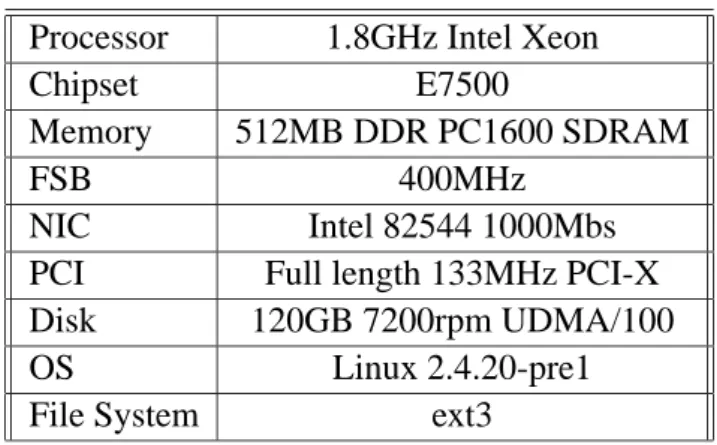
Processor 1.8GHz Intel Xeon
Chipset E7500
Memory 512MB DDR PC1600 SDRAM
FSB 400MHz
NIC Intel 82544 1000Mbs PCI Full length 133MHz PCI-X Disk 120GB 7200rpm UDMA/100
OS Linux 2.4.20-pre1
File System ext3
TABLE I EVALUATION SERVER
path itself. To achieve high-performance, the send path must be as fast as possible. The fi-nal issue is the scheduling of the process in re-lation to other applications and system activi-ties. NetVCRmust be allowed to run immedi-ately whenever packets need to be sent. Driven by these individual design issues, the following section describes the mechanisms employed and demonstrates their efficacy.
III. NETVCR
In the following section, we describe the de-sign decisions behind NetVCR and evaluate them using a set of fixed workloads. The eval-uation ofNetVCR was performed on an Intel-based server described in Table I. To evalu-ate the performance of the approaches, we mea-sured the difference between the time a packet should have been sent and the time it was ac-tually sent using the gettimeofday() sys-tem call. In the benchmarks on our system, this call took on average, 1.16µs to run. The measurement of the packet’s sending time was taken immediately after the sending system call (sendto()), thus introducing a slight mea-surement error equal to the time it took to per-form the call. As shown in Section III-C, this la-tency was about 5µs(microseconds). For all of
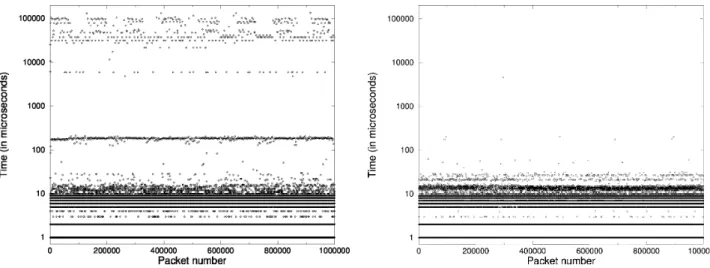
(a) First run (b) Second run
Fig. 1. Read latency usingfread()
our experiments, the workload used consisted of several fixed-interval, 64MB, 1 million packet traces 2. The trace files used contained
per-packet timestamps, MAC headers, and TCP/IP headers. In addition, each trace consisted of a continuous stream of packets sent at a periodic intervalδ. Using these workloads, we then eval-uated the tool by measuring the difference be-tween the time a packet in the trace should have been sent and the time it was actually sent. We refer to this difference as the send-time error and denote it as.
A. Trace file management
To properly send packets from the trace, the tool must first ensure that the trace data is read-ily available when packets are to be sent. In par-ticular, packet information and packet sending times must be prefetched from the file system and made available to the replay engine just be-fore it is needed. While a multithreaded design can solve this problem by employing a thread to do the prefetching, modern file systems typ-ically do some form of predictive prefetching in order to minimize the latency of file I/O.
2
The tool supports the DAG format along with other trace file formats such astcpdumpand TSH via freely available conver-sion software [11]
To evaluate the effectiveness of the Linux’s prefetching mechanism, we examined its abil-ity to efficiently read the trace. Figure 1(a) shows thefread()latency for each packet in the 64MB, 1 million packet trace. As the fig-ure shows, thefread()latency has extremely high variability and very high peaks of over
100ms, indicating that the file system is doing an unacceptably poor job in prefetching from the disk. One way to address this problem would be to “warm up” the file cache with the trace file before running the experiment. Fig-ure 1(b) shows thefread()latency when run a second time. As the figure shows, the la-tency is relatively fixed and is on the order of 10µs, a clear indication that the contents of the trace have been already prefetched and stored in memory. There are, however, some rather large spikes in the figure. As we will show in Sec-tion III-C, these spikes are caused by long, non-preemptible paths that are present in the default Linux kernel.
To illustrate the impact of the file system when using a real replay workload, we replayed a large trace with a fixed sending intervalδ of 20µs. While there are many ways to implement the timing functions, in this experiment, the tool employed a polling loop that continually
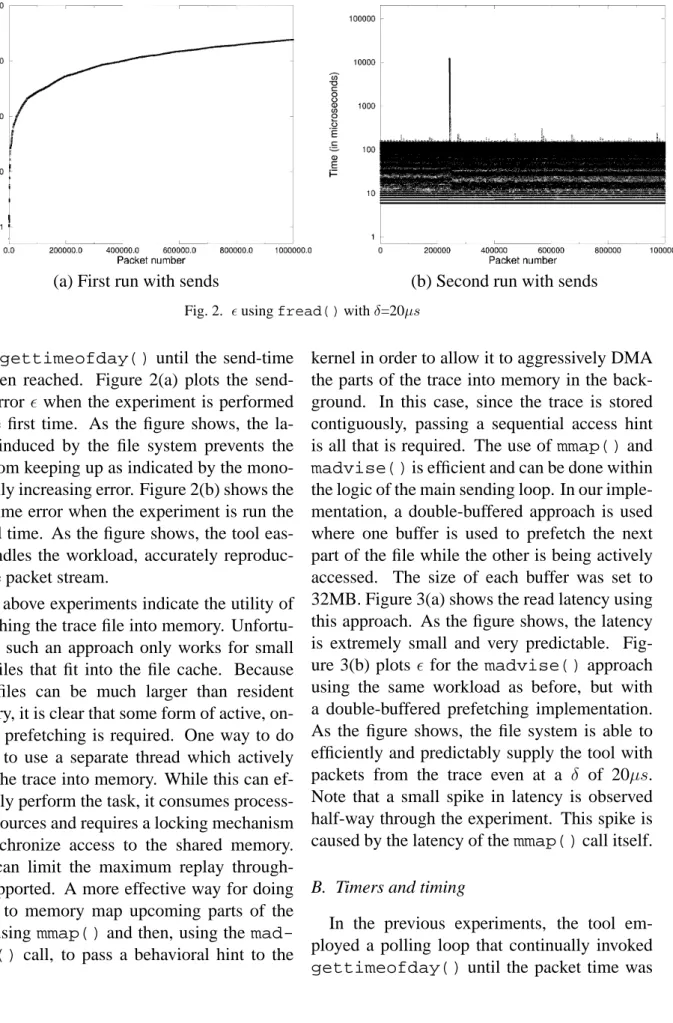
in-(a) First run with sends (b) Second run with sends
Fig. 2. usingfread()withδ=20µs vokes gettimeofday()until the send-time
has been reached. Figure 2(a) plots the send-time error when the experiment is performed for the first time. As the figure shows, the la-tency induced by the file system prevents the tool from keeping up as indicated by the mono-tonically increasing error. Figure 2(b) shows the send-time error when the experiment is run the second time. As the figure shows, the tool eas-ily handles the workload, accurately reproduc-ing the packet stream.
The above experiments indicate the utility of precaching the trace file into memory. Unfortu-nately, such an approach only works for small trace files that fit into the file cache. Because trace files can be much larger than resident memory, it is clear that some form of active, on-the-fly prefetching is required. One way to do this is to use a separate thread which actively loads the trace into memory. While this can ef-fectively perform the task, it consumes process-ing resources and requires a lockprocess-ing mechanism to synchronize access to the shared memory. Both can limit the maximum replay through-put supported. A more effective way for doing this is to memory map upcoming parts of the trace using mmap()and then, using the mad-vise() call, to pass a behavioral hint to the
kernel in order to allow it to aggressively DMA the parts of the trace into memory in the back-ground. In this case, since the trace is stored contiguously, passing a sequential access hint is all that is required. The use ofmmap()and
madvise()is efficient and can be done within the logic of the main sending loop. In our imple-mentation, a double-buffered approach is used where one buffer is used to prefetch the next part of the file while the other is being actively accessed. The size of each buffer was set to 32MB. Figure 3(a) shows the read latency using this approach. As the figure shows, the latency is extremely small and very predictable. Fig-ure 3(b) plots for themadvise() approach using the same workload as before, but with a double-buffered prefetching implementation. As the figure shows, the file system is able to efficiently and predictably supply the tool with packets from the trace even at a δ of 20µs. Note that a small spike in latency is observed half-way through the experiment. This spike is caused by the latency of themmap()call itself. B. Timers and timing
In the previous experiments, the tool em-ployed a polling loop that continually invoked
(a) Read latency (b)withδ=20µs
Fig. 3. Performance usingmadvise()
(a)δ=70µs (b)δ=2500µs
Fig. 4. using a polling loop
δ Polling usleep() Firm timers
70µs 78% 40% 19%
2500µs 99% 4% 1%
TABLE II
CPUUTILIZATION OF DIFFERENT APPROACHES
reached. This approach, while affording an ex-tremely high degree of accuracy, is exex-tremely compute-intensive. To avoid this resource con-sumption, one could use theusleep()system
call to put the sending process to sleep until the send time of the next packet. This approach saves a large amount of CPU time, but it does so at the expense of accuracy. In most cases,
usleep()employs a timer mechanism which is triggered by a periodic tick interrupt. On x86-based machines this interrupt is generated by the Programmable Interval Timer (PIT) and has a period of 10ms. As a result, based on where the send-time falls on this interval, it can expe-rience up to10msof jitter. Figure 4, Figure 5, and Table II show the send-time error and
(a)δ=70µs (b)δ=2500µs
Fig. 5. usingusleep()
Fig. 6. usingusleep()at real-time priorityδ=70µs the CPU utilization of the tool using a polling
implementation and a usleep() implemen-tation. The experiments were run using fixed sending intervals ofδ=70µsandδ=2500µs. To capture CPU utilization, thetime program was used. As the figures and table show, the use of usleep() forces one to give up accuracy in return for efficiency. Usingusleep(), the CPU utilization remains extremely low while fluctuates wildly due to the 10ms precision of the PIT. An interesting point to note is that when the real-time priority of a process is set in Linux 2.4-based kernels, the implementation of usleep() changes. For sleep times that
are under 2ms, usleep() employs a polling loop to implement them. Figure 6 showsupon re-running theusleep()experiments with the real-time priority set. As the figure shows, the accuracy of the tool matches those of the polling implementation shown in Figure 4(a). In addi-tion, the CPU utilization of the tool jumps to 78%, also matching that of the polling imple-mentation.
It is clear that decreasing the periodic tick in-terval would increase the accuracy of the timer immensely, however, doing so would also in-crease the interrupt handling overhead as well. To address this, modern real-time operating
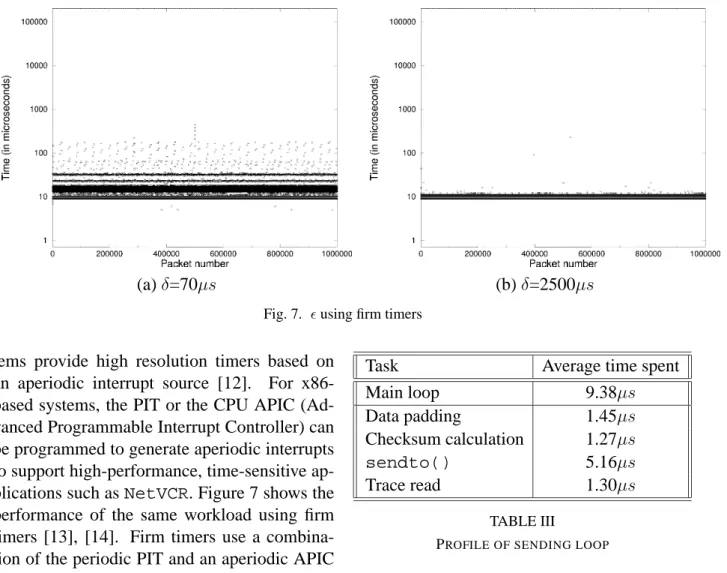
sys-(a)δ=70µs (b)δ=2500µs
Fig. 7. using firm timers
tems provide high resolution timers based on an aperiodic interrupt source [12]. For x86-based systems, the PIT or the CPU APIC (Ad-vanced Programmable Interrupt Controller) can be programmed to generate aperiodic interrupts to support high-performance, time-sensitive ap-plications such asNetVCR. Figure 7 shows the performance of the same workload using firm timers [13], [14]. Firm timers use a combina-tion of the periodic PIT and an aperiodic APIC timer to accurately and efficiently implement
usleep(). Figure 7 and Table II show and the CPU utilization using firm timers over the two workloads. As the figure shows, this im-plementation achieves the best of both worlds. It retains the accuracy of the polling approach while matching the efficiency of usleep()
across all time intervals. C. Packet transmission
An efficient packet transmission loop is es-sential in supporting gigabit network replay. To make sending more efficient and to support playback at speeds faster than the disk’s speed,
NetVCR supports the ability to replay packets without the original payload by replacing the payload with an equal amount of null-padded data instead. Because one of the applications
Task Average time spent
Main loop 9.38µs Data padding 1.45µs Checksum calculation 1.27µs sendto() 5.16µs Trace read 1.30µs TABLE III
PROFILE OF SENDING LOOP
for this tool is to evaluate routers and switches, it is often not necessary to send the original packet payloads with the packets themselves. For all of the results in this paper, this option was used. Padding the payload allows the send-ing loop to be much faster, as full packet pay-loads do not need to be read from the file sys-tem. As a side-effect of using dummy data, however, a new, valid checksum must be cal-culated for the packet at run-time. Table III shows the latency profile of the tool using mad-vise(), firm timers, and padded payloads. As shown in the table, the main sending loop takes, on average, less than 10µs. Assuming MTU-sized packets, this allowsNetVCRto nearly sat-urate the gigabit ethernet link of our test system. When broken down further into components,
(a) Memory load (b) Read/Write load
Fig. 8. using firm timers with background load andδ=70µs most of the latency of the loop occurs with the
call to send the packet with data padding and checksum computation each taking under 2µs to perform. As a further optimization,NetVCR
supports a trace processing step that pre-computes the checksum assuming padded data in order to reduce the latency of the sending loop further.
D. Scheduling
The previous experiments were all run us-ing a dedicated server with very little compet-ing load. Since in practice, there could be many other services and processes running, it is im-portant that the tool perform predictably un-der load. The first step to ensuring correct be-havior is to use the real-time scheduling prior-ities of Linux. While this can ensure NetVCR
gets priority over other user processes, the tool is still at the mercy of the kernel which must schedule it to run at the right time. Unfortu-nately, since Linux 2.4-based systems contain relatively long, non-preemptible paths within the kernel, it is often the case that the tool can not run when it needs to. Figure 8 demonstrates this problem by re-running the experiment in Figure 7 using real-time priorities, firm timers, andδ=70µs, but with two different background
loads. The first background load consists of a memory stress test in which a user process con-tinuously reads and writes a buffer of 128MB to generate page faults. The second background load consists of a file system stress test in which a user process continuously reads and writes a file of 8MB. Figure 8 shows the results under these two loads. As the figures show, in both cases, the addition of this low priority, back-ground load is enough to completely disrupt the performance of the tool.
To address this issue, several patches to the Linux kernel have been developed. Among them are a preemptible kernel patch and a low-latency kernel patch [15], [16]. By making the kernel preemptible or by reducing the longest non-preemptible path through it, the tool can be made much more predictable. Figure 9 shows the performance of the same experiments using the low-latency patch to Linux. As the figure shows, reducing the length of non-preemptible paths in the kernel allows the tool to maintain accurate timing.
IV. RELATED WORK
While we were finishing the development of NetVCR, another packet replay engine,
(a) Memory load (b) Read/Write load
Fig. 9. using low-latency kernel and firm timers with background load andδ=70µs
(a)δ=70µs (b)δ=2500µs
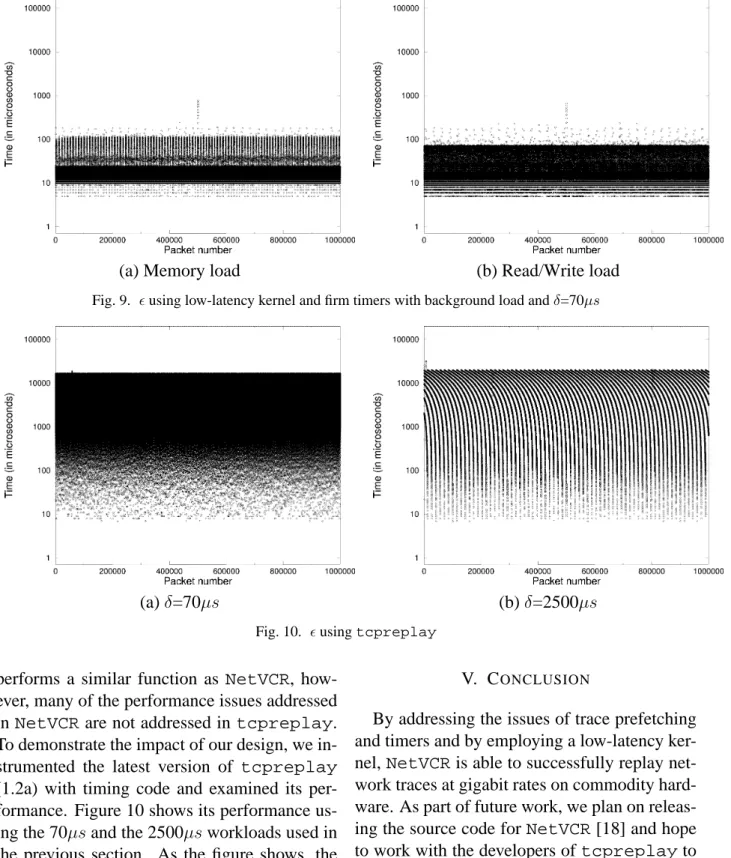
Fig. 10. usingtcpreplay
performs a similar function as NetVCR, how-ever, many of the performance issues addressed inNetVCR are not addressed intcpreplay. To demonstrate the impact of our design, we in-strumented the latest version of tcpreplay
(1.2a) with timing code and examined its per-formance. Figure 10 shows its performance us-ing the 70µsand the 2500µsworkloads used in the previous section. As the figure shows, the combination of poor file system prefetching and inaccurate timers adversely impacts the perfor-mance of the tool.
V. CONCLUSION
By addressing the issues of trace prefetching and timers and by employing a low-latency ker-nel,NetVCRis able to successfully replay net-work traces at gigabit rates on commodity hard-ware. As part of future work, we plan on releas-ing the source code forNetVCR[18] and hope to work with the developers oftcpreplayto merge the performance features ofNetVCRinto
tcpreplay. In addition, we also plan on pur-suing additional mechanisms that will allow for multi-gigabit replay including removing unnec-essary data copying via IO-Lite [19],
examin-ing kernel modifications for improvexamin-ing perfor-mance [20], [21], and examining the paralleliza-tion of the replay task itself on SMP servers.
VI. ACKNOWLEDGMENTS
The authors would like to thank Charles Kra-sic and Ashvin Goel for their many suggestions and help.
REFERENCES
[1] S. McCanne and S. Floyd, “http://www-nrg.ee. lbl.gov/ns/,” ns-LBNL Network Simulator, 1996. [2] E. Johnson and A. Kunze, “IXP1200 Programming,”
2002.
[3] Vern Paxson and Sally Floyd, “Why we don’t know how to simulate the internet,” in Winter Simulation Conference, 1997, pp. 1037–1044.
[4] Ixia, “Ixia 1600 Network Traffic Generator,” http:// www.ixiacom.com/.
[5] W. Feng, F. Chang, W. Feng, and J. Walpole, “Provi-sioning On-line Games: A Traffic Analysis of a Busy Counter-Strike Server,” in Internet Measurement
Work-shop, November 2002.
[6] L. Zhang, S. Shenker, and D. Clark, “Observations and Dynamics of a Congestion Control Algorithm: The Effects of Two-Way Traffic,” in Proceedings of ACM SIGCOMM, August 1991, pp. 133–148.
[7] J. Hay, W. Feng, and M. Gardner, “Capturing Network Traffic with a MAGNeT,” in Linux Showcase and
Conver-ence (ALS’01), 2001, pp. 259–270.
[8] NLANR, “Passive Measurement and Analysis,” http: //pma.nlanr.net/PMA/.
[9] tcpdump developers, “tcpdump/libpcap Public Reposi-tory,”http://www.tcpdump.org, 2002.
[10] Steven McCanne and Van Jacobson, “The BSD packet filter: A new architecture for user-level packet capture,” in
USENIX Winter, 1993, pp. 259–270.
[11] DAG developers, “DAG software,” http://dag.cs. waikato.ac.nz/dag/dag-soft.html.
[12] S. Savage and H. Tokuda, “RT-Mach Timers: Exporting Time to the User,” in USENIX Mach Symposium, April 1993.
[13] Ashvin Goel, Luca Abeni, Charles Krasic, Jim Snow, and Jonathan Walpole, “Supporting Time-sensitive Applica-tions on General-Purpose Operating Systems,” 2002. [14] Mohit Aron and Peter Druschel, “Soft Timers: Efficient
Microsecond Software Timer Support for Network Pro-cessing,” ACM Transactions on Computer Systems, vol. 18, no. 3, pp. 197–228, 2000.
[15] R. Love, “The Linux Kernel Preemption Project,”http: //kpreempt.sourceforge.net/.
[16] A. Morton, “Linux scheduling latency,” http://www. zip.com.au/˜akpm/linux/schedlat.html. [17] tcpreplay developers, “tcpreplay,” http://
tcpreplay.sourceforge.net, July 2002.
[18] NetVCR developers, “NetVCR,” http://www.cse. ogi.edu/sysl/projects/netvcr, August 2002. [19] Vivek Pai, Peter Druschel, and Willy Zwaenepoel, “IO
Lite: A Unified I/O Buffering and Caching System,” 1999. [20] CITI, “The Linux Scalability Project,” http:
//www.citi.umich.edu/projects/ linux-scalability, 2002.
[21] A. Goel, “Time-Sensitive Linux,” http://www.cse. ogi.edu/sysl/.